BACKGROUND
Immigration can be an emotional and time-consuming process depending on the reasons for emigration. The degree of voluntariness is one part of this. The factors making people move away from their countries include war, famine, political revolts, human rights violations, or unemployment and the lack of social and economic support. In the process of migration, refugees and asylum seekers probably differ from immigrants as the latter are not exposed to violence during the process of migration. The distinction between first generation immigrants, refugees and asylum seekers, resides in their social and political status in the resettlement country. Voluntary migration is characterized by immigrants who voluntarily leave their home country for reasons such as work, education and marriage. Involuntary migration includes asylum seekers and refugees who involuntarily leave their home country for reasons such as war, persecution and violence.
The role of hopelessness as part of a development of psychological conditions including depressive disorders has long been a research (Beck et al., Reference Beck, Steer, Beck and Newman1993; Beck & Weishaar, Reference Beck and Weishaar1990). A cognitive model has demonstrated that depression leads individuals to endure and possess a particular set of cognitive dysfunction that leads them to view themselves, the world, and the future in a negative way (Beck et al., Reference Beck, Steer, Beck and Newman1993; Beck & Weishaar, Reference Beck and Weishaar1990; Beck et al., Reference Beck, Brown, Berchick, Stewart and Steer1990; Beck & Steer, Reference Beck and Steer1989).
For asylum seekers and refugees, feelings and expectations about the future may be exacerbated by the character of their attempt to escape from political or religious conflicts and all kinds of human rights violations in the form of molestation, torture, and arbitrary imprisonment. Often, there is a breakdown in social and civil order in addition to famine, the loss of jobs, family, and friends, and the prevalence of severe mental health problems (Bhugra & Minas, Reference Kirmayer and Young2007; Bhugra & Becker, Reference Bhugra and Becker2005; Bhugra, Reference Bhugra2004; Dalgard et al., Reference Dalgard, Thapa, Hauff, McCubbin and Syed2006; Syed et al., Reference Dalgard, Thapa, Hauff, McCubbin and Syed2006; Dalgard, Reference Dalgard1993; Thapa et al., Reference Thapa, Dalgard, Claussen, Sandvik and Hauff2007). In the first country of asylum, asylum seekers may be at risk of being maltreated, imprisoned with long periods of interviews (to verify their story and identity), and possible repatriation before refugee status may be granted. The experiences that refugees and asylum seekers undergo during the process of migration may be very traumatic, and it has been assumed that this would affect their mental health during the adaptation process (Lay et al., Reference Lay, Lauber and Rossler2005; Lie & Skjeie, Reference Lie and Skjeie1996). Indeed, several studies have found high incidences of anxiety and depression among refugees during their resettlement (Kirmayer & Young, Reference Kirmayer and Young1998; Tang & Fox, Reference Tang and Fox2001). All asylum seekers in Norway live in asylum seekers’ reception centres until they either get permission to stay in Norway, or are expelled from the country. The waiting time for an answer to their asylum application is the most stressful period, especially when they do not know when a decision will be reached or what the outcome will be. Life in the reception centres seems to be particularly hard and difficult to manage; feelings of being degraded, ignored or dismissed by others may appear (Iversen & Morken, Reference Iversen and Morken2003; Reference Iversen and Morken2004). Their futures are uncertain and they are regularly forced to stay in asylum reception centres for long periods, which seems to increase their feeling of being isolated and doomed to a life of passivity without any serious purpose for their daily living (Lavik et al., Reference Lavik, Hauff, Skrondal and Solberg1996). Refugees and asylum seekers may have different feelings and expectations about the future than immigrants. Thus, for asylum seekers and refugees who know that some of their number may be sent back or be destined to life in exile, negative expectations may dominate.
The aim of the present study was to assess differences in expectations of the future among populations of immigrants, asylum seekers and refugees admitted to Norwegian acute psychiatric departments.
MATERIAL AND METHODS
Sample
The immigrants included in this study were all first generation immigrants. The official standard for immigrant classification in Norway defines first generation immigrants as those who are born abroad and whose parents (both) are also born abroad. Asylum seekers are people who on their own, unexpectedly, without any assessment in advance, move across borders, asking the political authorities for personal protection. They keep their status of asylum seeker until their application has been decided in their favour or not. If the application is approved, the person becomes a refugee, either political or humanitarian depending on the grounds on which the decision was made (Bjertnæs, Reference Bjertnæs2000).
Procedure
In a prospective design, data were collected from two Acute Psychiatric Departments at St. Olav’s University Hospital and Lovisenberg Hospital from 2005 to 2008. On January 1, 2008, there were 539,381 immigrants in Norway. We analyzed migrants living in the fourth largest metropolitan area (Trondheim) in Norway with 168,257 inhabitants and the capital (Oslo) with 575,475 inhabitants.
The participants were admitted to the study having been briefed about the purpose, background, and goals of the study and once they had signed an informed consent form. Four participants refused to participate in the study, and one was excluded from the study because of mental retardation. Permission for the study was granted by the Regional Committee for Medical Research Ethics of Central Norway.
Measurements
A questionnaire was designed to collect data on socio-demographic background. It included a checklist of self-perception of psychiatric symptoms and reasons for seeking help.
Diagnoses according to ICD-10 (‘Diagnostic criteria for research’)
Diagnoses were set by consensus of the department’s staff, including at least three specialists in psychiatry of whom at least two personally knew the patient.
Beck Hopelessness Scale
Hopelessness was assessed once at entry by the Beck Hopelessness Scale (Beck et al., Reference Beck, Steer, Kovacs and Garrison1985; Beck et al., Reference Beck, Brown, Berchick, Stewart and Steer1990). This is a 20-item, true-false, self-report instrument, which assesses the degree to which a person holds negative expectations about the future. Eleven items are keyed true and nine false with a total score of 20 for maximum hopelessness (Beck et al., Reference Beck, Brown, Berchick, Stewart and Steer1990; Beck & Steer, Reference Beck and Steer1988). It is extensively used and has been shown to have a satisfactory reliability and validity (Beck et al., Reference Beck, Steer, Kovacs and Garrison1985; Beck & Steer, Reference Beck and Steer1988; Beck et al., Reference Beck, Brown, Berchick, Stewart and Steer1990).
Global Assessment Functioning Scale (GAF)
The GAF-S is based on DSM-IV's Global Assessment of Functioning. The GAF is an observer-based rating scale with a scoring manual divided in 10 sections, each with a general description, examples and keywords of the symptoms and the functioning level that it represents on the scale. The split version of the GAF was used for this study. The GAF has been imposed as a part of initial and discharge assessments at all psychiatric acute wards in Norway (Soderberg et al., Reference Soderberg, Tungstrom and Armelius2005; Yamauchi et al., Reference Yamauchi, Ono, Baba and Ikegami2001).
The questionnaire applied in the present study was translated from Norwegian into the following languages: French, English, Somali, Farsi, Arabic, Russian, Dari, Spanish, Polish, and Amharic. Deviation from translated versions was discussed with the translators, and the authors were called into a discussion in order to change, improve, and/or approximate the translation to the original.
Statistics
Statistical analysis was performed using the SPSS statistical package. T-tests, chi-square tests, and Mann-Whitney U tests were used for differences between continuous and categorical groups, respectively. The level of significance was set at 0.05. Comparisons were made between the three groups, and between the immigrant group and the joint group of refugees and asylum seekers, as indicated in the tables.
RESULTS
A total of 94 people were interviewed during a resident stay at the two acute departments. Forty-eight were classified as immigrants, 24 as refugees, and 21 as asylum seekers. The migrant population in this study consisted of people from 36 different countries and independent regions. Persons who have moved to Norway are defined as immigrants; they might have come to Norway as refugees, asylum seekers, labour migrants, or students.
The participants originated from Africa, Asia, the Middle East, and Europe. At Østmarka Hospital in Trondheim, 34.0% of the participants were from Europe (excluding Turkey), 47.2% from Asia (including Turkey), 15.1% from Africa, and 3.8% from South America. At Lovisenberg in Oslo, 8.1% were from Europe (excluding Turkey), 37.8% from Asia (including Turkey), 48.6% from Africa, and 5.4% from South America. The mean stay for immigrants, refugees, and asylum seekers respectively was as follows: 11.2 (SD = 10.8), 16.4 (SD = 29.8), and 10.1 (SD = 9.9), and for refugees and asylum seekers combined 13.6 (SD = 22.5). The differences were not statistically different when using Mann-Whitney test. The mean age of the patients was as follows for the same categories: 35.2 (SD = 11.3), 35.8 (SD = 8.2), and 35.1 (SD = 9.3), respectively. The sex ratio for the same categories was (male/female) 22/26, 16/8, and 16/5, respectively. There were significantly more males among refugees and asylum seekers than among immigrants (Mann-Whitney: Z = 2.4 and p = 0.02).
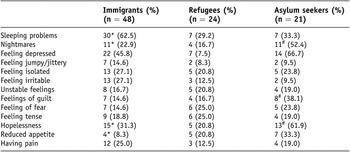
A checklist of the main psychological reasons for seeking psychiatric care is given in Table 1. A significantly higher proportion of asylum seekers than refugees had nightmares (p = 0.04), feelings of guilt (p = 0.04) and feelings of hopelessness (p = 0.04). A significantly higher proportion of asylum seekers than immigrants had sleeping problems (p = 0.03), nightmares (p = 0.03), feelings of hopelessness (p = 0.03) and reduced appetite (p = 0.04). There were no statistically significant differences between immigrants and refugees.
Number of patients in each group giving various main psychological reasons for seeking acute psychiatric services. No statistically significant differences were seen when the responses of immigrants were compared with those of refugees and asylum seekers together.

*Immigrants versus asylum seekers show a statistically significant difference at p < 0.05 level with Mann-Whitney test.
#Asylum seekers versus refugees show a statistically significant difference at 0.05 level with Mann-Whitney test.
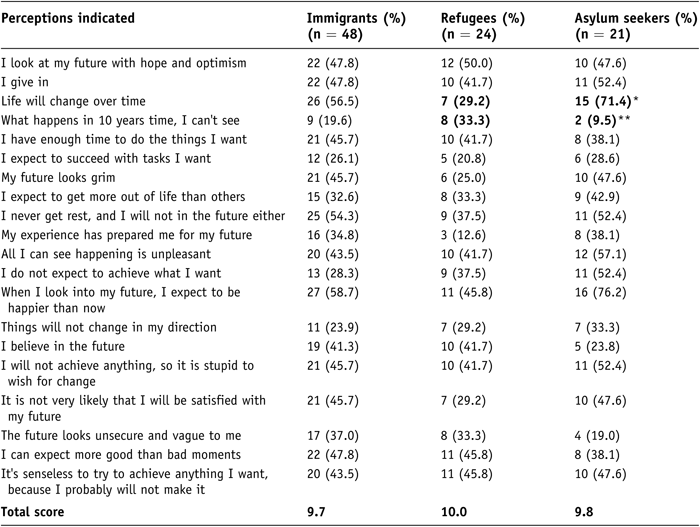
Perceptions of life and the future are presented in Table 2. Significantly more asylum seekers than refugees maintained that life would change for the better over time (Z = 2.0 and p = 0.04). More refugees than asylum seekers indicated problems judging life ten years from now (Z = 2.1 and p = 0.04). There were no differences between immigrants and asylum seekers. No statistical significant differences on the Beck hopelessness scale when comparing immigrants with refugees and asylum seekers combined were found (Mann-Whitney U tests). The levels of suffering in all three immigrant groups were high on all items of the hopelessness scale. Of the patients admitted, 27.1% (13) of immigrants reported suicide attempts, followed by 20.8% (5) of refugees and 47.6% (10) of asylum seekers. The highest rates of suicide attempts were recorded by people from Asia (including Turkey) with 42.3% (11), Africa with 23.1% (6), Europe (excluding Turkey) with 23.1% (6), and South America with 11.5 % (3).
Number of patients confirming perceptions and statistically significant differences on the Hopelessness Scale between immigrants, refugees and asylum seekers admitted to acute psychiatric departments. No statistically significant differences were seen when the responses of immigrants were compared with those of refugees and asylum seekers together. Mean total Hopelessness Scale score is shown for all the three groups
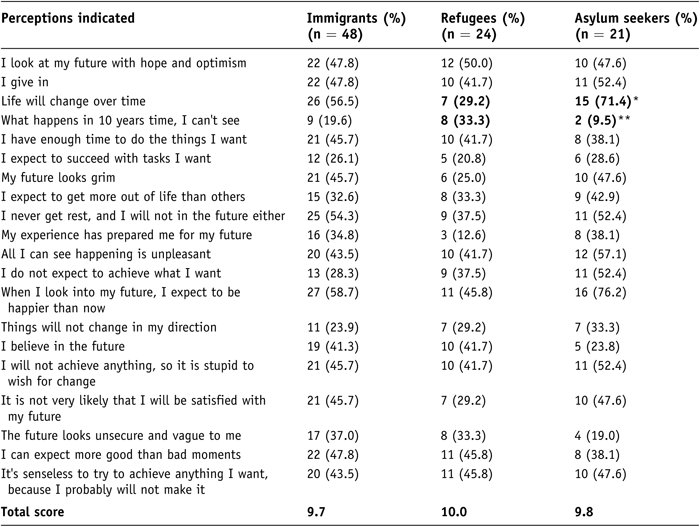
*Statistically significant difference between immigrants and refugees (p = 0.05) and between refugees and asylum seekers (p = 0.04) Mann-Whitney test.
**Statistically significant difference between refugees and asylum seekers (p = 0.04) Mann-Whitney test.
The three groups had the following percentages of persons who were given a diagnosis of psychosis: immigrants 22.9%, refugees 29.1% and asylum seekers 42.8%. The percentages with observational diagnosis, often given because of insufficient time and capacity for differential diagnostic work, were immigrants 2.1%, refugees 12.5% and asylum seekers 19.0%. The differences did not attain statistical significance with the chi-square test.
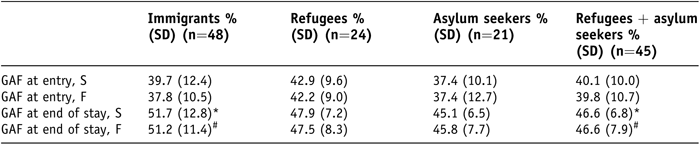
The mean GAF scores for the three immigrant groups are given in Table 3. All three groups had GAF scores at entry that were close to the cutoff for psychotic symptoms. At the end of stay, all groups had higher, more normal GAF scores. The immigrants had the highest increase in GAF scores during the stay. Symptom load decreased significantly more in immigrants than in the combined group of refugees and asylum seekers (t = 2.1, p = 0.04). Function as assessed by the GAF score improved significantly more in immigrants than in the combined group of refugees and asylum seekers (t = 2.4, p = 0.02).
Mean global assessment of symptoms (S) and function (F) scores (GAF) for immigrants, refugees and asylum seekers admitted to two acute psychiatric facilities
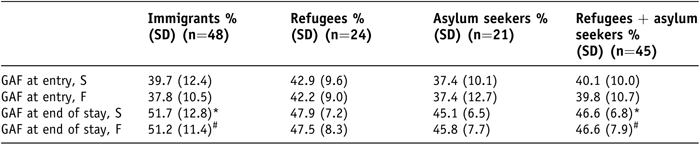
*The difference between GAF S scores from entry to end of stay show a statistically significant difference between immigrants and the joint group of refugees and asylum seekers, ANOVA p = 0.03
#The difference between GAF F scores from entry to end of stay show a statistically significant difference between immigrants and the joint group of refugees and asylum seekers, ANOVA p = 0.04
DISCUSSION
This study aimed to examine differences in expectations about the future among populations of immigrants, asylum seekers and refugees admitted to Norwegian acute psychiatric departments. A high level of psychological distress and gloomy perceptions of the future were observed in asylum seekers, refugees and immigrants who were admitted to acute psychiatric wards in two major cities in Norway. There was a gradient of increasing negative expectations from immigrants to refugees to asylum seekers. For asylum seekers the uncertain life in asylum seekers’ centres and the loneliness created by isolation there, has a significant effect on their mental health. Asylum seekers who had obtained a secure legal status, refugee status or residency permit, were less distressed than those who had not (Ryan, et al., Reference Ryan, Benson and Dooley2008).
The immigrant group had a majority of women, probably entering Norway as part of a family reunion and not persecuted in their country of origin. Refugee and asylum seeking males may come in advance in an attempt to get residence permission before they bring their family. In the case of asylum seekers, many of them are expelled from Norway before they get their families into Norway. Negative expectations about the future and life have been mentioned as one factor that may develop suicidal thoughts and wishes (Lester & Beck, Reference Lester and Beck1977). More than a quarter of the patients attempted suicide before admission to both hospitals. A correlation between negative expectations about the future and suicidal attempts have been found in several studies (Lester & Beck, Reference Lester and Beck1977; Beck et al., Reference Beck and Steer1975; Kovacs et al., Reference Kovacs, Beck and Weissman1975).
A significantly higher proportion of asylum seekers than refugees had nightmares and feelings of hopelessness and guilt as main reasons for seeking acute psychiatric care. This is in accordance with the observation that using the Beck Hopelessness scale, asylum seekers indicated more negative expectation about the future than either refugees or immigrants. Differences between asylum seekers and refugees may in part be explained by the fact that refugees do not normally experience the particular stress and fear connected with the insecurity in asylum seekers’ centres. Asylum seekers will, unlike refugees, live with the impending possibility of not gaining permission to stay in Norway.
The high rate of psychosis, more than a quarter of the patients in both hospitals, may have contributed to the high rate of negative expectations. In a study of patients with schizophrenia in 27 countries, Thornicroft et al. (2009) found that anticipated and experienced discrimination was consistently high among people with a major mental illness. Being an immigrant may increase this effect on their own perceptions of the future. The asylum seekers in our cohort indicated more distress than refugees and immigrants, commensurate with the unsettled situation for the asylum seekers. The mean age of the immigrants would normally imply high expectations for a positive future, which is then countered by the experience of coming to a country with a culture enormously different from what they might have expected. A situation where an individual is confronted with daily events that complicate the participation in an unfamiliar social structure over a long period of time, may eventually become extremely stressful. Sometimes it overwhelms a person’s ability to cope with the situation, and asylum seekers who experience isolation in asylum seekers’ centres may experience feelings of helplessness (Lavik et al., Reference Lavik, Hauff, Skrondal and Solberg1996).
There are probably differences in the diagnostic pattern between the migrant groups, but since the sample of this study was small, it did not attain statistical significance. Immigrants referred to Lovisenberg were, in a study from 2004, shown to have more severe mental illness, less substance abuse, and to be younger than the ethnic Norwegians referred (Berg & Johnsen, Reference Berg and Johnsen2004; Berg, Reference Berg2009). A German study showed that compared to ethnic Germans, immigrants had less day treatment, longer residential stays, more intensive care, and received less psychotherapy (Koch et al., Reference Koch, Hartkamp, Siefen and Schouler-Ocak2008; Koch & Muller, Reference Koch and Muller2007).
The GAF values both for symptom load and functional ability in life were significantly higher in immigrants than in the combined group of refugees and asylum seekers. It would be tempting to suggest that asylum seekers and refugees score lower on the GAF because of their unsettled lives. On the other hand, the immigrants group has another exodus experience; thus some of them may be more unsatisfied with life experiences in Norway.
Limitations of the study
Firstly, conducting research among different groups of migrants is quite a challenge for the researcher, since there will always be heterogeneous subgroups within the migrant population. Secondly, the analysis of the data was carried out the way it was because the relatively small number of the patients meant that we could not divide the data in ways that would have been possible with a larger sample. At the same time, the small number of patients in the study limits the generalisation of the findings. The possibility of getting more specific patterns of results on different ethnic national groups could have enriched the study. Even if the sample was not large enough to be representative, we would argue that it gives a clear trend on asylum seekers, refugees and immigrants, expectation about the future and the main reason for admission in acute psychiatric wards. Thirdly, the extent to which the differences between the three groups of immigrant patients are associated with the individual characteristics and background of the immigrants is not certain.
Finally, a follow-up study consisting of a larger sample would be useful, along with the need for more diagnostic tests and socio-cultural evaluation. That would most likely give a better understanding of the factors that underlie the expectation about the future. The present paper illustrates that differences exist in self-perception of psychiatric symptoms and reason for seeking help in acute psychiatry. Equally, the paper provides results that illuminate differences in expectation about the future among immigrants, refugees and asylum seekers.