According to the Institute for Life Course and Aging (2007), 59 per cent of adults over age 85 require assistance with activities of daily living (ADLs). This assistance can come from informal supports such as family or friends, or from formal supports such as home care. Many older adults prefer to live at home with an increased level of support as opposed to moving into long-term care (LTC) facilities (Carstairs & Keon, Reference Carstairs and Keon2009). Helping older adults age-in-place safely is the most cost-effective alternative for the health care system. Miller, Hollander, and MacAdam (Reference Miller, Hollander and MacAdam2008) reported that the average cost of provincially funded home care in Canada ($9,104/person/year) was six times lower than the cost of caring for an individual in LTC ($65,175/person/year). Currently, only 33.2 per cent of seniors over age 85 reside in LTC (Institute for Life Course and Aging, 2007), which means that the majority of older adults are able to age-in-place within their home environments. Among the prominent reasons for transition to LTC is an adverse event, such as a fall (Tinetti, Christianna, & Williams, Reference Tinetti, Christianna and Williams1997), which threatens an individual’s safety and the ability to age-in-place successfully. In 2004, falls cost the Canadian health care system $2 billion in direct care expenses (Smartrisk, Reference Smartrisk2009). Beyond health care utilization, it is important to address falls as they also have consequences on the health and well-being of those experiencing them.
Falls were the most prevalent adverse events identified in Canadian studies of home care safety. Doran et al. (Reference Doran, Hirdes, Blais, Baker, Pickard and Jantzi2009) reviewed 238,958 home care case files and found that 11 per cent of the files documented a new fall, which translated to 26,286 falls over the four-year review period. Falls can occur at any time of life, but the risk of injury after a fall is nine times greater when a person is over the age of 65 (Smartrisk, Reference Smartrisk2009). Peel (Reference Peel2011) reviewed 15 studies examining falls in older community-dwelling adults and found that the prevalence rates varied between 19.3 per cent and 60 per cent. The oldest old, those over age 85, had the highest rates. The accumulated effects of aging and co-morbidities (intrinsic factors) increase an older adult’s susceptibility to environmental (extrinsic) factors. Some key multifactorial fall risks include decreased vision, a history of falls, gait and balance abnormalities, neurological impairments, decreased strength, poor footwear and foot conditions, poly-pharmacy, postural hypotension, and environmental hazards (Panel on Prevention of Falls in Older Persons, American Geriatrics Society and British Geriatic Society, 2011; Scott et al., Reference Scott, Lockhart, Gallagher, Smith, Asselin and Belton2007; Waldron, Hill, & Barker, Reference Waldron, Hill and Barker2012).
Effective interventions for fall prevention in community-dwelling older adults have been identified in a Cochrane review: exercise that includes at least two components of balance, strengthening, endurance, or flexibility; multifactorial interventions; cataract surgery; and gradual medication adjustments (Gillespie et al., Reference Gillespie, Robertson, Gillespie, Lamb, Gates and Cummings2009). The same review also noted that
multifactorial interventions … have been shown in some studies to be effective, but have been ineffective in others. Overall current evidence shows that they do reduce rate of falls in older people living in the community. These are complex interventions, and their effectiveness may be dependent on factors yet to be determined. (Gillespie et al., Reference Gillespie, Robertson, Gillespie, Lamb, Gates and Cummings2009, p. 2)
Determining the factors that affect the effectiveness of these interventions would improve safety for this population.
A better understanding of the factors that contribute to adverse events within the home is required to improve safety and decrease the chances of a harmful incident, such as a fall (Doran et al., Reference Doran, Hirdes, Blais, Baker, Pickard and Jantzi2009; Masotti, McColl, & Green, Reference Masotti, McColl and Green2010; Sears, Reference Sears2008). For the purposes of this study, health-related safety in the home and community is defined as “the minimization of the probability of preventable, unintended harm in community-dwelling individuals … [and] aims to understand how and why adverse health events occur and to identify what breakdowns in the societal system expose individuals to hazards” (Lau, Scandrett, Jarzebowski, Holman, & Emanual, Reference Lau, Scandrett, Jarzebowski, Holman and Emanual2007, pp. 840–841).
Many multifactorial fall risk factors are known, and yet the safety of community-dwelling older adults still cannot be guaranteed. It is important to realize that a person does not age-in-place without context. Although unsafe actions can be seen as a result of human error (Miyagi, Reference Miyagi2005), this error needs to be treated as a consequence of system vulnerabilities and not the cause (Dekker, Reference Dekker2006; Henriksen, Dayton, Keyes, Carayon, & Hughes, Reference Henriksen, Dayton, Keyes, Carayon, Hughes and Hughes2008; Institute of Medicine, 1999). The immediate actions of an individual at the moment when an incident occurs are the result of latent factors within different components of the societal system. These factors create situations that call for people to act in one way or another, which may or may not result in harm. To understand how to improve the safety of older adults, it is essential to use a systems approach to develop an understanding of the societal system surrounding the person. If an incident investigation is conducted and only the immediate causes are identified, the latent underlying systemic causes will be missed and ignored. This will reduce opportunities to ameliorate the situation in the future, as the latent danger remains (Miyagi, Reference Miyagi2005; Reason, Reference Reason1990; Woods & Cook, Reference Woods, Cook and Durso1999).
The “Swiss cheese” model of accident causation (Reason, Reference Reason1990) identifies four layers of defenses that can, when intact, protect an individual from harm: (1) unsafe acts and decisions, (2) preconditions, (3) supervision, and (4) organizational issues. Safety deficiencies, or the “holes” in the Swiss cheese model, need to line up at all four layers of defenses in order for an incident, such as a fall, to occur. Identification of both the immediate actions/decisions (layer 1) and the latent factors (layers 2–4) that expose individuals to hazards will lead to a better understanding of systemic problems and allow implementation of targeted strategic changes. The improved defenses have the potential to increase the safety and well-being of many community-dwelling older adults, allowing for successful aging-in-place.
The purpose of this study was to identify system-wide factors contributing to adverse fall events in community-dwelling octogenarians. Specific study objectives were to (1) conduct case studies to identify specific safety deficiencies that contribute to fall events; (2) identify themes from patterns and similarities across multiple case studies; and (3) discuss implications for practice that will guide improvements of safety in community-dwelling octogenarians’ aging-in-place.
Methods
We used a collective case study research design, as described by Stake (Reference Stake, Denzin and Lincoln2005). Case study methodology allows for an in-depth analysis of complex real-life situations (Creswell, Reference Creswell2013; French, Reynolds, & Swain, Reference French, Reynolds and Swain2001; Stake, Reference Stake, Denzin and Lincoln2005). The systemic falls investigative method (SFIM) was applied to complete comprehensive investigations of the fall occurrences. Detailed description of the SFIM method and procedures is available elsewhere (Zecevic, Salmoni, Lewko, & Vandervoort, Reference Zecevic, Salmoni, Lewko and Vandervoort2007; Zecevic, Salmoni, Lewko, Vandervoort, & Speechley, Reference Zecevic, Salmoni, Lewko, Vandervoort and Speechley2009); only a brief description of its six steps is presented here.
Step one involves collecting data using the F-SHEL tool based on five categories: faller, software, hardware, environment, and liveware. The F stands for the individual who fell; S, for the “soft” information such as policies, procedures, and standard practices; H, for the hardware such as equipment or assistive devices; E, for the environment which can be immediate physical, natural, or social; and L, for the liveware or other people involved such as care providers, caregivers, or social networks. Step two requires development of a sequence of events and identification of the safety significant events. Step three consists of examining each safety significant event and connecting unsafe conditions with unsafe acts or unsafe decisions of involved individuals.
The fourth step situates the identified contributing factors within one of four levels of defense in the Swiss cheese model of accident causation (Reason, Reference Reason1990): (1) unsafe acts and decisions, (2) preconditions, (3) supervision, and (4) organizational issues. In step five, the investigator scrutinizes the contributing factors to identify how safety deficiencies, or “holes”, in all four layers of defenses lined up to result in a fall. The final, sixth step of the SFIM method is to assign priorities and develop a safety action. The tool has been used previously to investigate falls in community (Zecevic et al., Reference Zecevic, Salmoni, Lewko, Vandervoort and Speechley2009), acute care and rehabilitation hospitals, and long-term care facilities.
We completed the study in collaboration with a Family Health Team (FHT) located in Southwestern Ontario, Canada, which assisted with participant recruitment and review of medical files. The FHT was a primary health care team of five family physicians, three nurse practitioners, and one social worker. The team has been servicing a mostly rural community of 25,000 persons since 2005.
The primary study participants were individuals over the age of 80, who had experienced a fall in the past 30 days. We used purposeful sampling of high-risk vulnerable individuals, with multiple health issues and complex living situations that had the potential to contribute to adverse events. This sampling strategy provided the greatest opportunity for learning. For participants with cognitive impairments, written consent was sought from the legally authorized substitute decision maker. Cognitive status was measured with the Mini-Mental State Examination (Folstein, Folstein, & McHugh, Reference Folstein, Folstein and McHugh1975). Participants were excluded if they did not speak English or if they were receiving occupational therapy services from the principal author. For the purpose of easier identification in this article, we gave each primary participant a pseudonym. A secondary group of participants were informants who provided relevant information about the fall occurrence or the systemic factors identified during the fall investigation. A case study was defined by an adverse event (fall), not by the participant (faller).
In January 2012, the first author met with the FHT to describe the study, discuss the eligibility criteria for participants, and clarify any questions. Between January and June 2012, physicians and nurse practitioners in the FHT informed eligible patients about the study. When an individual expressed interest, the nurses ensured that the patient received a letter of information and completed a contact information form, which was later picked up by the researcher. The researcher telephoned the potential participant to review the purpose of the study, answer questions, and schedule an interview with the faller and their caregivers (if indicated either as a result of identified cognitive concerns or of participant preference). Written consent was obtained at the first meeting when the letter of information was reviewed. The SFIM investigation commenced at the first interview and continued in a cyclical fashion of generating information, including it in the sequence of events, generating new hypotheses, and returning to the participants for additional information. The first author completed all investigations in the field, engaged in reflective journaling, and continually sought and received external verification from co-authors and an SFIM team. The team was a group of four emerging scholars trained in the SFIM method and one experienced SFIM investigator. They had the expert knowledge about the investigative process, risk factors, contributing factors, or circumstances related to falls. The SFIM team met weekly and engaged in continuous hypothesis generation and triangulation from multiple data sources to reduce biases and ensure credibility of the collected data.
Recruitment concluded when the research team determined that eight in-depth case studies produced sufficient evidence to illustrate diversity and complexity of systemic influences contributing to falls of community-dwelling octogenarians. While more case studies would help identify patterns of contributing factors, we did not aim for saturation, as each investigation brings a unique set of circumstances, preconditions, environments, and societal influences. Due to the excessive amount of time required for the in-depth analysis of each case, and guided by recommendations from Stake (Reference Stake, Denzin and Lincoln2005) and Creswell (Reference Creswell2013) for collective case studies, we limited the number of cases to avoid “watered down” investigations. Ethics approval for this study was received from the University of Western Ontario Research Ethics Board. Explicit written consent was obtained from all study participants.
Data analysis occurred in two phases. The first was within-case analysis that occurred simultaneously with data collection. The data collected from interviews and other sources were reviewed, examined, and discussed with the SFIM team to facilitate credibility and improve accuracy. During the preparation of the SFIM investigative report, each contributing factor was further analyzed for placement within an appropriate level of the Swiss cheese model of accident causation. Upon completion of each investigation, a secondary reviewer thoroughly examined the occurrence report and sequence of events for consistency, coherence, and quality.
The second phase of data analysis focused on similarities, patterns, and repetitions between findings in case studies and led to identification of reoccurring themes. Summary tables of contributing factors from each case study were analysed using content analysis (Creswell, Reference Creswell2013; French et al., Reference French, Reynolds and Swain2001). This process involved three researchers (DG, AZ, and AS) and two cycles of analysis. The first stage involved independent line-by-line coding by three researchers. The primary author then amalgamated the three code lists, and the group met to discuss the codes, establish consensus, ensure that the list was exhaustive, and determine that each code was clearly defined and bounded (French et al., Reference French, Reynolds and Swain2001). Once the amalgamated coding list was completed, two researchers (DG and AZ) independently recoded all the contributing factors. Some minor discrepancies were noted, and, to create definitive boundaries, the code list was slightly adjusted and code definitions clarified. Supported by the prolonged engagement with the data and convergence of the codes, the first author (DG) proposed four distinct emergent themes of patterns and recurrences across multiple cases. Two other researchers (AZ and LK) were involved in discussion and consensus building around the emergent themes.
Results
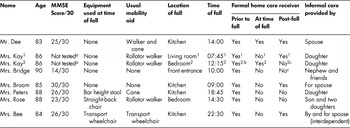
In total, seven individuals participated in the study. One participant experienced two falls, and both falls were investigated as separate case studies, resulting in the eight case studies presented here. Participants ranged in age from 83 to 90, with an average age of 86 years. Five were dependent on care support from others to remain in the community; one was co-dependent for care with her husband due to a visual impairment; and one faller was a primary caregiver for her husband. All were recipients of home care support services in the past, but only one was receiving home care service at the time of the fall. Table 1 provides a summary of characteristics of primary study participants and basic details about the investigated falls.
Primary participant demographics for falls investigated with the SFIM

Notes: 1 and 2 indicate first and second fall for the same individual; all names are pseudonyms.
a Mini-Mental State Examination (MMSE) was not completed; at first interview daughter was present to confirm all details of the investigation and at her second fall, the faller went to hospital before MMSE could be completed.
b Home care therapy services were initiated after first fall, but personal support worker (PSW) support was not yet in place.
c Participant was admitted to hospital.
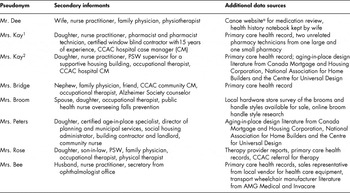
Secondary study informants included family members, friends, formal caregivers (such as doctors, nurses, therapists, and home care case managers), and representatives of agencies that had specialized knowledge and expertise about contributing factors, such as the Alzheimer Society and public health nurses. Table 2 provides a summary of secondary informants for each case study and describes additional data sources that were consulted for completion of the investigations.
Summary of secondary informants and description of additional data sources accessed during SFIM investigations for eight case studies

Notes: 1 and 2 indicate first and second fall for the same faller;
a Canoe website for medication review http://chealth.canoe.ca/drug_info.asp?relation_id=1196 was used for all investigations
CCAC = Community Care Access Centre
CM = case manager
PSW = personal support worker
AMG Medical and Invacare are health care equipment manufacturers.
A total of 247 unique contributing factors were identified in eight case studies: 68 at the level of unsafe acts and decisions (average 10 per case, range 7 to 12), 101 as preconditions (average 15 per case, range 9 to 23), 41 at the level of supervision (average 7 per case, range 2 to 13), and 37 at the level of organizational influences (average 5 per case, range 2 to 9). Half of the falls occurred in the morning and all happened indoors: four in the kitchen, two in the bedroom, one in the living room, and one at the front entrance of the home. Six falls resulted in an injury that required a hospital visit: one fractured hip, one concussion, a fractured humerus, a head laceration that required staples, one fractured rib, and one back and leg pain resulting in the inability to stand. Two of the injured fallers were admitted for a hospital stay. Two falls did not require medical attention and were divulged during a routine visit with the primary health care professional. Although a fall triggered the investigation for each case studied, falls were linked with other adverse event categories such as medication error, emergency room visit, new hospital stay, another injurious or non-injurious falls, and cognitive performance decline.
An Example of Within-Case Findings
Within-case analysis provided details about contributing factors and how they linked together. Two related case studies, which describe two falls of one participant, are represented here to demonstrate the complexities of the systemic factors that led to the falls (see Figure 1). These two case studies also show how failure to address latent safety deficiencies after the first fall contributed to the second fall. The full investigative reports for all eight case studies are available elsewhere (see Gotzmeister, Reference Gotzmeister2013).
Combined summary of two case studies involving the same faller, with safety deficiencies identified

Clearly, unsafe actions and decisions of many people involved in the two case studies combined with a multitude of contributing latent conditions at all four levels of the Swiss cheese model of accident causation and resulted in the falls. Contributing factors in the remaining six case studies were diverse, and the story of every fall was unique; nonetheless, on the level of preconditions, supervision, and organizational influences, distinct patterns began to emerge.
Findings from Across Case Analysis
Four themes emerged from the inductive content analysis of similarities across eight case studies: (1) everyday living has become risky; (2) supervision limitations; (3) disconnects within the system; and (4) poor safety risk identification and follow-up. The following is a description of characteristics and examples that support each theme.
Everyday Living Has Become Risky
At the time of the fall, the fallers were performing ordinary, routine, everyday activities such as meal preparation or cleanup, opening the blinds or a window, entering or exiting the home, reaching to put away kitchen items, or housecleaning; however, these mundane activities became risky because they linked with impaired functions of an aging body, such as poor balance, poor endurance, longer reaction times, decreased range of motion, or decreased vision. The daily activities also became risky because they combined with a faller’s fearfulness, anxiety, stress, or fierce determination to be very independent.
The participants’ physical environments and the design of their living spaces also contributed to falls by making the everyday task riskier. Examples of this included limited space to operate assistive devices in the home, windows that were difficult to open, and kitchen storage space that was difficult to access. Design features of everyday products used by the fallers also rendered normal functioning more risky, such as a slippery broom handle, a stool that tipped over easily, or a transport wheelchair that was inappropriately used as a walker. Finally, weather conditions also contributed – for example, a cloudy day resulted in decreased visibility, and summer heat resulted in decreased activity.
In an attempt to meet the challenges of aging-in-place, older adults frequently made maladaptive choices. Some of the fallers had an overpowering desire to stay independent, while others refused to acknowledge functional changes that were occurring in their bodies. Examples of maladaptive choices included a decision to retain excess furniture after a move into a smaller apartment, rejection of safety suggestions made by family and friends, and continuation with activities even when fatigued or in pain. Everyday living also became risky when the faller chose to refuse or circumvent care: declining to pay for medical file transfer between physicians, discontinuing community health services, avoiding a visit to the doctor, and not following up with medical recommendations. Due to lack of knowledge or incorrect information, some fallers and their informal caregivers perceived their situation as unchangeable and were doing their best to compromise, accommodate, and compensate.
Examples of this lack of knowledge or incorrect information included “furniture walking” in a home too small to accommodate a walker, reaching into a low cupboard while leaning on a stool because of a lack of kitchen storage space at a suitable height, using a transport wheelchair because it offers a place to sit and foot-propel when back pain increases, and declining a pain clinic appointment because of a lengthy application form and long drive to the clinic. Occasionally the fallers, their caregivers, policy makers, designers, and builders made a maladaptive choice without realizing that the long-term consequences of their decisions could be unsafe. Some examples of maladaptive choices included individuals who had the full intention of doing the right thing and were unaware of the potentially risky consequences, such as declining home support service at time of hospital discharge; introducing an electric lift chair to help with sit-to-stand transfers; or designing a kitchen featuring a difficult-to-reach cupboard. It was the combination of personal factors, environmental factors, and maladaptive choices that contributed to the increased safety risk of ordinary everyday tasks. In the words of the study participant Mr. Dee, “You get into these situations and you survive them.”
Supervision Limitations
Limitations in supervision, from both informal and formal care providers, increased the safety risk for this group of octogenarians. Informal caregivers’ unavailability contributed to a number of the investigated falls. Some older persons had no children or spouse to consistently monitor their functional and cognitive decline, or to question their safety choices. When children were present, they did not always have the time to assist as often as needed due to their own family and work commitments. Some family members lived far away and, although willing to assist, were not consistently available for provision of care.
Supervision limitations of formal care providers were related to policies and constraints with workloads and scheduling. Case managers perceived that their workload limited follow-up of patients who declined services at the time of hospital discharge. Scheduling policies of personal support workers (PSWs) prevented consistent timing of PSW visits, leading to strained relationships with the care recipient and even cancellation of services by the care recipient.
In some cases, supervision support was present but ineffective to decrease the risk of a fall. Both formal and informal caregivers yielded to the older person’s choices to avoid being paternalistic or when unable to persuade the older individual to accept a safer alternative. This was well described in the words of a caregiver who was concerned about a perceived push to have his mother-in-law (who in frustration fired all her PSW support services) admitted to LTC because of her past falls:
I don’t know if there is any real way you could prevent or improve [safety for community seniors]… because there is still an independent minded person … It is just something that’s going to happen. You can’t rubber pad all the walls and all the furniture, you know … you have to be careful, when you start thinking of ways to help them [independent older adults] because sometimes you take away their independence and that makes them more resistive and makes them angry … So, if you can help them to keep some of their independence, that’s what we need to be doing … I don’t blame them one bit [for taking risks]. (Mrs. Rose’s son-in-law)
Other examples of ineffectual formal and informal supervision and yielding to an older adult’s preferences included a physician’s accepting the new older patient without a medical file transfer, a family’s yielding to their mother’s desire to keep extra furniture that was creating clutter in the new apartment, friends’ not intervening when they witnessed bizarre behavior from an elderly person slipping into cognitive decline, the community home care case manager’s not intervening but erring on the side of caution when the cognitive capacity of a client was questioned, and a family doctor’s inability to enforce a faller’s compliance with health care recommendations. Many of the caregivers were willing to accept a certain level of risk in order to help the older person achieve the goal of aging-in-place, but this yielding also increased the likelihood of an adverse event occurrence.
Health Care System Disconnects
Disconnects between older persons and their support systems, as well as disconnects between the different members of the support systems, were found to contribute to the occurrence of investigated falls. One systemic disconnect occurred when home care services, which were meant to improve the older person’s life, ended up disrupting the faller’s daily routine. In this case, lack of flexibility in the provision of support from home care resulted in the client’s frustration and rejection of all PSW services because scheduling did not match the recipient’s needs and lifestyle. The PSW services are strictly guided by a care plan that, in this case, did not accommodate for client’s personal schedule or preference. If the PSW was scheduled to give a bath on a certain day, the care recipient felt obliged to have the bath, even if the bath was not desired, because she believed that her PSW services would be cut off if she did not follow the prescribed plan.
Another powerful factor that contributed to disconnects in the support system was incomplete, lacking, or inadequate communication. Communication was incomplete when there was an unrealistic expectation to recall instructions, which led to poor follow-up by the faller or their caregiver. The following are examples of incomplete communication from three case studies: first, the doctor and pharmacist provided only verbal instructions to the older adult and the caregiver regarding ending a previous medication dose and starting a new one; second, instructions to contact the home care agency if the faller’s care needs change were given at the time of hospital discharge, when the older adult was overwhelmed with information; and third, the occupational therapist reviewed fall prevention tips with the older adult only once, on the day of initial assessment, with no follow-up. Communication was lacking when information was not transferred from one health care provider to another, when it was not quickly accessible, or simply was not passed on by the older adult. Communication was inadequate when information was available but was presented in an ineffective way. For example, inadequate communication occurred when the benefits of a pain clinic were not explained clearly to the older person when she received the lengthy 10-page referral application in the mail. In another case study, the older adult did not notice ads about community fall prevention programs, published in the local newspaper, even though she read the paper daily.
These system-wide disconnects were directly linked to the contributing factors in the investigated falls. In the words of Mrs. Bee, whose fractured rib was initially missed during her ER visit and who had to make multiple phone calls to the community home care agency to receive much-needed PSW support twice a day:
My own experience right now is that somehow the client gets lost in the shuffle and it wasn’t meant to be that way, and no one person is doing that. It’s just we haven’t got a system smooth enough … I was not impressed with what was happening to me …. I know they [the government-paid health care system] are going through struggles and a lot of changes, but because of that and trying to follow the rules, people [care recipients] are getting lost a little bit … and that’s when the health care system gets costly, because it shouldn’t have happened in the first place.
Poor Safety Risk Identification and Follow-Up
The inability of the larger societal system, health care system, as well as family and friends, to recognize or to correctly manage known safety risks for older adults contributed to all falls investigated in this study. Contrary to children’s safety, there seems to be more of a laissez-faire attitude towards the safety of older persons living independently in the community. An example of this casual approach was the lack of adequate policies for supportive housing, which was predominantly utilized by older adults. This lack resulted in the use of apartment buildings with design features that did not match the abilities of older adults with health issues. Our study uncovered that one privately owned and one publicly funded building, both of which predominantly housed seniors, had numerous architectural and interior design flaws. Some examples of these design flaws were window latches at heights greater than 48 inches that were very difficult for an older person to open; lack of thermostats to independently regulate bedroom temperature thereby requiring the older resident to open a window when the room was too hot; narrow bathroom doors that did not allow an average-width walker to fit through; baseboard heaters that created a high step between the living room and balcony; storage spaces in the kitchen that were either too high or too low; and bathtub enclosures without pre-installed grab bars.
This casual approach to senior safety is demonstrated in the words of a builder, who had recently built two affordable-housing apartment buildings: “first one we built was geared to seniors, so there were no particular standards … the second one we built was geared to seniors and disabled … everything was [built according to] universal design.” Universal design involves “the design of products and environments to be usable by all people, to the greatest extent possible, without the need for adaptation or specialized design” (Canada Mortgage and Housing Corporation, 2010, p. 15). Sadly, both buildings examined in our study were considered wheelchair accessible, but not all of the apartment units were accessible. Current policies do not take into consideration specific needs and diminished functional abilities of older adults, which may be different from the needs of persons with disabilities or needs of the general adult population.
Similarly, the formal health care system does not have mechanisms to recognize and safely manage the changing safety risks of an older person. In one case study, this included a lack of a policy and procedure to allow the family doctor to regularly assess and monitor his patient’s cognitive decline. The individual did not have close family but was experiencing increasing confusion and memory loss. She had to be hospitalized with a hip fracture before her cognitive capacity was contested. In other case studies, marginal involvement of formal support systems contributed to poor risk identification and management. This occurred in situations when only basic requirements were completed by formal and informal supports, and more-critical evaluation of an older person’s situation was overlooked. Three examples illustrate when only the basic requirements were completed: first, a pharmacist assumed that the doctor explained a medication change to the patient (e.g., stop old dosage and start new dosage of the same medication) and filled a prescription without clarifying with the doctor; second, a nephew avoided getting overly involved in the caregiving of his aunt out of fear that he might be perceived as “snoopy”, even though the aunt exhibited serious unusual behaviors related to cognitive decline; and third, concerned friends of the same individual witnessed bizarre behaviour and were genuinely concerned but did not know how to follow up with the formal health system. This is demonstrated in the words of one of the friends: “we talked about it all the time … there was no one to take responsibility, you know”. Ultimately, inadequate identification and follow-up of potential safety risks contributed to the falls in all case studies.
Discussion
This article presents the findings from eight in-depth case studies that examined systemic factors that contributed to falls in community-living older adults. All cases involved adults over the age of 83. More than 240 unique contributing factors were identified, each representing a failure in one of the four safety defense layers of the Swiss cheese model of accident causation. When the “holes” within the layers aligned, safety barriers were breached, bringing the hazard in contact with a vulnerable person and culminating in the fall.
Previous literature has reported that person-related factors will expose individuals who age-in-place to an increased risk of harm, connecting to the first theme that everyday living has become risky for seniors. Many of the risk factors that have been identified in literature can be seen as person-related factors, such as balance, strength, footwear, vision, neurological conditions (Panel on Prevention of Falls in Older Persons, American Geriatrics Society and British Geriatic Society, 2011; Scott et al., Reference Scott, Lockhart, Gallagher, Smith, Asselin and Belton2007; Waldron et al., Reference Waldron, Hill and Barker2012). In his study of home care, Johnson (Reference Johnson2006) found that clients contributed to 30 per cent of adverse events, and Sears (Reference Sears2008) found that 52 per cent of the adverse events identified in home care charts were related to the clients’ caring for themselves. Henriksen, Joseph, and Zayas-Cuba (Reference Henriksen, Joseph and Zayas-Caba2009), as well as the National Research Council (2011), have discussed how human factors can affect care and expressed concerns about the fact that the health care system expects good results from older patients who suffer from co-morbidities that include sensory, physical, and cognitive impairments. Lang, Edwards, and Fleiszer (Reference Lang, Edwards and Fleiszer2008) advised that competent older adults have the right to personal choice and autonomy within their own private living environment, which may lead to situations laden with risk but cannot be regulated to the extent that a public hospital environment can.
This study confirms that safety in community care ought to be individualized, allowing for personal choices, especially when related to PSW care; however, the choices of older adults and their family’s caregivers need to be much better informed. There needs to be greater discussion between older adults and their formal and informal caregivers on how to balance safety while maintaining an older adult’s personal lifestyle choices, dignity, and sense of self (Lang & Edwards, Reference Lang and Edwards2006). Our study also confirmed findings from Green and Sawyer (Reference Green and Sawyer2010) that older adults and their care providers do not share an understanding of “acceptable” risk. This can create tensions between the older person who is attempting to maintain their freedom and the health care agencies that are attempting to “manage” risk. Person-related factors do contribute to falls but cannot be fully eliminated and will continue to link with deficiencies at other levels of the system.
In support of the second theme, supervision limitations, previous studies acknowledged numerous influences that constrain supervision of older adults in the community. The Canadian Caregiver Coalition (2008) reported that greater involvement of women in the workforce and more geographically dispersed families limit the availability of assistance and opportunities to share the care between family members, creating social frailty for older adults. In addition, caregiving is frequently treated as though it should be straightforward and “accomplished naturally” (Purkis, Ceci, & Bjornsdottir, Reference Purkis, Ceci, Bjornsdottir, Benoit and Hallgrimsdottir2011, p. 101), but the reality is that caring for an older adult who is becoming increasingly frail is challenging and complex (Purkis et al.). Contributing to the challenge is the tension between the desire of both formal and informal supervisors to balance safety, efficiency, and older adults’ autonomy. Evidence provided in these case studies confirms that limitations in supervision increase the risk of adverse events for community-dwelling older adults. These limitations leave holes in the defense layer that is meant to protect an older adult from harm but that cannot be fully closed due to social frailty and should not be fully closed due to personal autonomy. These holes in supervision will continue, therefore, to be present and link with the deficiencies from other defense layers.
Earlier research has demonstrated the potential for negative consequences that arise from disconnects within the system, the third theme emerging from this study. These disconnects include a lack of communication, incongruences in communication, fragmentation, and lack of collaboration. Masotti, Green, and McColl (Reference Masotti, Green and McColl2009) identified that the first priority for formal care providers to diminish adverse events was to improve communication among agencies and within agencies (i.e., nurse to therapist or nurse to nurse). Waugh (Reference Waugh2009) reported that close partnerships among key services and care providers is essential for providing quality care for those with dementia. Johnson (Reference Johnson2006) found that communication challenges among providers contributed to the adverse events identified in his study. Lang and Edwards (Reference Lang and Edwards2006) also reported that communication among clients and care providers, as well as communication among multiple organizations was a challenge linked to safety in home care. Integration of care is necessary for supporting older adults (Carstairs & Keon, Reference Carstairs and Keon2009; Sinha, Reference Sinha2013). Integrated care programs decrease fragmentation of services, improve the continuity and coordination of care, and therefore have the potential to enhance care and safety (Hollander, Miller, MacAdam, Chappell, & Pedlar, Reference Hollander, Miller, MacAdam, Chappell and Pedlar2009; Wilhelmson et al., Reference Wilhelmson, Duner, Eklund, Gosman-Hedstrom, Blomberg and Hasson2011). The latent-level systemic disconnects identified in this study support the evidence, as they led to holes in the defense layers at the supervision and organizational level and decreased safety for the participants, resulting in injuries, emergency room visits, hospitalizations, and increased costs for the health care system.
The need for thorough fall risk assessment and strategies to address identified risks was described in theme four, and it has also been acknowledged in previous research. Multifactorial fall risk assessment and management programs have been found to have the greatest effect for ameliorating fall rates (Chang et al., Reference Chang, Morton, Rubenstein, Mojica, Maglione and Suttorp2004; Chase, Mann, Wasek & Arbesman, Reference Chase, Mann, Wasek and Arbesman2012). Speechley (Reference Speechley2011) confirmed that a detailed fall risk assessment and treatment of the modifiable risk factors was an important part of evidence-based strategies to prevent falls; nonetheless, Peel (Reference Peel2011) identified that “despite the availability of policy and practice guidelines, there are still considerable challenges on many levels for integrating best-practice falls prevention strategies” (p. 15). The past 20 years of falls research has offered an abundance of tools and education programs to help identify fall risks and to provide suggestions on how to address these risks.
This study utilized the SFIM, a comprehensive and system-based tool, to investigate falls and identify contributing factors that can then be targeted to improve safety (Zecevic et al., Reference Zecevic, Salmoni, Lewko and Vandervoort2007). Other prominent tools and training programs that can help identify fall risk include the Canadian Patient Safety Institute’s 2012 Canadian Incident Analysis Framework (Incident Analysis Collaborating Parties, 2012), the Canadian Falls Prevention Curriculum (Scott et al., Reference Scott, Lockhart, Gallagher, Smith, Asselin and Belton2007), the Clinical Practice Guideline for Prevention of Falls in Older Persons (Panel on Prevention of Falls in Older Persons, American Geriatrics Society and British Geriatic Society, 2011), and the Safer Healthcare Now! program (2010). Our study has confirmed the challenges for integrating best-practice falls prevention strategies. Although publicly available, these resources are not utilized frequently enough either by health care providers caring for community-dwelling older adults or by policy makers. People, at many levels within the system, were unaware of the effect their decisions had on the immediate actions and decisions of older adults completing their everyday activities. The result of this poor safety risk identification and follow-up is continuous exposure of older adults to hazards.
Using case study methodology and SFIM, this study contributes to the current body of knowledge by showing how and why system-wide safety breaches linked up, intersected, overlapped, and sequentially accumulated to result in a fall. Mrs. Kay, as well as the other study participants, fell as a result of multiple gaps in the defense systems surrounding them. This study reinforces that falls in octogenarians are very complex events that require much more attention than currently given. Any meaningful change that will improve the safety in this population will have to arise from innovative, system-wide falls prevention programs that will involve integrating policy makers and health care professionals, as well as informal caregivers.
Implications for Practice
There are numerous implications for practice that arise from this study. One implication is that new solutions are needed to address the personal choices made by older adults that can lead to unsafe acts or conditions. The social norm to present oneself in a positive light and not to be perceived as vulnerable prevents some older individuals from proactive follow-up of fall prevention strategies (Gopaul & Connelly, Reference Gopaul and Connelly2012). Older adults do not see themselves as being at risk, and therefore, to maximize successful uptake, fall prevention messages need to align with this positive identification (Dollard, Barton, Newbury, & Turnbull, Reference Dollard, Barton, Newbury and Turnbull2012). Resources and solutions for improvement of safety, such as fall prevention education, need to be communicated in clear and meaningful ways to the older adults and their informal caregivers. A critical review of the effectiveness of education and messaging could ensure optimal utilization of resources. In this study, small things added up to escalate into significant fall events, and small adjustments have the potential to remove unsafe conditions. Small details, such as arranging recall medical appointments for individuals with a high fall risk or providing written instructions for medication adjustments, have the potential to help an older adult continue to safely age-in-place.
It is also important to keep in mind that although the majority of community-dwelling octogenarians are very functional, many will eventually have health issues that require more-accommodating physical environments in order to continue safe performance of occupational tasks (Gitlin et al., Reference Gitlin, Winter, Dennis, Corcoran, Schinfeld and Hauck2006). Four of the falls we investigated prominently featured contributing factors related to the home’s physical environment. Scott and colleagues reported that 51 per cent of falls in older Canadian adults occur within the home environment, with the bathroom, bedroom, and kitchen being the most common locations for indoor falls (Akyol, Reference Akyol2007; Scott, Wagar, & Elliot, Reference Scott, Wagar and Elliot2010). Cesari et al. (Reference Cesari, Landi, Torre, Onder, Lattanzio and Bernabei2002) found that living in a home with environmental hazards increases an older adult’s fall risk by 50 per cent. An occupational therapist (OT) is an irreplaceable resource for safety assessments within an older adult’s home. The goal of an OT assessment is to develop strategies for safe completion of daily activities and includes a review of environmental safety.
One barrier to follow-up of recommendations for structural changes within the home environment can be the expense. Development of building codes and regulations calling for more sophisticated age-in-place designs – such as installation of grab bars in the bathrooms, accessible storage spaces, accessible thermostats, and easy-to-open windows – would allow for safe completion of daily tasks as functional abilities changed, without the need to complete potentially expensive structural changes. As well, new technology such as built-in security systems against theft and intrusion, built-in medical alert systems, and systems and devices that accommodate low vision and impaired hearing should be utilized to enhance the age-in-place design. Modifying homes and communities to meet functional needs before people become frail may be one of the best ways to prevent falls and improve the well-being of older adults (Northridge & Levick, Reference Northridge and Levick2002). Implementing these changes on a policy level will translate into major safety improvements for our oldest citizens, the fastest-growing demographic in Canada.
Another powerful contributing factor that emerged from our study and requires further consideration was the mismatch between the lifestyle of the older care recipient and the home care agency’s PSW scheduling policies and practices. Further research is needed to investigate consequences of the mismatch between top-down policy-driven practices of home care service providers and the ground-level needs of the people being serviced by the program.
Although utmost care was exercised in the completion of this study, several limitations should be noted. The first is the possibility of selection bias, the tendency to use only those parts of the data that support preconceived hypotheses the researcher may have on the topic (French et al., Reference French, Reynolds and Swain2001). Having a team of trained SFIM investigators involved in the analysis of each case decreased the risk of this bias. That is not to say that a different team of investigators with different expertise and life experiences may not have produced additional or alternative contributing factors. Second, it should be noted that the study results should not be generalized to all older adults. Each adverse event has a unique combination of circumstances, individual physical and mental challenges, caregiving circumstances, and societal influences. Younger older adults may have different interests, abilities, and lifestyles. A third limitation is related to the investigation tool used. Lundberg, Rollenhagen, and Hollnagel (Reference Lundberg, Rollenhagen and Hollnagel2009) warned that different accident investigation models may give priorities to different factors that contribute to an event. Although this is a legitimate concern, the SFIM has been used successfully within community settings (Zecevic et al., Reference Zecevic, Salmoni, Lewko, Vandervoort and Speechley2009), and it ultimately provided a comprehensive list of contributing factors for the eight case studies.
Conclusions
It is unlikely that the safety of community-dwelling octogenarians can ever be guaranteed, but the system surrounding these older adults’ aging-in-place can become much safer than it currently is. To make everyday living safer, older adults need a knowledgeable and efficient support system, effective communication between elements of the health care system, timely recognition of safety risks, and proactive management of those risks to prevent adverse events. Going back to the words of one study participant: “people [care recipients] are getting lost a little bit … and that’s when the health care system gets costly, because it shouldn’t have happened in the first place.” People getting lost does not just apply to community-dwelling octogenarians, but also to their family members, friends, community agencies, health care organizations, and policy makers who support and cater to the needs of older adults. Changes and better coordination between multiple levels of the system are needed to address the safety of community-dwelling older adults and assure access to proper professionals, for an appropriate length of time. Many of the safety deficiencies identified in this study were a result of small issues compounding and escalating over time, ultimately jeopardizing the individual’s safety. With hindsight, it is possible to see the missed opportunities for intervention, but with the foresight gained from these investigations we may be able to reclaim these opportunities and improve safety for the growing demographic of older adults, many of whom would prefer to age-in-place.