


Introduction
A flourishing literature highlights the pivotal role of judicial institutions in order to promote economic development (Dughera and Melcarne, Reference Dughera and Melcarne2025; Marciano et al., Reference Marciano, Melcarne and Ramello2019; Ramello, Reference Ramello2025). Understanding the determinants of a well-functioning judiciary has straightforward policy implications, yet the precise components of performance and accuracy in courts often remain unclear. Attention has particularly focused on the role of judicial timeliness on economic transactions. Following the well-known maxim, justice delayed is justice denied, scholars have concentrated their studies mostly on the role of time to disposition: that is, the time needed by a court to adjudicate a case. Research in this area has tried to identify variance in this specific dimension of judicial performance by exploiting cross-country differ-ences (Djankov et al., Reference Djankov, Melcarne, Ramello and Spruk2025; Safavian and Sharma, Reference Safavian and Sharma2007), lab experiments (Feess and Sarel, Reference Feess and Sarel2018), exogenous shocks deriving from changes in legislation (Chemin, Reference Chemin2009, Reference Chemin2012; Visaria, Reference Visaria2009), external factors affecting judges’ attention (Clark et al., Reference Clark, Engst and Staton2018; Helland and Klick, Reference Helland and Klick2007), or case management deadlines (de Figueredo et al., Reference De Figueredo, Lahav and Siegelman2019; Frakes and Wasserman, Reference Frakes and Wasserman2020).
We use a quasi-experimental econometric method with a large sample of judicial decisions from a single small claims court in ItalyFootnote 1 to investigate how different procedures impact the magnitude of the time needed to solve cases in courts. To the best of our knowledge, this exercise is the first to study quasi-random assignment of cases to different adjudication procedures by employing regression discontinuity methods.
Early literature (Botero et al., Reference Botero, La Porta, silanes Lopez-de, Shleifer and Volokh2003; Buscaglia and Ulen, Reference Buscaglia and Ulen1997; Di Vita, Reference Di Vita2010; Djankov et al., Reference Djankov, La Porta, Lopez-de silanes and Shleifer2003) found judicial timeliness’ variance across countries to be mainly determined by procedural complexity, a legal feature originally thought to be derived from a country’s legal tradition (Glaeser and Shleifer, Reference Glaeser and Shleifer2002). From this literature emerges a monotonic effect of more complex regulation constraining judges’ and lawyers’ work, slowing down the functioning of the judiciary. The policy implications emerging from these studies suggested that a streamlined judicial procedure would allow courts to deliberate faster, thus ultimately better supporting economic activity.Footnote 2 The uniqueness of such prescription is that better judicial performance is possible by merely simplifying procedures with virtually zero extra public spending: no need to build new courts, hire more judges, invest in information technologies, etc. Later works have then enriched this literature, suggesting that legal origins do not explain present countries’ variance in procedural complexity (Klerman and Mahoney, Reference Klerman and Mahoney2007; Spamann, Reference Spamann2010). However, also when using new metrics less affected by problems of measurement error as the original indexes were, Spamann (Reference Spamann2010) still finds empirical evidence of a significant relationship between procedural complexity and courts’ timeliness.
Building on these works, we test how different kinds of procedures in adjudication constrain judicial behaviour and affect deliberations’ celerity, focusing on Italy’s small claim courts as a case study. Nonetheless, a similar approach could be easily adopted in most civil law jurisdictions across the world.Footnote 3 One of the key dimensions of civil procedure is the requirement of legal justification: it matters whether judges must expressly state the legal justification for their decision, citing articles of the law or case law, or whether their decision may rest simply on a more generic notion of justice or fairness.Footnote 4
We take advantage of two distinct institutional discontinuities imposed by the Italian Civil Procedure Code that lend themselves to be exploited in a regression discontinuity design (RDD) using case-level data collected from more than 650,000 trials. First, the code foresees that cases with a value below €1,100 can be decided equitably without an explicit motivation regarding the law being applied. The focus on the Italian judiciary is motivated by its well-known inefficacy and slowness.Footnote 5 Such institutional deficiency appears more pronounced when compared to countries with similar socio-economic characteristics and has been shown to have severe consequences on the economy (Esposito et al., Reference Esposito, Melcarne, Ramello and Zanola2025; Ichino et al., Reference Bamieh, Coviello, Ichino and Persico2023; Melcarne and Ramello, Reference Melcarne and RamelloG2020), thus confirming the pivotal role of the judicial system in the country’s performance. Contrary to expectations, we find rather inconclusive results, suggesting that judges enjoying more freedom do not improve their timeliness, while sometimes even tending to be slower.
Second, we also test the impact of what we will later define as a ‘bureaucratic’ procedure, that is, extra steps that do not ease judges to solve cases, but simply introduce hurdles with a detrimental effect on timeliness. In this vein, the Italian procedure for cases above €1,033 entails a €200 court fee and an additional procedural step. We find litigants strategically reacting to the potential of having to pay the court fee to have their case heard, a step that momentarily stops the case for the financial administration to check whether the payment took place. We also quantify the effect that this bureaucratic step has and find that it has a larger effect of time of disposition than the various adjudication procedures.
Below we describe the relevant details of the sources of quasi-experimental variation in procedural rules (Section ‘Institutional setting’). Then we discuss the data used (Section ‘Data description’) and explain the methodological characteristics of our empirical approach, an RDD (Section ‘Methodology’). In Section ‘Results’, we then present our results and robustness checks, and in Section ‘Discussion’ we discuss the implications of our findings for policy reforms and future research. Conclusions are drawn in Section ‘Conclusion’.
Institutional setting
‘Discontinuity’ in adjudication rules
In this section, we provide a more detailed description of the features of the Italian civil procedure that we exploit in our research design to identify the impact of adjudication procedures on case disposition time. For a detailed description of the Italian judiciary and of small claim courts, see Online Appendix. According to the second paragraph of Article 113 of the Italian Civil Procedure Code, Justices of Peace must resolve all cases whose value does not exceed €1,100 solely on what Italian law describes as equità, directly translated to English with the meaning ‘fairness’. Below such threshold, judges are not bound to apply substantive law when deciding a case and need not provide a legal justification for their decision.Footnote 6 On the contrary, they are free to dispose of litigation on the basis of a more generic sentiment of justice or fairness. In practical terms, this means that judges are not bound by formal rules in deciding whether and to what extent damages will be awarded or the exact nature of a non-monetary obligation that needs to be fulfilled. For example, both the Italian statutory and case law normally regulate the quantification of damages to be awarded in a tort case. ‘Economic’ damages (loss of earnings or property damages) need to be determined in strict relation to the corresponding market prices of the services and goods related to the case (e.g., monthly salaries or the retail price of the damaged good). ‘Non-economic’ damages (pain and suffering or emotional distress) are similarly determined on the basis of specific criteria quantifying a monetary equivalent for any physical or psychological damages. In the case of a claim above €1,100, the judge must apply these rules in order to calculate damages and account for such application in the decision’s motivation. If they do not, the consequent decision could be reversed on appeal. On the contrary, if the case’s value does not exceed €1,100, the judge will be free to evaluate damages based on the concepts of fairness and justice.Footnote 7 As a consequence, decisions based on equità cannot be appealed based on the merits, but solely in case of procedural issues, such as, for example, an irregularity in the subpoena process.
From a theoretical perspective and in line with the literature asserting that procedural complexity hurts the timeliness of judicial decisions (Djankov et al., Reference Djankov, La Porta, Lopez-de silanes and Shleifer2003), one could thus hypothesise that the fewer procedural constraints judges face when using the equità rule might translate into a smoother decision-making process and thus reduce the time to adjudicate a case, which is precisely what our RDD aims to estimate.Footnote 8
The institutional discontinuity across the €1,100 threshold could allow us to isolate the causal impact of legal formalism so long as no other differences occur at such a value that could affect our dependent variable, disposition time. However, one other important change does occur at this threshold. In cases below €1,100, litigants can avoid the requirement of legal representation and thus file a case pro se. Because we seek to identify effects of legal justification requirements on judicial decisions alone, rather than the effects of attorney behaviour, this change across the threshold could theoretically pose a problem for our identification strategy. And in fact, Italian legislationFootnote 9 bans attorneys from being remunerated with contingency fees and thus potentially incentivizing the extension of a case’s length, the precise outcome we are measuring Helland and Seabury (Reference Helland, Seabury and Arlen2013). However, our dataset allows us to discern whether litigants opted for legal services and, if so, how many attorneys they employed. As described in Section ‘Robustness’, we document no economically relevant differences in the use of attorneys around the €1,100 threshold.
‘Discontinuity’ in bureaucracy
The discontinuity in bureaucracy is somewhat ‘theoretically’ simpler than the one related to adjudication procedures, though it turns out to be central to our work. According to Art. 46 of Law No. 374/1991, claims submitted with a value above €1,033 are subject to a €200 filing fee.Footnote 10 Furthermore, being above this €1,033 threshold requires an extra procedural step involving time: before the case can be declared resolved, it is necessary for the judicial administration to file a request to the fiscal authority in order to apply the fee. This step can take some time and could therefore influence our dependent variable, disposition time.
Data description
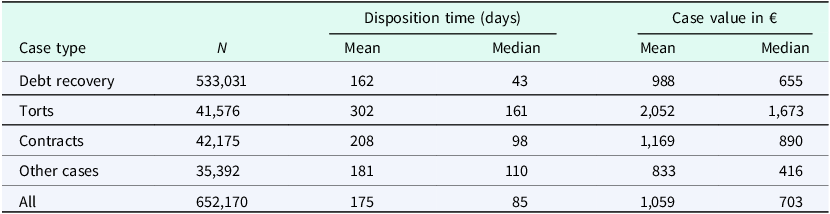
Table 1 provides basic summary statistics of our dataset, which includes the universe of small claims submitted in the Turin districtFootnote 11 from January 1995 to August 2017, gathered from the Italian Ministry of Justice. Once cleaning the datasetFootnote 12 of incomplete entries, our sample consists of 652,170 cases. The most common type of case is debt recovery,Footnote 13 followed by contracts and torts. The dataset contains other types of cases, such as property disputes, but we focus on the three most common types. Our main outcome of interest, motivated by the well-known inefficacies in the Italian court system described above, is the number of days it takes a judge to decide a case, an outcome which we term time. We are able to precisely measure disposition time as our dataset contains, for each case, the date the claim was filed by the plaintiff and the date of the final decision on the case. Table 1 shows that cases are slow to resolve overall: the average adjudication time for all claims in our dataset is 175 days, with the average torts case taking nearly 10 months (302 days). Table 1 also shows the mean and median of the case values. Recall that small claims court in Italy only handles cases with a value no greater than €5,000. The overall median case value is €703, Torts claims are the highest value with a mean value of €2,052 and a median of €1,673.
Summary statistics: justice of peace data (Turin, Italy 1995–2017)

Table 1. Long description
The table presents summary statistics of small claims cases submitted in the Turin district from January 1995 to August 2017. It includes data on case types, number of cases, disposition time in days, and case value in euros. The table has five rows and five columns. The columns are labeled Case type, N, Disposition time (days) with sub-columns Mean and Median, and Case value in € with sub-columns Mean and Median. The row labels are Debt recovery, Torts, Contracts, Other cases, and All. Row 1: Debt recovery, 533,031, Disposition time (days) Mean 162, Median 43, Case value in € Mean 988, Median 655. Row 2: Torts, 41,576, Disposition time (days) Mean 302, Median 161, Case value in € Mean 2,052, Median 1,673. Row 3: Contracts, 42,175, Disposition time (days) Mean 208, Median 98, Case value in € Mean 1,169, Median 890. Row 4: Other cases, 35,392, Disposition time (days) Mean 181, Median 110, Case value in € Mean 833, Median 416. Row 5: All, 652,170, Disposition time (days) Mean 175, Median 85, Case value in € Mean 1,059, Median 703.
Methodology
The adjudication procedure a judge will use to rule on a case is determined solely by the size of the claim. Claims with a value below €1,100 will be decided based on equità. For claims valued at €1,100 and above, judges will use standard civil law procedures, justifying their decisions with substantive law. Therefore, we can study the causal effect of allowing judges to use equità by comparing outcomes for claims just below €1,100 and those just above €1,100. We will use the same procedures for the discontinuity at €1,033, which entails extra administrative steps and paying a €200 fee. The so-called RDD is a quasi-experimental approach (Imbens and Lemieux, Reference Imbens and Lemieux2008; Rhodes and Jalbert, Reference Rhodes and Jalbert2014) well suited for this type of situation. Under several assumptions, which we describe and test below, one can treat cases as randomly assigned to their adjudication/bureaucratic procedure. Therefore, estimates of the difference in disposition time for cases just above and just below the threshold can be interpreted as the treatment effect of the differential adjudication/bureaucratic process.
The main assumptions of an RDD design (which we discuss respectively in Sections ‘Robustness’ and ‘Bunching around the threshold and “donut” RDD’) are 1) that observations on either side of the threshold are similar on all other relevant characteristics and 2) that the ‘running variable’ in our setting, that is, value of the case (‘valore’ in Italian), is not manipulated by litigants. In our setting, violation of the latter could take the form of litigants submitting, say, a claim worth €1,000 instead of €1,200, thinking that the equità procedures used to evaluate claims below €1,100 would result in a faster ruling for them. Below we describe our tests for these two assumptions, that is, that covariates are balanced around the €1,100 threshold; and that there is no bunching of valore near the thresholds. We begin by describing the RDD procedure and presenting our baseline estimations.
We use a standard RDD framework that takes the form of Equation (1). Our coefficient of interest is α 1, the coefficient on an indicator variable for a case having a value, or valore in Italian, above the threshold of interest, T = 1,033 or T = 1,100. In the RD framework, this coefficient can be interpreted as the local treatment effect:
 $$\eqalign{time_c & = \;{\alpha _0} + {\alpha _1}1\left\{ {valor{e_c} \gt T} \right\} + \;{\beta _1}\left (valor{e_c} - T \right) + {\beta _2}1\left\{ {valor{e_c} \gt T} \right\}*\left( {valor{e_c} - T} \right) \cr& \quad\,+ {\beta _3}valore_c^2 + \;\gamma X_c^r + {\varepsilon _c}}$$
As is standard practice, our regressions include the distance between valore and the threshold and an interaction of that distance with the indicator for a case having valore above the threshold under consideration. We control for valore with a quadratic polynomial.Footnote 14 X c is a vector of case characteristics which include year-fixed effects, the number of litigants, and the number of attorneys, where c indexes each case.
Bunching around the threshold and ‘Donut’ RDD
In this section, we address the issue of manipulation of the running variable, that is, whether litigants can adjust the value of their claim in a way that would bias our regression discontinuity results. One manifestation of bunching of data around the threshold that would affect the interpretation of our results is if litigants chose to submit a claim with a lower-than-true value to have the simplified equità procedure applied to their claim,Footnote 15 or avoid the €200 fee. Alternatively, litigants could inflate the value of their claim to avoid equità rules and judges’ greater discretion. From a series of interviews that we conducted with several Justices of Peace in Turin’s court and legal practitioners in the same jurisdiction, it has emerged that it is indeed possible for litigants to alter the value of their claim. While such endogeneity of the running variable is worrisome for our empirical procedure, results of the following tests suggest that such manipulation is not done to avoid or seek out a certain type of adjudication procedure but rather to avoid the filing fee assessed to claims above the €1,033 threshold.
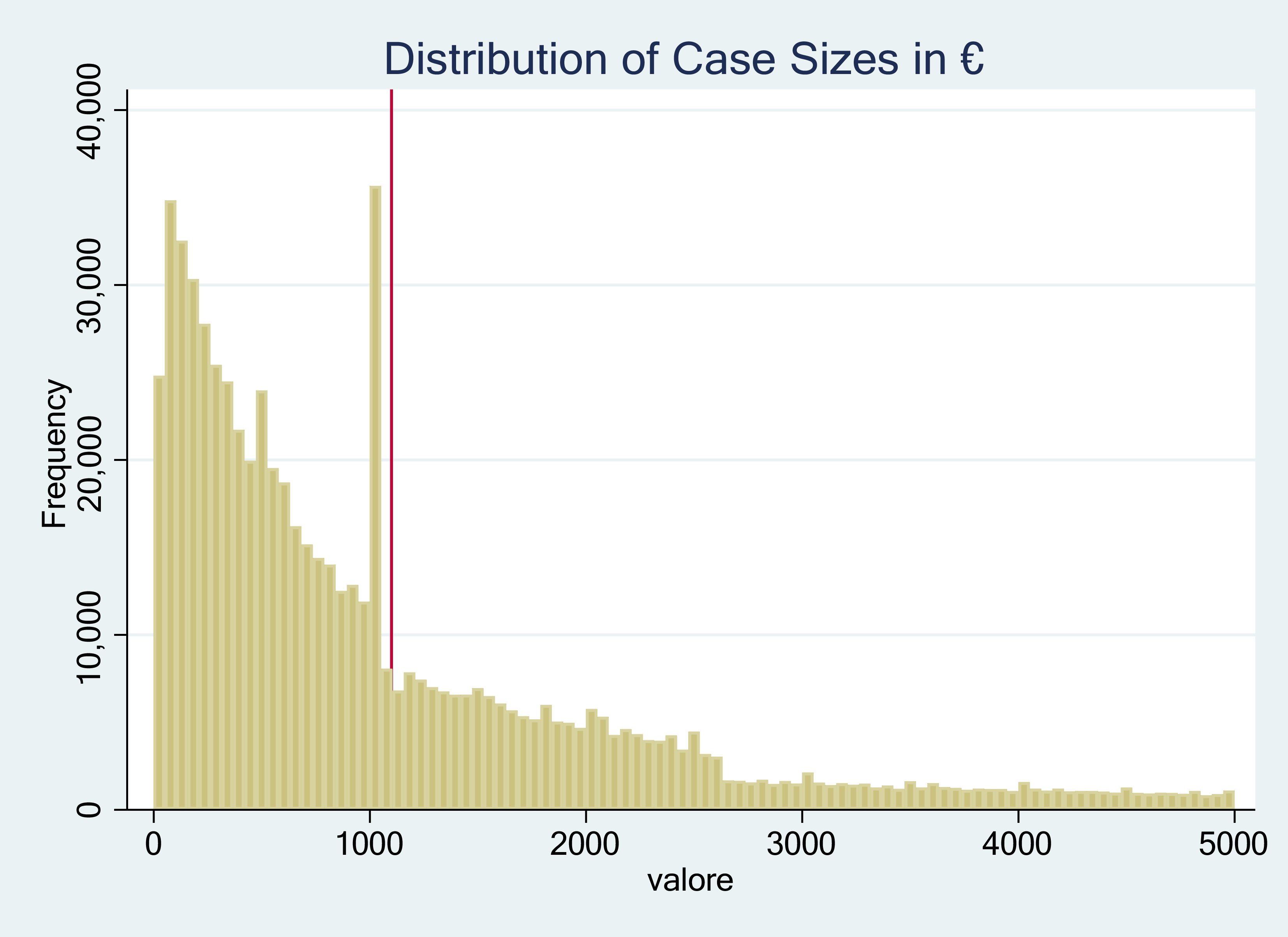
Cases’ value distribution.

The first and simplest test to uncover manipulation of the running variable is to plot a histogram of the raw density of the data, as shown in Figure 1. The figure shows the raw number of observations in €52.63 bins of case value. It is obvious from the figure that there is bunching of the running variable, but this bunching is not at €1,100, but rather at €1,032. As outlined above, litigants submitting claims valued at €1,033 and above must also pay a €200 fee. It appears obvious that litigants are manipulating their claims to avoid paying this fee. Figure 1 also shows that the running variable trends smoothly through our other threshold of interest at €1,100, thus suggesting that the incentive to manipulate should not abruptly change across €1,100 threshold.
Despite the massive heaping at €1,032, we think some of the latest methods may allow us to tackle the problem. We rely on previous research, which provides methods for use in a regression discontinuity even when such heaping exists. We follow Barreca et al. (Reference Barreca, Guldi, Lindo and Waddell2011) and Barreca et al. (Reference Barreca, Lindo and Waddell2016) who use a ‘donut’ regression discontinuity, so-called because it estimates regressions for a subsample of data that excludes observations just to the left and right of the threshold where heaping exists, forming what looks like a ‘donut hole’ cut out of the density function. A canonical example has become newborn birth weights, which show bunching at round numbers like 6 pounds and 7 pounds (Almond and Doyle, Reference Almond and Doyle2011; Barreca et al., Reference Barreca, Guldi, Lindo and Waddell2011; Barreca et al., Reference Barreca, Lindo and Waddell2016). Estimations are done via a traditional RDD on the remaining data. In our setting, the heaping exists at €1,032, so to implement the donut design, we restrict the sample to include data only outside of the peak in the histogram (using different ‘donut hole’ sizes as a robusntessFootnote 16 ). Then we estimate an optimal bandwidth (which we describe below),Footnote 17 drop the donut hole, and run regressions solely on the ‘donut dough’, those observations sufficiently similar (in terms of the running variable) but far enough from the heap.Footnote 18 To give an idea of the power of this method, Barreca et al. (Reference Barreca, Guldi, Lindo and Waddell2011) state ‘an analysis that simply drops the data at reporting heaps yields an unbiased estimate of the treatment effect for non-heaped types’.
Results
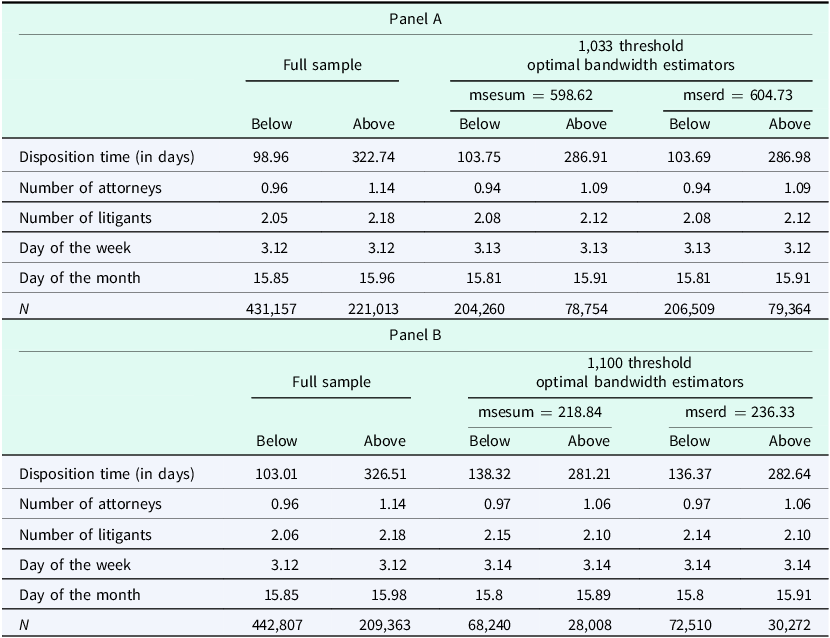
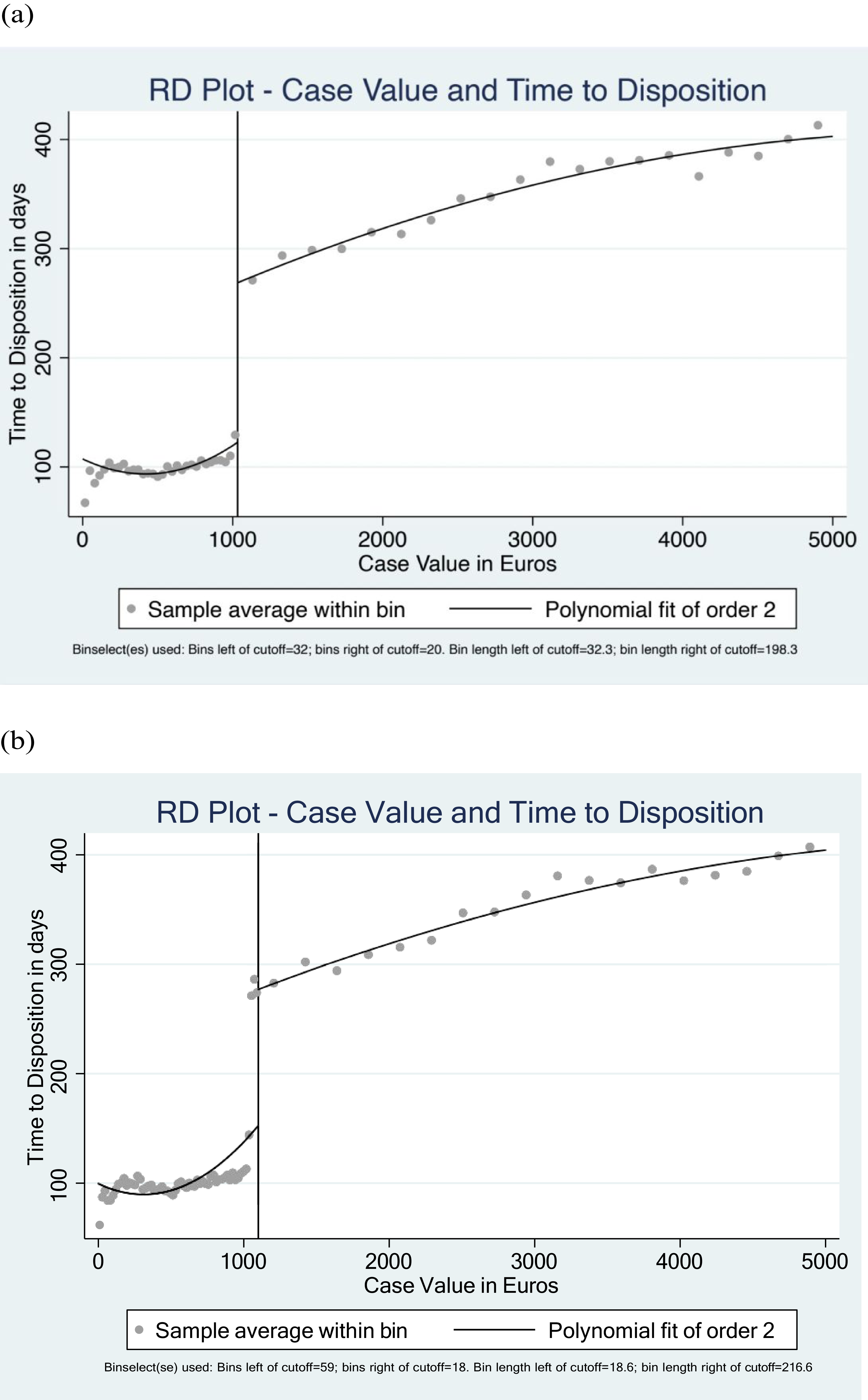
In Table 2, we find the mean values of disposition time conditional on being on one side of either threshold. It turns out that cases above the €1,100 and 1,033 thresholds are associated, respectively, on average with 223 and 225 extra days for arriving at a decision. Figure 2 would, at least at first sight, suggest similar increases in time to disposition from crossing both thresholds. However, as emerges from a more careful analysis of Figure 2b, the ‘jump’ seems to occur just before the €1,100 threshold, thus questioning the idea that using the equità adjudication procedure should be associated with shorter procedures. For this, we now turn to the estimates of Equation (1) presented in Table 3.
Summary statistics around the threshold

Table 2. Long description
A table comparing summary statistics around thresholds. The table has two panels, Panel A and Panel B, each with multiple columns and rows. Panel A includes data for the full sample and 1,033 threshold optimal bandwidth estimators, with columns for below and above threshold values. Panel B includes data for the full sample and 1,100 threshold optimal bandwidth estimators, with columns for below and above threshold values. Each panel lists disposition time in days, number of attorneys, number of litigants, day of the week, day of the month, and the sample size (N). Panel A: Row 1: Disposition time (in days), Below: 98.96, Above: 322.74, msesum Below: 103.75, msesum Above: 286.91, mserd Below: 103.69, mserd Above: 286.98. Row 2: Number of attorneys, Below: 0.96, Above: 1.14, msesum Below: 0.94, msesum Above: 1.09, mserd Below: 0.94, mserd Above: 1.09. Row 3: Number of litigants, Below: 2.05, Above: 2.18, msesum Below: 2.08, msesum Above: 2.12, mserd Below: 2.08, mserd Above: 2.12. Row 4: Day of the week, Below: 3.12, Above: 3.12, msesum Below: 3.13, msesum Above: 3.13, mserd Below: 3.13, mserd Above: 3.12. Row 5: Day of the month, Below: 15.85, Above: 15.96, msesum Below: 15.81, msesum Above: 15.91, mserd Below: 15.81, mserd Above: 15.91. Row 6: N, Below: 431,157, Above: 221,013, msesum Below: 204,260, msesum Above: 78,754, mserd Below: 206,509, mserd Above: 79,364. Panel B: Row 1: Disposition time (in days), Below: 103.01, Above: 326.51, msesum Below: 138.32, msesum Above: 281.21, mserd Below: 136.37, mserd Above: 282.64. Row 2: Number of attorneys, Below: 0.96, Above: 1.14, msesum Below: 0.97, msesum Above: 1.06, mserd Below: 0.97, mserd Above: 1.06. Row 3: Number of litigants, Below: 2.06, Above: 2.18, msesum Below: 2.15, msesum Above: 2.10, mserd Below: 2.14, mserd Above: 2.10. Row 4: Day of the week, Below: 3.12, Above: 3.12, msesum Below: 3.14, msesum Above: 3.14, mserd Below: 3.14, mserd Above: 3.14. Row 5: Day of the month, Below: 15.85, Above: 15.98, msesum Below: 15.8, msesum Above: 15.89, mserd Below: 15.8, mserd Above: 15.91. Row 6: N, Below: 442,807, Above: 209,363, msesum Below: 68,240, msesum Above: 28,008, mserd Below: 72,510, mserd Above: 30,272.
All figures represent the average value of the variable of interest in the considered sample above or below the threshold.
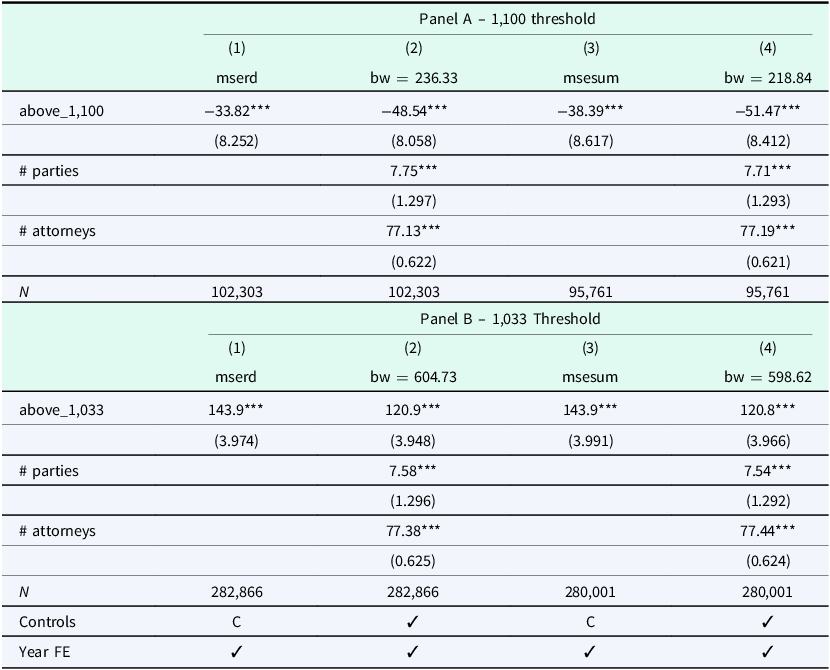
Donut RD – drop 1032–1033

Table 3. Long description
The table is divided into two panels, Panel A and Panel B, each with four columns and multiple rows. Panel A focuses on a 1,100 threshold, while Panel B focuses on a 1,033 threshold. Each panel contains data on mean squared error in days (mserd), mean squared error in bandwidth (bw), mean squared error sum (msesum), and another mean squared error in bandwidth (bw). The rows are labeled with ‘above_1,100’ and ‘above_1,033’ respectively, followed by values for ‘# parties’, ‘# attorneys’, and ‘N’. The table includes controls and year fixed effects (FE) indicators. Panel A shows values for ‘above_1,100’ with corresponding mean squared errors and bandwidths, along with the number of parties, attorneys, and observations (N). Panel B shows similar data for ‘above_1,033’. Notable trends include the significant mean squared errors and bandwidths associated with cases above the thresholds, indicating longer disposition times.
Each regression includes the following control variables: amount above the threshold, the interaction between this amount and above the threshold dummy, a quadratic polynomial of the case value, the number of litigants in each case, the number of attorneys in each case and year-fixed effects. Each regression use coverage error-rate optimal bandwidths (Imbens and Kalyanaraman, Reference Imbens and Kalyanaraman2012). Robust standard errors are in parentheses. *p < 0.10, **p < 0.05, ***p < 0.01.
RDD plot. (a) €1,033 threshold. (b) €1,100 threshold.

Figure 2. Long description
Panel A: A scatter plot with a polynomial fit of order 2 shows the relationship between case value in euros and time to disposition in days. The x-axis represents case value in euros, ranging from 0 to 5000. The y-axis represents time to disposition in days, ranging from 0 to 400. The plot includes sample averages within bins and a polynomial fit line. The data points show a noticeable increase in time to disposition as case value increases, with a sharp rise around the 1000 euro mark. Panel B: Another scatter plot with a polynomial fit of order 2 shows a similar relationship. The x-axis and y-axis are labeled the same as in Panel A. This plot also includes sample averages within bins and a polynomial fit line. The data points again show an increase in time to disposition with increasing case value, with a significant rise around the 1000 euro mark.
In Panel A of Table 3, we begin to explore the effect of the equità adjudication procedure on the time it takes to resolve a case. Our hypothesis, consistent with previous findings (Djankov et al., Reference Djankov, La Porta, Lopez-de silanes and Shleifer2003), is that equità would speed up the resolution of cases. Broadly, we find, however, consistently negative coefficients and statistically significant ones. In our preferred specification (column 2), the coefficient is −48.54. All the coefficients are around −50 and significant at the 1 percent level. This is somewhat puzzling in light of our initial hypothesis that being able to use one’s intuition and instincts rather than being forced to rely on the more demanding, more complex civil code rules would result in longer times to solve a case.
Our results seem to suggest that it is easier for judges to decide relatively simple cases using the Civil Code, rather than abstract principles of justice, a clear comparative advantage of civil law systems as compared to common law ones. Understanding and correctly applying the concepts of fairness and justice are a true conundrum for legal scholars since at least Aristotle. In our case, the judge does not have the burden of finding an argument essentially from scratch for the decision but can comfortably rely on solid and already existing arguments and solutions.
Another possibility is that judges procrastinate when equità frees them of the civil code’s constraints. Procrastination has been associated with several tasks’ characteristics that could explain the results here (Frakes and Wasserman, Reference Frakes and Wasserman2020; O’Donoghue and Rabin, Reference O’Donoghue, Rabin, Loewenstein and Read2003; Royer et al., Reference Royer, Stehr and Sydnor2015). Boring tasks, for example, are more likely to be avoided (Steel, Reference Steel2007). Therefore, if judges use the €1,100 threshold as a signal for which cases are more interesting, then this could explain the delay in adjudicating these cases. Alternatively, judges might be especially susceptible to perfectionism and evaluation concerns when employing equità rationales, which can also lead to procrastination (Rozental and Carlbring, Reference Rozental and Carlbring2014). Although equità decisions cannot be appealed on their merits, these opinions can influence judges’ reputations, a significant characteristic for judicial officers (Epstein et al., Reference Epstein, Landes and Posner2015; Melcarne, Reference Melcarne2017). Since equità allows a judge to apply their idiosyncratic notions of justice, these decisions may be more susceptible to critique than opinions grounded in a purportedly objective reading of the civil code. In this way, equità may introduce greater uncertainty into the decision-making process, in a way that slows down the decision-making process (Posner, Reference Posner1973). Without a countervailing reputational incentive to resolve these cases quickly, like the Six Month List in the United States (de Figueredo et al., Reference De Figueredo, Lahav and Siegelman2019), the reputational costs associated with resolving the cases correctly might dominate. Potentially discrepant decision-making styles employed above and below the equità threshold could also support a procrastination interpretation of these results. In at least one study, for example, rational decision-making (like what might be employed above the equità threshold) has been shown to be negatively correlated with procrastination, but a null correlation was found for intuitive decision-making, which relies on instinct and might be employed below the equità threshold (Vany et al., Reference Vany, Rajkumar, Lakshmi, John, Sunny, Joshua George, Pawar and Abraham2023). Finally, the equità adjudication does not offer the usual boundaries for writing decisions provided by the statutory law and case law. These can be seen as a sort of guidelines, procedural tracks that can speed up decision-making by reducing the degree of entropy in the problem-solving procedure and making affordable an already existing benchmark. The degree of freedom introduced by the equità rule can thus become a procedural brake. This finding relates to what is predicted by the theory of bounded rationality, showing how structured frameworks in decision-making help to narrow down options and simplify this process, overcoming cognitive bounds (Simon, Reference Simon, Eatwell, Milgate and New-man1990). Together, these results suggest we might expect more procrastination in situations where intuition is employed (like in equità) as opposed to situations where the standard decision-making based on statutory or case law is employed, an outcome consistent with what our results demonstrate.
Next, we turn to the €1,033 threshold, its €200 consequent fee, and time to disposition. Again, we run donut RD regressions with optimal bandwidths, which are shown in Panel B of Table 3. Here, we see the opposite effect that we did with the equità rule. As expected, effects are all positive and highly statistically significant. We find, consistently with previous works (Landoni, Reference Landoni2007; Pandey et al., Reference Pandey, Coursey and Moynihan2007), that having to pay the €200 fee increases the time to disposition by about 120 days, as this extra bureaucratic/administrative step burdens the overall (judicial) procedure. In this case, procedural hurdles do not give any internal boost to the case but rather dilute the time needed to reach a decision. It is worth noting that the additional stage does not give any internal contribution to the procedure itself, and it turns out to be a mere burden of the process, increasing the total length of the case.
We follow up these results with a series of robustness checks. First, we re-estimate our main regressions with another mean-squared-error optimal bandwidth estimator, columns 3 and 4 of Table 3. Results are essentially unchanged. We also use a slightly larger ‘donut hole’ of €10 size (€1,030–€1,040). Results are displayed in Table 5 available in the Online Appendix and turn out to be slightly larger for €1,033 (again, in this larger hole we still drop the heaping at 1,032–1,033). Estimates suggest it takes 156 days longer to have your case resolved if you pay the €200 euro. Estimates with the larger donut hole for €1,100 range from −39 to −51 days.
Robustness
A key assumption of the RDD strategy and one that is necessary to interpret our regression estimates as the causal effect of adjudication procedures is that observations falling on either side of the two thresholds are similar. If it were the case that observations just above and below €1,033 or €1,100 were different in important observable (or unobservable) ways, our estimations would pick up jointly the effect of adjudication procedures and other causes of the increase in time to disposition, rather than the adjudication procedure alone.
In Table 2, we test whether the observable covariates are balanced across the threshold. Because personal information on litigants in our data is anonymized, we do not, unfortunately, have a robust set of observable characteristics on the parties involved in the litigation. We do, however, have information on four covariates to test for this balance across the threshold: the number of litigants in each case, the number of attorneys, and the day of the week and month that cases were submitted. As mentioned above, the number of attorneys in particular could be critical in interpreting our results for the €1,100 threshold, since rules governing the use of attorneys do change at that cut-off point. Summary statistics for these four covariates around the two thresholds of interest are found in Table 2. For each covariate, we show the mean of the data above and below the €1,033 threshold (panel A) and the €1,100 threshold (Panel B). Given our large sample sizes, t-tests for differences in covariates in Table 2 do show significance at standard levels. However, the economic magnitudes of the differences are trivial. All cases have about 1 attorney (92% of plaintiffs are represented by a lawyer vs. around 10% of the defendants) and 2 litigants (one defendant, one plaintiff) and are submitted uniformly across days of the week and month. This implies that the possibility of claimants litigating pro se below the threshold does not appear to affect our analysis because, practically speaking, use of attorneys is not measurably different across the threshold. In fact, when further disaggregating data, it emerges that in 84.4% (83.6% for cases below the threshold and 86.1% for those above) of the entire sample of cases, only the plaintiff’s attorney is present. Results of our tests for differences in covariates around the threshold also hold for our optimal bandwidths discussed below. Again, the samples above and below the threshold are fairly similar.
There is obviously a difference in the raw data across these thresholds. Given the peculiarity of the Italian market for legal services, it remains a possibility that attorneys play a role in the litigation process and its duration, but given these results together with our other robustness checks discussed below, we believe any attorney effects are swamped by the effect of adjudication procedures. We have estimated Equation (1) using the number of attorneys involved in each case as a dependent variable, and our estimates tell the same story in Table 6. The regression discontinuity estimate in our regressions with attorney as the outcome variable around €1,100 is, depending on the specification, around 0.35, meaning those just above the threshold hire 1/3 more of an attorney on average. Interestingly, we see a pretty similar effect at €1,033. The coefficient is small, around 0.2, but still statistically significant. Given the small magnitudes of these effects, we do not feel they are the cause of our results, but we must caution the reader that it is possible that attorneys are making an important contribution to the length of the case in a way we may be ignoring here.
The fact that on Table 6, the coefficient for the €1,033 threshold is positive (more lawyers for cases above) allows us to reasonably rule out the possibility that lawyers induce plaintiffs to manipulate cases below 1,033 in order to avoid taxes. The heap at €1,032 might not reasonably be ascribed to lawyers, since we should observe the likeliest probability of having a lawyer at €1,032, where the fee is avoided and disposition time is lower. However, this does not allow us to rule out the possibility that lawyers, given their pay structure, influence delay. In particular, for the €1,033 threshold, since we observe that above such a level, both the likelihood of having an attorney and delay increase. It is worth mentioning that mandatory legal representation is needed at above €1,100, not €1,033. However, for cases above €1,100, despite the fact that we observe an increase in attorneys’ presence (though the coefficient is smaller for €1,100 than for €1,033), time to disposition actually decreases, suggesting that it is not the mandatory presence of an attorney to worsen judicial timeliness.
Another kind of heaping in at round numbers (1,100, 1,200, 1,300) exists as emerges from Figure 3 on the Online Appendix. We believe this is likely a round number bias (Lacetera et al., Reference Lacetera, Pope and Sydnor2012; Pope and Simonsohn, Reference Pope and Simonsohn2011) or just a natural part of how the values of the contracts are crafted. Nonetheless, guided by Barreca et al. (Reference Barreca, Lindo and Waddell2016), we drop the donut hole plus all instances of heaping at round 100 intervals. Results for a donut hole composed of 1,032–1,033 & 1,110 are shown in Table 7 (available on the Online Appendix) and are similar in sign and magnitude to the results above. For the €1,033 threshold, we estimate 121 extra days when we use controls. Results for €1,100 are about negative 34 days. Other estimates dropping 1,032–1,033 and other multiples of 100 (not shown here) are equally similar both in sign and in magnitude.
To further stress the robustness of our results, we implement a placebo approach in which we replicate our RDD strategy but use arbitrary thresholds that should not have a significant impact on judicial timeliness. For this purpose, we choose two different thresholds: €1,200 and €2,000. For the placebo test to be validated, one would expect that judicial delay for cases just across these thresholds should not be differ significantly. We report the estimates of our placebo test in Table 8 (available on the Online Appendix). The results are consistent with our expectations since none of the coefficients are significantly different from zero. To examine possible heterogeneity among different types of cases, we estimate our main model on different subsamples based on the three main casetypes: contracts, torts, and debt recovery. As emerges from the results shown in Table 9 (available on the Online Appendix), the effect for the €1,100 threshold is mainly driven by tort cases, which from Table 1 turn out to be the more valuable cases and thus overrepresented in the above €1,100 subsample. This could be a symptom of the fact that our previous estimate for the equità threshold in Table 3 could be less like a weighted average of the effects by case type than like a composition artefact. On the contrary, for the €1,033 threshold, contracts and debt recovery cases appear to have more relevance. In Table 10, we also estimate our baseline model controlling for case type dummies. Results remain unaltered for Panel B, while the magnitude of coefficients drastically decreases for the €1,100 threshold, possibly suggesting a composition effect by case type that undermines the robustness of our previous results for this threshold.
Although we follow a methodology to estimate our optimal bandwidth, which is now firmly established in academic literature, it is true that even our smallest estimated optimal bandwidth is above €200. This implies that when estimating the impact of either one of our two thresholds of interest, we are also including data around the other. One possibility to better isolate each treatment individually is to choose an arbitrary bandwidth to include enough observations, but small enough to exclude the other threshold. Accordingly, we decided to run our RDD approach with €50 bandwidths. Estimates are shown in Table 11 (available on the Online Appendix) and are consistent with the results above for Panel B. On the contrary, in Panel A, we observe a sharp decrease in the magnitude of the coefficient of interest in column (2) together with a reduction of significance. This might suggest that the interplay between the two thresholds might be somehow impossible to truly disentangle even when adopting a smaller bandwidth and that, as suggested by Figure 2b, the real discontinuity appears to be related more to the €1,033 threshold than the €1,100 one.
In sum, our results show, at the €1,033 threshold, a positive and significant effect of about 150 days in all specifications, meaning it takes 5 months for the 200 euro fee to be processed. The results for the €1,100 threshold appear more puzzling. The various robustness checks show a more fragile effect for equità, which appears to be sensitive to composition effects and probably affected by the proximity to the other threshold.
Discussion
Our work brings a large new dataset and state-of-the-art econometrics to inform the long line of literature on judicial decision-making and the debate concerning the impact of adjudication procedures on judicial timeliness. Our estimates reveal a puzzling effect of the equità rule, as it does not make for swifter decisions by small claims judges after all. Accordingly, our results cannot back the crafters of a recent reform enacted by the Italian Parliament, which more than doubled the level of the equità threshold to €2,500 from €1,100 in 2021.
The effects that swamp any difference in adjudication procedure are those of the bureaucratic hoops that must be stepped through for certain cases. These add tremendously to the courts’ backlog. Our estimates suggest that the bureaucratic procedure of mandating a €200 for cases fee causes an almost doubling (1.84x) (322/175) of the time to disposition. Courts would be wise to contemplate the benefits of the fee revenue relative to the time costs given such congested courts.Footnote 19 Nonetheless, the most important question left unanswered when discussing the goal of speeding up decision-making is whether Justices of Peace would simply be making faster decisions or possibly also worse ones. This is a much-debated question that, unfortunately, is left unanswered by our analysis, because of the lack of data regarding the quality of decisions (in terms of appeal and reversal). The dilemma between quality of justice and judicial performance is well known in the literature (Marciano et al., Reference Melcarne and RamelloG2019; Melcarne et al., Reference Melcarne, Ramello and Spruk2021).
An upshot of our results is the discovery of some potentially puzzling litigant behaviour. While litigants appear to try to circumvent the €200 filing fee, as evidenced by submitting claims just small enough to avoid paying, we do not observe litigants responding similarly to the equità threshold. It is somewhat surprising that litigants with claims close to the threshold do not try to take advantage of a swifter outcome. One explanation is that neither plaintiffs nor their attorneys (who may also opportunistically not reveal similar information when known) have knowledge of the potential benefits associated with this procedure.
Another aspect of the court system raises interesting strategic issues: the loser-pay-all rule. Willingness to submit a claim that requires a €200 filing fee that is close to the €1,033 threshold reveals some optimism in winning a case and having that fee reimbursed. Unless (depending on the level of risk aversion) one has a high level of confidence that the filing fee will be reimbursed, it would be a pure financial mistake to submit a claim for, say €1,100, and pay on top of that €200, rather than submit a claim below the €1,033 threshold that requires no filing fee. This is especially curious given the small stakes, and that €200 is a relatively large fee in percentage terms to have one’s case heard. We hope future research will shed light on these unanswered questions and puzzles within the behaviour of litigants, attorneys, and judges in the world of small claims.
Conclusion
In this paper, we have provided evidence of the impact of different civil procedures on judicial timeliness. Our provides a narrow, but hopefully informative, window into the world of judicial decision-making in a specific civil law context: small claims courts in Italy. Not only these courts handle around one-third of Italian civil litigation, but a similar setting could be easily replicated in most civil law countries. Our estimates do not allow us to conclude that letting judges use equità rather than more formal procedural rules has a positive impact on courts’ timeliness. Beyond the scholarly interest, this counter-intuitive result also has policy implications. At first sight, one might expect that cutting down procedural hurdles in the public administration can be a first step toward its effectiveness. On the contrary, our results suggest that reforms should distinguish among the different kinds of procedural complexity and discriminate whether or not they all contribute to improving the public administration’s performance. Despite the apparent limited external validity of our results, our study can inspire suggestions way beyond the limits of the specific jurisdiction studied here. Similar approaches could be easily replicated in most civil law countries, given the relevance of statutory law and the existence of small claim courts in most of these countries.
In a country like Italy, well known for its congested and slow judiciary, policy-makers should contemplate that allowing for more discretion (as done in a 2021 reform that raised the equità threshold from €1,100 to 2,500) could not necessarily help to alleviate time to disposition. On the contrary, ‘bureaucratic‘ procedures simply increase the burden of the process and thus increase judicial timeliness.
Our results show that leaving judges to their own devices might slow them down, possibly due to self-control problems, but these effects are swamped by the bureaucratic matters that slow down courts even more. While forcing litigants to pay a €200 fee and expanding the procedure to have their case heard slows down the time to disposition, it does raise money, albeit to a backlogged court system. Removing the filing fee would certainly speed up courts. Whether that benefit is worth the lost revenue is for the courts to decide and for future research to evaluate.
Allowing more discretion could have detrimental effects on judges’ accountability or provide an opening for the influence of corruption. More discretion can also leave judges susceptible to mistakes and cognitive errors, such as the biases among judges documented by (Guthrie et al., Reference Guthrie, Rachlinski and Wistrich2007). However, while these aspects are more binding in the context of criminal trials and high-stakes civil cases, the cases studied here represent an important and large portion of civil litigation. Accordingly, easing the congestion caused by these claims could have positive effects for the working of the entire judiciary, thus yielding benefits for the economy more broadly.
Supplementary material
The supplementary material for this article can be found at https://doi.org/10.1017/S1744137426100824.
Acknowledgements
We would like to thank Kitt Carpenter, Andrew Dustan, Andrew Hayashi, Eric Helland, Rich Hynes, Dan Klerman, Jason Lindo, and Justin McCrary the editor and nine referees for valuable feedback. We are grateful to Judge Maria Alessandra Buchi and Judge Alberto Maria Novarese for their support. Guimin Dong provided research assistance.


 Open access

