INTRODUCTION
Tropical coastal ecosystems are generally known for their high diversity, complexity of species interactions, and also the large amounts of discarded by-catch of fish, especially from shrimp trawling (Pauly, Reference Pauly1989). In Brazil, fish community structures over space and time have been intensively studied in recent years (Godefroid et al., Reference Godefroid, Spach, Santos, Maclaren and Schwarz2004; Branco & Verani, Reference Branco and Verani2006; Barletta et al., Reference Barletta, Amaral, Corrêa, Guebert, Dantas, Lorenzi and Saint-Paul2008; Rocha et al., Reference Rocha, Fernandez and Paiva Filho2010). However, populations of some fish are less well studied than would be expected from their abundance.
The shorthead drum Larimus breviceps Cuvier 1830 (Teleostei: Sciaenidae), commonly known in Brazil as ‘Oveva’, is one of these species, very abundant along the Brazilian coast and with minimal commercial value, a typical by-catch component (Vianna & Almeida, Reference Vianna and Almeida2005). This situation increases the importance of studies on the ecological importance of this species and its role in the ecosystem as a whole. This drum may reach 30 cm in total length and 500 g in weight (Cervigón et al., Reference Cervigón, Cipriani, Fischer, Garibaldi, Hendrickx, Lemus, Márquez, Poutiers, Robaina and Rodríguez1992) and generally lives on sand and muddy bottoms of coastal waters and estuaries at depths up to 50 m. It occurs in the western Atlantic Ocean from Costa Rica to Santa Catarina State, Brazil (Menezes et al., Reference Menezes, Buckup, Figueiredo and Moura2003) and feeds mainly on crustaceans such as shrimp (Menezes & Figueiredo, Reference Menezes and Figueiredo1980; Comelli, Reference Comelli2000; Moraes, Reference Moraes2004).
Although communities and population dynamics are largely determined by the trophic relationships (Pauly, Reference Pauly1989; Gratwicke & Speight, Reference Gratwicke and Speight2005), these aspects are rarely considered together. In addition to the scientific importance of understanding the functioning of a system, trophodynamics has practical importance for sustainable use of the environment, being extremely important for the rational consumption of fish and other marine organisms.
Larimus breviceps was the third most abundant fish in the community in Caraguatatuba Bight during 2003–2004, which permitted us to study its spatial and temporal distribution, growth parameters and seasonal diet composition concomitantly. We believe that this will add substantially to knowledge of the species and also of the area, an important bight in tropical south-eastern Brazil.
MATERIAL AND METHODS
Study area
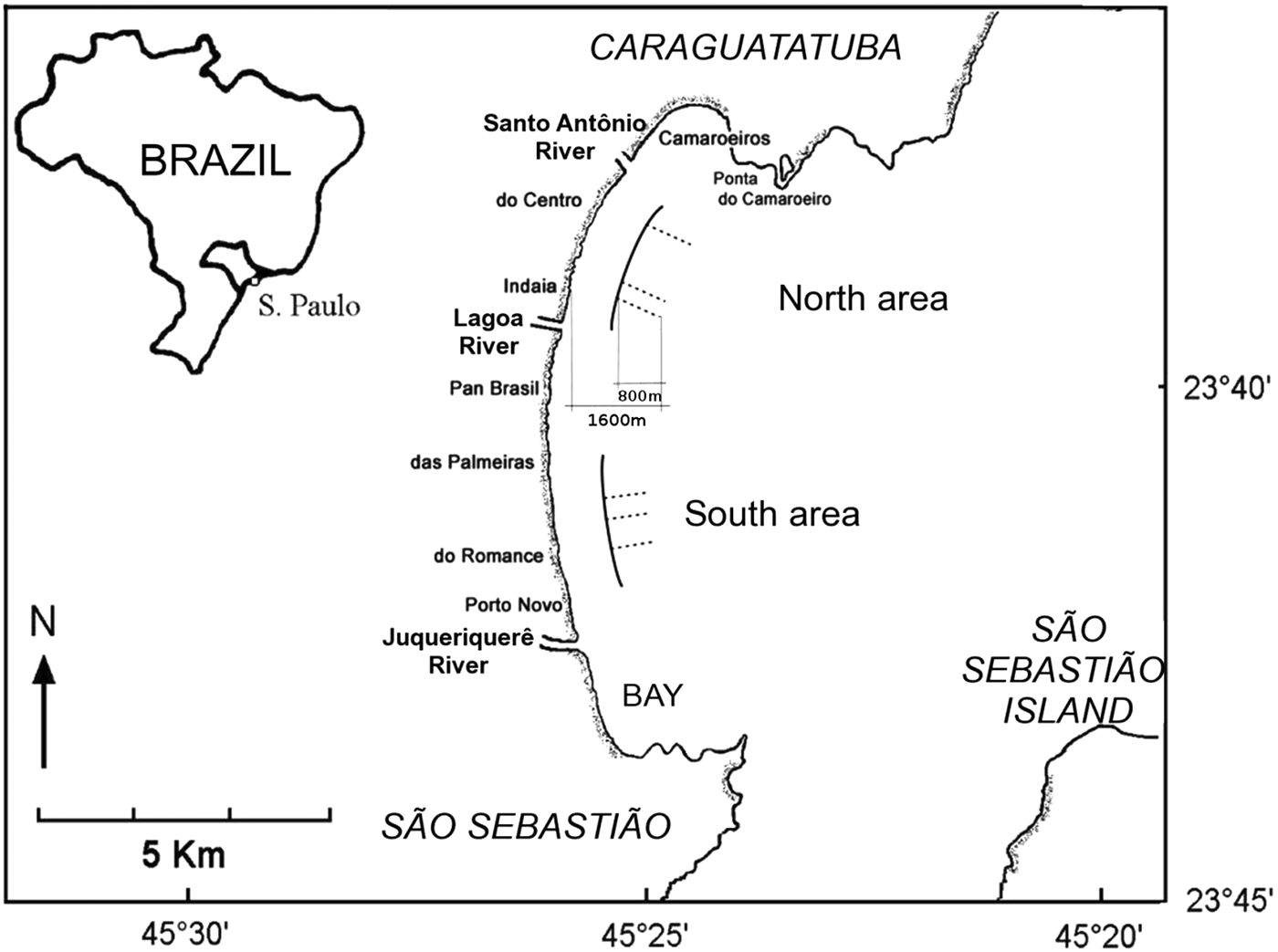
Caraguatatuba Bight (23°37′–23°44′S 45°24′–45°26′W) is about 16 km long and contains several sandy beaches. Two homogeneous areas, separate from each other but with the most similar possible features, termed South and North, each 2.0 × 0.8 km in extent, were selected so as to exclude the influence of rivers in the region (Figure 1). This procedure made the study more representative of shallow sites with little continental influence throughout the bight. The South area extends from Porto Novo to Palmeiras beaches; it has a gentler slope, and is on the side of the Juqueriquerê river, the largest river entering the bight. The North area, located between Indaiá and Centro beaches, has a steeper slope and is on the side of the smaller rivers entering the bight (Lagoa and Santo Antônio).
Caraguatatuba Bight and otter-trawl sampling schemes from a monthly sample (dashed lines), in the North and South areas (solid lines).

Sampling procedures
Samples were taken monthly from October 2003 to October 2004. In each area, a 2000 m length of the beach was divided into 10 m intervals, and three sampling stations were randomly selected from these 200 possibilities in each sampling period. The position of the station was stored in a GPS at mean low water (MLW). From this point, a fishing boat (class G2M, 11 m long with a 22 hp engine) performed 800 m trawls perpendicular to the beach, from a point 800 m to 1600 m distant from the MLW line. This interval is equivalent to depths of 1–4 m. The trawling speed was 1 knot, performed with a bottom otter trawl with 2.0 cm mesh, mouth aperture 1.6 m high and 6.0 m long, and bag depth 3.5 m.
The fish were removed from the net and immediately fixed in 10% formalin in order to paralyse the enzyme action, preserving the gut contents (Uieda & Castro, Reference Uieda, Castro, Caramaschi, Mazzoni and Peres-Neto1999). After screening and identification, the specimens of Larimus breviceps were preserved in 70% ethanol, and then measured (total length (TL), cm). A total of 160 individuals (40 for each season) were randomly selected from the total of 1526 individuals obtained over the sampling period. Abdominal-ventro-sagittal incisions were made and the sex and gonadal stage were determined. The digestive tubes were detached and measured, from the beginning of the oesophagus to the end of the rectum (digestive tube total length; DTTL). Stomach contents were identified, and the volume of each item was measured according to methods from Bemvenuti (Reference Bemvenuti1990).
Data analysis
The mean number and size of individuals (+SE) of L. breviceps were calculated for the study months and areas (South and North), and for the areas combined. Two-way ANOVAs (area × month) were performed to test distribution patterns, and when necessary were replaced by the equivalent non-parametric tests, Sheirer–Ray–Hare two-way ANOVA of ranks for abundance (equal sample sizes in each cell). In comparing size among months and areas it was not possible to use a two-way approach, because not all the species were sampled in all areas in all months. Therefore, months were compared by one-way ANOVA and areas by Student's t-test (Sokal & Rohlf Reference Sokal and Rohlf1995). Total length was used for estimation of growth parameters, based on the von Bertalanffy Growth Model (VBGM), which states that L t = L ∞[1−exp(−K* (t−t 0))]; where L t is length (mm) at time t, L ∞ is the mean length of infinitely old fish (asymptotic length); K is the curvature parameter (i.e. how fast a fish approaches L ∞) and t 0 is the theoretical point in time when fish length is zero. For this purpose we used the FISAT software and followed the methodology proposed by Pauly & Garcia (Reference Pauly and Garcia1994): ELEFAN I and Sheper s routines were combined in a general K-scan, to determine a common peak of optimum goodness-of-fit values for K (growth constant), before refining the analysis of parameters. Because the length of the largest individual was below the maximum length recorded in previous studies (31 cm total length; Cervigón et al., Reference Cervigón, Cipriani, Fischer, Garibaldi, Hendrickx, Lemus, Márquez, Poutiers, Robaina and Rodríguez1992), literature values were used as the basis to define an asymptotic length range, in order to perform the analysis. Empirical formulas were used to estimate t 0 ( Pauly, Reference Pauly1979) and tmax (longevity; Pauly, Reference Pauly1983a) respectively: log-t 0= −0.3922 − (0.2752 logL ∞) − (1.038 logK) and t max= t 0+ 2.9957/K. Total mortality index (Z) was estimated by FISAT software by the length-converted catch curve, a coefficient that basically measures the rate at which the number of individuals decreases over time (Pauly, Reference Pauly1983b).
The ratio between the fish digestive tube and body length was calculated (DTL/TL). For dietary analysis, for each stomach item the frequency of occurrence (FO) and per cent volume (V) were calculated. The amount of unidentified content (organic matter, OM) was divided proportionally among the identified items. The values obtained were graphed as proposed by Costello (1990), and used to calculate an index of dietary importance (IAi) as proposed by Kawakami & Vazzoler (Reference Kawakami and Vazzoler1980):
 $$IAi = {\rm FO}i \ast Vi/\Sigma {\lpar {\rm FO}i \ast Vi\rpar .}$$
RESULTS
Population biology
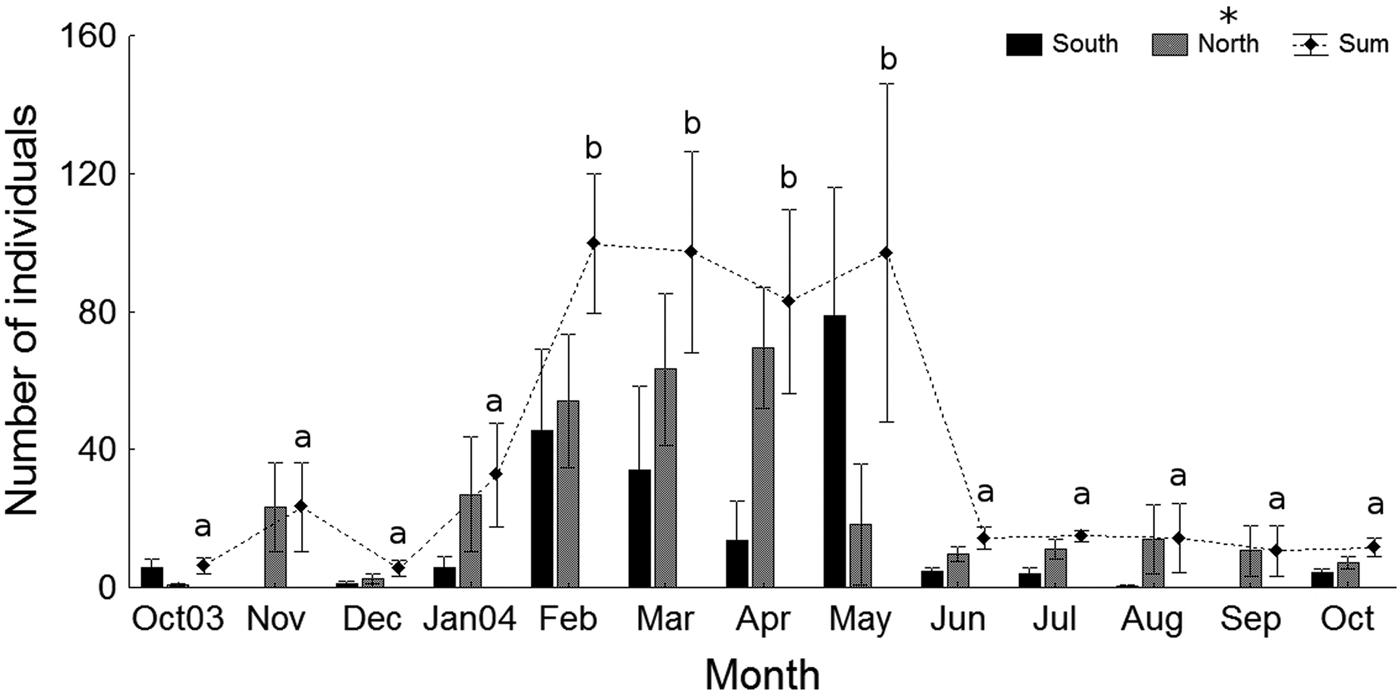
A total of 1526 individuals were collected during the study period. The overall abundance was low, but increased noticeably from mid-summer to mid-autumn (February–May), after which the numbers caught decreased sharply (Figure 2). Despite these temporal fluctuations, the number of individuals tended to behave equally between areas during the study period. In general, the fish were more abundant in the North area (i.e. in 11 of the 13 months), and increased noticeably in the South area only in May 2004. The SRH test indicated significant differences both for months (H = 27.30; df = 12; P = 0.007) and areas (H = 7.46; df = 1; P = 0.006), but no interactions between these factors (H = 14.30; df = 12; P = 0.282).
Spatial and temporal variation in number of individuals (mean ±standard error; α = 0.05) of Larimus breviceps in Caraguatatuba Bight. Individuals were sampled from October 2003 through October 2004. Significant differences are denoted by different letters (months; discriminated by SNK test) or * (areas, discriminated by SRH test).
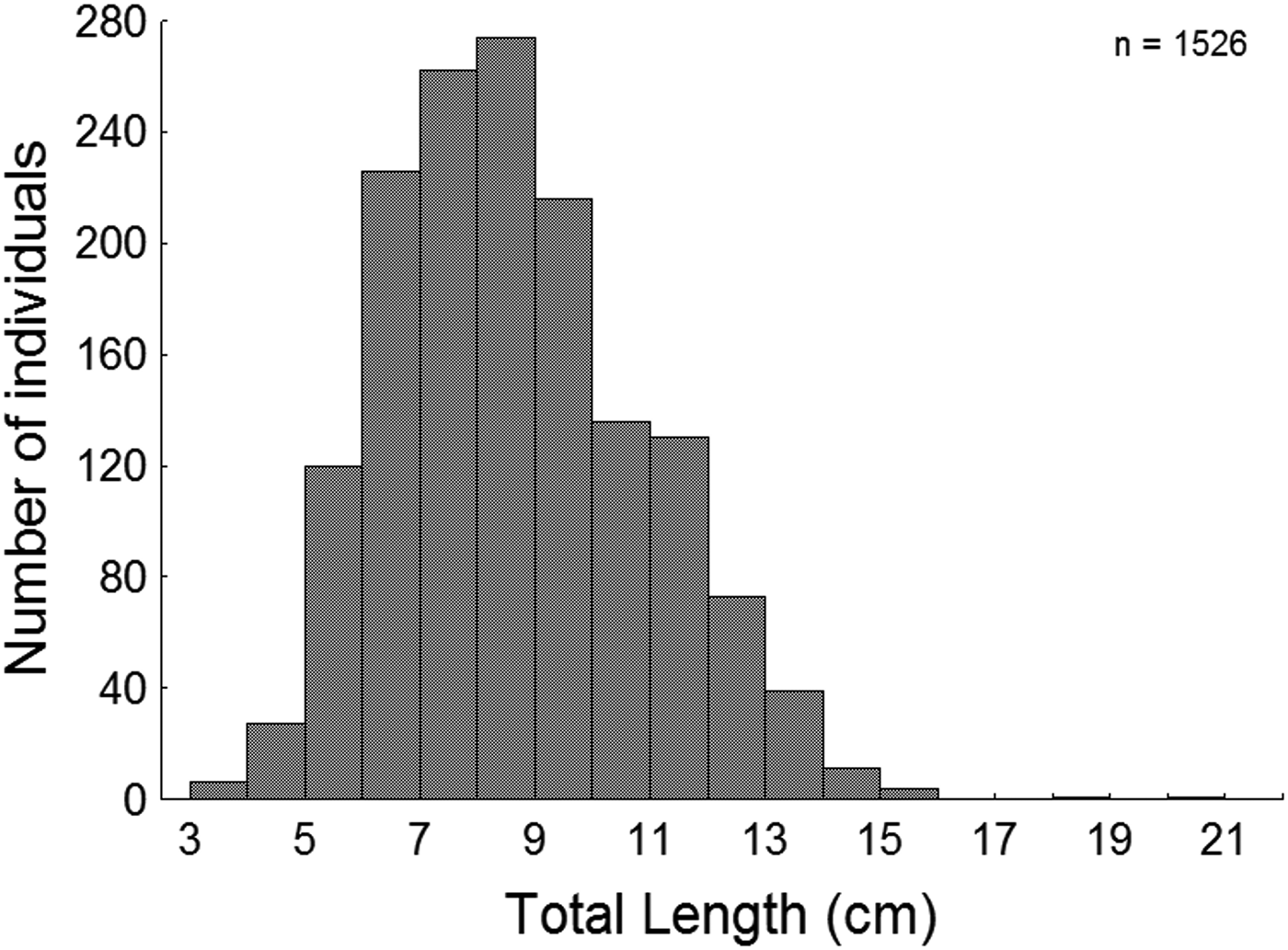
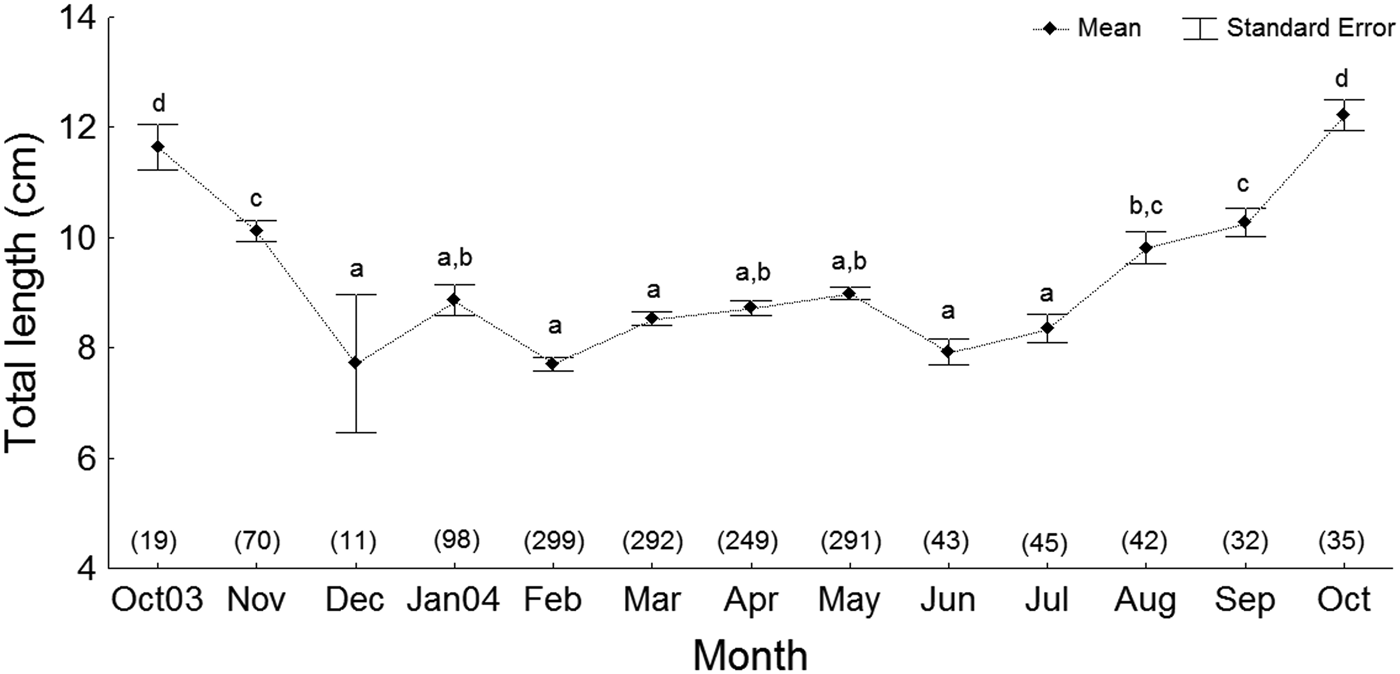
The fish ranged between 3.5 and 20.7 cm in total length (Figure 3), with most individuals between 6.1 and 11.9 cm (10th and 90th percentiles, respectively), and an overall mean length of 8.75 cm (±2.22 cm SD). Mean length differed significantly among months (F = 24.90; df = 12; P < 0.001), but not between areas (t = 1,37; df = 1524; P = 0.029). Mean length was significantly higher in October 2003 and October 2004 (11.64 ± 1.79 cm and 12.21 ± 1.66 cm SD, respectively). From October 2003 on, mean length decreased progressively and significantly to low levels from December 2003 until July 2004 (7.92 ± 1.52 cm SD). After July, mean length increased rapidly to a peak in October 2004 (Figure 4).
Total length (cm) class distribution for Larimus breviceps, sampled in Caraguatatuba Bight from October 2003 to October 2004.
Temporal variation of total length (cm; mean ±standard error; α = 0.05) for Larimus breviceps sampled in Caraguatatuba Bight from October 2003 to October 2004. Different letters denote significant differences among months, discriminated by SNK test; brackets on the x-axis enclose the number of observations in each case.
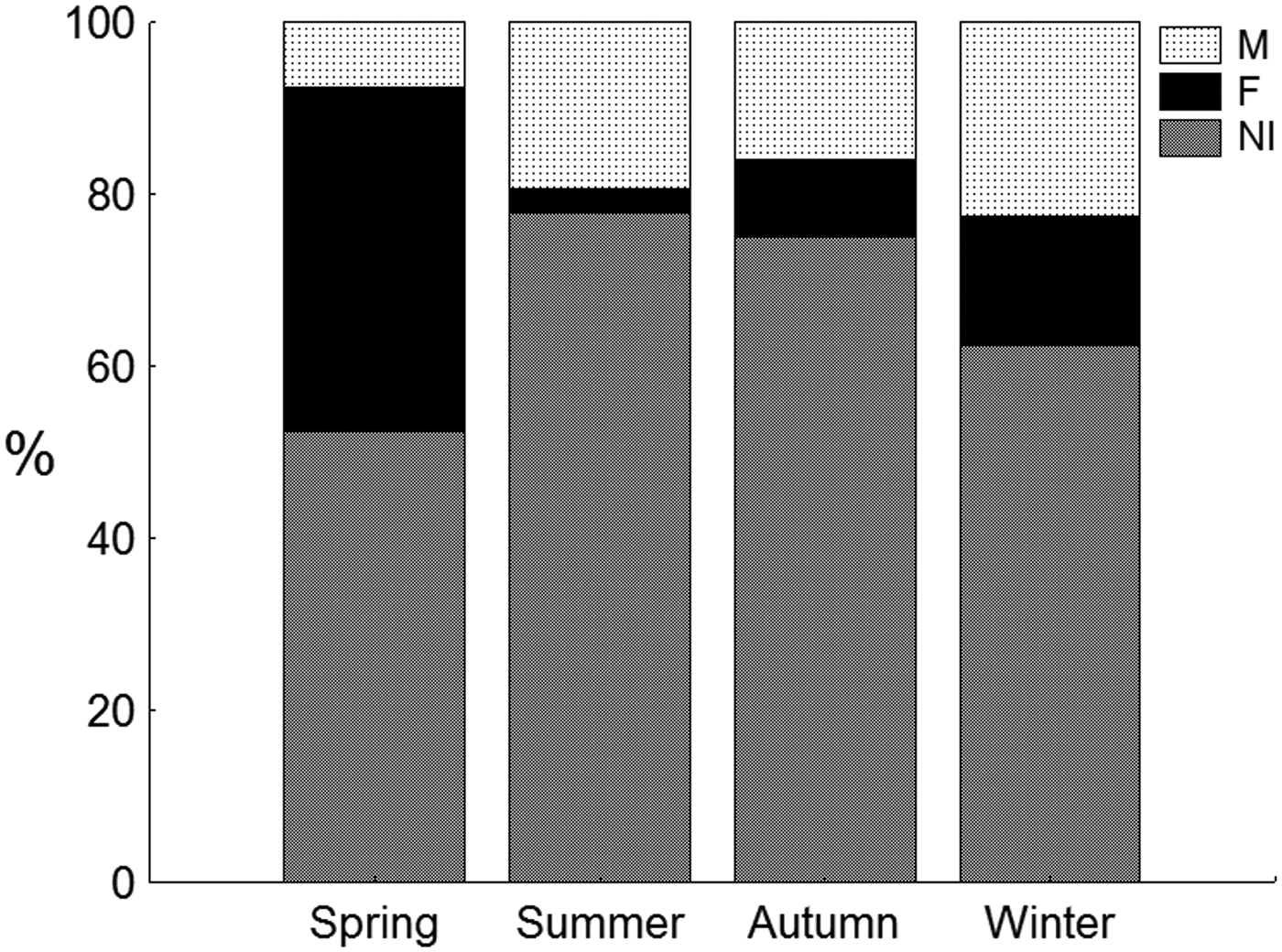
Almost 67% of the fish were immature (gonad Stage A); all others were in the gonad maturation Stage (B), except for a single mature female (Stage C). The proportion of individuals in later stages of gonadal development (B and C) was highest in the spring, reaching almost 50% of individuals, followed by the winter (Figure 5). Except in spring, males were more abundant throughout the study period. However, the small number of individuals with identified sex does not allow precise evaluations of sex ratios (53 of 160 individuals analysed).
Seasonal sexual and gonad proportions of Larimus breviceps, sampled in Caraguatatuba Bight from October 2003 to October 2004. M, Males; F, Females; NI, immature individuals, sex not identified. Of the individuals with identified sex (F or M), all but one mature female (A), identified in spring, were in gonad Stage B (maturing).
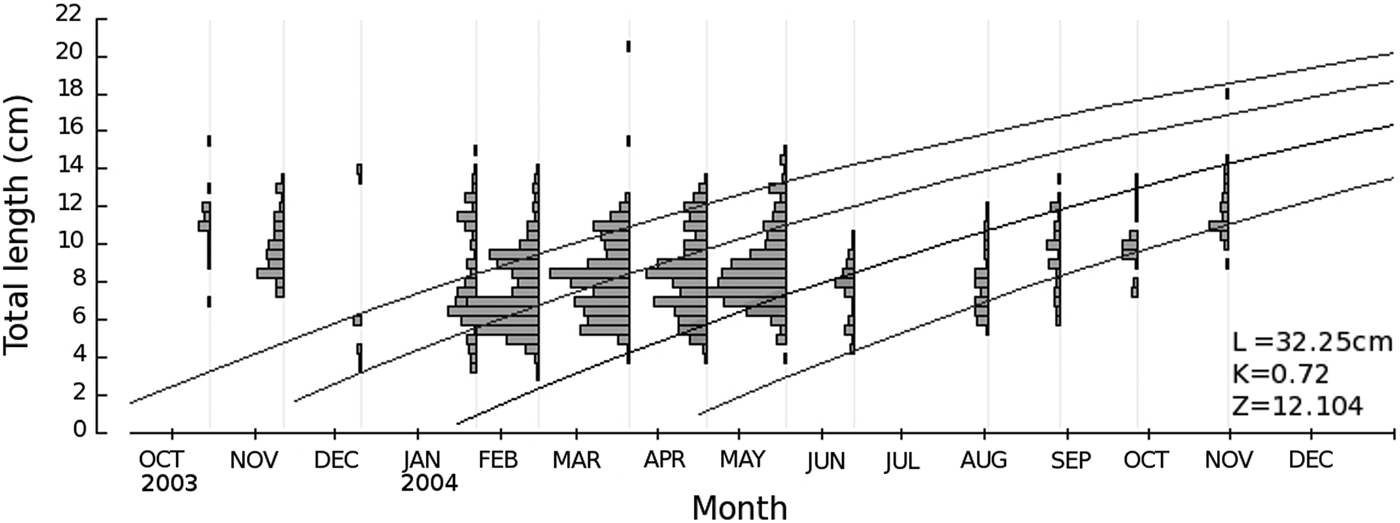
With respect to the life history analysis, ELEFAN and Sheperd's routines for the body growth parameters (VGBM) similarly showed three major peaks of score function, with values of K ranging from 0.1 to about 0.5. The Rn values obtained through the ELEFAN routine were all very low, reaching 0.246 to L ∞ = 29 cm and K = 0.08. This did not seem to correspond to a real population parameter, because this would assume very slow growth for a small short-lived tropical species—which is the same reason why we chose not to use the adaptation of the VGBM to temporal oscillation (see Pauly & Gaschutz, 1979 for more details). Therefore, all possible cohorts were identified visually, and a slope including all of them was considered the most suitable to define the population parameters, i.e. a K value resulting in a curve that applied similarly to all identified cohorts. Based on these analyses, an acceptable range of L ∞ and K was used to determine the best score (Rn). This procedure led to L ∞ = 32.25 and K = 0.72, with Rn = 0.137 (Figure 6). The empirical t 0 was −0.21 and t max 4.38 y. Therefore, individuals would be massively occupying the area from about 0.51 to 0.86 y-old (6.1–11.9 cm, respectively) with a mean age of 0.66 y. The Z total mortality estimate reached 12.104 (SD = 0.595; r 2 = 0.958).
Growth curves fitted for Larimus breviceps individuals, sampled in Caraguatatuba Bight from October 2003 to October 2004. All graphs correspond to the same life history parameters. L ∞, asymptotic total length (cm); K, growth curve parameter; Z, total mortality.
Diet
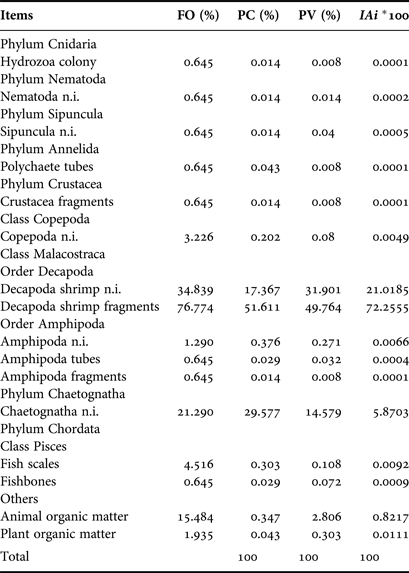
The length of the digestive tube relative to the total length (DTL/TL = 0.50 ± 0.12 cm) shows that this species has a short intestine, compatible with a carnivorous diet. Decapod crustaceans was the most important item; together, whole and fragmentary decapod shrimps reached an overall index of dietary importance of 93%. Whole and fragmented decapod shrimps are shown separately in the analysis, because these categories may represent different ways of foraging. Chaetognatha was the second main item, with an IAi of 5.87%. The other items, which together comprised an index of slightly more than 1%, were mainly represented by Copepoda, Amphipoda and fish scales, in that order of importance. Table 1 lists the full range of items identified. The nematodes, found in both the stomach and intestine portions, were considered parasites, because they showed no signs of digestion.
Items identified in stomach contents of Larimus breviceps (Sciaenidae, Perciformes) collected in Caraguatatuba Bight from October 2003 to October 2004, and the respective general values of: frequency of occurrence (FO), per cent composition (PC), per cent volume (PV%) and index of dietary importance (IAi). n.i., non identified.
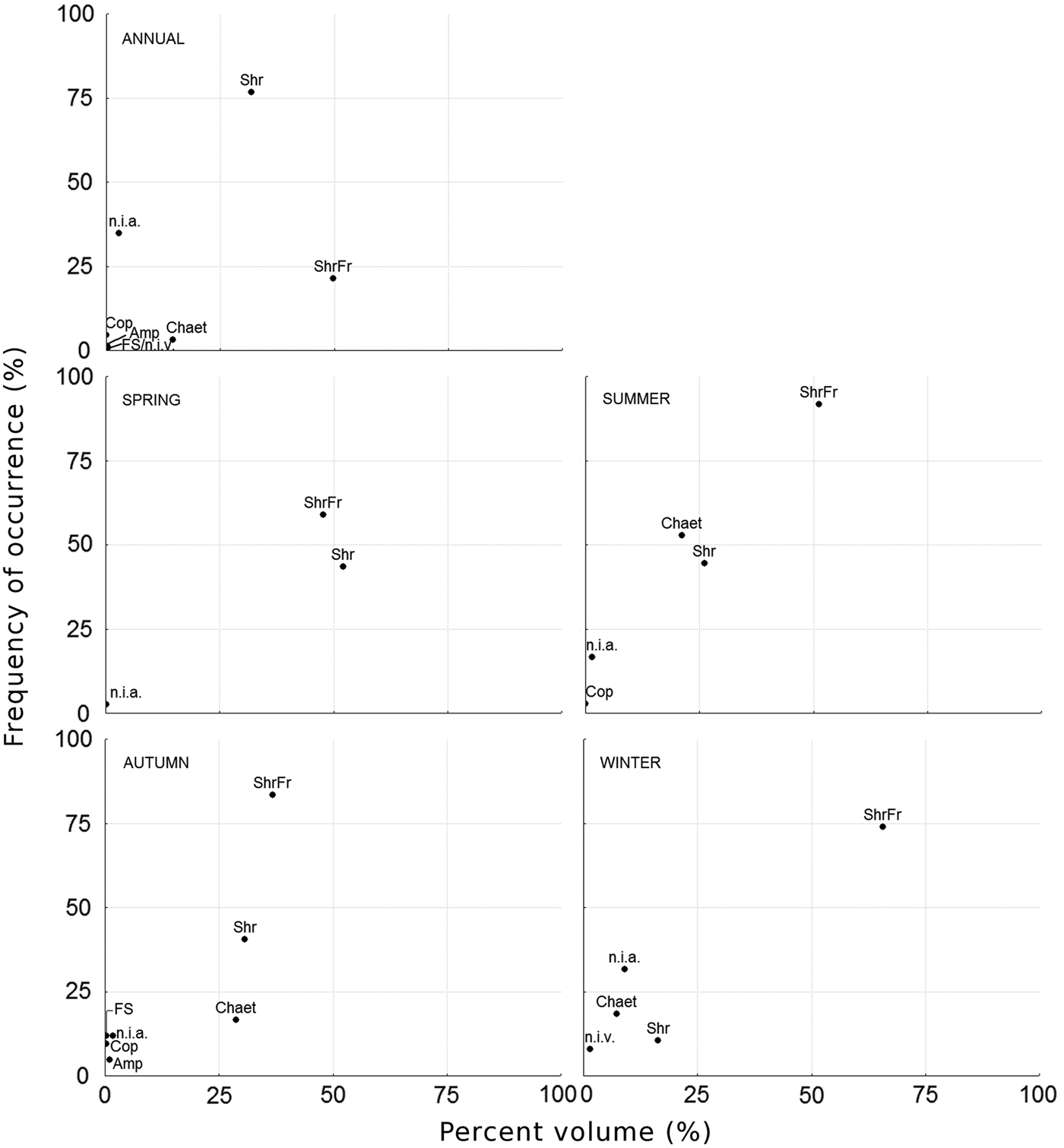
Seasonally, the main items in the stomach occurred less frequently in spring than in the other periods (Figure 7). However, also in spring, the main item, Decapoda, was virtually the only ingested item, either whole or in fragments. Because empty stomachs were not included in the calculation of FO, this means that individuals in spring tended to ingest either one or another. The importance of decapod fragments tended to increase in relation to whole decapods, along with fragments of unidentified animals, from the spring on.
Frequency of occurrence (FO) and per cent volume (PV), annually and seasonally, of stomach items identified for Larimus breviceps (Sciaenidae, Perciformes), collected in Caraguatatuba Bight from October 2003 through October 2004. Abbreviations: Decapoda shrimp (Shr), Decapoda shrimp fragments (ShrFr), Decapoda (Dec), Copepoda (Cop), Amphipoda (Amp), Chaetognatha (Chaet), non-identified decapod fragment (DecFr), non-identified animal (N.i.a.), non-identified plant matter (N.i.v.), fish scales (FS).
The diversity of food items was lowest in spring, increased until autumn, especially due to the occurrence of items such as Copepoda and Amphipoda, and decreased again in winter (Figure 7). Similarly, in summer and autumn, Chaetognatha were considerably more important than the annual quantification reveals. Therefore, the importance of some secondary items was emphasized in seasonal characterizations.
DISCUSSION
Larimus breviceps Cuvier 1830 was one of the most abundant species in Caraguatatuba Bight. The numerical importance of this species along the Brazilian coast varies from among the highest in some studies (Souza & Chaves, Reference Souza and Chaves2007; Freire et al., Reference Freire, Rocha and Souza2009) to rare in others (Giannini & Paiva Filho, Reference Giannini and Paiva Filho1990; Godefroid et al., Reference Godefroid, Spach, Schwarz and Queiroz2003). Here, the population of Larimus breviceps seemed to behave very similarly in both the North and South areas of Caraguatatuba Bight. Although North areas sheltered a higher mean number of individuals, the patterns of fluctuations in abundance over time were virtually the same, and no differences in individual mean size were observed.
The higher number of individuals in the North area could be related to a preference for more-saline waters. Although both areas were selected so as to exclude the influence of rivers, the largest river that discharges into the bight is closer to the South area. This does not explain, though, the peak of abundance in the South area in May 2004.
This pattern of fluctuation in the abundance of the individuals throughout the year was roughly the inverse of the pattern for mean size, with a significantly higher number of individuals and a lower mean length from February to May. Souza & Chaves (Reference Souza and Chaves2007) found that summer was the peak of reproduction for this species at Santa Catarina in southern Brazil. Therefore, the large influx of younger individuals in Caraguatatuba Bight may reflect a period of intense recruitment. A small influx of juvenile individuals was noted in December, but this influx peaked in February and remained high until May. During this period, not only the newly arrived individuals remained in the area, but the influx of the youngest fish continued. These individuals would be about 4 cm long when they enter the bight, remaining there until they reach about 9 cm. In relation to the gonad analysis, the results, which showed primarily A and B stages, indicate that potentially reproductive adults are remaining outside the bight, probably in deeper areas. According to Chao (Reference Chao and Fischer1978), this species may occur on shallow-water muddy-bottoms and in estuaries, to a depth of 60 m. Thus, our data reinforce the importance of this bight as a nursery region, because the fish need this area for the late development of the juveniles.
Size segregation immensely complicates life history studies, because of the cost of the enormous sampling efforts that would be necessary to cover the entire area of distribution of a species. For growth analysis, the lack of the smallest and/or largest modes, and the constancy of a main mode that does not represent the same cohort may seriously bias the calculation of parameters. However, in this study, it was possible to observe more than one modal progression, and all of them indicated a similar growth rate of the individuals in the area. Also, the value used for asymptotic length was based on the literature, because this species may reach 31.0 cm in total length (Cervigón et al., Reference Cervigón, Cipriani, Fischer, Garibaldi, Hendrickx, Lemus, Márquez, Poutiers, Robaina and Rodríguez1992). The results found by Ross (Reference Ross1988) for the congeneric L. fasciatus showed a K value of 0.98 and t max of 4 y, similar to the present estimates for L. breviceps, a high growth constant (K = 0.72) and maximum age of 4.38 years. A growth performance index, known as φ′, is a better parameter for comparison between species/populations, because it relativizes both K and L ∞, which are dependent on one another (log K + 2*log L ∞; Vakily, Reference Vakily1988). This means a growth performance index of 2.87 for L. breviceps, and 2.49 for L. fasciatus. In contrast, the total mortality index (Z) found for L. fasciatus was 1.44, against 12.10 found here for L. breviceps. The extremely high value for Z estimated here clearly comprises not only individuals that are dying, but also, and mainly, individuals that are out-migrating. Therefore, although the growth analyses were based on a limited size range, the values found for these parameters seem very reasonable and consistent with the population dynamics.
The preference for crustaceans is well known for Larimus breviceps along the Brazilian coast; these fish consume mainly sergestid shrimps, but also peneoids, mysids, copepods, anomurans and others (Teixeira et al., Reference Teixeira, Falcão and Melo1992; Comelli, Reference Comelli2000; Soares & Vazzoler, Reference Soares and Vazzoler2001). This variety of ingested crustaceans, however, leads to inconclusive discussions about the foraging habits of the species, because prey may be either benthic (e.g. Anomura, Brachyura) or pelagic (e.g. Copepoda, Mysida and Penaeoidea).
For congeneric species, (López-Peralta & Arcila, Reference López-Peralta and Arcila2002) showed that Larimus pacificus, a pelagic species, fed mainly upon the engraulid fish Anchoa sp. (87% of composition) but also on benthic stomatopod crustaceans. Ross (Reference Ross1989) found 42 food items for L. fasciatus, of which mysids, sergestids, calanoid copepods, fish remains and chaetognaths were the most important, indicating that the species is an opportunistic plankton feeder.
A shift in feeding habits during the ontogenic development of L. breviceps was observed by Moraes (Reference Moraes2004): larger individuals tended to ingest pelagic organisms, while the smaller ones (<12.9 cm TL) had a diet composed of both benthic and pelagic elements. Similarly, smaller individuals of the congeneric L. fasciatus preyed on calanoid copepods, and larger ones on the sergestid Acetes americanus (Ross, Reference Ross1989). The data from Caraguatatuba Bight do not allow discussion of ontogenic changes in the diet of L. breviceps, due to the dominance of late-juvenile individuals. However, the wide variety of small/medium-sized dietary items found for the fish in this size range accords with observations by other investigators.
Jucá-Chagas (Reference Jucá-Chagas1997) calculated the ‘flatness’ index for L. breviceps, showing a relatively low mobility for this fish, suggesting benthic feeding habits. Soares (Reference Soares2003), in turn, found a low similarity between the diets of L. breviceps and Isopisthus parvinipis, which have pelagic habits, but a higher similarity to the detritivores Micropogonias furnieri and Paralonchurus brasiliensis. Teixeira et al. (Reference Teixeira, Falcão and Melo1992), based on the high frequencies of pelagic crustaceans in the stomach contents of fish ranging from 1.1 to 10.8 cm, considered L. breviceps as a micro-macrozooplankton feeder. Comelli (Reference Comelli2000), however, suggested that the high consumption of pelagic and fast-swimming prey, such as the pelagic sergestid shrimp Acetes americanus, may be stimulated by their small sizes and high abundances in the environment. This author suggested a filter-feeding habit for L. breviceps, based on the morphological characteristics including the width and protrusion of the mouth, the intestinal index and the number of pyloric ceca.
The fish scales, unidentified organic matter, and the large amount of decapod fragments observed in the present study cannot be taken into account to discuss the foraging habit, because they could derive from a detritivorous feeding habit, but also from a diel change in feeding activity. Feeding in low frequencies on fish was reported by some authors for L. breviceps (Moraes et al., Reference Moraes, Oliveira-Silva and Lopes2001; Soares & Vazzoler, Reference Soares and Vazzoler2001; Teixeira et al., Reference Teixeira, Falcão and Melo1992). For example, Moraes et al. (Reference Moraes, Oliveira-Silva and Lopes2001) observed that one individual measuring 15.4 cm had ingested two fish measuring 2.33 and 2.53 cm. In general, the presence of scales and fishbones is attributed to the ingestion of whole fish, but in Caraguatatuba Bight, because only scales were observed and the individuals are mainly small-sized, they probably were not preying on whole fish. On the contrary, this may indicate either a lepidophagic or detritivorous habit. According to Comelli (Reference Comelli2000), however, the former possibility would be less likely, since the protruding mandible of L. breviceps does not seem to be strong enough to extract the scales. The relatively high frequency of decapod fragments and unidentified animal matter could indicate a detritivorous behaviour; however, this could also result from an advanced degree of digestion, which greatly hampers the identification of food items (López-Peralta & Arcila, Reference López-Peralta and Arcila2002). Because our samples were taken during the day, the latter suggestion is supported by the findings of Soares & Vazzoler (Reference Soares and Vazzoler2001), who observed that this fish is most active at dusk and secondarily at night, on the São Paulo coast of Brazil. Also, Ross (Reference Ross1989) stated that L. fasciatus is more likely to be a nocturnal or low-light-intensity feeder. On the other hand, Lopes & Oliveira-Silva (Reference Lopes and Oliveira-Silva1999) suggested a sequential feeding pattern for L. breviceps on the Pernambuco coast in Brazil, with constant searching and ingestion of small quantities of food. However, this behaviour would also result in at least some items being in an advanced state of digestion.
We observed the presence of planktonic items (Chaetognatha, Copepoda), and also of bottom-associated animals (Amphipoda, Sipuncula), as less important dietary items. Associated with the fact that the main item ingested was pelagic decapods, two hypotheses seem most reasonable. First, L. breviceps has mainly a pelagic feeding behaviour, but its proximity to the bottom would easily lead to accidental ingestion of benthic items during any resuspension event. Second, a daily migration in the water column would lead to the ingestion of both pelagic and benthic items, i.e. during the main feeding period the species would be feeding in the pelagic strata.
The present results indicated slight seasonal variations in the diet of L. breviceps and the perceptible ones, although on a small scale, similar to the description by Ross (Reference Ross1989) for the congeneric L. fasciatus. Ross (Reference Ross1989) found that copepods were more important during winter, mysids during spring and summer, sergestids during summer and autumn and chaetognaths in autumn. The diversity and amount of prey items are very likely to be driven by the influence of drier and rainy periods, especially in a coastal area such as the bight. Here, the drier periods are represented by spring and winter, seasons that showed a lower diversity of ingested items. It is worth considering, also, a seasonal shift among decapod species may have occurred, which was not detected by the taxonomic resolution of the prey identified.
When seasonal variations are observed in the diet, annual quantification may underestimate the importance of some items, because some of them may be considerably important during some seasons, but with their overall importance greatly reduced by heavier items and/or those that are present year round. Here, Chaetognatha may be taken as an example, because their importance was considerably higher in summer and secondarily in autumn, but considerably lower overall.
ACKNOWLEDGEMENTS
Essential logistical support was provided by the Instituto Costa Brasilis—Desenvolvimento Sócio-Ambiental and by the Centro Universitário da Fundação de Ensino Octávio Bastos. We are grateful to A.P. Majer, G.M. Dias, and C.G.M. Delboni for their assistance in the fieldwork.
FINANCIAL SUPPORT
This study was partially financed by the Fundação de Amparo à Pesquisa do Estado de São Paulo (FAPESP) within the Biota/FAPESP—The Biodiversity Virtual Institute Program (www.biota.org.br). We also thank FAPESP for the ‘Programa Jovem Pesquisador em Centro Emergente’ grant offered to M.R.D. (Proc. Nos. 05/60041-6 and 06/57575-1). The Project Aware Foundation and the Padi Foundation also financed part of this research.