Introduction
High temperature is an environment that many functional and structural materials, including ceramics, oxides, and metals, undergo during synthesis, processing, testing, and service. Often, one or more other environments are combined with high temperatures, such as mechanical, corrosive, magnetic, electric, and radioactive environments. Under such extreme stimuli/perturbations, both crystallographic and morphological changes occur, such as phase transformation, ordering and disordering transition, magnetic transition, recrystallization, coarsening, phase segregation, precipitation, slip, dislocation, twinning, grain reorientation, and straining.
Having an understanding of materials properties and behaviors in such environments is vital for materials design, performance, reliability, and efficiency in terms of cost, environment, and safety. Recent advances in modern instrumentation and methodologies enable unprecedented capabilities in both spatial and temporal scales. Compared to traditional postmortem tools that provide static and limited data of material changes, in situ crystallographic characterization of materials yields time- and spatial-resolved data and information when materials are under external stimuli. This leads to a better understanding of scientific phenomena that are process-, condition-, and time-dependent.
Neutrons, compared to electrons and photons, have several unique advantages for probing material bulk properties and behaviors within extreme environments. A neutron scatters by interaction with nuclei, and its elemental scattering power is independent of elemental periodic order. It has great sensitivity to lightweight elements and is able to differentiate elements with near-atomic position such as transition metals, and even isotopes. Neutrons are heavy and penetrating compared to electrons and x-rays, allowing for the easy implementation of complex sample environments. Neutrons are also sensitive to magnetism. Although neutron flux is relatively low compared to synchrotron sources, modern neutron sources such as the Spallation Neutron Source (SNS) at Oak Ridge National Laboratory (ORNL), the world’s most intense pulsed neutron source, have been able to produce much higher neutron brightness with an increase of several orders of magnitude than prior generation sources. With the high flux neutrons, advanced instrumentation, and complex sample environments, neutron instruments have become one of the most powerful modern tools for materials with great impact in both fundamental research and applied development.
The VULCAN instrument
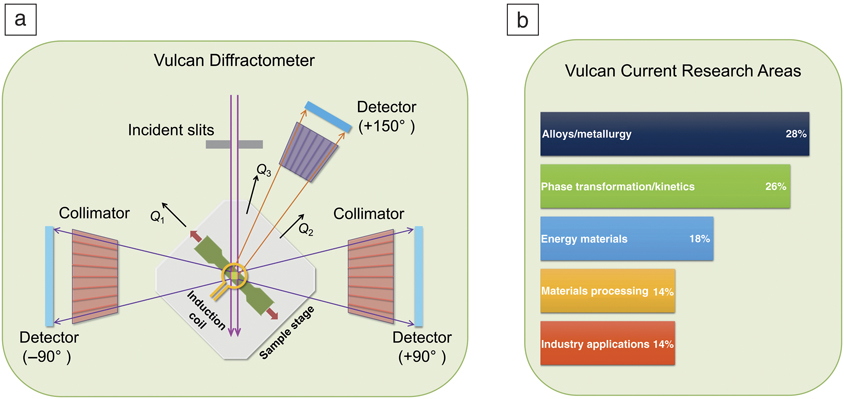
The VULCAN instrumentReference An, Skorpenske, Stoica, Ma and Wang1,Reference Calder, An, Boehler, Dela Cruz, Frontzek, Guthrie, Haberl, Huq, Kimber, Liu, Molaison, Neuefeind, Page, dos Santos, Taddei, Tulk and Tucker2 at SNS is a time-of-flight materials science and engineering diffractometer. As schematically shown in Figure 1a, the motorized incident slits allow selectable apertures for the incident neutron beam. It is equipped currently with three two-dimensional detector banks, located at +/–90° and 150° off the incident neutron beam and 2 m from the sample position. A gauge volume (ranges from 1–600 mm3) inside a large structure under different sample environments is defined by the intersection of the incident beam and the field of view of radial collimators in front of the detector banks. The detector banks measure different directional crystallographic information along the bisector of the incident beam and the scattering direction of each detector.
The setup and research on VULCAN. (a) A schematic of the experimental layout (Q 1, Q 2, and Q 3, are the scattering vectors for –90°, +90°, and +150° detectors, respectively), and (b) current research areas from user community proposals.

The sample stage supports robust sample environments and engineering structures for in situ characterization and mapping scans. Various sample environments with individual or combined fields can be mounted on VULCAN for in situ measurements. For example, high-temperature standalone furnaces with either a controlled atmosphere or vacuum could enable heating up to 1600°C. The VULCAN load frame and auxiliary induction heating coils enable thermomechanical testing/processing. A resistive heating gas enclosure load frame furnaceReference An, Armitage, Yu, Dickson, Mills, Feng and Skorpenske3 has been developed with conductive heating rates of up to 600°C/s. We have also demonstrated the use of neutron electrostatic levitation facility for high-temperature liquids.Reference Mauro, Vogt, Derendorf, Johnson, Rustan, Quirinale, Kreyssig, Lokshin, Neuefeind, An, Wang, Goldman, Egami and Kelton4
In the SNS, the acquired neutron data are registered by the time-event mode,Reference Granroth, An, Smith, Whitfield, Neuefeind, Lee, Zhou, Sedov, Peterson, Parizzi, Skorpenske, Hartman, Huq and Abernathy5 where individual neutrons are time-stamped, and VULCAN often operates in a real-time continuous neutron data collection mode during in situ parametric studies. Data chopping/slicing by different time bins can be performed by using VDRIVEReference An6 (VULCAN Data Reduction and Interactive Visualization softwarE) based on required data statistics and synchronized with sample environment parameters. The time bin for a diffraction pattern spectrum with sufficient statistics depends on the gauge volume, size of samples, and elemental compositions as well as crystallographic structures. For common Fe- or Ni-based alloys, typical measurement time with ∼250 mm3 gauge volume can be as short as 1 s for phase transformation studies, which is comparable to high-energy synchrotron x-rays. The time interval can be reduced to milli- or microseconds by using a larger beam size or stroboscopic approaches,Reference An, Armitage, Yu, Dickson, Mills, Feng and Skorpenske3 respectively.
VULCAN enables in situ crystallographic understanding or characterization of phenomena such as phase transformation,Reference Chen, Yang, Ren and An7–Reference Yu, Feng, An, Zhang, Specht, Chen, Wang and David9 site elemental occupancies,Reference Chen, Rangasamy, Lang and An10,Reference Wang, Chen, Fang, Zhang, Tang, An, Brinkman and Chen11 atomic-level ordering or disordering,Reference Cai, Liu, An and Liang12–Reference Radecka, Coakley, Jones, Rugg, Lindley and Dye14 kinetics of recrystallization,Reference Stoica, Dessieux, Stoica, Vogel, Muralidharan, Radhakrishnan, Gorti, An, Ma and Wang15 elastic anisotropy,Reference Stoica, Stoica, Miller and Ma16,Reference Lugovy, Aman, Chen, Orlovskaya, Kuebler, Graule, Reece, Ma, Stoica and An17 texture,Reference Stoica, Stoica, An, Ma, Vogel, Carpenter and Wang18,Reference Liu, Wu, Stoica, Xie, Wu, Gao, Bei and An19 elastoplastic load sharing,Reference Yu, Bei, Chen, George and An20 stacking-fault probabilityReference Xie, Chen, Yang, Zhao, Wang and An21,Reference de Bellefon, Gussev, Stoica, van Duysen and Sridharan22 and twinning,Reference Xie, Chen, Yang, Zhao, Wang and An21,Reference Wu, An, Huang, Lee and Liaw23–Reference Xie, Pei, Liang, Yu, Zhao, Yang, Li, Eisenbach and An26 strengtheningReference Yu, Bei, Chen, George and An20 and hardening,Reference Yu, An, Chen and Chen27 plasticity mechanisms,Reference Fu, Bei, Chen, Liu, Yu and An28,Reference Wang, Chen, Mu, Zhu, Zhang, Wang and An29 shape-memory effects,Reference Benafan, Noebe, Padula, Gaydosh, Lerch, Garg, Bigelow, An and Vaidyanathan30–Reference Wang, Mu, Chen, Qi, Wu, Wang, Xu, Zhang and An34 piezoelectric effects,Reference Maurya, Murayama, Pramanick, Reynolds, An and Priya35 and batteriesReference Wang, An, Cai, Feng, Nagler, Daniel, Rhodes, Stoica, Skorpenske, Liang, Zhang, Kim, Qi and Harris36–Reference Liu, Fell, An, Cai and Meng38 under external stimuli. As shown in Figure 1b, current research covers diverse science and engineering fields, where metallurgy and phase transformation/kinetics are the lead areas that account for more than one-half of the total conducted research. In addition, VULCAN has attracted the engagement of industry in using neutrons. While VULCAN is capable of tackling various problems, here we specifically highlight its scientific high-temperature capabilities in studies of functional materials and structural alloys, as well as additive manufacturing (AM).
High-temperature solid-state synthesis and processing
High-temperature solid-state synthesis or thermal processing can involve reversible, simultaneous, and complex processes among multiple species of reactants that are hard to monitor. The thermal treatment that controls chemical transportation and structural transition tunes materials performance, and thermal stability is also of importance for material applications. In situ high-temperature neutron diffraction (HTND) is capable of differentiating between multiple phases and evolutions, thus offering a direct tool to reveal the synthesis mechanism and aid the process optimization for producing target compounds.
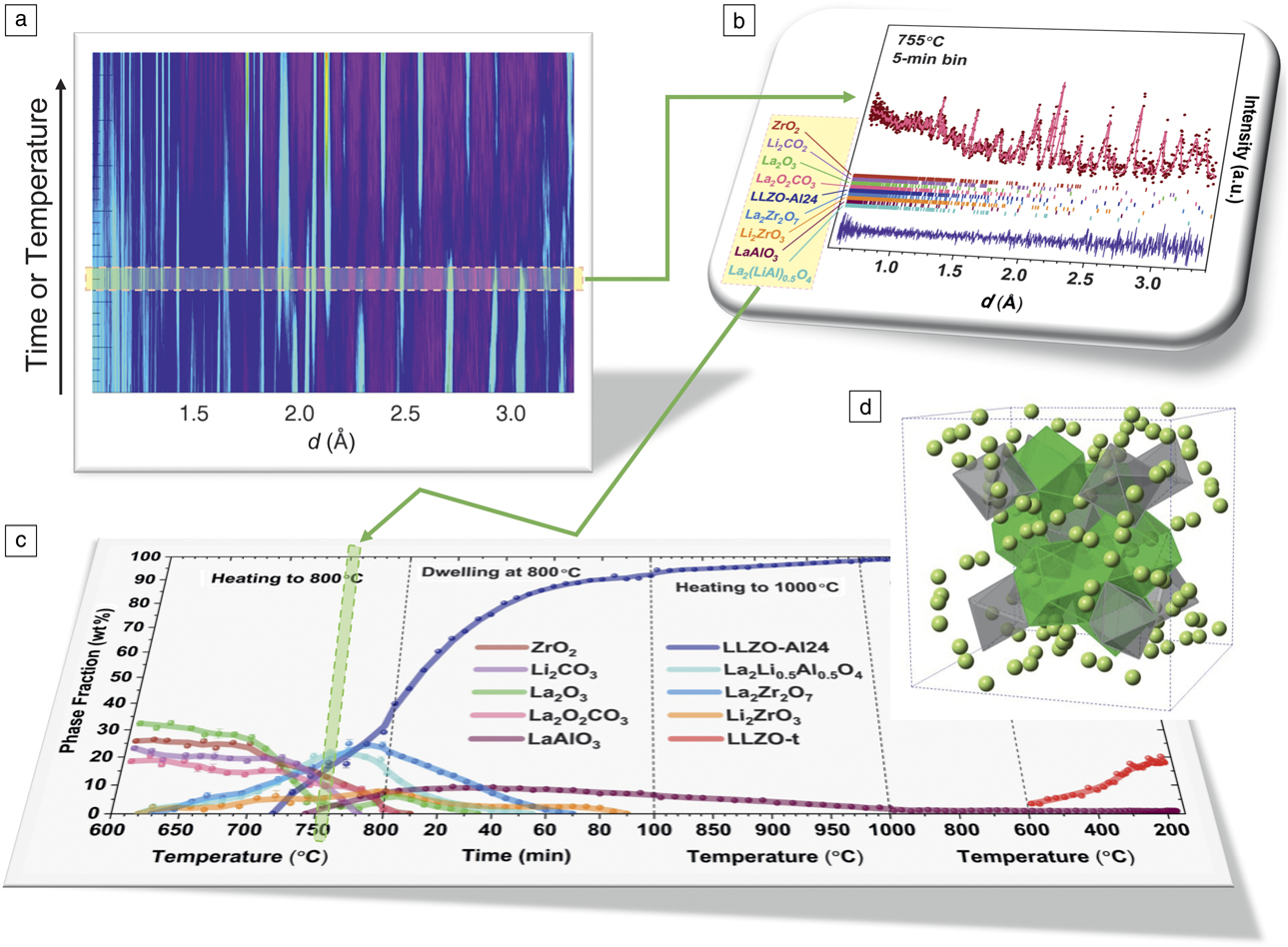
Figure 2Reference Chen, Rangasamy, dela Cruz, Liang and An39 shows an example where by tracking the reaction and kinetics among multiple (up to nine) phases in the synthesis of the Li-ion solid electrolyte Li7La3Zr2O12 (LLZO), HTND revealed the appearance of essential intermediate phases before the final cubic LLZO was formed. Minor dopants can thus be utilized to alter the intermediate phases and reaction kinetics, in order to stabilize the cubic LLZO upon cooling. In addition, the natural sensitivity of neutrons to light elements offers a unique capability of understanding the mechanism at the atomic scale and reveals how Li vacancies were distributed in the doped LLZO. It was discovered that not all vacancies contribute to Li transportation in the solid; only the active vacancy density determines the three-dimensional (3D) Li conduction pathway, which can be tuned by engineering the dopant valence and concentration.Reference Chen, Rangasamy, Lang and An10
An in situ neutron work flow is demonstrated for the solid-state synthesis of Al-doped Li7La3Zr2O12 (LLZO-Al24) at high temperatures. (a) Neutron diffraction intensity contour plot versus lattice spacing (denoted by d) and time/temperature visualizes the phase evolution during synthesis. (b) An instant neutron diffraction pattern (5-min time bin) and Rietveld refinement identifies and quantifies the multiple phases at 755°C. (c) Refinement results of all instant neutron patterns reveal the mechanism and kinetics of LLZO-Al24 synthesis. (d) A schematic of the LLZO-Al24 garnet crystal structure shows the Li transport tunnels (green spheres indicating Li sites), as well as ZrO6 polyhedra (gray) and LaO8 polyhedra (green) in the framework.Reference Chen, Rangasamy, dela Cruz, Liang and An39

Furthermore, neutrons can differentiate between transition metals and isotopes. For example, the LiNi0.5Mn1.5O4 spinel oxide is a high-voltage cathode material for Li-ion batteries in which the Ni and Mn arrangement influences the electrochemical performance.Reference Chen, Cheng, Li, Feygenson, Heller and Liang13 The high contrast of Ni and Mn to neutrons enables quantification of the subtle ordering process when annealing at 700°C and a reversible structural transition to a rock-salt phase at higher temperatures.Reference Cai, Liu, An and Liang12 The migration pathways of transition-metal ions among octahedral sites were found to use the tetrahedral vacancies as intermediate sites.Reference Xu, Qin, Ren, Cai, An, Amine and Chen40
The unique neutron capabilities of VULCAN have been exploited to understand functional material behaviors at high temperatures in a wide range of research areas, such as intermediate-temperature solid-oxide fuel-cell materialsReference Yang, Matthews, Xu, Chen, An, Ma and Huang41,Reference Yang, Wang, Chen, An, Ma, Vogt and Huang42 and composites,Reference Chen, Yang, Ren and An7 and thermoelectric materials.Reference Ren, Schmidt, Keum, Qian, Case, Littrell and An43,Reference Ren, Schmidt, Case and An44
High-entropy alloys
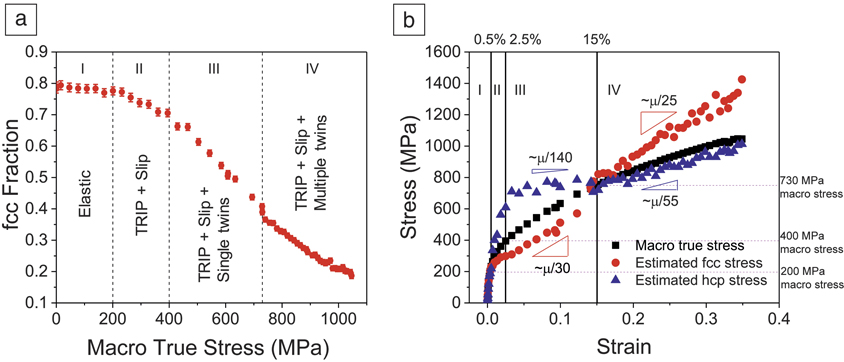
High-entropy alloys (HEAs) are based on a novel alloy design concept—a solid solution with five or more principal elements that each has a large concentration of 5∼35 at.%, thus possessing a high mixing entropy.Reference Yeh, Chen, Lin, Gan, Chin, Shun, Tsau and Chang45 With a disordered global structure, an HEA possesses both high strength and high ductility at room temperature and elevated temperatures.Reference Lee, Song, Gao, Feng, Chen, Brechtl, Chen, An, Guo, Poplawsky, Li, Samaei, Chen, Hu, Choo and Liaw46 VULCAN can be used to reveal phase-specific and crystal-plane-specific lattice responseReference Wu, Liu, Wang, Ma, Stoica, Nieh, He and Lu47 upon external heat and stress stimuli as a direct approach to investigate HEA formation, structure, physical properties, and performance over a wide temperature range. The structure–property relationship can be rapidly investigated. Plastic deformation mechanisms involving dislocations, stacking faults, twinning, phase transformation, and preferred grain orientation at different hardening stages can be elucidated by in situ neutron diffraction (e.g., by the transformation induced plasticity (TRIP) HEA in Figure 3).Reference Fu, Bei, Chen, Liu, Yu and An28
The staged deformation mechanisms and local phase stress and hardening revealed through neutron diffraction in a transformation induced plasticity (TRIP) high-entropy alloy. (a) The staged dominant deformation mechanisms are revealed in a TRIP high-entropy alloy. (b) The phase-specific stress–strain behaviors of each phase. The stress of face-centered-cubic (fcc) and hexagonal close-packed (hcp) phases can be calculated by multiplying the lattice strain (change in lattice parameter) and diffraction elastic constant. The phase-specific work-hardening rates μ are determined by the curve slopes and the triangles. The macro stresses and strains at the onsets of the stages are indicated. The results of these phase-specific deformation behaviors show that continuous fcc–hcp transformation and hcp phase work hardening contribute to the bulk work hardening.Reference Fu, Bei, Chen, Liu, Yu and An28

HTND was used to measure lattice parameter changes and the coefficients of the thermal expansion (CTE) of a family of Ni-containing single-phase solid-solution alloys with a change in entropy through the addition of more elements. The results confirm the estimation of the CTE by the quasi-harmonic approximation calculation with an error less than ∼0.2%,Reference Jin, Mu, An, Porter, Samolyuk, Stocks and Bei48 except for the case of Ni-20Cr, which was slightly underestimated by ∼1%. The family of Ni-containing solid solutions exhibited similar CTEs, with the exception of strong magnetostriction effects for NiFe and NiCoFe in their ferromagnetic state; NiCoFeCrMn shows slightly higher CTE compared to others in this work.
During deformation, dominant plastic deformation mechanisms transition from one to the other, which is affected by both the temperature and straining ranges. Under uniaxial tension of NiCoFeCrMn HEA strengthened by carbon addition,Reference Liu, Gao, Bei and An49 HTND showed the early stages of plastic deformation, where dislocation slip dominated the deformation behavior with little temperature dependency. However, under larger plastic strain, the deformation was governed solely by microbands at an elevated temperature while it was mediated simultaneously by deformation twins and microbands at room temperature.
HEA refractory alloys show promising high strength and ductility.Reference Lee, Song, Gao, Feng, Chen, Brechtl, Chen, An, Guo, Poplawsky, Li, Samaei, Chen, Hu, Choo and Liaw46,Reference Huang, Wu, He, Wang, Liu, An and Wu50–Reference Senkov, Wilks, Scott and Miracle52 Micromechanics neutron measurements by measuring the change of crystal-plane-specific or hkl-specific lattice strains (h, k, and l are Miller indices denoting the crystal plane) during deformation showed that dislocation slip dominated the plastic deformation in a homogenized refractory NbTaTiV HEA,Reference Lee, Song, Gao, Feng, Chen, Brechtl, Chen, An, Guo, Poplawsky, Li, Samaei, Chen, Hu, Choo and Liaw46 and in situ neutron diffraction presented clear evidence of body-centered-cubic (bcc) to hexagonal close-packed (hcp) transformation and hcp and bcc micromechanical lattice strains behavior in the brittle-to-ductile deformation transition in tailored bcc TaHfZrTi HEAs.Reference Huang, Wu, He, Wang, Liu, An and Wu50
Superalloys
Superalloys including Ni-based, Fe-based, and Co-based alloys in single-crystalline, polycrystalline, or composite form are important high-temperature structural materials. They are widely used in aerospace, nuclear power generation, chemical, and petroleum industries. The understanding of their high-temperature behaviors is vital for energy efficiency, reliability, and safety. Neutron measurements of the bulk materials reveal changes in elastic constant and anisotropy,Reference Yan, Coakley, Vorontsov, Jones, Stone and Dye53 misfit,Reference Huang, An, Gao and Suzuki54 rafting,Reference Coakley, Lass, Ma, Frost, Seidman, Dunand and Stone55 phase stress sharing,Reference Huang, Gao, An, Zheng, Wu, Teng and Liaw56–Reference Yu, An, Chen and Bei58 strengthening, and creep deformation mechanismsReference Coakley, Lass, Ma, Frost, Stone, Seidman and Dunand59 over short- or long-term mechanical testing at both ambient and elevated temperatures, and developmentReference Yu, An, Chen and Bei58 and relaxation of residual stressReference Aba-Perea, Pirling and Preuss60 in thermomechanical treatments. Experimental micromechanical data from crystallographic measurements provide basic knowledge of high-temperature structural material behavior, accelerate alloy design, and yield direct experimental verification of predictive models of material and structure performance.
Additive manufacturing
AM or 3D printing of metals enables layer-by-layer fabrication of complex structuresReference Thompson, Bian, Shamsaei and Yadollahi61 using aluminum, stainless steel, titanium, and superalloys. The local rapid thermal and mechanical processes induce buildup of residual stress, distortion, metastable phases, and heterogeneous microstructure and texture, which inevitably impact the structural mechanical integrity in applications. Fundamental physical properties and engineering parameters, which govern the mechanical performance, need to be evaluated nondestructively. VULCAN probes the development of residual stress for essential computational model validation,Reference An, Yuan, Dial, Spinelli, Stoica and Gao62,Reference Wang, Denlinger, Michaleris, Stoica, Ma and Beese63 bulk texture measurementsReference Ma, Stoica, Wang and Beese64 for the development of elastic anisotropy,Reference Wang, Stoica, Ma and Beese65 hardeningReference Huang, Lee, Jain, Tong, An, Tsou, Lam, Yu, Chae, Chen, Chen and Chou66 and deformation in printed 3D structures,Reference Cakmak, Kirka, Watkins, Cooper, An, Choo, Wu, Dehoff and Babu67 and abnormal high-temperature deformation behaviors, as compared to traditionally manufactured alloys.Reference Beese, Wang, Stoica and Ma68
VULCAN has seen continuous increases in demand for characterizing AM samples and structures fabricated from different alloys and their changes during and after heat treatments. The high-flux neutrons and instrument layout enable rapid lattice strain mapping deep inside structures with small voxels and simultaneously reveal heterogeneous distribution of the local phase and grain orientation texture in additively manufactured structures. Rapid time-dependent and nonequilibrium phenomena such as diffusion or phase transition can be observed directly or stroboscopically by native time-event data collections on the instrument. In addition, by combining neutron diffraction with neutron imaging,Reference Song, Lin, Bilheux, Xie, Santodonato, Molaison, Skorpenske, Dos Santos, Tulk, An, Stoica, Kirka, Dehoff, Tremsin, Bunn, Sochalski-Kolbus and Bilheux69–Reference Watkins, Bilheux, An, Payzant, Dehoff, Duty, Peter, Blue and Brice71 time-of-flight neutron instruments, such as VULCAN, open unique scientific opportunities for high spatial resolution structural analysis in AM parts.
Outlook
The SNS at ORNL plans to upgrade the accelerator power from its current 1.4 MW to 2.8 MW to support a future second target station.Reference Champion, Dean, Galambos, Howell, Plum and Riemer72 This will lead to 2.0-MW beam power on the first target station. VULCAN is currently upgrading to high-spatial-resolution and high-efficiency 3He detectors with wider detector coverage. Both upgrades would increase the measurement rate by a minimum of a factor of two. The detector upgrade would also enable pinhole neutron diffraction to have high spatial strain measurementReference Wu, Stoica, Berry, Frost, Skorpenske and An73 down to 250 µm, as compared to the current value of 2 mm, and small-angle scattering for multiscale measurements. Operando materials response such as in a running engine, or during AM, will be possible to observe with these future instrument capabilities.
Acknowledgment
This research used resources at the Spallation Neutron Source, a US Department of Energy—Office of Science User Facility operated by Oak Ridge National Laboratory under Contract No. DE-AC05–000R22725.

Ke An is the senior lead scientist of the VULCAN instrument at the Spallation Neutron Source at Oak Ridge National Laboratory. He received his PhD degree in engineering mechanics from the Virginia Polytechnic Institute and State University in 2003. His research focuses on neutron instrumentation, scientific computing, and application of neutron scattering in materials science and engineering, with a focus on structure and transformation of energy-storage and conversion materials and deformation behaviors in functional and engineering materials. An can be reached by email at kean@ornl.gov.

Yan Chen is an instrument scientist with the VULCAN instrument at the Spallation Neutron Source at Oak Ridge National Laboratory. He received his PhD degree in materials science from the University of Central Florida in 2013. His research interests include structural transitions in engineering and energy materials under synthesis and service. Chen can be reached by email at cheny1@ornl.gov.

Alexandru D. Stoica is a senior instrument scientist with the VULCAN instrument at the Spallation Neutron Source at Oak Ridge National Laboratory. He received his PhD degree in nuclear physics from the Institute of Nuclear Physics and Engineering, Romania, in 1983 with a focus on neutron optics and scattering instrumentation. His research interests include characterization by diffraction of microstructural evolution of materials under thermomechanical processing. He contributed to the conceptual design of VULCAN and the development of various diffraction techniques for materials science studies. Stoica can be reached by email at stoicaad@ornl.gov.