1. INTRODUCTION
Machining scheme selection (MSS) plays a key role in the manufacturing systems of enterprises for maintaining a competitive position in fast-changing markets. It is a crucial activity of process planning (Cicirello & Regli Reference Cicirello and Regli2002; Babic et al., Reference Babic, Nesic and Miljkovic2011; Sibalija et al., Reference Sibalija, Majstorovic and Miljkovic2011). One of the core activities in it is to decide which manufacturing resources to select and in which sequence to use them, mainly based on the objective of achieving the correct quality, the minimal manufacturing cost, and ensuring good manufacturability (Guo et al., Reference Guo, Li, Mileham and Owen2009). However, one part usually has more than one machining scheme, economical efficiency of each machining scheme is different, and the states of manufacturing resources are altering constantly, so the selection of machining operations and manufacturing resources for one part has a few factors to be considered. Because of the diversity of evaluation factors and the different demands of decision makers, the MSS is a multiobjective decision-making problem.
In traditional approaches, MSS is carried out mainly based on knowledge and experience, which cannot fully consider all kinds of influencing factors. Therefore, it is very important to develop effective, efficient, and advanced technologies and approaches for the multiobjective optimization problem of MSS. Thus far, many approaches have been developed, that is, the fuzzy optimization algorithm (Zhao, Reference Zhao1995), the hybrid algorithm (Li et al., Reference Li, Shao, Gao and Qian2010), the artificial neural network (Vosniakos et al., Reference Vosniakos, Galiotou, Pantelis, Benardos and Pavlou2009), the genetic algorithm (GA; Li et al., Reference Li, Fuh, Zhang and Nee2005; Salehi & Tavakkoli-Moghaddam, Reference Salehi and Tavakkoli-Moghaddam2009; Shao et al., Reference Shao, Li, Gao and Zhang2009), ant colony optimization (Leung et al., Reference Leung, Wong, Mak and Fung2010), the particle swarm optimization (PSO) algorithm (Chen & Lin, Reference Chen and Lin2009) and so on. Particularly, the evolutionary algorithms has become the research focus, because their convergence speed to the global or nearly global optimal solution is better than other techniques (Yıldız, Reference Yıldız2009). Therefore, evolutionary algorithms such as GA, ant colony optimization, and PSO have been used to improve the solution of optimization problems with complex natures.
Among evolutionary algorithms, GA has been studied thoroughly in MSS, and many improved versions have achieved better performance. In recent years, the PSO algorithm also has been used in many areas, such as multiobjective optimization (Rabbani et al., Reference Rabbani, Bajestani and Khoshkhou2010), pattern recognition (Kalyani & Swarup, Reference Kalyani and Swarup2011), fuzzy control systems (Marinaki et al., Reference Marinaki, Marinakis and Stavroulakis2010), parameter selection (Wu, Reference Wu2011), and so on. The results showed that the PSO algorithm is simpler, quicker, and better in convergence performance than GA.
The focus of this paper is on researching the application of PSO in MSS. Discrete PSO is needed to deal with the characteristics of integer programming. However, some discrete methods (Yeh, Reference Yeh2009; Yeh et al., Reference Yeh, Chang and Chung2009; Unler and Murat, Reference Unler and Murat2010) are not fit for MSS, because they are not aiming at integer programming. This paper develops a new discrete method by analyzing the characteristics of MSS. This method has been proved concise and efficient by one case study in this paper.
Although some improvements regarding multiobjective optimization of MSS have been achieved, because of the complexity of MSS with conflicting objectives and constraints, the multiobjective optimization problem of MSS still presents an important topic of investigation. One method for multiobjective optimization is to combine the individual objective functions into a single composite function. The single objective is determined by the method, such as utility theory, the weighted sum method, and so on, but it may be very difficult to select proper weights or utility functions accurately. Aiming at the problem, many approaches have been developed (Chan et al., Reference Chan, Chung and Wadhwa2005; Topaloglu, Reference Topaloglu2006; Wang et al., Reference Wang, Che and Wu2010). In this research, a new hybrid algorithm based on a novel discrete PSO (DPSO) algorithm and analytic hierarchy process (AHP) is presented to tackle the problem of MSS. Using the proposed hybrid algorithm, the weights of evaluation indices are formulated and obtained by AHP; then, weights, objectives, and constraints are combined and solved by PSO; and finally, a set of machining scheme is presented to the user as an outcome. The proposed approach not only can consider the different evaluation indices synthetically but also can assign the different weights to the indices according to the different preference of the decision maker.
The rest of this paper is organized as follows. Section 2 is a literature review. Section 3 presents the problem model. A new DPSO for MSS is given in Section 4. Section 5 uses the improved AHP algorithm to calculate weights of evaluation indices. An application example of the developed hybrid algorithm is shown and analyzed in Section 6. Finally, conclusions are summarized in Section 7.
2. LITERATURE REVIEW
2.1. PSO algorithm
PSO is an evolutionary computation technique developed by Kennedy and Eberhart (Reference Kennedy and Eberhart1995) and then modified by Shi (Shi & Eberhart, Reference Shi and Eberhart1998). It is inspired by the social behavior of bird flocking and fish schooling. Similar to GA, it is initialized with a population of random solutions called particle positions in PSO. Each potential solution is also assigned a random velocity. Every particle is affected by three factors: its own velocity, the best position it has achieved so far (pbest), and the global best position achieved by all particles (gbest). A particle in swarm changes its velocity based on these three factors.
2.2. AHP method
AHP is a combination of the qualitative and quantitative analysis methods for multicriteria decision making developed by Saaty (Reference Saaty1985, Reference Saaty1990). It has been studied widely and applied in many fields related with multicriteria decision making such as manufacturing (Nagahanumaiah et al., Reference Nagahanumaiah and Mukherjee2007), management (Rezaei & Dowlatshahi, Reference Rezaei and Dowlatshahi2010), education (Melón et al., Reference Melón, Beltran and Cruz2008), government (Huang et al., Reference Huang, Chu and Chiang2008), and so on. The widely variety of applications is due to its simplicity, ease of use, and flexibility of integration with other technologies. It mainly includes three operations: hierarchy construction, priority analysis, and consistency verification. Its main characteristic is that it is based on pairwise comparison judgment.
3. REPRESENTATION OF MSS AND THE MULTIOBJECTIVE OPTIMIZATION MODEL
3.1. Representation of MSS
A practical industrial environment exhibits a high degree of complexity where multiple machining schemes exist. There are multiple objectives, that is, minimized cost, maximized quality, maximized profit, and so on, and thus obtaining an optimal or near-optimal machining scheme has long been a difficult task in the manufacturing research community. However, traditional selection of machining scheme usually takes only one specific evaluation index into consideration in the whole problem. In this way, it can make the problem easy, but it also may lead to a unilateral result about the selection of the machining scheme. There are many factors that can affect the selection of machining scheme, such as production cost, production time, machining quality, production profit, and so on. At the same time, the selection can also be affected by the state and diversity of manufacturing resources, the structure of the part, the shape of the surface, the skill of the operator, and so on. The MSS is a typical multiobjective decision-making problem. In this research, the MSS mainly considers the aspect that the machining operation is fixed and the manufacturing resources are limited in one workshop.
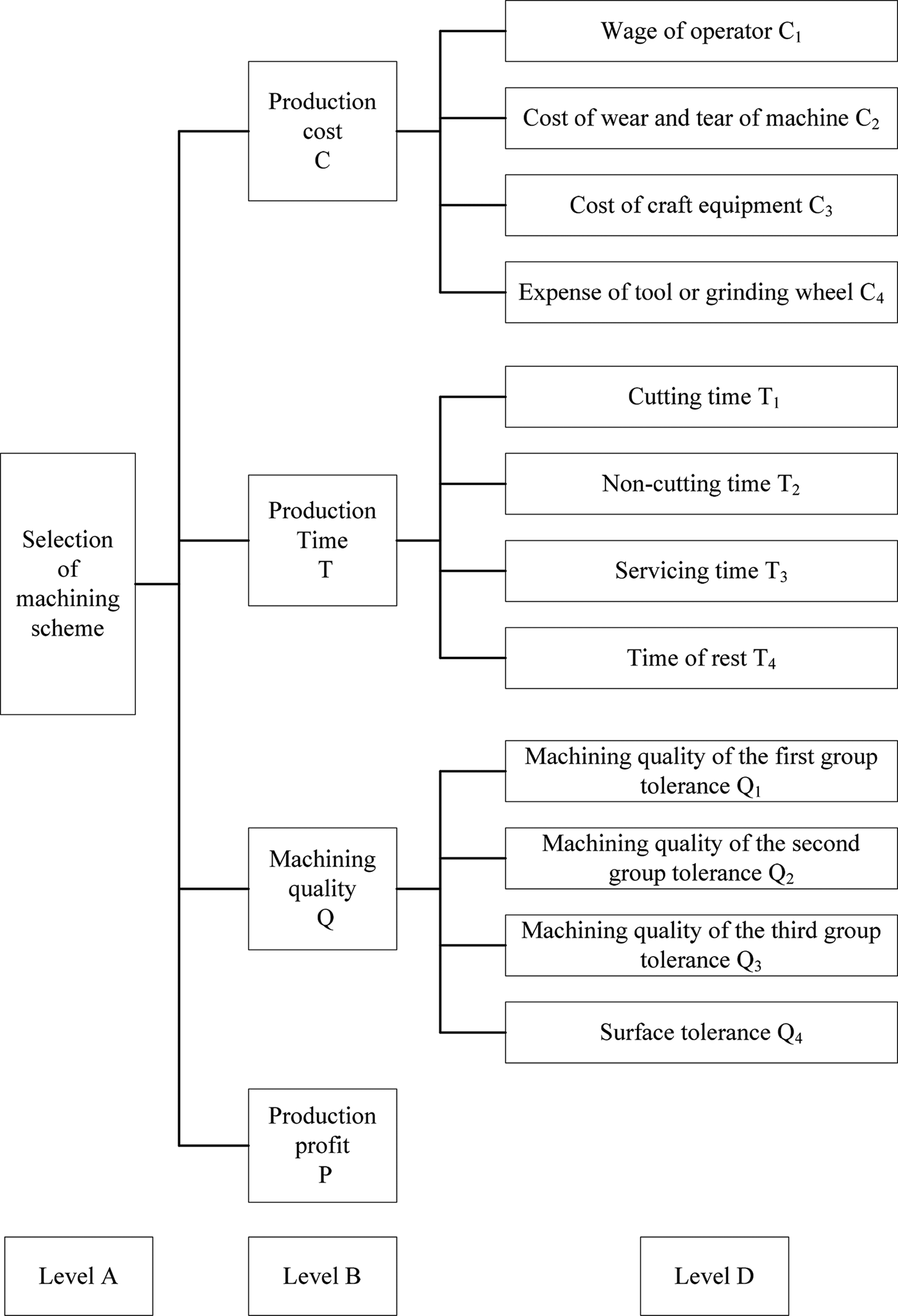
The AHP approach is used to determine the weights of evaluation indices by constructing stair hierarchy models and forming pairwise comparison matrixes. In this research, there are three levels in the stair hierarchy model for evaluation. Level A is the goal level, the selection of machining scheme, while Level B and Level D are the major evaluation indices and subevaluation indices, respectively. Production cost, production time, machining quality, and production profit are regarded as the major evaluation indices. The factors that can affect production cost mainly include material cost of the part, wage of the worker, electricity price of the machine tool, depreciation expense of the special machine and the universal machine, repair cost of the special machine and the universal machine, expense of the special fixture and the universal fixture, expense of the tool, and so on. This paper assumes that the material cost for various schemes is the same, so this factor is neglected in production cost evaluation. In order to further simplify the evaluation of production cost, if the expenses that are used by various schemes are the same or similar, the expenses will be neglected. At the same time, the factors that have little effect on MSS are also neglected. Furthermore, in this research, the manufacturing resources that can be selected are in the same workshop or the distance between the locations of those manufacturing resource is short, so the transportation time and cost are not taken into account. Here, an automobile gear is taken as the research object, so the subfactors of production cost are made up of wage of operator, cost of wear and tear of machine, cost of craft equipment, and expense of tool or grinding wheel. Production time is made up of cutting time, noncutting time, servicing time, and time of rest, and machining quality is made up of machining quality of the first group tolerance, machining quality of the second group tolerance, machining quality of the third group tolerance (Wu et al., Reference Wu, Zhang and Jiang1994), and surface quality. Production profit is the difference between the selling price of a single product and the total cost of product manufacturing. The stair hierarchy model of evaluation indices is shown in Figure 1.
The stair hierarchy model for evaluation.

3.2. Multiobjective optimization model
Real engineering problems usually need to optimize N objectives, and those objectives are often noncommensurable and conflict with each other. Without loss of generality, all objectives are of the minimization type (a maximization type objective can be converted to a minimization type by multiplying by a negative unit). A minimization multiobjective decision problem with N objectives is formulated as
 $$\min F\lpar x\rpar =\lpar f_1 \lpar x\rpar \comma \ f_2 \lpar x\rpar \comma \ldots\comma \; f_n \lpar x\rpar \rpar \comma \;$$
such that
 $$g\lpar x\rpar =\lpar g_1 \lpar x\rpar \comma \; g_2 \lpar x\rpar \comma \ldots\comma \; g_p \lpar x\rpar \rpar \leq 0\comma \;$$
where x = (x 1, x 2, . . . , x n) is a vector of n-dimensional decision variable, F(x) is an objective function, and g(x) is a constraint function.
Minimization cost is most commonly used as an optimization objective by many researchers. However, in this proposed optimization problem, four objectives are considered: production cost (C), production time (T), machining quality (Q), and production profit (P). These four objectives are mutually conflicting. The objective functions were built according to the lowest cost, the least production time, the best quality, and the highest profit.
There are m machining operations while machining a part, and P = {p 1, p 2, . . . , p m} p i is used to denote the ith machining operation. Corresponding to machining operation p i, there are manufacturing resources R i = {r 1, r 2, . . . , r ni}, where ni is the number of manufacturing resources that could be adopted in machining operation p i (ni is not constant, namely, ni may be variable according to different machining operation p i), and r ni is the nith manufacturing resources in R i. The design variable is x ij (i = 1, 2, … , m; j = 1, 2, … , ni), and if machining operation P i uses the jth manufacturing resources in R i, the value of x ij is 1 or 0. The objective function is described as follows:
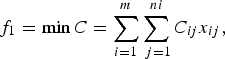 $$\,f_1=\min C=\sum\limits_{i=1}^m {\sum\limits_{\,j=1}^{ni} {C_{ij} } } x_{ij}\comma \;$$
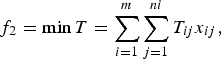 $$f_2=\min T=\sum\limits_{i=1}^m {\sum\limits_{j=1}^{ni} {T_{ij} } } x_{ij}\comma \;$$
 $$\,f_3=\min \lpar \!-\! Q\rpar =\sum\limits_{i=1}^m {\sum\limits_{\,j=1}^{ni} {\lsqb\! -\! \lpar Q_{1ij}+Q_{2ij}+Q_{3ij}+Q_{4ij} \rpar x_{ij} \rsqb } }\comma \;$$
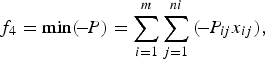 $$f_4=\min \lpar\! -\! P\rpar =\sum\limits_{i=1}^m {\sum\limits_{j=1}^{ni} {\lpar\! -\! P_{ij} x_{ij} \rpar } }\comma \;$$
where C ij, T ij, Q ij, and P ij indicate the production cost, production time, machining quality, and production profit corresponding to machining operation p i that is applied by manufacturing resource j, respectively. The function of C and T are minimization type, and the function of Q and P are maximization type. To maintain the generality, the function of Q and P are converted to a minimization type by multiplying by a negative unit.
In this paper, in order to solve the multiobjective optimization problem, a weight W i is assigned to each normalized objective function so that the problem is converted to a single objective problem with a scalar objective function as follows:
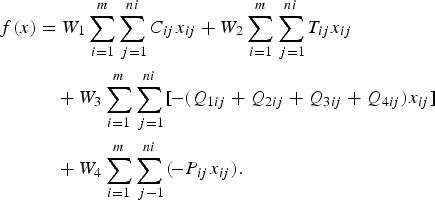 $$\eqalign{ f\lpar x\rpar & =W_1 \sum\limits_{i=1}^m {\sum\limits_{\,j=1}^{ni} {C_{ij} } } x_{ij}+W_2 \sum\limits_{i=1}^m {\sum\limits_{\,j=1}^{ni} {T_{ij} x_{ij} } } \cr &\quad +W_3 \sum\limits_{i=1}^m {\sum\limits_{\,j=1}^{ni} {\lsqb\! - \lpar Q_{1ij}+Q_{2ij}+Q_{3ij}+Q_{4ij} \rpar x_{ij} \rsqb } } \cr &\quad +W_4 \sum\limits_{i=1}^m {\sum\limits_{\,j - 1}^{ni} {\lpar \!- P_{ij} x_{ij} \rpar. } } }$$
4. DPSO FOR MSS
4.1. Fitness function
How to determine the fitness value is an important issue in multiobjective optimization (Sun, Chu, et al., Reference Sun, Chu and Sun2012; Sun, Mu, et al., Reference Sun, Mu and Chu2012). Each particle represents a machining scheme, and the fitness value of each particle reflects the good or bad of the particle based on its achievement of objectives. There are many different approaches to defining fitness functions in the literature (Zhang & Smart, Reference Zhang and Smart2006; Chen et al., Reference Chen, Worden, Peng and Leung2007; Nelson et al., Reference Nelson, Barlow and Doitsidis2009). In this research, the final objective function is directly used as the fitness function, as shown in Equation (5), and the minimum value of the fitness function is the best fitness. Constraints are defined as follows:
 $$\sum\limits_{\,j=1}^{ni} {x_{ij} }=1.$$
4.2. The proposed DPSO
The process of implementing the PSO algorithm is as follows:
1. Generate initial swarm population with random positions and velocities on m-dimensions in the problem space.
2. Calculate the fitness value for each particle.
3. Compare a particle's fitness value with the particle's pbest. If the current value is better than pbest, then set current value as the new pbest.
4. Compare a particle's fitness value with the population's previous gbest. If the current value is better than gbest, then set current value as the new gbest.
5. Change the velocity and position of particle according to Eqs. (7) and (8), respectively:
(7) $$v_{ik} \lpar t+1\rpar ={\rm \omega} \times v_{ik} \lpar t\rpar +c_1 \times r_1 \lpar p_{ik} - x_{ik} \lpar t\rpar \rpar +c_2 \times r_2 \lpar p_{gk} - x_{ik} \lpar t\rpar \rpar \comma \;$$(8)where ω is inertia weight, c 1 is cognitive coefficient and c 2 is social coefficient, r 1 and r 2 are random numbers between 0 and 1, t is the iterative generation, d is population size, m is the particle's dimension; v ik and x ik are the respective velocity and position of the ith particle on dimension index of k, and p ik and p gk are pbest and gbest positions on dimension index of k.$$\eqalign{x_{ik} \lpar t + 1 \rpar = x_{ik} \lpar t & \rpar +v_{ik} \lpar t+1\rpar \comma \cr & \quad i=1\comma \; 2\comma\ldots \comma \; d\comma \; k=1\comma \; 2\comma \ldots \comma \; m\comma}$$
6. Loop to the second step until the maximum iterations or minimum error criteria is met.


To solve the problem of MSS by using PSO, the problem needs to be abstracted by encoding. The coding method is integer coding, X = (x 1, x 2, . . . , x i, x m); the number of dimensions is m, which denotes the number of machining operations; the value of x i is a positive integer between 1and ni; and ni is the number of corresponding manufacturing resources that machining operation p i adopts. A group of coding responds to one machining scheme. For example, if a group of coding is X = (2, 1, 4, 5, 4), it indicates that the part has five machining operations, the first operation is carried out by using the second manufacturing resource in R 1, and the second operation is carried out with the first manufacturing resource in R 2.
By analyzing the characters of MSS, this paper proposes a new discrete method. Integral operation for particle position is used, and it is programmed by Matlab 7.0, so particle position is updated by the following equation on every iteration:
 $$\eqalign{x_{ik} \lpar t+1\rpar ={\rm fix}\lpar x_{ik} \lpar t\rpar +v_{ik} \lpar &t+1\rpar\rpar \comma \cr & i=1\comma \; 2\comma \ldots\comma \; d\comma \; k=1\comma \; 2\comma \ldots\comma \; m\comma \;}$$
in which Fix(f) is getting the integer part of f. When the value of x ik is bigger than ni (the number of corresponding manufacturing resources) or smaller than 1, generate x ik randomly between 1and ni. The other variables are the same as Eq. (8). Particle velocity is updated by Eq. (7). When v ik is bigger than v max, make v ik = v max; when v ik is smaller than v min, make v ik = v min. The inertia weight ω is updated by Eq. (10).
 $${\rm \omega}={\rm \omega}_{\max } - \displaystyle{{t \times \lpar {\rm \omega}_{\max } - {\rm \omega} _{\min } \rpar } \over {t_{\max } }}\comma \;$$
where ωmax is the biggest value of ω, ωmin is the smallest value of ω, t max is the maximum of iterative generation, and t is the current iterative generation.
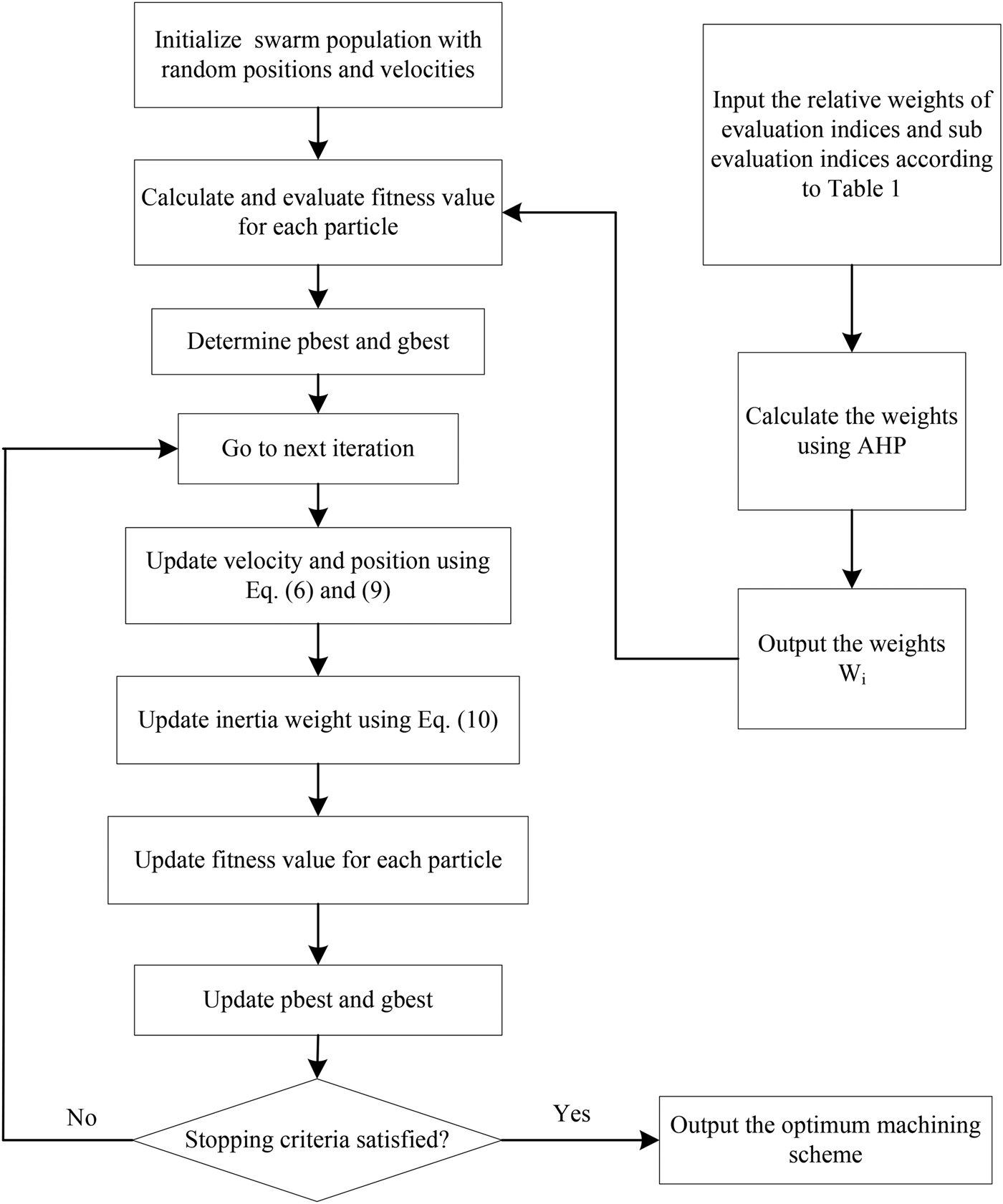
The DPSO algorithm implementation in MSS is shown in Figure 2.
The flow chart of the hybrid algorithm.
5. AHP FOR ASSIGNING WEIGHTS TO EVALUATION INDICES
In MSS, the evaluation indices play different roles and have different contributions to the selection. Therefore, the evaluation indices have to be assigned with different weights. An AHP method is introduced to assign weighting factors to evaluation indices.
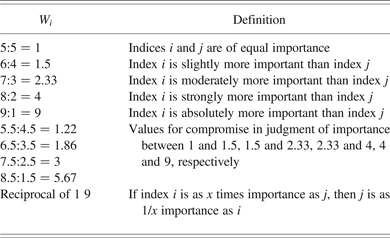
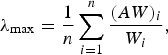
The pairwise comparison method developed by Saaty (Reference Saaty1985, Reference Saaty1990) is used to get the relative weights of evaluation indices. After the stair hierarchy model of the problem is set up, the priorities need to be calculated. Weights are assigned to each level. The 1–9 scale is the traditional scale for AHP to indicate importance. However, expertise will be considered in weights calculation, and the mean value of the expertise will get a nonintegral value. In order to close the subject of judgment more, the modified 1–9 scale, as shown in Table 1, is used to build a pairwise comparison matrix, and the eigenvector corresponding to the largest eigenvalue of the matrix is computed (Guo & Zheng, Reference Guo and Zheng1995). The eigenvector is normalized, and the resultant weights are obtained. If there are n evaluation indices, the resultant weighting factors are W i = (W 1, W 2, … , W n)T (0 ≤ W i ≤ 1) (i = 1, 2, … , n). The resultant weighting factors W i (i = 1, 2, … , n) and the eigenvector corresponding to the largest eigenvalue of the matrix λmax are calculated using the following equations:
 $$W_i=\displaystyle{1 \over n}\sum\limits_{\,j=1}^n {\lpar {{a_{ij} } / {\sum\limits_{k=1}^n {a_{kj} } }}\rpar }\ \lpar i=1\comma \; 2\comma \ldots\comma \; n\rpar \comma \;$$
 $${\rm \lambda} _{\max }=\displaystyle{1 \over n}\sum\limits_{i=1}^n {\displaystyle{{\lpar AW\rpar _i } \over {W_i }}}\comma \;$$
where a ij and a kj are elements of the matrix, and A is the judgment matrix.
Modified 1–9 scale for evaluation indices
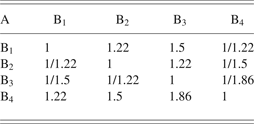
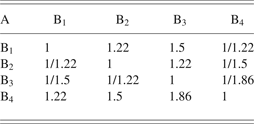
The decision maker's subjective judgments are quantified by using AHP. The modified 1–9 scale is used to quantify the magnitude of the importance of the pairwise comparison. The evaluation indices have a connection with a part structure also, so the size of the pairwise comparison matrix and the values of comparison weights between these indices are likely to change according to different parts complexity. The pairwise comparison matrix of each level is created. For example, the pairwise comparison matrix of layer A–B is shown in Table 2. Here, B1, B2, B3, and B4 are production cost, production time, machining quality, and production profit, respectively. In this case, B4 is the most important one, B1 is slightly more important than B2, and B2 is slightly more important than B3, so the value of comparison weight between B1 and B2 is 1.22, between B2 and B3 it is 1.22, between B1 and B3 it is 1.5, between B1 and B4 it is 1/1.22, between B2 and B4 it is 1/1.5, and between B3 and B4 it is 1/1.86.
Pairwise comparison matrix for layer A–B
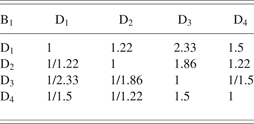
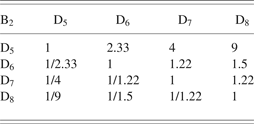
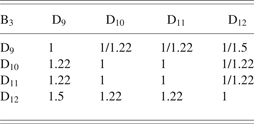
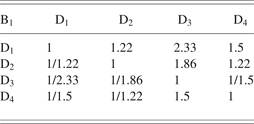
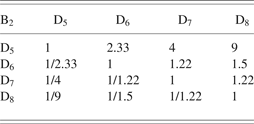
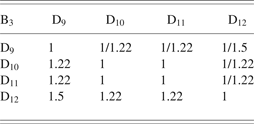
The pairwise comparison matrixes of layer B–D are shown in Table 3, Table 4, and Table 5. D1, D2, D3, and D4 are wage of operator, cost of wear and tear of machine, cost of craft equipment, and expense of tool or grinding wheel, respectively; D5, D6, D7, and D8 are cutting time, noncutting time, servicing time, and time of rest, respectively; and D9, D10, D11, and D12 are machining quality of the first group tolerance, machining quality of the second group tolerance, machining quality of the third group tolerance, and surface quality, respectively.
Pairwise comparison matrix for production cost
Pairwise comparison matrix for production time
Pairwise comparison matrix for machining quality
To prove the consistency of the judgment matrix, the consistency index CI = (λmax – n)/(n – 1) and the consistency ratio CR = [CI/RI(n)] (RI is the random consistency indexand n is the size of matrix) are calculated. If CR ≤ 0.1, it can satisfy the consistency, or the judgment matrix should be adjusted. The random consistency index RI is computed according to the method proposed by Saaty, and the values of RI are shown in Table 6.
Random consistency index (RI)

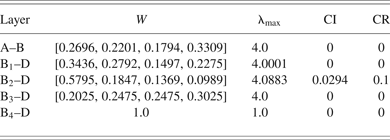
The results of parewise comparison matrix A–B and B–D are shown in Table 7. The consistency of the judgment matrix is satisfied because every CR is ≤ 0.1; therefore, the judgment matrix is logical.
Result of pairwise comparison matrix
Note: CI, consistency index; CR, consistency ratio.
The overall weight vector W, the consistency ratio CI′, and the random consistency index RI′ are computed using Eq. (13):
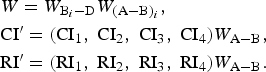 $$\eqalign{&W=W_{{\rm B}_i - {\rm D}} W_{\lpar {\rm A} - {\rm B}\rpar _i }\comma \; \cr & {\rm CI}^{\prime}=\lpar {\rm CI}_1\comma \; {\rm CI}_2\comma \; {\rm CI}_3\comma \; {\rm CI}_4 \rpar W_{{\rm A} - {\rm B}}\comma \; \cr & {\rm RI}^{\prime}=\lpar {\rm RI}_1\comma \; {\rm RI}_2\comma \; {\rm RI}_3\comma \; {\rm RI}_4 \rpar W_{\rm A - B}.}$$
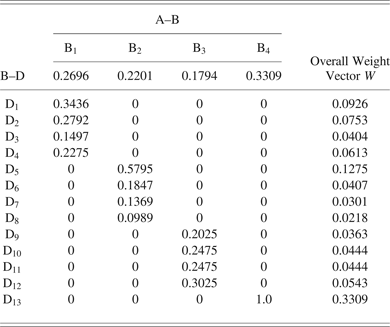
The overall consistency index CI′ = 0.0065 and the overall random consistency index RI′ = 0.1738, so the consistency ratio CR′ = CI′/RI′ = 0.04, and it can satisfy the consistency. The results of the overall weight vector W are shown in Table 8.
Priority matrix for the selection of machining scheme
6. PRACTICAL EXAMPLE AND ANALYSIS
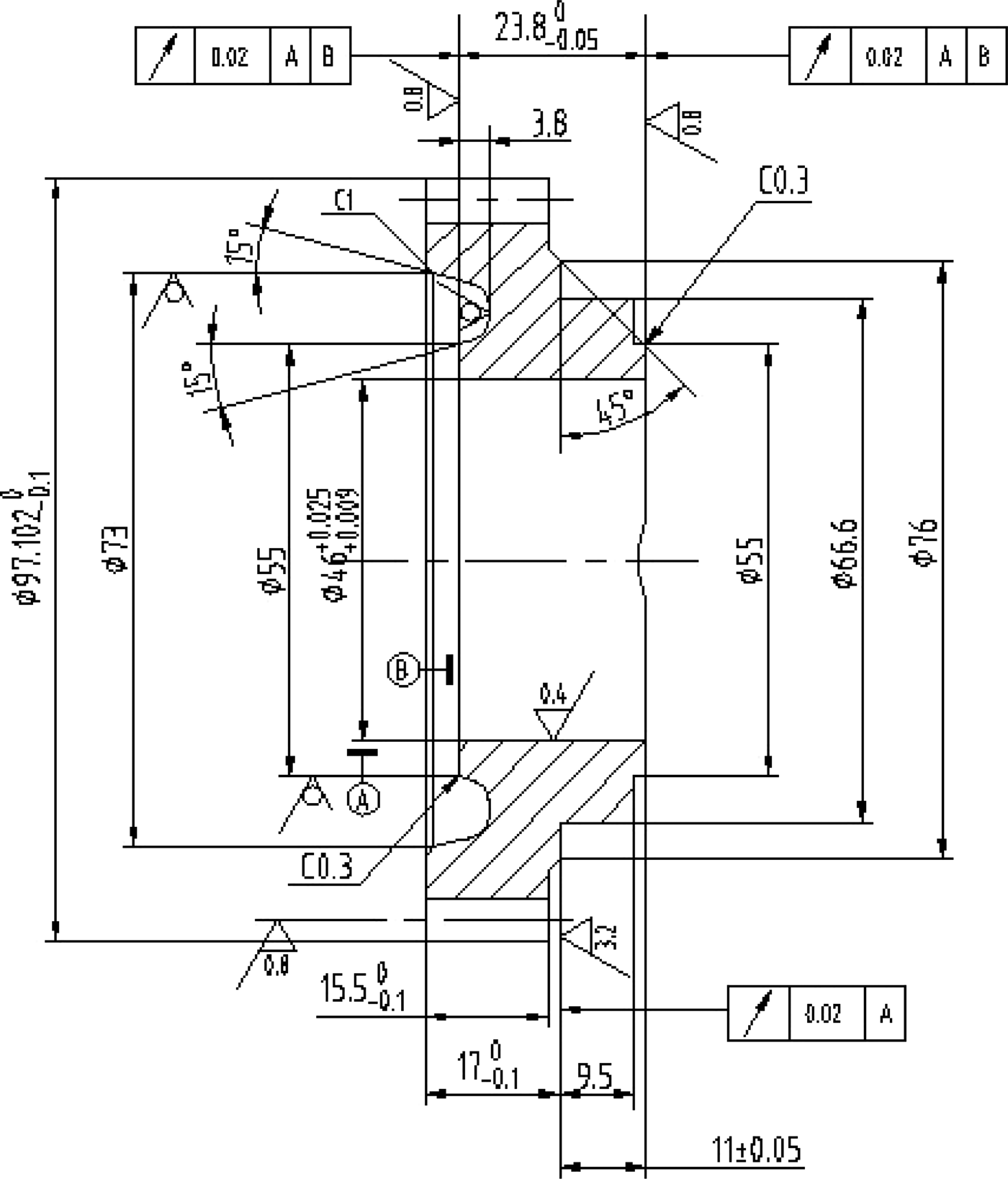
The proposed hybrid algorithm of DPSO and AHP is tested with machining the intermediate shaft gear of four-range for an automobile transmission, and the sketch is shown in Figure 3.
The intermediate shaft gear of the four range.
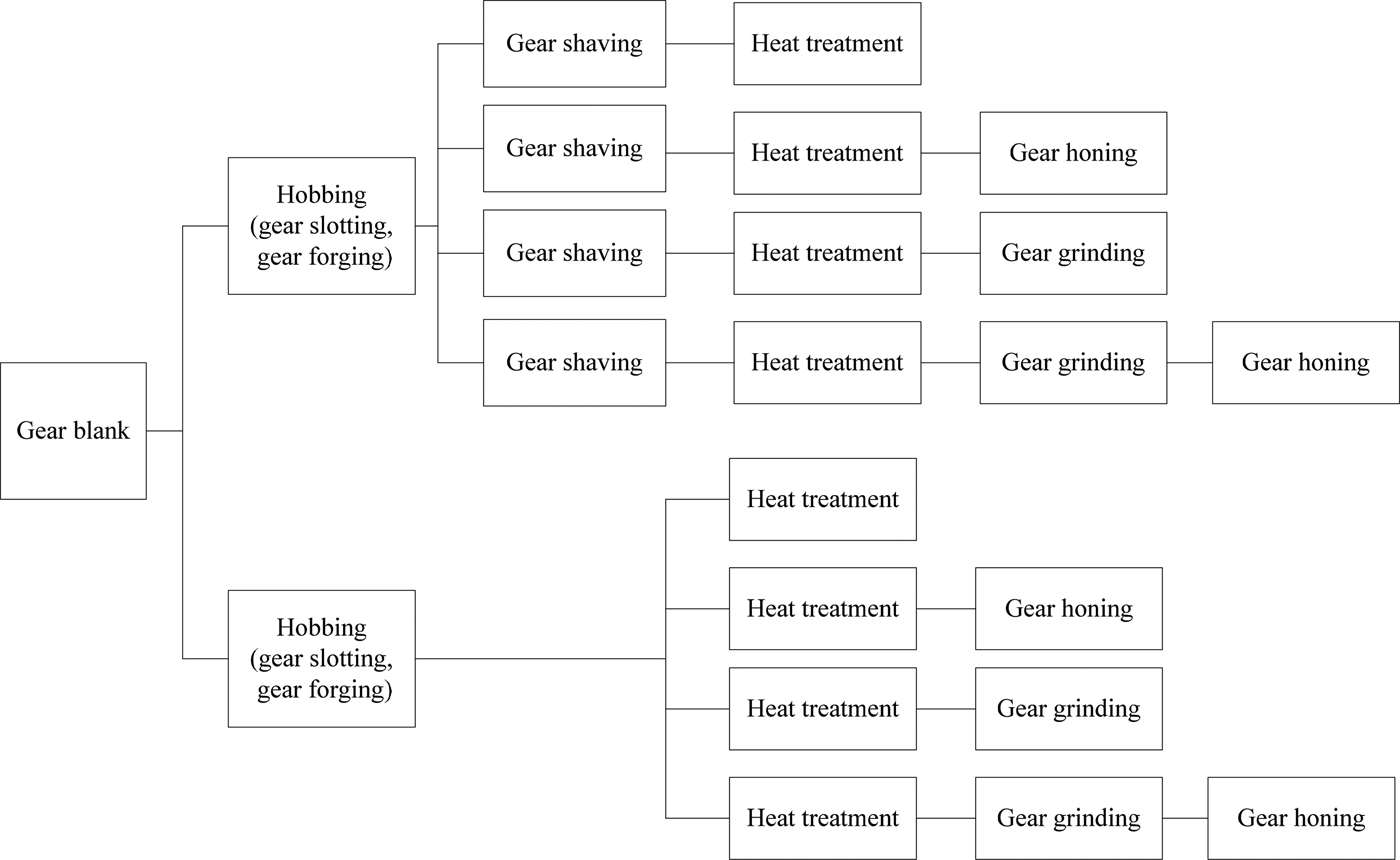
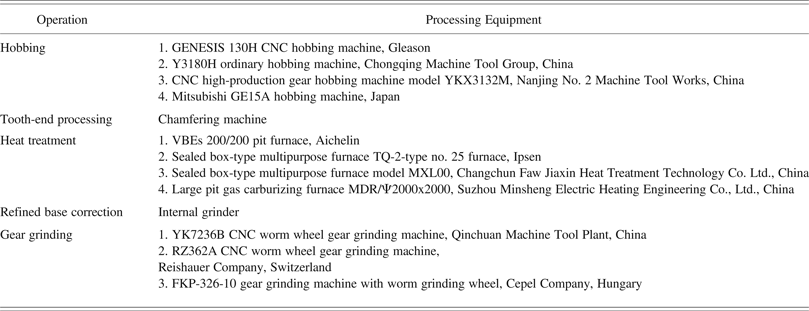
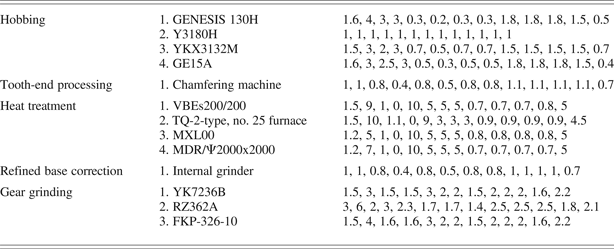
The main parameters of gear include module 1.94, tooth number 40, reference pressure angle 19°, reference helix angle 32°, drum-shaped size along tooth trace 0.005 (±0.002) mm, shape deviation of tooth profile 0.009 mm, angle deviation of tooth profile 0.0075 mm, individual circular pitch error 0.011 mm, and total cumulative pitch error 0.037 mm. The material and accuracy class of the gear are 20CrMnTiH and 7, respectively. The admissible machining schemes of cylindrical gear for automobile transmission are shown in Figure 4. In this paper, the scheme of “hobbing—tooth-end processing— heat treatment—refined base correction—gear grinding” is adopted. Some typical machining methods for each operation that can meet the machining needs are shown in Table 9. Because “tooth-end processing” and “refined base correction” are not the main machining operations of gear manufacturing, the typical processing equipment of the two operations are not given. Table 10 gives the estimated value of the 13 evaluation indices for some machining methods to illustrate the validity of the proposed algorithm.
Admissible machining schemes.
The typical machining method
Data of machining method
Note: The data are the values of the 13 indices.
A set of weights has been determined by the AHP in Tables 2–8. It is shown as follows: W = [0.0926, 0.0753, 0.0404, 0.0613, 0.1275, 0.0407, 0.0301, 0.0218, 0.0363, 0.0444, 0.0444, 0.0543, 0.3309].
By fixing the value of level D and changing the value of level B, the result is a new set of weights W′. The weight vector of the first level is (0.1157, 0.2732, 0.2732, 0.3379); the overall weight vector W′ is as follows: W′ = [0.0398, 0.0323, 0.0173, 0.0263, 0.1583, 0.0505, 0.0374, 0.0270, 0.0553, 0.0676, 0.0676, 0.0826, 0.3379].
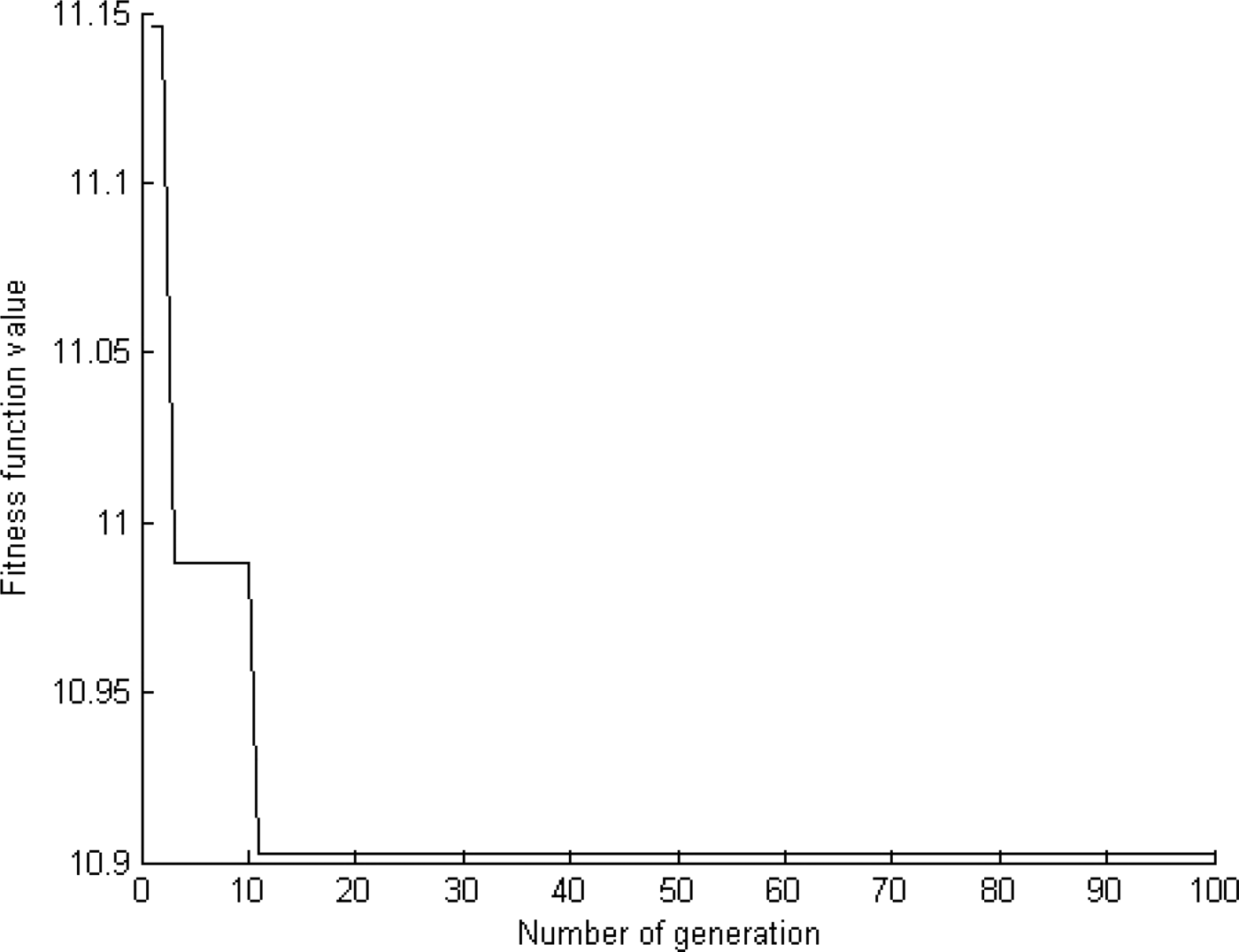
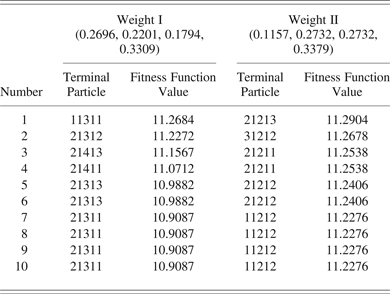
The proposed algorithm was implemented in Matlab 7.0. Each population has 20 particles, and the initial population is randomly generated. The iteration stops when it reaches the maximum 100 generations. The two different sets of weights that are gotten from the AHP are regarded as input variables and computed in the program. The results of the program run are shown in Table 11. The relationship between the fitness function value and the number of generation for the first set of weights is shown in Figure 5.
The relationship between fitness function value and the number of generations.
Results of discrete particle swarm optimization
It is shown in Table 11 that the smallest fitness function value is 10.9087 and 11.2276 for two different sets of weights, respectively, and the most optimal particle is (21311) and (11212), respectively. According to Table 10, the machining schemes are Y3180H—chamfering machine—MXL00—internal grinder—YK7236B and GENESIS 130H—chamfering machine—TQ-2-type, no. 25 furnace—internal grinder—RZ362A, respectively.
The weights of the first level (level B) of influence factors are (0.2696, 0.2201, 0.1794, 0.3309) and (0.1157, 0.2732, 0.2732, 0.3379). According to the values, production profit is the most important factor in both sets. For the first set, production cost is slight more important than production time and machining quality; for the second set, production time and machining quality are strongly more important than production cost. Because of the different demand of evaluation indices, there are two different machining schemes. The first machining scheme mainly adopts economic-type equipment as a machining method, which has lower production cost than the other machining schemes; the second machining scheme mainly adopts the multifunctional-type equipment as a machining method, which decreases production time and improves machining quality obviously. According to the result, the proposed algorithm can get more exact weights of evaluation indices based on the different demands of the decision maker. This algorithm can reach convergence soon. The results show that the proposed algorithm is effective and simple. The processing equipment of each operation can be added, so the proposed method can handle larger size problems.
In this research, the MSS is mainly about machining methods based on equipment, not the selection of specific processing equipment, so the resource utilization degree and the state of the equipment are not taken into account. That is the next work of this research.
7. CONCLUSION
This paper developed a multiobjective optimization model for solving the problem of MSS having to simultaneously consider four objectives: minimizing production cost, minimizing production time, maximizing machining quality, and maximizing production profit. In addition, a new DPSO method was developed according to the characters of MSS, which can simply and efficiently reach the optimal solutions of the multiobjective optimization problem. The hybrid algorithm of DPSO and AHP is used to do quantitative analysis of varied processing methods. The algorithm not only has an ability of global search but also can get more accurate and objective weights by building the stair hierarchy model for evaluation indices. The mathematical model is simple and easy to extend. An example of the intermediate shaft gear of four-range for an automobile transmission was provided to illustrate the application of the hybrid algorithm. This example shows that the hybrid algorithm of DPSO and AHP can do the selection of machining scheme according to different demands of the decision maker.
This research provides an academic and practical basis for further refining evaluation indices and developing a more practical selection model, which can help a decision maker do the selection of machining scheme based on different requirements more effectively. This paper also provides a good foundation for further research of the application of PSO in MSS. A more practical selection model will be studied in the future.
ACKNOWLEDGMENT
This research work was supported by the Nature Science Foundation of Jilin Province. The project name is “Research on the Precision Predict Technology of NC Turning based on Virtual Reality,” no. 201215129.
Yan-Juan Hu received her BS and MS degrees in mechanical engineering in 2003 and 2006 from Changchun University of Technology and her PhD degree in mechanical manufacturing in 2011 from Jilin University. Her research interests include intelligent manufacturing, virtual manufacturing, and computer-aided design.
Yao Wang received her BS and MS degrees in mechanical engineering from Changchun University of Technology in 1999 and 2006, respectively. Her research interests include intelligent controlling, intelligent manufacturing, and virtual manufacturing.
Zhan-Li Wang is a Professor of mechanical engineering at Changchun University of Technology. His research interests include intelligent manufacturing, virtual manufacturing, and computer-aided design.
Yi-Qiang Wang is a Professor of mechanical engineering at Ningbo Institute of Technology, Zhejiang University. His research interests include intelligent manufacturing, intelligent controlling, and bionic manufacturing.
Bang-Cheng Zhang is a Professor of mechanical engineering at Changchun University of Technology. His research interests include intelligent manufacturing, virtual manufacturing, and intelligent controlling.