Introduction
Development of HTA in Taiwan
Since its implementation in 1995, the National Health Insurance (NHI) program in Taiwan has successfully offered universal and high-quality healthcare to all its citizens at affordable costs. Taiwan started conducting health technology assessments (HTAs) in 2007 to support the National Health Insurance Administration (NHIA) in its reimbursement policies regarding new drugs by considering the health and well-being of all citizens, medical ethics, and cost-effectiveness within the financial framework of the NHI program. The Division of HTA operates under the Center of Drug Evaluation. Notably, the HTA process drew from the HTA programs of Australia, Canada, and the United Kingdom. Later, HTAs were extended to include medical devices in 2011, medical services in 2014 (Reference Chiu, Pwu and Gau1), and social care in 2016. A short history of the HTA development process in Taiwan was reviewed by Chiu et al. (Reference Chiu, Pwu and Gau1).
Main Tasks
The ultimate goal of HTA is to support the health authority's maximization of public health benefits. The HTA team primarily assesses the clinical comparative effectiveness and economic evaluation of new drugs and medical devices to support the NHI program's decision making. The HTA team also conducts various HTA-related research projects commissioned by other health authorities under the Ministry of Health and Welfare (MOHW).
Furthermore, the HTA team is accountable for the development of the HTA process and methods, promotion of international cooperation, organization of education and training programs, and provision of consultation services to pharmaceutical manufacturers who apply for NHI reimbursement (2).
Process and Methodology
Report Types (or HTA Products)
There are two types of reports produced by the HTA team: (i) assessment reports for NHI reimbursement decisions and (ii) commissioned research projects from other divisions under MOHW.
Assessment reports for NHI reimbursement decisions: Applications for reimbursement are received by NHIA, and NHIA commissions the HTA team for assessment of each new technology. For every new reimbursement request, the HTA team produces an assessment report by executing a clinical and economic assessment including the clinical efficacy, cost-effectiveness, and budget impact of the new technology. Types of assessment reports for NHI reimbursement decision include (i) breakthrough drugs, which are classified by NHIA and claimed by sponsors; (ii) general new drugs with new medical/molecular entities, new formulations, or new routes of administration, as approved by the competent authority; and (iii) new medical devices (2).
The assessment report needs to be completed within 42 calendar days as requested by NHIA (2). Then, the assessment report is submitted to NHIA to support the NHI reimbursement decision. Pharmaceutical Benefit and Reimbursement Scheme (PBRS), a joint appraisal committee comprising government officials, health professionals, manufacturers, and consumer representatives, finally decides on the appropriateness of a new drug/device for NHI coverage based on the National Health Insurance Act (3;Reference Hsu and Lu4). The committee members of PBRS are selected every 2 years (5).
Commissioned research projects: The HTA team also accepts commissions from other health authorities under the MOHW, including the NHIA, Centers for Disease Control (CDC), Social and Family Affairs Administration, and Health Promotion Administration, to conduct various HTA-related projects. The timeframe for each project is usually 1 year, but some projects last longer, especially when a cost-effectiveness analysis (CEA) is needed.
A systematic review of the comparative effectiveness, safety, and cost-effectiveness of the new technology is conducted following the published guideline (6) to collect and analyze the available evidence. Additionally, HTA reports from the United Kingdom, Canada, and Australia are reviewed, and other countries’ current reimbursement scenarios are obtained by means of a survey through the International Network of Agencies for Health Technology Assessment (INAHTA). While cost analysis is conducted using the NHI claim database, patient evidence is accessed using questionnaires and interviews. Furthermore, cost utility analysis (CUA) using the Markov model framework is often used to assess the cost-effectiveness of new technologies in current clinical settings.
Key procedures
The assessment reports and research projects include the following key procedures: (i) consulting clinical experts for the current medical situation in terms of clinical practice, usage, and possible comparators, (ii) conducting a systematic review of the evidence of relative clinical effectiveness and safety, (iii) summarizing HTA evaluation reports and reimbursement decisions from three reference countries (the United Kingdom, Canada, and Australia), (iv) investigating the current clinical situation and comparing the new technology with currently reimbursed comparators in Taiwan, (v) conducting budget impact analysis (BIA) on the drug/device, and (vi) performing CUA and CEA for research projects if needed
Outcomes and Impacts
Publication of Methodology Guidance
In 2016, the HTA team published several HTA methodology guidelines on BIA, CEA, systematic reviews, and a BIA template in Mandarin with a total of 2,883 hits until February of 2018 (6).
Assessment Reports for NHI Reimbursement Decisions
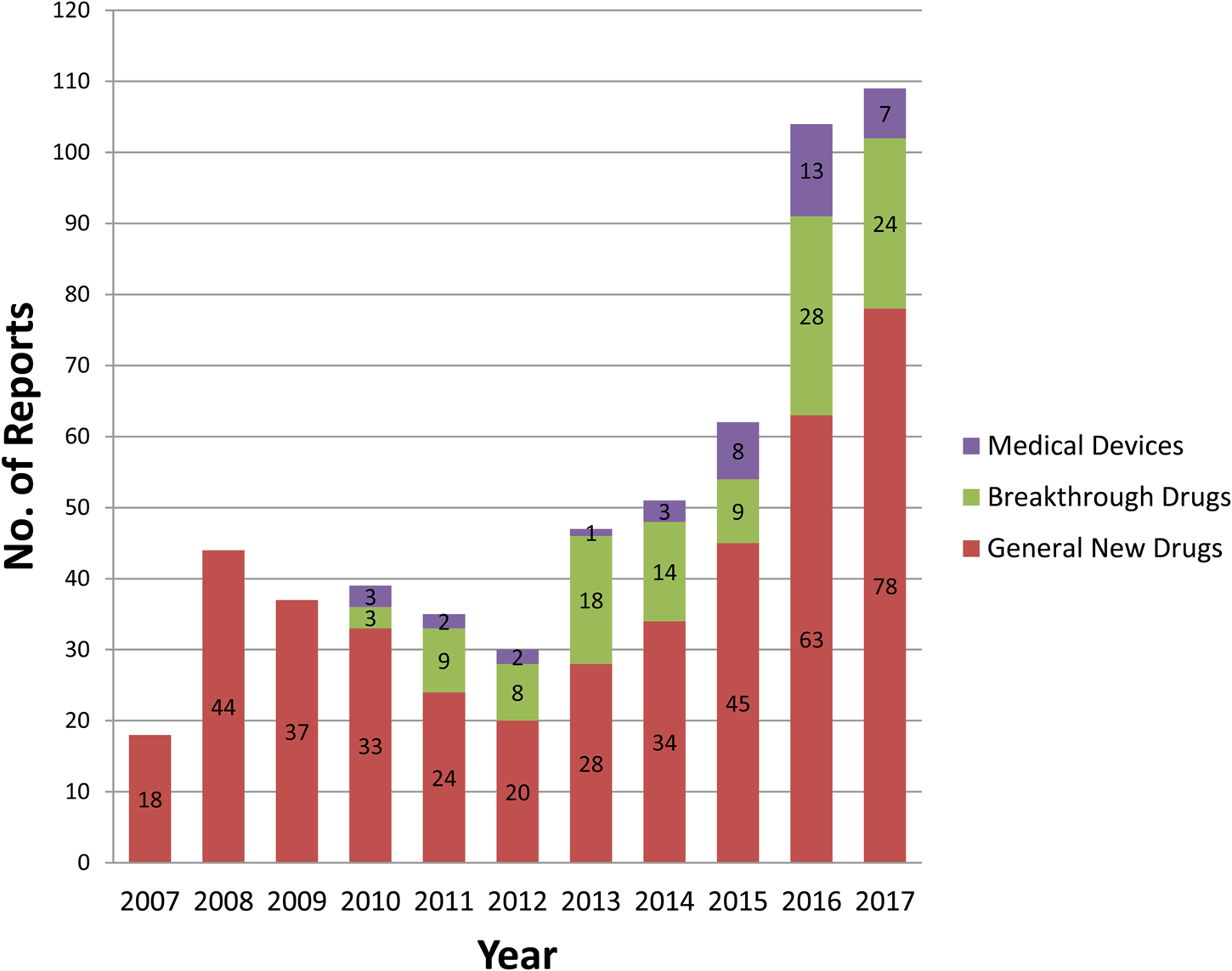
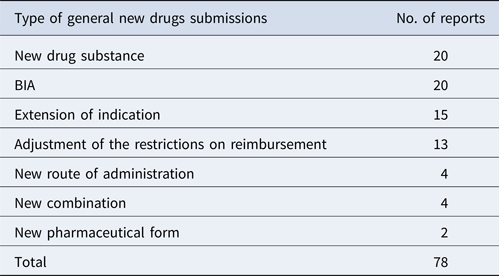
From 2007 to 2017, HTA working groups has facilitated NHIA's assessment of 113 breakthrough drugs, 424 general new drugs, and thirty-nine new medical devices, with a total of 576 assessment reports for NHI reimbursement decisions (see Figure 1 for the number of reports in each year). In 2017, a total of seventy-eight reports were published in the category of general new drugs, with most submissions for new drug substances, BIA, extension of indication, or adjustment of restrictions on reimbursement (Table 1). These assessment reports have been available on the website since March of 2016 with a total of 2,310 hits as of the end of 2017.
Number of reports for breakthrough drugs, general new drugs, and new medical devices in 2007 and 2017.

Types of Submissions within the Category of General New Drugs in 2017

BIA, budget impact analysis.
Commissioned Research Projects
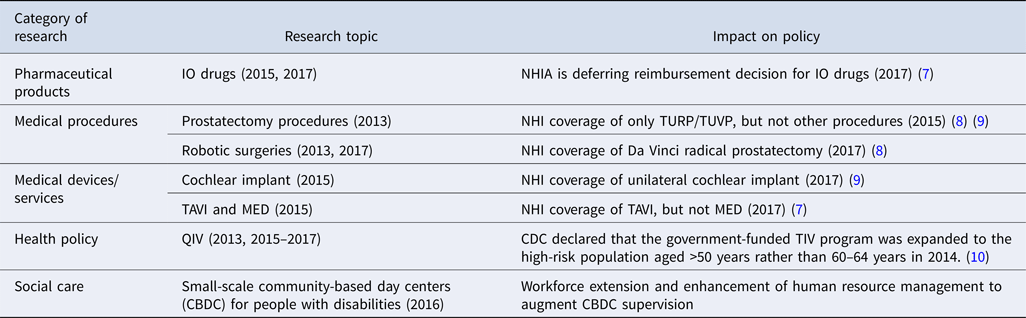
Around eighty-one commissioned research projects were conducted by the HTA team from 2007 to 2017. The projects within the last 5 years could be categorized into the following five categories: (i) pharmaceutical products, (ii) medical procedures, (iii) medical devices, (iv) health policy, and (v) social care. Some of the hot topics in each category and the impacts on policy are briefly described as follows (Table 2).
Recent Research Topics and Impacts on Policy in Five Categories

CDC, Center for Disease Control; IO, immuno-oncology; MED, microendoscopic discectomy; MCDA, multiple-criteria decision analysis; NHI, National Health Insurance; NHIA, National Health Insurance Administration; PVP, photoselective vaporization of the prostate; QIV, quadrivalent influenza vaccine; TAVI, transcatheter aortic valve implantation; TURP, transurethral resection of the prostate; TUVP, transurethral vaporization of the prostate.
Pharmaceutical Products. Project: Clinical and economic evaluation of immune-oncology (IO) drugs (2015, 2017) – commissioned by NHIA: Upon NHIA's request, the HTA team conducted comparative effectiveness and economic assessment of four IO drugs in the class of immune checkpoint inhibitors, including pembrolizumab (Keytruda), nivolumab (Opdivo), atezolizumab (Tecentriq), and ipilimumab (Yervoy), to assist policy making in 2015. This study comprised the following steps:
Select one reimbursed indication from one reference country (United Kingdom, Canada, or Australia) as the reference case and collect data (i) to estimate the user population and annual drug expenditure per person per year in Taiwan, (ii) to develop substitution scenarios if the four IO drugs should be reimbursed to estimate the potential budget impact, (iii) to compare the local incremental cost-effectiveness ratio (ICER) with that of the reference country, and (iv) to access the copayment rates of the reference country.
A survey of INAHTA members in 2015 revealed that pembrolizumab, nivolumab, and ipilimumab were reimbursed for malignant melanoma and/or non–small-cell lung carcinoma in the United Kingdom, Canada, Germany, Austria, Spain, and Australia (5). In Asia, pembrolizumab and nivolumab are under investigation in Korea, and their reimbursed prices have been reduced according to the value-based pricing strategy in Japan. Regarding long-term efficacy, evidence was only available for ipilimumab.
Impact on policy: In the last meeting of 2017, PBRS deferred the discussion of reimbursement of IO drugs due to a high estimation of BIA (7). Consequently, future research projects on safety, risk sharing, and managed entry agreement protocol for high-cost cancer drugs will be conducted by the HTA team to support the NHIA's policy formulation.
Medical Procedures
Project: prostatectomy procedures (2013) – commissioned by NHIA: This study aimed to comprehensively evaluate six emerging treatments for benign prostatic hyperplasia: bipolar transurethral resection of the prostate (TURP), bipolar transurethral vaporization of the prostate (TUVP), GreenLight™ photoselective vaporization of the prostate (PVP), and thulium, holmium, and diode laser prostatectomy. Most available evidence was associated with the comparison of bipolar and monopolar TURP from a systematic review. Additionally, CUA with a Markov model framework was performed to assess the cost-effectiveness of the six treatments.
Compared with the currently reimbursed option (monopolar TURP), bipolar TURP was safer and more effective, with a 78 percent reduction of TURP syndrome and a shorter length of hospital stay (mean: 0.79 days). If bipolar TURP were incorporated in NHI, the estimated budget impact would be USD 1.62 to 6.48 million. From CUA, bipolar TURP, if reimbursed at USD 978.93, would lead to an increment of 0.008378 quality-adjusted life-years (QALYs). Furthermore, if the ICER threshold were set at gross domestic product (GDP) per capita (approximately USD 20,220), bipolar TURP would be cost-effective because the increased surgical costs could be counterbalanced by subsequent healthcare cost savings.
Impact on policy: Per the HTA report, PBRS decided to reimburse bipolar TURP and bipolar TUVP but not other procedures in 2015 (8). Bipolar TURP and TUVP have been covered by NHI since 2016 (8). Notably, other procedures, including GreenLight™ PVP and thulium, holmium, and diode laser prostatectomy, have not been reimbursed due to the lack of evidence on their long-term efficacy and ICERs higher than three times GDP per capita.
Project: robotic surgery (2013, 2017) – commissioned by NHIA: Part 1: clinical and economic evaluation of 21 robot-assisted surgeries (RASs) (2013): In Taiwan, RAS with the Da Vinci Surgical System has been sanctioned for 21 surgical procedures, including lobectomy, cardiac valve repair, radical proctectomy with enterostomy, and gynecological procedures. The Da Vinci Surgical System is used in more than twenty hospitals, with an estimated 2,780 surgeries as of 2014, most commonly for radical prostatectomy (791 cases in 2013). The out-of-pocket expenditure for robot-assisted prostatectomy ranges from USD 4,861 to 5,833, but the out-of-pocket expenditure for RAS ranges from USD 6,480 to 24,300 for other surgeries. This project aimed to review the available evidence of this new technology and assess the clinical efficacy and cost-effectiveness of the 21 surgical categories with the Da Vinci Surgical System. Furthermore, qualitative interviews were conducted to assess the clinical status in Taiwan, including clinical application, volume of surgery, usage pattern, out-of-pocket expenditure, and cost analysis.
The 2013 systematic review revealed that randomized controlled trials comparing RAS and laparoscopic surgery were only available on radical prostatectomy and proctectomy. Based on the clinical evidence of efficacy and safety, CUA was performed for radical prostatectomy, and cost-minimization analyses were performed for other indications. Compared with the currently reimbursed open surgery, ICER for robot-assisted radical prostatectomy was USD 79,945 per QALY, which was more than three times GDP per capita, suggesting that it may not be a cost-effective option.
Part 2: evaluation of five RASs (2017). In 2017, a project investigated five RASs: radical prostatectomy, hysterectomy, partial nephrectomy, colorectal surgery, and radical proctectomy. No firm conclusions could be inferred about the clinical efficacy of these procedures.
A literature review was also conducted for the economic assessment of RAS. Reportedly, RAS's cost was higher than those of open and laparoscopic surgeries, whereas length of hospital stay was lower. In addition, the Markov decision analysis model with a 10-year duration to estimate the costs and utilities for radical prostatectomy reported that the ICER for RAS was USD 76,640/QALY compared with open surgery and USD 72,530/QALY compared with laparoscopic surgery.
Impact on policy: The Da Vinci–assisted RAS for radical prostatectomy has been partially covered by NHI since 2017 (9). To date, approximately 9,000 patients have benefited from this reimbursement decision and have saved approximately USD 1,240 per surgery due to the copayment scheme. As no firm conclusions could be inferred about the clinical efficacy and no cost-effectiveness evidence could be collected for the other twenty surgical procedures, PBRS did not include these under NHI coverage.
Medical Devices. Project: cochlear implant (2015) – commissioned by the NHIA: This study, conducted in 2015, aimed to assess the cochlear implant (CI) care program by evaluating the current clinical efficacy data, regulations from other countries, and patient evidence. In several countries, including the United Kingdom, Australia, Japan, and Korea, CIs for children and adults are reimbursed. The key findings from interviews and focus group sessions with patients and their caregivers were as follows: (i) patients and their families have an urgent clinical need for CIs; (ii) the subsidy for CIs from social welfare benefits and NHI reimbursement for CI surgery since 2012 do not offer adequate assistance to patients and their families; (iii) follow-up maintenance of the assistive device, spatial education, and career counseling for patients are needed; and (iv) access to aural rehabilitation and language therapy is inadequate and unevenly dispersed in Taiwan.
Per the opinions of the patient groups and HTA evaluation, CIs are safe, efficient, and cost-effective for adults and children with severe-to-profound deafness. Additionally, CIs facilitate the education of hearing-impaired children in mainstream schools and the reintegration of adult patients into society, thereby reducing societal burden.
Impact on policy: In 2017, CIs, along with speech processors, were incorporated into the NHI reimbursement scheme in the category of medical devices with innovative function. However, the coverage was only for unilateral implants and limited to once in a lifetime, with priority given to patients aged <18 years (9).
Project: transcatheter aortic valve implantation (TAVI) – commissioned by the NHIA: A systematic review revealed that the efficacy and safety of TAVI were not concrete compared with those of surgical aortic valve replacement (SAVR). However, TAVI demonstrated good efficacy and safety outcomes for patients ineligible for SAVR compared with medical management. CUA with a Markov model framework and 3-year follow-up to assess cost-effectiveness for patients with severe, symptomatic aortic stenosis ineligible for SAVR reported that the ICER of TAVI was USD 98,825, which is over three times GDP per capita, implicating that TAVI may not be a cost-effective option for patients ineligible for SAVR.
Impact on policy: In 2016, NHIA included TAVI under NHI for patients ineligible for SAVR because of the prolonged survival (10).
Health Policy. Project: influenza vaccine high-risk groups (2015–2017) – commissioned by CDC: A government-funded trivalent influenza vaccine (TIV) program has been implemented in Taiwan since 1998. In 2015, the priority groups of the government-funded TIV program comprised the high-risk population, including the elderly people (≥65 years), children aged six months to 6 years, school-age children, nursing care facility residents, patients with rare disorders, patients with catastrophic diseases, people aged 60–64 years with chronic diseases, healthcare workers, livestock breeding workers, and workers involved in the prevention of animal epidemics.
From 2015 to 2017, a study aimed to construct a dynamic epidemic model of influenza for economic evaluation of a quadrivalent influenza vaccine (QIV) among the high-risk population to support policy decision making. Based on a literature review, QIV was expected to result in substantial health benefits, including reduced numbers of symptomatic influenza cases, hospitalizations, and deaths and life-year (LY) gains compared with TIV. However, ICER per QALY substantially varied between countries (USD 5,000/QALY–80,000/QALY).
Based on a payer's perspective, both CUA and CEA with a static age-stratified model were conducted in clinical risk groups, including the population aged 3–18 years and high-risk subjects aged >50 years. The results revealed that a vaccination strategy using the QIV compared with the TIV exhibited a reduction of influenza cases (by 74,185), medical visits (by 28,598), hospitalizations (by 743), severe cases (by 59), and deaths (by 8). Moreover, the ICERs were USD 2,881/LY and USD 4,455/QALY, both lower than GDP per capita in all age groups, implicating that the QIV strategy was cost-effective in all the clinical risk groups.
Impact on policy: In 2014, the CDC declared that the government-funded TIV program would be expanded to the high-risk population aged >50 years rather than 60–64 years (11).
Social Care. Project: small-scale community-based day centers (CBDCs) for people with disabilities (2016) – commissioned by Social and Family Affairs Administration: CBDCs are small-scale, work-oriented centers providing care and recreation facilities for people aged >15 years with chronic psychiatric disorders or physical disabilities who have not been placed in social welfare institutions or psychiatric rehabilitation institutions. From 2011 to 2016, the number of centers increased from twenty-two to 143, with expenses increasing from USD 1,175,625 to USD 3,701,065, exhibiting an expansion of demand for this service.
This study aimed to investigate the following four research questions: (i) How can accessibility be improved for attendees? (ii) How many locations are required to fulfill the needs of attendees? (iii) What are the priority areas for this service? And (iv) How efficient is this service regarding quality of life of both attendees and their families?
Interviews and questionnaires determined that CBDCs offered several benefits, including improved quality of life of caregivers, satisfaction of attendees, and resocialization of people with disabilities. Apparently, more support is needed for employment training and healthcare services. Improvements could be made to enhance task-specific training, explore more job opportunities for attendees, clarify the eligibility of attendees, set clear goals, prepare a comprehensive plan, recruit talent, and promote service access to ensure sustainable operation of this service.
Impact on policy: Based on the HTA report, the government has extended the workforce and enhanced human resource management to augment CBDC supervision.
Future Direction
Research has suggested that multiple-criteria decision analysis (MCDA) could be an alternative methodology for evaluating the value of new medical technologies in the context of HTA. In 2017, a pilot study of MCDA was conducted to decide on reimbursement for metastatic castration-resistant prostate cancer (mCRPC) treatment. This study aimed to adopt the MCDA methodology to create a value framework for the evaluation of novel treatment options in mCRPC based on the Evidence and Value Impact on Decision Making (EVIDEM) framework. By eliciting the preferences of relevant stakeholders, MCDA could assess decision priorities for complicated health policy decisions. Therefore, it is a promising approach to make the reimbursement process transparent and efficient.
Value of HTA in Taiwan
Since 2007, the HTA program at the Center of Drug Evaluation has supported NHIA's reimbursement decisions for drugs and medical devices and assisted health policy formulation in Taiwan. Lately, some progress has been made in increasing the awareness of HTA through published guidance and reports, inclusion of HTA reports in reimbursement policies, changes to policies according to cost-effectiveness evaluations, and changes to practice per assessment of social care. The assessment reports have facilitated the expert committee's reaching a consensus and have affected reimbursement decisions in PBRS meetings. The dissemination of HTA reports on the website has enhanced the transparency of NHI's policies and procedures. Furthermore, the results of commissioned research projects have been incorporated into practice through policy revisions. Moreover, evidence gaps and the need for more research have been identified in different areas. Ongoing projects, such as managed entry agreement protocol and horizon scanning, intend to offer more support to policy formulation.
Overall, the 10-year implementation of HTA has not only supported the government's decision making but also enhanced patient care. Furthermore, patient evidence has been highlighted, and patient care pathways have been transformed through patient involvement in HTA. In conclusion, HTA's value has been determined by both government and social aspects in Taiwan.
Acknowledgments
The authors thank the Ministry of Health and Welfare (MOHW) and National Health Insurance Administration (NHIA) for financial support. No potential conflicts of interest relevant to this article are reported.
Conflicts of interest
The authors declare that there are no conflicts of interest.