Introduction
This study encompasses description of the new Paleozoic asteroid genus Pegoasterella together with survey of the Urasterellidae, the familial-level clade of Pegoasterella. Many taxonomic concepts at the familial level and below for Paleozoic asteroids have approached the status of ‘islands in space.’ The goal here to outline the state of knowledge for one family, the Urasterellidae, is suited for survey because of its relatively clear delineation, generic diversity, and comparatively long stratigraphic range.
Early in the study of extant asteroids, complexity of ossicular morphology and body construction drew the attention of Agassiz (Reference Agassiz1877) and Viguier (Reference Viguier1878). Later treatments were generally more limited, although some authors, including Fisher (Reference Fisher1930), emphasized skeletal configuration together with specificities of accessory pedicellariae and spines. Most recently, Gale (Reference Gale2011) provided extended and detailed exploration of ossicular morphology together with implications for the evaluation of crown-group asteroids. Taxonomic assessment of fossil Asterozoa using ossicular morphology is problematic because of a skeletal construction of small elements linked by dermal tissues enclosing a relatively large organ mass, all readily susceptible to scavengers and decay and leading to an overall scanty fossil record. Many names are based on single or very limited specimen occurrences, and knowledge of arm and especially disk interiors is sketchy. Whole-specimen, ossicular, and ossicular-series morphology vary with ontogeny, among individuals, between populations, and among taxa, all compounding difficulties. Ossicular shape is critical to the evaluation of asteroids; unfortunately, many fossil specimens suffered serious abrasion during both natural weathering and subsequent preparation.
The broad morphologic range of fossil asteroids, the diversity of the few ancient faunas that spanned limited time and space (e.g., the Early Devonian of the Hunsrück Slate [Lehmann, Reference Lehmann1957]), the diversity of many extant faunas (e.g., Fisher, Reference Fisher1911, Reference Fisher1928, Reference Fisher1930; Walenkamp, Reference Walenkamp1976, Reference Walenkamp1979), and the ever-expanding list of recognized extant species, genera, and geographic range distributions (e.g., Mah et al., Reference Mah, Mercier, Hamel and Nizinski2012, Reference Mah, Linse, Copley, Marsh, Rogers, Clague and Foltz2015; Mah, Reference Mah2017) argue that ancient taxa must be incompletely understood and generalizations subject to significant revision. Limited data availability encumbers compilation of data sets for phylogenetic analyses.
Although many morphologic specificities of Paleozoic asteroids differ from corresponding expressions of crown-group exemplars, these differences do not readily indicate significant functional differences; essentials of asteroid configuration and therefore perhaps behavior appeared early in class history.
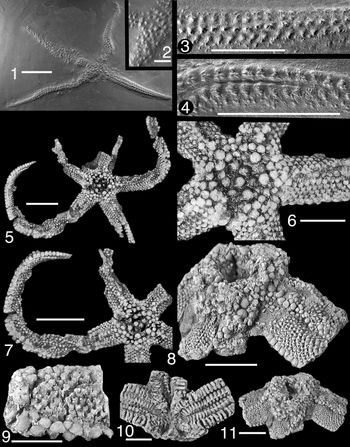
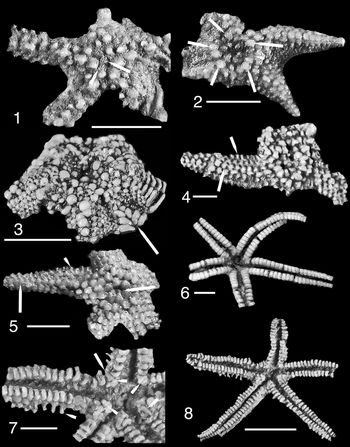
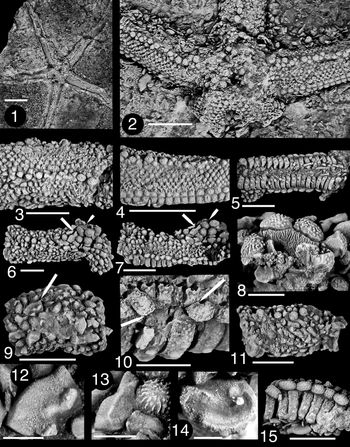
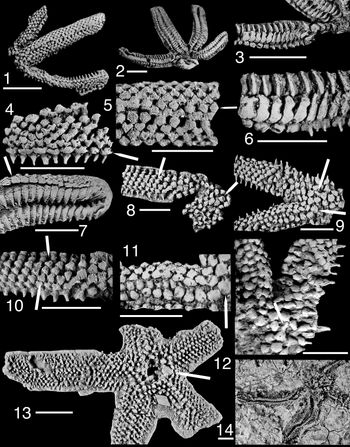
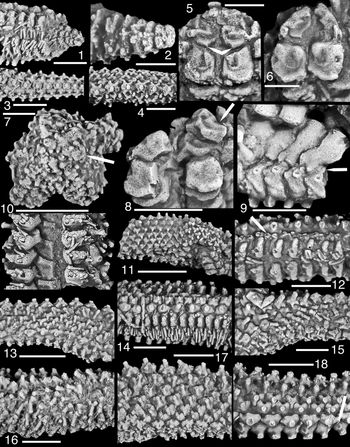
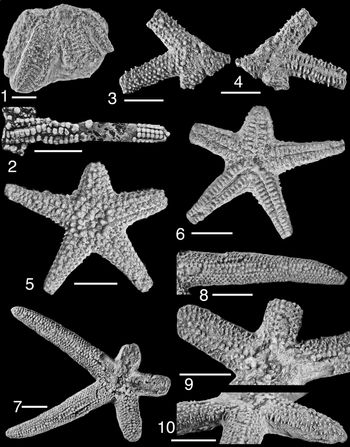
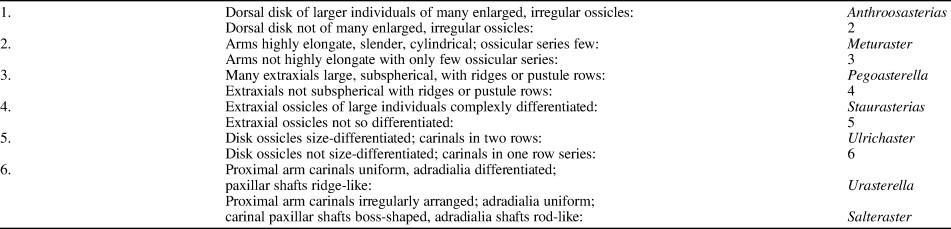
Because of the unfortunately incomplete available data for Urasterella ruthveni (Forbes, Reference Forbes1848), the type species of Urasterella, a specimen of U. asperula (Roemer, Reference Roemer1863) is illustrated along with holotypes of Anthroosasterias huxleyi (Billings, Reference Billings1865) and A. stibareus Blake, Reference Blake2017 (Fig. 1). Specimens of A. huxleyi document aspects of morphology and preservation (Figs. 2, 3) and important details of axial and adaxial morphology (Fig. 4), and smaller individuals illustrate aspects obscure in larger specimens (Fig. 5). Urasterellid diversity follows with Pegoasterella pompom n. gen. n. sp. (Fig. 6), Salteraster Stürtz, Reference Stürtz1893 (Figs. 7, 8, 9.3, 9.4), and Meturaster Blake, Guensburg, and Lefebvre, Reference Blake, Zamora and García-Alcalde2016 (Fig. 9.2); Staurasterias Blake, Reference Blake2017 (Fig. 9.1); and Ulrichaster Spencer, Reference Spencer1950 (Fig. 9.5–9.10). Table 1 provides a starting guide to identification of accepted urasterellid generic names.
(1–4) Urasterella asperula (Roemer, Reference Roemer1863) IPM Erg 192, Early Devonian, Germany. (1) Overall of complete specimen, arm to upper right largely overturned, otherwise of dorsal specimen surface; (2) disk, simple arrangement of remaining ossicles typical of Urasterella; (3) dorsal arm interval; differentiated ossicles adjacent to midarm carinal series critical to concept of Urasterella; (4) ventral arm interval, ossicular arrangement typical of urasterellids. (5–7) Anthroosasterias huxleyi (Billings, Reference Billings1865) holotype GSC 554, late Middle Ordovician, Newfoundland; disk ossicles similar in size, form; probable centrale enclosed by cycles of comparatively few larger and some smaller ossicles. (8–11) Anthroosasterias stibareus Blake, Reference Blake2017, holotype USNM 611002, Mississippian, Iowa; (8) central disk vaulted; (9) separated arm fragment; irregular IMs at specimen edge overlie adaxials; (10, 11) complete remaining specimen apart from fragment; adaxials converge toward mouth frame to form actinostome. (1) Scale bar = 20.0 mm; (2, 6, 9) scale bars = 5.0 mm; (3–5, 7, 8, 10, 11) scale bars = 10 mm.

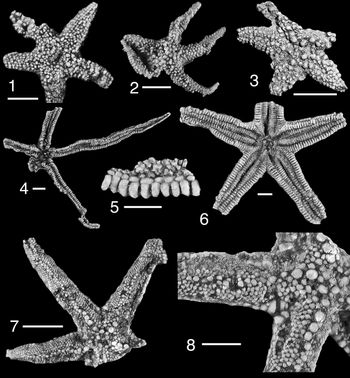
Ontogenetic and taphonomic variation in Anthroosasterias huxleyi. (1–3) Smaller individuals in dorsal aspect; (1) UMMP 74810; (2) UMMP 74798; (3) ROMIP 64928; variation in disk expression, alignment and exposure of arm adradialia, inferomarginals. (4) FMNH PE 91195, individual buried with little flattening of arms, most axials still vaulted to the arm interiors. (5) UMMP 74797, lateral view, large adaxials below, small inferomarginals nearly aligned with adaxials, likely partially displaced with burial; adradialia irregular. (6) FMNH PE 91196, arms flattened as to expose axials and to dilate medial water-vascular channel; adoral carina, MAO remain vaulted to the arm interior. (7, 8) UMMP 74803; (7) specimen thought to appear approximately as in life; disk arrangement relatively simple, carinal series somewhat irregular, adradialia arrangement regular; some inferomarginals exposed laterally; (8) expression of extraxials; smaller disk interbrachial series continuous with adradialia of arm, inferomarginals at interbrachium enlarged, compare Figures 3.3, 3.8, 5.3. (1–3, 5, 8) Scale bars = 5.0 mm; (4, 6, 7) scale bars = 10.0 mm.

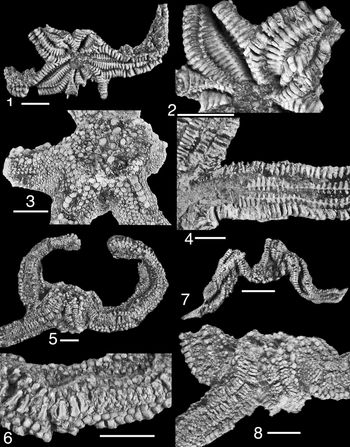
Preservation and morphology of Anthroosasterias huxleyi. (1, 2) UMMP 74809, axials of typical urasterellid form, narrowing approaching mouth frame thereby increasing podial number per unit arm length; adaxial series converges toward actinostome; distal portion of arm in lateral view showing adradialia, inferomarginals, adaxials. (3) UMMP 74805, disk vaulted, central area partially collapsed, adradialia continuing around interbrachium; disk and proximal arm ossicles near carinals enlarged. (4) UMMP 74796, disk and arm interval, axials of typical urasterellid shape, axials approaching disk (upper left) foreshortened; denuded adaxials with few inferomarginals (below), many adaxial spines remain near arm convergence. (5, 6, 8) UMMP 74799; (5) see text for interpretation of specimen orientation, compare orientation with that of (7); (6) right arm of (5) carinal series, smaller adradialia, axials rectangular, relatively large, above inferomarginals and adaxials, the latter denuded; (8) disk vaulted; enlarged inferomarginal at interbrachial position. (7) UMMP 74800, see text for interpretation of specimen orientation; reverse postures of (5) and (7) might be preservational artifacts. (1, 2, 4–8) Scale bars = 10.0 mm; (3) scale bar = 5.0 mm.

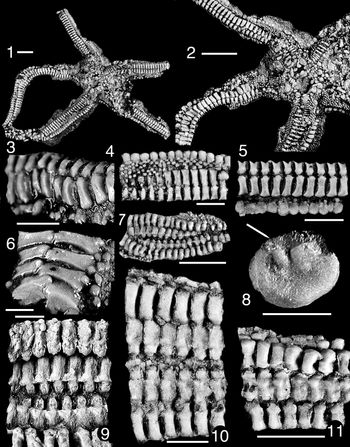
Ossicular expression in Anthroosasterias. (1–8, 10, 11) Anthroosasterias huxleyi; (1–6) UMMP 74801, (1) overall view, (2) rotated counterclockwise from (1); disk arched, ossicles somewhat displaced, smaller adradialia extend from arms onto disk; axials foreshortened toward disk; (3–6) views of arm intervals; (3, 6) dorsal portion of axials with tissue depression below bordering rim; (4, 5) axials from above, upper row rotated, bordering tissue-boundary rim of axials in profile; ossicles narrowed at arm midline, articulation arrangement thought to enhance arm flexibility and ability to support arm when extended into water column; (5) exposes flattened adaxial upper surface that abutted now-lost inferomarginals; (7, 9–11) typical urasterellid axial morphology exemplified by Anthroosasterias, proximal left; axials narrow adradially; axials proximally, near furrow midline, edged by overlapping flange; podial basin well defined; narrow, spurious suggestions of podial pores, especially in (10) produced during burial and sediment compaction; (7, 10) A. huxleyi, UMMP 74802, specimen more or less flattened, (7) distal and (10) more proximal arm intervals; disrupted axials of characteristic urasterellid shape; (8) UMMP 74810, adaxial in lateral view, furrow left, two interossicular facets separating tissue basin below from transverse groove for axial (arrow); (9) A. stibareus, USNM 611002; (11) A. huxleyi, FMNH PE 91195, mid-arm interval of Figure 2.4; lateral enlarged rows are adaxial, ‘upper’ row of axials now deflected away from view into arm; prominences here and (11) define podial basins; small inferomarginals above. (1, 2) Scale bars = 20.0 mm; (3–5, 9–11) scale bars = 5.0 mm; (6, 8) scale bars = 2.0 mm; (7) scale bar = 10.0 mm.

Morphology of smaller Anthroosasterias huxleyi. (1) UMMP 74808, centrale (arrow to right) enclosed by ring of about six ossicles, possibly including madreporite (lower left arrow). (2) UMMP 74811.1, ring of about six ossicles encloses centrale surrounded by second circlet (five longer arrows), one of circlet pairs separated by small, possible madreporite (short arrow to right); two ossicles remain between some marked pair suggesting original outer circlet of about 15 ossicles. (3) UMMP 74806, central disk partially collapsed over mouth area; proximal axials foreshortened (medial right); series at arrow are inferomarginals exposed with partial specimen collapse. (4) UMMP 74811.2, carinal series well defined (lower arrow); spinelets on inferomarginals (upper arrow), papular? reentrants on adradialia. (5) UMMP 74811.3, carinal series (left arrow), spinelets on inferomarginals (middle arrow), centrale (right arrow). (6) UMMP 74804, adaxial series converging toward mouth frame, onset of actinostome expression in small specimen, axillary not visible. (7, 8) UMMP 74807; (7) paxillae shafts on inferomarginals (arrow to left); disk arrows to upper left and lower right identify oral spines deflected away from mouth; upper right arrow identifies best-preserved MAO pair, two short arrows identify tiny likely axillaries immediately distal to MAO. (1, 2, 4–7) Scale bars = 3.0 mm; (3, 8) scale bars = 10.0 mm.

Pegoasterella pompom n. gen. n. sp., Late Ordovician. (1–4) holotype, PRIP UI-X-4935, Guttenberg Formation, Illinois; (1) overall of specimen except isolated fragment; much of arms lost; (2) disk ossicles comparatively few, similar to carinals; carinal series ossicular sizes, alignment irregular; (3) upper right and (4) lower right arm of (1), carinal, adradialia, inferomarginal, and adaxial series. (5–15) Bromide Formation, Oklahoma; (5–8, 13, 14) PRIP 20010; (5) ventral arm aspect, dominated by adaxials, adaxial spines; inferomarginals; (6, 7) dorsal inclined views; medial carinal series; axial (see 13) forced through disk surface (left arrows); madreporite (right arrows); (7) adradialia, inferomarginals, adaxials; (8) madreporite, form irregular, partially enclosed by pompom-like adradialia; (13) axial and pompom; (14) distal side of adaxial, furrow to right, deep tissue basin below interaxial articular facets; adaxial–axial articulation groove partially exposed along dorsal edge. (9, 12, 15) PRIP 20012; (9) view of dorsal of entire fragment, arrow identifies axial; (12) articular ridge discontinuous, unlike that of (13); (15) elliptical pustulate inferomarginal series overlies adaxials; axial in dorsal aspect below. (10, 11) PRIP 20011; (10) lateral view; first row of rectangular adradialia with papular? reentrant, inferomarginals elliptical, offset from flat contact surfaces to adaxial (left arrow) and adradial (right arrow); (11) dorsal view of fragment. (1) Scale bar = 20.0 mm; (2–4) scale bars = 10.0 mm; (5–7, 9, 11, 15) scale bars = 5.0 mm; (8, 10, 13) scale bars = 2.0 mm; (12, 14) scale bars = 1.0 mm.

(1–12) Salteraster asperrimus, Ordovician, England. (1–7) Mold and counterpart, separately numbered BGS 7435 and BGS 7436; (1, 2) entire remaining specimen; (3, 6) axials with narrow transverse ridges and relatively broad podial basins overlie large adaxials, some appearing crescentic; a few inferomarginals bear attenuated paxillae shafts; (4) arm fragment, domal carinal series (above) subrectangular inferomargnals (arrow) slightly overlap; crescentic adradialia above, adaxials below, their narrowed profiles not spinelets but the narrowed ossicular outline, compare (7); (5) near-disk interval of middle arm of (1), disk to left, carinal series aligned with arrow, bordered below by first adradialia series, it of ambiguous appearance; more lateral adradialia more typical of Urasterellidae; (7) distal arm interval, remnant of tip rounded in casting, inferomarginals (arrow) overlie adaxials, furrow nearly closed, lower adaxials show attenuated profile also visible in (4); (8, 10) BGS 25335; (8) centrale (right arrow) enclosed by ring of about eight ossicles; carinal series ambiguous, central series (arrow) appears faceted and flanked by series appearing to be crescentic and similar to more lateral adradialia, these opening toward midline (10, arrows); (9, 11, 12) BGS 25336, centrale enclosed by ring of about seven ossicles, none clearly differentiated as the madreporite; a single rod-like ossicle extends laterally from circle (9, upper arrow; 12); (11) midarm ossicles not clearly differentiated; lower arrow of (9) identifies same ossicle as arrow of (11). (13) Salteraster grandis (Meek, Reference Meek1872) USNM 40885, Late Ordovician, Ohio, subtle differentiation of carinal series and disk circlets; madreporite (arrow) interdigitates with adjacent ossicles; (14) S. grandis, Oklahoma, PRIP 20025, ventral surface. (1–3, 13, 14) Scale bars = 10.0 mm; (4–12) scale bars = 5.0 mm.

Variation in ossicular morphology of Salteraster grandis (Meek, Reference Meek1872) Late Ordovician, Oklahoma. (1) PRIP 20019, regenerated arm tip in ventral aspect, axials and adaxials enclose water-vascular radial canal, terminal lost; (2) PRIP 20021, arm tip, terminal ossicle to right; two tiny ossicles immediately proximal to terminal are possible axials, larger adaxials to left; (3) PRIP 20022, distal arm interval, carinals bordered by lateral adradialia, inferomarginals at arm edges; (4) PRIP 20020, dorsal view of arm, carinal series well defined, adjacent adradialia with deep crescentic reentrants; (5, 6) FMNH 84457, FMNH 84458, smaller arm fragments in cross section, furrows closed, axials fully dorsal on adaxials (5, arrows), a hadrosidan characteristic; adaxial interossicular tissue depressions rimmed with interossicular contact facets at dorsal margins. (7) PRIP 20018, disk in dorsal aspect; ossicles somewhat disrupted but uniform, paxilliform, and suggesting a concentric configuration; madreporite (arrow). (8) PRIP 20017, arm section, furrow partially opened, axial to left slightly displaced from adaxial, two axials to upper right rotated as to expose ventral surfaces; closed podial basin with lateral reentrant, possibly for ampulla; interaxial contact surfaces, contact surfaces between axials and adaxials are smooth, lacking apparent tooth-and-socket facets. (9) PRIP 20016, slightly displaced axial and adaxial series in oblique lateral view, the double abradial facets of the axials contact the subtle faces on the adaxials (arrow) whereas the distinctive subcircular facets on the adaxials contact lateral flanges of the inferomarginals. (10) PRIP 20015, axial row exposed to left, flattened to expose most of ossicular length; adaxial spines simple, enlarged; near-furrow pit seated spine, compare to (12). (11) PRIP 20014, lateral view of arm interval, carinal series above, disk ossicles to right similar to crescentic adradialia of arm. (12) PRIP 20013, ventral arm interval, disk toward left, furrow closed, some adaxials with enlarged spine pits, remaining spines uniform. (13) PRIP 20020, lateral view of arm interval, disk toward right; sequential from top: carinals, adradialia, and inferomarginals; adradialia in intersecting series, with crescentic papular? Reentrants. (14) FMNH 81579, furrow closed below with spines marking lower adaxial series; then second adaxial series, inferomarginals, lateral adradialia; two arthrostylid bryozoan fragments to left. (15) PRIP 20013, arm interval, disk to left, carinals above; disk ossicles similar to arm adradialia, these deflected from upright life positioning, paxillae shafts elongate, spinelets largely lost. (16) PRIP 20023, lateral view of arm interval, carinal series at top, elongate, paxillae shafts deflected laterally, many displaced paxillae spinelets remain. (17) PRIP 20024, lateral view of arm interval, sequential from top: carinals, multiple rows of subrectangular adradialia with weak papular? reentrants, inferomarginals, adaxial spines. (18) FMNH 81578, lateral view of arm interval, sequential from top: carinals, several rows of adradialia, papular? reentrants appearing deep and appearing unlike those of (17), inferomarginals, adaxials in profile. (1, 3, 4, 8, 9) Scale bars = 2.0 mm; (2) scale bar = 1.0 mm; (5–7, 10, 12–18) scale bars = 3.0 mm; (11) scale bar = 5.0 mm.

Select genera of Urasterellida. (1) Staurasterias elegans Blake, Reference Blake2017, USNM 92676, Mississippian, Indiana, overall view of remainder of specimen; madreporite enlarged, circular. (2) Meturaster belli Blake et al., Reference Blake, Guensburg and Lefebvre2016; USNM 629326, Ordovician, Nevada, overall view of remainder of specimen; largest double series of distal ossicles are axials. (3, 4) Salteraster grandis; PRIP 20026, Ordovician, Oklahoma, small individual similar to small individuals of other urasterellid genera. (5–10) Ulrichaster ulrichi (Schuchert, Reference Schuchert1915) Ordovician, Minnesota.; (5, 6) USNM 643640, double carinal series; lower surface dominated by adaxials; axillary, some inferomarginals remain in several interbrachia; (7–10) USNM 643639, specimen rests on sediment, lower surface unavailable; arms typical of larger urasterellids, the central disk configuration largely lost; (7) entire remaining specimen; (8) arm directed to lower left of (7) in dorsal aspect showing mid-arm series, papular? reentrant of adradialia; (9) central disk largely lost but remaining ossicles appearing uniform in size; adradialia to left tilted to show paxilla shaft, adradialia to right adjacent to subcircular carinal series; (10) inclined view, paxillae shafts rotated, expanded termini pointing downward, preservational mode could indicate lateralmost ossicles are shaft-bearing inferomarginals. (1–4, 7–10) Scale bars = 10.0 mm; (5, 6) scale bars = 5.0 mm.

Summary key to recognized genera of Urasterellidae.

Asterozoan taxonomy and interpretation of the Urasterellidae
Taxonomy and early history of the Asterozoa and Asteroidea have been widely discussed, with evaluations hindered by the limited fossil record. Durham (Reference Durham1967) argued that the early Paleozoic record of highly dissimilar echinoderms favored an extended undocumented history, and although diverse skeletal asterozoans have now been recorded from Early Ordovician strata, only trace fossils suggestive of asterozoans are known from Cambrian rocks. The seemingly abrupt first occurrence led Schuchert (Reference Schuchert1915, p. 31) to conclude that readily preserved asterozoan skeletons might only have emerged in the Ordovician, a perspective reiterated by Sprinkle (Reference Sprinkle, Jangoux and Lawrence1983) and Blake and Guensburg (Reference Blake and Guensburg2015).
Spencer (Reference Spencer1914, Reference Spencer1916) provided a detailed survey of asterozoan morphology and summarized earlier research on the Paleozoic fauna; limitations of the fossil record were described. More detailed evaluation of urasterellids began with Schuchert (Reference Schuchert1915, p. 172–180) and continued with Spencer (Reference Spencer1918, Reference Spencer1922, Reference Spencer1950, Reference Spencer1951) and the index of Owen (Reference Owen1965); later contributions include Fell (Reference Fell1963), Spencer and Wright (Reference Spencer, Wright and Moore1966), Shackleton (Reference Shackleton2005), Blake (Reference Blake2013, Reference Blake2018), and Blake and Guensburg (Reference Blake and Guensburg2015). The article by Spencer and Wright (Reference Spencer, Wright and Moore1966) is the most widely cited work of Spencer; it incorporates revisions of Wright (p. 5) prepared after Spencer's passing (Cox, Reference Cox1955). The relatively few available treatments of the mechanical operation of asteroid construction include Eylers (Reference Eylers1976), O'Neill (Reference O'Neill1989, Reference O'Neill1990), and Blowes et al. (Reference Blowes, Egertová, Liu, Davis, Terrill, Gupta and Elphick2017); these provide insights into asteroid morphology as related to life mode.
Some higher-taxon terms for Asteroidea remaining in widespread use (e.g., Spinulosida, Forcipulatida) originated with Perrier (Reference Perrier1884) whereas usages of many early researchers were at least influenced by the lead of Sladen (Reference Sladen1889, p. xl, xli) in dividing asteroids into two groups, a Phanerozonia, emphasizing but not restricted to the presence of “marginal plates large and highly developed in adult,” and a Cryptozonia, emphasizing but not restricted to the presence of “marginal plates small and inconspicuous.” Although both Schuchert (Reference Schuchert1915, p. 162) and Spencer (Reference Spencer1916, p. 63) considered the phanerozoan–cryptozoan dichotomy to be artificial, Schuchert (Reference Schuchert1915) used the subdivision as a convenience, including the Urasterellidae among cryptozoans. Spencer (Reference Spencer1914–1940) did not use the terms ‘Phanerozonia’ and ‘Cryptozonia’ but took a different approach early in his monograph in positing “the view that there is a class (of Asterozoa) which is more primitive than either the Asteroidea or Ophiuroidea, and that it was from this class that both the later classes diverged” (Reference Spencer1914, p. 19, 20). Spencer (Reference Spencer1914–1940) further subdivided all known asterozoans between the class and generic levels into 11 non-Linnaean ‘sections.’ Section terminology was abandoned by Spencer (Reference Spencer1951), and the subclass Somasteroidea (derived ultimately from the work of Thoral, Reference Thoral1935) was recognized on par with the Ophiuroidea and Asteroidea, the somasteroids argued as representing “the first stages in the differentiation of a starfish” (Spencer, Reference Spencer1951, p. 87), the word ‘starfish’ a generic term in Spencer's usage; W.K. Spencer had found his ‘more primitive’ class.
A problematic grouping within asterozoans was brought together as ‘Section K’ (Spencer, Reference Spencer1940), later recognized as the order Stenurida of the subclass Ophiuroidea (Spencer, Reference Spencer1951); ordinal-level recognition was retained by Spencer and Wright (Reference Spencer, Wright and Moore1966). The Stenurida of Spencer and Wright (Reference Spencer, Wright and Moore1966) was reevaluated and recognized at the class level by Blake (Reference Blake2013, Reference Blake2018) whereas and in contrast, Shackleton (Reference Shackleton2005) did not recognize a stenuroid cluster, rather assigning component genera to different positions within her interpretation of the ophiuran branch of asterozoan diversification.
Three orders of the subclass Asteroidea were recognized by Spencer (Reference Spencer1951, p. 122). The Urasterellidae was assigned to the new suborder Urasterina. Taxon diagnoses were brief, emphasizing the ambulacral and marginal skeletons. Spencer and Wright (Reference Spencer, Wright and Moore1966) used ordinal concepts of Perrier (Reference Perrier1884), assigning Paleozoic families and genera to the extant higher taxa. Kesling (Reference Kesling1969) and McKnight (Reference McKnight1975) offered alternative interpretations. Shackleton (Reference Shackleton2005) relied on plesion terminology for taxon concepts above the familial level. Blake (Reference Blake2018) developed a new ordinal-level classification for Paleozoic Asteroidea emphasizing the axial and adaxial skeletons, the approach retained here. Earlier familial terminology was largely retained, but generic assignments were altered.
At the generic level, Schuchert (Reference Schuchert1915, p. 31) was of the view that Hudsonaster Stürtz, Reference Stürtz1900 was most ‘primitive’ among known early asteroids. Spencer (Reference Spencer1916, p. 61) accepted the Hudsonasteridae as the ‘simplest’ Asteroidea but subsequently (Spencer, Reference Spencer1918, p. 128, 130) pointed out that hudsonasterids possess both superomarginals and inferomarginals whereas urasterellids have only inferomarginals, demonstrating that urasterellids are of a group that must have separated from an ‘original’ or ‘pre-hudsonasterid stock’ before superomarginals were developed. In suggesting superomarginals of Hudsonaster represent “modified abactinal ossicles,” Shackleton (Reference Shackleton2005, p. 39) opened the door to an interpretation of homoplasy within stem-group taxa, a potential she immediately suggested also applies to the crown group.
For Hudsonaster Stürtz, Reference Stürtz1900, Schuchert (Reference Schuchert1915, p. 32) noted a descriptively simple arrangement of a comparatively few closely fitted apical (dorsal disk) ossicles, and Spencer (Reference Spencer1916, p. 64, Reference Spencer1918, p. 128) discussed and provided diagrammatic reconstructions of ossicular arrangements for both Urasterella Schuchert, Reference Schuchert and Frech1914 and Hudsonaster. Comparatively few larger apical ossicles are present in the two (e.g., Figs. 5, 9 for Urasterella), arranged in one or two approximately pentameral cycles; phylogenetic implications of arrangement were considered (Spencer, Reference Spencer1918). Survey of apical configurations among ancient and modern (e.g., Sladen, Reference Sladen1889; Fisher, Reference Fisher1911, Reference Fisher1928, Reference Fisher1930; Mah, Reference Mah2018, Reference Mah2019) asteroids discloses great variation in overall ossicular sizes, differentiation of form, and apparent arrangement. Although the term ‘primary circlet’ was not used by Spencer (Reference Spencer1918), Spencer and Wright (Reference Spencer, Wright and Moore1966, p. 30) defined a dorsal disk primary circlet as a “ring of prominent ossicles on aboral surface, typically consisting of five radials and five interradials surrounding centrale”; although many taxa exhibit arrangements satisfying this definition and thereby providing a descriptive convenience for taxonomists, arrangement is inconsistent and ambiguous in others, including Urasterella, with apparent configurations likely influenced by overall pentamery.
Adding to complexities, many asteroids exhibit a regular five-fold apical ossicular configuration early in their ontogenetic skeletal development (Fewkes, Reference Fewkes1888; Kano et al., Reference Kano, Komatsu and Oguro1974; Komatsu, Reference Komatsu1975), and comparable five-fold ossicular configurations about a central axis are widely distributed among echinoderms (e.g., Spencer and Wright, Reference Spencer, Wright and Moore1966, fig. 26; Ubaghs, Reference Ubaghs and Moore1967, fig. 18). Such arrangement, however, is not considered to be of fundamental significance to echinoderm phylogenetic interpretation (e.g., Spencer, Reference Spencer1914, p. 34; Philip, Reference Philip1965). Citing Stürtz (Reference Stürtz1893), Spencer (Reference Spencer1914, p. 34) endorsed the notion that “the most primitive Asterozoa have a leathery skin in which are embedded small irregular plates,” and continuing, although many “primitive” asteroids show the apical system of urasterellids, this arrangement is not ancestral “but is acquired secondarily and independently in many forms.” This perspective preceded description of the somasteroid Chinianaster Thoral, Reference Thoral1935, which exhibited a uniform field of small dorsal ossicles, consistent with Spencer's (Reference Spencer1951) recognition of somasteroids as the first asterozoans. The somasteroid dorsal field of many small, apparently irregularly arranged ossicles suggests closer linkage to such asteroid taxa as Eukrinaster Blake et al., Reference Blake, Guensburg, Sprinkle and Sumrall2007 rather than Hudsonaster and Urasterella. The phylogenetic history of ordered apical arrangement remains unclear, the record perhaps supporting homoplasy.
In a series of contributions, H. Barraclough Fell (Reference Fell1962a, Reference Fellb, Reference Fell1963) developed a major new perspective in interpreting Platasterias Gray, Reference Gray1871 as a surviving somasteroid and arguing that the Paleozoic order Platyasterida Spencer, Reference Spencer1951, together with the extant Luidiidae, provide a phylogenetic sequence between somasteroids, including Platasterias, and asteroids. The viewpoint of Fell was discussed and challenged (Philip, Reference Philip1965; Madsen, Reference Madsen1966; Blake, Reference Blake1972), with Blake (Reference Blake1982) later recognizing Platasterias as a subgenus of extant Luidia Forbes, Reference Forbes1839. Fell's viewpoints on phylogeny and classification were emphasized by C.W. Wright in the Treatise on Invertebrate Paleontology (Spencer and Wright, Reference Spencer, Wright and Moore1966, p. 5), an emphasis that arguably suggests the positioning of the Somasteroidea as the first asterozoans depends on the later-challenged viewpoints of Fell; however, Spencer's (Reference Spencer1951, p. 87) designation of somasteroids as the “first starfish” as well as the tenor of his following discussions indicates a phylogenetic perspective in place before the work of H.B. Fell, who instead perhaps was influenced by Spencer's lead on phylogenetic positioning of somasteroids, an interpretation then and in turn continued by Wright in his Treatise work.
The next fundamental reevaluation of early asterozoan phylogeny was that of Shackleton (Reference Shackleton2005), arguing a history based on select better-understood Ordovician and a few later exemplars. This study proposed two branches (p. 30), one consisting of the class Ophiuroidea with several stemward plesions of which somasteroids were one, the second exclusively the Asteroidea with Urasterella emerging in a derived position (p. 15, fig. 54).
Among echinoderms, expression of the ambulacra has been stressed (e.g., Spencer, Reference Spencer1951, p. 122; Mooi and David, Reference Mooi and David2000; Blake, Reference Blake2013, Reference Blake2018), the emphasis continued here. The skimpy fossil yields major constraints for computer-based cladistics analyses, although overviews limited to better-understood taxa are possible (Shackleton, Reference Shackleton2005; Blake and Guensburg, Reference Blake and Guensburg2015; Blake et. al., Reference Blake, Zamora and García-Alcalde2015; Villier et al., Reference Villier, Brayard, Bylund, Jenks, Escarguel, Olivier, Stephen, Vennin and Fara2017). Argumentation of Blake (Reference Blake2018) placed the Urasterellidae as envisioned here in the order Hadrosida, distal to the stemward Euaxosida. Familial phylogenetic sequencing within orders is uncertain, but recurring transitions from many smaller to fewer larger ossicles was favored in that study, including derivation of the Asteroidea from the Somasteroidea.
Geologic settings
The new UMMP specimens of A. huxleyi were collected at the La Farge Quarry, 44°32.042'N, 79°9.260'W, and the Carden Quarry, 44°34.282'N, 79°6.107'W, in the Lake Simcoe, Brechin region of southern Ontario. The specimens were collected from blast pile debris of the upper 15 m of the Bobcaygeon Formation and the lower 5 m of the Verulam Formation, probably mostly from within 5 m of the contact, Late Ordovician (lower Katian in age). The setting, with locality maps, was described for crinoid occurrences by Ausich et al. (Reference Ausich, Wright, Cole and Koniecki2018, p. 851), these authors stressing the continuing evolution of stratigraphic nomenclature, citing Armstrong (Reference Armstrong2000) among other references. A single Royal Ontario Museum specimen was collected from the Verulam Formation at the Moira River, Belleville, Ontario. An additional specimen was collected from the Lindsay Formation of Colborne, Ontario (43°59'9.73"N, 77°52'44.41"W).
Pegoasterella pompom is described from the Late Ordovician Guttenberg Formation, Decorah Subgroup, Galena Group, from the surface of a megaripple. New specimens of Salteraster grandis (Meek, Reference Meek1872) are described from the Geological Enterprises Quarry, Criner Hills, Oklahoma, Late Ordovician Pooleville Member, Bromide Formation, Turian Stage, (see Sprinkle, Reference Sprinkle1982).
Materials
Repositories and institutional abbreviations
BGS, British Geological Survey; FMNH, Field Museum of Natural History; GSC, Geological Survey of Canada; IPM, Rheinische Friedrich-Wilhelms-Universität Institut für Paläontologie; PRIP, Prairie Research Institute for Paleontology; ROMIP, Royal Ontario Museum Invertebrate Paleontology; UMMP, University of Michigan Museum of Paleontology; USNM, United States National Museum.
Systematic paleontology
Terminology
Terminological usage for asterozoans begins with Spencer and Wright (Reference Spencer, Wright and Moore1966). The primary skeleton forms the body wall. The accessory skeleton includes the generally abundant spines, granules, and pedicellariae seated on all primary ossicular types except arm axials. Axial or ambulacral ossicles form a double series along the axis of the arm. Axials are vaulted to form the ambulacral furrow, and the mouth-angle ossicles (MAOs) are the proximalmost ossicles of the axial series. Axial ossicles articulate with and in more-derived asteroids are immediately dorsal to the adaxial or adambulacral ossicles. The remainder of the skeleton is extraxial. Ambital framework sensu Blake and Guensburg (Reference Blake and Guensburg2015) marginal ossicles form either a single inferomarginal series or a double inferomarginal plus superomarginal series, one or both positioned at the abradial ambital edge. Intermarginal series occur between the double marginal series of some asteroids. Dorsal ossicles, the adradialia, were defined by Spencer and Wright (Reference Spencer, Wright and Moore1966, p. 28) as ossicles of series between the carinals and marginals. Dorsal disk ossicles are arranged in one or multiple more or less regular cycles around the disk axis. Dorsal midarm ossicles can be enlarged and/or otherwise differentiated to form a carinal series. A madreporite links the water vascular system to the environment, although it can be difficult to locate among Paleozoic asteroids. No, few, or many actinal ossicles occur between the inferomarginals and adaxials. Useful descriptive terminology for paxillae was introduced by Ludwig (Reference Ludwig and Bronn1899, p. 510), followed by Spencer (Reference Spencer1918, fig. 82), and adopted here: individual paxillae consist of an expanded paxilla base that gives rise to a cone-like to columnar paxilla shaft typically bearing a paxilla crown of accessories; the paxilla shaft commonly expands at the base of the crown.
Order Hadrosida Blake, Reference Blake2018
Family Urasterellidae Schuchert, Reference Schuchert and Frech1914
Diagnosis
Hadrosidans with disk proportionately small, dorsum rounded, interbrachial angles more or less narrowly rounded; outline of smaller individuals more or less stellate whereas in larger individuals arms proportionately elongate. Dorsal disk expressions varied; ossicles few to many, arranged in irregular to well-defined concentric cycles. Dorsal disk ossicles and arm carinals of most genera more or less similar, paxillar, or plate-like, or thickened and irregular. Adradialia proportionately small, uniform, crescentic, opening and overlapping toward dorsal arm midline. Adradialia aligned in intersecting series, series arced from arm midline. Madreporite dorsal where recognized, can be moderately enlarged. Marginal ossicles in single, inferomarginal series; inferomarginals morphologically more or less clearly differentiated from adradialia, can be similar in size. Inferomarginals typically smaller than adjacent adaxials, ossicles of the two series together more or less resembling a double marginal series. Axillary where recognized inconspicuous, not distinctly differentiated from marginals. Actinal ossicles absent from arms, few if any on disk.
Axials foreshortened, podial basins in two rows throughout arm length. In many urasterellids, proximal axials and MAOs more or less distinctly deflected dorsally toward dorsal disk surface to form actinostome; one or more pairs of proximal axials can abut or nearly abut across the interbrachium to form an adoral carina. MAOs and any accessories comparatively small. Adaxials proportionately large, dominating ventral arm surface and forming part of arm margin; adaxials plate-like, robust, upright to form coin-like columns along arm axis; adaxial transverse accessory bases more or less well developed. Accessories varied, including spinelets and granules; significantly enlarged spines not recognized (edited from Blake, Reference Blake2018.)
Remarks
Fossils later assigned to the Urasterellidae were described and named beginning in the middle of the nineteenth century, mostly on the basis of limited material and, by later standards, with cursory descriptions. Schuchert (Reference Schuchert1915) provided extended review and discussion of urasterellid concepts; these were further reviewed and expanded by Spencer (Reference Spencer1918). Spencer and Wright (Reference Spencer, Wright and Moore1966) provided familial and generic summary, Shackleton (Reference Shackleton2005) reviewed status of Ordovician exemplars, and new urasterellid taxa with some reevaluation were included in Blake, Guensburg, and Lefebvre (Reference Blake, Guensburg and Lefebvre2016) and Blake (Reference Blake2017, Reference Blake2018).
The familial diagnosis of Schuchert (Reference Schuchert1915, p. 172) addressed axial positioning at the arm midline and expression of the marginal series. At the generic level, Schuchert (Reference Schuchert1915, p. 173) accepted only the name Urasterella but included 13 species names, some tentative. Certain interpretations of urasterellid morphology of Schuchert have been challenged by subsequent authors as discussed in the following. Spencer (Reference Spencer1918, p. 125) combined three families, including the Urasterellidae, in his ‘Section C’ of the Asterozoa. Two genera, Urasterella and Salteraster, were recognized. Spencer (Reference Spencer1918, p. 125) stressed occurrence in time in suggesting that “They [i.e., urasterellids] must have originated early because they form an important section of the earliest known Asterozoa.” The familial concept here is largely compatible with that of Spencer and Wright (Reference Spencer, Wright and Moore1966), stressing rounded arm shape, a single marginal series, and differentiation of the carinal series, similar paxilliform adradialia arranged in series and aligned with the adaxials, and adaxials disk-shaped and spine-bearing.
Remarks on generic diagnoses
For the most part, taxonomic diagnoses in the literature emphasize differentia. The expanded treatments here seek to ease comparisons. Needed generic revisions call for identification of added specimens from the type localities of type species, entailing work beyond the scope of the present study.
Remarks on the morphology of the Urasterellidae
Carinal series expression is critical to urasterellid generic concepts but less clearly expressed than might be hoped, in part because of irregular ossicular addition with growth, in part because of similar larger disk and carinal series shapes and sizes, and in part because of specimen disruption with preservation.
The ambulacral column of the Urasterellidae differs from such typical crown-group genera as extant Echinaster Müller and Troschel, Reference Müller and Troschel1840 in that, in the latter, podial pores are developed between successive axials, and axials and adaxials are offset rather than paired whereas essentially similar plate-like adaxial configurations, interadaxial articular faceting, and transverse series of accessory spines are found in both (Figs. 4.8, 6.14, 8.5, 8.6, 8.8).
In his evaluation of Salteraster, Spencer (Reference Spencer1918, p. 150) argued that displaced adradialia demonstrate that ossicular bases were quadrate, the ‘V’ shape an expression of the paxilla shaft (e.g., Figs. 1.6, 1.8, 2.8, 6.2, 7.4, 8.14, 8.15, 8.18, 9.8). In a discussion that can be extended to all urasterellids, Blake (Reference Blake2018, p. 36R) argued that many adradialia exhibit the presence of a true reentrant and that this ossicular shape likely reflects the presence of a respiratory papula comparable to those found among contemporary asteroids. Papulae are complexly distributed over the body wall among extant asteroids, and distribution could have been patchy in Salteraster and other urasterellids, perhaps thereby yielding the configuration noted by Spencer (Reference Spencer1918). Differential preservation can further obscure morphology.
Schuchert (Reference Schuchert1915, p. 172) was of the view that a double set of marginal ossicles was developed in the Urasterellidae, whereas Spencer (Reference Spencer1918, p. 128) recognized only inferomarginals (p. 130), a view supported by Blake (Reference Blake2018) and retained here.
Axial ossicles are paired across the arm midline among extant asteroids, but irregularly and partially offset in earlier representatives, especially so more distally on the arms. The interpretation here is that offset is the plesiomorphic condition among asterozoans and that alignment was emergent within Paleozoic Asteroidea, homoplastic among clades, and commonly enhanced with growth (i.e., axials nearer the disk tend to be more clearly paired than the more distal within a single individual) (Blake, Reference Blake2013, Reference Blake2018), indicating ontogenetic change. Taphonomic events can displace ossicles. Urasterellid axials are particularly vulnerable to distortion because ossicular termini at arm midlines are constricted (Fig. 4.5, 4.9) and ossicles therefore are readily subject to some postmortem displacement.
For various taxa, authors working with Paleozoic asteroids have argued the presence of podial pores (potentially leading to internal ampullae) at the juncture of axials and adaxials, although for urasterellids, Hudson (Reference Hudson1916, p. 117) rejected a hypothesis of pore presence. Blake (Reference Blake2018) argued that podial pores were emergent among Paleozoic Asteroidea and that criteria for evaluation of presence are available. Especially among earlier euaxosidans, many gaps or discontinuities were ascribed to diagenetic alteration of complex articular configurations. Some specimens of A. huxleyi both retain life orientation and expose axial–adaxial junctures that show such skeletal discontinuities (Fig. 4), argued as sites for muscles used in arm flexure; the spacing also provides clearance during movement. In addition, skeletal configurations do not indicate the presence of internal water-vascular tissue receptacles whereas a potential external receptacle is suggested by a Salteraster grandis occurrence (Fig. 8.8). Podial pores are not recognized in the Urasterellidae.
Pits suggestive of the pedicellariae housings found among extant asteroids occur on some adaxials of Salteraster grandis. Pedicellariae recognition minimally demands the presence of two opposed spinelets whereas only a single large spine occurs in S. grandis (Fig. 8.10, 8.12); a hypothesis of pedicellariae presence is rejected, the pits likely housing articular tissues.
Remarks on generic subdivision of the Urasterellidae
Historically, interpretation of taxa herein assigned to the Urasterellidae (and some no longer so assigned) form an intertwined complex of observations and viewpoints, some contradictory. Earlier partitioning of the Urasterellidae by Schuchert (Reference Schuchert1915) and Spencer (Reference Spencer1918) was revisited by Spencer (Reference Spencer1950), who recognized three groups of Urasterella in a diagnostic key (p. 406, ‘Note 4’). The first and second were based on the presence of one or two (only Ulrichaster) rows of mid-dorsal arm ossicles. The third category was represented by Palastropecten Stürtz, Reference Stürtz1886, later synonymized with the ophiuroid Furcaster Stürtz, Reference Stürtz1886 (Spencer and Wright, Reference Spencer, Wright and Moore1966, p. 88). Taxa with a single carinal row were divided into those with differentiated adradialia between the carinals and marginals (only Urasterella) and those in which adradialia are similar. The latter category in turn was separated into Salteraster, with highly swollen arms, and newly proposed Phillipsaster Spencer, Reference Spencer1950, with moderately swollen arms (Spencer, Reference Spencer1950). Three species were assigned to Phillipsaster: the type species Salteraster? coronella Salter, Reference Salter1857, Urasterella ruthveni mut. arisaigensis, sensu Ruedemann, Reference Ruedemann1916, p. 46 (the term ‘mutations’ was used by paleontologists “before the geneticists captured that word”; Simpson, Reference Simpson1961, p. 176), and Salteraster selwyni (McCoy, Reference McCoy1874; see also Withers and Keble, Reference Withers and Keble1934 for S. selwyni).
Spencer and Wright (Reference Spencer, Wright and Moore1966) listed eight available generic names for the Urasterellidae, noting that Palaeaster Hall, Reference Hall1852 included species later assigned elsewhere. Among the remaining names, Spencer and Wright (Reference Spencer, Wright and Moore1966) treated Bohemaster Jaekel, Reference Jaekel1923, as unrecognizable, an interpretation retained here. Three Hunsrück Slate genera proposed by Stürtz (Reference Stürtz1886), Roemeraster, Palasteracanthion, and Protasteracanthion, were synonymized with Urasterella (Spencer and Wright, Reference Spencer, Wright and Moore1966). Modern preparation techniques enable much improved evaluation of adequately preserved Hunsrück Slate specimens, but until such work is undertaken, these three names are held in abeyance. The presence of a double row of carinals was retained for the concept of Ulrichaster by Spencer and Wright (Reference Spencer, Wright and Moore1966, p. 73), and a single row of carinals was recognized for Urasterella, Salteraster, and Phillipsaster, the latter two differing on degree of swelling of the arms, whereas Urasterella was perceived as having flattened arms and paxillae with ‘unequal-sized bases.’
Shackleton (Reference Shackleton2005, p. 99) favored the synonymizing of Salteraster, Phillipsaster, and Ulrichaster with Urasterella; this author's taxonomic treatment emphasized better-understood species. The type of Salteraster, S. asperrimus (Salter, Reference Salter1857), was used for the coding of Urasterella. Because diagnoses of Spencer (Reference Spencer1950) and Spencer and Wright (Reference Spencer, Wright and Moore1966) were based on limited criteria, concerns of Shackleton (Reference Shackleton2005) were well founded; nevertheless, the approach herein differs in part from that of Shackleton as well as that of Blake (Reference Blake2018) in recognizing certain names based on limited data pending possible discovery and study of new specimens. Salteraster and Ulrichaster therefore are retained, but given the idiosyncratic nature of interpretation of arm shape (i.e., degree of swelling), Shackleton (Reference Shackleton2005) is followed in synonymizing Phillipsaster with Urasterella. Diagnoses of Urasterella, Salteraster, and Ulrichaster herein begin with emphases of Schuchert (Reference Schuchert1915), Spencer (Reference Spencer1918, Reference Spencer1950), and Spencer and Wright (Reference Spencer, Wright and Moore1966). Meturaster was recognized by Blake et al. (Reference Blake, Guensburg and Lefebvre2016), and the Carboniferous genera Staurasterias and Anthroosasterias were described by Blake (Reference Blake2017). The availability of a new suite of fossils encompassing a broad size range herein enables assignment of Urasterella huxleyi (Billings, Reference Billings1865) to Anthroosasterias.
Given the many complexities of both the fossils and past interpretations, no simple taxonomic partitioning is possible; the key of Table 1 is intended to serve as a starting guide to specimen identification.
Genus Urasterella Schuchert, Reference Spencer1914
Figure 1.1–1.4
Type species
Uraster ruthveni Forbes, Reference Forbes1848.
Other species
Twelve names were included or tentatively included in the species listing for Urasterella (Schuchert, Reference Schuchert1915, p. 175), including the type, U. ruthveni. Among these, U. asperula is included here and U. pulchella Billings, Reference Billings1857 is tentatively so, although the holotype of the latter is poorly preserved and the configuration of the arm midline is equivocal. Urasterella montanus (Shchurovskiy, Reference Shchurovskiy1874; name transcription S. Rozhnov, 2020) is important because of its Carboniferous age, but efforts to locate types were unsuccessful (Blake, Reference Blake2017). Both Schöndorf (Reference Schöndorf1909, p. 324) and Spencer (Reference Spencer1918, p. 147, 148) described the species in some detail, Spencer accepting it as a Urasterella; diagrams of Shchurovskiy (Reference Shchurovskiy1874) appear plausible but not definitive as a urasterellid. Spencer cited the Schöndorf (Reference Schöndorf1909, p. 326) species occurrence from the lowest horizons of the upper Carboniferous. Recovery of added specimens by collectors has been reported at a popular source, and therefore further information might eventually become available. Of other species listed by Schuchert, ‘U.’ asperrimus is the type species of Salteraster; U. constellata Thorent, Reference Thorent1838 was thought closest to Urasterella (Spencer, Reference Spencer1918, p. 147); ‘U.’ girvanensis Schuchert, Reference Schuchert1915 was recognized as the type species of Cnemidactis Spencer, Reference Spencer1918 (p. 156); ‘U.’ grandis was assigned to Salteraster (Spencer, Reference Spencer1918, p. 154); ‘U.’ hirudo was transferred to ophiuroids (Spencer, Reference Spencer1930, p. 434); ‘U.’ huxleyi is assigned herein to Anthroosasterias; ‘U.’ selwyni McCoy, Reference McCoy1874 was tentatively assigned to Salteraster (Spencer, Reference Spencer1918, p. 155); and ‘U.’ ulrichi Schuchert, Reference Schuchert1915 is the type species of Ulrichaster. In work subsequent to Schuchert (Reference Schuchert1915), U. ruthveni leintwardinensis Spencer, Reference Spencer1918 and U. thraivensis Spencer, Reference Spencer1918 were described whereas the new species ‘U.’ gutterfordensis later was transferred to Ulrichaster (Spencer, Reference Spencer1950, p. 406). Other undocumented names are listed (Spencer, Reference Spencer1918, p. 136, 146). Assignment of the Silurian U. creswelli Withers and Keble, Reference Withers and Keble1934 is in need of review whereas the Devonian Hunsrück Slate ‘U.’ verruculosa Lehmann, Reference Lehmann1957 is no longer assigned to Urasterella (Hotchkiss and Glass, Reference Hotchkiss, Glass, Harris, Böttger, Walker and Lesser2010). Ultimately, evaluation of the concept of Urasterella calls for added specimens of the type species. Generic range: Black River (= Sandbian) Ordovician–Early Devonian (Emsian)–late Carboniferous?
Diagnosis
Urasterellid, arms perhaps weakly petaloid. Disk ossicular configuration comparatively simple and regular: centrale enclosed by circlet of five prominent ossicles bearing longitudinal ridge-like paxilla shaft; one or two additional ossicles present in central disk. Madreporite recognized in some specimens; small and near disk center. Carinal series clearly defined, ossicles abutted; carinal series bordered on each side by row of six-sided ossicles, ossicles of three series bearing longitudinal ridge. Two or three added rows of smaller adradialia on arms, with relatively delicate paxillae shafts. Ossicular form somewhat varied among species. Inferomarginals distinct proximally, more obscure distally; paxillae shafts present. Adaxial series dominating ventral arm surfaces; outer face ridged; spine bases developed.
Remarks
Generic diagnosis for Urasterella is difficult because the type suite of the type species, U. ruthveni, consists of only five incomplete, moldic specimens (Spencer, Reference Spencer1918, p. 140). Generic recognition is retained not only because of name validity but also because of widespread usage. ‘Generic characters’ of Urasterella of Schuchert (Reference Schuchert1915, p. 174) were extended but based on ‘U.’ grandis, which was “thought to be in generic harmony with the genotype” (p. 174). Schuchert noted that U. rutheveni “is not well known, but appears to be congeneric with ‘U.’ grandis and U. pulchella” (p. 187). The generic diagnosis of Schuchert therefore is essentially his species diagnosis for ‘U.’ grandis rather than for the type species of the genus.
Treatment of Schuchert (Reference Schuchert1915) was revisited and reinterpreted by Spencer (Reference Spencer1918) and subsequently augmented by Spencer (Reference Spencer1950, Reference Spencer1951) and Spencer and Wright (Reference Spencer, Wright and Moore1966). The “Generic Characters” of Spencer (Reference Spencer1918, p. 136) for Urasterella were limited to “a Urasterellid [sic] with dissimilar rows of adradialia.” Associated discussion is more extended, but neither the reconstruction of a part of the dorsal surface (Spencer, Reference Spencer1918, p. 140, fig. 90) nor the following description clearly identify a differentiated series adjacent to the carinal series. Spencer went on to rely on a new ‘variety,’ U. ruthveni leintwardinensis, diagrammed (fig. 92, p. 143) with series adjacent to the carinals differing somewhat in form and described as having “bases more distinctly stellate, and the paxilla-shaft more thorn-like, than in the case of the corresponding structures of the radialia”; ‘radialia’ herein referring to carinals. The approach is difficult because of its reliance on specimens that were described as a ‘variety’ and because treatment of Spencer (Reference Spencer1918) begins with the new species U. thraivensis rather than with the type U. ruthveni. The brief diagnosis of Spencer and Wright (Reference Spencer, Wright and Moore1966, p. 71) was “aboral side of arms flat, many paxillae with unequal-sized bases.” The generic diagnosis here is summarized from data of Spencer (Reference Spencer1918, p. 127–145) on British representatives and his concurrence on assignment of the Hunsrück slate U. asperula (Fig. 1.1–1.4) to Urasterella.
Genus Anthroosasterias Blake, Reference Blake2017
Type species
Anthroosasterias stibareus Blake, Reference Blake2017, by monotypy.
Other species
The type species A. stibareus, Gilmore City Formation, Early to Middle Mississippian, Iowa; A. huxleyi (Billings, Reference Billings1865), Point Riche, Newfoundland, original citation, Quebec Group, Chazyan (currently, latest Darriwillian).
Diagnosis
Urasterellid with significant morphologic change accompanying increase in size: small individuals similar to smaller individuals of other urasterellids; in larger individuals, disk proportionately thickened, ossicles numerous, bulbous, ossicular arrangement irregular, arms highly elongate. Carinal series ossicles similar to larger disk ossicles but varied in size, locally offset to form an irregular sequence; configuration particularly complex at disk/arm juncture. Adradialia not bearing attenuated paxillae shafts; adradialia in multiple series. Small madreporite recognized among smaller specimens. Inferomarginals enlarged relative to adradialia. Actinostome, adoral carina strongly differentiated in larger individuals; ossicles of axial series foreshortened approaching actinostome.
Holotype
GSC 554.
Description
Extraxial ossicular differentiation among smaller individuals less distinct than among larger; dorsal ossicles more nearly equidimensional in smaller. Among larger individuals, dorsal disk more or less vaulted or domed, ossicles abundant, organization appearing irregular. Disk ossicles more or less clearly differentiated into size groups with enlarged ossicles toward center, these presumably including centrale enclosed by two more or less irregular circlets of enlarged ossicles. Larger ossicles subcircular, thickened. Smaller ossicles abundant, somewhat varied in size, polygonal to subcircular, some exhibiting papular? reentrants. Madreporite not recognized among available larger specimens but recognized among smaller.
Carinal series well defined more proximally, ossicles of series partially offset; distalmost ossicles of carinal series possibly not clearly differentiated from adjacent adradialia. Adradialia adjacent to carinals not differentiated from more lateral ossicles; adradialia typical of urasterellids but more shield-like rather than bearing prominent paxilla-shaft; adradialia arranged in many series in larger individuals, series extends to disk (Figs 2.7, 3.3, 3.8). Adradialia of arm of smaller individuals of form and arrangement similar to those of larger individuals.
Inferomarginals approximately paired with both adradialia and adaxials; inferomarginals and adradialia sizes similar, adaxials much larger; few smaller marginals irregularly intercalated along arm, not aligned with adradialia or adaxials. Inferomarginals together with adaxials forming arm margins. Inferomarginals subrectangular to elliptical, elongate parallel to arm, ossicles more nearly equidimensional distally on arms, not bearing papular reentrants; sequential ossicles abutted to weakly overlapping. Inferomarginals at disk poorly exposed in most specimens, can be exposed in dorsal aspect, these transversely elongate; inferomarginal series of adjacent arms converging toward disk center (Fig. 3.8). Inferomarginals less clearly differentiated from adradialia in smaller specimens; spines or spine-like prominences developed on at least some proximal marginals (Fig. 5.7). Axillary recognized in some smaller specimens, occurrences in larger specimens obscured with development of adoral carina and actinostome. Actinals not recognized.
Axials more or less typical of family (Fig. 4): axials rectangular in outline, moderately foreshortened, proportionately more strongly so approaching disk (Figs. 3.1, 3.2, 4.1, 4.2). Radial channel small, ossicular terminus narrowed at arm midline (thereby allowing for transverse water-vascular channel and space for arm flexure). Axial positioning at adaxial contact as exposed in ventral aspect can be suggestive of a podial pore (Fig. 4.5, 4.9) but podial opening lacking. Axials tall with deep articular tissue basins extending essentially full ossicular breadth; dorsal edge bordered by well-defined rim enclosing tissue basin. Adaxials more or less typical of family; closely fitted, much larger than inferomarginals. Adaxial proximal, distal faces approximately equidimensional, tissue depressions large; well-developed interossicular facets along dorsal edge (Fig. 4.8). Actinostome deep in larger specimens thereby obscuring MAOs; first seven or eight adaxials abutted across interbrachium to form adoral carina. Adoral carinal variation within and among specimens is varied enough to suggest both facultative twisting and therefore changing superficial appearances during normal life activities and burial with death as well as gradual carinal evolution through geologic time. Actinostome differentiation can be expressed in smaller specimens (Fig. 5.6). MAOs obscured by actinostome in larger specimens, comparatively small in smaller specimens; one robust oral spine occurs on each MAO pair in smaller specimens (Fig. 5.7). Spinelets numerous on MAOs, proximal adaxials (Fig. 3.4).
Remarks
Availability of the new fossil suite documenting transition between the comparatively small holotype of ‘Stenaster’ huxleyi Billings, Reference Billings1865 (Fig. 1.5–1.7) and the holotype of Anthroosasterias stibareus (Fig. 1.8–1.11) enables transfer of huxleyi to Anthroosasterias.
All the new A. huxleyi specimens are on slabs, none fully free as to expose all surfaces. Specimens include 34 on separate blocks, mostly a single specimen on each block, the smallest of these of arm radius (R) approximately 8 mm, the largest approximately R = 120 mm; in addition, a bedding plane surface of a larger slab, approximately 330 mm by approximately 315 mm, exposes 13 more or less complete specimens and additional fragments. All the specimens are small, suggestive of a single recruitment class. Small specimens have not been found on a block with a larger specimen. Although collected over a period of years and therefore different specific quarry blast sites, all but one of the specimens are from a single geographic area and stratigraphic interval that extends across the Bobcaygeon–Verulam formational boundary. A single specimen is from a different stratigraphic formation and locality, see Occurrence. Specimens across the size range differ gradationally in dorsal disk configuration and actinostome and adoral carinal development, with differences first clear in quite small specimens. Because small and large differ, it might be argued that the smaller specimens represent a taxon that did not reach a significantly larger size, thereby leaving the larger to represent a postulated second species. However, the presence of many smaller specimens in the full suite that accumulated through a stratigraphic thickness argues it is unreasonable to expect that no smaller specimens of any such posited ‘larger’ species would have been preserved, and therefore although some morphologic differences among specimens within a limited size range can be recognized (Figs. 2.1–2.3, 5.1–5.8), the comparatively large sample enables interpretation of differences throughout the full size range as ontogenetic, with the differences among smaller specimens documenting difficulties encountered in the interpretation of suites of small specimens of both ancient and extant species. Spencer (Reference Spencer1918, p. 139) also interpreted a small, stellate urasterellid as an immature specimen of his then-new Urasterella thraivensis, the interpretation of A. huxleyi here paralleling the earlier viewpoint of Spencer.
Variation among specimens arguably might reflect evolution during the Bobcaygeon–Verulam depositional interval and/or alternatively, biogeographic change; however, specific source horizons within the stratigraphic sequence are unknown. Therefore, any differences are treated as intraspecific and encompassed within taxonomic description.
Genus Meturaster Blake, Guensburg, and Lefebvre, Reference Blake, Guensburg and Lefebvre2016
Figure 9.2
Type species
Meturaster belli Blake, Guensburg, and Lefebvre, Reference Blake, Guensburg and Lefebvre2016, only species by monotypy.
Other species
Known only from the holotype of the type species, M. belli, lower Lehman Formation, Middle Ordovician (Darriwilian), Snake Range, Nevada.
Diagnosis
Urasterellid with remnants indicating disk small; arms sturdy, elongate, slender, cylindrical, not tapering notably along (available) length. Adradialia beyond midline series typical of family; small paxilla shaft present. Madreporite not recognized. Inferomarginals proportionately small, elongate, crescentic, each paired with and tightly fitted against adjacent adaxial; dorsal abradial corner of adaxial notched to receive inferomarginal; ossicles of the two series together forming evenly rounded arm margin visually suggestive of a closely fitted marginal pair. Dorsal surfaces of axials evenly rounded. Adaxials robust, abradial ossicular margins at arm edge upright and defining arm margin, demonstrating absence of arm actinals. Accessory bases not recognized; no remnant accessories recognized.
Remarks
The only known specimen is incomplete, with the disk almost entirely lost, but arm configuration is urasterellid and unlike other members of the family.
Genus Pegoasterella new genus
Type species
Pegoasterella pompom n. gen. n. sp., only species.
Diagnosis
As for the type species, by monotypy.
Etymology
Greek, pegos, strong, solid, urasterellid with relatively block-like, robust ossicles that lack paxilla shafts.
Pegoasterella pompom new species
Figure 6
Reference Kolata1973Promopalaeaster wilsoni; Kolata, p. 54, pl. 10, figs. 7–9.
Reference Branstrator and Sprinkle1982Urasterella sp.; Branstrator, p. 321, figs. 6–10.
Holotype
PRIP UI-X-4935, including a detached arm fragment.
Paratypes
Three small fragments, PRIP 20010–PRIP 20012.
Diagnosis
Urasterellid with comparatively robust extraxial ossicles. Dorsal disk circlet ossicles enlarged, subspherical; carinal series similar to larger disk ossicles but varied in size, locally offset to form irregular sequence; ossicular surfaces bearing radiating series of pustules and/or more or less continuous linear pustular ridges suggestive of ornamental tuft or cluster. Adradialia in five or more series. Madreporite large, irregular in outline, and fitted among adjacent ossicles. Inferomarginals clearly differentiated from more dorsal ossicles; inferomarginals approximately square and aligned with adaxials. Adradialia, inferomarginals, lateral surfaces of adaxials with discrete pustules rather than fused linear ridges; paxillae shafts lacking.
Occurrences
Holotype, Guttenberg Formation, Decorah Subgroup, Galena Group, Late Ordovician, on Route 2, east side of Wagon Wheel Airport, Rockton, Illinois, NW SE SW Sec. 25, 40N, 1E, Rockton Quadrangle. Paratypes are from the Pooleville Member, Bromide Formation, Turian Stage, Late Ordovician, Geological Enterprises Quarry, Criner Hills, Oklahoma (see Sprinkle, Reference Sprinkle1982). In addition to the illustrated specimens, several hundred small fragments are reposited at the Prairie Research Institute.
Description
Overall configuration of all specimen sizes typical of urasterellids; arms straight-sided; arms of smaller individuals proportionately shorter, more abruptly tapering than arms of larger individuals; transverse arm profile more nearly triangular, becoming more clearly cylindrical with growth but perhaps retaining some angularity. Disk arched, constructed predominantly of comparatively few, bulbous, similar ossicles; enlarged disk ossicles; ossicles of carinal series robust, subspherical or hemispherical, bearing enlarged pustules, pustules disjunct or united to form ridges. Proximal carinal ossicles offset, somewhat varied in size; ossicles locally paired, approaching double-series configuration. Adradialia rectangular, shield-like, papular? reentrants distinct, ossicular surfaces arched, ossicles aligned in series. Madreporite approximately elliptical, closely fitted with adradialia. Inferomarginals square to elliptical or rectangular, abutted or weakly overlapping; inferomarginals smaller than adjacent adaxials. Inferomarginals, adaxials approximately corresponding in number, or inferomarginals slightly more numerous. Axillary, actinal data not available. Axials robust; articular faceting well developed. Data on mouth frame lacking. Some debris suggests presence of granules, small spinelets on adradialia, inferomarginals.
Etymology
Named in honor and memory of Ailsa M. Clark, her many contributions to the understanding of modern echinoderms, and the pleasant memory of our conversation about the naming of her new genus and species, Paxillasterina pompom Clark, Reference Clark1983. Descriptively, the species also is named for the distinctive ossicles of the arms and disk.
Remarks
Surfaces of the three fragmentary Bromide specimens are better preserved than corresponding surfaces of the Guttenberg specimen, which nevertheless is selected as holotype because it is more complete. Inferomarginal shape from the two settings differs; these differences are treated as population differences rather than justifying recognition of a separate name. Pegoasterella pompom exhibits adradialia and inferomarginal arrangements of Urasterella, but extraxial ossicles are robust and postulate. Arms of P. pompom less elongate than those of Anthroosasterias huxleyi.
Genus Salteraster Stürtz, Reference Stürtz1893
Figures 7, 8, 9.3, 9.4
Type species
Palaeaster asperrima Salter, Reference Salter1857.
Other species
Salteraster asperrimus (Salter, Reference Salter1857), Caradoc, Late Ordovician, the part and counterpart separately numbered (Spencer, Reference Spencer1918, p. 150). Salteraster grandis (Meek, Reference Meek1872), Cinncinnatian, Late Ordovician, Ohio. Further names treated by Spencer (Reference Spencer1918) are held in abeyance pending restudy.
Diagnosis
Urasterellid of conventional form. Disk ossicular configuration comparatively simple: centrale enclosed by more clearly defined inner ring of few ossicles, it in turn enclosed by more irregular outer ring. Disk, carinal ossicles at most weakly differentiated in size and form from adradialia; sequential ossicles of carinal series might be slightly offset and at least suggestive of multiple series. Carinals approximately equidimensional, bases faceted, paxillae shafts ‘boss-shaped,’ those of the adjacent ossicles ‘rod-like’ (Spencer, Reference Spencer1918, p. 131). Adradialia similar; arranged in at least four to five rows. Madreporite small, near disk center. Inferomarginals somewhat irregular in outline, approximately elliptical, elongate parallel to arm axis, weakly overlapping, surfaces weakly arched but not conical; stout paxillae shafts might be developed at least proximally. Inferomarginals larger than immediately adjacent adradialia. Axillary status unknown. Axial transverse ridge linear, narrow; podial basins can be enlarged. Accessory spinelets developed on adradialia; conical and flattened short spines associated with adaxials.
Remarks
The name Salteraster has been broadly cited in the literature, yet generic delineation is problematic. The type specimens of the type species S. asperrimus are moldic, the casts suggesting ossicular surfaces are weathered; therefore, original topography is all but impossible to evaluate. The diagnosis of Urasterella of Schuchert (Reference Schuchert1915) was based on grandis; this generic assignment was rejected by Spencer (Reference Spencer1918, p. 154) because “the rows of adradialia are not differentiated” in grandis as in species correctly assigned to Urasterella. Interpretations of ossicular form in the two genera of Spencer (Reference Spencer1918) were illustrated in his figures 92, 94, and 95. The generic diagnosis of Spencer and Wright (Reference Spencer, Wright and Moore1966, p. 71), “Arms strongly swollen, with single row of carinals separated from marginals by many paxillae,” calls for idiosyncratic evaluation of “strongly” and “many.” Arms of all urasterellids appear to have been more or less rounded in life and relatively readily distorted with preservation because of comparatively small ossicular size.
In synonymizing Salteraster with Urasterella, Shackleton (Reference Shackleton2005, p. 99) referred to S. asperrimus as her exemplar for Urasterella; Blake (Reference Blake2018) followed Shackleton (2018) in synonymizing Salteraster with Urasterella whereas herein Salteraster is separated from other urasterellid genera based on axial and adaxial form and, potentially, dorsal disk arrangement.
Blake (Reference Blake2018, p. 10) suggested proportionately small axials relative to adaxials might reflect a neotenous derivation for the order Kermasida; ossicular size at a tiny arm tip of U. grandis (Fig. 8.2) is consistent with this interpretation, although this particular tip was regenerated.
Genus Staurasterias Blake, Reference Blake2017
Figure 9.1
Type species
Staurasterias elegans Blake, Reference Blake2017 by monotypy.
Other species
Known only from the type species S. elegans, original unit designation ‘Keokuk’; Early Mississippian, Carboniferous, Crawfordsville, Indiana.
Diagnosis
Urasterellid of overall robust form, extraxial ossicles strongly differentiated. Disk ossicles ranging in shape from paxilliform to tabulate. Carinal-series ossicles enlarged, clearly differing from adjacent adradialia; ossicles of carinal series aligned, both transversely and longitudinally bilateral, central portion subcircular, with medial spine base; centers of sequential ossicles overlap proximally; proximal and distal carinal flanges small, triangular; ossicular lateral flanges large, rectangular to subtriangular. Madreporite significantly enlarged, perhaps overlapping adjacent ossicles. Adradialia appear to be of characteristic urasterellid form and arrangement, in about five rows. Inferomarginals approximately aligned with both adradialia and adaxial series; inferomarginals L-shaped, abutting adaxial at corner of ‘L,’ corner thickened, bearing pustule. More proximal axials short, wide relative to more medial axials; only medial axials known to bear flange overlapping next-distal axial. Adaxials scoop-shaped, overlapping proximally. Larger spine pustules present on carinals, inferomarginals, adaxials; granule and spinelets present.
Remarks
The single specimen consists of the disk and proximal arm intervals recurved in a bud-like configuration that obscures ventral surfaces. Generic recognition based on expression of madreporite, carinals, inferomarginals, adaxials, and the ventral expression of the axials. The overlapping flange of the axials is recognized only on a part of the available ambulacral furrow but perhaps only because of limitations of preservation.
Genus Ulrichaster Spencer, Reference Spencer1950
Figure 9.5–9.10
Type species
Urasterella ulrichi Schuchert, Reference Schuchert1915.
Other species
Limited to the type species U. ulrichi Schuchert, Reference Schuchert1915, the original unit designation Mohawkian, Late Ordovician (Sandbian), Minnesota. Spencer (Reference Spencer1950) assigned Urasterella gutterfordensis, Spencer, Reference Spencer1918 and Urasterella biradialis Withers and Keble, Reference Withers and Keble1934 to Ulrichaster, interpretations here held in abeyance. The dorsal skeleton of Ulrichaster macrodentatus Jell and Theron, Reference Jell and Theron1999 is “an ordered meshwork (with large perforations) of small tuberculate elongate plates in 4 radial columns (2 columns on either side of arm axis smaller than next columns abradially) linked by less regular struts in transverse rows” (p. 156); this description places ‘U.’ macrodentatus apart from the concept of the Urasterellidae as diagnosed here, and assignment of this species to Ulrichaster and the Urasterellidae is not accepted.
Diagnosis
Urasterellid central disk ossicles and carinals relatively large, thickened, substellate; basal facets short, thickened, ossicles not appearing to have borne well-defined paxilla shaft. Carinals aligned in somewhat irregular double row. Adradialia robust, papular reentrants deep, paxillae shafts elongate, aligned in four or more rows. Madreporite not recognized. First inferomarginal pair exposed proximally on a smaller specimen might be enlarged relative to smaller, rectangular subsequent inferomarginals; proximal inferomarginal pair with conical paxilla shaft.
Remarks
Generic recognition and original separation of species was based primarily on presence of a unique double series of more or less plate-like ossicles at the dorsal arm midline; proportional ossicular size and arm shape was noted by Schuchert (Reference Schuchert1915, p. 185). Complex appearances of carinal series among urasterellids casts some question on generic separation of Ulrichaster.
Discussion
Preservation and life mode of Asteroidea
Broadly characterized, asteroids commonly are preserved in two end-member configurations. Following death, either sediment rapidly enclosed and supported specimens thereby preventing significant distortion (e.g., Figs. 2.4, 2.7, 2.8, 5.6) or, with burial, arms were more or less flattened and ambulacra spread (e.g., Figs. 2.6, 3.1, 3.2, 3.4). There are intermediate states, and positioning of ambulacral column ossicles can aid interpretation. Parallel argumentation is appropriate for actinostome preservation, although this robustly constructed structure is more resistant to deformation (e.g., Fig. 2.6). Preservational style can significantly affect interpretation of morphology and therefore taxonomy.
On the basis of enduring similarities in sedimentary occurrences between ancient and modern taxa, asteroids are and always have been marine invertebrates living in settings of approximately normal salinities. On the basis of similarities of morphology, asteroids are and always have been mobile, flexible, and epifaunal (Blake and Rozhnov, Reference Blake and Rozhnov2007), although self-burial is known in at least a few crown-group genera (e.g., Luidia Forbes, Reference Forbes1839, Astropecten Gray, Reference Gray1840), and some infaunal locomotion has been suggested for others (Madsen, Reference Madsen1961). Diets are varied among modern asteroids, with closely related taxa being both similar and different in habits (Sloan, Reference Sloan and Barnes1980; Jangoux, Reference Jangoux, Jangoux and Lawrence1982). A few fossil occurrences are known in which material within the disk suggests food items, including sponge spicules (Blake and Elliott, Reference Blake and Elliott2003) as well as sediment within the disk that might attest to bulk feeding (Blake, Reference Blake2018, fig. 2.2, 2.3), although it is difficult to fully discount secondary sediment influx even for specimens showing little taphonomic disruption. A bivalve embraced by an Ordovician Promopalaeaster Schuchert, Reference Schuchert and Frech1914 in a configuration similar to that found among extant Asteriidae argues molluscan predation from early in asteroid history (Blake and Guensburg, Reference Blake and Guensburg1994). For his then-new species Urasterella thraivensis, Spencer (Reference Spencer1918) noted the presence of a small gastropod “just within the mouth-angle plates” of one specimen, concluding that individuals of the species “did not depend on ciliary action for their food” (p. 139), the cautious phrasing not dismissing the possibility of multiple modes of food collection or the concern that the presence of potential prey near the furrow or mouth area might have been fortuitous.
Changes in expression of urasterellid taxa in ontogeny and through time
A number of changes in urasterellid expression were outlined by Spencer (Reference Spencer1918, p. 136). Smaller, presumably immature individuals are more nearly stellate with arms becoming proportionately elongate with growth. Through geologic time, taxon sizes increased, and arrangements of both the carinal series and the disk ossicles were seen as becoming more irregular. In general, smaller individuals of the urasterellid genera are similar and taxon discrimination is difficult, with morphology among taxa diverging with growth.
Life mode of Anthroosasterias huxleyi
The overall configuration and ossicular arrangement of small A. huxleyi and other urasterellids parallel those of many smaller extant and fossil asteroids thereby suggesting broadly similar errant epifaunal habits likely exploiting smaller food particles. The many relatively enlarged dorsal disk ossicles, elongate, proportionately slender arms, and deep actinostome of larger A. huxleyi are strikingly different. A ‘wriggling’ life mode ascribed to ophiuroids (Spencer, Reference Spencer1914, p. 23) was later extended to the highly elongate arms of urasterellids (Spencer, Reference Spencer1918, p. 127).
Extant asteroids offer an alternative hypothesis for interpretation of life habits of larger A. huxleyi. Living forcipulate Brisingida extend proportionately elongate arms into the water column. The brisingid mouth frame is atypical, with abutted ossicles forming a sturdy structure, and although axial ossicles are readily separated from those of A. huxleyi, the basic arm configurations are very similar (Sars, Reference Sars1875; Fisher, Reference Fisher1928). Notwithstanding that his specimens were dredged from deep water, arms remained “to a certain extent movable … both in a horizontal and in a vertical direction,” and for the latter motion, “the whole arm can even be curved upward nearly in a complete circle” (Sars, Reference Sars1875, p. 42). Another forcipulate, Labidiaster Lütken, Reference Lütken1871, extends highly elongate arms into the water column, and small fish apparently (and mistakenly) seeking shelter amid the arms are captured by enlarged, ice-tong-like pedicellariae. The mouth frame of Labidiaster is essentially of typical asteroid configuration. Photographic documentation distinguishes behavior; the arms of brisingids in life are held in an apparently comparatively rigid upward orientation whereas those of Labidiaster are flexuous. Ophiuroids also feed using arm extension into the water column (Warner, Reference Warner, Jangoux and Lawrence1982; Brun, Reference Brun1969), and Woodley (Reference Woodley and Jangoux1980) demonstrated a sophisticated complexity of ophiuran tube-foot biomechanics that presumably can empower diverse behaviors among asterozoans, including those of feeding.
With the extant forcipulates and ophiuroids providing analogies, the elongate arms of larger A. huxleyi are suggested to have been capable of extension into the water column. Interossicular muscles of the ambulacral column enable complex arm motion among extant asteroids, and similarly, the large axial and adaxial tissue depressions of A. huxleyi (Fig. 4.4) would have enabled lifting and lowering of the arm, as well as providing stabilization once arms were extended. Suggesting flexibility, arms of some specimens remain evenly curved (Figs. 1.5, 3.5, 3.7), an expression perhaps accentuated by tissue decay, although the decay was not sufficient in many specimens to have led to significant ossicular dislocation. In A. huxleyi, the enlarged dorsal disk with concentration of disk tissues and many near-oral tube feet might have contributed to stabilization while arms were extended. The arms of the specimen of Figure 3.5 might reflect partial retention of such life orientation.
More conjectural, large A. huxleyi might have lived in an inverted posture with the mouth frame directed upward into the water column and the dorsal disk partially sunken into the substrate to serve as a stabilizer, an orientation suggested by the specimen of Figure 3.7. Arguing against this interpretation, inversion would seem to require reversal of interossicular muscle function during lifting and lowering of the arms relative to positioning of the mouth frame toward the substrate. An inverted life mode was suggested for an extant ophidiasterid asteroid (Spencer, Reference Spencer1918, p. 123), but to the writers’ knowledge, such orientation has not been observed among extant asteroids.
No specimen with arms extended through sedimentary layers is known, although a confirming discovery seems plausible.
Hypothesis of feeding by arm extension does not require A. huxleyi to have spent the entire adult life span in the feeding posture; rather, individuals might have assumed a more typical asteroid orientation while transiting to a new feeding site, perhaps induced by storm stress, seasonal change (Pabst and Vicentini, Reference Pabst and Vicentini1978; Freeman et al., Reference Freeman, Richardson and Seed2001), or other ecologic concerns (e.g., McClintock and Lawrence, Reference McClintock and Lawrence1981, Reference McClintock and Lawrence1985).
Because a deep actinostome is a part of the construction of both modern (e.g., Asteriidae) and ancient (e.g., Promopalaeaster; Blake and Guensburg, Reference Blake and Guensburg1994) predatory asteroids, support for arm extension posits another function for an actinostome. Similarities between the extant predators and ancient urasterellids extend to overall configuration—a relatively small disk with acute interbrachial angles—as well as the presence of an extraxial skeleton of comparatively small, aligned ossicular series. Configurations differ in that four rows of podia and podial basins occur in Promopalaeaster and the Asteriidae but not in the Urasterellidae.
Although arm extension similar to that argued for A. huxleyi is possible for other urasterellids, taxa must be considered individually. The arms of the holotype of P. pompom, for example, are short compared with those of A. huxleyi, and disk ossicles are not significantly enlarged. The P. pompom holotype was collected in an undistorted configuration from the crest of a megaripple, further arguing against arm extension in this species.
Conclusions
The new Paleozoic genus and species Pegoasterella pompom (Urasterellidae, Asteroidea) is described, and another species, Anthroosasterias huxleyi, is redescribed.
Because smaller individuals of various urasterellid genera are similar, definitive taxon assignments must rely on association with larger specimens.
The Ordovician to Carboniferous Urasterellidae (Asteroidea) is surveyed. The following genera are included: Urasterella, Anthroosasterias, Meturaster, Pegoasterella n. gen., Salteraster, Staurasterias, and Ulrichaster. Other available names are held in abeyance. Some generic concepts have been based on limited specimen suites, and as a result, Urasterella has approached form-genus status.
Large but differently preserved specimen suites of A. huxleyi and Salteraster grandis enable exemplification of complex ossicular morphology, ontogeny, and intraspecific variability within the family.
Similarities between small A. huxleyi and extant asteroids suggest mobile, epifaunal, small-particle feeding, whereas larger A. huxleyi are posited to have extended elongate arms into the water column to gather food particles of an unknown nature. Comparable arm extension is known among extant Asteroidea and Ophiuroidea.
Robust disk construction of A. huxleyi suggests service as a stabilizing device with the mouth frame directed either toward the substrate or, alternatively, upward into the water column.
More or less elongate arms in other urasterellids suggest similar feeding habits, although interpretation must be on a taxon-by-taxon basis.
Complex variation and preservational limitations documented for urasterellids argue that development of comparative data sets for phylogenetic analyses for fossil asteroids is problematic.
Acknowledgments
The late A. Graffham donated many specimens from the Criner Hills, Oklahoma, to DBB, who transferred the specimens to the Prairie Research Institute and the Field Museum of Natural History. K. Derstler and P. Isotalo made important specimens available, subsequently donating these to museum collections. B. Lefebvre clarified a French literature citation and S. Rozhnov a Russian citation. T.E. Guensburg and L. Villier reviewed the manuscript and provided many valuable suggestions. S. Zamora provided editorial services. We are indebted to all.