I. INTRODUCTION
Amorphous compounds of chalcogen atoms (S, Se, or Te) with elements of fourth and fifth groups of the periodic table, known also as chalcogenide glasses (ChG), Reference Feltz1–Reference Popescu3 are still the focus of researchers because of their potential application in modern IR photonics Reference Zakery and Elliott4–Reference Eggleton, Luther-Davies and Richardson7 and optical systems for space. Reference Zhang, Bureau, Lucas, Boussard-Pledel and Lucas8–Reference Danto, Houizot, Boussard-Pledel, Zhang, Smektala and Lucas12 In addition to this IR functionality, these materials show high sensitivity to the external influences, such as high-energy radiation, light, thermal annealing, etc., Reference Shimakawa, Kolobov and Elliott13,Reference Shpotyuk, Fairman and Ushkov14 which provides a possibility for useful modification of their exploitation characteristics. The high-energy γ-irradiation is one of the most efficient kind of such external factors, because of (1) high penetration ability and as a result the uniform induced changes, (2) preferential electronic character of the interaction with matter (no direct atomic displacements), and (3) absence of nuclear transmutations resulting in the postirradiation activity. Reference Pikaev15 That is why the γ-induced effects in ChG have been studied since the mid-1960s, when I. Domoryad firstly documented changes in the microhardness and other mechanical properties of ChG caused by 60Co γ-quanta treatment. Reference Domoryad, Kaypnazarov and Khiznichenko16–Reference Kolomiets, Mamontova, Domoryad and Babaev18
Later on, these effects were comprehensively studied in stoichiometric glassy g-As2S3, which possessed the highest sensitivity to irradiation among all binary arsenic sulfides. Reference Domoryad and Kolomiets19,Reference Popov, Domoryad and Michalev20 The mechanism of structural transformations responsible for γ-induced changes in optical properties in these glasses was also proposed, the dynamic (e.g., changing with time after irradiation) and static (e.g., stable during prolonged time after irradiation) components being distinguished in their postirradiation state. Reference Shpotyuk21,Reference Shpotyuk, Kovalskii, Vakiv and Mrooz22 It allowed parameterization of this effect with respect to technical parameters of γ-treatment, first of all, the absorbed dose of irradiation. Reference Shpotyuk, Fairman and Ushkov14,Reference Shpotyuk21–Reference Shpotyuk and Matkovskii25 The observed γ-induced long-wave shift of fundamental optical absorption edge in g-As2S3 was explained by changes in the chemical bonding, these structural transformations being connected with hetero-to-homo-nuclear bond switching accompanied by formation of specific coordination topological defects (CTD). Reference Shpotyuk, Fairman and Ushkov14,Reference Street and Mott26,Reference Biegelsen and Street27 In addition to bond redistribution, the changes in atomic-deficient subsystem (void structure) play an essential role in these processes too, the emerging voids being attributed mainly to inner spaces of low-electron density located near undercoordinated atoms. Reference Shpotyuk, Fairman and Ushkov14,Reference Shpotyuk24,Reference Shpotyuk and Matkovskii25 In Ref. Reference Shpotyuk and Filipecki28, these CTD formation processes were first studied with positron annihilation lifetime (PAL) spectroscopy, an indirect structural characterization method sensitive to intrinsic free-volume entities in glasses and semiconductors. Reference Krause-Rehberg and Leipner29–Reference Tuomisto and Makkonen31 Probing electron density in solids by detection of positron (the electron antiparticle) lifetimes occurred to be an effective tool to identify extended structural imperfections in ChG like free-volume defects, vacancies, and vacancy-type clusters. Reference Shpotyuk and Filipecki28,Reference Shpotyuk, Balitska, Filipecki and Hyla32,Reference Balitska, Shpotyuk, Filipecki, Shpotyuk and Iovu33 It was shown, in part, that the excess of free volume owing to destroyed covalent chemical bonds at negatively charged undercoordinated chalcogen or pnictogen atoms was enough to observe detectable changes in the defect-related channel of positron annihilation. Reference Shpotyuk, Balitska, Filipecki and Hyla32
However, despite the achieved progress, the nature of radiation defects in ChG, especially in view of their compositional diversities, remains controversial and unclear. It was found that “pure” radiation-induced transformations in ChG could be essentially distorted by a competitive input of structural relaxation tending a glassy system toward thermodynamic equilibrium. Reference Golovchak, Shpotyuk, Kozdras, Riley, Sundaram and McCloy34,Reference Lucas, King, Erdmann, Riley, Sundaram and McCloy35 This process of enthalpy relaxation or physical aging Reference Golovchak, Shpotyuk, Kozdras, Riley, Sundaram and McCloy34–Reference Chakravarty, Georgiev, Boolchand and Micoulaut37 results in the drift of ChG physical properties at different stages of their treatment, both before and after irradiation. Thus, the ChG can be essentially modified in its “settle” point on configurational enthalpic diagram Reference Feltz1,Reference Saiter36 with respect to the equilibrium states of supercooled liquid, which strongly determine the character of further radiation-structural transformations in a free-volume void subsystem. Reference Shpotyuk, Fairman and Ushkov14,Reference Shpotyuk24,Reference Golovchak, Shpotyuk, Kozdras, Riley, Sundaram and McCloy34
With this in mind, in this work, we attempt to study systematically the γ-induced evolution of free-volume structure in binary As–S ChG depending on their composition and thermal prehistory (nonaged or as-prepared samples, and thermally aged samples) using the method of PAL spectroscopy. At all stages of the experiments, we control an actual state of the samples owing to fundamental optical absorption edge measurements.
II. EXPERIMENTAL
The samples of g-As x S100−x with x = 30, 33, 36, 40, and 42 taken for this research were prepared by a conventional rocking–melting–quenching technique as described elsewhere. Reference McCloy, Riley, Sundaram, Qiao, Crum and Johnson38 The synthesized ChG were annealed for 1–2.5 h at the temperature 30–40 K below the glass transition temperature T g to relieve residual mechanical stresses. Before experiments, the samples were cut into plane-parallel plates of 1.5 mm in thickness and polished to high optical quality.
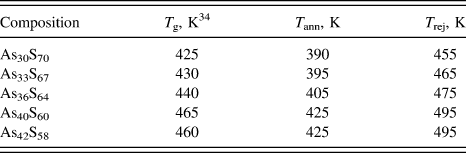
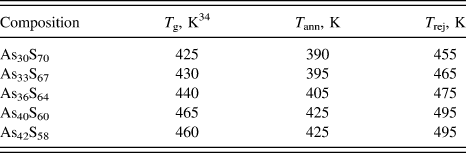
The γ-irradiation treatment was carried out at the ambient conditions in a closed cylindrical cavity of concentrically maintained 60Co sources (the mean energy of γ-quanta was 1.25 MeV) with a 0.7 kGy/h dose rate at the temperature not exceeding 300 K. The overall duration of γ-irradiation treatment was 6 months and the total accumulated dose during this period was ∼3 MGy. After γ-irradiation, part of the irradiated samples were annealed for a few hours at 30–40 K below T g and then rejuvenated above T g in a heating–cooling cycle as it is described in Ref. Reference Shpotyuk, Shpotyuk, Golovchak, McCloy and Riley39. The corresponding values of characteristic temperatures of annealing T ann and rejuvenation T rej for each γ-irradiated sample are given in Table I in comparison with T g measured for γ-irradiated samples. Reference Golovchak, Shpotyuk, Kozdras, Riley, Sundaram and McCloy34 Such a protocol allowed us to perform all investigations in a so-called backward measurement chronology during a short-period after γ-irradiation, excluding inaccuracies in the instrumentation and measurement procedures. Thus, under this methodological procedure, three different structural states were studied in g-As x S100−x , which are being (1) γ-irradiated, (2) γ-irradiated and additionally annealed, and (3) fully rejuvenated (pristine or nonaged) states. Such an approach is grounded on prerequisite that the applied rejuvenation procedure restores fully the as-prepared state of ChG, Reference Saiter36 and below-T g thermal annealing erases the reversible part of γ-induced changes tending ChG toward thermally aged state. Reference Feltz1,Reference Shpotyuk, Fairman and Ushkov14 So the evolution of free-volume void structure was studied ex situ using ChG in three above-mentioned states.
Characteristic temperatures for investigated g-As x S100−x samples.
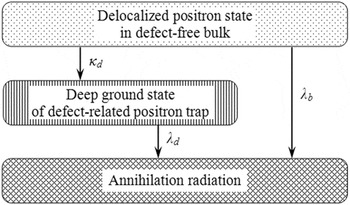
The PAL spectra were recorded with a fast–fast coincidence system ORTEC of 230 ps resolution (determined by full width at half maximum of a single Gaussian using 60Co isotope) at the temperature of T = 22 °C. The 22Na isotope of slight activity (∼50 kBq) sandwiched between two identical samples was used as a source of positrons. Each spectrum consisting ∼106 coincidences was measured with a channel width of 6.15 ps (the total number of channels was 8000). The source contribution in PAL spectra was compensated as 10% input caused with two components giving τ(S1) = 415 ps and τ(S2) ≈ 2 ns. Finally, the raw PAL spectra were processed with LT 9.0 software. Reference Kansy40 Two-state positron trapping model (Fig. 1) with τ1,2 lifetimes (±0.01 ns) and I 1,2 intensities (±0.01 a.u.) as fitting parameters Reference Krause-Rehberg and Leipner29 was used for ChG. The main feature of this model is that only one kind of defects is responsible for positron trapping, Reference Krause-Rehberg and Leipner29–Reference Tuomisto and Makkonen31 so that the positrons may annihilate from defect-free bulk state with λb rate or be trapped by vacancies with κd rate and then annihilate with λd rate as it sketched in Fig. 1. The competitive detrapping escape of positrons from defect-state backwards nontrapped state was excluded, for simplicity. The mean τav, defect-free bulk τb and defect-related τd lifetimes, and positron trapping rate in defects κd as main PAL trapping modes were calculated using fitting parameters: Reference Krause-Rehberg and Leipner29–Reference Tuomisto and Makkonen31
 $${\tau _{{\rm{av}}}} = {{{\tau _1}{I_1} + {\tau _2}{I_2}} \over {{I_1} + {I_2}}}\quad {\rm{,}}$$
 $${\tau _{\rm{b}}} = {1 \over {{\lambda _{\rm{b}}}}} = {{{I_1} + {I_2}} \over {{{{I_1}} \over {{\tau _1}}} + {{{I_2}} \over {{\tau _2}}}}}\quad {\rm{,}}$$
 $${\tau _{\rm{d}}} = {1 \over {{\lambda _{\rm{d}}}}} = {\tau _2}\quad {\rm{,}}$$
 $${\kappa _{\rm{d}}} = {{{I_2}} \over {{I_1}}}\left( {{1 \over {{\tau _{\rm{b}}}}} - {1 \over {{\tau _{\rm{d}}}}}} \right) = {I_2}\left( {{1 \over {{\tau _1}}} - {1 \over {{\tau _2}}}} \right)\quad {\rm{.}}$$
Schematic representation of two-state positron trapping model.

III. ANALYSIS OF VOID EVOLUTION PROCESSES IN ChG
Let us consider different void evolution processes possible in ChG under external influences and their expected impact on the PAL trapping modes. Such processes are governed by changes in both void volume and concentration, they being principally different for small and large voids. With respect to Ref. Reference Shpotyuk and Filipecki28, a strong increase in the positron trapping coefficient μ is expected with void size (the positron trapping rate κd is defect dependent as κd = Cμ, where C is defect concentration), while for large vacancy clusters this process is close to saturation (the positron trapping rate κd becomes dependent on the defect concentration C only).
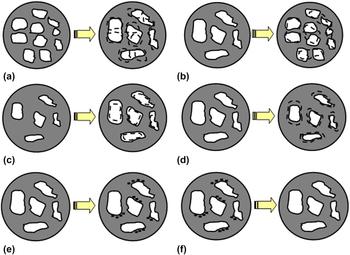
The first void evolution process, named the agglomeration of voids, is schematically illustrated in Fig. 2(a). Free-volume defects responsible for positron trapping got favorable environment to grow in size owing to their merging (joining together). As a result, one can expect a decrease in the number of voids accompanied by an increase in their average size and overall void-occupied volume. Two different types of agglomeration processes are possible depending on the void size. In the case of small voids evolving no more several vacancies (agglomeration I), strong increase in τd (as well as μ) results in enhanced κd despite decrease in the void content C. As a consequence, the slight deviations in I 2 can be expected owing to Eq. (4). But, in the case of large voids, only slight increase in τd lifetime is expected. So that the positron trapping rate κd drops down owing to preferential decrease in the content C and slight increase in the positron trapping coefficient μ. Consequently, the I 2 intensity decreases as it follows from Eq. (4). This process can be conditionally referred to as agglomeration II.
Schematic view of probable topological void evolution processes occurring in ChG under external influences: (a) agglomeration, (b) fragmentation, (c) expansion, (d) contraction, (e) charging, and (f) discharging. The left and right parts of each diagram show initial and changed distribution of voids in ChG. The dashed lines at the right part of the diagram show the contour of initial voids for more clarity.

In contrast to agglomeration, the process of division of voids can be considered, leading to an increase in void number accompanied by a simultaneous decrease in void size and overall void-occupied volume. The schematic view of such process named as void fragmentation is shown in Fig. 2(b). By analogy with agglomeration, fragmentation I and II can be defined with respect to the division of small or large free-volume voids, respectively. In the case of small voids (fragmentation I), one can expect strong decrease in τd accompanied by a decrease in κd (owing to preferential decrease in μ with respect to increase in C) and resulting in slight deviations in I 2. Under such consideration, fragmentation II should be characterized by a slight decrease in τd and increase in κd (owing to preferential input from C and just slight decrease in μ). As a consequence, an increase in I 2 is expected.
The next pair of opposite void evolution processes related to void expansion and contraction is shown schematically in Figs. 2(c) and 2(d), respectively. We consider that void expansion corresponds to getting the favorable environment by free-volume defects, leading to an increase in their size and overall void-occupied volume without essential changes in C. These changes are expected to be accompanied by an increase in positron trapping efficiency of voids due to production of some excess of free volume. So that void expansion causes the increase in τd and κd, however, these increments can be slight or even undetectable in the case of large voids and slight increase in μ. Under such conditions, the trend in I 2 is ambiguous: the preference in the increased κd leads to the enhanced I 2, while dominance in the τd causes the decreased I 2. By analogy, the void contraction as shown in Fig. 2(d) can be considered as process of getting by voids the environment suppressing their size and overall occupied volume without essential deviations in C. These PAL trapping modes show an opposite change in the case of void expansion.
One more pair of opposite void charging and discharging processes is illustrated schematically in Figs. 2(e) and 2(f), respectively. The void charging supposes appearance positron-attractive negative charge in the nearest surroundings of trapping site enhancing positron trapping efficiency. In the case of void discharging, the negative charge in the nearest environment of free-volume void is lost by attaining positron-repulsive neutral or more positive environment. As a result, the void charging causes a slight decrease in τd owing to more rapid positron annihilation in negatively charged trapping site, and κd will increase substantially because of the increase in μ. Consequently, it should lead to the increase in I 2 with respect to Eq. (4). Then, it is easy to show that the decrease in κd and I 2 with slight increase in τd can be assigned to opposite void discharging process.
It is noteworthy that all the above void evolution processes do not concern changes in the defect-free bulk positron annihilation channel, so that the defect-free bulk positron lifetime τb remains unchangeable. One more notable is that some of the considered void evolution processes produce very similar changes in the detected PAL trapping modes, so that additional arbitral experiments are needed to clarify the realistic nature of responsible structural transformations.
IV. RESULTS AND DISCUSSION
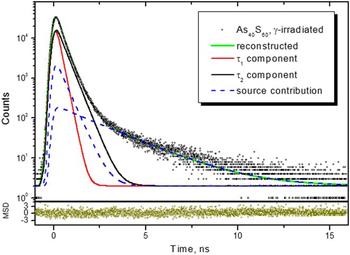
Typical row PAL spectrum of γ-irradiated g-As40S60 reconstructed with two-component fitting procedure is shown in Fig. 3. The similar spectra were detected for all other samples of the studied As–S system. Slight statistical scatter in the mean square deviations (MSD) between experimental and reconstructed spectra (see the bottom inset of Fig. 3) testifies in a favor of high reliability of the applied mathematical fitting procedure.
Row PAL spectrum of γ-irradiated As40S60 (open circles) and its deconvolution on two components (red and black lines). The reconstructed spectrum corresponds to green line, and source contribution is depicted by the blue dashed line.

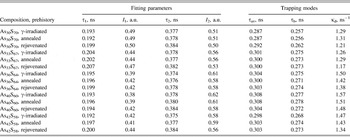
The PAL characteristics (fitting parameters and trapping modes) of g-As x S100−x in γ-irradiated, annealed, and rejuvenated states are given in Table II. It is obvious that γ-irradiated ChG samples of all compositions as compared to rejuvenated ones show an increase in the positron trapping coefficient κd. The defect-related positron lifetimes τd (which are equivalent of long-lived positron lifetimes τ2) decrease under γ-irradiation, while I 2 intensities demonstrate a slight increasing tendency under these conditions. With respect to the detected γ-induced changes in the PAL trapping modes (Table II), the void charging or fragmentation II processes can be considered as responsible for γ-induced structural evolution in the rejuvenated As–S ChG.
PAL characteristics of g-As x S100−x in different postirradiation states: after γ-irradiation (state 1); after further thermal annealing (state 2); and after further rejuvenation (state 3).

Comparing the PAL trapping modes in γ-irradiated and annealed ChG (Table II) shows no essential changes in the I 2 values, but τd and κd parameters exhibit clear compositional dependence. Both τd and κd are insensitive to γ-irradiation in S-rich g-As x S100−x (x = 30, 33), while in near-stoichiometric glasses (x = 36, 40, and 42) the τd slightly decreases and κd increases under irradiation. So that we can assign the former void charging or fragmentation II processes to γ-induced changes in the annealed near-stoichiometric ChG, and no significant structural difference occurs between γ-irradiated and annealed S-rich samples.
Thermally induced effect on the rejuvenated samples can be considered to deeper insight into the physical nature of radiation-induced changes in g-As x S100−x with different thermal prehistory. It is seen from Table II that annealing of the rejuvenated ChG leads to an increase in κd and I 2, and a slight decrease in τd. It means that both annealing and γ-irradiation have the same PAL response in the rejuvenated samples causing eventual void charging or fragmentation II.
Thus, only void evolution processes of charging or fragmentation II are responsible for γ-induced effects in both rejuvenated and annealed g-As x S100−x (the opposite thermally induced transformations occur in γ-irradiated glasses due to void discharging or agglomeration II), the processes of void agglomeration–fragmentation I and expansion–contraction being unsuitable for any of the observed effects. It is noteworthy that processes of fragmentation–agglomeration II are just probable for ChG, since relatively large intrinsic voids reaching 80–100 Å3 in a volume are responsible for positron trapping with τd = 0.36–0.38 ns lifetimes in these samples. Reference Shpotyuk and Filipecki28,Reference Jensen, Salmon, Penfold and Coleman41,Reference Shpotyuk, Ingram, Shpotyuk and Filipecki42
Since void charging and fragmentation II correspond to the same changes in the PAL trapping modes, to clarify the realistic nature of responsible void evolution processes let us refer to optical spectroscopy data for the same samples studied previously. Reference Shpotyuk, Shpotyuk, Golovchak, McCloy and Riley39 It was shown that γ-irradiation of near-stoichiometric g-As x S100−x (both annealed and rejuvenated) led to long-wave shift of the fundamental optical absorption edge (known as darkening effect) and any deviations from stoichiometry toward S- or As-rich compositions reduced this effect. At the same time, γ-irradiation of S-rich and annealing of all rejuvenated ChG caused the bleaching effect, while under-margin γ-induced optical changes were appropriate for annealed S-rich glasses. Reference Shpotyuk, Shpotyuk, Golovchak, McCloy and Riley39 Such behavior was explained by preference of different γ-induced structural transformations in the studied ChG. Destruction-polymerization transformations (DPT) Reference Shpotyuk, Fairman and Ushkov14,Reference Popov, Fairman and Ushkov43 occurring via switching of heteropolar As–S covalent bonds into homopolar As–As ones (as it was confirmed for g-As40S60 using IR Fourier spectroscopy technique Reference Shpotyuk, Fairman and Ushkov14,Reference Shpotyuk, Kovalskii, Vakiv and Mrooz22,Reference Shpotyuk, Kornelyuk and Yaskovets44 ) are responsible for radiation-induced darkening in near-stoichiometric ChG. At the same time, the γ-induced physical aging Reference Balitska, Shpotyuk, Filipecki, Shpotyuk and Iovu33,Reference Golovchak, Kozdras and Shpotyuk45 causes blue shift in the fundamental optical absorption edge (the bleaching effect) of S-rich rejuvenated ChG. Difference in the positions of the fundamental optical absorption edge of annealed and rejuvenated ChG confirmed this supposition, showing the bleaching as a result of thermally induced physical aging. Reference Golovchak, Kozdras, Shpotyuk, Gorecki, Kovalskiy and Jain46 Thus, changes in the position of fundamental optical absorption edge of As–S ChG were considered as a balance between two competitive processes of γ-induced DPT and physical aging.
Undoubtedly, the above induced optical effects should be accompanied by noticeable changes in both atomic and void structure of the studied ChG. The fragmentation of intrinsic subnanometer voids (reduction in the volume of voids accompanied by an increase in their content) was established as the main signature of physical aging. Reference Golovchak, Ingram, Kozyukhin and Shpotyuk47 It means that all externally induced changes in the PAL trapping modes accompanied by a short-wave shift of the fundamental optical absorption edge (as main optical response on physical aging) are related to void fragmentation tending ChG closer to equilibrium of supercooled liquid. So, with respect to the rejuvenated ChG, the γ-induced changes in the PAL trapping modes of S-rich samples can be ascribed to void fragmentation II due to γ-induced physical aging, and changes caused by annealing of all ChG can be explained by void fragmentation II due to the thermally induced physical aging.
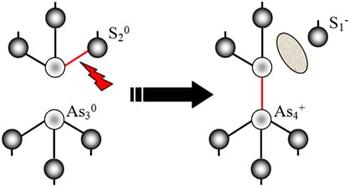
As to bond switching predicted by DPT concept, Reference Shpotyuk, Fairman and Ushkov14 this process is assumed to be accompanied by deviations in local atomic coordination (typically marked by subscript) and charge state (marked by superscript) of some atoms forming CTD pairs like (As4 +, S1 −). Reference Shpotyuk, Fairman and Ushkov14,Reference Shpotyuk, Kovalskii, Vakiv and Mrooz22,Reference Shpotyuk24 Topological scheme illustrating γ-induced formation of such CTD pair is shown in Fig. 4. The void size (unoccupied region of electron density) does not change essentially under such process, despite negative charge located preferentially around undercoordinated chalcogen atom, which appear in the void surrounding owing to destroyed covalent chemical bond. Thus, the created voids possess enhanced positron trapping efficiency. So, it is reasonable to conclude that γ-induced changes in the PAL trapping modes of near-stoichiometric (both annealed and rejuvenated) g-As x S100−x being accompanied by the long-wave shift of the fundamental optical absorption edge correspond to the void charging due to the appearance of free-volume voids in the vicinity of negatively charged CTD. Reference Shpotyuk and Filipecki30
Topological scheme illustrating the process of γ-induced (As4 +, S1 −) CTD formation in g-As2S3 (As and S atoms are shown by light-gray and dark-gray circles, respectively; the destroyed and created bonds are shown by red lines; gray oval represents free-volume void of lower electron density in a vicinity of negatively charged atom).

V. CONCLUSIONS
Investigation of γ-irradiated, annealed, and rejuvenated g-As x S100−x using PAL spectroscopy in a backward measurement chronology allows a systematic study of the γ-induced evolution of free-volume structure depending on the chemical composition and thermal prehistory. Two-state positron trapping model used for the ChG provides good correlation between experimental and reconstructed spectra, which testifies in favor of high reliability of the applied mathematical fitting procedure.
As a result of γ-irradiation, both the positron trapping coefficient κd and intensity I 2 increase, while defect-related positron lifetime τd shows a slight decrease in the rejuvenated glasses. The same trend is suitable for the annealing of the rejuvenated glasses. Effect of γ-irradiation on the annealed S-rich g-As x S100−x is negligible, while annealed near-stoichiometric glasses exhibit a slight decrease in τd and increase in κd.
Comparison of PAL data with changes in the position of the fundamental optical absorption edge of the investigated samples allows distinguishing the effects of γ-induced CTD formation, γ-induced, and thermally induced physical aging. The γ-induced physical aging is shown to be dominated in the rejuvenated S-rich glasses, while CTD are character for near-stoichiometric glasses (both rejuvenated and annealed). Then, annealing of the rejuvenated g-As x S100−x is accompanied by thermally induced physical aging.
Detailed analysis of different void evolution processes in ChG under external influences allows to establish correlation of the observed changes in the PAL trapping modes with real structural transformations. Thus, the free-volume evolution in g-As x S100−x associated with thermally and γ-induced physical aging is shown to be consistent with void fragmentation process, while γ-induced CTD formation leads mainly to void charging.