Actions produce dreams and ideas, and not the reverse.Footnote 1
Introduction
In the inaugural issue of the short-lived anarchist feminist journal Fujin Sensen (The Women's Front) published in March 1930, one of its founders, Takamure Itsue, critiqued the destruction of conditions that are specific to women's existence—like pregnancy, childbirth, and childrearing—in Japanese capitalist society. She explained, “In such a society, these special characteristics are viewed as private affairs. However, people's positions are evaluated only in public affairs.”Footnote 2 She argued that even if some of these burdens are alleviated through the creation of maternity hospitals and childcare facilities, as long as these tasks are considered to be inversely related to the ability of women to participate in public affairs, meaningful transformation will not take place. Developing her critique further, Takamure explained that capitalists have long used the excuse that these “private affairs” that are tied to the biological capacities of women detract from their ability to fully participate in production in order to reject demands for equal wages.
In the May 1930 issue of the same journal, fellow anarchist Yagi Akiko also explored the specific oppression that women faced in capitalist society in the May 1930 issue.Footnote 3 Yagi, who also edited a radical women's arts magazine called Nyonin Geijutsu (Women's Arts) presented a study called “Shihonshugi Keizai to Rōdō Fujin” (“The Capitalist Economy and Working Women”) in which she likened female workers in Japan's textile industry to slaves who picked cotton in the United States without compensation. She further linked their abjection to the exploitation faced by Chinese workers employed in Japanese-owned textile factories in Shanghai and Qingdao. In these ways, she connected low wages paid to female factory workers in Japan to American slavery-based capitalism and Japanese imperialism.
Takamure and Yagi, two anarchist successors of the female socialists who organized around the Sekirankai (Red Wave Society) that was founded in April 1921, distinguished themselves by highlighting the need to pay attention to the way that reproduction, rather than simply production, determined the specificity of Japanese women's present oppression.Footnote 4 In other words, Takamure, Yagi, and other contributors to the Fujin Sensen in the early 1930s highlighted what Marxist feminist scholars and feminist political economists would later call the problem of social reproduction as a key terrain of anticapitalist struggle. As this article will show, these theorizations emerged out of the concrete struggles, waged by women, that erupted in both city and countryside after World War One.
Japanese labor historians consider this moment to be a significant point of departure from the era of bourgeois party-led political struggle called Taishō democracy, which challenged the state's ability to secure the material and ideological foundations for the continued accumulation of capital.Footnote 5 One of the outcomes of the new class struggles that accompanied the transformation of Japanese capitalism after World War One was the destabilization of gender and familial relations, which social scientists and policymakers described at the time as the “woman question” (fujin mondai).Footnote 6 Though quite vague in its articulation, the problematization of women's roles and their place within society, political institutions, and their families was closely tied to concrete struggles over who would bear the burden of reproducing the conditions of capital accumulation.Footnote 7
Not long before the “woman question” emerged as a social problem in Japan, Rosa Luxemburg took up the question of the devaluation of women's work under capitalism in a speech, “Women's Suffrage and Class Struggle,” that she gave at the Second Social Democratic Women's Rally held in Stuttgart, Germany, on May 12, 1912. She explained that contrary to appearances, working women were productive members of society—they produced surplus value—according to standards that capitalists themselves employed. In a manner echoed by Takamure nineteen years later, Luxemburg explained that under capitalism, which took the wage labor relation as primary, the hours spent raising children and performing work were not recognized as productive: “[A]s long as capitalism and the wage system rule, only that kind of work is considered productive which produces surplus value, which creates capitalist profit.” She acknowledged that “this sounds brutal and insane” but emphasized that it was important to point out because it “corresponds exactly to the brutality and insanity of our present capitalist economy.”Footnote 8 Luxemburg argued that the most important first step for the proletarian woman was to understand this brutal reality for what it was and to articulate claims to suffrage based on their value-producing capacities as defined by the society in which they lived.Footnote 9
Like Luxemburg, Marxists and anarchist feminists in interwar Japan began to draw attention to the way that capitalist development since the Meiji Restoration had created the conditions that rendered the work that women performed less valuable relative to that of men. Unlike Luxemburg, who made her case for the extension of political rights to proletarian women based on their productivity in the capitalist sense, they concentrated their attacks against institutions and mechanisms like the Meiji Civil Code, the patriarchal family, and unequal labor markets that they believed structurally kept Japanese women in subordinate positions despite their centrality in waged work since the start of the Meiji era.
Reformist state actors pushed back against these critiques, explaining that a reaffirmation, not a denial, of existing capitalist and patriarchal structures was crucial to the country's ability to withstand the global crisis of capital. This crisis, which manifested itself in fierce competition between capitalist countries, they asserted, could only be managed through a reconfiguration of the empire and by strengthening an already repressive police state apparatus that alternated between periodic purges and daily surveillance of those who were identified as carriers of “dangerous thought” in the metropole.Footnote 10 Such thought was defined broadly and could include ideas that challenged assumptions about women's roles in capitalist society whether they appeared as rejections of the patriarchal extended family system (ie), calls for state-sponsored welfare institutions, or demands for the installation of equal educational facilities for girls.Footnote 11
The “woman question” as it emerged after World War One was thus at the center of debates over how crises of capital accumulation in the age of intensifying imperialist competition would be managed. Prewar socialist and anarchist feminists responded by critiquing the configuration of Japanese capitalist society that oppressed women by calling upon them to disproportionately shoulder the burden of social reproduction and simultaneously devalued this work. Strategies were fiercely debated, and these conversations were featured prominently in the pages of journals like the Fujin Sensen, as well as in newspapers and pamphlets that circulated in rural and urban spaces throughout the Japanese empire during the late 1920s and early 1930s. Despite the fact that these publications and new discourses on the “woman problem” were fueled by the suffering of, and struggles by, ordinary women, particularly poor female tenant farmers for whom many of these discussions had immediate material consequences, scholarly writing tends to approach their voices and experiences as the material realities to which Japanese feminists responded rather than as constitutive to the formation of thought itself.Footnote 12 This has the consequence of not simply minimizing the contributions of female tenant farmers to Japanese anticapitalist struggles but reinforces the divide between theory and praxis that has dominated analyses of activism in Japan and beyond.
This paper introduces the struggles over social reproduction that working women, particularly in rural areas participated in after World War one that served as precursors to theorizations that feminists like Takamure and Yagi articulated during the early 1930s. In so doing, it aims to complicate existing peasant and labor histories that do credit poor rural women with providing a spark that inaugurated a new era of mass struggle led by proletarian actors but at the same time rely on simplistic narratives that deny their agency. One can see examples of such analyses in depictions of devoted housewives who courageously fought to procure rice for their families and who in so doing sparked the 1918 Rice Riots, almost by accident.Footnote 13
In the last few decades, scholars have complicated this narrative by identifying the women who first protested the steeply rising price of their staple food, rice, in the summer of 1918.Footnote 14 Relying upon oral history, they have painstakingly recreated the conditions that first led a small group of women from a fishing community in Toyama prefecture to organize meetings and rallies after being drawn to action by the knowledge that they acquired as loaders of rice barrels onto steamships that transported the precious commodity to faraway lands for high prices that kept consumption out of their reach.Footnote 15 The detailed nature of this inquiry has allowed for some consensus as to the identities of the initial participants—many of whom have no subsequent public record—and the location of the community well that they congregated around to commiserate in their shared discontent.Footnote 16 The story of female stevedores disrupting an empirewide supply chain by refusing to allow the rice and grains aboard massive steam-powered vessels owned by powerful shipping interests paints a powerful picture of working women who recognized the indispensability of their labor power in global circuits of trade and took action that threatened to bring the entire system to a halt.
While meaningful in their own right, this characterization does not allow us to fully appreciate the ways in which the multiple, often contradictory roles that many of these women performed in their daily lives shaped their recognition of the need to address the question of social reproduction in their struggles. These analyses share an implicit assumption that many labor historians begin with: that revolutionary struggles are fought by “free” waged workers organized on a mass scale, while forms of struggle that women—not fully free because they continued to struggle under multiple forces of extraeconomic compulsion—participated in belong to the realm of the prepolitical.Footnote 17 While this approach allows us to recognize the female stevedores as wage-earning, value-producing, productive workers who inaugurated the country's largest workers’ strike to date, it obscures the full significance of their actions that were informed by much more than their occupation. By celebrating their resistance as resulting from their class consciousness as workers, these accounts unwittingly replicate the notion criticized by Marxist feminists that meaningful anticapitalist struggle can only take place on the factory floor.Footnote 18 This lacuna is linked to the common designation of prewar Japanese agrarian social relations as feudalistic or semifeudalistic, and landlord-tenant disputes that erupted in large numbers during the 1920s and early 1930s as by extension, almost revolutionary. These twin assumptions have made it difficult for scholars to take the activism of ordinary women as anything more than a spontaneous reaction to their abjection.Footnote 19
Similarly, gendered assumptions surrounding the figure of the tenant farmer who fought against capitalist landlords have often led scholars of agrarian social movements (n ōmin undō) who take tenant disputes seriously as drivers of historical transformation in Japan to also work from a relatively limited perspective of what constitutes struggle and, by extension, who its protagonists have been.Footnote 20 In addition to ascribing an implicitly male subjectivity to tenant farmers, the tendency to assume that working-class women in interwar Japan were either factory girls who worked outside of their natal homes in order to provide supplementary, low-waged income to their ailing farming households or nonwage earning members of agricultural households whose primary roles were housework that they performed without compensation and home work that they engaged in to earn “discretionary monies,” has limited the ability of scholars of agrarian struggle to recognize the full significance of many of the demands that women whose daily experiences were marked by the straddling of boundaries between paid and unpaid labor, factory, agricultural, and domestic work, articulated.
In fact, women who worked in the Japanese countryside—even the stevedores of Toyama—wore many hats. In addition to engaging in their main occupation, they were members of broader village communities, mothers, wives, daughters, sisters or in-laws in extended farming households, subjects of an empire that was built upon their exclusion from formal political institutions, and finally, members of national and international female working-class struggles. These multiple subject positions neither tell us little about the dreams they harbored, nor do they give us much indication of the scope of their imaginations. Still, it would be naïve to ignore the way that these positionalities influenced the solidarities they built, the modes of organizing that they utilized and the common visions that they articulated in the course of their struggles. Neglecting the complexity of their lives that traversed the categories of production and reproduction as we consider their activism can only lead us back to the old debates between moral economy and rational choice theorists that ultimately reduce people to either members of a collective or individual agents; feudal remnants or ultra-modern, rational actors.Footnote 21
It is necessary to read the sources that ordinary women who participated in the extraordinary challenges to the Japanese state and capital during and after the 1918 Rice Riots as examples of subjectification—consciousness that develops within the process of capitalist development that are the very openings from which revolutionary transformation can emerge.Footnote 22 In addition to providing us a window into the desires and visions of women whose voices have been erased from much of the historical record, careful analyses of the limited records that exist through the lens of social reproduction allow us to make connections between these struggles and the more dramatic, often celebrated moments in prewar Japanese feminism. For example, such analyses lead us to consider the possibility that the often cited calls for the “rejection of the family (katei hitei)” that contributors to the April 1930 issue of Fujin Sensen made gained their force and materiality through the hundreds of local disputes that thousands of women participated in at the height of landlord-tenant disputes that erupted in the countryside in the early to mid-1920s.Footnote 23 They also allow us to situate these disputes within a broader sphere of proletarian women's struggle that unfolded in Japan's agrarian villages, colonial possessions, and beyond, especially after World War One.Footnote 24
This task of reading differently requires a critique of the way that scholars then and now have tended to define the value of women's modes of existence in interwar Japan. Instead of replicating the data on women that official reports, mainstream media outlets, and even organ papers of radical groups to which women belonged as members accepted at the time, I focus on the way that boundaries between productive and unproductive, waged and unwaged, intimate and public were constantly negotiated—drawn and redrawn by and through women during these tumultuous times.Footnote 25 As such, it follows Patricia Tsurumi's earlier efforts to provide an alternative reading of Meiji era female textile workers as both waged and unwaged workers and to ask different questions.Footnote 26 It asks, how did ordinary women whose work straddled the boundaries of waged and unwaged; industrial and agricultural labor; public and private respond to the intensification of work, the reaffirmation of patriarchal family, and the naturalization of gender roles that dominated social policy in Japan after the post-World War One agricultural crisis? How were these collective responses read during that time? What impacts did their activism have upon landlord-tenant relations more broadly?
It is my contention that women in Japan's countryside did not accept the attempts by capital to intensify their work to cope with the economic crisis without a fight—a fight that we can glimpse through the participation of hundreds of poor farming women in tenant disputes that erupted throughout the countryside at precisely the moment that feminist intellectuals and activists were also making their demands heard in the cities. Further, their specific demands indicate their desire to maintain a degree of organizational autonomy even as they placed themselves squarely within the Japan Farmer's Union (Nihon N ōmin Kumiai, hereafter JFU) and other organizations that were founded after World War One to organize workers and peasants for class struggle.Footnote 27 They understood the complexity of their place within rural social relations and the specificity of their collective needs that were linked to, but distinct from those of tenant farmers understood as an undifferentiated class. Their demands require that we treat them as more than mere supporters of an ultimately male-driven movement. Through their participation in these struggles, they produced their own collective visions and critiqued the way that the state, capital, and their families undervalued their lives and their labor.Footnote 28 It was through and in their struggles over who would bear the burdens of social reproduction that their dreams for a radically different world were conjured and new grammars of struggle were articulated.
The rest of this article will focus on an example of one such struggle that erupted in Okayama prefecture against an Osaka-based conglomerate, Fujita-gumi during the first half of the 1920s. While limited in numbers, the imagination that these women held was global in scope and should be understood as one link in a rich history of proletarian feminist struggle outside of Japan, marked by Flora Tristan's call for a worker's international in 1844; the establishment of women's commissions in the Paris Commune in 1871 led by Elisabeth Dmitrieff; Clara Zetkin's 1910 call for an International Women's Day; Luxemburg's argument for the inclusion of women's suffrage in the political agenda of the SDP in 1912; and the women-led strike in Petrograd in 1917 on International Women's Day that lit a fuse for the Russian Revolution.Footnote 29 The challenges that female tenant farmers and their supporters mounted against the Fujita farm constituted a serious threat to the Japanese state, which was in the midst of articulating a new role for women as managers of the household economy and her ideal place within the family in order to respond to the post-World War One capitalist crisis.Footnote 30
Fujita-gumi's reclamation project in Okayama
Okayama, a prefecture that lies along the Seto Inland Sea, is well known as one of the nation's most active sites of tenant organizing during the early 1920s. Many pages of the JFU's organ paper, Tochi to jiy ū (Land and Liberty) especially in its early years, were devoted to introducing landlord-tenant disputes in the prefecture. The series of struggles that took place at the Fujita farm in Fujita village in the district of Kojima stands out as some of the largest and most intense of what many historians consider the first phase of modern Japan's agrarian social movements.Footnote 31
The Fujita farm was a bit of an anomaly in prewar Japan in that it was owned by the Fujita-gumi, a conglomerate that built its fortune in mining by the end of the Meiji period (1868–1912) by taking advantage of its close ties to the Ministry of Finance. In a country known for having its agricultural production dominated by small farming households, the Fujita farm stood out for housing more than 500 families that cultivated over 1,200 ch ōbu of land that the company owned.Footnote 32 It was one of the only large plantation-type farms that existed in the metropole outside of Hokkaido.Footnote 33
The formation of the Fujita farm was part of two emblematic projects of the Meiji Restoration. First, it served as compensation to former samurai who had lost the social standing and economic privileges that they had enjoyed during the Tokugawa period. Second, it was part of the so-called primitive accumulation phase of Japanese capitalism that consolidated large tracts of land in the hands of former elite.Footnote 34 Fujita Denjirō, the first head of the Fujita-gumi, was one of 144 former samurai who were initially granted titles to the mudflats of Kojima Bay. Its reclamation began in December of 1884. After some conflicts between rival companies were mediated by Finance Minister Matsukata Masayoshi, Fujita ended up with sole management rights over all of the land in 1887.Footnote 35 Construction on the first stage of a three-part project—the very area that came under dispute during the 1920s—began in May 1899 and was completed in March 1905. In contrast to the rather modest 432 chōbu that the home ministry approved in the initial stages of the project, by its conclusion, the Fujita-gumi controlled a vast area of land that encompassed both the Kōjo and Fujita villages. In the case of the Fujita village, since the farm comprised the entire area of the village, elected officials, bureaucrats, and the police were almost wholly funded by taxes paid or donations made by the company.Footnote 36
The company experimented with a variety of labor arrangements from the outset. It tested out classical landlord-tenant contracts wherein tenant farmers submitted a set quantity of rent in kind to the farm; arrangements where tenant farmers were granted free rent in exchange for the development of uncultivated lands for up to three years after which sharecropping would begin; a system of direct management (chokuei n ōhō) where small farming families would cultivate a plot of land in exchange for a monthly salary; various forms of sharecropping done primarily through the farming household unit (ukeoi); and, finally, the employment of agricultural day laborers for their testing station.Footnote 37 These forms coexisted in varying degrees in different parts of the farm. Despite some optimism that the Fujita farm could be the future of Japanese agriculture, many of the families that resided there were in dire straits since they had accumulated debts to the company in order to settle and, further, required more advances in order to maintain production. They were not able to repay these debts because of the high rents and disadvantageous terms of their contracts.Footnote 38
The eruption of tenant disputes at Fujita farm
The tenant disputes against the Fujita farm that unfolded in the early years of the 1920s were molded by these arrangements that had determined their relationship to the company since the late Meiji period. The first round of disputes, which scholar-activists of the JFU and official narratives understand as the Fujita farm dispute of 1922–1923, began in the summer of 1921 when cultivators demanded the right to buy and sell cultivation rights (kosakuken), a practice that Japanese tenants had continued to enjoy if only in practice following the completion of the Meiji land tax reforms.Footnote 39 These disputes gained national attention because of the heavy involvement of the leadership of the JFU following its own formation in Kobe on April 9, 1922. For our purposes, it is important because it prominently featured organized women's divisions called fujinbu. These women's divisions, which were the subject of much dispute in national labor and farmer organizations at that time, created activists out of ordinary women like Shigei Shigeko, Tajiri Okayo, Yamagami Kimie, and others who went on to inspire and lead other tenant and factory disputes, and help organize local women's divisions throughout the country.Footnote 40
Shigei, one of the leaders of Okayama's women's division, lived on the Fujita farm. According to an interview that she gave in 1974, her father, Okazaki Rinjirō sold his property in nearby Sone during World War One and moved his family to the farm after hearing that they could receive 2.5 chōbu there, which was a large plot of land for the time.Footnote 41 After selling his landholdings, he moved his family to the farm. Once there, he found that, despite promises of land, the contract that he had signed with the company was much harsher than tenant contracts that governed the majority of landlord-tenant relations at the time.Footnote 42 Shigei explained that as a result, her family ended up like serfs because the contract stipulated that they could not freely dispose of the products of their labor even after they had fulfilled their rent obligations.Footnote 43 Because they did not receive their distributions of rice (this ranged from twenty-five to thirty-five percent of the total harvest, depending on the type of contract they had with the company) until threshing was completed each March or April, they were never able to pay for their costly New Year's celebration without cash advances from the company. This kept them in a cycle of indebtedness to the Fujita-gumi that they were unable to break because other aspects of the contract were also disadvantageous to tenants.Footnote 44
As Shigei explained, tenant farmers who participated in the disputes against the farm protested these conditions. They demanded that the company implement the use of new machine-powered threshers that could speed up the harvesting process by months. If the company agreed, the rice would be ready to submit months earlier and households would no longer have to borrow money from the farm to pay for their New Year's celebrations.Footnote 45 Another important point of contention between the Fujita farm and its tenants concerned the use of straw that remained after the chaff had been separated from the rice stalks. Shigei explained that because the lands that they occupied were mud flats that had been newly reclaimed during the early part of the Meiji period, they did not have access to the communal mountain and forest lands that they had been allowed to use in their old village communities. As a result, they did not have any resources to supplement their livelihoods and had to purchase firewood.Footnote 46 Selling the straw that remained after the threshing process was completed was one of the only ways that tenant farmers could earn enough money to obtain the firewood that they needed for their daily lives. The company's refusal to allow their tenants to sell even one stalk of straw without its consent and warning that unauthorized sales would be treated as theft made it quite clear that it saw everything that farmers produced on land as their exclusive property—a point that the tenant farmers vehemently protested during the disputes.
The company also forbade tenants from planting anything for their own use on farm property. Even planting soybeans along the agricultural road in order to supplement their protein-deficient diets was not permitted.Footnote 47 Further, they were required to purchase water, fertilizer, the right to use agricultural tools and livestock owned by the company at prices that the latter unilaterally set.Footnote 48 Discontent that stemmed from these and other restrictions that the company placed on the ability of tenant farmers to freely engage in production on their lands and to control the products of their labor formed the basis for the deep-seated resentment that tenant farmers harbored against their parasitic large landlord. The daily experiences of exploitation and expropriation shaped their discursive strategies and their calculations of production expenses (seisanhi). These calculations, which were more than simple matters of accounting, but were intimately linked to how the value of one's labor was to be determined and by extension, how needs and desires would be differentiated, became an important tool that tenant farmers used since the early 1920s to counter the untenable calculations that landlords based their rent demands and justifications upon.Footnote 49 This calculation was indispensable, for example, to their demand for the “permanent reduction of rent by thirty per cent,” which was first expressed in Okayama and quickly became a hallmark of the early phase of JFU-led struggle nationwide. Women's divisions were particularly well-equipped to address these contests over the quality of daily life that tenants were or were not entitled to.
The formation of women's divisions in Fujita village
The women's division played a particularly important role in Miyako, one of three agricultural districts in Fujita village. Miyako had ninety-five tenant farming families that cultivated ninety-one ch ōbu and another ninety-five who were either directly managed farmers or sharecroppers who cultivated 321 chōbu.Footnote 50 They first emerged onto the scene following the intensification of the dispute in the fall of 1922. On October 26, 1922, members of the newly formed Miyako branch of the JFU submitted a complaint to the company, which began with the assertion that their current arrangement made their lives unfree and intolerable. They stated that instead of the present rice distribution ratio of 75:25, they preferred to submit half of their total harvest to the company. They also requested a change to “normal” tenant contracts that farmers lived under nationwide and demanded that the company “recognize our humanity.”Footnote 51 The company responded two days later with a terse refusal. The signatories to the first complaint filed a second one on the third of December but the two sides could not come to a compromise.Footnote 52 The dispute heated up on January 4, 1923, when the police arrested nine leaders of the dispute for theft and embezzlement after they began the threshing process with two of their own machines. The company dissolved the contracts of seven men for being the ringleaders and applied a “no trespassing” (tachiiri kinshi) order to their lands twelve days after the arrests.Footnote 53
Miyako's women catapulted onto the national scene following the issuing of this unprecedented no trespassing order. Tochi to jiy ū provided an account of this turn of events in a January 25, 1923, article titled “Miyako Nōmin Fujin Tatsu” (The Female Peasantry of Miyako Stand Up). According to the paper, after their husbands and children were taken away by the police for engaging in unlawful threshing, a group of women formed a women's division. They selected a chairperson and an executive committee and began discussing their next course of action. They called an impromptu meeting in the middle of the paddy fields where stacks of cut and bundled rice stalks lay waiting to be fed into the threshing machine that they had brought in and decided that they would defy police and company orders and would initiate another round of threshing. According to the article, the eighty women who gathered that afternoon reaffirmed their commitment to continuing the fight against the company even if all of their male comrades were jailed. Tochi to jiyū celebrated this moment and called upon their readers throughout the country to support this “wife corps” (nyōboren) that was willing to bravely carry on the struggle on their own.Footnote 54
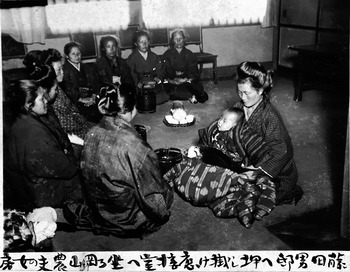
Realizing that their demands would not be met locally, the women selected representatives to travel by train to Osaka to register their appeals to the leader of the Fujita-gumi conglomerate in person. Newspapers that had a broad national readership like the Osaka Asahi and the Osaka Mainichi picked up this part of the story. The image that they painted of the women who travelled from Okayama to Osaka was in stark contrast to the way that Tochi to jiy ū reported their actions at the time, though they used the same language of the wife corps. In the hands of the sympathetic mainstream dailies, female representatives of Okayama's tenant farming households emerged as boisterous, unsophisticated, emotional, and, above all, devoted mothers and wives whose sole purpose was to beg for mercy from the wife of the head of the conglomerate. They were depicted sympathetically as supporters and comforters of their husbands, brothers, and sons, who were the real leaders of the dispute.Footnote 55
A whiff of condescension permeated its reporting on the ten women who made the trip. According to a January 23, 1923, article published in the Osaka Asahi, they disembarked the overnight train nervously, carrying baskets full of tattered clothes and outfitted in fabulously outdated shawls. They were whisked off to the headquarters of the JFU and were taken by its leadership to the Fujita mansion. It reported that after waiting impatiently for two hours for an audience with the mistress of the Fujita family, they burst into tears after being told that she was not available to meet with them.Footnote 56
Shigei, who by that time had emerged as one of the leaders of the women's division of Okayama prefecture, tells a slightly different story. While she did not make the trip in 1923, she was part of a group that made a similar visit two years later as part of a reconfigured, more formally organized Miyako women's division in 1925. Her account makes it clear that she and her comrades understood the economic and political power of the Fujita-gumi in Okayama. When the dispute erupted in 1925, tenants—both men and women—had visited the company's branch office in Fujita village in order to have their demands heard by their immediate overseers but were sent away after being told that the branch was powerless to change the terms of the contract without approval from the national headquarters. Members of the women's division immediately understood that they had to return to Osaka, which held the company's national headquarters. It was also an important center of national tenant organization. Their repeated visits to Osaka were part and parcel of their efforts to publicize and, in so doing, secure broader support for their struggle.
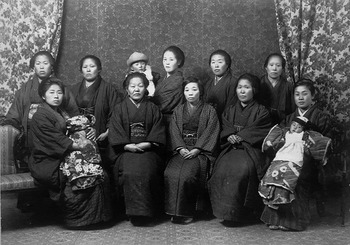
Shigei, nine other women, and their children stayed in Osaka for twenty days in February 1925. During that time, they met with leaders of the JFU Kagawa Toyohiko, Sugiyama Motojirō, and Suzuki Bunji, a prominent labor activist. At the time, the JFU was the organization charged with organizing tenant farmers into a broader coalition based on the theory of labor-farmer cooperation. According to Kondō Jirō, as deepening factionalization split the labor movement into the Sōdōmei (General Federation of Labor) and Hyōgikai (Council of Japanese Labor Unions), the JFU was pushed into playing a mediating role between these organizations despite the fact that its own leadership would split the following year over similar ideological divisions.Footnote 57 The leadership in 1925 more or less reflected its public stance that humanism and cooperation were key to raising the status of tenant farmers. It should be noted that the encounter between prominent labor and tenant union leadership and Okayama's female activists was not just important for the latter. The JFU, the Sōdōmei, and Hyōgikai all recognized the importance of organizing the large numbers of female workers in both city and countryside and were debating the method of their incorporation. This boiled down to the question of the degree of autonomy female activists and union members should hold within the organization at large.Footnote 58 Their visit coincided with the Fourth National Congress of the JFU that was held in Tokyo from February 27 to March 1, 1925. While the JFU could not reach a decision about the role that women should play within it, three of Shigei's comrades, Yamagami, Tajiri, and Kawamoto Konatsu attended the meeting and were seated prominently in the middle section of the hall alongside the close to five hundred male delegates that filled Shiba Park's Harmonization hall (Kyōchō kaikan).Footnote 59
This photo was taken to commemorate the February 1925 visit of the Fujita women to Osaka. Shigei is seated with her son in the front row, to the very right. (Ōhara Institute for Social Research, Hōsei University, reference number S3-02-006 (1/3))

Shigei and her comrades also crossed paths with prominent female activists like Kutsumi Fusako who had been one of the founding members of the Sekirankai just a few years prior. They took part in demonstrations and protests against the enactment of the draconian Peace Preservation Law that severely limited dissent and gave speeches at a labor-farmer assembly at Nakanoshima Park.Footnote 60 They were far from the hysterical housewives or mothers who prostrated themselves at the front gate of the Fujita-gumi's mansion, begging for handouts, as they had been depicted in the mainstream press. They were active participants in the exciting flurry of feminist and working-class activism that engulfed Osaka and the nation during this time.
Their decision to take their children with them on this and subsequent trips—noted in the mainstream media with curiosity—was a calculated move. On the one hand, it was an attempt to appeal to the wife of the head of the Fujita-gumi as a fellow woman in order to win better living conditions for their children. Their decision to direct their appeal to her was based on their hope that a common ground as mothers and wives that transcended class oppositions might move the needle in their favor. The work of social reproduction—providing food, medical care, and education to their children and families—that they bore disproportionately was work that was not given a value in the calculation of production expenses, but was something that they felt the bodily repercussions of every day.Footnote 61 This method of appeal was not unique to the women fighting against the Fujita farm. It was a method that prominent liberal feminists like Hiratsuka Raichō and Oku Mumeo had incorporated into their arsenal for some time. Despite the existence of intense internal debates over women's roles as mothers within and between Japanese feminist circles, the need to capture the allegiances of working women as a matter of organizational strategy also made it impossible for feminist groups, irrespective of their stance concerning the state's involvement in childrearing or the family unit to ignore the concrete needs of women who had to balance their work outside the home to child-rearing obligations in their families.Footnote 62 The Fujita women's form of appeal only highlighted the fact that bringing working women into the political movement for women's liberation would have to accommodate the responsibilities they shoulder as primary performers of reproductive labor within their households.
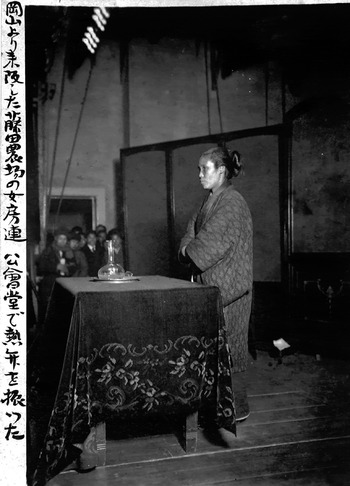
Shigei's assessment of their ventures was mixed. She notes that neither she nor her comrades in Okayama and Tokyo achieved their main articulated goal, which was to revise the central components of the existing tenant contract—the rice distribution rate and the guarantee of cultivating rights—but acknowledges the important gains that they did make. First, regarding the issue of the distribution of products, the company agreed to use “appropriate discretion” (tekagen) during the threshing period with regard to the ratio of chaff distribution.Footnote 63 By 1927, the practice of exercising appropriate discretion had become a normal part of the division of profits, evidenced by the precipitation of a large-scale dispute that year when the company decided to renege on this arrangement.Footnote 64 Another victory was a promise they wrested from the company to build a medical clinic and day care on the farm. These facilities were vital, as Fujita did not have a village doctor or medical facilities at the time. The company also agreed to build a public hall and install streetlights. While these items may seem insignificant in comparison to a formal renegotiation of contracts, their success in transferring the burden of these institutions of social welfare should not be underestimated, as the question of who would bear these costs was one of the central issues related to working-class women's struggle for national organizations like the Japanese Communist Party-affiliated Hy ōgikai.Footnote 65 Fujita's tenant farmers managed to transfer the burden of medical care and public services to the company. The visibility of members of their women's divisions on the stages of lecture halls throughout the country, often making speeches with their children at their side, cannot be disconnected from the inclusion of these facilities as part of the compromise that the two sides reached. The contributions of Fujita's women's divisions established patterns and methods of struggle that women's organizations in and beyond Okayama emulated.
The caption reads, “Fujita farm wife corps in the waiting room of the Fujita farm after imposing uninvited.” (Ōhara Institute for Social Research, Hōsei University, reference number S3-02-006 (2/3))

The caption reads, “Fujita farm wife corps member gives impassioned speech at the Osaka Central Public Hall.” (Ōhara Institute for Social Research, Hōsei University, reference number S3-02-006 (3/3))

Shigei, Yamagami, and other female tenant farmers who worked on the Fujita farm also directly challenged the company's long-standing insistence that it had sole ownership of all products that were produced on farm property. In order to raise funds for their struggle—something that they had to figure out on their own since many of their male counterparts had been jailed—the women's divisions fried broad beans into a snack called “hajiki-mame” and sold them in nearby towns. They also took these with them to Osaka, packaging them as “tenant dispute beans” as a way to raise money and to advertise their struggle.Footnote 66 Their bold act of claiming precisely those fruits of their labor that the company expressly denied them and selling them without its consent should not be underestimated, as it contributed to challenging a major point of dispute in tenant struggles: who the real owners of the products of tenant labor beyond the rent entitled to the landlord were. Further, the fact that they had been growing the beans all along reminds us of the need to consider the possibility that subtle forms of resistance had been taking place long before the eruption of the disputes in the 1920s.
Most importantly, women's divisions formulated their own agendas. Lest we misunderstand their activities as simple acts of resistance that were disconnected from any theory of revolution, it should be noted that the women's division in Okayama was one of several radical women's organizations that existed in Japan during the 1920s. The aforementioned Sekirankai and the women's bureaus in the two major independent national labor unions, the S ōdōmei and Hyōgikai took inspiration from the struggles of working women internationally.Footnote 67 Itō Noe, one of the founding members of the Sekirankai explained that they were inspired by the example of the women of Petrograd who were the sparkplugs of the 1917 Revolution.Footnote 68
It is clear from the resolutions that the Okayama women's division issued during their first meeting of the executive committee in January 1925 that they understood the importance of having an autonomous organization within the JFU. In addition to completely rejecting participation in state-sponsored women's associations (fujinkai), these resolutions focused on organizational autonomy.Footnote 69 They demanded the following: funds from the prefectural branch of the JFU as operating expenses; the ability to collect their own dues; and permission for their elected representatives to sit on the executive committee of the prefectural branch of the JFU.Footnote 70 These measures, as well as a declaration that Sugitani Tsumo, a female delegate from Kumamoto prefecture, had made at the Third National Congress of the JFU in March 1924 that women should comprise half the total number of delegates at next year's meeting, signaled the enthusiasm that female activists had for an autonomous women's movement within the organization as a whole. This demand posed a challenge to organizations like the Council of Japanese Labor Unions and the JFU, whose members generally agreed on the need to allow women to participate in working-class struggles but were less enthusiastic about providing them with the independence to set their own agendas.Footnote 71 Sugitani's statement was followed by a rebuke from a male delegate from Kagawa prefecture who said that in addition to the absurdity of the goal of achieving an even split between male and female delegates, women had to be “thoroughly educated” before they could join the union.Footnote 72
Despite the tepid response to these calls for greater organizational autonomy at national and local levels of labor organization, the leaders of women's divisions continued to develop their rationalization for these organs and also began the hard work of building broader networks of solidarity. At the First Prefectural Congress of the Okayama branch of the JFU, which was held two weeks after the January 1925 women's executive committee meeting, Yamagami Kimie was selected as the first head of the Okayama JFU's women's division. She, Shigei, and Tajiri continued to travel throughout the prefecture and to other prefectures including Yamanashi and Kagawa in order to conduct meetings, give lectures, and provide assistance in organizing female tenant farmers.Footnote 73 A culmination of their efforts at organizing in Okayama was the First Prefectural Women's Congress, which they held on April 18, 1926 at the Uchisange Music Hall in Okayama city. This was a public event by design. They managed to rally together 200 women who gathered in response to a call that the women's division issued in the form of a flier, which expressed their five main demands: (1) that state coffers be opened to maintain day care facilities during the harvest season; (2) that state coffers be opened to provide maternity pay and leave eight weeks before and after childbirth; (3) that voting rights be granted to women; (4) that unequal laws between men and women be abolished; and (5) that the Fujita farm's despotism be denounced.Footnote 74 As these demands indicate, the leadership of the Congress explicitly linked anticapitalist struggles against the Fujita farm to a broader call for a transformation of the modern legal structure that codified gender inequalities. It further demanded that the state recognize and absorb the costs of social reproduction currently burdened disproportionately by women.
At 9 a.m. on April 18, participants first congregated at the Kōrakuen Park and paraded together to the music hall that was approximately one kilometer away. They marched while singing songs of the JFU (nōminka) and carrying its flags and banners the entire way. Okayama's police kept close tabs on the event and stood ready to arrest any speakers who violated the Public Peace Police Law of 1900 that prohibited workers from organizing.Footnote 75 The official agenda for the day's formal meeting, which began just before noon, contained ten items for discussion:
-
1. Promote the organization of women's division branches
-
2. Organize more lectures by members of the women's division
-
3. Formulate a consistent message across all women's divisions
-
4. Reaffirm their rejection of ties to state-sponsored women's associations
-
5. Establish daily consumer cooperatives in each branch
-
6. Form cooperative relations with other women's divisions
-
7. Promote women's suffrage
-
8. Establish a woman's division in the national JFU
-
9. Celebrate International Women's Day
-
10. Take part in May Day activitiesFootnote 76
This ten-point agenda reconfirms the desire of the leaders of the women's division to situate themselves within an international struggle for working-class women's liberation. The last two items place Okayama's women's division squarely within efforts that prominent feminist activists like Yamakawa and Tanno Setsu had been engaged in since early 1923 to commemorate International Women's Day in Japan.Footnote 77 It also reflects their intention first expressed at the executive committee meeting in January 1925 to distinguish themselves from state-led efforts to mobilize women's divisions to promote thrift and savings in the countryside since the late Meiji period.Footnote 78 Finally, it reconfirms their position in support of the organizational autonomy of women's divisions that were being debated in national labor unions at the time.
The declaration that the leaders of Okayama's women's division wrote and signed to conclude the congress made their allegiances crystal clear:
It has been five years since we joined the Japan Farmer's Union. Today we are holding the Okayama Prefecture United Women's Division Congress. We, the proletarian women have for several centuries been defrauded, exploited and placated through various facilities, measures and the ideal of docility. Our history is one of blood and tears. We cannot bring ourselves to talk about it. We must now be steadfast. Our biggest enemy is our own acceptance of our condition. We must not cry ourselves to sleep. Society is changing and the proletariat continues to fight bravely. We, the proletariat women must also awaken from our slumber in which we cry in our sleep and must stand up in order to release ourselves from the shackles of exploitation and submission. Economically and politically, we must move to the center of the struggle and must regain what has been taken from us. When the proletariat have been liberated, the special demands of women will be realized and all proletariat women will be liberated. The future will belong to women and workers. Proletarian women unite.Footnote 79
As the declaration reveals, the women who organized the first congress saw worker and women's interests, as well as worker and tenant farmer interests, as inextricably linked and believed that a global class struggle that placed women's participation at its center was indispensable to the liberation of all women. Their intention to speak about their suffering and to articulate their demands in their own words—to place themselves squarely at the center of all proletarian struggle—challenged depictions of them, even by the JFU as the “wife corps” or a local specialty (meibutsu) that simply added flavor and flair to mainstream tenant disputes.Footnote 80
Just one month after the Congress, Shigei articulated her stance on this last point in the May 22, 1926, edition of the organ paper of the Japanese Communist Party (JCP), Musansha shimbun, in an article titled “Kumiai fujinbu wa hitsuyō ka? Shikari! (Is a Women's Division Necessary? Yes!).” In the piece, she expressed disappointment that national labor organizations did not allow women to form autonomous divisions and added a thinly veiled attack on the national JFU organization for treating its women's division like a “detached force.”Footnote 81 The following year, the Okayama JFU women's division under Shigei's leadership renamed itself the Proletarian Women's Alliance (Musan fujin dōmei) and continued its activities.Footnote 82 Though they did not use the concept social reproduction to critique the specificity of women's oppression in the Japanese countryside in the 1920s, their stance, that neither capitalism nor nationalism nor a reaffirmation of the village unit could liberate them from conditions under which they toiled and lived, reveals their understanding of it long before its theoretical elaboration.
The 1926 declaration cannot be taken to represent the vision of all of the women who enrolled in the division and participated in the tenant disputes, even in Okayama. Still, it is important to take the limited speech acts that are available to us seriously because they allow us to reestablish hidden connections between them and other radical voices whose connections have become less apparent over time.Footnote 83 If we dismantle the distinction that dominates the broader historiographical tradition that assumes that there are clearly compartmentalized female and male roles in struggle or distinguishes between theoreticians and practitioners of revolution, it becomes possible to paint a much more vivid, complicated picture of connections, fissures, and the reforging of alliances that were part and parcel of anticapitalist, antipatriarchal struggles in interwar Japan.
Yamagami Kimie on the bodily consequences of social reproduction
Yamagami Kimie was one female activist who straddled the boundaries between theory and praxis. It is for this reason that she has emerged as one of the more compelling figures of the female tenant farmers’ movement. As one of the leaders of the Okayama women's division that fought alongside Shigei against the Fujita farm, she provides us a glimpse into the complex world within which she and her comrades operated and explains how the family structure was a powerful mechanism that enabled their exploitation by the company. An essay that she published a month after the 1926 women's congress in Okayama city and right after her triumphant appearance at the Fifth National Congress of the JFU reveals a world that could only be changed through struggles that exceeded the boundaries that divided political and cultural; structural and subjective; classed and gendered. She published this piece, “Nōson fujin to kazoku seido (Women of the Agrarian Villages and the Family System)” in the May 1926 edition of the journal Mirai. Footnote 84 Though she was a midwife, not a tenant farmer, Yamagami's close involvement with the Fujita farm disputes and her own position as a working woman made her very aware of the obstacles that a capitalist system, which took advantage of and reinforced patriarchal familial relations, posed for women's liberation.
She begins her essay by introducing her readers to the tyranny of time and family that ravaged women's bodies. Equating life in the agrarian village to imprisonment, she described the endless parade of tasks that women of farming households were required to complete in the course of a day. She writes:
She cannot remain in her bed for a moment longer once the clock strikes five in the morning … After lunch, men have their cigarette break for 20–30 minutes and can read the paper. His wife has to take care of the cows and horses and children and has to clean up after the meal. She has no time to sit down … In the evening, she has to prepare a bath for seven to eight family members and has to finish cleaning up after dinner … She finally has her own time after 16–17 hours of long work.Footnote 85
Yamagami emphasizes the physical toll that working continuously from early in the morning until late at night has on women and highlights the sacrificial role that she plays to ensure the reproduction of the bodies of male members of the family. Her own deterioration is the price that has to be paid for their reproduction: “[H]er body has not recovered from fatigue even when morning comes. Her shoulders are sore, her arms are dull, the joints all over her body ache.”Footnote 86 In addition to physical degradation, she is unable to secure the simple comforts of life for herself. Washing her clothes or her hair regularly is frowned upon by elders who think of these acts as luxuries that waste both time and soap. Yamagami laments, “even people in jail are able to have their underwear and pillowcases washed or changed once a week. We are more unhygienic than criminals.”Footnote 87 Finally, her mind is never free from the exhaustion of being under the constant surveillance of her in-laws. Yamagami writes of the piercing glares that are directed toward her if she takes too much time performing her household chores or if she takes a peek at the newspaper after her husband is through with it.
Upon second consideration, Yamagami concludes that life for female tenant farmers is not like prison, but may be even worse than it. These conditions that ravage farming women's bodies and minds have to be transformed if their unrelenting suffering can be alleviated. She blames the family system, which she calls a feudalistic tradition, for this suffering that enables capitalists and landlords to exploit them. She concludes on an optimistic note, saying that women of the countryside have begun to awaken alongside her sisters in the cities. This awakening, which she believes has taken place socially, now has to be consolidated politically through a class struggle. To this end, she calls upon women to work for the liberation of the proletariat as the only way to achieve their own liberation.Footnote 88
Yamagami's essay shows that she understood what Melinda Cooper and Angela Mitropoulos have recently written about the household: that it was, and still is, a constantly shifting frontier within which conflicts, negotiations, and conciliations over what and who counts as property, who is allowed to make decisions regarding reproduction, and what kind of work is counted as legitimate labor, are all tenuously contained. The condition of the complete reproduction of their labor power—social reproduction—did not exist for women who straddled factory and paddy, waged and unwaged labor regimes. The specific suffering of women who resided in small farming households during interwar Japan sheds light upon the heavy extraeconomic compulsion that Japanese capitalism and capitalist regimes everywhere relied upon in order to attain great power status in the first quarter of the twentieth century.Footnote 89 Precisely because of the tensions inherent in this hierarchical space, the family or the household had to be situated as an “intimate sphere of a sentimental and self-managed equivalence.” It was thus, a powerful, “efflorescent machinery of that sentiment's limits and their multiplication.”Footnote 90 The familial space is where power was and is naturalized, where the unruly and unproductive were and continue to be recaptured. It is in this light that we should evaluate the establishment of a day care, a hospital, and a civic hall—the very first victories that tenant farmers extracted from the Fujita farm—as more than just minor concessions. While direct connections are impossible to make in light of the sources at our disposal, it seems likely that these were gains that the local women's divisions were instrumental in wresting from the company.Footnote 91
Conclusion
Okuda Kamezō, an entrepreneur and then House of Peers member from Tottori prefecture made an extraordinary statement in his 1927 work, Nōson kyūsai: Tochi seido kaiseiron (Salvation for the Agrarian Villages: Theory of Land Reforms) that women in Japan's agrarian villages are nothing more than machines with no existential meaning as human beings.Footnote 92 While Okuda problematized this treatment of farming women as machines, the history of the development of Japanese capitalism reveals the heavy burden that women of the countryside paid as the state turned to them soon after its founding to subsidize the costs of its project of the Meiji era, namely the pursuit of rich nation, strong army. Footnote 93 He was also right, though, when he said that because of their collective productivity, they had the power to destroy Japan's social and economic systems at their foundations. He pointed to the energy that the women from Toyama prefecture's fishing communities displayed during the Rice Riots as an example of the damage that they could cause to the well-being of the nation, if it were improperly channeled.Footnote 94 Fear of the collective strength of women drove Okuda to advocate the expansion of social welfare policies in the ailing countryside.Footnote 95 Despite their fears about what would happen if women refused to present their labor power to the nation, he and other officials downplayed the significance of women's participation in the landlord-tenant disputes that were taking place as he put pen to paper.Footnote 96
In fact, at the time that he wrote this piece, thousands of women in agrarian village communities in and beyond Okayama had already recognized their collective strength and had articulated their own visions of what a liberated human existence might look like. Unlike Okuda, they did not think of themselves as an undifferentiated mass force that could destroy capital simply by virtue of their sheer numbers, but located their force in their desire for freedom from their specific experiences of oppression. As we have seen, their knowledge that their subordination and exploitation were necessary conditions for capitalist society to reproduce itself was the force that threatened to undermine the very foundations of accumulation. They understood quite clearly that they were expected to fulfill a wide range of roles both inside and outside of their dwellings but were not always granted credit for them as value-producing tasks. In the majority of Japan's small farming households, women took on many roles during different stages of their lives that are not reflected in official calculations of their value-producing capacity. At times they were factory workers in nearby textile factories, and at others, caretakers of their families, providers of agricultural labor, students, partners to their husbands, mothers, caretakers of other people's children, or producers in handicraft industries at home. As participants in the often multigenerational farming household (n ōka), they were trained to compartmentalize each task, stretching or contracting the boundaries of each day as the season and household finances required. They endured unending battles with fatigue, ennui, and the prying, often disapproving gaze of their in-laws. They recognized the double exploitation that they endured as poor women of the countryside and understood as Marx did, that the task of social reproduction placed differential burdens on different groups of people within households and communities.
Even though Okuda did not recognize the significance of these struggles, the state clearly felt the threat and kept a close eye on the movements of the female farmer-activists. Okayama higher police reports include descriptions of women's division activities and records of arrests of key female leaders beginning in late 1925.Footnote 97 Records indicate that Kamei Shimeyo, who was an active member of the women's division of Oda district that protested the seizure of crops by the Fujita farm in October 1927, was one of twelve men and eight women who were arrested for setting fire to the residence of a purported traitor to the cause. In addition to arson, she faced charges of blackmail, property damage, and violation of censorship laws for which she received a sentence of fifteen years in jail.Footnote 98 The history of the National Farmer's Union Okayama Association's struggle, Zennō Okayama Tōsōshi, compiled in 1936, points out that Kamei's fifteen-year sentence was the longest given to any male or female participant in all of Okayama's peasant struggles to date.Footnote 99
Like the women who stormed Paris in the exhilarating spring months of 1871—Louise Michel, Elizabeth Dmitrieff, and many others—pioneers in the women's divisions of the country's first national tenant farmer union, the JFU, Yamagami, Shigei, Sugitani, Tajiri, and many others articulated and fought for their own visions of what a world without capitalism and patriarchy might look like. Their experiences working in factories, in the paddies, as petty merchants, midwives, and as pieceworkers positioned them favorably to forge connections with labor organizers and feminist intellectuals. While underrepresented in narratives of Japanese feminism, labor activism, and agrarian struggle, these women played important roles in the tenant disputes of the tumultuous 1920s. The dreams that they manufactured through their activism—though barely visible in the historical record—were carried on by prolific anarchists like Takamure Itsue and Yagi Akiko, who articulated more explicit and theoretically inflected attacks against the state, capital, and the family in the following decade. Their desires for liberation cannot be easily disentangled from the histories of their active struggles against the conditions that kept much of their work, their speech, and their bodies outside, but essential to the calculations of abstract value by capital mediated by the family form.
The possibilities and limits to action that female tenant farmers faced as members of farming households, which, in the case of modern Japan, attained its sentimental power through its purported unbreakable ties to the imperial household apparatus, makes the organization of antistatist, anticapitalist women's divisions all the more impressive. Despite the challenges they faced in making major inroads into the JFU's national organization, prefectural branches did organize in Yamanashi, Niigata, and Kumamoto in addition to Okayama.Footnote 100 Even more significant than the total number of women who participated in these radical organizations were the spaces that their activities, rooted in daily experiences of exploitation, expropriation, oppression, and discrimination, collectively opened up for theory and praxis. These struggles, far from being ancillary, were instrumental not just to agrarian struggle, but to the articulation of critiques against capitalism, patriarchy, and the state that socialist and anarchist Japanese feminist activists developed in the early 1930s.