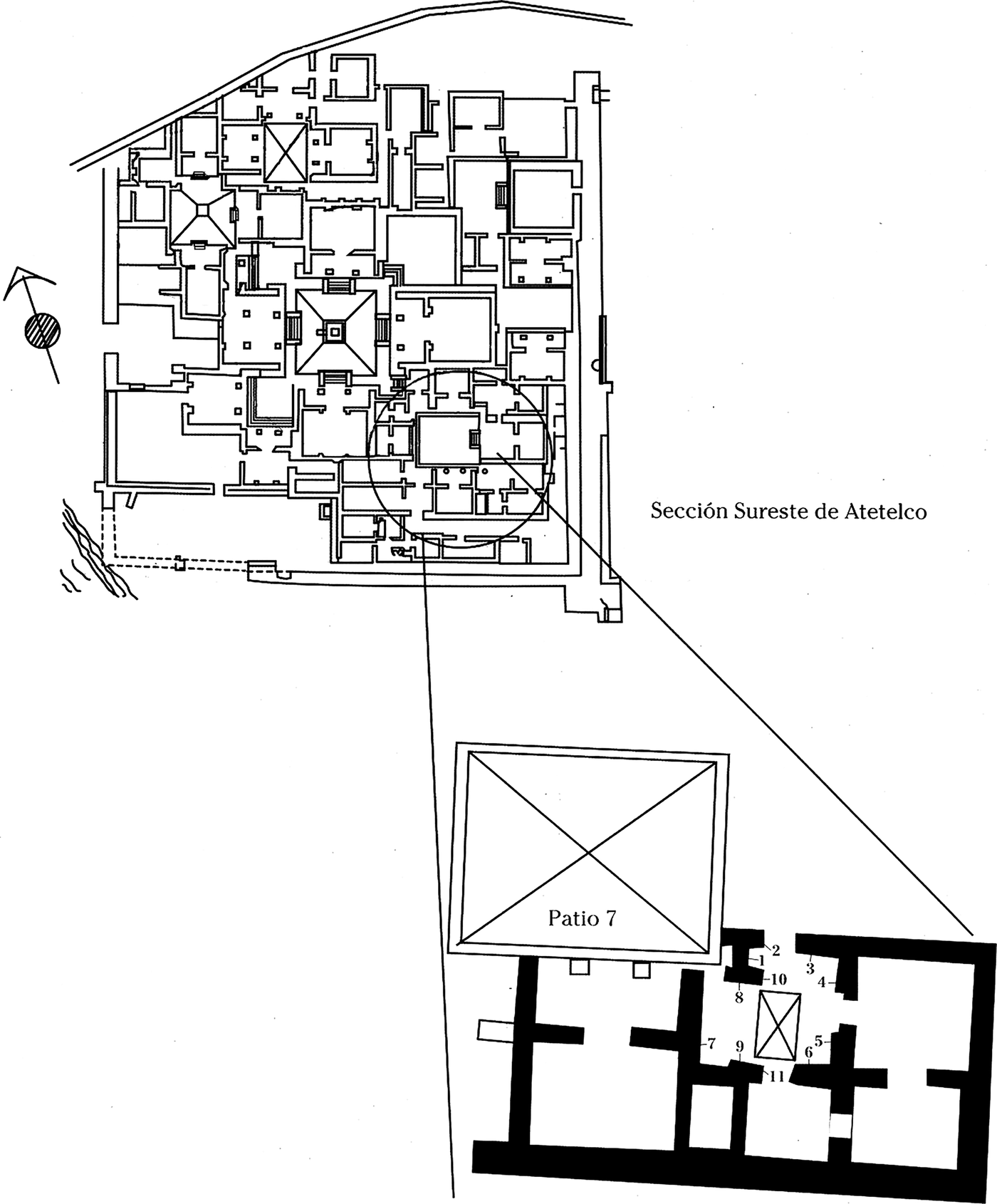
The starting point for this study is a group of murals discovered in the Atetelco apartment compound, Teotihuacan, during the 1990s (Cabrera Castro et al. Reference Cabrera Castro, Gómez, Gazzola and de la Fuente2007). The search for their meaning will take us far from Atetelco and Teotihuacan in an iconographic investigation that has developed into the reconstruction of several episodes of an important Teotihuacan myth. The murals, which were found in a small patio close to Patio 7, in the south eastern section of Atetelco, are painted in shades of red and belong to the local Xolalpan phase (a.d. 350–550) (Figure 1). They have been commented on in various studies (Cabrera Castro Reference Cabrera Castro and de la Fuente1995:247; Cabrera Castro et al. Reference Cabrera Castro, Gómez, Gazzola and de la Fuente2007; Giral Sancho Reference Giral Sancho2003, Reference Giral Sancho2004), but so far no detailed study has been made, such as their exceptional iconography deserves. I have made an initial study of the murals which serves as the basis for the research presented in this article (Paulinyi Reference Paulinyi, Castro and Cabrera2011). The four murals on the eastern half of the patio present a group of three motifs: a figure with the attributes of a bird and a butterfly, a mountain, and a bird whose body is covered with birds’ heads. The triad, consisting of the motifs mentioned above, is unique in Teotihuacan mural painting. The western half of the patio, in contrast, is characterized by murals with complex scenes composed of small human figures painted in a different style.
The location of the murals analyzed in Atetelco, Teotihuacan, with their numbering (after Cabrera Castro et al. [Reference Cabrera Castro, Gómez, Gazzola and de la Fuente2007:Figure 1]).

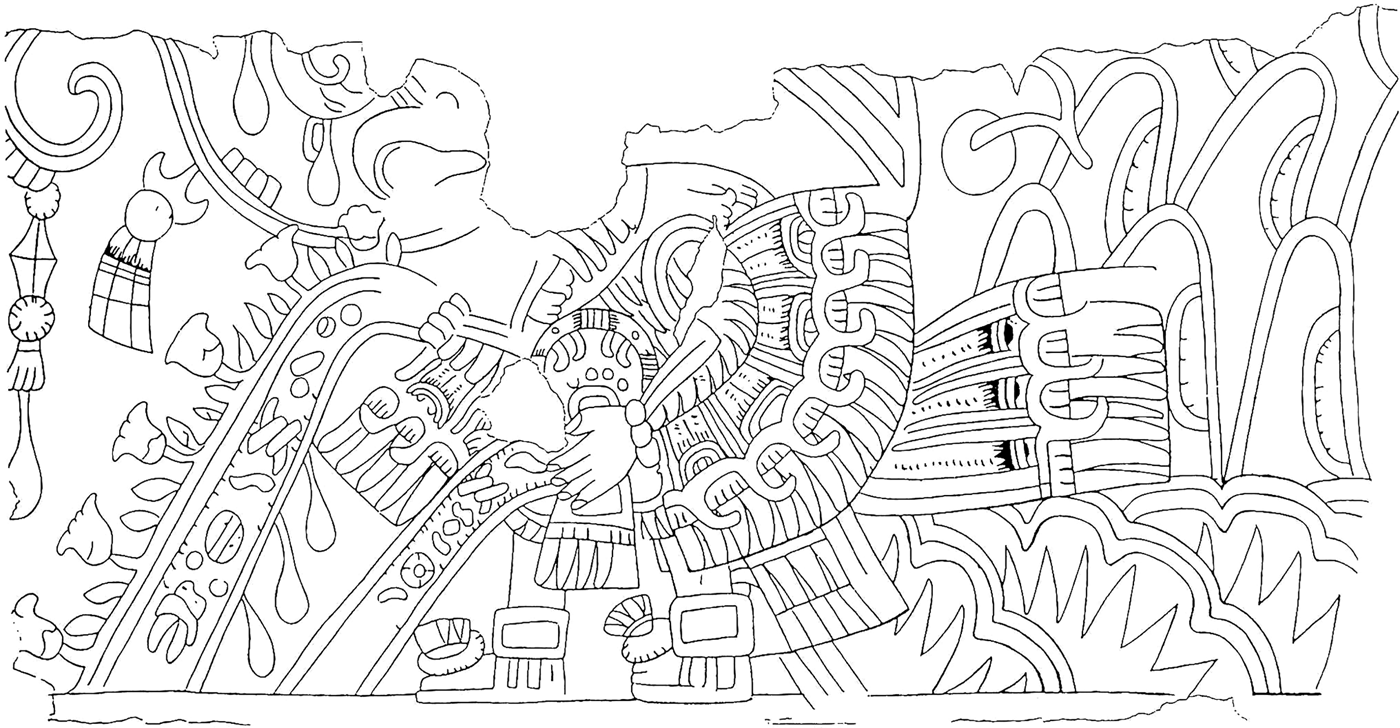
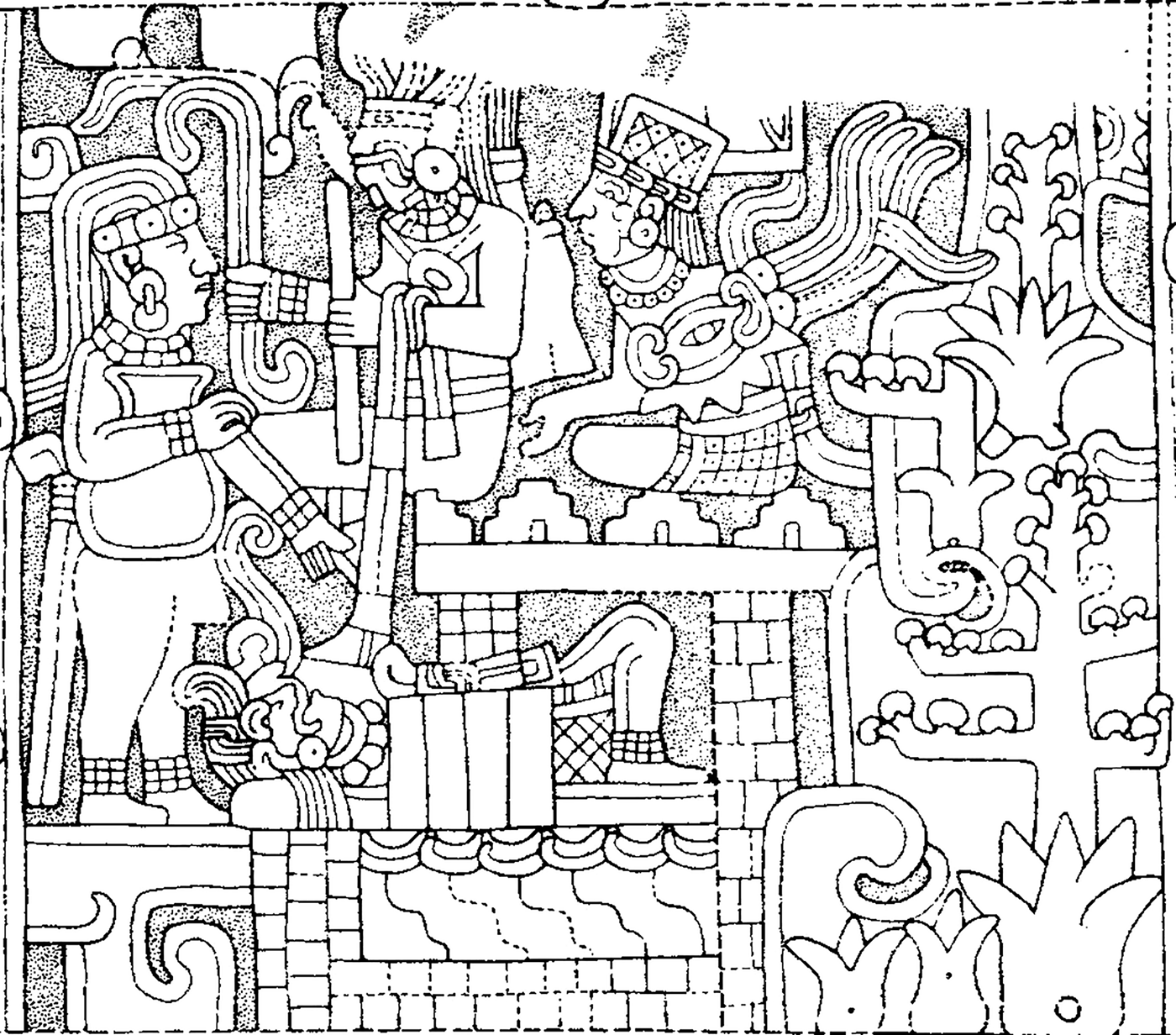
The central figure of this triad is the character with attributes of both the bird and butterfly (Figure 2). Cabrera Castro et al. (Reference Cabrera Castro, Gómez, Gazzola and de la Fuente2007:132, 136–137) correctly identified this character on the basis of several of his attributes, including butterfly wings, bird headdress, and “Reptile's Eye” glyph, with the Teotihuacan god originally interpreted by Séjourné as representing the Aztec god Xochipilli (Séjourné Reference Séjourné1959:116–128, Reference Séjourné1962). This has since been reinterpreted in various ways by different authors, including myself (Berlo Reference Berlo and Berlo1983, Reference Berlo and Berlo1992; Berrin and Pasztory Reference Berrin and Pasztory1993; Caso Reference Caso1966:259–263; Paulinyi Reference Paulinyi1995, Reference Paulinyi2006; Taube Reference Taube, Mazariegos and Arroyo2005a, Reference Taube, López Luján, Carrasco and Cué2006:164; von Winning Reference von Winning1987:1:111–124). In the course of my investigations I have concluded that this is a sun god and god of plant fertility, I believe most appropriately named the Butterfly Bird God, due to the intermingling of the butterfly and bird attributes that dominate his iconography (Paulinyi Reference Paulinyi1995). With respect to the solar character of this deity, Karl Taube (Reference Taube, Mazariegos and Arroyo2005a, Reference Taube, López Luján, Carrasco and Cué2006) has subsequently arrived at a similar conclusion.
The Butterfly Bird God and the fertile mountain. Mural 3, Atetelco. Courtesy of Rubén Cabrera Castro. Drawing by Víctor Álvarez.
The iconographic complex of this god is one of the most important in Teotihuacan art, being identified by Kubler (Reference Kubler1967:5) as the “butterfly complex” and by von Winning (Reference von Winning1987:1:111–124) as the “fire-butterfly complex,” in which he also included the old Fire God. Apart from the Atetelco murals, two images of this divinity may be observed in the murals of the Palace of the Sun, located in the precinct of the Pyramid of the Sun (Langley Reference Langley, Berrin and Pasztory1993:Figure 8; Miller Reference Miller1973:Figures 107–108; Paulinyi Reference Paulinyi1995, Reference Paulinyi2006). At the same time, the butterfly imagery that characterizes our deity is also the most frequent theme of stuccoed vessels (Conides Reference Conides2001), and its presence in other media is equally notable with the iconography of the Butterfly Bird God being predominant on censers. Outside Teotihuacan, the iconographic complex of the Butterfly Bird God also appears in the zones influenced by this metropolis, especially in ceramics and censers from Escuintla, Guatemala. The principal figure on censers from the Valley of Mexico and Escuintla has been interpreted in radically different ways. Accordingly it has been variably interpreted as the image of the deity himself (Caso Reference Caso1966; Séjourné Reference Séjourné1959, Reference Séjourné1962), of the deity and of warriors (Berlo Reference Berlo and Berlo1983), of the Butterfly Bird God and perhaps his mortal representatives (Paulinyi Reference Paulinyi1995), or more recently, as images of living or dead warriors (Headrick Reference Headrick, Brown and Stanton2003; Langley Reference Langley1998; Sugiyama Reference Sugiyama1998; Taube Reference Taube, Carrasco, Jones and Sessions2002; von Winning Reference von Winning1987). To date, the interpretation has not been convincingly explained.
THE BUTTERFLY BIRD GOD IN ATETELCO
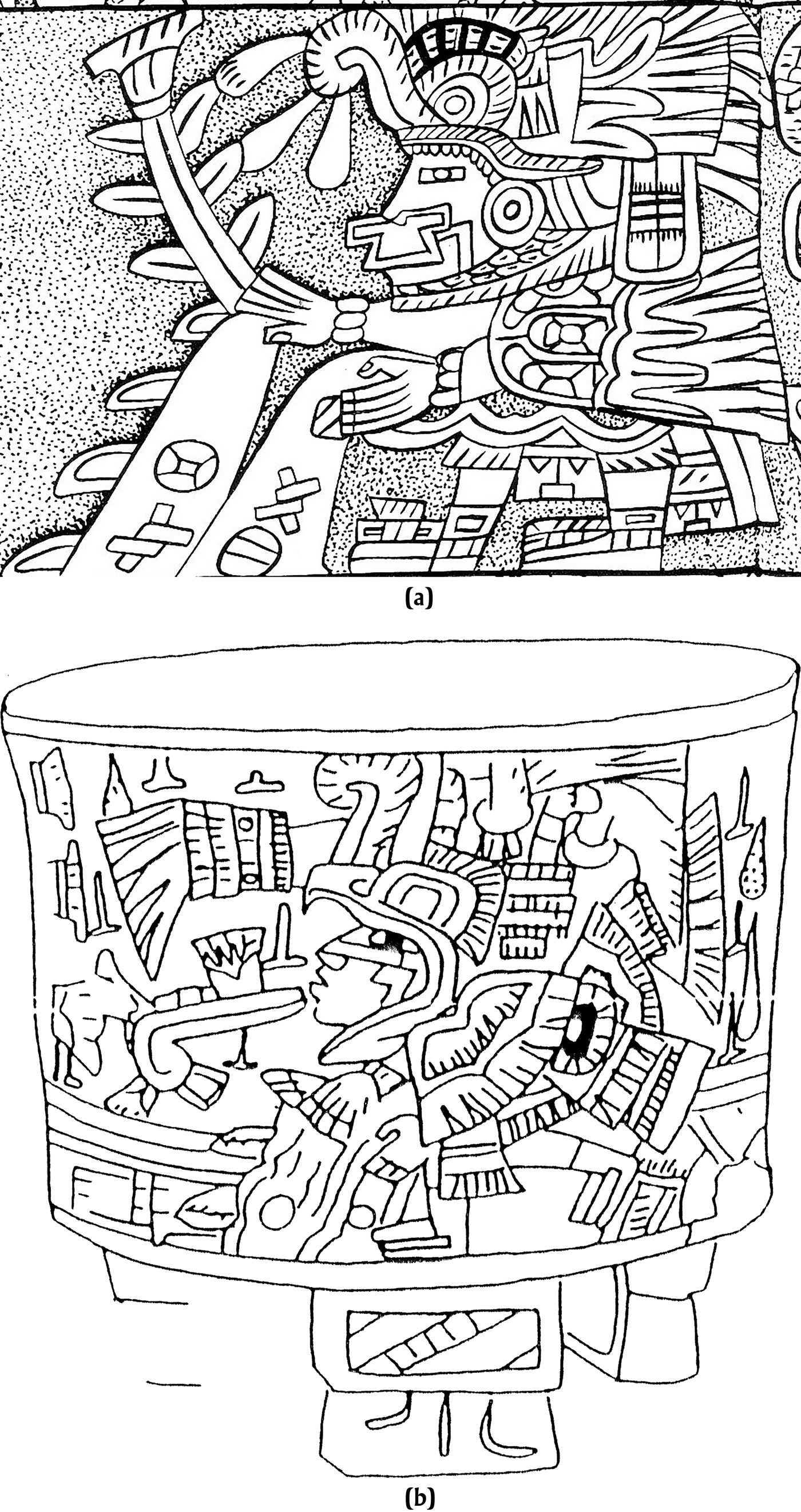
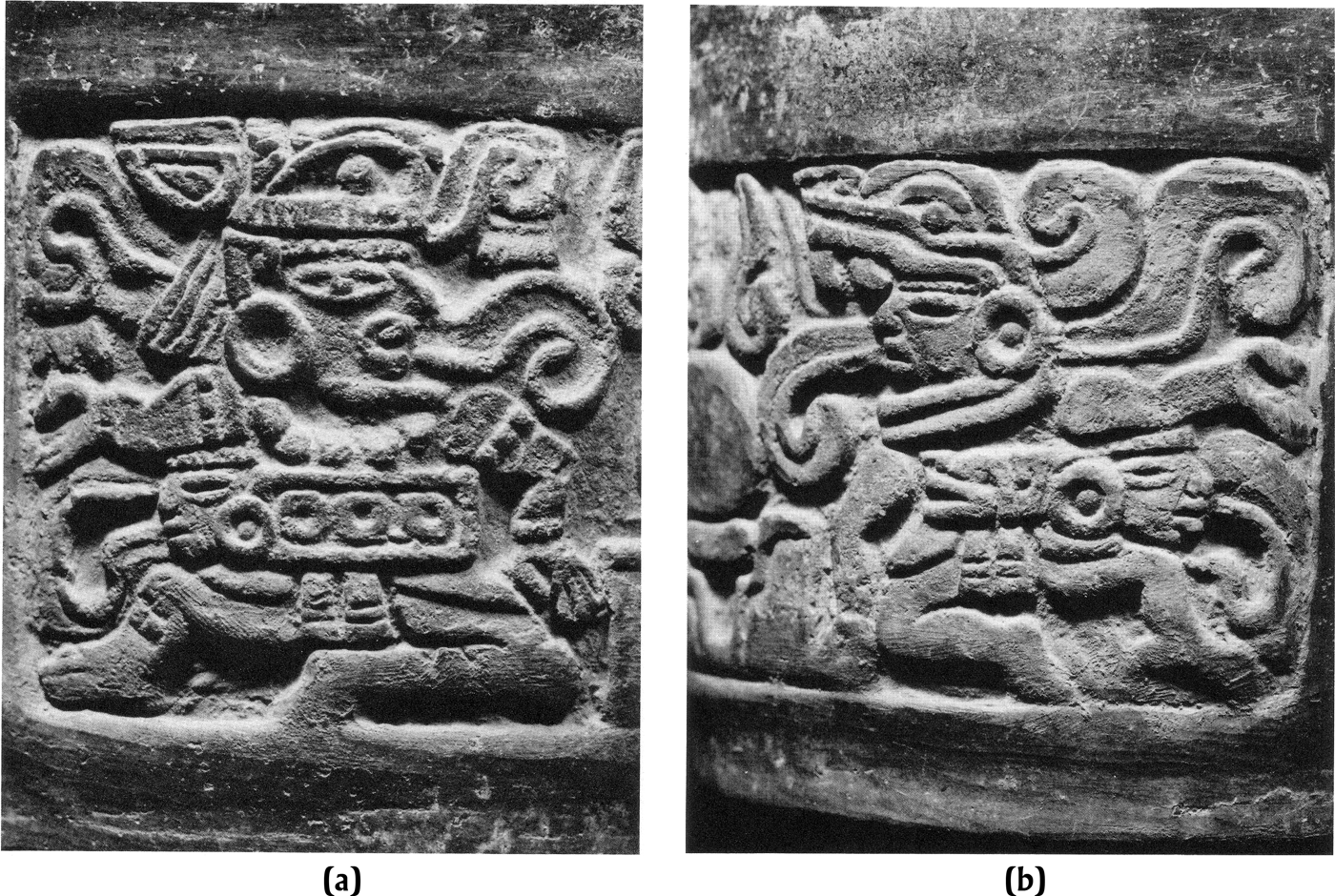
The image of the god, who appears together with a mountain, is relatively well preserved in Mural 3 (following the numbering established for the murals by Cabrera Castro et al. [Reference Cabrera Castro, Gómez, Gazzola and de la Fuente2007]) (see Figure 2). The god appears with an anthropomorphic body, while cascades of symbols flow from his hands. His clothing combines butterfly and bird features, and he exhibits several diagnostic attributes. To date, this form of representation of the deity has only been witnessed on vessels (Figures 3a and 3b). Unfortunately, the upper border of this mural at Atetelco has suffered severe damage. The god's face is unrecognizable, and his characteristic headdress, which combines elements of bird and butterfly, has only partially survived (see Figures 3b and 7a, where the headdress appears complete). In the mural, the upper part of the bird's beak may be observed and, higher up, a part of the butterfly's curved, feathered tongue, from which drops of water fall. Butterfly forewings attach to the god's arms, and a hind wing to his back. The wings on the arms have a particular shape that has no parallel with other representations of this god and also display certain spurs that generally appear in the hind wings of butterfly images.
Images analogous with the Butterfly Bird God from Mural 3 at Atetelco: (a) from Séjourné (Reference Séjourné1966a:Figure 38, detail); (b) from Conides (Reference Conides2001). Reproduced with permission.
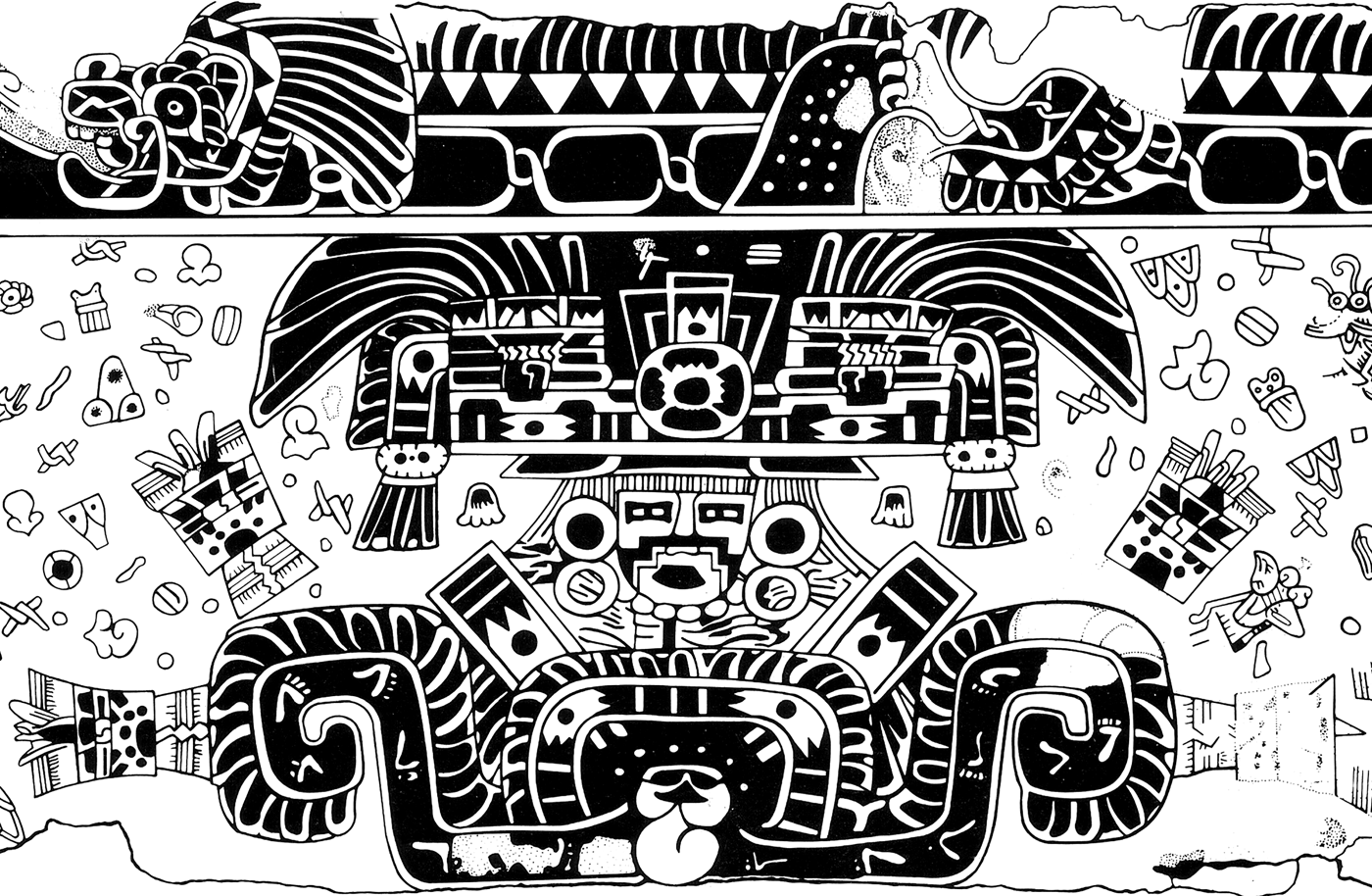
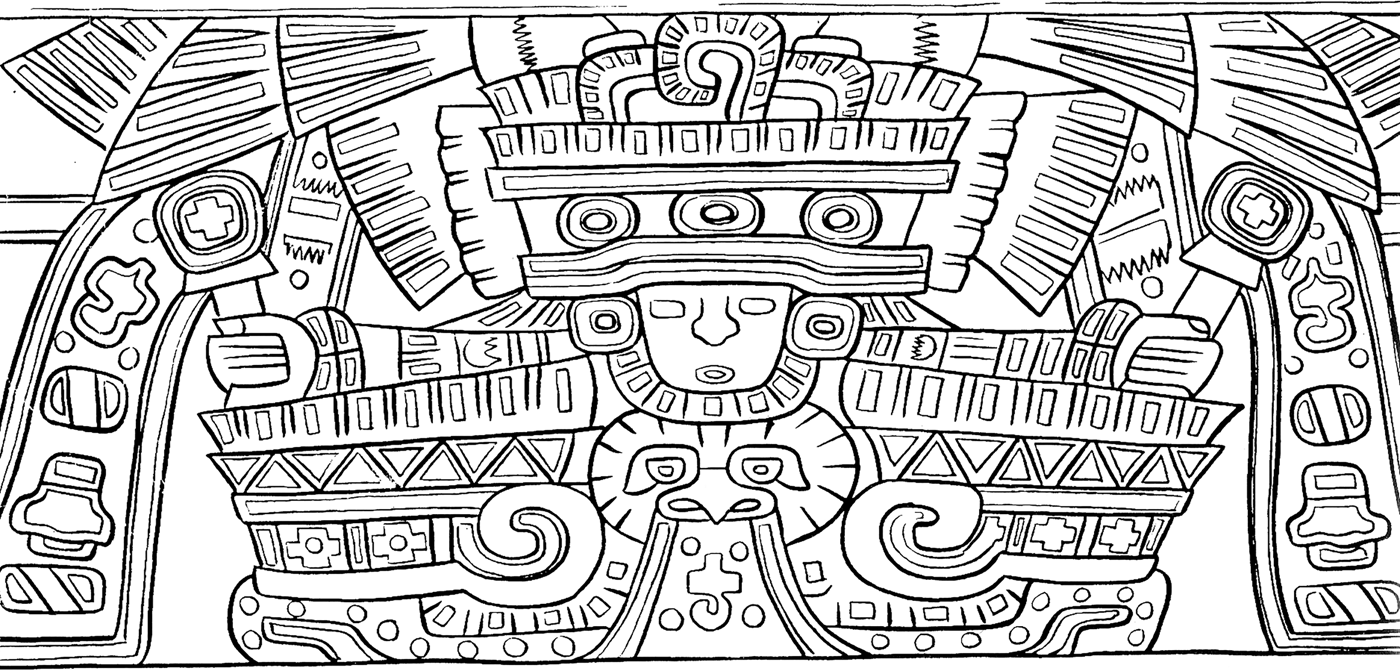
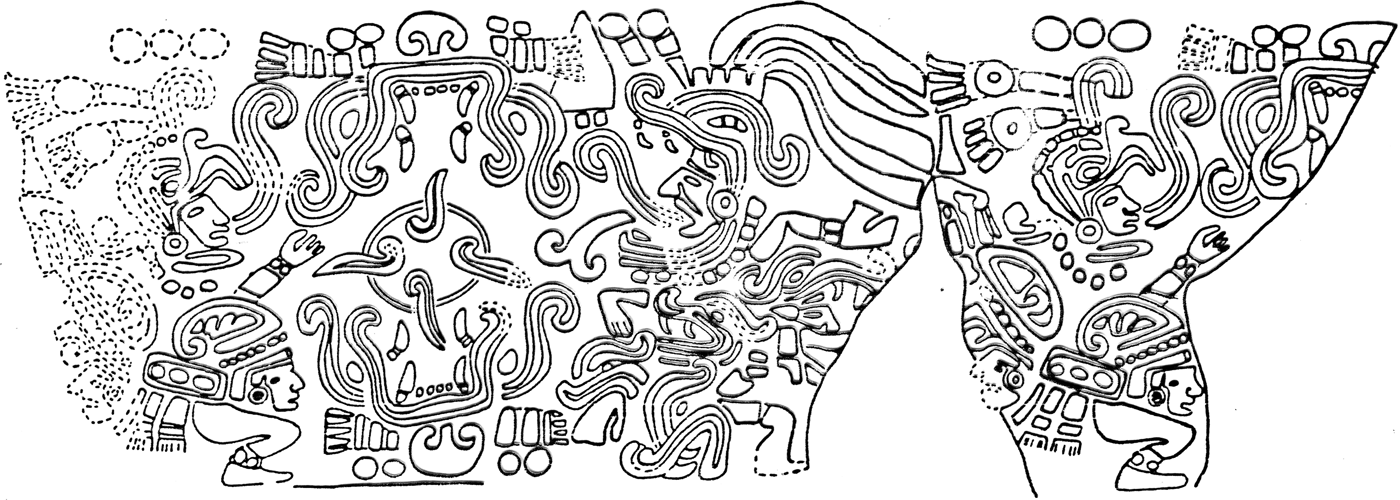
As can be seen in Figure 2, the god wears a loincloth and sandals. On his chest he wears a large emblem of the Reptile's Eye glyph, which is extremely important in his iconography; in the border of this emblem we can see fire symbols, called “comb-and-bar” by Hasso von Winning, which are very frequent in representations of the deity, alternating with circles (see similar emblems in von Winning [1987:II:Chapter 2:Figures d, e, h, i, and l]). In different representations of the god, the Reptile's Eye glyph may appear, among other places, on his torso and his headdress and may even replace the torso (Deletaille and Deletaille Reference Deletaille and Deletaille1992:Figure 123) (Figure 4). The god in Mural 3 has his usual bead bracelets on his wrists. As seen on other occasions, he is scattering abroad a cluster of characteristic symbols, called a “core cluster” by Langley (Reference Langley1986:103–107). This cluster consists of 11 symbols (Séjourné Reference Séjourné1966a:Figure 130) (see Figure 3a) and is closely linked to representations of the god. The band containing the symbols scattered by the right hand is bordered with flowers, leaves, and drops of water. We find in Teotihuacan art that the act of scattering with both hands is an exclusive privilege of deities. Apart from our god, the goddess of the murals of Tepantitla and Tetitla also appears scattering with both hands (Miller Reference Miller1973:Figures 301–314), as do the Rain God (Séjourné Reference Séjourné1966b:Plate XCII) and other symbolic supernatural characters (Miller Reference Miller1973:Figures 124 and 231).
The Butterfly Bird God wearing the Reptile's Eye glyph (from Langley Reference Langley, Berrin and Pasztory1993:Figure 8, detail). Courtesy of James C. Langley.
THE FERTILE MOUNTAIN OF ATETELCO
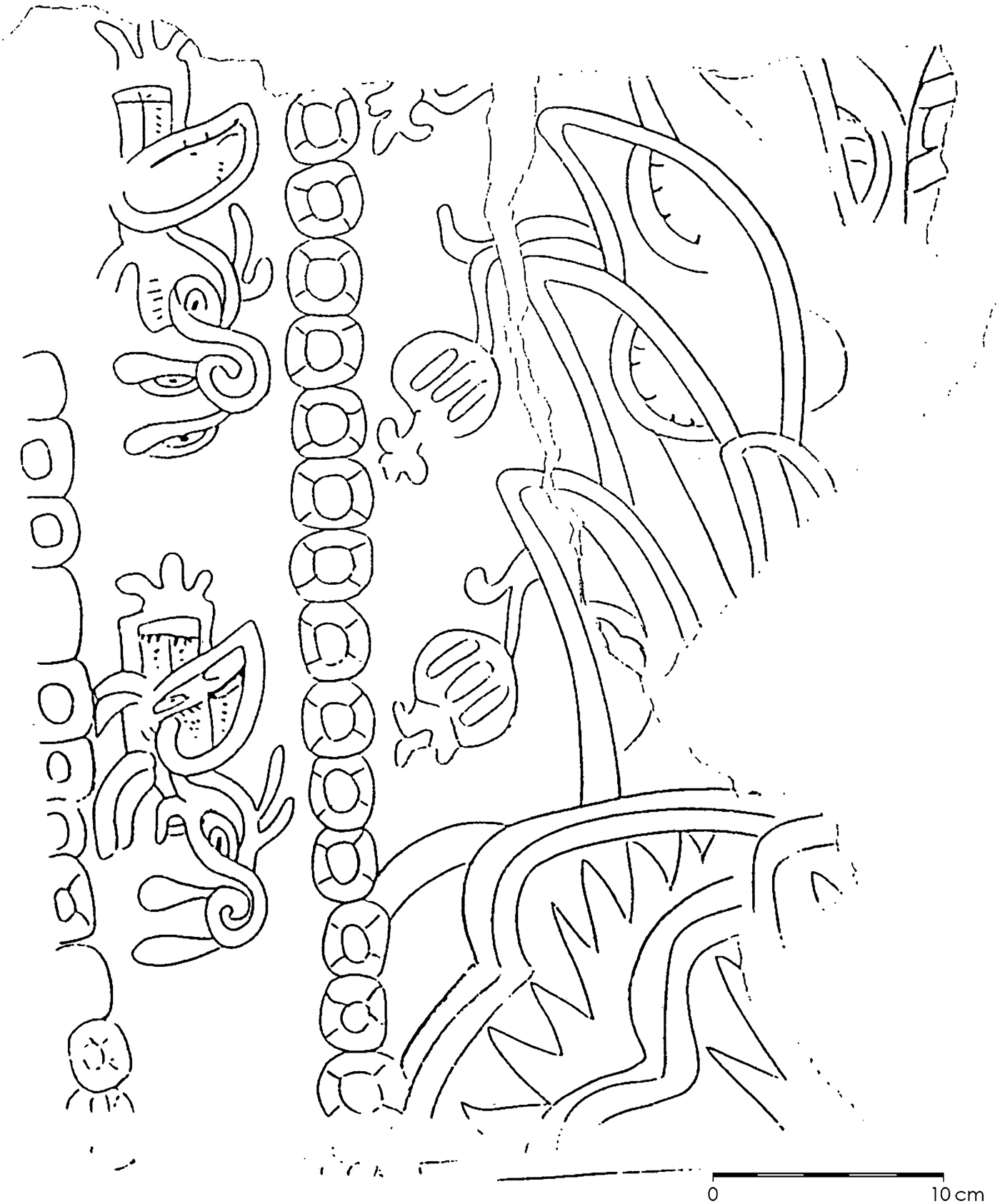
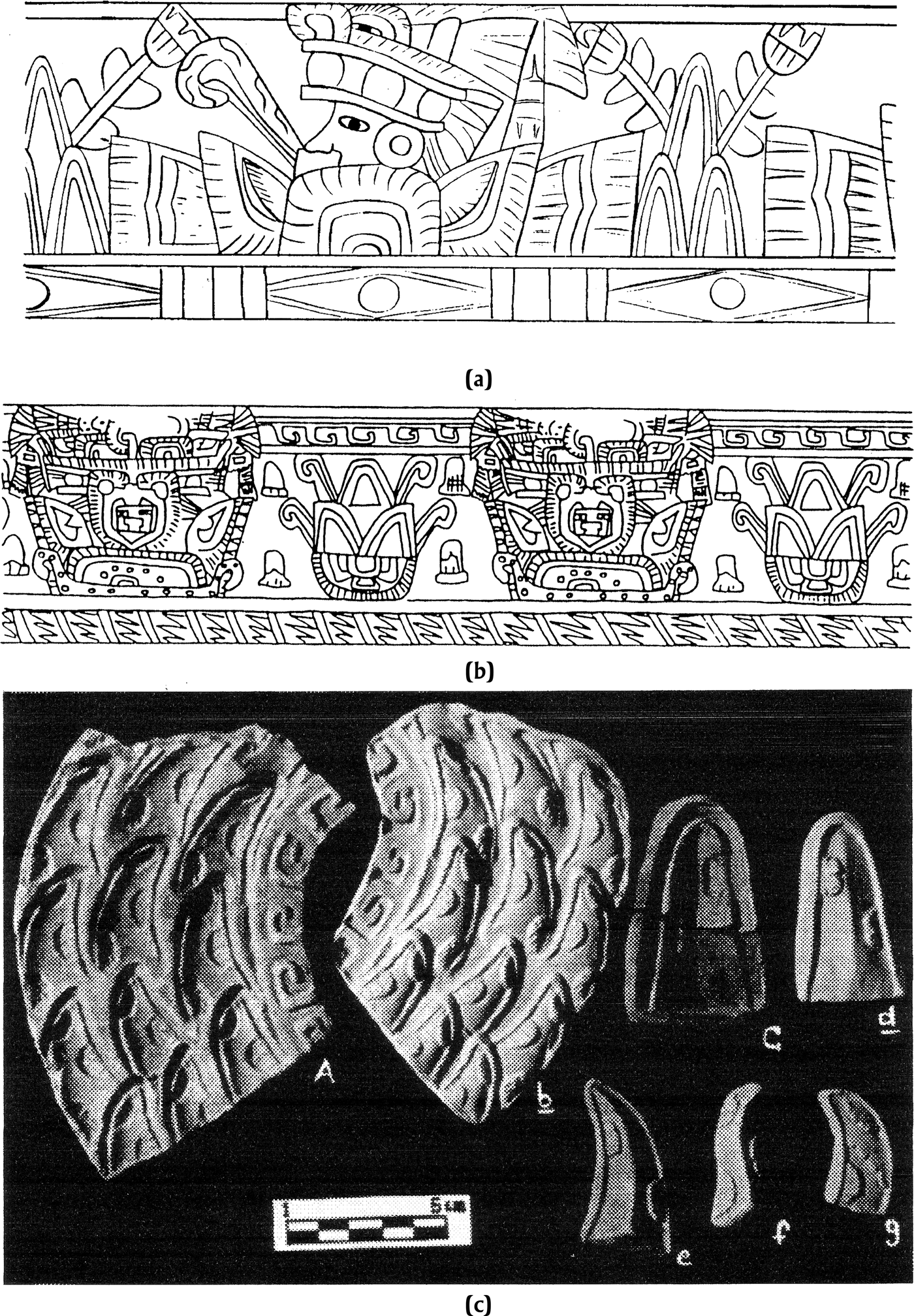
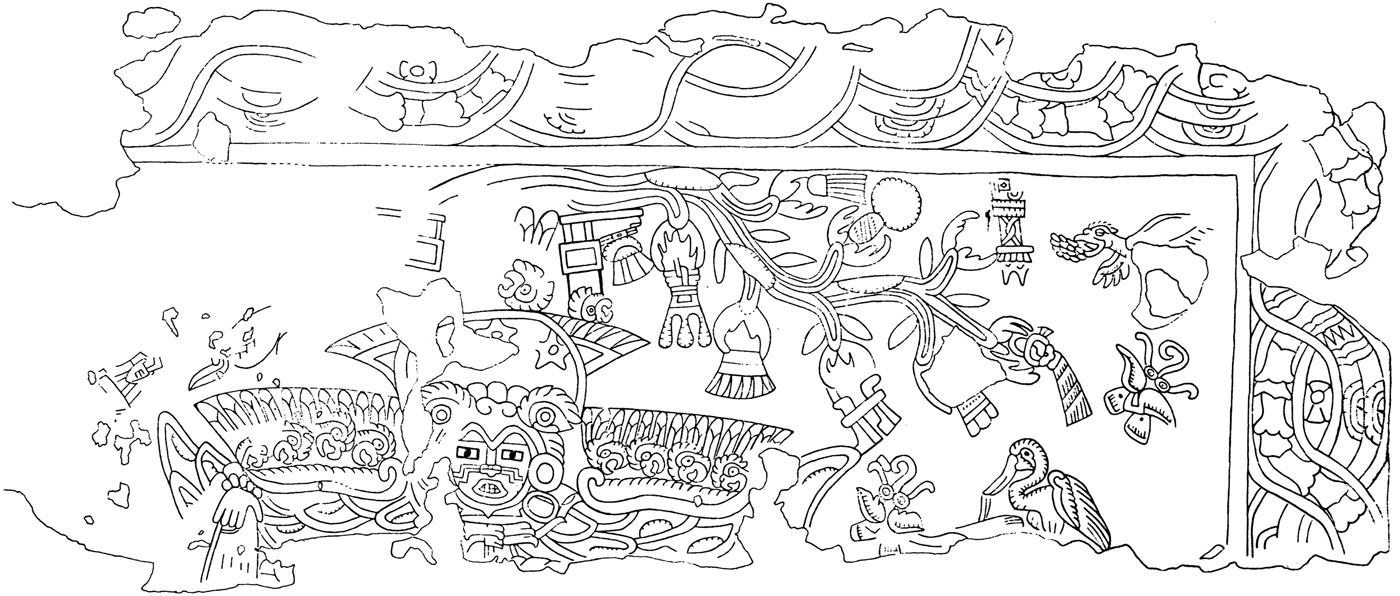
The god appears in an aquatic environment (see Figure 2). Behind him we observe a sequence of broad waves or diagonal bands of water, with a saw-tooth motif inside them. Similar waves also appear in other murals in the city, sometimes filled with aquatic animals (see Miller Reference Miller1973:Figures 125–128, 296, 317; Paredes Cetino Reference Paredes Cetino and Gallut2002:448–456). From the water rises a great mountain that is only partially preserved, consisting of various horizontal rows of superimposed hills. A plant grows on one of these hills, the fruit of which cannot be clearly seen. With the aid of Mural 4, however, which will be discussed in greater detail below, it can be identified as a squash (Figure 5). Inside each hill there is an oval, patch-like motif, parallel with the right border of the hill. The border of this motif has a double line—like the borders of the hills—and the inner line has notches. These extended, slightly curved hills look like plant leaves; similar hills are sometimes observed in Teotihuacan art (Berlo Reference Berlo1984:Plate 47; Eggebrecht Reference Eggebrecht1986:Number 115) (see Figure 6b). The representation that is most similar to our mountain, however, is a fragment of ceramic mould (Múnera and Sugiyama Reference Múnera B. and Sugiyama2005:Photos 137a and 137b) (Figure 6), which includes motifs practically identical to these hills, with the edged ovals in a similar configuration, overlapping and arranged in rows, forming a curved group bordered by waves of water. We will return to their meaning below.
The fertile mountain. Mural 4, Atetelco. Courtesy of Rubén Cabrera Castro. Drawing by Víctor Álvarez.
The Butterfly Bird God with the fertile mountain: (a) Séjourné Reference Séjourné1966a:Figure 94; (b) Conides Reference Conides2001; (c) Múnera and Sugiyama Reference Múnera B. and Sugiyama2005:photo 137. Reproduced with permission.
As has already been mentioned, in the neighboring Mural 4, we see another image of the mountain rising out of the water (see Figure 5). Two squash plants grow out of it, with two round fruits ending in appendices. The extended, almost pointed, hills of this mountain—as with the patch-like motifs mentioned above—are even more like plant leaves than the hills of the mountain in Mural 3. There is little doubt that these two murals represent a fertile mountain. In the border of Mural 4 we can observe butterflies descending between two vertical rows of four-petalled flowers (see Figure 5). The butterfly and the bird are the most important motifs of the iconography of the god under discussion, constituting his representatives or manifestations. The four-petalled flower very frequently accompanies the god, as well as being one of the symbols of the “core cluster” mentioned above. These butterflies, curiously, present human teeth, and drops of water drip from their proboscis; in this respect we find certain analogies. For example, in a Teotihuacan censer, a human skull with teeth replaces the butterfly's head (Merrin Gallery Reference Gallery1971:Number 3), and in pieces from Kaminaljuyu and Escuintla, Guatemala, butterflies are also found with the jaw of a human skull (Kidder et al. Reference Kidder, Jennings and Shook1946:Figure 207h) or with human teeth (Hellmuth Reference Hellmuth1993). Thus, it is reasonable to suppose that the teeth of the butterflies in Mural 4 are a reference to death.
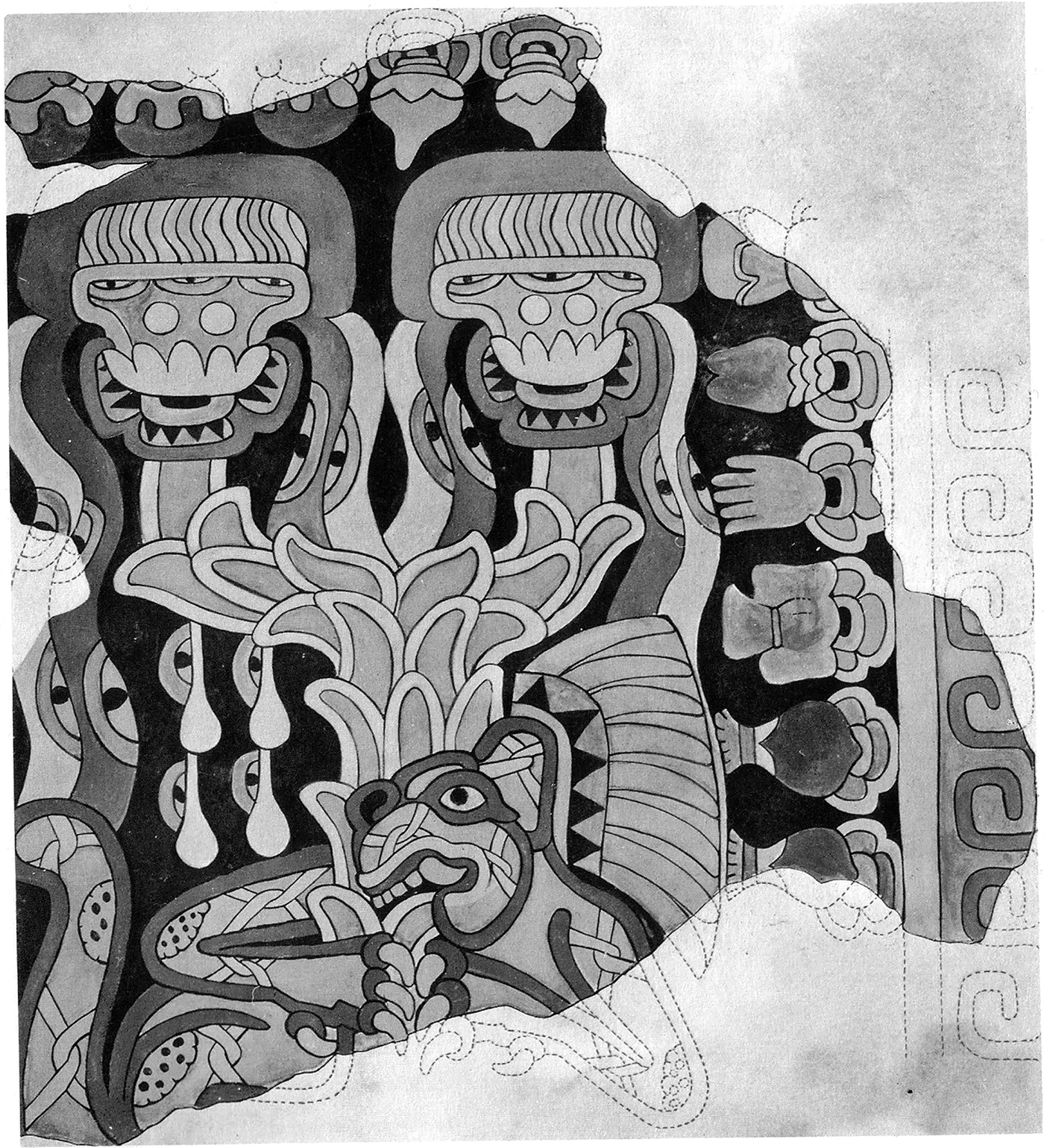
How can we interpret the context in which our god is placed? The broad strips of water, the mountain that rises out of the waves with its phytomorphic hills and squash plants, the drops of water scattered by the image of the god and his butterflies, and the skull's teeth of the latter, together indicate that the place in which the god is contextualized is probably the Underworld—a place of water, plant fertility, and death. The mountain is probably a more elaborate version of the well-known Teotihuacan motif of the “Triple Hill;” this motif frequently appears with the Butterfly Bird God (Figure 6a and 6b). The complexity of the fertile mountain in Atetelco is remarkable; we could cite few similar specimens (López Luján et al. Reference López Luján, Neff, Sugiyama, Carrasco, Jones and Sessions2002:Figure 8.8; Seler Reference Seler1915:Figure 178). As with our mountain, the Triple Hill is aquatic and characterized by plant fertility (Paulinyi Reference Paulinyi1995:85–87; von Winning Reference von Winning1987:pp. 11–13).
There are strong arguments to support the idea that the Triple Hill is located in the Underworld. On the one hand, we see the Butterfly Bird God coming out of the gates of the Underworld, which bears Triple Hill motifs (Taube Reference Taube, López Luján, Carrasco and Cué2006:Figure 4b) (see Figure 7a). On the other, the Triple Hill appears together with the wide vessel filled with water, symbol of the aquatic underworld, from which our god rises (Paulinyi Reference Paulinyi1995:83–84) (see Figure 6b). On other occasions, aquatic deities such as the Rain God and the Goddess of Tepantitla appear emerging from this same type of vessel and, indeed, the inverted vessel takes the role of the upper lip (the bigotera) of the emblem of the Rain God in the mural of the Goddess of Tepantitla (Paulinyi Reference Paulinyi2007:254). On a vessel from Escuintla, Guatemala, the Rain God appears in the same scene together with the Triple Hill—the simple version of the fertile mountain of Atetelco (Figure 8). This may indicate that the scene of the events of this myth corresponds to the subterranean land ruled by the Rain God, similar or identical to the Tlalocan of the Postclassic period. Although it is surprising to find a mythical hill situated in the Underworld, we can cite at least two cases of cosmological importance. For the Aztecs, the third level of the Underworld was a place of hills, and in the fourth level was a hill of obsidian, according to the Codex Vaticanus 3738 (López Austin Reference López Austin1980:62–63); Sahagún (Reference Sahagún2000:328) also refers to the first place mentioned. At the same time, Taube (Reference Taube, López Luján, Carrasco and Cué2006:158–165) has a different interpretation of the Triple Hill, inspired in the works of Jane Hill (Reference Hill1992) and Louise Burkhart (Reference Burkhart1992). These authors address the system of metaphors which concentrate on the flower symbol, in the case of the Uto-aztec linguistic family. In Taube's opinion, the Triple Hill represents a celestial, solar Flower Mountain, similar to that which, according to the same author, existed in the Maya cosmovision and was contemporary with Teotihuacan.
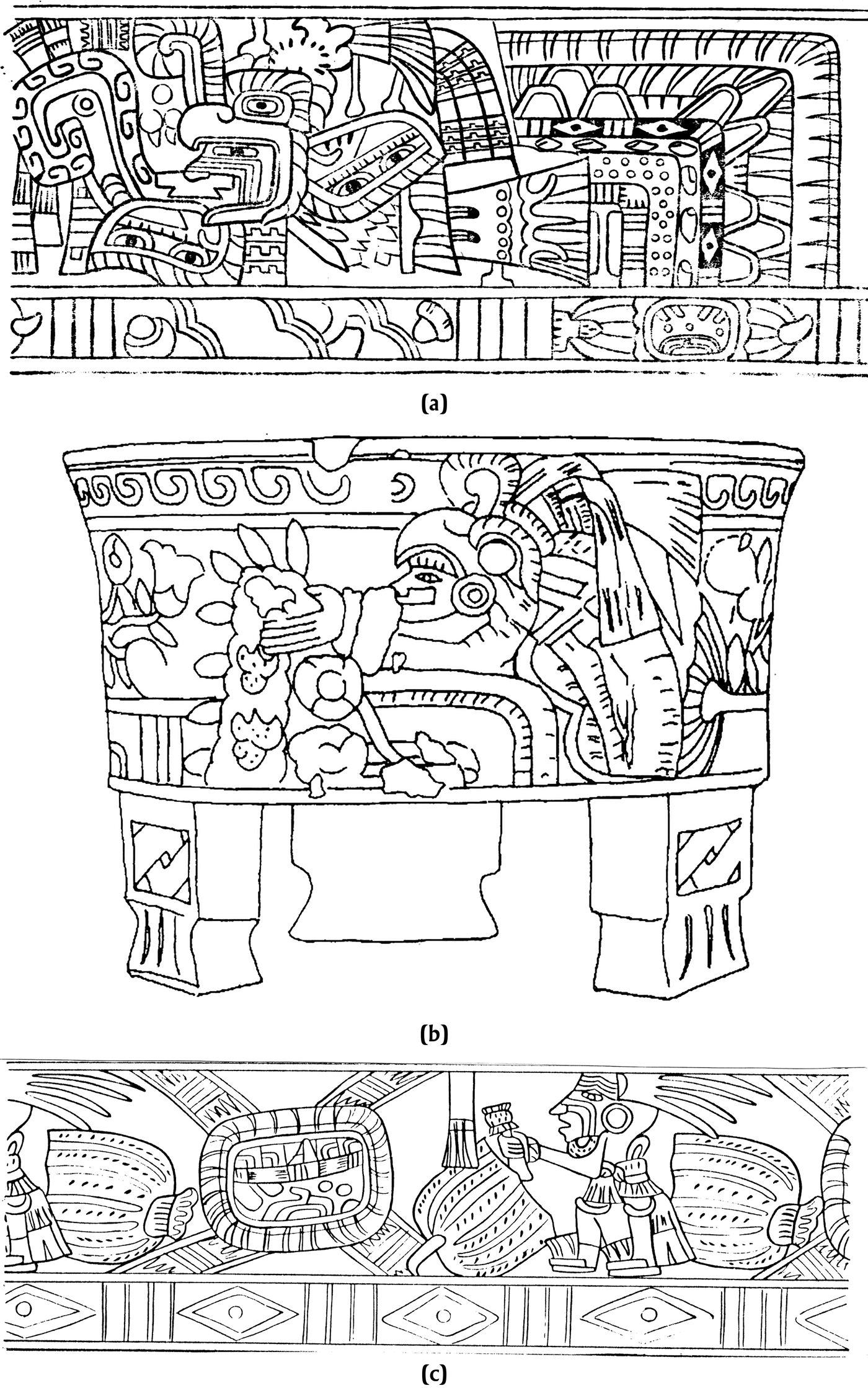
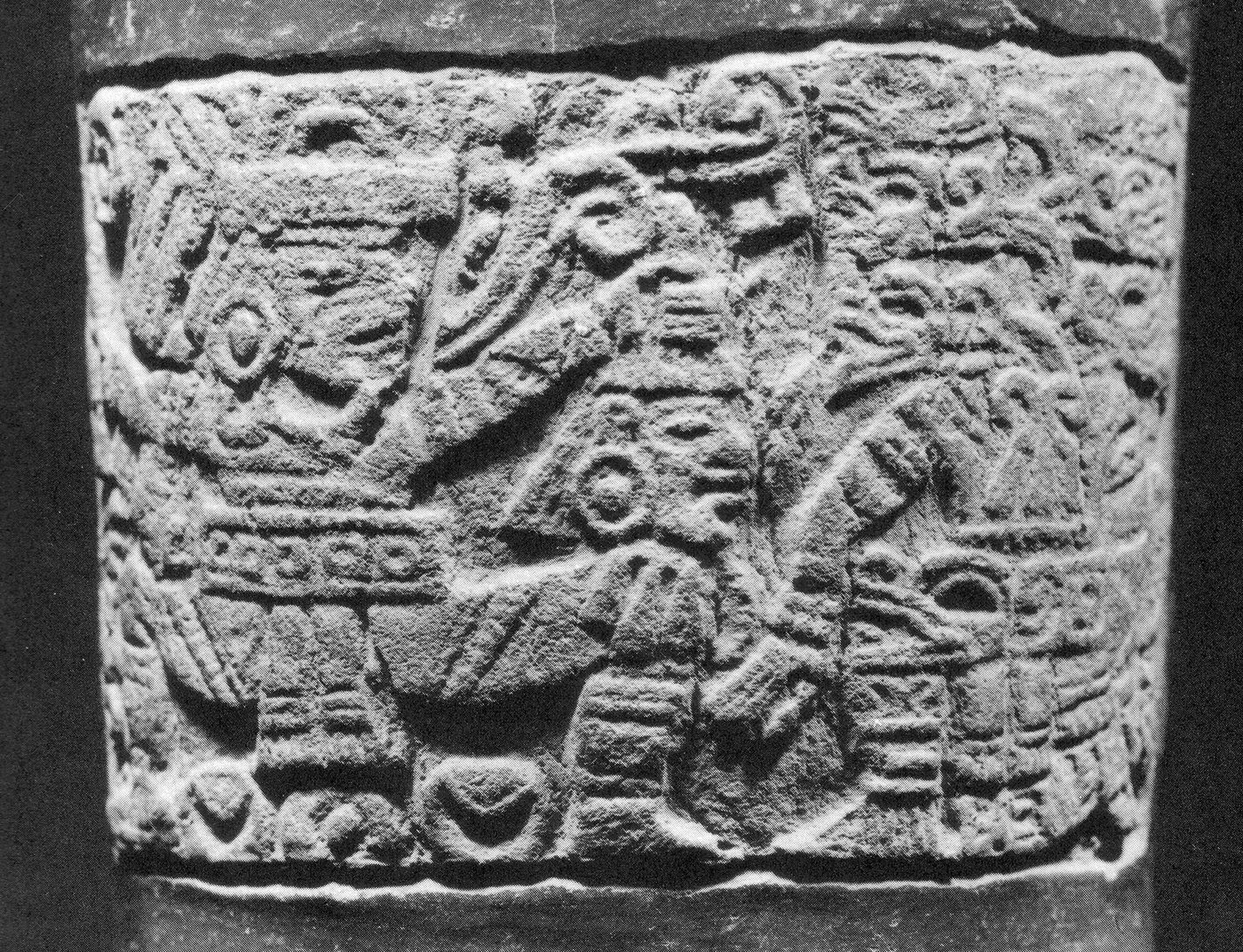
The Butterfly Bird God and the squash. (a) The god emerges from the portal of the Underworld. In the lower border the Reptile's Eye glyph emerging from the broken squash (Evans Reference Evans and Evans2010:Figure 8). (b) The god emerging from the squash. Drawing by the Author (after Sotheby Parke Bernet Reference Bernet1981:Photo 191). (c) A small anthropomorphic figure emerging from the broken squash (Séjourné Reference Séjourné1966a:Figure 194). Reproduced with permission.
Rain God with the Triple Hill, Escuintla, Guatemala (from Hellmuth Reference Hellmuth and Pasztory1978:Figure 14). Reproduced with permission.
The two Atetelco murals analyzed testify explicitly that our god, the fertile mountain, and the squash plant form an indivisible group, as I had previously suspected (Paulinyi Reference Paulinyi1995). In this earlier research, I was able to observe that in some representations of Teotihuacan art, the Butterfly Bird God appears together with the mountain—in general the Triple Hill—that displays attributes of plant fertility (Deletaille and Deletaille Reference Deletaille and Deletaille1992:Figure 123) (see Figure 6a and 6b). Likewise, evidence exists of a link between the god and the squash. For example, in one case the god is represented rising from half a squash (Figure 7b). In another example, the Reptile's Eye glyph can be seen in the lower border of the vessel (Figure 7a), appearing between two halves of a broken squash, surrounded by water, while above them the Butterfly Bird God emerges from the portal (see Conides Reference Conides2001), wherein the mouth of a cave or cavern probably represents the entrance to the Underworld (Paulinyi Reference Paulinyi2007:255–256). In another example, we see a small figure between two halves of a broken squash, perhaps a child, with the god's facial painting and what looks to be a sceptre (Figure 7c; see also the sceptre in Figure 11). These images tell of the birth of the god from inside a squash. The emergence of the god from the squash is similar to the emergence of a butterfly from the chrysalis. Here we should also make mention of the representation of a Triple Hill from which a squash plant is born (Berlo Reference Berlo1984:Plate 47).
According to all the evidence assembled, on the one hand, the god is closely linked to a mountain, and on the other he is born from a squash, which apparently belongs to the mountain (Paulinyi Reference Paulinyi1995:85–87). The Atetelco murals, where for the first time the three motifs appear simultaneously, enable us to close the circle: we see the Butterfly Bird God together with the fertile mountain in the Underworld, on which grows the squash plant whereby the god comes into the world.
THE SUPERNATURAL BIRD OF ATETELCO
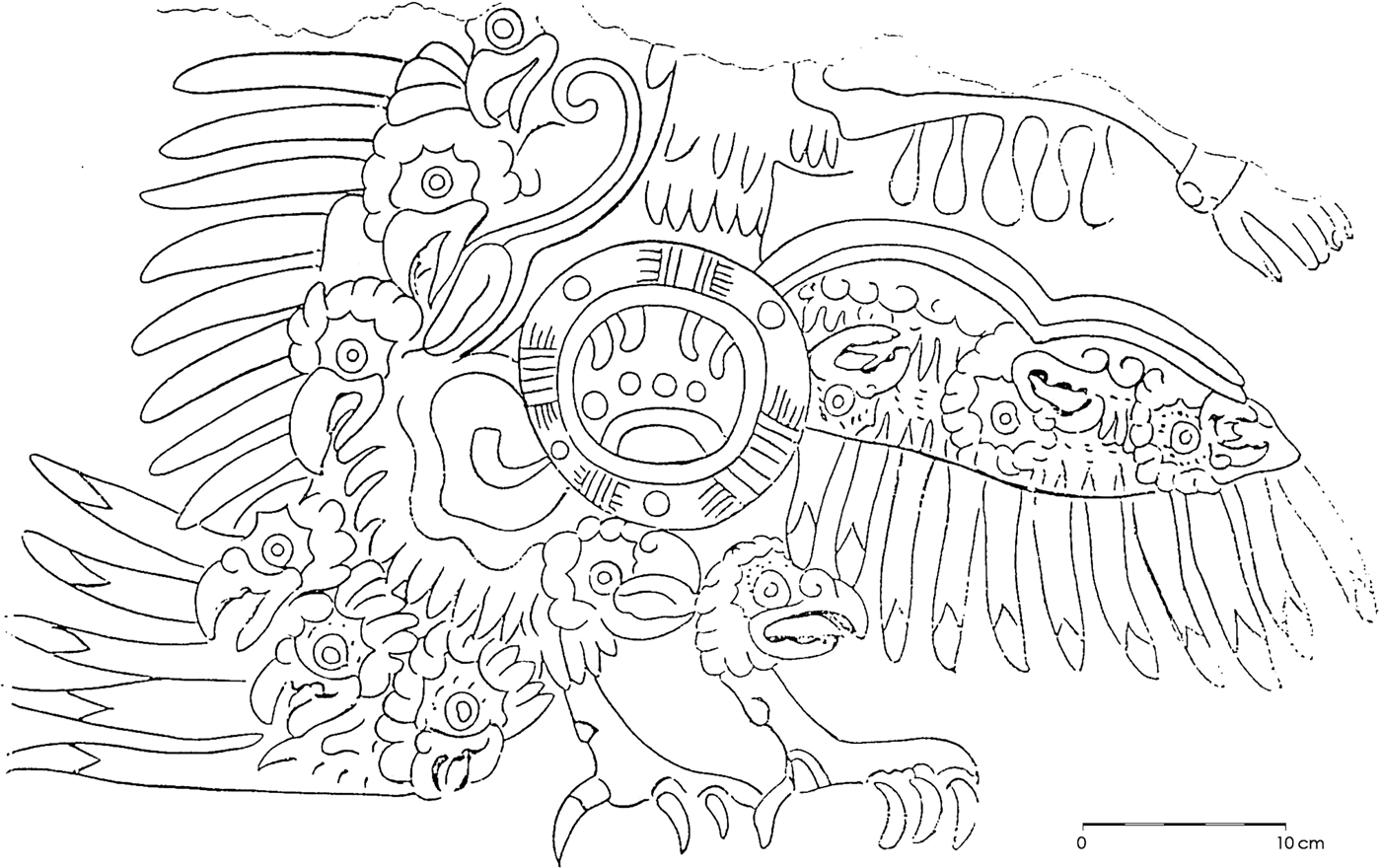
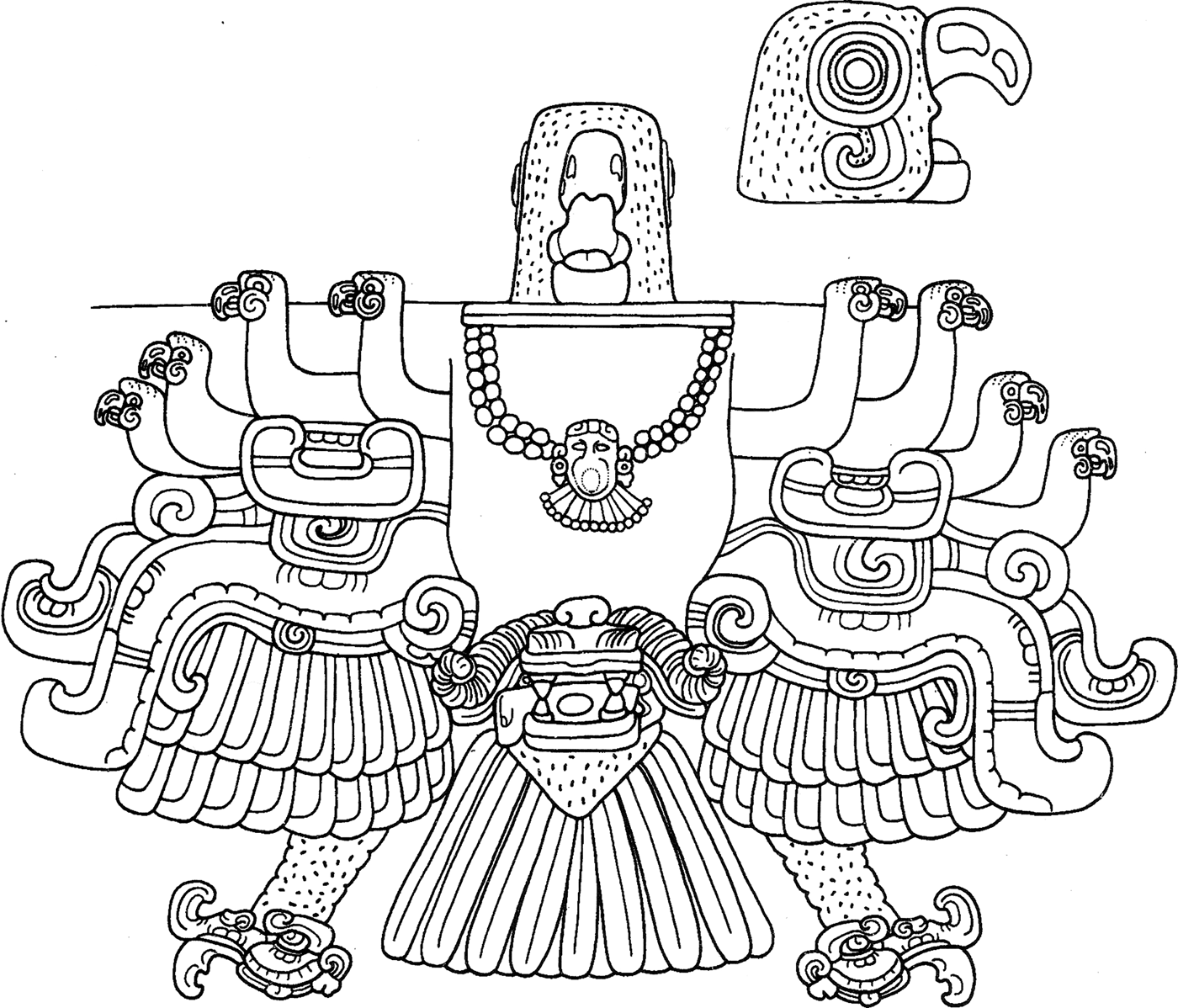
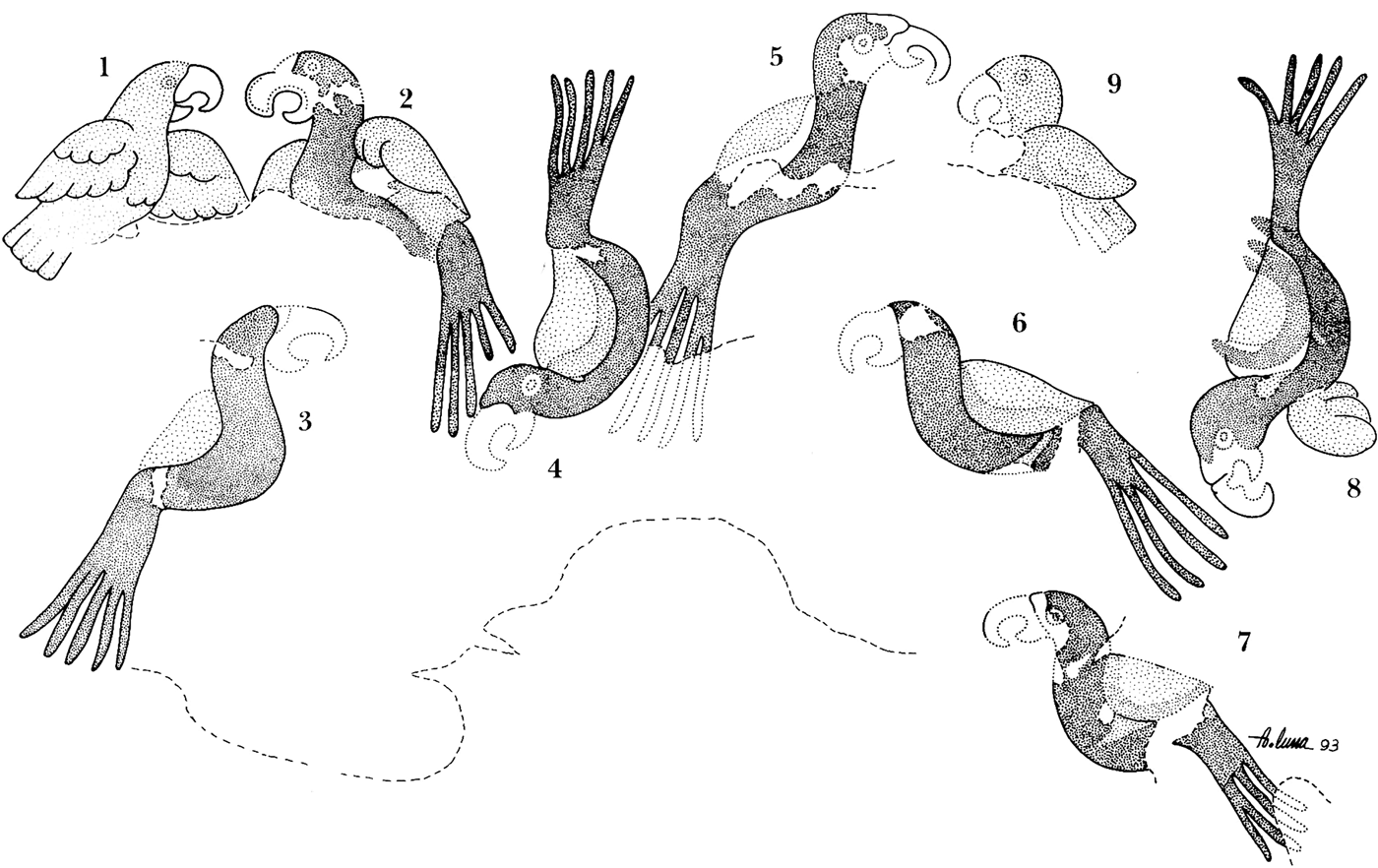
Two other murals in Atetelco—Murals 1 and 2—offer a representation of a supernatural bird. Mural 1 presents the complete animal figure (Figure 9). As the upper edge of the mural has been destroyed, all that survives of the head is the lower part of the beak. The peculiar thing about this bird is that there are other, smaller birds’ heads growing in various parts of its body: three on each wing, one on each leg, and three near the tail. These heads have previously been thought to be chicks (Cabrera Castro Reference Cabrera Castro and de la Fuente1995:247). It holds an arm with a bracelet, dripping blood, in its beak—probably an arm that has been cut or torn off. In Mural 2 we again find the border with toothed butterflies, this time ascending between two rows of flowers. The position of the wings is also interesting; the right wing is facing down while the other is spread forward. The wings of the birds in the lower part of a mural at Totometla, Teotihuacan (Juárez Osnaya and Ávila Rivera Reference Juarez Osnaya, Ávila Rivera and de la Fuente2006:Plate 10), present the same position, and their heads are also similar to those of the Atetelco birds. Furthermore, the composition of the upper part of the same mural is cantered on Reptile's Eye glyphs. As the Totometla bird has been identified as a green macaw (Ara militaris) (Navarijo Ornelas Reference Navarijo Ornelas and Fuente2006:338–339), the hypothesis arises that the Atetelco bird may also be a macaw.
The many-headed bird. Mural 1, Atetelco. Courtesy of Rubén Cabrera Castro. Drawing by Víctor Álvarez.
The bird's torso in Mural 1 is covered by a large Reptile's Eye glyph emblem (compare with Paulinyi Reference Paulinyi1995:Figures 1 and 2). This emblem is identical to that worn by the god in the image in Mural 3 (see Figure 2 and Figure 9). For this reason, and from the juxtaposition of their respective murals, it is plausible to suppose that a close link must exist between the god and the bird. But what is the bird? Recently, Nielsen and Helmke (Reference Nielsen and Helmke2011) have concluded that it must be a mythical being similar to Vucub Caquix (Seven Macaw)—the Principal Bird Deity of the Classic period and the supernatural bird of the Popol Vuh—which acts as a false sun. During its fight against the Hero Twins, Hunahpu and Xbalanque, it tears off the arm of the former before being finally defeated. I will return to this point below.
So far we can say that examination of the Atetelco murals has borne fruit, but it has also raised some unanswered questions. What myth underlies the birth of the god on the fertile mountain? What is the meaning of the plant-leaf shape of the hills of the mountain? What is the connection between the supernatural bird and the deity? To find the answers, we must go beyond the Atetelco murals to look at those from the Palace of the Sun, located in the precinct of the Pyramid of the Sun, as well as broader contexts within and without Teotihuacan art.
THE BUTTERFLY BIRD GOD IN THE PALACE OF THE SUN
A series of murals in the Palace of the Sun—some painted in shades of red and others polychromatic—represent a personage with bird's clothing flying downward, scattering drops of water with both hands, which immediately indicates a deity (de la Fuente Reference de la Fuente and de la Fuente2006:Plates 3–7; Miller Reference Miller1973:Figures 107–109) (see Figure 10). It is the Butterfly Bird God, and bears several of his diagnostic attributes including stepped facial painting, rectangular eyes, pendant earrings, the red color of the body, and the ornithomorphic appearance itself (Paulinyi Reference Paulinyi1995:83, 87; see also Taube Reference Taube, Mazariegos and Arroyo2005a, Reference Taube, López Luján, Carrasco and Cué2006). Inside the bird's open beak can be seen the god's face, and the wings also bear small bird heads similar to the principal head. These heads are similar to those of the bird in Murals 1 and 2 at Atetelco and are distributed about the god's body in a similar way (see Figure 9). On each of the wings we see four bird heads in profile and one on each leg. On the tail is another frontal or profile representation of the head, depending on the mural. Taube (Reference Taube and Braswell2003:278–230) established that the bird heads superimposed on the god's body are macaw heads, and at the same time he proposed that the green crest and feathers belong to a quetzal. Thus the supernatural bird of Atetelco—as already suspected in a mural at Totometla—must also be a macaw, or perhaps a macaw-quetzal. The difference is that in the Palace of the Sun we observe the god with feathered clothing similar to that of the bird, while in Atetelco we find the bird itself.
The Butterfly Bird God descending. Mural of the Palace of the Sun, Teotihuacan. From de la Fuente (Reference de la Fuente and de la Fuente2006:Figure 6.4).. Reproduced with permission.
Above the figure of the god appears a tree; the shape of its trunk, leaves, and broken fruits suggest that it is a cocoa tree. The god appears to be descending from the tree, the mythical character of which is evident from the fact that people and objects emerge from its fruits. It should be noted that Nielsen and Helmke (Reference Nielsen and Helmke2011:Figure 7c) have recently identified small human figures with blowguns on either side of a representation of the descending god in a fragmented mural in Room 13. These authors have interpreted the scene as being analogous with the scenes in Maya art that represent the Hero Twins of the Popol Vuh, as they shoot at the Principal Bird Deity with their blowguns. They propose that what is represented in the mural is the fall of the Principal Bird Deity from the tree after being wounded by the blowgun.
Nevertheless, it is important for interpretation of this scene to take into account that most of the images of blowgun shooters hunting birds in Teotihuacan vessels have the attributes of the Butterfly Bird God, or represent the god himself; these attributes are rectangular facial painting and rectangular eyes—as may be seen in the descending god—and the butterfly bird headdress (Conides Reference Conides2001:Appendix 2, Numbers 22, 49, 50, 60, 114, 122, 125, 141). In another image linked to this group of representations, the god appears surrounded by blowgun projectiles, while he scatters symbols with both hands and—although in this representation he does not have a blowgun—he is in the characteristic half-kneeling position of blowgun shooters on the vessels mentioned above (Figure 3b). This suggests that the god is the hunter and not the hunted, the blowgun shooter and not the shot bird. In this interpretation the god would be akin to the two blowgun shooters who appear flanking him in the mural. In short, I consider that the possibility also exists that the Butterfly Bird God represented descending, accompanied by blowgun shooters, is not comparable with the episode of the Popol Vuh that recounts the fight between the Hero Twins and the Principal Bird Deity.
How then are we to understand the descent of the Butterfly Bird God? In Figure 11 we see another image from Teotihuacan, in which the Butterfly Bird God—this time with a butterfly headdress—is fused with a bird that is descending toward the interior of a wide-mouthed vessel, which, as we have already noted, is a symbol of the aquatic underworld. The fact that the feathers on his wings are represented pointing upward is evidence that he is descending. Both the mural of the descent of the Butterfly Bird God and this image probably represent the descent of the god to the Underworld. In previous works (Paulinyi Reference Paulinyi1995:87, Reference Paulinyi2006), I proposed that they probably share the significance of the descending butterfly on the censers of Teotihuacan and especially of Escuintla (Berjonneau et al. Reference Berjonneau, Deletaille and Sonnery1985:Figure 362; Berlo Reference Berlo1984:Figure 18; Hellmuth Reference Hellmuth1975:Plate 32); and, indeed, in the Atetelco murals we have seen this god in the aquatic landscape of the Underworld, together with the fertile mountain (Figure 2). On the other hand, in the art of Teotihuacan and Escuintla our god rises from the vessel of the Underworld, frequently with his butterfly wings open (Berlo Reference Berlo1984:Plates 80, 106, 107, 108, 111, 115) (see Figure 6b). In the Palace of the Sun itself, a second image of the god in the “Los Glifos” mural belongs to this class of representations (see Figure 4), where we observe the god rising from a wide symbolic vessel. (The god has the same diagnostic attributes—stepped facial painting, rectangular eyes, and earrings—as the image represented in the mural analyzed above, in which he is descending.) On other occasions we see the god united, once again, with a bird with wings spread or with a butterfly body, emerging from the portal of the Underworld (Berrin and Pasztory Reference Berrin and Pasztory1993:Number 158; Taube Reference Taube, López Luján, Carrasco and Cué2006:Figure 7b) (see Figure 7a).
The Butterfly Bird God descending into the Underworld vessel (from Séjourné Reference Séjourné1966c:Figure 130, detail). Reproduced with permission.
Initially, I interpreted the images representing the deity emerging from the vessel as an expression of his sojourn in the Underworld (Paulinyi Reference Paulinyi1995:87). I subsequently came to the conclusion, however, that if the images of descent mean the immersion of the god in the Underworld, this ascendency must signify the opposite, his exit from the Underworld—the two types of images are opposed and complementary (Paulinyi Reference Paulinyi2006). (Taube [2006:164] has also concluded independently that the emergent images represent the sun rising from the Underworld.) The god descends into the Underworld and then reemerges. Furthermore, in the Palace of the Sun the attributes of the two images mentioned are also opposed and complementary—the descending figure has aquatic attributes, while in the other fire symbols predominate. A plausible interpretation is that the god emerges from the Underworld changed, renewed, or with new properties. In other words, the god is reborn from the depths of the earth.
Accompanying the god descending to the Underworld (Figure 11) we see a butterfly-bird, which is his zoomorphic manifestation (Séjourné Reference Séjourné1966c:Figure 130). This hybrid being appears with open wings spread open on the ground, probably meaning that it is dead. We have already identified the moment of the god's birth from inside a squash on the fertile mountain. The three moments of the myth complement one another and it is therefore probable that the Butterfly Bird God, after descending to the Underworld, is reborn from the plant in the same way as a butterfly emerges from a chrysalis. Not only do the three motifs complement one another, but there are also images—although Teotihuacan art is not basic narrative—that interweave the three moments of the sequence. One the one hand, we observe that in the lower part of the descending god in the Palace of the Sun (Figure 10), there is a horizontal element consisting of motifs identical or very similar to the hills—depending on which mural we observe—that make up the mountains of the Atetelco murals (see Figures 3 and 5); this horizontal element displays “patches” similar to those of the hills in the Atetelco mountains (compare Figures 2 and 10). These motifs probably allude to the fertile mountain where the god's rebirth occurs. On the other hand, we have already seen two motifs appearing in parallel on a vessel: the birth of the god in the form of his Reptile's Eye glyph rising from a broken squash, in a lower frieze of waves of water; and above, his exit from the Underworld through its portal (see Figure 7a). Thus, if this reconstruction of the myth is correct, the fertile mountain must be in the Underworld, as we have stated above on the basis of other evidence.
The rebirth of the Butterfly Bird God recalls the rebirth of the Maya Maize God in the Underworld, in the Popol Vuh story. Indeed, the representations of the Butterfly Bird God's exit from the Underworld with wings extended are similar to scenes of the resurrection of the Maize God with open arms in Maya vessels (Robicsek and Hales Reference Robicsek and Hales1981:Figures 57–58). Already present in Preclassic representation of the Maya myth at San Bartolo, we see the Maize God descending head-first into the waters of the Underworld (Saturno Reference Saturno, Fash and Luján2009:Figure 129), and in the Postclassic period he is frequently represented in descent (Taube Reference Taube1992a:Figure 18).
THE FERTILE MOUNTAIN AND THE MAGUEY PLANT
Turning to the horizontal element located beneath the descending deity, it is also of interest to note that a net jaguar, painted in various murals close to those showing the descending god, is also represented in the midst of an aquatic environment, clasping a plant that, from its overlapping leaves, appears to be a maguey (Miller Reference Miller1973:Figure 112; Luna Reference Luna and Fuente2006:379) (Figure 12). The net jaguar is an animal or manifestation of the Rain God, and as such linked with the aquatic underworld, which is where the god lives. The leaves of the maguey are similar to the horizontal element mentioned above, and it is therefore plausible to propose that this element may also refer to the maguey. The body of the jaguar itself displays “patches” like those on the horizontal elements, although with spots inside them. The presence or absence of spots may not signify an important difference because in a reconstruction of the horizontal element made by Séjourné (Reference Séjourné1966b:Figure 180) the “patches” are also spotted, just like the “patches” of the ceramic mould mentioned earlier (see Figure 6c). If the interpretation of maguey leaves is correct, then the form of the hills in the Atetelco murals probably alludes to a link between the fertile mountain and maguey; this would indicate that the fertile mountain of the Atetelco is similar to a maguey plant.
Net jaguar grasping a maguey plant, Palace of the Sun, Teotihuacan (from Miller Reference Miller1973:Figure 113). Reproduced with permission.
On the same subject, it should be noted that in the South Ballcourt at El Tajin we find images of a mythical mountain covered with flowering maguey plants (Kampen Reference Kampen1972:Figure 24) (see Figure 13). This mountain has been compared with Pozonaltepetl, the hill where the gods invented pulque, according to the Nahua tradition (Wilkerson Reference Wilkerson and Boone1984:126); with the heavenly flowered hill proposed by Taube, mentioned above, and with Tamoanchan, the site of creation in the Nahua tradition (Koontz Reference Koontz, Fash and López Luján2009:276–282). The analogy proposed between the Atetelco mountain and the South Ballcourt is not limited to the maguey plant. In the representations at El Tajin, the flowering maguey mountain is located in the aquatic world, as at Teotihuacan. The principal actor in the two scenes of El Tajin is a Rain god, the tank in the central building is represented full of water and with a fish figure (see Koontz Reference Koontz, Fash and López Luján2009:278–280). Consequently, all this would appear to indicate that we are not in a heavenly paradise but in the aquatic world of the Rain God.
The mountain of the flowering maguey at El Tajin, South Ballcourt (from Kampen Reference Kampen1972:Figure 25, detail). Reproduced with permission.
At this point we may wonder whether, if the Atetelco fertile mountain is associated with maguey, it might not also be linked to pulque? Analyzing Figure 10, it can be seen that a triple drop of liquid appears to hang from the plant placed above the descending god; similar drops with notched outlines have been identified as drops of pulque (Miller and Taube Reference Miller and Taube1993:163; see also Rivas Castro Reference Rivas Castro2001). Likewise, it is of interest to note that both the “patches” of this plant and those of the horizontal element placed below the god, and the “patches” of the hills of the Atetelco fertile mountain, all display the same notches in their outlines. Thus it is possible that the “patches” in some way represent pulque, perhaps the froth. This idea is reinforced by various fragments of ceramic, which represent hands holding cups full of liquid, with drops running over the rim, and capped with froth. The froth has small spots, just like some of the “patches” already observed (Múnera and Sugiyama Reference Múnera B. and Sugiyama2005:Photos 126–127). It is very probable that these fragments of ceramic are indeed a representation of pulque: in the Conquest-period codices, pulque was represented in the same way—in cups with a froth of small spots, held by a hand in the same manner (see, for example, Berdan and Anawalt Reference Berdan and Anawalt1992:3:Folios 70v and 71v).
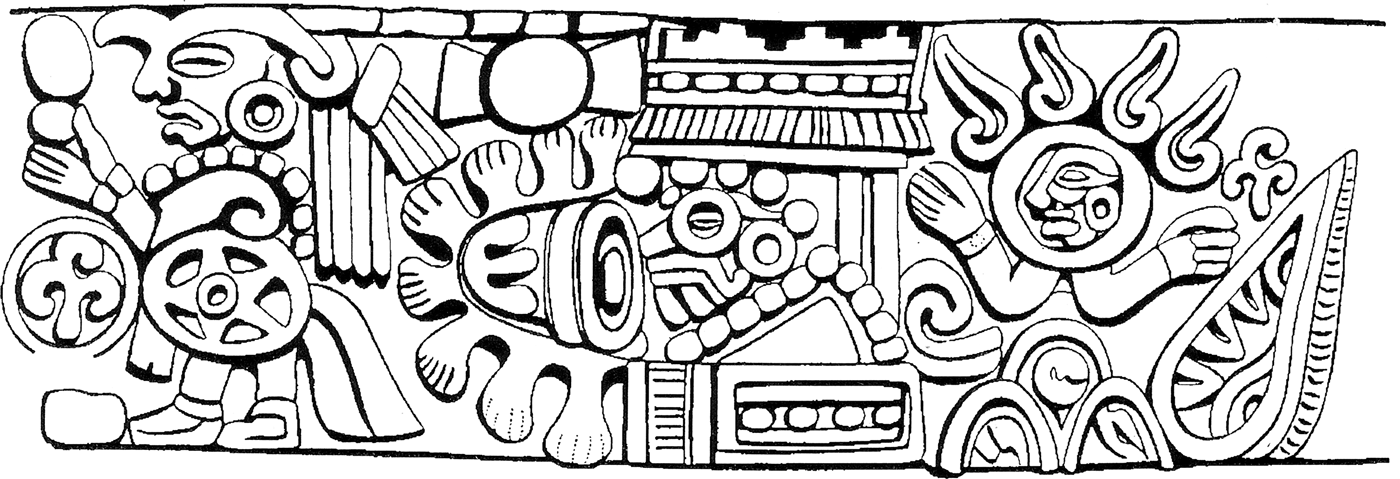
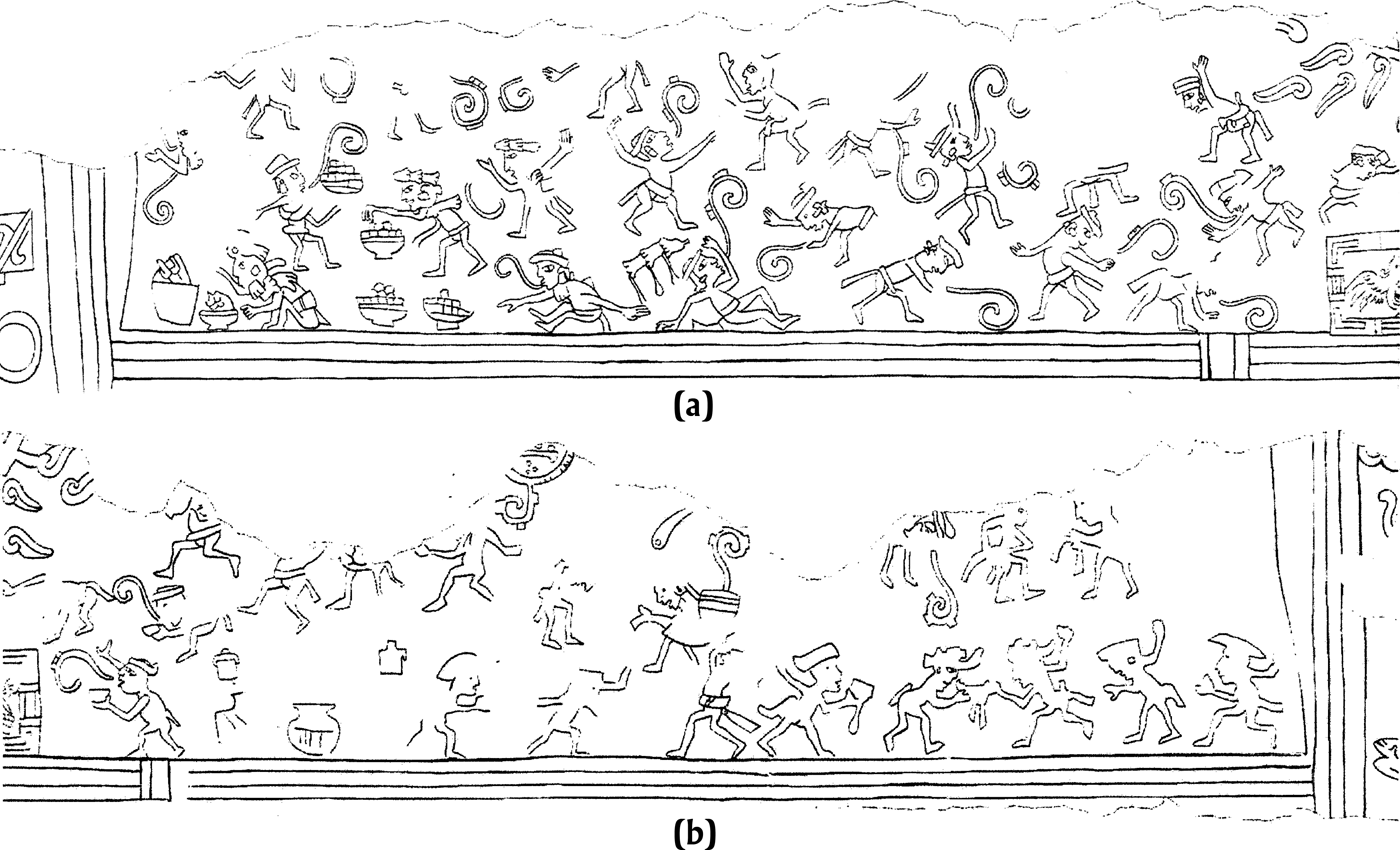
If the fertile mountain of the Atetelco murals refers not only to maguey but also to pulque, this would explain the presence of a feast scene composed of small human figures in Mural 7 in the west side of the same patio where the murals of the Butterfly Bird God with the fertile mountain are found (Figure 14a and 14b). According to Cabrera Castro et al. (Reference Cabrera Castro, Gómez, Gazzola and de la Fuente2007:138), we see the participants at the feast drinking an intoxicating drink, singing, and dancing. Tamales and perhaps tortillas can also be seen in big ceramic dishes, just as in the offering scene painted on a Teotihuacanoid vessel from Kaminaljuyu (Kidder et al. Reference Kidder, Jennings and Shook1946:Figure 207; Taube Reference Taube1989:33). It is a feast similar to that represented in the famous “Los Bebedores” mural in Cholula. In Mural 7 at Atetelco, the drinkers hold cups with drops overflowing the rim. Taking all the above into account, the drink consumed by the figures of Mural 7 is probably pulque. Yet whether or not it is, there is an important detail that may indicate that the feast is related with our god: on the heads of some of the participants, and floating around in the scene, we see floral chains in profile, which are characteristic motifs of the iconography of the Butterfly Bird God (see Conides Reference Conides2001:Figure 52c; Séjourné Reference Séjourné1966c:Figure 130; Taube Reference Taube, López Luján, Carrasco and Cué2006:Figure 7b). Thus on the walls of the patio we not only find allusions to the myth of this god, but also a representation of the cult in his honor.
Representations of pulque. Mural 7 at Atetelco (from Cabrera et al. Reference Cabrera Castro, Gómez, Gazzola and de la Fuente2007:Figure 9). Reproduced with permission.
THE GOD AND THE BIRD: BEYOND TEOTIHUACAN
Both the Atetelco bird and the descending god dressed as this bird also appear in other parts of Mesoamerica—as in, for example, images from Copan, Escuintla, and El Tajin, as well as Xelha, in Quintana Roo. With the exception of the last-named site, these images were identified by Taube as analogous with the representation of the descending figure in the Palace of the Sun (Taube Reference Taube and Braswell2003, Reference Taube, Mazariegos and Arroyo2005a). In Copan, Honduras, we find a particularly interesting analogy in the form of the monumental macaws of stucco that adorned the first ballcourt of the city (Fash and Fash Reference Fash and Fash1996:131–132) (Figure 15). The court was constructed in the fifth century a.d., probably by the founder of the Copan dynasty, K'inich Yaax K'uk’ Mo, who arrived from another land, bringing with him extensive use of Teotihuacan iconography. The birds represented on each wing of the monumental macaws have smaller heads, identical to the main head. From the bird's abdomen is born a feathered serpent's head, similar to those at Teotihuacan; this serpent holds a human arm crosswise in its mouth, just as in the beak of the Atetelco bird. The arm is adorned with a circle; it is probably the torn-off arm of Hunahpu, one of the Hero Twins of the Popol Vuh (Fash et al. Reference Fash, Fash, Davis-Salazar, Bell, Canuto and Sharer2004:74).
Supernatural macaw of stucco from the ballcourt in Copan. Reproduced with permission (from Fash et al. Reference Fash, Fash, Davis-Salazar, Bell, Canuto and Sharer2004:Figure 4.7, drawing by Barbara Fash).
Although the macaw is Maya in style, Taube (Reference Taube and Braswell2003:278–280) noticed that it is analogous with the descending figure in the Palace of the Sun. I think it highly likely that the archetype is the many-headed bird of Teotihuacan, which appears in the Atetelco mural. According to the version of the Popol Vuh from the Classic period, the opponent of the Hero Twins is not a macaw but a monstrous bird called the Principal Bird Deity, a zoomorphic manifestation of the god Itzamna. And here we must stress that the supernatural macaw of Copan, of Teotihuacan origin, nevertheless appears occupying the place of the Principal Bird Deity, since it is carrying the arm of Hunahpu. This substitution suggests that for the artist and his public—apparently familiar with both the Maya and Teotihuacan mythic and iconographic traditions—the two supernatural birds were analogous. It must be stressed that outside the Copan region, no ballcourts have been found with macaw iconography in the whole Classic Maya world (Fash et al. Reference Fash, Fash, Davis-Salazar, Bell, Canuto and Sharer2004:82). In this respect, I consider that its exceptional nature could be explained by its having originated in Teotihuacan. On the other hand, this macaw iconography does appear in the ballcourts of other important centers located in the Guatemala Plateau and the Pacific coast, such as Kaminaljuyu and Cerro Bernal, which display the presence or influence of Teotihuacan iconography (Parsons Reference Parsons1986:101, 123–125, Figs. 201–209; García-Des Lauriers Reference García-Des Lauriers, Mazariegos and Arroyo2005:4).
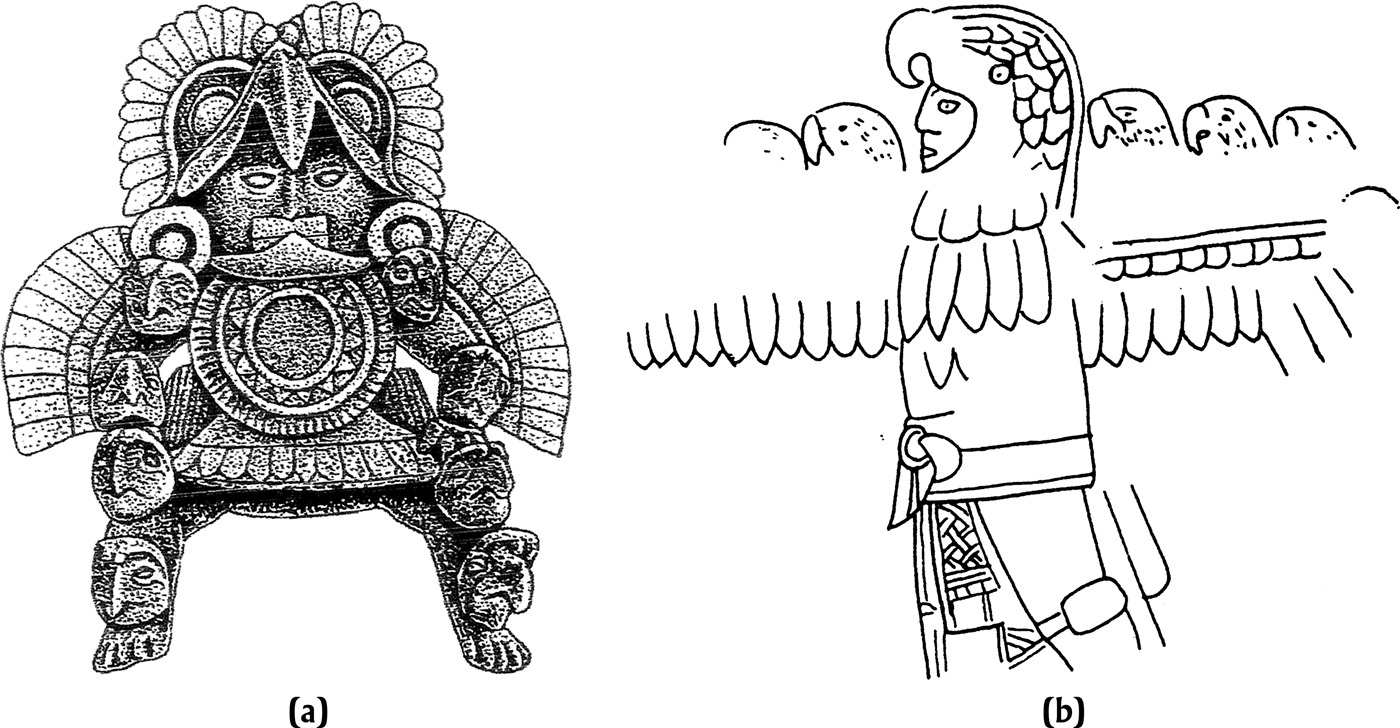
With regard to the figure of the descending Butterfly Bird God, we find the closest analogies on censers in the provincial Teotihuacan style from Escuintla. In one case, the deity bears a solar disc on his torso, just like images on other censers from the same zone (Hellmuth Reference Hellmuth1975:Plate 30b, inside cover) (Figure 16a) emphasizing the essence of his nature. In the case cited, the god also has a rectangular pendant nose, as can likewise be observed in Teotihuacan art (Deletaille and Deletaille Reference Deletaille and Deletaille1992:Figure 123). In particular, the cut-off arm, which we saw in the beak of the Atetelco bird, also appears together with the Butterfly Bird God on two of these censers, although as an adornment in models of buildings apparently dedicated to the god. In El Tajin, on the coast of the Gulf of Mexico, a macaw figure that appears to bear small macaw heads on his wings (Figure 16b) can be seen in a relief. This image takes on a special significance if we consider that in the iconography of El Tajin we have already analyzed a close analogy with the aquatic mountain of Atetelco, namely the mountain of the flowering maguey (Taube Reference Taube, Mazariegos and Arroyo2005a:41, 43, Figs. 4d, 6, and 7).
(a) The Butterfly Bird God with his body covered with macaw heads, sculptural ceramic, Escuintla, Guatemala (Taube Reference Taube, Mazariegos and Arroyo2005a:Figure 6a); (b) the many-headed macaw figure of El Tajin, Mound of the Building Columns (from Taube Reference Taube, Mazariegos and Arroyo2005a:Figure 4b). Reproduced with permission.
Finally, apart from these direct analogies, there would appear to be another type of analogy in the Maya city Xelha, Quintana Roo, in a group of murals with Teotihuacan iconography from the Early Classic period (Lombardo de Ruíz Reference Lombardo de Ruíz and Cicero2001:106–109; Ruíz Gallut Reference Ruíz Gallut, de la Fuente and Cicero2001:289–291). Represented in one of these murals is a figure dressed in Teotihuacan style, wearing a headdress in the form of a butterfly or a butterfly with jaguar's teeth (see Miller and Taube Reference Miller and Taube1993:49). On the same wall, in a mural close by, can be seen a deteriorated but recognizable image of a mountain, consisting of several rows of superimposed hills in the Teotihuacan style; this mountain is of a complexity similar to that of Atetelco. On the mountain can be seen a large flock of circling birds (Figure 17). According to Navarijo Ornelas (Reference Navarijo Ornelas and Cicero2001:242–247), the majority of these birds are red macaws (Ara macao), but there are also some green parrots (Amazona amazonica). These birds may correspond to the big macaw of Atetelco (see Figure 9). This, in turn, may represent the flock as a whole. It may also be a flock which arises from the body of the bird, as in seen in Huichol mythology (Taube Reference Taube, Mazariegos and Arroyo2005a:40–41).
Flock of macaws over a mountain in a mural at Xelha (from Navarijo Ornelas Reference Navarijo Ornelas and Cicero2001:Figure 8). Reproduced with permission.
In sum, how are we to interpret the relation between the supernatural macaw and the Butterfly Bird God? This macaw may be an important zoomorphic manifestation of the Butterfly Bird God; in this case, the god would be of the same type as the Principal Bird Deity, with an unknown mythical opponent, whose right arm is in the bird's beak. Although this interpretation is attractive, there are other considerations which suggest a different interpretation. The identifiable zoomorphic manifestations of the god are the butterfly, a bird that is not a macaw, and especially a hybrid creature: the butterfly-bird. The multiple macaw heads are not a frequent attribute of the Butterfly Bird God and only appear exceptionally. On the other hand, and as mentioned above, there is a series of Teotihuacan vessels bearing representations of figures with the attributes of the Butterfly Bird God hunting birds with a blowgun. Thus we have a Teotihuacan god who on occasion appears as a hunter with a blowgun, and a supernatural macaw carrying a human arm in its beak and that is in some yet undefined way linked to this god. These two mutually related characters strongly evoke the well-known Popol Vuh episode (from the Postclassic version) retelling the struggle of the Hero Twin blowgun hunters against the Principal Bird Deity.
Nevertheless, if the supernatural macaw were the enemy of the Teotihuacan god, and if there had been a confrontation between them, how can we explain the fact that the physical characteristics of the supernatural macaw sometimes appear as attributes of the Butterfly Bird God? For the moment, we can speculate for example that these attributes of the Butterfly Bird God may be an indication of his victory over the macaw, by appropriation of the enemy's attributes or faculties. If this were the case, the torn-off arms which adorn the buildings dedicated to the god in the Escuintla censers would be a representation of the god's own arm, an allusion to his fight against and victory over the macaw. But evidence cannot currently clarify which of the two possible interpretations is valid.
THE BUTTERFLY BIRD GOD AND THE BALLGAME
The images of the supernatural macaw of Copan adorned a ballcourt. Although there is little information from Teotihuacan about the ballgame, there are sufficient reasons to assert that the Butterfly Bird God was associated with it. First of all, it should be noted that the disc that crowns the ballgame marker in La Ventilla (Aveleyra Arroyo de Anda Reference Aveleyra Arroyo de Anda1963) imitates the Teotihuacan censer discs—possibly solar symbols—and the central motif of the marker disc generally appears on the side plates of censers. As mentioned above, censers figure among the most important manifestations of the iconography of the Butterfly Bird God.
With respect to the link existing between the ballgame and our god, images in the provincial Teotihuacan style of Escuintla speak more eloquently on this subject, as compared to the laconic nature of the art of Teotihuacan itself. On certain vessels from Escuintla we can see a player with the attributes of the Butterfly Bird God, facing a rival wearing a serpent headdress, in a setting of aquatic symbols (Hellmuth Reference Hellmuth1987:Figures 1–10; Paulinyi Reference Paulinyi1995:95–102; von Winning Reference von Winning1987:II:Chapter 2:Figure 18d) (Figure 18). Similar markers to those at La Ventilla appear in these game scenes, the disc of which may be surrounded by flames (Figure 19) (Hellmuth Reference Hellmuth and Pasztory1978:Figure 12). Although in my first analysis of this subject I was seeking indications that either player might win (Paulinyi Reference Paulinyi1995:95–96), in reality only the player with the attributes of the Butterfly Bird God appears explicitly as the winner in two of these scenes, decapitating his opponent (Hellmuth Reference Hellmuth and Pasztory1978:Figure 11, Reference Hellmuth1987:Figures 1–10) (see Figure 20).
Ballgame scene from Escuintla, Guatemala. A player with attributes of the Butterfly Bird God and his opponent with serpent headdress (from Hellmuth Reference Hellmuth and Pasztory1978:Figure 12). Reproduced with permission.
The player with attributes of the Butterfly Bird God and the player with serpent attributes on both sides of the ballgame court marker surrounded by flames, at Escuintla, Guatemala (from Hellmuth Reference Hellmuth1987:Figures 15–18). Reproduced with permission.
The ballgame player with attributes of the Butterfly Bird God decapitates his opponent, at Escuintla, Guatemala (from Hellmuth Reference Hellmuth1987:Figure 4, detail). Reproduced with permission.
To whom do the attributes of the opposing player allude? Both the clothing and the headdress of the figure represented in Figure 18, consisting of serpents’ heads, resemble the attire in the form of a many-headed serpent of the images of rulers in Stelae 1 and 7 at Itzimte, Campeche. Covering the face of the first ruler appears a Rain God mask (Paulinyi Reference Paulinyi1995:100; von Euw Reference von Euw1977:9, 19). This, together with the aquatic environment in which the game is taking place, would indicate that the opponent must be a serpent related with the Rain God or the Rain God himself manifested in this form. The absence of feathers on its body means that it cannot be a feathered serpent, but some other form. The attire of our player, together with that at Itzimte, corresponds to a supernatural serpent of Teotihuacan origin, identified and named the “War Serpent” by Taube (Reference Taube1992b:63–65, Note 6). According to him, the “War Serpent” is an early version of the fire serpent Xiuhcoatl from the Postclassic period (Reference Taube1992a; Reference Taube, Carrasco, Jones and Sessions2002:270–289).
The fiery and warlike nature of the serpent, as Taube indicates, is beyond doubt. Nevertheless, in my opinion, its characteristics correspond to a different supernatural entity to Xiuhcoatl, although also with a fiery connotation: the lightning serpent of the Rain God. This is supported by the fact that in various representations of this “War Serpent,” a close relation is observed between it and the Teotihuacan Rain God (Paulinyi Reference Paulinyi1995, Reference Paulinyi1997). It should be noted that the head of the Teotihuacan Rain God appears several times in the open mouth of the “War Serpent” in Stela 6 at Copan (Baudez Reference Baudez1994:Figures 63–64), in Lintel 25 at Yaxchilan, and in a carved panel from the Palenque area (Miller and Martin Reference Miller and Martin2004:Plate 36). In these cases the serpent is acting as the body or carrier of the god. At the same time it bears both fire symbols (the “comb-and-bar” of Teotihuacan in the third case), and water symbols (the Teotihuacan net in the first case), or a symbol recently identified by Taube (Reference Taube2005b:Figures 11e and 11f) as a rain cloud, which corresponds very well to the dual water-fire nature of the Rain God.
Now, the ballgame match that we see may form part of the myth which we are deciphering. It is also possible that the game may correspond to a rite performed not by supernatural beings, but by mortals invested with their attributes, and that it refers to a victory of the Butterfly Bird God over the lightning serpent, which need not necessarily have occurred in the context of the ballgame. The scene of the ballgame is set in an environment with aquatic symbols, with an opponent who belongs to or represents the Rain God, the inhabitant of the depths; thus the game must be taking place in the world of earth and water, perhaps only symbolically. And so we may possibly have returned to the same mythical point from which we set out—the place to which the Butterfly Bird God descends and from which he is reborn. But how does the ballgame fit into the history of the god as it unfolds before us? Since in this game the figure with the attributes of the Butterfly Bird God achieves victory over the representative of the Rain God, it is reasonable to suppose that this would occur after the rebirth of the god from a squash and before he rises from the Underworld. It is also possible, however, that the episode of rebirth from the squash and the victorious conclusion of the ballgame are synonymous: while representations of the ballgame are found exclusively in Escuintla, the themes of the birth from the squash and the Triple Hill are concentrated in Teotihuacan.
A TEOTIHUACAN MYTH
How can we interpret the myth revealed here? What does the rebirth of the Butterfly Bird God signify? The first possibility is that the death and rebirth of the solar god is a myth about the solar cycle and the renewal of plant life: the god arises from the fruit of a squash plant. Another possibility would be that the god dies and is reborn to become a new being—in this case the solar god—a recurrent motif in Mesoamerican creation myths. There is no clear-cut separation, however, between these two alternatives: the beginning of a solar calendar cycle may be considered as a replica of the creation of the sun.
The episodes identified from the myth about the Butterfly Bird God present considerable similarities with the Popol Vuh, which would support the idea of a Teotihuacan creation myth. This is why the Butterfly Bird God appears occasionally as a hunter with a blowgun, descends to the Underworld to be reborn, perhaps plays the ballgame while he is there and, after his triumph, rises from the Underworld. All this evokes the history of the Hero Twins and their father in the Popol Vuh. Furthermore, rebirth in the form of an edible plant or vegetable occurs in both myths: our god arises from a squash, while the father of the twins is reborn as the Maize God. Likewise, the fertile mountain of Teotihuacan is comparable to Broken Place, Bitter Water Place, the primordial mountain of the Popol Vuh. Similarly, although the many-headed macaw of Teotihuacan is not identical to the Principal Bird Deity, it may be that it played a similar role in the context of the Teotihuacan myth. At the same time, there are marked differences between the Popol Vuh and the Teotihuacan myth. The Teotihuacan solar god with his butterfly and bird attributes is a one-of-a-kind phenomenon of the central Mexican Plateau, as is the mythic role of the squash, which goes back at least to the squash images carved in the rock at Preclassic Chalcatzingo (Ángulo Reference Ángulo and Grove1987:Figures 104, 106). His opponent in the ballgame is not any of the malignant gods of death, as in the Popol Vuh, but possibly a lightning serpent of the Rain God, one of the oldest and most important gods of the same area. Moreover, in the Teotihuacan myth, great emphasis is placed on the rebirth of the sun god: this is apparently the first manifestation of a long tradition in the central plateau, which centuries later would assume the form of the Aztec myth of the creation of the Fifth Sun.
The coincidences and differences observed in the analysis of the two myths speak in favor both of a basic family relationship and of the independence of these two traditions that come respectively from the east and west of Mesoamerica. There are also indications that further, similar myths may exist. We have seen that in El Tajin the figure dressed as a many-headed macaw, the possible blowgun hunt scene, and the mountain of the flowering magueys of the Underworld, together provide clues to the existence of a third myth related to these two, perhaps closer to the Teotihuacan myth than to the Popol Vuh.
The myth protagonized by the Butterfly Bird God must have constituted one of the pillars of the Teotihuacan cosmovision. When we contemplate the hero of this myth, we realize that he is a deity of great importance, whose fiery, solar, and celestial nature is opposed to that of the Rain God and other aquatic beings, but to whom he is linked and complementary, among other factors, precisely through his rebirth in the aquatic underworld. He was probably the highest representative of the upper half of the Teotihuacan cosmos, and as such the counterpart of the Rain God who reigned in the lower half. By giving our god his due place and role, we can reach a more balanced and a more dynamic comprehension of the Teotihuacan cosmos.
RESUMEN
Poco se sabe sobre los dioses del panteón teotihuacano y su mitología es prácticamente desconocida. Partiendo del análisis de un grupo de murales de Atetelco (Teotihuacan), y arribando a otros escenarios mesoamericanos, se propone una reconstrucción parcial de un mito teotihuacano. En los murales de Atetelco aparece en un contexto acuático el actor principal del mito, el Dios Mariposa Pájaro, quien es un dios solar vinculado con la vegetación. Este dios se encuentra acompañado por una montaña fértil con calabazas, la que probablemente es su lugar de nacimiento. La montaña, que al parecer se ubica en el inframundo, tiene cerros que imitan las hojas del maguey, por lo cual se vincula con la planta de maguey y con el pulque; a su vez, dicha montaña es análoga con el cerro con plantas de maguey floreciente representado en El Tajin. Según distintas evidencias, el Dios Mariposa Pájaro desciende al inframundo y renace, surgiendo de esta manera de las profundidades de la tierra. Dentro de este contexto, la montaña fértil podría significar el lugar de su renacimiento y no de su nacimiento. La tercera y más enigmática imagen de los murales de Atetelco es un guacamayo sobrenatural de muchas cabezas que parece ser análogo con Vucub Caquix del Popol Vuh. Puesto que en otras ocasiones el Dios Mariposa Pájaro surge vestido como guacamayo sobrenatural, ambos se encuentran claramente vinculados entre sí, aunque es difícil descifrar este vínculo. La pregunta es si el guacamayo es el alter ego del dios, o—como sugieren algunas evidencias—por el contrario, su oponente; el autor de este artículo se inclina por la segunda posibilidad. El mito parece incluir además un juego de pelota en el inframundo donde el Dios Mariposa Pájaro vence y decapita a su contrincante, a la Serpiente Rayo del Dios de la Lluvia. En síntesis, aparentemente se trataría de un mito de creación, cuya estructura básica habría sido semejante a la del Popol Vuh.
ACKNOWLEDGMENTS
My thanks, first of all, to Maestro Rubén Cabrera Castro, who showed me the new Atetelco murals in 2005 and later invited me to analyze them, generously making available all the photographs, drawings, and archaeological information necessary for the work. Preliminary results of this analysis were presented in the symposium “Atetelco: Un conjunto arquitectónico teotihuacano, su secuencia ocupacional y sus funciones a través de sus materiales arqueológicos,” organized by Cabrera Castro at the XXVIII Mesa Redonda de la Sociedad Mexicana de Antropología, August 2007, in Mexico City. I must also mention the generosity of Jesper Nielsen and Christophe Helmke in sharing with me their manuscript on the fall of the great celestial bird. I also wish to thank Helena Horta for correcting the style of the original text of this article. Finally, I am grateful for the remarks of the evaluators, Barbara Headrick, Karl Taube, and an anonymous colleague, who reviewed the text. My special thanks to Karl Taube, who contributed to the enrichment of this work with bibliographical material.