I made all my contacts with local government officials when they were visiting MIT. I was a graduate student at the time, and served as their translator. They never would have spoken to me in Shanghai, but things were different when we were all at MIT.
— CEO of an IT consulting firm, Shanghai, May 2014If not for you all, there wouldn't have been an IT revolution.
— Narendra Modi to 18,000 Indian Americans, Madison Square Garden, New York, September 2014Anywhere there's a market in the world with Chinese, you can find Wenzhou people.
— Private entrepreneur, Wenzhou, April 2014China and India's economic ascendance in the twenty-first century has drawn attention to their national political economies, as well as the developmental experience of particular localities. The fact that China and India have the largest diasporic populations in the world—at fifty-five million and twenty-five million, respectively—has also attracted comparative studies on the economic contributions of their returnees and ethnic investors (Khanna Reference Khanna2008; Saxenian Reference Saxenian2005; Ye Reference Ye2014). Both national and local state policies have played a role in mediating diasporic relations. Yet within the study of comparative politics, “state-society relations” typically refers to the relationship between a Weberian nation-state and citizens residing within its administratively defined and coercively enforced territorial borders. This article thus departs from conventional usages of both state and society by focusing on the local state in combination with a less territorialized conception of society.
The rationale for this dual definitional stretch—both downwards (local state) and outwards (transnational society)—has an empirical basis. First, the local government represents the day-to-day point of contact with “the state’’ for most people. Government regulations, fees for service, and public goods are generally administered through local state channels even if they are mandated nationally. The local state represents the first point of accountability for most citizens, and noncitizens for that matter. Second, limiting the scope of “society’’ to populations currently residing within national borders unnecessarily excludes temporary migrants and diasporic communities who continue to identify with a locality. A more expansive notion of society recognizes the possibility of return migration, remittances from abroad, and the formation of transnational native place networks. Transnational migrants represent potential human, financial, and social resources for local and national development.
Theoretically, this article extends the economist Albert Hirschman's (Reference Hirschman1970) classic categorical troika of “exit, voice, and loyalty (EVL)” to the literature on new transnationalism. EVL serves as a deceptively parsimonious heuristic for revealing the nonexclusive relationship among three types of strategies for dealing with one's immediate environment: exit (migration), voice (participation), and loyalty (support). Migration (exit) may not be permanent, but even when it is, remaining abroad does not preclude deep-rooted identity (local and/or national loyalty), or meaningful impact on homeland affairs (voice). For these reasons, the reflexive association of society with domestic groups is incomplete.
Empirically, this article demonstrates the logic of this dual definitional stretch of state-society relations by examining different expressions of “cosmopolitan capitalism” in three paired localities in China and India: (1) transnational trading: Wenzhou, Zhejiang/Surat, Gujarat; (2) high-technology hubs: Zhongguancun, Beijing/Bangalore; and (3) coastal cosmopolitans: Guangdong/Kerala. The first pair of localities (Wenzhou and Surat) are the home bases of transnational networks of merchants who have developed reliable forms of cross-border informal finance and, in special industries, have gained a market share disproportionate to their populations. The second pair (Zhongguancun and Bangalore) are the Silicon Valleys of China and India, respectively. Both have earned global reputations in the IT sector in a remarkably short period of time, and have also been held up by their national governments as exemplars for return migration. The third pair of cases (Guangdong and Kerala) are long-standing exporters of labor, whose localities have been shaped—albeit unevenly—by remittances, diasporic investment, and internal migration. Each subnational paired case illustrates why the conventional state-society framework should be expanded to capture the nuances of (local) state and (transnational) society relations.
This article proceeds as follows. The first section reviews existing literature that challenges the conventional definition of state-society relations by disaggregating the state, on the one hand, and deterritorializing the range of actors that constitute society, on the other. These insights are valuable for understanding the dynamics of transnational migration, as seen when juxtaposed with Hirschman's EVL framework. The second part compares three pairs of localities in China and India to demonstrate the empirical relevance of a more fluid approach to analyzing state-society relations. The third section concludes.
Challenges to the State-Society Dichotomy
Lowering the State
Since the statist revival among political scientists in the 1980s (Evans, Reuschemeyer, and Skocpol Reference Evans, Reuschemeyer and Skocpol1985), multiple critiques of the Weberian conception of the state have emerged. Qualifications to the notion of the state (as a “set of institutions possessing monopoly over the legitimate use of force within territorial boundaries”) have grown primarily from studies of developing, postcolonial, and newly established countries. In the latter contexts, the state is more likely to fall short of key components of Weber's definition. States may be “weak” because the political system is not well institutionalized compared to the authority of local social forces (Migdal Reference Migdal1988). States do not necessarily monopolize the use of violence or the enforcement of national security (Mandel Reference Mandel2002; Volkov Reference Volkov2002). And the territorial boundaries of the state may be unsettled (Spruyt Reference Spruyt2005; Young Reference Young1994). Many internationally recognized nation-states are characterized by these definitional deficiencies.
Another line of critique concerns the narrowness of focusing on the central state apparatus. Even before the resurgence in state-centric theorizing, various studies explored the role of local states in subnational governance (Sellers Reference Sellers and Bevir2010). Charles Tiebout (Reference Tiebout1956) noted the relationship between local provision of public goods and citizens who could “vote with their feet” by moving to other localities. Others detailed the importance of local leadership in mediating among diverse interests and urban redevelopment (Dahl Reference Dahl1961; Stone Reference Stone1989). In the 1990s, the study of China's reform era political economy highlighted the impact of fiscal decentralization in incentivizing localities to promote economic development (Oi Reference Oi1992, Reference Oi1999). Local states competed with one another in various industries in a manner dubbed “market-preserving federalism” (Montinola, Qian, and Weingast Reference Montinola, Qian and Weingast1996) and engaged in “competitive liberalization” to attract foreign direct investment (Yang Reference Yang1997; Zweig Reference Zweig2002).
Distinguishing between the central state writ large and subnational governments is an initial step in acknowledging the potential agency of local states. Regional distinctions can also be made among local states. In large decentralized countries, localities pursue varying political and economic strategies; indeed, some local states are more predatory than developmental. In Russia, governmental performance varies provincially (Stoner-Weiss Reference Stoner-Weiss2002). In Italy, the effectiveness of democratic institutions varies regionally (Putnam Reference Putnam1993). For comparable historical reasons, subnational differences in political dynamics were evident in Brazil's transition to democracy (Hagopian Reference Hagopian1996). In both China and India, local governments vary in the treatment of private enterprises and foreign direct investment (Chen Reference Chen2014; Sinha Reference Sinha2005; Tsai Reference Tsai2007).
In short, there are empirical, and therefore methodological, rationales for decentralizing analytic attention to the state (Snyder Reference Snyder2001). The local state merits attention not only as an administrative extension of the central state, but also as a semi-autonomous agent that pursues contextually contingent political and economic strategies. Local states have different histories, preferences, governance capabilities, and developmental impact. Moreover, local state agents interact more directly with society than the national government.Footnote 1 The local state simultaneously represents the central state, while instilling a distinct imprint on state-society relations.
Expanding Society
Just as there are well-established reasons to focus on the state at a lower level of analysis, the case for enlarging the scope of “society” is equally compelling. Given the territorially bound foundation of the Weberian state, most discussions of state-society relations reflexively treat society as being contained within administratively enforced borders. Accounts of primordial attachment to territory reinforce this tendency (Grosby Reference Grosby1995). Yet a sizable multidisciplinary literature—in political science, anthropology, sociology, geography, and migration studies—exists on deterritorialized collective identity, and transnational networks and society. The empirical scope of such studies transcends national boundaries, while maintaining, perhaps ironically, territoriality as an organizing reference point.
For international migrants, sustained identity with the homeland or a particular locality may have implications for national politics. At one end, a political diaspora comprising revolutionaries, exiles, and dissidents constitute a territorially displaced extension of society, either mobilizing or waiting for an opportune moment to reenter territorial state and society (Adamson Reference Adamson, Lyons and Mandaville2012). The Jewish/Zionist, Chinese Nationalist, Albanian, Armenian, and Greek Cypriot diasporas are well-known examples of this politically motivated category. First-generation migrants, which Sidney Tarrow calls “rooted cosmopolitans,” can be especially effective as transnational activists because they came of age in their homelands and continue to participate in domestic networks while abroad (Tarrow Reference Tarrow2005; cf. Keck and Sikkink Reference Keck and Sikkink1998). Other diasporic populations include longer-term, multigenerational communities that have sustained identity with the homeland, if not political aspirations (Sheffer Reference Sheffer2003), though the extent of active identity may vary temporally (Chan Reference Chan2015).
Beyond political science, anthropologists have explored this deterritorial dimension of society through various lenses. Arjun Appadurai (Reference Appadurai1990, 297) coined the term “ethnoscape” to denote “the landscape of persons who constitute the shifting world in which we live: tourists, immigrants, refugees, exiles, guest workers, and other moving groups and persons [who] constitute an essential feature of the world, and appear to affect the politics of and between nations to a hitherto unprecedented degree.” In a kindred vein, the volume Nations Unbound: Transnational Projects, Postcolonial Predicaments, and Deterritorialized Nation-States defines transnationalism as “the process by which immigrants forge and sustain multi-stranded social relations that link together their societies of origin and settlement” (Basch, Schiller, and Blanc Reference Basch, Schiller and Blanc1994, 7). The complex cultural logics of transnationalism in late capitalism are perhaps best articulated by Aihwa Ong's (Reference Ong1999) notion of “flexible citizenship,” deriving from her ethnographic study of the Chinese diaspora.
Taken together, these studies focus on a deterritorialized, yet national conception of diasporic society. This stance should be distinguished from the literature on global citizenship and transnational civil society, which erases the nation-state as a mobilizing frame. The transnational human rights activists in Margaret Keck and Kathryn Sikkink's now-classic Activists Beyond Borders: Advocacy Networks in International Politics, for example, appeal to universal moral values in campaigning for changes that “transcend a specific cultural or political context” (Keck and Sikkink Reference Keck and Sikkink1998, 204). Their advocacy concerns truly transnational issues. Such activists are not the “long distance nationalists,” “flexible citizens,” or sojourners that comprise the expanded definition of society (Anderson Reference Anderson1992; Ong Reference Ong1999; Schiller and Fouron Reference Schiller and Fouron2001). The expanded definition is bounded by identity with imagined or actual territorial origins.
This article concerns migrant populations that retain some degree of native identity, however cosmopolitan in expression, and whose practices and movements may have implications for the homeland's political economy. The developmental impact of diasporas may take the form of financial remittances, return migration (social remittances), outmigration of elites opposed to popular enfranchisement, and influence on foreign policy (Kapur Reference Kapur2010). Diasporic communities may also contribute to economic development through foreign direct investment and “diaspora bonds” issued by national governments (Burgess and Pérez-Armendáriz Reference Burgess and Pérez-Armendáriz2013; Leblang Reference Leblang2010; Pellerin and Mullings Reference Pellerin and Mullings2013). In short, diasporic society may be smaller than domestic society, but the former's relevance for understanding state-society relations with greater empirical accuracy should be acknowledged. Society is mobile, and thus extends beyond coercively enforced territorial boundaries. This leaves room for shifting, layered, and contingent visions of the nation and community that may be reconstructed (rather than merely reproduced) over time (Duara Reference Duara1995). To borrow from Prasenjit Duara's provocative phrasing, this article proposes to rescue society from the nation-state as a conceptual move to recognize the cosmopolitan possibilities for (local) development. The rescue effort entails a dual definitional stretch—of ratcheting down the level of the state, while deterritorializing the scope of society (see figure 1).
Dual definitional stretch in state-society relations.

Empirically, this rescue effort is premised on the possibility and practice of international migration. People move abroad. But why? What motivates outmigration compared with other options? Hirschman's apparently simplistic EVL framework, combined with the dual definitional stretch, provides an analytic opportunity for understanding state-society relations in a more nuanced and dynamic manner.
Hirschman's theory starts from the premise that “under any economic, social, or political system, individuals, business firms, and organizations in general are subject to lapses from efficient, rational, law-abiding, virtuous, or otherwise functional behavior” (Hirschman Reference Hirschman1970, 1). Three choices follow. Rational individual or organizational actors may choose to exit their current situation, voice concerns, or demonstrate loyalty. The framework is intuitive and elegant, holding particular appeal to neoclassical economists. When Exit, Voice, and Loyalty was published in 1970, economists at the University of Chicago applied the logic of exit to policy arenas not typically governed by markets, such as public housing (Economist 2012). In the public choice tradition of Tiebout (Reference Tiebout1956), mentioned earlier, dissatisfied citizens will vote with their feet. And the normative implication is that exit or the threat of exit will improve the overall delivery of public goods in a market-clearing manner.
There are, of course, several limitations associated with assuming that exit is a viable choice for consumers and citizens alike, and that exit will motivate welfare benefits. For one, options are limited in monopolistic or oligopolistic environments. Moreover, as Hirschman himself noted in the context of public schools, exit may lead to further deterioration in the public education system when “quality conscious parents” with economic means enroll their children in private schools (Hirschman Reference Hirschman1970, 51). Exit without voice contributes to this decline because those with exit options are less likely to express concerns. Voice is important for identifying both problems and potential solutions. As such, some degree of loyalty, meaning belief in the possibility of change, is needed to motivate the use of voice.
The basic EVL framework lends itself well for generating propositions regarding political participation, governmental performance, and outmigration. Its three-pronged foundation also invites further analysis. Indeed, Hirschman (Reference Hirschman1978) subsequently made refinements concerning international exit and domestic politics. In particular, small states experience the effects of outmigration more than large ones. Hirschman's original formulation expected that exit without voice would have adverse effects. Yet mass outmigration from small European states in the nineteenth and early twentieth centuries alleviated political pressures as disaffected populations departed (on ships with “many actual or potential anarchists and socialists, reformers and revolutionaries”; Hirschman Reference Hirschman1978, 102). The extension of suffrage and protection of civil rights occurred in those same countries by the early twentieth century. Devesh Kapur (Reference Kapur2010, chap. 6) observes a similar phenomenon in India, where there has been outmigration of elites who might otherwise obstruct mass political empowerment. A broader implication is that the exit of disloyal elites can facilitate regime consolidation and political stability, regardless of regime type (Hoffmann Reference Hoffmann2005).
As suggested above, insights from the literature on new transnationalism provide additional depth to the EVL framework and the present analysis of state-society relations. Above all, migration (exit) is not as starkly fixed as implied by the original EVL framework. Return migration is possible. Even when physical exit is long-term or becomes permanent, however, identity with the homeland and/or locality may endure, evolve, or even intensify. Yet such identity does not necessarily imply loyalty to the ruling regime, as evident in the cases of exiled populations with dissenting political agendas. Exit does not prohibit either loyalty or voice with meaningful impact on domestic politics.
This is not meant to imply that all international migrants are politically disaffected or motivated to affect domestic change. To the contrary, the preponderance of migrants are economic (rather than political) migrants seeking better opportunities for employment, commercial trade, production sites, investment, and overall material well-being (Massey Reference Massey1988).Footnote 2 For economic migrants, “voice” may be expressed financially in the form of remittances and return investment. Financial flows from diasporic populations signal some degree of identity or commercial connection with the homeland. Remittances may be interpreted as loyalty, not necessarily to the central state, but more likely to kin or to a particular locality. Other forms of return capital, such as charitable donations, bank deposits, foreign direct investment, real estate purchases, and portfolio investment, may reflect a mixture of affinity, commercial expectations, and confidence in the homeland or native place. But to be sure, there are fully assimilated co-ethnic investors who have purely commercial motives.
The often ambiguous drivers of ethnic capital are captured by the notion of “cosmopolitan capitalism,” a term used by Gary Hamilton (Reference Hamilton1999) in the context of Chinese diasporic networks, which he also calls “Confucian capitalism.” Others have described the apparently exceptional characteristics of Chinese commercial practices as “guanxi capitalism,” “bamboo capitalism,” and more simply, “Chinese capitalism.” Although these labels are cast in essentializing cultural terms, the transnational subcontracting networks described in these accounts are not limited to the Chinese diaspora. The “informal governmentality” of the “connections of guanxi capitalism” described by Aiwah Ong (Reference Ong1999, 116–17, cited in Callahan Reference Callahan2004, 11) extends to other diasporic communities, including, for example, Arab traders between the third and sixteenth centuries, Jewish Maghrebi merchants in the eleventh and twelfth centuries (Shatzmiller Reference Shatzmiller2011), and thirteenth-century Venetian traders.
In contexts characterized by legal uncertainty or weak enforcement of contracts, such as long-distance trading networks, kinship, ethnicity, and other forms of particularistic identity provide the basis for trust needed for engaging in exchange relations (Landa Reference Landa1995). Yet the scope of trust is characterized by a distinctly cosmopolitan rather than nativist sensibility. Cosmopolitanism may be “understood as an activity connecting and entangling places and people for the exchange of goods and knowledge” (Gestrich and Beerbühl Reference Gestrich, Beerbühl, Gestrich and Beerbühl2011, 9). The commercial agents of cosmopolitanism are cosmopolitan capitalists who develop at least a minimal degree of multicultural fluency to survive, if not thrive, in generating income abroad and/or brokering capital flows across territorial boundaries. Unlike the multinational corporation, the cosmopolitan capitalist not only engages in cross-border economic transactions, but in so doing engages in ongoing cross-cultural translation and demystification of “the other.” In this sense, deterritorialized society constitutes the core of cosmopolitan capitalism, which is not captured by the conventional association of society with domestic groups.
Understanding the implications of diasporic capital for the homeland requires disaggregation of national indicators. Macro-level accounts elide the reality of uneven distribution and disparate forms of remittances and ethnic foreign direct investment (FDI) within national borders (Ye Reference Ye2014). India and China, for example, have been the leading recipients of international remittances since 2005; together, they account for one-third of the world's total remittance flows (UNCTAD 1991–2015). These aggregate figures reflect the countries' large diasporic populations. Yet remittances ultimately go to a particular region or locality, not the entire country. As such, examining the local manifestations of return capital provides greater insight into debates about the developmental impact of migration and remittances (Brown Reference Brown2006; Maimo and Ratha Reference Maimbo and Ratha2005).
Three Faces of Cosmopolitan Capitalism
Three subnational patterns of cosmopolitan capitalism are illustrated through the following cross-national pairs: (1) transnational trading: Wenzhou, Zhejiang/Surat, Gujarat; (2) high-technology hubs: Zhongguancun, Beijing/Bangalore; and (3) coastal cosmopolitans: Guangdong/Kerala. In terms of case selection, this study combines a “within-nation” and “between-nation” comparative research design based on the logic of Mill's Method of Agreement. Each of the paired localities is located in a different country with a different regime type and national economic structure. But the cross-national dyads share key similarities in the historical and contemporary demographics of migratory trends; local state activism in harnessing benefits from migratory circulation; and the impact of return (human and financial) capital on local development, which encompasses economic growth, market development, technological capacity, and human development indicators. These individual localities are sometimes presented in a manner that appears to represent developmental dynamics in China or India as a whole. By contrast, this study highlights the reality of intra-national variation through three expressions of cosmopolitan capitalism, while pointing to the contextual and historical factors that may contribute to cross-national local similarities.
Transnational Traders from Wenzhou, Zhejiang, and Surat, Gujarat
The first pair of localities—Wenzhou in Zhejiang Province and Surat in the state of Gujarat—are port cities whose cosmopolitan capitalists have established flourishing transnational commercial networks. Wenzhou locals often say, “Anywhere there's a market in the world with Chinese, you can find Wenzhou people.” Guangdong and Fujian provinces also have a rich history of outmigration (populating Hong Kong, Taiwan, and portions of Southeast Asia). But during the reform era, Wenzhou stood out for its early development of the local private economy and reliance on a creative variety of informal financing mechanisms well before the central government sanctioned such experimentation (see citations in Tsai Reference Tsai2002, chap. 4). Meanwhile, Wenzhou's private entrepreneurs are known for leaving the mountainous locality in search of income-generating opportunities in other parts of the country and beyond, including Europe and Africa.
Gujarati merchants have a comparable reputation, though with greater historical interaction with European powers.Footnote 3 As the Mughal Empire's central port city, Surat attracted investment from British, French, Portuguese, and Dutch textile producers. By the late nineteenth century, Gujarati traders were operating in most coastal cities in East Africa, and had established an extensive commercial presence, ranging from small retailers (dukawalla) to larger companies engaged in high volumes of transnational trade (Vahed Reference Vahed2005). During the rise of European colonialism on the African continent, Gujaratis followed the expansion of railways and roads into the interior, creating new communities as “East Asian Africans,” which became the basis for further migration to Britain following African independence (United Kingdom Government Web Archive, n.d.).
Despite historical differences in the timing and trajectory of out-migration, the commercial imprints of Wenzhou and Surat/Gujarati capitalists share striking similarities, both nationally and transnationally. First, both have vibrant local economies that serve as the hub for global production and distribution of products in niche industries. By the 1990s, various rural counties in Wenzhou had already established substantial global market shares in small commodity items, including buttons, cigarette lighters, footwear, eyeglasses, and industrial components such as pumps and valves. When I first visited Qiaotou in 1997, for example, the rural township in Yongjia County was supplying 80 percent of the buttons used in apparel manufactured in Asia, and 80 percent of the world's zippers. During the early 2000s, Wenzhou produced 70 percent of the world's cigarette lighters (China Daily 2002). And to date, the Yiwu Small Commodities Market is the world's largest wholesale market with over 70,000 stalls, attracting buyers from eighty-nine countries, especially those from the Middle East, Africa, South Asia, and Central Asia.Footnote 4
Surat's global reach in the diamond industry is no less impressive, and quite lucrative with annual sales of $14 billion (Coggiola Reference Coggiola2014). Known as the diamond hub of the world, Surat is home to nearly 10,000 cutting and polishing workshops, processes 90 percent of the world's small diamonds, and accounts for over 70 percent of India's diamond exports (L. Samuel Reference Samuel2013). The industry originated from Gujarati traders who brought diamonds from East Africa back to Surat in the early twentieth century. When global demand for diamonds expanded in the 1970s and early 1980s, Surat's cutting and polishing capacity took off (Engelshoven Reference Engelshoven1999). By the late 1990s, Surat was a global player in the small diamond industry (Kapur Reference Kapur2010, 100).
Besides diamonds, Surat has a thriving textile industry, which involves the majority of the local workforce and is geared towards the domestic apparel market. The “Silk City's” traditional cotton mills and expertise in silk brocade and gold embroidery (jari) have extended into manufacturing of man-made fiber (MMF). Surat now accounts for 60 percent of India's polyester production (Thomas Reference Thomas2014c). Textile trade sources indicate that local producers export non-apparel MMF mainly to Pakistan and Central Asia, and seek to increase exports to the United States, which imports nearly 40 percent of its textiles and garments from China.
Despite the apparently hyperbolic nomenclature of the “World's Largest Supermarket for Small Commodities,’’ and “Diamond Hub of the World,” respectively, Wenzhou and Surat dominate key markets disproportionate to their local “permanent” populations (at seven million and six million, respectively). The reasons for this dominance merit far more historical explanation than can be supplied in here. But it is clear that their diasporas, both past and contemporary, are essential contributors to their commercial success.Footnote 5 They constitute networked economic resources beyond the borders of the nation-state. With access to lower-cost textiles from Wenzhou, for example, the clothing factories in Prato owned by Wenzhou people dominate manufacturing in the non-designer brand segment of Italy's apparel industry (Fels and Hamilton Reference Fels and Hamilton2013). With offices in Mumbai, Hong Kong, New York, London, Tel Aviv, and Antwerp (the former headquarters of De Beers), Surat's diamantaires have displaced Hasidic Jewish dealers in Antwerp (Engelshoven Reference Engelshoven1999; Kapur Reference Kapur2010, 100–104), which has consolidated Surat as the global center for cutting and polishing small diamonds. There are undoubtedly multigenerational and more recent migrants from Wenzhou and Surat who are not involved in business (e.g., wage workers, professionals, students, unemployed relatives, etc.), and who may be assimilated abroad. Nonetheless, substantial segments of Wenzhou and Surat's local economies are connected to the commercial diaspora, and therefore, may be viewed as a transnational extension of society.
The question, then, is how to analyze the impact of the commercial diaspora on state-society relations. Examining the activities of both government-organ and societal associations based on native-place or industrial sector is a starting point.
In Wenzhou, the municipal government takes pride in the propensity of local merchants to trade abroad and has an office dedicated to overseas Wenzhou affairs, which receives international delegations and also visits Wenzhou associations in other countries (Wenzhou Government 2012, 243).Footnote 6 The Overseas Chinese Association of Wenzhou (OCAW) maintains a website, the Wenzhou Overseas Network (Wenzhou qiaowang: www.wzqw.com.cn), which provides news about Wenzhou people living abroad, and links to Wenzhou overseas associations on all five continents.Footnote 7 Much of the web content highlights the contributions of overseas Wenzhou Chinese. For example, the OCAW reports that over 80 percent of Wenzhou's exports are brokered through its diasporic networks. External trade is important for Wenzhou's economy. Prior to the global financial crisis, trade reached a peak of 43 percent of the municipality's GDP, with exports accounting for 36 percent of local GDP (Wenzhou Government 2008, pt. 6; 2014, pt. 6).Footnote 8 Apart from trade, the local government recognizes numerous other examples of overseas Wenzhou Chinese giving back to their native place, including individual remittances and charitable donations collected by associations from abroad, such as the Wenzhou Association of Overseas Businesspeople.Footnote 9
Recent field interviews indicate that Wenzhou's entrepreneurs are frustrated with local economic conditions, which include rising wages; declining asset values (local real estate prices have dropped by 40–50 percent since 2009); and various crises in informal financial markets. Many are thus highly motivated to exit, as other Wenzhou entrepreneurs have done. Yet the impact of the present downturn should not be over-interpreted. The local state in Wenzhou is attuned to its diasporic society, and the attention is often reciprocated meaningfully.
Although India's national government has been less proactive than China's in encouraging investment by Non-Resident Indians (NRIs) and Persons-of-Indian Origin (PIOs), the state of Gujarat recognized early on the value of encouraging Gujaratis to reinvest in the locality. This was motivated by the state's founding circumstances, as Gujarat was established in 1960 out of a portion of Bombay and the merger of Saurashtra and Kutch. Aseema Sinha (Reference Sinha2005, 182) observed that the loss of Bombay city to Maharashtra generated among Gujarat's new leaders “an ideology of competitive developmentalism” with Bombay. Gujarat thus pursued a variety of strategies, such as tax breaks, subsidies, and low-cost labor, to encourage investment from Gujaratis who had moved to Bombay city and elsewhere (Gorter Reference Gorter1996).
The local state's developmental orientation endures. The Gujarat Industrial Development Corporation is focused on attracting both domestic and international investment, and has approved fifty-five special economic zones (SEZs) (Gujarat Industrial Development Corporation, n.d.). One of the three SEZs that are already operational is an Apparel Park in Surat, which is now the fourth fastest growing developing city in the world (Bhatt Reference Bhatt2011). Competitive dynamics with Mumbai also continue, which entrepreneurs use to negotiate better business conditions in Surat. For example, in 2014 over fifty large diamond companies in Mumbai announced their intention to relocate to Surat, where a new “world-class” diamond market would be constructed (Thomas Reference Thomas2014a). Shortly thereafter, the Surat Diamond Association announced intentions to lobby rigorously for an international airport in Surat; otherwise, the claim is that Mumbai would be a more attractive city for Surat's transnational diamantaires (Thomas Reference Thomas2014b).Footnote 10 In Belgium alone, there are 14,000 Gujaratis, mainly from Surat, of which 5,000 are engaged in the diamond trade (Thomas Reference Thomas2013). Notwithstanding the fact that India's current prime minister is from Gujarat, the Non-Resident Gujarati center in Surat and the NRI Division of the Gujarat Chamber of Commerce and Industry are institutional channels for having their voices heard.Footnote 11
High-Technology Hubs: Asia's Silicon Valleys, Zhongguancun and Bangalore
In the span of less than two decades, the districts of Zhongguancun in Beijing and Bangalore in Karnataka have developed into the information and communications technology (ICT) centers of China and India, respectively. Zhongguancun is home to Lenovo, Stone, and Baidu; about half of the Chinese firms currently listed on NASDAQ are based in Zhongguancun. Bangalore is the “Outsourcing Capital of the World”: 400 of the Fortune 500 companies outsource IT services to Bangalore, and Bangalore accounts for over 35 percent of India's software exports (Karnataka Information Communication Technology Group 2013). The economic transformation of these localities cannot be attributed solely to comparatively lower prices in factor endowments (land, labor, and capital). Zhongguancun and Bangalore are both strategically selected beneficiaries of national industrial policy for ICT development, while their local governments have also provided a supportive environment. At the same time, their ICT sectors rely on blended domestic and diasporic networks of human, intellectual, social, and financial capital. Economic geographers who study regional innovation systems emphasize the importance of tacit knowledge shared by individuals and organizations who interact with one another on a regular basis (Cooke Reference Cooke2001; Storper and Venables Reference Storper and Venables2004). Zhongguancun and Bangalore possess such local networks, but what distinguishes them as significant sites for global sourcing of technology are their diasporic ties and attractiveness as sites for returnees. Anne Saxenian (Reference Saxenian2005) refers to the return migration of well-trained technical professionals, managers, and venture capitalists as “brain circulation.” As in the Wenzhou/Surat pair, characterizing the nature of state-society relations in Zhongguancun and Bangalore involves dynamics that extend beyond administrative boundaries. Unlike the Wenzhou/Surat cases, however, central state policies have played a key role in Zhongguancun and Bangalore's IT development, and returnees in that sector are not necessarily natives to Beijing or Bangalore, though they may have attended schools in those localities.Footnote 12
The vision for Zhongguancun's development as “China's Silicon Valley” dates back to 1980, when a physicist from the Chinese Academy of Sciences (CAS), Chen Chunxian, returned from a government-sponsored trip to the United States (Zhou Reference Zhou2008). Professor Chen subsequently established China's first private (minying) technology service company in northwestern Beijing's Haidian district, where Peking University, Tsinghua University, and dozens of other colleges and universities are concentrated. The area also includes over 200 scientific institutions such as CAS and the Chinese Academy of Engineering. By the time that Beijing designated Zhongguancun as an experimental high-technology zone in 1988, the main street in Zhongguancun was already known as “Electronics Avenue,” with dozens of minying computer hardware and software businesses. Many of these firms, including Legend (now Lenovo), were established by academics from local universities who raised funds through informal sources, and were quietly sponsored by their state units (Segal Reference Segal2002, chap. 3).
Multinational corporations (MNCs) such as IBM, Microsoft, and Fujitsu started establishing operations in Zhongguancun in the early 1990s, and were producing ICT for the domestic market by the end of the decade. By the 2000s, an increasing number of Chinese who were educated or had worked abroad (including the founders of Baidu, China's leading Internet search engine) returned to pursue opportunities in the ICT industry (Wang, Zweig, and Lin Reference Wang, Zweig and Lin2011). As of 2012, Zhongguancun had over 5,000 enterprises with 16,000 returnees, of which 12,000 had received graduate training abroad (Zhongguancun Science Park Administrative Committee 2013, 8). Zhongguancun now encompasses two dozen science and technology parks and twenty-nine Overseas Students Pioneer Parks.
Zhongguancun's development as China's ICT center evolved out of a synergistic combination of central state policies, spatial concentration of China's best universities, entrepreneurialism, and “brain circulation.” Since 2003, state efforts to promote “indigenous innovation” have included funding facilities to encourage start-ups by overseas returnees (Zhou Reference Zhou2008, chap. 7). These include access to “state-sponsored incubators, small start-up grants, basic guarantees for small loans, rent breaks, and other limited subsidies” (138). But in general, the most attractive sources of funding are returnees themselves. Venture capitalists with overseas ICT experience understand the financing needs of the market better than employees of state banks, and are more interested in growth potential than risk management.Footnote 13
Like Zhongguancun, Bangalore also started with a promising base of human capital. Shortly after independence, India's central government relocated important industries away from border regions to Bangalore, the capital of Karnataka state in southern India (Basant Reference Basant, Yusuf, Nabeshima and Yamashita2008). Major public enterprises included Hindustan Machine Tools, Bharat Electronics Limited, Bharat Heavy Electrical, Hindustan Aeronautics Limited, and Indian Telephone Industries. Significant state investment in Bangalore's defense industry, combined with dozens of engineering colleges, research organizations, and the Indian Institute of Science, created a solid industrial infrastructure and a supply of well-trained technical staff. By the late 1960s, Bangalore had become a center for scientific and defense-related research.
Well before economic liberalization and the authorization of Software Technology Parks (STPs) in Bangalore in 1991, the Foreign Exchange Regulation Act of 1975 and limits on imports of computer hardware in the early 1980s had two notable impacts on subsequent developments in Bangalore and India's computer industry (Basant Reference Basant, Yusuf, Nabeshima and Yamashita2008, 159). First, due to restrictions on foreign ownership of firms, IBM departed from India in 1978, leaving behind 1,200 unemployed software specialists. A number of former IBM employees established small computer companies in Bangalore, while many moved abroad for better IT employment opportunities (Heeks Reference Heeks1996, 70). Both groups contributed to the export-oriented development of ICT in Bangalore. Local software companies faced difficulties in entering a limited domestic market and thus turned to the external one for product development. Although they were not started by former IBM employees, Wipro and Infosys are successful examples of domestic firms that began operating in the early 1980s. Meanwhile, Bangalore's expatriates rose through the ranks of various multinational IT companies, and became a bridge for MNCs to outsource their services through Bangalore.
While the initial group of ICT firms in Beijing's Zhongguancun were established by local scientists and engineers, the development of Bangalore's ICT industry was led more by MNCs that swiftly engaged local firms in outsourcing production for export markets (Wang, Cheng, and Ganapati Reference Wang, Cheng and Ganapati2012). The establishment of Texas Instruments in 1986 as India's first wholly foreign-owned software subsidiary paved the way for other major companies, including General Electric, Hewlett-Packard, Motorola, and Siemens, to set up operations in Bangalore. The introduction of STPs and dedicated satellite communications infrastructure provided an inviting environment during the 1990s, but the Indian diaspora also played a critical role in generating confidence about Bangalore among MNCs. For example, one study found that seventy-one out of the seventy-five MNCs operating in Bangalore's STP were directed by Indians with previous work experience in the United States or other countries (Ghamawat Reference Ghemawat2000). As Devesh Kapur (Reference Kapur2010, 91) observes, “[T]he Indian diaspora's success in Silicon Valley … has created a ‘brand-name,’ wherein an Indian software programmer sends an ex ante signal of quality.” In other words, earlier outmigration of well-educated scientists, engineers, and professionals became an asset for domestic ICT development. Rather than unidirectional exit or brain drain, migrants represent a potential societal resource. The state-level NRI Karnataka Forum recognizes and seeks to harness this resource (Government of Karnataka, n.d.).
Over ten years ago, Yasheng Huang and Tarun Khanna quipped in Foreign Policy, “With the help of its diaspora, China has won the race to be the world's factory. With the help of its diaspora, India could become the world's technology lab” (Huang and Kanna Reference Huang and Khanna2003). Another group of researchers finds that Zhongguancun lags behind Bangalore in software services, but leads in ICT innovation (J. Wang et al. Reference Wang, Cheng and Ganapati2012). But regardless of relative competitiveness from an industry perspective, noting the relevance of their respective diasporas is less controversial. Overall, China's ICT returnees have been particularly attuned to localizing MNC technology and products for the domestic market, which contrasts with the Indian diaspora's role in building Bangalore's outsourcing capabilities (J. Wang et al. Reference Wang, Cheng and Ganapati2012). Bangalore's most recent returnees are also becoming IT entrepreneurs by leveraging professional networks from former Silicon Valley employers.Footnote 14 What distinguishes the technology hub pattern of cosmopolitan capitalism is that Beijing and Bangalore attract non-native national returnees. The social impact of their privileged status merits further study.
Coastal Cosmopolitans: The Migrants of Guangdong and Kerala
Based on economic indicators, the pairing of Guangdong Province and the state of Kerala may seem puzzling at first glance. During the reform era, Guangdong developed into a major manufacturing center and was one of China's fastest growing provinces with a population of nearly 106 million. Even after the global financial crisis of 2008–9, Guangdong still ranks first among China's thirty-one provinces in terms of GDP. Kerala's economy, on the other hand, relies on services and agriculture, and had more modest rates of growth until the mid-2000s. Yet the “Kerala model” of development is renowned for its extensive provision of social services and maintaining the highest human development indicators in India (Heller Reference Heller1999; Tsai Reference Tsai2006).Footnote 15
Their internal politics also lie at opposite ends of the ideological spectrum. Guangdong people have traditionally been more liberal and market-oriented. In the political context of modern China, Guangdong has a “rightist” reputation.Footnote 16 As in Wenzhou, the local state in Guangdong was more permissive of private commerce years before it was legal by Beijing. By contrast, Kerala's politics are unabashedly leftist. The Communist Party of India (Marxist) (CPM)–led Left Democratic Front coalition in Kerala enjoys widespread popular support with regular electoral success (alternating with the United Democratic Front coalition). Unlike the Chinese Communist Party, which has pragmatically adapted its official ideology to accommodate the effects of marketization, the CPM retains a more orthodox Marxist agenda. Furthermore, even though Kerala's industrial wages are higher than those in neighboring states, labor unrest is common.
Despite these differences in the two localities' contemporary political economy, they share cross-national similarities in geographic position and significance for national migration history. Both have long coastlines that, for centuries, served as ports of exit for their respective populations. Both have also attracted internal migrants from other parts of the country. They are circuits for both domestic and external migration.
Guangdong is adjacent to Hong Kong, a gateway to the South China Sea. The various Chinatowns that emerged in North America, Britain, and Australia during the nineteenth century were also established by (mainly Cantonese-speaking) migrants from Guangdong Province. Localities with high levels of outmigration developed networks with particular destinations. For example, migrant workers from Taishan settled in North America, and accounted for 60 percent of the Chinese population in the United States in the nineteenth century (Zhang Reference Zhang and Pan1998, 36). In the 1930s, one study found that remittances to Chaozhou and Shantou originated from Thailand, Malaya, Vietnam, and Indonesia (Wu Reference Wu1937, cited in Hoe Reference Hoe2013, 28). Hakka people from Meixian (formerly Jiaying) became gold miners in Borneo and also settled in Taiwan (Zhang Reference Zhang and Pan1998, 39). Twentieth-century outmigration from Guangdong to Hong Kong reflected stressful periods in China's political economy (e.g., the communist revolution, the Great Leap Forward, and the Cultural Revolution). Due to its locational advantages for attracting foreign direct investment, during the reform era, Guangdong was selected for three of the first four special economic zones (Shenzhen, Shantou, and Zhuhai), and has since attracted over twenty million migrants from inland provinces. Meanwhile, although emigration to Hong Kong continued in the 1990s, the primary port of Chinese outmigration shifted to Chang Le, Fujian (Chin Reference Chin1999; Keefe Reference Keefe2009). Overall, Guangdong's migrants form a multigenerational mix of overseas Chinese populations. The earlier Chinatown settlements have evolved into a diverse diaspora that encompasses assimilated co-ethnics, people in Hong Kong with a distinct postcolonial identity, and transnational Cantonese in a variety of commercial sectors and noncommercial professions.
Kerala lies on India's southwestern coastal tip, flanking the Arabian Sea. Early twentieth-century waves of migration from Kerala comprised semi-skilled workers who went to Ceylon, Malaya, Burma, and large cities in south Asia such as Calcutta, Karachi, and Bombay. Following the establishment of new oil fields in the Middle East, and accompanying demand for labor in construction and infrastructural development, mass migration from India to the Gulf accelerated in the 1970s and 1980s. Workers from Kerala accounted for 80 percent of these migrants. Besides Gulf migration, professionals in the medical, engineering, IT, and academic sectors also migrated to North America and Europe. As in Guangdong, Kerala's migration patterns have been shaped by both local conditions and the cumulative effects of migration networks. Migration of manual labor, for example, is more prevalent from northern districts such as Malappuram and Kannur, while nurses migrate from Christian-dominant areas with more developed educational infrastructure (J. Samuel Reference Samuel2011). In recent years, Kerala has also attracted about 2.5 million migrant laborers from other Indian states who seek better employment opportunities (Nair Reference Nair2014). Meanwhile, outmigration continues, primarily to the United Arab Emirates and Saudi Arabia, but also to other parts of the world.
Notwithstanding Guangdong's neoliberalism and Kerala's populism, the fact that both have multigenerational as well as more recent diasporic populations has had complex developmental implications. Their local states are sensitive to these realities, and have adapted a proactive stance towards incorporating their transnational extensions of society. They value their diasporas. In this sense, local state identity is as much shaped by outmigration as native place retains some degree of identity for those who have left.
From the mid-nineteenth century until the establishment of the PRC, remittances contributed significantly to certain localities in Guangdong, especially migrant-sending districts (qiaoxiang) along the Pearl River Delta, such as Taishan, Panyu, and Xinyi. For most households, remittances were used for daily, subsistence-level necessities. Contemporaneously, diasporic capital changed the nature of local production and consumerism (e.g., with the establishment of Gold Mountain banks, factories, and luxury markets); and contributed to building schools, orphanages, hospitals, ancestral halls, roads, bridges, and even the Xinning Railway (Hoe Reference Hoe2013; Nair Reference Nair2014). During the Mao era, transfers from abroad were limited due to political campaigns attacking capitalist influences. But substantial inflows of remittances and charitable donations from Guangdong's diaspora resumed during the reform period. FDI from Hong Kong and other overseas Chinese played a pivotal role in building Guangdong's manufacturing and commercial infrastructure. From 1979 to 1999, nearly 75 percent of the province's FDI arrived through Hong Kong—and of that amount, 97 percent was invested by ethnic Chinese residing in Hong Kong and Macau, with the remaining 3 percent coming from the Chinese diaspora in Southeast Asia (Hoe Reference Hoe2013, 35, table 2.6). Guangzhou, Dongguan, and Shenzhen developed most rapidly, but local governments in other parts of Guangdong also actively pursued overseas Chinese investment. Overseas Chinese Affairs offices courted “native sons” and “compatriots” (tongbao) residing abroad. Local governments offered “foreign” investors a host of preferential policies, including tax holidays and access to land. Indeed, the operating environment for foreign-invested enterprises (FIEs) was more favorable than that for domestic private enterprises, which incentivized local businesses to disguise themselves as FIEs.Footnote 17 Arguably, the relationship between the local state and transnational society in Guangdong has been more mutually supportive than (central) state–(domestic) society relations in recent decades.Footnote 18
Compared with Guangdong, remittances have been more central to Kerala's local development than FDI. This reflects broader cross-national realities: India has been the world's leading recipient of remittances since 2005; China ranks second in terms of remittances, but has attracted far more FDI than India (UNCTAD 1991–2015.Footnote 19 The reasons for this variation in remittances versus FDI have been discussed elsewhere (Tsai Reference Tsai2010; Ye Reference Ye2014). For the present analysis, the point is that remittances represent a major component of Kerala's economy. At the peak of the Gulf boom during 1980–81, remittances to localities with large numbers of migrants—known as “Gulf pockets”—reached 50 percent of local GDP (Kurien Reference Kurien1994, 765). More recent statistics indicate that workers' remittances from the Gulf continue to contribute a nontrivial proportion of local and national capital. In 2013, remittances to Kerala reached $2.3 billion, accounting for one-third of India's total remittances (Business Standard 2014). That same year, remittances contributed to over 31 percent of Kerala's net state domestic product and therefore, per capita GDP (Mistry Reference Mistry2014, 4). The impact of remittances compared with the state's fiscal resources is even more staggering: remittances exceed the state's revenues receipts by 160 percent; account for over 6.2 times the central transfers to Kerala; and represent more than double the amount of annual state expenditures (Mistry Reference Mistry2014, 4). The state's remarkable human development indicators (e.g., high literacy, low infant mortality, longer life expectancy, and greater female education) have been financed in large part by the availability of remittances. As a result, the local state is acutely aware of trends in migration and remittances, and in 1996 established a Non-Resident Keralites Affairs Department (NORKA) to assist its expatriate population.Footnote 20 NORKA provides non-resident Keralites (NRKs) with a wide range of services, including grievance resolution, pension benefits, and resettlement of returnees. Kerala is a particularly salient case of how cosmopolitan laborers, if not capitalists, represent an integral component of society.
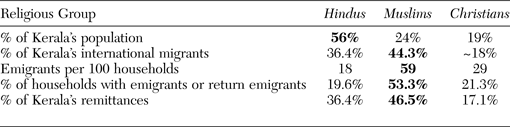
Yet Kerala is also a highly diverse state with fourteen districts and a population of 33.4 million (as of 2011). There is variation in the geographic and religious demographics of migration, as well as in the volume of remittances and uses of diasporic capital (see table 1). Muslims are more likely to migrate abroad than other religious groups; they account for 44.3 percent of migrants from Kerala, but only 26 percent of the population (Zachariah and Rajan Reference Zachariah and Rajan2013). Hindus represent 55 percent of Kerala's population; they comprise 36.4 percent of Kerala's international migrants and nearly two-thirds (64.6 percent) of the state's domestic migrants to other parts of India. The distribution of remittances received by households in different religious groups roughly mirrors their portion of Kerala's migrants (Zachariah and Rajan Reference Zachariah and Rajan2013).Footnote 21
Migration and remittances among religious groups in Kerala.
Source: Zachariah and Rajan (Reference Zachariah and Rajan2013).
Note: Boldface represents the largest number or percentage in a particular category.
An ethnographic study by Prema Ann Kurien in three “Gulf pockets” with different dominant religions offers a revealing glimpse into the variation in remittance-financed patterns of consumption, investment, and exchange (Kurien Reference Kurien1994, 765). In a northern Mappilas (Keralite Muslim) village called Veni,Footnote 22 male migrants usually work in the informal sector in the Gulf. While abroad, enclave communities of Mappilas participate in rotating credit and savings associations (chitty groups) and remit larger sums of laundered “tube money” to their kin. Veni now has a central market area with gold jewelry shops, video libraries, and department stores. By contrast, the southern village of Cherur is dominated by Ezhavas (lower-caste Keralite Hindu) whose male migrants are employed in the Gulf on formal contracts as plumbers, electricians, drivers, mechanics, and masons. Rather than local commercial development, remittances are used for lavish life-cycle ceremonies such as weddings and Hindu festivals, as well as school fees for English medium schools. The third village of Cherur in central Kerala is dominated by Syrian Christians (upper-caste Keralite Christian). Cherur's migrants are well-educated and employed as nurses, clerical workers, and engineers in the Gulf. Unlike the first two villages, which send only men abroad, migration from Cherur is more likely to include immediate family members. Remittances in Cherur are concentrated in higher education, bank deposits, and real estate.
These sketches demonstrate the enduring loyalty of those who have exited and returned, as well as the locally contingent uses of remittances. The cases also highlight the complexity of characterizing the impact of Kerala's diaspora on local state-society relations. The state of Kerala understands the centrality of remittances for its developmental model. Yet remittances have created marked inequalities between migrant and nonmigrant households. The Kerala Migration Survey of 2011 found that only 17.1 percent of households received remittances, meaning that over 80 percent of households in Kerala do not benefit directly from additional income for consumption, private health providers, private schools, higher-quality houses, savings, or land purchases. Based on its 2004–5 survey, the National Sample Survey Organization (NSSO) reports that Kerala has the highest levels of rural and urban inequality among the fifteen most populous Indian states (Bhagwati and Panagariya Reference Bhagwati and Panagariya2013, 69). But the fact that Kerala ranked first in the 2009–10 NSSO expenditure survey in terms of per capita expenditures is largely due to remittances—even if the expenditures are unevenly distributed (Times of India 2012).
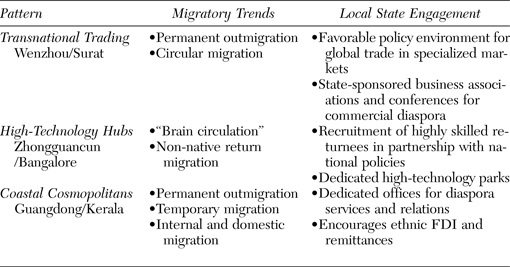
Table 2 summarizes the patterns of circulation and local state engagement in each of the three modes of cosmopolitan capitalism discussed above. The emphases of local state developmentalism reflect the financial and human resources presented by migratory trends. In transnational trading areas, the local state recognizes that the local economy is intimately tied with diasporic success in certain industries and nurtures local-transnational networking. State policy in the high-technology hubs focuses on attracting highly skilled cosmopolitan returnees through dedicated technology zones. In the coastal cosmopolitan pattern, the local state prioritizes attracting FDI and remittances from co-ethnics. Notwithstanding rich historical, demographic, and political differences among the individual cases, what they have in common is active state engagement with mobile populations.
Local state-society patterns in cosmopolitan capitalism.
Conclusion
Examining state-society relations at different levels of analysis expands the scope of interactions that may be relevant for developmental processes. Local states represent the central state administratively, but their policy preferences and practices may exhibit relative autonomy from the center, even in authoritarian regimes. By the same token, limiting the scope of society to populations immediately contained within the borders of the nation-state myopically excludes transnational members of society. In the study of state-society relations, the argument has been made across different disciplines for either focusing on the local state, or recognizing that social identity and action transcends territorial borders. Rarely both. Engaging in the dual definitional stretch of lowering the state and deterritorializing society reveals dynamics that are imprecisely captured by the Weberian definition of the state, and the accompanying assumption of domestic society.
A potential critique of this dual definitional stretch is that it runs the risk of concept stretching, which the “democracy with adjectives” literature straddles delicately (Collier and Levitsky Reference Collier and Levitsky1997). Building on Hirschman's classic exit-voice-loyalty framework is intended to avoid such ad hoc dilution of conceptual discipline. In analyzing the impact of international migration on subnational development, the local state provides both juridical and territorial boundaries; and society (as defined by identity with native place or the broader nation) retains three options even if they are not mutually exclusive. The parameters of local state and transnational society are still contained. It is the dynamics engendered by their relationship that generate ambiguity when viewed from a conventional state-society perspective. Despite their distinct histories, by research design, the cases presented above share features that provide empirical illustrations of these claims.
All six cases involve economic migration (exit). The Wenzhou-Surat migrants are archetypal cosmopolitan capitalists whose commercial beginnings originated in their localities, but now constitute a formidable transnational network of manufacturers, traders, and dealers in key industries. Their commercial success abroad has transformed not only the economic status of their families, but also that of their locality relative to others within the homeland. Some migrated due to dissatisfaction with local economic conditions. Others sought greater entrepreneurial opportunities. Regardless of their initial sense of loyalty, the collective impact of individual and networked decisions to move abroad has refracted a commercial reputation back to the locality. Voice can be articulated by example through transnational praxis and economic success. The local states of Wenzhou and Surat thus encourage and anticipate such expressions of economic loyalty.
Parallel dynamics can be seen in Guangdong and Kerala, though their much larger populations bring greater historical, ethnic, religious, socioeconomic, and occupational diversity into the analysis. The two areas alone could yield multiple pairs of research cases, particularly since they are also destinations for internal migrants. Yet it is precisely the reality of such domestic and diasporic diversity that guards the study from overgeneralizing from a single dyad, such as Wenzhou and Surat. Ethnic FDI and remittances have had mixed implications for Guangdong and Kerala. In both areas, they provided supplementary external sources of capital that enhanced the welfare of kin and contributed to local infrastructural development. These same funds financed higher-end consumerism and exacerbated local inequality. The aggregate effects of economic exit, voice, and loyalty are variegated. Nonetheless, the local states of Guangdong and Kerala tend to prioritize their relations with transnational economic society to ensure continuity of financial, if not physical, loyalty in the form of return migration.
The local state is similarly attentive to transnational links in supporting Asia's Silicon Valleys, Zhongguancun and Bangalore. As national high technology hubs, their density of higher education institutions, preferential policies, and brain circulation are defining features of their rapid rise to prominence in the ICT sector. Enhancing competitiveness in ICT is consistent with state priorities at both the central and local levels. But in the early years, state policies did not explicitly promote educational migration and local entrepreneurialism. It was only after the value of transnational diasporic linkages to local ICT development became apparent that the state made a more concerted effort to incentivize return migration.
China has been active in this respect. At the end of 2009, it launched the “Thousand Talents Plan,” which aims to attract 2,000 top-tier scientists, engineers, and professionals to China over five to ten years (State Administration of Foreign Experts Affairs, n.d.; Zweig and Wang Reference Zweig and Wang2013). Relatedly, the cadre evaluation system has recently shifted from attracting FDI to returnees. Besides Zhongguancun, other local governments have responded to the national Thousand Talents Plan by putting forth various programs to attract returnees.Footnote 23 In India, seven out of the twenty-eight states have assorted government offices that promote NRI affairs, including the NRI Division in Gujarat, NORKA in Kerala, and a Karnataka Diaspora Cell (Government of India, n.d.). Most of these offices are geared towards developing a database of NRIs and PIOs from particular localities and encouraging diasporic investment. NORKA in Kerala provides more extensive services, such as assisting in resolving nonpayment of salaries, addressing complaints against illegal overseas recruitment agencies, dealing with other state government departments, transporting the mortal remains of NRKs back to Kerala, and providing a social security network for NRKs. NORKA's charge is arguably more responsive to NRKs than most local governments are with their local citizens. Exit can coexist with voice and ongoing engagement with the local state. Loyalty may be reciprocated in local state-transnational society relations.
These observations do not discount the orthodox scope of state-society relations or the enduring appeal of Hirschman's EVL framework for explaining certain types of questions. Distinguishing between citizens contained within national borders and those residing abroad remains relevant. Exit can occur without domestic voice or loyalty. Exit can be permanent, whether voluntary or involuntary. Moreover, this article has not examined political instances of mutual or asymmetric hostility between the local state and its diaspora, which merits attention in its own right. The foregoing focus on “most similar,” generally positive, cases of local state-transnational society relations is only meant to remind us that theories of political economy may be incomplete when they reflexively exclude the local state and transnational society as potential developmental actors and resources. In the absence of local state agency, migratory circulation, and diasporic reinvestment, none of the six localities discussed would feature on the map of national leaders, social scientists, foreign investors, and journalists. The fact that they are known as cases of developmental success has everything to do with state-society relations, but not in the way conventionally understood. The recommended dual-definitional stretch captures empirical dynamics at alternative levels of analysis to provide a more complete account of local developmental processes.
Acknowledgments
Research for this article was supported by the Hong Kong Research Grants Council under General Research Fund grant #16401414. I thank Joel Andreas; Erin Chung; Prasenjit Duara; Mark Frazier; Mary Gallagher; Akhil Gupta; Victoria Hattam; Roger Haydon; Devesh Kapur; David Ludden; Elizabeth Perry; Benjamin Van Rooj; Sanjay Ruparelia; Mark Selden; Jack Snyder; Barbara Stallings; Danielle Stockman; Fubing Su; Eric Thun; David Zweig; two anonymous reviewers; and audiences at the New School for Social Research's India-China Institute, the National University of Singapore, Peking University, and the University of Michigan for comments on earlier versions of this paper. Pankaj Chandra, Ying Deng, Carine Foyan, Sasidaran Gopalan, Renqing Li, Wenzhi Lu, Xiaoxiao Shen, Xiaoyi Wang, and Kwan To Wong provided valuable assistance in the research process. They are of course absolved from its inadequacies.