1. Introduction
Sound symbolism typically refers to the iconic associations that exist between speech sounds and conceptual and/or perceptual properties of a referent. These kinds of iconic connections between speech sounds and meaning are increasingly accepted as a general element of language (Perniss et al., Reference Perniss, Thompson and Vigliocco2010; Perniss & Vigliocco, Reference Perniss and Vigliocco2014). Evolutionarily, these iconic connections might have claimed a place in language cognition by having a facilitatory role in language acquisition (Imai & Kita, Reference Imai and Kita2014; Monaghan et al., Reference Monaghan, Mattock and Walker2012). The non-arbitrary association between speech sounds and meaning can be based on iconicity (i.e., form-meaning resemblance) and systematicity (i.e., similar forms have similar meanings across words) (Dingemanse et al., Reference Dingemanse, Blasi, Lupyan, Christiansen and Monaghan2015). In the present article, we use the term ‘sound symbolism’ solely in relation to an iconic relationship between speech sounds and meaning.
Research has identified sound-meaning associations in relation to various perceptual and conceptual properties such as emotion (Adelman et al., Reference Adelman, Estes and Cossu2018; Körner & Rummer, Reference Körner and Rummer2022), motion speed (Cuskley, Reference Cuskley2013), color (Anikin & Johansson, Reference Anikin and Johansson2019; Johansson et al., Reference Johansson, Anikin and Aseyev2020), and size (Sapir, Reference Sapir1929; Winter & Perlman, Reference Winter and Perlman2021). Most relevantly for the present study, research has revealed sound-symbolic links between speech sounds and spatial relations. For example, in the sound-distance effect, the back and low vowels have been associated with distal meaning referring to deictic concepts that are remote from an observer, while the front-high vowels have been associated with proximal meaning referring to deictic concepts that are near to an observer (Johansson & Zlatev, Reference Johansson and Zlatev2013; Rabaglia et al., Reference Rabaglia, Maglio, Krehm, Seok and Trope2016; Tanz, Reference Tanz1971; Vainio, Reference Vainio2021). Furthermore, Vainio et al. (Reference Vainio, Tiainen, Tiippana, Komeilipoor and Vainio2015, Reference Vainio, Tiippana, Tiainen, Rantala and Vainio2018) demonstrated another type of sound-space symbolism in which the front vowels [i] and [ø] were associated with forward-directed hand movements, while the back vowels [ɑ] and [o] were associated with backward-directed hand movements. Later investigations have revealed that this effect can be also observed in relation to forward/backward-directed leg movements suggesting that the effect might be based on the connection between processing front/back vowels and processing concepts of forward/backward (Vainio et al., Reference Vainio, Tiainen, Tiippana and Vainio2019; Vainio & Vainio, Reference Vainio and Vainio2021). Indeed, recent research revealed that the corresponding effect can be observed when the front ([i]) and back ([o]) vowel is produced based on whether the visual stimulus presents a front or back concept (Vainio et al., Reference Vainio, Kilpeläinen, Wikström and Vainio2023), supporting the view that the effect originally observed in front- and back-directed limb movements reflects a general processing of front and back concepts. That is, the front concept is sound-symbolically associated with the vocalization of a front vowel, while the back concept is sound-symbolically associated with the vocalization of a back vowel. It was proposed that this sound-symbolic connection between the front/back vowel and the front/back concept might be based on associating semantic knowledge of front and back concepts to the articulatory front/back position of the tongue.
Regarding vertical space, Shintel et al. (Reference Shintel, Nusbaum and Okrent2006) asked their participants to vocalize the sentence “It is going up” or “It is going down” depending on whether the visual stimulus moved up or down. The mean f0 was found to be higher in relation to up vocalization in comparison to down vocalization. Similarly, Clark et al. (Reference Clark, Perlman and Johansson Falck2013) have shown that participants use a higher pitch when reading stories related to high vertical space in comparison to low vertical space. It is not known, however, whether concepts linked to vertical space can be sound-symbolically associated with particular vowels. Hence, the present study investigates whether the spatial concepts of up/down and/or above/below could be associated with producing high/low vowels. The concept of up/down refers to the movement of something that is directed toward a higher/lower position, while the concept of above/below refers to a spatial position of something relative to a reference object. Our hypothesis was that high vowels would be associated with the concepts of up and above, while low vowels would be associated with the concepts of down and below. We had two reasons – that are not necessarily mutually exclusive – to assume that this would be the case. Firstly, high vowels have a relatively higher fundamental frequency (intrinsic vowel pitch; IVP) than low vowels (Sapir, Reference Sapir1989; Whalen & Levitt, Reference Whalen and Levitt1995), and high/low tones are implicitly associated with high/low concepts (Pratt, Reference Pratt1930; Shintel et al., Reference Shintel, Nusbaum and Okrent2006; Spence, Reference Spence2019), perhaps because higher frequencies relatively frequently originate from elevated sources in the natural environment (Parise et al., Reference Parise, Knorre and Ernst2014). As a consequence, this perceived resemblance might associate high/low vowels with the high/low vertical space. The second reason emphasizes sensorimotor compatibility between the perceived up- and down-directed movement of the visual stimulus and the up and down-directed movement of the larynx, tongue, and jaw required for executing high and low vowels, respectively (Fant, Reference Fant1960; Honda et al., Reference Honda, Hirai, Masaki and Shimada1999; Ladefoged, Reference Ladefoged1968). This perspective is based on findings showing that some properties of the perceived stimulus – at least those that are potentially relevant for ongoing behavior – are automatically represented in action representations. As an example, the size of a viewed graspable object is automatically represented in grasp motor programs that correspond to the size (Franca et al., Reference Franca, Turella, Canto, Brunelli, Allione, Andreasi, Desantis, Marzoli and Fadiga2012; Tucker & Ellis, Reference Tucker and Ellis2001), and perceiving the lip- or tongue-related phonemes selectively activates the lip- and tongue-related motor areas, respectively (Pulvermüller et al., Reference Pulvermüller, Huss, Kherif, del Prado Martin, Hauk and Shtyrov2006). As such, one might assume that perception of up- and down-directed stimuli is automatically represented in motor programs including the motor representations that are involved in producing up- (e.g., [i]) and down-directed (e.g., [æ]) articulations resulting in an association between particular vowels and the concepts of up and down.
Various experimental tasks have been used to investigate sound symbolism. Perhaps the most common methods in sound symbolism research are 2-alternative forced choice tasks (e.g., Margiotoudi & Pulvermüller, Reference Margiotoudi and Pulvermüller2020; Nielsen & Rendall, Reference Nielsen and Rendall2012) and cross-linguistic methods (e.g., Blasi et al., Reference Blasi, Wichmann, Hammarström, Stadler and Christiansen2016; Tanz, Reference Tanz1971). The present study uses the speeded choice reaction time (CRT) task in order to explore whether a particular speech sound is associated with a particular spatial concept. In CRT tasks, the overlap between stimuli and response is known to speed up performance (Kornblum et al., Reference Kornblum, Hasbroucq and Osman1990). Most typically, this overlap occurs between spatial dimensions of visual stimuli and manual responses such as between the left–right location of the visual stimuli and the left–right hand as in the Simon effect (Simon, Reference Simon, Proctor and Reeve1990). However, our previous research has shown that the CRT task, which measures reaction times of vocal responses, can be also used to investigate various sound symbolism phenomena (Vainio et al., Reference Vainio, Rantala, Tiainen, Tiippana, Komeilipoor and Vainio2017). For example, in Vainio’s (Reference Vainio2021) study participants were presented with target objects whose inter-object distance was either shortened or lengthened compared to the inter-object distance in the reference stimuli, and they were required to vocalize either [i] or [u] according to shortening/lengthening of the distance. It was found that vocalization responses were performed particularly rapidly in the hypothetically congruent block (i.e., [i]-short, [u]-long) in comparison to the incongruent block. Similarly, in the present study, we investigate whether a potential overlap between the spatial dimension of the visual stimuli and the vocalization response can be observed in reduced reaction times of vocal responses. Hence, the participants are asked to respond to the stimuli in hypothetically congruent and incongruent conditions. In the congruent condition, they were asked to vocalize [i] for the upward-directed movement and [æ] for the downward-directed movement, and vice versa in the incongruent condition. We propose that if the concepts of up/above and down/below are sound-symbolically associated with high/low vowels, the responses should be produced particularly rapidly in congruent conditions in comparison to incongruent conditions.
In addition to measuring response times of vocalizations, we also measure the vocal characteristics of f0 (fundamental frequency), F1 (first formant), and F2 (second formant). It is known that the F1 of vocalization increases with the opening of the oral cavity (Fant, Reference Fant1960). Hence, low vowels have typically higher F1 values than high vowels. In addition, the F2 is known to increase when vocalizations are produced with the increased front position of the tongue. Consequently, front vowels have typically higher F2 values than back vowels. Finally, as mentioned above, the f0 is known to be increased with high in comparison to low vowels. Regarding these vocal characteristics, it could be hypothesized, for example, that if the perceived upward-directed movement is indeed associated with high vowels, the upward-directed stimuli could decrease the F1 values in comparison to the downward-directed stimuli. Furthermore, it is expected that similar to that reported by Shintel et al. (Reference Shintel, Nusbaum and Okrent2006), f0 values might be increased when vocalizations are produced to the upward-directed stimuli in comparison to the downward-directed stimuli.
The study consists of three experiments that investigate whether high vowel [i] would be associated with the concepts up and above and whether low vowel [æ] would be associated with the concepts down and below. The first experiment investigates whether the production of the unrounded high-front vowel [i] is associated with the upward-directed movement of the stimuli and whether the production of the unrounded low-front vowel [æ] is associated with the downward-directed movement of the stimuli. Basically, due to our selection criteria, we were not left with the possibility to use other vowels than [i] and [æ]. That is, we had three reasons for selecting these vowels. Firstly, they are suitable for our hypothesis requiring a high–low contrast between the response alternatives. Secondly, they are not included in the words up, down, above, or below in the languages that were mastered by the participants (see the Participants section below). Thirdly, they presented phonemes that were allowed by Finnish phonology and phonotacticsFootnote 1. The second experiment primarily provides a control study for the first experiment using different speech sounds to those used in the first experiment. Finally, the third experiment replicates the first experiment with the exception that instead of exploring sound symbolism in relation to the concepts of up and down, the experiment explores sound symbolism in relation to the concepts of above and below.
2. Experiments 1 and 2
Experiment 1 investigates whether the vowel [i] is produced faster when the target stimulus moves upward in comparison to downward and whether the vowel [æ] is produced faster when the target stimulus moves downward in comparison to upward. In addition, the experiment explores whether the vocal characteristics of f0, F1, and/or F2 could be modulated by the up–down direction of the stimulus. Based on the previous findings (Shintel et al., Reference Shintel, Nusbaum and Okrent2006), it was expected that at least f0 values could be modulated by up/down-directed stimuli so that f0 values would be increased when vocal responses are performed to up-directed stimuli.
Experiment 2 provides a control study for Experiment 1. It should be noticed that the letter i is a much more commonly used letter in the Finnish language than the letter ä (i.e., the phoneme [æ]) (Pääkkönen, Reference Pääkkönen1991). Therefore, based on the linguistic markedness account (Zimmer, Reference Zimmer1964), it can be assumed that, due to being more frequent, the [i] is a non-marked item, while the [æ] is a marked item. Similarly, it has been proposed that the spatial dimension of up is non-marked, while down is marked because the word up is more frequent than down (Winter et al., Reference Winter, Matlock, Shaki and Fischer2015). As such, it is possible that the congruency effect observed in Experiment 1 presents a version of the so-called MARC (Markedness Association of Response Codes) effect (Lakens, Reference Lakens2012; Willmes & Iversen, Reference Willmes and Iversen1995) in which the congruency between the non-markedness/markedness of the response ([i]/[æ]) and the non-markedness/markedness of the stimulus (up/down) causes the observed congruency effect. If this were the case, we should observe that, in addition to [i], the speech sound [v] should be associated with faster responses when the stimulus moves upward, and, in addition to [æ], the speech sound [f] should be associated with faster responses when the stimulus moves downward. That is, because, due to being more frequent, [v] is a non-marked item, while [f] is a marked item (Pääkkönen, Reference Pääkkönen1991). Hence, Experiment 2 replicates Experiment 1 with the exception that the responses [i] and [æ] will be replaced by the responses [fe] and [ve]. The reason why we used the consonant–vowel structure in responses rather than asking participants to solely pronounce the consonants was that it is very difficult to pronounce [v] in the absence of any surrounding vowel.
2.1. Methods
2.1.1. Participants
Twenty-four volunteers naïve to the purposes of the experiment participated in Experiment 1 (19–40 years of age; mean age = 27 years; 5 males; 1 left-handed), and twenty-five volunteers naïve to the purposes of the experiment participated in Experiment 2 (19–44 years of age; mean age = 27.3 years; 1 male; 2 left-handed). All participants were native speakers of Finnish and reported normal hearing and normal or corrected-to-normal vision. In both Experiments, all participants mastered Finnish, English, and Swedish. In Experiment 1, one participant mastered Spanish, one mastered Estonian, and one mastered German. In Experiment 2, one participant mastered Estonian. The participants did not master any other languages. Power was estimated based on simulations (Brysbaert & Stevens, Reference Brysbaert and Stevens2018). The simulations were based on an earlier dataset from an experiment with a very similar design (Vainio et al., Reference Vainio, Kilpeläinen, Wikström and Vainio2023). In the simulations, a mixed linear model with log-transformed reaction time data was fitted. The participants had a random effect on the intercept and the slope of congruency. The simulations suggest, firstly, that with the effect size (dz = 0.42) observed by Vainio et al. (Reference Vainio, Kilpeläinen, Wikström and Vainio2023), 22 observers would have sufficed to produce a statistically significant difference in 85% of experiments. The simulations were run with R package simr (Green & MacLeod, Reference Green and MacLeod2016). All of the participants reported being unaware of the purpose of the study and the nature of the investigated effect. Written informed consent was obtained from all participants. The study was approved by the Ethical Review Board in the Humanities and Social and Behavioral Sciences at the University of Helsinki.
2.1.2. Stimuli, procedure, and apparatus
Each participant sat in a dimly lit room with his or her head 75 cm in front of a 19″ CRT monitor (screen refresh rate: 85 Hz; screen resolution: 1280 × 1024). A head-mounted microphone was adjusted close to the participant’s mouth. At the beginning of each trial, a blank white screen was presented for 2,700 ms. Then the reference stimulus (Fig. 1: frame-b) was presented for 1,000 ms. The size of the stimulus was 7.6° (horizontally) x 5° (vertically). After that, the target stimulus, which was the same bird as in the reference stimulus (Fig. 1: frame-c), was presented for 1,000 ms. In the target stimulus, the bird was presented either higher or lower (1.9°) than the reference stimulus. This design is illustrated in Fig. 1. In Experiment 1, participants were required to pronounce a single vowel ([i] or [æ]) according to the up/down location of the target. The vowels [i] and [æ] were selected for the study firstly because [i] as a high vowel and [æ] as a low vowel make them suitable for exploring whether spatial compatibility between response (high vowel versus low vowel) and stimulus (high location versus low location) results in a congruency effect, and secondly, because these sounds are not dominant in the words up/down in the languages that were mastered by the participants (i.e., Finnish: /yløs/−/ˈɑlɑs/; Swedish: /ɵp/−/neːd/; Spanish: /aˈriβa/−/abaˈxo/; Estonian: /ˈyles/−/ˈɑlːɑ/; German: /hɛˈraʊ̯f/−/hɛˈrʊntɐ/). In Experiment 2, participants were required to pronounce a single syllable ([fe] or [ve]) according to the up/down location of the target.
An illustration of the design used in Experiments 1 and 2.

Experiments 1 and 2 were divided into two blocks that were separated by a 10-minute break. Each block lasted for approximately 10 minutes. In one block (i.e., the congruent block), the participants were required to vocalize [i] (or [fe] in Experiment 2) if the target bird moved upward and [æ] (or [ve] in Experiment 2) if it moved downward. In the other block (i.e., the incongruent block), the participants were required to vocalize [æ] (or [ve] in Experiment 2) if the bird moved upward and [i] (or [fe] in Experiment 2) if it moved downward. The beginning of each block included a practice session that presented 20 repetitions including the same number of hypothetically congruent and incongruent stimulus–response conditions.
Half of the participants performed first the [i]-up (or [fe]-up in Experiment 2) block. Both blocks consisted of 15 stimulus conditions in which the face of the bird was pointing to the left and it moved upward, 15 stimulus conditions in which the face of the bird was pointing to the left and it moved downward, 15 stimulus conditions in which the face of the bird was pointing to the right and it moved upward, and 15 stimulus conditions in which the face of the bird was pointing to the right and it moved downward. All stimuli were presented in randomized order and on a white background. In total, both experiments consisted of 120 trials [30 repetitions × 2 (block) × 2 (direction)].
The participants were instructed to pronounce the vowel/syllable as quickly as possible after the onset of the target stimulus. It was emphasized that the vowel should be uttered as a short (e.g., [i]) rather than a long (e.g., [i:]) vowel in a natural talking voice. During the practice session, the experimenter verified that the vocalizations met these criteria. After Experiment 1, the participants were asked whether the task was easier to perform in the [i]-upward/[æ]-downward or in the [i]-downward/[æ]-upward block. After Experiment 2, the participants were asked whether the task was easier to perform in the [fe]-up/[ve]-down or in the [fe]-down/[ve]-up block. In addition, in both experiments, they were asked whether they noticed that they would have mirrored the up/down movement of the bird by raising or lowering their vocalization pitch.
Sound recording and stimulus presentation were carried out with Presentation® software (Version 16.1, www.neurobs.com). The vocal responses were recorded for 2,000 ms starting from the onset of the target object. At the beginning of the experiment, the recording levels were calibrated for each participant using the voice calibration function of Presentation® software so that the recording levels would match the natural intensity of the participant’s voice.
2.1.3. Statistical analyses
For analysis purposes, the onsets of the vocalizations were located for each trial as the first observable peak in the acoustic signal. Similarly, the offsets of the vocalization were located individually for each trial as the observable ending of the acoustic signal. For this task, onsets and offsets were initially located by a highly experienced person who was blind to the condition of each acoustic signal. The spectral components (F 1 and F 2), as well as f 0, were calculated as median values of the middle third of the voiced section of the vowel. The procedure of locating the onsets and offsets of vocalizations, as well as calculating the acoustic parameters, was carried out in the same way as in our previous studies that similarly investigate reaction times of vocalizations (e.g., Vainio, Reference Vainio2021; Vainio et al., Reference Vainio, Rantala, Tiainen, Tiippana, Komeilipoor and Vainio2017).
The following parameters were analyzed from the raw data: reaction times, f0, F1, and F2. On a few occasions, the formant value was not found by Praat (Version 6.2.15; Boersma, Reference Boersma2001) or the output value clearly exceeded variations that can normally be observed within the voice characteristics of the given vowels (e.g., octave jump errors) (Experiment 1: f0: 1.5%; F1: 5.8%; F2: 4.2%; Experiment 2: f0: 1.7%; F1: 0.7%; F2: 0.5%). The particularly large number of missing values of F1 and F2 are due to breathy voice quality as some participants produced vocalizations rather quietly. Such values, as well as values that were more or less than two standard deviations from a participant’s median (Experiment 1: f0: 0.4%; F1: 1.7%; F2: 0.9%; Experiment 2: f0: 1.1%; F1: 0.2%; F2: 0.2%), were discarded prior to analyzing the acoustic characteristics of the vocalizations. However, prior to analyzing any of these parameters, the errors (i.e., the participant uttered the wrong speech unit or did not produce any response) were removed from the data (Experiment 1: 0.6%; Experiment 2: 1.6%). In the analysis of reaction times, reaction times faster than 250 ms (Experiment 1: 0.3%; Experiment 2: 0.4%) and slower than 1,000 ms (Experiment 1: 0.07%; Experiment 2: 1.1%) were excluded from the analysis because it has been shown that responding to a visually presented target takes a minimum of 200–300 ms (Welford, Reference Welford1980). In Experiment 2, the data of one participant was removed from the analyses because 15% of her responses were either missing (12%) or incorrect (3%) (see Bennett, Reference Bennett2001). In addition, for analyzing fundamental frequencies, the raw f0 values were converted to semitone (st) movements relative to each participant’s mean f0. Semitone conversion was conducted to account for the logarithmic nature of the perceiving pitch and pitch movements and to eliminate the bimodal distribution of fundamental frequencies caused by the fact that male speakers have fundamentally lower f0 values than female speakers.
The output of the normality test indicated that the data were not normally distributed in Experiments 1 and 2. Consequently, the statistical significance of observed differences was tested using the generalized linear mixed model analysis (GLMM) with gamma distribution assumption (log link function). The GLMM analysis treated Location (1 = up; 2 = down) and Response [1 = [i] (or [fe] in Experiment 2); 2 = [æ] (or [ve] in Experiment 2)] as fixed within factors. The subject was allowed to have a random effect on the intercept and the slope of Location and Response. All pairwise comparisons were carried out using Bonferroni correction for multiple comparisons. The analysis was carried out using the SPSS statistics software package (version 28). For effect sizes, standardized effect sizes (Cohen’s dz; see Lakens, Reference Lakens2013) were calculated. General guidelines for d are small (>0.2), medium (>0.5), and large (>0.8).
2.2. Results
In Experiment 1, the analysis of reaction times revealed a significant interaction between Location and Response [F(1,2849) = 91.45, p < .001]. The pairwise comparisons test showed that [i] responses were performed faster when the target was presented in the up location (M = 432 ms) rather than the down location (M = 454 ms) (p < .001, dz = 0.25), while [æ] responses were performed faster when the target was presented in the down location (M = 434 ms) rather than the up location (M = 464 ms) (p < .001, dz = 0.33). These observations are presented in Fig. 2. In Experiment 2, the analysis of reaction times showed that the interaction [F(1,2801) = 2.66, p = .103] was not significant. None of the main effects were significant. These observations are presented in Fig. 3.
The mean vocal reaction times for Experiment 1 as a function of the response (vowel) and the up/down location of the target stimulus. Error bars depict the standard error of the mean. Asterisks indicate statistically significant differences (***p < .001).

The mean vocal reaction times for Experiment 2 as a function of the response (syllable) and the up/down location of the target stimulus. Error bars depict the standard error of the mean.

2.2.1. Cross-experiment analysis
We analyzed whether the congruency effect observed particularly in reaction times of Experiment 1 differs significantly between Experiments 1 and 2 by extracting Location and Response data into one Congruency variable in which congruent responses referred to conditions in which Target location was up and Response was [i]/[fe] and Location was down, and Response was [æ]/[ve]. Opposite Location-Response mapping was applied for incongruent responses. A significant interaction between Congruency and Experiment [F(1,5654) = 25.15, p < .001] was observed in this analysis. This shows that the congruency effect between Location and Response significantly differs between Experiments 1 and 2. The congruency effect is highly significant in Experiment 1 (p < .001), while in Experiment 2 the effect is missing (p = .125).
In Experiment 1, the analysis of f0 values revealed significant main effects of Location [F(1,1392) = 11.96, p < .001] ([up]: M = 0.67 st, [down]: M = 0.51 st, dz = 0.43) and Response [F(1,1392) = 22.80, p < .001] ([i]: M = 0.72 st, [æ]: M = 0.48 Hz, dz = 0.39) as well as the interaction between these two factors [F(1,1392) = 10.64, p < .001]. The pairwise comparisons test showed that for [i] responses the st values were significantly higher in the up location (M = 0.86 st) than in the down location (M = 0.58 st) (p < .001; dz = 0.66). However, this effect was not significant for [æ] responses (p = .383). Regarding the analysis of F1 values, the main effect of Response was significant [F(1,2644) = 98.13, p < .001], showing that [æ] responses were higher (M = 592 Hz) than [i] responses (M = 313 Hz) (dz = 0.98). Regarding F2 values, the [i] responses were significantly [F(1,2711) = 782.20, p < .001] higher (M = 2855 Hz) than [æ] responses (M = 1490 Hz) (dz = 4.2).
In Experiment 2, the analysis of f0 values showed significant main effects of Location [F(1,1317) = 5.79, p = .016] ([up]: M = 0.66 st, [down]: M = 0.54 st, dz = 0.31) and Response [F(1,1317) = 4.45, p = .035] ([fe]: M = 0.66 st, [ve]: M = 0.55 st, dz = 0.27). The interaction was not significant [F(1,1317) = 3.80, p = .052]. Regarding the analysis of F1 values, the main effect of Response [F(1,2816) = 28.79, p < .001] ([fe]: M = 530 Hz; [ve]: M = 500 Hz, dz = 0.24) was significant. The analysis of F2 values revealed a significant main effect of Response [F(1,2824) = 6.73, p = .010] ([fe]: M = 2199 Hz; [ve]: M = 2173 Hz, dz = 0.11). However, notice that the effect size is very small.
Finally, in Experiment 1, 15 participants (62.5%) judged that the task was easier to perform in the [i]-upward/[æ]-downward block, and 5 participants (20.8%) judged that the task was easier to perform in the [i]-downward/[æ]-upward block. The rest of the participants did not report any difference between the blocks. Two participants mentioned that they might have involuntarily raised/lowered their vocalization pitch according to the up/down movement of the bird. In Experiment 2, 10 participants (41.6%) judged that the task was easier to perform in the [fe]-upward/[ve]-downward block, and 5 participants (20.8%) judged that the task was easier to perform in the [fe]-downward/[ve]-upward block. The rest of the participants did not report any difference between the blocks. Four participants mentioned that they might have involuntarily raised/lowered their vocalization pitch according to the up/down movement of the bird.
2.3. Discussion
The results of Experiment 1 revealed the stimulus–response compatibility effect between the up/down location of the target stimulus and the high/low response. The high vowel [i] was produced particularly rapidly when the target was presented at the up location, while the low vowel [æ] was produced particularly rapidly when the target was presented at the down location. Considering the analysis of the F1 or F2, the results did not reveal any other effects than the expected difference in F1 and F2 values between the two responses. That is, F1 is larger for [æ] than [i], and F2 is larger for [i] than [æ]. However, the analysis of the f0 values showed, firstly, that the f0 is significantly higher for the [i] responses than for the [æ] responses replicating the IVP phenomenon. In addition, f0 was significantly higher when the target was presented at the up location in comparison to the down location. This was particularly the case in relation to [i] and [e] (i.e., [fe] and [ve]) responses. This effect was not observed for [æ] responses in Experiment 1. This finding is somewhat in line with the previous observations (e.g., Shintel et al., Reference Shintel, Nusbaum and Okrent2006) presenting that people show an implicit tendency to produce higher-pitched vocalizations when the vocalizations are produced to up-directed stimuli in comparison to down-directed stimuli. However, the fact that the effect was not observed in relation to [æ] suggests vowel articulation processes can modify this effect so that the effect is diminished with those vowel articulations whose IVP is naturally relatively low.
The results of Experiment 2 did not replicate the congruency effect that was observed in Experiment 1. The [fe] or [ve] responses were not associated with facilitated responses when the target was presented at the up or down location. The analysis showed that the congruency effect significantly differs between Experiment 1 and Experiment 2; in Experiment 2 the effect was missing. This finding supports the view that the congruency effect observed in the response times of Experiment 1 is not likely to be based on the markedness mapping processes. Consequently, the account according to which the congruency effect observed in Experiment 1 reflects sound-symbolic associations between speech sounds of [i]/[æ] and spatial concepts of up/down remains a plausible explanation of the effect.
3. Experiment 3
Experiment 3 investigates whether the congruency effect observed in the response times of Experiment 1 can be replicated when the concept of up/down is replaced by the concept of above/below. For this purpose, the vowels [i] and [æ] are pronounced according to the spatial relationship between the target (a bird) and the reference (a cloud). Hence, instead of responding to the up/down-directed movement of the target bird as in Experiment 1, in this experiment, the participants are asked to pronounce [i]/[æ] if the bird is above/below the cloud.
3.1. Methods
3.1.1. Participants
Twenty-three volunteers naïve to the purposes of the experiment participated in Experiment 3 (20–38 years of age; mean age = 25.8 years; 4 male; 4 left-handed). All participants were native speakers of Finnish and reported normal hearing and normal or corrected-to-normal vision. All participants mastered Finnish, English, and Swedish, and one participant mastered German. All of the participants reported being unaware of the purpose of the study and the nature of the investigated effect. Written informed consent was obtained from all participants. The study was approved by the Ethical Review Board in the Humanities and Social and Behavioral Sciences at the University of Helsinki.
3.1.2. Stimuli, procedure, and apparatus
The apparatus, environmental conditions, and calibration were the same as those in Experiments 1 and 2. The procedure and design were also similar to that of Experiment 1 with the exception that instead of presenting participants with a bird that moved up or down, the stimuli consisted of a bird (6.1° horizontally, 3.4° vertically) that was located above or below a cloud (10.7° horizontally, 3.8° vertically). The distance between the bird and the cloud was 0.8°. At the beginning of each trial, a blank white screen was presented for 2,500 ms. Then the target object was presented for 1,400 ms. The participants were required to vocalize the vowel [i] or [æ] depending on whether the bird was located above or under the cloud. The face of the bird was pointing to the right in each stimulus. There were two ‘above’ conditions: the cloud was located at the center of the display (above-high), or the bird was located at the center of the display (above-low). In addition, there were two ‘below’ conditions: the bird was located at the center of the display (below-high), or the cloud was located at the center of the display (below-low). The vowels [i] and [æ] were suitable for exploring whether spatial compatibility between response (high vowel versus low vowel) and stimulus (above versus below) results in a congruency effect because these sounds are not included in the words above/below in the languages that were mastered by the participants (respectively; Finnish: /ˈylæˌpuo̯lelːɑ/−/ˈɑlɑˌpuo̯lelːɑ/; Swedish: /ˈøːvɛr/−/ˈɵndɛr/; German: /ˈyːbɐ/−/ˈʊntɐ/). As can be noticed, the vowel [æ] occurs in the word above in Finnish (/ˈylæˌpuo̯lelːɑ/). However, as it was hypothesized that this vowel should be associated with the concept of below rather than above, we concluded that this overlap did not cause any theoretical problem. That is, the overlap between the vowel [æ] and the word /ˈylæˌpuo̯lelːɑ/ should result in a negative congruency effect instead of a positive congruency effect, which works against the hypothesis, making the potential interaction effect even more convincing.
Half of the participants performed first the [i]-above block. Both blocks consisted of 15 stimulus conditions in which the bird was above the cloud and the cloud was located at the center of the display (1: higher above condition), 15 stimulus conditions in which the bird was above the cloud and the bird was located at the center of the display (2: lower above condition), 15 stimulus conditions in which the bird was below the cloud and the bird was located at the center of the display (3: higher below condition), and 15 stimulus conditions in which the bird was below the cloud and the cloud was located at the center of the display (4: lower below condition) (see Fig. 4 for these stimulus conditions).
The stimuli used in Experiment 3.

The voice calibration, sound recording, stimulus presentation, Praat analysis, and semitone conversion were carried out similarly to that in Experiments 1 and 2. After Experiment 3, the participants were asked whether the task was easier to perform in the [i]-above/[æ]-below or in the [i]-below/[æ]-above block. In addition, they were asked whether they noticed that they would have mirrored the above/below location of the bird by raising or lowering their vocalization pitch. The beginning of each block included a practice session that presented 20 repetitions including the same number of hypothetically congruent and incongruent stimulus–response conditions. In total, Experiment 3 consisted of 120 trials [15 repetitions × 2 (block) × 2 (above/below position) × 2 (bird located at the center/cloud located at the center)].
3.1.3. Statistical analyses
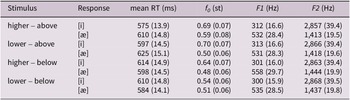
The following parameters were analyzed from the raw data: reaction times, f0, F1, and F2 (Table 1). Regarding the voice characteristics, the same criteria were employed for removing outliers (f0: 0.9%; F1: 5.5%; F2: 2.4%) as in Experiments 1 and 2. Prior to analyzing any of these parameters, the errors (i.e., the participant uttered the wrong speech unit or did not produce any response) were removed from the data (0.5%). In the analysis of reaction times, reaction times faster than 250 ms (0.0%) and slower than 1,000 ms (1.8%) were excluded from the analysis before carrying out the reaction time analysis.
The means and SEs of reaction times, f0s, F1s, and F2s of Experiment 3 in all possible Stimulus and Response combinations

The statistical significance of observed differences was tested using GLMM with gamma distribution assumption (log link function). The GLMM analysis treated Location (1 = above; 2 = below), Height [1 = higher above/below conditions (images 1 and 3 in Fig. 4); 2 = lower above/below conditions (images 2 and 4 in Fig. 4)], and Response (1 = [i]; 2 = [æ]) as fixed within factors. The subject was allowed to have a random effect on the intercept and the slope of Location, Height, and Response. All pairwise comparisons were carried out using Bonferroni correction for multiple comparisons. The analysis was carried out using the SPSS statistics software package (version 28).
3.2. Results
In the analysis of reaction times, we observed significant interactions between Location and Response [F(1,2689) = 59.55, p < .001] as well as Location and Height [F(1,2689) = 16.61, p < .001]. None of the main effects were significant. In addition, the two-way interaction between Height and Response [F(1,2689) = 1.69, p = .193] as well as the three-way interaction between Location, Height, and Response [F(1,2689) = 0.09, p = .771] were not significant. According to the pairwise comparisons test, the [i] responses were performed faster when Location was above (M = 586 ms) rather than below (M = 612 ms) (p < .001, dz = 0.29), while the [æ] responses were performed faster when Location was below (M = 591 ms) rather than above (M = 617 ms) (p < .001, dz = 0.29). These observations are presented in Fig. 5. Furthermore, the above condition was associated with faster responses in the higher condition (M = 592 ms) rather than the lower condition (M = 611 ms) (p < .001, dz = 0.19), while the below condition was associated with somewhat faster responses in the lower condition (M = 597 ms) rather than the higher condition (M = 606 ms), although this effect was not significant (p = .065, dz = 0.10).
The mean vocal reaction times for Experiment 3 as a function of the response (vowel) and the above/below position of the target stimulus. Error bars depict the standard error of the mean. Asterisks indicate statistically significant differences (***p < .001).

Considering the analysis of f0 values, a main effect of Response [F(1,1313) = 9.97, p = .002] ([i]: M = 0.64 st, [æ]: M = 0.52 st, dz = 0.34) was observed. The pairwise comparisons test for a significant three-way interaction [F(1,1313) = 4.65, p = .031] revealed that f0 values were significantly higher for [i] responses in the condition of lower height (Height 2) when Location was above (M = 0.69 st) rather than below (M = 0.52 st) (p = .012; dz = 0.37). This suggests that the f0 values of [i] responses are heightened when the response is performed to the above condition rather than the below condition, but this effect is not robustly observed in both Height conditions. Regarding F1, the main effect of Response [F(1,2588) = 58.03, p < .001] showed that [æ] responses were higher (M = 529 Hz) than [i] responses (M = 303 Hz) (dz = 1.14). In addition, the interaction between Location and Response was significant [F(1,2588) = 28.55, p < .001]. F1 was higher for [i] responses (notice that the effect size is very small) when the location was above (M = 308 Hz) rather than below (M = 297) (p = .012; dz = 0.08), while the effect was not significant for [æ] responses (p = .132). Regarding F2, the main effect of Response [F(1,2674) = 1398.64, p < .001] showed that [i] responses were higher (M = 2861 Hz) than [æ] responses (M = 1427 Hz) (dz = 5.7). In addition, the interaction between Location and Response was significant [F(1,2674) = 10.32, p < .001]. F2 values were higher for [æ] responses (notice that the effect size is very small) when the location was below (M = 2863 Hz) rather than above (M = 2858 Hz) (p < .001; dz = 0.02), while the effect was not significant for [i] responses (p = .677).
Finally, 11 participants (47.8%) judged that the task was easier to perform in the [i]-above/[æ]-below block, and 5 participants (21.7%) judged that the task was easier to perform in the [i]-below/[æ]-above block. The rest of the participants did not report any difference between the blocks. Furthermore, two participants mentioned that they might have involuntarily raised/lowered their vocalization pitch according to the above/below location of the bird.
3.3. Discussion
The results of Experiment 3 replicated the congruency effect observed in the response times of Experiment 1. The [i] responses were produced faster when they were performed to the above position of the target, while the [æ] responses were produced faster when they were performed to the below position of the target. However, the effect observed in Experiments 1 and 2 in which the f0 values were heightened when the target appeared at the upper location in comparison to the lower location was not robustly observed in Experiment 3, albeit there was a hint of this effect. The f0 values of [i] responses were heightened when the responses were performed to the above condition rather than the below condition, but this effect was only observed in the lower height condition.
4. General discussion
The study investigated whether the spatial concepts of up/above and down/below would be sound-symbolically associated with a high and low vowel, respectively. In line with our hypothesis, the study revealed that the production of the high-front vowel [i] is associated with the concepts of up and above, while the production of the low-front vowel [æ] is associated with the concepts of down and below. This effect was observed in speeded-up vocal responses when the responses were performed in congruent ([i]-up; [æ]-down) rather than incongruent conditions. In order to contrast this finding with previous observations, research has shown that spatial concepts of distance (Johansson & Zlatev, Reference Johansson and Zlatev2013; Rabaglia et al., Reference Rabaglia, Maglio, Krehm, Seok and Trope2016; Tanz, Reference Tanz1971; Vainio, Reference Vainio2021), size (Knoeferle et al., Reference Knoeferle, Li, Maggioni and Spence2017; Sapir, Reference Sapir1929; Thompson & Estes, Reference Thompson and Estes2011), and front/back (Vainio et al., Reference Vainio, Kilpeläinen, Wikström and Vainio2023) are similarly sound-symbolically associated with particular speech sounds. Hence, the present finding expands our understanding of spatial sound symbolism suggesting that up and down concepts of vertical space can be also sound-symbolically associated with particular vowels. Furthermore, the study shows that this phenomenon is not tight to concepts of vertical movement, but the non-movement-related concepts above and below are similarly associated with the high and low vowels, respectively. This proposes that this congruency effect is based on relatively robust and generalizable processes of semantic representation.
Experiment 2 tested whether the same congruency effect, which was observed between particular vowels and spatial concepts in Experiment 1, would be replicated with other speech sounds that also have the potential to provide the MARC effect. In Experiment 2, the marked ([æ]) and non-marked ([i]) vowels were replaced by the marked ([f]) and non-marked ([v]) consonants, while other aspects of Experiment 2 remained identical to that of Experiment 1. The congruency effect was not replicated in Experiment 2. The results of Experiment 2 supported the assumption that rather than being based on the MARC effect, the vowel-height congruency effect reflects sound-symbolic connections between the production of a particular vowel and the processing of these spatial concepts.
The theoretically relevant question is why the production of the high and low vowels is associated with spatial concepts up/above and down/below, respectively. Although the findings of this study cannot state anything conclusive about the mechanisms behind the height-vowel congruency effect observed in reaction times of the present study, we would like to discuss two possible explanations that might shed light on these mechanisms. It is important to emphasize that both of these explanations can provide the mechanistic basis for the effect, as it has been recognized that two or more mechanisms can provide a basis for a single sound symbolism phenomenon (Sidhu & Pexman, Reference Sidhu and Pexman2018). The first explanation emphasizes how the associative network of semantic memory represents sensory properties that naturally occur in the environment and also in relation to our own behavior. According to this sensory account, these spatial sound symbolism phenomena are a consequence of an implicit tendency to imitate environmental sounds by producing corresponding speech sounds. This account has been provided to explain spatial sound symbolism phenomena such as size, so that speech sounds with relatively high f0 (e.g., [i]) are associated with small size because smaller animals tend to produce sounds with higher f0 than larger animals (e.g., Knoeferle et al., Reference Knoeferle, Li, Maggioni and Spence2017; Ohala, Reference Ohala1994). This perspective can be also adapted to explain the sound symbolism effect observed in the present study in relation to vertical space. As already presented in the Introduction, given that people have a tendency to link high/low tones with high/low vertical space (Pisanski et al., Reference Pisanski, Isenstein, Montano, O’Connor and Feinberg2017; Pratt, Reference Pratt1930; Shintel et al., Reference Shintel, Nusbaum and Okrent2006; Spence, Reference Spence2019), and high/low vowels have a relatively higher/lower IVP (Sapir, Reference Sapir1989; Whalen & Levitt, Reference Whalen and Levitt1995), it is possible that this resemblance results in an implicit tendency to associate high/low vowels with high/low vertical space.
A second reason to assume that high/low vowels would be associated with the concepts of high/low is linked to the hypothesis that action representations play a key role in representing the meaning of many concepts in general and abstract concepts in particular (Binder & Desai, Reference Binder and Desai2011; Dreyer & Pulvermüller, Reference Dreyer and Pulvermüller2018; Pulvermüller, Reference Pulvermüller2018). This action account emphasizes a tendency to implicitly imitate environmental properties by producing body movements (e.g., articulatory gestures) that mirror these properties (see Vainio, Reference Vainio2021 for a review). If we apply this perspective to explain spatial sound symbolism phenomena related to size, it can be stated that the low-back vowels implicitly mirror the largeness of the referent’s size by increasing the oral cavity and the high-front vowels mirror the smallness of the referent by decreasing the oral cavity (Ramachandran & Hubbard, Reference Ramachandran and Hubbard2001; Sapir, Reference Sapir1929; Vainio, Reference Vainio2021). Regarding the present finding, this hypothesis assumes that representing the meaning of spatial concepts such as up and down is partially grounded in action representations that move body parts upward/downward. Given that high/low vowels are produced by moving the larynx, tongue, and jaw upward/downward (Fant, Reference Fant1960; Honda et al., Reference Honda, Hirai, Masaki and Shimada1999; Ladefoged, Reference Ladefoged1968), it is possible that semantic knowledge of these spatial concepts is implicitly connected to the articulatory movements of high and low vowels resulting in the sound-symbolic association between high/low vowels and high/low concepts.
As already mentioned, it has been previously observed that people tend to produce slightly higher-pitched speech when vocalizing the sentence “It is going up” when the visual stimulus moves up and lower-pitched speech when vocalizing the sentence “It is going down” when the visual stimulus moves down (Shintel et al., Reference Shintel, Nusbaum and Okrent2006). In the present study, this phenomenon was observed when the participants were required to produce a vowel [i] or [æ] (Experiment 1) and a syllable [fe] or [ve] (Experiment 2) depending on whether the visual stimulus moved upward or downward. The rising pitch was observed with the vowel [i] and syllables [fe] and [ve] when the stimulus moved upward in comparison to downward. However, a similar effect was not observed in relation to the vowel [æ] suggesting that vowel articulation processes might have a role in this effect. The effect might be diminished with those vowel articulations that require down-directed movement of the larynx, tongue, and jaw from a speech-ready position (such as [æ]) that was adapted to the position optimally ready to produce both of the speech sounds in the experiment (cf. Simko & Cummins, Reference Simko and Cummins2010). If this interpretation of the results is correct, one might state that this vocal pitch-elevation effect is, at least to some extent, caused by the elevated movement of the vocal apparatuses that mirrors the elevated movement of the visual stimulus and which results in pitch raise of vocalization. Furthermore, Experiment 3 revealed that when these [i]/[æ] responses were performed according to the spatial concepts above and below there was only a hint of this effect. This might suggest that perhaps this effect is emphasized when speech is referring to absolute verticality (e.g., a bird moves up) rather than relative verticality (e.g., a bird is above a cloud). Finally, given that the participants mostly did not report being aware that they produced higher-pitched vocalizations when the stimulus moved upward suggests that this vocal pitch-elevation effect operates implicitly.
Nevertheless, similarly to the height-vowel congruency effect observed in the reaction times of the present study, the vocal pitch-elevation effect can be also explained by two possible mechanisms: the sensory account and the action account. The sensory account highlights a tendency to imitate environmental sounds by producing corresponding speech sounds resulting in uttering higher-pitched sounds in relation to the up-directed stimulus. This occurs perhaps because higher frequencies originate more frequently from elevated sources in the natural environment (Parise et al., Reference Parise, Knorre and Ernst2014). The action account assumes that higher-pitched vocalizations are associated with higher vertical space, not solely because people tend to imitate environmental sounds by producing corresponding speech sounds per se, but rather because the relative raising or lowering of vocalization pitch is a consequence of vertically moving head, larynx, tongue, and jaw. Indeed, it has been shown that head elevation correlates with f0 rise and head lowering with f0 fall (Cwiek & Fuchs, Reference Cwiek and Fuchs2019; Liu et al., Reference Liu, Shamei, Chow, Soo, Pineda Mora, de Boer and Gick2020; Munhall et al., Reference Munhall, Jones, Callan, Kuratate and Vatikiotis-Bateson2004) perhaps because head elevation changes the position of the larynx, which in turn pulls on the cricothyroid muscle leading to f0 rise (Honda et al., Reference Honda, Hirai, Masaki and Shimada1999). Correspondingly, the intentional production of a high-pitched voice might involve lifting the larynx and the tongue (Higashikawa et al., Reference Higashikawa, Nakai, Sakakura and Takahashi1996; Saldías et al., Reference Saldías, Laukkanen, Guzmán, Miranda, Stoney, Alku and Sundberg2021), and high vowels, which typically have a relatively high intrinsic pitch, are produced by moving the larynx, tongue, and jaw upward (Fant, Reference Fant1960; Honda et al., Reference Honda, Hirai, Masaki and Shimada1999; Ladefoged, Reference Ladefoged1968). In general, according to this account, high tones have the connotation of ‘being high’ because high tones are implicitly associated with up-directed movements of the head, tongue, jaw, and larynx. However, it is possible that both of these phenomena – acoustically and gesturally based – might contribute to the pitch-elevation phenomenon.
In conclusion, the study presents a novel sound-meaning correspondence effect in which the concepts of up/above and down/below are sound-symbolically associated with a high and low vowel, respectively. Given that sound-symbolic sound-meaning pairing has been also linked to the spatial concepts of size (Knoeferle et al., Reference Knoeferle, Li, Maggioni and Spence2017; Sapir, Reference Sapir1929; Thompson & Estes, Reference Thompson and Estes2011), distance (Johansson & Zlatev, Reference Johansson and Zlatev2013; Rabaglia et al., Reference Rabaglia, Maglio, Krehm, Seok and Trope2016; Tanz, Reference Tanz1971; Vainio, Reference Vainio2021), and front/back (Vainio et al., Reference Vainio, Kilpeläinen, Wikström and Vainio2023), it seems that spatial concepts are particularly prone to be represented in an iconic manner in speech. Although this study did not reveal the mechanisms behind the effect, we proposed that the acoustic and articulatory aspects of high and low vowels can contribute to this effect. Furthermore, the study replicated the vocal pitch-elevation effect (Shintel et al., Reference Shintel, Nusbaum and Okrent2006) so that people tended to utter higher-pitched vocalizations in relation to the up-directed stimulus. This observation shows that the pitch-elevation effect, observed in a vocal context, is a robust phenomenon.
Supplementary material
The supplementary material for this article can be found at http://doi.org/10.1017/langcog.2023.31.
Data availability statement
The data is available at https://osf.io/wkqrf/?view_only=2deb7f3c3d814050a7ee9b860ed6085f.
Acknowledgments
We would like to thank Dr. Markku Kilpeläinen for his help in analyzing the data.