1. Introduction
Donaldson–Thomas (DT) theory is a topic at the intersection of algebraic geometry, symplectic geometry, representation theory, and theoretical physics. Given a triangulated category  $C$ which is Calabi–Yau of dimension three (CY3) together with a choice of Bridgeland stability condition
 $\theta$ (see [Reference BridgelandBri07]), DT invariants are defined by virtually counting
 $\theta$-semistable objects in
 $C$ (see [Reference Donaldson and ThomasDT98, Reference ThomasTho00, Reference Joyce and SongJS12, Reference Kontsevich and SoibelmanKS08]). In quantum field theory and string theory, they play an important role as counts of Bogomol'nyi–Prasad–Sommerfield (BPS) states and D-branes [Reference Aspinwall, Bridgeland, Craw, Douglas, Gross, Kapustin, Moore, Segal, Szendröi and WilsonABC+09].
Quivers with potentials [Reference Derksen, Weyman and ZelevinskyDWZ08] provide a natural source of examples of CY3 categories coming from representation theory [Reference GinzburgGin06, Reference KellerKel08]. Owing to its more algebraic nature, DT theory of quivers with potentials is an ideal setting to study and explore many questions which are also of interest in the geometric incarnations of DT theory given by counts of semistable objects in the derived category of coherent sheaves on Calabi–Yau 3-folds [Reference ThomasTho00] and by counts of special Lagrangian submanifolds in Calabi–Yau 3-folds [Reference Thomas and YauTY02, Reference JoyceJoy02].
A key phenomenon in DT theory is wall-crossing in the space of stability conditions: DT invariants are constant in the complement of countably many real codimension-one loci in the space of stability conditions called walls, but they jump discontinuously in general when the stability condition crosses a wall. The precise description of this jumping behavior of DT invariants across walls in the space of stability conditions is given by the wall-crossing formula of Joyce and Song [Reference Joyce and SongJS12] and Kontsevich and Soibelman [Reference Kontsevich and SoibelmanKS08], which is a universal algebraic expression that contains some amount of combinatorial complexity.
By successive applications of the wall-crossing formula, one can show that the DT invariants of a quiver with potential are determined by a much smaller subset of attractor DT invariants defined by picking particular stability conditions [Reference Kontsevich and SoibelmanKS14, Reference Alexandrov and PiolineAP19]. In [Reference Alexandrov and PiolineAP19], Alexandrov and Pioline conjectured, based on string-theoretic predictions, a new formula that expresses DT invariants in terms of the attractor DT invariants as a sum over trees, called the flow tree formula. Their conjecture reduces the general wall-crossing formula to an iterative application of the much simpler primitive wall-crossing formula. The main result of the present paper is a proof of the flow tree formula. In fact, we prove a version of the flow tree formula in the more general context of consistent scattering diagrams.
The flow tree formula is a new tool to unravel some of the deep and hidden structures in DT theory. For example, versions of the flow tree formula are a major tool in the recent formulation of the conjectural proposal of [Reference Alexandrov and PiolineAP20] (see also [Reference Alexandrov, Manschot and PiolineAMP20]) for the construction of modular completions for generating series of DT invariants counting coherent sheaves supported on surfaces inside Calabi–Yau 3-folds.
1.1 Background
A quiver with potential  $(Q,W)$ is given by a finite oriented graph
 $Q$, and a finite formal linear combination
 $W$ of oriented cycles in
 $Q$. We assume that
 $Q$ does not contain oriented
 $2$-cycles, and we denote by
 $Q_0$ the set of vertices of
 $Q$. For every dimension vector
 $\gamma \in N := \mathbb {Z}^{Q_0}$ and stability parameter
 \begin{equation} \theta \in \gamma^{\perp} \subset M_\mathbb{R} := \operatorname{Hom}(N,\mathbb{R}), \end{equation}
where  $\gamma ^{\perp } := \{\theta \in M_\mathbb {R}\,|\,\theta (\gamma )=0\}$, the theory of King's stability for quiver representations [Reference KingKin94] defines a quasiprojective variety
 $M_\gamma ^{\theta }$, parametrizing S-equivalence classes of
 $\theta$-semistable representations of
 $Q$ of dimension
 $\gamma$, and a regular function
 \begin{equation} \operatorname{Tr} (W)_\gamma^\theta \colon M_\gamma^\theta \longrightarrow \mathbb{C}. \end{equation}
Assuming that  $\theta$ is
 $\gamma$-generic in the sense that
 $\theta (\gamma ')=0$ implies
 $\gamma '$ collinear with
 $\gamma$, the DT invariant
 $\Omega _\gamma ^{\theta }$ is an integer which is a virtual count of the critical points of
 $\operatorname {Tr} (W)_\gamma ^\theta$. Applying Hodge theory to the sheaf of vanishing cycles of
 $\operatorname {Tr} (W)_\gamma ^\theta$, the integer
 $\Omega _\gamma ^\theta$ can be refined into a Laurent polynomial
 $\Omega _\gamma ^\theta (y,t)$ in two variables
 $y$ and
 $t$ and with integer coefficients, referred to as refined DT invariants [Reference Joyce and SongJS12, Reference Kontsevich and SoibelmanKS08, Reference ReinekeRei11, Reference ReinekeRei10, Reference Meinhardt and ReinekeMR19, Reference Davison and MeinhardtDM15, Reference Davison and MeinhardtDM20]. It is often convenient to use the rational functions
 $\overline {\Omega }_\gamma ^\theta (y,t) \in \mathbb {Q}(y,t)$ defined as in [Reference Joyce and SongJS12, Reference Kontsevich and SoibelmanKS08, Reference Manschot, Pioline and SenMPS11] by
 \begin{equation} \overline{\Omega}_{\gamma}^\theta(y,t):= \sum_{\substack{\gamma' \in N\\ \gamma=k \gamma',\ k\in \mathbb{Z}_{\geq 1}}} \frac{1}{k} \frac{y-y^{-1}}{y^k - y^{-k}} \Omega_{\gamma'}^{\theta}(y^k,t^k), \end{equation}
and referred to as rational DT invariants.
The DT invariants  $\Omega _\gamma ^\theta (y,t)$ are locally constant functions of the
 $\gamma$-generic stability parameter
 $\theta \in \gamma ^{\perp }$ and their jumps across the loci of non-
 $\gamma$-generic stability parameters are given by the wall-crossing formula of Joyce and Song [Reference Joyce and SongJS12] and Kontsevich and Soibelman [Reference Kontsevich and SoibelmanKS08]. Using the wall-crossing formula, the DT invariants can be computed in terms of the simpler attractor DT invariants, which are DT invariants at specific values of the stability parameter.
Let  $\langle -,-\rangle \colon N \times N \rightarrow \mathbb {Z}$ be the skew-symmetric form given by
 \begin{equation} \langle \gamma, \gamma'\rangle = \sum_{i,j\in Q_0}(a_{ij}-a_{ji})\gamma_i\gamma_j', \end{equation}
where  $a_{ij}$ is the number of arrows in
 $Q$ from the vertex
 $i$ to the vertex
 $j$. The specific point
 $\langle \gamma,- \rangle \in \gamma ^{\perp } \subset M_{\mathbb R }$ is called the attractor point for
 $\gamma$ (see [Reference Alexandrov and PiolineAP19, Reference Mozgovoy and PiolineMP20]). In general, the attractor point
 $\langle \gamma,-\rangle$ is not
 $\gamma$-generic and we define the attractor DT invariants
 $\Omega _\gamma ^{*}(y,t)$ by
 \begin{equation} \Omega_\gamma^{*}(y,t):= \Omega_\gamma^{\theta_\gamma}(y,t), \end{equation}
where  $\theta _\gamma$ is a small
 $\gamma$-generic perturbation of
 $\langle \gamma,- \rangle$ in
 $\gamma ^{\perp }$ (see [Reference Alexandrov and PiolineAP19, Reference Mozgovoy and PiolineMP20]). One can check that
 $\Omega _\gamma ^{*}(y,t)$ is independent of the choice of the small perturbation [Reference Alexandrov and PiolineAP19, Reference Mozgovoy and PiolineMP20].
For an acyclic quiver  $Q$ (and so
 $W=0$), or more generally for a quiver
 $Q$ with a non-degenerate potential
 $W$ admitting a green-to-red sequence [Reference MouMou19], the attractor DT invariants are as simple as possible:
 \begin{equation} \Omega_\gamma^{*}(y,t)= \begin{cases} 1 & \mathrm{if}\ \gamma=(\delta_{ij})_{i\in Q_0}\ \mathrm{for\ some}\ j \in Q_0 \\ 0 & \mathrm{otherwise}, \end{cases} \end{equation}
where  $\delta _{ij}$ is the Kronecker delta. Similarly, for a quiver with potential
 $(Q,W)$ describing the derived category of coherent sheaves on a local del Pezzo surface, it has recently been conjectured [Reference Beaujard, Manschot and PiolineBMP21, Reference Mozgovoy and PiolineMP20] that
 $\Omega _\gamma ^{*}(y,t)=0$ unless
 $\gamma =(\delta _{ij})_{i\in Q_0}$ for some
 $j \in Q_0$ or unless
 $\gamma$ is the class of the skyscraper sheaf of a point. However, for quivers with potential
 $(Q,W)$ describing interesting parts of the derived category of coherent sheaves on a compact Calabi–Yau 3-fold, the attractor DT invariants are expected to be non-vanishing and to typically exhibit an exponential growth. We refer to [Reference Denef and MooreDM11, Reference Manschot, Pioline and SenMPS12, Reference Lee, Wang and YiLWY12b, Reference Lee, Wang and YiLWY12a, Reference Bena, Berkooz, de Boer, El-Showk and Van den BleekenBBdB+12] for some explicit examples involving
 $n$-gon quivers.
The rational DT invariants  $\overline {\Omega }_\gamma ^{\theta }(y,t)$ for general
 $\gamma$-generic stability parameters
 $\theta \in \gamma ^{\perp }$ are expressed in terms of the rational attractor DT invariants
 $\overline {\Omega }_\gamma ^{*}(y,t)$ by a formula of the form
 \begin{equation} \overline{\Omega}_\gamma^\theta(y,t) = \sum_{r\geq 1} \sum_{\substack{\{\gamma_i\}_{1\leq i\leq r}\\ \sum_{i=1}^r \gamma_i = \gamma}} \frac{1}{|\operatorname{Aut}(\{\gamma_i\}_i)|} F_r^{\theta}(\gamma_1,\ldots,\gamma_r) \prod_{i=1}^r \overline{\Omega}_{\gamma_i}^{*}(y,t), \end{equation}
where the second sum is over the multisets  $\{\gamma _i\}_{1\leq i\leq r}$ with
 $\gamma _i \in N$ and
 $\sum _{i=1}^r \gamma _i=\gamma$. Here, the denominator
 $|\operatorname {Aut}(\{\gamma _i\}_i)|$ is the order of the symmetry group of
 $\{\gamma _i\}$: if
 $m_{\gamma '}$ is the number of times that
 $\gamma ' \in N$ appears in
 $\{\gamma _i\}_i$, then
 $|\operatorname {Aut}(\{\gamma _i\}_i)|=\prod _{\gamma '\in N}m_{\gamma '}!$. The coefficients
 $F_r^{\theta }(\gamma _1,\ldots,\gamma _r)$ are element of
 $\mathbb {Q}(y)$ and are universal in the sense that they depend on
 $(Q,W)$ only through the skew-symmetric form
 $\langle -,-\rangle$ on
 $N$. Our main result is the proof of an explicit formula, called the flow tree formula and conjectured by Alexandrov and Pioline [Reference Alexandrov and PiolineAP19], which computes the coefficients
 $F_r^{\theta }(\gamma _1,\ldots,\gamma _r)$ in (1.7) combinatorially in terms of a sum over binary rooted trees, and where the contribution of each tree is computed following the flow on the tree starting at the root and ending at the leaves.
1.2 Main result: the flow tree formula
We introduce some notation which is necessary to state precisely the flow tree formula in Theorem 1.1. We fix  $\gamma \in N$, a
 $\gamma$-generic stability parameter
 $\theta \in \gamma ^{\perp }$, and
 $\gamma _1,\ldots,\gamma _r \in N$ such that
 $\sum _{i=1}^r \gamma _i=\gamma$.
An essential ingredient in the formulation of the flow tree formula for  $F_r^\theta (\gamma _1,\ldots,\gamma _r)$ is the choice of a generic skew-symmetric perturbation
 $(\omega _{ij})_{1\leq i,j\leq r}$ of the skew-symmetric matrix
 $(\langle \gamma _i,\gamma _j\rangle )_{1\leq i,j \leq r}$. The matrix
 $(\omega _{ij})_{1\leq i,j\leq r}$ cannot be viewed in general as a skew-symmetric bilinear form on the sublattice of
 $N$ generated by
 $\gamma _1,\ldots,\gamma _r$ because
 $\gamma _1,\ldots,\gamma _r$ are not necessarily linearly independent in
 $N$. Nevertheless, the matrix
 $(\omega _{ij})_{1\leq i,j \leq r}$ can always be interpreted as a skew-symmetric bilinear form
 $\omega$ on a rank
 $r$ free abelian group
 $\mathcal {N} := \bigoplus _{i=1}^r \mathbb {Z} e_i$ with a basis
 $\{e_i\}_{1\leq i\leq r}$ and such that
 $\omega _{ij}=\omega (e_i,e_j)$. From this point of view, there is a natural additive map
 \begin{align} \begin{aligned} p \colon \mathcal{N} \longrightarrow N \nonumber\\ e_i \longmapsto \gamma_i, \end{aligned} \end{align}
which enables us to define a skew-symmetric bilinear form  $\eta$ on
 $\mathcal {N}$ as being the pullback of
 $\langle -,-\rangle$ on
 $N$, that is,
 $\eta (e_i,e_j) := \langle \gamma _i,\gamma _j\rangle$, and we consider a real-valued skew-symmetric form
 $\omega$ on
 $\mathcal {N}$ obtained as a small enough generic perturbation of
 $\eta$. Let
 $\mathcal {M}_\mathbb {R} := \operatorname {Hom}(\mathcal {N},\mathbb {R})$ and
 $q \colon M_\mathbb {R} \rightarrow \mathcal {M}_\mathbb {R}$ be the map induced from
 $p \colon \mathcal {N} \rightarrow N$ by duality. We denote by
 \begin{equation} \alpha := q(\theta) \end{equation}
the image in  $\mathcal {M}_\mathbb {R}$ of the stability parameter
 $\theta \in M_\mathbb {R}$ by the map
 $q$.
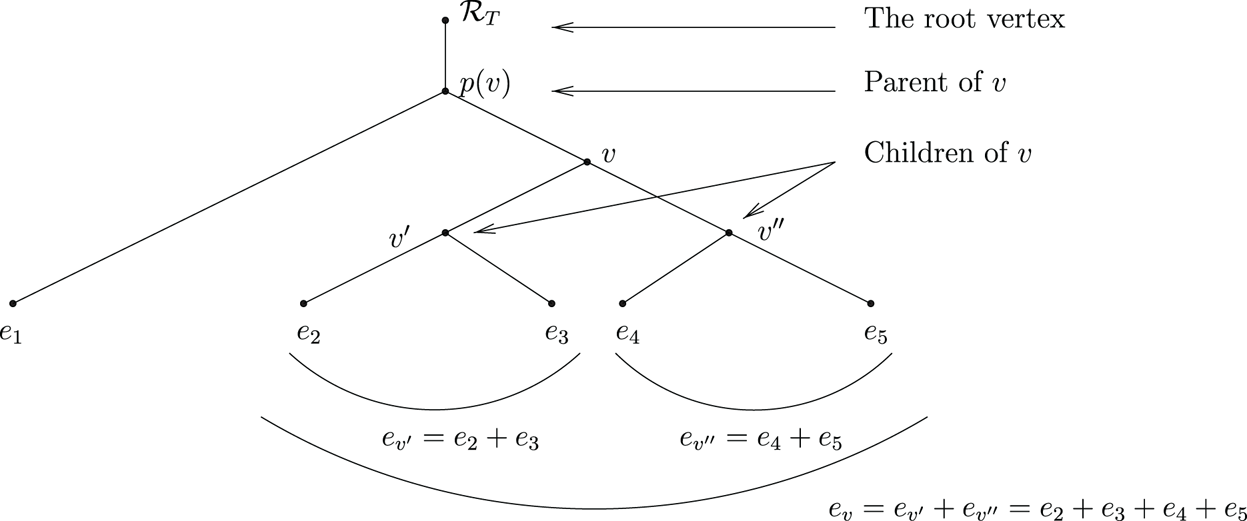
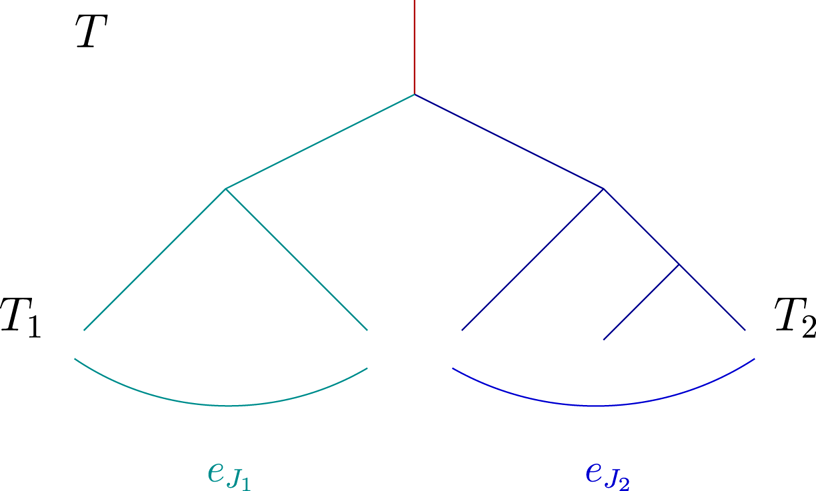
The flow tree formula in Theorem 1.1 takes the form of a sum over trees. More precisely, we consider rooted trees which apart from the root vertex have  $r$ univalent vertices, or leaves, decorated by the basis elements
 $e_1,\ldots,e_r$ of
 $\mathcal {N}$. For such a tree
 $T$, we denote by
 $V_T^{\circ }$ the set of interior, that is, non-univalent, vertices. We endow each such tree with the flow from the root to the leaves. Given a vertex
 $v$ in a tree, the vertex adjacent to
 $v$ coming before
 $v$ along the flow is referred to as the parent of
 $v$ and denoted by
 $p(v)$, and the vertices adjacent to
 $v$ and coming after
 $v$ along the flow are referred to as the children of
 $v$, as illustrated in Figure 1.1. Any vertex that comes after
 $v$ along the flow is a descendent of
 $v$. Let
 $\mathcal {T}_r$ be the set of such trees which are binary, that is such that each interior vertex
 $v$ of a tree
 $T \in \mathcal {T}_r$ has exactly two children. For every tree
 $T \in \mathcal {T}_r$ and
 $v$ a vertex of
 $T$, we define
 $e_v \in \mathcal {N}$ as the sum of all elements that appear as decorations on the leaves which are descendent of a vertex
 $v$. We denote by
 $\mathcal {T}_r^{\eta }$ the set of trees
 $T \in \mathcal {T}_r$ such that
 $\eta (e_{v'},e_{v''}) \neq 0$ where
 $v$ is the child of the root and
 $v',v''$ are the children of
 $v$.
A binary tree  $T$ with five leaves for
 $\mathcal {N}=\mathbb {Z} e_1 \oplus \mathbb {Z} e_2 \oplus \mathbb {Z} e_3 \oplus \mathbb {Z} e_4 \oplus \mathbb {Z} e_5$.

For every tree  $T \in \mathcal {T}_r^\eta$ and
 $v$ a vertex of
 $T$ distinct from the leaves, we define
 $\theta _{T,v}^{\alpha,\omega } \in \mathcal {M}_\mathbb {R}$ recursively as follows: if
 $v$ is the root vertex, then set
 $\theta _{T,v}^{\alpha,\omega }:= \alpha$. If
 $v$ is not the root, let
 $p(v)$ be the parent of
 $v$, and for any of the children, say
 $v'$ of
 $v$, and
 $\iota _{e_v} \omega := \omega (e_v,-) \in \mathcal {M}_{\mathbb {R}}$, define
 \begin{equation} \theta_{T,v}^{\alpha,\omega} :=\theta_{T,p(v)}^{\alpha,\omega} -\frac{\theta_{T,p(v)}^{\alpha,\omega}(e_{v'})}{ \omega(e_v,e_{v'})} \iota_{e_v} \omega. \end{equation}
We show in Lemma 2.12 that this definition is independent of the choice of the child  $v'$ of
 $v$. Following [Reference Alexandrov and PiolineAP19], we call
 $v \mapsto \theta _{T,v}^{\alpha,\omega }$ the discrete attractor flow.
For every tree  $T \in \mathcal {T}_r^\eta$ and interior vertex
 $v \in V_T^\circ$, we fix a labeling
 $v'$ and
 $v''$ of the two children of
 $v$, and we define
 \begin{equation} \epsilon_{T,v}^{\alpha, \omega} := - \frac{\operatorname{sgn} (\theta_{T,p(v)}^{\alpha,\omega}(e_{v'})) + \operatorname{sgn} (\omega(e_{v'}, e_{v''}))}{2} \in \{0,1,-1\}, \end{equation}
where  $\operatorname {sgn}(x) \in \{\pm 1\}$ is the sign of
 $x \in \mathbb {R}-\{0\}$. We show in § 2 that for generic
 $\omega \in \bigwedge ^2\mathcal {M}_{\mathbb R }$, we have
 $\theta _{T,p(v)}^{\alpha,\omega }(e_{v'}) \neq 0$ and
 $\omega (e_{v'}, e_{v''}) \neq 0$ and so the definition of
 $\epsilon _{T,v}^{\alpha,\omega }$ indeed makes sense. Our main result is the following flow tree formula, conjectured in [Reference Alexandrov and PiolineAP19], which enables us to determine the coefficients
 $F_r^{\theta }(\gamma _1,\ldots,\gamma _r)$ in (1.7) expressing the DT invariants
 $\overline {\Omega }_\gamma ^{\theta }(y,t)$ in terms of the attractor DT invariants
 $\overline {\Omega }_{\gamma _i}^{*}(y,t)$.
Theorem 1.1 For every choice a small enough generic perturbation  $\omega \in \bigwedge ^2 \mathcal {M}_\mathbb {R}$ of the skew-symmetric bilinear form
 $\eta$, the universal coefficient
 $F_r^{\theta }(\gamma _1,\ldots,\gamma _r)$ in ( 1.7) is given by the flow tree formula:
 \begin{equation} F_r^\theta(\gamma_1,\ldots,\gamma_r)= \sum_{T \in \mathcal{T}_r^{\eta}} \prod_{v \in V_T^\circ} \epsilon_{T,v}^{\alpha,\omega} \kappa(\eta(e_{v'},e_{v''})), \end{equation}
where  $\epsilon _{T,v}^{\alpha,\omega }$ is as in ( 1.11) and
 \begin{equation} \kappa(x):= {(-1)^x} \cdot \frac{y^x-y^{-x}}{y-y^{-1}} \end{equation}
for every  $x \in \mathbb {Z}$.
Theorem 5.5 presents a version of Theorem 1.1 in which we phrase more explicitly the condition that  $\omega$ should be a small enough generic perturbation of
 $\eta$.
We also prove a variant of the flow tree formula recently conjectured by Mozgovoy [Reference MozgovoyMoz22], which relies on a perturbation of points in  $\mathcal {M}_{\mathbb R }$ rather than the skew-symmetric form. We first remark that
 $\theta \in \gamma ^{\perp }$ implies that
 $\alpha \in \mathcal {M}_\mathbb {R}$ defined in (1.9) satisfies
 $\alpha \in (\sum _{i=1}^r e_i)^{\perp }$. For
 $\beta$ a small perturbation of
 $\alpha$ in the hyperplane
 $(\sum _{i=1}^r e_i)^{\perp }$, we define
 $\theta _{T,v}^{\beta,\eta } \in \mathcal {M}_{\mathbb R }$ and
 $\epsilon _{T,v}^{\beta,\eta } \in \{0,1,-1\}$ by replacing
 $\alpha$ by
 $\beta$ and
 $\omega$ by
 $\eta$ in (1.10) and (1.11).
Theorem 1.2 For every choice  $\beta \in (\sum _{i=1}^r e_i)^{\perp }$ of small enough generic perturbation of
 $\alpha := q(\theta )$ in the hyperplane
 $(\sum _{i=1}^r e_i)^{\perp }$, the universal coefficient
 $F_r^{\theta }(\gamma _1,\ldots,\gamma _r)$ is given by
 \begin{equation} F_r^\theta(\gamma_1,\ldots,\gamma_r)= \sum_{T \in \mathcal{T}_r^{\eta}} \prod_{v \in V_T^\circ} \epsilon_{T,v}^{\beta,\eta} \kappa(\eta(e_{v'},e_{v''})), \end{equation}
where  $\epsilon _{T,v}^{\alpha,\omega }$ is as in (1.11) and
 $\kappa$ is as in (1.13).
In Theorem 5.6, we present a version of Theorem 1.2 in which we state more precisely the condition that  $\beta$ should be a small enough generic perturbation of
 $\alpha$.
1.3 Structure of the proof
The proof of Theorems 1.1 and 1.2 relies on the notion of a scattering diagram, introduced in [Reference Gross and SiebertGS11], based on the insights of [Reference Kontsevich and SoibelmanKS06], to provide an algebro-geometric understanding of the mirror symmetry phenomenon in physics. To give the rough idea of a scattering diagram, which we elaborate further in § 3.1, fix a nilpotent  $N^+$-graded Lie algebra
 $\mathfrak g=\bigoplus _{n \in N^+} \mathfrak g_n$. There is an associated unipotent algebraic group
 $G$ with a bijective exponential map
 $\exp :\mathfrak g \to G$ defined using the Baker–Campbell–Hausdorff formula. Given these data, a
 $(N^+,\mathfrak g)$-scattering diagram is defined as the collection of real codimension-one cones in
 $M_{\mathbb R }$, called walls, which are decorated by wall-crossing automorphisms, that are elements of
 $G$. We focus attention on scattering diagrams relevant to DT and cluster theory, which have wall-crossing automorphism preserving a holomorphic symplectic form as in [Reference Gross, Pandharipande and SiebertGPS10, Reference Gross and PandharipandeGP10, Reference Kontsevich and SoibelmanKS14, Reference BridgelandBri17, Reference Gross, Hacking, Keel and KontsevichGHKK18, Reference MouMou19, Reference MandelMan21, Reference Cheung and MandelCM20, Reference Davison and MandelDM21], and not on the more general scattering diagrams that have wall-crossing automorphisms preserving a holomorphic volume form, and which appear frequently in the context of mirror symmetry [Reference Gross and SiebertGS11, Reference Gross, Hacking and SiebertGHS22, Reference Argüz and GrossAG20, Reference Keel and YuKY19].
A codimension-two locus in  $M_{\mathbb R }$ along which distinct walls intersect is called a joint. A scattering diagram is said to be consistent if for any joint, the path-ordered product of all wall-crossing automorphisms of walls that are adjacent to the joint is identity. It is shown in [Reference Kontsevich and SoibelmanKS06, Reference Gross and SiebertGS11] that there is an algorithmic prescription for constructing a consistent scattering diagram from the data of an initial set of walls. This prescription is based on inserting new walls, along with wall-crossing automorphisms, which order-by-order decrease the divergence of the path-ordered products of wall-crossing automorphisms around joints from being identity.
Given a quiver with potential  $(Q,W)$, Bridgeland [Reference BridgelandBri17] constructed from the DT invariants of
 $(Q,W)$ a consistent scattering diagram in
 $M_\mathbb {R}$, called the stability scattering diagram, whose initial walls are determined by the attractor DT invariants. The stability scattering diagram is a very useful tool to study DT invariants of quivers. For example, the transformation properties of DT invariants under mutations of a quiver with potential, conjectured in [Reference Manschot, Pioline and SenMPS14] and [Reference Mozgovoy and PiolineMP20, Conjecture 3.14], are proved in [Reference MouMou19, Theorem 4.22] by a study of the corresponding transformation of the stability scattering diagram.
The main technical goal of the paper is to prove Theorems 4.22 and 4.24: they are flow tree formulas for consistent scattering diagrams which express as a sum over binary trees the wall-crossing automorphism attached to a general wall in terms of the wall-crossing automorphisms attached to the initial walls. In § 5, we then derive Theorems 1.1 and 1.2 from the flow tree formulas for scattering diagram applied to the stability scattering diagram.
The proof of Theorems 4.22 and 4.24 is given in § 4 and consists of two parts. In the first part of the proof, described in § 4.2, we relate the  $(N^+,\mathfrak g)$-scattering diagrams, which live in
 $M_\mathbb {R}$, to auxiliary
 $(\mathcal {N}^+,\mathfrak h)$-scattering diagrams which live in
 $\mathcal {M}_\mathbb {R}$, where
 $\mathfrak h$ is a
 $\mathcal {N}^+$-graded Lie algebra constructed from
 $\mathfrak g$. In the second part of the proof in § 4.3, we show that the discrete attractor flow naturally defines a embedding of the binary rooted trees inside the walls of the auxiliary scattering diagrams in
 $\mathcal {M}_\mathbb {R}$. The images of the trees in
 $\mathcal {M}_\mathbb {R}$ are embedded graphs in
 $\mathcal {M}_\mathbb {R}$ with a balancing condition satisfied at each vertex distinct from the root, that is, essentially tropical disks in
 $\mathcal {M}_\mathbb {R}$ (see [Reference Nishinou and SiebertNS06, Reference GrossGro10, Reference Carl, Pumperla and SiebertCPS22]). The generic perturbation of either the skew-symmetric form or the position in
 $\mathcal {M}_\mathbb {R}$ of the root of the embedded trees guarantees that the vertices of the embedded trees are always contained in double intersections of walls, but never in triple intersections. The iteration of the local consistency condition around double intersection of walls determines the contribution of each tree. In the language of DT invariants, this reduces the general wall-crossing formula to an iteration of the much simpler primitive wall-crossing formula.
We note in Remark 4.25 that the perturbation of the position in  $\mathcal {M}_\mathbb {R}$ of the root of the trees used in the formulation of Theorems 1.2 and 4.24 is related to a way of perturbing scattering diagrams going back to the work of Gross, Pandharipande, and Siebert [Reference Gross, Pandharipande and SiebertGPS10]. However the perturbation of the skew-symmetric form used in the formulation of Theorems 1.1 and 4.22 seems to be a completely new way to study scattering diagrams. Thus, most of the paper is focused on the study of this perturbation of the skew-symmetric form and on the proof of Theorems 1.1 and 4.22.
1.4 Related work
1.4.1 Operads and wall-crossing
Very recently, while this paper was being completed, Mozgovoy [Reference MozgovoyMoz22] proved using an operadic approach to the wall-crossing formula, a different formula for the coefficients  $F_r^{\theta }(\gamma _1,\ldots,\gamma _r)$, called the attractor tree formula and originally conjectured in [Reference Mozgovoy and PiolineMP20], following [Reference Alexandrov and PiolineAP20, Reference Alexandrov, Manschot and PiolineAMP20]. The key differences between the flow tree formula that we prove in this paper and the attractor tree formula proved in [Reference MozgovoyMoz22] are the following: the flow tree formula involves binary trees, requires a choice of generic perturbation, and is naturally phrased in terms of Lie algebras, whereas the attractor tree formula involves general (not necessarily binary) trees, does not require the choice of generic perturbation, and is naturally phrased in terms of associative algebras. It is currently not known whether one of these two formulas implies the other in a simple way.
Both the flow tree formula and the attractor tree formula, formulated precisely and proved for DT invariants of quivers with potentials, are expected to have versions holding more generally in DT theory as long as a global understanding of the space of stability conditions is available. For example, the flow tree formula and the attractor tree formula play an important role in the conjectural proposal of Alexandrov and Pioline [Reference Alexandrov and PiolineAP20] (see also [Reference Alexandrov, Manschot and PiolineAMP20]) for the construction of modular completions for generating series of DT invariants counting coherent sheaves supported on surfaces inside Calabi–Yau 3-folds.
1.4.2 BPS states
From a physics perspective, a quiver with potential  $(Q,W)$ defines a supersymmetric quantum mechanical system with four supercharges [Reference DenefDen02] and the (refined) DT invariants are counts of supersymmetric ground states, which often can be identified with supersymmetric indices counting BPS particles in four-dimensional
 $\mathcal {N}=2$ supersymmetric quantum field theories [Reference FiolFio06, Reference Cecotti and VafaCV13, Reference Alim, Cecotti, Córdova, Espahbodi, Rastogi and VafaACC+14, Reference Alim, Cecotti, Córdova, Espahbodi, Rastogi and VafaACC+13, Reference Cecotti, Neitzke and VafaCNV10] and BPS configurations of black holes in four-dimensional
 $\mathcal {N}=2$ string compactifications [Reference DenefDen02, Reference Manschot, Pioline and SenMPS12, Reference Manschot, Pioline and SenMPS11, Reference Manschot, Pioline and SenMPS13, Reference Lee, Wang and YiLWY12b, Reference Lee, Wang and YiLWY12a, Reference Denef and MooreDM11, Reference de Boer, El-Showk, Messamah and Van den BleekendBES+09, Reference Bena, Berkooz, de Boer, El-Showk and Van den BleekenBBdB+12]. In particular, the definition of the attractor point, as well as the attractor invariants, is motivated by the attractor mechanism for BPS black holes in
 $\mathcal {N}=2$ supergravity [Reference Ferrara, Kallosh and StromingerFKS95, Reference StromingerStr96]. The attractor invariants are closely related but not equal in general to the single-centered invariants [Reference Manschot, Pioline and SenMPS12], which are expected to count micro-states of a single, spherically symmetric black hole, but whose conceptual definition is still mysterious mathematically. The flow tree formula conjectured by Alexandrov and Pioline [Reference Alexandrov and PiolineAP19], that we prove in this paper, is motivated by the split attractor flow picture in
 $\mathcal {N}=2$ supergravity [Reference DenefDen00, Reference Denef, Greene and RaugasDGR01, Reference Denef and MooreDM11]. The idea that the supergravity attractor flow could be replaced by a discrete attractor flow using sign functions was first suggested by Manschot [Reference ManschotMan11].
1.4.3 Tropical curves and mirror symmetry
In [Reference Gross, Pandharipande and SiebertGPS10, Reference Carl, Pumperla and SiebertCPS22, Reference Filippini and StoppaFS15, Reference MandelMan21], the perturbation of scattering diagrams originally introduced by Gross, Pandharipande, and Siebert [Reference Gross, Pandharipande and SiebertGPS10] is used to express general walls of a consistent scattering diagram in terms of the initial walls using sums over tropical curves. The connection between scattering diagrams and tropical geometry is particularly interesting from the point of view of mirror symmetry and connection with Gromov–Witten theory, as shown in dimension two by Gross, Pandharipande, and Siebert [Reference Gross, Pandharipande and SiebertGPS10] in genus zero and the second author [Reference BousseauBou20] in higher genus, and generalized to higher dimensions in the work of the first author with Gross [Reference Argüz and GrossAG20].
However, the point of view adopted in the present paper is different: the main interest of the flow tree formula is that it is not written as a sum over tropical curves but as a sum over abstract trees. The resulting formula is therefore entirely combinatorial, and more amenable to formal manipulations, as exemplified in [Reference Alexandrov and PiolineAP19, Reference Alexandrov and PiolineAP20, Reference Alexandrov, Manschot and PiolineAMP20]. In particular, the flow tree formula can be easily implemented efficiently on a computer, as done in [Reference PiolinePio20].
1.5 Plan of the paper
In § 2, we introduce our notation for trees and the discrete attractor flow, and we prove the existence of suitably generic perturbations of the skew-symmetric form. In § 3, we first review the reconstruction of consistent scattering diagrams from initial data, and then we state the flow tree formula for scattering diagrams. The technical heart of the paper is § 4 in which we prove the flow tree formula for scattering diagrams. Finally, we prove in § 5 the flow tree formula for DT invariants of quivers with potentials by applying the flow tree formula for scattering diagrams to the stability scattering diagram.
2. Trees and flows
In §§ 2.1 and 2.2, we introduce elementary notions on trees and skew-symmetric forms that are used throughout the paper. In § 2.3, we review the discrete attractor flow following [Reference Alexandrov and PiolineAP19]. In § 2.4, we prove the existence of sufficiently generic skew-symmetric bilinear forms to allow the definition of the flow tree map in § 2.5.
Throughout this section we fix a free abelian group  $\mathcal {N}$ of finite rank
 $r$, and let
 $\mathcal {M} := \operatorname {Hom}_{\mathbb {Z}}(\mathcal {N},\mathbb {Z})$ and
 $\mathcal {M}_\mathbb {R} := \mathcal {M} \otimes _{\mathbb {Z}} \mathbb {R}$. We introduce the notation
 $I := \{1,\ldots,r\}$, we fix a basis
 $\{e_i\}_{i \in I}$ of
 $\mathcal {N}$, and we use the notation
 \begin{equation} \mathcal{N}^+ := \bigg\{\sum_{i\in I} a_i e_i \,|\, a_i \geq 0,\ \sum_{i\in I} a_i >0\bigg\}. \end{equation}
We also fix a skew-symmetric bilinear form  $\eta \in \bigwedge ^2 \mathcal {M}$ on
 $\mathcal {N}$, a subset
 $J \subset I$ of cardinality
 $|J|$, and let
 \begin{equation} e_J := \sum_{i\in J}e_i. \end{equation}
Finally, for every non-zero  $n \in \mathcal {N}$, we denote by
 $n^{\perp }:= \{ \theta \in \mathcal {M}_{\mathbb {R}}\,|\, \theta (n)=0\}$ the corresponding hyperplane in
 $\mathcal {M}_{\mathbb {R}}$.
2.1 Trees
Definition 2.1 A rooted tree  $T$ is a connected tree with a finite number of vertices and edges, with no divalent vertices, together with the additional data of a distinguished univalent vertex referred to as the root. We denote by
 $V_T$ the set of vertices of
 $T$, by
 $\mathcal {R}_T$ the set with the root for unique element,
 $V_T^\circ$ the set of interior vertices, which are vertices of valency greater than one, and by
 $V_T^{\rm L}$ the set of univalent vertices that are not the root, that is the set of leaves of
 $T$. An isomorphism between two rooted trees
 $T$ and
 $T'$ is a bijection
 $\varphi \colon V_T \rightarrow V_{T'}$, which maps adjacent vertices of
 $T$ to adjacent vertices of
 $T'$ and the root of
 $T$ to the root of
 $T'$.
Definition 2.2 A J-decorated rooted tree is a rooted tree  $T$ endowed with a decoration of the leaves of
 $T$ by
 $\{e_i\}_{i\in J}$, that is, a bijection
 $\psi \colon V_T^{\rm L} \rightarrow \{e_i\}_{i\in J}$. An isomorphism between two
 $J$-decorated rooted trees
 $(T,\psi )$ and
 $(T',\psi ')$ is an isomorphism of tree
 $\varphi \colon V_T \rightarrow V_{T'}$ compatible with the decorations, in the sense that
 $\psi = \psi ' \circ \varphi$.
Definition 2.3 Let  $T$ be a rooted tree. The parent of a vertex
 $v \in V_T \setminus \mathcal {R}_T$ is the unique vertex denoted by
 $p(v)$ which is adjacent to
 $v$ and lies on the shortest path between
 $v$ and the root. A child of a vertex
 $v \in V_T$ is a vertex for which
 $v$ is a parent, and a descendant of
 $v$ is any vertex which is either the child of
 $v$ or is (recursively) the descendant of any of the children of
 $v$.
Definition 2.4 A rooted tree  $T$ is binary if the root has exactly one child and each interior vertex has two children.
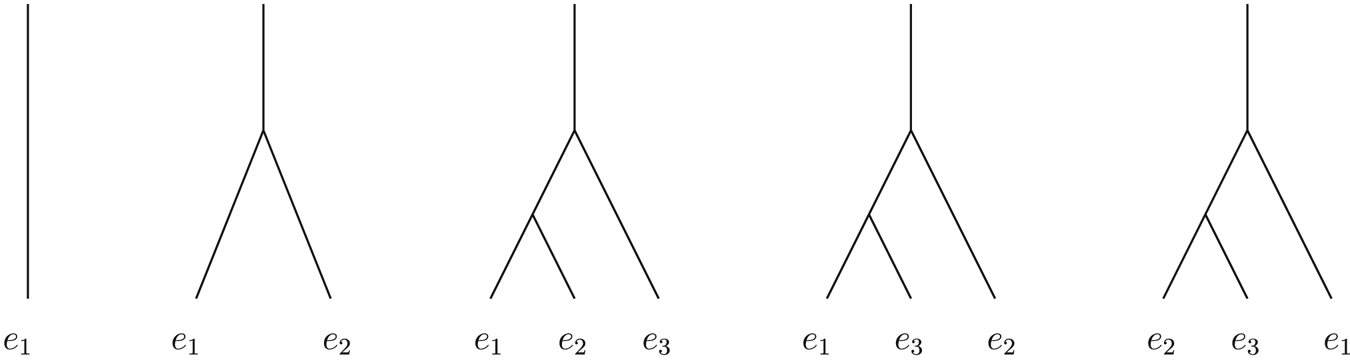
Remark 2.5 We illustrate in Figure 2.1 some decorated binary rooted trees. Our binary rooted trees are unordered in the sense that we do not fix an order on the set of children of a vertex. In a binary rooted tree  $T$, for every vertex
 $v \in V_T^\circ$, we denote by
 $\{v',v''\}$ the set of the children of
 $v$, without specifying an ordering. Nonetheless, for some constructions in what follows it is sometimes useful to choose an ordering for the children. At any occasion where such a choice is made we show that the result of the construction is in fact independent of this choice.
Decorated binary rooted trees with at most three leaves.

Lemma 2.6 Let  $T$ be a
 $J$-decorated binary rooted tree. Then,
 $T$ has
 $2|J|$ vertices and
 $2|J|-1$ edges.
Proof. The proof is by induction on the cardinality  $|J|$ of
 $J$. The result is immediate for
 $|J|=1$. For
 $|J|>1$, write
 $J=\{i_0\} \sqcup \{i\}_{i\in |J'|}$ with
 $|J'|=|J|-1$. Removing from
 $T$ the leg decorated by
 $e_{i_0}$, and erasing the resulting divalent vertex, we obtain a
 $J'$-decorated binary rooted tree
 $T'$. The result follows because
 $T'$ has two fewer edges and two fewer vertices than
 $T$.
Lemma 2.7 The set  $\mathcal {T}_J$ of isomorphism classes of
 $J$-decorated binary rooted trees is of cardinality
 $(2|J|-3)!! =\prod _{k=1}^{|J|-1}(2k-1)$.
Proof. The proof is by induction on the cardinality  $|J|$ of
 $J$. The result is immediate for
 $|J|=1$. For
 $|J|>1$, write
 $J=\{i_0\} \sqcup \{i\}_{i\in |J'|}$ with
 $|J'|=|J|-1$. Removing from
 $T$ the leg decorated by
 $e_{i_0}$, we obtain a
 $J'$-decorated binary rooted tree
 $T'$ with an added divalent vertex on one of its edges
 $E$. Conversely, given a
 $J'$-decorated binary rooted tree
 $T'$ and an edge
 $E$ of
 $T'$, then adding a divalent vertex
 $v$ in the middle of
 $E$ and gluing a leg decorated by
 $e_{i_0}$ to
 $v$, we obtain a
 $J$-decorated binary rooted tree. Therefore, we have a bijection between
 $\mathcal {T}_J$ and the set of pairs
 $(T',E)$, where
 $T' \in \mathcal {T}_{J'}$ and
 $E$ is an edge of
 $T'$. By Lemma 2.6, a
 $J'$-decorated binary rooted tree has
 $2|J'|-1$ edges, and so
 $|\mathcal {T}_J|=(2|J'|-1)|\mathcal {T}_{J'}|=(2|J|-3)|\mathcal {T}_{J'}|$.
2.2 Skew-symmetric bilinear forms
We view elements  $\omega \in \bigwedge ^2 \mathcal {M}_\mathbb {R}$ as
 $\mathbb {R}$-valued skew-symmetric bilinear forms on
 $\mathcal {N}$, given by
 \begin{align} \begin{aligned}\omega \colon \mathcal{N} \times \mathcal{N} & \longrightarrow \mathbb{R} \nonumber\\ (v_1, v_2) & \longmapsto \omega(v_1,v_2).\end{aligned} \end{align}
Definition 2.8 For every tree  $T \in \mathcal {T}_J$, and a vertex
 $v \in V_T$, we define an associated element
 $e_v \in \mathcal {N}^+$, referred to as the charge of
 $v$ as follows: let
 $J_{T,v} \subset J$ be the subset of indices with which the leaves that are descendant to
 $v$ are labeled, that is,
 $j \in J_{T,v}$ if and only if the leaf decorated by
 $e_j$ is a descendant of
 $v$. Then, we set
 \begin{equation} e_v := e_{J_{T,v}}=\sum_{i \in J_{T,v}} e_i. \end{equation}
Note that if  $v$ is the leaf decorated by
 $e_i$, then the associated charge
 $e_v= e_i$. For
 $v \in V_T^\circ$, the sets
 $J_{T,v'}$ and
 $J_{T,v''}$ are disjoint, and we have
 $e_v=e_{v'}+e_{v''}$. If
 $v$ is the root of
 $T$ or the child of the root of
 $T$, then
 $J_{T,v}=J$ and
 $e_v=e_J$.
Lemma 2.9 For every tree  $T \in \mathcal {T}_J$ and interior vertex
 $v \in V_T^\circ$, the linear form
 \begin{align}\begin{aligned} \wedge^2 \mathcal{M}_\mathbb{R} &\longrightarrow \mathbb{R} \nonumber\\ \omega &\longmapsto \omega(e_{v'},e_{v''})\end{aligned} \end{align}
is not identically zero.
Proof. As  $\{e_i\}_{i\in I}$ is a basis of
 $\mathcal {N}$, the linear forms
 $\omega \mapsto \omega (e_i,e_j)$ for
 $i,j \in I$ and
 $i< j$ form a basis of the space of linear forms on
 $\bigwedge ^2 \mathcal {M}_\mathbb {R}$. We have
 \begin{equation} \omega(e_{v'},e_{v''}) = \sum_{j' \in J_{T,v'}} \sum_{j'' \in J_{T,v''}} \omega(e_{j'},e_{j''}). \end{equation}
As the sets  $J_{T,v'}$ and
 $J_{T,v''}$ are disjoint, each basis element
 $\omega \mapsto \omega (e_{j'},e_{j''})$ with
 $j'< j''$ appears up to sign at most once in the sum (2.6). In particular, there are no cancellations and
 $\omega \mapsto \omega (e_{v'},e_{v''})$ is not the zero linear form.
Proposition 2.10 Let  $U_J \subset \bigwedge ^2 \mathcal {M}_\mathbb {R}$ be the subset of
 $\omega \in \bigwedge ^2 \mathcal {M}_\mathbb {R}$ such that for every tree
 $T \in \mathcal {T}_J$ and interior vertex
 $v \in V_T^\circ$, we have
 $\omega (e_{v'},e_{v''}) \neq 0$. Then, the following hold:
(i)
 $U_J$ is open and dense in $\bigwedge ^2 \mathcal {M}_\mathbb {R}$;
(ii) for every
$\omega \in U_J$, $T \in \mathcal {T}_J$ and $v \in V_T^\circ$, we have $\omega (e_v,e_{v'}) \neq 0$ and $\omega (e_v,e_{v''}) \neq 0$;(iii) for every
$J_2 \subset J_1 \subset I$, we have $U_{J_1} \subset U_{J_2}$.


Proof. By Lemma 2.9,  $U_J$ is the complement of finitely many hyperplanes in
 $\bigwedge ^2 \mathcal {M}_\mathbb {R}$. Thus, statement (i) follows. To show part (ii), observe that as
 $e_v=e_{v'}+e_{v''}$, we have
 $\omega (e_v,e_{v'})=\omega (e_{v''}, e_{v'})$ and
 $\omega (e_v,e_{v''})=\omega (e_{v'},e_{v''})$. Finally, part (iii) follows from the fact that every
 $J_2$-decorated binary rooted tree can be realized as a subtree of a
 $J_1$-decorated binary rooted tree.
2.3 Discrete attractor flow
We review the description of the discrete attractor flow introduced in [Reference Alexandrov and PiolineAP19, § 2.6].
Definition 2.11 Fix a tree  $T \in \mathcal {T}_J$, a skew-symmetric bilinear form
 $\omega \in U_J \subset \bigwedge ^2 \mathcal {M}_\mathbb {R}$ and a point
 $\alpha \in e_J^{\perp } \subset \mathcal {M}_\mathbb {R}$. We also fix a labeling
 $v', v''$ of the children of the vertices
 $v \in V_T^\circ$. The discrete attractor flow for
 $(T,\omega,\alpha )$ is the map
 \begin{align}\begin{aligned} \theta_T^{\alpha,\omega} \colon \mathcal{R}_T \cup V_T^\circ &\longrightarrow \mathcal{M}_\mathbb{R} \nonumber\\ v &\longmapsto \theta_{T,v}^{\alpha, \omega}\end{aligned} \end{align}
defined inductively, following the flow on  $T$ starting at the root and ending at the leaves, as follows.
(i) For the root vertex
$v \in \mathcal {R}_T$, we set
(2.8)\begin{equation} \theta_{T,v}^{\alpha,\omega} := \alpha. \end{equation}(ii) For
$v \in V_T^\circ$, and a child $v'$ of $v$, we set
(2.9)where\begin{equation} \theta_{T,v}^{\alpha,\omega} =\theta_{T,p(v)}^{\alpha,\omega} - \frac{\theta_{T,p(v)}^{\alpha,\omega}(e_{v'})}{ \omega(e_v,e_{v'})} \iota_{e_v} \omega, \end{equation}$p(v)$ is the parent of $v$, and for every $n \in \mathcal {N}$, $\iota _n \omega = \omega (n,-) \in \mathcal {M}_{\mathbb R }$.


Note that because  $\omega \in U_{J}$, we have
 $\omega (e_v,e_{v'}) \neq 0$ for every
 $v \in V_T^\circ$ by Proposition 2.10, and so (2.9) makes sense.
Lemma 2.12 Using the notation of Definition 2.11, we have for every  $v \in V_T^\circ$:
 \begin{equation} \theta_{T,v}^{\alpha, \omega} \in e_{v'}^\perp \cap e_{v''}^{\perp} \subset e_v^{\perp}, \end{equation}
and
 \begin{equation} \theta_{T,v}^{\alpha,\omega} =\theta_{T,p(v)}^{\alpha,\omega} - \frac{\theta_{T,p(v)}^{\alpha,\omega}(e_{v''})}{ \omega(e_v,e_{v''})} \iota_{e_v} \omega. \end{equation}
In particular, the discrete flow  $\theta _T^{\alpha, \omega }$ defined as in (2.11) is independent of the choice of labeling
 $v'$ and
 $v''$ of children of vertices
 $v \in V_T^\circ$.
Proof. We prove the result inductively following the flow on  $T$ starting at the root and ending at the leaves. If
 $v \in V_T^\circ$ is the child of the root of
 $T$, then
 $\theta _{T,v}^{\alpha,\omega }$ is given by (2.9). By (2.8), we have
 $\theta _{T,p(v)}^{\alpha, \omega }=\alpha$ and so
 \begin{equation} \theta_{T,v}^{\alpha,\omega}(e_{v'})=\alpha(e_{v'}) -\frac{\alpha(e_{v'})}{\omega(e_v,e_{v'})}\omega(e_v,e_{v'})=0. \end{equation}
On the other hand, as  $\alpha \in e_J^{\perp }$, we have
 $\alpha (e_v)=\alpha (e_J)=0$, and so, using
 $e_v=e_{v'}+e_{v''}$, we have
 $\alpha (e_{v''})=-\alpha (e_{v'})$. As we also have
 $\omega (e_v,e_{v'})=-\omega (e_v,e_{v''})$, we finally obtain
 \begin{equation} \theta_{T,v}^{\alpha,\omega}(e_{v''})=\alpha(e_{v''}) +\frac{\alpha(e_{v''})}{\omega(e_v,e_{v'})}\omega(e_v,e_{v''})=0. \end{equation}
Similarly, if  $v \in V_T^\circ$ is not the root of
 $T$, then
 $\theta _{T,v}^{\alpha, \omega }$ is given by (2.9) and so
 \begin{equation} \theta_{T,v}^{\alpha,\omega}(e_{v'})=\theta_{T,p(v)}^{\alpha, \omega}(e_{v'}) -\frac{\theta_{T,p(v)}^{\alpha, \omega}(e_{v'})}{\omega(e_v,e_{v'})}\omega(e_v,e_{v'})=0. \end{equation}
By the induction hypothesis, we have  $\theta _{T,p(v)}^{\alpha, \omega }(e_v)=0$ and so, using
 $e_v=e_{v'}+e_{v''}$, we have
 $\theta _{T,p(v)}^{\alpha, \omega }(e_{v''})=-\theta _{T,p(v)}^{\alpha, \omega }(e_{v'})$. As we also have
 $\omega (e_v,e_{v'})=-\omega (e_v,e_{v''})$, we finally obtain (2.11) and
 \begin{equation} \theta_{T,v}^{\alpha,\omega}(e_{v''})=\theta_{T,p(v)}^{\alpha, \omega}(e_{v''}) +\frac{\theta_{T,p(v)}^{\alpha, \omega}(e_{v''})}{\omega(e_v,e_{v'})}\omega(e_v,e_{v''})=0. \end{equation}
2.4 Generic skew-symmetric bilinear forms
Recall that we are fixing a skew-symmetric bilinear form  $\eta \in \bigwedge ^2 \mathcal {M}$ on
 $\mathcal {N}$.
Definition 2.13 We denote by  $\mathcal {T}_J^\eta$ the set of trees
 $T \in \mathcal {T}_J$ such that
 $\eta (e_{v'},e_{v''}) \neq 0$ where
 $v$ is the child of the root of
 $T$.
Definition 2.14 A point  $\alpha \in \mathcal {M}_\mathbb {R}$ is
 $(J,\eta )$-generic if
 $\alpha \in e_J^{\perp }$ and for every tree
 $T \in \mathcal {T}_J^\eta$, we have
 $\alpha (e_{v'}) \neq 0$, where
 $v$ is the child of the root of
 $T$.
Note that for  $T \in \mathcal {T}_J^\eta$ and
 $v$ the child of the root of
 $T$, we have
 $e_{v'}+e_{v''}=e_v=e_J$, and so, if
 $\alpha \in e_J^{\perp }$, then
 $\alpha (e_{v'}) \neq 0$ is equivalent to
 $\alpha (e_{v''}) \neq 0$. Equivalently, a point
 $\alpha \in e_J^{\perp }$ is
 $(J,\eta )$-generic if
 $\alpha \notin e_{J'}^{\perp }$ for every strict subset
 $J'$ of
 $J$ such that
 $\eta (e_J,e_{J'}) \neq 0$.
Definition 2.15 Let  $\alpha \in e_J^{\perp }$ be a
 $(J,\eta )$-generic point. A skew-symmetric bilinear form
 $\omega \in U_{J} \subset \bigwedge ^2 \mathcal {M}_\mathbb {R}$ is called
 $(J,\alpha )$-generic if for every
 $T \in \mathcal {T}_J^\eta$ and
 $v \in V_T^\circ$, we have
 \begin{equation} \theta_{T, p(v)}^{\alpha,\omega}(e_{v'})\neq 0 \quad \text{and} \quad \theta_{T, p(v)}^{\alpha,\omega}(e_{v''})\neq 0. \end{equation}
We denote by  $U_{J,\alpha } \subset U_J$ the set of
 $(J,\alpha )$-generic skew-symmetric bilinear forms.
Lemma 2.16 Using the notation of Definition 2.15, for every  $T \in \mathcal {T}_J^\eta$ and
 $v \in V_T^\circ$, we have
 $\theta _{T,p(v)}^{\alpha,\omega }(e_v)=0$ and
 $\theta _{T,p(v)}^{\alpha,\omega }(e_{v'})= -\theta _{T,p(v)}^{\alpha,\omega }(e_{v''})$.
Proof. As  $e_v=e_{v'}+e_{v''}$, it is enough to show that
 $\theta _{T,p(v)}^{\alpha,\omega }(e_v)=0$. If
 $v$ is the child of the root, then
 $\theta _{T,p(v)}^{\alpha,\omega }=\alpha$ by (2.8), and so, as
 $\alpha \in e_J^{\perp }$, we have
 $\alpha (e_v)=\alpha (e_J)=0$. If
 $v$ is not the child of the root, the result follows by (2.10) of Lemma 2.12 applied to the parent
 $p(v)$ of
 $v$.
Lemma 2.17 Let  $\alpha \in e_J^{\perp }$ be a
 $(J,\eta )$-generic point,
 $T \in \mathcal {T}_J^\eta$, and
 $v \in V_T$. Denote by
 $v_0, \ldots, v_m$ the unique sequence of vertices of
 $T$ such that
 $v_0$ is the root of
 $T$,
 $v_m=v$, and for every
 $0 \leq a \leq m-1$,
 $v_{a+1}$ is a child of
 $v_a$. Then, the following hold.
(i) The elements
$e_{v_0}, \ldots, e_{v_m}$ are linearly independent in $\mathcal {N}$.(ii) For every
$0 \leq a \leq m-1$ and $0\leq b \leq m$, the map
is a rational function with\begin{align*} U_{J} &\longrightarrow \mathbb{R} \\ \omega &\longmapsto \theta_{T,v_a}^{\alpha, \omega}(e_{v_b}) \end{align*}
$\mathbb {R}$-coefficients, in the variables given by the linear maps
for\begin{align*} U_{J} &\longrightarrow \mathbb{R} \\ \omega &\longmapsto \omega(e_{v_{a'}},e_{v_{b'}}) \end{align*}
$0 \leq a', b' \leq m$ and $\min (a',b') \leq a$.(iii) For every
$0 \leq a \leq m-2$, the map
is not identically zero.\begin{align*} U_{J} &\longrightarrow \mathbb{R} \\ \omega &\longmapsto \theta_{T,v_a}^{\alpha, \omega}(e_{v_{a+2}}) \end{align*}


Proof. (i) Assume that  $\sum _{i=0}^m a_i e_{v_i}=0$ with some
 $a_{i} \neq 0$. Let
 $i_{\min }$ be the smallest index
 $i$ such that
 $a_i \neq 0$. There exists
 $j \in J_{T,v_{i_{\min }}}$ such that
 $j \notin J_{T,v_i}$ for every
 $i >i'$, and so we obtain a contradiction.
(ii) We prove this by induction on  $a$ from
 $0$ to
 $m-1$. For
 $a=0$,
 $v_0$ is the root of
 $T$, and so by (2.8) we have
 $\theta _{T,v_0}^{\alpha,\omega }(e_{v_b})= \alpha (e_b)$ which is constant as a function of
 $\omega$. Now, assume that the result holds for
 $a \geq 0$ and that
 $a+1 \leq m-1$. Then, we have
 $v_{a+1} \in V_T^\circ$, and so by (2.9),
 \begin{equation} \theta_{T,v_{a+1}}^{\alpha,\omega}(e_{v_b})=\theta_{T,v_a}^{\alpha,\omega}(e_{v_b}) - \frac{\theta_{T,v_a}^{\alpha,\omega}(e_{v_{a+2}})}{ \omega(e_{v_{a+1}},e_{v_{a+2}})} \omega(e_{v_{a+1}}, e_{v_b}). \end{equation}
By the induction hypothesis,  $\theta _{T,v_a}^{\alpha,\omega }(e_{v_b})$ and
 $\theta _{T,v_a}^{\alpha,\omega }(e_{v_{a+2}})$ are rational functions in the variables
 $\omega (e_{v_{a'}}, e_{v_{b'}})$ with
 $\min (a',b') \leq a$ and so, in particular, with
 $\min (a',b') \leq a+1$. The only extra variables appearing in
 $\theta _{T,v_{a+1}}^{\alpha,\omega }(e_{v_b})$ are
 $\omega (e_{v_{a+1}},e_{v_{a+2}})$ and
 $\omega (e_{v_{a+1}}, e_{v_b})$, which are both of the form
 $\omega (e_{v_{a'}}, e_{v_{b'}})$ with
 $\min (a',b') \leq a+1$. This shows the result for
 $a+1$.
(iii) First note that by part (i), the elements  $e_{v_0},\ldots, e_{v_m}$ are linearly independent in
 $\mathcal {N}$, and so the linear forms
 $\omega \mapsto \omega (e_{v_a}, e_{v_b})$ with
 $a< b$ are linearly independent.
We prove the result by induction on  $a$ from
 $0$ to
 $m-2$. For
 $a=0$,
 $v_0$ is the root of
 $T$ and we have by (2.8) that
 $\theta _{T,v_0}^{\alpha,\omega }(e_{v_2})= \alpha (e_{v_2})$, which is non-zero because
 $T \in \mathcal {T}_J^\eta$ and
 $\alpha$ is
 $(J,\eta )$-generic (see Definition 2.14).
Assume that the result holds for  $a$ and that
 $a+1 \leq m-2$. We have to show that the result holds for
 $a+1$. As
 $a+1 \leq m-2$, we have in particular
 $v_{a+1} \in V_T^\circ$ and so, by (2.9),
 \begin{equation} \theta_{T,v_{a+1}}^{\alpha,\omega}(e_{v_{a+3}})=\theta_{T,v_a}^{\alpha,\omega}(e_{v_{a+3}}) - \frac{\theta_{T,v_a}^{\alpha,\omega}(e_{v_{a+2}})}{ \omega(e_{v_{a+1}},e_{v_{a+2}})} \omega(e_{v_{a+1}}, e_{v_{a+3}}). \end{equation}
By Lemma 2.17(ii),  $\omega \mapsto \theta _{T,v_a}^{\alpha,\omega }(e_{v_{a+2}})$ and
 $\omega \mapsto \theta _{T,v_a}^{\alpha,\omega }(e_{v_{a+3}})$ are rational functions in the linear forms
 $\omega \mapsto \omega (e_{v_{a'}}, e_{v_{b'}})$ with
 $\min (a',b') \leq a$. In particular, they are algebraically independent of
 $\omega \mapsto \omega (e_{v_{a+1}},e_{v_{a+2}})$ and
 $\omega \mapsto \omega (e_{v_{a+1}}, e_{v_{a+3}})$. On the other hand, by the induction hypothesis,
 $\omega \mapsto \theta _{T,v_a}^{\alpha,\omega }(e_{v_{a+2}})$ is not identically zero. We conclude that
 $\omega \mapsto \theta _{T,v_{a+1}}^{\alpha,\omega }(e_{v_{a+3}})$ is not identically zero.
Proposition 2.18 Let  $\alpha \in e_J^{\perp }$ be a
 $(J,\eta )$-generic point. Then the set
 $U_{J,\alpha } \subset U_{J} \subset \bigwedge ^2 \mathcal {M}_\mathbb {R}$ defined in Definition 2.15 is the complement of finitely many algebraic hypersurfaces in
 $U_{J}$. In particular,
 $U_{J,\alpha }$ is open and dense in
 $U_{J}$, and so in
 $\bigwedge ^2 \mathcal {M}_\mathbb {R}$.
Proof. By Lemma 2.17(ii) and (iii), for every  $T \in \mathcal {T}_J^\eta$,
 $v \in V_T^\circ$ and
 $v'$ child of
 $v$, the map
 $\omega \mapsto \theta _{T,p(v)}^{\alpha, \omega }(e_{v'})$ is a not identically zero rational function. Therefore, the set
 \[ \{\omega \in U_{J}\,|\, \theta_{T,p(v)}^{\alpha, \omega}(e_{v'}) \neq 0\} \]
is the complement of an algebraic hypersurface in  $U_{J}$. By definition,
 $U_{J,\alpha }$ is the intersection of the finitely many sets of this form obtained by varying
 $T$,
 $v$, and
 $v'$. Hence,
 $U_{J,\alpha }$ is the complement of finitely many algebraic hypersurfaces in
 $U_{J}$ and is open and dense in
 $U_{J}$. By Proposition 2.10,
 $U_{J}$ is open and dense in
 $\bigwedge ^2 \mathcal {M}_\mathbb {R}$, and so it is also the case for
 $U_{J,\alpha }$.
We end this section in a different direction: instead of fixing  $\alpha \in e_J^{\perp }$ and looking for
 $(J,\alpha )$-generic
 $\omega \in \bigwedge ^2 \mathcal {M}_\mathbb {R}$, we look for all
 $\alpha \in e_J^{\perp }$ such that the fixed
 $\eta \in \bigwedge ^2 \mathcal {M}_\mathbb {R}$ is
 $(J,\alpha )$-generic.
Lemma 2.19 Let  $T \in \mathcal {T}_J^\eta$ and
 $v \in V_T$. Denote by
 $v_0,\ldots,v_m$ the unique sequence of vertices of
 $T$ such that
 $v_0$ is the root of
 $T$,
 $v_m=v$, and for every
 $0 \leq a \leq m-1$,
 $v_{a+1}$ is a child of
 $v_a$. Then for every
 $0 \leq a \leq m-2$, the map
 \begin{align}\begin{aligned} e_J^{\perp} &\longrightarrow \mathcal{M}_\mathbb{R} \nonumber\\ \alpha &\longmapsto \theta^{\alpha,\eta}_{T,v_a}\end{aligned} \end{align}
is linear, and the linear form
 \begin{align}\begin{aligned} e_J^{\perp} &\longrightarrow \mathbb{R} \nonumber\\ \alpha & \longmapsto \theta^{\alpha,\eta}_{T,v_a}(e_{v_{a+2}})\end{aligned} \end{align}
is not identically zero.
Proof. The result is easily proved by induction on  $a$, using Lemma 2.17(i) and the fact that the linear form
 $\alpha \mapsto \theta _{T,v_a}^{\alpha,\eta }(e_{v_{a+2}})$ is equal to the sum of the linear form
 $\alpha \mapsto \alpha (e_{v_{a+2}})$ and of a linear combination of the linear forms
 $\alpha \mapsto \alpha (e_{v_b})$ with
 $b< a+2$.
Proposition 2.20 Let  $V_{J,\eta }$ be the set of
 $\alpha \in e_J^{\perp } \subset \mathcal {M}_\mathbb {R}$ such that
 $\alpha$ is
 $(J,\eta )$-generic and
 $\eta$ is
 $(J,\alpha )$-generic. Then
 $V_{J,\eta }$ is open and dense in
 $e_J^{\perp }$.


2.5 The flow tree map
Let  $\mathfrak h=\bigoplus _{n \in \mathcal {N}^+} \mathfrak h_n$ be a Lie algebra over
 $\mathbb {Q}$ which is
 $\mathcal {N}^+$-graded, that is, such that
 $[\mathfrak h_{n_1},\mathfrak h_{n_2}]\subset \mathfrak h_{n_1+n_2}$ for every
 $n_1,n_2 \in \mathcal {N}^+$. We say that
 $\mathfrak h$ is finitely
 $\mathcal {N}^+$-graded if its support
 $\operatorname {Supp}(\mathfrak h) := \{ n \in \mathcal {N}^+ \,|\, \mathfrak h_n \neq 0 \}$ is finite. Note that a finitely
 $\mathcal {N}^+$-graded Lie algebra is nilpotent. In what follows, we fix
 $\mathfrak h=\bigoplus _{n \in \mathcal {N}^+} \mathfrak h_n$ a finitely
 $\mathcal {N}^+$-graded Lie algebra. For every
 $x \in \mathbb {R}-\{0\}$, we denote by
 $\operatorname {sgn}(x)$ the sign of
 $x$ defined as follows:
 \begin{equation} \operatorname{sgn}(x) = \begin{cases} 1 & \mathrm{if}\ x>0, \\ -1 & \mathrm{if}\ x<0. \end{cases} \end{equation}
Definition 2.21 Fix a  $(J,\eta )$-generic point
 $\alpha \in e_J^{\perp } \subset \mathcal {M}_\mathbb {R}$, a skew-symmetric bilinear form
 $\omega \in U_{J,\alpha }\subset \bigwedge ^2 \mathcal {M}_\mathbb {R}$ as in Definition 2.15, a tree
 $T \in \mathcal {T}_J^\eta$, and for every interior vertex
 $v \in V_T^\circ$ a labeling
 $v'$ and
 $v''$ of the children of
 $v$. We define a multilinear map
 \begin{equation} A_{J,T,v}^{\alpha, \omega}\colon \prod_{i\in J_{T,v}} \mathfrak h_{e_i} \longrightarrow\mathfrak h_{e_v} \end{equation}
for every  $v \in V_T^{\rm L} \cup V_T^\circ$ inductively, following the flow on
 $T$ starting at the leaves and ending at the root, as follows.
(i) If
$v \in V_T^{\rm L}$, that is, if $v$ is a leaf of $T$ decorated by some $e_i$, we define $A_{J,T,v}^{\alpha, \omega } \colon \mathfrak h_{e_i} \rightarrow \mathfrak h_{e_i}$ as the identity map.(ii) If
$v \in V_T^\circ$, we set
(2.23)and\begin{equation} \epsilon^{\alpha, \omega}_{T,v} := - \frac{\operatorname{sgn} (\theta_{T,p(v)}^{\alpha,\omega}(e_{v'})) + \operatorname{sgn} ( \omega(e_{v'}, e_{v''}))}{2}\in \{0,1,-1\}, \end{equation}(2.24)where\begin{equation} A_{J,T,v}^{\alpha, \omega}:= \epsilon^{\alpha, \omega}_{T,v} [A_{J,T,v'}^{\alpha, \omega},A_{J,T,v''}^{\alpha, \omega}], \end{equation}$[A_{J,T,v'}^{\alpha, \omega }, A_{J,T,v''}^{\alpha, \omega }]$ is the composition of the maps $A_{J,T,v'}^{\alpha, \omega } \colon \prod _{j\in J_{v'}} \mathfrak h_{e_j} \longrightarrow \mathfrak h_{e_{v'}}$ and $A_{J,T,v''}^{\alpha, \omega } \colon \prod _{j\in J_{v''}} \mathfrak h_{e_j} \longrightarrow \mathfrak h_{e_{v''}}$ with the Lie bracket $[-,-] \colon \mathfrak h_{e_{v'}} \times \mathfrak h_{e_{v''}} \longrightarrow \mathfrak h_{e_{v'}+e_{v''}}=\mathfrak h_{e_v}$.


Note that by the definition of  $U_J$, we have
 $\omega (e_{v'},e_{v''}) \neq 0$ for every
 $v \in V_T^\circ$. Moreover, by Definition 2.15 of
 $U_{J,\alpha }$, we have
 $\theta _{T,p(v)}^{\alpha, \omega }(e_{v'}) \neq 0$. Hence, both of the signs
 $\operatorname {sgn}(\omega (e_{v'}, e_{v''}))$ and
 $\operatorname {sgn} (\theta _{T,p(v)}^{\alpha,\omega }(e_{v'}))$ in (2.23) make sense.
Lemma 2.22 Using the notation of Definition 2.21, for every  $v \in V_T^\circ$, we have
 \begin{equation} A_{J,T,v}^{\alpha, \omega}= -\frac{\operatorname{sgn} (\theta_{T,p(v)}^{\alpha,\omega}(e_{v''})) + \operatorname{sgn} (\omega(e_{v''}, e_{v'}))}{2} [A_{J,T,v''}^{\alpha, \omega}, A_{J,T,v'}^{\alpha, \omega}]. \end{equation}
In particular, the map  $A_{J,T,v}^{\alpha, \omega }$ is independent of the choice of the labeling of the children
 $v'$ and
 $v''$ of
 $v \in V_T^\circ$.
Proof. As the Lie bracket is skew-symmetric, we have  $[A_{J,T,v''}^{\alpha, \omega }, A_{J,T,v'}^{\alpha, \omega }]= -[A_{J,T,v'}^{\alpha, \omega }, A_{J,T,v''}^{\alpha, \omega }]$. Moreover, because
 $\omega$ is skew-symmetric, we have
 $\operatorname {sgn} (\omega (e_{v''},e_{v'}))=-\operatorname {sgn} (\omega (e_{v'},e_{v''}))$. Finally, by Lemma 2.16, we have
 $\operatorname {sgn} (\theta _{T,p(v)}^{\alpha,\omega }(e_{v''})) = - \operatorname {sgn} (\theta _{T,p(v)}^{\alpha,\omega }(e_{v'}))$.
Definition 2.23 For every  $(J,\eta )$-generic
 $\alpha \in e_J^{\perp }$,
 $\omega \in U_{J,\alpha }$ and
 $T \in \mathcal {T}_J^\eta$, let
 \begin{equation} A_{J,T}^{\alpha, \omega} \colon \prod_{i \in J} \mathfrak h_{e_i}\longrightarrow \mathfrak h_{e_J} \end{equation}
be the linear map associated with  $T$, defined by
 $A_{J,T}^{\alpha, \omega } := A_{J,T, v}^{\alpha, \omega }$, where
 $v$ is the child of the root of
 $T$. For every
 $(J,\eta )$-generic
 $\alpha \in e_J^{\perp }$ and
 $\omega \in U_{J,\alpha }$, we define the flow tree map
 $A_{J}^{\alpha, \omega }$ with initial point
 $\alpha$, by summing over all the trees in
 $\mathcal {T}_J^\eta$:
 \begin{equation} A_J^{\alpha, \omega} :=\sum_{T \in \mathcal{T}_J^\eta} A_{J,T}^{\alpha, \omega}. \end{equation}
3. Scattering diagrams
In § 3.1, we review the concept of consistent scattering diagram, mainly following [Reference BridgelandBri17, Reference Kontsevich and SoibelmanKS14, Reference Gross, Hacking, Keel and KontsevichGHKK18]. In § 3.2, we recall the notion of initial data for scattering diagrams. Finally, in § 3.3, we make explicit the universal nature of the reconstruction of consistent scattering diagrams from their initial data.
3.1 Consistent scattering diagrams
Throughout this section, we fix a free abelian group  $N$ of finite rank
 $\ell$, and let
 $M := \operatorname {Hom}(N,\mathbb {Z})$ and
 $M_\mathbb {R} := M \otimes _\mathbb {Z} \mathbb {R}$. We fix a basis
 $\{s_i\}_{1 \leq i \leq \ell }$ of
 $N$, and we use the notation
 \begin{equation} N^+ := \bigg\{\sum_{i=1}^\ell a_i s_i \,|\, a_i \in \mathbb{Z}_{\geq 0},\ \sum_{i=1}^\ell a_i >0\bigg\}. \end{equation}
For every  $n \in N-\{0\}$, we denote
 $n^{\perp }:= \{\theta \in M_{\mathbb {R}}\,|\, \theta (n)=0\}$, and for every subset
 $\mathfrak d \subset M_{\mathbb {R}}$, we use the notation
 $\mathfrak d^{\perp } := \{ n \in N^+ \,|\, \theta (n)=0\ \text {for every}\ \theta \in \mathfrak d\}$. Finally, we fix a finitely
 $N^+$-graded Lie algebra
 $\mathfrak g=\bigoplus _{n \in N^+} \mathfrak g_n$ over
 $\mathbb {Q}$, that is, a
 $N^+$-graded Lie algebra whose support
 \begin{equation} \operatorname{Supp}(\mathfrak g):= \{n \in N^+ \,|\, \mathfrak g_n \neq 0\} \end{equation}
is a finite set. In particular,  $\mathfrak g$ is a nilpotent Lie algebra.
For us, a cone in  $M_\mathbb {R}$ is a closed, convex, rational, polyhedral cone in
 $M_\mathbb {R}$, that is, a subset of
 $M_\mathbb {R}$ of the form
 \begin{equation} \sigma = \bigg\{\sum_{i=1}^q \lambda_i m_i \,|\, \lambda_i \in \mathbb{R}_{\geq 0}\bigg\},\quad m_1, \ldots, m_q \in M. \end{equation}
By definition, the codimension of a cone is the codimension of the subspace of  $M_\mathbb {R}$ it spans. A wall is a cone of codimension
 $1$ and a joint is a cone of codimension
 $2$. If
 $\mathfrak d$ is a wall in
 $M_\mathbb {R}$, we denote by
 $n_\mathfrak d$ the unique primitive element in
 $N^+ \cap \mathfrak d^{\perp }$, referred to as the normal vector to the wall. A face of a cone
 $\sigma$ is a subset of the form
 $\sigma \cap n^{\perp }$ where
 $n \in N$ satisfies
 $\theta (n) \geq 0$ for all
 $\theta \in \sigma$. Note that every face of a cone is itself a cone, and every intersection of faces of a given cone is also a face. Finally, a cone complex in
 $M_\mathbb {R}$ is a finite collection
 $\mathfrak S$ of cones in
 $M_{\mathbb {R}}$, such that any face of a cone in
 $\mathfrak S$ is also a cone in
 $\mathfrak S$, and the intersection of any two cones in
 $\mathfrak S$ is a face of each.
Definition 3.1 For every finite subset  $P \subset N^+$, we denote by
 $\mathfrak S_P$ the cone complex in
 $M_\mathbb {R}$ whose cones are indexed by partitions
 $P=P_+ \sqcup P_0 \sqcup P_-$ with
 $P_0$ non-empty and given by
 \[ \sigma(P_+,P_0,P_-):= \{\theta \in M_\mathbb{R} \,|\, \theta(n)=0\ \text{for}\ n\in P_0,\ \pm \theta(n) \geq 0\ \text{for}\ n \in P_{\pm}\}. \]
We denote by  $\operatorname {Wall}_P$ the set of walls in
 $\mathfrak S_P$.
In what follows, we take for the finite set  $P \subset N^+$ in Definition 3.1 the support
 $\operatorname {Supp}(\mathfrak g) \subset N^+$ of the Lie algebra
 $\mathfrak g$ defined by (3.2).
Definition 3.2 A  $(N^+, \mathfrak g)$-scattering diagram is a map
 \[ \phi \colon \operatorname{Wall}_{\operatorname{Supp}(\mathfrak g)} \longrightarrow\mathfrak g \]
with the property that
 \[ \phi(\mathfrak d) \in \bigoplus_{n \in \mathbb{Z}_{\geq 1}n_\mathfrak d} \mathfrak g_{n}\subset \mathfrak g \]
for every  $\mathfrak d \in \operatorname {Wall}_{\operatorname {Supp}(\mathfrak g)}$. For every
 $n \in \mathbb {Z}_{\geq 1}n_\mathfrak d$, the projection of
 $\phi (\mathfrak d)$ on
 $\mathfrak g_{n}$ is denoted by
 $\phi (\mathfrak d)_{n}$.
Definition 3.3 A smooth path  $\mathfrak p \colon [0,1] \rightarrow M_\mathbb {R}$ is
 $\mathfrak g$-generic if:
(i) the endpoints
$\mathfrak p(0)$ and $\mathfrak p(1)$ do not lie in any wall $\mathfrak d \in \operatorname {Wall}_{\operatorname {Supp}(\mathfrak g)}$;(ii)
$\mathfrak p$ does not meet any cone of $\mathfrak S_{\operatorname {Supp}(\mathfrak g)}$ of codimension greater than one;(iii) all intersections of
$\gamma$ with walls $\mathfrak d \in \operatorname {Wall}_{\operatorname {Supp}(\mathfrak g)}$ are transversal.


Note that, given a  $\mathfrak g$-generic path
 $\mathfrak p \colon [0,1] \rightarrow M_\mathbb {R}$ there is a finite set of points
 \begin{equation} 0< t_1<\cdots< t_k<1 \end{equation}
for which  $\mathfrak p(t_i)$ lies in
 $\bigcup _{\mathfrak d \in \operatorname {Wall}_{\operatorname {Supp}(\mathfrak g)}} \mathfrak d$, and for each of these points
 $t_i$ there is a unique wall
 $\mathfrak d_i \in \operatorname {Wall}_{\operatorname {Supp}(\mathfrak g)}$ such that
 $\mathfrak p(t_i) \in \mathfrak d_i$. Given a
 $(N^+,\mathfrak g)$-scattering diagram
 $\phi$ and a
 $\mathfrak g$-generic path
 $\mathfrak p \colon [0,1] \rightarrow M_\mathbb {R}$, we define the path-ordered product along
 $\mathfrak p$ of
 $\phi$ by
 \begin{equation} \Psi_{\mathfrak p, \phi}:=\exp(\epsilon_k \phi(\mathfrak d_k))\cdot \exp(\epsilon_{k-1} \phi(\mathfrak d_{k-1}))\cdots\exp(\epsilon_2 \phi(\mathfrak d_2)) \cdot \exp(\epsilon_1 \phi(\mathfrak d_1)) \in G, \end{equation}
where  $\epsilon _i \in \{ \pm 1\}$ is the sign of the derivative of
 $t \mapsto -\mathfrak p(t)(n_{\mathfrak d_i})$ at
 $t=t_i$,
 $G$ is the unipotent group associated with the nilpotent Lie algebra
 $\mathfrak g$, and
 $\exp \colon \mathfrak g \rightarrow G$ is the exponential map.
Definition 3.4 A  $(N^+,\mathfrak g)$-scattering diagram
 $\phi$ is consistent if
 $\Psi _{\mathfrak p_1,\phi }=\Psi _{\mathfrak p_2,\phi }$ for every two
 $\mathfrak g$-generic paths
 $\mathfrak p_1$ and
 $\mathfrak p_2$ with the same endpoints.
Note that Definition 3.4 is equivalent to the definition of the consistency mentioned in the introduction, which requires the composition of all wall-crossing automorphisms on walls adjacent to a given joint to be identity. We set  $M^+_\mathbb {R} := \{ \theta \in M_{\mathbb {R}}\,|\, \theta (n)>0 \ \forall \ n\in N^+ \}$ and
 $M^-_\mathbb {R} := \{\theta \in M_{\mathbb {R}}\,|\, \theta (n)<0 \ \forall \ n\in N^+ \}$. The cone complex
 $\mathfrak S_{\operatorname {Supp}(\mathfrak g)}$ is disjoint from
 $M^+_\mathbb {R}$ and
 $M^-_\mathbb {R}$. Therefore, if
 $\phi$ is a consistent
 $(N^+,\mathfrak g)$-scattering diagram, we can consider the element
 $\Psi _{\mathfrak p,\phi }$ of
 $G$, where
 $\mathfrak p$ is a
 $\mathfrak g$-generic path with initial point in
 $M^+_\mathbb {R}$ and final point in
 $M^-_\mathbb {R}$. By consistency of
 $\phi$,
 $\Psi _{\mathfrak p,\phi }$ is independent of the particular choice of
 $\mathfrak p$, and we set
 $\Psi _\phi := \Psi _{\mathfrak p,\phi } \in G$.
Proposition 3.5 The map  $\phi \mapsto \Psi _\phi$ is a bijection between consistent
 $(N^+,\mathfrak g)$-scattering diagrams and elements of the group
 $G$.
Proof. In the setting of scattering diagrams as cone complexes, this is exactly Proposition 3.3 of [Reference BridgelandBri17]. In the setting of scattering diagrams as set of walls, this result is originally Theorem 2.1.6 of [Reference Kontsevich and SoibelmanKS14] (see also Theorem 1.17 of [Reference Gross, Hacking, Keel and KontsevichGHKK18]). Note that Proposition 3.3 of [Reference BridgelandBri17] in fact shows that these two possible points of view on scattering diagrams are, in fact, equivalent.
3.2 Initial data for scattering diagrams
From now on, we assume given a real-valued skew-symmetric bilinear form  $\langle -,-\rangle$ on
 $N$ such that the finitely
 $N^+$-graded Lie algebra
 $\mathfrak g=\bigoplus _{n \in N^+} \mathfrak g_n$ satisfies
 \begin{equation} [\mathfrak g_{n_1}, \mathfrak g_{n_2}]=0 \quad \text{as soon as}\ \langle n_1, n_2 \rangle=0. \end{equation}
In this section we review the notion of initial data for a  $(N^+,\mathfrak g)$-scattering diagram.
For every primitive  $\overline {n} \in N^+$, we have a direct sum decomposition
 $\mathfrak g=\mathfrak g_{\overline {n},+} \oplus \mathfrak g_{\overline {n},0} \oplus \mathfrak g_{\overline {n},-}$ of
 $\mathfrak g$ into Lie subalgebras
 \begin{equation} \mathfrak g_{\overline{n},+} := \bigoplus_{\substack{n \in N^+ \\ \langle \overline{n},n \rangle>0}}\mathfrak g_{n},\quad \mathfrak g_{\overline{n},0} := \bigoplus_{\substack{n \in N^+ \\ \langle \overline{n},n\rangle=0}}\mathfrak g_{n},\quad \mathfrak g_{\overline{n},-} := \bigoplus_{\substack{n \in N^+ \\ \langle \overline{n},n \rangle <0}}\mathfrak g_{n}. \end{equation}
It follows that, denoting by  $G_{\overline {n},+} := \exp (\mathfrak g_{\overline {n},+})$,
 $G_{\overline {n},0} := \exp (\mathfrak g_{\overline {n},0})$,
 $G_{\overline {n},-} := \exp (\mathfrak g_{\overline {n},-})$ the corresponding subgroups of
 $G$, every element
 $g \in G$ can be written uniquely as a product
 $g=g_{\overline {n},+} g_{\overline {n},0} g_{\overline {n},-}$ with
 $g_{\overline {n},+} \in G_{\overline {n},+}$,
 $g_{\overline {n},0} \in G_{\overline {n},0}$,
 $g_{\overline {n},-} \in G_{\overline {n},-}$. We have a further decomposition
 $\mathfrak g_{\overline {n},0} = \mathfrak g_{\overline {n},0}^{\parallel } \oplus \mathfrak g_{\overline {n},0}^{\perp }$, where
 \begin{equation} \mathfrak g_{\overline{n},0}^{\parallel} := \bigoplus_{n \in \mathbb{Z}_{\geq 1} \overline{n}} \mathfrak g_{n},\quad \mathfrak g_{\overline{n},0}^{\perp} := \bigoplus_{\substack{n \in N^+ \\ \langle \overline{n},n \rangle=0 \\ n\notin \mathbb{Z}_{\geq 1}\overline{n}}} \mathfrak g_{n}. \end{equation}
If  $n_1+n_2=k\overline {n}$ with
 $\langle \overline {n}, n_1 \rangle =0$ and
 $\langle \overline {n},n_2\rangle =0$, then
 $\langle n_1, n_2\rangle =0$ and so
 $[\mathfrak g_{n_1},\mathfrak g_{n_2}] = 0$ by (3.6). In particular, we have
 $[\mathfrak g_{\overline {n},0}, \mathfrak g_{\overline {n},0}^{\perp }] \subset \mathfrak g_{\overline {n},0}^{\perp }$. Hence,
 $\mathfrak g_{\overline {n},0}^{\perp }$ is a Lie ideal in
 $\mathfrak g_{\overline {n},0}$ and so the subgroup
 $G_{\overline {n},0}^{\perp } := \exp (\mathfrak g_{\overline {n},0}^{\perp })$ is normal. We denote by
 \begin{equation} \pi_{\overline{n},0} \colon G_{\overline{n},0} \longrightarrow G_{\overline{n},0}/G_{\overline{n},0}^{\perp}=G_{\overline{n},0}^{\parallel} \end{equation}
the quotient group morphism, where  $G_{\overline {n},0}^{\parallel } := \exp (\mathfrak g_{\overline {n},0}^{\parallel })$. Given
 $g=g_{\overline {n},+}g_{\overline {n},0}g_{\overline {n},-}$, set
 $g_{\overline {n},0}^{\parallel } := \pi _{\overline {n},0}(g_{\overline {n},0})$. This defines a map
 \begin{align}\begin{aligned} \pi_{\overline{n}} \colon G &\longrightarrow G_{\overline{n},0}^{\parallel} \nonumber\\ g &\longmapsto g_{\overline{n},0}^{\parallel}.\end{aligned} \end{align}
Proposition 3.6 The map
 \begin{align}\begin{aligned} \pi \colon G &\longrightarrow \prod_{\substack{\overline{n} \in N^+ \\ n\ \text{primitive}}} G_{\overline{n},0}^{\parallel} \nonumber \\ g &\longmapsto (\pi_{\overline{n}}(g))_{\overline{n}}\end{aligned} \end{align}
is a bijection.
Proof. This is Proposition 3.3.2 of [Reference Kontsevich and SoibelmanKS14]. See also Proposition 1.20 of [Reference Gross, Hacking, Keel and KontsevichGHKK18].
Definition 3.7 For every  $n \in N^+$, the initial data
 $I_{\phi,n}$ of a consistent
 $(N^+,\mathfrak g)$-scattering diagram
 $\phi$ is the projection on
 $\mathfrak g_n$ of
 \begin{equation} \log(\pi_{\overline{n}}(\Psi_\phi)) \in \mathfrak g_{\overline{n},0}^{\parallel} = \bigoplus_{n' \in \mathbb{Z}_{\geq 1} \overline{n}} \mathfrak g_{n'}, \end{equation}
where  $\overline {n}$ is the unique primitive element of
 $N^+$ such that
 $n \in \mathbb {Z}_{\geq 1} \overline {n}$, and
 $\Psi _\phi$ is the element of
 $G$ attached to
 $\phi$ as in Proposition 3.5.
Proposition 3.8 The map  $\phi \mapsto (I_{\phi,n})_{n \in N^+}$ is a bijection between equivalence classes of consistent
 $(N^+,\mathfrak g)$-scattering diagrams and elements of
 $\mathfrak g=\bigoplus _{n \in N^+} \mathfrak g_n$. In other words, for every
 $(\mathcal {I}_n)_{n \in N^{+}} \in \mathfrak g=\bigoplus _{n \in N^+}\mathfrak g_n$, there exists a unique consistent
 $(N^+,\mathfrak g)$-scattering diagram
 $\phi$ with initial data
 $(I_{\phi,n})_{n \in N^+}=(\mathcal {I}_n)_{n \in N^+}$.
The next Proposition 3.9 describes how to read the initial data  $I_{\phi,n}$ of a consistent
 $(N^+,\mathfrak g)$-scattering diagram
 $\phi$ from the walls.
Proposition 3.9 Let  $\phi$ be a consistent
 $(N^+,\mathfrak g)$-scattering diagram,
 $n \in N^+$, and let
 $\overline {n}$ be the unique primitive element of
 $N^+$ such that
 $n \in \mathbb {Z}_{\geq 1} \overline {n}$. For every wall
 $\mathfrak d \in \operatorname {Wall}_{\operatorname {Supp}(\mathfrak g)}$ with
 $n_\mathfrak d=\overline {n}$ and containing the attractor point
 $\langle n,-\rangle \in M_\mathbb {R}$ for
 $n$, we have
 \begin{equation} \phi(\mathfrak d)_n=I_{\phi,n}. \end{equation}
Proof. This follows from Theorem 1.21(1) of [Reference Gross, Hacking, Keel and KontsevichGHKK18].
Note that in the context of Proposition 3.9 there are, in general, several walls  $\mathfrak d$ with
 $n_\mathfrak d=\overline {n}$ and containing the attractor point
 $\langle n, -\rangle$. Proposition 3.9 implies, in particular, that
 $\phi (\mathfrak d)_n$ does not depend on the choice of
 $\mathfrak d$.
3.3 Universality of the reconstruction of scattering diagrams from initial data
The next proposition shows that the elements  $\phi (\mathfrak d) \in \mathfrak g$ assigned to walls
 $\mathfrak d \in \operatorname {Wall}_{\operatorname {Supp}(\mathfrak g)}$ by a consistent
 $(N^+,\mathfrak g)$-scattering diagram
 $\phi$ are determined by the initial data
 $(I_{\phi,n})_{n \in N^+}$ via universal formulas.
Definition 3.10 A finite multiset  $\Gamma =\{\gamma _i\}_{1 \leq i\leq r}$ of elements of
 $N^+$ is a finite unordered collection
 $\gamma _1,\ldots,\gamma _r$ of elements of
 $N^+$ where multiple occurrences of elements are allowed. For every
 $n \in N^+$, the multiplicity
 $m_\Gamma (n) \in \mathbb {Z}_{\geq 0}$ of
 $n$ in
 $\Gamma$ is the number of occurrences of
 $n$ in
 $\Gamma$. Given a multiset
 $\Gamma$, we denote by
 $\overline {\Gamma }$ the set of
 $n \in N^+$ such that
 $m_\Gamma (n) \neq 0$. The set of finite multisets of elements of
 $N^+$ is denoted by
 $\operatorname {mult}(N^+)$.
Proposition 3.11 For every  $\Gamma \in \operatorname {mult}(N^+)$ and
 $\mathfrak d \in \operatorname {Wall}_{\operatorname {Supp}(\mathfrak g)}$, there exists a unique map
 \begin{equation} F_\Gamma^{\mathfrak g,\mathfrak d} \colon \prod_{n\in \overline{\Gamma}} \mathfrak g_n\longrightarrow \mathfrak g_{\sum_{n\in \Gamma} n}, \end{equation}
which is a homogeneous polynomial map of degree  $m_\Gamma (n)$ in restriction to the factor
 $\mathfrak g_n$, and such that for every consistent
 $(N^+,\mathfrak g)$-scattering diagram
 $\phi$ and
 $\gamma \in \mathbb {Z}_{\geq 1}n_\mathfrak d \in N^+$, the component
 $\phi (\mathfrak d)_\gamma$ of
 $\phi (\mathfrak d)$ in
 $\mathfrak g_\gamma$ is given by
 \begin{equation} \phi(\mathfrak d)_{\gamma} = \sum_{\substack{\Gamma \in \operatorname{mult}(N^+) \\ \sum_{n\in \Gamma} n=\gamma}} F_\Gamma^{\mathfrak g,\mathfrak d}((I_{\phi,n})_{n \in\overline{\Gamma}}), \end{equation}
where the sum is over all finite multisets  $\Gamma$ of
 $N^+$ whose elements sum up to
 $\gamma$.
Proof. We first prove the uniqueness part. Assume that we have two collections  $(F_\Gamma ^{\mathfrak g,\mathfrak d})_1$ and
 $(F_\Gamma ^{\mathfrak g,\mathfrak d})_2$ of maps satisfying the conditions of Proposition 3.11. By Proposition 3.8, there exists a consistent
 $(N^+,\mathfrak g)$-scattering diagram for every initial data. Therefore, (3.15) implies the equality of maps
 \begin{equation} \sum_{\substack{\Gamma \in \operatorname{mult}(N^+) \\ \sum_{n \in \Gamma}=\gamma}} (F_\Gamma^{\mathfrak g,\mathfrak d})_1= \sum_{\substack{\Gamma \in \operatorname{mult}(N^+) \\ \sum_{n \in \Gamma} n=\gamma}} (F_\Gamma^{\mathfrak g,\mathfrak d})_2. \end{equation}
For every  $\Gamma \in \operatorname {mult}(N^+)$ with
 $\sum _{n \in \Gamma }n=\gamma$, isolating on both sides of (3.16) the part homogeneous of degree
 $m_\Gamma (n)$ in restriction to each factor
 $\mathfrak g_n$, we obtain
 $(F_\Gamma ^{\mathfrak g,\mathfrak d})_1 = (F_\Gamma ^{\mathfrak g,\mathfrak d})_2$.
We now prove the existence claim. Let  $\delta \colon N \rightarrow \mathbb {Z}$ be an additive map such that
 $\delta (N^+) \subset \mathbb {Z}_{\geq 1}$. For every
 $k \in \mathbb {Z}_{\geq 0}$, we define the Lie subalgebra
 $\mathfrak g^{>k} := \bigoplus _{\substack {n \in N^+ \\ \delta (n)>k}} \mathfrak g_n \subset \mathfrak g$. We prove by induction on
 $k$ that for every
 $k \in \mathbb {Z}_{\geq 0}$,
 $\Gamma \in \operatorname {mult}(N^+)$ and
 $\mathfrak d \in \operatorname {Wall}_{\operatorname {Supp}(\mathfrak g)}$, there exists a map
 \begin{equation} F_{k, \Gamma}^{\mathfrak g,\mathfrak d} \colon \prod_{n \in \overline{\Gamma}} \mathfrak g_n \longrightarrow \mathfrak g_{\sum_{n \in\Gamma} n}, \end{equation}
such that for every consistent  $(N^+,\mathfrak g)$-scattering diagram
 $\phi$ and
 $\gamma \in \mathbb {Z}_{\geq 1}n_\mathfrak d$, we have
 \begin{equation} \phi(\mathfrak d)_\gamma =\sum_{\substack{\Gamma \in \operatorname{mult}(N^+) \\ \sum_{n \in\Gamma} n =\gamma}} F_{k,\Gamma}^{\mathfrak g,\mathfrak d} ((I_{\phi,n})_{n \in\overline{\Gamma}}) \mod \mathfrak g^{>k}. \end{equation}
As  $\mathfrak g$ is nilpotent, we have
 $\mathfrak g^{>k}=0$ for
 $k$ large enough, and so it will be enough to take
 $F_{\Gamma }^{\mathfrak g,\mathfrak d} := F_{k,\Gamma }^{\mathfrak g,\mathfrak d}$ for
 $k$ large enough.
For the base step of the induction, we have  $\mathfrak g^{>0}=\mathfrak g$, so
 $\phi (\mathfrak d)_\gamma =0 \mod \mathfrak g^{>0}$ for every
 $\phi$,
 $\mathfrak d$,
 $\gamma$, and so we can take
 $F_{0,\Gamma }^{\mathfrak g,\mathfrak d}=0$ for every
 $\Gamma$ and
 $\mathfrak d$. For the induction step, fix
 $k \geq 0$, and assume that the existence of the maps
 $F_{k, \Gamma }^{\mathfrak g,\mathfrak d}$ is known. We have to show the existence of the maps
 $F_{k+1,\Gamma }^{\mathfrak g,\mathfrak d}$. For every wall
 $\mathfrak d \in \operatorname {Wall}_{\operatorname {Supp}(\mathfrak g)}$ and for every consistent
 $(N^+,\mathfrak g)$-scattering diagram
 $\phi$, define
 \begin{equation} \overline{\phi(\mathfrak d)} :=\sum_{\substack{\Gamma \in \operatorname{mult}(N^+)\\ \sum_{n \in\Gamma} n \in\mathbb{Z}_{\geq 1}n_{\mathfrak d}}} F_{k, \Gamma}^{\mathfrak g,\mathfrak d} ((I_{\phi,n})_{n \in\overline{\Gamma}}). \end{equation}
By the induction hypothesis, we have
 \begin{equation} \phi(\mathfrak d)=\overline{\phi(\mathfrak d)} \mod \mathfrak g^{>k}. \end{equation}
By [Reference Gross, Hacking, Keel and KontsevichGHKK18, Definition-Lemma C.2], a joint  $\mathfrak j \in \mathfrak {S}_{\operatorname {Supp}(\mathfrak g)}$, that is a codimension-two cone, is perpendicular if for every wall
 $\mathfrak d \in \operatorname {Wall}_{\operatorname {Supp}(\mathfrak g)}$ containing
 $\mathfrak j$, the contraction
 $\iota _{n_\mathfrak d}\langle -,-\rangle = \langle n_\mathfrak d, -\rangle$ of
 $\langle -,-\rangle$ with the normal vector
 $n_\mathfrak d$ to
 $\mathfrak d$ is not contained in the
 $\mathbb {R}$-linear span of
 $\mathfrak j$. For every perpendicular joint
 $\mathfrak j \in \mathfrak S_{\operatorname {Supp}(\mathfrak g)}$, let
 $\operatorname {Wall}(\mathfrak j)$ be the set of walls
 $\mathfrak d \in \operatorname {Wall}_{\operatorname {Supp}(\mathfrak g)}$ containing
 $\mathfrak j$, and let
 $\mathfrak p_{\mathfrak j} \colon [0,1] \rightarrow M_\mathbb {R}$ be a
 $\mathfrak g$-generic loop around
 $\mathfrak j$, intersecting only once each wall
 $\mathfrak d \in \operatorname {Wall}(\mathfrak j)$ and no other wall. For every wall
 $\mathfrak d \in \operatorname {Wall}(\mathfrak j)$, denote by
 $t_\mathfrak d^\mathfrak j \in [0,1]$ the point such that
 $\mathfrak p_\mathfrak j(t_\mathfrak d^\mathfrak j) \in \mathfrak d$, and denote by
 $\epsilon _\mathfrak d^\mathfrak j \in \{ \pm 1\}$ the sign of the derivative of
 $t \mapsto -\mathfrak p_\mathfrak j(t)(n_{\mathfrak d})$ at
 $t=t_\mathfrak d^\mathfrak j$. We label
 $\mathfrak d_1, \ldots, \mathfrak d_m$ the elements of
 $\operatorname {Wall}(\mathfrak j)$ so that
 $0< t_{\mathfrak d_1}^{\mathfrak j}<\cdots < t_{\mathfrak d_m}^{\mathfrak j}<1$. By Definition 3.4 the relation
 \begin{equation} \exp(\epsilon_{\mathfrak d_m}^\mathfrak j \phi(\mathfrak d_m))\cdot \exp(\epsilon_{\mathfrak d_{m-1}}^\mathfrak j \phi(\mathfrak d_{m-1})) \cdots\exp(\epsilon_{\mathfrak d_2}^\mathfrak j \phi(\mathfrak d_2)) \cdot \exp(\epsilon_{\mathfrak d_1}^\mathfrak j \phi(\mathfrak d_1)) =1 \end{equation}
holds for every consistent  $(N^+,\mathfrak g)$-scattering diagram
 $\phi$. Therefore, it follows from (3.20) that
 \begin{equation} \log (\exp(\epsilon_{\mathfrak d_m}^\mathfrak j \overline{\phi(\mathfrak d_m)}) \cdots \exp(\epsilon_{\mathfrak d_1}^\mathfrak j \overline{\phi(\mathfrak d_1)})) =\sum_{\substack{\gamma \in N^+ \\ \delta(\gamma) \geq k+1}} g_{\phi,\gamma}^\mathfrak j \end{equation}
for some  $g_{\phi,\gamma }^\mathfrak j \in \mathfrak g_n$. Using the Baker–Campbell–Hausdorff formula to compute the left-hand side of (3.22), together with (3.19), we deduce that for every
 $\Gamma \in \operatorname {mult}(N^+)$, there exists a map
 $G_{\Gamma }^\mathfrak j \colon \prod _{n \in \overline {\Gamma }} \mathfrak g_n \rightarrow \mathfrak g_{\sum _{n \in \Gamma }n}$, which is a homogeneous polynomial map of degree
 $m_\Gamma (n)$ in restriction to the factor
 $\mathfrak g_n$, such that for every consistent
 $(N^+,\mathfrak g)$-scattering diagram
 $\phi$ and
 $\gamma \in N^+$ with
 $\delta (\gamma ) \geq k+1$, we have
 \begin{equation} g_{\phi,\gamma}^\mathfrak j =\sum_{\substack{\Gamma \in \operatorname{mult}(N^+)\\ \sum_{i=1}^r \gamma_i=\gamma}} G_{\Gamma}^\mathfrak j ((I_{\phi,n})_{n \in\overline{\Gamma}}), \end{equation}
where the sum is over multisets  $\Gamma =\{ \gamma _i\}_{i\in I}$ for some index set
 $I$, whose elements sum up to
 $\gamma$. According to Appendix C.1 of [Reference Gross, Hacking, Keel and KontsevichGHKK18] (see the equations defining
 $\tilde {\mathfrak D}_{k+1}$ and
 $\mathfrak D[\mathfrak {j}]$ before Lemma C.6), for every wall
 $\mathfrak d \in \operatorname {Wall}_{\operatorname {Supp}(\mathfrak g)}$ we have
 \begin{equation} \phi(\mathfrak d)=\overline{\phi(\mathfrak d)}+\sum_{\substack{\gamma \in\mathbb{Z}_{\geq 1}n_\mathfrak d \\ \delta(\gamma)=k+1}} I_{\phi,\gamma}-\sum_{\gamma \in \mathbb{Z}_{\geq 1}n_\mathfrak d} \sum_{\mathfrak j} \epsilon_{\mathfrak d_\mathfrak j}^\mathfrak j g_{\phi,\gamma}^{\mathfrak j} \mod \mathfrak g^{>k+1}, \end{equation}
where the sum over  $\mathfrak j$ is over the perpendicular joints
 $\mathfrak j$ such that
 $\mathfrak d \subset \mathfrak j - \mathbb {R}_{\geq 0} \langle n_\mathfrak d, -\rangle$, and where
 $\mathfrak d_\mathfrak j \in \operatorname {Wall}(\mathfrak j)$ is the wall containing
 $\mathfrak j$ and contained in
 $\mathfrak j - \mathbb {R}_{\geq 0} \langle n_\mathfrak d, -\rangle$. Therefore, for every
 $\Gamma \in \operatorname {mult}(N^+)$ with
 $\sum _{n\in \Gamma } n \in \mathbb {Z}_{\geq 1} n_\mathfrak d$, we can take
 \begin{equation} F_{k+1,\Gamma}^{\mathfrak g,\mathfrak d}=F_{k,\Gamma}^{\mathfrak g,\mathfrak d} +I_{k+1,\Gamma}^\mathfrak d- \sum_{\mathfrak j} \epsilon_{\mathfrak d_\mathfrak j}^{\mathfrak j}G_\Gamma^{\mathfrak j}, \end{equation}
where  $I_{k+1,\Gamma }^\mathfrak d$ is the identity map
 $\mathfrak g_{\gamma } \rightarrow \mathfrak g_\gamma$ if
 $\Gamma =\{\gamma \}$ with
 $\gamma \in \mathbb {Z}_{\geq 1}n_\mathfrak d$ such that
 $\delta (\gamma )=k+1$, and
 $I_{k+1,\Gamma }^\mathfrak d=0$ otherwise.
4. Flow tree formula for scattering diagrams
In this section we prove our main result, Theorem 4.22, which provides an explicit description of the maps  $F_\Gamma ^{\mathfrak g,\mathfrak d}$ in (3.14) in terms of the (specialization of the) flow tree maps.
4.1 $(\mathcal {N}^+,\mathfrak h)$-scattering diagrams

As in § 3, we work with  $(N^+,\mathfrak g)$-scattering diagrams. We fix a wall
 $\mathfrak d \in \operatorname {Wall}_{\operatorname {Supp}(\mathfrak g)}$, an element
 $\gamma \in \mathbb {Z}_{\geq 1}n_\mathfrak d \subset N^+$ proportional to the normal vector
 $n_\mathfrak d$ to
 $\mathfrak d$, and a multiset
 $\Gamma = \{ \gamma _i\}_{i\in I} \in \operatorname {mult}(N^+)$ of elements of
 $N^+$ such that
 $\sum _{i\in I} \gamma _i=\gamma$, where
 $I=\{ 1,\ldots r\}$ is some index set. Applying Proposition 3.11 to the multiset
 $\Gamma = \{\gamma _i\}_{i \in I}$ and to the wall
 $\mathfrak d$, we obtain a map
 \begin{equation} F_{\Gamma}^{\mathfrak g,\mathfrak d} \colon \prod_{n \in \overline{\Gamma}} \mathfrak g_{n} \longrightarrow \mathfrak g_{\gamma}. \end{equation}
Our goal is to state a formula for the map  $F_\Gamma ^{\mathfrak g,\mathfrak d}$. As a first step to achieve this goal, we define in this section another class of scattering diagrams, referred to as
 $(\mathcal {N}^+,\mathfrak h)$-scattering diagrams.
We introduce a rank- $r$ free abelian group
 $\mathcal {N} := \bigoplus _{i \in I} \mathbb {Z} e_i$ with a basis
 $\{e_i\}_{i \in I}$, and the additive map
 \begin{align}\begin{aligned} p \colon \mathcal{N} &\longrightarrow N \nonumber \\ e_i &\longmapsto \gamma_i.\end{aligned} \end{align}
For every  $J \subset I$, let
 \begin{equation} e_J := \sum_{i\in J} e_i. \end{equation}
In particular, we have  $p(e_I)=\gamma$. Following the notation set up in § 2, we use the notation
 $\mathcal {M} := \operatorname {Hom}(\mathcal {N},\mathbb {Z})$,
 $\mathcal {M}_\mathbb {R} := \mathcal {M} \otimes \mathbb {R}$, and
 $\mathcal {N}^+ := \{\sum _{i\in I} a_i e_i \,|\, a_i \geq 0,\ \sum _{i\in I} a_i >0\}$. The map
 $p \colon \mathcal {N} \rightarrow N$ defines by duality a linear map
 \begin{align}\begin{aligned} q \colon M_{\mathbb{R}} &\longrightarrow \mathcal{M}_{\mathbb{R}} \nonumber \\ \theta & \longmapsto \theta \circ p.\end{aligned} \end{align}
We define a skew-symmetric bilinear form  $\eta \in \bigwedge ^2 \mathcal {M}$ by
 \begin{equation} \eta(e_i,e_j) := \langle \gamma_i,\gamma_j\rangle \end{equation}
for every  $i, j \in I$. In other words,
 $\eta$ is the pullback of
 $\langle -,-\rangle$ by
 $p$.
Definition 4.1 We define a  $\mathcal {N}^+$-graded Lie algebra
 $\mathfrak h= \bigoplus _{n \in \mathcal {N}^+} \mathfrak h_n$ as follows. First, we introduce the finite set
 \begin{equation} \mathcal{N}_e^+ := \bigg\{\sum_{i\in I}a_i e_i \in \mathcal{N}^+\,|\, a_i \in \{0,1\}\ \forall\ i \in I\bigg\}=\{ e_J\,|\, J \subset I,\ J \neq \emptyset\} \subset \mathcal{N}^+. \end{equation}
Then, as vector spaces, we set  $\mathfrak h_n := \mathfrak g_{p(n)}$ if
 $n \in \mathcal {N}_e^+$, and
 $\mathfrak h_n := 0$ otherwise. For
 $x \in \mathfrak h_{n_1}$ and
 $y \in \mathfrak h_{n_2}$, we define the bracket
 $[x,y]$ as being the bracket
 $[x,y]$ in
 $\mathfrak h_{n_1+n_2}=\mathfrak g_{p(n_1)+p(n_2)}$ if
 $n_1, n_2, n_1+n_2 \in \mathcal {N}_e^+$, and as being zero otherwise.
One checks easily that this defines a Lie bracket on  $\mathfrak h$ and that the resulting Lie algebra is finitely
 $\mathcal {N}^+$-graded: by construction, the support
 $\operatorname {Supp}(\mathfrak h)=\{n \in \mathcal {N}^+\,|\, \mathfrak h_n \neq 0\}$ of
 $\mathfrak h$ is contained in
 $\mathcal {N}_e^+$. It follows from (3.6) that
 $[\mathfrak h_{n_1},\mathfrak h_{n_2}]=0$ if
 $\eta (n_1,n_2)=0$. Thus, we can consider
 $(\mathcal {N}^+,\mathfrak h)$-scattering diagrams as in Definition 3.2 and their initial data as in Definition 3.7, where
 $N^+$,
 $\mathfrak g$ and
 $\langle -,-\rangle \in \bigwedge ^2 M$ are replaced by
 $\mathcal {N}^+$,
 $\mathfrak h$, and
 $\eta \in \bigwedge ^2 \mathcal {M}$.
Let  $\mathfrak e \in \operatorname {Wall}_{\operatorname {Supp}(\mathfrak h)}$ be a wall in
 $\mathcal {M}_\mathbb {R}$ with normal vector
 $n_\mathfrak e =e_I$ and which contains the image
 $q(\mathfrak d)$ of the wall
 $\mathfrak d \in \operatorname {Wall}_{\operatorname {Supp}(\mathfrak g)}$ by the map
 $q \colon M_\mathbb {R} \rightarrow \mathcal {M}_\mathbb {R}$ as in (4.4). Applying Proposition 3.11 to the multiset
 $\Gamma _e := \{e_i\}_{i \in I} \in \operatorname {mult}(\mathcal {N}^+)$ of elements of
 $\mathcal {N}^+$ and to the wall
 $\mathfrak e \in \operatorname {Wall}_{\operatorname {Supp}(\mathfrak h)}$, we obtain a map
 \begin{equation} F_{\Gamma_e}^{\mathfrak h,\mathfrak e} \colon \prod_{i \in I} \mathfrak h_{e_i} \longrightarrow \mathfrak h_{e_I}, \end{equation}
where we used that, as  $\{e_i\}_{i \in I}$ is a basis of
 $\mathcal {N}$, we have
 $\overline {\Gamma }_e = \Gamma _e=\{e_i\}_{i \in I}$.
4.2 From $(N^+,\mathfrak g)$ to $(\mathcal {N}^+, \mathfrak h)$-scattering diagrams


The main result of this section, Theorem 4.9, provides a comparison of the map  $F_\Gamma ^{\mathfrak g,\mathfrak d}$ in (4.1) and the map
 $F_{\Gamma _e}^{\mathfrak h,\mathfrak e}$ in (4.7). To prove it, we first need to compare the Lie algebras
 $\mathfrak g$ and
 $\mathfrak h$. We do this by going through an intermediate
 $N^+$-graded Lie algebra
 \begin{equation} \tilde{\mathfrak g}=\bigoplus_{n \in N^+} \tilde{\mathfrak g}_n \end{equation}
defined using the map  $p \colon \mathcal {N} \rightarrow N$ in (4.2) and the finite subset
 $\mathcal {N}_e^+ \subset \mathcal {N}^+$ in (4.6).
4.2.1 The Lie algebra $\tilde {\mathfrak g}$

Definition 4.2 Define the Lie algebra  $\tilde {\mathfrak g}$ as follows: as vector spaces, we set
 $\tilde {\mathfrak g}_n := \mathfrak g_{n}$ if
 $n \in p(\mathcal {N}_e^+)$, and
 $\tilde {\mathfrak g}_n := 0$ otherwise. For
 $x \in \tilde {\mathfrak g}_{n_1}$ and
 $y \in \tilde {\mathfrak g}_{n_2}$, we define the bracket
 $[x,y]$ as being the bracket
 $[x,y]$ in
 $\tilde {\mathfrak g}_{n_1+n_2}=\mathfrak g_{n_1+n_2}$ if
 $n_1, n_2, n_1+n_2 \in p(\mathcal {N}_e^+)$, and as being zero otherwise.
One checks easily that this defines a Lie bracket on  $\tilde {\mathfrak g}$ and that the resulting Lie algebra is finitely
 $\mathcal {N}^+$-graded. It follows from (3.6) that
 $[\tilde {\mathfrak g}_{n_1},\tilde {\mathfrak g}_{n_2}]=0$ if
 $\langle n_1,n_2 \rangle =0$. As
 $\gamma =p(e) \in \operatorname {Supp}(\tilde {\mathfrak g})$, there exists a unique wall
 $\tilde {\mathfrak d} \in \operatorname {Wall}_{\operatorname {Supp}(\tilde {\mathfrak g})}$ such that
 $\mathfrak d \subset \tilde {\mathfrak d}$. Applying Proposition 3.11 for
 $(N^+,\tilde {\mathfrak g})$-scattering diagram to the multiset
 $\Gamma \in \operatorname {mult}(N^+)$ and the wall
 $\tilde {\mathfrak d}$, we obtain a map
 \begin{equation} F_\Gamma^{\tilde{\mathfrak g},\tilde{\mathfrak d}} \colon \prod_{n \in \overline{\Gamma}} \tilde{\mathfrak g}_n \longrightarrow \tilde{\mathfrak g}_\gamma. \end{equation}
Proposition 4.3 The maps  $F_\Gamma ^{\mathfrak g,\mathfrak d}$ in (4.1) and
 $F_\Gamma ^{\tilde {\mathfrak g},\tilde {\mathfrak d}}$ in (4.9) are equal:
 $F_\Gamma ^{\mathfrak g,\mathfrak d}=F_\Gamma ^{\tilde {\mathfrak g}, \tilde {\mathfrak d}}$.
Proof. By definition of  $\tilde {\mathfrak g}$, we have
 $\tilde {\mathfrak g}_n = \mathfrak g_n$ for every
 $n \in \Gamma \cup \{ \gamma \}$, and so the maps
 $F_\Gamma ^{\mathfrak g,\mathfrak d}$ and
 $F_\Gamma ^{\tilde {\mathfrak g},\tilde {\mathfrak d}}$ have the same domain and codomain. The result then follows from the fact that the algorithmic construction of
 $F_\Gamma ^{\mathfrak g,\mathfrak d}$ reviewed in the proof of Proposition 3.11 involves only brackets
 $[x,y]$ with
 $x \in \mathfrak g_{n_1}$,
 $y \in \mathfrak g_{n_2}$,
 $[x,y] \in \mathfrak g_{n_1+n_2}$ and
 $n_1, n_2, n_1+n_2 \in p(\mathcal {N}_e^+)$.
In what remains, we compare the Lie algebras  $\tilde {\mathfrak g}$ and
 $\mathfrak h$.
Proposition 4.4 Let  $q \colon M_{\mathbb R } \to \mathcal {M}_{\mathbb R }$ be the linear map defined in (4.4). Then:
(i) for every
$n \in \mathcal {N}$, the preimage $q^{-1}(n^{\perp })$ of the hyperplane $n^{\perp } \subset M_\mathbb {R}$ by the map
is the hyperplane\[ q \colon M_\mathbb{R} \longrightarrow \mathcal{M}_\mathbb{R} \]
$(p(n))^{\perp } \subset \mathcal {M}_\mathbb {R}$;(ii) for every cone
$\sigma \in \mathfrak S_{\operatorname {Supp}(\tilde {\mathfrak g})}$, the image $q(\sigma )$ of $\sigma$ by $q \colon M_\mathbb {R} \rightarrow \mathcal {M}_\mathbb {R}$ is a cone $q(\sigma ) \in \mathfrak S_{\operatorname {Supp}(\mathfrak h)}$.


Proof. Part (i) of the lemma follows immediately because we have  $\theta \in q^{-1}(n^{\perp })$ if and only if
 $(q(\theta ))(n)=0$ if and only if
 $\theta (p(n))=0$.
To show part (ii), first note that by Definition 3.1, the assumption  $\sigma \in \mathfrak S_{\operatorname {Supp}(\tilde {\mathfrak g})}$ implies that there exists a partition of the set
 $\operatorname {Supp}(\tilde {\mathfrak g}) \subset N^+$ into subsets
 $\operatorname {Supp}(\tilde {\mathfrak g})=P_+ \sqcup P_0 \sqcup P_-$ such that
 \begin{equation} \sigma:= \{\theta \in M_\mathbb{R} \,|\, \theta(n)=0\ \text{for}\ n\in P_0,\ \pm \theta(n) \geq 0\ \text{for}\ n \in P_{\pm}\}. \end{equation}
Define  $Q_\pm := \{n \in \operatorname {Supp}(\mathfrak h)\,|\,p(n) \in P_{\pm }\}$ and
 $Q_0 := \{n \in \operatorname {Supp}(\mathfrak h)\,|\,p(n) \in P_{0}\}$. As
 $\operatorname {Supp}(\tilde {\mathfrak g})=p(\operatorname {Supp}(\mathfrak h))$, we have
 $\operatorname {Supp}(\mathfrak h)=Q_+ \sqcup Q_0 \sqcup Q_-$. Using that
 $\theta (p(n))=(q(\theta ))(n)$ for every
 $n \in \mathcal {N}$, we obtain
 $q(\sigma )= \{\theta \in \mathcal {M}_\mathbb {R} \,|\, \theta (n)=0\ \text {for}\ n\in Q_0,\ \pm \theta (n) \geq 0\ \text {for}\ n \in Q_{\pm }\}$. Hence,
 $q(\sigma ) \in \mathfrak S_{\operatorname {Supp}(\mathfrak h)}$ by Definition 3.1.
Proposition 4.5 For every  $n \in \mathcal {N}$, the attractor points
 $\langle p(n),-\rangle$ for
 $p(n)$ and
 $\iota _n \eta =\eta (n,-)$ for
 $n$ as in Proposition 3.9 are related by
 \begin{equation} q(\langle p(n),- \rangle)= \iota_n \eta, \end{equation}
where  $\eta \in \bigwedge ^2 \mathcal {M}$ is defined by (4.5).


4.2.2 The $(N^+, \tilde {\mathfrak g})$-scattering diagram and consistency

In this section, we construct a consistent  $(N^+,\tilde {\mathfrak g})$-scattering diagram
 $\phi _\rho$ starting from a consistent
 $(N^+,\mathfrak h)$-scattering diagram
 $\rho$.
Let  $\rho \colon \operatorname {Wall}_{\operatorname {Supp}(\mathfrak h)} \rightarrow \mathfrak h$ be a consistent
 $(N^+,\mathfrak h)$-scattering diagram. Following [Reference MouMou19, §
 $2$], we start by defining an extension
 $\overline {\rho } \colon \mathfrak S_{\operatorname {Supp}(\mathfrak h)} \rightarrow \mathfrak h$ of
 $\rho$ where the set of walls
 $\operatorname {Wall}_{\operatorname {Supp}(\mathfrak h)}$ is replaced by the set
 $\mathfrak S_{\operatorname {Supp}(\mathfrak h)}$ of all cones. For a cone
 $\sigma \in \mathfrak S_{\operatorname {Supp}(\mathfrak h)}$, there exists by Definition 3.1 a decomposition
 $\operatorname {Supp}(\mathfrak h)=P_+ \sqcup P_0 \sqcup P_-$ such that
 \begin{equation} \sigma:= \{\theta \in \mathcal{M}_\mathbb{R} \,|\, \theta(n)=0\ \text{for}\ n\in P_0,\ \pm \theta(n) \geq 0\ \text{for}\ n \in P_{\pm}\}. \end{equation}
We use the notation
 \[ \sigma^+ := \{\theta \in \mathcal{M}_{\mathbb{R}}\,|\,\theta(m) >0,\ \forall\ m \in P_+ \cup P_0,\ \text{and}\ \theta(m)<0,\ \forall\ m \in P_-\} \]
and
 \[ \sigma^- := \{\theta \in \mathcal{M}_{\mathbb{R}}\,|\, \theta(m) >0,\ \forall\ m \in P_+,\ \text{and}\ \theta(m)<0,\ \forall\ m \in P_0 \cup P_-\}. \]
Let  $\mathfrak p \colon [0,1] \rightarrow \mathcal {M}_{\mathbb {R}}$ be a
 $\mathfrak h$-generic path with
 $\mathfrak p(0) \in \sigma ^+$ and
 $\mathfrak p(1) \in \sigma ^-$ (see Figure 4.1). By (3.5), we have the corresponding path-ordered product
 $\Psi _{\mathfrak p,\rho } \in H := \exp (\mathfrak h)$, and we define
 \begin{equation} \overline{\rho}(\sigma) := \log \Psi_{\mathfrak p,\rho} \in \mathfrak h. \end{equation}
By consistency of  $\rho$, this definition of
 $\overline {\rho }(\sigma )$ is independent of the choice of the path
 $\mathfrak p$.
Paths around a codimension-two cone  $\sigma$.

By Definitions 4.1 and 4.2, we have  $\tilde {\mathfrak g}=\bigoplus _{n \in p(\mathcal {N}_e^+)} \mathfrak g_n$ and
 $\mathfrak h=\bigoplus _{n \in \mathcal {N}_e^+} \mathfrak g_{p(n)}$. We denote by
 $\nu \colon \mathfrak h \rightarrow \tilde {\mathfrak g}$ the natural projection map sending
 $\mathfrak h_n=\mathfrak g_{p(n)}$ onto
 $\mathfrak g_{p(n)}=\tilde {\mathfrak g}_{p(n)}$. We now define a
 $(N^+, \tilde {\mathfrak g})$-scattering diagram
 $\phi _\rho \colon \operatorname {Wall}_{\operatorname {Supp}(\tilde {\mathfrak g})} \rightarrow \tilde {\mathfrak g}$. For every wall
 $\sigma \in \operatorname {Wall}_{\operatorname {Supp}(\tilde {\mathfrak g})}$, the image
 $q(\sigma )$ of
 $\sigma$ by
 $q$ is a cone in
 $\mathfrak S_{\operatorname {Supp}(\mathfrak h)}$ by Proposition 4.4(ii). Therefore, one can apply
 $\overline {\rho }$ to
 $q(\sigma )$ to obtain
 $\overline {\rho }(q(\sigma )) \in \mathfrak h$, and finally
 $\nu \colon \mathfrak h \rightarrow \tilde {\mathfrak g}$:
 \begin{equation} \phi_\rho(\sigma) := \nu (\overline{\rho}(q(\sigma))) \in \tilde{\mathfrak g}. \end{equation}
Lemma 4.6 For every consistent  $(\mathcal {N}^+,\mathfrak h)$-scattering diagram
 $\rho \colon \operatorname {Wall}_{\operatorname {Supp}(\mathfrak h)} \rightarrow \mathfrak h$, the
 $(N^+, \tilde {\mathfrak g})$-scattering diagram
 $\phi _\rho \colon \operatorname {Wall}_{\operatorname {Supp}(\tilde {\mathfrak g})} \rightarrow \tilde {\mathfrak g}$ defined by (4.15) is consistent.
Proof. Let  $\mathfrak p \colon [0,1] \rightarrow M_\mathbb {R}$ be a
 $\tilde {\mathfrak g}$-generic loop. Let
 $\mathfrak q$ be a small generic perturbation of
 $t \mapsto q(\mathfrak p(t))$ such that, for every
 $\sigma \in \operatorname {Wall}_{\operatorname {Supp}(\tilde {\mathfrak g})}$ and
 $t' \in [0,1]$ with
 $\mathfrak p(t') \in \sigma$, the perturbed path
 $t \mapsto \mathfrak q(t)$ goes from
 $(q(\sigma ))^-$ to
 $(q(\sigma ))^+$, or from
 $(q(\sigma ))^+$ to
 $(q(\sigma ))^-$, in a small neighborhood of
 $t'$. By the definition of
 $\phi _\rho$ in (4.15), the group element
 $\Psi _{\mathfrak p,\phi _\rho }$ is the image in
 $\tilde {G}=\exp (\tilde {\mathfrak g})$ of the group element
 $\Psi _{\mathfrak q,\rho }$ by
 $\exp (\nu ) \colon H \rightarrow \tilde {G}$. By consistency of
 $\rho$ we have
 $\Psi _{\mathfrak q,\rho }=\mathrm {id}$ and, hence,
 $\Psi _{\mathfrak p,\phi _\rho }=\mathrm {id}$.
Lemma 4.7 For every consistent  $(\mathcal {N}^+,\mathfrak h)$-scattering diagram
 $\rho \colon \operatorname {Wall}_{\operatorname {Supp}(\mathfrak h)} \rightarrow \mathfrak h$, the initial data of
 $\rho$ and of the
 $(N^+, \tilde {\mathfrak g})$-scattering diagram
 $\phi _\rho \colon \operatorname {Wall}_{\operatorname {Supp}(\tilde {\mathfrak g})} \rightarrow \tilde {\mathfrak g}$ defined by (4.15) are related as follows: for every
 $n \in \operatorname {Supp}(\tilde {\mathfrak g})=p(\operatorname {Supp}(\mathfrak h))$, we have
 \begin{equation} I_{\phi_\rho, n}= \sum_{\substack{m \in \operatorname{Supp}(\mathfrak h)\\ p(m)=n}}\nu(I_{\rho,m}), \end{equation}
where  $I_{\phi _\rho, n}$ and
 $I_{\rho,m}$ are the initial data of
 $\phi _\rho$ and
 $\rho$ as in Definition 3.7.
Proof. Let  $\sigma \in \operatorname {Wall}_{\operatorname {Supp}(\tilde {\mathfrak g})}$ be a wall containing the attractor point
 $\langle n,-\rangle$ for
 $n$ and such that
 $n \in \mathbb {Z}_{\geq 1} n_{\sigma }$. By Proposition 3.9 applied to
 $\phi$, we have
 \begin{equation} I_{\phi,n}= (\phi(\sigma))_n. \end{equation}
Let  $\Delta \subset \operatorname {Supp}(\mathfrak h)$ be the subset of primitive
 $m \in \operatorname {Supp}(\mathfrak h)$ such that
 $p(m) \in \mathbb {Z}_{\geq 1}n_{\sigma }$. By Proposition 4.4, for every primitive
 $m \in \operatorname {Supp}(\mathfrak h)$, the hyperplane
 $m^{\perp }$ contains the cone
 $q(\sigma )$ if and only if
 $m \in \Delta$.
Let  $\mathfrak p \colon [0,1] \rightarrow \mathcal {M}_{\mathbb {R}}$ be a
 $\mathfrak h$-generic path with
 $\mathfrak p(0) \in (q(\sigma ))^+$ and
 $\mathfrak p(1) \in (q(\sigma ))^-$. For every
 $m\in \Delta$, we have
 $\theta (m)>0$ for every
 $\theta \in (q(\sigma ))^+$ and
 $\theta (m)<0$ for every
 $\theta \in (q(\sigma ))^-$. Therefore, up to straightening
 $\mathfrak p$, one can assume that for every
 $m\in \Delta$, the path
 $\mathfrak p$ intersects the hyperplane
 $m^\perp$ exactly once. We can also assume that for every
 $m \in \Delta$, the intersection of
 $\mathfrak p$ with
 $m^{\perp }$ lies in a wall
 $\mathfrak d_{m} \subset m^{\perp }$ containing the cone
 $q(\sigma )$. For every
 $m, m' \in \Delta$, we have
 $\eta (m,m')= \langle p(m),p(m')\rangle =0$, and so
 $[\rho (\mathfrak d_{m}),\rho (\mathfrak d_{m'})]=0$. Thus, it follows from the definition (4.15) of
 $\phi _\rho$ that
 \begin{equation} \phi_\rho(\sigma)_n = \sum_{\substack{m \in \Delta,\ k \in \mathbb{Z}_{\geq 1}\\ p(km)=n}} \nu (\rho(\mathfrak d_{m})_{km}). \end{equation}
By Proposition 4.5, for every  $m \in \Delta$ and
 $k \in \mathbb {Z}_{\geq 1}$ such that
 $p(km)=n$, we have
 $\iota _{km}\eta =q(\langle n,-\rangle ) \in q(\sigma ) \subset \mathfrak d_{m}$. We deduce from Proposition 3.9 applied to
 $\rho$ that
 \begin{equation} \rho(\mathfrak d_{m})_{km}= I_{\rho, km}. \end{equation}
Definition 4.8 Given a map  $\varphi \colon \prod _{i \in I}\mathfrak h_{e_i} \rightarrow \mathfrak h_{e_I}$, the specialization of
 $\varphi$ is the map
 $\hat {\varphi } \colon \prod _{n \in \overline {\Gamma }} \mathfrak g_n \rightarrow \mathfrak g_\gamma$ defined as follows. For
 $(x_n)_{n \in \overline {\Gamma }} \in \prod _{n \in \overline {\Gamma }} \mathfrak g_n$, define
 $(y_i)_{i\in I} \in \prod _{i\in I} \mathfrak h_{e_i}$ by
 $y_i := x_{p(e_i)}$, where
 $p \colon \mathcal {N} \rightarrow N$ is as in (4.2), and set
 \begin{equation} \hat{\varphi} ((x_n)_{n \in\overline{\Gamma}}) := \varphi ((y_i)_{i\in I}). \end{equation}
Theorem 4.9 Let  $\mathfrak d \in \operatorname {Wall}_{\operatorname {Supp}(\mathfrak g)}$ be a wall in
 $M_\mathbb {R}$ and
 $\Gamma =\{\gamma _i\}_{i\in I}\in \operatorname {mult}(N^+)$ a multiset of elements in
 $N^+$ such that
 $\mathfrak d \subset \gamma ^{\perp }$, where
 $\gamma =\sum _{i \in I} \gamma _i$. Let
 $\Gamma _e =\{e_i\}_{i \in I} \in \operatorname {mult}(\mathcal {N}^+)$, and
 $\mathfrak e \in \operatorname {Wall}_{\operatorname {Supp}(\mathfrak h)}$ a wall in
 $\mathcal {M}_\mathbb {R}$ such that
 $\mathfrak e \subset e_I^{\perp }$ and containing the image
 $q(\mathfrak d)$ of
 $\mathfrak d$ by the map
 $q \colon M_\mathbb {R} \rightarrow \mathcal {M}_\mathbb {R}$ as in (4.4). Then, the maps
 $F_{\Gamma }^{\mathfrak g,\mathfrak d}$ in (4.1) and
 $F_{\Gamma _e}^{\mathfrak h, \mathfrak e}$ in (4.7) satisfy
 \begin{equation} F_{\Gamma}^{\mathfrak g,\mathfrak d}=\frac{1}{\prod_{n \in N^+}m_\Gamma(n)!} \hat{F}_{\Gamma_e}^{\mathfrak h, \mathfrak e}, \end{equation}
where  $\hat {F}_{\Gamma _e}^{\mathfrak h, \mathfrak e}$ is the specialization of
 $F_{\Gamma _e}^{\mathfrak h, \mathfrak e}$ as in Definition 4.8.
Proof. By Proposition 4.3, it is enough to show that
 \begin{equation} F_{\Gamma}^{\tilde{\mathfrak g},\tilde{\mathfrak d}}=\frac{1}{\prod_{n \in N^+}m_\Gamma(n)!} \hat{F}_{\Gamma_e}^{\mathfrak h, \mathfrak e}. \end{equation}
Let  $\Delta \subset \operatorname {Supp}(\mathfrak h)$ be the subset of primitive
 $m \in \operatorname {Supp}(\mathfrak h)$ such that
 $p(m) \in \mathbb {Z}_{\geq 1} n_{\tilde {\mathfrak d}}$. As
 $p(e)=\gamma$, we have
 $e \in \Delta$. By Proposition 4.4, for primitive
 $m \in \operatorname {Supp}(\mathfrak h)$, the hyperplane
 $m^{\perp }$ contains the cone
 $q(\tilde {\mathfrak d})$ if and only if
 $m \in \Delta$. Arguing as in the proof of Lemma 4.7, one can find a
 $\mathfrak h$-generic path
 $\mathfrak p \colon [0,1] \rightarrow \mathcal {M}_{\mathbb {R}}$ with
 $\mathfrak p(0) \in (q(\tilde {\mathfrak d}))^+$,
 $\mathfrak p(1) \in (q(\tilde {\mathfrak d}))^-$, and such that for every
 $m \in \Delta$, the path
 $\mathfrak p$ intersects the hyperplane
 $m^{\perp }$ at a single point, lying in a wall
 $\mathfrak d_{m} \subset m^{\perp }$ which contains the cone
 $q(\tilde {\mathfrak d})$. We can also assume that
 $\mathfrak d_e=\mathfrak e$.
Let  $\rho \colon \operatorname {Wall}_{\operatorname {Supp}(\mathfrak h)} \rightarrow \mathfrak h$ be a consistent
 $(\mathcal {N}^+,\mathfrak h)$-scattering diagram and
 $\phi _\rho \colon \operatorname {Wall}_{\operatorname {Supp}(\tilde {\mathfrak g})} \rightarrow \tilde {\mathfrak g}$ the corresponding consistent
 $(N^+, \tilde {\mathfrak g})$-scattering diagram defined by (4.15). As in the proof of Lemma 4.7, for every
 $m, m' \in \Delta$, we have
 $[\rho (\mathfrak d_{m}),\rho (\mathfrak d_{m'})]=0$ and so it follows from the definition (4.15) of
 $\phi _\rho$ that
 \begin{equation} \phi_\rho(\tilde{\mathfrak d})_\gamma = \sum_{\substack{m \in \Delta,\ k \in \mathbb{Z}_{\geq 1}\\ p(km)=\gamma}} \nu (\rho(\mathfrak d_{m})_{km}). \end{equation}
We show in the following that the equality (4.22) follows from identifying on both sides of (4.23) the terms homogeneous of degree  $m_\Gamma (n)$ in the initial data
 $I_{\phi _\rho,n}$.
By Proposition 3.11 applied to  $\phi _\rho$, we have
 \begin{equation} \phi_\rho(\tilde{\mathfrak d})_\gamma=\sum_{\substack{\Gamma'=\{\gamma'\}\in \operatorname{mult}(N^+) \\ \gamma' \in \operatorname{Supp}(\tilde{\mathfrak g}),\ \sum_{\gamma'\in \Gamma'} \gamma'=\gamma}} F_{\Gamma'}^{\tilde{\mathfrak g},\tilde{\mathfrak d}}((I_{\phi_\rho, \gamma'})_{\gamma' \in \Gamma'}). \end{equation}
The only term homogeneous of degree  $m_\Gamma (n)$ in the initial data
 $I_{\phi _\rho,n}$ in (4.24) is obtained for
 $\Gamma '=\Gamma$ and is equal to
 $F_{\Gamma }^{\tilde {\mathfrak g},\tilde {\mathfrak d}}((I_{\phi _\rho, n})_{n \in \Gamma })$.
On the other hand, by Proposition 3.11 applied to  $\rho$, the right-hand side of (4.23) is equal to
 \begin{equation} \sum_{\substack{m \in \Delta,\ k \in \mathbb{Z}_{\geq 1}\\ p(km)=\gamma}} \sum_{\substack{\Gamma'=\{n'\}\in \operatorname{mult}(\mathcal{N}^+)\\ n' \in \operatorname{Supp}(\mathfrak h),\ \sum_{n'\in \Gamma'} n'=km}} \nu (F_{\Gamma'}^{\mathfrak h,\mathfrak d_m} ((I_{\rho, n'})_{n' \in \Gamma'})). \end{equation}
The only term homogeneous of degree  $1$ in the initial data
 $I_{\rho, e_i}$ in (4.25) is obtained for
 $\Gamma '=\Gamma _e$ and is equal to
 $\nu (F_{\Gamma _e}^{\mathfrak h,\mathfrak e}((I_{\rho, e_i})_{1\leq i\leq r}))$.
Finally, by Lemma 4.7, we have for every  $n \in \Gamma$,
 \begin{equation} I_{\phi_\rho,n}= \sum_{e_i, p(e_i)=n} \nu (I_{\rho, e_i}). \end{equation}
Note that the sum in (4.26) contains  $m_\Gamma (n)$ terms. Therefore, (4.22) follows from the following algebraic claim applied to
 $(x_i)_i=(I_{\phi _\rho,n})_n$,
 $(y_{ij})_{ij}=(\nu (I_{\rho,e_i}))_i$,
 $f=F_{\Gamma }^{\tilde {\mathfrak g},\tilde {\mathfrak d}}$ and
 $g=\nu (F_{\Gamma _e}^{\mathfrak h,\mathfrak e})$.
Claim Let  $f((x_i)_{1 \leq i\leq s})$ be a polynomial function of
 $s$ variables which is homogeneous of degree
 $a_i$ in the variable
 $x_i$. Write each variable
 $x_i$ as a sum of
 $a_i$ variables
 $y_{ij}$:
 $x_i=\sum _{j=1}^{a_i} y_{ij}$, and let
 $g((y_{ij})_{1\leq i\leq r,\ 1\leq j \leq a_i})$ be the component of
 $f((\sum _{j=1}^{a_i}y_{ij})_{1\leq i\leq s})$ which is homogeneous of degree one in each variable
 $y_{ij}$. Finally, let
 $\hat {g}((x_i)_{1\leq i\leq s})$ be the function obtained from
 $g((y_{ij})_{1\leq i\leq s,\ 1\leq j \leq a_i})$ by the specialization of variables
 $y_{ij} \mapsto x_i$, for every
 $1 \leq i \leq s$ and
 $1\leq j \leq a_i$. Then, we have
 \begin{equation} \hat{g}((x_i)_{1\leq i\leq s})=\bigg(\prod_{i=1}^s a_i!\bigg)f((x_i)_{1\leq i\leq s}). \end{equation}
Proof of the Claim It is enough to prove the result for  $f=\prod _{i=1}^s x_i^{a_i}$. For
 $f=\prod _i x_i^{a_i}$,
 $g$ is the term proportional to
 $\prod _{i,j}y_{ij}$ in
 $\prod _i(\sum _j y_{ij})^{a_i}$. Thus,
 $g=(\prod _i a_i!)\prod _{i,j}y_{ij}$ and so
 $\hat {g}=(\prod _i a_i!) \prod _i x_i^{a_i}=(\prod _i a_i!) f$. Hence, the result follows.
4.3 $(\mathcal {N}^+, \mathfrak h)$-scattering diagrams and flow tree maps

This section includes the technical heart of the paper, Theorem 4.14. The key result of the paper, the flow tree formula in Theorem 4.22, will follow from Theorems 4.14 and 4.9.
4.3.1 Small enough generic perturbations of the skew-symmetric bilinear form
In this section, we define small enough generic perturbations of the skew-symmetric bilinear form  $\eta \in \bigwedge ^2 \mathcal {M}$ defined by (4.5).
Definition 4.10 We denote by  $U^\eta$ the set of
 $\omega \in \bigwedge ^2 \mathcal {M}_\mathbb {R}$ such that for every
 $n_1, n_2 \in \mathcal {N}_e^+$ with
 $\eta (n_1,n_2)$ non-zero,
 $\omega (n_1,n_2)$ is non-zero and has the same sign as
 $\eta (n_1,n_2)$. We have
 $\eta \in U^\eta$ and
 $U^\eta$ is an open neighborhood of
 $\eta$ in
 $\bigwedge ^2 \mathcal {M}_\mathbb {R}$.
For a fixed  $(I,\eta )$-generic point
 $\alpha \in e_I^{\perp } \subset \mathcal {M}_\mathbb {R}$ as in Definition 2.14, we call a perturbation
 $\omega$ of
 $\eta$ generic if it belongs to the open dense subset
 $U_{I,\alpha }\subset \bigwedge ^2 \mathcal {M}_\mathbb {R}$, as in Definition 2.15, and we say that the perturbation is small enough if
 $\omega$ belongs to the open neighborhood
 $U^\eta \subset \bigwedge ^2 \mathcal {M}_\mathbb {R}$, as in Definition 4.10. Hence,
 $\omega$ is a small enough generic perturbation of
 $\eta \in \bigwedge ^2 \mathcal {M}$ if
 \begin{equation} \omega \in U_{I,\alpha} \cap U^{\eta}. \end{equation}
4.3.2 Embedding trees in $\mathcal {M}_\mathbb {R}$ via the discrete attractor flow

We fix a  $(I,\eta )$-generic point
 $\alpha \in e_I^{\perp }\subset \mathcal {M}_\mathbb {R}$ as in Definition 2.14 and
 $\omega \in U_{I,\alpha }$ as in Definition 2.15. In this section we use the discrete attractor flow defined in § 2.3 to define an embedding of binary trees in
 $\mathcal {M}_\mathbb {R}$ as follows. For every tree
 $T \in \mathcal {T}_I$, where
 $\mathcal {T}_I$ is defined as in Lemma 2.7, we denote by
 $T^{\circ }$ the graph obtained from
 $T$ by removing all the leaves
 $v \in V_T^{\rm L}$, and extending the resulting open intervals to unbounded edges. For every tree
 $T \in \mathcal {T}_I$, we fix a continuous map
 \begin{equation} j_T^{\alpha,\omega} \colon T^{\circ} \longrightarrow \mathcal{M}_{\mathbb{R}} \end{equation}
such that:
(i) for every vertex
$v \in \mathcal {R}_T \cup V_T^\circ$, we have
(4.30)\begin{equation} j_T^{\alpha,\omega}(v)=\theta_{T,v}^{\alpha, \omega}; \end{equation}(ii) for every bounded edge
$E$ of $T^\circ$, connecting vertices $v$ and $v'$, the image of the map $j_T^{\alpha,\omega }$ restricted to $E$ is the line segment in $\mathcal {M}_\mathbb {R}$ with endpoints $\theta _{T,v}^{\alpha, \omega }$ and $\theta _{T,v'}^{\alpha, \omega }$;(iii) for every unbounded edge
$E$ of $T^\circ$ obtained by removing the leaf decorated by $e_i$, the image of the map $j_T^{\alpha,\omega }$ restricted to $E$ is the half-line $\theta _{T,v}^{\alpha, \omega } + \mathbb {R}_{\geq 0} \iota _{e_i} \omega$ in $\mathcal {M}_\mathbb {R}$, where $v$ is the vertex in $V_T^\circ$ incident to $E$.


Remark 4.11 For every tree  $T \in \mathcal {T}_I$, the embedded graph
 $j_T^{\alpha,\omega }(T^\circ ) \subset \mathcal {M}_\mathbb {R}$ in (4.29) defined using the discrete flow has a natural structure of tropical disks in
 $\mathcal {M}_\mathbb {R}$ (see [Reference Nishinou and SiebertNS06, Reference Gross, Pandharipande and SiebertGPS10, Reference Carl, Pumperla and SiebertCPS22]) if
 $\omega \in \bigwedge ^2 \mathcal {M} \otimes _\mathbb {Z} \mathbb {Q} \subset \bigwedge ^2 \mathcal {M}_\mathbb {R}$: edges have then rational weighted directions of the form
 $\iota _{e_v} \omega$ and the tropical balancing condition at vertices distinct from the root follows from the relation
 $e_v=e_{v'}+e_{v''}$ in Definition 2.8.
Proposition 4.12 For every tree  $T \in \mathcal {T}_I^\eta$ and interior vertex
 $v \in V_T^\circ$, we have
 $j_T^{\alpha,\omega }(v) \notin j_T^{\alpha,\omega }(p(v))$, that is, the edge connecting
 $v$ and
 $p(v)$ is not contracted to a point by
 $j_T^{\alpha,\omega }$.
Proof. From the assumption  $\omega \in U_{I,\alpha }$ and Definition 2.15 of
 $U_{I,\alpha }$, we have
 $\theta _{T,p(v)}^{\alpha,\omega }(e_{v'}) \neq 0$, and so
 $\theta _{T,p(v)}^{\alpha, \omega } \neq \theta _{T,v}^{\alpha,\omega }$ by (2.9).
Definition 4.13 We denote by  $F^{\alpha,\omega }$ the union of all the images of the trees
 $T^{\circ }$ by the maps
 $j_T^{\alpha,\omega }$ for
 $T \in \mathcal {T}_I^\eta$:
 \begin{equation} F^{\alpha,\omega} := \bigcup_{T \in \mathcal{T}_I^\eta} j_T^{\alpha,\omega}(T^{\circ}) \subset \mathcal{M}_{\mathbb{R}}. \end{equation}
We view  $F^{\alpha,\omega }$ as a graph embedded in
 $\mathcal {M}_{\mathbb {R}}$. Note that we have
 $\alpha \in F^{\alpha,\omega }$ because
 $\alpha$ is the common image by the maps
 $j_T^{\alpha,\omega }$ of the roots of the trees
 $T \in \mathcal {T}_I^\eta$.
4.3.3 Scattering diagrams via flow tree maps
Now we are ready to state our main theorem of this section, that allows us to describe scattering diagrams in terms of flow tree maps. This is the technical heart of this paper.
Theorem 4.14 Fix a  $(I,\eta )$-generic point
 $\alpha \in e_I^{\perp } \subset \mathcal {M}_\mathbb {R}$ as in Definition 2.14 and a small enough generic perturbation
 $\omega \in U_{I,\alpha } \cap U^\eta$ of
 $\eta$ as in § 4.3.1. Let
 $J \subset I$ be a non-empty index set, and
 $x \in e_J^{\perp }$ a
 $(J,\eta )$-generic point such that
 $x \in F^{\alpha, \omega }$ and the line segment
 $(x+\mathbb {R} \iota _{e_J}\omega ) \cap F^{\alpha,\omega }$ is not a point. Let
 $\sigma \in \operatorname {Wall}_{\operatorname {Supp}(\mathfrak h)}$ be a wall containing
 $x$ and with normal vector
 $n_\sigma =e_J$. Then for every consistent
 $(\mathcal {N}^+,\mathfrak h)$-scattering diagram
 $\phi$ constructed from initial data
 $I_{\phi,n}$ that satisfies
 $I_{\phi,n}=0$ if
 $n \notin \{e_i\}_{i\in I}$, we have
 \begin{equation} \phi(\sigma)_{e_J}= A_J^{x,\omega}((I_{\phi,e_i})_{i \in J}), \end{equation}
where  $\phi (\sigma )_{e_J} \in \mathfrak h_{e_J}$ is the component of
 $\phi (\sigma ) \in \mathfrak h$ in
 $\mathfrak h_{e_J}$, and
 $A_J^{x,\omega }$ is the flow tree map with initial point
 $x$ as in Definition 2.23.
Proof. The proof is done by induction on the cardinality of the subset  $J \subset I$. For the initial step of the induction, let
 $J$ be a singleton, that is,
 $J=\{i\}$ for some
 $i\in J$. Then by Lemma 2.7,
 $\mathcal {T}_J$ consists of a single tree
 $T$, with one root and one leg connected by a single edge. Therefore by item (i) of Definition 2.21, the map
 $A_{J,T}^{x,\omega } \colon \mathfrak g_{e_i} \rightarrow \mathfrak g_{e_i}$ is the identity map. Hence,
 $A_J^{x,\omega }(I_{\phi,e_i})=I_{\phi,e_i}$. On the other hand, let
 $\sigma$ be a wall with
 $n_{\sigma }=e_i$. As
 $e_i$ does not admit any non-trivial decomposition as a sum of elements of
 $\operatorname {Supp}(\mathfrak h) \subset \mathcal {N}_e^+$, it follows from the algorithmic construction of scattering diagrams from initial data reviewed in the proof of Proposition 3.11 that
 $\phi (\sigma )_{e_i}=I_{\phi,e_i}$ for every consistent
 $(\mathcal {N}^+,\mathfrak h)$-scattering diagram
 $\phi$. Therefore, we conclude
 $\phi (\sigma )_{e_i} = A_J^{x,\omega }(I_{\phi,e_i})$ and, hence, the initial step of the induction.
For the induction step, let  $J \subset I$ of cardinality
 $|J|>1$. We assume that Theorem 4.14 holds for every
 $J' \subset I$ with
 $|J'|<|J|$. Let
 $\sigma \in \operatorname {Wall}_{\operatorname {Supp}(\mathfrak h)}$ be a wall such that
 $n_\sigma =e_J$ and let
 $x \in F^{\alpha,\omega } \cap \sigma$ be a
 $(J,\eta )$-generic point such that
 $(x+\mathbb {R} \iota _{e_J} \omega ) \cap F^{\alpha,\omega }$ is a non-trivial line segment.
In the remaining part of the section, we show that the statement of the theorem holds for  $J$,
 $x$, and
 $\sigma$ in the following four steps.
Step I. We define a set of relevant joints
$\mathcal {J}$, and show in Lemma 4.15 that if two walls contained in $e_J^{\perp }$ intersect along any joint that is not relevant, then the elements of the Lie algebra $\mathfrak h$ associated to these walls are the same. This enables us to partition the hyperplane $e_J^{\perp }$ into regions where any wall in a given region has the same associated element of the Lie algebra, which we denote by $\phi _{i-1,i} \in \mathfrak h_{e_J}$ in (4.34), for $i\in \{1,\ldots,k\}$, and $\phi _{k,\infty } \in \mathfrak h_{e_J}$ in (4.35).Step II. Using the genericity of
$\omega$, we prove Lemma 4.16 and we obtain (4.36), expressing the difference $\phi _{i-1,i} - \phi _{i,i+1}$ in terms of some Lie brackets. On the other hand, using that $\omega$ is close enough to $\eta$, we prove that $\phi _{k,\infty }=0$.Step III. Using the consistency condition around the relevant joints and the induction hypothesis, we determine explicitly the Lie brackets appearing in (4.36).
Step IV. Using the explicit expression obtained in Step III for the difference in (4.36), we obtain the expression (4.35) for
$\phi (\sigma )_{e_J}$. This, together with $\phi _{k,\infty } = 0$ shown in Step II, concludes the proof.


We expand each of these steps in the remaining part of this section.
Step I. We define the set  $\mathcal {J}$ of relevant joints: a joint
 $\mathfrak j \in \mathfrak S_{\operatorname {Supp}(\mathfrak h)}$, that is, a codimension-two cone of the cone complex
 $\mathfrak S_{\operatorname {Supp}(\mathfrak h)}$ is relevant if there exists a subindex set
 $J' \subset J$ with
 $\mathfrak j \subset e_{J'}^\perp \cap e_J^{\perp }$ and
 $\eta (e_{J'},e_J) \neq 0$. Note that the point
 $x$ is not contained in a relevant joint because of the assumption that
 $x$ is
 $(J,\eta )$-generic. Let
 $0=t_0 < t_1 <\cdots < t_k$ be an increasing sequence of positive real numbers, such that the intersection points of the half-line
 $x+\mathbb {R}_{\geq 0} \iota _{e_J} \omega$ with relevant joints
 $\mathfrak j \in \mathcal {J}$ correspond to points
 \begin{equation} x_i=x+t_i \iota_{e_J} \omega \subset e_J^{\perp} \subset \mathcal{M}_\mathbb{R}, \end{equation}
for  $i \in \{ 1, \ldots,k\}$, as illustrated in Figures 4.2 and 4.3.
Joints on the wall  $e_J^{\perp }$, the perturbation
 $\iota _{e_J}\omega$ of
 $\iota _{e_J}\eta$, and the half line
 $x+{\mathbb R} _{\geq 0}\iota _{e_J}\omega$.

Walls intersecting along joints (left panel) and the wall  $\sigma _{i-1,i} \subset e_J^{\perp }$ (right panel).

Lemma 4.15 Let  $\phi$ be a consistent
 $(\mathcal {N}^+,\mathfrak h)$-scattering diagram, such that
 $I_{\phi,n}=0$ if
 $n \notin \{e_i\}_{i\in J}$. Let
 $\sigma _1, \sigma _2 \in \operatorname {Wall}_{\operatorname {Supp}(\mathfrak h)}$ such that
 $n_{\sigma _1} =n_{\sigma _2}=e_J$. Assume that the intersection
 $\sigma _1 \cap \sigma _2$ is a joint not belonging to
 $\mathcal {J}$. Then we have
 $\phi (\sigma _1)_{e_J}=\phi (\sigma _2)_{e_J}$.
Proof. By consistency of  $\phi$ applied around the joint
 $\sigma _1 \cap \sigma _2$, the difference
 $\phi (\sigma ')_{e_J}-\phi (\sigma )_{e_J}$ is an element of
 $\mathfrak h_{e_J}$ equal to a sum of iterated Lie brackets in the elements
 $\phi (\mathfrak d_k)$, where
 $\mathfrak d_k \in \operatorname {Wall}_{\operatorname {Supp}(\mathfrak h)}$ are the walls containing
 $\sigma _1 \cap \sigma _2$ apart from
 $\sigma _1$ and
 $\sigma _2$. As, by assumption,
 $\sigma _1 \cap \sigma _2 \notin \mathcal {J}$, for every such wall
 $\mathfrak d_k$, we have either
 $n_{\mathfrak d_k}=e_{J'}$ for
 $J' \subset I$ not contained in
 $J$, or
 $n_{\mathfrak d_k}=e_{J'}$ with
 $J' \subset J$ and
 $\eta (e_J,e_{J'})=0$. If
 $J' \subset I$ is not contained in
 $J$, then
 $[\mathfrak h_{e_{J'}},\mathfrak h] \cap \mathfrak h_{e_J}=\{0\}$ and so in this case the wall
 $\mathfrak d_k$ does not contribute non-trivially to the sum of iterated Lie brackets. If
 $J' \subset J$ and
 $\eta (e_{J'},e_J)=0$, then
 $\eta (e_{J'},n)=0$ and
 $[e_{J'},\mathfrak h_n]=0$ for every
 $n \in N$ such that
 $e_J=e_{J'}+n$, and so also in this case the wall
 $\mathfrak d_k$ does not contribute to the sum of iterated Lie brackets. We conclude that
 $\phi (\sigma _1)_{e_J}-\phi (\sigma _2)_{e_J}=0$.
By Lemma 4.15, for any  $i \in \{1,\ldots,k\}$, if
 $\sigma _1, \sigma _2$ are two walls with
 $n_{\sigma _1}=n_{\sigma _2}=e_J$ such that
 $\sigma _1 \cap (x+\mathbb {R}_{\geq 0} \iota _{e_J}\omega )$ and
 $\sigma _2 \cap (x+\mathbb {R}_{\geq 0} \iota _{e_J}\omega )$ are non-trivial line segments contained in
 $x+[t_{i-1},t_{i}] \iota _{e_J}\omega$, then
 $\phi (\sigma _1)_{e_J}=\phi (\sigma _2)_{e_J}$. We denote this common value by
 \begin{equation} \phi_{i-1,i} \in \mathfrak h_{e_J}. \end{equation}
Note that  $\phi (\sigma )_{e_J}=\phi _{0,1}$. Similarly, for every walls
 $\sigma _1, \sigma _2$ with
 $n_{\sigma _1}=n_{\sigma _2}=e_J$ such that
 $\sigma _1 \cap (x+\mathbb {R}_{\geq 0} \iota _{e_J}\omega )$ and
 $\sigma _2 \cap (x+\mathbb {R}_{\geq 0} \iota _{e_J}\omega )$ are non-trivial line segments contained in
 $x+[t_k,\infty ) \iota _{e_J} \omega$, we have
 $\phi (\sigma _1)_{e_J}=\phi (\sigma _2)_{e_J}$, and we denote this common value by
 \begin{equation} \phi_{k,\infty} \in \mathfrak h_{e_J}. \end{equation}
Step II. In this step, we show that the differences between  $\phi _{i-1,i}$ and
 $\phi _{i,i+1}$ have the form given by (4.36), and we prove that
 $\phi _{k,\infty }=0$.
Lemma 4.16 Let  $\omega \in U_{I,\alpha }$ as in Definition 2.15. Let
 $J=J_1 \sqcup \cdots \sqcup J_s$ be a partition of
 $J$ in
 $s$ subsets such that
 $x_i \in e_{J_1}^{\perp } \cap \cdots \cap e_{J_s}^{\perp }$. Then, we have
 $s \leq 2$.
Proof. If  $s\geq 3$, then writing
 $J_1'=J_1$,
 $J_2'=J_2$ and
 $J_3'=\bigcup _{k=3}^s J_k$, we have
 $J=J_1' \sqcup J_2' \sqcup J_3'$ and
 $x_i \in e_{J_1'}^{\perp } \cap e_{J_2'}^{\perp }\cap e_{J_3'}^{\perp }$. Thus, it is enough to prove that the case
 $s=3$ cannot happen.
Thus, we assume by contradiction that there exists a partition  $J=J_1 \sqcup J_2 \sqcup J_3$ such that
 $x_i \in e_{J_1}^{\perp } \cap e_{J_2}^{\perp }\cap e_{J_3}^{\perp }$. As we are assuming that
 $(x+\mathbb {R} \iota _{e_J}\omega ) \cap F^{\alpha,\omega }$ is a non-trivial line segment, there exists a tree
 $T \in \mathcal {T}_I^\eta$ and an edge
 $E$ of
 $T$ such that, denoting by
 $v$ the vertex of
 $T$ incident to
 $E$ on the path from
 $E$ to the leaves,
 $x$ is in the interior of
 $j_T^{\alpha,\omega }(E)$ and the charge
 $e_v$ as in Definition 2.8 is given by
 $e_v=e_J$.
We choose a tree  $T_{12} \in \mathcal {T}_{J_1 \sqcup J_2}$ such that, denoting by
 $v_{12}$ the child of the root of
 $T_{12}$, we have
 $e_{v_{12}'}=e_{J_1}$ and
 $e_{v_{12}''}=e_{J_2}$. We also choose a tree
 $T_3 \in \mathcal {T}_{J_3}$. We construct a new tree
 $\tilde {T} \in \mathcal {T}_I^\eta$ from
 $T$,
 $T_{12}$, and
 $T_3$ as follows (see Figure 4.4). First, let
 $\overline {T}$ be the tree obtained by removing from
 $T$ all the edges and vertices descendant from
 $v$, so that
 $v$ becomes a leaf of
 $\overline {T}$. Then, we obtain
 $\tilde {T}$ by gluing the three trees
 $\overline {T}$,
 $T_{12}$, and
 $T_3$: we identify the leaf
 $v$ of
 $\overline {T}$ with the roots of
 $T_{12}$ and
 $T_3$. We still denote by
 $v$ the vertex of
 $\tilde {T}$ where
 $\overline {T}$,
 $T_{12}$, and
 $T_3$ are glued together, and by
 $E$ the edge of
 $\tilde {T}$ incident to
 $v$ on the path from
 $v$ to the root. We have
 $e_v= e_J$, and we label
 $v'$ and
 $v''$ the children of
 $v$ so that
 $e_{v'}=e_{J_1}+e_{J_2}$,
 $e_{v''}=e_{J_3}$, and
 $(v')'$ and
 $(v')''$ the children of
 $v'$ so that
 $e_{(v')'}=e_{J_1}$ and
 $e_{(v')''}=e_{J_2}$.
A tree  $\tilde {T}$ as in the proof of Lemma 4.16.

By (4.30), we have  $j_{\tilde {T}}(v)=\theta _{\tilde {T},v}^{\alpha,\omega }$ and it follows from Lemma 2.12 that
 $j_{\tilde {T}}(v) \in (e_{J_1}+e_{J_2})^{\perp }\cap e_{J_3}^{\perp }$. As we also have
 $j_{\tilde {T}}(E) \subset x+\mathbb {R} \iota _{e_J} \omega$, we deduce that
 $j_{\tilde {T}}(v)$ is the intersection point of the line
 $x+\mathbb {R} \iota _{e_J}$ with
 $(e_{J_1}+e_{J_2})^{\perp } \cap e_{J_3}^{\perp }$ and so
 $j_{\tilde {T}}(v)=x_i$. As we are assuming
 $x_i \in e_{J_1}^{\perp } \cap e_{J_2}^{\perp } \cap e_{J_3}^{\perp }$, we have in particular
 $\theta ^{\alpha,\omega }_{\tilde {T},v}(e_{J_1})=0$, so
 $\theta ^{\alpha,\omega }_{\tilde {T},v}(e_{(v')'})=0$, in contradiction with our assumption that
 $\omega \in U_{I,\alpha }$ and Definition 2.15 of
 $U_{I,\alpha }$.
For every  $i\in \{1,\ldots,k\}$, we pick a relevant joint
 $\mathfrak j_i \in \mathcal {J}$ containing the point
 $x_i$. By consistency of
 $\phi$ around the joint
 $\mathfrak j_i$, the difference
 $\phi _{i-1,i}-\phi _{i,i+1}$ can be written in terms of the walls containing
 $\mathfrak j_i$ as a sum of iterated Lie brackets. By Lemma 4.16,
 $\phi _{i-1,i}-\phi _{i,i+1}$ only receives contributions from two-terms decompositions
 $e_J = e_{J_1}+e_{J_2}$. Denote by
 $P_{\mathfrak j_i}$ the set of
 $\{J_1,J_2\}$ with
 $J_1, J_2\subset J$,
 $J=J_1\sqcup J_2$,
 $\mathfrak j_i \subset e_{J_1}^{\perp } \cap e_{J_2}^{\perp }$, and
 $\eta (e_{J_1},e_{J_2}) \neq 0$. Then, we have
 \begin{equation} \phi_{i-1,i}-\phi_{i,i+1}=\sum_{\{J_1,J_2\} \in P_{\mathfrak j_i}} g^{\mathfrak j_i}_{J_1,J_2}, \end{equation}
where  $g_{J_1,J_2}^{\mathfrak j_i}$ is a scalar multiple of a Lie bracket produced by the walls contained in the hyperplanes
 $e_{J_1}^{\perp }$ and
 $e_{J_2}^{\perp }$ and intersecting along the joint
 $\mathfrak j_i$. It follows from Lemma 4.16 that one can compute each term
 $g_{J,J'}^{\mathfrak j_i}$ as if the only walls intersecting along the joint
 $\mathfrak j_i$ were contained in the hyperplanes
 $e_{J_1}^{\perp }$,
 $e_{J_2}^\perp$ and
 $e_J^\perp$. The precise form of
 $g_{J_1,J_2}^{\mathfrak j_i}$ is given in Lemma 4.18.
Proposition 4.17 For  $\omega \in U^\eta$, we have
 $\phi _{k,\infty }=0$.
Proof. As the set of walls  $\operatorname {Wall}_{\operatorname {Supp}(\mathfrak h)}$ is finite, there exists a wall
 $\sigma _\infty \in \operatorname {Wall}_{\operatorname {Supp}(\mathfrak h)}$ such that
 $n_{\sigma _\infty }=e_J$ and
 $x+t \iota _{e_J} \omega \subset \sigma _\infty$ for
 $t$ large enough, as illustrated in Figure 4.2. As
 $\sigma _\infty$ is a cone in
 $\mathcal {M}_\mathbb {R}$, this last condition is only possible if
 $\iota _{e_J} \omega \in \sigma _\infty$. As
 $\operatorname {Supp}(\mathfrak h) \subset \mathcal {N}_e^+$, it follows from the assumption
 $\omega \in U^\eta$ and from the Definition 4.10 of
 $U^\eta$ that
 $\iota _{e_J} \eta \in \sigma _\infty$: indeed the condition that
 $\omega (e_J,n)$ has the same sign as
 $\eta (e_J,n)$ for all
 $n \in \mathcal {N}_e^+$ exactly means that there are no hyperplane
 $n^{\perp }$ with
 $n \in \mathcal {N}_e^+$ and separating the points
 $\iota _{e_J}\omega$ and
 $\iota _{e_J}\omega$. Therefore, we have by Proposition 3.9 that
 $\phi (\sigma _\infty )_{e_J}=I_{\phi,e_J}$. However, we are assuming that
 $I_{\phi,n}=0$ if
 $n \notin \{e_i\}_{i\in I}$ and
 $|J|>1$, so
 $I_{\phi,e_J}=0$. We conclude that
 $\phi _{k,\infty } =\phi (\sigma _\infty )_{e_J}=0$.
Step III. In this step, we apply the consistency condition for  $\phi$ around the joint
 $\mathfrak j_i$ through the point
 $x_i=x+t_i \iota _{e_J}\omega$ to compute the quantities
 $g_{J_1,J_2}^{\mathfrak j_i}$ appearing in (4.36).
We denote by  $\sigma _{i-1,i}$ (respectively,
 $\sigma _{i,i+1}$) the wall containing
 $\mathfrak j_i$ such that
 $n_{\sigma _{i-1,i}}=e_J$ and
 $\sigma _{i-1,i} \subset \mathfrak j_i -\mathbb {R}_{\geq 0} \iota _{e_J}\omega$ (respectively,
 $\sigma _{i,i+1} \subset \mathfrak j_i+\mathbb {R}_{\geq 0} \iota _{e_J} \omega$), as illustrated in Figures 4.2 and 4.3. We have
 $\phi (\sigma _{i-1,i})=\phi _{i-1,i}$ and
 $\phi (\sigma _{i,i+1})=\phi _{i,i+1}$.
Let  $\{J_1,J_2\} \in P_{\mathfrak j_i}$. We denote by
 $\mathfrak d_1^{\rm in}$,
 $\mathfrak d_2^{\rm in}$,
 $\mathfrak d_1^{\rm out}$ and
 $\mathfrak d_2^{\rm out}$ the walls containing
 $\mathfrak j_i$ such that
 $n_{\mathfrak d_1^{\rm in}} =n_{\mathfrak d_1^{\rm out}}=e_{J_1}$,
 $n_{\mathfrak d_2^{\rm in}}=n_{\mathfrak d_2^{\rm out}}=e_{J_2}$,
 \begin{align} &\mathfrak d_1^{\rm in} \subset \mathfrak j_i + \mathbb{R}_{\geq 0} \iota_{e_{J_1}}\omega,\quad \mathfrak d_2^{\rm in} \subset \mathfrak j_i + \mathbb{R}_{\geq 0} \iota_{e_{J_2}}\omega \end{align}
 \begin{align} &\mathfrak d_1^{\rm out} \subset \mathfrak j_i - \mathbb{R}_{\geq 0} \iota_{e_{J_1}}\omega,\quad \mathfrak d_2^{\rm out} \subset\mathfrak j_i - \mathbb{R}_{\geq 0} \iota_{e_{J_2}}\omega. \end{align}
By Lemma 4.16, there are no non-trivial decompositions  $e_{J_1}=\sum _{j=1}^s n_j$ with
 $n_j \in \mathcal {N}_e^+$ and
 $\mathfrak j_i \subset \cap _{j=1}^s n_j^{\perp }$, and so it follows from the consistency of
 $\phi$ around
 $\mathfrak j_i$ that
 $\phi (\mathfrak d_1^{\rm out})_{e_{J_1}}=\phi (\mathfrak d_1^{\rm in})_{e_{J_1}}$. Similarly, we have
 $\phi (\mathfrak d_2^{\rm out})_{e_{J_2}}=\phi (\mathfrak d_2^{\rm in})_{e_{J_2}}$.
Lemma 4.18 Let  $\mathfrak p \colon [0,1] \rightarrow \mathcal {M}_\mathbb {R}$ be a
 $\mathfrak h$-generic oriented loop around
 $\mathfrak j_i$ intersecting successively
 $\mathfrak d_2^{\rm in}$,
 $\sigma _{i,i+1}$,
 $\mathfrak d_1^{\rm in}$,
 $\mathfrak d_2^{\rm out}$,
 $\sigma _{i-1,i}$, and
 $\mathfrak d_1^{\rm out}$ (see Figure 4.5). Then, we have
 \begin{equation} g_{J_1,J_2}^{\mathfrak j_i} = - \operatorname{sgn}(\omega(e_{J_1},e_{J_2})) [\phi(\mathfrak d_1^{\rm in})_{e_{J_1}},\phi(\mathfrak d_2^{\rm in})_{e_{J_2}}]. \end{equation}
Consistency around the joint  $\mathfrak j_i$.

Proof. Denote by  $\epsilon _1$ (respectively,
 $\epsilon _2$ and
 $\epsilon$) the sign of the derivative of
 $t \mapsto -\mathfrak p(t)(e_{J_1})$ (respectively,
 $-\mathfrak p(t)(e_{J_2})$ and
 $-\mathfrak p(t)(e_J)$) at the intersection point of
 $\mathfrak p$ with
 $\mathfrak d_1^{\rm in}$ (respectively,
 $\mathfrak d_2^{\rm in}$ and
 $\sigma _{i,i+1}$). According to (3.5), we have
 \begin{equation} \Psi_{\mathfrak p,\phi}= e^{-\epsilon_1 \phi(\mathfrak d_1^{\rm in})_{e_{J_1}}} e^{-\epsilon \phi_{i-1,i}} e^{-\epsilon_2 \phi(\mathfrak d_2^{\rm in})_{e_{J_2}}} e^{\epsilon_1 \phi(\mathfrak d_1^{\rm in})_{e_{J_1}}} e^{\epsilon \phi_{i,i+1}} e^{\epsilon_2 \phi(\mathfrak d_2^{\rm in})_{e_{J_2}}}. \end{equation}
Therefore, the consistency of  $\phi$ around
 $\mathfrak j_i$ implies
 \begin{equation} \epsilon(\phi_{i,i+1}-\phi_{i-1,i}) + \epsilon_1 \epsilon_2 [\phi(\mathfrak d_1^{\rm in})_{e_{J_1}}, \phi(\mathfrak d_2^{\rm in})_{e_{J_2}}]=0 \end{equation}
and so
 \begin{equation} g_{J_1,J_2}^{\mathfrak j_i} = \epsilon \epsilon_1 \epsilon_2 [\phi(\mathfrak d_1^{\rm in})_{e_{J_1}}, \phi(\mathfrak d_2^{\rm in})_{e_{J_2}}]. \end{equation}
We show  $-\operatorname {sgn}(\omega (e_{J_1},e_{J_2})) = \epsilon \epsilon _1\epsilon _2$ in the remaining part of the proof. We work in the plane transverse to
 $\mathfrak j_i$ spanned by
 $\iota _{e_{J_1}}\omega$,
 $\iota _{e_{J_2}}\omega$, and we view
 $(e_{J_1},e_{J_2})$ as coordinates on this plane. Up to smoothly deforming
 $\mathfrak p$, one can assume that
 $\mathfrak p$ intersects
 $\mathfrak p_2^{\rm in}$ (respectively,
 $\sigma _{i,i+1}$ and
 $\mathfrak d_1^{\rm in}$) at the point
 $\mathfrak j_i+\iota _{e_{J_2}}\omega$ (respectively,
 $\mathfrak j_i+\iota _{e_J}\omega$ and
 $\mathfrak j_i+\iota _{e_{J_1}}\omega$), which has coordinates
 $(-\omega (e_{J_1},e_{J_2}),0)$ (respectively,
 $(-\omega (e_{J_1},e_{J_2}), \omega (e_{J_1},e_{J_2}))$ and
 $(0, \omega (e_{J_1},e_{J_2}))$).
By definition,  $\epsilon _2$ is minus the sign of variation of the coordinate
 $e_{J_2}$ when
 $\mathfrak p$ crosses
 $\mathfrak d_2^{\rm in}$. When
 $\mathfrak p$ goes from
 $\mathfrak j_i+\iota _{e_{J_2}}\omega$ to
 $\mathfrak j_i+\iota _{e_J}\omega$, the variation of the coordinate
 $e_{J_2}$ is
 $\omega (e_{J_1},e_{J_2})$, and so
 $\epsilon _2=-\operatorname {sgn}(\omega (e_{J_1},e_{J_2}))$. Similarly, one checks that
 $\epsilon = -\operatorname {sgn}(\omega (e_{J_1},e_{J_2}))$ and
 $\epsilon _1= -\operatorname {sgn}(\omega (e_{J_1},e_{J_2}))$.
Lemma 4.19 We can apply the induction hypothesis to  $J_1$,
 $\mathfrak d_1^{\rm in}$,
 $x_i$ and
 $J_2$,
 $\mathfrak d_2^{\rm in}$,
 $x_i$. Hence,
 \begin{align} \phi(\mathfrak d_1^{\rm in}) & =A_{J_1}^{x_i,\omega}((I_{\phi,e_j})_{j\in J_1}), \end{align}
 \begin{align} \phi(\mathfrak d_2^{\rm in}) & =A_{J_2}^{x_i,\omega}((I_{\phi,e_j})_{j\in J_2}). \end{align}
Proof. To show we can apply the induction hypothesis to  $J_1, \mathfrak d_1^{\rm in}$,
 $x_i$ and
 $J_2$,
 $\mathfrak d_2^{\rm in}$,
 $x_i$, we need to show that:
(i) the point
$x_i$ is $(J_1,\eta )$-generic and $(J_2,\eta )$-generic;(ii) the intersections
$(x_i + \mathbb {R} \iota _{e_{J_1}}\omega ) \cap F^{\alpha,\omega }$ and $(x_i + \mathbb {R} \iota _{e_{J_1}}\omega ) \cap F^{\alpha,\omega }$ are non-trivial line segments.


To prove part (i), first note that  $x_i \in \mathfrak j_i \subset e_{J_1}^{\perp } \cap e_{J_2}^{\perp }$. If there were
 $J_1' \subsetneq J_1$ such that
 $x_i \in e_{J_1'}^{\perp }$, then, writing
 $J_1=J_1' \sqcup J_1''$, one would have
 $e_J=e_{J_1'}+e_{J_1''}+e_{J_2}$ and
 $x_i \in e_{J_1'}^\perp \cap e_{J_1''}^\perp \cap e_{J_2}^\perp$, in contradiction with Lemma 4.16. Therefore,
 $x_i$ is
 $(J_1,\eta )$-generic. Exchanging the roles of
 $J_1$ and
 $J_2$, this also proves that
 $x_i$ is
 $(J_2,\eta )$-generic.
To prove part (ii), we follow the same logic as in the proof of Lemma 4.16. As we are assuming that  $x+\mathbb {R} \iota _{e_J} \omega \subset F$ is a non-trivial line segment, there exists a tree
 $T \in \mathcal {T}_I^\eta$ and an edge
 $E$ of
 $T$ such that, denoting by
 $v$ the vertex of
 $T$ incident to
 $E$ on the path from
 $E$ to the leaves,
 $x$ is in the interior of
 $j_T^{\alpha,\omega }(E)$ and
 $e_v=e_J$.
We choose trees  $T_1 \in \mathcal {T}_{J_1}$ and
 $T_2 \in \mathcal {T}_{J_2}$. We construct a new tree
 $\tilde {T} \in \mathcal {T}_I^\eta$ from
 $T$,
 $T_1$, and
 $T_2$ as follows (see Figure 4.6). First, let
 $\overline {T}$ be the tree obtained by removing from
 $T$ all the edges and vertices descendant from
 $v$, so that
 $v$ becomes a leaf of
 $\overline {T}$. Then, we obtain
 $\tilde {T}$ by gluing the three trees
 $\overline {T}$,
 $T_1$, and
 $T_2$: we identify the leaf
 $v$ of
 $\overline {T}$ with the roots of
 $T_1$ and
 $T_2$. We still denote by
 $v$ the vertex of
 $\tilde {T}$ where
 $\overline {T}$,
 $T_1$, and
 $T_2$ are glued together and by
 $E$ the edge of
 $\tilde {T}$ incident to
 $v$ on the path from
 $v$ to the root. We have
 $e_v=e_{J}$ and we label
 $v'$ and
 $v''$ the children of
 $v$ so that
 $e_{v'}=e_{J_1}$ and
 $e_{v''}=e_{J_2}$. Let
 $E'$ (respectively,
 $E''$) be the edge of
 $\tilde {T}$ connecting
 $v$ to
 $v'$ (respectively,
 $v''$). We have
 $j_{\tilde {T}}(e_v)=\theta _{\tilde {T},v}^{\alpha,\omega }$, and so by Lemma 2.12,
 $j_{\tilde {T}}(e_v) \in e_{J_1}^{\perp }\cap e_{J_2}^{\perp }$. As we also have
 $j_{\tilde {T}}(E) \subset x+\mathbb {R} \iota _{e_J} \omega$, we deduce that
 $j_{\tilde {T}}(v)=x_i$. We conclude that
 $j_{\tilde {T}}(E') \subset (x_i+\mathbb {R} \iota _{e_{J_1}}\omega )\cap F^{\alpha,\omega }$ and
 $j_{\tilde {T}}(E'') \subset (x_i+\mathbb {R} \iota _{e_{J_2}}\omega )\cap F^{\alpha,\omega }$. By Proposition 4.12,
 $j_{\tilde {T}}(E')$ and
 $j_{\tilde {T}}(E'')$ are non-trivial line segments and hence the proof of part (ii) follows.
A tree  $\tilde {T}$ as in the proof of Lemma 4.19.

Thus, we can rewrite Lemma 4.18 as
 \begin{equation} g_{J_1,J_2}^{\mathfrak j_i}=-\operatorname{sgn}(\omega(e_{J_1},e_{J_2})) [A_{J_1}^{x_i,\omega}, A_{J_2}^{x_i,\omega}]((I_{\phi,e_j})_{j\in J}). \end{equation}
By Definition 2.23 of the flow tree maps as sum over trees, this can be rewritten as
 \begin{equation} g_{J_1,J_2}^{\mathfrak j_i}=- \sum_{T_1 \in \mathcal{T}_{J_1}^{\eta}} \sum_{T_2 \in \mathcal{T}_{J_2}^\eta} \operatorname{sgn}(\omega(e_{J_1},e_{J_2}))[A_{J_1,T_1}^{x_i,\omega}, A_{J_2,T_2}^{x_i,\omega}]((I_{\phi,e_j})_{j\in J}). \end{equation}
Step IV. As a final step, we show that
 \begin{equation} \phi(\sigma)_{e_J}=\phi_{k,\infty}+A_J^{x,\omega}((I_{\phi,e_j})_{j \in J}). \end{equation}
To prove (4.47), first observe that summing (4.36) side by side for all values  $i\in \{ 1, \ldots,k \}$ we obtain
 $\phi (\sigma )_{e_J}=\phi _{k,\infty } + \sum _{i=1}^k \sum _{\{J_1,J_2\} \in P_{\mathfrak j_i}}g_{J_1,J_2}^{\mathfrak j_i}$. Then, using (4.46), we get
 \begin{equation} \phi(\sigma)_{e_J}=\phi_{k,\infty}- \sum_{i=1}^k \sum_{\{J_1,J_2\} \in P_{\mathfrak j_i}} \sum_{T_1 \in \mathcal{T}_{J_1}^{\eta}} \sum_{T_2 \in \mathcal{T}_{J_2}^\eta}\operatorname{sgn}(\omega(e_{J_1},e_{J_2})) [A_{J_1,T_1}^{x_i,\omega}, A_{J_2,T_2}^{x_i,\omega}]((I_{\phi,e_j})_{j\in J}). \end{equation}
On the other hand, we have  $A_J^{x,\omega }=\sum _{T \in \mathcal {T}_J^\eta } A_{J,T}^{x,\omega }$ by Definition 2.23, and so, using Definition 2.21:
 \begin{equation} \sum_{T\in \mathcal{T}_J^\eta} A_{J,T}^{x, \omega}=-\sum_{T \in \mathcal{T}_J^{\eta}}\frac{\operatorname{sgn} (x(e_{v_T'})) + \operatorname{sgn} (\omega(e_{v_T'}, e_{v_T''}))}{2} [A_{J,T,v_T'}^{x, \omega}, A_{J,T,v_T''}^{x, \omega}], \end{equation}
where  $v_T$ is the child of the root of the tree
 $T$, and
 $v_T', v_T''$ are the children of
 $v_T$.
Comparing (4.48) and (4.49), it remains to show that
 \begin{align} & \sum_{i=1}^k \sum_{\{J_1,J_2\} \in P_{\mathfrak j_i}} \sum_{T_1 \in \mathcal{T}_{J_1}^{\eta}} \sum_{T_2 \in \mathcal{T}_{J_2}^\eta} \operatorname{sgn}(\omega(e_{J_1},e_{J_2}))[A_{J_1,T_1}^{x_i,\omega}, A_{J_2,T_2}^{x_i,\omega}] \end{align}
 \begin{align} &\quad = \sum_{T \in \mathcal{T}_J^{\eta}}\frac{\operatorname{sgn} (x(e_{v_T'})) + \operatorname{sgn} ( \omega(e_{v_T'}, e_{v_T''}))}{2} [A_{J,T,v_T'}^{x, \omega},A_{J,T,v_T''}^{x, \omega}]. \end{align}
Given  $T \in \mathcal {T}_J^\eta$ and writing
 $J_1=J_{T,v_T'}$ and
 $J_2=J_{T,v_T''}$, we obtain a tree
 $T_1 \in \mathcal {T}_{J_1}$ (respectively,
 $T_2 \in \mathcal {T}_{J_2}$) by considering the subtree of
 $T$ made of
 $v_T$ and its descendant through the child
 $v_{T}'$ (respectively,
 $v_T''$) (see Figure 4.7). If the contribution of
 $T$ in (4.51) is non-zero, we have in fact
 $T_1 \in \mathcal {T}_{J_1}^\eta$ and
 $T_2 \in \mathcal {T}_{J_2}^\eta$. We claim that
 $x(e_{J_1})$ and
 $\omega (e_{J_1},e_{J_2})$ are of the same sign if and only if the intersection point of the line
 $x+\mathbb {R} \iota _{e_J} \omega$ with
 $e_{J_1}^{\perp } \cap e_{J_2}^{\perp }$ is contained in the half-line
 $x+\mathbb {R}_{\geq 0} \iota _{e_J} \omega$. Indeed, the intersection point of the line
 $x+\mathbb {R} \iota _{e_J} \omega$ with
 $e_{J_1}^{\perp } \cap e_{J_2}^{\perp }$ is the point
 \begin{equation} x-\frac{x(e_{J_1})}{\omega(e_J,e_{J_1})} \iota_{e_J} \omega. \end{equation}
Thus, if  $\operatorname {sgn} (x(e_{J_1}))+\operatorname {sgn}(\omega (e_{J_1},e_{J_2})) \neq 0$, the intersection point of the line
 $x+\mathbb {R} \iota _{e_J} \omega$ with
 $e_{J_1}^{\perp } \cap e_{J_2}^{\perp }$ is equal
 $x_i$ for some
 $1 \leq i\leq k$ such that
 $\{J_1,J_2\} \in \mathfrak j_i$, and we have
 \begin{equation} x_i= x-\frac{x(e_{J_1})}{\omega(e_J,e_{J_1})} \iota_{e_J} \omega = \theta_{T,v}^{x,\omega}. \end{equation}
Then, it follows from Definitions 2.21 and 2.23 that  $A_{J_1,T_1}^{x_i,\omega }=A_{J,T,v_T'}^{x,\omega }$ and
 $A_{J_2,T_2}^{x_i,\omega }=A_{J,T,v_T''}^{x,\omega }$. Conversely, for every
 $1 \leq i\leq k$ and
 $\{J_1,J_2\} \in P_{\mathfrak j_i}$, every
 $T_1 \in \mathcal {T}_{J_1}^\eta$ and
 $T_2 \in \mathcal {T}_{J_2}^\eta$ are obtained in this way. Hence, (4.47) follows.
Trees  $T_1$,
 $T_2$, and
 $T$.

From (4.47) together with Proposition 4.17, we obtain  $\phi (\sigma )_{e_J} =A_J^{x,\omega }((I_{\phi,e_j})_{j\in J})$ and so Theorem 4.14 holds for
 $J$,
 $\sigma$, and
 $x$. Hence, this concludes our proof of Theorem 4.14.
4.4 The flow tree formula for scattering diagrams
Definition 4.20 A point  $\tau \in \gamma ^{\perp } \subset M_\mathbb {R}$ is
 $\gamma$-generic if for every
 $\gamma ' \in N$,
 $\theta (\gamma ')=0$ implies that
 $\gamma '$ is collinear with
 $\gamma$.
Lemma 4.21 Let  $\tau \in \gamma ^{\perp } \subset M_\mathbb {R}$ be a
 $\gamma$-generic point as in Definition 4.20. Then, the image
 $\alpha := q(\tau ) \in e_I^{\perp } \subset \mathcal {M}_\mathbb {R}$ of
 $\tau$ by the map
 $q \colon M_\mathbb {R} \rightarrow \mathcal {M}_\mathbb {R}$ given by (4.4) is
 $(I,\eta )$-generic as in Definition 2.14.
Proof. Assume by contradiction that  $\alpha$ is not
 $(I,\eta )$-generic, which means by Definition 2.14 that there exists a tree
 $T \in \mathcal {T}_I^{\eta }$ such that
 $\alpha (e_{v'}) = 0$, where
 $v$ is the child of the root of
 $T$. Thus, we have
 $\tau (p(e_{v'}))=0$, that is,
 $\tau \in p(e_{v'})^{\perp }$, and so the condition that
 $\tau$ is
 $\gamma$-generic implies by Definition 4.20 that
 $p(e_{v'})$ is collinear with
 $\gamma =p(e_I)$. Recalling that
 $e_v=e_I$, this implies that
 $\eta (e_{v'},e_v)=\eta (e_{v'},e_I)= \langle p(e_{v'}), p(e_I) \rangle =0$, in contradiction with the assumption that
 $T \in \mathcal {T}_I^\eta$ and the Definition 2.13 of
 $\mathcal {T}_I^\eta$.
Let  $\tau \in \gamma ^\perp$ be a
 $\gamma$-generic point as in Definition 4.20. By Lemma 4.21, the point
 $\alpha := q(\tau ) \in e_I^{\perp }$ is
 $(I,\eta )$-generic. Therefore, by Proposition 2.18 the set
 $U_{I,\alpha }$ of
 $(I,\alpha )$-generic skew-symmetric bilinear form is open and dense in
 $\bigwedge ^2 \mathcal {M}_\mathbb {R}$, and for every
 $\omega \in U_{I,\alpha }$ the flow tree map
 $A^{\alpha, \omega }_I \colon \prod _{i\in I} \mathfrak h_{e_i} \rightarrow \mathfrak h_e$ is defined by Definition 2.23.
Finally, we arrive at our main theorem of this section, the flow tree formula for scattering diagrams I.
Theorem 4.22 Let  $\mathfrak d \in \operatorname {Wall}_{\operatorname {Supp}(\mathfrak g)}$ be a wall in
 $M_\mathbb {R}$ and
 $\Gamma =\{\gamma _i\}_{i\in I}\in \operatorname {mult}(N^+)$ a multiset of elements of
 $N^+$ such that
 $\mathfrak d \subset \gamma ^{\perp }$, where
 $\gamma =\sum _{i \in I} \gamma _i$. Let
 $\tau \in \mathfrak d$ be a
 $\gamma$-generic point and
 $\alpha := q(\tau )\in \mathcal {M}_\mathbb {R}$ the image of
 $\tau$ by the map
 $q: M_{\mathbb R } \to \mathcal {M}_{\mathbb R }$ as in (4.4). For every small enough generic perturbation
 $\omega \in U_{I,\alpha } \cap U^{\eta }$ of
 $\eta$ as in 4.3.1, the map
 $F_\Gamma ^{\mathfrak g,\mathfrak d}$ in (3.14) is given by the ‘flow tree formula for scattering diagrams I’:
 \begin{equation} F_\Gamma^{\mathfrak g,\mathfrak d} = \frac{1}{\prod_{n \in N^+}m_\Gamma(n)!}\hat{A}^{\alpha,\omega}_I, \end{equation}
where  $\hat {A}^{\alpha,\omega }_I$ is as in Definition 4.8 the specialization of the flow tree map
 $A^{\alpha,\omega }_I$ defined in Definition 2.23.
Proof. Let  $\mathfrak e \in \operatorname {Wall}_{\operatorname {Supp}(\mathfrak h)}$ be a wall in
 $\mathcal {M}_\mathbb {R}$ containing
 $q(\mathfrak d)$ such that
 $\mathfrak e \subset e_I^{\perp }$. In particular, we have
 $\alpha \in \mathfrak e$. By Theorem 4.9, we have
 \begin{equation} F_{\Gamma}^{\mathfrak g,\mathfrak d}=\frac{1}{\prod_{n \in N^+}m_\Gamma(n)!} \hat{F}_{\Gamma_e}^{\mathfrak h, \mathfrak e}. \end{equation}
On the other hand, as  $\alpha$ is
 $(I,\eta )$-generic by Lemma 4.21, we can apply Theorem 4.14 for
 $J=I$,
 $\sigma =\mathfrak e$,
 $x=\alpha$, and we obtain
 \begin{equation} F_{\Gamma_e}^{\mathfrak h, \mathfrak e}=A_I^{\alpha,\omega}. \end{equation}
We provide also a variant of the flow tree formula for scattering diagrams, the flow tree formula for scattering diagrams II, which involves perturbing the points in  $\mathcal {M}_{\mathbb R }$ rather than the skew-symmetric bilinear form, as in Theorem 4.22.
Note that from Proposition 2.20 that the set  $V_{I,\eta }$ of
 $\beta \in e_I^{\perp } \subset \mathcal {M}_\mathbb {R}$ such that
 $\beta$ is
 $(I,\eta )$-generic and
 $\eta$ is
 $\beta$-generic is open and dense in
 $e_I^{\perp }$. For every
 $\beta \in V_{I,\eta }$, we define the flow tree maps
 $A_I^{\beta,\eta } \colon \prod _{i\in I} \mathfrak h_{e_i} \rightarrow \mathfrak h_e$ as in Definition 2.23 and its specialization
 $\hat {A}_I^{\beta,\eta } \colon \prod _{n \in \overline {\Gamma }} \mathfrak g_n \rightarrow \mathfrak g_\gamma$ as in Definition 4.8. For every
 $\beta \in V_{I,\eta }$, we define
 $F^{\beta,\eta }$ as
 $F^{\alpha,\omega }$ in (4.31) and replacing
 $\alpha$ with
 $\beta$, and
 $\omega$ with
 $\eta$. We also define
 $V^\alpha \subset e_I^{\perp }$ as the set of
 $\beta \in e_I^{\perp }$ such that there exists a wall
 $\mathfrak e \in \operatorname {Wall}_{\operatorname {Supp}(\mathfrak h)}$ with
 $\mathfrak e \subset e_I^{\perp }$ which contains both
 $\alpha$ and
 $\beta$. We have
 $\alpha \in V^\alpha$ and
 $V^{\alpha }$ is an open neighborhood of
 $\alpha$ in
 $e_I^{\perp }$. We say that
 $\beta$ is a small enough generic perturbation of
 $\alpha$ in
 $e_I^{\perp }$ if
 \begin{equation} \beta \in V_{I,\alpha} \cap V^{\alpha}. \end{equation}
Theorem 4.23 Fix a  $(I,\eta )$-generic point
 $\alpha \in e_I^{\perp } \subset \mathcal {M}_\mathbb {R}$ as in Definition 2.14 and a small enough generic perturbation
 $\beta \in V_{I,\alpha } \cap V^\alpha$ of
 $\alpha$ in
 $e_I^{\perp }$. Let
 $J \subset I$ be a non-empty index set, and
 $x \in e_J^{\perp }$ a
 $(J,\eta )$-generic point such that
 $x \in F^{\beta, \eta }$ and the line segment
 $(x+\mathbb {R} \iota _{e_J}\omega ) \cap F^{\beta,\eta }$ is not a point. Let
 $\sigma \in \operatorname {Wall}_{\operatorname {Supp}(\mathfrak h)}$ be a wall containing
 $x$ and with normal vector
 $n_\sigma =e_J$. Then for every consistent
 $(\mathcal {N}^+,\mathfrak h)$-scattering diagram
 $\phi$ such that
 $I_{\phi,n}=0$ if
 $n \notin \{e_i\}_{i\in I}$, we have
 \begin{equation} \phi(\sigma)_{e_J}= A_J^{x,\eta}((I_{\phi,e_i})_{i \in J}) \end{equation}
Proof. The proof is analogous to the proof of Theorem 4.14, with  $\alpha$,
 $\omega$ replaced by
 $\beta$,
 $\eta$, respectively, and with an extra simplification in Proposition 4.17: for
 $t$ positive large enough,
 $x+t \iota _{e_J}\eta$ is contained in a wall
 $\sigma _\infty$, which thus necessarily contains
 $\iota _{e_J}\eta$ and so
 $\phi _{k,\infty }=0$ follows from Proposition 3.9.
Theorem 4.24 Let  $\mathfrak d \in \operatorname {Wall}_{\operatorname {Supp}(\mathfrak g)}$ be a wall in
 $M_\mathbb {R}$ and
 $\Gamma =\{\gamma _i\}_{i\in I}\in \operatorname {mult}(N^+)$ a multiset of elements of
 $N^+$ such that
 $\mathfrak d \subset \gamma ^{\perp }$, where
 $\gamma =\sum _{i \in I} \gamma _i$. Let
 $\tau \in \mathfrak d$ be a
 $\gamma$-generic point and
 $\alpha := q(\tau )\in \mathcal {M}_\mathbb {R}$ the image of
 $\tau$ by the map
 $q: M_{\mathbb R } \to \mathcal {M}_{\mathbb R }$ as in (4.4). For every small enough generic perturbation
 $\beta \in V_{I,\alpha } \cap V^{\alpha }$ of
 $\alpha$ in
 $e_I^{\perp }$, the universal map
 $F_\Gamma ^{\mathfrak g,\mathfrak d}$ in (3.14) is given by the ‘flow tree formula for scattering diagrams II’:
 \begin{equation} F_\Gamma^{\mathfrak g,\mathfrak d} = \frac{1}{\prod_{n\in N^+} m_\Gamma(n)!} \hat{A}_I^{\beta,\eta}. \end{equation}
Proof. Let  $\mathfrak e \in \operatorname {Wall}_{\operatorname {Supp}(\mathfrak h)}$ be a wall in
 $\mathcal {M}_\mathbb {R}$ such that
 $\mathfrak e \subset e_I^{\perp }$ and containing both
 $q(\mathfrak d)$ and
 $\beta$. By Theorem 4.9, we have
 \begin{equation} F_{\Gamma}^{\mathfrak g,\mathfrak d}=\frac{1}{\prod_{n \in N^+}m_\Gamma(n)!} \hat{F}_{\Gamma_e}^{\mathfrak h, \mathfrak e}. \end{equation}
On the other hand, as  $\alpha$ is
 $(I,\eta )$-generic by Lemma 4.21, we can apply Theorem 4.23 for
 $J=I$,
 $\sigma =\mathfrak e$,
 $x=\beta$, and we obtain
 \begin{equation} F_{\Gamma_e}^{\mathfrak h, \mathfrak e}=A_I^{\beta,\eta}. \end{equation}
Remark 4.25 We compare briefly the passage from scattering diagrams in  $N$ with scattering diagrams in
 $\mathcal {N}$ and the perturbation of scattering diagrams introduced in [Reference Gross, Pandharipande and SiebertGPS10]. Using our notation, the perturbation of [Reference Gross, Pandharipande and SiebertGPS10] consists in replacing the hyperplanes
 $\gamma _i^{\perp } =\{ \theta \in M_\mathbb {R} \,|\, \theta (\gamma _i)=0\}$ by the affine hyperplanes
 $\{ \theta \in M_\mathbb {R} \,|\, \theta (\gamma _i)=\epsilon _i \}$ where
 $\epsilon _i \in \mathbb {R}$ are generic perturbation parameters. On the other hand, denoting by
 $K$ the kernel of
 $p \colon \mathcal {N} \rightarrow N$, we obtain by duality a surjective map
 $\pi \colon \mathcal {M}_\mathbb {R} \rightarrow K^\vee _\mathbb {R}$, where
 $K^\vee _{\mathbb {R}} := \operatorname {Hom}(K,\mathbb {R})$. We claim that our scattering diagram in
 $\mathcal {M}_\mathbb {R}$ is a universal family of perturbed scattering diagrams in the sense of [Reference Gross, Pandharipande and SiebertGPS10]. Indeed, fixing
 $\epsilon \in K^\vee _\mathbb {R}$ is equivalent to fixing the perturbation parameters
 $\epsilon _i$ of [Reference Gross, Pandharipande and SiebertGPS10], and the intersections of our scattering diagram in
 $\mathcal {M}_\mathbb {R}$ with the fibers
 $\pi ^{-1}(\epsilon )$ are essentially the perturbed scattering diagrams of [Reference Gross, Pandharipande and SiebertGPS10].
The embedded trees  $j_T^{\beta,\eta }(T^{\circ })$ used in the proof of Theorem 4.24 are all contained in the fiber
 $\pi ^{-1}(\pi (\beta ))$ of
 $\pi$. Indeed, all edges have directions of the form
 $\iota _{e_v}\eta$, and so for every
 $k \in K$, we have
 $\iota _{e_v}\eta (k)=\eta (e_v,k)=0$ because
 $\eta$ is the pullback of
 $\langle -,-\rangle$ by
 $p$. Therefore, these embedded trees viewed inside
 $\pi ^{-1}(\pi (\beta ))$ essentially coincide with the tropical curves contained in the perturbed scattering diagrams considered in [Reference Gross, Pandharipande and SiebertGPS10] (see also [Reference MandelMan21, Reference Cheung and MandelCM20]).
By contrast, the embedded trees  $j_T^{\alpha,\omega }(T^\circ )$ used in the proof of Theorem 4.22 are not contained in a given fiber of
 $\pi$ in general: one cannot use the perturbed scattering diagrams in the sense of [Reference Gross, Pandharipande and SiebertGPS10] and it is essential to work with scattering diagrams in
 $\mathcal {M}_\mathbb {R}$.
5. The flow tree formula for DT invariants
In §§ 5.1–5.2, we review the definition of DT invariants of quivers with potentials. In § 5.3, we state the flow tree formula, which computes DT invariants in terms of a smaller set of attractor DT invariants. We prove the flow tree formula for DT invariants in § 5.4 by applying the flow tree formula for scattering diagrams to the stability scattering diagram introduced by Bridgeland in [Reference BridgelandBri17].
5.1 Quivers with potentials
A quiver  $Q$ is a finite oriented graph. A potential
 $W \in \mathbb {C} Q$ for
 $Q$ is a finite linear combination of oriented cycles of
 $Q$ in the path algebra
 $\mathbb {C} Q$ of
 $Q$. We assume that
 $Q$ does not contain oriented
 $2$-cycles and we denote by
 $Q_0$ the set of vertices of
 $Q$, and set
 $N := \mathbb {Z}^{Q_0}$, with dual
 $M_\mathbb {R} := \operatorname {Hom}(N,\mathbb {R})$, and
 \begin{equation} N^+ := \mathbb{N}^{Q_0} \backslash \{0\} \subset N. \end{equation}
Definition 5.1 A representation  $E$ of
 $Q$ is a finite-dimensional left-module over the path algebra
 $\mathbb {C} Q$, that is, the data of a finite-dimensional
 $\mathbb {C}$-vector space
 $E_i$ for each vertex
 $i\in Q_0$ and of a linear map
 $f_{\alpha } \colon E_i \rightarrow E_j$ for every arrow
 $\alpha \colon i \rightarrow j$ in
 $Q$. Every non-zero representation of
 $Q$ has a dimension vector
 $(\dim E_i)_{i\in Q_0} \in N^+$.
Definition 5.2 Given  $\gamma \in N^+$ and a stability parameter
 $\theta \in \gamma ^{\perp }=\{\theta '\in M_\mathbb {R}\,|\, \theta '(\gamma )=0\}$, a representation
 $E$ of
 $Q$ of dimension vector
 $\gamma$ is
 $\theta$-semistable (respectively,
 $\theta$-stable) if for every non-zero strict subrepresentation
 $F \subsetneq E$, we have
 $\theta (F) \leq 0$ (respectively,
 $\theta (F)<0$).
It is shown in [Reference KingKin94] that there exists a smooth quasiprojective variety  $M_\gamma ^{\theta -st}$ parametrizing isomorphism classes of
 $\theta$-stable representations of
 $Q$ of dimension vector
 $\gamma$, and a generally singular quasiprojective variety
 $M_\gamma ^\theta$ parametrizing S-equivalence classes of
 $\theta$-semistable representations of
 $Q$ of dimension vector
 $\gamma$. A potential
 $W \in \mathbb {C} Q$ defines regular functions
 $\operatorname {Tr}(W)_\gamma ^\theta$ on the moduli spaces
 $M_\gamma ^{\theta }$ as follows: given a representation
 $E=(E_i, f_\alpha )_{i,\alpha } \in M_\gamma ^\theta$ and an a oriented cycle
 $c=\alpha _r \dots \alpha _0$ in
 $Q$ starting and ending at the vertex
 $i_0 \in Q_0$, the composition
 \begin{equation} f_c := f_{\alpha_r} \circ \dots \circ f_{\alpha_0} \end{equation}
of the linear maps  $f_{\alpha _i}$ along the arrows of the cycle is an endomorphism of
 $E_{i_0}$, and we define the evaluation of the function
 $\operatorname {Tr}(c)_\gamma ^\theta$ on
 $E$ as being the trace of this endomorphism. More generally,
 $W$ is a linear combination
 $\sum _k a_k c_k$ of oriented cycles
 $c_k$ and we define
 $\operatorname {Tr}(W)_\gamma ^\theta$ by linearity, that is,
 $\operatorname {Tr}(W)_\gamma ^\theta := \sum _k a_k \operatorname {Tr}(c_k)_\gamma ^\theta$.
5.2 DT invariants of quivers with potentials and flow trees
Let  $(Q,W)$ be a quiver with potential,
 $\gamma \in N^+$ a dimension vector, and
 $\theta \in \gamma ^{\perp } \subset M_\mathbb {R}$ a stability parameter. We assume that
 $\theta$ is
 $\gamma$-generic in the sense that
 $\theta (\gamma ')=0$ implies
 $\gamma '$ collinear with
 $\gamma$. Then, the (refined) DT invariant of
 $(Q,W)$ for the dimension vector
 $\gamma$ and the stability parameter
 $\theta$ is a Laurent polynomial
 \begin{equation} \Omega_\gamma^\theta(y,t) \in \mathbb{Z}[y^{\pm},t^{\pm}] \end{equation}
in two variables  $y$ and
 $t$, and with integer coefficients. In the ideal case where
 $M_\gamma ^\theta$ is smooth and the critical locus of
 $\operatorname {Tr}(W)_\gamma ^\theta$ is non-degenerate,
 $\Omega _\gamma ^\theta (y,t)$ coincides with the (signed symmetrized) Hodge polynomial of the critical locus of
 $\operatorname {Tr}(W)_\gamma ^\theta$. In general, the singularities of
 $M_\gamma ^\theta$ and the degeneracy of the critical locus require the use of the theory of perverse sheaves [Reference Beĭlinson, Bernstein and DeligneBBD82] and of the theory of vanishing cycles [Reference Deligne and KatzDK73], respectively. We review the definition of
 $\Omega _\gamma ^\theta (y,t)$ following the approach of [Reference Meinhardt and ReinekeMR19, Reference Davison and MeinhardtDM20] and referring to [Reference Davison and MeinhardtDM20] for technical details.
We define the DT sheaf  $\mathcal {D}\mathcal {T}_\gamma ^\theta$ on
 $M_\gamma ^{\theta }$ by
 \begin{equation} \mathcal{D}\mathcal{T}_\gamma^\theta = \begin{cases} \phi_{\operatorname{Tr}(W)_\gamma^\theta}(IC_{M_\gamma^{\theta}}) & \mathrm{if}\ M_\gamma^{\theta-st} \neq \emptyset \\ 0 & \mathrm{otherwise}, \end{cases} \end{equation}
where  $IC_{M_d^{\theta }}$ denotes the intersection cohomology sheaf on
 $M_\gamma ^\theta$ and
 $\phi _{\operatorname {Tr}(W)_\gamma ^\theta }$ is the vanishing cycle functor defined by the function
 \begin{equation} \operatorname{Tr}(W)_\gamma^\theta \colon M_\gamma^\theta \longrightarrow \mathbb{C}. \end{equation}
The cohomological DT invariant  $DT_\gamma ^\theta$ is then defined as the cohomology of the DT sheaf:
 \begin{equation} DT_\gamma^\theta := H^{*}(M_\gamma^\theta, \mathcal{D}\mathcal{T}_\gamma^\theta). \end{equation}
By Saito's theory of mixed Hodge modules [Reference SaitoSai90], the graded vector space  $DT_\gamma ^\theta$ is naturally endowed with a (monodromic) mixed Hodge structure, and so in particular with an increasing weight filtration
 $\mathbf {W}$ and a decreasing Hodge filtration
 $\mathbf {F}$. The Hodge–Deligne numbers of
 $DT_\gamma ^\theta$ are
 \begin{equation} h^{p,q} := \sum_{i \in \mathbb{Z}} (-1)^i \dim Gr_{\mathbf{F}}^p Gr^{\mathbf{W}}_{p+q} H^i(M_\gamma^\theta, \mathcal{D}\mathcal{T}_\gamma^\theta), \end{equation}
where  $Gr_{\mathbf {F}}^{*}$ and
 $Gr^{\mathbf {W}}_{*}$ are the graded pieces of the filtrations
 $\mathbf {F}$ and
 $\mathbf {W}$. The (refined) DT invariant
 $\Omega _\gamma ^\theta (y,t)$ is by definition a Laurent polynomial with coefficients the Hodge–Deligne numbers of
 $DT_\gamma ^\theta$:
 \begin{equation} \Omega_\gamma^\theta(y,t) := \sum_{p,q} h^{p,q} y^{p+q}t^{p-q} \in \mathbb{Z}[y^{\pm}, t^{\pm}]. \end{equation}
The flow tree formula is more naturally formulated in terms of the rational DT invariants  $\overline {\Omega }_\gamma ^\theta (y,t) \in \mathbb {Q}(y,t)$ defined by
 \begin{equation} \overline{\Omega}_{\gamma}^\theta(y,t):= \sum_{\substack{\gamma' \in N^+\\ \gamma=k \gamma',\ k\in \mathbb{Z}_{\geq 1}}} \frac{1}{k} \frac{y-y^{-1}}{y^k - y^{-k}} \Omega_{\gamma'}^{\theta}(y^k,t^k). \end{equation}
It is proved in [Reference Davison and MeinhardtDM15, Reference Davison and MeinhardtDM20] that the dependence on  $\theta$ of the invariants
 $\Omega _\gamma ^\theta (y,t)$ is given by the wall-crossing formula of Joyce and Song [Reference Joyce and SongJS12] and Kontsevich and Soibelman [Reference Kontsevich and SoibelmanKS08], and that the invariants
 $\overline {\Omega }_{\gamma }^\theta (y,t)$ coincide with those previously defined in [Reference Joyce and SongJS12, Reference Kontsevich and SoibelmanKS08] using the motivic Hall algebra.
5.3 Attractor invariants and the flow tree formula
In this section we state our main result, the flow tree formula in Theorem 5.5, which expresses the DT invariants in terms of a smaller subset of invariants, referred to as attractor invariants and defined as follows.
Let  $\langle -,- \rangle \colon N \times N \rightarrow \mathbb {Z}$ be the skew-symmetric bilinear form defined by
 \begin{equation} \langle \gamma,\gamma' \rangle := \sum_{i,j \in Q_0} (a_{ij}-a_{ji}) \gamma_i \gamma_j', \end{equation}
where  $a_{ij}$ is the number of arrows in
 $Q$ from the vertex
 $i$ to the vertex
 $j$.
Definition 5.3 For every  $\gamma \in N^+$, the rational attractor invariant
 $\overline {\Omega }_\gamma ^{*}(y,t)$ is defined by
 \begin{equation} \overline{\Omega}_\gamma^{*}(y,t) := \overline{\Omega}_\gamma^{\theta_\gamma}(y,t), \end{equation}
where  $\overline {\Omega }_\gamma ^{\theta _\gamma }(y,t)$ is as in (5.9), and
 $\theta _\gamma$ is a small
 $\gamma$-generic perturbation of the attractor point
 $\langle \gamma, - \rangle \in M_\mathbb {R}$.
Remark 5.4 Definition 5.3 of rational attractor invariants is independent of the choice of the small  $\gamma$-generic perturbation (see [Reference Mozgovoy and PiolineMP20, Theorem 3.1]): indeed, if there is a wall of marginal stability associated to a decomposition
 $\gamma =\gamma '+\gamma '$ passing through the attractor point
 $\langle \gamma,-\rangle$, then
 $\langle \gamma,\gamma ' \rangle =0$ and so
 $\overline {\Omega }_\gamma ^\theta (y,t)$ does not jump through this wall according to the wall-crossing formula. Replacing
 $\overline {\Omega }_\gamma ^{\theta _\gamma }(y,t)$ in Definition 5.3 by
 $\Omega _\gamma ^{\theta _\gamma }(y,t)$ in (5.8), we obtain the definition of an attractor invariants, which are related to rational attractor invariants via the formula (5.9). In what follows, we often make use of the rational attractor invariants, which are better suited to wall-crossing computations.
By iteration of the wall-crossing formula, the DT invariants  $\overline {\Omega }_\gamma ^\theta (y,t)$ for any
 $\gamma$-generic stability parameter
 $\theta \in \gamma ^{\perp }$ can be expressed in terms of the attractor invariants
 $\overline {\Omega }_\gamma ^{*}$ by a formula of the form
 \begin{equation} \overline{\Omega}_\gamma^\theta(y,t) = \sum_{r\geq 1} \sum_{\substack{\{\gamma_i\}_{1\leq i\leq r}\\ \sum_{i=1}^r\gamma_i = \gamma}} \frac{1}{|\operatorname{Aut}(\{\gamma_i\}_i)|}F_r^{\theta}(\gamma_1,\ldots,\gamma_r) \prod_{i=1}^r \overline{\Omega}_{\gamma_i}^{*}(y,t), \end{equation}
where the second sum is over the multisets  $\{\gamma _i\}_{1\leq i\leq r}$ with
 $\gamma _i \in N$ and
 $\sum _{i=1}^r \gamma _i=\gamma$. Here, the denominator
 $|\operatorname {Aut}(\{\gamma _i\}_i)|$ is the order of the symmetry group of
 $\{\gamma _i\}$: if
 $m_{\gamma '}$ is the number of times that
 $\gamma ' \in N$ appears in
 $\{\gamma _i\}_i$, then
 $|\operatorname {Aut}(\{\gamma _i\}_i)|=\prod _{\gamma '\in N}m_{\gamma '}!$. The coefficients
 $F_r^{\theta }(\gamma _1,\ldots,\gamma _r)$ are universal in the sense that they depend on
 $(Q,W)$ only through the skew-symmetric form
 $\langle -,-\rangle$ on
 $N$. The flow tree formula gives an explicit formula for coefficients
 $F_r^{\theta }(\gamma _1,\ldots,\gamma _r)$ as a sum over binary trees. We state the flow tree formula in Theorem 5.5 after introducing some notation.
Let  $\gamma _1,\ldots,\gamma _r \in N$ such that
 $\sum _{i=1}^r \gamma _i=\gamma$. As in (4.2)–(4.4), we set
 $I := \{1, \ldots, r\}$ and we introduce a rank-
 $r$ free abelian group
 $\mathcal {N}=\bigoplus _{i\in I}\mathbb {Z} e_i$, along with the map
 $p: \mathcal {N} \rightarrow N$ as in (4.2) and the map
 $q \colon M_\mathbb {R} \rightarrow \mathcal {M}_\mathbb {R}=\operatorname {Hom}(\mathcal {N},\mathbb {R})$ defined as in (4.4). We also define a skew-symmetric bilinear form
 $\eta \in \bigwedge ^2 \mathcal {M}$ on
 $\mathcal {N}$ by
 $\eta (e_i,e_j) := \langle \gamma _i,\gamma _j\rangle$, and consider the image
 $\alpha$ of the stability parameter
 $\theta$ by
 $q$:
 \begin{equation} \alpha := q(\theta) \in \mathcal{M}_\mathbb{R}. \end{equation}
By Lemma 4.21 the assumption that  $\theta$ is
 $\gamma$-generic implies that
 $\alpha$ is
 $(I,\eta )$-generic and so we can consider a small enough generic perturbation
 $\omega \in U_{I,\alpha } \cap U^\eta$ of
 $\eta$ as in Definitions 2.15 and 4.10.
In the following theorem we state our main result, the flow tree formula, which provides an explicit description for the universal coefficient  $F_r^{\theta }(\gamma _1,\ldots,\gamma _r)$ that appears in the formula (5.12) expressing the DT invariants
 $\overline {\Omega }_\gamma ^{\theta }(y,t)$ in terms of the attractor invariants
 $\overline {\Omega }_{\gamma _i}^{*}(y,t)$.
Theorem 5.5 For every small enough generic perturbation  $\omega \in U_{I,\alpha } \cap U^\eta \subset \bigwedge ^2 \mathcal {M}_\mathbb {R}$ of
 $\eta \in \bigwedge ^2 \mathcal {M}_\mathbb {R}$, the universal coefficients
 $F_r^{\theta }(\gamma _1,\ldots,\gamma _r)$ in (5.12) are given by the flow tree formula:
 \begin{equation} F_r^\theta(\gamma_1,\ldots,\gamma_r) = \sum_{T \in \mathcal{T}_r^{\eta}} \prod_{v \in V_T^\circ} \epsilon_{T,v}^{\alpha,\omega} \kappa(\eta(e_{v'},e_{v''})), \end{equation}
where the sum is over binary trees as in § 2.1,  $\epsilon ^{\alpha,\omega }_{T,v} \in \{0,1,-1\}$ is as in (2.23) and
 \begin{equation} \kappa(x):= {(-1)^x} \cdot \frac{y^x-y^{-x}}{y-y^{-1}} \end{equation}
for every  $x\in \mathbb {Z}$.
The flow tree formula stated in Theorem 5.5 was conjectured by Alexandrov and Pioline in [Reference Alexandrov and PiolineAP19]. The assumption  $\omega \in U_{I,\alpha } \cap U^\eta$ in Theorem 5.5 makes precise and explicit the conditions ‘small enough’ and ‘generic’ which were left slightly vague in the statement of Theorem 1.1 given in the introduction and in the original formulation of the conjecture in [Reference Alexandrov and PiolineAP19]:
 $\omega \in U^\eta$ is the condition ‘small enough’, and
 $\omega \in U_{I,\alpha }$ is the condition ‘generic’.
We also prove a variant of the flow tree formula recently conjectured by Mozgovoy [Reference MozgovoyMoz22] in which one perturbs points in  $\mathcal {M}_{\mathbb R }$ rather than the skew-symmetric form. Recall that we denote
 $e_I := \sum _{i\in I}e_i$. By Proposition 2.20, the set
 $V_{I,\eta }$ of
 $\beta \in e_I^{\perp } \subset \mathcal {M}_\mathbb {R}$ such that
 $\beta$ is
 $(I,\eta )$-generic and
 $\eta$ is
 $\beta$-generic is open and dense in
 $e_I^{\perp }$. Finally, we denote by
 $V^\alpha$ the open neighborhood of
 $\alpha$ in
 $e_I^{\perp }$ defined by:
 $\beta \in V^{\alpha }$ if and only if for every
 $n \in \mathcal {N}_e^+$ such that
 $\alpha (n)$ is non-zero,
 $\beta (n)$ is non-zero and of the same sign as
 $\alpha (n)$.
Theorem 5.6 For every small enough generic perturbation  $\beta \in V_{I,\eta } \cap V^\alpha$ of
 $\alpha$ in
 $e_I^{\perp }$, the universal coefficient
 $F_r^{\theta }(\gamma _1,\ldots,\gamma _r)$ which appears in the formula (5.12) expressing the DT invariants
 $\overline {\Omega }_\gamma ^{\theta }(y,t)$ in terms of the attractor invariants
 $\overline {\Omega }_{\gamma _i}^{*}(y,t)$ is given by
 \begin{equation} F_r^\theta(\gamma_1,\ldots,\gamma_r) = \sum_{T \in \mathcal{T}_r^{\eta}} \prod_{v \in V_T^\circ} \epsilon_{T,v}^{\beta,\eta} \kappa(\eta(e_{v'},e_{v''})), \end{equation}
where the sum is over binary trees as in § 2.1,  $\epsilon _{T,v}^{\alpha,\omega }$ is as in (2.23), and
 $\kappa$ is as in (5.15).
In Theorem 5.6, the assumption  $\beta \in V_{I,\eta } \cap V^\alpha$ makes precise and explicit the expression ‘small enough generic perturbation’ used in the statement of Theorem 1.2 given in the introduction:
 $\beta \in V^\alpha$ is the condition ‘small enough’, and
 $\beta \in V_{I,\eta }$ is the condition ‘generic’.
5.4 Proofs of Theorems 5.5 and 5.6
We derive the proof of the flow tree formula in Theorem 5.5 (and of its variant in Theorem 5.6), from the flow tree formula for scattering diagrams in Theorem 4.22 (and from its variant in Theorem 4.24, respectively). We do this by applying the latter formulas to the stability scattering diagram, which is a  $(N^+,\mathfrak g)$-scattering diagram as in Definition 3.2, introduced by Bridgeland. We roughly review its description here, and for details refer to [Reference BridgelandBri17].
Let  $(Q,W)$ be a quiver with potential, and
 $\gamma \in N^+$ be a dimension vector. Define a
 $N^+$-graded Lie algebra over
 $\mathbb {Q}(y,t)$ by
 \begin{equation} \tilde{\mathfrak g} := \bigoplus_{n \in N^+} \mathbb{Q}(y,t)z^n, \end{equation}
where the Lie bracket  $[-,-]$ is given by
 \begin{equation} [z^{n_1}, z^{n_2}] := \kappa(\langle n_1, n_2 \rangle) z^{n_1+n_2}, \end{equation}
where  $\kappa$ is as in (5.15). Let
 $\delta \colon N \rightarrow \mathbb {Z}$ be an additive map such that
 $\delta (N^+) \subset \mathbb {Z}_{\geq 1}$. Then
 \begin{equation} \tilde{\mathfrak g}^{>n(\gamma)}:= \bigoplus_{\substack{n \in N^+ \\ \delta(n)>\delta(\gamma)}} \mathbb{Q}(y,t)z^n \end{equation}
is a Lie ideal of  $\tilde {\mathfrak g}$ and we consider the quotient Lie algebra
 \begin{equation} \mathfrak g := \tilde{\mathfrak g}/\tilde{\mathfrak g}^{>\delta(\gamma)}, \end{equation}
which is finitely  $N^+$-graded. The support of
 $\mathfrak g$ is
 $\operatorname {Supp}(\mathfrak g)=\{n \in N^+\,|\, \delta (n) \leq \delta (\gamma )\}$.
For every wall  $\mathfrak d \in \operatorname {Wall}_{\operatorname {Supp}(\mathfrak g)}$, pick a point
 $x_\mathfrak d \in \mathfrak d$ such that
 $x_\mathfrak d \notin \mathfrak d'$ for all
 $\mathfrak d' \in \operatorname {Wall}_{\operatorname {Supp}(\mathfrak g)}$ distinct from
 $\mathfrak d$. The stability scattering diagram
 \begin{equation} \phi \colon \operatorname{Wall}_{\operatorname{Supp}(\mathfrak g)} \longrightarrow \mathfrak g \end{equation}
is defined by
 \begin{equation} \phi(\mathfrak d) := \sum_{\substack{k \geq 1\\\delta(kn_\mathfrak d) \leq \delta(\gamma) }} \overline{\Omega}_{kn_\mathfrak d}^{x_\mathfrak d}(y,t) z^{k n_\mathfrak d}, \end{equation}
for every wall  $\mathfrak d\in \operatorname {Wall}_{\operatorname {Supp}(\mathfrak g)}$, where
 $\overline {\Omega }_{kn_\mathfrak d}^{x_\mathfrak d}(y,t)$ are rational DT invariants defined as in (5.9). The definition of
 $\phi$ is, in fact, independent of the choices of the points
 $x_\mathfrak d$: by the wall-crossing formula, the DT invariants
 $\Omega _n^\theta (y,t)$ with
 $\delta (n) \leq \delta (\gamma )$ do not jump as long as
 $\theta$ stays in the interior of a wall
 $\mathfrak d \in \operatorname {Wall}_{\operatorname {Supp}(\mathfrak g)}$. The following key theorem is due to Bridgeland [Reference BridgelandBri17, Theorem 1.1].
Theorem 5.7 (Bridgeland [Reference BridgelandBri17])
The stability scattering diagram is consistent.
More precisely, the main results of [Reference BridgelandBri17] are stated in terms of the rational DT invariants defined by Joyce and Song [Reference Joyce and SongJS12] using the motivic Hall algebra. The comparison with the rational DT invariants defined as in (5.9) is established in [Reference Davison and MeinhardtDM15, § 6.7]. Moreover, [Reference BridgelandBri17, Theorem 1.1] is only stated for the ‘unsigned unrefined’ invariants (virtual Euler characteristics), but the proof by applying an integration map to the Hall algebra scattering diagram immediately generalizes to the case of the ‘signed refined’ invariants (virtual signed Hodge polynomials) (see also [Reference Davison and MandelDM21, § 7.1]).
By Theorem 5.7, we can apply Theorems 4.22 and 4.24 to the stability scattering diagram  $\phi$. By Proposition 3.9, the initial data of
 $\phi$ are given by the attractor DT invariants:
 \begin{equation} I_{\phi,n}=\overline{\Omega}_n^{*}(y,t) z^n, \end{equation}
for every  $n\in N^+$ with
 $\delta (n) \leq \gamma$, and so Theorems 5.5 and 5.6 follow.
Acknowledgements
We thank Boris Pioline and Sergey Mozgovoy for exchanges on their works [Reference Mozgovoy and PiolineMP20] and [Reference MozgovoyMoz22]. We also thank the anonymous referee for their careful reading and helpful comments which improved the manuscript.