Introduction
The avoidance of morbidity and disability in later life is a potent component in the paradigm of successful aging (Rowe and Kahn, Reference Rowe and Kahn1997). A wealth of research has linked social ties to positive health outcomes. Although social isolation and low social support have consistently been associated with increased morbidity and mortality (House et al., Reference House, Landis and Umberson1988; Berkman, Reference Berkman1995), it has been argued recently that many of the studies linking social relationships with health have focused mainly on objective quantitative aspects of social bonds, such as number of friends, and family and marital status (Berkman et al., Reference Berkman, Glass, Brissette and Seeman2000) and neglected subjective social aspects.
Loneliness is considered a discrete, subjective construct that is distinct from the objective situation defined as aloneness (Peplau and Perlman, Reference Peplau, Perlman, Peplau and Perlman1982; Andersson, Reference Andersson1998). The detailed definition of loneliness by de Jong Gierveld (Reference de Jong Gierveld1998) underscores the important role of the perceptual component to loneliness:
Loneliness is a situation experienced by the individual as one where there is an unpleasant or inadmissible lack of (quality of) certain relationships. This includes situations in which the number of existing relationships is smaller than is considered desirable or admissible, as well as situations where the intimacy one wishes for has not been realized. Thus loneliness is seen to involve the manner in which the person perceives experiences and evaluates his or her isolation and lack of communication with other people. (1998, p. 73)
This definition stems from cognitive theory, a leading perspective in the loneliness field. According to this theory, loneliness results from a perceived discrepancy between desired and actual social relationships or a subjective gap between one's optimal level of social relationships and achieved levels. Past experiences as well as the experiences of other people in the social environment shape this evaluation process (Peplau and Perlman, Reference Peplau, Perlman, Peplau and Perlman1982; Perlman and Peplau, Reference Perlman, Peplau, Peplau and Perlman1982; Peplau et al., Reference Peplau, Miceli, Morasch, Peplau and Perlman1982).
One central typology of loneliness that has received only limited attention concerns the duration of loneliness (de Jong Gierveld and Raadschelders, Reference de Jong Gierveld, Raadschelders, Peplau and Perlman1982). According to this approach, there are two common types of loneliness: situational loneliness and chronic loneliness. The former often occurs after experiencing stressful life events such as losses to one's social network, for example the death of a spouse or retirement, both of which are more prevalent in later life. Nonetheless, despite the emotional and social difficulties associated with situational loneliness, it has been argued that after a short time of psychological distress, individuals who suffer from situational loneliness typically manage to cope with their loss and recover. Chronic loneliness, on the other hand, is a more stable state that results from the inability of the individual to develop satisfying social relationships over the years. According to Young (Reference Young, Peplau and Perlman1982), relative to situational loneliness, individuals who suffer from chronic loneliness tend to exhibit more long-term interpersonal difficulties.
The above typology substantiates loneliness as a multidimensional phenomenon as opposed to a single-dimensional construct and, thus, can serve as an alternative explanation for observed changes in loneliness over time (Dykstra et al., Reference Dykstra, van Tilburg and de Jong Gierveld2005). This is particularly true for situational loneliness, in which people may temporarily experience feelings of loneliness due to a major change in their social network, which eventually improves following a period of recovery and compensation.
The interest in the intersection between aging and loneliness has grown in recent years for two primary reasons. First, loneliness is a socially prevalent phenomenon among older adults. For example, in a representative sample of British community-dwelling older people, almost 40% experienced loneliness to some degree. Of these, 7% reported feeling lonely often or always (Victor et al., Reference Victor, Scambler, Bowling and Bond2005). Similar prevalence rates were recently found in Finland in a random sample of people aged 75 and over (Savikko et al., Reference Savikko, Routasalo, Tilvis, Strandberg and Pitkälä2005). In the U.S.A., on the other hand, only 17% of people aged 50 and above reported loneliness (Theeke, Reference Theeke2007). It may well be, however, that these studies under-represent levels of loneliness amongst older people because the labels of “loneliness” and “lonely people” often have negative social connotations that motivate respondents to avoid characterizing themselves as lonely (Victor et al., Reference Victor, Scambler, Bond and Bowling2000; 2005). Further, lonely people may be less likely to participate in studies (Pinquart and Sörensen, Reference Pinquart and Sörensen2001). Thus, the prevalence of loneliness might be even higher than reported estimates.
Second, loneliness has been shown to have deleterious effects in multiple domains of elderly people's lives. For instance, various studies explored the deleterious effects of loneliness on physical health. In a recent population-based study (Chicago Health Aging and Social Relations Study; CHASRS), loneliness was found to be associated with elevated systolic blood pressure; and, moreover, loneliness was identified as a unique predictor of age-related increases in systolic blood pressure (Hawkley et al., Reference Hawkley, Masi, Berry and Cacioppo2006). Loneliness was also found to affect cardiovascular activity in everyday life by predicting higher basal total peripheral resistance and lower cardiac output (Hawkley et al., Reference Hawkley, Burleson, Berntson and Cacioppo2003). In another study of 180 older adults, loneliness was identified as a significant risk factor for coronary heart conditions (Sorkin et al., Reference Sorkin, Rook and Lu2002). Similarly, in a study carried out in the Netherlands involving 2788 community-dwelling individuals between the ages of 55 and 85, peripheral vascular disease, lung disease and arthritis were associated with greater loneliness taking into account the effects of demographics and other diseases such as stroke and cancer (Penninx et al., Reference Penninx, van Tilburg, Kriegsman, Boeke, Deeg and van Eijk1999). Recently, Tomaka et al. (Reference Tomaka, Thompson and Palacios2006) explored how loneliness, social isolation, and social support relate to morbidity in later life using a random sample of 755 New Mexico residents aged 60 years and over. They found that both social isolation and loneliness demonstrated health-damaging effects. Finally, in a longitudinal study that employed the situational/chronic differentiation, chronically lonely individuals had shown poorer physical health in terms of chronic illnesses and greater number of nights in nursing homes (Theeke, Reference Theeke2007).
Loneliness has also shown to be a risk for mortality. A study of 2829 community-dwelling older adults who participated in the Longitudinal Aging Study Amsterdam found that higher loneliness was directly associated with higher mortality risk (OR = 1.06, CI = 1.00–1.12) (Penninx et al., Reference Penninx, van Tilburg, Kriegsman, Deeg, Boeke and van Eijk1997). In the Berlin Aging Study of indicators of social support, the presence of close confidants and loneliness, only emotional loneliness was identified as a mortality risk factor (Maier and Smith, Reference Maier and Smith1999). The importance of loneliness to survival in old age was also demonstrated in a study of the oldest-old population. Of the 476 participants in the Leiden 85-plus Study, those who reported both depressive symptoms and feelings of loneliness were twice as likely to die (Stek et al., Reference Stek, Vinkers, Gussekloo, Beekman, Van Der Mast and Westendrop2005). Loneliness was also found to affect short- and long-term mortality in patients who underwent coronary artery bypass grafting. In fact, loneliness was the only quality of life indicator that was independently associated with mortality both at 30 days and at five years after the operation (Herlitz et al., Reference Herlitz1998). The finding of loneliness as a risk for mortality was also substantiated in an oriental society such as Japan; perceived loneliness had indirect effect on mortality through its statistically significant associations with poorer self-rated health, higher number of chronic diseases and functional disability (Sugisawa et al., Reference Sugisawa, Liang and Liu1994).
Although the various studies conducted in different countries have substantiated loneliness as a mortality risk factor, none of the studies has evaluated the effect of situational loneliness vs. chronic loneliness upon mortality. From a theoretical point of view, these two types of loneliness are different in nature and thus, may influence mortality differently. Situational loneliness, by definition, is a transient experience, albeit painful, whereas individuals who suffer from chronic loneliness experience these unwelcome feelings, with proven health-damaging effects, for long periods of time.
The aim of the present study is to fill this gap and assess the effects of situational vs. chronic loneliness on mortality. In light of both theoretical and empirical knowledge we expect both types of loneliness (situational and chronic) to serve as risk factors for mortality, with chronic loneliness being a stronger risk factor.
Methods
The Health and Retirement Study (HRS) is a nationally representative sample of individuals living in the U.S.A. aged 50 years and older (Health and Retirement Study, 2007; visit http://hrsonline.isr.umich.edu). The HRS is sponsored by the National Institute of Aging and is conducted by the University of Michigan. The study is reviewed and approved by the University of Michigan's Health Sciences Institutional Review Board. Participants take part in a biennial interview that covers a range of topics including income, wealth, work, retirement, health and health care utilization. Most interviews are conducted over the phone.
Baseline data for the present study were collected in the years 1996, 1998 and 2000. Overall, 10,964, 21,384, and 19,580 individuals responded to the 1996, 1998 and 2000 HRS questionnaires, respectively. The present study concerns those individuals who completed all three waves. Therefore the maximum sample size was determined based on the smallest wave, administered in 1996 (n = 10,964). Those respondents who needed a proxy due to cognitive or physical impairments were excluded from our analysis because they did not respond to the loneliness item. This resulted in 10,221 individuals responding to the loneliness item in 1996, 19,322 responding in 1998, and 17,504 in 2000. However, across all three waves 8,250 individuals responded to this single item question. The non-response to the loneliness single item across all three waves was very small, amounting to less than 1% of the total. Following our classification of respondents to not lonely (i.e. reported not lonely across all three waves; n = 5,895), situationally lonely (i.e. reported lonely in only one wave; n = 1,406), and chronically lonely (reported lonely across all three waves; n = 377), our analytic sample for this study consisted of 7,638 respondents. Mortality data were available through to the year 2004. All other covariates were based on data collected in 1996.
Measures
Outcome variable
Mortality. Month and year of death were available from completion of the third wave in 2000 to 2004 based on the National Death Index.
Predictor
Loneliness. In order to represent loneliness, we took a single item from the Center for Epidemiologic Studies Depression Scale (CES-D), a commonly used measure for the assessment of depression in population studies (Radloff, Reference Radloff1977). This item asks respondents whether they felt lonely much of the time over the past week. Response options are “yes” or “no”. Mode of administration and phrasing were similar in all three waves. In this study, we classified responses to this item as not lonely, defined as reporting “no” to the loneliness item in all three waves, chronic loneliness defined as reporting loneliness across all three waves, and situational loneliness defined as reporting loneliness in one wave only. We decided to exclude those reporting loneliness in two of the three waves (n = 612) in order to make a clearer distinction between the two typologies of loneliness evaluated in the present study (i.e. chronic vs. situational). As already noted, the response rate to this single-item question was very high across all three waves (less than 1% missing values due to non-response).
Covariates
Medical status. The number of chronic medical conditions out of seven common conditions (e.g. cancer, diabetes, stroke) was gathered based on self-report. We dichotomized respondents into those with 0–1 medical conditions versus >1 conditions.
Functional impairments. Participants were asked to indicate the presence or absence of impairments in nine activities (e.g. difficulties sitting). A cutoff of two and higher was used to represent impairment.
Depression. In order to avoid multicollinearity, we did not use the eight-item CES-D measure from which the loneliness item was obtained, but instead used a single screening item concerning depression: “During the past 12 months, was there ever a time when you felt sad, blue, or depressed for two weeks or more in a row?” A “yes” response was considered depressed.
Sociodemographic data. Age, gender, and education (0–12, 13+ years) were gathered based on self-report.
Statistical analysis
We used a Cox proportional hazards model, with time to death as the outcome variable and loneliness as the predictor. Those who did not die within the study period (2000–2004) were censored at the end of this period (2004). In the adjusted models, we controlled for potential confounders such as age, gender, level of education, medical conditions, functional impairments, and depression, which were all gathered in the year 1996. In an additional sensitivity analysis, we examined interactions between age and loneliness and gender and loneliness. All analyses were weighted, stratified, and clustered using Stata SVY command to account for the complex sampling design employed by HRS.
Results
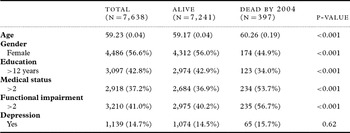
Table 1 summarizes the demographic and clinical characteristics of the sample. Overall, 395 participants (5%) died between 2000 and 2004. As expected, there were significant differences between those who died and those who survived on almost all demographic and health-related variables including: age, gender, medical conditions, and functional impairments. Older adults, males, those with a greater number of medical conditions, and those with more functional impairments were more likely to die within this period.
Demographic and clinical characteristics of the samplea

a Results are reported as frequency (%) for categorical variables and mean (SD) for continuous variables.
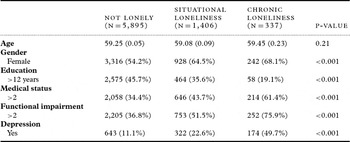
Table 2 demonstrates the distribution of demographic and clinical characteristics by loneliness status. Overall, 5,895 were classified as “not lonely”, 1,406 were classified as “situationally lonely”, and 337 as “chronically lonely”. There were significant differences across groups. Relative to those classified as not lonely, those classified as situationally/chronically lonely were more likely to be female. In addition, those classified as chronically lonely were less educated, had more medical conditions, reported greater functional impairment, and were more likely to be depressed.
Sample characteristics by lonelinessa

a Results are reported as frequency (%) for categorical variables and mean (SD) for continuous variables.
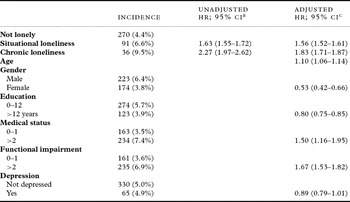
Results of the Cox regression model (Table 3) reveal that relative to the “not lonely” group (4.4% incidence), those classified as “situationally lonely” (6.6% incidence; unadjusted HR = 1.63; 95% CI: 1.55–1.72) as well as those classified as “chronically lonely” (9.5% incidence; unadjusted HR = 2.27; 95% CI: 1.97–2.62) had a greater risk of all cause mortality. Results remained similar even after adjustment for demographic and clinical characteristics (adjusted HR = 1.56; 95% CI: 1.52–1.61; adjusted HR = 1.83; 95% CI: 1.71–1.87, respectively). Thus, both classifications (situational and chronic loneliness) serve as significant risk factors for mortality, with chronic loneliness being a slightly stronger mortality risk (see Figure 1). As expected, older age, female gender, lower levels of education, more medical conditions, and higher functional impairment were also significant risk factors for all cause mortality.
Mortality risk as a function of lonelinessa

aCox proportional models were calculated. HR = Hazards Ratio, CI = Confidence Interval.
bLog likelihood = −1344.
cAdjusted for age, gender, education, medical status, functional impairment, and depression. Log likelihood = −1301.
Kaplan-Meier survival estimates.

There was no significant interaction between age and loneliness (HR = 1.01; 95% CI: 0.95–1.07) or between gender and loneliness (HR = 1.06; 95% CI: 0.53–2.12).
Discussion
The present study evaluated the effect of two types of loneliness – situational vs. chronic – upon all-cause mortality. Although previous studies explored the association between loneliness and mortality in older adults and substantiated loneliness as a mortality risk factor (Penninx et al., Reference Penninx, van Tilburg, Kriegsman, Deeg, Boeke and van Eijk1997; Herlitz et al., Reference Herlitz1998), none of these studies has evaluated chronic vs. situational loneliness as predictors of mortality. One possible reason for the absence of past research concerning this typology is the need for a longitudinal design of more than two waves. In the present study, we used three waves of the HRS as well as subsequent follow-up data concerning mortality, and classified respondents into three groups: “not lonely”, “situationally lonely” and “chronically lonely”.
In line with previous studies, perceived loneliness was found to be a risk factor for mortality (Sugisawa et al., Reference Sugisawa, Liang and Liu1994). Those classified as “situationally lonely” as well as those classified as “chronically lonely” had a greater risk for all-cause mortality net of the effect of possible demographic and health confounders, such as age, gender and disability.
We further found that individuals who reported loneliness across all three waves (i.e. classified as suffering from chronic loneliness) had a slightly greater mortality risk relative to those who reported loneliness in only one wave (i.e. “situationally lonely”). These findings were expected given the chronic negative emotional state associated with chronic loneliness. Further, chronic loneliness is often a product of prolonged interpersonal difficulties and not a result of loss or other setbacks that can, in time, be overcome (Young, Reference Young, Peplau and Perlman1982; Cacioppo et al., Reference Cacioppo2000). Nonetheless, it is important to note that being classified as suffering either from chronic or situational loneliness poses a substantial mortality risk relative to those classified as not lonely even after controlling for demographic and clinical characteristics. Thus, although some support for the classification of loneliness based on temporal data exists, our findings suggest that either type of loneliness has deleterious effects on older adults’ survival.
In this study, we did not test causal mechanisms underlying the observed association between loneliness and mortality. However, previous studies have tried to explain the deleterious effect of loneliness on physical health through several mechanisms. For instance, one striking pathway is the evidence that healthcare providers tend to provide better medical treatment to individuals with supportive networks, compared with more socially isolated individuals (Cacioppo et al., Reference Cacioppo, Hawkley and Berntson2003). Another pathway would be loneliness as a cause of disability and morbidity, which in turn also affects mortality (Sugisawa et al., Reference Sugisawa, Liang and Liu1994). Still, there is a need to investigate whether there are different mechanisms by which the two different types of loneliness – situational vs. chronic – affect mortality in later life.
One potential limitation of the present study is the fact that loneliness was evaluated using a single explicit item. This was done because this single item question was the only consistent query concerning loneliness across all three HRS waves. Obviously, using a single item is less than ideal in terms of reliability. Further, explicitly using the word “lonely” to ask about loneliness might bias reports as people try to avoid labeling themselves as such (Victor et al., Reference Victor, Scambler, Bond and Bowling2000; 2005; Pinquart and Sörensen, Reference Pinquart and Sörensen2001). Nonetheless, it is important to note that using a single-item explicit self-labeling measure of loneliness has been widely used in past research (Borys and Perlman, Reference Borys and Perlman1985; Sugisawa et al., Reference Sugisawa, Liang and Liu1994; Herlitz et al., Reference Herlitz1998; Tilvis et al., Reference Tilvis2004). We also used historically prospective datasets, in which both situational loneliness and chronic loneliness were gathered over three waves of data collection and not retrospectively based on respondents’ memory. Our study also benefits from the use of a nationally representative sample.
Conflict of interest
None.
Description of authors’ roles
S. Shiovitz-Ezra formulated the research questions and wrote the article. L. Ayalon was responsible for carrying out the statistical analysis and assisted in writing the article.