Introduction
Temperate fruit trees originate from places with low temperatures during the winter (Rohde and Bhalerão, Reference Rohde and Bhalerão2007). In autumn, there is natural leaf fall stimulated by the shortened day and the marked reduction in temperature. These weather changes stimulate the onset of the period known as dormancy (Ruiz et al., Reference Ruiz, Campoy and Egea2007). Dormancy is an adaptation mechanism developed by temperate fruit trees as a way to protect plant tissues that are sensitive to low temperatures (Campoy et al., Reference Campoy, Ruiz and Egea2011).
Temperate fruit trees need to accumulate chilling hours during the dormancy period (Pio et al., Reference Pio, Souza, Kalcsits, Bisi and Farias2019). Temperatures at or below 7.2°C are arbitrarily considered a cut-off for the accumulation of chilling hours (Minuzzi, Reference Minuzzi2018). During the dormancy period, there is a temporary suspension of growth and development. This period is characterized by several biochemical and physiological events in the meristem or nearby tissues (Anzanello et al., Reference Anzanello, Fialho, Santos, Bergamashi and Marondin2014). At the end of the dormancy period, the buds begin sprouting or flowering (Rufato et al., Reference Rufato, Kretzschmar, Bogo, Machado, Marcon Filho, Luz and Marchi2011).
Temperate fruit tree plantations have extended to subtropical regions, where temperatures are mild in winter and high in summer (Pio et al., Reference Pio, Souza, Kalcsits, Bisi and Farias2019). In subtropical regions, temperatures during the winter are not low enough for the accumulation of chilling hours. That is, most temperate fruit trees do not accumulate enough chilling hours to stimulate the natural breaking of dormancy (Erez, Reference Erez and Erez2000; Souza et al., Reference Souza, Alves, Pio, Castro, Reighard, Freire, Mayer and Pimentel2019). In this situation, it is necessary to choose cultivars that require fewer chilling hours (Souza et al., Reference Souza, Alvarenga, Pio, Gonçalves and Patto2013).
The peach tree (Prunus persica) belongs to the temperate fruit tree group. The cultivar ‘Kampai’ is a new cultivar that has been grown in subtropical regions because it requires less accumulation of chilling hours (Tadeu et al., Reference Tadeu, Pio, Silva, Olmstead, Cruz, Souza and Bisi2019). When the chilling requirement is not met during the winter, due to insufficient accumulation of chilling hours by the cultivar, there is deficient and uneven budding and reduced and irregular opening of floral and vegetative buds (Hawerroth et al., Reference Hawerroth, Petri, Leite and Herter2010a). In this case, it is necessary to use chemicals that stimulate the onset of budding and flowering (Zhuang et al., Reference Zhuang, Gao, Wen, Huo, Cai and Zhang2015).
To make up for the lack of chilling hours, the chemical inducer most used for breaking dormancy is hydrogen cyanamide (H2CN2) (Petri et al., Reference Petri, Leite, Couto and Gabardo2014). This substance is rapidly absorbed and metabolized. It acts by decreasing the activity of enzymes involved in the formation of reactive oxygen species, especially catalase (Maia et al., Reference Maia, Schwan-Estrada, Faria, Jardinetti and Botelho2013). The catalase enzyme (present in anaerobic cells) degrades hydrogen peroxide (H2O2) into one molecule of oxygen (O2) and water (H2O). With the decrease in catalase activity at the end of the dormancy period, the concentration of H2O2 in the buds increases (Goldback et al., Reference Goldback, Thaler and Wünsch1988). This increase is responsible for the activation of the pentose cycle and consequent induction of dormancy release (Omran, Reference Omran1980).
In search of alternative products for peach dormancy breaking, the effect of an agent on the activity of catalase and peroxidase enzymes would be indicative of its efficiency as an inducer of dormancy breaking. Studies recommend performing the enzymatic biochemical evaluation 24 h after the application of the products tested for breaking dormancy (Tomanková et al., Reference Tomanková, Luhová, Petřivalský, Peč and Lebeda2006; Maia et al., Reference Maia, Schwan-Estrada, Faria, Jardinetti and Botelho2013) because it is believed that the relevant biochemical reactions may occur in the first hours after application of the products. Hydrogen cyanamide has high toxicity to humans and the environment (Petri et al., Reference Petri, Leite, Couto and Gabardo2014), highlighting the need to develop efficient alternative application protocols for inducing budding. The objective of this study was to evaluate alternative products for breaking the dormancy of the ‘Kampai’ peach tree in subtropical regions.
Materials and methods
The experiment was conducted in the municipality of Barbacena, Minas Gerais (MG), Brazil (22°22′S, 43°77′W and 1173 m altitude). This site is located in the Mantiqueira mountain range of the state of Minas Gerais. According to the Köppen climate classification, this region is classified as Cwa – subtropical climate (Köppen, Reference Köppen1931). The region has cold, dry winters and hot, humid summers. The experiment was carried out from June 2018 to December 2018, June 2019 to December 2019 and June 2020 to December 2020.
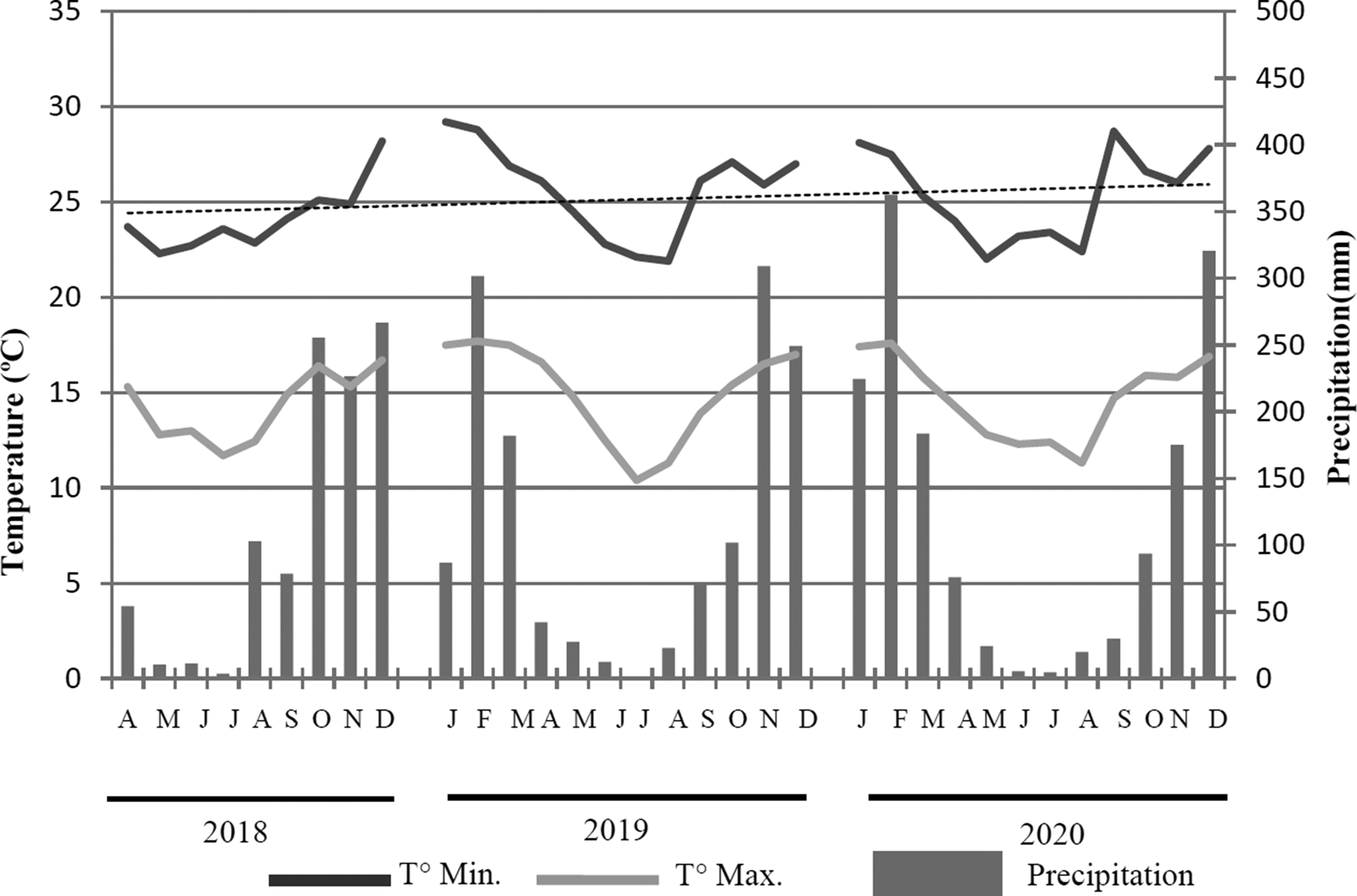
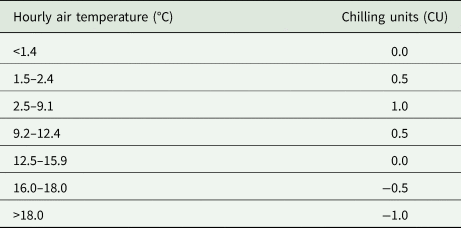
The minimum and maximum temperatures were collected daily, along with precipitation, to calculate the monthly average temperatures and cumulative precipitation (Fig. 1). These data were provided by the weather station of the municipality of Barbacena, MG. The hourly temperatures were used to calculate the chilling hours accumulated according to the Utah method (Minuzzi, Reference Minuzzi2018). In subtropical regions, located in the southern hemisphere, the period in which the refrigeration units were calculated was between the months of May and July. The method considers that temperature intervals by time of day are equivalent to a certain number of chilling units (Table 1).
Monthly precipitation and average maximum and minimum temperature from April (A) to December (D) for 2018 and from January (J) to December for 2019 and 2020.

Chilling units (CU) by the Utah method, as a function of hourly air temperature (Richardson et al., Reference Richardson, Seeley and Walker1974)

For the experiment, 7-year-old trees of the ‘Kampai’ cultivar grafted on the ‘Okinawa’ rootstock were used. The trees were grown in an open-centre system with 6.0 × 2.7 m spacing, totalling a density of 617 trees per hectare. The crop management practices were standardized throughout the experimental area with respect to fertilization and phytosanitary control, using chemicals recommended for peach cultivation. Fruit thinning was also performed, leaving four fruits on every 25 cm of branch.
The treatments consisted of (1) control; (2) hydrogen cyanamide (H2CN2); (3) Erger G®; (4) potassium nitrate and (5) copper sulphate. The treatments were applied using a backpack sprayer at 2 litres of spray solution per tree. The experimental design was a randomized block design, with five treatments, four replicates and five trees per plot, for a total of 100 trees. Only the three central trees of the plot were considered experimental trees.
Pruning was performed in June (dry pruning) and January (green pruning) each year. The treatments were applied on 18 June 2018, 12 June 2019 and 11 June 2020, immediately after pruning. After applying the treatments to break dormancy, the following were counted: days until the beginning of flowering, when 5% of the flowers had opened; duration of flowering, considering 5% flower opening and 95% flower fall; the period from fruit formation until harvest; and the total number of days between the application of the treatments and the end of the harvest.
From each experimental tree in the plot, five mixed branches an average of 25 cm long were chosen from the full circumference of the tree in the middle portion, and their number of buds was counted. These same branches supplied the buds for enzyme extraction. At full bloom, when 95% flower open was estimated, the number of flowers was counted; at 95% flower fall, the number of buds was counted; and 2 days before fruit thinning, the number of fruits was counted. Thus, the percentages of budding, flowering and effective fruiting were calculated.
At the time of harvest, all fruits of each experimental tree in the plot were placed separately in collection boxes, and the total production (kg/tree) was obtained using a scale. A representative sample of 20 fruits per plot was taken to calculate the mean fruit mass (g) using a digital analytical balance. The estimated yield (t/ha) was estimated by multiplying production per tree by the population density (617 trees per hectare).
For the physical analysis of the fruits, five fruits were selected per experimental tree per plot. Fruit size (height and width, expressed in cm) was measured using a digital caliper. The five fruits were ground to obtain homogenized pulp, and fruit quality analyses were performed: soluble solids (SS), expressed in °Brix, using a digital refractometer; titratable acidity (TA), in % citric acid by titration with 0.1 NaOH; the ratio between the total SS and total TA levels; and pH measured using a digital pH meter.
For the physiological analyses of the enzymes, the buds were collected at 1, 3, 6, 24 and 48 h after application of the products evaluated to determine the activity of the antioxidant enzymes catalase (CAT) and guaiacol peroxidase (POD). This collection only occurred in the 2020 production cycle. The triads (vegetative and floral) were placed in plastic bags, wrapped in aluminium foil, and then frozen in liquid nitrogen to immediately stop all metabolic reactions. These samples were stored in a freezer at −80°C until analysis.
The enzyme extract was obtained by maceration in liquid nitrogen of 0.2 g of buds, to which 1.5 ml of the extraction buffer containing 400 mm potassium phosphate buffer (pH 7.8), 10 mm EDTA, 200 mm ascorbic acid and polyvinylpolypyrrolidone was added. The extract was centrifuged at 13 000 g for 10 min at 4°C, and the supernatant was collected and stored at −20°C during the analysis period. The supernatants collected were submitted to CAT and POD enzyme analyses.
CAT was evaluated according to Havir and McHale (Reference Havir and Mchale1987), in which a 9 μl aliquot of the enzyme extract was added to 180 μl of the incubation medium containing 200 mm potassium phosphate (pH 7.0) and 12.5 mm hydrogen and incubated at 28°C. The activity of this enzyme was determined by the decrease in absorbance at 240 nm every 15 s for 3 min, as monitored by the consumption of H2O2. The molar extinction coefficient used was 36 mm/cm.
To determine the enzymatic activity of POD, an aliquot of enzyme extract was added to the reaction medium containing 60 μl of guaiacol (0.8%), 180 μl of 100 mm sodium phosphate buffer (pH 6.0) and 60 μl of H2O2 (0.9%) in a 3.6 ml reaction volume. The activity of this enzyme was determined by the increase in absorbance at 470 nm every 15 s for 3 min. The molar extinction coefficient used was 26.6 mm/cm (Neves, Reference Neves2003).
The data were statistically analysed by analysis of variance. In case of significance by the F test, Tukey's test was run at 5% probability. The statistical analyses were run in the System for Analysis of Variance (SISVAR) (Ferreira, Reference Ferreira2011).
Results
The values of chilling hours according to the Utah method were negative, between −2120.5 and −2250, for the years of experimental evaluation. This indicates that there was no chilling accumulation. In the first year of evaluation (2018), the values of cooling hours by the Utah method were between −2000.5 and −2200, in 2019, they ranged between −2200.5 and −2300, and in 2020, they were between −2160.5 and −2250.
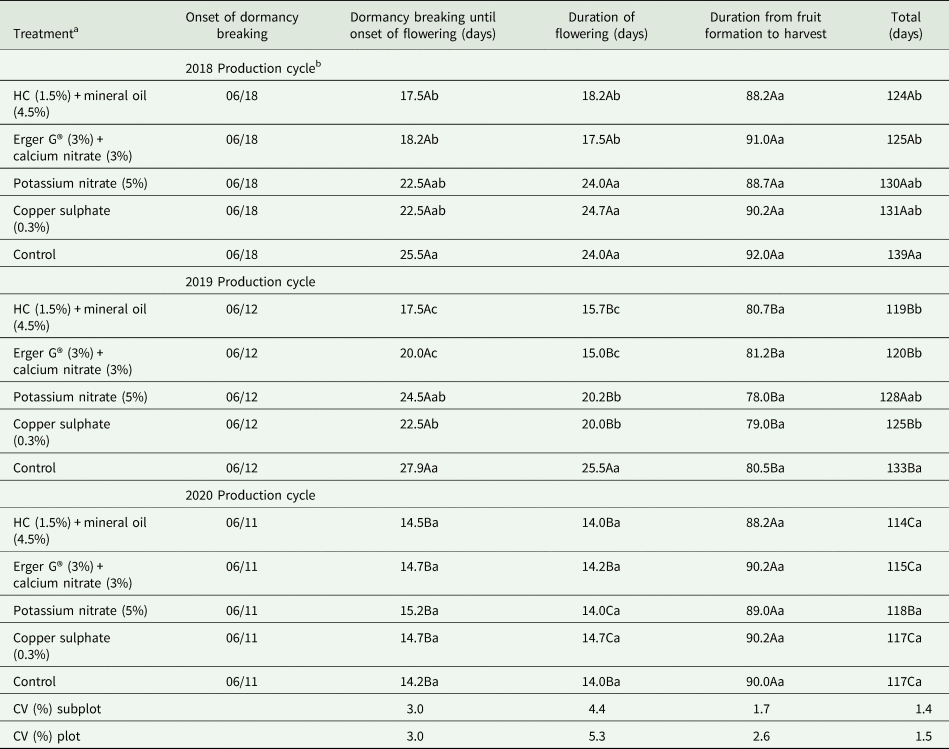
According to the statistical analysis, there was a difference in the phenological description of ‘Kampai’ peach trees only in the first two production cycles between treatment groups (Table 2). All the chemicals applied accelerated floral opening compared to the negative control (water) (Table 2). The application of hydrogen cyanamide and the organomineral fertilizer Erger G® shortened the flowering period by at least 1 week. Consequently, the application of these two chemicals reduced the period between application and the end of the harvest by 2 weeks compared to the negative control (Table 2).
Phenological description of the ‘Kampai’ peach trees according to the dormancy-breaking treatments for three growing seasons in Barbacena, MG, Brazil

a Treatments were: hydrogen cyanamide (HC) + mineral oil, organomineral fertilizer Erger G® + calcium nitrate, potassium nitrate, copper sulphate or the control composed only of water, in the 2018, 2019 and 2020 production cycles, in a subtropical region. Barbacena, MG, Brazil.
b Uppercase letters compare the production cycles, and lowercase letters compare the treatments. Means followed by the same letter do not differ by Tukey's test (P ≤ 0.05).
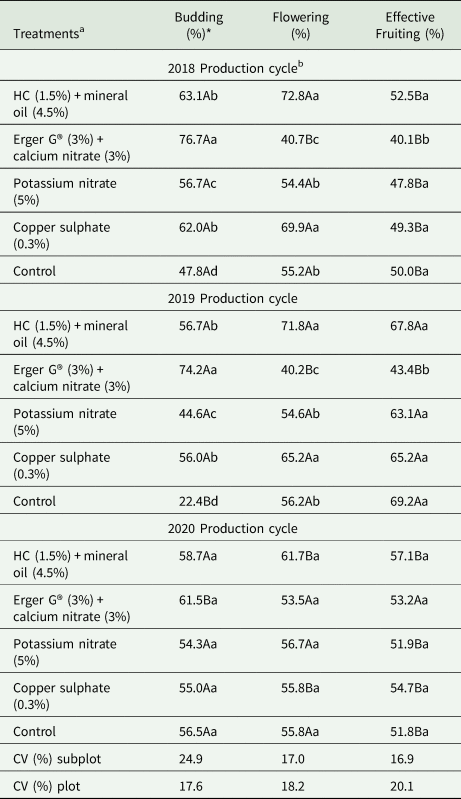
In the first two production cycles under evaluation, Erger G® promoted an increase in the percentage of budding. The applications of hydrogen cyanamide and copper sulphate also promoted an increase in budding relative to the negative control (Table 3). However, the application of Erger G® had a negative effect on flowering. This product provided the lowest percentage of flowering and effective fruiting (Table 3). On the other hand, hydrogen cyanamide and copper sulphate promoted an increase in the percentage of flowering of the peach trees.
Percentage of budding, flowering and effective fruiting in ‘Kampai’ peach trees according to dormancy-breaking treatments for three growing seasons in Barbacena, MG, Brazil

a Treatments were: hydrogen cyanamide (HC) + mineral oil, organomineral fertilizer Erger G® + calcium nitrate, potassium nitrate, copper sulphate or the control composed only of water, in the 2018, 2019 and 2020 production cycles, in a subtropical region. Barbacena, MG, Brazil.
b Uppercase letters compare the production cycles, and lowercase letters compare the treatments. Means followed by the same letter do not differ by Tukey's test (P ≤ 0.05).
* Variables were: budding (%), flowering (%), effective fruiting (%), in the 2018, 2019 and 2020 production cycles, in a subtropical region. Barbacena, MG, Brazil.
In the third production cycle evaluated (2020), there were no significant differences between the chemicals used in breaking dormancy in terms of the phenological cycle or the percentage of budding, flowering or effective fruiting (Tables 2 and 3). In the 2020 cycle, the minimum temperatures for the months of May, June and July averaged 11.8° (Fig. 1). Values below 12.5° refer to the average of the cycles of other years. Since these are the months in which cold hours accumulate, we believe that for the budding and flowering of the ‘Kampai’ peach, the exposed cold hours were sufficient, so there was no difference between the chemical products applied and the negative control.
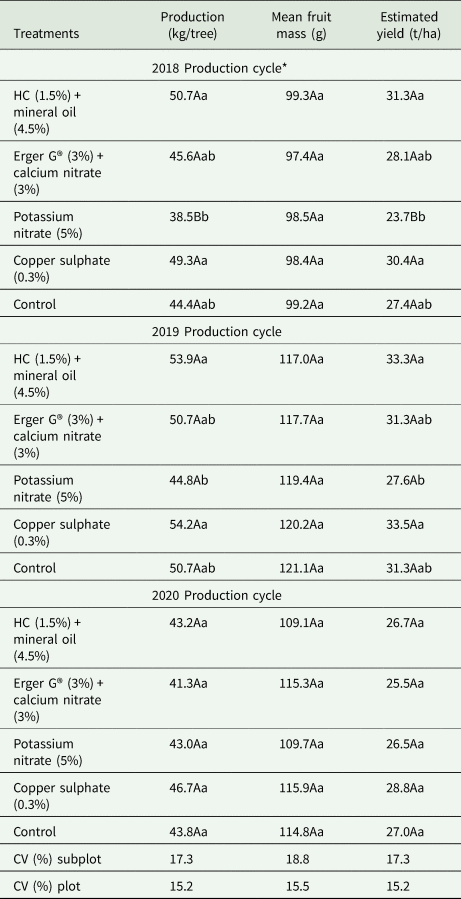
The application of hydrogen cyanamide and copper sulphate promoted an increase in peach production and consequently in the estimated yield in the first two production cycles (Table 4). This increase occurred because these chemicals promoted an increase in the percentage of flowering (Table 3).
Production (kg/tree), mean fruit mass (g) and estimated yield (t/ha) of ‘Kampai’ peach trees according to the dormancy-breaking treatments for three growing seasons in Barbacena, MG, Brazil

aTreatments were: hydrogen cyanamide (HC) + mineral oil, organomineral fertilizer Erger G® + calcium nitrate, potassium nitrate, copper sulphate, or the control composed only of water, in the 2018, 2019 and 2020 production cycles, in a subtropical region. Barbacena, MG, Brazil.
bUppercase letters compare the production cycles, and lowercase letters compare the treatments. Means followed by the same letter do not differ by Tukey's test (P ≤ 0.05).
* Variables were: production (Kg/tree), mean fruit mass (g), estimated yield (t/ha), in the 2018, 2019 and 2020 production cycles, in a subtropical region. Barbacena, MG, Brazil.
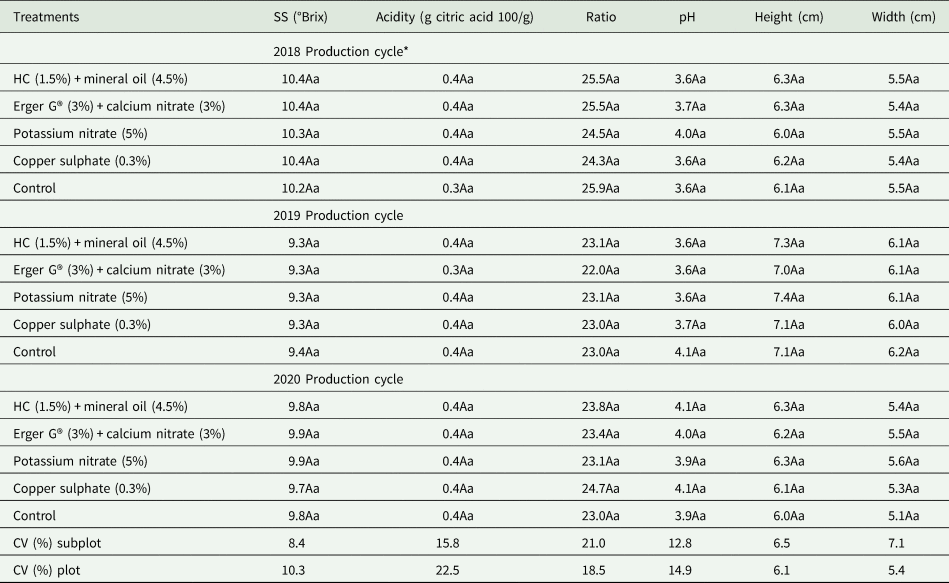
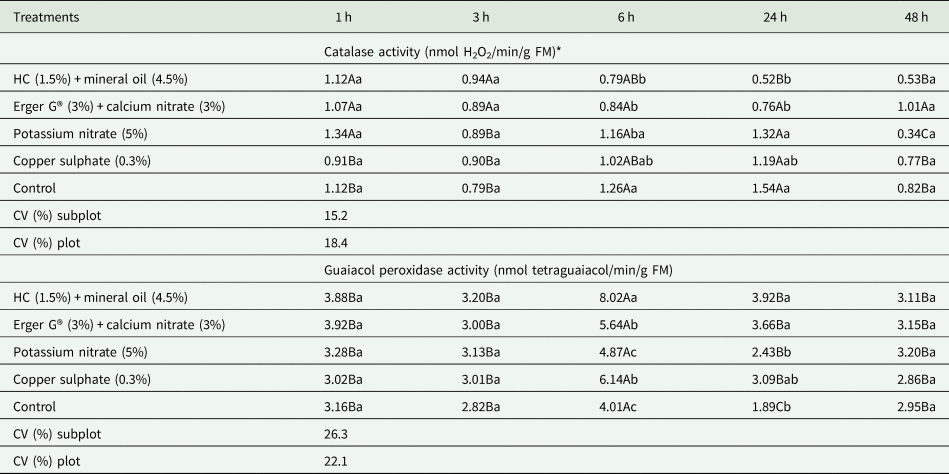
There was no difference between the negative and positive controls (treatments with chemical products) in the improvements in peach quality (Table 5). In the first 2 h after the application of the evaluated products, the activity of the antioxidant enzymes catalase (CAT) and guaiacol peroxidase (POD) was not different between groups. At 6 h, changes in the activity of CAT and POD were already recorded (Table 6). These results are important from the point of view of the evaluation of enzymatic activity in subtropical regions, which have milder winters than temperate regions. Our data suggest that enzymatic evaluations in temperate fruit trees in subtropical regions can be performed 6 h after the application of the dormancy-breaking chemicals.
Total soluble solids (expressed in °Brix), total titratable acidity (g citric acid 100/g), soluble solids and titratable acidity ratio (ratio), pH and fruit size (height and width, expressed in cm) of fruits of the peach tree ‘Kampai’ according to the dormancy-breaking treatments for three growing seasons in Barbacena, MG, Brazil

aTreatments were: hydrogen cyanamide (HC) + mineral oil, organomineral fertilizer Erger G® + calcium nitrate, potassium nitrate, copper sulphate or the control composed only of water, in the 2018, 2019 and 2020 production cycles, in a subtropical region. Barbacena, MG, Brazil.
bUppercase letters compare the production cycles, and lowercase letters compare the treatments. Means followed by the same letter do not differ by Tukey's test (P ≤ 0.05).
* Variables were: SS total soluble solids (expressed in ° Brix), total titratable acidity (g citric acid 100/g), soluble solid and titratable acidity ratio, pH, height (cm) and width (cm).
Physiological analyses of catalase (nmol H2O2/min/g FM) and guaiacol peroxidase (nmol tetraguaiacol/min/g FM) in buds of ‘Kampai’ peach branches, collected 1, 3, 6, 24 and 48 h after the application of the dormancy-breaking treatments for three growing seasons in Barbacena, MG, Brazil

aTreatments were: hydrogen cyanamide (HC) + mineral oil, organomineral fertilizer Erger G® + calcium nitrate, potassium nitrate, copper sulphate or the control composed only of water, in the 2018, 2019 and 2020 production cycles, in a subtropical region. Barbacena, MG, Brazil.
bUppercase letters compare the time (hours), and lowercase letters compare the treatments. The means followed by the same do not differ by Tukey's test (P ≤ 0.05).
* Variables were: catalase activity (nmol H2O2/min/g FM) and guaiacol peroxidase activity (nmol tetraguaiacol/min/g FM).
The CAT activity was lower in the buds of trees that were sprayed with hydrogen cyanamide and with the organomineral fertilizer Erger G®. There was a trend of lower catalase activity in the buds that received copper sulphate than the buds that received potassium nitrate or water only (Table 6). On the other hand, POD activity was highest in the buds of the trees that were sprayed with hydrogen cyanamide, followed by organomineral fertilizer Erger G® and copper sulphate. The results were similar between 6 and 24 h.
Discussion
The accumulation of chilling hours is necessary for the breaking of the dormancy phase in the buds (El-Yazal and Rady, Reference El-Yazal and Rady2013). In regions where the chilling hours are fewer than those required by a temperate fruit tree, it is necessary to use chemical products that have physiological effects to break them out of their dormant state (Pio et al., Reference Pio, Souza, Kalcsits, Bisi and Farias2019). Thus, there was a need to apply chemicals to induce the breaking of peach dormancy in the experimental area, where it is characterized by the subtropical climate, with mild winter.
The application of hydrogen cyanamide and the organomineral fertilizer Erger G® can reduce the flowering period of the ‘Imperial Gala’ and ‘Fuji Suprema’ apple trees by at least 7 days (Hawerroth et al., Reference Hawerroth, Petri, Leite and Herter2010a). In blackberry, also classified as fruit of temperate climate, the application of hydrogenated cyanamide and Erger G® anticipated flowering by 22 and 15 days, respectively (Segantini et al., Reference Segantini, Leonel, Silva Ripardo, Tecchio and de Souza2015). Long flowering periods are symptoms of insufficient chilling during the winter in temperate fruit trees grown in subtropical regions (Pio et al., Reference Pio, Souza, Kalcsits, Bisi and Farias2019).
Increased budding and uniformity of budding have been observed in ‘Imperial Gala’, ‘Suprema’ and ‘Fuji’ apple trees when applying the organomineral fertilizer Erger G® and hydrogen cyanamide (Hawerroth et al., Reference Hawerroth, Petri and Leite2010b). An increase was reported in the formation of shoots in grapevines that received Erger G® compared to water only (Rosa et al., Reference Rosa, Marodin, Fialho, Marchi and Santos2020). Thus, Erger G® can increase the budding capacity in apple and grapevines, as observed here in the ‘Kampai’ peach tree. However, unlike apple and grapevines, which have mixed buds, peach trees have floral and vegetative buds. For this reason, there was a marked difference in budding and flowering capacity in the Erger G® group. Ferreira et al. (Reference Ferreira, Leonel, Souza, Silva, Ferraz, Martins and Silva2019) also observed an increase in sprouting in ‘Kampai’ peach when applying the organomineral fertilizer Erger G®.
El-Yazal and Rady (Reference El-Yazal and Rady2012) observed an increase in budding with the use of potassium nitrate for dormancy breaking in apple trees. On the other hand, this fertilizer was not effective when applied to peach trees in the present subtropical region. Just as it was not effective in the sprouting of Almond Trees in a study carried out by Elsabagh (Reference Elsabagh2014).
No studies have been published that used copper sulphate as a substitute for hydrogen cyanamide. However, the literature indicates that oxidative stress occurs in response to the presence of heavy metals, especially copper and zinc (Maksymiec, Reference Maksymiec1998; Cuypers et al., Reference Cuypers, Vangronsveld and Clijsters1999). Thus, a controlled oxidative stress can be involved in the bud dormancy release (Hernandez et al., Reference Hernandez, Vivancos, Sánchez, Alburquerque, Martínez, Barba-Espín, Acosta-Motos, Carrera and Bruntón2021a, Reference Hernandez, Vivancos, Acosta-Motos, Alburquerque, Martínez, Carrera, Bruntón and Barba-Espín2021b).
In the improvements in peach quality, the results agree with Hawerroth et al. (Reference Hawerroth, Petri and Leite2010b) and Uber et al. (Reference Uber, Petri, Kretzschmar, Fagundes, Correa and Silveira2019) who also did not observe changes in the quality or production of apples with the application of chemicals to break dormancy. Marchi et al. (Reference Marchi, Oliari, Maia, Sato and Botelho2017) working with apple trees found changes in the activity of CAT or POD 24 h after the application of dormancy-breaking products, following the recommendations of the literature. Mohamed et al. (Reference Mohamed, Vadel and Geuns2012) found that the application of hydrogen cyanamide had an inhibitory effect on CAT activity, an effect that triggered the oxidative stress process, with an increase in H2O2 that promoted the breaking of dormancy.
When buds are exposed to cold and to chemical or natural agents, the CAT activity declines, H2O2 can accumulate inside the peroxisomes. It seems that the peroxisomal membrane is permeable to H2O2, so that excess H2O2 could also diffuse through the peroxisomal membrane into the cytosol (Del Río et al., Reference Del Río, Pastori, Palma, Sandalio, Sevilla, Corpas, Jiménez, López-Huertas and Hernández2018), thus increasing the risk of an oxidative damage in this compartment.
According to Bartosz (Reference Bartosz1997), H2O2, a reactive oxygen species, might act as a signal in response to abiotic and biotic stresses. It has been proposed that blocking glycolysis during conditions of oxidative stress could stimulate the pentose phosphate pathway (PPP) (Job et al., Reference Job, Rajjou, Lovigny, Belghazi and Job2005). The oxidation of proteins involved in glycolysis can stimulate the PPP, an alternative pathway to glycolysis that generates NADPH and pentoses. There are two distinct phases in the PPP pathway. The first is the oxidative phase (oxPPP), in which NADPH is generated, and the second is the non-oxidative synthesis of 5-carbon sugars. In non-photosynthetic cells (as occurred in the flower buds) the oxPPP is a primary source of reducing power, in the form of NADPH for inorganic nitrogen assimilation, as well as for fatty acid and nucleotide biosynthesis (Barba-Espín et al., Reference Barba-Espín, Diaz-Vivancos, Job, Belghazi, Job and Hernández2011).
Conclusions
Hydrogen cyanamide and the organomineral fertilizer Erger G® promote earlier flowering and an earlier production cycle. Erger G® stimulates budding. On the other hand, hydrogen cyanamide and copper sulphate promote greater flower opening and therefore higher peach production. These chemicals only promote improvements in milder winters. The chemicals used to break the dormancy of the ‘Kampai’ peach tree in subtropical regions stimulate a decrease in CAT activity (up to 24 h after application) and an increase in POD (6 h after application). The application of copper sulphate is an option for breaking the dormancy of peach trees in subtropical regions.
Financial support
This study was financed in part by the Coordenação de Aperfeiçoamento de Pessoal de Nível Superior – Brasil (CAPES) – Finance Code 001 and National Council for Scientific and Technological Development – CNPq. Thanks to UFLA, CNPq (Conselho Nacional de Desenvolvimento Científico e Tecnológico), CAPES (Coordenação de Aperfeiçoamento de Pessoal de Nível Superior) and FAPEMIG (Fundação de Amparo à Pesquisa do Estado de Minas Gerais) for the financial support for research.
Conflict of interest
None.
Ethical standards
Not applicable.