Introduction
Idiopathic vocal process granuloma is uncommon disease that may cause throat irritation, frequent throat clearing and voice change. The aetiology of vocal process granuloma is unclear. Most scholars believe that the most common aetiologies are laryngopharyngeal reflux, followed by arytenoid adduction asymmetry and vocal abuse,Reference Lemos, Sennes, Imamura and Tsuji1–Reference Mathew and Menon5 resulting in repetitive contact friction of the vocal process of the arytenoid cartilage, thereby causing ulceration, inflammation and granuloma formation of the mucosa with exposure of the underlying cartilage.
Vocal process granulomas are most commonly located on the vocal process, but they may occur on the arytenoid cartilage too.Reference Wang, Ko, Wang, Hu and Hsiao6,Reference Barrena, Miller and Nelson7 A consensus protocol on treatment for vocal process granulomas has not been established to date, but proton pump inhibitors and voice therapy were recommended as the first choice by most scholars.Reference Karkos, George, Van Der Veen, Atkinson, Dwivedi and Kim8–Reference Lee, Hong, Choi, Sun, Park and Lee10 Local injection was suggested for patients with no response to proton pump inhibitors, including botulinum toxin injection,Reference Pham, Campbell, Mattioni and Sataloff11 autologous fat injectionReference Hu, Hung, Lin and Chang12 and intralesional steroid injection.Reference Wang, Lai, Lo, Liao and Cheng13 If these fail and the patient remains symptomatic, then surgical excision may be considered. However, the therapeutic effect of proton pump inhibitors and voice therapy remain controversial. Lei et al.Reference Lei, Yang, Zhang and Ren14 reported a resolution rate of up to 95 per cent, although other studies reported a resolution rate of 41.3–48.6 per centReference Lemos, Sennes, Imamura and Tsuji1,Reference Lee, Hong, Choi, Sun, Park and Lee10,Reference Ma, Xiao, Ye, Yang and Wang15 and another study reported 69 per cent.Reference Hillel, Lin, Samlan, Starmer, Leahy and Flint16
The objective of the present study was to evaluate the curative effect of proton pump inhibitors combined with prokinetic agents and voice therapy on 16 patients with idiopathic vocal process granulomas.
Materials and methods
This was a prospective case series study. The study protocol was reviewed and approved by the institutional ethical review board of Yiwu Central Hospital, China. Informed consent was obtained from all participants.
Study subjects were recruited from consecutive patients diagnosed with idiopathic vocal process granulomas who visited the Department of Otorhinolaryngology, Head and Neck Surgery at Yiwu Central Hospital between January 2017 and December 2020.
The inclusion criteria were: (1) the lesion was located in the vocal process or arytenoid cartilage body at the back of the vocal fold, appearing as smooth milky white or yellow masses with a clear boundary from surrounding tissues, (2) laryngeal computed tomography showed no bone destruction and (3) patients with and without laryngopharyngeal reflux. Intubation granulomas and patients with history of laryngeal trauma or surgery were excluded from this study.
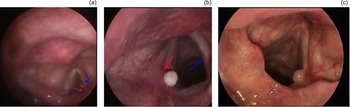
The vocal process granulomas were classified based on their position as follows. (1) Vocal process type: the lesion was restricted to only the vocal process. (2) Arytenoid cartilage body type: the lesion was restricted to only the arytenoid cartilage body. (3) Associated area type: the lesion involved the vocal process and arytenoid cartilage body (Figure 1).
Endoscopic images showing position clarity for (a) vocal process type, (b) arytenoid cartilage body type and (c) associated area type. Red arrows indicate arytenoid cartilage body and blue arrows indicate the vocal process.

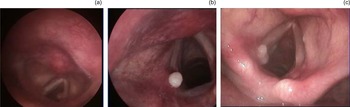
Location of granulomas was also classified based on their relation to the rima glottidis area as follows. (1) Medial type: the lesion was on the margin of the vocal process or arytenoid cartilage and toward the rima glottidis. (2) Surface type: the lesion was above the vocal process or arytenoid cartilage at the supraglottic level (higher on the arytenoids). (3) Mixed type: the lesion was both toward the rima glottidis and higher on the arytenoids (Figure 2).
Endoscopic images showing location clarity for (a) medial type, (b) surface type and (c) mixed type.

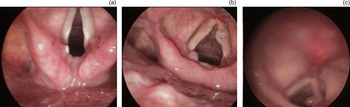
In addition, the morphology of granulomas was also classified based on their endoscopic appearance, as follows: (1) ulceration type, (2) cyst type and (3) granulation type (Figure 3).
Endoscopic images showing morphology clarity for (a) ulceration type, (b) cyst type and (c) granulation type.

The granulomas were graded based on size as follows: grade I, sessile, non-ulcerative granuloma limited to the vocal process; grade II, pedunculated or ulcerated granuloma limited to vocal process; grade III, granuloma extending past the vocal process but not crossing midline of the airway in the fully abducted position; and grade IV, granulomas extending past vocal process and past the midline of the airway in the fully abducted position.Reference Farwell, Belafsky and Rees17
The diagnosis of laryngopharyngeal reflux was based on a Reflux Symptom Index score of more than 13 and a Reflux Finding Score more than 7.Reference Boom, Edens and Rinia18
The age, sex, side, position and location of the granuloma, size and morphology of the granuloma, acid reflux, and proton pump inhibitor treatment course were recorded in all patients. Proton pump inhibitors (pantoprazole, 10 mg) were given twice daily and vocal hygiene education was given for at least 8 weeks and at most 20 weeks. The course of the treatment was divided into 10 weeks, 12 weeks, 16 weeks and 20 weeks. Complete remission was defined as no recurrence at three months’ follow-up after the resolution of the granuloma. Fisher's exact test was used to compare the difference in relevant factors of complete remission.
Results
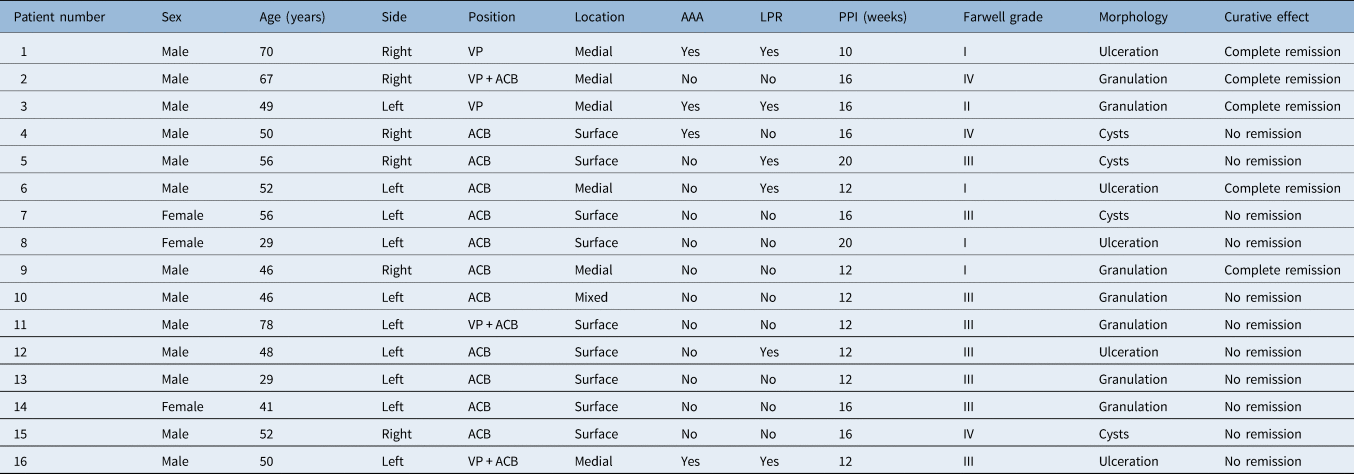
Sixteen patients with vocal process granulomas were included in this study. The mean age was 51.19 ± 9.08 (range, 29–70) years, and 3 patients (18.7 per cent) were female and 13 patients (81.3 per cent) were male. All the granulomas were unilateral: 6 patients (37.5 per cent) had right-side granulomas and 10 patients (62.5 per cent) had left-side granulomas. Granulomas were located on the vocal process in 2 patients (12.5 per cent), on the arytenoid cartilage body in 11 patients (68.8 per cent) and in the associated area in 3 patients (18.7 per cent). Granulomas were of medial type in 6 patients (37.5 per cent), surface type in 9 patients (56.2 per cent) and mixed type in 1 patient (6.3 per cent). Four patients (25.0 per cent) were grade I, 1 patient was grade II (6.3 per cent), 8 patients were grade III (50.0 per cent) and 3 patients were grade IV (18.7 per cent). Of the 16 patients, arytenoid adduction asymmetry was found in 4 patients (25.0 per cent), and 6 patients (37.5 per cent) had laryngopharyngeal reflux and 10 patients had no laryngopharyngeal reflux (62.5 per cent; Table 1).
Patient profiles

AAA = arytenoid adduction asymmetry; LPR = laryngopharyngeal reflux; PPI = proton pump inhibitor; VP = vocal process; ACB = arytenoid cartilage body
Therapeutic effect
Of the 16 patients, the mean proton pump inhibitor treatment time was 14.38 ± 2.63 (range, 10–20) weeks, and 5 patients (31.25 per cent) achieved complete remission (Table 2). Comparing complete remission rates between ages, 2 of 7 patients (28.6 per cent) of 29–49 years and 3 of 9 patients (33.3 per cent) more than 50 years achieved complete remission (p = 1.000). With regard to sex and complete remission rates, 5 of 13 men (38.5 per cent) and 0 of 3 women (0.0 per cent) achieved complete remission (p = 0.296). When comparing remission rates between the left and right side, 3 of 6 (50 per cent) right-side granulomas and 2 of 10 (20 per cent) left-side granulomas achieved complete remission (p = 0.299).
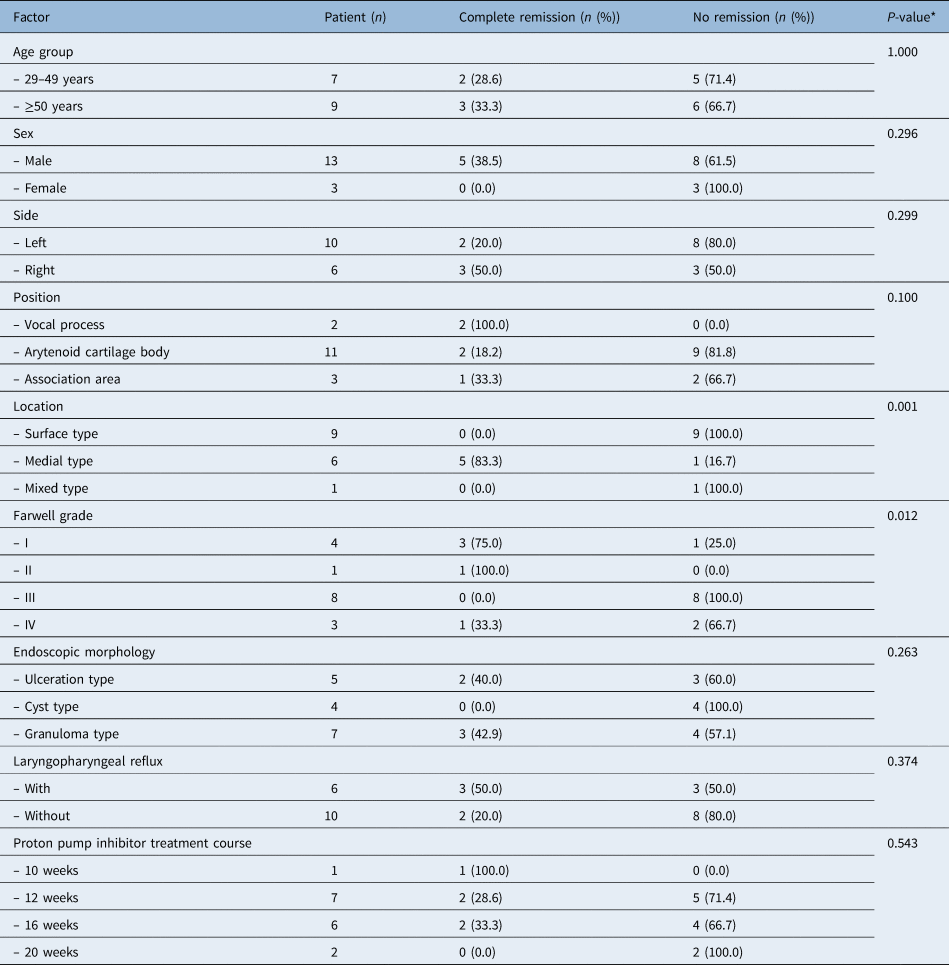
Univariate analysis of prognostic factors of complete remission of vocal process granulomas
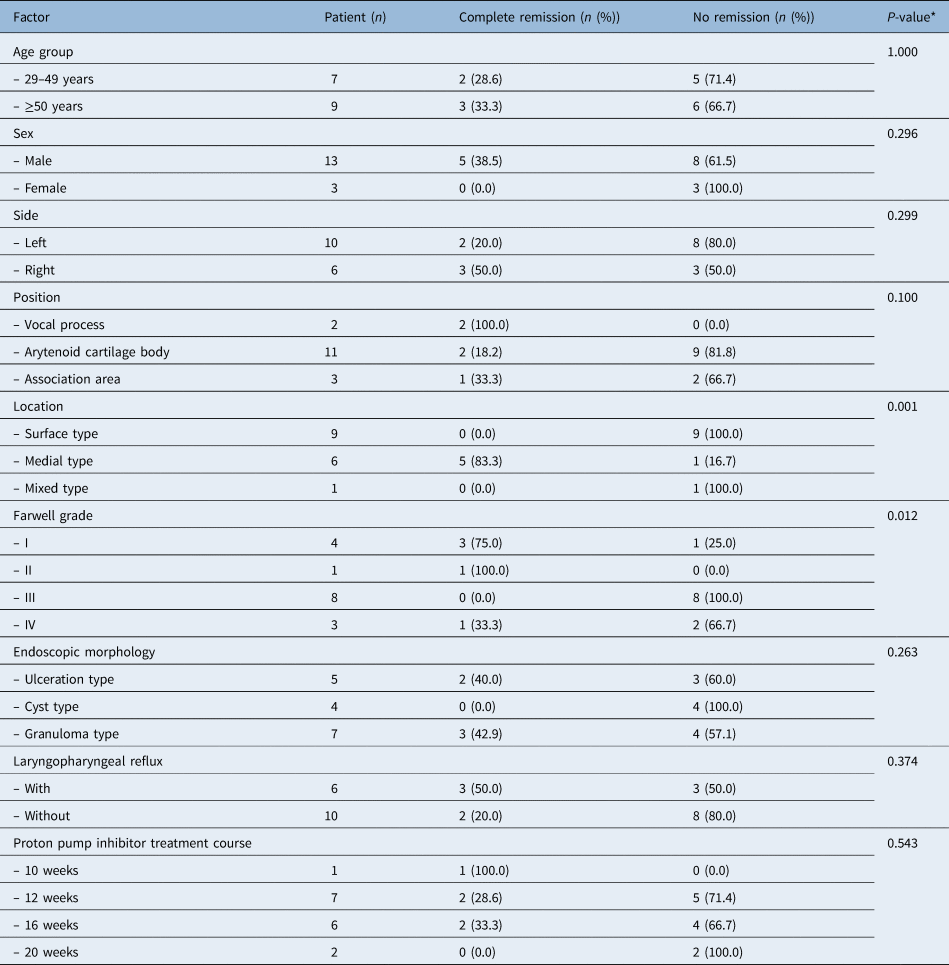
*P-value: Fisher's exact test
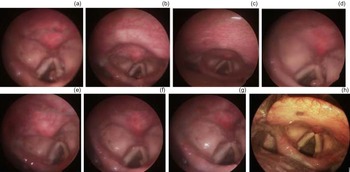
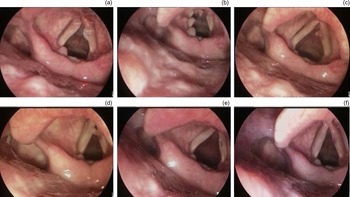
Comparing complete remission rates with regard to position, 2 of 2 (100.0 per cent) occurrences on the vocal process, 2 of 11 (18.2 per cent) on the arytenoid cartilage body and 1 of 3 (33.3 per cent) in the associated area achieved complete remission (p = 0.100; Figure 4). With regard to complete remission rates for location, 0 of 9 (0.0 per cent) surface type, 5 of 6 (83.3 per cent) medial type and 0 of 1 (0.0 per cent) mixed type achieved complete remission (p = 0.001; Figure 5). When comparing complete remission rates for size, 3 of 4 (75 per cent) grade I granulomas, 1 of 1 (100.0 per cent) grade II granulomas, 0 of 8 (0.0 per cent) grade III granulomas and 1 of 3 (33.3 per cent) grade IV granulomas achieved complete remission (p = 0.012).
Endoscopic images from a 67-year-old male. (a) Granuloma in the vocal process, (b) 2 weeks post-proton pump inhibitor treatment, (c) 4 weeks post-proton pump inhibitor treatment, (d) 6 weeks post-proton pump inhibitor treatment, (e) 9 weeks post-proton pump inhibitor treatment, (f) 11 weeks post-proton pump inhibitor treatment, (g) 14 weeks post-proton pump inhibitor treatment and (h) 12 months post-proton pump inhibitor treatment.

Endoscopic images from a 56-year-old female. (a) Granuloma in the arytenoid cartilage body, (b) 1 week post-proton pump inhibitor treatment, (c) 3 weeks post-proton pump inhibitor treatment, (d) 7 weeks post-proton pump inhibitor treatment, (e) 13 weeks post-proton pump inhibitor treatment and (f) 18 weeks post-proton pump inhibitor treatment.

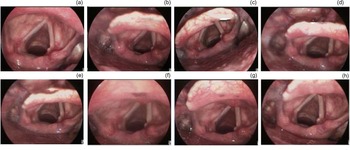
Comparing complete remission rates for endoscopic morphology, 2 of 5 (40.0 per cent) ulceration type occurrences, 0 of 4 (0.0 per cent) cyst type occurrences and 3 of 7 (42.9 per cent) granulation type occurrences achieved complete remission (p = 0.263; Figure 6). With regard to complete remission rates for laryngopharyngeal reflux, 3 of 6 (50.0 per cent) occurrences of laryngopharyngeal reflux and 2 of 10 (20.0 per cent) occurrences without laryngopharyngeal reflux achieved complete remission (p = 0.374). When comparing complete remission rates of proton pump inhibitor treatment course, 1 of 1 (100.0) using proton pump inhibitors for 10 weeks, 2 of 7 (28.6 per cent) using proton pump inhibitors for 12 weeks, 2 of 6 (33.3 per cent) using proton pump inhibitors for 16 weeks and 0 of 2 using proton pump inhibitors for 20 weeks (0.0 per cent) achieved complete remission (p = 0.543).
Endoscopic images from a 56-year-old male. (a) Granuloma showed granulation type of arytenoid cartilage body, (b) 1 week post-proton pump inhibitor treatment, (c) 2 weeks post-proton pump inhibitor treatment, (d) 14 weeks post-proton pump inhibitor treatment, (e) 16 weeks post-proton pump inhibitor treatment, (f) 18 weeks post-proton pump inhibitor treatment, (g) 20 weeks post-proton pump inhibitor treatment and (h) 22 weeks post-proton pump inhibitor treatment.

The complete remission rate for granulomas was not significantly related to age (p = 1.000), sex (p = 0.296), side (p = 0.299), position (p = 0.100), endoscopic morphology (p = 0.263), acid reflux (p = 0.374) or proton pump inhibitor treatment course (p = 0.543) but was significantly associated with granuloma location (p = 0.001) and granuloma size (p = 0.012). Unfortunately, multiple regression analysis for the related factors was not performed because of the small sample size.
Discussion
The aetiology of vocal process granulomas is not completely understood. The generally accepted view is that laryngeal-pharynx reflux plays a significant role in the cause of vocal process granulomas. Reflux is seen in 30 to 76 per cent of cases of vocal process granuloma.Reference Havas, Priestley and Lowinger19 Lei et al.Reference Lei, Yang, Zhang and Ren14 reported that 27 of 46 (58.7 per cent) patients with vocal process granulomas had acid reflux based on diagnosis of Reflux Symptom Index and Reflux Finding Score. A total of 47 per cent of vocal process granulomas were accompanied with acid reflux in the present study. However, Wani et al.Reference Wani and Woodson20 reported that laryngopharyngeal reflux was confirmed in only 24 per cent of vocal process granulomas. Some studies suggest that vocal process granulomas could be related to arytenoid adduction asymmetry.Reference Mathew and Menon5 Carroll et al.Reference Carroll, Gartner-Schmidt, Statham and Rosen3 reported that 53 per cent of patients had underlying glottal insufficiency. We observed that 5 of 16 (31.2 per cent) cases had underlying glottal insufficiency in this study. Others believe that vocal process granulomas can be associated with unilateral superior laryngeal nerve paresis, potentially related to altered contact points between the vocal processes of the arytenoids.Reference Halum, Miller and Early21 We believe that this cause may well explain the formation of vocal process granulomas. A suddenly hyperfunctional voice could result in the abnormal contact of one side of the vocal process and contralateral arytenoid cartilage body for the patients with unilateral superior laryngeal nerve paresis, thereby causing trauma and chronic inflammation of the arytenoid cartilage body and gradual formation of vocal process granulomas. This is the reason why the occurrence of vocal process granulomas in the arytenoid cartilage body was significantly higher than for the vocal process in this study.
Lee et al.Reference Lin, Cheng and Su22 explained that laryngeal denervation (paresis or paralysis) resulting in aerodynamic incompetence and supraglottic compensatory activity can also lead to the posterior vocal process granuloma formation, often at the supraglottic level (higher on the arytenoids). If superior laryngeal nerve paresis was recovered and voice rest was maintained, the abnormal contact would be improved and the granuloma would go into spontaneous remission. In addition, similar to another study, the occurrence of vocal process granulomas on the left side was significantly higher than that of the right side.Reference Hillel, Lin, Samlan, Starmer, Leahy and Flint16,Reference Lee, Yoon, Lee and Lim23 Idiopathic vocal fold paralysis is more common on the left side compared with the right; similarly, superior laryngeal nerve paresis is more common on the left side compared with the right. This may explain the reason why the occurrence of vocal process granulomas was the most common on the left side.
On the contrary, it is difficult to explain granulomas being caused by acid reflux. Many patients with hiatal hernias and laryngopharyngeal reflux do not have contact granulomas.Reference Ward, Zwitman, Hanson and Berci4 Some cases with vocal process granulomas and acid reflux failed to respond to proton pump inhibitor treatment. In our study, only 50 per cent of cases with vocal process granulomas and laryngopharyngeal reflux achieved complete remission. de Lima Pontes et al.Reference de Lima Pontes, De Biase and Gadelha24 reported a success rate of 75 per cent using anti-reflux treatment for only those patients with proven gastroesophageal reflux disease. Although some patients had a good response for proton pump inhibitors, it was difficult to explain whether the effect was because of proton pump inhibitor treatment or other treatments. Other studies reported that a few patients with vocal process granulomas went into spontaneous complete remission after simple observation.Reference Wang, Ko, Wang, Hu and Hsiao6,Reference Lee, Hong, Choi, Sun, Park and Lee10 Lee et al.Reference Lee, Hong, Choi, Sun, Park and Lee10 reported that 20.5 per cent of patients had spontaneous remission without any therapy. One explanation is that acid reflux should theoretically result in equal opportunity of bilateral sides or right dominance (most people sleep supine on the right). Nevertheless, the exact mechanisms of vocal process granulomas remain to be further studied.
A reliable system for grading vocal process granulomas is lacking at present. Although Farwell et al.Reference Farwell, Belafsky and Rees17 presented an endoscopic grading system, it was only suitable for the assessment of granuloma size. The grading system was based on the degree of granuloma extending past the vocal process and the midline of the airway but ignored the granuloma extending to posterior arytenoid cartilage body or corniculate cartilage. The granulomas were classified as vocal process type, arytenoid cartilage body type and associated area type based on their origin in this study, and thereby the relation between proton pump inhibitor treatment effect and origin was investigated. In addition, the granulomas were classified as medial type, surface type and mixed type based on whether the granulomas were on the surface or margin of vocal process and arytenoid cartilage body. Theoretically, the marginal granuloma could be related to hyperfunctional voice use and abuse, which would improve by voice rest or correction of voice use. Granulomas of the arytenoid cartilage body and superficial granulomas of the vocal process could be related to motion abnormality of arytenoid cartilage. Thus, these classifications were useful for evaluating the efficacy of proton pump inhibitors and voice therapy on the idiopathic vocal process granulomas. In addition, granulomas were subjectively classified as ulceration type, cyst type and granulation type based on the endoscopic appearance. This classification may be used for preliminary evaluation of granulation morphology and efficacy; however, further classification remains to be further studied.
Proton pump inhibitor therapy for 2–4 months was recommended by most scholars.Reference Emami, Morrison, Rammage and Bosch25 Large dosage and prolonged period of treatment may result in osteoporosis.Reference Chou, Jiang, Chen, Ho and Lee26–Reference Park, Lee, Yu, Jung, Han and Kim28 The treatment of 10–20 weeks in this study was consistent with the suggestion of most studies; thus, its efficacy may be compared with the literature. The complete remission rate was 31.25 per cent following proton pump inhibitor treatment in this study, similar to other studies, which reported a complete remission rate of 41.3–48.6 per cent.Reference Lemos, Sennes, Imamura and Tsuji1,Reference Lee, Hong, Choi, Sun, Park and Lee10,Reference Ma, Xiao, Ye, Yang and Wang15 However, the complete remission rate found by Hillel et al.Reference Hillel, Lin, Samlan, Starmer, Leahy and Flint16 was 69 per cent and by Wani et al.Reference Wani and Woodson20 was 77.8 per cent. Although Lei et al.Reference Lei, Yang, Zhang and Ren14 reported that esomeprazole plus mosapride citrate were used and achieved the complete remission rate of 95 per cent, the reliability of this study is questionable.
In this study, complete remission was defined as no recurrence after three months’ follow up after the resolution of granuloma. Although the follow-up time of three months is short, it is well beyond the typically reported recurrence window of six weeks.Reference Emami, Morrison, Rammage and Bosch25 We evaluated the correlation between complete remission of granulomas and related factors. Although multiple regression analysis of the related factors was not performed because of the small sample size, we determined the factors that influence complete remission. This initial study showed that the complete remission rate of vocal process granulomas was 31.25 per cent and was only significantly related to the position and size of vocal process granulomas but was not significantly associated with other factors. The complete remission rate of vocal process granulomas of medial type was significantly higher compared with the surface type.
• Granuloma location may indicate the efficacy of anti-reflux treatment
• Granulomas in the vocal fold and the margin of the vocal process had excellent response to proton pump inhibitors
• Granulomas on the surface of vocal process and arytenoid cartilage body had little response to proton pump inhibitors
• A prolonged period of proton pump inhibitor treatment did not increase the complete remission rate for vocal process granulomas
Pham et al.Reference Pham, Campbell, Mattioni and Sataloff11 reported that all the granulomas were located on the surface of the arytenoid cartilage body for two patients with recurrence of the granuloma following intralesional steroid injection and surgical excision. Hamdan et al.Reference Hamdan, Khalifee, Jaffal and Ghanem29 and Fink et al.Reference Fink, Achkar, Franco and Song30 each reported that eight patients with granuloma resistant to anti-reflux therapy were also located on the surface of the arytenoid cartilage body. In addition, the complete remission the rate of vocal process granulomas of grade I was significantly higher compared with grades III and IV. This finding may be easily understood. Similar to a vocal cord polyp, some polyps of the margin of the vocal fold may completely disappear after voice rest, whereas the polyps on the surface of vocal fold usually require surgical excision. We speculate that the aetiology and pathogenesis of vocal process granulomas of medial type and surface type could be different. The drawback of this study was a small sample size and the lack of 24-hour pH monitoring. In addition, all the classifications of position, location and morphology were based on endoscopic observation by naked eye.
Competing interests
None declared