Introduction
In 1947, a short cist was discovered at Staarvey Farm on the Isle of Man. Excavation yielded two ceramic vessels, cremated human remains and a lithic assemblage. Osteological examination of the cremated remains was undertaken by Michelle Gamble in 2016 as part of the ‘Round Mounds of the Isle of Man’ project (Gamble Reference Gamble2017a). Discovered among them was a rare bone knife pommel along with 20 other previously unknown animal-bone objects, including 14 bead fragments, a toggle, a bone point and four enigmatic worked bone artefacts (hereafter ‘bone oblongs’). The pommel is the first to be identified from the Isle of Man, and the bone oblongs have no known comparators. These discoveries prompted a wider analysis of Early Bronze Age burials that share some of the traits of the Staarvey burial deposit, and a consideration of the importance of bone grave goods during the period.
This article adopts a multi-dimensional, relational typological approach to burial assemblages (Fowler Reference Fowler2017). Traditional typological analyses assess the form of a single object in relation to others of the same type. In contrast, the approach employed here examines each mortuary assemblage as a combination of traits, comparing one mortuary deposit with others that share several such traits. By considering the type and location of the burial feature, the range of artefact types present, the form, material and decoration of such artefacts and the treatment of human remains and artefacts, it is possible to identify similar burial assemblages and then consider the specific differences between them. Comparison operates at a large geographic scale in order to detect local and regional spheres of interaction. Working beyond a single artefact corpus highlights how similar yet different assemblages were combined in burial contexts in creative and reflexive ways. As such, this approach moves beyond culture-historical models in which geographically bounded communities repeatedly perform traditional practices. This article employs this relational typological approach to identify overlapping spheres of funerary practice across central Britain, including the deployment of knife pommels in ways that contrast with southern England. This research thereby contributes to discussions of methods for analysing burial assemblages and regionality in the past.
The burial context
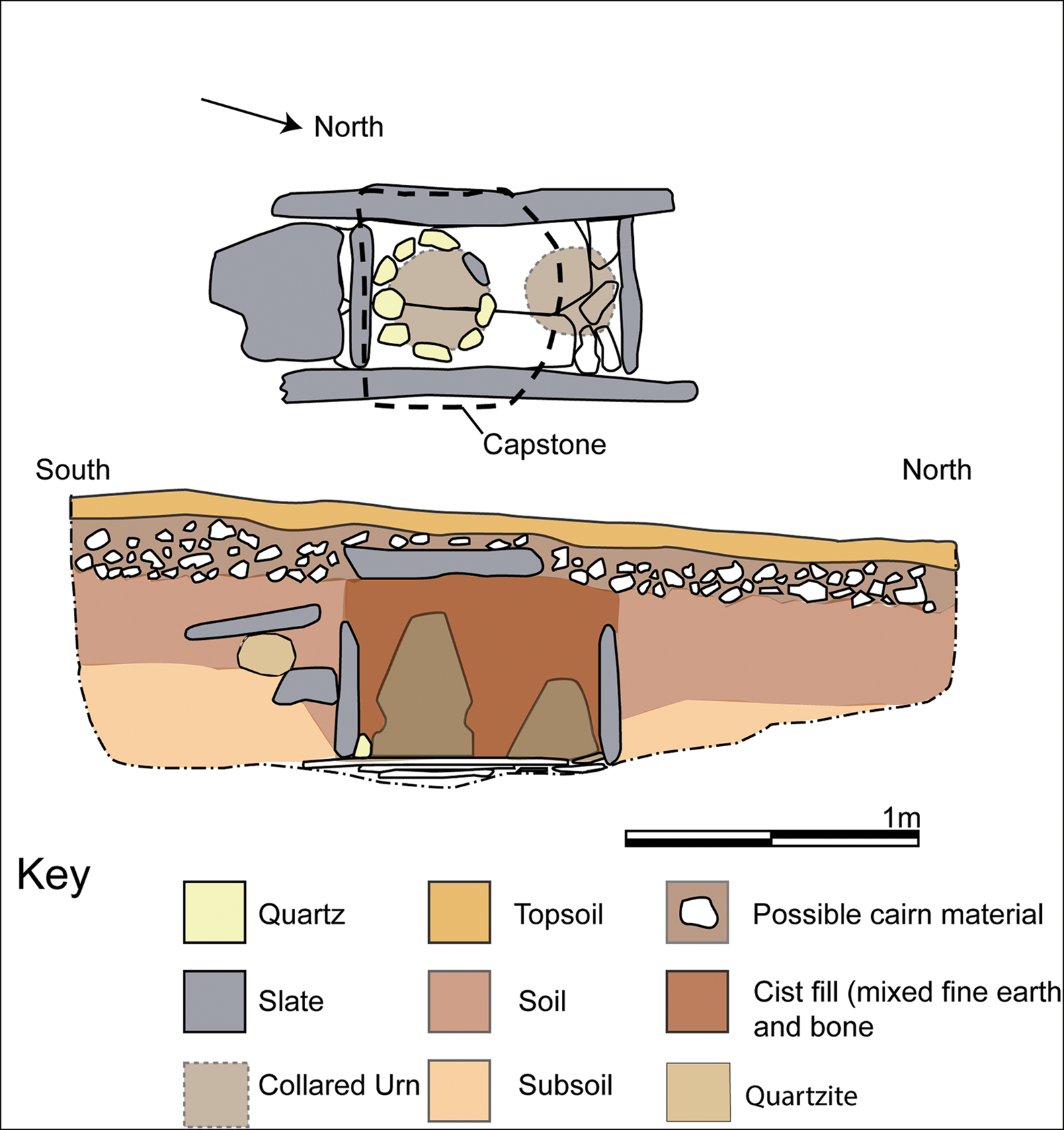
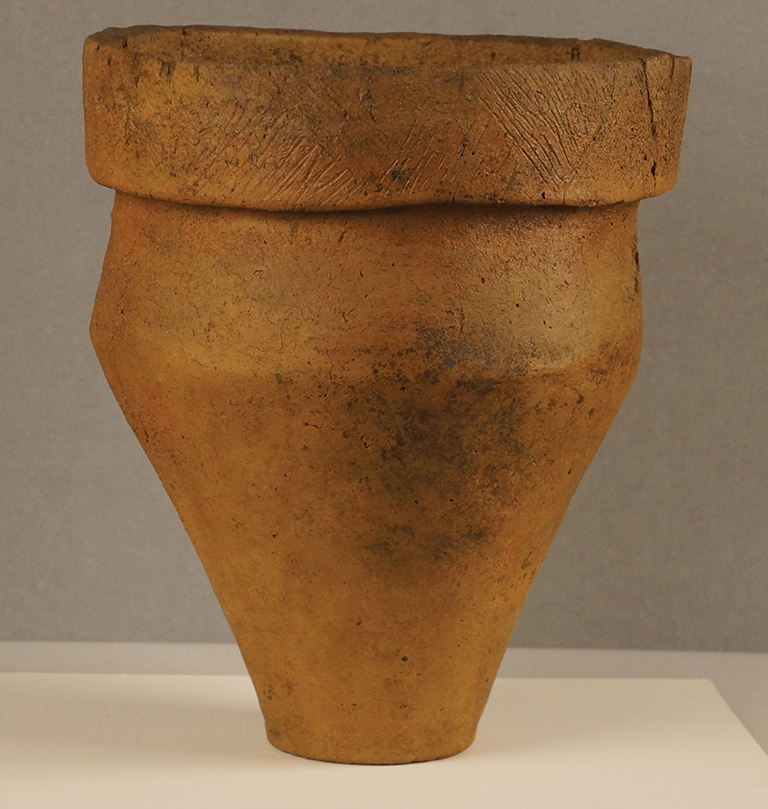
A short cist (0.91m long × 0.61m wide) made from slate slabs at Staarvey Farm in German parish was excavated by Basil Megaw in 1947, but remained unpublished until 1999 (Woodcock Reference Woodcock and Davey1999) (Figure 1). Two inverted vessels were found within the cist: a Collared Urn (Figure 2) and a vessel that had lost its rim and was broken into 22 sherds, including two sherds with an incised lattice design and two sherds with an applied cordon (Longworth Reference Longworth1984: 214, fig. 104d; Woodcock Reference Woodcock and Davey1999: 93–95). A ring of pebbles, all but one of which were quartz, surrounded the Collared Urn. A burnt plano-convex flint knife and a burnt flint endscraper were also found, although their exact locations within the cist were not recorded. Cremated bones were found beneath both inverted vessels, elsewhere in the cist and spilled beyond the south end of the cist (perhaps when the capstone was displaced) (Woodcock Reference Woodcock and Davey1999).
Cist burial at Staarvey Farm, based on illustrations by J. Woodcock (Reference Woodcock and Davey1999) (image by R. Crellin).

Collared Urn from the Staarvey Farm cist (image by R. Crellin, with permission of the trustees of Manx National Heritage).

The human remains
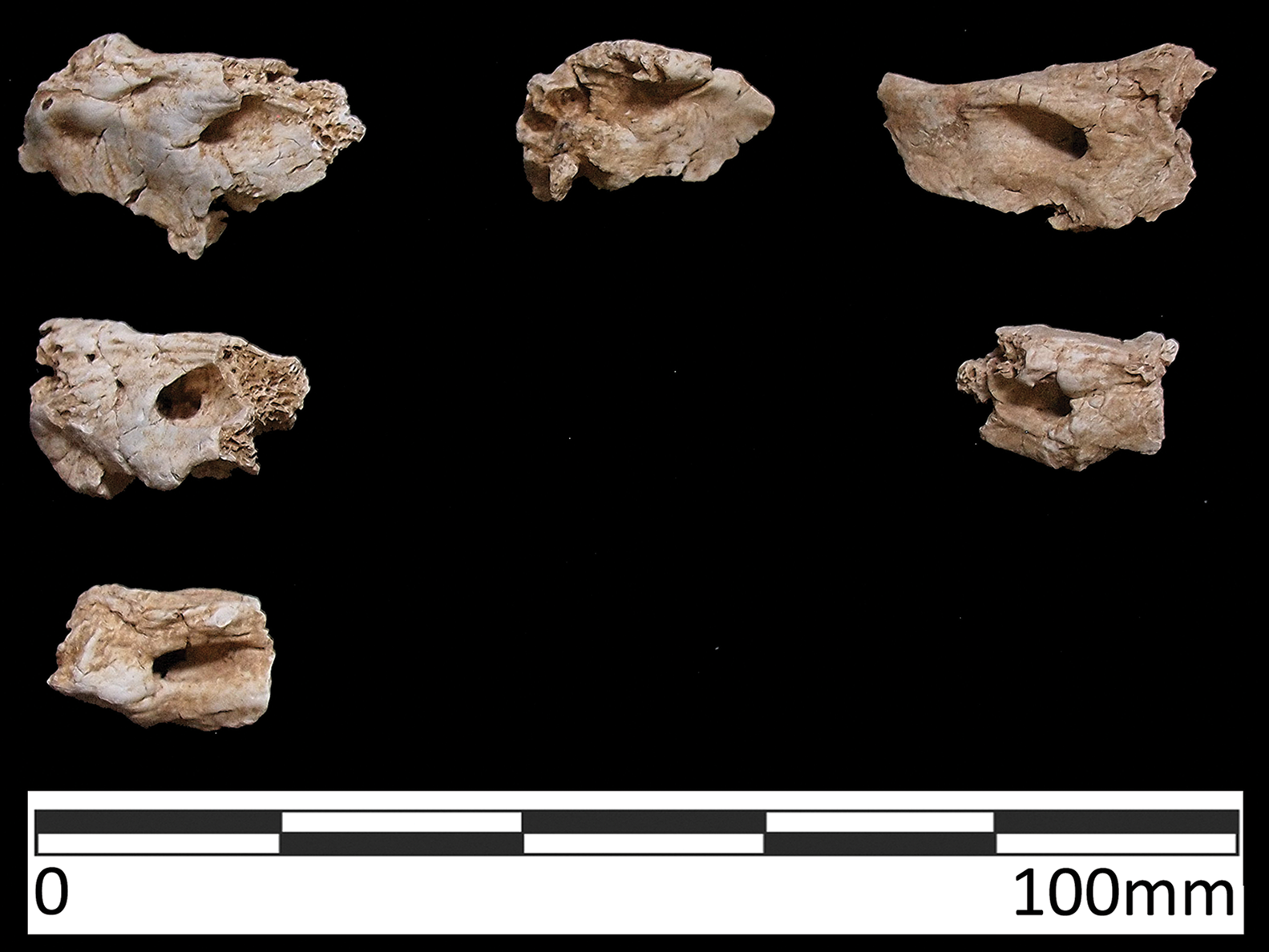
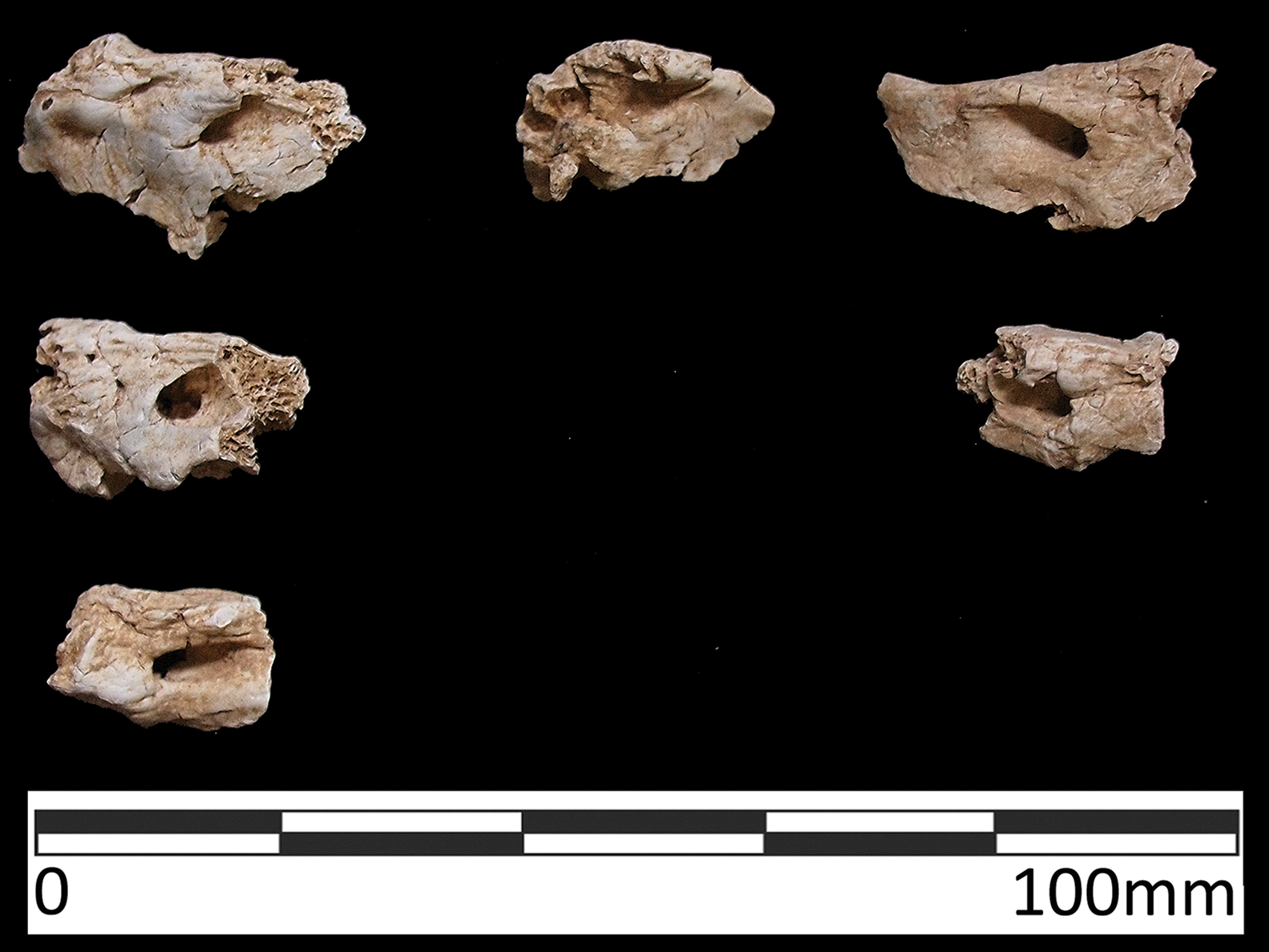
The human remains from Staarvey Farm were examined at the Manx Museum, employing standard methods of observation and analysis (Buikstra & Ubelaker Reference Buikstra and Ubelaker1994; McKinley Reference McKinley, Brickley and McKinley2004). The material was sieved through a 2mm mesh (pre-sieved weight 4410.14g; sieved bone weight 3268.40g). Only a small amount of charcoal was present. The skeletal material was calcined white, creamy white or grey-white, and showed significant warping, cracking, transverse checking and longitudinal fracturing. It was highly fragmented, with relatively few large (>15mm) pieces. A minimum of four individuals were identified, based on fragments of the left petrous portion of the temporal bone (Figure 3). At least two adults are represented, with a supra-orbital rim fragment of the frontal bone and the robusticity of several cranial fragments suggesting that one individual was probably male. There is one adolescent, aged 10–15 years at death, based on the presence of unfused long bone epiphyses from a left proximal humerus and from an unsided proximal radius. Limited remains of an infant/child, aged one to three years at death, were also identified. Portions of all parts of the body were identified, including 35 hand phalanx fragments. The total bone weight of 3268.40g for four individuals, one of which is an adolescent and one an infant, suggests that most, but not all, of the cremated bone from the older individuals was buried in the cist (for burial weight discussions, see McKinley Reference McKinley1993, Reference McKinley, Grupe and McGlynn2016; van Deest et al. Reference van Deest, Murad and Bartelink2011; Gonçalves et al. Reference Gonçalves, Campanacho, Thompson, Mataloto and Thompson2015).
Petrous portions of the temporal bone from a minimum of four individuals (image by M. Gamble, with permission of the trustees of Manx National Heritage).
These observations suggest that complete, fleshed bodies were burned and then carefully collected from the pyre site. The high degree of fragmentation suggests that the bones may have been manipulated while still hot (Thompson et al. Reference Thompson, Gonçalves, Squires, Ulguim, Schotsmans, Márquez-Grant and Forbes2017: 320–22). While it is not possible to know whether the individuals were cremated together or separately, the cremation process appears to have been consistent across all the remains. It is also not possible to reconstruct which bones came from which locations within the cist, or to ascertain whether bones were deposited in one or several events. Three of the human bone fragments may have been worked (see the online supplementary material (OSM)).
Bone artefacts found within the cremated human remains
The pommel
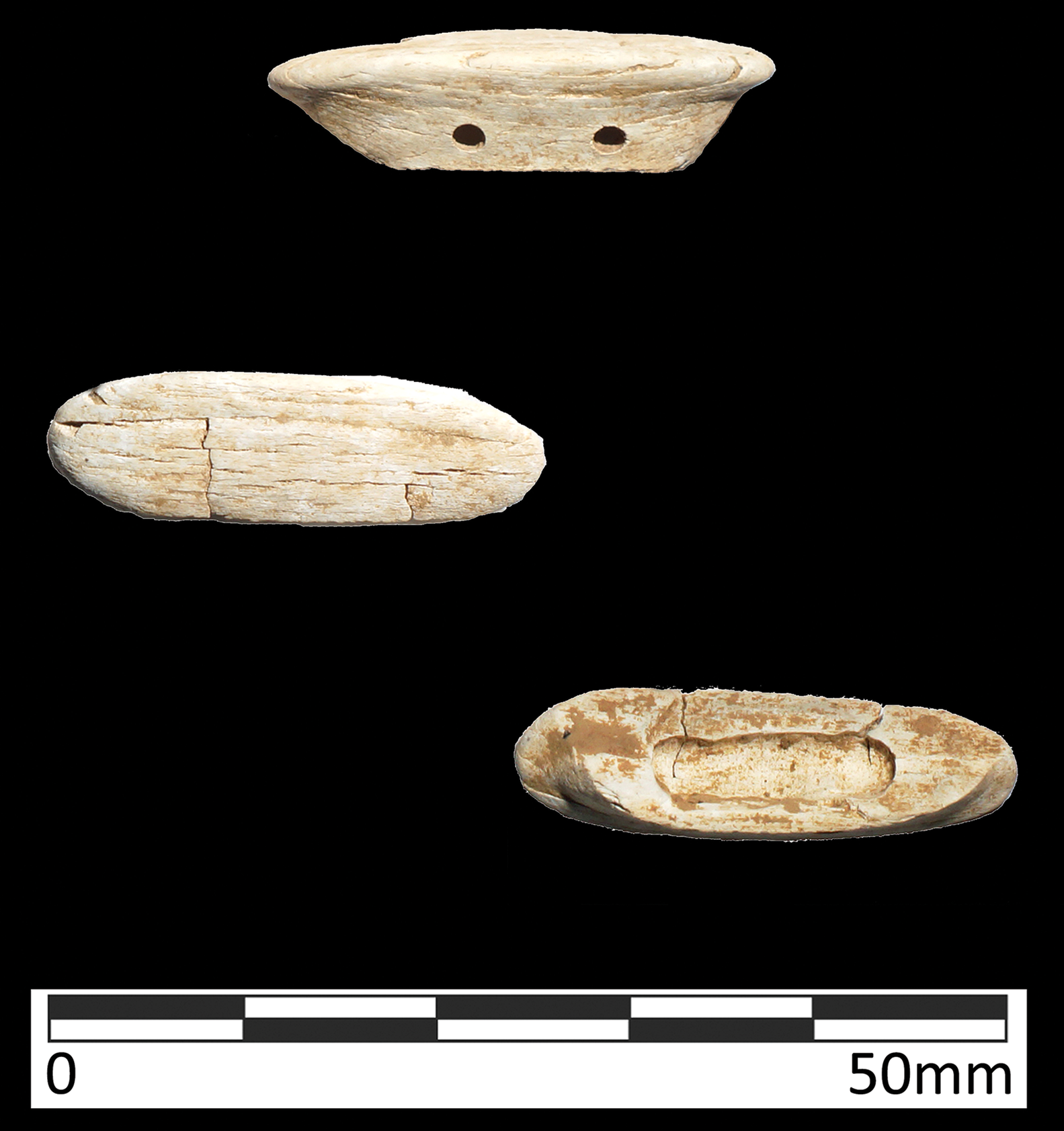
The bone pommel is elliptical in plan, with an elongated lipped socket (Figure 4). It is cream-coloured with smooth surfaces and some evidence of cracking, but no warping, suggesting that it was directly exposed to heat. The bone derives from a “weight-bearing compact bone of a large terrestrial mammal, such as cattle or horse” (S. O'Connor pers. comm.). While the top of the pommel is complete, the wall of the socket is broken in half lengthways, with one side missing, likely due to exposure to high temperature. The surviving side exhibits two tiny perforations, which are presumably holes for pegs that attached the pommel to a knife handle. The top of the pommel is slightly dished.
Class 3 bone pommel from Staarvey Farm (scale 50mm; image by R. Crellin, with permission of the trustees of Manx National Heritage).
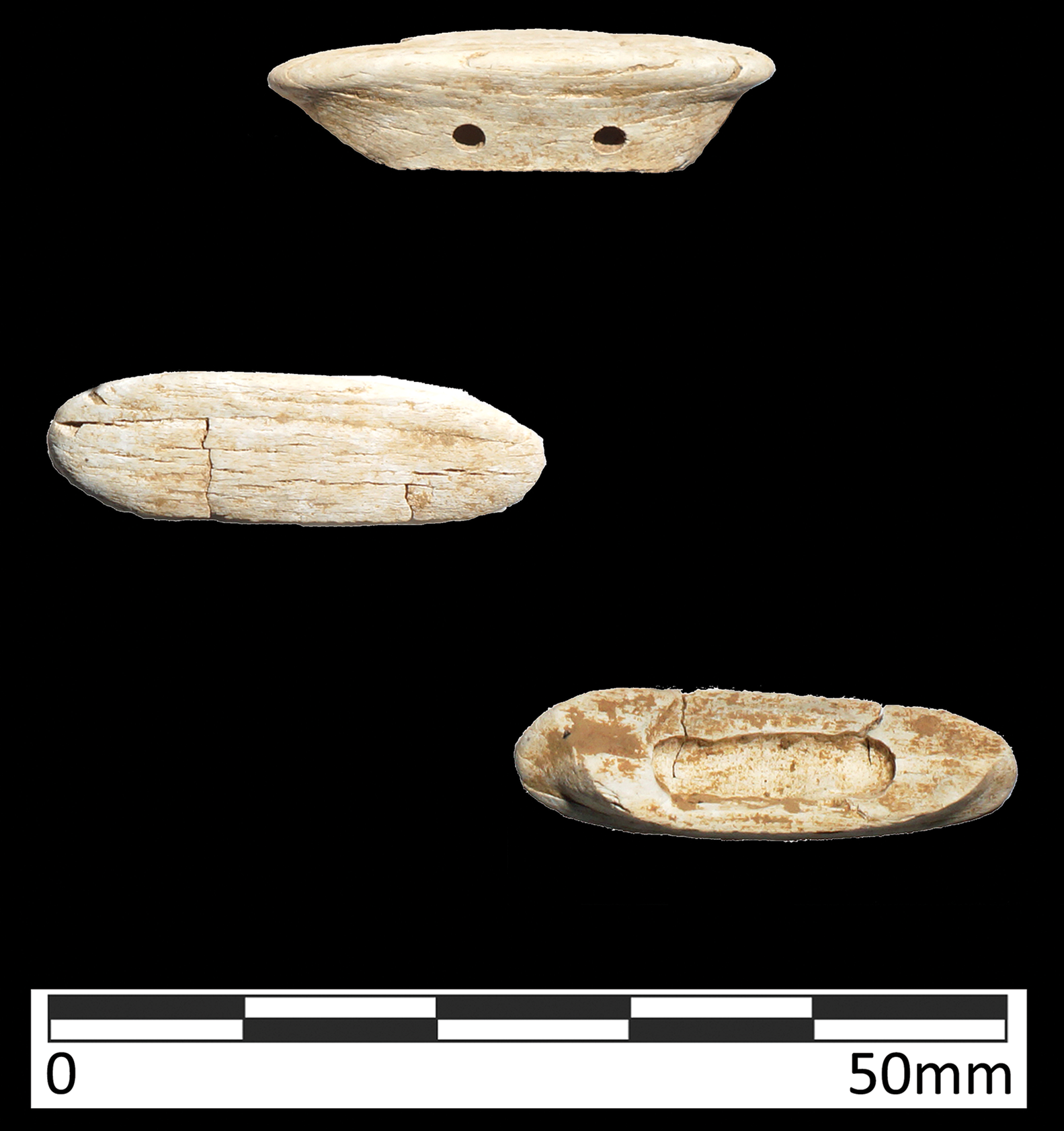
The elliptical socket and strongly expanded profile are characteristic of a class 3 pommel, following Needham's recently revised typology (see Needham in Woodward et al. Reference Woodward, Hunter, Needham, O'Connor, Woodward, Hunter, Bukach, Needham and Sheridan2015a: 45–46). The pommel is very small, with a maximum width of 26.2mm and a breadth of 7.9mm. It could accommodate the butt of a handle no wider than 15mm or thicker than 4.5mm. This suggests a thin knife handle about the size of a modern table knife. Hardaker (Reference Hardaker1974: 49) and Needham (Reference Needham, Harding and Healy2011: 388; cf. Woodward et al. Reference Woodward, Hunter, Needham, O'Connor, Woodward, Hunter, Bukach, Needham and Sheridan2015a: 53) have suggested that pommels of this type under 35mm wide were from ‘knife-daggers’, which have been found associated with the burials of women, men and juveniles (Woodward et al. Reference Woodward, Hunter, Bukach, Woodward, Hunter, Bukach, Needham and Sheridan2015b: 518–19). Here, we simply refer to the artefact as a knife pommel.
Bone beads and possible toggle
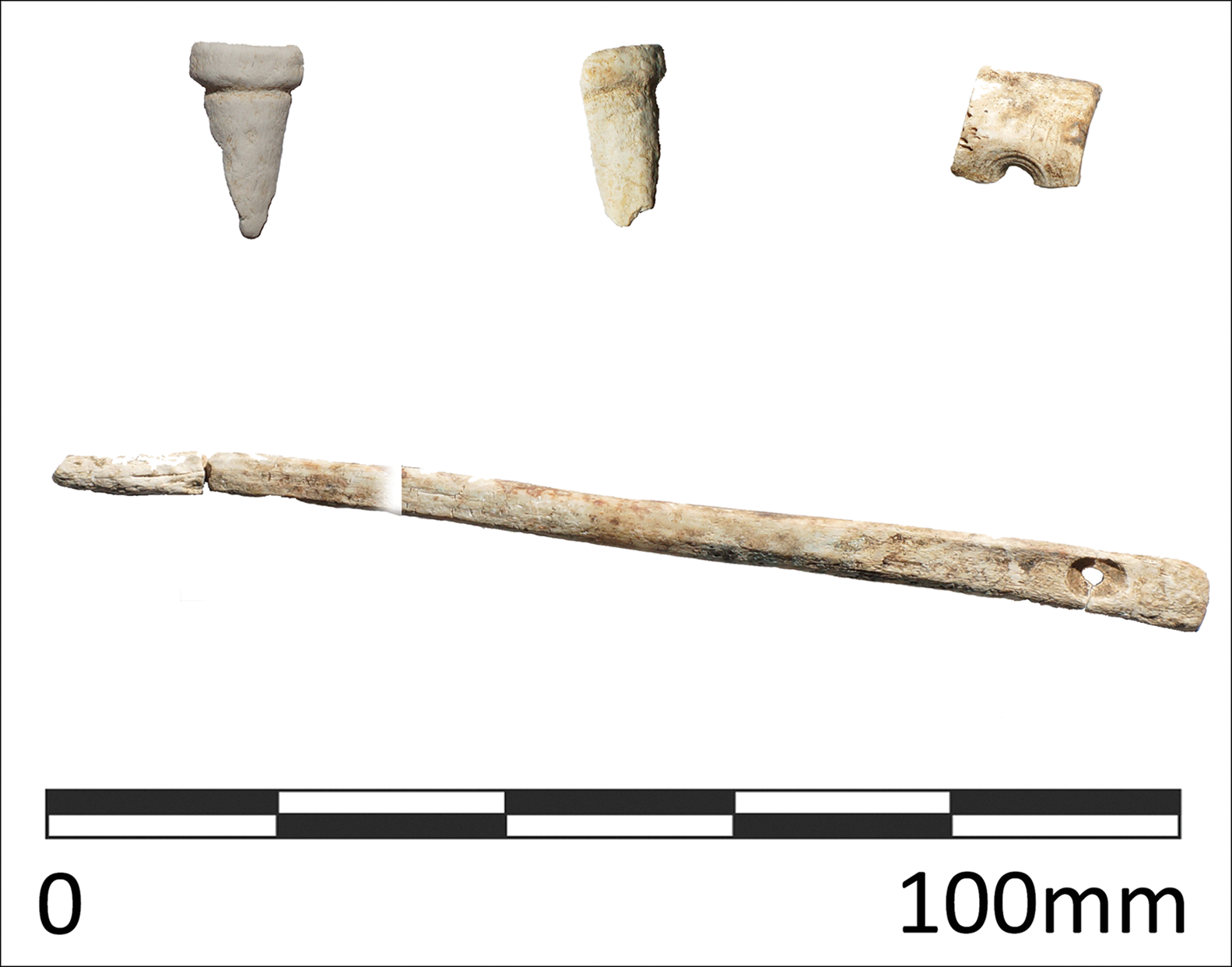
Fourteen fragments of bone beads, including one from a possible toggle, were identified (Figure 5). The thin cortical bone wall and lack of medullary bone suggest that they were cut from bird bones. They have smoothed surfaces and slightly polished exterior surfaces. All appear to have been fractured by burning and are white in colour, with some exhibiting black marks. Two thin bone bead fragments have shaped ridges and grooves at their ends, and exhibit smoothed hollow interiors and polished exteriors (Figure 5). A third smoothed and polished bead is perforated with a 2.2mm diameter hole and is broken across this perforation. This could be a fragment of a toggle rather than a bead, or even part of a bone whistle (Woodward & Hunter Reference Woodward, Hunter, Woodward, Hunter, Bukach, Needham and Sheridan2015a: 117 & 121–23). The remaining fragments are from beads with a simpler form: none is complete, but all show working on at least one end.
Bone bead (1983.0215.007a); bone bead (1983.0215.007b); bone toggle (1983-0215/0011 a); bone point (1983-0215/0001a-c) (left to right) (image by R. Crellin, with permission of the Trustees of Manx National Heritage).

Relatively little research has been carried out on bone beads compared to those made from more exotic materials. There are four other cases where beads (of varying materials) have been found alongside bone pommels in burials (Bedd Branwen burial H, Radwell barrow I, Manton barrow and Winterbourne Stoke G66 (Colt Hoare Reference Colt Hoare1810; Cunnington Reference Cunnington1907; Lynch Reference Lynch1971; Hall & Woodward Reference Hall and Woodward1977)). All are Needham class 3 pommels, all are associated with Collared Urns, and associated human remains include those identified as male and as possibly female. Graves at Bedd Branwen H (Wales) and Staarvey include bone beads, while a bone toggle was also found with a class 3 bone pommel at Beech Hill House (Stevenson et al. Reference Stevenson, Boardman, Carter, Finlayson, McKinley, MacSween and Tipping1995).
Bone point
A burnt, perforated bone point was found in three parts, with the tip missing (Figure 5). The perforation was drilled from both sides and the point has broken across this hole, and again nearer to the tip. The point has curved sides, giving a sub-oval cross-section, and is longitudinally curved. It is tan in colour, with some brown patches and a crack along one side, suggesting thermal exposure. The object was ground and polished prior to burning to produce a smooth surface.
In Woodward and Hunter's (Reference Woodward, Hunter, Woodward, Hunter, Bukach, Needham and Sheridan2015a: 97) typology, this is a class 4 bone point, distinguished by the worked and rounded end and perforated head. Approximately 75 per cent of the bone points examined by Woodward and Hunter (Reference Woodward, Hunter, Woodward, Hunter, Bukach, Needham and Sheridan2015a: 97–109) exhibit little or no evidence of damage to the tip, as might be expected if the points had been used as tools. The authors describe some points as showing light wear around the perforation, indicating that they were threaded, and possibly stitched onto a garment or head-covering (Woodward & Hunter Reference Woodward, Hunter, Woodward, Hunter, Bukach, Needham and Sheridan2015a: 105). Bone points found within inhumation burials were positioned close to the head. They have been found in the graves of both men and women, and while more common in the latter, this seems to vary regionally and/or chronologically (Woodward & Hunter Reference Woodward, Hunter, Woodward, Hunter, Bukach, Needham and Sheridan2015a; Parker Pearson et al. Reference Parker Pearson, Sheridan, Jay, Chamberlain, Richards and Evans2019: 193).
Four worked bone oblongs
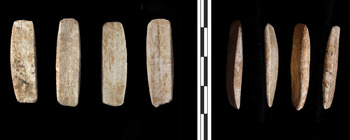
The four bone oblongs are sub-rectangular, slightly curved objects, probably made from animal cortical bone (Figure 6). They are white with smooth polished surfaces, and are uniform in appearance and size (between 28–30mm long, 8.5–8.9mm wide and 3.0–3.6mm thick). They are thickest in the middle and taper to relatively sharp edges at both ends. One face is flat and the other slightly concave. The sides are slightly rounded, with a convex shape. Each object exhibits cracking and some mild transverse checking, consistent with burning.
Worked bone oblongs A–D (left to right) (image by R. Crellin, with permission of the Trustees of Manx National Heritage).

We are aware of no direct comparators for these objects. Woodward and Hunter (Reference Woodward, Hunter, Woodward, Hunter, Bukach, Needham and Sheridan2015a: 118–20) identify several ‘bone plates’, probably made of cattle rib, from barrow contexts in Wiltshire, suggesting that these were components of body ornaments. These are, however, all at least twice the size of the Staarvey oblong objects, and none have dished surfaces. The function or significance of the Staarvey examples therefore remains unclear. They may have provided shape to a garment or headdress, if sewn within it; they could have been used as tokens; or perhaps their chiselled ends were used to finish and decorate pots—the incised lines on the collar of the urn from Staarvey may exemplify this use. Further details concerning the Staarvey Farm cist, artefacts and human remains, including accession codes, can be found in the OSM.
Radiocarbon dating
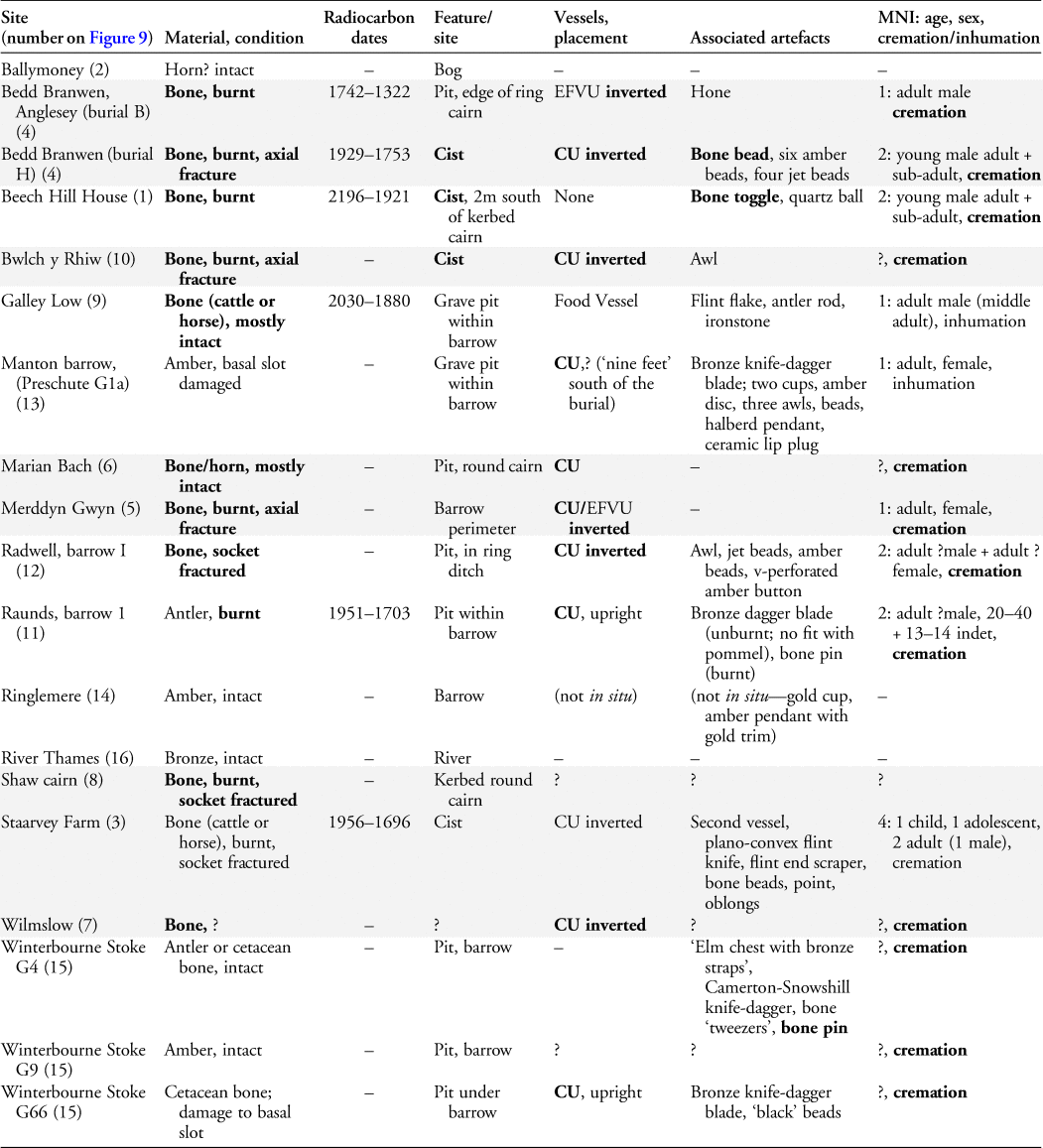
A sample of the cremated bone from the Staarvey cist has been dated to 3515±45 BP (GrA-29940: 1956–1696 cal BC; Woodcock Reference Woodcock2008: 152). It is not possible to determine from which individual this bone derives. Two other radiocarbon dates from burials with class 3 pommels (at Bedd Branwen H and Raunds 1) are also within the range c. 1950–1700 BC, while Galley Low overlaps with this and Beech Hill House provides an earlier date (Table 1). Although human bone absorbs some of the carbon signature of the fuel used during cremation, pyres probably included young wood, and thus the impact on radiocarbon dating is expected to be minimal (Snoeck et al. Reference Snoeck, Brock and Schulting2014: 599).
Burials with class 3 bone pommels. Sites from central Britain and the Isle of Man highlighted in grey, entries in bold are most similar to Staarvey. All dates are cal BC (95.4% probability) using OxCal v3.4.2 with IntCal 13 (Bronk Ramsey Reference Bronk Ramsey2009; Reimer et al. Reference Reimer2013). MNI = minimum number of individuals; CU= Collared Urn; EFVU = Enlarged Food Vessel Urn. A more detailed version of this table is provided in the OSM.

Wider comparisons
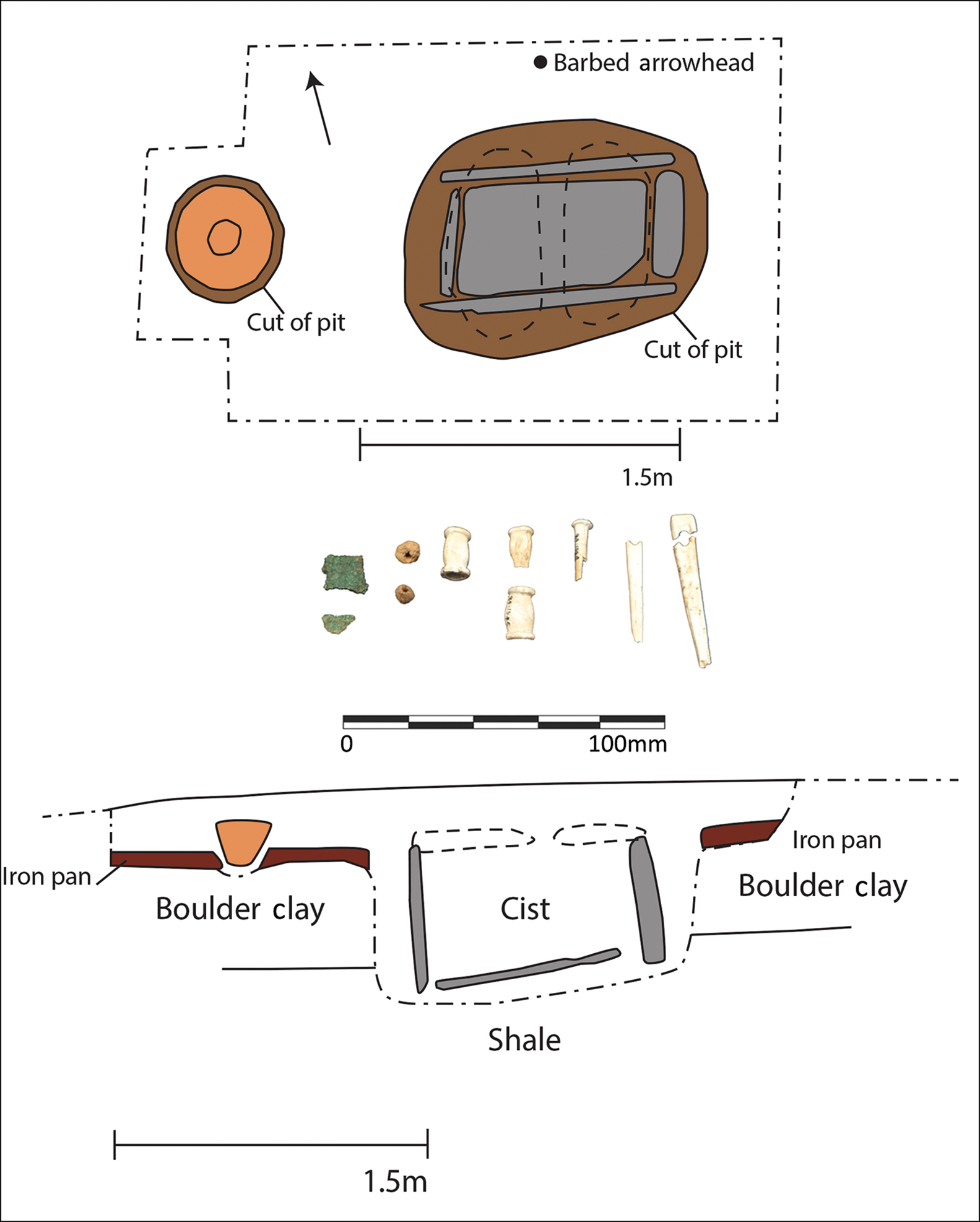
A number of burials from Early Bronze Age Britain share similarities with key components of the Staarvey burial feature, depositional practice or artefact assemblage (Table 1). One of the most similar is located 1km away at The Cronk, Upper Lhergydhoo. Here, a sandstone cist contained an inverted Food Vessel Urn and two bone bodkins, a bone point and two bone beads (Woodcock Reference Woodcock1996: 232 & 240–42) (Figure 7), and the cremated remains of two adults and one child two to four years old (Gamble Reference Gamble2017b). The bone assemblage exhibits evidence of burning. The cremated remains date to 3440±40 BP (GrA-29936: 1881–1658 cal BC; Woodcock Reference Woodcock2008: 153). Although the number and type of vessels differ from the Staarvey cist, the form of the cists and the mortuary assemblages are very similar and roughly contemporaneous. Both burials included a range of bone ornaments and the remains of multiple individuals.
The burial features and artefacts from The Cronk, Upper Lhergydhoo, based on illustrations by J. Woodcock (Reference Woodward, Hunter, Needham, O'Connor, Woodward, Hunter, Bukach, Needham and Sheridan1996) (image by R. Crellin, with permission of the trustees of Manx National Heritage).

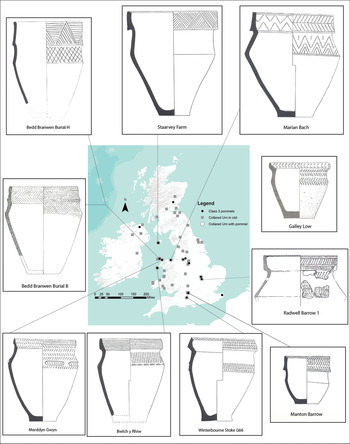
The pattern of incised lines around the collar of the Staarvey Farm Collared Urn shares similarities with other Collared Urns from Ireland, Wales, southern Scotland and northern England, which Longworth (Reference Longworth1984) grouped together in the ‘North West Style’ of his ‘secondary series’. Nine other Collared Urns have been found with class 3 pommels (Needham in Woodward et al. Reference Woodward, Hunter, Needham, O'Connor, Woodward, Hunter, Bukach, Needham and Sheridan2015a: 46): one of these vessels, from Merddyn Gwyn, borders on being classed as an Enlarged Food Vessel Urn, while a further Enlarged Food Vessel Urn was found with a class 3 pommel at Bedd Branwen burial B. This latter vessel is little different from a Collared Urn. Of these vessels, those from Merddyn Gwyn and Bwlch y Rhiw in Wales are very similar to each other, as are the Staarvey and Bedd Branwen H vessels (Figure 8). Shape and decoration may have been significant for conveying aspects of the identity of the deceased, or those making the vessels (e.g. kinship).
Distribution of class 3 pommels, ceramics associated with class 3 pommels, and Collared Urns in cists (vessel images from Longworth (Reference Longworth1984: pls 89a, 104d, 37f, 6c, 22d, 80a & 189c; reproduced with permission of the Licensor through PLSclear), except Bedd Branwen B (Lynch Reference Lynch1971: 29, with permission of Archaeologia Cambrensis), Radwell (Hall & Woodward Reference Hall and Woodward1977: 3, with permission of Bedfordshire Archaeology) and Galley Low (Vine Reference Vine1982: 358); image by C. Fowler & R. Crellin).

While nine burials of cremated remains associated with both Collared Urns and class 3 bone dagger pommels are now known, only one of the 20 known pommels of classes 1, 2 or 4 was found associated with a Collared Urn (at Stanton Moor in Derbyshire; Longworth Reference Longworth1984: 175). Some class 1 and 2 pommels and one class 4 pommel were found with knives and accompanying burials with Beakers (which were in use c. 2500–1900 BC); the remains associated with these pommels were not cremated. This probably indicates that class 3 pommels were later than those associated with Beakers, but also emphasises the close association between class 3 pommels and a specific mortuary practice (cremation) in central Britain. The earlier inhumation with an accompanying Food Vessel at Galley Low provides a notable exception. Other burials with class 3 pommels from northern Wales, the Pennines and the Isle of Man indicate some consistency in how cremated remains placed in Collared Urns with bone pommels were treated (Table 1). Collared Urns were predominantly buried inverted, either within cists or at the peripheries of cairns or barrows (Table 1). Short cists were frequently used for burial in the mid and later third millennium BC, including on the Isle of Man, where they contained either unburnt or cremated remains (Crellin Reference Crellin and Brandherm2019). The practice of placing Collared Urns in cists, however, seems to have been relatively rare compared to the popularity of both cists and Collared Urns in the late third and early second millennium: Longworth (Reference Longworth1984) reported only 44 such cases in his catalogue of over 2230 Collared Urns, and 22 of these were found in Wales or western England.
Four burnt pommels from the Irish Sea region exhibit a lengthways break in either the socket wall or along the entire pommel. The closest of these to Staarvey Farm is burial H in a small cist at Bedd Branwen kerbed ring cairn. This burial included an inverted Collared Urn containing cremated bone from at least two individuals, a burnt bone bead and a class 3 bone pommel. Several unburnt jet and amber beads were placed on top of the cremated bone within the vessel, ending up at the bottom of the deposit (Lynch Reference Lynch1971). The urn decoration is very similar to that noted at Staarvey (Figure 8). The treatment of remains and artefacts is also similar: at least one body was burnt along with a knife pommel, and the cremated bone and the fragmented pommel were placed within an urn (and possibly commingled here, with remains cremated separately); the urn was then deposited inverted in a cist. There were also subtle differences between these two burial contexts, such as the addition of unburnt jet and amber beads—potentially from different necklaces—at Bedd Branwen H. These variations in what otherwise appears to be a similar mortuary practice perhaps relate to differences in the identities of the deceased and/or mourners.
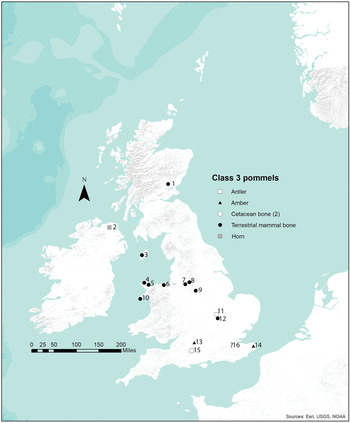
Greater differences are evident on a larger scale (Figure 9; in-text numbers in parentheses refer to sites on the map). Although the 20 known class 3 pommels from Britain and Ireland all have a similar form, there are differences in size and material (Table 1). Two of the larger bone examples, from Galley Low (9) and Beech Hill House (1), come from burials with ‘early’ dates that diverge from the deposition pattern we suggest for smaller pommels. Fourteen class 3 pommels are made from bone or antler. They are located predominantly around the Irish Sea coasts of western Britain, and most were found with cremated remains.
Distribution of class 3 pommels (for key to site numbers, see Table 1; image by C. Fowler & R. Crellin).

Two pommels, both from southern England (Winterbourne Stoke (15) G4 and G66) are made of cetacean bone, while a horn pommel was found in a wetland in Northern Ireland (2), and a pommel found in the River Thames (16) was cast in bronze as part of a handle (Woodward et al. Reference Woodward, Hunter, Needham, O'Connor, Woodward, Hunter, Bukach, Needham and Sheridan2015a: 47 & 53). Three class 3 pommels from southern England were made from amber. One was found at Manton barrow (13) among a complex assemblage of bronze, clay, chalk, gold, amber and shale artefacts. The assemblage was placed around the crouched inhumation of a woman (sex was estimated using now outdated methods), who was wrapped in cloth at Manton barrow (Cunnington Reference Cunnington1907: 6–13). The burial mode, type of site and/or range of surviving objects and materials in these southern sites differ from the central Britain group to which we suggest Staarvey belongs.
There is an overlap in the colour of materials used in class 3 pommels found in southern and central Britain. In neither of these regions were pommels made from dark materials, such as shale or jet, even though these were used for other personal ornaments during the Early Bronze Age. We suggest, however, that the southern class 3 pommels were a different category of thing to their more northerly counterparts. While the pommels from the far south of England share the same morphology as bone pommels from central Britain, they capture other properties in their substance. The golden translucence and scarcity of amber, with its origins in the East and the sea, for example, may have imbued the southern knives with a distinct kind of power. The bones of whales may have had similar marine associations. Class 3 pommels with post-1700 BC associations, such as those from Winterbourne Stoke G4, are from the south of England. It is possible that the exotic examples found here are either later developments or were curated. The overall picture does not suggest that more northerly communities copied elite objects in mundane materials, but rather that communities in southern England created new exotic versions of what might have been small and ordinary things that were in wider use farther afield.
We therefore suggest that small knives with class 3 bone pommels were associated with Collared Urns as a recurring assemblage—a set of equipment that played specific roles in funerary rites involving cremation—from the Isle of Man across northern Wales and into the west Pennines, between c. 1950 and 1700 BC. It is unclear whether the pommels were present among cremated remains because the deceased—or one of the deceased, given that several graves included remains from more than one individual—habitually wore them. The inclusion of the pommels may have commemorated a relationship between a mourner (or mourners) and the deceased, and/or may have played a specific funerary role. Regardless, it is important to set them in the context of a wider bone-artefact assemblage that focused on bodily adornment. While a detailed, large-scale review of bone ornaments is arguably overdue, it is beyond the scope of this article. For now, we suggest that such objects were commonly worn or used in the Early Bronze Age, and that while they often preferentially survive compared with other organic materials, they are more likely to have been overlooked in older excavations of cremated remains. Bone objects placed on Bronze Age funerary pyres warped, cracked and changed colour. By the end of the cremation, the remains of these artefacts blended in with human remains. For mourners, burnt bone objects may have become increasingly inalienable from the deceased by sharing the process of cremation, thereby dissolving any distinction between bodies and associated objects. Perhaps bone was chosen for making personal accoutrements in central Britain partly with this transformation and merging of body and object in mind.
Overlapping spheres of interaction
At Staarvey Farm, people made decisions in a similar way to contemporaneous mourners who buried their dead on Anglesey, in North Wales, and western England. Although this is only one grave from the Isle of Man, and other contemporaneous sites have very different characteristics, it is worth considering the choice of grave goods at Staarvey Farm in a wider regional context.
The class 3 pommels from Wessex are located in an area with a concentration of contemporaneous daggers, as are those from Radwell and Raunds (Woodward & Hunter Reference Woodward, Hunter, Woodward, Hunter, Bukach, Needham and Sheridan2015b: 548). Those from Wales and north-west England, however, are in areas without daggers. Indeed, these regions have no history of dagger use from the Chalcolithic (c. 2500–2200 BC), and burials with Beaker pottery are also very rare. Axe-hammers are found frequently in early second-millennium BC Dumfries and Galloway and Lancashire (Roy Reference Roy2019), but are less common in the areas where class 3 pommels have been found; these two object types may have had different resonances. Battle-axes are rarer than axe-hammers, but have been found in Dumfries and Galloway, including two buried with cremated remains and Collared Urns at the edge of Bargrennan chambered cairns (Cummings & Fowler Reference Cummings and Fowler2007). More battle-axes (7) than axe-hammers (1) are known from the Isle of Man (Crellin Reference Crellin and Brandherm2019: 58–59). Cordoned Urns dating to c. 2000–1550 BC are also found on the Isle of Man, the north and east of Ireland, Anglesey and south-west and eastern Scotland—areas where battle-axes are present in relatively high numbers. We therefore suggest that the Isle of Man was involved in at least two overlapping zones of interaction c. 2000–1700 BC. One extended from the island across western Wales and western England, and included the use of knives with bone pommels. The other crossed the north of Ireland and south-west Scotland into eastern Scotland, and is associated with Cordoned Urns and battle-axes. These zones encompass regions with forms of material culture and mortuary practices that partially overlap with, yet are largely distinct from, those of contemporaneous Wessex (‘Wessex I’). Additional analyses of the contexts in which such objects were deposited, and their distribution, may further illuminate the shifting spheres of interaction through which they developed.
Traditional typological approaches have often been used to support culture-historical interpretations of regional identities (e.g. Clarke Reference Clarke1970). A relational typological approach highlights how what appears to be one type of artefact (‘class 3 pommels’) may have different significances and may even matter differently, as it is deployed alongside the other media present in one region but not another. Thus, bone pommels in regions of central Britain without a history of daggers have different resonances than pommels in exotic media in southern regions historically associated with daggers. Through this approach, traditional distribution maps of one type (of object, burial or site) and interpretations of culture-historical territories that draw upon them can be replaced by multiple overlapping distributions of traits that derive from the practices that produced and deployed these objects, burials and sites, better demonstrating the complexity of connections among and between communities. In the Early Bronze Age—in Britain, at least—such dispersed distributions of related traits can be contextualised alongside stable isotope evidence for mobility across geological zones (Parker Pearson et al. Reference Parker Pearson, Sheridan, Jay, Chamberlain, Richards and Evans2019). Identity comprises many intersecting factors, such as age, gender and religion, and choices concerning artefact styles may vary according to any of these, shifting by age cohort as much as ethnicity, for example (Larick Reference Larick1986). The relational typological approach deployed here therefore interprets the Staarvey burial as a result of meaningful funerary transformations and mortuary practices, in which well-connected communities drew from a broadly shared pool of well-understood practices and media as they articulated relations with and between the dead.
Conclusion
The Staarvey assemblage offers an insight into the importance of bone objects in Early Bronze Age Britain. Regional comparisons suggest that they form part of a bone-working tradition that was strong in north Wales, the north of England and the Isle of Man. In these regions, ornaments or fittings made from exotic materials, such as jet, were rarer than in Wessex, Yorkshire, or on the west and east coasts of Scotland (Sheridan & Davies Reference Sheridan and Davis2002). Bone ornaments were probably widely used, and only in some areas were versions of bone objects made in other materials: this seemingly happened late in the currency of class 3 pommels.
Analysis of the osteological material from Staarvey has revealed a previously unknown assemblage of artefacts. These have prompted further discussions of Early Bronze Age personal ornaments and tools, and how the decisions made by participants in mortuary activities at Staarvey related to those in neighbouring regions. A multi-dimensional, relational typological approach to investigating not only the form of an object, but also its size, material, treatment and deposition, allows us to refine and move beyond traditional typologies to trace not just types of things, but types of practices. This allows archaeologists to move beyond distribution maps of artefact types to consider overlapping, nuanced types of practice that inform us about the complex relations within and between different communities in the past. Early Bronze Age communities on the Isle of Man shared some such practices with several neighbouring regions. Just as the Staarvey cist illustrates similarities with aspects of contemporaneous burials across western-central Britain, it also helps us to identify disjuncture with other regions, where similar types of artefacts were made from other materials and were deployed using different funerary practices.
Acknowledgements
Many thanks to Allison Fox for facilitating research at the Manx Museum, Stuart Needham for confirming typological identification of the pommel, and Sonia O'Connor for visually assessing its bone material. Thanks to Jenny Woodcock, Manx National Heritage, Cambridge University Press, Archaeologia Cambrensis and Bedfordshire Archaeology for image permissions.
Funding statement
The osteological analyses were funded by Culture Vannin. ‘Round Mound of the Isle of Man’ has received financial support from Manx National Heritage, the Universities of Leicester and Newcastle, and the Isle of Man Steam Packet Company.
Supplementary material
To view supplementary material for this article, please visit https://doi.org/10.15184/aqy.2020.175