




Introduction
If 2024 witnessed growing difficulties for the left-wing coalition formed by the Spanish Socialist Workers’ Party (PSOE) and Sumar, led by PM Pedro Sánchez, these problems intensified further in 2025, which marked the midpoint of the legislative term. Despite Spain’s positive macroeconomic performance, corruption scandals continued and deepened, even leading to the imprisonment of two former Socialist Secretaries of Organisation, Santos Cerdán and José Luis Ábalos (former Minister), and to the destitution of the Attorney General following a sentence by the Supreme Court. Meanwhile, the minor coalition partner, Sumar, remained immersed in internal confusion and a leadership crisis. However, this ongoing turmoil did not affect the cohesion of its parliamentary group or the five ministers it held in government, with the exception of Member of Parliament (MP) Águeda Micó, who left Sumar’s parliamentary group.
Despite the weakening of the government in Parliament, reflected in several legislative defeats, including the Catalanist party Junts rhetorically severing ties with the Socialists, the government remained in office. Political tensions within the PSOE, including corruption allegations and accusations of sexual harassment among its members and the related media pressure, further complicated the situation, as did growing social discontent over the housing crisis, international challenges, and the absence of a new budget (the last time the Parliament passed a budget was in November 2022, for the 2023 budget). Nevertheless, the government continued to govern and succeeded in passing some key legislation and measures, such as the increase in the minimum wage. Notably, no major cabinet reshuffle took place, except for Minister and Government Spokesperson Pilar Alegría, who resigned in order to run in the Aragon elections scheduled for February 2026.
The government also continued to set the agenda on international issues, particularly in relation to Israel’s attacks on Palestinians in Gaza. Spain emerged as one of the most critical voices in Europe against Israel’s actions, as well as against the pressure exerted by US President Donald Trump on NATO members to increase public expenditure in defense. The active international role of the government, especially that of Pedro Sánchez, stood in stark contrast to the complicated domestic political situation at home.
The People’s Party (PP) and Vox continued their competition on the right, with the upcoming regional elections of Aragón, Castilla and Leon and Andalucía in 2026 in sight. The leadership of Feijóo, although arguably weakened throughout 2025 according to electoral projections in opinion polls such as 40db (Galicia Press 2025), Sigma Dos (El Mundo 2025), or Center for Sociological Research - Centro de Investigaciones Sociológicas (RTVE 2025), among others, was revalidated at the PP’s National Congress. For its part, Vox opted for a more aggressive opposition to the government, systematically voting against most of its initiatives and intensifying its rhetoric against the government.
2025 will likely be remembered as the year when Spain, along with Portugal, Andorra, and southern France, experienced an almost complete day-long blackout on 28 April. This event, which shocked the nation, opened a debate on the country’s energy and electricity infrastructure, and (re)opened discussions on renewable energies. By the end of the year, its causes had not been definitively clarified, nor had any authority or responsible actor been held accountable.
2025 concluded with the regional election in Extremadura, which could be seen as a reflection of the broader political mood suggested by national developments and opinion polls: a bitter victory for the PP, a strengthening of Vox, a severe blow for the PSOE, and a slight improvement for the left (Sumar, IU [Izquierda Unida - United Left], and allies).
Election report
Regional elections
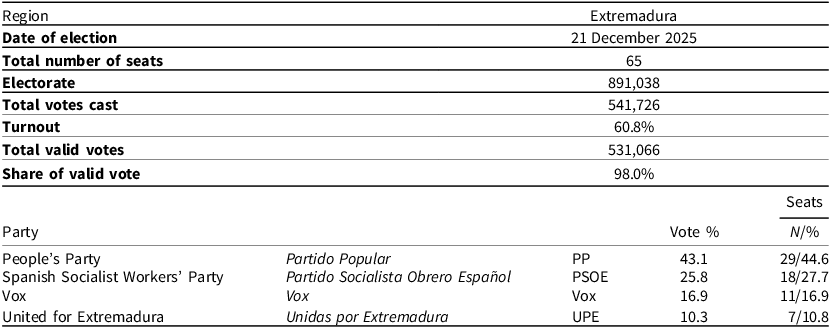
In 2025, only one election was held in Spain: the regional election in Extremadura (Table 1) . On 27 October, María Guardiola (PP), President of the Government of Extremadura, who headed a single-party minority government, called a snap election for 21 December after the regional parliament rejected the government’s budget proposal. Extremadura was among the regions where, in 2024, Vox severed ties with the PP following disagreements over the distribution of unaccompanied foreign minors arriving in Spain (see Bohigues and Sendra Reference Bohigues and Sendra2025).
Results of regional (Extremadura) elections in Spain in 2025

Table 1. Long description
Table 1 presents the results of the regional elections in Extremadura, Spain, held on 21 December 2025. It includes data on the total number of seats, electorate, total votes cast, turnout, total valid votes, and the share of valid votes. The table also lists the performance of different political parties in terms of vote percentage and the number of seats won. The parties included are the People’s Party (Partido Popular), Spanish Socialist Workers’ Party (Partido Socialista Obrero Español), Vox, and United for Extremadura (Unidas por Extremadura). Row 1: Region, Extremadura. Row 2: Date of election, 21 December 2025. Row 3: Total number of seats, 65. Row 4: Electorate, 891,038. Row 5: Total votes cast, 541,726. Row 6: Turnout, 60.8 percent. Row 7: Total valid votes, 531,066. Row 8: Share of valid vote, 98.0 percent. Row 9: Party, Vote percent, Seats N percent. Row 10: People’s Party, Partido Popular, PP, 43.1, 29/44.6. Row 11: Spanish Socialist Workers’ Party, Partido Socialista Obrero Español, PSOE, 25.8, 18/27.7. Row 12: Vox, Vox, Vox, 16.9, 11/16.9. Row 13: United for Extremadura, Unidas por Extremadura, UPE, 10.3, 7/10.8.
Note: 1. UPE is an electoral coalition formed by We Can (Podemos), United Left (Izquierda Unida, IU) and Green Alliance (Alianza Verde).
Source: Elecciones 2025 Extremadura (2025; https://resultados.elecciones2025.juntaex.es).
This regional election in a sparsely populated autonomous community appeared to confirm trends anticipated by most opinion polls at both the national and regional levels: a slight improvement for the PP, a decline for the PSOE, and further gains for Vox. Indeed, the PP emerged as the leading party in Extremadura with over 43% of the vote (29 seats, +1), representing a marginal increase in vote share compared to 2023, albeit with a lower absolute number of votes. The PSOE recorded its worst electoral result ever in the region, securing slightly more than 25% of the vote (18 seats, −10). This outcome is particularly noteworthy given that Extremadura had long been regarded as one of the Socialist Party’s electoral strongholds. Vox was the main beneficiary of the election, obtaining close to 17% of the vote (11 seats, +6). Finally, the left-wing United for Extremadura coalition (Podemos, Izquierda Unida and Green Alliance) received over 10% of the vote and won seven seats (+3). As expected, voter turnout declined markedly, falling by around ten percentage points from 70.35% in 2023 to 60.79% in 2025.
Although the PP, led by María Guardiola, secured the largest share of the vote, it fell short of an absolute majority, which had been the party’s stated objective. Consequently, all viable options for Guardiola to remain President depended on Vox and its 11 seats in the Assembly, either through the formation of a coalition government (as had been the case following the 2023 election until 2024) or via a parliamentary arrangement in the form of an investiture agreement. By the end of 2025, however, no clear resolution regarding government formation had been reached.
Cabinet report
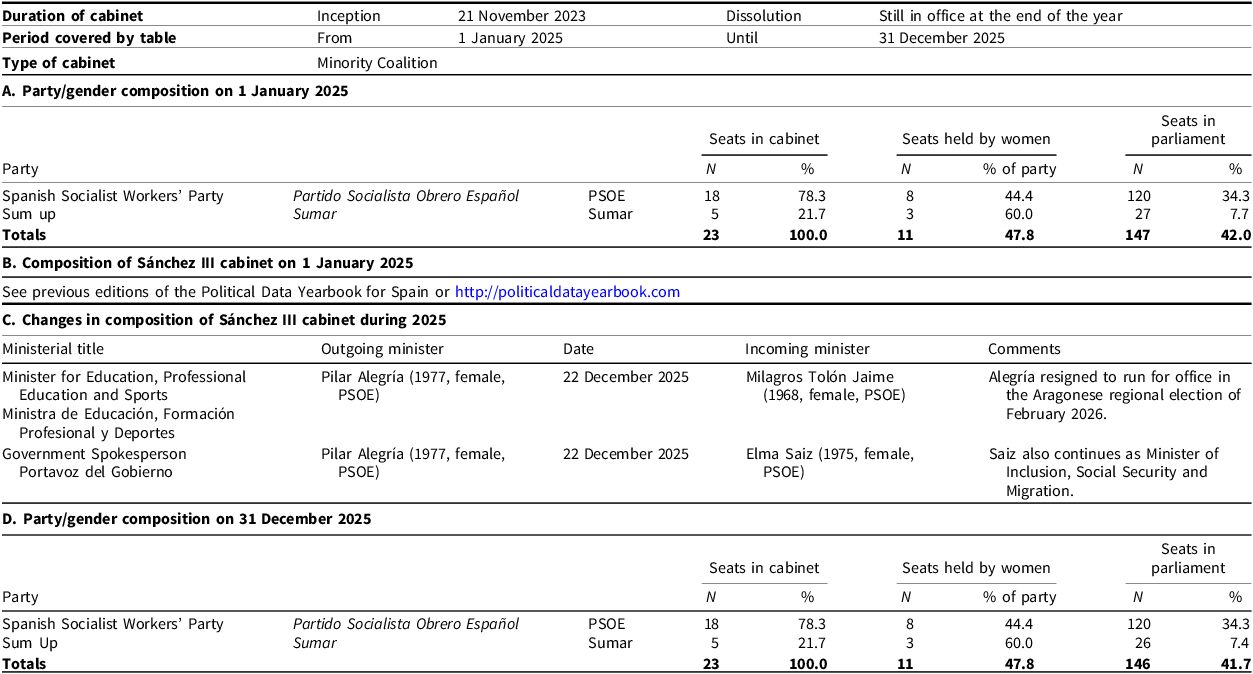
In 2025, there was only one double change in the composition of the cabinet (Table 2), affecting a ministry held by the PSOE. In December, Pilar Alegría, Government Spokesperson and Minister of Education, Professional Education and Sports, resigned to run for office in the upcoming regional elections in Aragon scheduled for February 2026. Alegría was replaced at the Ministry by Milagros Tolón, who until then had served as Government Delegate in Castilla–La Mancha. At the same time, Elma Saiz, Minister of Inclusion, Social Security and Migration, assumed the additional role of Government Spokesperson.
Cabinet composition of Sánchez III in Spain in 2025

Table 2. Long description
Table 2 provides details on the cabinet composition in Spain for the year 2025. It includes information on the duration of the cabinet, its type, party/gender composition on specific dates, and changes in the composition during the year. The table is divided into several sections: A, B, C, and D. Section A shows the party/gender composition on 1 January 2025, with the Spanish Socialist Workers’ Party (PSOE) holding 18 seats and Sumar holding 5 seats, totaling 23 seats. Section B lists the composition of Sánchez III cabinet on 1 January 2025. Section C details changes in the cabinet composition during 2025, including the resignation of Pilar Alegría and her replacement by Milagros Tolón Jaime, and Elma Saiz taking on the additional role of Government Spokesperson. Section D shows the party/gender composition on 31 December 2025, which remains the same as on 1 January 2025. The table also includes a summary of party/gender composition for all parties in parliament on 1 January and 31 December 2025.
Note: 1. See Tables 3 and 4 for more information on the changes in the seats in Parliament controlled by PSOE and Sumar.
Sources: La Moncloa (2025; www.lamoncloa.gob.es) and Lower House (Congreso de los Diputados) (2025; www.congreso.es).
Party and gender composition of the lower house of the Parliament (Congreso de los Diputados) in Spain in 2025

Table 3. Long description
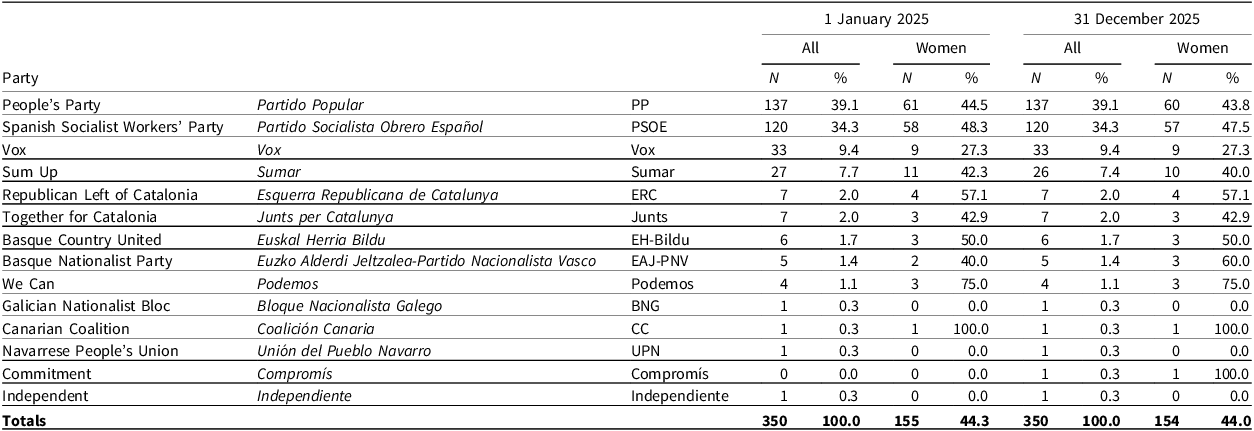
The table presents the party and gender composition of the lower house of the Parliament in Spain in 2025. It is divided into four sections: A, B, C, and D. Section A shows the party and gender composition on 1 January 2025, with columns for seats in the cabinet, seats held by women, and seats in parliament. Section B provides a reference to previous editions of the Political Data Yearbook for Spain. Section C details changes in the composition of the Sánchez III cabinet during 2025, including ministerial titles, outgoing and incoming ministers, and comments on the changes. Section D shows the party and gender composition on 31 December 2025, with the same columns as Section A. The table includes data for the Spanish Socialist Workers' Party (PSOE) and Sum Up (Sumar), with totals for each section. The table also notes changes in the seats in Parliament controlled by PSOE and Sumar, with sources from La Moncloa and the Lower House (Congreso de los Diputados).
Note: 1. Águeda Micó (Commitment) left the Sumar parliamentary group in July 2025, giving Compromís its own MP. Compromís still has another MP, Alberto Ibáñez, who remained in Sumar.
Source: Lower House (Congreso de los Diputados) (2025; www.congreso.es).
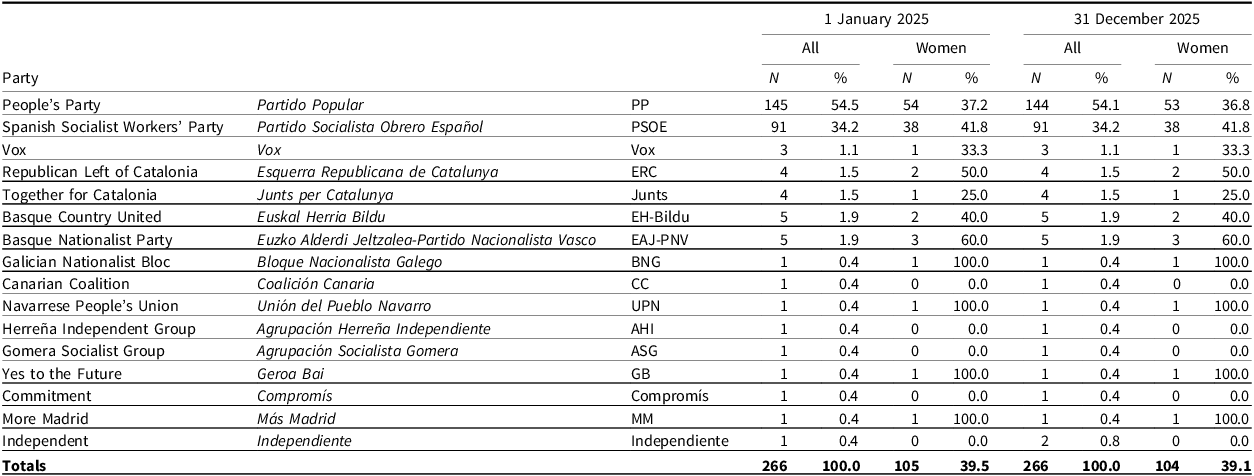
Party and gender composition of the upper house of the Parliament (Senado) in Spain in 2025

Table 4. Long description
A table showing party and gender composition of the upper house of the Parliament in Spain in 2025. The table has 20 rows and 10 columns. The columns are labeled as Party, Partido Popular, Spanish Socialist Workers' Party, Vox, Republican Left of Catalonia, Together for Catalonia, Basque Country United, Basque Nationalist Party, Galician Nationalist Bloc, Canarian Coalition, Navarre's People's Union, Herreña Independent Group, Gomera Socialist Group, Yes to the Future, Commitment, More Madrid, Independent, and Totals. The rows are labeled as 1 January 2025 and 31 December 2025. Each row contains data for All and Women categories with N and % values. Row 1: People's Party, Partido Popular, PP, 145, 54.5, 54, 37.2, 144, 54.1, 53, 36.8. Row 2: Spanish Socialist Workers' Party, Partido Socialista Obrero Español, PSOE, 91, 34.2, 38, 41.8, 91, 34.2, 38, 41.8. Row 3: Vox, Vox, 3, 1.1, 1, 33.3, 3, 1.1, 1, 33.3. Row 4: Republican Left of Catalonia, Esquerra Republicana de Catalunya, ERC, 4, 1.5, 2, 50.0, 4, 1.5, 2, 50.0. Row 5: Together for Catalonia, Junts per Catalunya, Junts, 4, 1.5, 1, 25.0, 4, 1.5, 1, 25.0. Row 6: Basque Country United, Euskal Herria Bildu, EH-Bildu, 5, 1.9, 2, 40.0, 5, 1.9, 2, 40.0. Row 7: Basque Nationalist Party, Euzko Alderdi Jeltzalea-Partido Nacionalista Vasco, EAJ-PNV, 5, 1.9, 3, 60.0, 5, 1.9, 3, 60.0. Row 8: Galician Nationalist Bloc, Bloque Nacionalista Galego, BNG, 1, 0.4, 1, 100.0, 1, 0.4, 1, 100.0. Row 9: Canarian Coalition, Coalición Canaria, CC, 1, 0.4, 0, 0.0, 1, 0.4, 0, 0.0. Row 10: Navarre's People's Union, Unión del Pueblo Navarro, UPN, 1, 0.4, 1, 100.0, 1, 0.4, 1, 100.0. Row 11: Herreña Independent Group, Agrupación Herreña Independiente, AHI, 1, 0.4, 0, 0.0, 1, 0.4, 0, 0.0. Row 12: Gomera Socialist Group, Agrupación Socialista Gomera, ASG, 1, 0.4, 0, 0.0, 1, 0.4, 0, 0.0. Row 13: Yes to the Future, Geroa Bai, GB, 1, 0.4, 1, 100.0, 1, 0.4, 1, 100.0. Row 14: Commitment, Compromís, 1, 0.4, 0, 0.0, 1, 0.4, 0, 0.0. Row 15: More Madrid, Más Madrid, MM, 1, 0.4, 1, 100.0, 1, 0.4, 1, 100.0. Row 16: Independent, Independiente, 1, 0.4, 0, 0.0, 2, 0.8, 0, 0.0. Row 17: Totals, 266, 100.0, 105, 39.5, 266, 100.0, 104, 39.1.
Notes: 1. Más Madrid and Compromís formed part of Sumar for the elections to the lower house, but their senators are designated by the parliaments of the Community of Madrid and the Valencian Community.
2. Senator José Ignacio Landaluce (PP) left the parliamentary group and resigned his party membership after a formal accusation of sexual harassment in December 2025. This left the PP with one fewer senator, since Landaluce kept his seat as an independent. The other independent senator is Juanjo Ferrer, who ran in the 2023 Senate election on the platform Eivissa i Formentera al Senat (Ibiza and Formentera to the Senate), supported by PSOE, Sumar, Esquerra Unida de les Illes Balears, and Ara Eivissa.
Source: Upper House (Senado) (2025; www.senado.es).
Parliament report
In 2025, the Spanish parliament approved three Organic Laws (LO), seventeen Royal Decree Laws (RD), and ten Ordinary Laws. Organic Laws included: measures regarding the efficiency of the Public Justice Service (LO 1/2025, of 2 January), ratification of four amendments to Article 8.2 of the Rome Statute of the International Criminal Court (LO 2/2025, of 3 June), and the amendment of Organic Law 1/2002, of 22 March, regulating the right of association (LO 3/2025, of 27 June).
At the end of 2024, the government approved an ‘Omnibus Decree’ adopting urgent measures in the areas of the economy, transport, and social security (Bohigues and Sendra Reference Bohigues and Sendra2025), which was voted down in early 2025 by PP, Vox, and Junts. After negotiations, the Congress successfully approved a new version (RD 1/2025, of 28 January), with the votes in favour of all parties but Vox. Two additional decrees were approved: the one to promote the use of collective public transport by young people during the summer period of 2025 (RD 5/2025, of 10 June), and the second one on urgent measures to strengthen the electricity system following the 28 April blackout (RD 7/2025, of 24 June).
Among the Ordinary Laws, one of the most outstanding was the Sustainable Mobility Law (9/2025, of 3 December), aimed at modernising the transport system and promoting decarbonisation. It was passed with 174 votes in favour and 170 against, with the absence of one PP MP and the abstention of Podemos’ four MPs. Its approval was necessary for the disbursement of around €10 billion in European funds linked to a package of reforms under Spain’s Recovery, Transformation and Resilience Plan.
In 2025 Spain became one of the first European countries to adopt sanctions against Israel in response to the attacks in Gaza, through the Royal Decree-Law, on urgent measures against the genocide in Gaza and in support of the Palestinian population (RD 10/2025, of 23 September), which included an arms embargo, a trade ban, and increased humanitarian aid. This decree was ratified by Congress with 178 votes in favour, 169 votes against and one abstention; all parties voted in favour, except PP and Vox.
The government also faced significant parliamentary defeats. On the one hand, with the negative vote of the PP, Vox, and Junts, the bill to reduce the working week to 37.5 hours was rejected, which was one of the key proposals of the Minister of Labour and government partner, Yolanda Díaz (Sumar). On the other hand, the law agreed between the government and Junts to delegate immigration competences to Catalonia also failed to pass; PP, Vox, Podemos, two MPs from Sumar, and one from UPN (Navarrese People’s Union - Unión del Pueblo Navarro) voted against.
Some of the initiatives defeated in Parliament could be interpreted as signals from the junior coalition partner, Sumar, to its own electorate, including proposals to reduce the working week, create an Anti-Corruption Prevention Office, restrict housing purchases by investment funds, and replace Israeli military technology. Despite being rejected, these appeared aimed more at agenda-setting and issues central to Sumar than at representing realistic legislative attempts, given their ideological distance from the current parliamentary majority.
In June, the Constitutional Court ruled, by six votes to four, that the Amnesty Law adopted in 2024, which granted full amnesty to everyone involved in the Catalan independence procés between 2011 and 2023 (Bohigues and Sendra Reference Bohigues and Sendra2025), was constitutional (STC 137/2025). This was crucial for securing the support of ERC (Republican Left of Catalonia - Esquerra Republicana de Catalunya) and particularly Junts for Pedro Sánchez’s investiture. Shortly afterwards, however, the Supreme Court announced that the law would not be applied to Carles Puigdemont in relation to the offence of misappropriation of funds.
In parallel, 2025 continued to witness institutional tensions between the government and Congress, where the balance of power was comparatively more favourable to the Executive, and the Senate, where the PP held an absolute majority. These tensions prompted several interventions by the Constitutional Court. Notably, the Court ruled in favour of the Senate in the conflict over the law abolishing the inheritance tax, considering that the government had overstepped its powers by blocking the Senate’s initiative (STC 135/2025). In addition, the Constitutional Court struck down parts of the 2023 Housing Law following an appeal by the PP (STC 26/2025). These judicial interventions were politically significant, as they directly affected key government policies.
Political party report
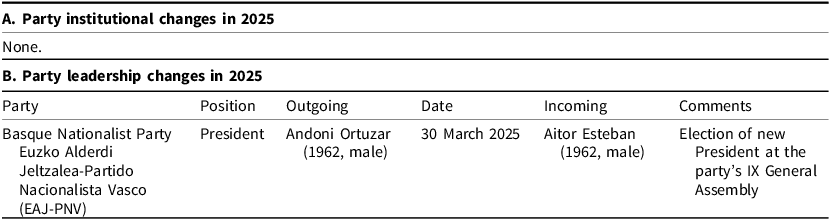
The PP held its XXI National Congress, at which Alberto Núñez Feijóo was re-elected as President. For its part, the Basque Nationalist Party (PNV) convened its IX General Assembly, during which Aitor Esteban, a member of the Congress of Deputies since 2004 and the party’s parliamentary spokesperson since 2012, was elected as the new party President, replacing Andoni Ortuzar.
Although there was no change in the formal party leadership of the PSOE, a key organisational position was reshuffled: the Secretary of Organisation, the third most important post within the party hierarchy. Santos Cerdán, who had served as Secretary of Organisation since 2021 after replacing José Luis Ábalos, was implicated in the so-called Koldo Case (see Bohigues and Sendra Reference Bohigues and Sendra2025) through a report issued by the Civil Guard. Following the publication of this report, Cerdán resigned from all his party positions as well as from his seat in the Lower House (Congreso de los Diputados). He was replaced as Secretary of Organisation by Rebeca Torró, who until then had served as Secretary of State at the Ministry of Industry. In fact, barely two weeks after his resignation, Santos Cerdán was placed in pre-trial detention, where he remained until November, when he was released under provisional liberty.
Information on changes in political parties in Spain in 2025 can be found in Table 5.
Changes in political parties in Spain in 2025

Table 5. Long description
Table 5 details changes in political parties in Spain in 2025. The table has two sections: Party institutional changes and Party leadership changes. The first section indicates there were no institutional changes. The second section lists changes in party leadership, with one row of data. The row details the Basque Nationalist Party (Euzko Alderdi Jeltzalea-Partido Nacionalista Vasco (EAJ-PNV)), where Andoni Ortuzar stepped down as President on 30 March 2025 and was replaced by Aitor Esteban. The comments note that the change occurred due to the election of a new President at the party’s 9th General Assembly.
Source: EAJ-PNV (2025; https://www.eaj-pnv.eus/es/).
Institutional change report
In November 2025, the Supreme Court (Tribunal Supremo) sentenced the Attorney General of the State, Álvaro García Ortiz, to two years of special disqualification from holding public office and a fine of €7,200 for the offence of disclosure of confidential information. The sentence stemmed from the leak of information related to a case involving the businessman Alberto González Amador, partner of the President of the Community of Madrid, Isabel Díaz Ayuso (PP), who was accused of an alleged tax offence (see Bohigues and Sendra Reference Bohigues and Sendra2025).
The trial constituted an unprecedented event in Spain, as it was the first time that an in-office Attorney General had been prosecuted, and it took place amid significant media attention. The PSOE stated that it disagreed with the decision, while nevertheless respecting it. Teresa Peramato was subsequently appointed by the Government as the new Attorney General of the State.
Issues in national politics
During 2025, the Spanish economy continued to perform relatively well compared to the European average. Gross Domestic Product (GDP) growth reached 2.6% in the fourth quarter of 2025, and the unemployment rate declined slightly from 10.3% in 2024 to 9.93% in 2025 (Instituto Nacional de Estadística 2026), falling below the 10% threshold for the first time since 2008. Additionally, the Ministry of Labour agreed with trade unions on a 3.1% increase in the minimum wage, up to 1221€ per month.
Still in the economic sphere, the takeover bid (Oferta Pública de Adquisición) by banking group Banco Bilbao Vizcaya Argentaria for rival Banco Sabadell ultimately failed after lengthy negotiations and an intense campaign, as it did not secure sufficient support among Sabadell’s shareholders. The merger would have created a major player in the Spanish banking system, with the combined entity accounting for around 25% of the market share, further increasing the already high concentration of the sector.
Corruption scandals continued to affect the government. Alongside investigations into Pedro Sánchez’s wife and brother for alleged influence peddling, accusations of pressure on judges linked to Socialist rank-and-file party member Leire Díez, and the conviction of the Attorney General, the government was shaken by the repercussions of the corruption cases and by allegations of sexual harassment within the PSOE. Two consecutive Secretaries of Organisation were sent to prison due to links to the Koldo case, which involved public contracts in exchange for commissions. These were Santos Cerdán, who spent five months in pre-trial detention, and José Luis Ábalos, who entered prison in November after a Supreme Court decision citing a risk of flight, along with Koldo García, after whom the corruption case is named. Cerdán left his seat as an MP, but not Ábalos, who then became the first sitting MP in Spain’s current democratic period to be sent directly to prison. In parallel, at least six sexual harassment complaints involving PSOE officials at different levels raised concern both within the party and also among government partners.
The government also faced several political setbacks, besides those mentioned in the Parliament report. These included the rejection of the Ministry of Health’s Mental Health Action Plan 2025–2027 by the autonomous communities governed by the PP, the failure of the government’s attempt to the European Union recognition of Catalan, Basque, and Galician as official EU languages, and the fact that the year once again ended without the approval of a national budget. Furthermore, Junts announced the withdrawal of its support to the government due to disagreements over issues related to the amnesty and migration control, leaving the government in a weaker position, short of a majority (PP, Junts and Vox hold a bare majority in Congress: 177/350).
For its part, the opposition led by the PP also faced tensions in the regions where it governs. In the Valencian Community, the political fallout from the 2024 DANA floods led to the resignation of regional President Carlos Mazón after a year of protests and controversy over the Valencian government’s response and management of the tragedy. The party also faced additional scandals, including the crisis surrounding failures in the breast cancer screening programme in Andalusia, the corruption scandal in the Almería Provincial Council (Diputación) over mask purchases during the COVID-19 pandemic, and corruption allegations involving former finance minister Cristóbal Montoro with Mariano Rajoy (2011–2018).
In Catalonia, the rise (for now in polls) of Sílvia Orriols and her far-right Catalanist party, Aliança Catalana, added further pressure on the pro-independence camp, particularly on Junts, as competition for the rightist Catalanist electorate intensified. At the same time, Vox showed signs of growing political strength, in polls and through agreements with PP-ruled regional governments, including budget deals in the Valencian Community, the Balearic Islands, and Murcia. Where such agreements failed to materialise, political instability followed, leading to early elections in Extremadura in 2025. The party also reinforced its international profile by hosting the Patriots meeting in Madrid, a gathering of European radical-right leaders chaired by Santiago Abascal.
The international arena was also marked by significant events. The war in Gaza triggered political and social repercussions in Spain. The return of the Global Sumud flotilla that departed from Barcelona carrying humanitarian aid for Gaza generated social protests, while the Israeli government banned ministers Yolanda Díaz and Sira Rego from entering the country, prompting Spain to recall its ambassador for consultations. The conflict also had domestic political and cultural repercussions, with widespread protests in summer during the La Vuelta a España cycling race against the participation of an Israeli team, and the decision by RTVE (Spanish Public Radio and Television Broadcaster) that Spain would not participate in the 2026 Eurovision Contest due to Israel’s presence.
At the same time, Spain remained active diplomatically, including Pedro Sánchez’s visit to China and the visit of Ukrainian President Volodymyr Zelensky. In the security domain, controversy emerged around Donald Trump’s push to increase defence spending among NATO member states from 2 to 5% of GDP, a proposal Spain resisted. Meanwhile, the United Kingdom and Spain reached a long-awaited agreement on the status of Gibraltar, which envisages the removal of all physical barriers and border controls on the movement of persons and goods.
The social sphere was also marked by sources of unrest in 2025. The housing crisis remained one of the most salient issues, prompting protests and demonstrations in several cities as rising rents and limited housing supply intensified public discontent. In mid-July, disturbances occurred in Torre-Pacheco (Region of Murcia) after a 68-year-old man was assaulted by a young Moroccan man. Following the incident, groups of residents, instigated by far-right forces and organisations, attacked Moroccan people, who represent around 30% of the town’s population.
The year was also punctuated by unexpected events. A nationwide energy blackout on 28 April generated widespread political and media attention and raised concerns about the resilience of Spain’s energy infrastructure. Later in the summer, Spain experienced an exceptionally severe wildfire season: around twenty major forest fires broke out within two weeks in August, burning more than 300,000 hectares.
Data availability statement
The data for this article can be found at the PDY Interactive website: www.politicaldatayearbook.com.
Competing interests
The authors declare none.
Use of Artificial Intelligence (AI) Tools
In accordance with Cambridge University Press publishing ethics guidelines, ChatGPT (OpenAI, GPT-5.5) was used solely for proofreading and language editing of the manuscript. The authors take full responsibility for its content.“No original data were generated for this article. All data used in the analysis are publicly available from the sources cited in the text and tables.

 Open access

