Community response to disaster events is an area of continued concern. Disaster readiness is often evaluated in terms of public health provision of services, health care response, and emergency management systems. Increased focus on specific preparedness levels of local citizens and the impact of preparedness efforts is needed to support overall community health.Reference Breckjord, Stern and Shugarman 1 The American Preparedness Project 2 notes that 50% of US citizens believe their community will respond adequately to an unexpected disaster. This project was undertaken to determine the extent of actual and perceived preparedness by local citizens to a disaster. Specific consideration was given to the perception of readiness and past involvement with local support systems (eg, universities, law enforcement, health care institutions) on improved disaster preparedness.
Disasters are an extreme disturbance in community or societal functioning that can cause catastrophic loss. 3 , 4 Disasters are categorized as natural, manmade incidents, or natural with minimally effective community response, such as Hurricane Katrina and the New Orleans levee breach in 2005. 5 The Federal Emergency Management Agency (FEMA) 6 has outlined a list of probable weather-related and terrorism-related disaster threats such as drought, earthquake, fire, flood, winter storms, biological terrorism, and chemical terrorism. Although each threat is potentially devastating, singular disaster events may combine to create a larger threat to public health.
Despite a focus on training and education of public health personnel, communities may lack resources needed to support immediate response capability. Disaster health personnel at FEMA 6 have acknowledged local residents as the true first responders to a disaster or emergency event. Individuals are most likely to respond to the needs of their families, friends, and neighbors long before formal help arrives. The World Health Organization 4 (WHO) encourages individuals to become educated on necessary methods to support personal preparedness and to pay special attention to areas of community vulnerability. Education should be centered on areas of greatest impact and include preparedness teaching for special needs populations, such as physically handicapped or elderly individuals and persons with physical limitations or comorbidities. Community-focused agencies such as the American Red Cross 7 acknowledge the influence disaster events have on all areas of personal health. These agencies encourage increased efforts toward community-based training and education.
The goal of this study was to assess the knowledge and state of readiness regarding disasters and emergency preparedness of residents within a community. The primary question was, To what extent are community members prepared (perceived and actual) to respond in a disaster event? Findings will facilitate efforts to develop educational materials and marshal community support.
METHODS
During a 4-week period, English-speaking adult residents of an identified county were asked to participate in a face-to-face survey addressing knowledge of local hazards, emergency systems, and personal preparedness. The county was geographically and demographically diverse (19 cities and towns) with approximately 500,000 residents and covered 500 square miles and was located in the Midwest. Institutional review board approval was received and informed consent was obtained.
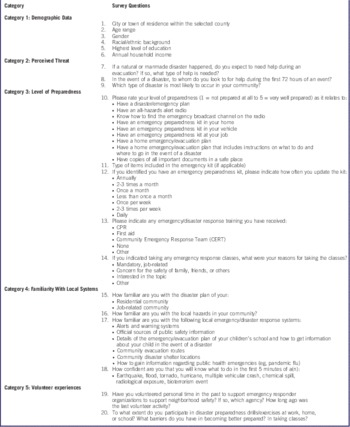
The survey was developed with feedback from key informants. The 20-item instrument included questions on levels of preparedness, familiarity with emergency management systems, confidence in response capability, and extent of participation in preparedness activities. The instrument was tested with community members and was revised before actual data collection. Demographic questions were also included (Table 1). Each question used Likert scales and open-ended comments to allow participants to share their perceptions of knowledge and preparedness. This article reports the findings related to general levels of preparedness.
Disaster Assessment Survey Questions

Participants were asked to complete the assessment by using their current level of knowledge and ability. They were encouraged to answer all questions but were allowed to skip questions that they did not feel were applicable to their experience. Most of the questions asked the participants to rate their responses by using a 4-point or 5-point rating scale that ranged from none to a higher level of skill and ability.
Collected data were compiled in Microsoft Excel (Microsoft Corp, Redmond, WA) and exported to SPSS, version 22 (IBM, Armonk, NY), for evaluation of descriptive statistics and frequencies for ordinal items. Content analysis was used for qualitative comments.
RESULTS
Of the 500 community members approached for survey participation, a total of 423 adults (85%; 53% female, 44% male, 3% nonreporting) completed the instrument. The average age of the respondents was 18 to 34 years, with 36% reporting some level of college education. The average income of the respondents was $60,000 per year or greater. The racial/ethnic mix was 51% white, 23% black/African American, 18% Hispanic/Latino, 2% Asian, and 1% each for American Indian/Alaskan Native, Hawaiian/Pacific Islander, and other or no response. The sample was representative of the local population.
Perceived Threat
Participants shared their perceptions of potential threats from a list of major disaster and emergency options: earthquake, bioterrorism, tornadoes, or severe disease outbreak. While many chose combined answers indicating increased areas of possible threat and possible receipt of education or training, the majority of residents reported that their single greatest perceived threat from disasters were tornadoes (66%; n=279).
Level of Preparedness
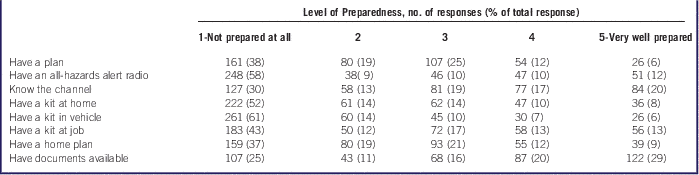
Fifty-seven percent (n=241; Table 2) reported that they had little to no personal preparedness for possible disasters. Survey respondents were evaluated on their specific level of personal preparedness (having a disaster plan, an all-hazards radio, emergency kits, and copies of documents). Participants were overwhelmingly unprepared in the following areas:
-
∙ General disaster/emergency plan (n=161);
-
∙ All-hazards alert radio (n=248);
-
∙ Knowledge about local emergency broadcast channel radio stations (n=127);
-
∙ Availability of emergency preparedness kit: home (n=222), car (n=261), work (n=183); and
-
∙ Existence of a home emergency evacuation plan (n=159).
Level of Preparedness of Local Citizens as Reported on a Disaster Readiness SurveyFootnote a

a n=423. Likert scale ranged from 1=not prepared at all to 5=very well prepared.
Respondents demonstrated greater states of readiness with the maintenance of copies of important documents in a safe place (29% reporting very well prepared; n=122).
Familiarity with Emergency Systems
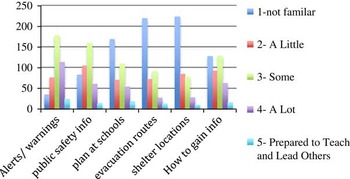
Sixty-three percent (n=267; Figure 1) reported little to no level of familiarity with community hazards. The majority of participants (76%, n=321) shared that they had little to no familiarity with residential disaster plans and 59% (n=250) had little to no familiarity with job-related emergency plans. Participants reported having the least amount of emergency response system knowledge in disaster plans at local schools, evacuation routes, and shelter locations. Fifty-two percent (n=220) had little to no familiarity with how to gain information with regard to public health emergencies, such as pandemic flu. The greatest knowledge of disaster/emergency response was noted in alerts and warnings. A total of 42% of respondents (n=178) reported some familiarity with these areas, 27% (n=114) reported a lot of familiarity, and 6% (n=25) reported that they felt they were prepared enough to teach or lead others.
Familiarity With Emergency Management Systems. Data are from a community disaster readiness survey completed by 423 residents of a midwestern county in the United States.

Past Experience and Levels of Preparedness
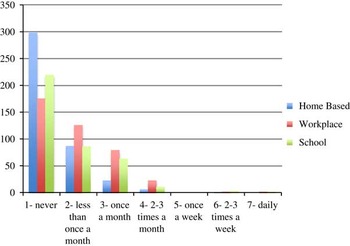
Eighty-six percent (n=364) reported that they had not taken any personal time to support emergency responder organizations focusing on neighborhood safety (Figure 2). Individuals were allowed to share the factors influencing their participation in emergency response and neighborhood safety events. When asked what barriers were present to being prepared, many respondents indicated that there were no barriers. However, others identified their greatest challenges were lack of time, limited knowledge on where to get emergency information, lack of access, and lack of funds to purchase readiness kits.
Extent of Participation in Emergency Preparedness Activities. Data are from a community disaster readiness survey completed by 423 residents of a midwestern county in the United States.

The goal of the study was to ascertain the level of disaster and emergency readiness (perceived and actual) of the community members within a particular midwestern region. The results presented demonstrate reduced levels of preparedness, familiarity with hazards, emergency notification/response systems, and active involvement in preparedness activities.
DISCUSSION
Since 2001, national health care agencies such as the Department of Health and Human Service (DHHS), FEMA, and the Department of Homeland Security (DHS) have made efforts to encourage, promote, and support communities active in emergency preparedness. Unfortunately, not all community members embrace these efforts. Many citizens do not apply emergency preparedness principles, or even see the need to receive the education, if they do not repeatedly see disaster events occurring in their daily lives. 8 Additionally, many people may not associate frequent weather-related or environmental occurrences that can cause mass casualty incidents, such as storms, power outages, or multiple motor vehicle crashes, as types of preventable disasters. They often view these as unavoidable events.Reference Wells, Tang and Lizaola 9 The result is a community not aware of potential hazards and unprepared for the required self-care that may be needed. 8 Improved community preparedness requires combined efforts of all community stakeholders (eg, educators, health care providers, public health personnel, emergency management officials). Disaster preparedness activities are recognized as an opportunity to minimize the effect of these events, encouraging engagement in planning, organizing, training, evaluating, implementing, and reevaluating preparedness measures to ensure effective response during a disaster event. 8 Residents need to explore the types of potential hazards that may affect their communities and create emergency plans to support self-care efforts until help arrives.
The midwestern site of this study is frequently plagued with winter storms, severe weather, and other hazards that place the public in danger. Lack of personal preparedness places the community at risk for greater danger and decreased resilience for repeated occurrences. Those individuals and families not active in disaster preparedness may experience high levels of anxiety should a major event take place, 7 causing them to engage in unsafe, risky behaviors, or failing to heed warning signs of an encroaching, potentially life-threatening event.
Despite living in a region with frequent severe weather, power outages, and winter storms, the majority of participants (76%, n=321) in this study had little knowledge or awareness of the emergency systems in their community. This can be detrimental to overall response capability and community resilience. Lack of exposure to emergency systems places individuals and families at greater risk for additional incidents of danger and possible harm. Moreover, study participants (57%, n=241) overwhelmingly reported that they did not participate in home, school, or work-based preparedness activities. Community health promotion stakeholders must seize opportunities to expand their efforts toward addressing these and other disaster preparedness concepts with the public. This is an opportunity for improved community education with the incorporation of active partnership building to support improved knowledge and active preparation.
Recommendations
The original research question inquired about the extent of community-based preparedness for disasters and emergencies. The region selected for assessment has limited community-based data that identify the exact level of preparedness of its citizens. The results of this study suggest that the members of this community have limited preparation and knowledge related to these events. Therefore, increased focus on community education and training is recommended. Through the use of frequent community-based educational sessions and messaging, residents can become more familiar with potential hazardous situations. The educational measures can be supported by local disaster training centers, academic units, public health, and emergency response professionals. National agencies such as FEMA, DHHS, and DHS strongly encourage the development of community emergency response teams (CERTs) that are knowledgeable and willing to respond to a variety of community-based, disaster-related needs should first responders not be able to respond. 8 Through training, CERTs focus on immediate disaster response, safety, and community empowerment.
Types of educational materials can include listings of topics such as local emergency response centers and development of personal and family emergency plans. The survey and narrative responses of the participants suggest that specific educational topics that might be appropriate include winter storm preparedness, severe weather safety, evacuation routes, developing an emergency kit, sheltering in place, and preparedness techniques for seniors and pet owners. Open-ended comments from the survey participants suggested that these types of topics would be welcomed through frequent reminders and local alerts. Additionally, the average age of the survey responder was 18 to 34 years old, which is the age range with the greatest use of social media outlets. 10 Therefore, in addition to offering traditional educational training, residents can receive instruction on emergency preparedness concepts electronically via social media, e-mail, and other forms of electronic communication.
Community support for increased involvement in preparedness activities can be encouraged by the frequent discussion of preparedness topics. Survey participants reported a personal lack of focus on emergency and disaster concerns. Several participants reported that the primary barriers to them not seeking preparedness training were “don’t think about it really,” “deficient knowledge,” “lack of exposure,” and “not knowing who to go to.” Many reported increased awareness of this topic as a result of completing the survey. The release of these findings to the community may offer an opportunity to expand the conversation about personal and community preparedness across the county.
Additional recommendations include the development of academic and community partnerships that incorporate mandatory education of health professions students on disaster concepts with community-based educational sessions.Reference Adams and Canclini 11 This can be developed as service learning or clinical experience for mutual student and community gain. The process is recommended to include well-designed outcomes for students and community members, incorporating participatory action in the design and implementation.Reference Adams and Canclini 11 Other recommendations for improving community-based disaster readiness include:
-
∙ Frequent assessment of community readiness,
-
∙ Frequent delivery of community-based education,
-
∙ Distribution of disaster readiness tools, and
-
∙ Development of emergency plans with all members of the community (home, work, school).
Although this study included a large number of community residents (n=423), it was limited in its lack of focus on special populations (eg, disabled persons). These populations are especially vulnerable in times of disasters owing to their lack of resources and limited supplies. 6 Future studies should consider additional focus on these populations. Additionally, this was a convenience sample with a potential for bias in focusing only on those participants who demonstrated a willingness to explore the concepts presented by the survey. The sample used for this survey may not be representative of the population. The results also represent the findings of a specific geographical region and may not be generalizable to all communities.
Despite these limitations, it is clear that lack of adequate disaster and emergency response readiness is an identified problem for this community. Many participants reported that they had not considered themselves vulnerable to a disaster prior to participating in the survey. This suggests that the community has a desire for improved knowledge of overall personal preparedness. Immediate action on behalf of public and health care personnel is required to address this area of concern, before a disaster occurs.