Introduction
The pine wood nematode (PWN), Bursaphelenchus xylophilus, is a highly invasive species that causes pine wilt disease (PWD). It has devastating effects to pine forests of Japan, China, Korea and Europe (Nickle et al., Reference Nickle, Golden, Mamiya and Wergin1981; Cheng et al., Reference Cheng, Lin, Li and Fang1983; Yi et al., Reference Yi, Byun, Park, Yang and Chang1989; Mota et al., Reference Mota, Braasch, Bravo, Penas, Burgermeister, Metge and Sousa1999; Zamora et al., Reference Zamora, Rodriguez, Renedo, Sanz, Dominguez, Perez-Escolar, Miranda, Alvarez, Gonzalez-Casas, Mayor, Duenas, Miravalles, Navas, Robertson and Martin2015), and poses a serious threat to pine forests globally. The life cycle of B. xylophilus involves two forms, propagative and dispersal (Mamiya, Reference Mamiya1975, Reference Mamiya1983b). Under suitable environmental conditions, the nematodes will reproduce and grow very rapidly from egg to adult. However, when the environment becomes unsuitable, the dispersal-stage larvae 3 (DL3) and dispersal-stage larvae 4 (dauer, DL4) appear (Mamiya, Reference Mamiya1983a; Fukushige, Reference Fukushige1991; Maehara and Futai, Reference Maehara and Futai2000). The DL3 nematodes moult to DL4 to enter the trachea of enclosing beetles (Zhao et al., Reference Zhao, Zhang, Wei, Zhou, Zhang, Qin, Chinta, Kong, Liu, Yu, Hu, Zou, Butcher and Sun2016). Following dispersal, while the vector beetles are feeding on healthy pines, DL4 nematodes leave the trachea, enter the pines and moult into adults. These propagative nematodes reproduce and kill the pines (Zhao et al., Reference Zhao, Zhang, Wei, Hao, Zhang, Butcher and Sun2013). Thus, the dauer recovery (DL4 transformation to adult) of B. xylophilus is the final step leading to the successful spread of PWD to healthy pines.
In response to harsh environmental conditions, most nematode species undergo a diapausal stage, dauer arrest, prior to the reproductive stage. In Caenorhabditis elegans, a free-living nematode, the dauer developmental decision hinges on the integration of three environmental parameters: population density, nutrient supply and ambient temperature. A high population density initiates the dauer developmental program, while high temperatures and reduced nutrient resources strongly potentiate this decision (Golden and Riddle, Reference Golden and Riddle1982, Reference Golden and Riddle1984; Ouellet et al., Reference Ouellet, Li and Roy2008). Thus, dauer recovery, which leads to the propagative stage, requires a low population density, sufficient nutrients and suitable temperatures (Ouellet et al., Reference Ouellet, Li and Roy2008). As with C. elegans, the food supply-related signal could also induce the recovery of entomopathogenic Heterorhabditis spp. nematodes (Strauch and Ehlers, Reference Strauch and Ehlers1998; Aumann and Ehlers, Reference Aumann and Ehlers2001; Dolan et al., Reference Dolan, Jones and Burnell2003). However, requirements for dauer recovery are not clearly understood as in many other nematodes.
Terpenes, mainly composed of monoterpenes, sesquiterpenes and diterpenes (Chen et al., Reference Chen, He, Chen, Gu, Liu, Xu, Teale and Hao2018), are the main pine volatile components responsible for plant defence (Smith, Reference Smith2000; Xu et al., Reference Xu, Xu, Zhou, Wang, Wang, Lu and Sun2018) and kairomone attraction of phytophagous pests (Fan et al., Reference Fan, Sun and Shi2007; Xu et al., Reference Xu, Shi, Wang, Lu and Sun2016). In B. xylophilus, propagative larvae are attracted to terpene volatiles (α-pinene, β-pinene and longifolene) produced by the host pine (Zhao et al., Reference Zhao, Wei, Kang and Sun2007). DL4 are attracted to β-myrcene and are recovered by some monoterpenes like β-myrcene, limonene and α-pinene (Hinode et al., Reference Hinode, Shuto and Watanabe1987; Stamps and Linit, Reference Stamps and Linit1998a). While population density, nutrient supply or ambient temperature are well-known factors promoting nematode dauer recovery, the role that volatile terpenes like sesquiterpenes of pines play in dauer recovery of B. xylophilus is unclear.
Here, we investigated the effects of food supply, population density, temperature and volatile terpenes of pines on dauer recovery. The results showed that pine volatiles, but the common dauer recovery stimulators, could promote the dauer recovery of B. xylophilus from DL4 to adult. Understanding the mechanisms that trigger dauer recovery may lead to new applications in PWD prevention, for example, if a technique is developed to sustain dauer arrest even after transmission, then it may prevent PWD from developing.
Materials and methods
DL4 of B. xylophilus
DL4 nematodes were obtained from vector beetles of Monochamus alternatus. To ensure the stability of the DL4, we dissected the beetles collected at peak eclosion time (April to August, 2018) from Zhejiang and Guangdong Provinces, China. The dissected beetle was soaked in ddH2O in a 60-mm Petri dish for 2 h. The DL4 nematodes swam out of the beetle trachea and were then sequentially transferred three times into new petri dishes using a 10-μL pipette tip for decontamination. The collected DL4 nematodes were stored at 4 °C for further research.
Stimulation of the B. xylophilus dauer recovery process with different nutrients
Cellulose, glucose, Botrytis cinerea (the fungal food of B. xylophilus) and the twigs of different trees (Ginkgo biloba, Pinus massoniana and Pinus thunbergii) were collected at the vector beetle's peak eclosion time (May) on the campus of the Chinese Academy of Forestry and used as nutrient sources for the dauer recovery of DL4. In total, 30 DL4 nematodes were soaked in 4 mL ddH2O supplemented with different nutrients in a 35-mm petri dish. The concentrations of cellulose and glucose were 5 × 10⁻² g mL−1. The sizes of B. cinerea, G. biloba, P. massoniana and P. thunbergii were 5 mm × 5 mm. After cultivating for 2 d in a 25 °C incubator, the numbers of adult stage nematodes were counted using an optical microscope equipped with a camera (CZX51 and BX51, Olympus, Japan), and the transformation rates of the DL4 were calculated. These tests were performed with three replicates.
Transformation rates of B. xylophilus DL4 stimulated by population density
To test the effects of DL4 population density on dauer recovery, we used one nematode and 100 DL4 nematodes per well as different population densities (Hirao and Ehlers, Reference Hirao and Ehlers2010). In a 96-well plate, every well had one nematode soaked in 100 µL ddH2O, with or without a ~2 mm × 2 mm pine chip. Totally, there were 96 nematodes in 96 wells respectively for one nematode in one well tests. Meanwhile, in the well of 96-well plate, every well had 100 nematodes soaked in 100 µL ddH2O, with or without a ~2 mm × 2 mm pine chip for one hundred nematodes in one well test. The test methods were as above, and the transformation rates of the DL4 were calculated. These tests were performed with three replicates.
Transformation rates of B. xylophilus DL4 stimulated by temperature
To test the effects of temperature on dauer recovery, a temperature gradient was used. In total, 30 DL4 nematodes were cultivated at 4, 10, 15, 20, 25, 30, 35, 40 and 45 °C. The nematodes were soaked in 4 mL ddH2O, with or without a ~5 mm × 5 mm pine chip. The transformation rates of DL4 were calculated as above. These tests were performed with three replicates.
Transformation rates of B. xylophilus DL4 stimulated by pine volatiles
In these tests, petri dishes divided into two parts with a physical barrier in the middle were used (Fig. 4). In total, 50 DL4 nematodes were inoculated into the centre of 2% agarose media on one side of the petri dish. A 20-mm dish, with G. biloba or P. massoniana chips, and filled with 5 mL ddH2O was adhered to the opposite side. After cultivating for 2 d in a 25 °C incubator, the numbers of nematodes at different transformational stages in both sides of the petri dish were counted, and the transformation rates of the DL4 were calculated. These tests were performed with three replicates.
Volatile analysis of G. biloba, P. massoniana and P. thunbergii
Volatiles of G. biloba, P. massoniana and P. thunbergii were collected by solid phase micro-extraction (SPME, 57310-U, Supelco, USA) and analysed by Gas chromatography-Mass spectrometry (GC-MS, Agilent, USA, Agilent 6980N GC coupled 5973 mass selective detector) equipped with a DB-WAX capillary column (30 m × 0.25 mm, Agilent Technologies, USA), and the column temperature was programmed from an initial temperature 50 °C for 1 min, then increased by 5 °C min−1 to 160 °C and held for 2 min, and last increased by 20 °C min−1 to 250 °C and held for 5 min (Zhou et al., Reference Zhou, Xu, Wang, Wang, Lou, Lu and Sun2017). Data files were analysed with the automated mass spectral and identification system for peak deconvolution, and spectra were matched using the mass spectral library (NIST 2008) and a custom library. To further identify the main volatiles of these trees, the volatile samples were compared with candidate standard chemicals α-pinene (Sigma, USA, 98% purity), camphene (TCI, Japan, >78% purity, containing 20% Tricyclene), D-limonene (Sigma-Aldrich, USA, 98% purity), β-pinene (Sigma-Aldrich, USA, 99% purity), β-myrcene (Sigma-Aldrich, USA, 2000 µg mL−1 in hexane), β-phellandrene (TRC, Canada, 100% purity), longifolene (Sigma-Aldrich, USA, ⩾75% purity) and trans-caryophyllene (Sigma-Aldrich, USA, ⩾98% purity) using above methods. The contents of the main volatiles of the tested trees were measured using GC analysis of the hexane-extracted tree chip samples containing heptyl acetate as an internal standard (Xu et al., Reference Xu, Lou, Cheng, Lu and Sun2015).
Transformation rates of B. xylophilus DL4 stimulated by the main volatiles
We tested the effects of the pine volatiles including α-pinene, camphene, D-limonene, β-pinene, β-myrcene, β-phellandrene, longifolene and trans-caryophyllene on dauer recovery. In total, 30 DL4 nematodes were cultivated in 5% Triton X-100 with or without 10−2 g mL−1 of each main volatile independently. These tests revealed the most promotive volatile, which was then used to test the gradient effects on dauer recovery. The gradient concentrations of this volatile were 0, 10−5, 10−4, 10−3, 10−2 and 10−1 g mL−1. After cultivating for 2 d in a 25 °C incubator, the transformation rates of the DL4 were calculated as above. These tests were performed with three replicates.
Statistical analyses
In all experiments, the normality of data was measured using the Kolmogorov–Smirnov test, and the homogeneity of group variances was screened using Levene's test. The statistical significance of the population density promotive tests was evaluated using the unpaired two-tailed Student's t test. Different pine and pine volatile promotive tests were evaluated using one-way ANOVA (analysis of variance) with Tukey's test or Dunnett's T3 depending on normality and homogeneity. A two-way ANOVA was used to evaluate the between-subject effects on transformation rates promoted by G. biloba or P. massoniana chips. Data were analysed using SPSS 18.0 software (SPSS, Inc., Chicago, USA). All the quantitative data were represented as means ± s.e. (standard error).
Results
B. xylophilus dauer recovery promoted by different foods, temperatures and densities
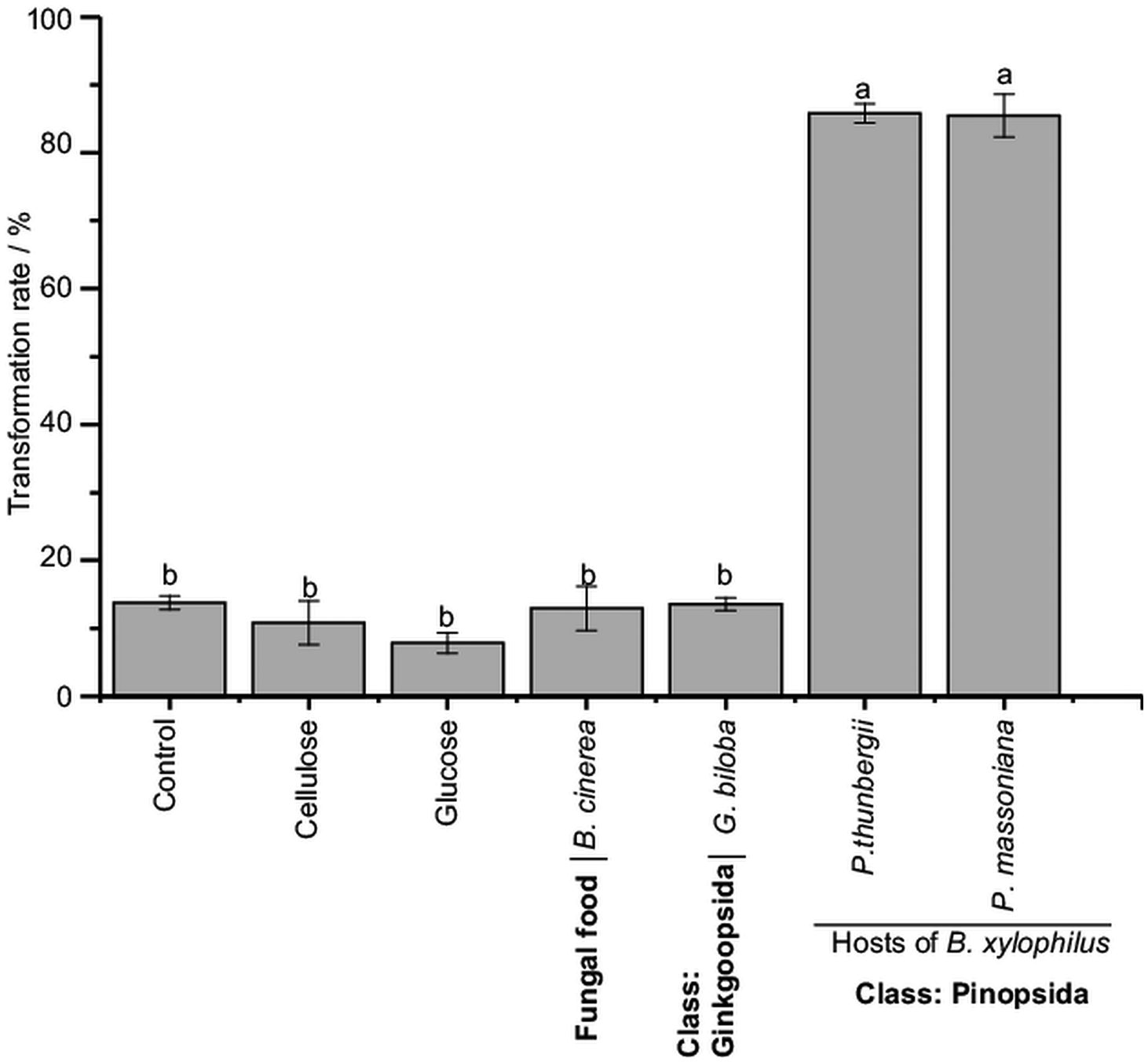
Here, we used cellulose, glucose, B. cinerea, G. biloba, P. thunbergii and P. massoniana as stimulators to monitor the DL4 transformation process from DL4 to adult. As B. xylophilus hosts, P. thunbergii and P. massoniana promoted high transformation rates of DL4 at ~80% significantly higher than the control at ~13%. However, The DL4 transformation rates stimulated by cellulose, B. cinerea and especially glucose were not significantly different compared to controls. In addition, G. biloba from Ginkgoopsida was tested as outgroup. The transformation rate when stimulated by G. biloba was similar to controls at ~15%. In addition, in the control test without a stimulator, some nematodes also moulted successfully (Fig. 1, one-way ANOVA, F 6,14 = 248.90, P < 0.001).
Transformation rate of B. xylophilus DL4 promoted by different nutrients. G. biloba is from Ginkgoopsida, as an outgroup. Statistical differences in the means are indicated with different letters, P < 0.05. Error bars represent ± s.e.

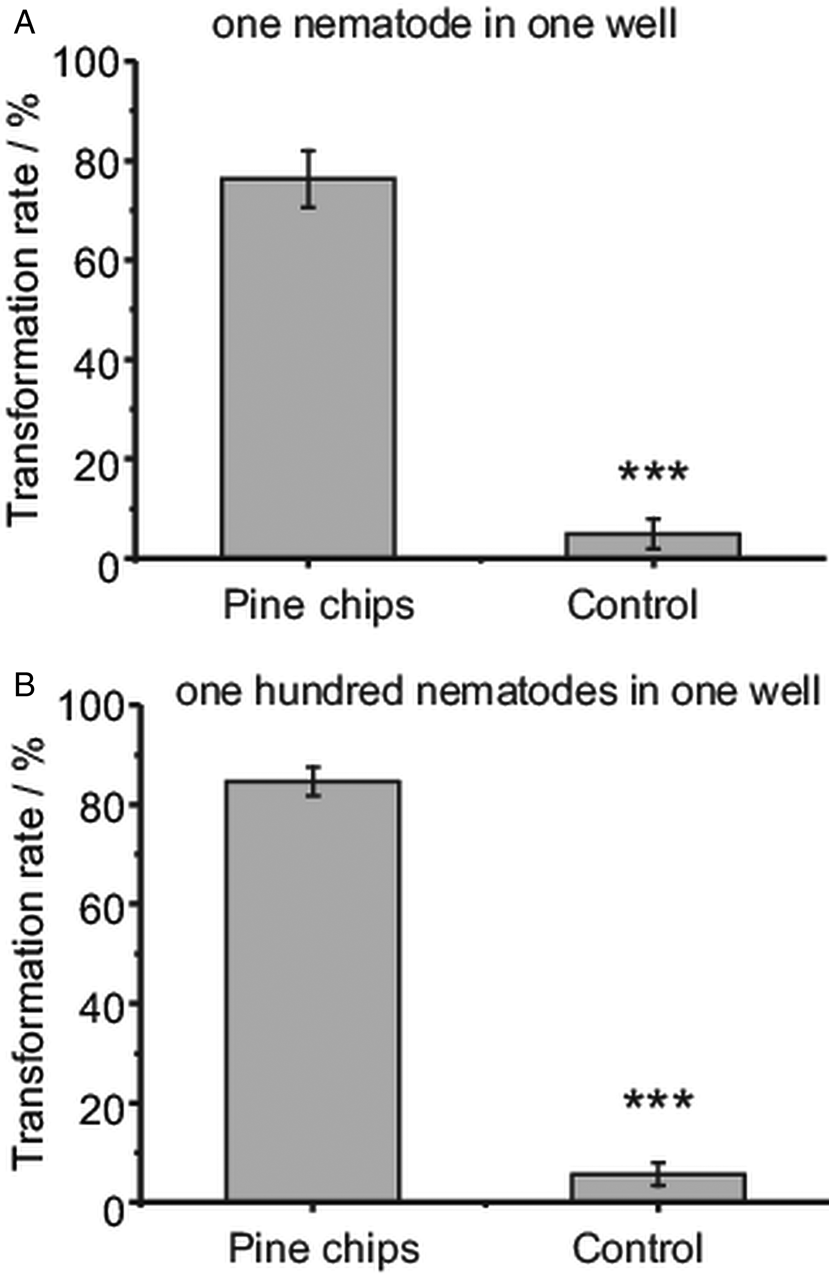
In addition to nutrient supply, temperature and population density are known effectors of C. elegans dauer recovery. Consequently, the effects of these factors on B. xylophilus DL4 transformation were tested. For population density, one nematode per well and 100 nematodes per well were used to represent low- and high-population density levels, respectively. Independent of the population level, the transformation rates were low without pine stimulation. However, with pine stimulation, nematodes at both population density levels had significant transformation rates compared with control (Fig. 2a, df = 4, t = 15.27, P < 0.001; Fig. 2b, df = 4, t = 22.01, P < 0.001).
Transformation rates of B. xylophilus DL4 promoted by different densities, with or without pine chips. (a) Transformation rates of B. xylophilus DL4 of one nematode in one well, with or without pine chips. Statistical differences in the means are indicated with ‘***, P < 0.001’. Error bars represent ± s.e. (b) Transformation rates of B. xylophilus DL4 of one hundred nematodes in one well, with or without pine chips. Statistical differences in the means are indicated with ‘***, P < 0.001’. Error bars represent ± s.e.

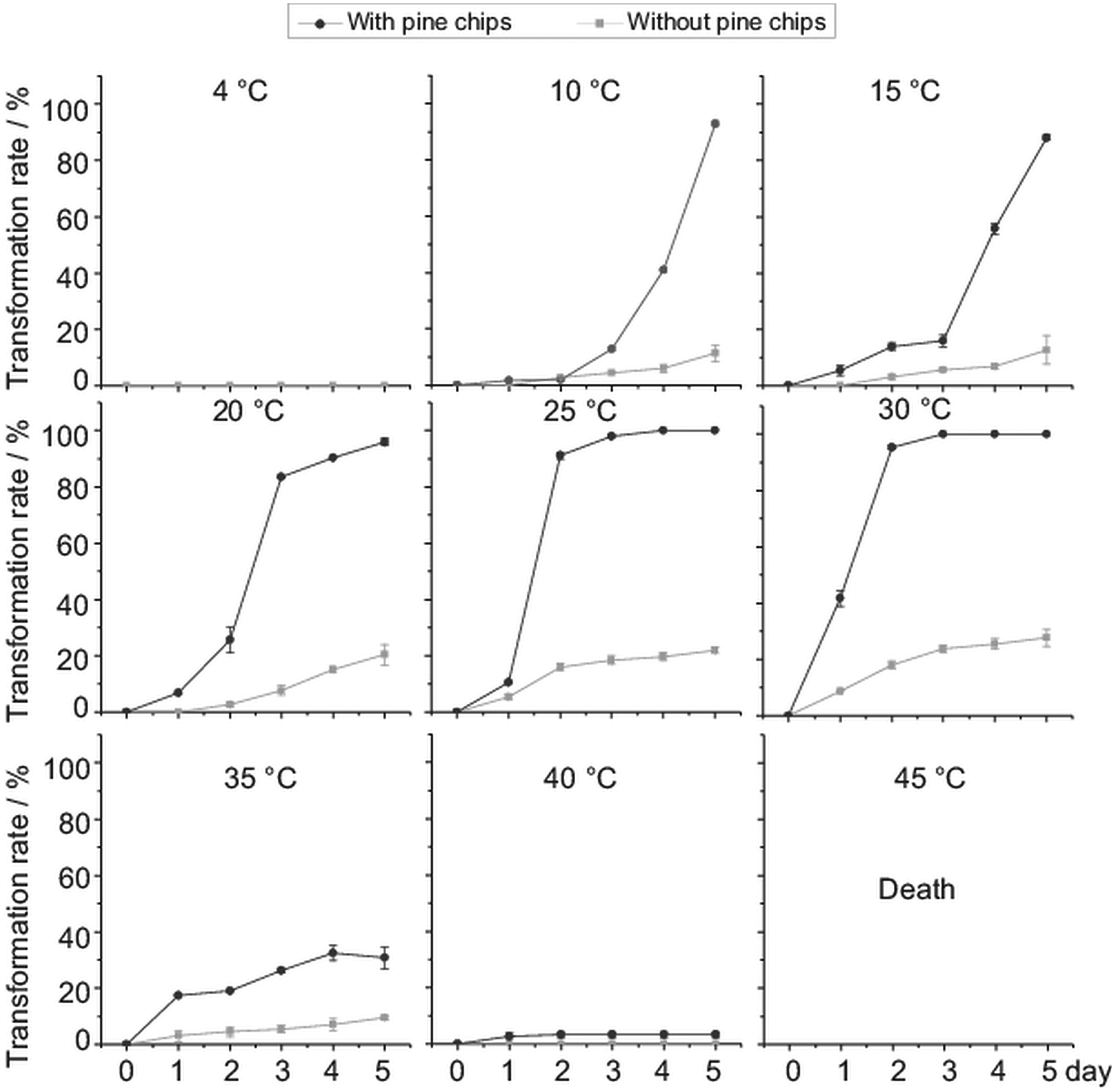
Without pine chips, the transformation rates of DL4 at all the tested temperatures were less than 30%, even after 5 d (Fig. 3). However, with pine chip stimulation, the transformation rates of DL4 at 25 and 30 °C increased rapidly to 85% after 2 d (Fig. 3). At less than 25 °C, the transformation rate decreased as the temperature decreased, until 4 °C, when the nematodes stopped transforming at all over 5 d (Fig. 3). Interestingly, the DL4 transformation was inhibited when temperature was greater than 35 °C. At 35 °C, DL4 transformed rapidly during the first day, but the transformations stopped in the following days (Fig. 3). At 40 °C, like at 4 °C, the nematodes did not transform. All the DL4 nematodes died after 1 d at 45 °C (Fig. 3).
Transformation rates of B. xylophilus DL4 promoted by different temperatures, with or without pine chips.

B. xylophilus DL4 recovery promoted by pine volatiles of P. massoniana
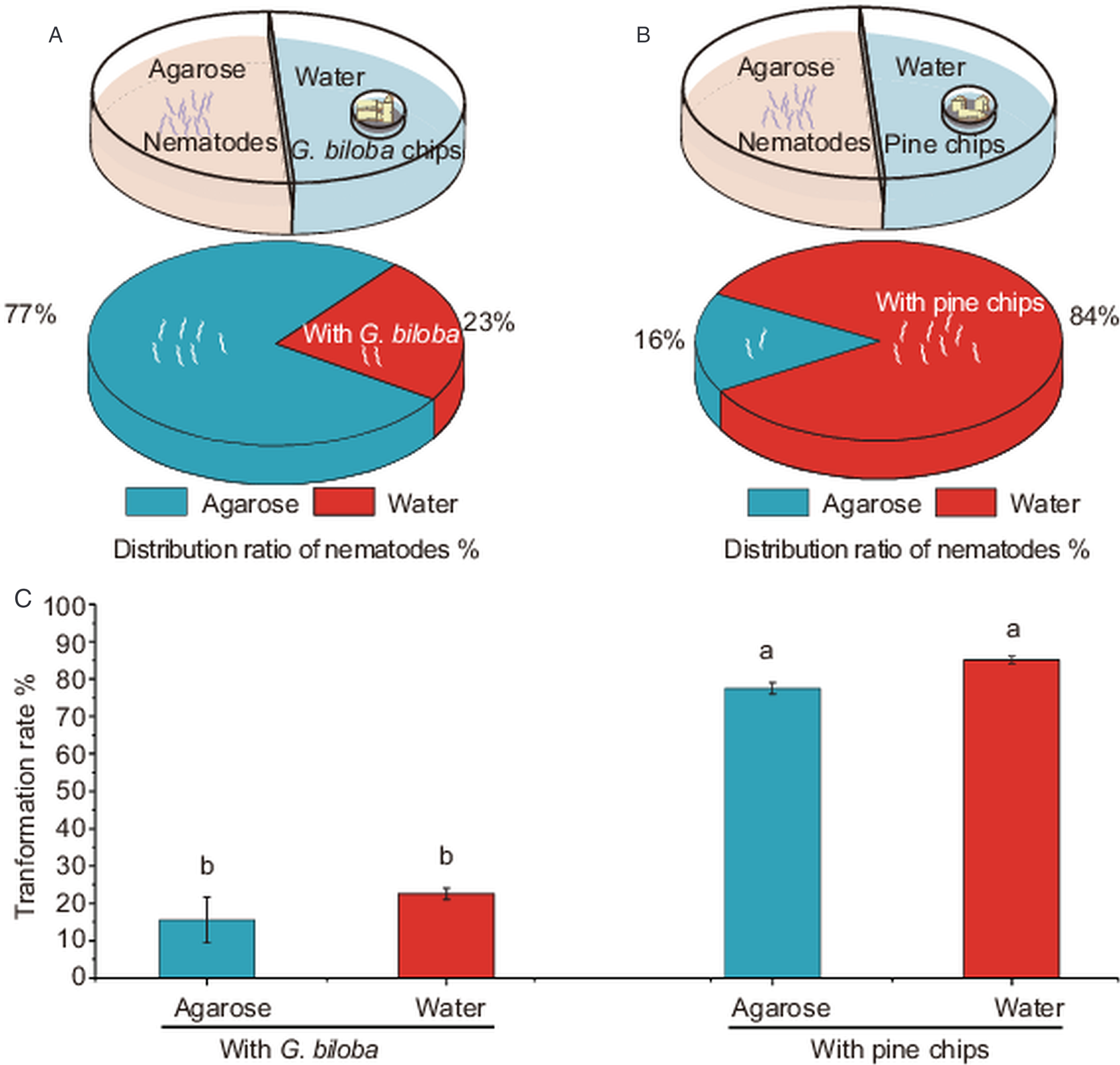
P. massoniana was used as the representative pine for investigating transformation-stimulating signals. After cellulose and nutrients, volatiles are the most important components of pines. The promotive capability of volatiles from P. massoniana on DL4 transformation was first determined. The percentage of nematodes in the water section of the dish attracted by pine chips was 84% (Fig. 4b), while it was only 23% with G. biloba (Fig. 4a). Independent of the section, water or agarose, when nematodes were exposed to pine volatiles, the DL4 transformation rates were ~80%. When nematodes were exposed to ginkgo volatiles from G. biloba chips, the transformation rates were only ~20% (Fig. 4c, one-way ANOVA, F 3,8 = 123.98, P < 0.001). To eliminate the effect of agarose on DL4 recovery, we evaluated the between-subject effects on the transformation rates promoted by pine chips or agarose (Table S1). The main effect on DL4 recovery was attributed to pine chips (P < 0.001), while agarose had no effect (P > 0.05). There was no interaction between pine chips and agarose (P > 0.05). In conclusion, the volatiles from pine promoted the DL4 transformation into an adult.
Distribution and transformation rates of B. xylophilus DL4 promoted by the volatiles from P. massoniana or G. biloba. (a) DL4 nematode distributions in each part of divided Petri dishes with G. biloba chips attraction. In the test diagram the left and right parts contained agarose and water, respectively. An empty 20-mm dish with G. biloba chips was adhered to the right side. The distribution of nematodes on agarose and in water are displayed in pie graphs. (b) DL4 nematode distributions in each part of divided Petri dishes with pine chips attraction. A 20-mm dish with pine chips was adhered to the right side. (c) Transformation rate of B. xylophilus DL4 promoted by the volatilization of chemicals from P. massoniana or G. biloba. Transformation rates of DL4 on agarose and in water were calculated with P. massoniana or G. biloba. Statistical differences in the means are indicated with different letters, P < 0.05. Error bars represent ± s.e.

Analysis of main volatiles of P. massoniana
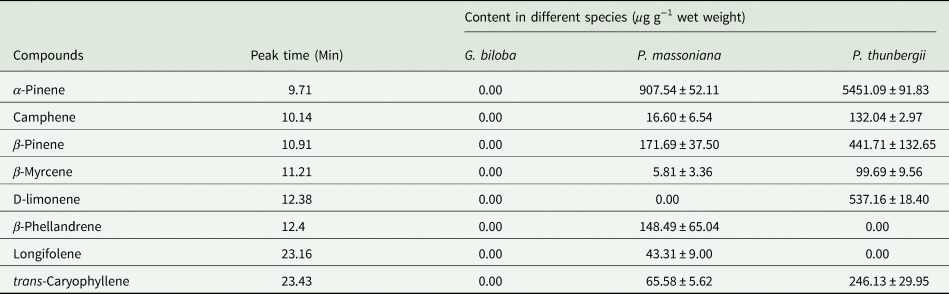
The main volatiles of P. massoniana were α-pinene, camphene, β-pinene, β-myrcene, β-phellandrene, longifolene and trans-caryophyllene. Among the main volatiles, the content of α-pinene was highest, followed by β-phellandrene and β-pinene. The contents of other volatiles were no more than 10%. While, the main volatiles of P. thunbergii were α-pinene, camphene, β-pinene, β-myrcene, D-limonene and trans-caryophyllene. Among the main volatiles, the content of α-pinene was highest, followed by D-limonene and β-pinene. Concentrations of all the volatile components from P. thunbergii were higher than those of P. massoniana. In addition, G. biloba did not contain any pine volatiles (Table 1).
Quantification of the main volatiles of tested trees

The value indicates mean ± s.e.
B. xylophilus DL4 recovery promoted by standard pine volatiles
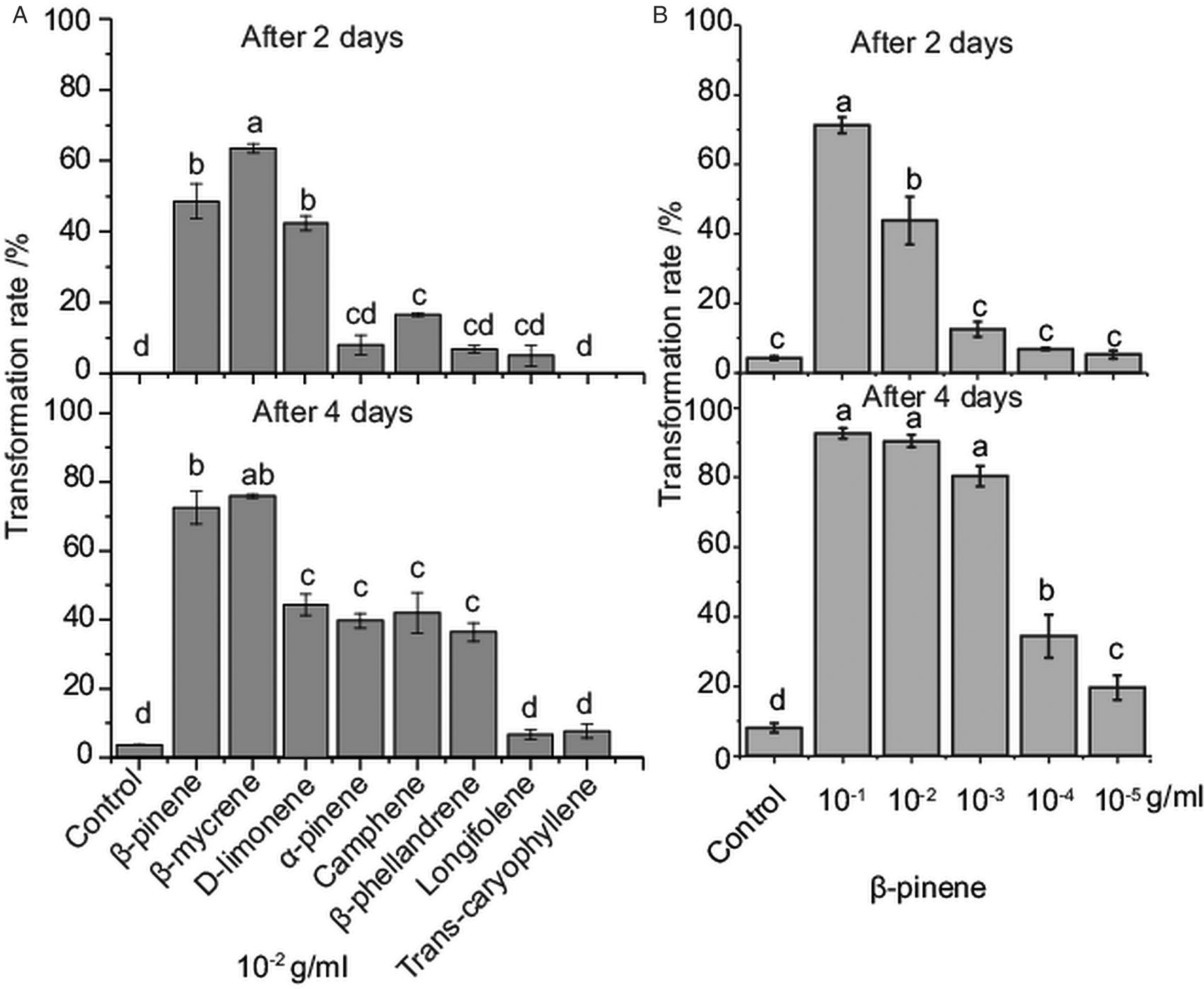
Authentic standards of seven main volatiles in tested pines were used to investigate their promotive effects on DL4 transformation. After 2 d, the transformation rates of DL4 stimulated by β-myrcene and β-pinene were highest, followed by D-limonene, and the remain chemicals had limited effects on DL4 transformation (Fig. 5a, one-way ANOVA, F 12,26 = 127.05, P < 0.001), suggesting pine chips have a stronger promotive ability than that of the standard chemicals (Fig. 1a). After 4 d, β-myrcene and β-pinene were still the most effective promoters for DL4 transformation (Fig. 5a, one-way ANOVA, F 12,26 = 158.93, P < 0.001), and no significant effects were found for the longifolene and trans-caryophyllene. β-Pinene was chosen for the effect of gradient chemical concentration on DL4 transformation. After 2 d, the transformation rates of DL4 increased correspondingly with the enhanced β-pinene concentrations (Fig. 5b), and all the tested β-pinene concentrations promoted DL4 transformation (Fig. 5b, one-way ANOVA, F 5,12 = 130.51, P < 0.001) though the chemical had little effect on the transformation when its concentration is less than 10−3 g mL−1 (Fig. 5b, one-way ANOVA, F 5,12 = 77.49, P < 0.001).
Transformation rate of B. xylophilus DL4 promoted by the standard volatiles detected in tested pine trees. (a) Transformation rates of B. xylophilus DL4 promoted by standard volatiles detected in P. massoniana after 2 and 4 d. (b) Transformation rates of B. xylophilus DL4 promoted by different concentrations of β-pinene after 2 and 4 d. Statistical differences in the means are indicated with different letters, P < 0.05. Error bars represent ± s.e.

Discussion
Dauer recovery is necessary for nematodes to complete their life cycles (Dolan et al., Reference Dolan, Jones and Burnell2003; Murgatroyd and Spengler, Reference Murgatroyd and Spengler2010; Zhao et al., Reference Zhao, Zhang, Wei, Hao, Zhang, Butcher and Sun2013). For B. xylophilus, we found that pine volatiles could promote dauer recovery from DL4 to adult. The determinant factors of dauer recovery for many other nematodes are population density, food supply and ambient temperature (Dolan et al., Reference Dolan, Jones and Burnell2003; Fielenbach and Antebi, Reference Fielenbach and Antebi2008). However, it was not clear whether these three factors promote the DL4 recovery of B. xylophilus. In C. elegans, its dauer will recover under 27 °C (Fielenbach and Antebi, Reference Fielenbach and Antebi2008). However, B. xylophilus dauer is not sensitive to temperature. In our experiments, we tested nine temperatures, ranging from 4 to 45 °C to assay their effects on B. xylophilus dauer recovery. Some specific temperatures (20, 25 and 30 °C) could promote dauer recovery slightly. The transformation rates were less than 40% in the control group, but the transformation rates of nematodes rearing at 20, 25 and 30 °C were higher than those in the control, which increased with the rising temperature. Moreover, extreme temperatures of 4, 35 and 40 °C inhibited DL4 transformation even with pine chips. Independent of the population density, the transformation rates of DL4 were very low without pine chips. This is corroborated in the lack of density-dependent effects on the dauer recovery of Entomopathogenic nematodes Steinernema carpocapsae and Steinernema feltiae (Hirao and Ehlers, Reference Hirao and Ehlers2010). However, with pine chips, the transformation rates of nematodes, no matter at low density or high density, were very high. From the above, we thus deduct that the pine chips play important roles for B. xylophilus DL4 recovery, but temperature and density were not.
Although pine chips were necessary for DL4 recovery, DL4 do not feed during the process of leaving the beetle trachea and entering the pines (Van Gundy, Reference Van Gundy1967; Storey, Reference Storey1984; Zhao et al., Reference Zhao, Zhang, Wei, Hao, Zhang, Butcher and Sun2013). The main energy reserves of DL4s are neutral lipids (Stamps and Linit, Reference Stamps and Linit1995). These lipids are converted into energy or undergo histogenesis into digestive and reproductive organs during dauer recovery to adult. Here, we found that, unlike pine volatiles, nutrition had no effect on DL4 transformation (Figs 2 and 3). Pine volatiles, such as β-myrcene and β-pinene, promoted DL4 transformation (Fig. 5). In addition, they also attracted DL4 (Fig. 4) (Stamps and Linit, Reference Stamps and Linit1998b; Linit and Stamps, Reference Linit and Stamps2001). Nematodes are very sensitive to chemicals and B. xylophilus DL4 appears to respond to a variety of chemical cues to leave the trachea of vector beetles (Futai, Reference Futai2013).
When the vector beetle feeds on pine trees, the volatile concentrations from the pine increase rapidly (Su et al., Reference Su, Zeng, Qin and Ge2008; Niu et al., Reference Niu, Zhao, Lu, Zhang and Sun2012; Zhao et al., Reference Zhao, Mota, Vieira, Butcher and Sun2014; Chen et al., Reference Chen, He, Chen, Gu, Liu, Xu, Teale and Hao2018). The accumulation of volatiles in response to herbivore or pathogen attack is an important component of host defence (Lewinsohn et al., Reference Lewinsohn, Gijzen and Croteau1991; Keeling and Bohlmann, Reference Keeling and Bohlmann2006; Hansen et al., Reference Hansen, Stolter, Imholt and Jacob2017). However, B. xylophilus might take advantage of these volatile accumulations for its survival (Figs 4 and 5). Pine volatiles could attract DL4 and promote DL4 transformation in a gradient-dependent manner. After a 2-d exposure to β-pinene, the transformation rates increased with the rising concentration of β-pinene. In our experiments, we tested eight volatiles released from P. massoniana or P. thunbergii. Different terpenes had varied promotive effects. Among them, the monoterpenes β-myrcene and β-pinene were the most effective stimulators of DL4 transformation, following closely by D-limonene, α-pinene, camphene and β-phellandrene. However, the sesquiterpenes longifolene and trans-caryophyllene had no effects on DL4 transformation (Fig. 5). Since the results cannot fully explain the different promotive effects of terpenes to B. xylophilus DL4 transformation and the sample size is small, more studies are needed to further explore and confirm the molecular mechanisms of the transformation.
Although pine volatiles have been shown to promote B. xylophilus DL4 transformation (Fig. 5), a few nematodes were capable of transforming to the propagative stage without any stimulators regardless of the low transformation rate (see controls in all Figures). Thus, other factors may initiate the DL4 transformation. For example, the amounts of neutral storage lipids in DL4 may act as an internal clock that influences the decision to remain in the body of the vector beetle or enter the pine host (Stamps and Linit, Reference Stamps and Linit1995; Stamps and Linit, Reference Stamps and Linit1998b; Linit and Stamps, Reference Linit and Stamps2001). Additionally, different carbon dioxide concentrations from trachea produced by the beetle's breathing may attract or repel DL4 (Maehara and Futai, Reference Maehara and Futai2001). These signals might also be the stimulators of B. xylophilus DL4 transformation. Our study identified a new dauer recovery signal of nematodes and this may contribute to preventing dauer recovery, which would aid in decreasing the incidence of pine wilt disease.
Supplementary material
The supplementary material for this article can be found at https://doi.org/10.1017/S0031182019001264.
Financial support
This study was funded by Fundamental Research Funds of Research Institute of Forest New Technology, CAF (CAFYBB2018SY037), National Key Research and Development Program of China (2017YFD0600100) and the National Natural Science Foundation of China (NSFC 31901315).
Conflict of interest
None.
Ethical standards
Not applicable.