

Donald Trump's 2016 presidential campaign highlighted offshore production's centrality to American trade politics, and to American politics more generally. Trump frequently discussed trade policy on the campaign trail, and almost always through an offshoring “frame.”Footnote 1 This appears to have been consequential. Trump's conflation of existing American trade policy with offshore production is widely thought to have depressed popular support for trade while driving up his electoral support.Footnote 2 JournalisticFootnote 3 and academicFootnote 4 accounts suggest that Trump's skepticism of American trade policy resonated especially strongly in the American Rust Belt, particularly among white men.
Trump's apparent ability to leverage opposition to offshoring for political gain raises but does not answer important questions about trade politics and the political meaning of offshore production. Reminding Americans of one of free trade's least liked features very plausibly depresses enthusiasm for it, but the 2016 presidential election could hardly be a worse laboratory for establishing that relationship. Trump identified opposition to offshoring as a Republican tenet, targeted audiences in deindustrialized areas, intentionally conflated offshoring with broader nativist and anti-elite sentiment, and routinely evoked China and Mexico, rather than more popular American trade partners like Canada.Footnote 5 That might all be good politics, but the sum of these efforts makes it difficult to identify the role that offshoring, separated from its various confounders, actually plays in Americans’ trade attitudes. It is especially ill-suited to determine for whom offshoring is politically salient. Are white men in the Rust Belt inherently sensitive to offshoring, or is their apparent sensitivity to the issue better explained by the nature of the campaign itself?
This paper reports the results of a survey-based priming experiment fielded in the week of the 2016 election that more reliably characterizes the relationship between offshoring and popular attitudes towards free trade. Our particular interest is in whether (and, if so, for whom and under what conditions) exposure to offshoring drives down support for free trade when that exposure is stripped of any explicit politicization. Our experiment used marketing research for a fictional American brand of pet furniture to expose survey takers to offshoring in an apolitical, consumer-oriented context. We randomly divided survey takers (all of whom were in the United States) into treatment groups defined by whether the pet furniture they read about was produced domestically, or by one of the United States’ three largest trade partners—China, Mexico, and Canada. We then solicited their trade policy preferences in an ostensibly unrelated survey about political attitudes. We use that data to establish, in a more controlled environment than the 2016 election, whether Americans’ attitudes towards trade are sensitive to offshoring and the extent to which those sensitivities vary by 1) the location of the offshore production site, 2) they survey-taker's race and gender, and 3) the participant's physical proximity to trade-related job loss.
Our analysis suggests two noteworthy findings. First, as consumers, Americans are broadly hostile to offshore production in China and Mexico, but not Canada. Our survey takers were less likely to indicate a willingness to purchase pet furniture produced in China and Mexico relative to an identically described product that was produced domestically. Those patterns were largely consistent across demographic groups and with respect to the survey-takers’ proximity to trade-related job loss. As consumers, Americans appear in our data to be united in their antipathy towards Chinese and Mexican production. Our findings regarding politics are different. Exposure to the concept of offshoring affects Americans’ trade policy preferences, but those effects are substantially more circumscribed by demographics and by context. Exposure to our offshoring prime reduced enthusiasm for free trade, but only among white men living in trade-affected counties, and only when the offshoring occurred in China. Those findings resonate to a remarkable extent with conventional narratives about the role of trade and offshoring in the 2016 election.
These findings are also broadly consistent with similar works in the political economy literature. They support the notion that stated trade attitudes are sensitive to the context in which they are solicitedFootnote 6; and more specifically support Guisinger's (Reference Guisinger2016) findings that American men's trade opinions are especially sensitive to new information and tied to perceptions of China as a trading partner. Our findings also resonate with studies of the 2016 election, including Freund and Sidhu (Reference Freund and Sidhu2017) and Mutz (Reference Mutz2018).Footnote 7 These papers found that the pro-Trump electoral swing in deindustrialized areas of the United States was largely a phenomenon among white people, which Mutz attributes to deindustrialization as a signifier of status decline (rather than a strictly economic phenomenon) and Freund and Sidhu attribute to the effects of “policy bundling” in the context of a presidential candidate that merged trade-skepticism with a broader identity politics. We interpret our results in the spirit of the “status decline” argument, but they are consistent with both arguments and with the broader notion that white men's trade politics were distinctive during the 2016 election.
Most importantly, we think, these results highlight the ephemerality of demographic divides in Americans’ attitudes toward trade. Like other studies on the topic, we find that in the absence of an offshoring prime, white male Americans are more “pro-trade” than other demographic groups. While our experimental manipulation had its greatest effects on white men, the consequence of that manipulation to simply to rid white American men of their exceptionally pro-trade views, leaving them with attitudes toward trade that are statistically indistinguishable from those held by women and by nonwhite men. That speaks to offshoring's political potency within that group, but also to the flimsiness of demographic-based distinctions in trade policy preferences in the first place. Our prime was unremarkable and subtle. We tried to sell people pet furniture. Other than doing so in a controlled environment, there is nothing about our intervention that is particularly noteworthy. Americans are routinely exposed to reminders that our consumer products are made abroad, particularly in China. If white men's exceptionally pro-trade views can be erased by exposure to a pet furniture advertisement with no references in it to trade or trade policy, it suggests to us that demographic distinctions in trade preferences might not be as practically meaningful to trade politics as they are often assumed to be.
The next section situates our experiment within the literature; section three explains the details of our survey experiment; section four describes our results; section five concludes.
Trade preferences and sensitivities to priming
Trade preferences are famously sensitive to the context in which they are solicited.Footnote 8 We know that, in part, through priming experiments. Priming experiments randomly assign subliminal exposure to a stimulus—often through seemingly unrelated questions on a survey, or by manipulating the images that accompany a survey—and look for differences in the subsequent behavior of individuals in the exposed group and in a control group of otherwise similar but unexposed individuals. Studies of trade preferences have used priming experiments to, for example, assess the impact of being primed to consider either consumption or employment,Footnote 9 of being primed to consider national culture,Footnote 10 or being exposed to evidence of a firm's corporate social responsibility.Footnote 11 We use priming to consider offshoring's impact and, more specifically, whether and for whom being primed to think about offshoring reduces enthusiasm for free trade.Footnote 12
That offshoring can be used to reduce support for free trade seems, to us, uncontroversial. Studies of framing effects routinely find that contextualizing trade in terms of its most popular consequences—job creation, efficiency, lower prices, elite support—increases popular support for it, while framing trade in terms of its least popular consequences—job loss, “unfair” competition—does the opposite. And offshoring is an exceptionally unpopular aspect of American trade policyFootnote 13 and free trade more generally.Footnote 14 It is less clear that consumer-based exposure to offshoring has such an effect. Such exposure is nearly ubiquitous, but its effects on politics are largely unexplored. What literature exists on the nexus between politics and consumer behavior tends to focus on the inverse relationship, i.e., how politics affects consumer behavior. Pandya and Venkatesen (Reference Pandya and Venkatesan2016), for example, find that Americans’ consumption decisions track with the global politics of the day. Beyond Kerner and Sumner (Reference Kerner and Sumner2019), we know of no work that explores if and how the consumer experience affects political beliefs.
We also explore conditional relationships suggested by extant theory and by journalistic descriptions of contemporary American trade politics. The first of these is that Americans’ sensitivities to offshore production are specific to the country hosting the offshoring. Studies routinely show that consumers prefer products from “popular” countries and penalize products from “unpopular” ones.Footnote 15 Those distinctions appear to impact trade policy preferences as well. Guisinger (Reference Guisinger2016) shows that American men who believe that China is the United States’ largest trading partner express more pro-trade attitudes after being shown that the Unites States’ largest trading partner is, in fact, Canada. A similar dynamic likely affects offshoring's impact on American trade attitudes. A recent Gallup poll indicates that among the United States’ three largest trading partners, Canada is viewed favorably by 92 percent of Americans, Mexico by 64 percent, and China by 50 percent.Footnote 16 To the extent that political sensitivity to offshoring similarly follows country popularity, we would expect that exposure to Chinese offshoring should be the most off-putting, followed by Mexican offshoring, and Canadian offshoring the least provocative.Footnote 17 The converse may, of course, also be true: offshoring may be so toxic a lens through which to consider trade policy that any invocation of offshoring would generate a comparable retreat from support for free trade. In this view, offshoring to China would be not more provocative than offshoring to Canada or Mexico.
We also evaluate the extent to which offshoring's resonance is heightened among white men, as has been widely reported in journalistic accounts.Footnote 18 While the academic literature has not, to our knowledge, tested whether offshoring resonated especially strongly with white men during the 2016 campaign, a variety of studies suggest that it likely would have. Mansfield and Mutz (Reference Mansfield and Mutz2009), for example, find that whites are more critical of offshoring than nonwhites, and a series of recent studies suggest that the social pathologies associated with trade-induced deindustrialization cluster among white men.Footnote 19 Nonmaterial sources of sensitivities to offshoring among white men are also deducible from existing theory. Brunk (Reference Brunk2010, 259–60) contends that offshoring's unpopularity derives from its undermining of home communities’ claim to social importance, which resonates with Cramer's (Reference Cramer2016) description of (rural) white male identity as a “forgotten” and politically ignored class. Offshoring is not the sole driver of a once more powerful social class perceiving themselves as “forgotten,” but offshoring and the trade policies that allow it are likely among them.Footnote 20 As Mutz (Reference Mutz2018, E4332) describes the nexus between China, globalization, and a broader sense of status insecurity: “Racial status threat and global status threat are technically separable, but they are difficult to distinguish in practice. Because white male Christians are seen as most prototypically ‘American,’ they have the most to lose psychologically if they perceive America and/or whites to be no longer dominant. . . . For white Americans, the political consequences of racial and global status threat seem to point in similar directions with respect to issue positions: opposition to immigration, rejection of international trade relationships, and perceptions of China as a threat to American wellbeing.”
Finally, we ask whether political sensitivities to offshoring correlate with geographic proximity to trade-related job loss. We expect that it does, which follows straightforwardly from Autor et al.'s (Reference Autor, Dorn and Hanson2017) finding that prior growth in a “commuting zone's” exposure to Chinese trade increased Trump's share of the two-party vote. Other works have also linked the political backlash to the China shock to geographic conceptualizations of trade exposure.Footnote 21 We expect that our prime should be similarly more consequential among Americans living in areas with greater trade-related job loss.
The foregoing suggests four hypotheses that we bring to bear on our data:
H1: Prior exposure to offshoring through product advertisement reduces enthusiasm for trade.
H2: Prior exposure to offshoring through product advertisement reduces enthusiasm for trade to a greater degree when the offshoring occurs in China (and, to a lesser extent, Mexico) than when it occurs in Canada.
H3: Prior exposure to offshoring through product advertisement reduces enthusiasm for trade to a greater degree among white men than other demographic groups.
H4: Prior exposure to offshoring through product advertisement reduces enthusiasm for trade to a greater degree among Americans living in proximity to trade-related job losses.Footnote 22
Experiment
We fielded our experiment between 26 October and 9 November 2016. Each respondent was paid $1 for participating. We limited our sample to respondents residing in the United States. Removing unfinished surveys and surveys with obviously disingenuous responses left us with 4,485 completed surveys.Footnote 23
We conducted our experiment using Mechanical Turk (MTurk), which yields a more representative sample than standard samples of convenience, and at a lower cost.Footnote 24 With respect to its applicability to experimental studies of trade, Huff and Tingley (Reference Huff and Tingley2015, 5) argue that MTurk respondents are comparable to samples used in professional polling in terms of their occupation and location. Our sample draws from individual US states in rough proportion to the state's share of the national population.Footnote 25 That noted, our sample is younger (median age of 33 vs. 38 for the overall population, and more likely to be college educated [48.7 percent vs. 29.8 percent]) than the United States as a whole.Footnote 26 This may impose limits on external validity but not to inference, as the samples are roughly balanced across treatment groups (see Appendix B).
Our experiment's goal was to prime respondents to think about offshore production in different locations in an otherwise apolitical context. We accomplished that by using an advertisement for a fictional product: the “Petscalibur” line of pet furniture from the fictional firm “Playful Pets.” We explicitly identified “Playful Pets” as an American company. We chose pet furniture for being broadly representative of the low-end manufacturing that has largely been moved offshore to countries with lower production costs.Footnote 27 The full text of the advertisement is included in Appendix A.
Our advertisement naturally focuses on the product, but the last two lines (of a twenty-line, 285-word script) note that the furniture was produced through a corporate partnership at the site of the local partner. Our treatment groups vary the identity of the partner, and thus the production location.Footnote 28 Our Chinese-made product was produced in Guangdong, China, in partnership with “Huabai Limited;” our Canadian product in Hamilton, Ontario, with “Ontario-Dominion Technologies;” our Mexican product in Tamaulipas, Mexico, with “Grupo Tamaulipas;” and our American product was produced in concert with “American Fabric & Textile, Inc.” of Spartanburg, South Carolina. Comparing trade attitudes in an “offshoring” scenario to the domestic “outsourcing” scenario described in the South Carolina treatment allows us to hold constant any effects of corporate partnership, and focus instead on the effects of moving production out of the United States.
If successful, our advertisement should prime respondents in each treatment group to think about the idea of offshoring to the country in question. We assessed that prime's effect on enthusiasm for free trade through a subsequent survey. We derived our dependent variable from that survey's first question, which is a standard indicator of respondents’ support for free trade: “Do you support or oppose free trade (e.g., the elimination of tariffs and quotas)?” We recorded responses to that question on a three-point scale (oppose, neither, support), condensed from a five-point scale in the survey.Footnote 29 None of our featured findings are products of this truncation.
Embedding our offshoring prime in advertising minimizes the extent to which our experiment cues respondents to react to offshoring in a conscious, “correct” way that may only dimly reflect the extent to which non-cued exposures to offshoring are politically resonant.Footnote 30 Our research design is not to replicate in an experimental setting the overtly trade-skeptical and partisan appeals made during the 2016 presidential campaign but to capture the underlying sensitivities that such an appeal taps into. A secondary benefit of this design is that it allows us to compare survey takers’ political responses to their responses as potential consumers of pet furniture. That is interesting on its own, and given our strong (and corroborated) priors about consumers’ negative reactions to Chinese and Mexican made products,Footnote 31 the marketing survey provides a manipulation check of participants’ attentiveness to the production location.
Results
Consumer decisions and the liability of foreignness
We first describe our prime's effects on participants’ willingness to purchase pet furniture. The literature suggests that consumers punish products made in Mexico and China. Replicating those effects in our data would suggest that our treatment was noticed, and that it was strong enough to affect stated consumer behavior, and thus potentially capable of affecting trade preferences as well. The converse is perhaps more important: If our prime does not affect stated consumer behavior, it is unlikely to be strong enough to affect trade policy preferences.
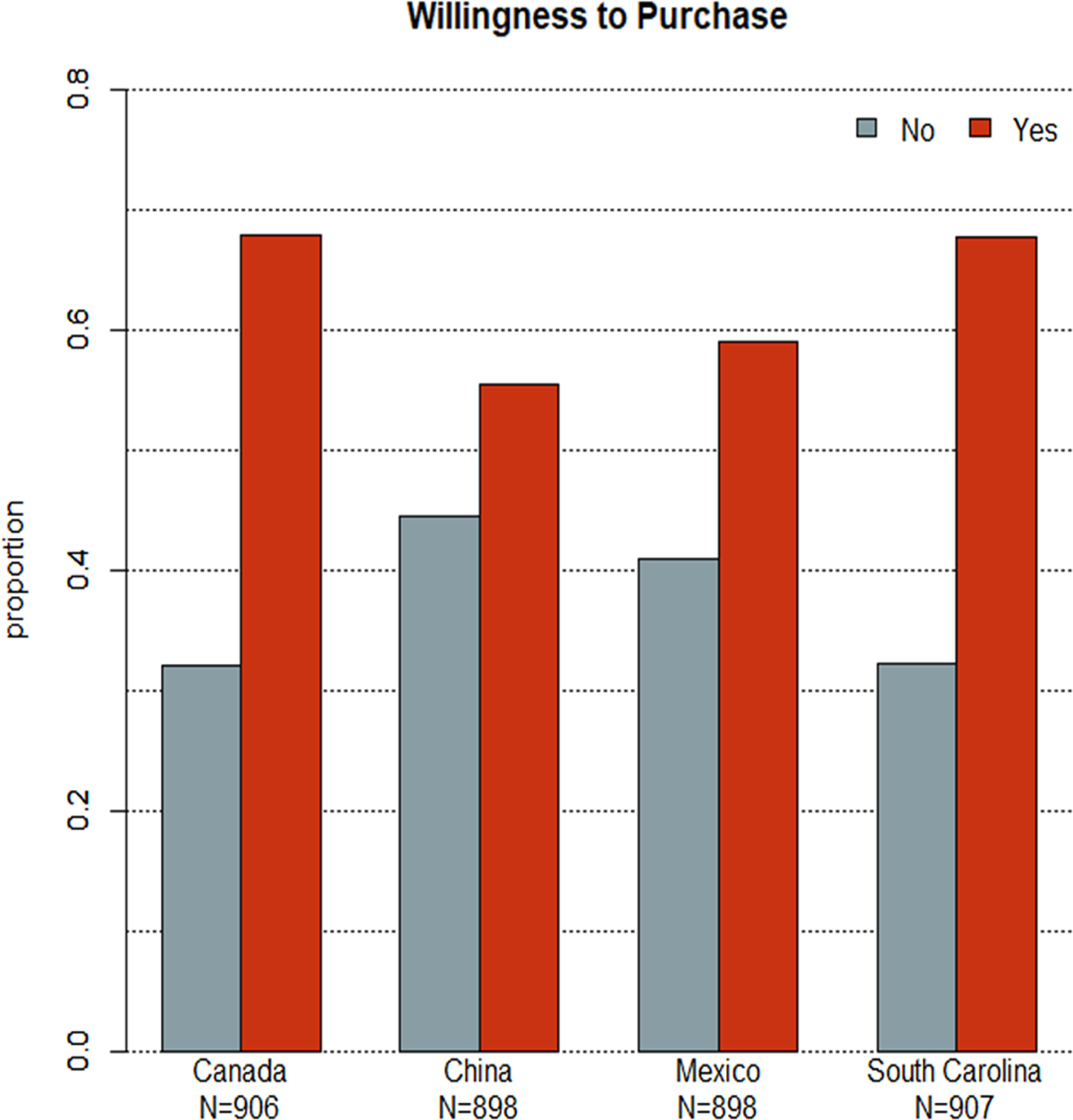
We present these results graphically as bar plots in figure 1.Footnote 32 These data suggest that our intervention affected survey takers’ consumer preferences in expected ways. More survey takers were willing to purchase pet furniture made in Canada (66.6 percent) or South Carolina (66.4 percent) than they were pet furniture made in Mexico (57.5 percent) or China (54.1 percent). Those differences between “popular” and “unpopular” countries are statistically significant at the 0.01-level, suggesting that our priming worked.Footnote 33 Survey takers noticed the country of production embedded in our vignette and altered their preferences accordingly. They also suggest that the relevant issue for our survey takers was not offshoring per se, but offshoring to an unpopular country.
Distribution of willingness to purchase across treatment groups.

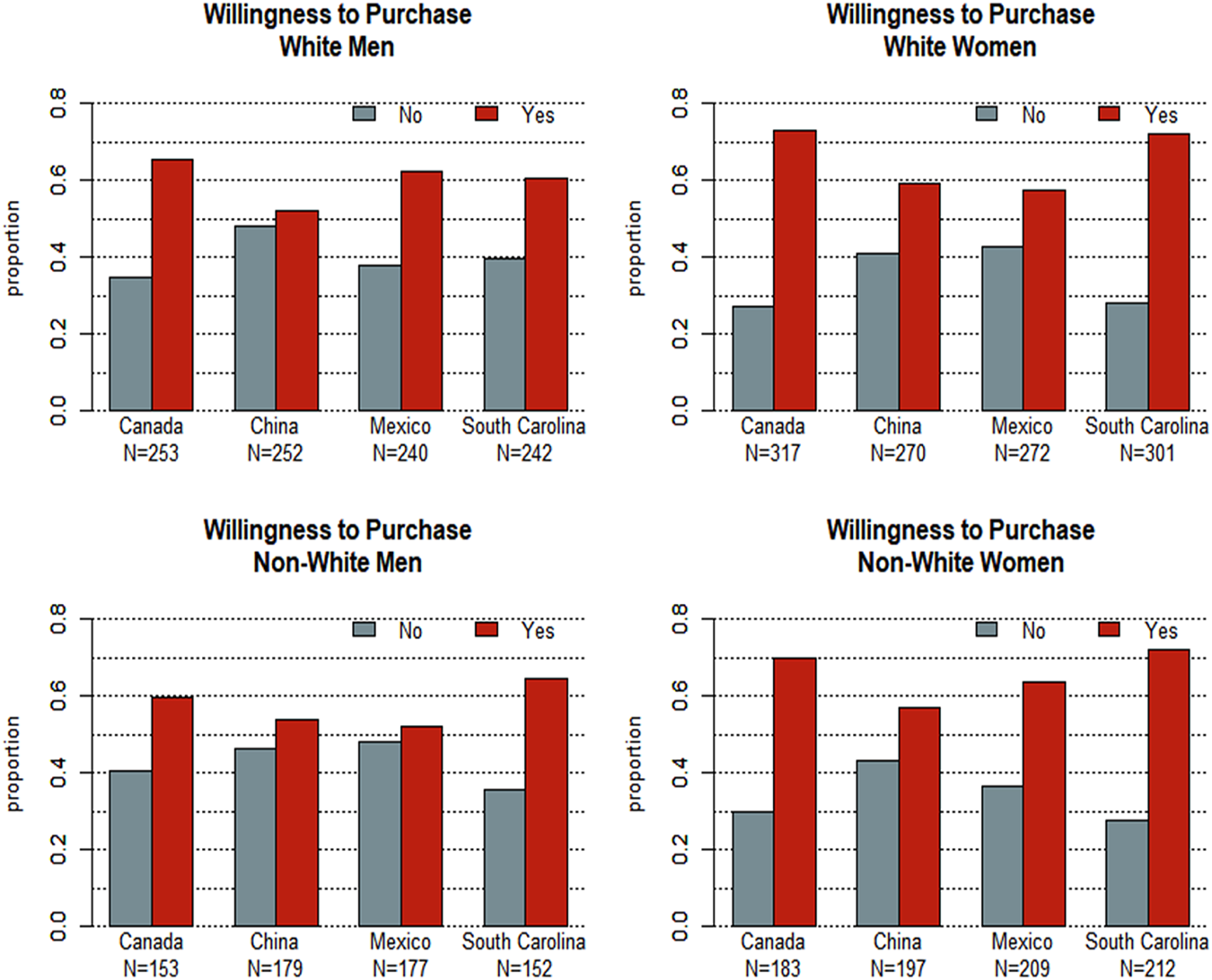
Figure 2 disaggregates the willingness-to-purchase data by race and gender.Footnote 34 We find little evidence that consumer reactions to offshoring are related to demographic and geographic distinctions. White men punish Chinese-made goods slightly more than other demographics, but the differences are small and statistically insignificant. Every demographic group in our study punishes Chinese-made goods to some degree.Footnote 35 White men as consumers are no more punitive towards offshoring than anyone else. White men are distinctively less punitive towards Mexican products,Footnote 36 which was not anticipated by our theory and which defies obvious ad hoc explanation.
Distribution of willingness to purchase across treatment groups, disaggregated by whiteness and gender.

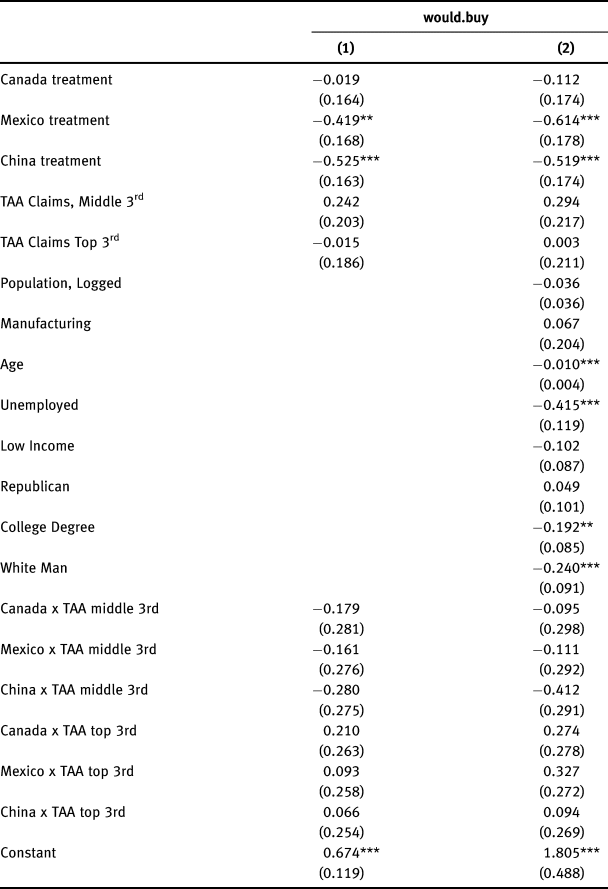
In Appendix C, we report regressions that consider the possible effect of proximity to trade-related job loss's effects on consumer preferences, which we proxy for using the number of Trade Adjustment Assistance (TAA) claims in each respondent's home county. (See the following section for more detail, including the control variable set.) We find no evidence that proximity to trade related–job loss on its own affects purchasing intentions across the four treatment groups, or that it moderates differences between white men and other demographics.
Political sensitivities to offshoring by country and race/gender
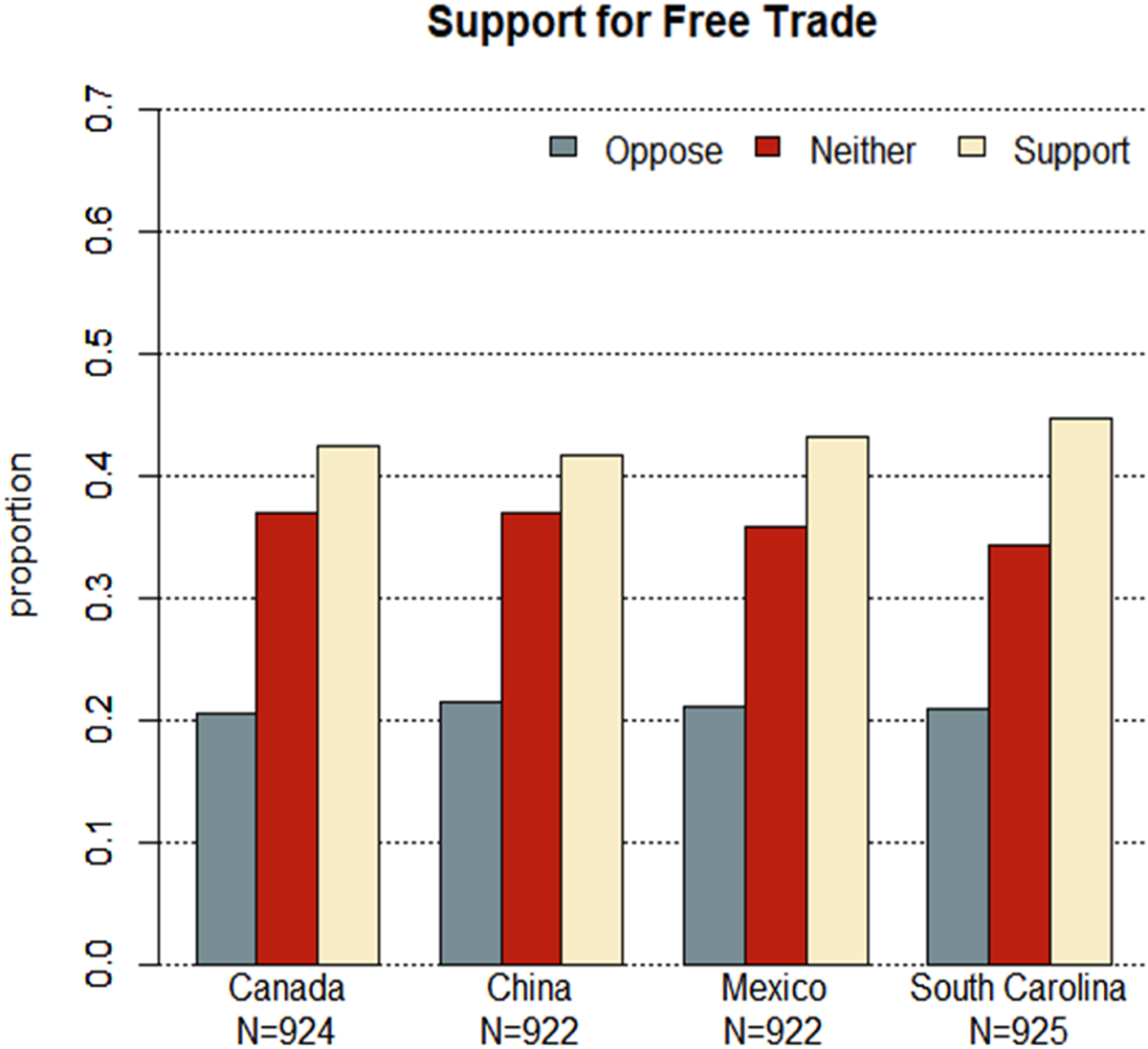
We now move to the main question of our treatment's effect on trade preferences. We begin as before with bar graph representations of our data. Figure 3 replicates figure 1, but replaces the dichotomous willingness to purchase data with trichotomous indicators of attitudes towards free trade (oppose, neutral, support). Figure 3 suggests no evidence in the full sample of respondents that trade preferences are sensitive to our offshore prime. Similar proportions of respondents report “support,” “neutrality,” and “opposition” across each of the four groups. The plurality of respondents in each group support free trade.Footnote 37 This is notable in itself but especially so in its contrast to our prime's broad effects on consumer choices. There is no evidence in these data to support the unconditional version of our hypothesis (H1) or its China/Mexico specific version (H2).
Distribution of free trade support across treatment groups.

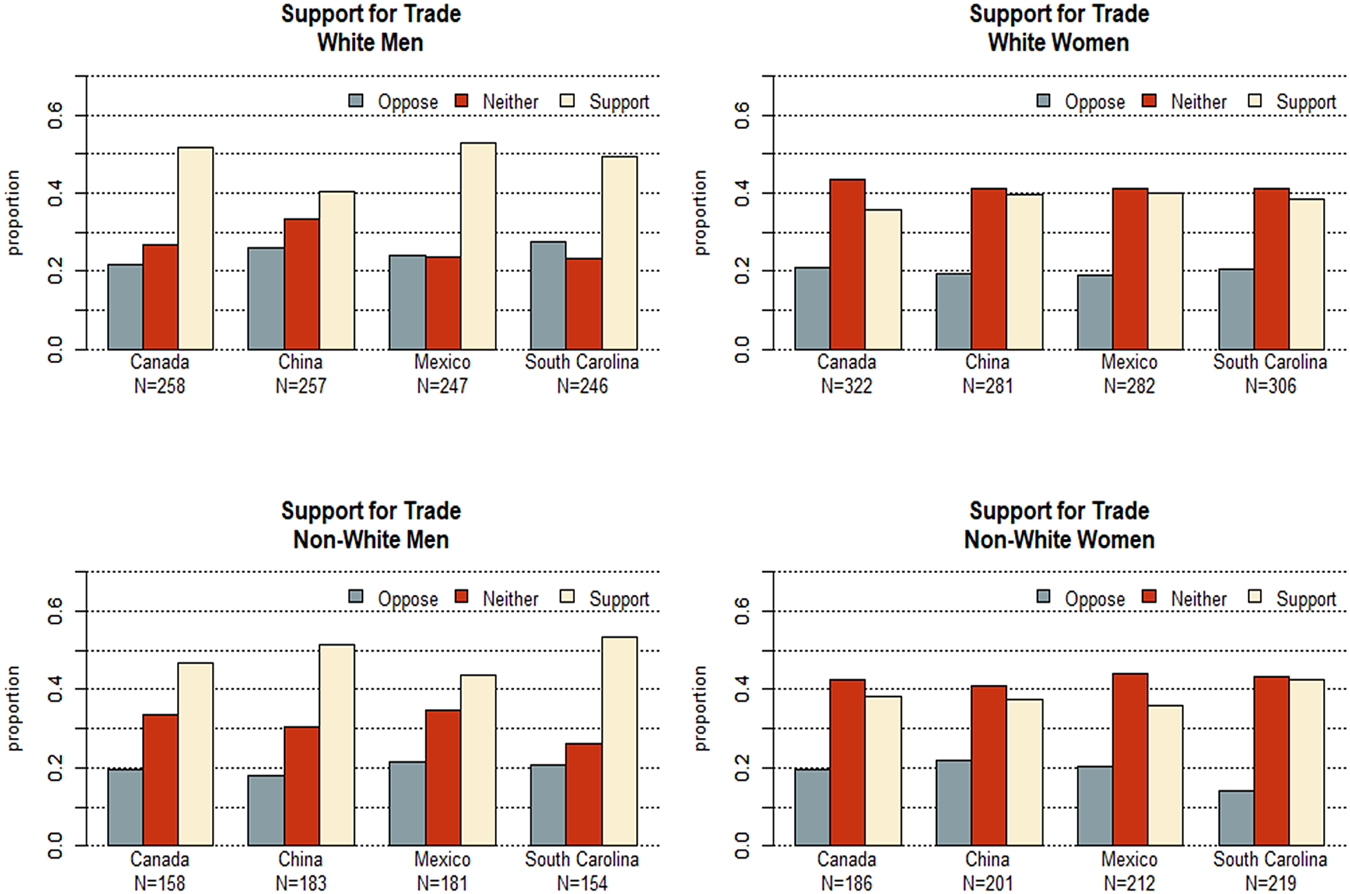
Offshoring's effect on trade opinions is more apparent when we disaggregate the sample by demographic subgroups, which is shown in figure 4. The most obvious finding in these data is that men support trade more than women. That is true generally and within racial categories: white men embrace trade more than white women, nonwhite men embrace trade more than nonwhite women. The treatment effect also appears to be highly gendered. There is evidence in these data of a treatment effect among men but not women, and among white men in the Chinese treatment group in particular. Multiple aspects of these findings—men being more accepting of free trade, men being more sensitive to new information/priming, American white men being especially concerned with China—resonate with prior works, most notably Guisinger (Reference Guisinger2016, Reference Guisinger2017).
Distribution of free trade support across treatment groups, disaggregated by whiteness and gender.

More precisely, there is a statistically significant reduction in trade support and a statistically significant increase in trade neutrality among white men in our Chinese treatment group. Only 40.5 percent of white men in our Chinese treatment group support trade, against 49.2 percent in our South Carolinian, 51.6 percent in our Canadian treatment group, and 52.6 percent in out Mexican treatment group.Footnote 38 The 33.5 percent of white men in the Chinese treatment group who claim neutrality to free trade is also statistically significantly higher than in the South Carolina treatment group (23.2 percent), the Canadian treatment group (26.7 percent), or the Mexican treatment group (23.5 percent). Opposition to trade, in contrast, remains relatively constant across treatment groups (26.1 percent in the Chinese treatment group, 27.6 percent in the South Carolinian treatment group, 23.9 percent in the Mexican treatment group, 21.7 percent in the Canadian treatment group).
These findings suggest qualified support for Hypotheses 2 and 3—that the trade attitudes of white men are affected by exposure to offshoring, and that offshoring is especially resonant when it occurs in China. Both hypotheses are borne out but only in conjunction with each other. Chinese offshoring is especially resonant but only among white men. White men are especially sensitive to offshoring but only to Chinese offshoring.
Notably, the exceptionally large effects that Chinese offshoring had on white men in our sample did not make them exceptionally trade skeptical relative to other demographic groups. Rather, exposure to advertising of a Chinese-produced product undid their otherwise exceptionally high levels of trade support, and rendered them less trade supportive than non-white men, but roughly as trade-skeptical as women. The 40.5 percent rate of support for free trade among white men in the Chinese production treatment group is only slightly different from the 39.5 percent support among white women and the 37.3 percent rate of support among non-white women. The only difference between white men in the Chinese treatment group and women in the Chinese treatment group is that white male skepticism is more likely to manifest as opposition rather than neutrality. That suggests to us that gender differences in unprimed trade preferences may not be as durable or politically meaningful as is often thought. If our intentionally subtle evocation of offshore production was enough to erase it, we presume that a motivated politician could easily do so as well.Footnote 39
Figure 4 also suggests that exposure to our Mexican treatment group reduced enthusiasm (and increased neutrality) for trade among nonwhite men. Unreported analyses (available on request) suggest that our prime's effects on “nonwhite men” category is almost entirely driven by Black men becoming much more trade-skeptical when exposed to our Mexican treatment, and only modestly more trade-skeptical when exposed to our China treatment group. Those results lend themselves to plausible explanation—we suspect, in particular, that responses from Black men may reflect heightened perceptions of labor market competition (Doherty, Reference Doherty2006)—but any such explanation is post hoc, based on a small sample of black male respondents and not directly testable with these data. In the absence of strong theory, or a sufficiently large sample of different nonwhite demographic groups, we limit ourselves to noting that these findings are worthy of future exploration.
Political sensitivities to Chinese offshoring by local economic conditions
Our final analysis looks at the mediating role of proximity to trade-related deindustrialization. Given the above findings (and in order to estimate simpler models), we focus our attention on responsiveness to our Chinese treatment. This section asks whether physical proximity to China-linked trade related–job loss magnifies the Chinese treatment effect, in general and specifically among the white men who were especially affected by it.
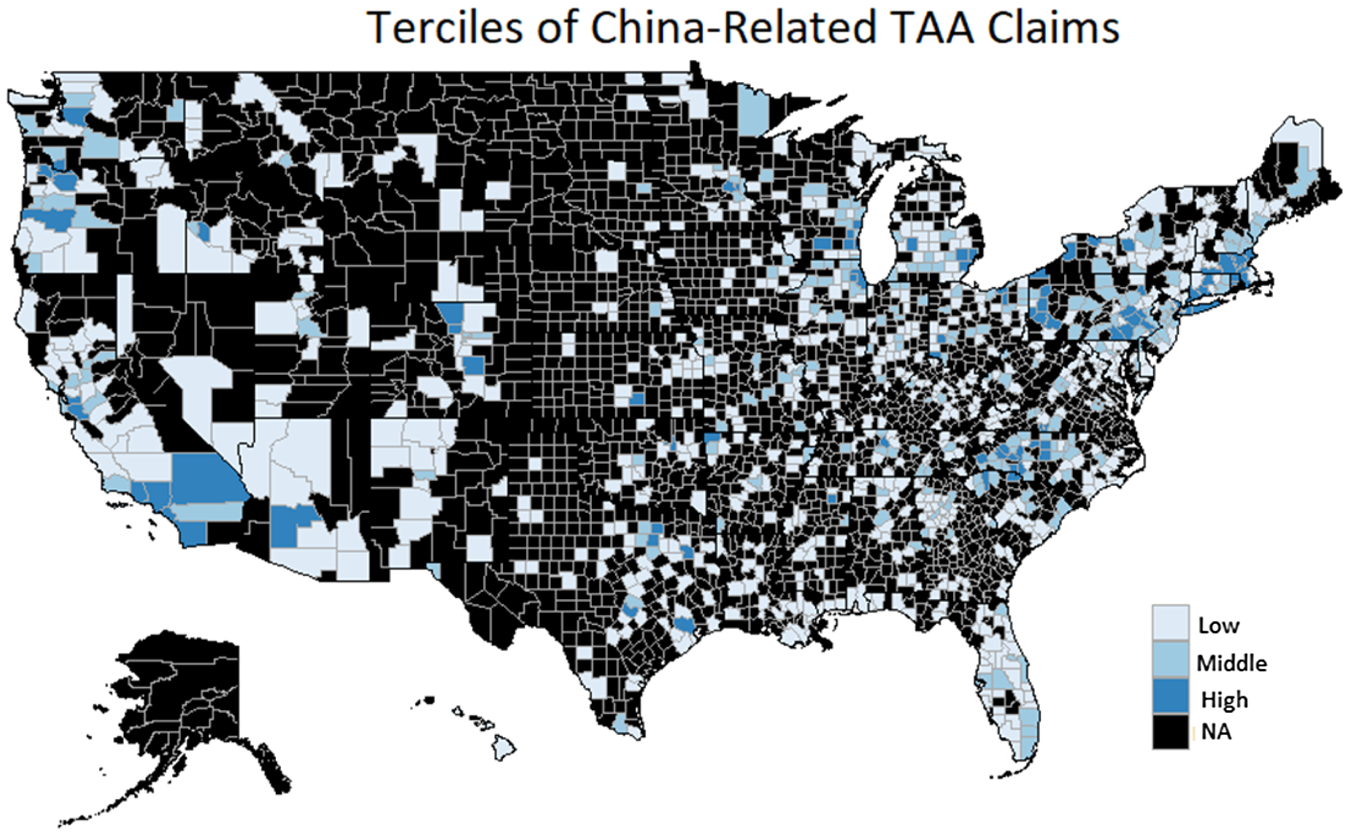
As noted above, we proxy for exposure to Chinese trade using the number of TAA claims related to China in each respondent's home county.Footnote 40 Our measure takes the sum of all cases filed between 2005 and 2015—whether denied or accepted—that cite Chinese imports as the cause.Footnote 41 More claims suggest more exposure to Chinese imports.Footnote 42 We convert the continuous measure of TAA claims into a categorical variables indicating whether the subject's home county was in the lowest third, the middle third, or the highest third of the TAA claims distribution. Binning in this way provides a more flexible functional form than including the TAA variable as a continuous variable.Footnote 43 In practice, the lower tercile represents counties with 0 or 1 China-related TAA claims, the middle tercile represents counties with between 2 and 4 claims, and the highest tercile includes counties with greater than four claims, up to a maximum of 48. Figure 5 shows the distribution of TAA claims by county, limited to counties that actually appear in our sample.
TAA Claims among counties represented in our data, separated into terciles. Dark counties have no respondents in our survey.

Because TAA claims are not randomly assigned and are very likely correlated with a variety of potential confounders, we rely on regression analysis rather than the simpler presentations given above.Footnote 44 The regressions we report control for a variety of individual-level characteristics—whether or not our survey taker reports being employed in manufacturing, their age, employment status, household income, partisan identification, educational attainment—as well as the (the log of the) population of the county that they live in.Footnote 45 The main results are robust to specifications that exclude the controls.
Our regressions use a dichotomized version of our dependent variable (support v. not support), which better reflects that the movement in our data is primarily between support and neutrality/opposition. In order to maintain a conceptually coherent reference category, we limited our sample in these regressions to respondents in either the China or the South Carolina treatment groups. As such, coefficients on our “China” variable characterize distinctions between survey-takers in those two groups. In practice, we draw essentially the same conclusions about trade preferences and offshoring comparing behavior of individuals in the China treatment group to individuals in either of the Canadian or Mexican treatment groups, or by pooling across individuals in the Canadian, Mexican, and South Carolinian groups.Footnote 46
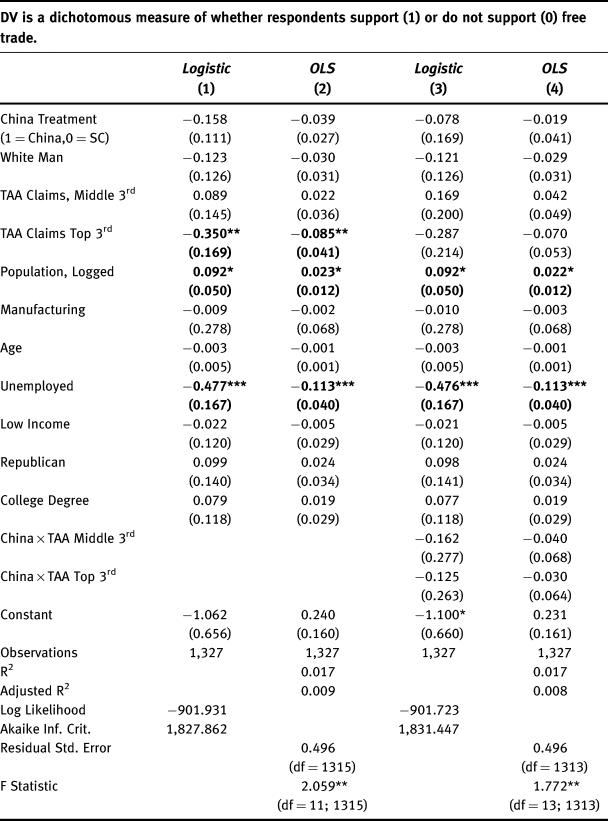
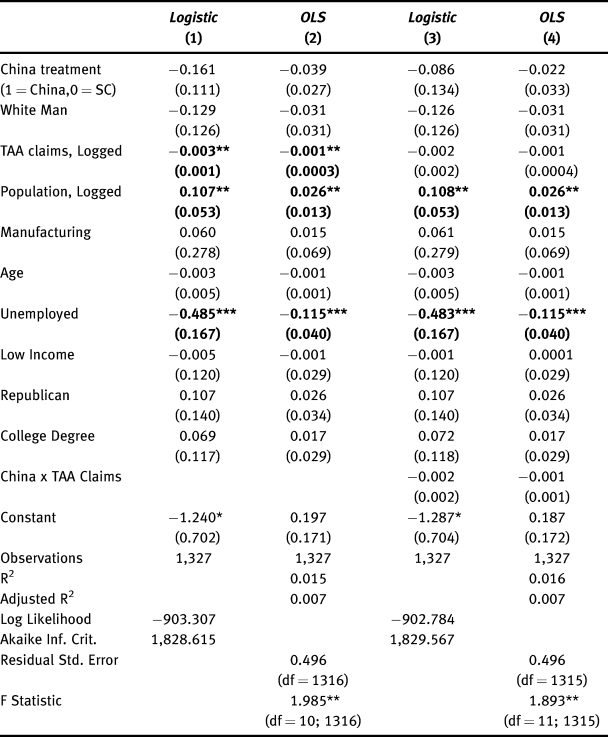
The results of our regression are listed in table 1. We begin by estimating a baseline, additive model, using a logit (model 1) and a linear probability model (model 2). Both models indicate that subjects in our Chinese treatment group were less supportive of free trade than subjects in our South Carolinian treatment group, but only slightly, and the estimated differences are statistically insignificant. Exposure to Chinese trade has a negative and highly non-linear effect on trade attitudes. Subjects living in counties in the highest tercile of TAA clams are much more likely to oppose trade than subjects in the residual category (the lowest tercile). Subjects in counties exposed to middling levels of Chinese trade competition are no more or less trade skeptical than those in the residual category. The effects of location are substantial: For even the most trade-supportive profile (young, college-educated, Republican, employed, not in manufacturing, etc.), our results suggest that living in a third-tercile county is associated with an 8.4 percent decrease in predicted probability of supporting free trade.Footnote 47 The corresponding decrease for our most typical profile, with all continuous variables held at their means and all dichotomous variables held at their modes, is 8.7 percent.Footnote 48
Results of regression models.

Notes: *p < 0.10, **p < 0.05, ***p < 0.01
Low-income is defined as a household income of less than $40,000 per year. Population is an average over 2005–15, the same range as we use for TAA claims. This sample is significantly smaller than the total number of surveys noted in the paper because, as discussed, this incorporates only the China and South Carolina treatment groups.
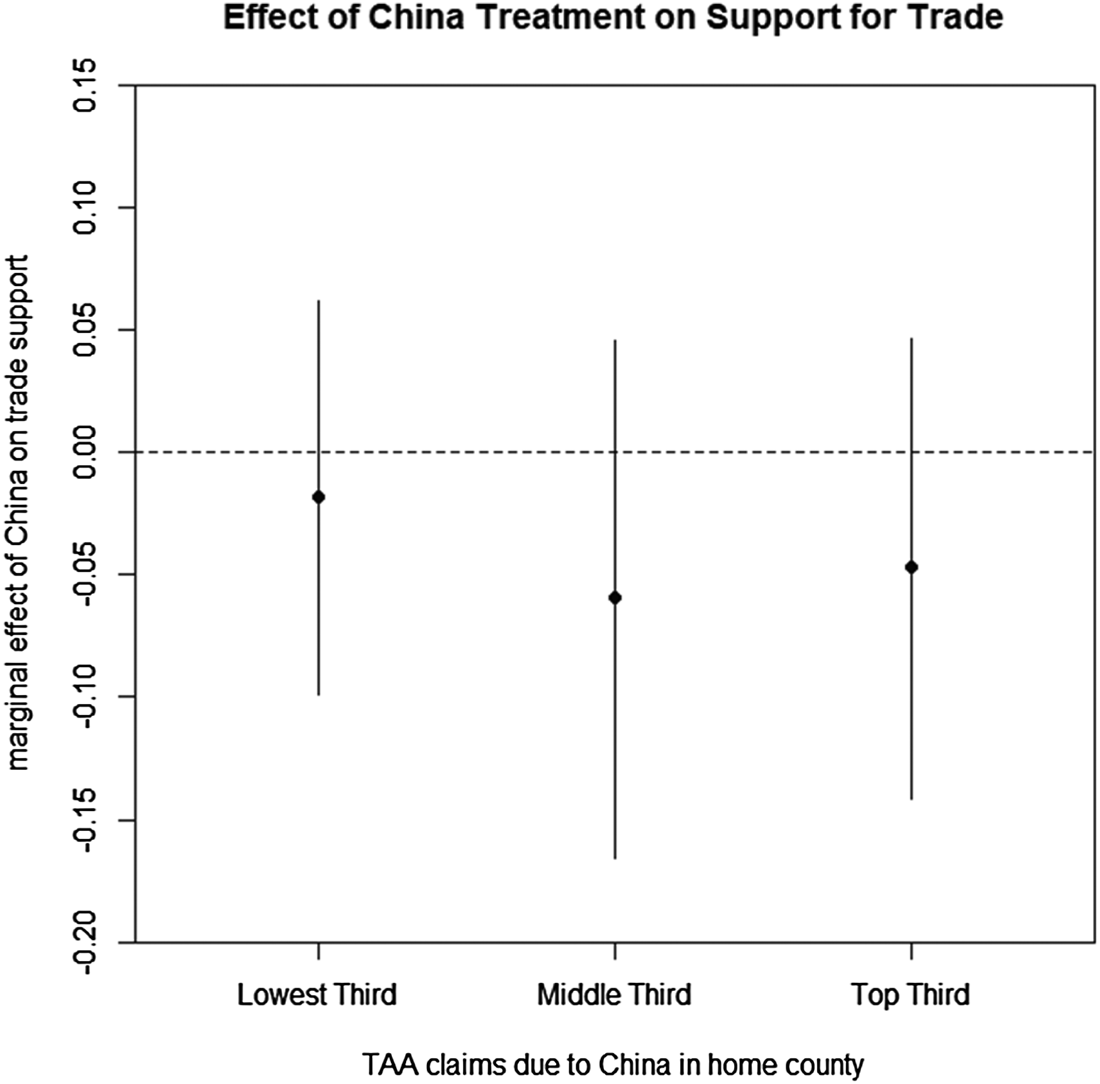
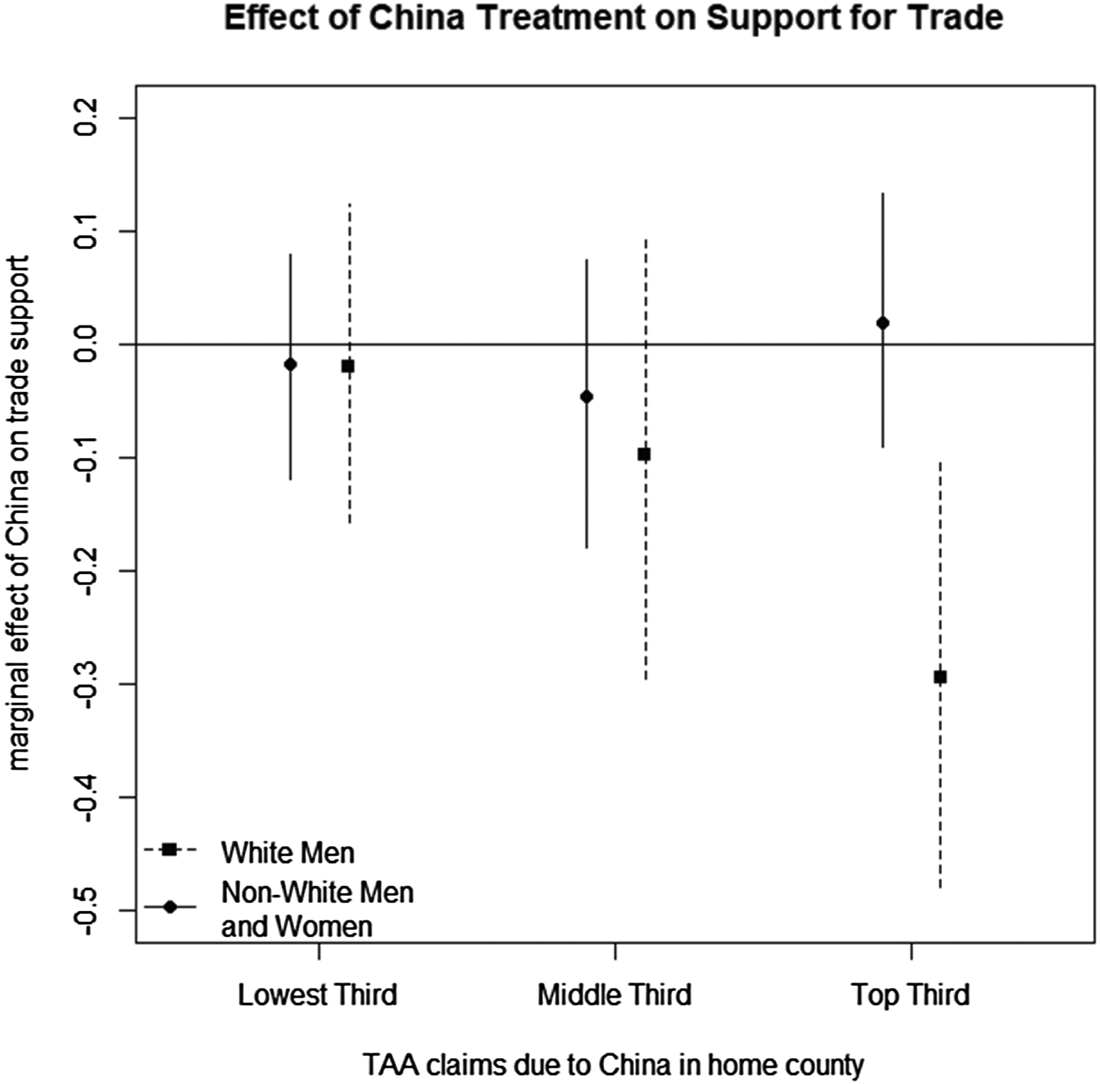
Our next set of models considers that exposure to Chinese trade magnifies sensitivity to Chinese offshoring, which would be consistent with Hypothesis 4. To test this, we interact our China treatment indicator with our trichotomized indicators of exposure to Chinese trade competition. The results of these regressions are shown in columns 3 and 4 in table 1. If sensitivity to our Chinese treatment were conditional on the local-to-the-respondent effects of Chinese trade, we would expect to observe a negative coefficient on the interaction between our TAA claims variables and the China treatment variable. We do not find convincing evidence of this. The interaction terms are always negative but never statistically significant. Figure 6 represents these findings more clearly, noting the marginal effect of our China treatment on trade support (along with a bootstrapped 95 percent confidence interval), estimated for each of the three categories of TAA claims. For ease of interpretation, we use the linear probability model (model 4) from table 2 to derive our estimates. The estimated effect of being in the Chinese production treatment group is always negative but never statistically significant and relatively stable across the three groups.
The marginal effect of the treatment (China) on support for free trade at different levels of TAA claims. Marginal effects estimates use coefficients from model 4 in table 1 and 95 percent confidence intervals are produced by non-parametric bootstrap.

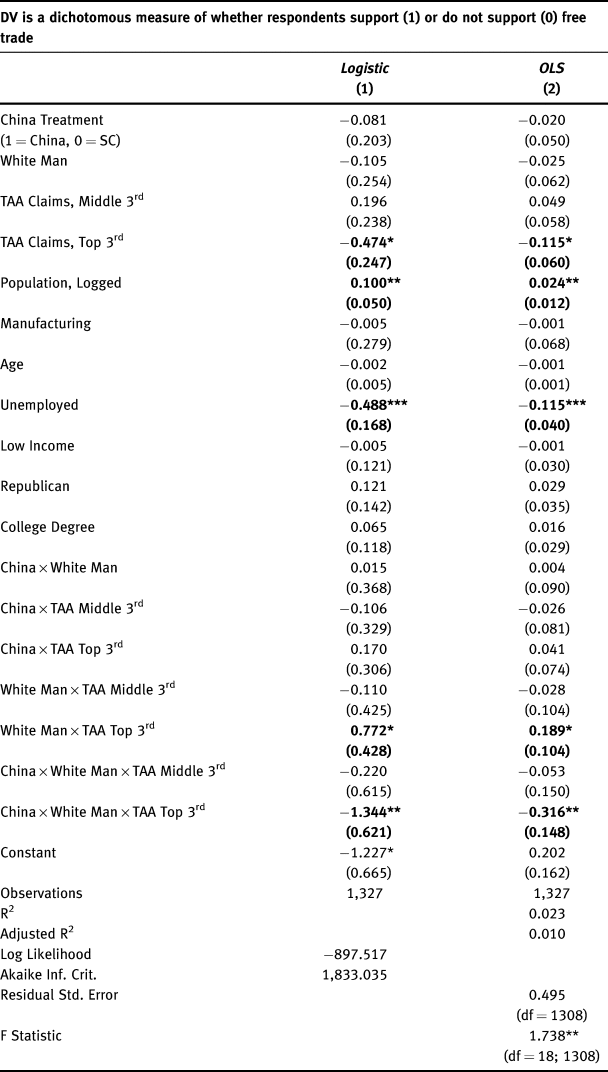
Results of regression models.

Notes: *p < 0.10, **p < 0.05, ***p < 0.01.
Low-income is defined as a household income of less than $40,000 per year.
Population is an average over 2005–15, the same range as we use for TAA claims.
The sample in these regressions is smaller than the sample size noted in the paper because these regressions use only the South Carolina and China treatment groups.
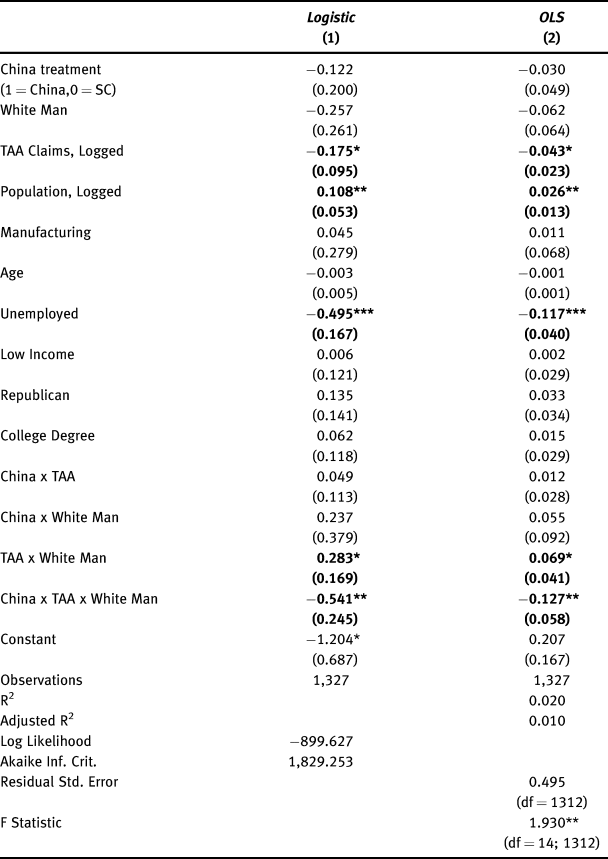
The limited effect of exposure to Chinese offshoring among survey takers living in China-trade exposed areas is somewhat surprising. Beyond the obvious explanations—that exposure to Chinese trade does not inform sensitivities to Chinese offshoring, or that the increased sensitivity to offshoring among individuals in these counties is already baked into their trade preferences, rendering our additional priming superfluous—it is also possible that the non-effects in the broad sample belie more significant effects among white men. We probe the extent of white male distinctiveness in models 1 (logistic regression) and 2 (OLS) in table 2 by introducing a further interaction with an indictor variable coded 1 for white men and 0 otherwise.Footnote 49
Because triple interactions can be difficult to interpret in regression tables, figure 7 relates these results graphically, showing sensitivity to our China treatment as a function of local TAA claims, separately for white men and for all other demographics in our sample. The results of this model—we again use model 2, the linear probability model—underlines both the unique sensitivities of white men to Chinese trade and offshoring, and the extent to which those sensitivities are conditional on local economic circumstances. Figure 7 suggests that white men living in counties in the lowest tercile of Chinese trade exposure are no different from other survey takers in those counties. There are some indications of white male distinctiveness in the middle tercile of Chinese trade exposure—the point estimate of the marginal effect of the treatment among white men is almost twice the magnitude of the estimate among non-white men—but no evidence of a statistically significant effect. It is only in the third tercile of Chinese trade exposure that we see substantial evidence of white male distinctiveness. In the highest tercile of TAA claims, the estimated marginal effect of being in the Chinese treatment group among non-white men and women is statistically indistinguishable from zero, while the estimate among white men is clearly and substantially negative. The confidence intervals for the estimates do not overlap, and we can reject the null that the point estimates for the two groups are equal with a p < 0.01. Our estimate for white men in the highest tercile of trade exposure is also statistically distinguishable from the estimate relating to white men in the second tercile of trade exposure (p = 0.05) and from the estimate relating to white men in the first tercile of trade exposure (p = 0.006).Footnote 50
Marginal effect of the China treatment on support for free trade at different levels of TAA claims for white men (dotted line, square) and non-white men and women (solid line, circle). This illustrates the results of the triple interaction results from model 2 in table 2. Ninety-five percent confidence intervals formed by non-parametric bootstrap.

In sum, our experiment suggests that offshoring, when presented without any explicit political context, has a real but limited effect on Americans’ trade attitudes. Those limitations are driven by gender, race, and geography. White men's trade attitudes were uniquely affected by exposure to the idea of Chinese production, and that is especially true of white men living in geographic proximity to China-related job loss.
Conclusion
The 2016 presidential campaign prominently featured an offshoring-centered attack on the permissiveness of American trade policy. That was most true of the Trump candidacy, but those themes were also evident in the Sanders and the Clinton campaigns. It is not unreasonable to suggest that such rhetoric would dampen trade enthusiasm, and many commentators have. Trade preferences are famously susceptible to framing and priming effects, and offshoring is a powerful antitrade frame. But some skepticism about that narrative is warranted. Political campaigns are poor laboratories to discern the power of those framing effects. It is not clear from the campaign itself that the focus on offshoring had much of an effect, and it is even less clear that its effect was, as the conventional wisdom goes, especially powerful among “forgotten” white men in the Rust Belt.
This article describes an experiment intended to shed light on whether and under what conditions offshoring reduces enthusiasm for free trade. Our experimental approach—embedding exposure to offshoring in an apolitical advertisement—allowed us to tap into sensitivities towards offshoring that are otherwise obscured by the noisiness of actual political campaigns. Our results suggest that the political salience of offshoring was real and highly conditioned by race, gender, and physical proximity to trade related–job loss. White men were especially affected by being primed to consider offshoring, and even then only when that offshoring occurred in China and only for those living in close proximity to China–related job loss.
This research suggests multiple avenues for future research. First, such research could shed light on the extent to which these findings are temporally defined. Our analysis takes place at the point of the 2016 election. That is an important point in time, and but it is unclear in these data whether the atmospherics of the Trump campaign produced the distribution of sensitivities that we observed or simply tapped into them. Knowing the extent to which these patterns become enduring parts of the political landscape will require future replication.
Second, future research would do well to more precisely pinpoint why white men were so uniquely sensitive to China. We have noted two possibilities: that the social pathologies associated with Chinese trade-driven deindustrialization seem to have hit white men the hardest, and that that resistance to offshoring is rooted in a sense of being “forgotten” or “overlooked,” and that this aspect of globalization likely feeds into a broader narrative of American white men's anxiety over status decline.Footnote 51 Other possibilities exist. It could be, for example, that white men in our sample are especially nationalist or ethnocentric, which Mansfield and Mutz (Reference Mansfield and Mutz2013) show can drive sensitivities to offshoring. We suspect that is not the case—O'Rourke and Sinnot (Reference O'Rourke and Sinnott2001) and Mansfield and Mutz (Reference Mansfield and Mutz2009) show that nationalists tend to oppose free trade, which was not true of white men in our sample; it would also fail to explain white men's non-reaction to Mexican offshoring—but it is possible. What we can say from our research is that white distinctiveness is not simply proxying for the fact of living in areas beset by trade related–job loss, working in manufacturing, or identifying as a Republican. Future research would do well to more fully explore its drivers.
Appendix A: Advertisement from Experiment
All respondents viewed this same advertisement after answering basic demographic questions. The advertisement was the same for all respondents, except that the location of production and the partner company's name (both bold below, but not in experiment) were randomized, as was the location of the home company. Respondents were also randomly assigned into one of three corporate social responsibility (CSR) groups, which determined the existence, and content of a final paragraph. We found no evidence that the CSR treatment effected offshoring's effect on trade attitudes, and all of our treatment groups are balanced with respect to this randomization. Reproduced below is the “no-CSR” version.
Is Spot digging at your carpet? Does Sassy climb up your curtains? Is your beloved pet acting out and destroying your furniture, despite your best efforts at discipline? That isn't because your pet is bad, it's bored!
Many pet disciplinary problems can be overcome by enriching their environment. From your pet's point of view, clawing at the couch, or shredding the curtains, are just natural expressions of their instincts to hunt, chase, stalk, and track. Your pet's instincts might be here to stay, but you can redirect those instincts in ways that will save your furniture!
For years, South Carolina-based Playful Pets has been on the leading edge of helping your pet live their best life through natural play. Our innovative toys and feeders are designed to allow your pets to act on their instinctive behaviors, but do so in a way that leaves them happy and healthy, and without destroying the couch!
Playful Pets is expanding on this success with its new line of Petscalibur products. The Petscalibur line is crafted to the highest standards. It features improved version of already beloved cat trees, cat scratching posts and dog beds, and an expanded line of innovative dog and cat toys. Petscalibur cat trees and scratching posts are made with 100% hardwood oak and high-quality plush carpeting. Our dog beds are made with cotton fabric, stuffed with allergen-free materials, and are fully machine washable. All Petscalibur products give your pet an outlet for scratching, digging, burrowing, and hiding, all while looking stylish and being virtually indestructible.
And with the help of our new partner [Huabai Limited/Ontario-Dominion Technologies/ Grupo Tamaulipas/American Fabric & Textile, Inc.], and their state-of-the-art facility in [Guangdong, China/Hamilton Ontario, Canada/Tamaulipas, Mexico/Spartanburg, South Carolina], we are able to bring you the highest quality, best value pet toys and furniture.
Appendix B: Balance in Treatment Assignment

Appendix C: Alternative Specification
This appendix contains Tables 1 and 2 from the main text with the continuous TAA claims count logged rather than cut into terciles. The original measure has 1 added to it before it is logged to deal with the zero counts. Table 3 shows willingness to purchase as a function of proximity to local trade-related job loss
DV is a dichotomous measure of whether respondents support (1) or do not support (0) free trade.

DV is a dichotomous measure of whether respondents support (1) or do not support (0) free trade.

DV is a dichotomous measure of whether respondents are willing to purchase a pestacliabur product (1) or not (0)