Introduction
The dominant narrative of research on urban reconstruction in the post-World War II era focuses on the obstacles faced by those seeking to rebuild Britain's blitzed cities and the effect that these problems had on outcomes.Footnote 1 In 1941, Lord Reith, as minister of works and buildings, encouraged blitzed cities to plan boldly and comprehensively.Footnote 2 Reith's advice stimulated the formulation of ambitious reconstruction plans in a number of British cities. Such plans came to assume as much importance as advertisements for the newly emerging profession of planning as they were schemes for rebuilding the damaged cities involved.Footnote 3 However, the early optimism, confidence and enthusiasm of the planners quickly encountered the opposition of vested interests and political machinations and, by 1947, many local authorities had retreated into an approach characterized more by caution, indecision, economy and conventionalism.Footnote 4 Some authors have even claimed that only Coventry and Plymouth were successful in maintaining their faith in bold plans and planners.Footnote 5
In Coventry, although the real degree of consensus has been questioned in recent insights,Footnote 6 research has pointed to the determination of local officials and the mobilization of a huge ground swell of public support in favour of the implementation of its reconstruction plan.Footnote 7 Even though it was the object of one of the most celebrated war-time plans,Footnote 8 Plymouth's achievement of a boldly planned new townscape has, by contrast, not been fully explored. Unlike Coventry, Plymouth was not selected as an ‘official test case’ by the Ministry of Town and Country PlanningFootnote 9 and the interpretation of the highly fragmented and dispersed archival evidence is inevitably more challenging.Footnote 10 Indeed, drawing mostly on more easily accessible sources, previous studies of Plymouth's reconstruction have tended to offer only a superficial description of the origins of the city's famous plan, and none has paid much attention to the legal and bureaucratic obstacles that threatened to thwart its progress, and how such challenges were met.Footnote 11 Given that Plymouth represents the most complete and most comprehensive rebuild after World War II, bequeathing a city centre that lasted virtually intact for the rest of the twentieth century, the lack of a detailed study is a significant oversight in the literature. While it is certainly misleading, as has been the case in some previous publications, to suggest that the reconstruction blueprint articulated in the pages of the 1943 plan was translated in its entirety to the post-war landscape, the transfer of so much of the original radical vision from page into physical reality does stand in stark contrast to the experience of rebuilding that occurred elsewhere in the UK.
The aim of this article is to examine the stages in the reconstruction process and explain how and why Plymouth managed to realize so much more of its radical reconstruction plan than was the case elsewhere. While the obstacles and opposition encountered during the reconstruction of Plymouth were similar to those experienced in other blitzed cities, the actions employed to overcome the challenges produced very different outcomes. The article seeks to understand the reasons why the key actors involved in devising and implementing the city's redevelopment plan maintained their faith in the project and saw so much of it through to completion. This evidence provides an opportunity to view the rebirth of Plymouth from a new perspective whereby the strategies employed to deal with the very real problems encountered in the largely successful implementation of a particular post-war reconstruction plan can be revealed.
The reconstruction process
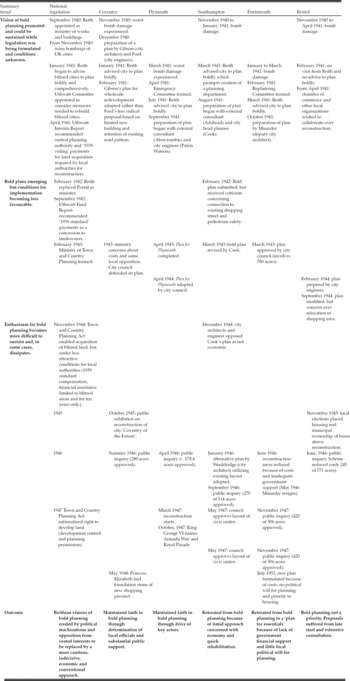
Narrative from classic reconstruction texts, such as Hasegawa and Tiratsoo, highlight a number of circumstances which encouraged blitzed cities to abandon their bold plans (see Table 1). The key factors were uncertainty over the legislative powers and funding for comprehensive redevelopment, the interventionist bureaucracy of the newly emerging centralized government ministries, strong local pressures to respond to the immediate priorities of housing and education rather than longer-term objectives, and a growing sense of public dissatisfaction with reconstruction. These factors are explained in the next section.
Timeline showing key dates in the post-war reconstruction in a number of UK blitzed cities

Sources: Coventry: T. Mason and N. Tiratsoo, ‘People, politics and planning: the reconstruction of Coventry's city centre’, in J.M. Diefendorf (ed.), Rebuilding Europe's Bombed Cities (Basingstoke, 1990); J. Hasegawa, Replanning the Blitzed City Centre: A Comparative Study of Bristol, Coventry and Southampton 1941–1950 (Buckingham, 1992); P. Hubbard, L. Faire and K. Lilley, ‘Contesting the modern city: reconstruction and everyday life in post-war Coventry’, Planning Perspectives, 18 (2003), 377–97. Plymouth: S. Essex and M. Brayshay, ‘Vision, vested interest and pragmatism: who re-made Britain's blitzed cities?’, Planning Perspectives, 22 (2007), 417–41. Southampton: Hasegawa, Replanning the Blitzed City Centre. Portsmouth: J. Hasegawa, ‘Reconstruction of Portsmouth in the 1940s’, Contemporary British History, 14 (2000), 45–62; Bristol: Hasegawa, Replanning the Blitzed City Centre.
It is well known that Lord Reith, the minister of works and buildings between September 1940 and February 1942, moved quickly to introduce the measures needed to enable blitzed cities to rebuild. In addition to the preparation of measures to deal with bomb damage, he was required to report on the need for a post-war town and country planning system. Reith established an Expert Committee on Compensation and Betterment (the Uthwatt Committee) in January 1941. This committee explored ways in which development land values might be stabilized in order to prevent speculative transactions that could prejudice post-war reconstruction and planning.
Uthwatt's Interim Report, issued as a matter of urgency at the end of April 1941, contained two important recommendations. First, public authorities should be entrusted to acquire the land needed for planning by compulsory purchase on a metric of values based upon those of 31 March 1939 – which became known as the ‘1939 ceiling’. Second, the committee recommended that local authorities should be empowered to acquire blitzed or blighted areas and designate them as reconstruction areas.Footnote 12 Both recommendations would enable local authorities to implement bold reconstruction schemes, but were highly political as they essentially proposed the nationalization of landownership and limited the compensation to be paid. Although the government initially accepted both recommendations, debate between interested parties thereafter raged and no legislation was forthcoming for more than three years. Meanwhile, blitzed cities were becoming desperate to obtain appropriate powers in order to secure and operationalize their rebuilding plans.
When finally published in September 1942, the Uthwatt Report recommended a ‘1939 standard’ for property compensation, rather than a ‘1939 ceiling’ as earlier envisaged. This change was a clear concession to the landowners. Underlining the painful slowness of the process, the legislation – the Town and Country Planning Act – introduced in November 1944, finally reached the Statute Book more than three years after Reith's first urgent pronouncements on reconstruction planning. Moreover, the Act contained yet more concessions to landowners. Financial assistance to local authorities was to be confined to the blitzed areas (rather than including other ‘blighted’ areas, which local authorities might have wanted to include within reconstruction areas) and government funds were to be made available for only 10 years.Footnote 13 The 1944 Act was described by some contemporary critics as a ‘great betrayal’ to local authorities and a ‘triumph of the rights of property’.Footnote 14 Later, the centrepiece of post-war planning legislation – the Town and Country Planning Act of 1947 – nationalized controls on the future development of land (i.e. planning permission), rather than the nationalization of land itself.Footnote 15
In addition, during the period between 1943 and 1947, other factors such as bureaucratic delays within central government conspired against Reithian boldness and caused an apparent shift in the expectations of reconstruction at the local level. The requirement that all plans must be approved by the newly formed Ministry of Town and Country Planning and Ministry of Transport acted as a severe brake on progress. On a steep learning curve, Whitehall civil servants broke new ground in urban development and control, and were almost overwhelmed by the scale of the task that they faced across the country.Footnote 16 As a result, delays in the confirmation of the boundaries of reconstruction areas and the financial acceptance of plans were commonplace.
Enthusiasm was also dampened by more immediate and urgent priorities, such as the construction of housing and schools.Footnote 17 Local opposition to reconstruction plans, especially from vested interests intent on maintaining the status quo, were often successful in modifying the plans of local authorities. The most effective groups in tempering the bold principles of the early schemes were local landowners, concerned about the effect of planning and reconstruction on property rights, and by retailers, over the layout and exclusion of motor traffic from shopping zones. Shortages of labour and materials in the building trades during the austerity years of the immediate post-war period, together with government controls and bureaucracy, were, however, perhaps the most potent obstacles to the implementation of the master plans in terms of layout and architecture.Footnote 18 Partly as a consequence of these issues and the resulting delays, public support and interest in reconstruction plans began to fade creating further shifts in the expectations of reconstruction.Footnote 19
This cocktail of factors conspired to make local authorities much more cautious about adopting a bold approach.Footnote 20 Some councils were unable to resist the intense short-term pressures to reconstruct quickly and cheaply.Footnote 21 For example, Portsmouth's ambitions were reduced to a workmanlike plan to rebuild the essentials, with the frills removed. The key factor in this retreat was the end of special government financial assistance in March 1948, which then transferred the cost of reconstruction to its ratepayers.Footnote 22 Similarly, cities such as Bristol and Southampton felt compelled to adopt reduced and fairly modest reconstruction plans because of local opposition, the financial implications, the shortage of labour and materials and the urgent need to provide homes and schools.Footnote 23 In Plymouth, however, as Table 1 demonstrates, comparable pressures and the emergence of less favourable conditions for achieving boldness were much more stoutly resisted. This article therefore provides a new and different perspective on reconstruction planning to that told in the classic reconstruction texts, namely how challenges to implementation were overcome. Using the Plymouth example, the discussion also builds on previous research by setting the importance of actor networks in the implementation of the plan in the context of the extent of problems faced.Footnote 24
Reconstruction in Plymouth
The outline story of Plymouth's blitz has often been told and has now become embedded as an ingredient in the city's sense of identity.Footnote 25 As a prime military target, the fall of France in June 1940 brought Plymouth within the flying range of enemy bombers and immediate risk of attack. In fact, however, the most severe raids were delayed until the nights of 20 and 21 March 1941, and these were concentrated on the centres of Plymouth itself and those of Stonehouse and Devonport. A south-west wind on 21 March allowed fires to develop much more quickly than on the previous night. The flames that engulfed the centre, visible from more than 20 miles away, have become a potent image that encapsulates Plymouth's war-time suffering. A total of 293 people are known for certain to have been killed on those two nights; another 100 or so were never traced. About 750 dwellings were completely destroyed or damaged beyond repair; a further 5,000 dwellings were seriously damaged but capable of repair; and another 13,500 sustained slight damage.Footnote 26 Firemen from as far as Birmingham, Reading, Salisbury and Swindon were engaged in fighting the inferno.Footnote 27 Though none compared in ferocity with those of 20–1 March 1941, many further attacks occurred thereafter and Plymouth ultimately achieved dubious fame as one of the country's worst blitzed cities.
Despite the loss and devastation of the raids, the opportunity was immediately recognized by the city council to build a better Plymouth, free from the pre-war problems of congestion and overcrowding. Lord Reith's ringing exhortation to ‘plan boldly’ was thus rapidly taken on board in Plymouth, and amongst a small, influential and powerful network of key actors formed by the city's war-time lord mayor, Viscount Astor, a determination to achieve this objective thereafter never seriously wavered despite tremendous odds.Footnote 28 To adjust the size of Plymouth's retail heart to suit modern circumstances, to design a centre spared the motor-vehicle congestion that had become the worst in southern England outside London, to provide better standards of housing and open space for the citizens, and to control urban sprawl, were seen as opportunities too important to miss.Footnote 29
From the beginning, in a skilful and well-orchestrated promotional campaign, the plan was presented in Plymouth as a means of securing a better future after the war that would reward townspeople for their defiance of the enemy, as well as their courage and confidence in the city's future. Its proponents recognized the potency of a radical and ambitious project for rebuilding Plymouth for maintaining morale and engendering a sense of unity.Footnote 30 In addition to the remarkable speed of Plymouth's response to its destruction, a second crucial factor was the immediate engagement of an external expert whose judgment would be hard to question and whose ideas were not easily challenged. Arguably as the country's foremost planner of the time, Professor Patrick Abercrombie of the University of London was thus employed as a consultant on the recommendation of George Pepler at the Ministry of Health and without open recruitment.Footnote 31 He would work with the city engineer and surveyor, James Paton Watson, to produce the Plan for Plymouth, which was eventually published in 1944 and formed the basis of the city's reconstruction. Steps were taken to ensure that the document itself acquired celebrated status. A major publicity campaign was conducted that gave the entire project an unusually high profile at the local, national and international levels. The Plan for Plymouth is still an important artefact in its own right and is regarded as emblematic of war-time and post-war idealism and radicalism (Figure 1).
The 2004 aerial view of the layout of the city centre of Plymouth bears a remarkable resemblance to the design proposed in the Plan for Plymouth in 1943 (see inset). However, on implementation, some details were altered or sacrificed.
Sources: ©English Heritage NMR23651/10 (SX4753/19: 23 Jul. 2004); J. Paton Watson and P. Abercrombie, A Plan for Plymouth (Plymouth, 1943).

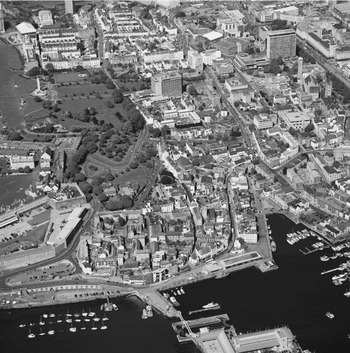
The plan contained strikingly radical proposals. First, the layout of the new centre was devised as an entirely ‘clean break’ with the tangled street pattern that had developed by 1939. In its place came a geometric design based around two main axes: Armada Way running north–south and Royal Parade running east–west. Second, land use in the city centre was to be zoned into discrete precincts, with distinct areas for retailing, offices, government offices, banks, culture and tourist accommodation. The so-called Barbican area was to be enhanced as the city's medieval quarter through the construction of a wall to enclose it, the restoration of important historic buildings and other cosmetic improvements to improve its attractiveness.Footnote 32 Such work would create a distinct contrast to the ‘modernity’ of the centre (Figure 2). Third, the design of the new centre was to be monumental through the use of vistas (such as from the railway station down Armada Way to the Hoe), gateways and coherent architectural treatment inspired by the ‘imperial’ style of Lutyens and the neo-classicism of Bath and Cheltenham.Footnote 33 The streets were to be traffic-free with vehicular access from a ring road around the central area. Fourth, outlying residential housing was to be based around neighbourhood units. These had the purpose of creating a community spirit focused on smaller district centres within a ‘Greater Plymouth’, and strongly reflected urban planning theories then prevailing.Footnote 34
The Barbican area of Plymouth around Sutton Harbour. The Plan for Plymouth recommended a wall to enclose the Barbican to create a ‘medieval quarter’ that would contrast with the modernity of the adjoining city centre. No such wall was built.
Source: ©English Heritage NMR23513/16 (SX4854/16: 18 May 2004).

The high and lasting profile of the plan and the prevailing sense that its prescriptions for reconstructing the city were largely transferred from page to landscape has, however, tended to obscure the fact that four years of wrangling and difficulty intervened before the first tentative start on its implementation was made in 1947. The process of implementation thereafter took several decades. In a sense, therefore, the real triumph lies in the fact that so many of the obstacles were overcome and problems solved.
Plymouth's response to obstacles
Government procrastination and delay in the formulation of a legislative framework to facilitate reconstruction created an immediate dilemma not just for Plymouth, but for all blitzed cities. On the one hand, the erection of even temporary buildings on bombed or adjacent sites, often necessary to provide essential local services, was likely to jeopardize comprehensive redevelopment along planned lines.Footnote 35 Any interim redevelopment would also add to the risk (and costs to the city) of claims for disturbance when the owners were eventually required to vacate sites.Footnote 36 On the other hand, continual rejection of redevelopment proposals by individual landowners imposed real hardships on both businesses and the local population, and impeded the recovery of rate revenues within the city.Footnote 37
Another key side effect of the delays was the general inflation of property prices encouraged by land speculation within blitzed cities. Information collected by Paton Watson indicated that inflation was in the range of 36 to 107 per cent and was therefore likely to increase the final cost of planning.Footnote 38 Aware of the need for speed, Astor spoke several times in the Lords about the urgency of finalizing the planning legislation.Footnote 39
I can assure the Government that a very strong feeling of indignation exists . . . We have been asked to do a particular job, and we have not been given the powers to do it. We see time passing and, unless the legislation is carried through quickly, it will be too late and we shall have missed the opportunity.Footnote 40
Though both Astor and Abercrombie almost certainly understood what would be required as early as 1941, they were sufficiently astute to make no mention in the pages of the 1943 plan of issues such as compulsory purchase and the removal of freeholds. However, by April 1944, Plymouth's local officials were articulating the sweeping new powers that would be required to achieve their ambitions. According to Colin Campbell (the town clerk), these powers included: (a) compulsory purchase of bomb-damaged and non-bomb-damaged buildings to facilitate complete and efficient development; (b) speedy powers of entry to buildings and vacant land; (c) the control of all development; and (d) financial assistance from the treasury.Footnote 41 As late as September 1944, Lord Astor was still berating the lack of government action. At the opening of an exhibition about Plymouth's bold plans in London, Astor remarked that he hoped ministers would visit and realize what improvements were required to the bill dealing with town and country planning – ‘it was extraordinary how long that idea took to get into the heads of MPs’.Footnote 42 It is clear that Astor and his network showed a steely determination to ensure that the reconstruction of Plymouth was undertaken in what they regarded as the right conditions.
As noted earlier, the Town and Planning Act, eventually passed in November 1944 to facilitate the reconstruction of blitzed cities, fell short of the recommendations of the Uthwatt Report because of landowners' opposition. The Act did, however, partly meet the ‘wish-list’ of Plymouth City Council. Crucially, the new legislation allowed local authorities to acquire areas of extensive war damage for reconstruction purposes through compulsory purchase and to set compensation to landowners at a standard valuation of properties on 31 March 1939. Government grants to local authorities were equal to two years of loan charges incurred on the costs of purchase and clearing land in war-damaged areas.Footnote 43 After this time, local authority receipts from land rental and leases were expected to be sufficient to meet outgoings.
The creation of the new Ministry of Town and Country Planning in 1943 occurred as Plymouth's reconstruction plans were nearing publication. The Plan for Plymouth went to press in April 1943, and was approved by the city council for release to the general public in April 1944. At this point, 12 copies of the plan were sent to the Ministry of Town and Country Planning for approval.Footnote 44 The ministry's consideration of Plymouth's reconstruction plan was highly interventionist and critical. Perhaps most significantly, it was also extremely slow – to the annoyance of local officials. Delegations were called to London and protracted wrangling ensued. Engaged in a power struggle, Whitehall officials realized that Plymouth's determination was unusually strong. However, when at last ministry comment was issued in April 1946, the shocking verdict was that Plymouth's plan was ‘radically defective’. The extent of new construction was considered extravagant. The axial and symmetrical street layout was deemed unsuitable for the undulating site. Serious concerns were raised that the central area might not function properly because of the strict land-use zoning and severance by traffic routes. These objections reflected different interpretations as well as the inexperience of a fledgling government department that was dealing with a scale of reconstruction never previously faced. Significantly, however, despite its strong desire to modify the proposals, the ministry recognized that, in Plymouth's case, alterations would be folly given that the plan had assumed the status of a local ‘Magna Carta’ and that they had effectively been out-manoeuvred.Footnote 45
Finally, in July 1947, the Ministry of Town and Country Planning stated its willingness to accept the proposals for Plymouth's central area as a ‘target plan’, subject to a number of rather ambiguous ‘conditions’.Footnote 46 These conditions related to concerns about the number and location of roundabouts on Royal Parade, the postponement of building the road system around the telephone exchange for five years and to consider the construction of a road to be laid from Drake Circus to North Cross. There was also a rather prescient prophecy about the need to ‘realise the importance of retaining sufficient flexibility in their plan to enable them to meet such essential readjustments as may be called for by circumstances’.Footnote 47 Paton Watson robustly criticized the minister's mealy-mouthed letter of approval, describing it as ambiguous.Footnote 48 In any case, some preparatory work could be undertaken to set in motion the restoration of a city laid waste more than six years earlier and the local officials seized their chance to begin the next stage of the task.
The process for reconstructing any war-damaged area first required the local authority to apply for a Declaratory Order for the land that they wished to purchase compulsorily for this purpose. Applications must comprise a full statement of the proposed redevelopment plus maps and diagrams showing the layout. The ministry would receive objections and arrange a public inquiry before confirming or modifying the Order. The minister must be fully satisfied that the land needed to be laid out afresh and redeveloped as a whole. At this point, Compulsory Purchase Orders (CPOs) could be made and, subject to a further public inquiry and approval, site preparation work could begin. Recognizing the potential for delay in these mechanisms, the ministry allowed the CPO procedure in Plymouth to proceed contemporaneously with the procedure for the declaration of areas.Footnote 49 The city council recognized the tactical urgency of commencing construction works in the central area during the summer of 1946, not simply to ensure that the implementation of the Plan for Plymouth was underway before enthusiasm began to wane and the full implications for private owners of property and building plots were understood, but also to raise public morale and thereby exert a ‘profound and beneficial effect on public psychology’.Footnote 50
The Declaratory Order for the entire central area was made in February 1946 and became known as ‘Reconstruction Area No. 1’. Its stated purpose was to facilitate ‘the laying out afresh and redevelopment as a whole’ of an area of 178.4 acres (72.2 ha) encompassing the wards of Drake, Vintry, St Andrew, Valletort and St Peters. It was estimated that, if accepted, the probable cost of the compulsory acquisition would be £7.5 million.Footnote 51 The first Compulsory Purchase Order submitted for this Declaratory Area was to be for 36 acres (14.6 ha).Footnote 52 Significantly, Plymouth was the first city in the country to submit an application for a Declaratory Order.Footnote 53 The public inquiry was in fact held in April 1946 and CPOs were confirmed by October.
During March 1946, ahead of the public inquiry, the city council received a large number of written objections to the Declaratory Order (and CPO) from property owners directly affected by the application. Indeed, the town clerk estimated that over 300 objections were lodged.Footnote 54 One source suggests that in organizing the paperwork for the inquiry, the council identified 33 separate grounds for objections to the Declaratory Order.Footnote 55 In most instances, however, companies, shops and individuals represented by the same firm of solicitors appear to have tabled a standard set of objections. At this point, the enthusiasm for the new vision for Plymouth began noticeably to diminish as residents were at last confronted with the stark realities of operationalizing the plan.
One common objection was that the area included in Reconstruction Area No. 1 by the city council extended beyond the zone that was extensively war damaged. The reason for the inclusion of a wider area (and undamaged buildings) was, of course, that it was the intention of the council to control the remodelling of Plymouth on modern lines with better standards of general layout and amenity. As the council's submission at the public inquiry for the first Compulsory Order pointed out, ‘It would be surprising if the area flattened by enemy action were in all respects a convenient and proper unit of redevelopment.’Footnote 56 However, these broader considerations were not always appreciated by property owners facing the prospect of compulsory purchase of land or buildings that had neither sustained war damage nor lay adjacent to sites that had.Footnote 57 Many owners felt highly aggrieved, especially if their property had been newly built in the immediate pre-war period. The Westminster Bank, whose substantial building had been completed only in 1939 and had not suffered extensive war damage, was nevertheless within the reconstruction area.Footnote 58 Under the surface of the compulsory purchase issue were the objections to freehold property being taken away and previous owners being forced to accept 99-year city council leases.Footnote 59 Owners of houses in the Crescent, for example, fought hard to keep their properties in private ownership on the main grounds that they were neither contiguous nor adjacent to land which had suffered extensive war damage and that the Plan for Plymouth had identified their graceful curving boulevard for retention.Footnote 60
Another general concern expressed at this time was that the area specified for Compulsory Purchase Orders in the centre was too large to be redeveloped as a whole.Footnote 61 Related to this concern were claims that Abercrombie and Paton Watson had overprovided retail space, thereby threatening the commercial viability of the sector. A local solicitor, H.O. Stidson-Broadbent, apparently in dispute with the city council over his own property,Footnote 62 calculated that the pre-war city centre contained 10.5 acres (4.2 ha) of ground-floor retail space, or 31.5 acres (12.8 ha) over three floors. The Plan for Plymouth allocated 27.5 acres (11.1 ha) for ground-floor retail provision (or 82.5 acres [33.4 ha]) over three floors). Stidson-Broadbent pointed out that that the plan had therefore overprovided 51 acres (20.6 ha) for retailing.Footnote 63 Plymouth City Council was nonetheless well-prepared to defend its position at the inquiry. It pointed out that applications for retail space amounting to 73.3 acres (29.7 ha) of floor area in the centre had already been received. This demand later increased to 84.2 acres (34.1 ha).Footnote 64
Levels of compensation to property owners in reconstruction areas under the War Damage Act and the Town and Country Planning Act of 1944 added another complication and source of controversy at the local level. Three categories of compensation payment were defined. First, undamaged properties whose sites were required in a reconstruction plan would entitle owners to a ‘value payment’ (i.e. its value on 31 March 1939 + 30 per cent). Second, damaged buildings in a non-compulsory purchase area, capable of reinstatement, were eligible for a ‘cost of works’ payment (i.e. rebuilding costs). Third, owners of damaged buildings in a compulsory purchase area were entitled to a ‘converted value payment’.Footnote 65 In this third case, the payment was jointly borne by the War Damage Committee and the local authority and was broadly comparable to the ‘cost of works’ payment, although new-builds faced rapid inflation often not fully covered by ‘converted value’ payments.
Initially there was uncertainty over the level of payments and the converted value payments were considered by those affected as unfairly low.Footnote 66 Abercrombie wrote: ‘I do not think the Min[istry] of Town and Country Planning can have been quite so chuckle-headed as to frame a bill to re-plan central areas without finding out its relation to the War damage position: but you never know!’Footnote 67 Local retailers pointed to the apparent injustice of the system.Footnote 68 The Dingles department store could not be rebuilt on its original position because its site was lost beneath a road in the new central layout and the company was therefore entitled to a ‘converted value payment’. In contrast, the retailer Pophams, whose original site was still available, was allowed to rebuild, entitling the company to a ‘cost of works’ payment (i.e. complete cost of rebuilding). Similar inconsistencies in the treatment of city-centre businesses are recorded in the archives. The issue of fair compensation also applied to residential property owners in the reconstruction areas.Footnote 69 Numerous cases of winners and losers – both commercial and residential – can be identified.Footnote 70
In December 1946, appeals were lodged by a number of private individuals against the Compulsory Purchase Order and the Declaratory Order in the city centre. These were to be heard in February 1947. In the meantime, all physical work in any part of the area was rendered impossible.Footnote 71 The key appeal against the Declaratory Order was made by Phoenix Assurance Company Limited that occupied offices in Phoenix Chambers, Princess Square, lying at the edge of the Declaratory Order Area. The company objected to the compulsory purchase of their building on the grounds that it was not to be demolished, did not interfere with the reconstruction scheme and represented an investment by the company as security for insurance obligations to policy holders.Footnote 72 The case was referred to the High Court and heard in December 1946. Judgment was found in favour of the Phoenix Assurance Company, mainly because there was no evidence that its building required to be redeveloped. Plymouth City Council was ordered to pay costs.Footnote 73 The significance of this ruling was outlined by Colin Campbell. He considered that the exclusion, while not serious in itself, as the layout of the new centre was unaffected, could mean that private owners would profit from public expenditure on replanning.Footnote 74 Abercrombie's view was that the decision was ‘a definite blow to serious planning’ and even suggested resigning.Footnote 75
Overcoming the formidable obstacle of objections to compulsory purchase and the boundaries of the Declaratory Order Area, reconstruction work in the city centre finally began in March 1947. The ultimate cost of land acquisition by Plymouth City Council in the period between 1947 and 1958 exceeded £8 million.Footnote 76 Much of this sum was provided by government grant or loan. At the end of the 99-year leases (i.e. c. 2050), the council would own, free of debt, all land in the redevelopment area and all buildings that had been erected on it by the developers.Footnote 77 The council's takeover of the control of the central area of Plymouth could hardly have been more emphatic.
In contrast to the processes involved in the acquisition of land, which had been determined according to rules framed by central government, the allocation of retail stores to particular sites and the design of their buildings in the new shopping area was an entirely local procedure. The allocation of sites by the council's estates and development valuer involved extensive consultation with the retailers. In October 1946, the Plymouth Retail Advisory Committee had suggested that the allocation of new sites should consider the position of the trader's old site, and that, as far as possible, neighbours in the old shopping centre should form clusters in the new layout. The city valuer recognized the wisdom of adopting these suggestions as his guiding principles, which appear to have avoided major controversy. He decided that the old Bedford Street group of stores would occupy the new Royal Parade, while the former George Street group of stores would occupy the second parallel boulevard (i.e. New George Street). Concerned to ensure that the potential for prosperity was spread as evenly as possible, the city valuer sought to place key traders in strategic positions as a means of attracting the public to all parts of the shopping centre.
Key traders, whose sites were allocated first, were distributed around the centre to act as ‘magnets’ or ‘anchors’; they were Woolworths, Marks and Spencer, Dingles, Spooners and the Co-operative Society. Secondary, or ‘satellite’, traders were then offered sites in a known relationship to the key businesses. This approach simplified the assessment of ground rents as the character of the principal streets was centrally determined.Footnote 78 It was reported that by January 1948, subject to the terms of leases and ground rents, the allocation of sites to retailers had at long last been completed.Footnote 79
The process of actually constructing buildings in the new city centre proved more problematic. It involved each leaseholder in submitting their proposed architectural designs to the city councils' co-ordinating architect, who would seek to ensure harmony in the overall appearance of the central area. Initially, between 1946 and early 1950, this role was ‘out-sourced’ to a London-based architect, William Crabtree, and proved to be an extremely demanding task for one individual. The preparation of modifications to elevations and designs of each building to ensure coherence, together with negotiations with each architect and developer, was a lengthy and less than satisfactory procedure. After March 1950, the task was transferred to a team of architects based in Plymouth, with a jury of three eminent practitioners (including Crabtree) to confer on contentious designs. Again, although there were some notable mistakes and compromises, this approach of co-ordinating the design and physical appearance of redevelopment in a reconstruction area was pioneered in Plymouth.Footnote 80
One of the main problems for the implementation of the plan was the availability of appropriate staff and labour at all levels. During hostilities, Paton Watson's department had been reduced from its pre-war establishment of 40 to a staff of just 16, of whom four were aged over 60 and two were trainees under 20.Footnote 81 Two assistants, previously working on the Plan for Plymouth, left to take up senior positions in other councils. At these levels, the council's technical staffing was insufficient to undertake all the work involved with the post-war development. Paton Watson calculated that, as a minimum, his department required 58 personnel. The council approved eight new posts enabling Paton Watson to seek Ministry of Labour and National Service permission to make appointments in these ‘priority professions’ as personnel was demobilized from the war effort.Footnote 82 However, he was not optimistic about successfully filling the vacancies.Footnote 83
The power struggle between local officials and central government extended to hiring necessary staff. Paton Watson found that municipalities could not advertise posts for town planning assistants on the free market because his department was deemed to come under the controlled category of civil engineering.Footnote 84 After a wrangle, the advertisements appeared nearly three months later (23 February 1945) and interviews were held after a further month (in early April 1945). For the eight posts advertised, seven of the ten attendees were appointable. The recommended candidates then had to be sanctioned by the Ministry of Labour. Subsequently, two applicants were unable to accept the posts because of difficulties of finding suitable accommodation in Plymouth.Footnote 85 Such delays had serious implications for the reconstruction project, as Paton Watson explained to Astor: ‘It seems unlikely, at the rate we are going, that I shall have any additional staff until next summer. This means . . . that little or no progress is being made with the preliminary work in connection with reconstruction.’Footnote 86 Mobilizing his wider connections, Lord Astor brought the matter to the attention of Aneurin Bevan (minister of health) and suggested that, in order to overcome the shortage of technical staff, the Ordnance Survey might undertake the surveys of all reconstruction sites in the city.Footnote 87
Other problems with labour involved the use of prisoners of war in reconstruction work. Applications had to be submitted to the town clerk, although permissions were controlled directly from Whitehall. The approval process could take four weeks and, in any case, any such labour could not even be moved from one part of the city-centre building site to another without seven days' notice. Such bureaucratic restrictions inevitably exacerbated delays.
Bureaucracy also affected the supply of materials. Timber and steel were strictly controlled by a licensing organization, whose responses to applications could take three to four weeks. National shortages of materials significantly delayed Plymouth's reconstruction. In June 1949, the Regional Office of the Ministry of Town and Country Planning regretfully reported its failure to obtain an extra 75 tons of steel for the Odeon building in Plymouth. The 1,120 tons of steel used in the new Dingles building had already exceeded the city's quota (750 tons). As the civil servant explained: ‘All the other Departments opposed this strongly, since they contended that it would mean someone else going short – already they were unable to get the steel they require to sponsor factories, shops and other projects elsewhere.’Footnote 88
The use of stone was similarly controlled, usually with little consideration for either geography or the limited budgets within which local councils operated. Plymouth, for example, found itself referred to quarries at Lands' End in Cornwall, rather than buy supplies in the immediate locality. Further difficulties were encountered in obtaining surplus American earth-moving equipment.Footnote 89 Inadequate physical and human resources were to remain impediments to the reconstruction work well into the 1950s.
Discussion and conclusion
The reconstruction of heavily blitzed cities, as illustrated in this study of Plymouth, clearly involved significant delays because neither the legislation nor the mechanisms were in place. While local government in bombed cities recognized the urgency to rebuild, as well the unique opportunity to redevelop along modern lines, Whitehall moved much more hesitantly. The combination of socialism, interventionist bureaucracy and the legacy of war-time austerity measures tended to increase centralization and stifled local initiative and confidence. Treasury financial controls on public spending, and the apparent meddling of the fledgling Ministry of Town and Country Planning in every detail of post-war reconstruction, imposed heavy constraints on local authorities. Moreover, the continuing influence of landowners and other vested interests prevented the introduction of the radical measures in new town and country planning legislation that might have dealt more effectively with the circumstances of blitzed cities. These conflicts reflected, of course, local priorities to rebuild cities as quickly as possible and national concerns to manage the legal basis for reconstruction, and the persistent early post-war shortages of building materials. The ensuing delays exercised a very real drain on the initial enthusiasm and scope for bold planning.
The length of time involved in Plymouth's reconstruction exerted a further, often overlooked effect. It became almost impossible to sustain the necessary continuity of personnel over such an extended period of time. By 1946, for example, two of the original proponents of Plymouth's 1943 plan, Lord Astor and Sir Patrick Abercrombie, fatigued by the battles in preparing the way for reconstruction, had stepped back, thereby denying the city their drive, vision and leadership. The strain also began to take its toll on the city council's staff. War-time shortages of paper, maps, construction materials and appropriately skilled personnel persisted into the early years of peace. The burden exacted a price on James Paton Watson who fell ill in November to December 1946.Footnote 90 In these circumstances, compromises and hasty decisions became inevitable as time from the original publication of the plan lengthened. Consequently, there were compromises in translating the 1943 blueprint to reality on the ground. Most notably, the architectural grandeur, harmony and scale of the main axes (Royal Parade and Armada Way) and other parts of the centre, the ‘Bath-like’ alleys between the main blocks, and the construction of a ‘medieval’ wall around the Barbican were all major casualties of the original plan.
Against this background, it is notable that the proponents of the Plan for Plymouth were nevertheless able to achieve much more of their original vision than other blitzed cities and a number of factors can be identified to explain this difference. First, largely as result of Lord Astor's drive and his network of connections, a plan for reconstruction was devised with astonishing speed. Second, again resulting from Astor's influence and his astute judgment, an external expert was quickly engaged, whose association with the plan added a weight to its recommendations that was not easily challenged either locally or at the national level. Third, the power-axis comprising Astor, Abercrombie and Paton Watson seems to have recognized instinctively when it was appropriate to make concessions and offer compromises in order to protect the integrity of the broader project.
Indeed, on occasions, implementation of the Plymouth plan was achieved by ignoring local opinion and circumventing official procedures. For example, the physical alignment of Royal Parade, one of the main axes of the redesigned centre, was set in place before ministry approval was secured. Paton Watson's engineering department completed the groundwork in time for the king's visit on 29 October 1947, when George VI named both Royal Parade and Armada Way (revised from Phoenix Way).Footnote 91 This daring pre-emptive action established the defining feature of the 1943 plan, namely the grid-iron street layout, and symbolizes the risk-taking boldness of those in Plymouth who drove forward the city's reconstruction project.
Fourth, a promotional campaign was orchestrated with consummate skill that secured wide support for the plan long before the detailed and less-appealing realities such as compulsory purchase and the extinction of freehold land tenure in Plymouth's centre were revealed. Indeed, it may be argued that, somewhat paradoxically, Whitehall's delays actually worked in Plymouth's favour. While the processes and practicalities of reconstruction remained vague and uncertain, Astor and his associates worked tirelessly to commend the virtues of the plan to the city and world beyond. The result was that when the time came for government to consider granting approval, and the truth about the local authority's land grab became known, the plan's ‘Magna Carta’ status made it easier to sweep aside both local and central government objections.
However, as the realities of the system for reconstruction became clearer to residents and businesses in the city, local hostilities towards the plan – not apparent in London – began to emerge. Personal testimonies of local residents and businesses at the public inquiry over the Declaratory and Compulsory Purchase Orders in April 1946, hitherto disregarded in narrative accounts of Plymouth's rebuilding, indicate the strength of feelings. After the sacrifices made during the war, many felt that the loss of private property rights in reconstruction areas was unjust, tyrannous and highly unconstitutional.Footnote 92 One objector noted: ‘The fine city you plan, founded on injustice to the small tradesman and property owner, is doomed from the start, as anything must be which is built on sand.’Footnote 93
In 1953, Plymouth citizens organized a petition against the reconstruction of the city. Sent to the prime minister, Sir Winston Churchill, this petition contained 7,200 signatures.Footnote 94 An accompanying letter argued that
In the guise of replanning, [the] council is gradually acquiring the greater part of Plymouth. Traders and householders are ruthlessly being turned out . . . The whole business smacks of dictatorship and is in effect land nationalization . . . we . . . ask you to . . . cause the Plymouth city council to review the situation to see if it is really necessary for them to acquire larger and still larger areas of the city.Footnote 95
These comments emphasize the steely determination of Plymouth's leaders to remain faithful to Reith's call for boldness and their readiness to test the scope of the newly emerging profession of town planning, and stands in contrast to the hesitancy displayed by other blitzed cities. Above all, it is clear that the notion of a concordant link between the rebuilding of bomb-damaged provincial cities and the development of town and country planning should be challenged. The reality was far more complicated and the relationship a good deal less benign.