An overview of key issues relevant to the intermediate piano stage
The intermediate phase of learning the piano is largely neglected in terms of systematic research inquiry, despite the fact that the piano lesson is commonplace within music education and the intermediate level is a pivotal stage in the learning of an instrument (Hallam, Reference HALLAM1998; Gaunt, Reference GAUNT2008). While there are various texts and articles written about the piano lesson in general (e.g. Creech & Hallam, Reference CREECH and HALLAM2002; Thompson, Reference THOMPSON2002; Macmillan, Reference MACMILLAN2004; StGeorge, Reference STGEORGE2004), the majority refer to either the beginner or advanced student (e.g. Presland, Reference PRESLAND2005; Jacobson, Reference JACOBSON2006; Daniel, Reference DANIEL2008; Wöllner & Ginsborg, Reference WÖLLNER and GINSBORG2011), or to the generic attributes required for teaching the piano (e.g. Baker-Jordan, Reference BAKER-JORDAN2003). In terms of the intermediate piano student, there are few texts that focus specifically on this stage of learning (Magrath, Reference MAGRATH1995; Albergo & Alexander, Reference ALBERGO and ALEXANDER2000). Some provide broad information about the profile of the student at this level (Bastien, Reference BASTIEN1995; Hinson, Reference HINSON2000; Uszler et al., Reference USZLER, GORDON and SMITH2000), while there are a limited number of research theses that look at such areas as the use of group lessons (Spoelman, Reference SPOELMAN2009) or how to manage the wealth of literature available to teachers and students (e.g. Winston, Reference WINSTON2003; Walsh, Reference WALSH2007). There is however a paucity of material that provides evidence-based insights into what factors influence whether a student continues to the advanced stage or ceases learning. This is despite the fact that it is acknowledged in the literature that intermediate piano students are increasingly involved in a range of extra-curricular activities (Walsh, Reference WALSH2007) and there is a high drop-out rate at this particular stage of learning (Scanlan, Reference SCANLAN1988; Winston, Reference WINSTON2003).
What immediately complicates the situation is the fact that it is challenging to define the intermediate piano student, as he or she lies somewhere between the beginner and advanced level. Uszler et al. (Reference USZLER, GORDON and SMITH2000) provide an insight into this situation when describing the intermediate piano student as typically ‘between the ages of ten and fourteen, an adolescent or preadolescent. Yet many older students and adults happily study at this level for many years’ (Uszler et al., Reference USZLER, GORDON and SMITH2000, p. 81). Albergo and Alexander (Reference ALBERGO and ALEXANDER2000) support this view, stating that the intermediate stage varies for each student depending on their age and ability. For their purposes, they define the intermediate level as ‘music study following the completion . . . or the mastery of the concepts needed to perform elementary level repertoire’ (Albergo & Alexander, Reference ALBERGO and ALEXANDER2000, p. 6). Bastien (Reference BASTIEN1995) adds a complication in terms of defining the intermediate student in terms of three categories: early intermediate (students in their fourth year of learning), intermediate (students in their late fourth or early fifth year of learning) and advanced intermediate (students in their fifth or sixth year of learning). Albergo and Alexander (Reference ALBERGO and ALEXANDER2000), Winston (Reference WINSTON2003) and Walsh (Reference WALSH2007) support these categories as do Uszler et al. (Reference USZLER, GORDON and SMITH2000), who argue that the intermediate student should not only be defined by their skill set, but also by the level of repertoire they are studying.
The intermediate level is considered a difficult time as the initial excitement of learning has often subsided (Ruismäki & Tereska Reference RUISMÄKI and TERESKA2008). Uszler et al. (Reference USZLER, GORDON and SMITH2000) state that the intermediate student has many other family and extra-curricular activities that can lead to a lack of time, energy and motivation for learning the piano, hence it represents ‘a crucial point in the student's development’ (Bastien, Reference BASTIEN1995, p. 170). Winston (Reference WINSTON2003) highlights how complex this period can also be for teachers, given the challenges in dealing with the expansiveness of the available repertoire and the need to motivate students through repertoire selection. Indeed, one of the key issues at this stage of learning is motivation, an issue referred to by many authors in relation to learning a music instrument (e.g. Rife et al., Reference RIFE, SHNEK, LAUBY and LAPIDUS2001; Harris, Reference HARRIS2003; Macmillan, Reference MACMILLAN2004; Coats, Reference COATS2006; Lammers, Reference LAMMERS2006; StGeorge, Reference STGEORGE2006; Mak et al., Reference MAK, KORS and RENSHAW2007). Motivation to learn the piano is a complex matter involving a range of stakeholders (e.g. student, teacher, parents), variables and issues (e.g. relative isolation of practice, student–teacher relationship, curriculum, teaching quality and student engagement). While there are many factors involved, it is clear that motivating students to move through the intermediate stage is critical; indeed Ruismäki and Tereska (Reference RUISMÄKI and TERESKA2008) argue that there is a renewed excitement for learning if a student does in fact reach the advanced level.
It is therefore the case that the intermediate stage is complex and potentially daunting for the piano teacher. For example, while there is some guidance in relation to the profile of the intermediate piano student (e.g. skill set, ability to perform a certain level of repertoire), there are a number of variables that in reality will mean a great diversity between students (e.g. age, length of learning, whether early or late intermediate stage, how motivated they are to learn). The sheer wealth of repertoire available to the teacher can cause additional challenges, given some teachers may not have an in-depth knowledge of this body of work nor had extensive training in any form of music instrument pedagogy (Winston, Reference WINSTON2003; Burwell, Reference BURWELL2005). In addition, apart from the student and teacher, there are external exam bodies, competitions (e.g. festivals, eisteddfodau), parents, school teachers and informal music settings that are potential factors of influence. It is arguably not surprising therefore that the literature refers to this stage as being challenging for teachers and also involving a high drop-out rate amongst students, yet there is little extant research that specifically explores these issues in any depth. Therefore, in order to respond to this gap in the literature, this study set out to explore the following questions:
• How do teachers define or perceive the profile of the intermediate piano student?
• What learning material and/or repertoire do teachers adopt at this level and how do they experience students’ reactions to it?
• What do teachers see as the primary factors that play a role in determining whether students drop out or continue to the advanced level?
Accessing teacher perceptions
It is rarely possible in systematic research to sample every relevant stakeholder in every situation (Punch, Reference PUNCH2009). While students and other stakeholders (e.g. parents, composers, editors of literature guides) were certainly considered relevant to these research questions, as a preliminary phase it was decided to sample the views of the teachers themselves. One of the benefits of initially focusing on the views of teachers is that it would provide a broad context and set of insights from those that have had numerous experiences of working with intermediate-level students. This would then provide a broad picture and enable an informed and systematic approach to further research involving additional stakeholders. After considering various possible methods of accessing data from the teachers (e.g. live interview, print or e-survey), each of which has various advantages and disadvantages (Yin, Reference YIN2009), it was decided to develop and deliver an e-survey. This approach has numerous advantages and is gaining increasing validity as a research method (Schonlau et al., Reference SCHONLAU, FRICKER and ELLIOTT2002; Dixon & Turner, Reference DIXON, TURNER, Reynolds, Woods and Baker2007). In addition to the cost, time and in-built analysis benefits that online surveys provide, one of the major advantages of this approach was that it would enable the researchers to reach populations that would be extremely difficult to access by any other means (Wright, Reference WRIGHT2006; Reynolds et al., Reference REYNOLDS, WOODS and BAKER2007), given the cost and geographical issues involved. While there are acknowledged disadvantages of this approach, including the relatively impersonal nature of the method, and the fact that it relies on practitioners being identifiable on the internet and with accurate contact details, the researchers felt that the advantages far outweighed the disadvantages.
Subsequently, an e-survey was developed through the surveymonkey.com platform and using both open-ended questions and those where the respondents would select options, to enable both freedom of response as well as the ability to quantify certain aspects of the data. For example, open-ended questions would be used where teachers were asked to describe their teaching style for an intermediate student, while a choice of options would be presented when asking teachers to select the types of repertoire they use in lessons. The broad survey structure was subsequently designed to create a dataset across the following areas:
• Profiling the teachers.
• Defining the intermediate piano student.
• Teaching the intermediate piano student.
• Programmes of learning/repertoire.
• Issues of motivation.
An extensive search was subsequently undertaken to identify potential participants in the USA, UK and Australia, with these three geographical areas chosen given there were many teacher organisations and practitioners in these locations published on the internet. In addition, broadening the sample beyond the researchers’ home country of Australia would provide the opportunity to not only explore whether teachers identify particular contextual or localised issues of relevance, but it would bring validity and confidence to the results.
In the event, publically available university/college websites listing piano teachers as well as representative music teacher groups/organisations’ websites were identified, with a database of nearly 3000 piano teachers formed. A small number of teachers based in Canada, New Zealand and India were inadvertently found via an international piano teachers’ website hence these were included in the sample. Ethical approval was gained in order to involve human participants and the e-survey was designed and subsequently tested with stakeholders to ensure functionality and clarity. In terms of the delivery of the survey, a pre-approach letter was initially sent in order to alert those on the database that they would shortly receive the survey, or alternatively, give them the opportunity to indicate that they did not want to participate. Shortly after this occurred, the survey was delivered to those that agreed to take part, with a reminder sent at 8 weeks and the survey closed at 4 months. In total, 583 surveys were received from the final sample of 2961 which represented a positive response rate of 19.7%. While some teachers chose not to complete every question, it was seen as a substantial body of data representative of a significant number of teachers.
The complete dataset was rich in terms of the amount of qualitative information as well as that which could be quantified (e.g. the number of teachers that chose a particular response). In terms of the analytical method, an inductive reasoning approach (Denzin & Lincoln, Reference DENZIN and LINCOLN2011) was applied to the qualitative comments independently and then together by the researchers, in order to identify emerging themes and/or patterns. Qualitative comments varied in length and detail, for example one teacher presented a comment that reflected one theme, while others provided longer responses that referred to a number of issues thus multiple codes or themes were applied. Overall, key themes were coded descriptively (Saldana, Reference SALDANA2009) and quantified to determine the most prevalent issues; this also allowed triangulation across different questions. After analysing the qualitative comments in particular, it became clear that there were no major differences to emerge relevant to the countries where the practitioners were based. Indeed the teachers, regardless of location, identified similar issues and factors of relevance to the intermediate piano student, therefore the data could be analysed as one set. For presentation purposes, it became necessary to identify ways of synthesising the considerable amount of information and to provide a concise format for review and reflection, hence tables with core emergent themes and their significance identified by quantitative references became an effective method. In order to add richness to these findings, exemplar quotes from teachers are also presented in order to gain direct insights into the thinking of these practitioners.
Profiling the teachers
The majority of the teachers were very experienced, with 357 (61.7%) having taught piano for more than 21 years, thereby adding significant validity to the data. An additional 188 had taught piano for between 6 and 20 years (32.5%), while only 34 had taught for 5 years or less (5.8%). There was also considerable experience of working with intermediate piano students, with 191 (49.4%) having taught more than 50 and 104 (26.9%) having taught between 21 and 50 students. Of the 333 survey respondents that opted to provide their demographic details, the majority of the teachers were based in the USA (61.3%), with the remainder from Australia (31%), the UK (5.1%) and other nations (2.6%).
Defining the intermediate student
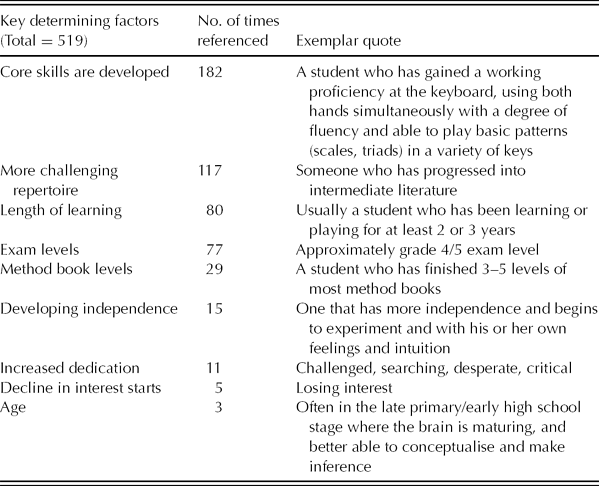
One of the key issues identified in the literature is how to determine or define the intermediate stage; hence teachers were asked to reflect on what factors indicate to them that a student has reached this level. The data are summarised in Table 1 in terms of the key determining factors, including the number of times these were referred to and with an exemplar quote relevant to each.
Defining the intermediate piano student

The data in Table 1 present a range of factors or attributes that teachers believe determine when a student has reached the intermediate stage. While the ability to accomplish certain technical functions or perform more complex repertoire is frequently cited and certainly logical, what is of interest are the other identified factors. For some teachers for example, a student has reached the intermediate stage when they are showing signs of being increasingly independent or more dedicated. In addition, and while it is a low number, it is of concern that a small number of teachers admit that this stage represents the beginning of a decline in interest for some students.
Teaching the intermediate student
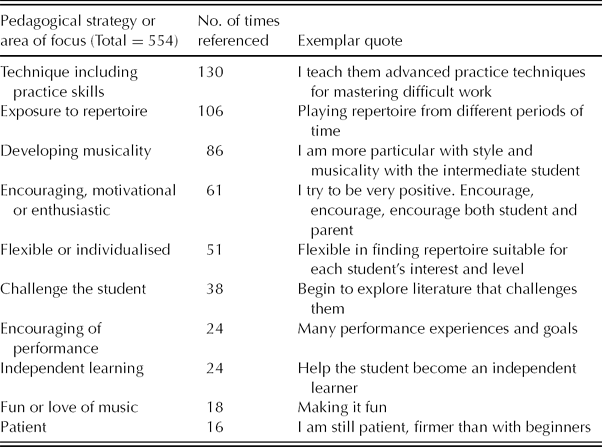
The teachers were invited to reflect on and consider their teaching focus or strategy for an intermediate student; these data are summarised in Table 2.
Approaches to teaching the intermediate student

Table 2 reveals the fact that teachers largely focus on the development of technical and/or practice skills; this is not surprising given these underpin the capacity to perform and deliver repertoire and musicality, the latter two areas also referenced frequently. While technical and practice skills are at the forefront of the majority of teachers’ minds, there is certainly recognition by some of the importance of moving students towards increasing independence:
• I am more demanding of the student to determine on their own the elements of a piece, including key signatures, times signatures and visual analysis.
• My goal is to get the student to be more and more ‘self-directed’ and self-motivated at this point.
• I expect more commitment in practice and theory, still lots of encouragement, but expect fewer excuses for work not done.
• I train students to teach themselves, planning that they will learn ‘correctly’ rather than have to have mistakes corrected.
While these views certainly propose that some teachers see increasing independence as critical, what the data reveal overall is that in the majority of situations, text-based work is the primary focus for teachers, which therefore proposes that it is critical that students are engaged with the material that they are required to learn and practice beyond lessons.
Learning material for the intermediate student
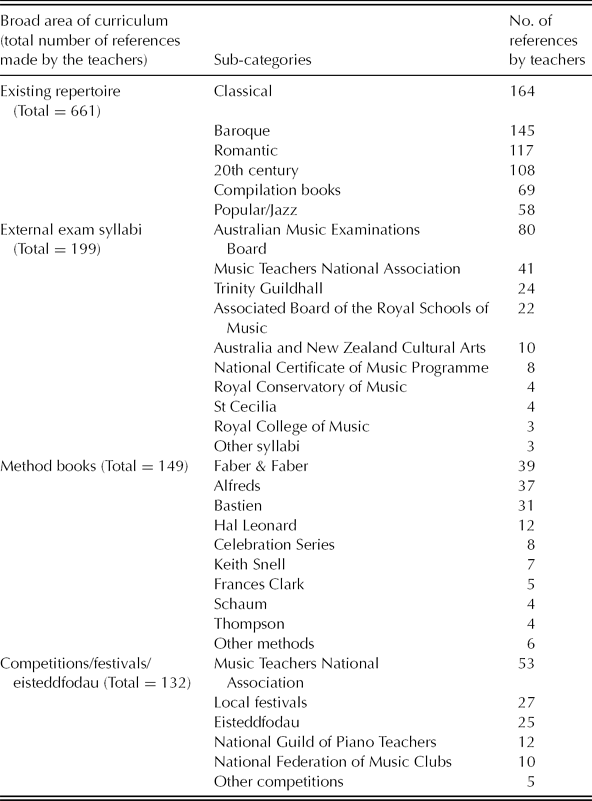
Given that the literature refers to the significant body of repertoire available at the intermediate level and the challenges that this presents when selecting work for students, the teachers were asked to provide details about the specific materials they use when working with intermediate students. These data are summarised in Table 3, with the sub-categories of each of the four broad areas presented in descending order in terms of the number of teachers who indicated that they used this material or method.
Specific curricula or learning material adopted by teachers when working with the intermediate piano student

Table 3 offers interesting insights into the specific learning material and/or experiences that teachers choose for the intermediate student. Certainly, traditional western art music repertoire dominates, which is not only cited most frequently by teachers but also further referenced given it is a core feature of most external examination syllabi. While there is some use of popular music and/or jazz, it is the lowest used area of material in comparison to the use of the various styles of Western art music (e.g. classical, romantic).
Given the references in the literature to the potential for higher student engagement with learning if students self-select their own material (e.g. Renwick & McPherson Reference RENWICK and MCPHERSON2002) the teachers were asked to identify how often their students would choose the repertoire they are required to practice and perform. The majority of teachers indicated ‘sometimes’ (66.9%), with a smaller number indicating ‘always’ (8.4%) and some indicating ‘never’ (4.7%). Of those who chose to provide an open-ended response, some identified that it was a mutual decision (4.9%) while others (15.1%) present students with a sample of material from which they would choose, as illustrated by the following comments:
• I choose several pieces, and then they select from those.
• I give a choice of a few pieces I think are appropriate for the particular student.
• I usually give them a list of about 20 pieces from which, with my input, they are to choose two.
• Usually I choose a style for them to learn, and then play three pieces for them to choose between.
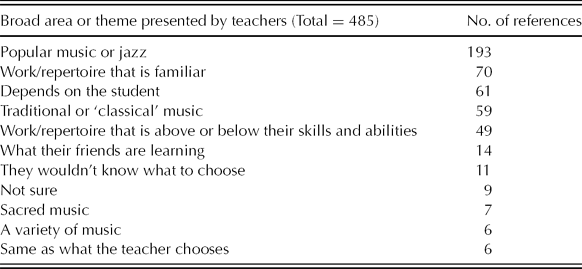
These various data confirm the fact that the piano teacher typically plays the primary role in the selection of repertoire for students, which emphasises how critical it is that the material chosen does in fact engage the students. In order to investigate further the concept of student engagement with repertoire, the teachers were asked to reflect on what they feel students would choose if they were left to their own devices; the data are presented in Table 4.
Teacher perceptions of what intermediate students would select if choosing their own learning material

What is a major finding to emerge from the data in Table 4 is the fact that teachers cite popular music or music that students know well as the material the majority would naturally select. The following comments from teachers provide further insights into this issue:
• Most would choose popular music because that's all they know.
• Generally, music that they want to play from rock bands, musicals, show tunes, movies – songs they hear every day.
• What they hear – video games, movies, TV, some like church music, their iPod lists.
• Popular music that they hear through movies or TV as well as modern composers.
• They respond well to music that they can relate to or at least identify.
• Arrangements of popular music, and other well-known pieces such as Fur Elise, Moonlight, Turkish Rondo.
The findings here propose that traditional repertoire, which has historically been the focus of most formalised piano teaching approaches, continues to be prioritised when many of the students are arguably more exposed to and engaged with popular music or at least, music that they know. What this reveals is a potentially major disconnect between what an intermediate student is exposed to in their daily listening habits and experiences and the material that teachers are presenting them within formalised lessons.
This issue of many students exhibiting a natural preference towards commercial and/or popular music is further highlighted when teachers were asked to rate, using a five-point scale (1 – disdain, 3 – ambivalence, 5 – excitement), a typical intermediate student's reaction to five standard categories of piano repertoire. These are listed below in descending order:
• Popular/Jazz music – 4.5
• Romantic music – 4.1
• Classical music – 3.9
• 20th century music – 3.2
• Baroque music – 3.1
These ratings provide further evidence of the fact that, while it is the least used repertoire in teaching, teachers acknowledge that students typically react more positively to popular/jazz music than all other areas of repertoire.
Perceptions and reflections on issues of motivation
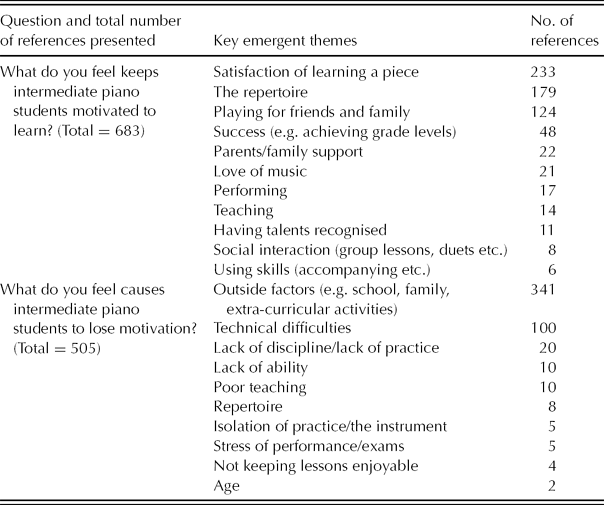
In order to explore what may be the factors that influence whether students are likely to move through the intermediate stage to an advanced level, Table 5 summarises teachers’ responses to open-ended questions about positive and negative impacts on motivation.
Motivation and learning: key factors of influence

In terms of what motivates the intermediate student, repertoire is again raised as a key factor, with teachers citing the ability to accomplish the learning of a piece of music as having the most positive impact. This again confirms the critical nature of the role that teachers play in determining the most appropriate repertoire and/or learning material for students. It also highlights the importance of the activity that occurs between lessons and how students manage their practice and/or progress from week to week. In terms of negative factors of influence on motivation, it is the additional activities students are involved with beyond their lessons that is overwhelmingly cited by teachers, with the following example comments providing a window on this issue:
• Without a doubt, it is the extra-curricular activities plus the computer!!
• School work, other extra-curricular activities – and they just lose interest (too much work).
• Too many distractions today – entertainment that is fun, quick and easy.
• Young people live a very busy life and they all want to be involved. Unless a student is motivated they do not want to spend time practicing when their friends are all at parties or playing sport.
This last comment certainly highlights the relatively isolated nature of studying a music instrument and how critical it is that students are motivated to learn. Indeed one teacher clearly supports this fact when describing the learning of a music instrument as a ‘solitary activity for most students, [hence] piano playing becomes a secondary activity in favour of group activities, e.g. sports, school clubs, etc.’.
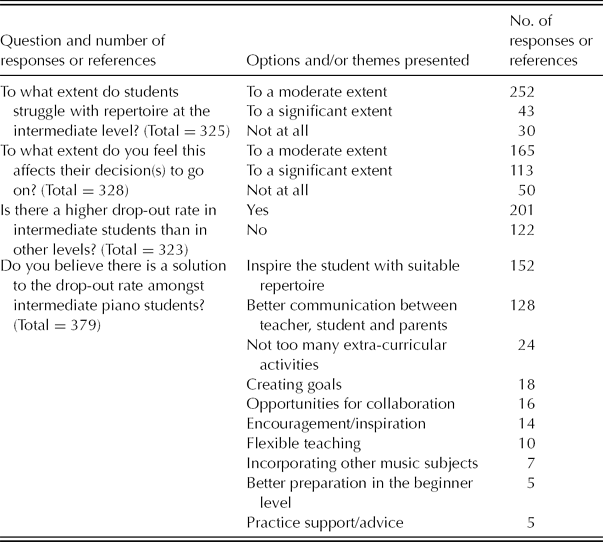
Given repertoire represents such a core component of the learning experience for an intermediate student, the teachers were asked to comment on the extent to which they believe it has an impact on continuation with study. These data are summarised and presented in Table 6.
Teachers’ perspectives on issues affecting continuation with learning

It is interesting that teachers believe intermediate piano students struggle with repertoire to a moderate or significant extent (90.7%), and that this has an affect on their ongoing commitment to learning, with just over one-third of teachers (34.5%) believing it has a significant impact. It is not surprising therefore that more than half of the teachers (62.2%) believe this stage of learning involves a high drop-out rate. What is also interesting in Table 6 are the high number of references to the need for better communication between teachers, students and parents, which has previously been identified as being important to the success of a student's journey when learning a music instrument (Davidson et al., Reference DAVIDSON, MOORE, SLOBODA and HOWE1998; Creech, Reference CREECH2010). While it is arguably logical and straightforward that parents play a role in any student's learning, it is clearly more difficult in practice, with one teacher providing a particularly interesting set of insights into the complexities of attempting to involve parents:
There's a massive uphill battle we have in educating parents. I only have one parent in the studio that is a professional music teacher. The remaining parents have had only very limited musical experience, if any. Some parents have enormous self confidence issues as they say to me ‘I don't know anything about music!’ Often students are left to their own devices and they need support especially when things get more challenging at the intermediate level. Music is still seen by some parents as being an ‘optional extra’. Generally, parents are often ignorant as to how to support their students through their piano studies when the going gets more challenging or tough. There has been a lot of negativity on the way many parents were taught piano years ago, and often these parents (either consciously or unconsciously) won't or don't allow their children to continue with piano because of their experience. They tend to lower their expectations, together with a mentality that as long as their child can read music well, then that's all that matters. As a music teacher I find that sad.
Reflections on the experience of teaching intermediate piano students
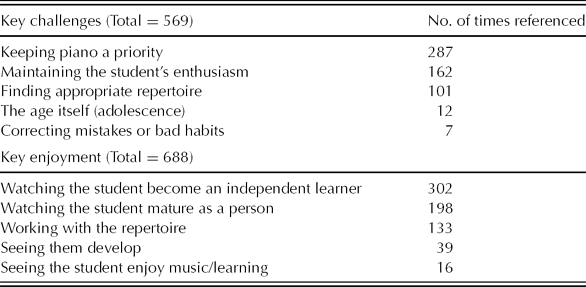
Finally, teachers were asked to reflect on what they believe to be the most challenging and enjoyable aspects of working with an intermediate piano student. The open-ended responses are summarised in Table 7.
Teachers’ identified challenges and enjoyment from working with the intermediate piano student

Given the findings presented earlier in this paper, it is not unexpected that the majority of challenges (79%) for teachers relate to the need to keep students engaged in or committed to the process of learning. One teacher provides an interesting picture:
It is a difficult time in the student's life. So many pressures are coming from all angles at them. They are developing at such a great pace, that they no longer have time to be children. Sports have taken over the entire world, and music has become less important than it was a few years ago. Parents are too busy to encourage and discipline.
Another teacher provides additional insights into the complex issues at play:
The most challenging aspect of teaching intermediate piano students is helping them find balance in their lives and keeping their music in that balance. Many parents today place unrealistic expectations on their young people, often stretching them to the max as far as schedule goes. The students feel pressure at school, pressure at home, pressure from peers, and, they should not feel pressure in their musical studies. I want them to find release and joy in their music as well as a sense of accomplishment.
In terms of what teachers enjoy the most when working with an intermediate student, it is not surprising that the most cited area is the development of independent learning skills. What is surprising however are the limited references made to the enjoyment of music/learning and which is arguably essential if a student is to continue through to the advanced stage or at least develop a lifelong love of music.
Summary and implications
This study provides a current picture of both the practices teachers adopt and the realities they face when working with the intermediate piano student. It is clearly a critical stage and one that is complex and challenging for both teachers and students. While it is acknowledged that the data in this paper only reflect the views of teachers, the large sample size and representation across different geographical locations brings validity to the results and confidence in the two major findings to emerge. The first of these is the fundamental role that repertoire and/or learning material plays and the impact it has on student engagement and continuation with study. While traditional ‘classical’ or western art music continues to dominate curricula, there appears to be an underlying tension or disconnect between what the music students are required to learn in their lessons and that which they typically engage with beyond lessons. The second relates to non-lesson time and how this is managed, with teachers arguing that students are increasingly busy with extra-curricular activities and therefore less able to focus on what is necessary to both keep up with their piano studies but also move through the intermediate stage. As part of this non-lesson time, it is also clear that parents have a critical role to play, although how this might work in reality is far from clear.
Further research is therefore needed in relation to the views of students and parents. Indeed it is critical to explore the views of current intermediate-level students in order to develop a deeper understanding of how they respond to the material they are currently required to learn and how they manage their time outside lessons. In addition, the views of advanced students might also be sought given they have had the benefit of time to reflect on what factors motivated them to continue through the intermediate stage. Finally, the views of those students that drop out during the intermediate stage should be accessed, in order to identify the specific factors of relevance including what may have made the difference to them continuing their studies. It is also clear that further research is necessary to explore the views of parents, given they play a critical role in the time between a student's lessons. While teachers refer to this as a very important issue, do parents see themselves as being key stakeholders in the learning process? If not, what are the reasons? If they do see themselves as key participants in the learning process, what role do they currently play and what impact does it have for students?
In addition to teachers, students and parents, these issues are also relevant to a range of other stakeholders, including composers of intermediate piano music, authors and/or editors of intermediate literature guides and compendiums, external examination organisations that offer graded exams and curricula, and school-based music educators who may also be working with the intermediate piano student. Regardless of whether a student seeks to develop a career as a pianist or they simply enjoy music making and the act of playing the piano, it is certainly clear that there are numerous opportunities for research in order to develop further evidence-based findings that offer new directions for this important stage of music education.
Ryan Daniel maintains an active music performance, teaching and publishing profile, the latter in leading international publications including the British Journal of Music Education, Music Education Research and CoDesign. With VDM Verlag, he has recently published a substantive text on group piano teaching, a major research study that offers new directions for the music instrument teaching sector.
Julia Bowden holds a Master of Music research degree and first class Honours in music performance. With strong research interests in piano pedagogy, Julia has published a text with VDM Verlag on holistic learning programmes for beginner piano students. Julia is an active educator at both the secondary and university levels, while she also manages and runs a private piano teaching studio.