





Traumatic events are widespread, with an estimated 60–80% of adults experiencing at least one during their lifetime. Reference Benjet, Bromet, Karam, Kessler, McLaughlin and Ruscio1,Reference Kessler, Aguilar-Gaxiola, Alonso, Benjet, Bromet and Cardoso2 Exposure to trauma is associated with an increased risk of post-traumatic stress disorder (PTSD), depression and anxiety disorders, Reference Schincariol, Orrù, Otgaar, Sartori and Scarpazza3–Reference Cénat, McIntee and Blais-Rochette6 with PTSD characterised by re-experiencing, avoidance and heightened arousal that can significantly impair psychosocial functioning. Reference Bryant7–Reference Jellestad, Vital, Malamud, Taeymans and Mueller-Pfeiffer9
Current models of PTSD emphasise that its development is shaped by a combination of pre-, peri- and post-trauma factors. Reference Bomyea, Risbrough and Lang10,Reference Elwood, Hahn, Olatunji and Williams11 Among peri-trauma variables, peritraumatic reactions, particularly dissociation and distress, have received considerable attention as early indicators of later PTSD risk. Reference Ozer, Best, Lipsey and Weiss12–Reference Thomas, Saumier and Brunet14 However, findings regarding their long-term predictive role have been inconsistent. While some studies suggest that these reactions continue to predict PTSD over time, Reference Breh and Seidler15,Reference Dokkedahl and Lahav16 others indicate that their influence decreases, particularly when early symptom levels are taken into account. Reference Gershuny, Cloitre and Otto17,Reference van der Velden, Kleber, Christiaanse, Gersons, Marcelissen and Drogendijk18
An additional complexity arises from the retrospective nature of peritraumatic assessments. In most disaster studies, peritraumatic dissociation and distress are measured days, weeks or months after the event, meaning that responses may reflect reconstructed recollections rather than the original peri-event experience. Research on trauma memory suggests that such recollections can shift over time as a function of current symptoms, appraisals and meaning-making processes, Reference Ehlers and Clark23,Reference Rubin, Berntsen and Bohni24 and prospective studies have documented divergence between real-time and retrospective trauma symptom reports. Reference Greene, Sznitman, Contractor, Prakash, Fried and Gelkopf25 This question becomes particularly relevant in large-scale disasters, where individuals face not only the initial trauma but also prolonged post-disaster stressors. The February 2023 earthquakes in Turkey, which led to widespread displacement and long-term disruption, Reference Alpay, Redican, Hyland, Karatzias and Shevlin4,Reference Alpay and Aydın20 provide a valuable context for examining how these associations change over time.
In this study, we examined how the relationships between peritraumatic dissociation, peritraumatic distress and PTSD symptoms evolve across 3 post-disaster phases: 2 months, 1 year and 2 years after the earthquake, using parallel-process latent growth curve modelling, also referred to as latent growth modelling (LGM). We expected all three constructs to decline over time and anticipated that dissociation and distress would be more strongly associated with PTSD during the early phase. Given mixed prior findings, the extent to which early peritraumatic reactions would predict the longitudinal trajectory of PTSD was examined more cautiously.
Method
Participants and procedure
A total of 261 adult earthquake survivors (aged 18–65) were enrolled at Time 1 (April 2023, approximately 2 months post-disaster), of whom 182 participated at Time 2 (1 year post-earthquake) and 131 at Time 3 (2 years post-earthquake). The final sample (mean age 29.66, s.d. 12.10) comprised 96 women (73.2%) and 35 men (26.8%); further demographic characteristics are presented in Table 1. Participants were survivors who relocated to Mersin following the 6 February 2023 earthquakes and applied for psychosocial support services. Inclusion criteria required participants to be aged 18–65, resident in the earthquake epicentre at the time of the event and literate. Individuals with a diagnosed psychotic disorder were excluded.
Means, standard deviations and Cronbach’s α coefficients of the variables

Table 1 Long description
A table comparing means, standard deviations, and Cronbach’s alpha coefficients of PTSD, Distress, and Dissociation across three time points. The table has three rows and nine columns. The rows are labeled PTSD, Distress, and Dissociation. The columns are labeled Time 1 X, Time 1 s.d., Time 1 α, Time 2 X, Time 2 s.d., Time 2 α, Time 3 X, Time 3 s.d., and Time 3 α. Row 1: PTSD, Time 1 X 19.03, Time 1 s.d. 3.74, Time 1 α 0.81, Time 2 X 16.18, Time 2 s.d. 3.75, Time 2 α 0.74, Time 3 X 12.80, Time 3 s.d. 3.95, Time 3 α 0.79. Row 2: Distress, Time 1 X 29.01, Time 1 s.d. 4.60, Time 1 α 0.86, Time 2 X 24.67, Time 2 s.d. 3.99, Time 2 α 0.75, Time 3 X 20.60, Time 3 s.d. 3.87, Time 3 α 0.75. Row 3: Dissociation, Time 1 X 31.32, Time 1 s.d. 5.81, Time 1 α 0.80, Time 2 X 27.15, Time 2 s.d. 5.86, Time 2 α 0.79, Time 3 X 22.37, Time 3 s.d. 5.97, Time 3 α 0.76.
PTSD, Post-traumatic stress disorder.
Participants reported substantial direct exposure to the earthquake’s immediate aftermath: 93.1% spent at least one night away from home in the days following the earthquake, 84.7% reported damage to their home and 70.9% had to relocate due to structurally unsafe housing. Regarding injury and loss, 29.9% were physically injured themselves, 60.5% had a family member or loved one who was injured, 48.7% lost an immediate family member and 48.7% lost an extended family member. Additionally, 16.5% were involved in rescue work, and 27.2% reported witnessing dead bodies or body parts during the rescue and clearing period.
Time 1 assessments were administered face-to-face by trained psychosocial support volunteers who held no authority over participants’ access to humanitarian aid, housing assistance or other relief services; participation was voluntary and explicitly presented as independent of any eligibility determination for support services. Times 2 and 3 were completed online, with participants contacted via telephone and social media. The study received ethical approval from the Mersin University Social Sciences Ethics Committee (03.03.2023-145). The authors assert that all procedures contributing to this work comply with the ethical standards of the relevant national and institutional committees on human experimentation and with the Helsinki Declaration of 1975, as revised in 2013. Written informed consent was obtained from all participants prior to participation.
Measures
International Trauma Questionnaire (ITQ)
The ITQ is a self-report instrument assessing ICD-11 PTSD symptoms. Reference Cloitre, Shevlin, Brewin, Bisson, Roberts and Maercker31 Of the items, 6 target three core symptom clusters (re-experiencing, avoidance and persistent sense of current threat) plus 3 functional impairment items, rated on a 5-point Likert scale (0 = Not at all to 4 = Extremely). The Turkish version demonstrated excellent internal consistency (α = 0.92). Reference Gündoğmuş, Ünsal, Alma and Par32
Peritraumatic Dissociative Experiences Questionnaire (PDEQ)
The PDEQ is a 10-item self-report measure assessing dissociative responses during or immediately after trauma, including depersonalisation and altered time perception. Reference Marmar, Weiss, Metzler, Wilson and Keane33 Items are rated on a 5-point scale (1 = Not at all true to 5 = Extremely true). The Turkish version showed good internal consistency (α = 0.85). Reference Geyran, Kocabaşoğlu, Özdemir and Yargıç34
Peritraumatic Distress Inventory (PDI)
The PDI is a 13-item self-report tool assessing distress during or immediately following a traumatic event, covering fear, helplessness and bodily arousal. Reference Brunet, Weiss, Metzler, Best, Neylan and Rogers35 Items are rated on a 5-point scale (0 = Not at all true to 4 = Extremely true). The Turkish version indicated strong internal consistency (α = 0.88). Reference Ermağan Çağlar, Sanal Özcan, Türk Kurtça and Hamzaoğlu36
Statistical analysis
Preliminary statistical analyses were conducted using IBM SPSS Statistics (version 29.0 for Windows; IBM Corp., Armonk, NY, USA; https://www.ibm.com/products/spss-statistics) while the parallel-process latent growth models were estimated in R (version 4.2.2 for Windows; Posit Software, PBC, Boston, MA, USA; https://posit.co/download/rstudio-desktop/) using the lavaan package. Reference Rosseel37 Attrition analyses compared participants retained at Time 3 with those lost to follow-up on baseline demographic and clinical variables, using independent-sample t-tests and chi-square tests. Baseline PTSD scores did not differ between groups (t(259) = 0.84, p = 0.40, d = 0.10), nor did peritraumatic dissociation (t(259) = 1.02, p = 0.31, d = 0.13), peritraumatic distress (t(259) = 0.67, p = 0.50, d = 0.08), age (t(259) = 0.58, p = 0.56, d = 0.07), gender (χ2(1) = 1.94, p = 0.16, V = 0.09) or education level (χ2(2) = 2.07, p = 0.35, V = 0.08). Missing data were handled using full information maximum likelihood (FIML) under the missing-at-random assumption. Distributional assumptions were examined via skewness and kurtosis statistics, with values within ±2 indicating acceptable univariate normality.
Pearson correlation analyses examined associations among the study variables across the three waves. Parallel-process LGMs were estimated using the lavaan package. Reference Rosseel37 Separate models were estimated for peritraumatic dissociation and peritraumatic distress. In each model, latent intercept and slope factors represented initial symptom levels and rates of change across the three waves. PTSD intercept and slope factors were regressed on the peritraumatic reaction intercept factors to evaluate whether early peritraumatic responses predicted initial PTSD severity and subsequent trajectories. Models were estimated using robust maximum likelihood estimation. Model fit was evaluated using the chi-square statistic, Comparative Fit Index (CFI), Tucker–Lewis Index (TLI), root mean square error of approximation (RMSEA) and standardised root mean square residual (SRMR). CFI and TLI values of 0.90 or above indicated acceptable fit and 0.95 or above indicated good fit; RMSEA and SRMR values of 0.08 or below indicated acceptable fit. Reference Hu and Bentler38
Results
Descriptive statistics
Table 1 presents the mean, s.d. and Cronbach’s alpha coefficients for the study variables across the three time points. All variables showed a general decreasing pattern from Time 1 to Time 3.
Correlation analyses
Table 2 displays Pearson correlation coefficients among the study variables at each time point. Both peritraumatic dissociation and distress were strongly correlated with PTSD at Time 1 (r = 0.528 and r = 0.629, respectively), but these associations weakened substantially by Time 2 and were no longer statistically significant at Time 3 (r = 0.025 and r = 0.068).
Pearson correlation coefficents among variables for Time 1, Time 2 and Time 3

Table 2 Long description
A table with three rows and nine columns, displaying Pearson correlation coefficients among variables for Time 1, Time 2, and Time 3. The rows are labeled as Dissociation, PTSD, and Distress. The columns are labeled as Time 1, Time 2, and Time 3, each with sub-columns 1, 2, and 3. Row 1: Dissociation. Time 1: Column 2: 0.528, Column 3: 0.634. Time 2: Column 2: 0.376, Column 3: 0.312. Time 3: Column 2: 0.025, Column 3: 0.192. Row 2: PTSD. Time 1: Column 3: 0.629. Time 2: Column 3: 0.270. Time 3: Column 3: 0.068. Row 3: Distress. No values are present for this row.
PTSD, Post-traumatic stress disorder. **p < 0.01, *p < 0.05.
Latent growth model: peritraumatic dissociation and PTSD
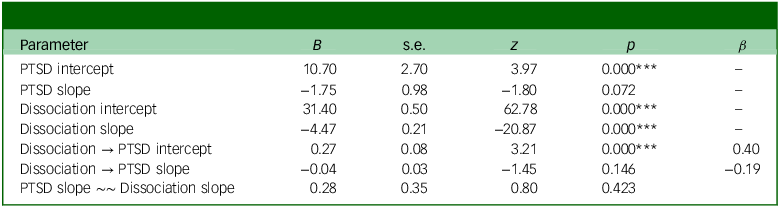
The parallel-process LGM for peritraumatic dissociation and PTSD demonstrated acceptable to good fit: χ2(7) = 9.96, p = 0.191, CFI = 0.993, TLI = 0.985, RMSEA = 0.057, SRMR = 0.038. Robust fit indices confirmed excellent fit (robust CFI = 0.998, TLI = 0.997, RMSEA = 0.026). Parameter estimates are presented in Table 3.
Parameter estimates for the parallel latent growth model

Table 3 Long description
A table with 10 rows and 6 columns showing parameter estimates for a parallel latent growth model. The columns are labeled Parameter, B, s.e., z, p, and β. The rows list different parameters and their corresponding values. Row 1: PTSD intercept, 10.70, 2.70, 3.97, 0.000***, -. Row 2: PTSD slope, -1.75, 0.98, -1.80, 0.072, -. Row 3: Dissociation intercept, 31.40, 0.50, 62.78, 0.000***, -. Row 4: Dissociation slope, -4.47, 0.21, -20.87, 0.000***, -. Row 5: Dissociation -> PTSD intercept, 0.27, 0.08, 3.21, 0.000***, 0.40. Row 6: Dissociation -> PTSD slope, -0.04, 0.03, -1.45, 0.146, -0.19. Row 7: PTSD slope ~ Dissociation slope, 0.28, 0.35, 0.80, 0.423, -. The table provides detailed parameter estimates for the model, including intercepts and slopes for PTSD and dissociation, as well as their interactions.
PTSD, post-traumatic stress disorder. ***p < 0.001.
The intercept of PTSD symptoms was significant (b = 10.70, s.e. = 2.70, p < 0.001). The slope of PTSD symptoms was negative but only marginally significant (b = –1.75, s.e. = 0.98, p = 0.072), suggesting a tendency toward decline without reaching conventional statistical significance. For peritraumatic dissociation, both the intercept (b = 31.40, s.e. = 0.50, p < 0.001) and slope (b = –4.47, s.e. = 0.21, p < 0.001) were significant, indicating substantial initial levels and a significant decline across waves.
The intercept of peritraumatic dissociation significantly predicted the intercept of PTSD symptoms (b = 0.27, s.e. = 0.08, p < 0.001, β = 0.40), indicating that higher initial dissociation was associated with greater initial PTSD severity, accounting for approximately 16% of variance in the PTSD intercept. However, the dissociation intercept did not significantly predict the PTSD slope (b = –0.04, s.e. = 0.03, p = 0.146, β = –0.19). The covariance between the PTSD and dissociation slopes was also non-significant (b = 0.28, s.e. = 0.35, p = 0.423). Taken together, these findings indicate that peritraumatic dissociation is primarily associated with early PTSD severity rather than with longitudinal symptom change.
Latent growth model: peritraumatic distress and PTSD
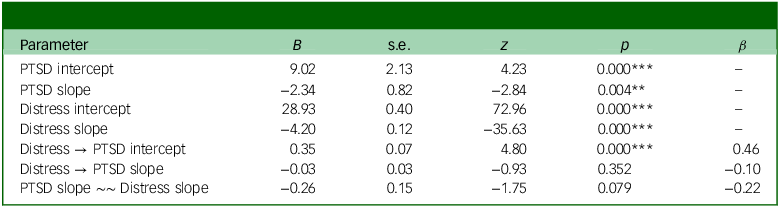
The parallel-process LGM for peritraumatic distress and PTSD demonstrated acceptable fit: χ2(7) = 13.23, p = 0.067, CFI = 0.991, TLI = 0.981, RMSEA = 0.082 and SRMR = 0.026. Robust fit indices showed a very similar pattern (robust CFI = 0.991, TLI = 0.981 and RMSEA = 0.083). Parameter estimates are presented in Table 4.
Parameter estimates for the parallel latent growth model

Table 4 Long description
A table presenting parameter estimates for a parallel latent growth model. The table has 10 rows and 5 columns. The columns are labeled Parameter, B, s.e., z, p, and beta. The rows list various parameters related to PTSD and distress, including intercepts and slopes, as well as interactions between distress and PTSD. Each row provides the corresponding values for B, standard error (s.e.), z-score, p-value, and beta coefficient. Notable parameters include PTSD intercept with a B value of 9.02 and a p-value of 0.000, Distress intercept with a B value of 28.93 and a p-value of 0.000, and Distress slope with a B value of -4.20 and a p-value of 0.000. The table also includes interactions such as Distress -> PTSD intercept with a B value of 0.35 and a p-value of 0.000, and PTSD slope ~ Distress slope with a B value of -0.26 and a p-value of 0.079.
PTSD, post-traumatic stress disorder. ***p < 0.001; **p < 0.01.
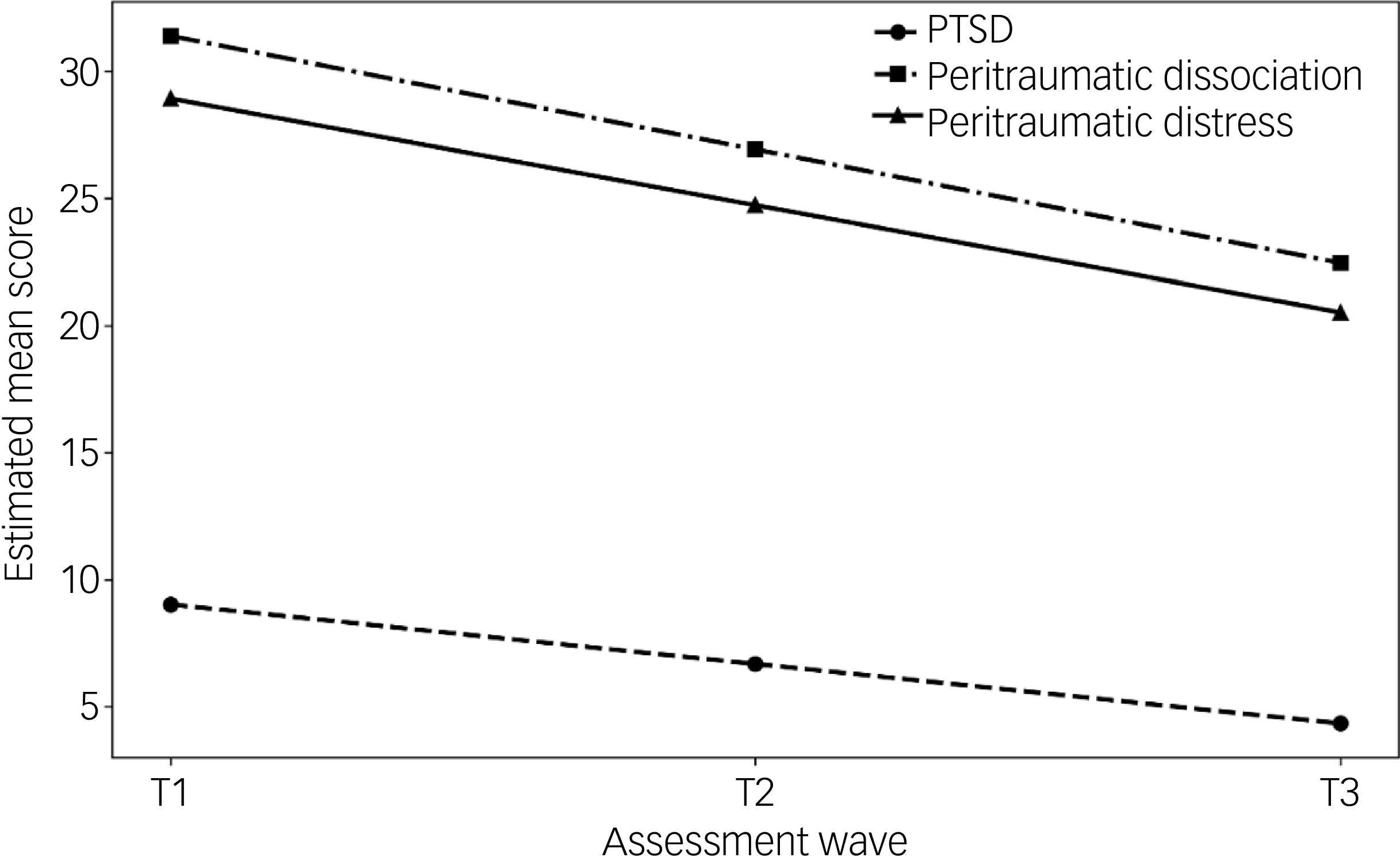
Estimated longitudinal trajectories of post-traumatic stress disorder (PTSD) symptoms, peritraumatic dissociation and peritraumatic distress across the three post-earthquake assessment waves. Figure 1 illustrates the estimated trajectories of PTSD symptoms, peritraumatic dissociation and peritraumatic distress across the three assessment waves. As shown in the figure, all three constructs demonstrated a decreasing pattern over time. However, the magnitude of decline differed across variables. Peritraumatic dissociation and peritraumatic distress showed steeper reductions between Time (T) 1 and T3, whereas PTSD symptoms declined more gradually. This visual pattern is consistent with the latent growth model results, suggesting that peritraumatic reactions are more characteristic of the acute post-disaster phase, while PTSD symptoms tend to persist more steadily over time.

The intercept of PTSD symptoms was significant (b = 9.02, s.e. = 2.13, p < 0.001), and the PTSD slope was negative and significant (b = –2.34, s.e. = 0.82, p = 0.004), indicating a significant reduction in PTSD symptoms over time. For peritraumatic distress, both the intercept (b = 28.93, s.e. = 0.40, p < 0.001) and slope (b = –4.20, s.e. = 0.12, p < 0.001) were significant. Notably, unlike the dissociation model, the variance of the distress slope was significant (σ2 = 1.05, p = 0.040), indicating meaningful between-person variability in the rate of distress decline. The covariance between the distress intercept and slope was significant and negative (b = –2.56, s.e. = 0.77, p = 0.001), suggesting that individuals with higher initial distress tended to show steeper declines.
The distress intercept significantly predicted the PTSD intercept (b = 0.35, s.e. = 0.07, p < 0.001, β = 0.46), accounting for approximately 21% of variance. However, the distress intercept did not significantly predict the PTSD slope (b = –0.03, s.e. = 0.03, p = 0.352, β = –0.10). The covariance between the PTSD and distress slopes was negative and marginally significant (b = –0.26, s.e. = 0.15, p = 0.079), suggesting a trend whereby greater declines in distress may be associated with greater declines in PTSD, although this did not reach conventional significance.
Discussion
This study examined the temporal relationship between peritraumatic reactions and PTSD symptoms across three post-disaster phases among survivors of the February 2023 earthquakes in Turkey, using parallel-process LGM.
Consistent with prior cross-sectional and early longitudinal work, Reference Ozer, Best, Lipsey and Weiss12–Reference Thomas, Saumier and Brunet14,Reference Alpay and Aydın20,Reference Marmar, McCaslin, Metzler, Best, Weiss and Fagan22 both peritraumatic dissociation and distress were strongly correlated with PTSD at Time 1 and significantly predicted initial PTSD severity in the LGMs. These findings align with diathesis-stress frameworks suggesting that peritraumatic responses index the activation of underlying vulnerabilities in the immediate aftermath of trauma, Reference Bomyea, Risbrough and Lang10,Reference Elwood, Hahn, Olatunji and Williams11 and reinforce the clinical importance of early screening for dissociation and distress following mass trauma.
However, neither peritraumatic dissociation nor distress predicted the slope of PTSD symptoms over time, and slope covariances were non-significant or only marginal. This pattern echoes van der Velden et al, Reference van der Velden, Kleber, Christiaanse, Gersons, Marcelissen and Drogendijk18 who found that peritraumatic dissociation had limited independent predictive value for PTSD years after a disaster once baseline symptom levels were considered. The present LGM findings extend this evidence by demonstrating that initial peritraumatic reactions do not determine the trajectory of PTSD recovery, suggesting that other post-traumatic mechanisms become progressively more important over time.
An important distinction emerged between dissociation and distress. While the slope variance for dissociation was non-significant, the slope variance for distress was significant, indicating that individuals differed meaningfully in how rapidly distress declined, but showed more homogeneous declines in dissociation. This may reflect that dissociation functions as a more immediate, state-like defensive response to acute threat, whereas distress captures a broader and more heterogeneous set of emotional and physiological experiences that remain more sensitive to individual differences in coping resources, social support and ongoing adversity. The negative intercept-slope covariance for distress further supports this, suggesting that highly distressed individuals tended to show steeper recovery.
The diminishing associations between peritraumatic reactions and PTSD over time may also reflect the reconstructive nature of trauma memory. Because peritraumatic reactions were assessed retrospectively, beginning approximately two months after the earthquake, later scores likely captured survivors’ remembered or reconstructed accounts rather than the original peri-event response. Research on trauma memory suggests that recollections of traumatic experiences are dynamically reconstructed over time through ongoing cognitive and emotional processes, Reference Ehlers and Clark23,Reference Rubin, Berntsen and Bohni24 and prospective studies have documented divergence between real-time and retrospective symptom reports. Reference Greene, Sznitman, Contractor, Prakash, Fried and Gelkopf25,Reference Heir, Blix, Knatten and Berntsen26 Longitudinal disaster research has similarly shown that survivors may retrospectively reinterpret aspects of their immediate reactions. Reference Karam, Al Barathie, Hayek, Mascayano, Susser and Bryant27 This extends beyond a simple measurement limitation and raises a broader conceptual question regarding what retrospective peritraumatic assessments capture over time. From a cognitive model perspective, Reference Ehlers and Clark23,Reference Beierl, Böllinghaus, Clark, Glucksman and Ehlers28 the observed declines in dissociation and distress scores may partly reflect gradual reorganisation of traumatic memory such that the event is recalled as less overwhelming as recovery progresses.
Theoretical and clinical implications
The present findings support a dynamic view of PTSD aetiology. Peritraumatic reactions appear to serve as early indicators of acute vulnerability, while post-traumatic cognitive, interpersonal and environmental processes become increasingly central to symptom maintenance. Reference Ehlers and Clark23,Reference Beierl, Böllinghaus, Clark, Glucksman and Ehlers28,Reference McKeever and Huff29 This challenges screening approaches that rely heavily on a single early peritraumatic assessment to forecast chronic PTSD risk. A more effective strategy involves stepped-care interventions adapted to evolving recovery trajectories, with follow-up assessments incorporating post-traumatic cognitive processes, ongoing stressors and social support. At the same time, early dissociation and distress remain clinically important: they are highly informative regarding early symptom burden and can identify survivors in immediate need of stabilisation and supportive care.
Limitations and future directions
Several limitations warrant attention. First, the sample consisted exclusively of help-seeking survivors who relocated to Mersin, which may limit generalisability to survivors who remained in the epicentre or did not seek support. Second, all measures relied on self-report, which is subject to recall bias and retrospective distortion; Reference Weathers, Bovin, Lee, Sloan, Schnurr and Kaloupek30 future studies should incorporate clinician-administered assessments such as the Clinician-Administered PTSD Scale for DSM-5. Reference Weathers, Bovin, Lee, Sloan, Schnurr and Kaloupek30 Third, peritraumatic reactions were assessed retrospectively, starting two months after the earthquake. As a result, participants’ reports may reflect reconstructed memories shaped by later experiences and current psychological states rather than their immediate responses during the event. This introduces both methodological concerns related to recall bias and conceptual challenges regarding what is being captured when peritraumatic processes are measured after a delay. Future studies should attempt to assess peri-event reactions closer to the time of trauma. Additionally, this study was not pre-registered. While our expectations were grounded in prior theoretical and empirical work, the absence of preregistration means our hypotheses should be considered theoretically motivated rather than confirmatory, and findings, particularly those involving exploratory comparisons such as the differential slope variance observed between dissociation and distress, should be interpreted with appropriate caution. Fourth, treatment exposure and psychosocial service utilisation during follow-up were not assessed, making it difficult to disentangle natural recovery from intervention effects. Fifth, a further limitation concerns participant attrition across the three assessment waves. Although attrition analyses indicated no significant differences between participants who completed all assessments and those who dropped out on baseline demographic characteristics, PTSD symptoms or peritraumatic reactions, the possibility of systematic attrition related to unmeasured variables cannot be excluded. Given the substantial displacement, housing instability and ongoing stressors experienced by earthquake survivors, loss to follow-up was expected but may nevertheless have affected the representativeness of the final sample. In addition, although FIML estimation enabled all available data to contribute to model estimation, the reduced sample size at later waves (n = 131 at Time 3, compared with N = 261 at baseline) may have limited statistical power to detect smaller longitudinal effects. Future studies would benefit from larger samples and improved retention strategies across follow-up assessments. Sixth, the intervals between assessments (approximately 2 months, 1 year and 2 years post-earthquake) were relatively long and unevenly spaced. This coarse temporal resolution may have obscured more fine-grained fluctuations in the post-traumatic process, including possible non-monotonic patterns, such as temporary symptom exacerbations around disaster anniversaries, which more frequent assessments could have captured. Future longitudinal studies should consider denser sampling schedules, particularly during the first year post-disaster, when peritraumatic reactions and PTSD symptoms appear to change most rapidly based on the present findings. Finally, post-traumatic cognitive processes, social support and ongoing threat perception were not measured; incorporating these would allow more comprehensive tests of theoretical models integrating peritraumatic and post-traumatic pathways.
An alternative analytic approach worth considering is trajectory-based modelling, such as growth mixture modelling or latent class growth analysis, as employed by Pérez et al Reference Pérez, Conchado, Andreu, Galdón, Cardeña and Ibanez39 in their study of acute stress trajectories following breast cancer diagnosis. Such person-centred approaches could identify distinct subgroups of survivors (e.g. resilient, recovering or chronic) within our sample, potentially revealing heterogeneity in recovery patterns that the variable-centred LGM approach used here may not capture. Future research with larger samples should consider this complementary method to better characterise qualitatively distinct trajectories of post-disaster psychological adjustment.
This study provides longitudinal evidence that peritraumatic dissociation and distress function primarily as indicators of early PTSD severity rather than as determinants of long-term symptom trajectories. These findings highlight the temporal variability of peritraumatic responses and underscore the importance of multi-stage, dynamic screening frameworks that extend beyond early peritraumatic assessments to incorporate post-traumatic cognitive, social and environmental factors in post-disaster mental health responses.
Data availability
The data that support the findings of this study are available from the corresponding author upon reasonable request. The data are not publicly available due to their containing information that could compromise the privacy of research participants.
Acknowledgement
The authors used ChatGPT (OpenAI, GPT-4, accessed April 2025) to assist with language editing and improving the clarity and readability of the manuscript. The authors reviewed and edited all artificial intelligence-assisted content and take full responsibility for the content of the publication.
Author contributions
E.A. conceptualised and designed the study, coordinated data collection, conducted statistical analyses and drafted the manuscript. R.Ç. contributed to statistical analysis and interpretation of the latent growth models. F.U. contributed to data collection and reviewed the manuscript. All authors approved the final version submitted for publication.
Funding
This research received no specific grant from any funding agency, commercial or not-for-profit sectors.
Declaration of interest
None.



 Open access


eLetters
No eLetters have been published for this article.