1 Pre-R Dentalisation
Dental pronunciation of (general English, ?underlying, ?historical) alveolar non-sibilant consonants before /r/ and /ər/ is a well-known (and indeed stereotyped) feature of traditional varieties of Irish English. Thus we find pronunciations such as try [ ɾaˑe], dry [
 ɾaˑe], street [sɾit], entry [ˈɛ
 ɾe], better [ˈbɛɚ], wonder [ˈw
 ɚ] and dinner [ˈdəɚ] used by conservative speakers of Tyrone English (TyrE) in Northern Ireland.Footnote 2 This Pre-R Dentalisation (henceforth PreRD) is a pan-Irish English feature, having been reported from locations as linguistically and geographically diverse as Wexford (Henry Reference Henry1958: 122; Ó Muirithe Reference Ó Muirithe and Dolan1996), Cork (Lunny Reference Lunny1981), Dublin (Hickey Reference Hickey2005: 42), Westmeath (Henry Reference Henry1958: 122; Nally Reference Nally1971), Mayo (Ó hÚrdail Reference Ó hÚrdail and Kallen1997), Roscommon (Henry Reference Henry1952), Donegal (Henry Reference Henry1958: 122; Ní Ghallchóir Reference Ní Ghallchóir1981; Gregg Reference Gregg1985), Belfast (Harris Reference Harris1985) and Antrim (Gregg Reference Gregg and Brendan Adams1964, Reference Gregg1985).Footnote 3
PreRD in Ireland is fascinating, not least because of its presence in varieties which formed in a context of language contact (Irish Gaelic, English and, in some areas, Scots) and dialect contact (between dialects of English and, in some areas, Scots). Indeed, it has usually been suggested that PreRD in Irish English is at least partly the result of contact with Irish Gaelic (e.g. Ellis Reference Ellis1869: 1239; Adams Reference Adams1967: 34; Ó Baoill Reference Ó Baoill, Sture Ureland and Broderick1991: 590–1; Ó hÚrdail Reference Ó hÚrdail and Kallen1997: 146; see also Harris Reference Harris1985: 211–18 for a critical analysis), which has (phonemic) contrasts between ‘broad’ dental /t d n l/ and ‘slender’ (palato-)alveolar /t´ d´ n´ l´/. Furthermore, PreRD has a number of intriguing linguistic properties, in particular an associated /r/-Realisation Effect (henceforth RRE), and a Morpheme Boundary Constraint (henceforth MBC). PreRD in Irish English is often associated with tapped (and possibly trilled) pronunciations of /r/, as in TyrE try [ɾaˑe] vs cry [kɹaˑe]. The RRE has been recorded in varieties of Ulster Scots (Gregg Reference Gregg1985), in Mid-Ulster English generally (Harris Reference Harris1985), in Donegal Gaeltacht English (Ní Ghallchóir Reference Ní Ghallchóir1981), and in Wexford (Ó Muirithe Reference Ó Muirithe and Dolan1996). Since the RRE is also present after /θ/ and /ð/ in those northern Irish English varieties which retain the dental fricatives, this may well be connected with tapped pronunciations of /r/ after /θ/ in English more generally (Wells Reference Wells1982: 282). Regarding the MBC, PreRD may be blocked by ‘Class 2’ morpheme boundaries and word boundaries (Bermúdez-Otero & McMahon Reference Bermúdez-Otero, McMahon, Aarts and McMahon2006; Harris Reference Harris2006). Thus compare TyrE better ‘more good’ [ˈbɛɚ] and matter [ˈmaɚ] with better ‘one who bets’ [ˈbɛtɚ] and fatter [ˈfatɚ], and with bet her [ˈbɛtɚ] and at her [ˈatɚ]; cf. also elementary [ˌɛləˈmɛ(ə)ɾe], secondary [ˈsɛkə(ə)ɾe], and hat-rack [ˈhatˌɹak], bed-rock [ˈbɛdˌɹɒk]. The MBC in Irish English has been recorded in Westmeath (Nally Reference Nally1971), in Mayo (by the present author), in Antrim (Gregg Reference Gregg and Brendan Adams1964), and in Mid-Ulster English (Harris Reference Harris1985). The interaction between the MBC and the RRE provides good evidence for phonological strata (Bermúdez-Otero & McMahon Reference Bermúdez-Otero, McMahon, Aarts and McMahon2006), since PreRD is blocked by ‘Class 2’ morpheme boundaries but not by ‘Class 1’ boundaries (see the examples above), whilst the RRE is post-lexical, in some instances at least, as evidenced by pronunciations in TyrE such as better [ˈbɛɚ] vs better at that [ˈbɛəɾ ət ˈðat], bother [ˈbɒðɚ] vs bother about it [ˈbɒðəɾ əˈbəʉt ət], and road [ɹoʊd] vs down the road [ˈdəʉn ðə ˈɾoʊd] (but not in go to Rome [ˈgoʊ tə ˈɹoʊm] where PreRD is blocked).
It is less well known that PreRD is (or perhaps was) also a feature of a number of English varieties outside Ireland. Broderick (Reference Broderick and Tristram1997) records it in Manx English, and it has been reported in Hebridean English (Shuken Reference Shuken and Trudgill1984) and Caithness Scots (Grant & Murison Reference Grant and Murison1931: xxxviii) in Scotland. All three of these have, like Irish Englishes, been in close contact with Gaelic varieties, adding to the suspicion that PreRD is a contact phenomenon. However, PreRD was also found in traditional northern English dialects (Wright Reference Wright1905: 228–9), where contact with Gaelic can hardly have been a factor, thus complicating any explanation of its origins. So, for example, Ellis (Reference Ellis1869: 1239) states that in the second half of the nineteenth century there was:
a peculiar dentality all over Ireland. This dentality is not noted in conjunction with any other letter but R, either immediately following, as in dr-, tr-, or separated by an unaccented vowel, as -der, -ter, the r being of course trilled . . .
We shall find that dental (ˎt, ˎd)Footnote 4 occur frequently in English dialects, but always and only in connection with r . . . under precisely the same circumstances as the Irish dental . . .
We have nothing in older English to lead us to a knowledge of the existence of dental (ˎt, ˎd), and their distinction from coronal (t, d). There is also no trace of it in Scotch . . .
How did it get into Irish English? It is believed to be Celtic.
Ellis (Reference Ellis1869: 1240) goes on to quote J. A. Murray, who communicated to him that:
I do not at all identify the tth of Ireland with the North of England dental. To my remembrance it was something distinct, with more (th)Footnote 5 or aspiration and more moisture in it – a spluttering effect in perfervid oratory, as though the force of the explosion were carrying out the saliva with it. The northern English has a much finer [more delicate] and more simple-tonely effect.
Although it has been suggested that PreRD in Irish English might be the result of contact with Irish Gaelic (see above), Harris (Reference Harris1985: 211–18) compares PreRD in Ireland with the similar patterns in northern England, and suggests that it has its origin there instead. But PreRD in northern England has never been investigated in any detail, and, as a result, we can't be sure that we are dealing with the same phenomenon as is found in Irish English, or how the two might be related if we are. If they are different phenomena, this would support the Gaelic contact hypothesis for Irish English, especially given the presence of PreRD in other varieties which have been in contact with Gaelic. If, on the other hand, PreRD in northern England and in Ireland are essentially the same phenomenon, this would considerably weaken the Gaelic contact hypothesis and would demand other explanations for its geographical distribution. In this article, I report a detailed analysis of PreRD in traditional varieties of northern English in order to answer this and other questions. Of course, an examination of PreRD in northern England is not just of value for the light it sheds on the situation in Irish English. PreRD occurs in what are, at first sight, rather different phonological environments: Cr- clusters (e.g. try) and -Cər sequences (e.g. butter). An analysis of northern English data allows us to determine whether these two different aspects of PreRD are, in fact, the same. And since PreRD provides evidence for phonological strata and an interaction between lexical and post-lexical rules, its realisation in northern England is of considerable phonological interest. Furthermore, the interaction between PreRD and rhoticity in northern England is complicated by low levels of rhoticity in some northern English dialects. If it is possible for PreRD to exist in words such as better and Saturday in semi-rhotic or even non-rhotic varieties, this suggests that underlying /r/, which causes dentalisation of preceding alveolars, need not be realised at the surface level.
The rest of this article is organised as follows. In section 2, I examine the evidence for PreRD in northern England in the nineteenth and twentieth centuries, and make a detailed investigation of its geographical distribution and linguistic properties. In particular I investigate evidence for the RRE and the MBC, and examine the interaction between PreRD and non-rhoticity. It will be seen that the northern English data under analysis are crucial from phonological and historical perspectives. In sections 3 and 4, I discuss the implications of these findings, comparing the results of this investigation with PreRD as found in Ireland, and examining the consequences of the obvious similarities between them for our understanding of the history and phonology of the phenomenon.
2 PreRD in northern England
PreRD in northern England is essentially a feature of traditional dialects up till the middle of the twentieth century, and, as a result, this analysis examines data from traditional dialect studies.Footnote 6 In particular, it examines data from the Survey of English Dialects (Orton & Dieth Reference Orton and Dieth1962–71), and considers additional evidence for PreRD in Ellis (Reference Ellis1889) and a range of dialect studies from the twentieth century (especially Shorrocks Reference Shorrocks1998). It will be seen that these traditional dialect studies contain a wealth of information regarding the distribution of PreRD in northern England and give us an excellent insight into the linguistic constraints on the phenomenon in the dialects of the region.
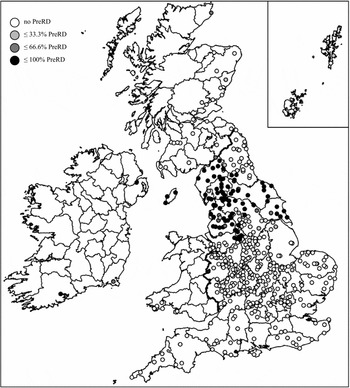
The earliest linguistic account we have of PreRD is found in Ellis (Reference Ellis1869: 1239), as quoted above. In his continuation of this work, On Early English Pronunciation, Ellis (Reference Ellis1889) provides the first large-scale survey of English and Scots dialects, giving us detailed phonetic transcriptions of word lists and short texts in a phonetic alphabet called the ‘Palaeotype’.Footnote 7 Ellis's palaeotype transcriptions give a detailed picture of phonetic variation in traditional dialects in the second half of the nineteenth century, including PreRD in northern English dialects. Dentalisation is recorded for /t/ and /d/ before /r/ and /ər/, symbolised as (ˎt) and (ˎd), but not for /n/ or /l/ (unless they immediately precede (ˎt) and (ˎd)). At some locations in Lancashire and East Yorkshire, fricative and affricate values, (th) and (tth), had developed. The geographical distribution of PreRD in Ellis's data is summarised in figure 1.Footnote 8
The distribution of PreRD in Ellis (Reference Ellis1889)

Outside Ireland and northern England, Ellis records PreRD in the Isle of Man, in Shetland, Caithness and Kincardineshire (but only in a few tokens), in Liddesdale in southern Scotland (just across the border from Cumberland), and in north Cambridgeshire (but only in a few tokens, and Ellis himself casts doubt on the validity of these data, which were provided by an intermediary). In northern England, PreRD is mostly absent from Northumberland (where, perhaps not coincidentally, /r/ was uvular), except for the southwest periphery (where /r/ was coronal), lowland Durham, and the southern half of the (often urban) West Riding of Yorkshire. It is predominant in Cumberland, Westmorland, Lancashire, North and East Yorkshire, the northern half of West Yorkshire, and most of the Peak District areas of Cheshire and Derbyshire. It is also found, at low levels, in north Lincolnshire.
Later dialect studies (other than the SED, which is examined in greater detail below) find PreRD in the same locations: southwest Northumberland (Rydland Reference Rydland1998, data collected 1930s), Cumberland (Brilioth Reference Brilioth1913; Reaney Reference Reaney1927), Westmorland (Hirst Reference Hirst1906; Rydland Reference Rydland1982, data collected early 1970s), Lancashire (Hargreaves Reference Hargreaves1904; Schilling Reference Schilling1906; Rydland Reference Rydland1982; Shorrocks Reference Shorrocks1998, data collected in the 1970s and early 80s), northwest Yorkshire (Hedevind Reference Hedevind1967), and northeast Yorkshire (Cowling Reference Cowling1915; Tidholm Reference Tidholm1979). It is not recorded in south Yorkshire (Wright Reference Wright1892), central Lincolnshire (Oxley Reference Oxley1940), nor in localities more remote from Ellis's PreRD area, but Orton (Reference Orton1933) records some instances in Byers Green in south Durham.
There are two notable exclusions from the analysis so far. Firstly, I have excluded words in which /d/ is preceded by a stressed vowel and followed by /ər/ (/V ˊdər/ words). Secondly, the copious phonetic dialect data in Wright (Reference Wright1905) have not been referred to. The data in Wright (Reference Wright1905) have not been considered thus far for two reasons: (i) much of the data is taken directly from Ellis (Reference Ellis1889), despite the warning in Wright (Reference Wright1892: 174) about the accuracy of Ellis's data; and (ii) Wright's phonetic transcriptions are quite broad, verging on phonemic; as such, dentalisation is not indicated unless it involves, or is interpreted as involving, affrication to [tθ] and [dð] or frication to [θ] and [ð], which is only the case at a minority of locations, as noted above. Thus only a limited picture of the distribution of PreRD in northern England is given even when Wright's data are original. The picture that does emerge is consistent with Ellis (Reference Ellis1889), but with the addition of a single dentalised token of better ([bɛθə(r)]) recorded in south Cheshire, some way beyond the PreRD area identified by Ellis. As noted immediately below, Wright (Reference Wright1905) contains further useful data of a different type for our understanding of PreRD in English dialects.
Words with historical /V ˊdər/ fall into two groups: (i) those which have /ð/ in all, or nearly all, varieties of English, including RP, and which had intervocalic /d/ in Old English (OE); key examples are father < OE fæder, gather < OE gad(e)rian, hither < OE hider, mother < OE mōdor, together < OE tōgædere, and weather < OE weder; and (ii) a group of words which have /ð/ in traditional English dialects, not just in northern English counties but throughout much of Britain and Ulster; these words, which either had OE /(d)d/ or derived from French, may include adder, bladder, consider, fodder, ladder and powder, and, in dialects with early L-vocalisation after short back vowels, words such as shoulder (see Wright Reference Wright1905: 231–2, and the entries for these words in his index, none of which is found in Ellis Reference Ellis1889). It appears, in fact, that there was a general (and early) English rule of pre-R dentalisation which applied to /d/ when preceded by a stressed vowel and followed by /ər/ regardless of its source (Wright Reference Wright1905: 231–2; Luick Reference Luick1964: 1010–12). Although this ‘-dər lenition’ is very similar to PreRD as defined previously, it is not clear that it is the same phenomenon, at least synchronically, since /ð/ is generally restricted to a few words (e.g. fodder and ladder), with [] found otherwise for /d/ in PreRD environments. But it may be historically, and, in order not to get bogged down in a lengthy analysis of this difficult problem, I exclude /V ˊdər/ words (but not words where /d/ is preceded by /n/ or /l/, since these only have dentalisation in PreRD locations) from the analysis in this article. If PreRD and -dər lenition are the same thing historically, this would provide crucial evidence for the history of PreRD generally, but it would require that an explanation be found for their very distinct geographical distributions. I return to this issue in sections 3 and 4 below.
2.1 Pre-R Dentalisation in the SED
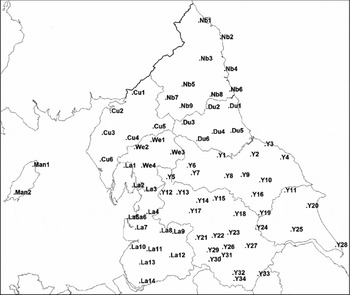
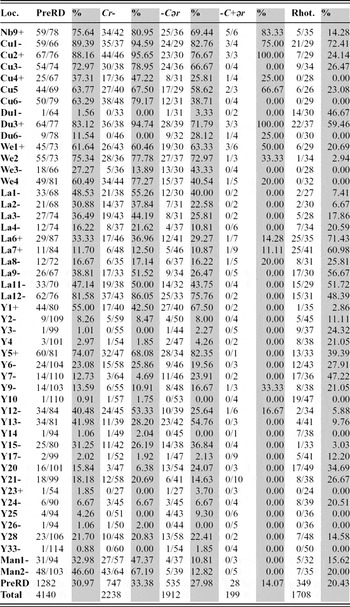
The SED contains a wealth of data, collected in the 1950s, relevant to the study of PreRD in northern England, but previous superficial analyses of the geographical distribution of PreRD in the SED have involved only a few tokens from each location (see Kolb Reference Kolb1966: 368–79, and Orton, Sanderson & Widdowson Reference Orton, Sanderson and Widdowson1978, maps Ph236–9). In the present study, every relevant token at locations with some PreRD (over 4,400 tokens in total, averaging about 90 per location) has been analysed, providing a detailed picture of the distribution and nature of the phenomenon in northern England. Northern English locations in the SED are given in figure 2, and results of the analysis are summarised in table 1, the particulars of which are explained below.Footnote 9
SED northern county locations

Pre-R Dentalisation in the SEDa

aIn the first ‘Locations’ column, + indicates that there is dentalisation in the phrase brought her up (SED question VIII.I.11), − indicates that there is no dentalisation in this phrase, and no symbol means that no data are available for this phrase at the location. See further section 2.3. The PreRD column indicates the degree of PreRD in all environments considered in this article. Cr- and -Cər indicate the amount of PreRD in sequences of those types. -C+ər indicates the amount of PreRD across ‘Class 2’ morpheme boundaries (compounds excluded). Rhot. indicates the amount of rhoticity found in -Cər sequences where PreRD is possible, even if it is not present (the mismatch between these figures and the figures for -Cər is the result of exclusion of cases with linking-r in the Rhot. count).
Before examining the results of this survey, a few words are in order concerning my analysis of the SED data:
• Only locations with some degree of PreRD have been analysed; it is possible that the RRE and rhoticity effects discussed below might be present at some locations without PreRD (e.g. in combination with alveolar stops or dental fricatives).
• Words which are potentially subject to -dər lenition have been excluded from the analysis (but see figure 5), since dentalisation in these cases is a pan-English feature.
• Although an average of 3.4 informants supplied data for each SED location in the northern counties, I have not attempted to distinguish between the contributions made by each informant, since this would dramatically reduce the total number of tokens for each data point. Rather, I have treated the data for each location as being from a single ‘informant’. Note that the variation present at each location is not a result of combining informants with different patterns of behaviour – all individual informants exhibited such variation.
• It is not always clear what constitutes a new token in the SED data, as there is some cross-referencing and repetition between responses to different questions. This is usually indicated in the SED (by listing the relevant question numbers), but I suspect not always. I have treated as a new token every case which isn't so identified, even when there is a suspicion that it is a repetition. The number of such cases is small.
• With reference to the analysis of rhoticity (section 2.4), it is not always clear whether a word final vowel in the SED transcriptions is intended as utterance final, pre-consonantal or pre-vocalic. Although the SED uses [+ V.], [+ C.] to indicate following phonological environment, it is not certain that this usage is consistent, and it is not always clear how these should be interpreted when more than one transcription is listed (especially when the symbol ~ is used to indicate identical transcriptions). Nor is it clear how transcriptions should be interpreted when no such environment is specified but when the SED question indicates that a vowel or consonant follows. In this analysis, I have followed the SED transcriptions, assuming that if no [+ V.] or [+ C.] is indicated then the word was pronounced in isolation (i.e. utterance finally).
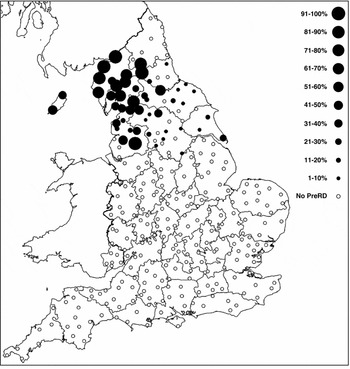
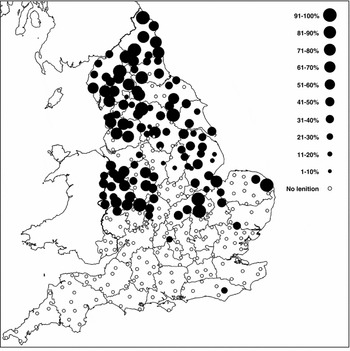
Turning now to PreRD as revealed in the SED data, it is only recorded for /t/ and /d/ in Cr- and -Cər environments, but never for /n/ or /l/. As figure 3 illustrates, it occurred most consistently in southwest Northumberland, western Durham, Cumberland, Westmorland, Lancashire away from the southwest, northwest Yorkshire, and the Isle of Man, with scattered instances found throughout most of Yorkshire. It is characteristically absent in most of Northumberland and in all other counties. In other words, the distribution of PreRD in the SED is similar to that recorded in Ellis (Reference Ellis1889), but it has disappeared from the Peak District and become obsolescent in most of Yorkshire. There appears, in fact, to have been a retreat of the phenomenon into and beyond the Pennines, although traces remain in most of the area identified in Ellis (Reference Ellis1889). The highest levels of PreRD are found in Cumberland where, for example, it occurs in 89.39 per cent and 88.16 per cent of tokens in Cu1 and Cu2 respectively (see table 1 for full details). In many locations in Yorkshire, on the other hand, it is only recorded in a handful, or even one or two, tokens.
PreRD in the SED

The results of PreRD for /t/ and /d/, in both Cr- and -Cər clusters, are typically [] and [], these being the only variants recorded at most locations, and being the majority variants in all locations outside of central Lancashire. Single tokens of [θ] or [θ] in -Cər were recorded in Du6, We1, We2, La1 and Y5, and single tokens of [θ] in Cr- were recorded in La6, Y6 and Y21. Localities in central Lancashire (La8, La9, La11, La12) have a high proportion of tokens with [tθ]/[θ], [θ] and [ð] in both Cr- and -Cər words, a situation which is also reported in Shorrocks (Reference Shorrocks1998: 352–4, 356–7). [θ] in Cr- and -Cər is also a common variant in Man1, as it also is in -Cər words in Y28.
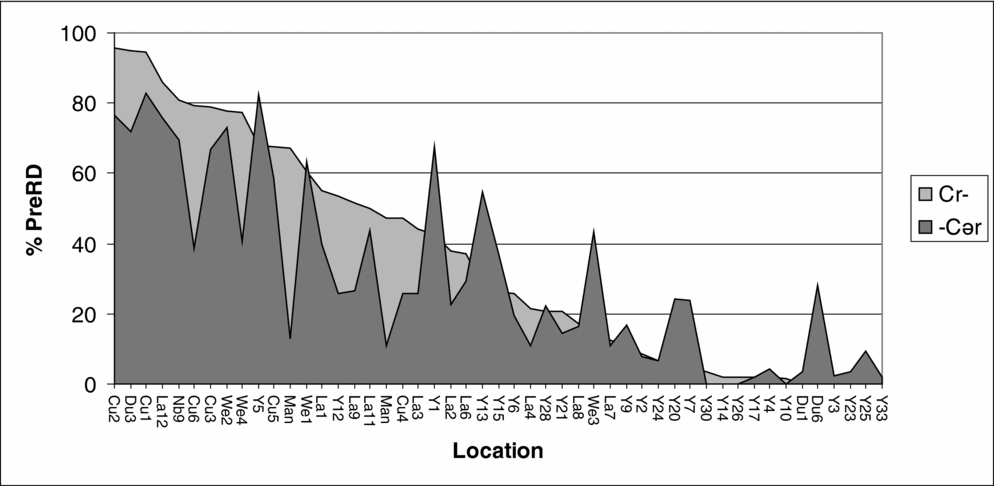
As the distribution of variants indicates, the results of PreRD may be different in Cr- and -Cər environments. This distinction is even more apparent when the proportion of dentalised variants in each environment in the SED data is examined (see table 1 for details). The over-all frequencies of PreRD for localities with some dentalisation is 33.38 per cent (747/2238 tokens) for Cr-, which is significantly higher than for -Cər, at 27.98 per cent (535/1912 tokens).Footnote 10 This difference is illustrated in figure 4, where the percentages of PreRD in the two environments is compared for each location.
The frequency of PreRD in Cr- and -Cər in the SED
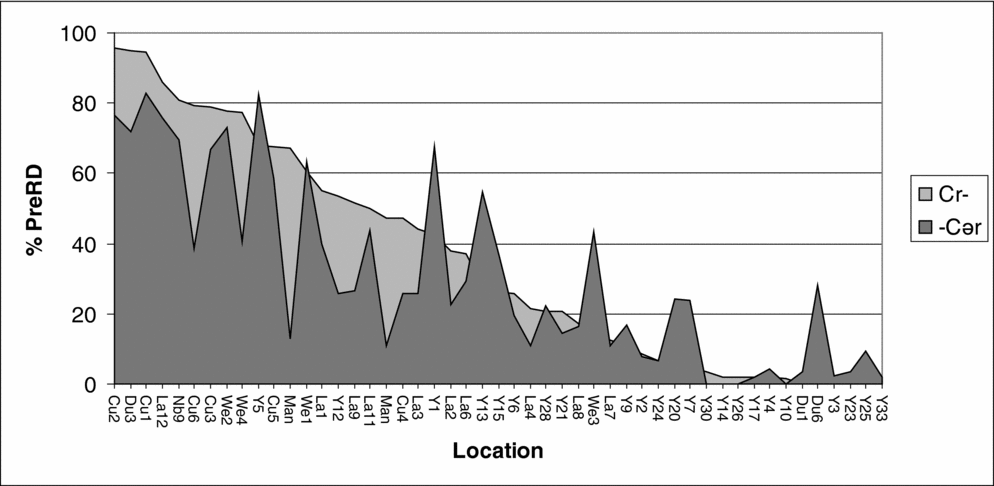
Of the 49 locations with some PreRD, 31 have more dentalisation in Cr- than in -Cər. Seven of those where -Cər is favoured have very low levels of PreRD, but a number of locations (Du6, We3, Y1, Y5, Y13 and Y15) with a reasonably high frequency of PreRD over-all have significantly higher levels of dentalisation in -Cər. The mismatch between levels of dentalisation in Cr- and -Cər environments suggests that, for many localities in northern England, PreRD consists of two overlapping but subtly different patterns, synchronically at least.
Although I have excluded /-V ˊdər/ words from the analysis, it is worth briefly considering the pronunciation of them in the SED separately to show the stark difference between -dər lenition and PreRD otherwise. Figure 5 illustrates the frequency of /ð/ in the words adder (SED question IV.9.4), fodder (III.3.1, III.5.1, III.5.2), ladder (I.7.14), shoulder (VI.6.6)Footnote 11 and udder (III.2.5) in all SED locations.Footnote 12
-dər lenition in the SED

It is obvious that -dər lenition and PreRD were very different phenomena in the mid-twentieth century. As well as being found throughout Northumberland and large parts of the East and West Midlands, -dər lenition was rather uncommon in some locations (e.g. in Cumberland and Durham) where PreRD levels were very high. As noted above, the geographical mismatch is even greater when we take into account the data in Wright (Reference Wright1905), where -dər lenition was recorded in Scotland, Leicestershire, Kent, Dorset, Somerset and Devon (see adder, bladder, consider, fodder, ladder and shoulder in Wright's index). When we add to this the fact that -dər lenition is found in almost all dialects of English and Scots in the words father, gather, hither, mother, together and weather, the difference between the two kinds of pre-R dentalisation is even greater. This suggests either that PreRD and -dər lenition are different phenomena and always have been (despite their close similarity), or that a single pre-R dentalisation split into two distinct patterns in most parts of Britain well before our first phonetic records in the second half of the nineteenth century. I discuss this issue further in sections 3 and 4.
2.2 The R-Realisation effect in northern England
The RRE was found throughout the PreRD area in northern England, although it has not been recorded in all sources or at all locations, and underspecification of the precise articulation of /r/ in many traditional dialect sources means that the picture is obscured somewhat. In Ellis (Reference Ellis1889), Cr- clusters are usually transcribed as (ˎtˎr), (ˎdˎr), and -Cər sequences as (ˎtɐˎr), (ˎdɐˎr) (with Ellis's (ˎ) indicating dental pronunciation and (ɐ) equivalent to [ə]). The precise articulation of /r/ generally is often not very clear in Ellis's data, and his transcription of it in PreRD environments as (ˎr) may simply indicate that there was something different about /r/ in this environment rather than that it was strictly dental.
In fact, the only definitive statement of an RRE in northern England is found in Shorrocks (Reference Shorrocks1998: 390–2). Shorrocks states that, although /r/ is usually pronounced as a retroflex approximant in the Bolton area, tapped and trilled allophones are found intervocalically and immediately after dental consonants (both those corresponding to general English /t/ and /d/, and those corresponding to general English /θ/). Other dialect monographs are silent on the distribution of /r/ pronunciations (although the description in Rydland Reference Rydland1982: 67–8 suggests that the RRE might also have been present in southeast Cumbria).
Despite this, there is ample evidence for the RRE in the SED data. However, this evidence is complicated by what looks like a deliberate transcription policy of not marking tapped [ɾ] except in certain environments. Thus, for example, there is next to no indication in the SED data that tapped pronunciations of /r/ are frequent in intervocalic position in northern England, and taps are almost never recorded after /θ/. It is hard to believe that they did not occur in either of these environments, at least some of the time, in many dialects in northern England and beyond. Tapped and trilled pronunciations are, however, marked for some locations in PreRD environments. Although comparison with other environments is difficult due to these problematic transcription practices, the quantity of tapped and trilled /r/ pronunciations in PreRD environments is striking. When we add to this the fact that some locations (see below) have significantly different frequencies of rhoticity in PreRD environments as opposed to other environments, it is clear that we are dealing with a real RRE.
Evidence for an RRE in the SED data is of three kinds. Firstly, tap [ɾ] or trill [r] may occur in PreRD Cr- clusters but not (or almost never) in other Cr- clusters. This pattern is clearly present in Nb9, Cu4, Cu5, Cu6, We1, We2, We4, La1, La2, La3, La11, Y1, Y5, Y12, Y13 and Y15. The other locations in Cumberland and the two locations in the Isle of Man frequently have taps and/or trills in all Cr- environments. Other locations with PreRD always, or almost always, have [ɹ] in all Cr- clusters. Secondly, a number of locations have [ɾ] or [r] rather than [ɹ] in -Cər PreRD sequences (e.g. butter [bɷəɾ] vs finger [fɪŋəɹ]). Locations which clearly have this pattern are Nb9, Cu5, Du3, We2, Y5, Y10, Y13, Y14, Y16, Y20 and Y28; i.e. it is found throughout the PreRD area in northern England, although only at some locations. This pattern was also consistently recorded at Allenheads (Northumberland) in the 1930s (see Rydland Reference Rydland1998; cf. also Nb9). Thirdly, some locations, particularly in the far north, have a distinct preference for rhoticity, regardless of the exact realistion of /r/, in PreRD -Cər environments compared with other -Cər sequences. This pattern is statistically significant (at the .001 levelFootnote 13) in Nb9, Cu5 and Du3.
2.3 The Morpheme Boundary Constraint in northern England
The only definite statement of the MBC in northern England is also found in Shorrocks (Reference Shorrocks1998). Shorrocks states (Reference Shorrocks1998: 353) that ‘whilst dialect -/(t)θɵ(r)/ corresponds to R.P. -/tə/ (+ historical /r/)’, there are a number of apparent exceptions which are ‘grammatically defined, being the comparative-degree forms of a number of adjectives and adverbs: /ˈliːtɵ(r)/ ‘lighter’; /ˈbriːtɵ(r)/ ‘brighter’; etc.’ (the same is said for /dər/; cf. redder, without dentalisation, 1998: 356). He notes, however, that dentalisation was recorded in sadder, sweeter and faster (as well as better, which is exceptional even in Ireland), so the MBC is not absolute. Shorrocks does not inform us as to whether the MBC holds for agent suffix -er (as in reader, writer).
Otherwise, traditional dialect studies of northern English varieties are silent on the MBC, primarily because most of the data they provide involve monomorphemic words. However, the SED contains a substantial amount of data relevant to the question, and an examination of these gives a rather complex picture of the constraints on PreRD in northern England. Although the number of relevant tokens per location is small, the following general patterns emerge when the data are viewed as a whole:
(i) PreRD in the sequences /t-r/, /d-r/ across compound morpheme boundariesFootnote 14 is almost entirely absent, even in localities with high levels of dentalisation; 2 out of 91 tokens (2.2%) are dentalised (both of them at the same location, Cu3), compared with 747 out of 2238 tokens (33.38%) for /tr/ and /dr/ morpheme internally in all locations (747 out of 1966 tokens, 38.0%, in locations with some degree of PreRD in this environment).Footnote 15 Bermúdez-Otero & McMahon (Reference Bermúdez-Otero, McMahon, Aarts and McMahon2006) suggest that blocking of PreRD in compounds may be a result of prosodic factors rather than the intervening morpheme boundary.
(ii) Several localities seem not to have an MBC otherwise. Thus, for example, Nb9 has no dentalisation in unloader, but does have dentalisation in band-twister, blinders, loader, older and shafter, whilst Du3 has dentalisation in all relevant tokens (blinders, older and rester). Similarly, Cu1, Cu2 and Cu5 have dentalisation in over half of all tokens of the same type. Other localities have lower levels of dentalisation in -C+ər words, and many have no dentalisation in these words at all. Excluding locations with no PreRD in either -Cər or -C+ər words, a strong MBC effect is apparent: of 183 -C+ər tokens, only 28 (15.3%) have dentalisation. This is significantly much lower than the rate of dentalisation in -Cər words without morpheme boundaries (535 out of 1729 tokens, or 30.9%) at the same locations.Footnote 16 Thus, the MBC was a feature of most northern English traditional dialects as recorded in the SED, although it was not absolute.
(iii) Somewhat unexpectedly, PreRD occurs across a word boundary (or, rather, a clitic boundary) in a number of locations in the phrase brought her up (e.g. [bɹɒɷ
 əɹ ɷp]; SED question VIII.1.11), including those which otherwise appear to have an MBC (see table 1). Since this phrase is prosodically like other -C(+)ər words (unlike the compounds in (i)), it appears that PreRD is variably possible across word/clitic boundaries, as it is across morpheme boundaries.
The evidence from the SED and from Shorrocks (Reference Shorrocks1998) reveals that the MBC was indeed a feature of traditional northern English dialects in the middle of the twentieth century. This is so even if we exclude compounds, which particularly disfavour PreRD. But the MBC was not absolute – rather it was a tendency, strong in some locations, absent or weak in others. The small number of relevant tokens per location in the SED makes statement of the precise constraints in any particular dialect difficult to specify, although the account in Shorrocks (Reference Shorrocks1998) suggests that the over-all pattern in northern England may be representative of patterns at the local level.
2.4 Pre-R Dentalisation and (non)-rhoticity in northern England
PreRD appears to depend, as its name suggests, on the presence of a following /r/. This is certainly the case diachronically – PreRD is only attested in words which historically had /(ə)r/ after the consonant affected. There is no record, in the SED or elsewhere, of dentalisation in words such as meadow, Thursday and window, which are pronounced with final [ə] in many traditional varieties. Assuming that PreRD is also a synchronic phenomenon (i.e. that [] and [] are allophones of /t/ and /d/ rather than realisations of separate dental phonemes), and that it only occurs in words which historically had /r/, it might seem to follow that PreRD is dependent on the existence of a following synchronic /r/. This is unproblematic in Cr- cases, where /r/ has not been lost in varieties of English, but how does PreRD interact with loss of rhoticity in -Cər words? This is not an issue for traditional Irish English varieties with PreRD, since they are consistently rhotic, but is certainly an issue when traditional northern English dialects are considered, since many of them are characterised by high levels of non-rhoticity.
Taking only localities with some degree of PreRD in -Cər words into account, which have 30.94 per cent dentalisation over all, it is noteworthy that the level of rhoticity in these words for these locations is 22.50 per cent. In other words, the level of PreRD is significantly higher than the level of rhoticity, so that PreRD is often present in tokens without any surface realisation of /r/ (see, for example, SED question V.5.4 butter, typically [bɷə],Footnote 17 with PreRD and non-rhoticity recorded at Nb9, Cu2, Cu3, Cu6, We1, We2, La1, La3, La8, La11, La12, Y1, Y6, Y15, Y21, Y25 and Y28). But since many of these locations have some degree of rhoticity in -Cər words and other lett er words (see Wells Reference Wells1982: 165–7), it could be argued that the variable presence of rhoticity is sufficient to motivate underlying rhoticity and explain PreRD synchronically.
However, several locations in the SED which have PreRD (to an extent) in -Cər words do not have any rhoticity in these same words. Other than a few localities in Yorkshire with very low levels of PreRD, these are: Cu4 (25.81% PreRD in -Cər words), Cu6 (38.71% PreRD), Du6 (28.12% PreRD), We3 (43.33% PreRD) and We4 (40.54% PreRD). Of these localities, Cu4, Du6 and We3 have no rhoticity whatsoever in lett er words more generally, whilst Cu6 has only a single rhotic lett er token otherwise. We4, on the other hand, has 9.59 per cent rhoticity in lett er words which don't contain a potential PreRD environment. Although the number of localities is small, and although the levels of PreRD in -Cər words at these locations is not as high as in some others, this demonstrates that it is possible for varieties to have PreRD in -Cər words without any surface rhoticity.
3 Discussion
3.1 Pre-R Dentalisation in northern England and Ireland
Pre-R Dentalisation was a feature of traditional northern English dialects up to the middle of the twentieth century at least. Although there was some variation in its exact phonetic realisation, in the degree to which it has been maintained at particular localities, and in the precise linguistic constraints on it, PreRD in northern England is, to all intents and purposes, the same phenomenon as has been reported in Irish English. PreRD in England and Ireland is found in the same phonological environments, is realised in the same or similar ways, it is often accompanied by an R-Realisation Effect (with /r/ realised as a tap or trill), and it is subject to a Morpheme Boundary Constraint (across ‘Class 2’ boundaries at least). There can be no doubt that they are historically connected. So does this allow us to answer the question How did it get into Irish English? posed by Ellis? Perhaps. Ellis's own suggestion was that It is believed to be Celtic. If this were the case, we would have to explain how a feature of Celtic (Gaelic) origin entered English and then became established in traditional, rural northern English dialects by the middle of the nineteenth century, by which time it was, according to the evidence in Ellis (Reference Ellis1889), already an old-fashioned, recessive feature there. Given that it is difficult to identify Irish English influence even in areas of concentrated and relatively recent Irish settlement such as Middlesbrough (Jones & Llamas Reference Jones and Llamas2008) and southwest Scotland (Maguire Reference Maguire and Hickey2012), the chances of just one isolated and linguistically complex feature of Irish English spreading into English varieties in such isolated places as the north Pennines is extremely low, especially given the lack of Irish settlement in these areas. I return to the issue of whether Irish Gaelic played any role in the development of PreRD in Ireland (and elsewhere) below.
The alternative, that the feature originated in English in Britain and was taken, as an original feature of (at least some varieties of) the English language, to Ireland is preferable but not unproblematic, since we must then explain how a feature of traditional northern English dialects was transferred across the Irish Sea and survived the processes of language and dialect contact and new dialect formation in Ireland. The analysis in this article suggests solutions to this problem, however. Firstly, the distribution of PreRD in England was demonstrably wider in the nineteenth century than it was in the middle of the twentieth century, indicating that the feature has been disappearing from English dialects. In the eighty or so years between the fieldwork conducted by Ellis and Wright, on the one hand, and the SED, on the other, PreRD had disappeared from Cheshire, Derbyshire, Lincolnshire and most of Yorkshire, and, if we assume that this was part of an ongoing loss, it is not unreasonable to project that it was found further south in England in the relatively recent past. Secondly, the distribution of PreRD in Scotland is something of an unknown. The fragmentary attestations of it suggest that it might be (or might at one time have been) quite widespread there. Further research is needed on this point, however. Thirdly, the possibility that PreRD and -dər lenition are in origin the same phenomenon (discussed further below) suggests that PreRD was once found throughout most of England and Scotland, since -dər lenition is characteristic of dialects from the southwest of England to the far north of Scotland (and is also a feature, though restricted in scope, of Standard English). All of this means that at the time of the formation of Irish English varieties (essentially in the sixteenth and seventeenth centuries), PreRD may well have been a feature not just of northern English dialects but of dialects of English in the north, in the Midlands and, perhaps, in the south of England too, and could have been a feature of Scots dialects as well. This being the case, PreRD would have been found in a substantial proportion of the input varieties in the formation of Irish Englishes and would, in the terminology of Trudgill (Reference Trudgill2004), have been inevitable in the formation of this colonial English variety.Footnote 18
It might seem that the scenario outlined above leaves no room for an input from Irish Gaelic in the development of PreRD in English in Ireland, but this need not necessarily have been the case. Since Irish Gaelic has a phonemic opposition between dentalised broad coronal consonants and alveolar (or palato-alveolar) slender coronal consonants, speakers of Irish would already have been sensitive to the distinction between dental and non-dental variants in English. In addition, Irish Gaelic has a phonotactic property which gives an effect rather similar to the RRE in English. In Irish, clusters of consonants must all be either broad or slender (Ó Siadhail Reference Ó Siadhail1989: 83), so that /tr/, /dr/, /t´r´/ and /d´r´/ are possible, but combinations such as /t´r/ and /dr´/ are not. The broad and slender clusters are rather different phonetically (e.g. [ˠɾˠ] in trá ‘beach’ and [ ʲɾʲ] in trí ‘three’), and the broad clusters are phonetically very close to the clusters /tr/ and /dr/ in English varieties with PreRD. In other words, an English system with an allophonic opposition between dental and alveolar coronals, and with a constraint whereby dental stops were followed by a tap [ɾ], was closely paralleled by, and compatible with, an Irish Gaelic system with a phonemic opposition between dental and non-dental coronals, and in which dental coronals could only be followed by a non-palatal tap [ɾˠ]. Compatibility between linguistic systems in contact has been identified as an important factor in the survival and reinforcement of particular features (e.g. Harris Reference Harris, Trudgill and Chambers1991; Filppula Reference Filppula1999; Britain Reference Britain2005), and it seems likely that Irish Gaelic reinforced this pattern in Irish English. Ultimately, PreRD in Ireland had, like many features which survive and develop in contact situations, multiple origins and causations (Filppula Reference Filppula1999).
3.2 Phonological implications of Pre-R Dentalisation in northern England
As mentioned above, the present analysis of PreRD in northern England provides further evidence for the importance of strata in phonological theory, since the MBC was found there in many locations. In this section, however, I concentrate on the phonological implications of the interaction of non-rhoticity and PreRD in northern England. As the analysis has shown, the SED reveals that PreRD is possible with low levels of rhoticity at quite a few locations and, even more strikingly, is present at fairly substantial levels in a number of locations which are entirely non-rhotic. For -Cər words in some northern English traditional dialects, it appears that PreRD was, in fact, a case of phonological opacity (Kiparsky Reference Kiparsky and Koutsoudas1976) – a phonological alternation with no surface conditioning. Assuming that they did not have separate dental phonemes (and it would be rather odd to assume that they did, in my opinion, given that they would only occur before /r/ and schwa), what is the synchronic motivation for PreRD in these varieties?
If we want to say that PreRD in Cr- and -Cər environments was one phenomenon (synchronically), which we may or may not want to do depending upon the frequency of dentalisation in each environment (see figure 4), then we are forced to assume that -Cər words have an underlying (synchronic) /r/, and must explain how this can be if the variety is non-rhotic. Even if we don't want to say that PreRD in Cr- and -Cər environments are exactly the same thing, it seems counterintuitive to suggest that two kinds of PreRD have nothing to do with each other, and don't have the same motivation, since both of them give the same results and are typically found in the same varieties. In varieties which are semi-rhotic, it is possible that variation between rhotic and non-rhotic pronunciations of -Cər words in some localities is sufficient to provide motivation for underlying coda /r/. But this can't be the case for localities where there is no rhoticity in -Cər words or in lett er words more generally. Alternatively, the presence of Linking-R (Wells Reference Wells1982: 219; Giegerich Reference Giegerich1999: 167–97), when -Cər words are followed by other words or morphemes beginning in a vowel, may be sufficient to motivate the presence of underlying coda /r/ in these words. But this doesn't account for words, such as Saturday and yesterday, where Linking-R is not possible (because the schwa is never followed by a vowel). If PreRD is possible in these words, this suggests that underlying /r/ is present, even without any possibility of surface /r/.
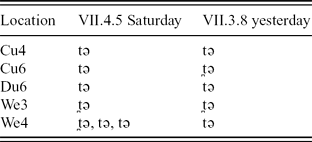
If we examine the pronunciation of the words Saturday and yesterday in non-rhotic PreRD locations in the SED, we find that dentalisation is indeed possible (see table 2).
PreRD in Saturday and yesterday in non-rhotic locations in the SED
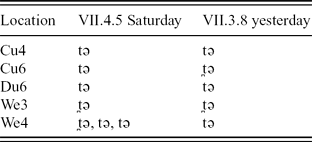
Although PreRD is not found in the majority of tokens, it is present in 33.33 per cent of them. This is almost identical to the rate of PreRD in -Cər words for these same locations (35.30 per cent), although the very small number of tokens involved means that this similarity can only be indicative. Nevertheless, these data reveal that PreRD is possible even where there is no other motivation for underlying /r/. This leaves us in the rather problematic position where the only evidence for underlying /r/ in these cases is PreRD, which in turn is caused by that underlying /r/.
Crucial for our understanding of this problem is the fact that schwa in these cases (and in other -Cər words where Linking-R is possible) acts differently from schwa in words such as paddock, meadow, window, holiday, Monday, Tuesday (also bare-footed, (right-)handed, tasted, which in some locations have schwa rather than /ɪ/). These words also have [ə] after /t/ or /d/ in traditional northern English dialects as recorded in the SED, but they never have dentalisation. And the fact that the words of this type which end in schwa (e.g. meadow, Thursday, window) cannot have PreRD predicts that they also cannot have Intrusive-R (Wells Reference Wells1982: 222–7; Giegerich Reference Giegerich1999: 167–97). Unfortunately, data which would tell us whether this is so or not are lacking in the SED, since most words are given in citation form only. If this is the case, however, then these data provide evidence that it is possible for some non-rhotic varieties to distinguish between words with Linking-R and those without Intrusive-R, suggesting in turn that /r/ is deleted, not inserted in words with (surface) word-final schwa (see Giegerich Reference Giegerich1999: 167–97 for a discussion of the issues; see also Heselwood Reference Heselwood2009). And, in turn, this offers us a solution to the circular problem of predicting underlying /r/ from surface PreRD which is caused by underlying /r/. If Linking-R is possible and Intrusive-R is not, then dentalisation in words such as butter is motivated by underlying /r/, which in turn is motivated by alternations of the type [bʊə] + C or #, and [bʊəɹ] + V. Given this series of dependencies, an association between PreRD and underlying /r/ can be established, even in cases (such as Saturday) where there is never any possibility of /r/ being realised. Since /r/ predicts PreRD, PreRD in turn predicts /r/. This association would not be possible were Intrusive-R to exist in these dialects in words such as meadow, Thursday and window.
4 Conclusions
This article reveals that there is considerable mileage in the analysis of non-standard phonological features as recorded in traditional dialect studies such as the SED. It also demonstrates the value of regional dialects for our understanding of English synchronic and diachronic phonology. It is clear that a further consideration of evidence from Scotland, which should be possible given that Mather & Speitel (Reference Mather and Speitel1986) only represents a part of the data collected for the Scots section of the Linguistic Survey of Scotland, is necessary to help answer many of the questions raised in this article. Furthermore, a detailed analysis of PreRD in Ireland is still to be made, and this is especially important since there are still speakers in Ireland who have PreRD as part of their phonologies. In such circumstances, we would not have to rely on historical phonetic transcriptions, and could access speaker knowledge as well as usage.
A number of factors suggest that PreRD was once much more widespread in Britain. Nineteenth-century studies reveal that it was more widespread than in, for example, the 1950s when the SED was conducted. Its presence across Ireland suggests that it was not just a minority localised feature when Irish English varieties formed in the sixteenth and seventeeth centuries. And the potential equation of PreRD with -dər lenition suggests that PreRD was once found throughout English and Scots varieties (again explaining its presence in Ireland), and would mean that PreRD has been around since the Middle English period at least – Luick (Reference Luick1964: 1010–12) dates -dər lenition to the first half of the fifteenth century, whilst Dobson (Reference Dobson1957: 956) dates it as early as 1400.
If this were the case, how is it that there is no trace of PreRD in England outside the northern counties, even though -dər lenition is found throughout the country and is a feature of Standard English? What caused PreRD and -dər lenition to diverge in this way? The obvious explanation is that dentalisation of intervocalic /d/ (as in father, fodder) resulted in lenition to /ð/ and merger with original /ð/ in words such as brother and feather. Dentalisation of /d/ immediately before /r/ (as in dry) did not, since it remained as [] and the sequence /ðr/ did not exist in English in any case. Likewise, dentalisation of /t/ resulted in [], which did not merge with /θ/. Since -dər lenition involved merger with -ðər, this meant that its loss was difficult, since reversing mergers involves the reintroduction of a phonemic distinction which has been lost (see Labov Reference Labov1994: 311–13 for discussion). Loss of dentalisation of /d/ immediately before /r/ and of /t/ is much easier, however, since dentalisation in these cases is sub-phonemic and no mergers are involved. Loss of rhoticity, whilst not lethal (as we have seen), cannot have helped – note the precarious motivation for PreRD in northern English non-rhotic dialects discussed above. Thus the extra lenition which occurred in words such as father and fodder mean that -dər lenition and PreRD could go their separate ways.
Loss of dentalisation of /t/ and of /d/ immediately before /r/ raises another possibility, however. Throughout this article, I have assumed that diachronically this has been a change from alveolar realisation of /t/ and /d/ to dental realisation, caused by following /r/ (as it is synchronically). But perhaps this is the wrong way round. If dentalisation could be lost, merger with /ð/ aside, might it not have been lost across the board, except before /r/ (and even there in recent centuries in most varieties)? In other words, might we be dealing not with a historical Pre-R Dentalisation but with a historical ‘Non-Pre-R Dedentalisation’? Whichever way we look at it, Pre-R Dentalisation is a fascinating phonetic, phonological, dialectological, contact and historical puzzle about which much more could (and hopefully will) be said.