Introduction
Cochlear implantation is a basic treatment for children with prelingual or progressive severe-to-profound sensorineural hearing loss (SNHL).Reference Svirsky, Teoh and Neuburger1–Reference Gray, Jones and Court3 Children with severe SNHL have shown very good results for speech and language skills after cochlear implantation.Reference Svirsky, Teoh and Neuburger1 Cochlear implantation at an early age enables children with hearing loss to maintain their lives as a normal individual in terms of hearing and speech functions. The age of cochlear implantation surgery has decreased to 12 months in many centres.Reference Dettman, Dowell, Choo, Arnott, Choo and Abrahams4 Moreover, cochlear implantation is performed in some centres in infants under 12 months of age to optimise speech perception, subsequent language acquisition and speech production accuracy.Reference Dettman, Dowell, Choo, Arnott, Choo and Abrahams4
It has been reported that the results of bilateral cochlear implantation related to the understanding of speech in noise, sound localisation and quality of life were better compared with unilateral implantation.Reference Mok, Galvin, Dowell and McKay5–Reference Steffens, Lesinski-Schiedat, Strutz, Aschendorff, Klenzner and Ruhl8 However, there are some concerns about the safety of bilateral implantation, including a more pronounced effect on vestibular function, the potential for bilateral surgical complications, a prolonged anaesthesia time and reduced cost effectiveness.Reference Ramsden, Papsin, Leung, James and Gordon9 It has been shown that simultaneous bilateral cochlear implantation is associated with improved speech and language development and detection of speech in noise.Reference Steffens, Lesinski-Schiedat, Strutz, Aschendorff, Klenzner and Ruhl8,Reference Gordon and Papsin10–Reference Boons, Brokx, Frijns, Peeraer, Philips and Vermeulen14
Bilateral cochlear implantation has been gradually increasing in patients under the age of four years in Turkey because of changes to reimbursement for this procedure by health insurance. In children with bilateral cochlear implantation, the shorter the interval between implants, the better the hearing outcomes and speech recognition.Reference Uecker, Szczepek and Olze15,Reference Hansen, Anthonsen, Stangerup, Jensen, Thomsen and Cayé-Thomasen16 There are two important advantages of simultaneous bilateral cochlear implantations: implantation of the devices within a shorter period of time and bilateral stimulation of the hearing pathways. There is still a debate about whether bilateral cochlear implantation should be performed in consecutive surgical procedures or during the same session. Bilateral cochlear implantation in the same session, especially in young children, has become a widely discussed topic for both physicians and families in recent years. In the literature, there are several reports about bilateral implantation, but the sample sizes in these studies are relatively small.Reference Geers2,Reference Dettman, Dowell, Choo, Arnott, Choo and Abrahams4,Reference Uecker, Szczepek and Olze15
Our study aimed to compare the duration of anaesthesia, surgical complications and hospitalisation time of patients who had bilateral cochlear implantation simultaneously and consecutively.
Materials and methods
This study was carried out retrospectively at the otorhinolaryngology clinics of the Health Sciences University, Izmir Bozyaka Training and Research Hospital, and the Baskent University, İzmir Zübeyde Hanım Research and Application Center. Patients diagnosed with severe-to-profound hearing loss detected by the neonatal screening programme underwent cochlear implantation surgery. Bilateral cochlear implantation was proposed for all patients.
Until 2017, the health insurance system in Turkey paid for only one cochlear implantation. The patients had to pay for the second one themselves. However, with the change in the insurance system after 2017, two cochlear implantations have become affordable. Our recommendation to each patient was in the direction of bilateral simultaneous cochlear implantation. The percentage of patients with bilateral simultaneous cochlear implantation after 2017 increased for this reason. Patients with bilateral cochlear implantation in the same session and bilateral cochlear implantation in consecutive sessions between 2003 and 2019 at the two centres were included.
The same surgeon performed all cochlear implantation operations with the same technique. Temporal bone computed tomography (CT) was performed pre-operatively for all patients and inner- or middle-ear anomalies were not detected in any patients. The patients were divided into two groups of bilateral cochlear implantation in the same session (group 1) and bilateral cochlear implantation in consecutive sessions (group 2). Demographic data, age at the time of the operation, duration of anaesthesia, duration of surgery, pre-operative and post-operative radiological findings, peri-operative and post-operative complications, duration of post-operative hospitalisation, and audiological findings were retrospectively analysed, and the groups were compared. Complications were classified as major and minor according to the classification of Hansen et al.Reference Hansen, Anthonsen, Stangerup, Jensen, Thomsen and Cayé-Thomasen16
The total operation time was defined as the time from the moment the patient was taken to the operating table until the patient left the operating table at the end of the operation. The surgery time was defined as the time from the beginning of general anaesthesia until the end of the operation and included the time taken placing the patient in the proper position needed for the surgery and the time taken for the patient's surgery and dressing.
Data analysis was performed using SPSS® (version 22) statistical software. The Mann–Whitney U test was used to determine whether the distribution between the two groups was different. The Wilcoxon test was used to compare the results between the two groups. The significance level of p < 0.05 was used in all statistical analyses.
Results
Fifty patients with bilateral cochlear implantation in the same session (group 1) and 47 patients with bilateral cochlear implantation in consecutive sessions (group 2) were included in the study. In group 1, 22 patients (44 per cent) were female and 28 (56 per cent) were male. The mean age at the time of surgery was 23.8 months (range, 12–50 months). In group 2, 26 patients (55 per cent) were female and 21 (45 per cent) were male. The mean age at the time of the first operation was 18.9 months (range, 12–42 months), and the mean age at the time of the second operation was 38.1 months (range, 15–59 months; Table 1).
Demographic characteristics of patients with simultaneous bilateral and consecutive bilateral cochlear implantation

When we compared group 1 and the first operation of group 2, neither age nor sex were statistically significantly different (p = 0.16 and p = 0.11, respectively).
In both groups, total operation time and surgery time were documented for each operation. The mean total operation time was 189 minutes (range, 165–241 minutes) in group 1. In group 2, the mean total operation time was 134 minutes for the first surgery and 136 minutes for the second surgery. The total operation time for both surgical procedures in group 2 was 270 minutes (range, 234–301 minutes; Figure 1).
Total operation time of patients with simultaneous bilateral and consecutive bilateral cochlear implantation.

When the total operation time of group 1 and the sum of the total operation time of the first and second surgery of group 2 were compared, the total operation time of group 1 was significantly shorter than that of group 2 (p = 0.001).
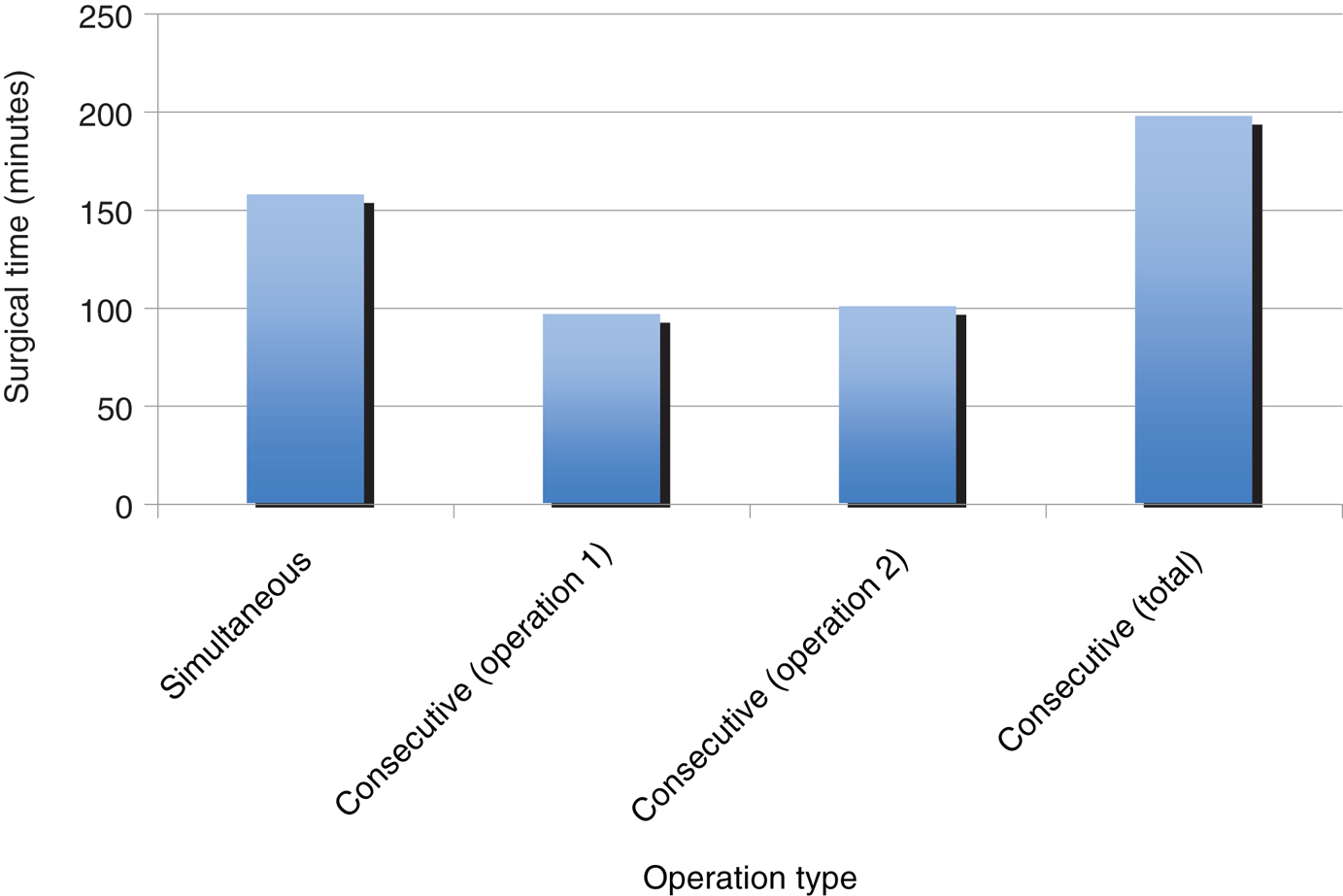
In group 1, the mean surgical time was 79 minutes per ear, and the surgery time for both ears was 158 minutes (range, 121–272 minutes). In group 2, the mean surgery times for the first and second surgical procedures were 97 and 101 minutes, respectively, and the mean surgery time for both implants was 198 minutes (range, 171–224 minutes; Figure 2).
Surgical time of patients with simultaneous bilateral and consecutive bilateral cochlear implantation.

When the surgery time of group 1 and the sum of the surgery times of both operations of group 2 were compared, the duration of bilateral implantation in group 1 was significantly less than that of the cochlear implantation in group 2 (p = 0.01).
The mean post-operative hospitalisation time was 2.4 days (range, 1–7 days) in group 1. In group 2, the mean post-operative hospitalisation times were 3.2 days (range, 1–8 days) and 2.6 days (range, 1–7 days), for the first and second operations, respectively, and a total of 5.8 days (range, 2–11 days) for both operations (Figure 3). Post-operative hospitalisation of the patients in group 1 was significantly shorter than the total post-operative hospitalisation of the sum of both operations of the patients in group 2 (p = 0.01).
Post-operative hospitalisation days of patients with simultaneous bilateral and consecutive bilateral cochlear implantation.

For one patient in group 1, the post-operative temporal bone CT scan showed that the electrode was not in the cochlea, and re-implantation was performed on post-operative day 1 (a major complication). In addition, bronchospasm (a minor complication) was observed in three patients during awakening from general anaesthesia, and bronchodilator nebulisation treatment was applied. The ventilator was not needed, and the bronchospasms were not life threatening. Two patients had bleeding in the implant bed during the operation, which was stopped with a minor intervention (a minor complication). In group 1, in 9 ears (9 per cent) of 8 patients (16 per cent), the round window membrane could not be seen and cochleostomy was performed.
In group 2, in the first operations, a perilymph gusher developed in one patient after cochleostomy. In the second operations, a perilymph gusher developed in another patient after cochleostomy. In another two patients, an external ear canal defect occurred because of burr trauma, which was repaired by tragal cartilage. Two patients had bleeding in the implant bed during surgery, and it was stopped with a minor intervention (a minor complication). In group 2, the round window membrane could not be seen in 8 ears (8.51 per cent) of 6 patients (12.76 per cent) and cochleostomy was performed.
As a summary, group 1 had one major and five minor complications. Group 2 had two major and four minor complications (Table 2). When the two groups were compared in terms of minor and major complication rates, there were no statistically significant differences (p = 0.12 and p = 0.18, respectively).
Complications of patients with simultaneous bilateral and consecutive bilateral cochlear implantation

Discussion
Cochlear implantation performed at an early age leads to better results in speech perception and language development in children.Reference Ramsden, Papsin, Leung, James and Gordon9,Reference Gordon, Valero and Papsin17,Reference Rahne and Plontke18 In particular, sound localisation is significantly better in bilateral implantation than in unilateral implantation.Reference Migirov and Kronenberg19 In hearing-impaired infants, normal binaural hearing can be restored by bilateral cochlear implantation in the same session or in consecutive sessions.
Because of post-operative improvements in basic listening functions such as sound localisation or understanding speech in background noise, most patients and their families have preferred bilateral implantation instead of unilateral implantation in recent years.Reference Migirov and Kronenberg19 Although children with bilateral cochlear implantations have better results in sound localisation and voice perception in noise, hesitation may occur, especially in the patients’ families.Reference Lovett, Kitterick and Hewitt20,Reference Basura, Eapen and Buchman21 Bilateral cochlear implantations are highly advantageous in children because they provide physiological binaural brainstem stimulation.Reference Basura, Eapen and Buchman21 It is important to discuss in detail the advantages and disadvantages of the two implantation procedures (simultaneous and consecutive) before the operation with the parents and individuals who are closely related to the development of the child. After this pre-operative evaluation, discussion of the implantation strategy between the surgeon and the whole team (anaesthesiologist, paediatrician, radiologist, psychologist and audiologist) is necessary for the decision of bilateral implantation.Reference Jöhr, Ho, Wagner and Linder22
The age of cochlear implantation has decreased gradually.Reference Peters, Wyss and Manrique23 In many centres, the lower age of cochlear implantation has been reduced to 12 months, and in some centres, it has even been reduced to under 12 months.Reference Roland, Cosetti, Wang, Immerman and Waltzman24,Reference James and Papsin25 Considering the possible complications of elective surgical procedures in children under four years of age because of the gradually decreasing age of cochlear implantation, it is useful to perform cochlear implantation in institutions with experience in advanced paediatric surgery, anaesthetic and peri-operative care experience. Reference Jöhr, Ho, Wagner and Linder22
Bilateral cochlear implantation can be performed consecutively or simultaneously.Reference Gordon, Valero and Papsin17,Reference Migirov and Kronenberg19 In bilateral cochlear implantation, it is seen that a shorter interval between implants improves hearing outcomes and speech recognition.Reference Steffens, Lesinski-Schiedat, Strutz, Aschendorff, Klenzner and Ruhl8,Reference Kronenberg, Migirov, Taitelbaum-Swead and Hildesheimer26 There are two important advantages of simultaneous bilateral cochlear implantation surgery: implantation of the devices in a shorter period of time and bilateral stimulation of the hearing pathways. However, the long surgery and anaesthesia time and fatigue of the surgical team may cause some concerns in the family and among physicians. Until 2017, the health insurance system in Turkey paid for only one cochlear implantation. The patient's family had to pay for the second one. However, with the change in the insurance system after 2017, bilateral cochlear implantation has become more affordable. Patients who had undergone surgery before 2017 applied for a second cochlear implantation operation after 2017 with the change in reimbursement by the health insurance. That is why, in group 2, the time interval between the first and second operations was so long, at 20 months on average.
In our study, when we compared the cumulative total operation time of the bilateral cochlear implantation in consecutive sessions with the total operation time required for the bilateral cochlear implantation in the same session, we found that the total operation time of bilateral cochlear implantation in the same session was significantly shorter. These findings are supported by the literature.Reference Ramsden, Papsin, Leung, James and Gordon9,Reference Grainger, Jonas and Cochrane27
When we compared these two groups in terms of the duration of hospitalisation, the simultaneous cochlear implantation group had significantly shorter hospitalisation. Although implant costs do not differ between simultaneous and consecutive implantation, a shorter operative time and shorter total hospitalisation make the simultaneous bilateral cochlear implantation economically more advantageous.
Merdad et al. have shown significant cost-effectiveness of simultaneous bilateral cochlear implantation compared with two sequential unilateral cochlear implantations, attributed to the efficient use of surgical time and materials. As healthcare systems become more strained, it is critical that surgeons and implant programmes evaluate their practices to ensure resources are used in the most efficient way possible.Reference Merdad, Wolter, Cushing, Gordon and Papsin28
There were no significant differences between the groups in terms of age or risk factors. Although simultaneous bilateral cochlear implantation may cause concerns in the family and surgical team, we can say that it seems more advantageous, especially in infants, because of the shorter anaesthesia time, shorter surgery time and shorter post-operative hospitalisation time. In addition, there were no statistically significant differences between the two groups in terms of minor and major complications (p = 0.12 and p = 0.18, respectively). Similar to our study, Broomfield et al. showed that there was no evidence of an increased risk of complications following simultaneous bilateral cochlear implantation compared with sequential and unilateral cochlear implantation. This study provides evidence that bilateral paediatric cochlear implantation, either simultaneous or sequential, is a safe procedure.Reference Broomfield, Murphy, Wild, Emmett and O'Donoghue29
In the light of these findings, simultaneous bilateral cochlear implantation seems more advantageous in terms of surgical time, anaesthesia time, post-operative hospitalisation and economics when compared with consecutive bilateral cochlear implantation. No significant difference was observed between the two groups in terms of peri-operative and post-operative complications. In addition, it has been reported in the literature that a delay of more than 12 months between the two procedures in a consecutive procedure leads to worse performance of the second ear.Reference Ramsden, Greenham, O‘Driscoll, Mawman, Proops and Craddock30 This should be considered when planning the second implantation. It can be said that bilateral cochlear implantation in the same session has a positive effect on the quality of life as a result of implantation in a single session by reducing the frequency of hospital admissions and the duration of hospitalisation.
Grainger et al. showed that bilateral simultaneous cochlear implantation in children is safe when performed in a dedicated paediatric facility. In addition, bilateral simultaneous implantation results in a reduction in analgesia and antiemetic requirements when compared with sequential implantation and reduces hospitalisation so that it is comparable with single-side implantation.Reference Grainger, Jonas and Cochrane27
• Bilateral simultaneous cochlear implantation has a significantly shorter operation time than bilateral consecutive cochlear implantation
• The duration of post-operative hospitalisation is shorter for bilateral simultaneous cochlear implantation than for consecutive cochlear implantation
• Cochlear implantation can be safely performed in the same session in the presence of a joint decision by the family and the cochlear implantation team
In our study, there were no anatomic inner- or middle-ear anomalies. We think that, in patients with inner- or middle-ear anomalies, consecutive operations should be preferred because any situation that may prolong the surgery may result in a very long-term operation. Therefore, consecutive, rather than simultaneous, cochlear implantation would be more appropriate for patients with an anatomic anomaly or with risks related to anaesthesia.
Conclusion
If there is no anatomical problem that will prolong the surgical duration and if there is no problem that increases the risk associated with anaesthesia, bilateral cochlear implantation can be safely performed in the same session in the presence of a joint decision by the family and the cochlear implantation team.
Competing interests
None declared