Electoral systems are the architecture within which party systems exist. In democratic polities, the electoral system shapes the number of political parties, their cohesiveness and the characteristics of representative democracy. It is an open question, however, whether electoral systems influence the ideological positioning of political parties. That the question remains unresolved is itself surprising. The expectation that electoral rules influence spatial positioning has existed since Downs first explicitly linked electoral systems to party positioning in an ideological space and argued that majoritarian systems induce centripetal electoral incentives, whereas proportional systems induce centrifugal electoral incentives.Footnote 1 The theoretical literature largely echoes Downs, but it is also replete with studies demonstrating that both majoritarian and proportional systems may or may not encourage median voter behaviour. This might depend on whether the election is contested over one or more ideological dimensions, whether voters weigh ‘valence’ issues in their choice calculus, whether voters abstain if parties are too distant and a myriad of other considerations.Footnote 2
This points to the importance of the empirical literature, which should provide insight as to what is, rather than what might be, given the modelling assumptions. But here, too, the relationship between electoral system and party ideological positioning is uncertain. There are few comparative studies that draw sufficient case variation in party-system spatial dispersion across nations and in electoral-system characteristics to provide definitive conclusions. Schofield’s assessment that ‘there is no empirical evidence for [party] convergence either in the U.S. polity or in those European polities whose electoral systems are based on proportional representation’, combined with Ezrow’s conclusion that there is ‘no evidence that proportional systems promote extreme party positioning’, illustrates that the empirical literature, taken as a whole, reveals no obvious relationship between electoral-system and party-system convergence or divergence.Footnote 3 This is disappointing given the importance of electoral rules in theoretical studies of party positioning and the core importance of party positioning for the quality of democratic representation. In addition, the electoral system is one of the few foundations of electoral democracy that can be ‘engineered’ to achieve particular objectives.
I enter the discussion by comparing the extent of party-system compactness in thirty-one democracies as a function of electoral-system proportionality. Specifically, I seek to determine whether there are systematic patterns in the extent to which a nation’s electoral system induces political parties to cluster near the centre of the political space or instead to disperse widely across it. I do so by estimating the extent of spatial compactness within national party systems and by comparing party-system compactness across nations as a function of the proportionality of their respective electoral systems and in terms of specific electoral-system characteristics, including threshold, district magnitude and the number of competitive parties. Party-system compactness is measured on a uni-dimensional, left–right axis using party placements obtained from individual-level survey responses. The unit of analysis is the country–election, and the data used to construct these measurements are obtained from the Comparative Studies of Electoral Systems (CSES) project.Footnote 4
The analysis illuminates the debate over whether electoral systems influence aggregate party ideological positioning. Most importantly, the large number of cases (by the standards of the literature) facilitates definitive statements about the relationship between electoral system and party dispersion in an electoral space.Footnote 5 Our present understanding is largely based on the findings of single-country studies and a few comparative analyses. These comparative analyses are typically predicated on party positioning in only a few countries, with too little variation in measured party-system compactness and in electoral-system characteristics to confidently infer the relationship between the extent of party spatial dispersion and the characteristics of the electoral systems in which parties exist. This study also assesses which electoral-system characteristics are most closely associated with party positioning and whether the relationship between electoral systems and party positioning is consistent across a wide class of electoral democracies or only in established Western democracies.
These empirics show that party-system extremism (the extent to which a polity’s political parties are clustered near the centre of the political space or widely dispersed) is a function of electoral-system proportionality in the expected direction. Majoritarian and less proportional systems foster compact party systems, while parties in moderate to highly proportional systems are dispersed more widely across the political space. ‘Effective threshold’ is the system characteristic that most clearly influences party-system dispersion, although district magnitude is also influential. The empirical analysis reveals an unexpected finding. Once one controls for electoral-system proportionality, measured party-system extremism decreases in the effective number of political parties. Since Duverger’s Law and Hypothesis tell us that a polity’s electoral system shapes the number of viable political parties, this suggests that electoral system proportionality mitigates the compactness of the political space through the number of political parties. Majoritarian systems support fewer viable parties and, ceteris paribus, these tend to locate closer to the centre of the political space. Proportional systems support more parties, which tend to disperse to all regions of the political space, including the centre.
The next section places this study in the context of related literature. I then discuss the empirical methods, including measurement, variable construction and estimation. With respect to the empirical analysis, it is sufficient for now to note that cross-national analysis of party-system dispersion invites significant measurement questions and studies that compare the effects of electoral institutions on party systems must be sensitive to these considerations in their analyses and interpretation. The fourth section presents the empirical findings. The final section discusses these findings and argues that the conventional theoretical wisdom that party-system dispersion is increasing in electoral-system proportionality is substantiated by observed party positioning across a wide spectrum of electoral democracies.
Background
Do less proportional systems induce centripetal electoral incentives and more proportional systems induce centrifugal electoral incentives? This seemingly straightforward question has no definitive answer. The received theoretical view is attributed to Cox, who argues that, under deterministic spatial voting, parties in majoritarian systems will converge towards the centre of the ideological space and parties in proportional systems will gravitate away from it.Footnote 6 The electoral-system variable that drives centripetal or centrifugal spatial incentives is district magnitude, which is arguably the key characteristic that defines an electoral system as majoritarian or proportional.Footnote 7 Despite this, theoretical studies suggest many circumstances under which these expectations may not hold. For example, majoritarian systems in which political competition takes place over two or more issue dimensions, or in which more than two parties compete, may not produce party location equilibrium of any sort.Footnote 8 Also, if non-policy or ‘trust’ issues are important components of the voter calculus, even parties in multiparty systems may locate near the centre of the voter distribution.Footnote 9 As a general statement, two considerations that appear important in determining whether one expects political parties to pursue convergent or divergent electoral strategies are (1) the number of parties supported in the electoral space and (2) whether voter choice is driven by spatial proximity in the policy or ideological space, or by valence issues and other non-policy considerations.Footnote 10
The empirical literature divides into single-country studies and a relatively few cross-national studies. Most single-country studies seek to determine whether parties or candidates locate at or near their vote-maximizing positions, which may or may not be near the centre of the electoral space.Footnote 11 Parties often appear to locate far from expected vote-maximizing locations, given the electoral system. For example, Poole and Rosenthal find little evidence of electoral convergence by the Democratic and Republican parties in the two-party, single-member district case of the United States. Alvarez, Bowler and Nagler reach a similar conclusion in their study of the archetypal British case. Schofield and Sened’s study of spatial positioning in several established Western democracies reveals little rhyme or reason behind the estimated party configurations in terms of the electoral system or purely spatial voting, as neither majoritarian systems such as Great Britain nor proportional systems such as Israel feature parties located near the centre of the electoral space.Footnote 12
Among cross-national studies, mine elsewhere and that by Ezrow are the most relevant to the present analysis.Footnote 13 I have argued that majoritarian systems foster convergence through the combined effects of restricting the viable electoral space and limiting the number of political parties. This encourages parties to compete over a relatively small portion of the electoral space due to the ‘winner takes all’ nature of majoritarian politics. Proportional systems, in contrast, support more parties and increase the range of the viable political space by rewarding parties with seats for relatively modest vote shares. This suggests that if voter choice is primarily based on spatial proximity and parties are few, less proportional systems will encourage median voter type strategies. If parties are many, then non-convergent spatial strategies will dominate.
I have evaluated this thesis by comparing estimated spatial party locations in two majoritarian (Canada and France) and two proportional (the Netherlands and Israel) systems.Footnote 14 The four-country selection is thin due to limited data availability for the multidimensional scaling method used to estimate party spatial dispersion, but this comparison of electoral systems provides evidence that the average party placements in the majoritarian systems are closer to the median voter than those in the proportional systems. Complementing this analysis, Schofield and Sened also estimate spatial placements in Israeli and Dutch elections.Footnote 15 Although these scholars study different elections and use a different scaling methodology than I did, their estimated maps are remarkably similar to mine, and their conclusions are identical. In both cases, the major parties are located well away from the median voter and could indeed increase vote share by locating closer to the centre of the space.Footnote 16 The Schofield and Sened finding for the majoritarian British case is less definitive. The winning Labour party did locate near the centre of the electoral distribution but the Conservatives did not.
Ezrow continues this line of inquiry by analysing the party ideological positioning of between twelve and fifteen elections contested in eighteen Western democracies.Footnote 17 Using political party placements obtained from citizen perceptions, expert placements and the Party Manifesto Project, he calculates the ideological dispersion of political parties relative to the distribution of voters. The voter placements are determined by citizen responses to the Eurobarometer instrument,Footnote 18 which obtains ideological self-placement. Ezrow’s analysis reveals no relationship between party ideological positions and the proportionality characteristics of electoral systems. While this finding may be plausible given the unsettled state of the theoretical literature, it raises questions and encourages further exploration. At the least, it is at variance with the most widely received theoretical expectations. Still, even though Ezrow’s study is based on a modest number of national elections, it presents the largest number of cases in any cross-national study of this type and ranks among the most definitive.
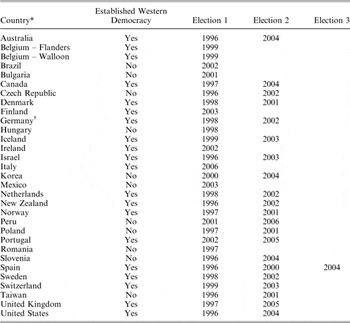
In this study, I further explore the relationship between party ideological positioning and electoral-system proportionality by estimating the extent of party-system compactness in fifty-three distinct elections contested in thirty-one nations between 1996 and 2006. The countries and election years are presented in the Appendix. The objective is to determine if the ideological dispersion of parties relative to voters is a systematic function of the proportionality of the electoral system. To facilitate comparison with Ezrow’s study, I use identical measurements of spatial dispersion and other concepts, and I perform identical or nearly identical statistical tests. The CSES data present two important advantages for studying the relationship between party-system compactness and the proportionality characteristics of electoral systems. First, the estimates of party positions and voter spatial locations – the components of measured party system compactness – are calculated from the same data source. This eliminates problems with the comparability of voter and party placements.Footnote 19 Secondly, since the unit of analysis is the country–election, the CSES presents the largest single source of available cases. These considerations are discussed in greater detail in the subsequent section.
Data and measurement
The empirical question is whether party systems in polities that use more proportional electoral rules display more spatial dispersion than party systems in polities that use less proportional rules. Determining this requires that one obtain comparable measures of party and voter locations in an electoral space across a sufficient number of countries and electoral regimes to make such comparisons meaningful. The CSES data contain the information necessary to construct such measures. Specifically, the CSES studies recover citizen placements of political parties on a left–right political scale and self-placement on the same scale. While the left–right axis is not the only dimension of electoral competition, it is a central organizing system that carries policy meaning for citizens and political elites and around which parties organize and compete in electoral democracies.Footnote 20
With the country–election as the unit of analysis, I begin by calculating party-system extremism, the dependent variable. Party-system extremism captures the extent to which a nation’s party system as a whole displays centrifugal or centripetal tendencies. A less extreme party system is one in which political parties tend to cluster near the centre of the political space, while in a more extreme system parties are more widely dispersed. I sometimes use the term ‘compact’ to describe party systems in the sense that a compact party system is characterized by parties clustered relatively close to the centre of the political space.
While there are several measures of party-system extremism,Footnote 21 I use that which is proposed by Alvarez and Nagler and used by Ezrow.Footnote 22 For each country–election, the distance between each party and the mean voter is calculated; and the sum of these distances is normalized by the underlying voter distribution. It also weights each party by its electoral strength. This means that smaller, sometimes highly ideological, niche parties are counted but do not drive the summary measure of spatial dispersion in the same manner as major parties. My notation is nearly identical to Ezrow’s:

WPEk is the weighted party-system extremism for country–election k;  is the mean citizen perceived location of party j in country-election k;
 is the mean citizen left–right placement on the same ideological scale; σvk is the standard deviation of the citizen placements on this scale; and VSjk is the received vote share for party j in country-election k. In brief, WPEk is the sum of party distances from the mean voter relative to the underlying distribution of voters, and each party’s contribution to the sum is weighted by its vote share. Party-system extremism is bounded below by a value of 0, and lower values of extremism mean that political parties are clustered closer to the centre of the distribution of voters than in polities that return higher values of extremism. As WPEk approaches 0, parties are increasingly located near the ideal point of the median voter.Footnote 23 I also use an unweighted measure of party extremism:

Here, n indexes the number of parties, and the calculation is limited to parties that receive at least 5 percent of the vote.
It is useful to consider what information party system extremism captures. In particular, it is important to understand that WPEk and UPEk 05 measure party system dispersion and not whether any particular party is near or far from the centre of the voter distribution. It is possible that a highly dispersed party system will have one or more parties located near the centre of the voter distribution, while a compact party system may not have any party near the ideal point of the mean voter. An example using UPEk 05 illustrates this. Consider two polities, one majoritarian with two political parties, Am and Bm, and the other proportional with three political parties, Ap, Bp and Cp. Assume that these parties are aligned along a uni-dimensional political axis with the mean voter ideal point located at 0, and a standard deviation of voter ideal points at 4. If the majoritarian parties Am and Bm are located at −1 and +1, respectively, quick calculation shows that compactness, UPEk 05, equals 0.25. If the proportional parties Ap, Bp and Cp are located at −2, 0 and +1.5, respectively, extremism equals 0.29. The majoritarian system is more compact, even though party Bp in the proportional system is at the mean voter ideal point.Footnote 24
Among the independent variables, proportionality is the most important.Footnote 25 Here I use a standard definition:Footnote 26

Dk is polity k’s deviation from proportionality, and Vj and Sj denote the vote and seat shares for party j in lower chamber legislative elections in each country–election. If Dk equals zero, there is no discrepancy between vote and seat share and the electoral system is proportional in outcome. If there are significant differences between Vj and Sj summed across parties, then Dk will have a large value and the electoral system is disproportional. To preserve comparison with Ezrow’s reported figures, I reverse the proportionality scale so that larger values represent more proportional seat vote shares: proportionality Pk = abs(Dk−(D min + D max)).Footnote 27
This definition of proportionality is not synonymous with ‘majoritarian’ and ‘proportional’ electoral rules because it is given in terms of the outcome of the vote–seat translation and not in terms of the electoral formula per se. For example, legislative electoral outcomes in the United States are proportional in that the Democratic and Republican seat shares in the House of Representatives closely approximate their electoral vote shares despite the use of the decidedly non-proportional single-member district, plurality rule, system used to elect members of Congress.Footnote 28 This proportionality in outcome is driven indirectly by the electoral formula, which shapes the number of political parties as well as their vote shares. Still, it is well documented that proportional rules return the most proportional vote–seat shares; measured proportionality in vote–seat shares reflects the underlying mechanics of proportional and majoritarian electoral rules.Footnote 29
It is also important to assess the effect of clearly exogenous electoral-system features, such as threshold and district magnitude, on party-system compactness. While these electoral-system components are conceptually straightforward, measurement can be complicated because many legislatures are elected in multiple tiers. The German Bundestag, for example, is elected in two tiers: half of its 598 elected seats are chosen in single-member districts using the plurality rule, and the remaining seats are elected using party-list proportional representation.Footnote 30
There is no simple method of measuring these electoral system components across a large number of nations having significant differences in electoral systems, seat allocation rules and legislative structure.Footnote 31 For multi-tier legislatures such as the Bundestag, I calculate district magnitude and threshold as the weighted average of these components for each tier; the weights are proportional to the number of seats elected in each tier. This approach has the advantage of simplicity and captures Lijphart’s notion of ‘decisiveness’ in that it weights the relative importance of the tiers in determining the allocation of legislative seats. To illustrate, the district magnitude for the first Bundestag segment is 1, owing to the use of single-member districts, while the average district magnitude for the party list seats is slightly less than 19.Footnote 32 Consequently, I calculate the district magnitude for the 2002 Bundestag election as DM = 0.5*1+0.5*18.7, or 9.85. To preserve comparability across national elections, I measure the threshold using the effective threshold as:

where M is district magnitude.Footnote 33 I again calculate effective threshold as the weighted average of the effective threshold for each legislative tier where the weights are proportional to the number of seats elected in each tier. Continuing with Germany’s example, I follow convention by assigning the single-member districts an effective threshold of 35 per cent and M is the average magnitude of the multi-member districts. Thus,

The legal threshold for the Bundestag is 5 per cent, and therefore the 19.4 figure is close to the average legal threshold, which equals Tlegal_Ger = 0.5*35+0.5*5 = 20. Since the weights for each polity are simply the proportion of seats elected to the lower chamber from each tier, for single-tier legislatures these terms default to the average district magnitude and the effective threshold for the lower chamber of the legislature.
Finally, received theory suggests that increasing the number of parties will increase spatial dispersion. Cox argues that increasing the number of candidates or parties produces increased spatial dispersion under many electoral rules.Footnote 34 Merrill and Adams reach the same conclusion in a probabilistic model of multi-candidate spatial competition that includes partisan affiliation.Footnote 35 In more recent scholarship, Adams and Merrill argue that centrifugal incentives will dominate even in plurality rule systems when major parties are policy seeking and compete in a political space in which a minor centrist party exists, even if that minor party has no chance of winning the election.Footnote 36 Consequently, for some purposes, I also control for the effective number of parliamentary parties (ENP) in each polity. Here, I use the measure originally proposed by Laakso and Taagepera:Footnote 37

using the seat share, Sj, in the lower chamber. The empirical results, however, do not substantively differ if one uses vote share in the denominator.
I calculate all of these measures for fifty-three country–election combinations for elections held in polities graded as ‘free’ by Freedom House in the year in which the election was held.Footnote 38 I then perform comparable analyses on subsets of observations consisting of (1) elections held in established Western democracies, which I define as nations in Western Europe, North America and Oceania, and (2) the most recent elections in each of these established Western democracies. These cases present a greater number of cross-national units than are found in most comparable studies. They provide sufficient variation in party system extremism and proportionality for us to be able to infer with confidence something about the relationship between party-system compactness and proportionality.
Party-system extremism and proportionality
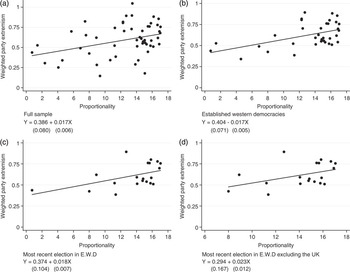
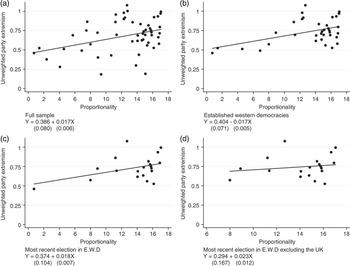
The study’s primary findings are captured by Figures 1 and 2. The four panels of each figure graph party-system extremism as a function of proportionality. The vertical axis is party-system extremism; smaller values indicate a less spatially dispersed party system. The horizontal axis is proportionality (Pk); larger values indicate a more proportional vote–seat correspondence. Each panel captures a progressively more restrictive sample, moving from the full set of CSES cases, to only established Western democracies, to the most recent elections in the established Western democracies, and finally narrowing to the most recent elections in established Western democracies with the extreme case of the United Kingdom removed.
Weighted party-system extremism and proportionality

Unweighted party-system extremism and proportionality

Regardless of whether one uses weighted or unweighted compactness and regardless of the sample, the figures illustrate that the relationship between party-system compactness and electoral-system proportionality works in the expected direction. The labelled observations in Panel C of each figure show that majoritarian systems such as Australia, Canada and the United Kingdom produce both highly disproportional vote–seat shares and greater party concentration near the centre of the political space. The overall relationship, however, does not depend on the inclusion of these nations in the sample. Even absent these countries, more proportional electoral systems produce more dispersed party systems and vice versa. The Panel D plot, for example, which excludes the extreme case of the United Kingdom, maintains a robust relationship between party-system compactness and proportionality.Footnote 39
I also graphed the bivariate relationships between weighted party-system compactness and threshold, and between compactness and district magnitude (to conserve space, these plots are not presented). Unlike proportionality, which is measured in terms of electoral system outcome, threshold and district magnitude capture the direct effect of electoral system on party-system compactness. These characteristics are certainly intertwined; high district magnitude is coupled with low threshold and vice versa. Threshold and district magnitude also largely define majoritarian and proportional electoral systems. Proportional systems, by definition, require multi-member electoral districts and generally combine large district magnitude and low electoral threshold. Majoritarian systems, in contrast, are generally predicated on the limiting case of single-member districts with a correspondingly high threshold.
The relationship between threshold and party-system extremism is strong. Regardless of the sample, as threshold increases, the party system becomes more compact.Footnote 40 The single-member district systems, which are assigned a threshold of 35 per cent, present the most extreme cases; yet, even after removing these cases, the political space becomes more compact as the threshold increases. The relationship between party-system compactness and district magnitude is in the expected direction, but it is noticeably weaker than the threshold effect. Since increased values of party system compactness denote less centralized party systems, it is expected that as district magnitude increases, so will the value of party-system compactness. This is evident, although the relationship progressively weakens as the sample is reduced to Western democracies. It is weaker still in the sample consisting of the most recent elections in the established Western democracies.Footnote 41
To be thorough, I also plotted (but do not display) the relationship between party-system dispersion and ENP, along with the relationship between ENP and disproportionality, effective threshold and district magnitude. There is no bivariate relationship between party-system dispersion and ENP; the fitted line is flat. Plotting the effective number of parties as a function of electoral system characteristics shows that ENP increases in district magnitude and decreases in effective threshold. Taken as a whole, these data confirm that Duverger incentives shape the number of parties in the expected manner, but that there is no direct relationship between ENP and party-system compactness. This will prove important in understanding and interpreting subsequent analysis in which party system dispersion is modelled as a function of electoral system and ENP.
To assess the relationship between party system extremism and electoral system precisely, I separately regress party-system extremism on proportionality, then on threshold, and finally on district magnitude. I also regress party-system dispersion on all these variables simultaneously. I control for ENP even though there is no bivariate relationship between party-system extremism and ENP in the samples. This is because the number of political parties may affect party-system dispersion within polities with similar proportionality profiles. Each of these regressions is presented in Tables 1 to 4, and each is estimated using the full set of CSES cases, only Western democracies and only the most recent elections in the Western democracies.
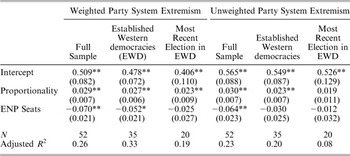
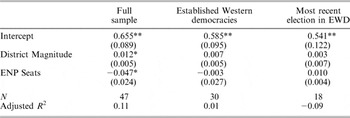
Table 1 presents the regression of party-system extremism on proportionality, controlling for ENP. A unit increase in proportionality increases measured party-system dispersion by about 0.02 to 0.03, depending on the sample. This effect is always in the expected direction and statistically significant regardless of the sample. It is also substantively significant given the observed ranges of compactness and proportionality. A 10-unit change in proportionality, say from the level of proportionality associated with Canada, Australia and Ireland to values associated with nations with more proportional vote–seat shares such as Switzerland, Sweden and Denmark, increases the overall dispersion of the party system by about a third even after accounting for the number of political parties in each nation. One intriguing finding in the regression is the negative coefficient for the ENP; once one controls for proportionality, polities with more parties have more compact political spaces. While the statistical significance of the ENP coefficient varies across samples and models, the finding is robust and merits further discussion below.
Party System Extremism and Electoral System Proportionality

Note: Standard errors in parentheses.
*p < 0.05; **p < 0.01.
Tables 2 and 3, respectively, display the coefficients for party-system compactness regressed on threshold and district magnitude. Both explanatory variables have the anticipated effect: the party system becomes more compact as the threshold rises and the district magnitude decreases. The threshold effect, however, is much stronger. The coefficient for this variable is statistically significant in all three samples, and the adjusted R-squares are respectable. The statistical effect for district magnitude is weak in the full sample and non-existent in the two smaller samples. The discrepancy between threshold and district magnitude is curious because the two are so closely linked – effective threshold is defined in terms of district magnitude – but nonetheless exists.
Party-System Extremism and Threshold

Note: Standard errors in parentheses.
*p < 0.05; **p < 0.01.
Party-System Extremism and District Magnitude

Note: Standard errors in parentheses.
*p < 0.05; **p < 0.01.
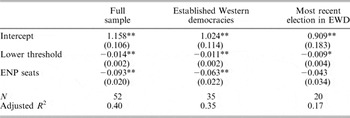
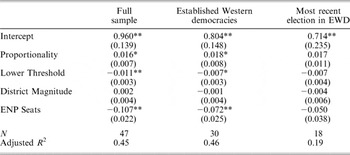
Table 4 presents the final regression of compactness on the four explanatory variables used in the previous regressions. In all of the regressions, the coefficient signs are in the expected direction; however, as the previous regressions suggest, threshold is the key electoral system variable that shapes party-system compactness. Removing disproportionality from these regressions does not change the basic finding that electoral systems with higher thresholds have more compact party systems than those with lower thresholds, even when accounting for district magnitude and the number of political parties. District magnitude again has no independent effect on the spatial dispersion of political parties. The sample consisting of only the most recent elections in Western democracies is too small for the explanatory variables to show statistically significant effects, but the two larger samples do return the expected relationships and respectable summary measures of fit.
Electoral System Characteristics and Party-System Compactness

Note: Standard errors in parentheses.
*p < 0.05; **p < 0.01.
Returning to the question of the negative ENP coefficient, why might it be that among polities with similar proportionality profiles, those with more parties have more compact party systems? Three possibilities are likely. First, this may be an artefact of compressing party location in multiparty systems to a single axis. Multiparty systems, almost by definition, exist in multiple issue dimensions,Footnote 42 and such compression might disproportionally affect those polities with more parties, all else being equal. The central importance of the left–right axis to electoral politics, however, suggests that there is not enough distortion in the relative party positions when these are collapsed to a single axis to account for this finding. Secondly, holding the number of parties constant, parties with larger vote shares may be closer to the centre of the political space. This would be a promising explanation if the finding only exists for weighted party extremism, but it exists for unweighted extremism as well. Thirdly, among nations likely to produce coalition governments, some parties may locate near the centre of the political space to increase their likelihood of being included in the government.Footnote 43
I assess this explanation by first replicating Table 1 for those national elections in which no single party secured a majority of legislative seats. For all regressions, both the size and statistical significance of the ENP coefficient increased significantly despite the smaller sample size.Footnote 44 The anomalous ENP finding is clearly more pronounced for national elections that do not produce majority-party governments. In further considering the twenty-seven elections in Western democracies that produced coalition governments, several patterns emerge from the data.Footnote 45 First, the party with the largest seat share is almost always in the government. While this party is not always closest to the mean voter, one of the two closest parties to the mean voter is in the governing coalition 80 per cent of the time. More important for understanding the ENP coefficient is that, compared with parties with similar vote shares located farther from the centre of the space, small, moderate parties – those relatively close to the mean voter and with vote shares ranging from about 8 to 13 per cent – are disproportionally included in governing coalitions. For example, among parties that rank third in total vote share, about 40 per cent are included in post-election coalitions, and the average distance of these parties to the mean voter ideal point is about half that of parties with comparable votes shares that are not in government.Footnote 46 The same pattern exists for fourth-ranked parties. Only six of these parties are in post-election coalitions, but these six are about half again as close to the mean voter as those fourth-ranked parties not in government.Footnote 47 These findings are consistent with received coalition theory: size and location matter, and smaller parties in particular are more likely to gain admission to the government if they are moderate.Footnote 48 This helps explain the negative ENP coefficient because it shows that among polities with comparable proportionality profiles, those with more parties and, therefore, those nations more likely to govern through coalitions provide incentives for smaller parties to locate near the centre of the political space if their objective is to be part of the government.
Discussion
What do the empirics reveal about the relationship between electoral-system proportionality and party-system ideological convergence or divergence? First and foremost, proportionality fosters party-system divergence, while disproportional electoral systems foster more compact party systems. Party systems in highly proportional electoral systems are significantly less compact than those in less proportional, especially majoritarian, systems. This pattern is evident in the bivariate plots of party-system compactness against vote–seat shares and threshold and is maintained regardless of weighted or unweighted measures of party-system extremism. Likewise, the pattern is maintained in the three samples consisting of the full set of CSES cases, only Western democracies, and only the most recent elections in Western democracies.
Why does this finding differ from Ezrow’s? Since my variables and estimation approaches are identical to his, any differences are in changes in party politics during the periods captured in each study or in the data and measurements. Recall that Ezrow’s sample of twelve West European nations draws from elections contested between 1987 and 1990.Footnote 49 I study elections contested between 1996 and 2006 in Western Europe and beyond. We share nine common nations and no common elections.
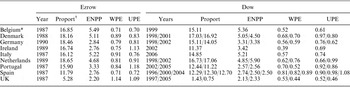
The independent variables, proportionality and ENP, do not depend on data source and are easily measured from observed party vote and seat shares. Table 5 presents our respective values for these variables as well as for weighted and unweighted party-system extremism. Despite the decade or more that separates the elections in the two studies, there are not enough differences in proportionality and the effective number of parliamentary parties to explain the discrepancies in our respective findings. The studies’ differences must result from the dependent variables, unweighted and weighted party-system extremism. Since these are a function of the left–right locations of parties relative to each other and the voters and, in the case of WPE, their respective vote shares, exploring this question is straightforward.
Dow and Ezrow Comparable Cases

*Dow’s figures in this row are the average of those for Belgium Flanders and Belgium Walloon.
†To preserve comparison with Ezrow’s reported figures, the proportionality scale is reversed so that larger values represent more proportional seat vote shares. Specifically,  . Proportionality for country-election k is Pk = abs(Dk−(D min + D max)).
This is indeed where the differences lie. For the nine common nations, UPE and WPE bear little relationship across studies. Furthermore, the party systems become more compact across time. This is seen in unweighted extremism, where the only exceptions are Denmark (1998 election), the Netherlands (2002 election) and Spain, but it is especially pronounced in weighted party extremism. Here, all nations except Spain display more compact party systems by the late 1990s. There are also noticeable differences in the ordinal rankings of national party-system compactness. For example, in the late 1980s, the UK and Irish party systems are among the least compact; by the late 1990s, these are among the most compact. Conversely, between the 1980s and 1990s, Spain’s party system evolved from relatively compact to one of the most dispersed. Do these changes result from real differences in the party systems, or are they owing to measurement and data considerations? The evidence shows that these changes are real. Citizens perceived changes in party left–right positions in many nations between the Cold War’s end and the contemporary era that produced more compact party systems. In addition, the extent of party-system dispersion or extremism more closely corresponds to electoral-system proportionality in the expected manner. Still, data and measurement considerations also contribute to discrepancies in the studies’ respective findings.
The majoritarian United Kingdom and proportional Denmark illustrate how changing political times and, to a lesser extent, differences in data and measurement, contribute to differences in our measures of UPE and WPE. The United Kingdom’s political parties in the late 1980s were dispersed fairly widely in the political space. Labour, for example, is decidedly not new and still embraces the industrial nationalization Clause IV of its manifesto. This is reflected in the Eurobarometer survey, which returns left–right locations of Labour, SDP-Lib Alliance and Conservatives at 3.3, 4.7 and 8.2, respectively, on a ten-point left–right scale.Footnote 50 The corresponding 2005 CSES locations for these parties are 4.7, 4.4 and 6.7 on an eleven-point scale.Footnote 51 Graphs of the party positions relative to the distribution of voters capture the considerable party moderation across time.Footnote 52 The Danish example displays a similar pattern. In 1989, the five leading parties are aligned along the left–right axis from approximately 2.68 to 8.85, or from about the 10th to the 90th percentiles of the voter distribution. By the 2002 parliamentary elections, citizens locate the most left-leaning major party, the Social Democrats, at about 4.4, and the rightmost People’s Party at about 8.1. While this difference covers a large percentage of the voter distribution, the party system remains significantly more compact than it was in the previous decade.
Beyond party left–right locations, changes in relative party vote shares also affect the values of weighted party extremism. For example, in 1987 the Conservatives received a 42.2 per cent plurality, followed by Labour at 30.8 per cent and the Liberals at 22.6 per cent. In 1997, Labour governed with a 43.2 per cent vote share, while the Conservatives and Liberals obtained 30.7 and 16.8 per cent, respectively. Even if party left–right locations remained unchanged, weighted party extremism would differ across the studies simply because of differences in the party vote shares. In this case, however, the ideological moderation of Labour, combined with its increased vote share, produces a significantly smaller value for WPE.
Finally, there are important differences in how the data used to construct relative party and voter placements are obtained in the two studies. Specifically, the Eurobarometer does not generally obtain concurrent party and voter placements in the 1980s. Voter placements are obtained in several surveys between 1987 and 1990, but only the 1987 study recovers party placements. This means that in only four of Ezrow’s twelve observations are the party and voter locations determined in the same year. For example, the United Kingdom party placements are for the 1989 general election, creating a two-year gap between the party and voter placements. While voter distributions are fairly stable from year to year, they are not fixed. The more time that passes between solicitation of party and voter left–right locations, the more likely these two measures will be incomparable. In the CSES data, all voter and party placements are concurrent. How much this accounts for differences in our respective findings is unknown. Given the number of countries and political parties, it is easy to speculate that a two-year gap between party and voter locations leaves ample time for measurable changes in relative party and voter locations, potentially compromising measurement validity.
Beyond this, the relationship between electoral system and party system compactness is subtle and complex, and its study is influenced by the methods employed and the cases analysed. Ezrow’s null findings, for example, are based on careful methods and a variety of measurement strategies, but on a relatively small sample of cases.Footnote 53 Beyond sample size, inferences about proportionality and party-system compactness are also heavily influenced by case selection. As Geddes argues, the cases one selects determine the answers one gets.Footnote 54 There is no relationship between proportionality and party-system compactness among cases where the vote–seat translation is highly to moderately proportional. The relationship is quite strong, however, if cases include nations with relatively disproportional vote–seat translations. One might argue that the most disproportional electoral systems – Great Britain, Canada and Australia – use electoral systems that are so distinct from those found among the world’s electoral democracies that these should be excluded from study. Yet, not only does the expected relationship exist regardless of the inclusion or exclusion of these nations in the sample, but also these cases are precisely the most informative to the question we ask: In principle, do disproportional electoral systems produce more compact party systems than proportional electoral systems? By properly including these cases, the answer to this question is a resounding ‘Yes’.
Appendix
See Table A1
Countries and Elections

Notes: CSES universe limited to countries identified as ‘free’ in Freedom House, Freedom in the World, 1972–2006 country ratings.
*The data coding rules code as missing values any nation that did not conduct legislative elections, or for which the CSES data do not obtain the necessary information to code party-system compactness, disproportionality, or the effective number of legislative parties. For example, France is not included in the analysis because, although included in the CSES data, the French presidential elections did not return data to construct measures of proportionality or several explanatory variables. In addition, I coded calculated values of party system compactness greater than 1.2 as a missing value. This eliminated the 2005 Chilean election, which returned an outlying value greater than 3. I also eliminated countries that returned values disproportionality greater than 18 (Hong Kong 1998, Hungary 2002, Romania 2004, Philippines 2004 and Mexico 2000), because these values are significant outliers and are unreliable. None of these cases would be included in the analyses of elections in Western democracies. I also coded the effective number of legislative parties greater than 10 as missing values. These coding rules removed relatively few outliers from the dataset. These rules, combined with the requirement that elections be free and fair as assessed by Freedom House, leave the 53 CSES cases representing the 31 nations presented in this table.
†2002 CSES German Telephone Survey.