Introduction
Bees of the tribe Anthidiini (Hymenoptera: Megachilidae) can be distinguished from other megachilids in Asia by the short stigma and usually the presence of conspicuous yellow or red integumental markings (Michener Reference Michener2007; Kumar et al. Reference Kumar, Griswold and Belavadi2017). Anthidiine bees occur almost worldwide, except in Antarctica and Australia (except for one introduced species), in many different habitats. The nests are constructed by the females in rocks, stems, pre-existing burrows and cavities, and on exposed surfaces. Materials like resin, pebbles, soil particles, leaf pieces, plant hairs, and other fibres are used in the construction of nests (Michener Reference Michener2007). Hence, Anthidiini bees are commonly known as ‘resin and carder bees’. The floral associations of anthidiines of the Indo-Malayan region have been provided by Niu et al. (Reference Niu, Ascher, Luo, Griswold and Zhu2016, Reference Niu, Ascher, Griswold and Zhu2019a, Reference Niu, Ascher, Orr, Griswold and Zhu2019b, Reference Niu, Yuan, Ascher, Kasparek, Orr, Griswold and Zhu2020a, Reference Niu, Yuan and Zhu2020b), Soh et al. (Reference Soh, Soh, Chui and Ascher2016), and Kumar et al. (Reference Kumar, Griswold and Belavadi2017). Pasteels (Reference Pasteels1969, Reference Pasteels1972) and Michener and Griswold (Reference Michener and Griswold1994) pioneered taxonomic studies of Anthidiini bees and provided a taxonomic revision of Old World species. Litman et al. (Reference Litman, Griswold and Danforth2016) reviewed the systematics of the tribe in a phylogenetic context.
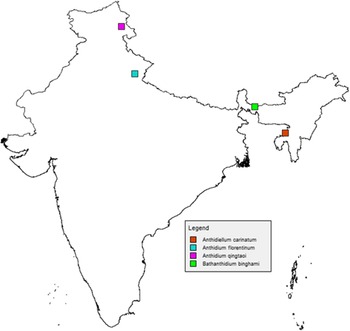
The tribe Anthidiini currently consists of 894 known species belonging to 40 genera worldwide (Ascher and Pickering Reference Ascher and Pickering2021). The known Indian fauna includes 46 species in the following 13 genera: Acedanthidium (1), Anthidiellum (5), Eoanthidium (5), Euaspis (4), Icteranthidium (2), Pachyanthidium (2), Stelis (2), Trachusa (2), Trachusoides (1), Anthidium (13), Anthidium_sensu_lato (2), Indanthidium (1), and Pseudoanthidium (6; Gupta Reference Gupta1993; Kasparek Reference Kasparek2017; Kumar et al. Reference Kumar, Griswold and Belavadi2017; Ascher and Pickering Reference Ascher and Pickering2021). In this study, four Anthidiini species, including one new genus, are added to the Indian fauna (Fig. 1). Floral associations and distribution status for the studied species are also discussed in the broader context of the Indo-Malayan region.
Map showing the distribution of the new species of anthidiine bees reported to India.

Materials and methods
The bee specimens of the tribe Anthidiini included in this study were sorted out from the Hymenoptera collection at the National Zoological Collection (NZC), Zoological Survey of India, Kolkata, West Bengal, India. All bees were collected with sweep nets. Specimens were examined using a Nikon SMZ25 stereo zoom microscope (Nikon, Minato City, Tokyo, Japan). Digital photographs were obtained using a Nikon DS-Ri2 camera (Nikon) attached to the stereo zoom microscope and processed with the NIS-Elements BR Analysis, version 5.20.00 (Nikon). Voucher specimens were deposited with their appropriate registration numbers at the NZC. The distribution map was prepared using the software programme DIVA-GIS 7.5 (available from https://www.diva-gis.org/ [accessed 6 May 2021]). The morphological terminology used in the diagnoses follows Michener (Reference Michener2007).
Results
Family Megachilidae
Subfamily Megachilinae
Tribe Anthidiini
1. Anthidium (Anthidium) florentinum (Fabricius, 1775)
(Fig. 2)
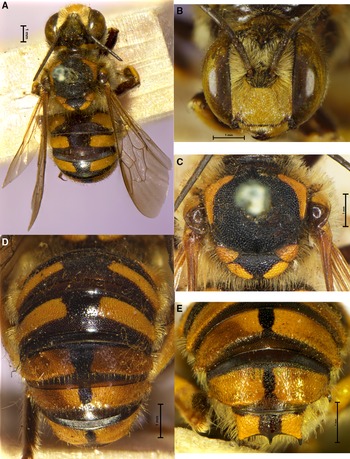
Anthidium florentinum ♂: A, habitus, dorsal view; B, head, frontal view; C, mesosoma, dorsal view; D, metasoma, dorsal view; and E, tergites T5–T7 showing lateral spines. Scale bars measure 1 mm.

Apis florentina Fabricius (Reference Fabricius1775): 384, ♂.
Diagnosis. Male. Length 12 mm (Fig. 2A). Mandible tri-dentate, yellow, with dark brown teeth; clypeus yellow; yellow maculation on paraocular region almost reaching middle of the eye (Fig. 2B); vertex with lateral yellow maculation. Tegula with yellow spot anteriorly; boomerang-shaped maculation on scutum anterolaterally (Fig. 2C); wings subhyaline; arolia absent. Hind femur with ventral tooth near the base. Maculation on all terga interrupted medially, with the interruptions gradually decreasing towards T6; lateral margins on T2–T4 slightly protuberant, with sparse tufts of white pubescence (Fig. 2D); lateral spine of T5 yellow and T6 brown; T7 spiniform with three acute apical spines (Fig. 2E); S6 with median apical margin truncately produced.
Material examined. 1 ♂, India, Uttarakhand, Nainital, 29.3807° N, 79.4692° E, sweeping net, vi.1898 (NZC Regn.: 26023/H3).
Floral association. Astragalus sp. (Fabaceae), Chamaenerion angustifolium (Onagraceae), Hedysarum mongolicum (Leguminosae), Helianthus annuus (Asteraceae) (Wu Reference Wu2006), and Apocynum venetum (Apocynaceae) (Niu et al. Reference Niu, Yuan, Ascher, Kasparek, Orr, Griswold and Zhu2020a).
Distribution in Asia. India (new record), China, Pakistan, Afghanistan (Ascher and Pickering Reference Ascher and Pickering2021).
2. Anthidium ( Proanthidium ) qingtaoi Niu and Zhu, 2020
(Fig. 3)
Anthidium qingtaoi ♀: A, habitus, dorsal view; B, head, frontal view; C, antenna; D, scutellum showing lateral spines; E, metasoma, dorsal view; and F, tergites T5–T7. Scale bars measure 1 mm.

Anthidium (Proanthidium) qingtaoi Niu and Zhu 2020: 59, ♀, ♂.
Diagnosis: Female. Length 8.5 mm (Fig. 3A). Head broader than long; clypeus yellow with two elongated brown spots, apical margin smooth, slightly emarginated medially; mandibles with 10 teeth, upper three teeth and apical sharp and large, six small teeth present between the apical and third large tooth (Fig. 3B); lower paraocular area maculated; F1 twice as long as broad, F2, F3, and F4 with reddish colouration on dorsal surface (Fig. 3C); vertex with narrow yellow band interrupted medially. Omaular carina absent; pronotal lobe lamellate; outer part of tegulae and anterior part of pronotal lobe with yellow maculation; scutellum with small triangular tooth posterolaterally and with a narrow yellow band on posterior margin interrupted medially (Fig. 3D) overhanging metanotum and propodeum; axillae black; arolia absent; the femora, tibiae, tarsi with outer surface yellowish and inner reddish brown. Yellow bands on T1–T3 interrupted medially, T4–T6 with uninterrupted bands (Fig. 3E); median V-shaped black area present on T4 and T5 directed forwards and on T6 inverted (Fig. 3F).
Materials examined. 1 ♀, India, Ladakh, Chumathang (13694 ft), 33.3593° N, 78.3369° E, sweeping net, 11.ix.2008, B. Mitra (NZC Regn.: 26024/H3).
Floral association. Melilotus officinalis (Fabaceae) (Niu et al. Reference Niu, Yuan, Ascher, Kasparek, Orr, Griswold and Zhu2020a).
Distribution in Asia. India (new record), China (Xizang) (Niu et al. Reference Niu, Yuan, Ascher, Kasparek, Orr, Griswold and Zhu2020a).
Comments. The examined specimens were mostly similar to the original description of Anthidium qingtaoi (Niu et al. Reference Niu, Yuan, Ascher, Kasparek, Orr, Griswold and Zhu2020a), but mandibles had 10 instead of nine teeth, and F2, F3, and F4 had reddish colouration anteriorly instead of only F3. These two features are more similar to A. kashgarense as described by Niu et al. (Reference Niu, Yuan, Ascher, Kasparek, Orr, Griswold and Zhu2020a).
Anthidium qingtaoi is morphologically similar to A. kashgarense, but it can be distinguished from the latter species by its pale yellow integumental markings, a genal area completely black without yellow marking, its vertex with a narrow yellow band sometimes interrupted medially, black axillae, presence of a black spot on clypeus, yellow band on scutellum narrow and sometimes interrupted, and yellow bands on T4–T6 uninterrupted or narrowly interrupted. (Anthidium kashgarense has chrome yellow integumental markings, lower part of gena with yellow marking, vertex with a broad and uninterrupted yellow band, yellow axillae, clypeus yellow without black spot, yellow band on scutellum broad and uninterrupted, and yellow bands on T4–T6 widely interrupted.)
3. Anthidiellum ( Pycnanthidium ) carinatum (Wu, 1962)
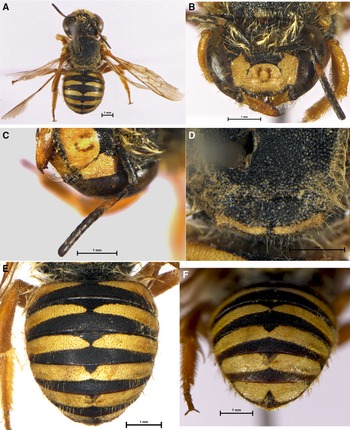
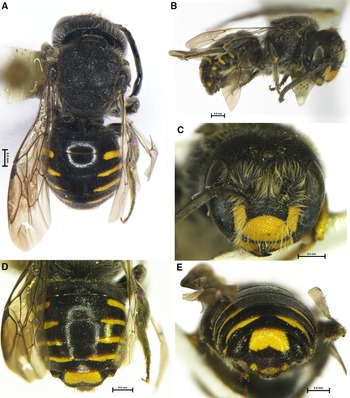
Anthidiellum carinatum ♀: A, habitus, dorsal view; B, habitus, lateral view; C, head, frontal view; D, hind tibia and basitarsus showing longitudinal carina; and E, metasoma, dorsal view. Scale bars measure 0.5 mm.

Anthidiellum carinatum ♂: A, habitus, dorsal view; B, habitus, lateral view; C, head, frontal view; D, hind tibia and basitarsus showing longitudinal carina; and E, metasoma, dorsal view. Scale bars measure 0.5 mm.

Paraanthidium carinatum Wu (Reference Wu1962): 165, ♀, ♂.
Diagnosis. Female. Length 5.6 mm (Fig. 4A, B). Mandible with three teeth; clypeus yellow, lower margin with four small tubercles, punctures on clypeus fine and densely arranged; supraclypeal area with lateral maculation (Fig. 4C); maculation on paraocular area extending up to the middle of the eye, a yellow spot below frontal ocellus. Pronotal lobe with maculation anterior to the tegula; scutum with yellow maculation on anterior margin, broadly interrupted medially; hind tibia and basitarsus with longitudinal carina on the outer surface (Fig. 4D); hind basitarsus black; arolia present. T1 with maculations on lateral edges, T2 immaculate, T3 with yellow bands contiguous, T4–T6 with uninterrupted yellow bands (Fig. 4E).
Male. Length 4.5 mm (Fig. 5A, B). Same as female, but tubercles on clypeal margin more prominent, supra clypeal maculation U-shaped (Fig. 5C), yellow small spot anterior to frontal ocellus; hind basitarsus yellow (Fig. 5D); T7 completely yellow (Fig. 5E) and S5 with brown comb.
Materials examined. 1 ♀, 1 ♂, India, Tripura, Dharmanagar, 24.3890° N, 92.1092° E, sweeping net, 03.vi.1978, A. Issar (NZC Regn.: 26025/H3, 26026/H3).
Floral association. No record.
Distribution in Asia. India (new record), China (Hainan, Yunnan) (Wu Reference Wu1962).
4. Bathanthidium ( Manthidium ) binghami (Friese, 1901)
(Fig. 6)
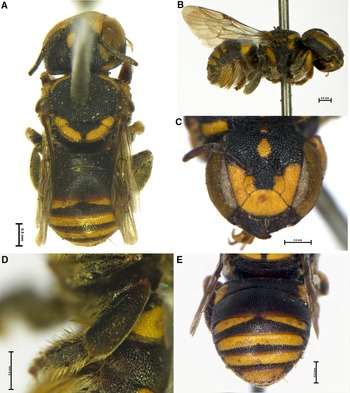
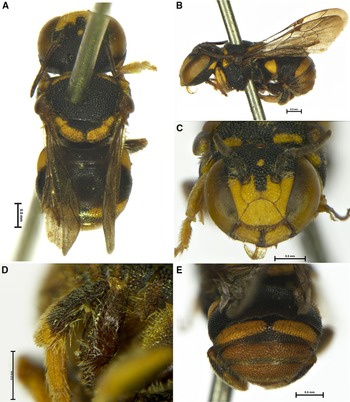
Bathanthidium binghami ♂: A, habitus, dorsal view; B, habitus, lateral view; C, head, frontal view; D, metasoma, dorsal view; and E, tergites T5–T7. Scale bars measure 0.5 mm.

Anthidium fraternum Bingham (Reference Bingham1897) (nec. Pérez 1895): 495, ♀.
Diagnosis. Male. Length 5.8 mm (Fig. 6A, B). Mandible tridentate, yellow, but teeth and margins dark brown; clypeus entirely maculated; maculation on paraocular area extending up to below of antennal socket (Fig. 6C); vertex and pre-occipital area immaculate. Mesosoma black; the anterior surface of fore-tibia and basitarsus with yellow maculation; apex of the middle tibia with yellow spot; arolia present; wings fuscohyaline, becoming darker along marginal cell. T1 immaculate, maculation on T2–T5 interrupted medially (Fig. 6D), T6 with large maculation (Fig. 6E).
Materials examined. 1 ♂, India, West Bengal, Buxa Tiger Reserve, 22 miles, East Damanpur, 26.6177° N, 89.5605° E, sweeping net, 27.iii.2019, A. Rameshkumar (NZC Regn.: 26027/H3).
Floral association. No record.
Distribution in Asia. India (new record), Burma (Bingham Reference Bingham1897), Thailand (Friese Reference Friese1925), Laos (Pasteels Reference Pasteels1969), China (Wu Reference Wu1962).
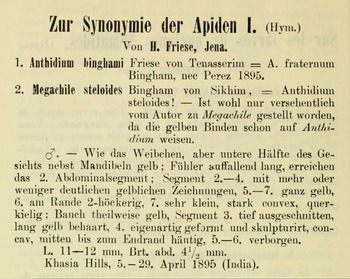
Comments. The distribution of the genus Bathanthidium and its species in India was erroneously cited by Michener (Reference Michener2000, Reference Michener2007) and was subsequently followed by Gupta (Reference Gupta2003) in ‘An annotated catalogue of the bee species of the Indian region’ and also by Niu et al. (Reference Niu, Ascher, Griswold and Zhu2019a). The error was also highlighted by Soh et al. (Reference Soh, Soh, Chui and Ascher2016). This first wrong Indian record was probably based on a misinterpretation of the habitat of Megachile steloides and of Anthidium binghami (Friese Reference Friese1901; Fig. 7). Hence, we believe that our report of Bathanthidium binghami represents the first confirmed record from India.
Clipping from Friese (Reference Friese1901, p. 224) showing the distribution of Anthidium binghami.

Discussion
With the addition of the four species reported here, the tribe Anthidiini currently has 14 genera and 50 species reported for India. Compared to other tribes of Megachilidae, Anthidiini is fairly rich at the generic level, even though species diversity within the genera is low. Bathanthidium is the fifth genus represented by a single species in India, together with Acedanthidium, Trachusa, Trachusoides, and Indanthidium. It is therefore evident that the anthidiine fauna of India is understudied and needs further attention.
Acknowledgements
The authors thank the Director, Zoological Survey of India, Kolkata, West Bengal, India, for providing facilities and the Council of Scientific and Industrial Research (CSIR) for providing financial assistance for conducting research as a part of NET-JRF fellowship programme.