Improvements in medical treatments have led to an increased survival in patients with CHD, with over 90% of patients reaching adulthood nowadays.Reference van der Linde, Konings and Slager 1 , Reference Brickner, Hillis and Lange 2 In 1990, the Erasmus Medical Center started a cohort study in order to investigate the long-term outcome after surgery for CHD during childhood (<15 years), including all consecutive patients operated between 1968 and 1980. The following five major cardiac diagnostic groups were included: atrial septal defect, ventricular septal defect, pulmonary stenosis, tetralogy of Fallot, and transposition of the great arteries (all Mustard). This study is the first, worldwide, to perform a third (30–43 year) follow-up of the same cohort of patients, now aged between 30 and 56 years.
The first (1990) and the second follow-ups (2001) of this cohort showed elevated levels of psychopathology and psychosocial problems in childhood, adolescence, and young adulthood.Reference Utens, Verhulst and Erdman 3 , Reference van Rijen, Utens and Roos-Hesselink 4 Other researchers also reported psychopathological problems and problems regarding subjective (physical) health status in (young) adult patients with CHD, underlining the necessity for continuing surveillance.Reference Kovacs, Sears and Saidi 5 – Reference Marino, Lipkin and Newburger 7
Based on these previous outcomes, problems in psychosocial functioning could be expected and might even get worse, as patients now have to face the challenges of a new life phase – middle adulthood – which can be accompanied by physical and cardiac deterioration.
Unfortunately, most of the previous studies are cross-sectional or hampered by shorter follow-up periods. Limited knowledge is available concerning longitudinal pathways of psychopathology from childhood through young adulthood to later adulthood and regarding the subjective health status of this first generation of patients reaching middle adulthood.
This study offers the unique possibility to assess developmental pathways of psychopathology in a cohort of CHD adults over a period of 30 years, as assessments were carried out using parallel instruments. Moreover, risk factors for long-term psychopathology can be identified. The aims of this study are as follows:
-
∙ To determine the longitudinal development of psychopathology over a 30-year period, after at least 10, 20, and 30 years of follow-up, in patients who underwent surgery for CHD during childhood. To compare the psychopathological problems and subjective health status of this cohort at the 30- to 43-year follow-up with normative groups and also between different cardiac diagnostic groups.
-
∙ To identify medical variables that predict the longitudinal changes in psychopathology over time.
Materials and methods
Inclusion criteria and patient sample
All consecutive patients who underwent their first open heart surgery between 1968 and 1980 at the Erasmus Medical Center, and who were younger than 15 years of age at the time of surgery, were included in this study. Patients belonged to one of the following five cardiac diagnostic groups: atrial septal defect, ventricular septal defect, pulmonary stenosis, tetralogy of Fallot, or transposition of the great arteries. The two previous follow-ups took place in 1990 and 2001 (details were described previouslyReference Utens, Verhulst and Erdman 3 , Reference Utens, Verhulst and Meijboom 8 – Reference Roos-Hesselink, Meijboom and Spitaels 12 ).
In order to make a longitudinal comparison, we invited all the 422 patients who had participated in the second follow-up in 2001, all the patients had reached adulthood at that time. Of these patients, 10 had died, and the causes for death were as follows: six cardiac-related, two unknown, one accident, and one after undergoing heart transplantation; 29 patients were untraceable. Of the remaining 383 eligible patients, 131 refused to participate in this study due to practical reasons such as work, distance to the hospital, etc., resulting in 252 participating patients with a response rate of 66%. There was no difference in responders (n=252) versus non-responders (n=131+29=160) with regard to age (p=0.866), gender (p=0.192), severity of CHD (p=0.086), or ventricular function (p=0.605). Differences were found on exercise testing (p<0.0001, in favour of responders, 48.6% missing data in the non-responder group) and use of medications (p=0.033 in favour of responders, 27.2% missing data in the non-responder group).
Of the 252 patients, 152 had completed measurements at all three time points (psychopathology).
Patient sample
Conforming to the classification of the American Heart Association Task Force on Adults with CHD, patients were classified into two groups of disease severity: simple CHD – encompassing atrial septal defect, ventricular septal defect, and pulmonary stenosis – and moderate/complex CHD – encompassing tetralogy of Fallot or transposition of the great arteries (Mustard).Reference Warnes, Williams and Bashore 13
Assessment procedure
The local institutional ethical committee approved the research protocol a priori, which conforms to the ethical guidelines of the 1975 Declaration of Helsinki. All patients signed the informed consent before participating. In the outpatient clinic, a cardiologist performed the cardiac and medical examination, and the patients completed psychosocial questionnaires. Owing to practical reasons such as work, children, etc., 18 patients completed the psychosocial questionnaires at home.
Instruments and normative groups
Questionnaires covered the specific age range of the cohort at all three follow-ups.
For psychopathology, proxy reports were completed by parents or spouses, regarding the patients. In 1990, 2001, and 2011, we used the following questionnaires as proxy reports: Child Behavior Checklist, the Young Adult Behavior Checklist, and Adult Behavior Checklist, respectively.Reference Achenbach 14 – Reference Achenbach 16
The self-reports, containing parallel items, were the Youth Self-Report, the Young Adult Self-Report, and the Adult Self-Report, respectively.Reference Achenbach and Rescorla 17 On all questionnaires, a total problem score, an internalising score (anxiety/depression, somatic complaints), and externalising score (reflecting conflict with others) can be calculated. Higher scores indicate more problems. For questionnaires used in 1990 and 2001, Dutch normative data were available; however, in 2011, the United States of America normative data – specified by age and gender – had to be used, because no Dutch normative data were available for the age range of the patient sample.
Subjective quality of life was assessed by the Short Form-36.Reference Ware and Sherbourne 18 Physical functioning was excluded to avoid re-publishing of data. The Dutch SF-36 version was validated by Aaronson et alReference Aaronson, Muller and Cohen 30 . The psychometric properties of the Dutch versions are good, and adequate normative data are available. The Short Form-36 was complete at follow-ups in 2001 and 2011 (n=252).
Statistical analyses
Continuous data are represented by mean±standard deviation, and categorical variables are represented by percentages. In case of a skewed distribution – significant Kolmgorov–Smirnov test – medians and interquantile ranges (Q1–Q3) are displayed. The comparison between questionnaires – that is, Adult Self-Report, Adult Behavior Checklist, and Short Form-36 – and normative data was analysed using means±standard deviation, according to the manuals. Effect sizes were calculated.Reference Cohen 19 Percentages of patients scoring in the psychopathological range compared with normative data were compared using Binomial testing. To test the difference between CHD diagnostic groups, t-tests or Mann–Whitney-U tests were utilised.
When comparing categorical variables between CHD diagnostic groups, the χ2 or the Fisher exact test was used, where appropriate. Longitudinal comparison of categorical variables was computed by the McNemar test for 2×2-paired tables and the Stuart–Maxwell test for ⩾3×3-paired tables.Reference Maxwell 20 The repeated measurements analysis of variance and multiple analysis of variance tests were used to assess differences between the three time points.
Prediction analysis
As all the patients were adults in 2001, the course of psychopathology at adulthood could be determined by comparing the outcomes on questionnaires between 2001 and 2011 using the same 88 items. By using the same 88 items in both 2001 and 2011, the data sets in our analyses were directly comparable over time. To identify the predictive value of medical variables on the course of psychopathology, changes in outcomes between 2001 and 2011 on these 88 items were used. The time point 1990 was excluded from these analyses, as patients who were children then completed incomparable (children’s) items. In all three follow-ups, the same medical variables were used.
A three-phase strategy was followed for each of the seven “clusters” – combination – of medical variables, see Table 1. In phase 1, each of the separate prediction variables (univariate) was entered in a linear regression model, corrected for age and gender. This was carried out to explore the predictive quality of each predictor separately. In phase 2, each “cluster” – combination of predictors – was related to the Adult Self-Report and Adult Behavior Checklist outcomes (multivariate analysis), corrected for age and gender. The following clusters of medical variables were used: medical history, first open-heart surgery and direct post-operative course, medical course before 1990, between 1990 and 2001 and between 2001 and 2011, and present medical status. As these phase 2 analyses served as a first broad selection of predictors, a backward elimination procedure was used (p-values set to 0.20). The final model in phase 3 contained all significant variables from phase 2 analyses (p-values⩽0.05, backward elimination). Variables with significant results in this final phase 3 model were regarded as final predictors of Adult Self-Report and Adult Behavior Checklist outcomes.
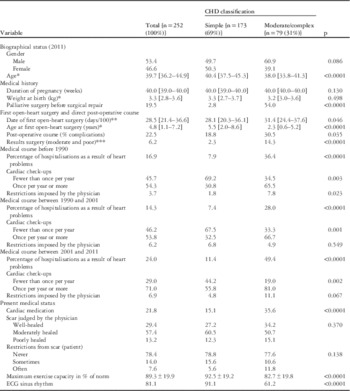
Patient characteristics in 1990, 2001, and 2011.

* Data are presented as medians (Q1–Q3)
** “Date first open heart surgery” shows the number of days/100 that elapsed since the first patient of this cohort underwent open-heart surgery
*** As judged by an experienced cardiologist
For the two outcomes – Adult Self-Report Total and Adult Behavior Checklist Externalising – phase 3 analyses could not be performed because there was only one significant variable in the final model.
Unless otherwise specified (phase 2 regression model), two-tailed probability values of <0.05 were considered statistically significant. The statistical and graphical packages IBM SPSS Statistics for Mac, Version 20.0 (2011), R for Mac (64 bit, version 2.14.2), and GraphPad Prism version 6.0a for Mac (2012) were used.
Results
Patient characteristics – assessed in 1990, 2001, and 2011
Table 1 shows that patients with simple CHD were significantly older at the time of follow-up 2011 (p<0.0001) and at the time of their first operation (p<0.0001), had fewer complications (p=0.035) and less often moderate/poor (p<0.0001) results after the first operation, had fewer hospitalisations during the last 2 decades (p<0.0001), less often used cardiac medication (p<0.0001), and had better present exercise capacity (p<0.0001).
Longitudinal development of psychopathology over 30 years
Mauchly’s test indicated that the assumption of sphericity had been violated (χ2(5)=25.06, p<0.0001); therefore multivariate tests are reported (ε=0.87).
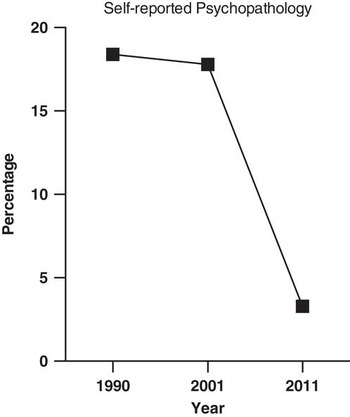
Figure 1 shows that the percentages of patients scoring in the psychopathological range – compared with normative data at each specific time point – decreased significantly over time, V=0.76, F(2, 150)=237.81, p<0.0001, effect size (ω2 overall)=0.4 (Fig 1).
Percentages of CHD patients scoring in the psychopathological range. 1990=first follow-up in 1990; 2001=second follow-up in 2001; 2011=third follow-up in 2011. p-value is calculated with a multiple analysis of variance test. For 1990 and 2001: The cut-offs indicating clinical psychopathology were based on the 90th percentiles of the cumulative frequency distribution of total problems scores form Dutch normative groups. For 2011, the 90th percentiles were derived from the official manual (90th percentiles), as Dutch normative data were not available for same-aged categories.Reference Achenbach and Rescorla 17

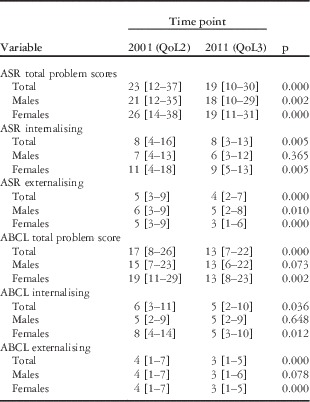
Within the CHD sample, results between 2001 to 2011 showed a significant decline in mean scores on the same 88 items on total problems, internalising, and externalising items, both on self-reports and on proxy reports (Table 2).
Mean scores in 2001 and 2011 on 88 overlapping items.

ABCL=Adult Behavior Checklist; ASR=Adult Self-Report
Comparison between CHD and normative data of the follow-up in 2011 (Table 3)
Psychopathology
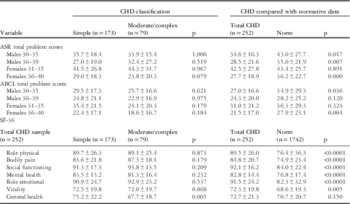
On the Adult Self-Report self-report, men aged 30–35 and 36–39 obtained significantly lower total problem scores compared with normative data. Women aged 36–40 showed fewer psychopathological problems on the Adult Self-Report total problem score and externalising scale (not shown in the table).
Mean problem scores on the Adult Self-Report, Adult Behavior Checklist, and Short Form-36 at the 30- to 43-year follow-up in 2011.

ABCL=Adult Behavior Checklist; ASR=Adult Self-Report; SF-36=Short Form-36
SF-36 expressed in means±standard deviation according to published normative data.Reference Aaronson, Muller and Cohen 30 Normative data for the ASR and the ABCL were derived from the manual.Reference Achenbach and Rescorla 17 Significant differences between the total CHD group and published normative data, using one-sample t-tests. Differences between diagnostic groups on the ASR, ABCL, and SF-36 were analysed by Mann–Whitney-U tests
Cohen’s D indicated a small effect size for both the ASR and the ABCL, for all male and female sub-groupsReference Cohen 19
According to proxy reports (Adult Behavior Checklist), men aged 30–35 and women aged 36–40 showed fewer psychopathological problems on the total problem score and externalising scale compared with normative data.
Subjective health status
On all Short Form-36 scales patients reported fewer problems compared with normative data, except on general health, which was comparable with normative data.
Comparison between CHD diagnostic groups
Regarding psychopathology (Adult Self-Report/Adult Behavior Checklist), only one difference was found: on the Adult Self-Report self-report, women aged between 36 and 40 years with simple CHD remarkably reported more internalising problems such as anxiety and depression compared with older women with moderate/complex CHD (data not shown in the table).
On the Short Form-36, patients with moderate/complex CHD reported worse general health compared with patients who had simple CHD (p=0.005).
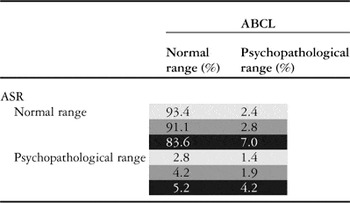
Discrepancy between informants in 2011 (Table 4)
No significant differences were found on total problem scores (p=1.000), internalising (p=0.607), or externalising (p=0.557) scores between patient reports and proxy reports (total score, p=1.000; internalising score, p=0.607; and externalising score, p=0.557).
Discrepancies between patients’ (Adult Self-Report) and their proxy’s (Adult Behavior Checklist) ratings in 2011.

ABCL=Adult Behavior Checklist; ASR=Adult Self-Report
Light grey=total score (p=1.000); dark grey=internalising problems (p=0.607); black=externalising problems (p=0.557)
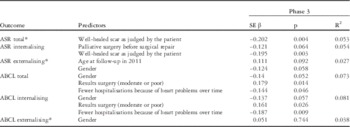
Prediction of changes in psychopathology over time – Adult Self-Report and Adult Behavior Checklist, 2001–2011
Phase 3: the final model (Table 5)
A well-healed scar as judged by the patient was associated with a decrease in psychopathology (2001–2011) on the Adult Self-Report total problem and internalising scores (phase 2 analysis). Patients who had poor-to-moderate surgical results showed an increase over the last decade in total problem and internalising scores, as reported by significant others (Adult Behavior Checklist). Fewer hospitalisations were associated with a decrease over time in problems on the Adult Behavior Checklist total and internalising scales.
Final model; prediction of changes from 2001 to 2011 on psychopathology outcomes on Adult Self-Report and Adult Behavior Checklist (proxy-report).

ABCL=Adult Behavior Checklist; ASR=Adult Self-Report
All separate predictor variables are listed in Table 1. Standardised coefficients βs are presented
* For these outcomes, results from phase 2 analysis are presented (see description in ‘Statistical analyses’ section)
Discussion
Over a 30-year period, the level of psychopathology in CHD adults decreased significantly. At the 30-year follow-up, the mean overall problem scores were comparable or even better compared with normative data. No differences were found in the self-report and proxy report of psychopathology between the cardiac diagnostic groups. Medical variables that predicted changes in psychopathology from the 20- to 30-year follow-ups were: the scar as judged by the patient, the results of the initial cardiac surgery, and the number of hospitalisations over time.
Longitudinal changes in psychopathology over 10, 20, and 30 years
This study showed that the percentages of patients scoring in the psychopathological range decreased over time, being most prominent during childhood/adolescence, then normalising during adulthood, and even reaching significantly lower levels of psychopathology during later adulthood. This decrease has been hypothesised before.Reference van Rijen, Utens and Roos-Hesselink 4
A possible explanation might be the normalising of biographical characteristics. Having reached middle adulthood, our patients appear to have caught up from a previous delay in gaining autonomy. Most patients were now living independently, had formed families, and had stable careers.Reference van Rijen, Utens and Roos-Hesselink 9 , Reference Opić, Roos-Hesselink and Cuypers 21 , Reference Zomer, Vaartjes and Uiterwaal 22 This normalisation may have contributed to decreased levels of psychopathology.
Another explanation is response shift; patients may have different values and internal standards after life-threatening experiences – for example, cardiac surgery/hospitalisations – when compared with healthy peers.Reference Moons 23
A relative increase in psychopathology in normative groups when getting older could also be an explanation. Older age might lead to physical complaints; however, the repeated measurement analyses within the CHD sample (overlapping items) also clearly showed a significant decrease in psychopathology. Moreover, previous analyses show that the emotional functioning (Dutch Personality Questionnaire) of this sample was significantly better compared with normative data.Reference Opić, Roos-Hesselink and Cuypers 21 We believe that these findings clearly demonstrate that decrease of psychopathology is not just an artefact of change in normative groups but a significant pattern, indicated by different informants (patients/proxy’s) and different instruments. CHD patients are accustomed to coping with physical limitations, which appears to be protective for their mental health in this life phase.
Psychopathology and subjective health status compared with normative data
The adult CHD sample showed similar/lower levels of psychopathology, and overall subjective quality of life was more favourable compared with normative data.
A decade ago, especially young women (age range ⩽27 years) showed elevated rates of psychopathology. This seemed related to disease-specific uncertainties associated with that specific life phase – for example, contraception, pregnancy, etc.Reference van Rijen, Utens and Roos-Hesselink 4 , Reference Utens, Verhulst and Meijboom 8 , Reference Utens, Bieman, Verhulst, Meijboom, Erdman and Hess 24 During that 20-year follow-up, it was already shown that patients who were in their late 20s had more favourable outcomes on psychopathology than younger patients. The present findings confirm this trend, which now appears to continue into middle adulthood.
Medical predictors of changes in psychopathology (2001–2011)
Scar
A well-healed scar, as judged by the patient, was the only predictor for a decrease in psychopathology (Adult Self-Report) from the 20- to 30-year follow-up period. In 2001, the scar was already a significant predictor, and thus can be considered a stable risk factor for psychopathology throughout adult life.Reference Kańtoch, Eustace, Collins-Nakai, Taylor, Bolsvert and Lysak 25 Negative feelings regarding the scar have a negative impact on feelings of self-esteem and self-confidence.Reference Horner, Liberthson and Jellinek 26
A decade ago, the scar predicted both internalising and externalising problems. Patients who now reported fewer restrictions from their scar showed a significant decrease in internalising problems only – for example anxiety or depression – over the last decade. Literature has shown that with older age, patients seem to have accepted the scar and find it less important.Reference Kovacs, Sears and Saidi 5 , Reference Horner, Liberthson and Jellinek 26
In conclusion, the scar remains a significant factor for mental health, even in middle adulthood.
Gender
A decade ago, female patients (20–27 years) were especially at risk for significantly elevated levels of psychopathology. This was attributed to disease-specific concerns and worries during that period in their lives.Reference van Rijen, Utens and Roos-Hesselink 4 , Reference van Rijen, Utens and Roos-Hesselink 10 At present, non-significant decreases in psychopathology for women in later adulthood were found both on the self-report and proxy outcomes. This can be explained by the end of a stressful period in their lives.Reference Cyranowski, Frank, Young and Shear 27 Nowadays, these women have settled down and have found their way in society – that is, they have jobs, relationships, and family lives.Reference Cyranowski, Frank, Young and Shear 27 The present results underline the importance of assessing psychosocial outcomes for both genders separately.
Medical history
Proxy reports (Adult Behavior Checklist) showed that significant predictors for a decrease in psychopathology over the last decade were as follows: fewer hospitalisations over time and better results at initial surgery. These variables reflected the medical history of the patient. Van Rijen et alReference van Rijen, Utens and Roos-Hesselink 10 previously found that the number of hospitalisations was associated with an elevated risk for long-term psychopathology. These findings reflect that hospitalisations have an ongoing, long-lasting influence on the psychopathology of patients, even into middle adulthood, from the perspective of people close to the patient (proxy reports). This has not been reported previously in the literature.
Moderate or poor results from the first cardiac surgery in childhood were also significant predictors for psychopathology in our cohort, as seen in proxy reports. A possible explanation is that moderate/poor results led to more concerns and anxiety in parents considering the long-term development of the cardiac status over time. This might have continued into adulthood and might possibly have influenced this picture.Reference van Rijen, Utens and Roos-Hesselink 10 , Reference DeMaso, Campis, Wypij, Bertram, Lipshitz and Freed 28 Over-protectiveness has been associated with a lower quality of life at a later age and may have consequences on long-term mental health.Reference Kovacs, Sears and Saidi 5 , Reference Ong, Nolan, Irvine and Kovacs 29
Strengths and limitations
This study is the first to report on the levels of psychopathology in a cohort of CHD adults between three time points – namely, 10, 20, and 30 years of follow-up. Internationally validated, questionnaires and a multi-informant approaches were used to measure psychopathology and subjective health status for five diagnostic groups and both genders.
The patients included in this study all had the diagnoses of atrial septal defect, ventricular septal defect, pulmonary stenosis, tetralogy of Fallot, or transposition of the great arteries (all Mustard repair). Therefore, results obtained may not be generalisable to other diagnoses apart from the diagnoses included in our study – for example, patients who underwent Fontan surgery and who had Eisenmenger’s syndrome were not included. Between 1968 and 1980 patients with Fontan procedure were not operated upon in our hospital, and the number of patients with Eisenmenger’s syndrome was so very small that it was not statistically warranted to include them in the study.
A limitation is that in 2011, United States of America normative data had to be used for the psychopathology questionnaires. However, compared with normative data from the United States, our results not only showed a significant decrease of patients scoring in the psychopathological range, but also our longitudinal (2011–2011) analyses, (using exactly the same 88 overlapping items, thus enabling a direct comparison), also clearly showed a significant decrease in psychopathology. Moreover, our SF-36 results and previous results for the present sample on emotional functioning assessed with the Dutch Personality Questionnaire also showed significant “better than normal” outcomes, confirming our very positive findings on psychopathology.Reference Opić, Roos-Hesselink and Cuypers 21 Considering the above, we think our conclusions that psychopathology decreased over time is warranted.
Future recommendations
In the next decade, deterioration in cardiac function and also acquired heart disease may occur in patients with CHD of middle age. This may have a negative impact on their mental health and subjective health status. Therefore, further systematic longitudinal follow-up of these patients is recommended.
Conclusions
Over a 30-year period, psychopathology clearly decreased in patients operated for CHD, now aged between 30 and 54 years. Medical variables that predicted changes in psychopathology from the 20- to 30-year follow-ups were as follows: the scar as judged by the patient, the results of the initial cardiac surgery, and the number of hospitalisations over time.
Acknowledgement
None.
Financial Support
The authors gratefully thank the participating patients for their contribution to this study. This work was supported by the “Stichting Coolsingel”, a non-profit organisation, supporting a wide scale of medical research (Grant number: 125).
Conflicts of Interest
None.
Ethical Standards
The authors assert that all procedures contributing to this work comply with the ethical standards of the relevant national guidelines on human experimentation (WMO) and with the Helsinki Declaration of 1975, as revised in 2008, and has been approved by the institutional committees of the Erasmus Medical Center.