Overall, 4% of hospitalized patients develop at least 1 healthcare-associated infection (HAI).Reference Magill, Edwards, Bamberg, Beldavs, Dumyati, Kainer, Lynfield, Maloney, McAllister-Hollod, Nadle, Ray, Thompson, Wilson and Fridkin 1 This represents almost 650,000 patients yearlyReference Magill, Edwards, Bamberg, Beldavs, Dumyati, Kainer, Lynfield, Maloney, McAllister-Hollod, Nadle, Ray, Thompson, Wilson and Fridkin 1 with an annual cost of $10 billion.Reference Zimlichman, Henderson, Tamir, Franz, Song, Yamin, Keohane, Denham and Bates 2 The risk of patient-to-patient transmission associated with prior room occupancy existsReference Huang, Datta and Platt 3 – Reference Mitchell, Dancer, Anderson and Dehn 6 because multidrug-resistant organisms (MDROs) are able to survive in the environment for days or even weeks.Reference Kramer, Schwebke and Kampf 7 , Reference Dancer 8 Thus, environmental hygiene is an important component of an effective infection prevention program.Reference Wenzel and Edmond 9 No-touch technologies, as adjuncts to traditional environmental cleaning, have become increasingly common in US hospitals.Reference Weber, Anderson and Rutala 10 , Reference Carling, Parry, Bruno-Murtha and Dick 11 Two types of devices have been developed and used for disinfection of hospital rooms: devices that utilize ultraviolet light (UVL) and devices that utilize hydrogen peroxide mist or vapor (HPV).
Over the last few years, research applying these no-touch modalities has led to a large amount of conflicting data on the prevention of MDRO infections in hospital settings.Reference Boyce 13 – Reference Weber, Kanamori and Rutala 16 In addition, questions have been raised regarding the cost-benefit of applying these systems.Reference Leas, Sullivan, Han, Pegues, Kaczmarek and Umscheid 12 – Reference Weber, Kanamori and Rutala 16
This study aims to review the literature on the impact of no-touch disinfection methods (UVL and HPV) on HAIs due to MDROs, such as methicillin-resistant Staphylococcus aureus (MRSA), vancomycin-resistant Enterococci (VRE), Clostridium difficile, and other MDROs.
METHODS
Systematic Review and Inclusion and Exclusion Criteria
This review was conducted according to the Preferred Reporting Items for Systematic Reviews and Meta-Analysis (PRISMA) statementReference Moher, Liberati, Tetzlaff and Altman 17 and the Meta-analysis of Observational Studies in Epidemiology (MOOSE) guidelines.Reference Stroup, Berlin, Morton, Olkin, Williamson, Rennie, Moher, Becker, Sipe and Thacker 18 Institutional review board approval was not required. Inclusion criteria for studies in this systematic review were as follows: original research manuscripts; published in peer-reviewed, scientific journals; involved human inpatients; conducted in acute-care settings that implemented no-touch disinfection methods (ie, ultraviolet light (UVL) and hydrogen peroxide producing systems) against MDRO HAIs; and controlled trial or quasi-experimental study design. The literature search was from database inception to April 30, 2017. Editorials, commentaries, and outbreak studies were excluded. Studies in which no-touch disinfection methods were used to evaluate the efficacy of reducing contamination of hospital surfaces were also excluded.
Search Strategy
We performed literature searches in PubMed, the Cumulative Index to Nursing and Allied Health (CINAHL), the Cochrane Database of Systematic Reviews (CDSR), the Cochrane Central Register of Controlled Trials (CENTRAL), the Database of Abstracts of Reviews of Effects (DARE), and Scopus (which includes EMBASE abstracts). The entire search strategy is described in Supplementary Appendix 1. We reviewed the reference lists of retrieved articles to identify studies that were not identified from the preliminary literature searches.
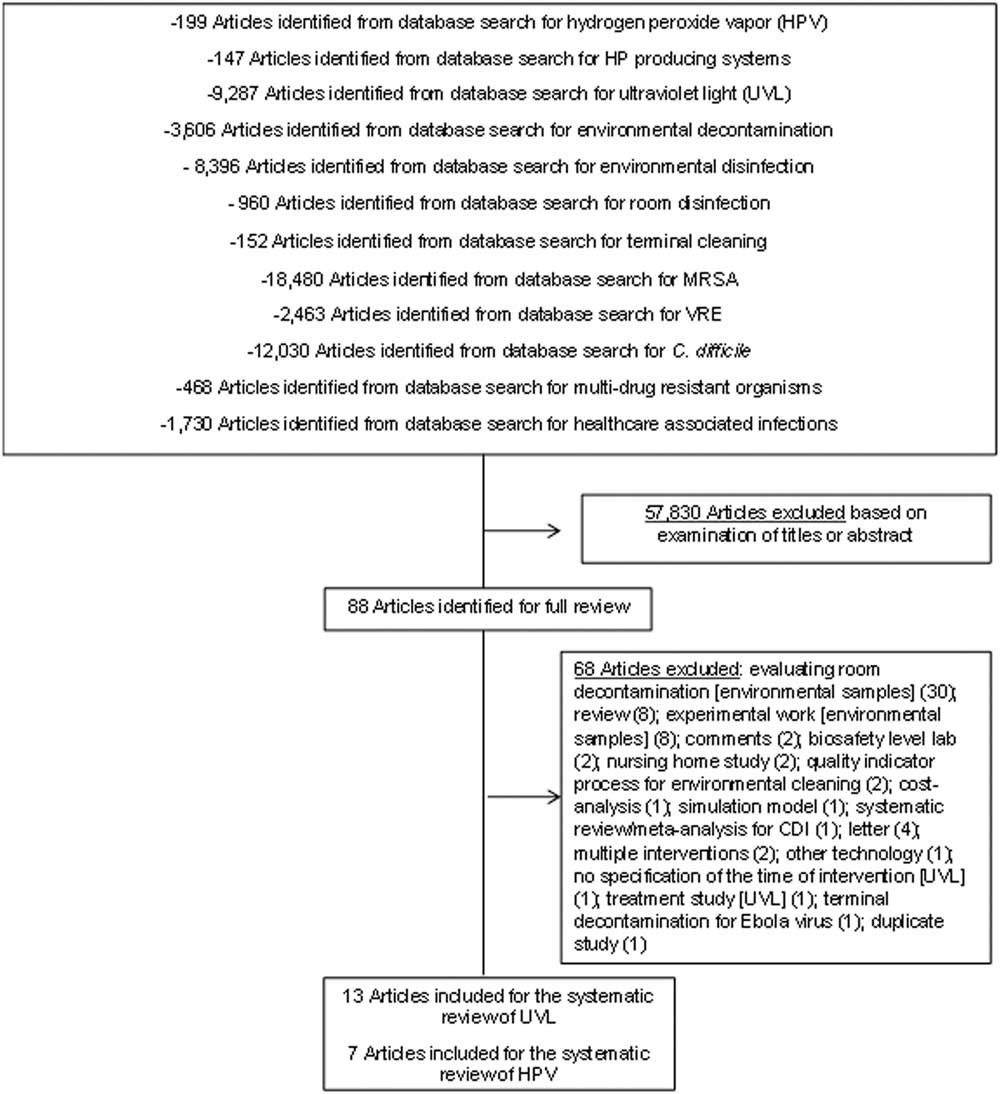
When searched alone, the term “hydrogen peroxide vapor” yielded 199 articles; “hydrogen peroxide producing systems” yielded 147 articles; “ultraviolet light” yielded 9,287 articles; “environmental decontamination” yielded 3,606 articles; “environmental disinfection” yielded 8,396 articles; “room disinfection” yielded 960 articles; “terminal cleaning” yielded 152 articles; “MRSA” yielded 18,480 articles; “VRE” yielded 2,463 articles; “Clostridium difficile” yielded 12,030 articles; “multi-drug resistant organisms” yielded 468 articles; and “healthcare associated infections” yielded 1,730 articles. After applying exclusion criteria, we reviewed the full articles for 88 papers; finally, 20 studies met the inclusion criteria and were included in the systematic review (Figure 1).
Literature search for articles on no-touch disinfection methods. Abbreviations: UVL, ultraviolet light; HPV, hydrogen peroxide vapor.

Data Abstraction and Quality Assessment
The titles and abstracts of all articles were screened to assess whether they met inclusion criteria. The reviewers (A.R.M. and M.B.E.) abstracted data on study design, population, setting, interventions tested, and measurement of no-touch technologies for UVL or HPV systems, respectively. We also collected information about the year of intervention, compliance with alternative interventions (eg, hand hygiene and antimicrobial stewardship), outcome and cost-effectiveness evaluation. We used the scales employed by Aboelela et alReference Aboelela, Saiman, Stone, Lowy, Quiros and Larson 19 and Cohen et alReference Cohen, Cohen and Shang 20 to evaluate study quality. These tools have items regarding sample representativeness, bias and confounding, description of the intervention, outcomes and follow-up, and statistical analysis, which are each scored 1–4, where 4 indicates the highest quality. Each reviewed paper was assessed as to whether it addressed the aforementioned categories in a manner that was “completely adequate,” “partially adequate,” “inadequate, not stated or impossible to tell” or “not applicable.”Reference Aboelela, Saiman, Stone, Lowy, Quiros and Larson 19 , Reference Cohen, Cohen and Shang 20 The authors (A.R.M. and M.B.E.) performed component quality analysis independently, reviewed all inconsistent assessments, and achieved consensus by discussion.Reference Alderson and Higgins 21 For quasi-experimental studies, we evaluated whether time series analysis was performed, the rationale for why randomization was not used, and other caveats of a quasi-experimental design.Reference Harris, Lautenbach and Perencevich 22
Statistical Analysis
To meta-analyze the extracted data, we calculated the natural log of the risk ratios (RR) and standard errors (SE) for UVL and HPV systems independently using 2 outcomes: CDI and VRE infection. We also performed stratified analysis with forest plots of the association between UVL and CDI, comparing high baseline CDI rates (>1.5 CDI/1,000 patient days) to low baseline CDI rates (<1.5 CDI/1,000 patient days); controlled versus noncontrolled trials; academic versus community hospitals; and the quality of studies (those reporting compliance rates as completely adequate vs not completely adequate).Reference Aboelela, Saiman, Stone, Lowy, Quiros and Larson 19 , Reference Cohen, Cohen and Shang 20 All of the studies in the meta-analysis evaluated infections as the outcome, not colonization, except that of Passaretti et al,Reference Passaretti, Otter, Reich, Myers, Shepard, Ross, Carroll, Lipsett and Perl 40 which evaluated infection and colonization combined for MRSA and VRE.Reference Passaretti, Otter, Reich, Myers, Shepard, Ross, Carroll, Lipsett and Perl 40 We employed random-effect models to obtain pooled risk ratio estimates (pRR), using Microsoft Excel software (2007, Redmond, WA) and the Cochrane Review Manager (RevMan) version 5.3 (The Nordic Cochrane Centre, The Cochrane Collaboration, Copenhagen, 2014). Heterogeneity between studies was evaluated using I2 estimation and the Cochran Q statistic test.
RESULTS
Characteristics of Included Studies
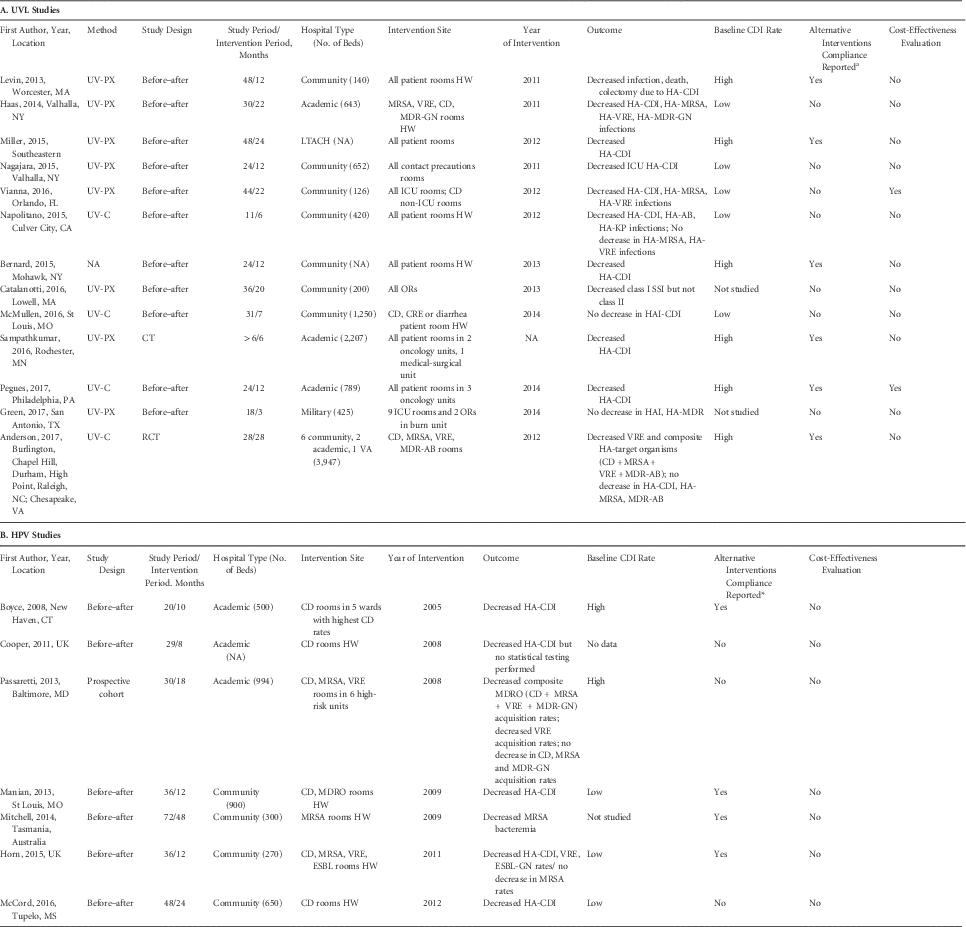
Twenty studies met the inclusion criteria and were included in the final review (Table 1). Of these 20 studies, 18 (90%) were nonrandomized, quasi-experimental studiesReference Boyce, Havill, Otter, McDonald, Adams, Cooper, Thompson, Wiggs, Killgore, Tauman and Noble-Wang 23 – Reference Passaretti, Otter, Reich, Myers, Shepard, Ross, Carroll, Lipsett and Perl 40 ; 17 (94.4%) compared infection rates before and after implementation of no-touch technology (UVL or HPV)Reference Boyce, Havill, Otter, McDonald, Adams, Cooper, Thompson, Wiggs, Killgore, Tauman and Noble-Wang 23 – Reference McMullen, Wood, Buol, Johnson, Bradley, Dubberke, Woeltje and Warren 39 ; and 1 was a prospective observational cohort study.Reference Passaretti, Otter, Reich, Myers, Shepard, Ross, Carroll, Lipsett and Perl 40 Another 2 studies (10%) were clinical trials: 1 was a randomized trialReference Anderson, Chen, Weber, Moehring, Lewis, Triplett, Blocker, Becherer, Schwab, Knelson, Lokhnygina, Rutala, Kanamori, Gergen and Sexton 41 and 1 was a controlled trial.Reference Sampathkumar, Nation, Folkert, Wentink and Zavaleta 42 Of the 20 studies, 13 (65%) used a UVL disinfection system,Reference Catalanotti, Abbe, Simmons and Stibich 24 , Reference Green, Pamplin, Chafin, Murray and Yun 26 , Reference Levin, Riley, Parrish, English and Ahn 28 , Reference Bernard and Little 31 , Reference Miller, Simmons, Dale, Stachowiak and Stibich 32 , Reference Pegues, Han, Gilmar, McDonnell and Gaynes 34 – Reference McMullen, Wood, Buol, Johnson, Bradley, Dubberke, Woeltje and Warren 39 , Reference Anderson, Chen, Weber, Moehring, Lewis, Triplett, Blocker, Becherer, Schwab, Knelson, Lokhnygina, Rutala, Kanamori, Gergen and Sexton 41 , Reference Sampathkumar, Nation, Folkert, Wentink and Zavaleta 42 and 7 studies (35%) used an HPV disinfection system.Reference Boyce, Havill, Otter, McDonald, Adams, Cooper, Thompson, Wiggs, Killgore, Tauman and Noble-Wang 23 , Reference Cooper, O’ Leary, Yezli and Otter 25 , Reference Horn and Otter 27 , Reference Manian, Griesnauer and Bryant 29 , Reference McCord, Prewitt, Dyakova, Mookerjee and Otter 30 , Reference Mitchell, Digney, Locket and Dancer 33 , Reference Passaretti, Otter, Reich, Myers, Shepard, Ross, Carroll, Lipsett and Perl 40 Of the UVL disinfection system studies,Reference Catalanotti, Abbe, Simmons and Stibich 24 , Reference Green, Pamplin, Chafin, Murray and Yun 26 , Reference Levin, Riley, Parrish, English and Ahn 28 , Reference Bernard and Little 31 , Reference Miller, Simmons, Dale, Stachowiak and Stibich 32 , Reference Pegues, Han, Gilmar, McDonnell and Gaynes 34 – Reference McMullen, Wood, Buol, Johnson, Bradley, Dubberke, Woeltje and Warren 39 , Reference Anderson, Chen, Weber, Moehring, Lewis, Triplett, Blocker, Becherer, Schwab, Knelson, Lokhnygina, Rutala, Kanamori, Gergen and Sexton 41 , Reference Sampathkumar, Nation, Folkert, Wentink and Zavaleta 42 8 studies used pulsed Xenon UVL (PX-UV),Reference Catalanotti, Abbe, Simmons and Stibich 24 , Reference Green, Pamplin, Chafin, Murray and Yun 26 , Reference Levin, Riley, Parrish, English and Ahn 28 , Reference Miller, Simmons, Dale, Stachowiak and Stibich 32 , Reference Vianna, Dale, Simmons, Stibich and Licitra 35 , Reference Haas, Menz, Dusza and Montecalvo 36 , Reference Nagaraja, Visintainer, Haas, Menz, Wormser and Montecalvo 38 , Reference Sampathkumar, Nation, Folkert, Wentink and Zavaleta 42 4 studies used UV-C radiation (UV-C),Reference Pegues, Han, Gilmar, McDonnell and Gaynes 34 , Reference Napolitano, Mahapatra and Tang 37 , Reference McMullen, Wood, Buol, Johnson, Bradley, Dubberke, Woeltje and Warren 39 , Reference Anderson, Chen, Weber, Moehring, Lewis, Triplett, Blocker, Becherer, Schwab, Knelson, Lokhnygina, Rutala, Kanamori, Gergen and Sexton 41 and 1 study did not specify the type of UVL.Reference Bernard and Little 31
Summary of Characteristics of Studies Included in the Systematic Review for UVL Studies (A) and HPV Studies (B)

NOTE. UVL, ultraviolet light; HPV, hydrogen peroxide vapor; CP, contact precaution; HAI, healthcare-associated infection; MRSA, methicillin-resistant S. aureus; MSSA, methicillin-susceptible S. aureus; VRE vancomycin-resistant enterococci; CD, Clostridium difficile; CDI, Clostridium difficile infection; MDR-GN, multidrug-resistant gram negative; MDRO, multidrug-resistant organism; ESBL, extended-spectrum β-lactamase; CRE, carbapenem-resistant Enterobacteriaceae; UV-PX, ultraviolet-pulsed xenon; UV-C, ultraviolet-C light; RCT, randomized control trial; CT, clinical trial; HW, hospital-wide; LTACH long-term acute-care hospital; OR, operating room; EC, environmental cleaning; VA, Veterans Affairs; NA, not available.
a Alternative interventions include hand hygiene, antimicrobial stewardship.
Most of the studies included in our review were conducted in the United States (17 studies)Reference Boyce, Havill, Otter, McDonald, Adams, Cooper, Thompson, Wiggs, Killgore, Tauman and Noble-Wang 23 , Reference Catalanotti, Abbe, Simmons and Stibich 24 , Reference Green, Pamplin, Chafin, Murray and Yun 26 , Reference Levin, Riley, Parrish, English and Ahn 28 – Reference Miller, Simmons, Dale, Stachowiak and Stibich 32 , Reference Pegues, Han, Gilmar, McDonnell and Gaynes 34 – Reference Sampathkumar, Nation, Folkert, Wentink and Zavaleta 42 ; 2 studies were performed in the United KingdomReference Cooper, O’ Leary, Yezli and Otter 25 , Reference Horn and Otter 27 ; and 1 study took place in Australia.Reference Mitchell, Digney, Locket and Dancer 33 All of the UV system studies were conducted in the United States (13 studies).Reference Catalanotti, Abbe, Simmons and Stibich 24 , Reference Green, Pamplin, Chafin, Murray and Yun 26 , Reference Levin, Riley, Parrish, English and Ahn 28 , Reference Bernard and Little 31 , Reference Miller, Simmons, Dale, Stachowiak and Stibich 32 , Reference Pegues, Han, Gilmar, McDonnell and Gaynes 34 – Reference McMullen, Wood, Buol, Johnson, Bradley, Dubberke, Woeltje and Warren 39 , Reference Anderson, Chen, Weber, Moehring, Lewis, Triplett, Blocker, Becherer, Schwab, Knelson, Lokhnygina, Rutala, Kanamori, Gergen and Sexton 41 , Reference Sampathkumar, Nation, Folkert, Wentink and Zavaleta 42 Studies varied on the type of rooms that used the no-touch technology. The majority of the studies used no-touch technology after terminal cleaning of rooms of patients on contact precautions (11 studies),Reference Boyce, Havill, Otter, McDonald, Adams, Cooper, Thompson, Wiggs, Killgore, Tauman and Noble-Wang 23 , Reference Cooper, O’ Leary, Yezli and Otter 25 , Reference Horn and Otter 27 , Reference Manian, Griesnauer and Bryant 29 , Reference McCord, Prewitt, Dyakova, Mookerjee and Otter 30 , Reference Mitchell, Digney, Locket and Dancer 33 , Reference Pegues, Han, Gilmar, McDonnell and Gaynes 34 , Reference Haas, Menz, Dusza and Montecalvo 36 , Reference Nagaraja, Visintainer, Haas, Menz, Wormser and Montecalvo 38 – Reference Sampathkumar, Nation, Folkert, Wentink and Zavaleta 42 but other studies evaluated the no-touch technology after terminal cleaning of all patient rooms hospital-wide (4 studies),Reference Levin, Riley, Parrish, English and Ahn 28 , Reference Bernard and Little 31 , Reference Miller, Simmons, Dale, Stachowiak and Stibich 32 , Reference Napolitano, Mahapatra and Tang 37 after terminal cleaning in oncology units (2 studies),Reference Pegues, Han, Gilmar, McDonnell and Gaynes 34 , Reference Sampathkumar, Nation, Folkert, Wentink and Zavaleta 42 and ICU patient roomsReference Green, Pamplin, Chafin, Murray and Yun 26 , Reference Vianna, Dale, Simmons, Stibich and Licitra 35 (2 studies, 1 of which also used no-touch technology after terminal cleaning in the operating room of a burn unit).Reference Green, Pamplin, Chafin, Murray and Yun 26 Another study investigated no-touch technology after terminal cleaning in all operating rooms hospital-wide.Reference Catalanotti, Abbe, Simmons and Stibich 24 All of the HPV system studies were conducted after terminal cleaning of rooms of patients on contact precautions.Reference Boyce, Havill, Otter, McDonald, Adams, Cooper, Thompson, Wiggs, Killgore, Tauman and Noble-Wang 23 , Reference Cooper, O’ Leary, Yezli and Otter 25 , Reference Horn and Otter 27 , Reference Manian, Griesnauer and Bryant 29 , Reference McCord, Prewitt, Dyakova, Mookerjee and Otter 30 , Reference Mitchell, Digney, Locket and Dancer 33 , Reference Passaretti, Otter, Reich, Myers, Shepard, Ross, Carroll, Lipsett and Perl 40
The year that HPV no-touch technology was used ranged from 2005 to 2012.Reference Boyce, Havill, Otter, McDonald, Adams, Cooper, Thompson, Wiggs, Killgore, Tauman and Noble-Wang 23 , Reference Cooper, O’ Leary, Yezli and Otter 25 For UVL systems, the studies ranged from 2011 to 2014.Reference Catalanotti, Abbe, Simmons and Stibich 24 , Reference Green, Pamplin, Chafin, Murray and Yun 26 – Reference Sampathkumar, Nation, Folkert, Wentink and Zavaleta 42 The longest study time was 6 years (an HPV system study)Reference Mitchell, Digney, Locket and Dancer 33 and the shortest study duration <1 year (a UVL system study).Reference Sampathkumar, Nation, Folkert, Wentink and Zavaleta 42
Many of the UVL and HPV studies included in our review were conducted at community medical centers (12 studies)Reference Catalanotti, Abbe, Simmons and Stibich 24 , Reference Horn and Otter 27 – Reference Mitchell, Digney, Locket and Dancer 33 , Reference Vianna, Dale, Simmons, Stibich and Licitra 35 , Reference Napolitano, Mahapatra and Tang 37 – Reference McMullen, Wood, Buol, Johnson, Bradley, Dubberke, Woeltje and Warren 39 ; 6 studies were performed at academic medical centersReference Boyce, Havill, Otter, McDonald, Adams, Cooper, Thompson, Wiggs, Killgore, Tauman and Noble-Wang 23 , Reference Cooper, O’ Leary, Yezli and Otter 25 , Reference Pegues, Han, Gilmar, McDonnell and Gaynes 34 , Reference Haas, Menz, Dusza and Montecalvo 36 , Reference Passaretti, Otter, Reich, Myers, Shepard, Ross, Carroll, Lipsett and Perl 40 , Reference Sampathkumar, Nation, Folkert, Wentink and Zavaleta 42 ; and 1 study was performed at a military medical center.Reference Green, Pamplin, Chafin, Murray and Yun 26 One studyReference Anderson, Chen, Weber, Moehring, Lewis, Triplett, Blocker, Becherer, Schwab, Knelson, Lokhnygina, Rutala, Kanamori, Gergen and Sexton 41 was conducted in 9 hospitals: 6 community medical centers, 2 academic medical centers, and 1 Veterans Affairs medical center. For HPV systems, 4 studies were performed at community medical centersReference Horn and Otter 27 , Reference Manian, Griesnauer and Bryant 29 , Reference McCord, Prewitt, Dyakova, Mookerjee and Otter 30 , Reference Mitchell, Digney, Locket and Dancer 33 and 3 studies were performed at academic medical centers.Reference Boyce, Havill, Otter, McDonald, Adams, Cooper, Thompson, Wiggs, Killgore, Tauman and Noble-Wang 23 , Reference Cooper, O’ Leary, Yezli and Otter 25 , Reference Passaretti, Otter, Reich, Myers, Shepard, Ross, Carroll, Lipsett and Perl 40
The outcome for the majority of the studies (17 studies) was CDI ratesReference Boyce, Havill, Otter, McDonald, Adams, Cooper, Thompson, Wiggs, Killgore, Tauman and Noble-Wang 23 , Reference Cooper, O’ Leary, Yezli and Otter 25 , Reference Horn and Otter 27 – Reference Miller, Simmons, Dale, Stachowiak and Stibich 32 , Reference Pegues, Han, Gilmar, McDonnell and Gaynes 34 – Reference Sampathkumar, Nation, Folkert, Wentink and Zavaleta 42 ; among these, 11 were studies of UVL disinfection systemsReference Levin, Riley, Parrish, English and Ahn 28 , Reference Bernard and Little 31 , Reference Miller, Simmons, Dale, Stachowiak and Stibich 32 , Reference Pegues, Han, Gilmar, McDonnell and Gaynes 34 – Reference McMullen, Wood, Buol, Johnson, Bradley, Dubberke, Woeltje and Warren 39 , Reference Anderson, Chen, Weber, Moehring, Lewis, Triplett, Blocker, Becherer, Schwab, Knelson, Lokhnygina, Rutala, Kanamori, Gergen and Sexton 41 , Reference Sampathkumar, Nation, Folkert, Wentink and Zavaleta 42 and 6 were studies of HPV disinfection systems.Reference Boyce, Havill, Otter, McDonald, Adams, Cooper, Thompson, Wiggs, Killgore, Tauman and Noble-Wang 23 , Reference Cooper, O’ Leary, Yezli and Otter 25 , Reference Horn and Otter 27 , Reference Manian, Griesnauer and Bryant 29 , Reference McCord, Prewitt, Dyakova, Mookerjee and Otter 30 , Reference Passaretti, Otter, Reich, Myers, Shepard, Ross, Carroll, Lipsett and Perl 40 For the UVL disinfection system baseline CDI rates, 6 studies were considered to have a high baseline rate (≥1.5 per 1,000 patient days)Reference Levin, Riley, Parrish, English and Ahn 28 , Reference Bernard and Little 31 , Reference Miller, Simmons, Dale, Stachowiak and Stibich 32 , Reference Pegues, Han, Gilmar, McDonnell and Gaynes 34 , Reference Anderson, Chen, Weber, Moehring, Lewis, Triplett, Blocker, Becherer, Schwab, Knelson, Lokhnygina, Rutala, Kanamori, Gergen and Sexton 41 , Reference Sampathkumar, Nation, Folkert, Wentink and Zavaleta 42 and 5 studies had a low baseline CDI rate (<1.5 per 1,000 patient days).Reference Vianna, Dale, Simmons, Stibich and Licitra 35 – Reference McMullen, Wood, Buol, Johnson, Bradley, Dubberke, Woeltje and Warren 39 For HPV disinfection, 2 studies had high baseline CDI rates,Reference Boyce, Havill, Otter, McDonald, Adams, Cooper, Thompson, Wiggs, Killgore, Tauman and Noble-Wang 23 , Reference Passaretti, Otter, Reich, Myers, Shepard, Ross, Carroll, Lipsett and Perl 40 3 studies had low baseline CDI rates,Reference Horn and Otter 27 , Reference Manian, Griesnauer and Bryant 29 , Reference McCord, Prewitt, Dyakova, Mookerjee and Otter 30 and 1 study did not report rate data.Reference Cooper, O’ Leary, Yezli and Otter 25 In 7 studies, the outcome evaluated was MRSA ratesReference Horn and Otter 27 , Reference Mitchell, Digney, Locket and Dancer 33 , Reference Vianna, Dale, Simmons, Stibich and Licitra 35 – Reference Napolitano, Mahapatra and Tang 37 , Reference Passaretti, Otter, Reich, Myers, Shepard, Ross, Carroll, Lipsett and Perl 40 , Reference Anderson, Chen, Weber, Moehring, Lewis, Triplett, Blocker, Becherer, Schwab, Knelson, Lokhnygina, Rutala, Kanamori, Gergen and Sexton 41 : 4 were studies of UVL systemsReference Vianna, Dale, Simmons, Stibich and Licitra 35 – Reference Napolitano, Mahapatra and Tang 37 , Reference Anderson, Chen, Weber, Moehring, Lewis, Triplett, Blocker, Becherer, Schwab, Knelson, Lokhnygina, Rutala, Kanamori, Gergen and Sexton 41 and 3 were studies of HPV.Reference Horn and Otter 27 , Reference McCord, Prewitt, Dyakova, Mookerjee and Otter 30 , Reference Passaretti, Otter, Reich, Myers, Shepard, Ross, Carroll, Lipsett and Perl 40 In addition, 6 studies evaluated VRE rates as the outcomeReference Horn and Otter 27 , Reference Vianna, Dale, Simmons, Stibich and Licitra 35 – Reference Napolitano, Mahapatra and Tang 37 , Reference Passaretti, Otter, Reich, Myers, Shepard, Ross, Carroll, Lipsett and Perl 40 , Reference Anderson, Chen, Weber, Moehring, Lewis, Triplett, Blocker, Becherer, Schwab, Knelson, Lokhnygina, Rutala, Kanamori, Gergen and Sexton 41 : 4 studies of UVLReference Vianna, Dale, Simmons, Stibich and Licitra 35 – Reference Napolitano, Mahapatra and Tang 37 , Reference Anderson, Chen, Weber, Moehring, Lewis, Triplett, Blocker, Becherer, Schwab, Knelson, Lokhnygina, Rutala, Kanamori, Gergen and Sexton 41 and 2 studies of HPV.Reference Horn and Otter 27 , Reference Passaretti, Otter, Reich, Myers, Shepard, Ross, Carroll, Lipsett and Perl 40 In addition, 2 UVL disinfection studies evaluated gram-negative MDRO infections as an outcome measure.Reference Green, Pamplin, Chafin, Murray and Yun 26 , Reference Haas, Menz, Dusza and Montecalvo 36 One UVL system study evaluated HAI rates (generically)Reference Green, Pamplin, Chafin, Murray and Yun 26 and another study evaluated the impact of surgical site infection as an outcome.Reference Catalanotti, Abbe, Simmons and Stibich 24
Outcomes Measures and Follow-Up
When we considered the assessment quality of the reviewed papers (Supplementary Appendix 2) more than one-third of the studies (9 studies) were considered “completely adequate” for reporting compliance rates of no-touch technology for hospital room disinfection.Reference Levin, Riley, Parrish, English and Ahn 28 , Reference Manian, Griesnauer and Bryant 29 , Reference Pegues, Han, Gilmar, McDonnell and Gaynes 34 , Reference Haas, Menz, Dusza and Montecalvo 36 , Reference Napolitano, Mahapatra and Tang 37 , Reference McMullen, Wood, Buol, Johnson, Bradley, Dubberke, Woeltje and Warren 39 – Reference Sampathkumar, Nation, Folkert, Wentink and Zavaleta 42 More than a half of these studies (n=12) had a clearly defined outcomeReference Levin, Riley, Parrish, English and Ahn 28 – Reference McCord, Prewitt, Dyakova, Mookerjee and Otter 30 , Reference Miller, Simmons, Dale, Stachowiak and Stibich 32 – Reference Nagaraja, Visintainer, Haas, Menz, Wormser and Montecalvo 38 , Reference Passaretti, Otter, Reich, Myers, Shepard, Ross, Carroll, Lipsett and Perl 40 , Reference Anderson, Chen, Weber, Moehring, Lewis, Triplett, Blocker, Becherer, Schwab, Knelson, Lokhnygina, Rutala, Kanamori, Gergen and Sexton 41 but only 2 of these studies tested differences between groups and variability.Reference Pegues, Han, Gilmar, McDonnell and Gaynes 34 , Reference Anderson, Chen, Weber, Moehring, Lewis, Triplett, Blocker, Becherer, Schwab, Knelson, Lokhnygina, Rutala, Kanamori, Gergen and Sexton 41
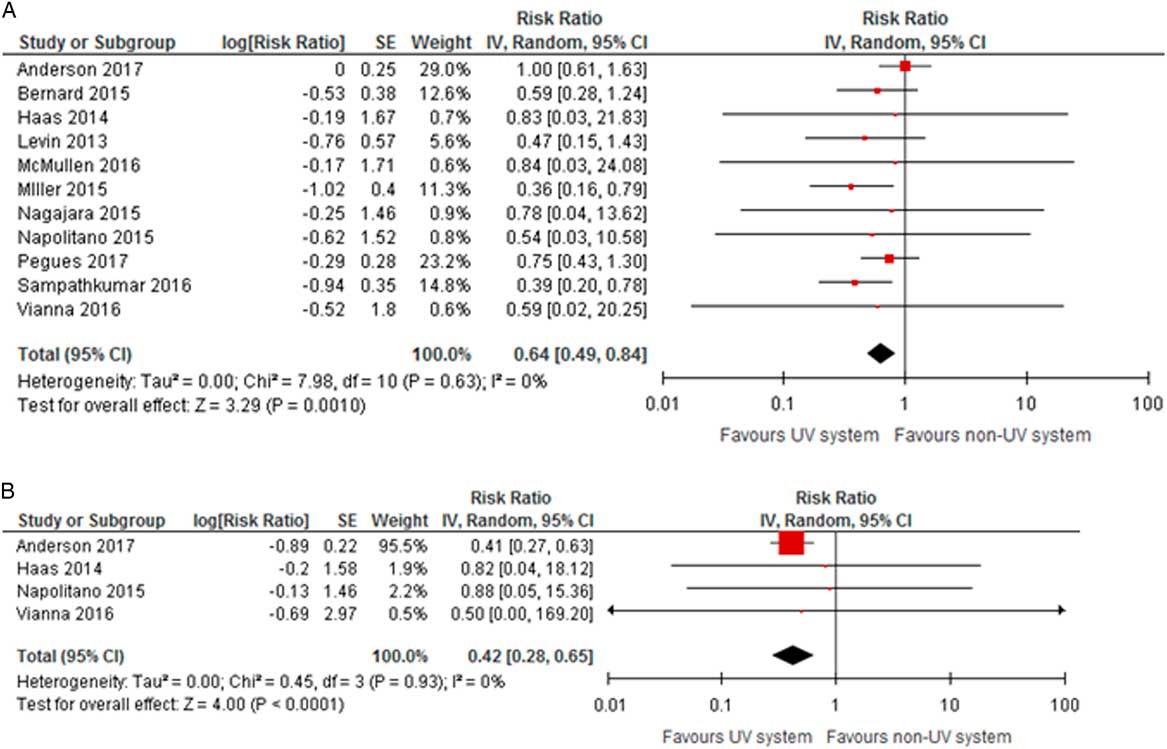
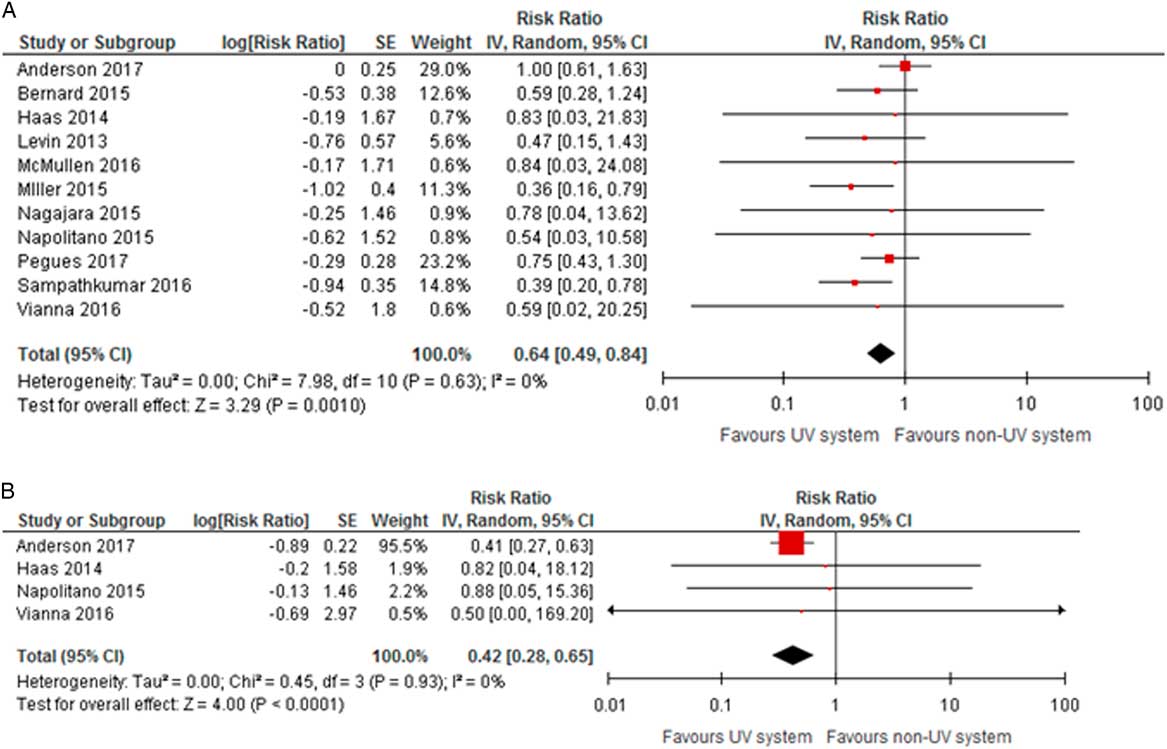
When the results of the studies were pooled, after terminal cleaning using UVL no-touch technology, we detected a statistically significant reduction in Clostridium difficile infection (CDI) rates (pRR, 0.64; 95% CI, 0.49–0.84; P=.001)Reference Levin, Riley, Parrish, English and Ahn 28 , Reference Bernard and Little 31 , Reference Miller, Simmons, Dale, Stachowiak and Stibich 32 , Reference Pegues, Han, Gilmar, McDonnell and Gaynes 34 , Reference Haas, Menz, Dusza and Montecalvo 36 – Reference McMullen, Wood, Buol, Johnson, Bradley, Dubberke, Woeltje and Warren 39 , Reference Anderson, Chen, Weber, Moehring, Lewis, Triplett, Blocker, Becherer, Schwab, Knelson, Lokhnygina, Rutala, Kanamori, Gergen and Sexton 41 , Reference Sampathkumar, Nation, Folkert, Wentink and Zavaleta 42 and VRE infection rates (pRR, 0.42; 95% CI, 0.28–0.65; P<.001).Reference Vianna, Dale, Simmons, Stibich and Licitra 35 – Reference Napolitano, Mahapatra and Tang 37 , Reference Anderson, Chen, Weber, Moehring, Lewis, Triplett, Blocker, Becherer, Schwab, Knelson, Lokhnygina, Rutala, Kanamori, Gergen and Sexton 41 The results of both meta-analyses for CDI and for VRE were homogeneous (for CDI: heterogeneity P=.63; I2=0%; for VRE: heterogeneity P=.93; I2=0%; Figure 2A and 2B). There was a nonsignificant reduction in MRSA infections using UV (pRR, 0.78; 95% CI, 0.51–1.20; P=.26)Reference Vianna, Dale, Simmons, Stibich and Licitra 35 , Reference Haas, Menz, Dusza and Montecalvo 36 , Reference Napolitano, Mahapatra and Tang 37 , Reference Anderson, Chen, Weber, Moehring, Lewis, Triplett, Blocker, Becherer, Schwab, Knelson, Lokhnygina, Rutala, Kanamori, Gergen and Sexton 41 as well as nonsignificant reductions in other infection rates for gram-negative MDRO pathogens (pRR, 1.83; 95% CI, 0.49–6.82; P=.37)Reference Green, Pamplin, Chafin, Murray and Yun 26 , Reference Haas, Menz, Dusza and Montecalvo 36 (Supplementary Appendix 3A and 3B).
Forest plots of the associations between UVL no-touch technology and Clostridium difficile infection (CDI) or vancomycin-resistant Enterococcus (VRE): (A) CDI and (B) VRE. Abbreviations: CI, confidence interval; IV, inverse variance weighting; SE, standard error.
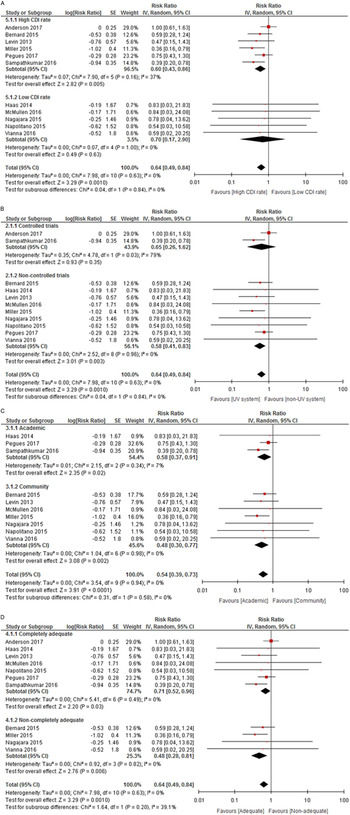
After performing a stratified analysis with forest plots, we observed a statistically significant reduction in Clostridium difficile infection (CDI) rates in UVL system studies with high baseline CDI rates (pRR, 0.60; 95% CI, 0.43–0.86; P=.005)Reference Levin, Riley, Parrish, English and Ahn 28 , Reference Bernard and Little 31 , Reference Miller, Simmons, Dale, Stachowiak and Stibich 32 , Reference Pegues, Han, Gilmar, McDonnell and Gaynes 34 , Reference Anderson, Chen, Weber, Moehring, Lewis, Triplett, Blocker, Becherer, Schwab, Knelson, Lokhnygina, Rutala, Kanamori, Gergen and Sexton 41 , Reference Sampathkumar, Nation, Folkert, Wentink and Zavaleta 42 but not for studies with low baseline CDI rates (pRR, 0.70; 95% CI, 0.17–2.90; P=.63) (Figure 3A). Also, there was a statistically significant reduction in CDI rates for UVL in studies that were not controlled trials (pRR, 0.58; 95% CI, 0.41–0.83; P=.003)Reference Levin, Riley, Parrish, English and Ahn 28 , Reference Bernard and Little 31 , Reference Miller, Simmons, Dale, Stachowiak and Stibich 32 , Reference Pegues, Han, Gilmar, McDonnell and Gaynes 34 – Reference McMullen, Wood, Buol, Johnson, Bradley, Dubberke, Woeltje and Warren 39 ] but not for controlled trials (pRR, 0.65; 95% CI, 0.26–1.62; P=.35)Reference Anderson, Chen, Weber, Moehring, Lewis, Triplett, Blocker, Becherer, Schwab, Knelson, Lokhnygina, Rutala, Kanamori, Gergen and Sexton 41 , Reference Sampathkumar, Nation, Folkert, Wentink and Zavaleta 42 (Figure 3B). We used a statistically significant reduction in CDI rates for UVL for both academicReference Pegues, Han, Gilmar, McDonnell and Gaynes 34 , Reference Haas, Menz, Dusza and Montecalvo 36 , Reference Sampathkumar, Nation, Folkert, Wentink and Zavaleta 42 and community hospital studiesReference Levin, Riley, Parrish, English and Ahn 28 , Reference Bernard and Little 31 , Reference Miller, Simmons, Dale, Stachowiak and Stibich 32 , Reference Vianna, Dale, Simmons, Stibich and Licitra 35 , Reference Napolitano, Mahapatra and Tang 37 – Reference McMullen, Wood, Buol, Johnson, Bradley, Dubberke, Woeltje and Warren 39 (for academic hospitals: pRR, 0.58; 95% CI, 0.37–0.91; P=.02; and for community hosptials: pRR, 0.48; 95% CI, 0.30–0.77; P=.002) (Figure 3C). Considering the quality of studies reporting compliance rates as completely adequateReference Levin, Riley, Parrish, English and Ahn 28 , Reference Pegues, Han, Gilmar, McDonnell and Gaynes 34 , Reference Haas, Menz, Dusza and Montecalvo 36 , Reference Napolitano, Mahapatra and Tang 37 , Reference McMullen, Wood, Buol, Johnson, Bradley, Dubberke, Woeltje and Warren 39 , Reference Anderson, Chen, Weber, Moehring, Lewis, Triplett, Blocker, Becherer, Schwab, Knelson, Lokhnygina, Rutala, Kanamori, Gergen and Sexton 41 , Reference Sampathkumar, Nation, Folkert, Wentink and Zavaleta 42 versus not completely adequate studies,Reference Bernard and Little 31 , Reference Miller, Simmons, Dale, Stachowiak and Stibich 32 , Reference Vianna, Dale, Simmons, Stibich and Licitra 35 , Reference Nagaraja, Visintainer, Haas, Menz, Wormser and Montecalvo 38 we found statistically significant reductions in CDI rates for both (pRR, 0.71; 95% CI, 0.52–0.96; P=.03 and pRR, 0.48; 95% CI, 0.28–0.81; P=.006, respectively) (Figure 3D).
Forest plots of the associations between UVL no-touch technology and Clostridium difficile infection (CDI) comparing (A) high baseline CDI rates versus low baseline, (B) controlled trials versus noncontrolled trials, (C) academic versus community hospitals, (D) quality of studies reporting compliance rates (completely adequate vs not completely adequate). Abbreviations: CI, confidence interval; IV, inverse variance weighting; SE, standard error.

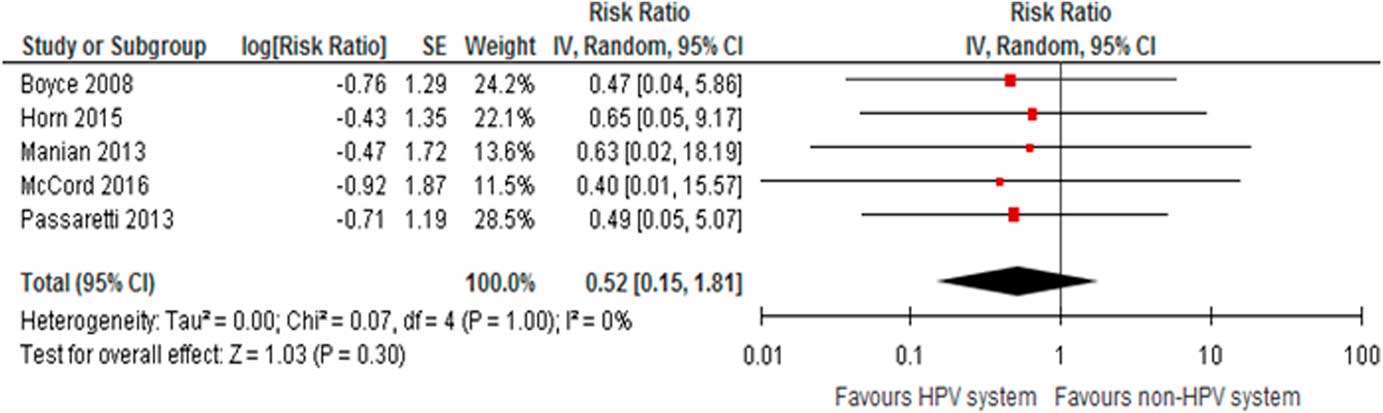
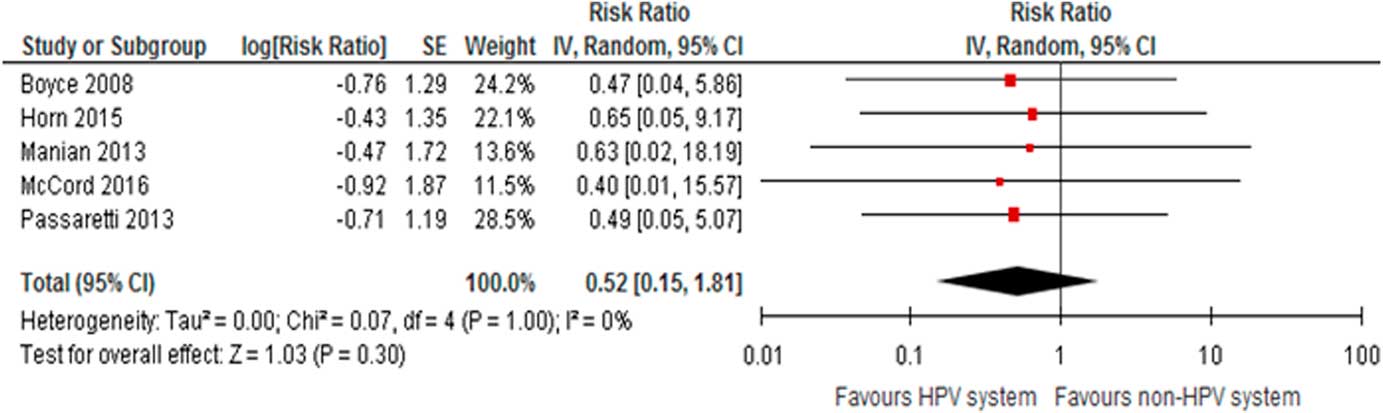
Among the results of the studies that used HPV no-touch technology (Figure 4), we found a nonsignificant reduction in CDI rates (pRR, 0.52; 95% CI, 0.15–1.81; P=.30).Reference Boyce, Havill, Otter, McDonald, Adams, Cooper, Thompson, Wiggs, Killgore, Tauman and Noble-Wang 23 , Reference Horn and Otter 27 , Reference Manian, Griesnauer and Bryant 29 , Reference McCord, Prewitt, Dyakova, Mookerjee and Otter 30 , Reference Passaretti, Otter, Reich, Myers, Shepard, Ross, Carroll, Lipsett and Perl 40 The HPV study by Cooper et alReference Cooper, O’ Leary, Yezli and Otter 25 was not included in the meta-analysis because it was not possible to calculate the risk ratio with the available data. There was also no statistically significant difference for MRSA infection rates (pRR, 0.54; 95% CI, 0.07–4.13; P=.55; Supplementary Appendix 4). The results of meta-analyses for CDI and for MRSA were homogeneous (for CDI: heterogeneity P=1.00; I2=0%; for MRSA: heterogeneity P=1.00; I2=0% (see Figure 4 for CDI and Supplementary Appendix 4 for MRSA). Only 2 studies used HPV for VRE.Reference Horn and Otter 27 , Reference Passaretti, Otter, Reich, Myers, Shepard, Ross, Carroll, Lipsett and Perl 40 Both showed a reduction for VRE infection/colonization rates (from 0.21 to 0.01 cases per 1,000 patient days in one studyReference Horn and Otter 27 and from 11.6 to 2.4 per 1,000 patient days in another studyReference Passaretti, Otter, Reich, Myers, Shepard, Ross, Carroll, Lipsett and Perl 40 ). We did not pool the results because a single studyReference Passaretti, Otter, Reich, Myers, Shepard, Ross, Carroll, Lipsett and Perl 40 would have contributed 99.5% of the weight in this analysis (data not shown).
Forest plots of the associations between HPV no-touch technology and Clostridium difficile infection (CDI). Abbreviations: CI, confidence interval; IV, inverse variance weighting; SE, standard error.
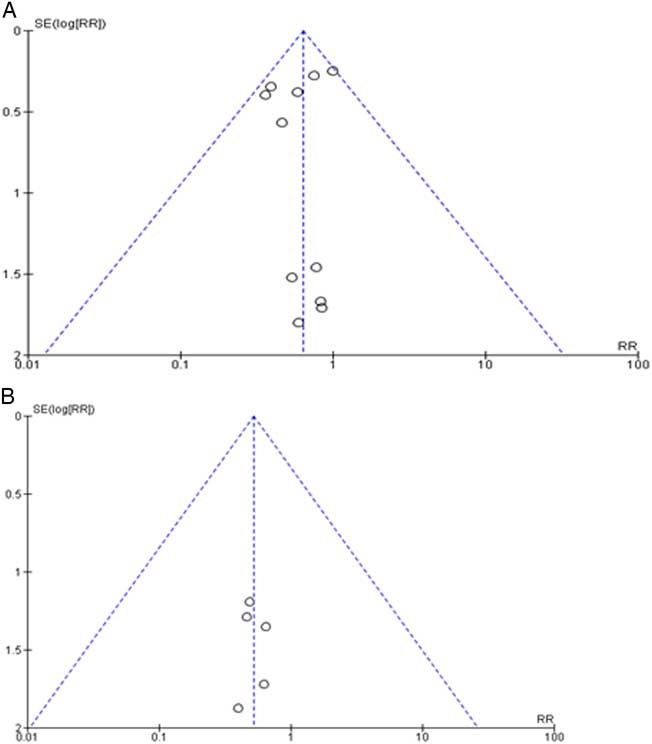
Our analysis of the potential for publication bias with funnel plots (Figures 5A and 5B) suggested that there was little evidence of publication bias among UVL and HPV studies when CDI was evaluated as the outcome. Too few studies evaluated other outcomes to determine whether publication bias was present (Supplementary Appendix 5). Also, analyzing the potential for publication bias with funnel plots (Supplementary Appendix 6A–6D) showed little evidence of publication bias among the majority of UVL studies when CDI subgroups were evaluated as the outcome.
Funnel plots demonstrating the association between (A) UVL no-touch technology and Clostridium difficile infection (CDI) and (B) HPV no-touch technology and CDI. Abbreviations: SE, standard error; RR, risk ratio.

DISCUSSION
This systematic review and meta-analysis showed that using UVL no-touch technology to enhance environmental hygiene can decrease HAIs for specific pathogens, specifically CDI and VRE infections. For CDI prevention it seems that there is a benefit for hospitals with high baseline CDI rates. There was some evidence of a decrease in and VRE infection with HPV disinfection, but more studies are needed to confirm these results. A growing number of hospitals are using no-touch technologies (UVL or HPV system) for environmental decontamination,Reference Doll, Morgan, Anderson and Bearman 14 – Reference Weber, Kanamori and Rutala 16 as there is now a greater understanding that environmental contamination contributes to HAIs.Reference Weber and Rutala 43 The great majority of disinfection studies consider surface contamination as an outcome measure and they advocate that eradicating microorganisms from patient room surfaces contributes to infection controlReference Dancer 8 , Reference Boyce 13 – Reference Weber, Kanamori and Rutala 16 ; however, fewer disinfection studies have evaluated, and MDROs can survive on inanimate surfaces for prolonged periods.Reference Kramer, Schwebke and Kampf 7 , Reference Weber, Anderson and Rutala 10 Contact with hospital room surfaces or medical equipment by HCWs also contributes to the environmental transmission of microorganisms and frequently leads to the contamination of hands and gloves.Reference Dancer 8 , Reference Weber, Anderson and Rutala 10 , Reference Leas, Sullivan, Han, Pegues, Kaczmarek and Umscheid 12 , Reference Doll, Morgan, Anderson and Bearman 14 Clonal outbreaks of pathogens contaminating the room surfaces of colonized or infected patients have also been demonstrated.Reference Weber, Anderson and Rutala 10 , Reference Doll, Morgan, Anderson and Bearman 14
There is a risk of pathogen acquisition for patients associated with prior room occupancyReference Shaughnessy, Micielli, DePestel, Arndt, Strachan, Welch and Chenoweth 5 , Reference Mitchell, Dancer, Anderson and Dehn 6 not only for gram-positive organisms,Reference Mitchell, Dancer, Anderson and Dehn 6 such as MRSA and VREReference Huang, Datta and Platt 3 , Reference Mitchell, Dancer, Anderson and Dehn 6 and C. difficile,Reference Weber, Rutala, Miller, Huslage and Sickbert-Bennett 4 , Reference Shaughnessy, Micielli, DePestel, Arndt, Strachan, Welch and Chenoweth 5 but also for gram-negative organisms suchReference Mitchell, Dancer, Anderson and Dehn 6 as Acinetobacter.Reference Weber, Rutala, Miller, Huslage and Sickbert-Bennett 4 Manual terminal cleaning of rooms decreases the burden of microbial contamination but cannot eliminate it completely.Reference Boyce 13 , Reference Shams, Rose, Edwards, Cali, Harris, Jacob, LaFae, Pineles, Thom, McDonald, Arduino and Noble-Wang 44 In fact, one study found that only 50% of room surfaces are properly cleaned after terminal disinfection of patient rooms.Reference Carling, Parry, Bruno-Murtha and Dick 11 Cleaning is a complex, multifaceted process, plagued with random variation and the potential for introducing new pathogens if cleaning cloths and solutions become contaminated. Other problems include the high turnover of housekeepers in hospitals, incorrect disinfectant contact times, and overdilution of disinfectant solutions. All of these problems underscore the need for enhancement with automated decontamination processes such as UVL and HPV no-touch technologies.Reference Dancer 8 , Reference Boyce 13 , Reference Weber, Rutala, Anderson, Chen, Sickbert-Bennett and Boyce 15 , Reference Weber, Kanamori and Rutala 16
In our systematic review, we identified 2 clinical trials comparing UVL system disinfection after terminal cleaning with standard terminal cleaning.Reference Anderson, Chen, Weber, Moehring, Lewis, Triplett, Blocker, Becherer, Schwab, Knelson, Lokhnygina, Rutala, Kanamori, Gergen and Sexton 41 , Reference Sampathkumar, Nation, Folkert, Wentink and Zavaleta 42 One of the studies is a multicenter, cluster-randomized crossover trial with 4 comparisons after terminal cleaning: UVL alone, UVL plus bleach, bleach alone, and a quarternary ammonium disinfectant (except for C. difficile, for which bleach was used).Reference Anderson, Chen, Weber, Moehring, Lewis, Triplett, Blocker, Becherer, Schwab, Knelson, Lokhnygina, Rutala, Kanamori, Gergen and Sexton 41 The other UVL controlled clinical trial compared 3 UVL hospital units (intervention arm) with 3 control units (control arm) where UVL disinfection was not used.Reference Sampathkumar, Nation, Folkert, Wentink and Zavaleta 42 There are no clinical trials evaluating HPV systems. Most of the UVL or HPV studies evaluating the impact on HAIs (18 studies) were nonrandomized, quasi-experimental studies.Reference Boyce, Havill, Otter, McDonald, Adams, Cooper, Thompson, Wiggs, Killgore, Tauman and Noble-Wang 23 – Reference Passaretti, Otter, Reich, Myers, Shepard, Ross, Carroll, Lipsett and Perl 40 Quasi-experimental studies attempt to demonstrate causality between an intervention and an outcome and encompass a broad range of nonrandomized intervention studies. These designs are frequently used when it is not logistically feasible or ethical to conduct a randomized controlled trial.Reference Harris, Lautenbach and Perencevich 22 In our review, the outcome measures demonstrated a benefit to the use of UVL disinfection to decrease Clostridium difficile and VRE infections, and HVP was shown to decrease VRE infection. Importantly, however, only 2 HPV studies evaluated VRE infection rates.Reference Horn and Otter 27 , Reference Passaretti, Otter, Reich, Myers, Shepard, Ross, Carroll, Lipsett and Perl 40 Also, few studies (6 studies)Reference Boyce, Havill, Otter, McDonald, Adams, Cooper, Thompson, Wiggs, Killgore, Tauman and Noble-Wang 23 , Reference Cooper, O’ Leary, Yezli and Otter 25 , Reference Green, Pamplin, Chafin, Murray and Yun 26 , Reference McCord, Prewitt, Dyakova, Mookerjee and Otter 30 , Reference Pegues, Han, Gilmar, McDonnell and Gaynes 34 , Reference Anderson, Chen, Weber, Moehring, Lewis, Triplett, Blocker, Becherer, Schwab, Knelson, Lokhnygina, Rutala, Kanamori, Gergen and Sexton 41 applied these no-touch technologies after terminal cleaning in all patient rooms hospital-wide, independent of whether the patients were in contact precautions. Most of these studies applied no-touch technology in restricted situations such as the rooms of patients with C. difficile, MRSA, VRE, or other MDROs.Reference Boyce, Havill, Otter, McDonald, Adams, Cooper, Thompson, Wiggs, Killgore, Tauman and Noble-Wang 23 , Reference Cooper, O’ Leary, Yezli and Otter 25 , Reference Horn and Otter 27 , Reference Manian, Griesnauer and Bryant 29 , Reference McCord, Prewitt, Dyakova, Mookerjee and Otter 30 , Reference Mitchell, Digney, Locket and Dancer 33 , Reference Pegues, Han, Gilmar, McDonnell and Gaynes 34 , Reference Haas, Menz, Dusza and Montecalvo 36 , Reference Nagaraja, Visintainer, Haas, Menz, Wormser and Montecalvo 38 – Reference Sampathkumar, Nation, Folkert, Wentink and Zavaleta 42
A limitation of our study was that we included many studies that were before-and-after quasi-experimental studies, which are subject to multiple biases.Reference Harris, Lautenbach and Perencevich 22 However, this is the most common study design in the infection prevention literature.Reference Harris, Lautenbach and Perencevich 22 The disadvantages of no-touch technologies are that the patient room must be vacated and cleaned before the technology can be used. This can cause logistical problems and can impede patient flow and nursing care. In addition, the room equipment and furniture must be moved away from walls to prevent shadowing for UVL, and air vents, doors, and windows must be isolated and sealed for the use of HPV. Other disadvantages are the contact time, device distance and the inability of UV to reach around corners or reach partially opened items such as drawers. In our study, one-third of these studies (7 studies) reported the turnaround time and details about how to run the no-touch robots.Reference Boyce, Havill, Otter, McDonald, Adams, Cooper, Thompson, Wiggs, Killgore, Tauman and Noble-Wang 23 , Reference Manian, Griesnauer and Bryant 29 , Reference Pegues, Han, Gilmar, McDonnell and Gaynes 34 , Reference Napolitano, Mahapatra and Tang 37 , Reference Nagaraja, Visintainer, Haas, Menz, Wormser and Montecalvo 38 , Reference Passaretti, Otter, Reich, Myers, Shepard, Ross, Carroll, Lipsett and Perl 40 , Reference Anderson, Chen, Weber, Moehring, Lewis, Triplett, Blocker, Becherer, Schwab, Knelson, Lokhnygina, Rutala, Kanamori, Gergen and Sexton 41 Only 2 studies (UVL) performed a cost-effectiveness evaluation of using no-touch technology after terminal cleaning,Reference Pegues, Han, Gilmar, McDonnell and Gaynes 34 , Reference Vianna, Dale, Simmons, Stibich and Licitra 35 with annual costs for the first year estimated to be nearly $300,000 (including personnel and equipment acquisition), and approximately $200,000 for the next year.Reference Pegues, Han, Gilmar, McDonnell and Gaynes 34 This finding must be balanced against the cost of HAIs; C. difficile and VRE cases are nonreimbursable and cost $14,000 per case on average.Reference Vianna, Dale, Simmons, Stibich and Licitra 35 , Reference Dubberke and Olsen 46 , Reference Cosgrove 47
We believe that no-touch methods (UVL and HPV systems) augment traditional cleaning but cannot replace it. Given the goal to eliminate all preventable HAIs, hospitals will need to continue to improve in both hand hygiene and environmental disinfection. More randomized trials should be performed to evaluate these no-touch systems, as well as cost-effectiveness analyses to determine the role that no-touch systems can have in hospital infection control.
ACKNOWLEDGMENTS
Financial support: M.L.S. is funded through a VA Health Services Research and Development award (grant no. CDA 11-215).
Potential conflicts of interest: All authors report no conflict of interest relevant to this article.
SUPPLEMENTARY MATERIAL
To view supplementary material for this article, please visit https://doi.org/10.1017/ice.2017.226