In many tropical forests, ground-dwelling vertebrates, such as rodents, play important roles in post-dispersal predation and movement of large seeds, which may influence patterns of plant recruitment and regeneration (Dunham Reference DUNHAM2011, Forget Reference FORGET1990). Rodents can enhance plant recruitment by moving seeds to more suitable microhabitats (e.g. away from parent and conspecific trees, where germination success may be lower and predation pressure higher), and through scatter-hoarding of seeds (i.e. spatially scattered burial of single seeds in the soil or under piles of leaf litter, Forget Reference FORGET1990).
Patterns of post-dispersal processes by rodents could differ between disturbed and undisturbed habitats because of differences in species’ foraging behaviour and their responses to habitat disturbance (Carvajal & Adler Reference CARVAJAL and ADLER2008). For instance, in the rain forests of Ranomafana National Park (RNP), in the south-eastern part of Madagascar, heavy logging was found to be associated with the loss of endemic rodent species and an increase in the non-native rodent species, Rattus rattus (Lehtonen et al. Reference LEHTONEN, MUSTONEN, RAMIARINJANAHARY, NIEMELÄ and RITA2001). Thus, if these species are particularly good dispersers or predators, this may positively or negatively influence plant demography and will have implications for the functional role of these rodent species in disturbed vs. undisturbed forests. Seasonal variation in fruit production may also influence observed patterns of post-dispersal processes (Forget et al. Reference FORGET, HAMMOND, MILLERON, THOMAS, Levey, Silva and Galetti2002). For example, in the dry season, a period of low fruit productivity, seeds are more likely to be consumed than hoarded, and therefore less likely to be secondarily dispersed (Forget et al. Reference FORGET, HAMMOND, MILLERON, THOMAS, Levey, Silva and Galetti2002).
This study used manipulative experiments with two large-seeded, frugivore-dispersed tree species in RNP, during the dry season, to test the following hypotheses: (1) post-dispersal seed handling (predation/removal) by rodents differs between disturbed and less-disturbed habitats in RNP, (2) seeds are more likely to be predated than removed and cached in burrow (larder-) or cache (scatter-hoarding), and (3) non-native rodent species are more likely to predate and/or remove the seeds in the disturbed than less-disturbed habitat.
Two sites within the boundary of RNP were selected: Vohiparara, characterized by secondary forest with an history of heavy logging and clear-cutting for agriculture (disturbed), and Valohoaka, composed of a mixture of undisturbed and past selectively logged forest (less-disturbed) (Gerber et al. Reference GERBER, KARPANTY, CRAWFORD, KOTSCHWAR and RANDRIANANTENAINA2010). These habitats have similar plant species richness and diversity; but they considerably differ in plant density (less dense in the disturbed habitat) and in species composition, both in terms of species identity and abundances (Razafindratsima unpubl. data). The climate in RNP is characterized by an average annual rainfall of 2830 mm, with a peak dry season in June–October (Dunham et al. Reference DUNHAM, ERHART and WRIGHT2011). Fruiting occurs year-round in Ranomafana, with a peak in the number of individual trees fruiting in April (Razafindratsima & Dunham Reference RAZAFINDRATSIMA and DUNHAM2016). The experimental trials took place in June–August 2014, during the dry season.
The rodent assemblage in Ranomafana is composed of eight native species (Brachytarsomys albicauda Günther, Brachyuromys betsileoensis Bartlett, Gymnuromys roberti Major, Nesomys rufus Peters, N. audeberti Jentink, Eliurus tanala Major, E. minor Major and E. webbi Ellerman) and two introduced species (Rattus rattus Linnaeus and Mus musculus Linnaeus) (Garbutt Reference GARBUTT2007, Lehtonen et al. Reference LEHTONEN, MUSTONEN, RAMIARINJANAHARY, NIEMELÄ and RITA2001). These species occur in both the disturbed and less-disturbed habitats, except Mus musculus, which is only observed in secondary forest (Lehtonen et al. Reference LEHTONEN, MUSTONEN, RAMIARINJANAHARY, NIEMELÄ and RITA2001).
Experimental trials were conducted using the seeds of two long-lived canopy tree species, Abrahamia thouvenotii Randrian. & Lowry (Anacardiaceae) and Cryptocarya crassifolia Baker (Lauraceae). Given their relatively large seed size (mean length and width ± SD for A. thouvenotii = 20.8 ± 0.88 mm and 14.4 ± 0.53 mm, and for C. crassifolia = 16.8 ± 1.38 mm and 16.8 ± 1.31 mm), they are ideal for studies of secondary seed dispersal by rodents, which often select for larger seeds (Jansen et al. Reference JANSEN, BARTHOLOMEUS, BONGERS, ELZINGA, DEN OUDEN, VAN WIEREN, Levey, Silva and Galetti2002). These species are primarily dispersed by large-sized birds and lemurs (Razafindratsima & Dunham Reference RAZAFINDRATSIMA and DUNHAM2016, Razafindratsima et al. Reference RAZAFINDRATSIMA, JONES and DUNHAM2014). Seeds were manually removed and cleaned from fresh ripe fruits collected on the ground or from fruiting trees at random locations. Each seed was marked by tying and gluing ~ 75 cm of non-conspicuous string on its coat; a flagging tape of ~15 cm with an identification number was added at the distal end of each string (as in Forget Reference FORGET1990, Wenny Reference WENNY2000). Initially, fishing lines were used, but were later replaced with thin metal wire because the lines were chewed off the seed in almost all cases. The type of string used in the experiment had a significant effect on rodent-handling of seeds, such that the proportion of seeds handled by rodents (predated and removed) were lower when metal wire was used (Generalized Linear Model, P < 0.001); thus, it was considered as an effect in the models described below.
In each habitat type, 80 seed stations (40 per plant species) were randomly established. These stations were spaced at least 100 m apart and located at least 5 m away from main trails to avoid human disturbance. In each station, five marked seeds were placed above the ground cleared of litter, with their flags buried under leaf litter to make them less conspicuous. Following previous studies (Blackham & Corlett Reference BLACKHAM and CORLETT2015, Forget & Cuijpers Reference FORGET and CUIJPERS2008), all seeds were monitored for 14 d, after which, fresh seeds were put to replace all remaining seeds (for a total of 2200 seeds used). At each monitoring, all seeds were checked and categorized as intact, predated (i.e. partially consumed or in small pieces) or removed (missing). We searched for the removed seeds within a 25-m radius surrounding the station (Forget Reference FORGET1990, Wenny Reference WENNY2000). Seeds were found at a mean distance of 1.69 m (up to 8 m) from the stations, but it is also possible that seeds not retrieved might have been moved outside of the 25-m retrieval limit (Dittel et al. Reference DITTEL, LAMBERT and ADLER2015). Any recovered seed was further classified as predated or intact, and whether the intact seed had been individually cached, left in the open or buried in burrows (i.e. string and/or flag sticking out of burrows).
To determine the identity of rodent species that predates or removes seeds, five camera traps (UCO Uway ScoutGuard SG56FV, 5 Mega Pixels) were installed in select stations in each habitat. Each camera was placed at 10–20 cm from the ground at a distance of 1–1.5 m away from the plot, overlooking the seeds. The cameras were set up to take three colour pictures per minute when an animal passes in front of the sensor, and were checked every day. Species were identified based on their physical characteristics as described and pictured in Garbutt (Reference GARBUTT2007).
Data were analysed using Generalized Linear Models with a binomial distribution in R (R Core Team, Vienna), to test whether rodent-handling of seeds differed between the two habitat types. Response variables were the proportion of seeds manipulated (i.e. predated/removed) in each station at the end of the 14-d monitoring, relative to the initial number of seeds; and the predictors were habitat type, species and string type. The status of the removed seeds was also compared between the two habitats, using the same test, in which the response variables were proportions of seeds retrieved in the open and in burrows, and the predictors were habitat, species and string type. Standard errors for each proportion were calculated in R using the function prop.test, under a binomial distribution.
Overall, rodent-handling of seeds (as represented by the proportions of seeds predated and/or removed) was low in both habitats (<30%); but it was lower in disturbed than in less-disturbed habitats (β = −0.57, P < 0.0001) and was lower for C. crassifolia than A. thouvenotii seeds (β = −1.41, P < 0.0001) (mean proportion of handled seeds for C. crassifolia in disturbed habitat = 3.33% ± 0.75% and in less-disturbed habitat = 12.6% ± 1.49%; and for A. thouvenotii in disturbed habitat = 21.8% ± 1.68% and in less-disturbed habitat = 28.6% ± 2.01%). The mean proportion of seeds predated was lower in disturbed (16.5% ± 1.51%) than in less-disturbed habitat (25.2% ± 1.94%) for A. thouvenotii (β = −0.53, P < 0.0001); but it was not different between the two habitats for C. crassifolia (β = −18.4, P = 0.99), which had <1% predation in both. However, the mean proportion of seeds removed from their initial locations were significantly lower in disturbed than in less-disturbed habitats for C. crassifolia (3.33% ± 0.75% vs. 12.0% ± 1.44%; β = −1.37, P = 0.001), but not for A. thouvenotii (5.33% ± 0.93% vs. 3.40% ± 0.83%; β = 0.47, P = 0.12).
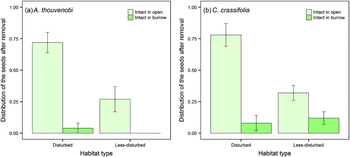
In total, 52 seeds were removed from their initial placement in the disturbed habitat (32 A. thouvenotii and 20 C. crassifolia seeds) and 77 in the less-disturbed site (17 A. thouvenotii and 60 C. crassifolia seeds). Among these removed seeds, 73.0% of the seeds in the disturbed habitat were retrieved, and 40.3% for those in less-disturbed habitat. There was no evidence of scatter hoarding; but some seeds were cached in rodent burrows (larder-hoarding). The mean proportions of seeds cached in burrows were similar between disturbed and less-disturbed habitats (Figure 1, P = 0.99). The proportions of seeds found intact on the open ground were high in both habitats (Figure 1), but were higher in disturbed than less-disturbed habitats (β = 2.70, P < 0.0001).
The mean proportion of Abrahamia thouvenotii (a) and Cryptocarya crassifolia (b) seeds found intact on forest floor after removal form initial placements were significantly higher in the disturbed than less-disturbed habitat in Ranomafana National Park, Madagascar; however, there was no significant difference in the mean proportion of seeds cached in burrows between these habitats. Error bar correspond to standard errors calculated under a binomial distribution, using prop.test function in R.

Pictures from the camera traps recorded nine instances in which the native rodent species, Nesomys rufus, was observed consuming or sniffing seeds in the experimental seed stations in the less-disturbed habitat. No pictures of rodents were captured in the disturbed habitats.
The observed difference in the proportions of seed handling between the two habitat types may be due to the varying degrees of vegetation cover available in these habitats. The dense vegetation in less-disturbed habitats may provide rodents protection from predators (Wenny Reference WENNY2000). Thus, they may consume seeds on the spot in the less-disturbed habitat because they may be less vulnerable; whereas in the disturbed habitat, they remove seeds to more safe microhabitats for later processing. Nevertheless, the proportions of seeds predated were low in both habitats, and seeds were less likely to be secondarily dispersed. In most cases, seed predation was partial, which can be non-lethal for large seeds and thus may allow for successful and/or faster germination (Vallejo-Marín et al. Reference VALLEJO-MARÍN, DOMÍNGUEZ and DIRZO2006).
The lower proportion of handled seeds observed in C. crassifolia compared with A. thouvenotii may be due to differences in seed traits (e.g. coat hardness, palatability, nutrient value and biochemical content), at the species-, family- or clade-level. For example, the seed coat of A. thouvenotii is less hard than that of C. crassifolia (pers. obs.), allowing rodents to easily consume the seed, and thus maximizing their energy intake while reducing the costs associated with seed handling (Hulme & Benkman Reference HULME, BENKMAN, Herrera and Pellmyr2002).
The native diurnal rodent species, Nesomys rufus (weight: 158.5 g; Goodman & Sterling Reference GOODMAN and STERLING1996), was likely to be responsible for seed predation and removal in the less-disturbed habitat during this study. This species was also found to preferentially select and larder-hoard large seeds in the Reserve National d'Andringitra in Madagascar (Goodman & Sterling Reference GOODMAN and STERLING1996), and was the most abundant species in the less-disturbed habitat of Valohoaka in RNP (Lehtonen et al. Reference LEHTONEN, MUSTONEN, RAMIARINJANAHARY, NIEMELÄ and RITA2001). Although the camera traps captured only nine pictures with identifiable species, possibly due to malfunctions, I speculate that other rodent species may also have visited the seed stations. The non-native nocturnal rodent species, Rattus rattus, may be responsible for the post-dispersal processes in the disturbed habitat because in Ranomafana, disturbance has been found to be associated with higher densities of R. rattus and the concurrent loss of native rodents (Lehtonen et al. Reference LEHTONEN, MUSTONEN, RAMIARINJANAHARY, NIEMELÄ and RITA2001). This species is also known to predate dispersed seeds in Madagascar's forests and elsewhere (Goodman & Sterling Reference GOODMAN and STERLING1996, Wilson et al. Reference WILSON, WRIGHT, CANHAM and RUSCOE2007). The native rodent species, Eliurus webbi (weight: 72.3 g, Goodman & Sterling Reference GOODMAN and STERLING1996), may also be active in seed predation or removal in Ranomafana because it has been observed to predate and cache large-sized seeds in burrows in other Malagasy forests (Goodman Reference GOODMAN1994, Goodman & Sterling Reference GOODMAN and STERLING1996).
Seasonal variation in fruit availability and seed production may influence the foraging behaviour of seed predators and hoarders, as well as the abundance and diversity of active animals, affecting post seed-dispersal processes (Forget & Cuijpers Reference FORGET and CUIJPERS2008, Forget et al. Reference FORGET, HAMMOND, MILLERON, THOMAS, Levey, Silva and Galetti2002). Given that this study was conducted during the dry season, a period of low food availability, the rodents may have been less active in foraging, having already stored food in burrows or caches during the wet season. This may also explain the higher rates of predation vs caching observed. An extensive study across multiple seasons is much needed for a detailed understanding of the roles of rodents in post seed-dispersal processes in Madagascar's forests.
ACKNOWLEDGEMENTS
This work was funded through a Rufford Booster Grant and a Wagoner Foreign Study Scholarship. Logistical and administrative support was provided by Centre ValBio, MICET, Rice University and Ecole Normale Supérieure d'Antananarivo. Thanks to J. Krauss, F. Rojoarivelo, P. Rafalinirina, J. Mamiharalala, N. Beson and J.-C. Ramanandraibe for their valuable assistance with fieldwork; and to A. Dunham, P.-M. Forget, H. Rogers, D. Park and three anonymous reviewers for valuable insights and comments.