INTRODUCTION
The marine ichthyofauna of Turkey has been studied by several authors for over six decades. Most of these studies served as the base for the two recently published comprehensive checklists of Turkish marine life (Bilecenoglu et al., Reference Bilecenoglu, Taskavak, Mater and Kaya2002) and of marine and freshwater fish (Fricke et al., Reference Fricke, Bilecenoglu and Sari2007). Bilecenoglu et al. (Reference Bilecenoglu, Taskavak, Mater and Kaya2002) enumerated 388 fish species from the Mediterranean coast of southern Turkey, out of the total of 448 species known from the seas surrounding Turkey. In consequent studies (summarized in Fricke et al., Reference Fricke, Bilecenoglu and Sari2007) another 16 marine species were added.
In this paper we report the first records of the slender snipe eel Nemichthys scolopaceus and Randall's threadfin bream Nemipterus randalli and the second record of the European finless eel Apterichthus caecus from Antalya Bay, southern Turkey. The specimens of the newly recorded species are deposited in the fish collection of Akdeniz University, Antalya, Turkey (AKU) and the fish collection of The Hebrew University of Jerusalem, Israel (HUJ).
MATERIAL EXAMINED
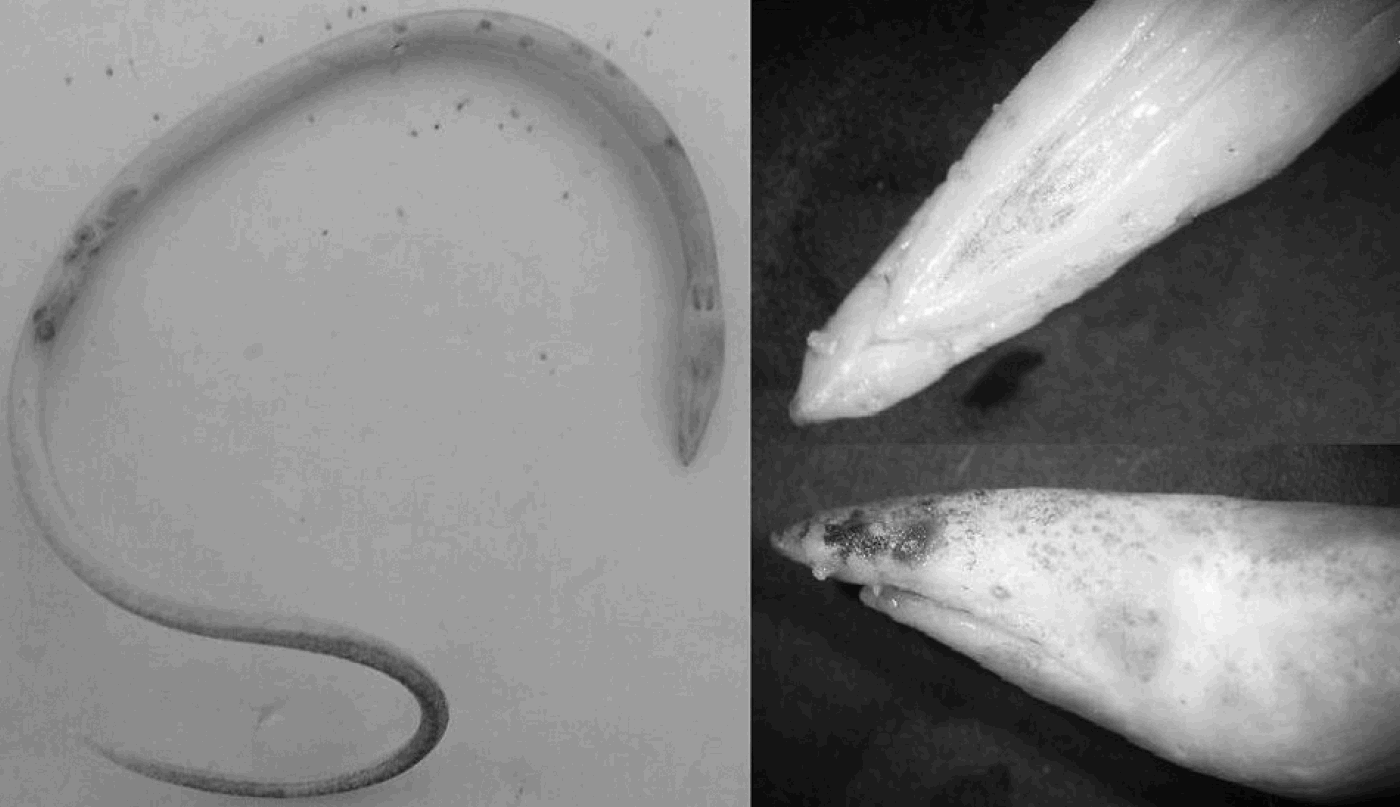
AKU-125, 322 mm total length (TL), 4.96 g, 13 February 2007, Bay of Antalya, collected with hand net during night SCUBA diving at 8 m (Figure 1).
Apterichthus caecus, AKU-125, 322 mm TL, 13 February 2007, from Antalya Bay, Turkey. Underside of snout and lateral view of head are shown in detail.

DESCRIPTION
Body very elongated, almost round in cross section. Body depth for most of its length 1.3% of TL. Enlarged throat and branchial region. Finless. Posterior tip stiffened and pointed. Head 6.9% in TL. Pointed snout (15.6%), small eye (4.0%) covered by membrane, interorbital (5.8%) all in head length. A row of depressible backward recurved teeth in both jaws. A row of vomerine teeth terminating slightly behind the vertical of eye. Anterior nostril tubular. Posterior nostril with a distinct nasal fold located just in front of upper lip. Gill opening ventral with delicate flap.
Colour (fresh): dorsal surface pinkish red, ventral surface creamy white.
Colour (in alcohol): dorsal surface beige with delicate brown spots on the head becoming gradually more dense on the snout. Caudal tip and the belly white.
REMARKS
Apterichthus caecus was known from the western basin of the Mediterranean and the west coast of Africa (Bauchot & Saldanha, 1986). Golani (Reference Golani1996) reported a single specimen from the coast of Israel. Recently, Fricke et al. (Reference Fricke, Bilecenoglu and Sari2007) reported the occurrence of this species from Antalya as the first record from Turkish waters based on the collection of a single specimen. Therefore the present report constitutes the second record from Turkey and provides evidence that the first record was not just a sheer accident of a stray specimen.
MATERIAL EXAMINED
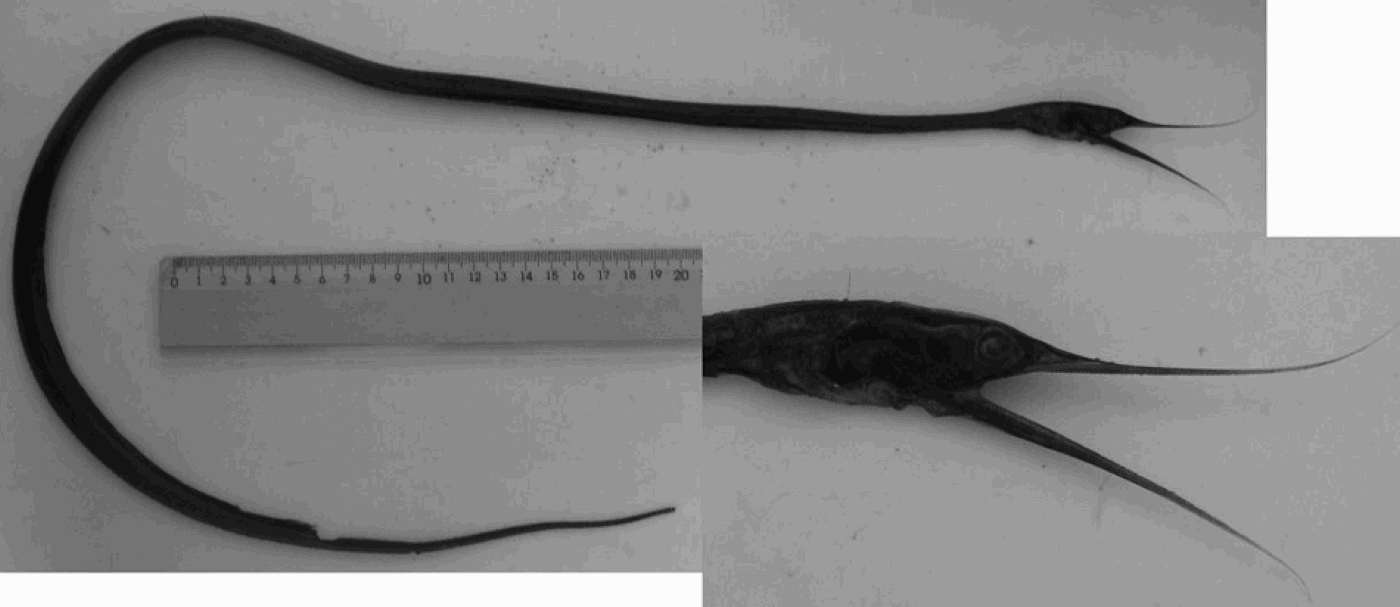
AKU-126, 820 mm TL, 47.2 g, 13 February 2007, Bay of Antalya, commercial trawl at 350 m (Figure 2); HUJ-19690, 550 mm TL, 25.2 g (same data as AKU-126). The extreme end of the tail of both specimens is missing, as well as part of both jaws of HUJ-19690.
Nemichthys scolopaceus, AKU-126, 820 mm TL (slightly damaged specimen), 13 February 2007 from Antalya Bay, Turkey. Lateral view of head shown in detail.

DESCRIPTION
Body extremely long and slightly compressed. Posterior part of head from eye to gill opening deeper than rest of body. Long dorsal fin originating 2/3 the distance between posterior edge of eye and pectoral fin. Anal fin originating slightly behind gill opening. Dorsal fin with well-developed spine-like rays, tapering toward the tail. Large eye, its diameter close to half of head depth. Extremely long and pointed beak-like mouth with nonocclusible jaws. Both jaws with bands of small teeth slightly recurved backwards. Teeth are visible when mouth closed. Jaw cleft reaches behind eye. There are 9–10 postorbital pores and 8–12 preopercular pores arranged in an irregular row.
Colour (in alcohol): large specimen dark brown-grey with light grey belly; smaller specimen brownish-grey with light beige belly.
REMARKS
Nemichthys scolopaceus is an oceanic species which has been collected from the surface (Nielsen, 1986) down to depths of 2500 m (Wheeler, Reference Wheeler1969). It is found on both sides of the Atlantic and the Pacific oceans (Bilecenoglu et al., Reference Bilecenoglu, Kaya and Irmak2006). In the Mediterranean it occurs in the western (Nielsen, 1986) and central regions (Mytilineou et al., Reference Mytilineou, Politou, Papaconstantinou, Kavadas, D'Onghia and Sion2005). Recently Bilecenoglu et al. (Reference Bilecenoglu, Kaya and Irmak2006) recorded a specimen from Marmaris in the southern Aegean Sea. The present record constitutes an additional eastward extension of the previously known distribution of this species.
MATERIAL EXAMINED
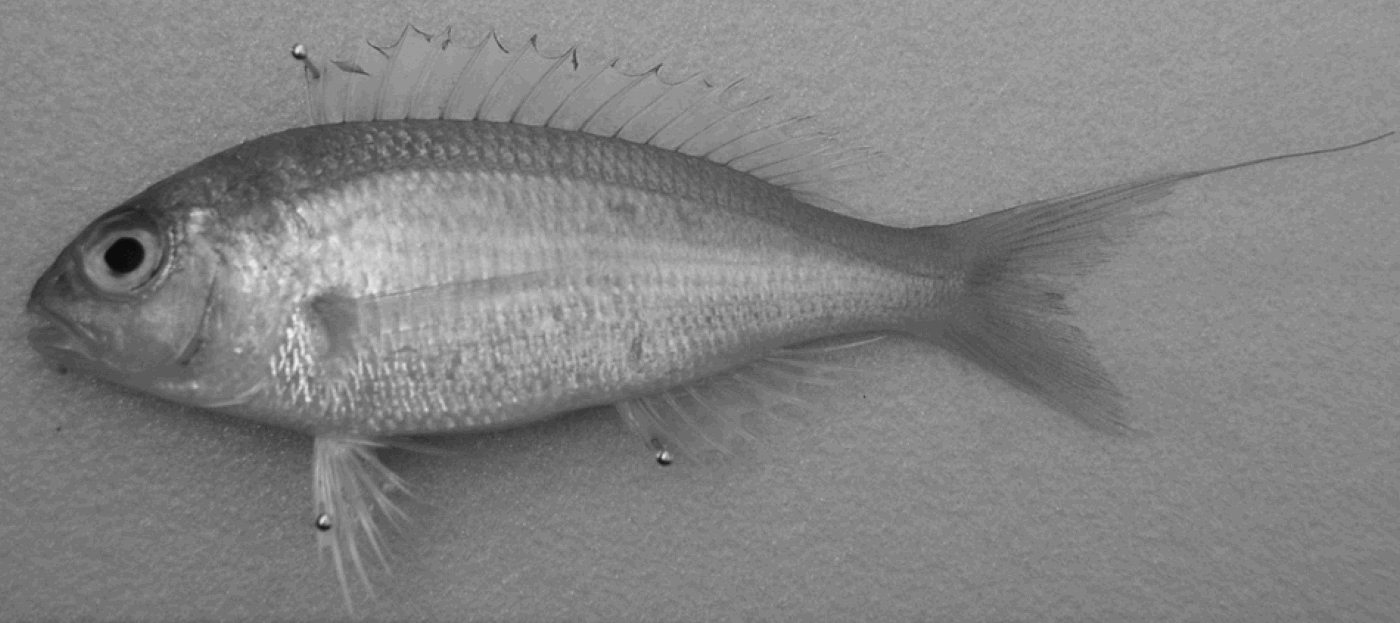
AKU-161, 166 mm SL (203 mm including caudal filament), 57.7 g, 9 February, 2008, Antalya Bay, trawl at 30 m (Figure 3); HUJ-19692, 96 mm SL (135 mm including caudal filament), 24.05 g, 2 February, 2008 (same data as AKU-161).
Nemipterus randalli HUJ-19692, 96 mm SL, 24.05 g, 2 February, 2008, Antalya Bay, Turkey. Trawl at 30 m.

DESCRIPTION
Body ellipsoid and slightly compressed. Continuous dorsal fin with ten spines and nine soft rays originating above pectoral fin. Anal fin with three spines and seven soft rays. Caudal fin forked, the upper ray extremely elongated. Pectoral fin with 15 rays reaching the anal fin origin. Pelvic fin with one spine and five soft rays. The first ray somewhat elongated, reaching slightly beyond anus on the right side and a short distance before anus on the left side. Large head 30.2% in SL. Snout 17.9%; eye 38.3%; interorbital 26.9%, all in SL. Mouth terminal reaching to anterior of eye margin. A series of small backward recurved teeth in both upper and lower jaws; eight canine teeth in anterior upper jaw and seven in lower jaw. Preoperculum scaly with three transverse rows, its posterior margin finely serrated. Three rows of scales on the operculum.
Colour (fresh): background pink, darker on the dorsal surface, becoming light pink on the belly. Four faint yellow longitudinal stripes on the flank. Caudal fin pink, the other fins almost transparent with a pinkish hue.
Colour (in alcohol): whitish-yellow.
REMARKS
The original distribution of Nemipterus randalli was the western Indian Ocean, from western India, the Arabian Gulf (Persian Gulf), the Red Sea to Madagascar (Russell, Reference Russell1990). It entered the Mediterranean via the Suez Canal as a lessepsian migrant. Nemipterus randalli was first recorded at the Mediterranean coast of Israel by Golani & Sonin (Reference Golani and Sonin2006), mistakenly as N. japonicus. Several months later, it became a common commercial species caught in large numbers by Israeli trawlers at depths of 25–60 m (unpublished data). Two years after it was first collected in Israel, it appeared as a common species in Lebanon (Lelli et al., in press) and later it was collected at Iskenderun Bay, Turkey (Bilecenoglu & Russell, in press). The present record from Antalya Bay constitutes a substantial westward extension of the distribution of this species. The discovery of two specimens from Antalya Bay suggests that N. randalli has established a sustainable population in its new region.
POSTSCRIPT
On 22–25 May 2008, six specimens of N. randalli were collected in the Bay of Antalya by commercial trawl (M.G., personal communication).