Introduction
Deixis is defined as the characteristic of languages that situates Speaker and Addressee in the communicative act of enunciation within spatio-temporal coordinates, taking the here-and-now as the origin or zero point of reference. Since the contexts of enunciation are variable, deictics are comparable to a container that defines the form of what was indicated at the moment of enunciation, with a word like “this”, and their function is clearly established within the language.
Every language has different systems to express deixis, and children are challenged with discovering the symbolic distinctions that are mapped by each of the deictic terms of the language they are exposed to. In a language like English, children have to grasp that although “this” and “that”, and “here” and “there”, have the communicative function of directing the Addressee's attention to a specific referent, the former are used for entities and the latter are used for locations. Children learning Yucatec Maya, a language spoken in southeastern Mexico, have a particular challenge, as there are four different place terms: demonstrative (le), locative adverbs (te'), ostensive evidential (je’), and modal adverbs (bey). These terms are not only different in terms of the type of referent, e.g., entities (le) vs. locations (te), but, in order to master the use of ostensive evidentials (je’), the Speaker has to take into account the Addressee's knowledge of a referent. There are also modal adverbs, which are used for comparison or exemplification (bey). It is this highly specialized particularity of the Yucatec Mayan system that provides an interesting perspective on the acquisition of deixis. The goal of the present study is to identify the route children follow in early acquisition to map out the function and the type of referent that corresponds to each base of the Yucatec Mayan deictic system.
Review of the Acquisition Literature on Deixis
Deictics are among the first words children acquire; their indexicality allows children to understand that there is a link between the index gesture, the word, and the referent (Clark, Reference Clark, Bruner and Garton1978). In the acquisition of deictic terms in English, children discover that such words attract their interlocutor's attention through gestural signaling (Brown, Reference Brown1973, Wales, Reference Wales, Fletcher and Garman1979, Clark, Reference Clark, Bruner and Garton1978). Carter (Reference Carter and Lock1978) recorded all the phonemes uttered by a preverbal child along with communicative attitudes and intentions, emphasizing the moments when the child's attention was directed to a determined object, and found that the phoneme /d/ was related to the child's intention to point to or draw attention to an object. For 12 months (from 1;00 to 2;00), the child added certain vowels to the phoneme /d/, which at 2;00 became the English deictics “this”, “these”, “that”, and “there”, and the definite article “the” (Carter, Reference Carter and Lock1978:339). The study showed that the child related a phoneme of the language to a specific communicative attitude at an early age: in this case, a directive function. That is, one single phoneme can become a pivot related to most of the elements of a deictic system. Carter (Reference Carter1975) reports that the child in his study initially associated the deictic “here” with a specific pragmatic context of exchange, and then began to extend its use to other contexts, until he finally began to use it as a locative term. Tanz (Reference Tanz1980) notes that the problem of acquiring a correct use of deictic terms is not in the indexical function in itself, but in discovering the symbolic distinctions that are mapped by each of the deictic terms. She argues that children associate deictics with more transparent contexts of use (in a first stage), until they discover other contexts that allow them to extend it to other uses. After having identified the mapping of one word to one function, they identify more instances by noting the salient invariant characteristics of other examples, which finally leads them to acquire their meaning.
Bowerman (Reference Bowerman1973:52–53) observes that, in the acquisition of Finnish, children use “there” (tuossa) to answer maternal questions that require answers such as “this”, “look”, and “that.” That is, they use the word to perform an overextended communicative function within the deictic system. The way in which mothers ask their children to name some objects, she suggests, might very well lead to the use of “there” to point out and name them because, instead of using questions such as “What's that?”, they normally ask “What's there/here?”
In a naturalistic study of a Spanish-speaking child, it was observed that in a first stage (ages 1;07-2:05) the child used demonstratives est- (proximity) /es- (distance) without deictic contrast. Later, the child mastered deictic contrast, but it was not applied in terms of social distance: proximity and distance vary socially, and not every member of a family shares the same conception of proximity as the mother does with a child. Only at the age of 3;05 was it found that the child used the deictic terms in a socially appropriate way (Espinosa Ochoa, Reference Espinosa Ochoa2001).
All of these studies suggest that children, in a first stage, tend to grasp a communicative function characteristic of these terms, and use it with a phonologically transparent term; in a second stage, they rehearse the specificities of other deictic terms, which lead them to overextensions, until they can finally map out every term and the corresponding characteristics of its members. Flores Vera (Reference Flores Vera1998), in his case study of the acquisition of the lexical inventory of a Yucatec Mayan child (1;1-1;07), notes that the boy used the ostensive evidential base je’ as the distal deictic te'lo’ (“there”), as the affirmative je'le’ (“yes” or “that's right”), as the demonstrative lelo’ (“that”), and even as the visual deictic ilej (“look”). It was also found next to the locative adverb te'(l), with no deictic specification. What he identified as the affirmative and visual deictic je'ele’ coincides with the function of the ostensive and can be interpreted as correct in the adult linguistic norm. However, the child also used the ostensive je’- with communicative functions corresponding to the locative adverb and the demonstrative. Although Flores Vera does not mention the overextension within grammatical categories, his description suggests that it exists. Bowerman (Reference Bowerman, Waterson and Snow1978) argues that overextension of the meaning of the first lexicon of the children shows the way in which children learn to classify, they found certain similarities among objects or events that are relevant to them.
General linguistic background
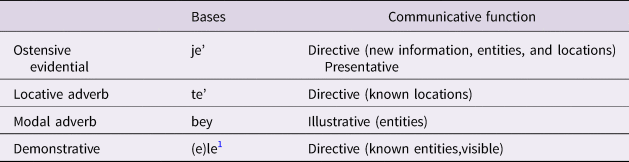
Yucatec Maya has a complex deictic system (Hanks, Reference Hanks1990) that varies even by dialectal zone. Every element of the deictic system is formed by two morphemes: a base or initial morpheme and an enclitic or final morpheme (-a’, -o’, ti’). These morphemes can be used both continuously, by adding an epenthetic “l” between them (e.g., le-l-a’, “this one”), and discontinuously (e.g., le paal-a', “this child”). This study focuses only on the four bases of the deictic system that are used in the dialectal area studied. In the noun phrase, these bases are of the grammatical categories of locative adverb (te'), demonstrative (le), modal adverb (bey), and ostensive evidential (je’) (Table 1).
Synopsis of the bases of the Yucatec Mayan Deictic System

According to Hanks (Reference Hanks1990), the deictic force, or communicative function of each deictic, is related to the Speaker's intention in uttering it, an intention whose function might go beyond individualizing a referent in the here-and-now of the enunciation. For example, when a Speaker takes an object and passes it on, with the intention that the Addressee receive it, the communicative function is presentative. If the Speaker's intention is that the Addressee focus attention on a referent, the intention is directive.
Each of these bases draws attention to a specific referent bearing a communicative function. The directive function points to different categories, each of which plays a different role. For example, a difference between demonstratives (le) and locative adverbs (te’) is the type of referent: the former points out entities, and the latter points out locations.

In (1) SAN refers to a piece of the puzzle, an entity. In (2), in the same scenario, te’- is used to refer to a place or location:

The differences can be even subtler, as attention and cognitive processes come into play: the difference between a demonstrative (le) and an ostensive evidential (je’) lies in the Addressee's degree of knowledge of or attention to the referent.

There is another difference between the demonstrative (le), the ostensive evidential (je’), and the modal (bey), all of which can refer to entities. Demonstratives refer to entities already known or within the field of joint attention between Speaker and Addressee, and ostensive evidentials mostly provide the Addressee with a new visual field, as shown above. Modal adverbs refer also to entities of a particular type or bring out an analogy with another element present in the context of enunciation: they illustrate to the Addressee what the Speaker means by comparing or exemplifying.

Ostensive evidentials are also uttered with the action of giving something to someone, or taking something from someone, in what Hanks (Reference Hanks1990) describes as the presentative function.

In spontaneous adult speech of the dialectal area studied, demonstratives and ostensive evidentials might also be uttered without the initial phoneme, and so it is not uncommon to find a continuous form uttered as ela’/elo’, instead of je'la’/je'lo’ and lela'/lelo' respectively. These incomplete forms will be referred to as aphaereses.
Methods
Three different databases were used for this analysis: a semi-naturalistic cross-sectional database compiled by the author, a naturalistic longitudinal case study, and the data from Gaskins (Reference Gaskins1990).
Cross-Sectional DatabaseFootnote 2
The cross-sectional data was collected by the author in the town of Yalcoba, located in the eastern part of Mexico's Yucatan State, a few kilometers from the city of Valladolid. Two different families, typical of the community, agreed to participate. The language exposure of the children of these families was monolingual, and no hearing or speech disorders were reported by their caretakers or detected during data collectionFootnote 3.
Two 1-hour video recordings were made in the course of a week. Only the speech of the girl NAY (2;00) in family 1 was considered for this study. NAY had two older brothers at time of data collection.
One 1.2-hour video of the family 2 was recorded, which includes the boy DAN (2;08), who was recorded playing with his teenage cousins; they agreed to play with him since there were no other children in the family who could playFootnote 4. DAN's teenage cousins are part of his everyday life; they live on the same solar (homestead), where it is common to interact on a daily basis with relatives who live in another house on the same solar. The first 40 minutes of the video were recorded in the morning, and the following 40 minutes were recorded the same afternoon.
The speech collected was spontaneous but not produced in scenes of ordinary life, since the children played games which were not familiar to them but which prompted the use of deictics. For this reason, I describe this data as semi-naturalistic. The children played with Mega Blocks, suitable for small children, and also coloring books, a puzzle and cards, activities that similarly encourage the utterance of deictics. The location was always their own home, so that the children felt comfortable in their environment.
Data from Gaskins (Reference Gaskins1990)
Data was also used from a transcription made by Gaskins (Reference Gaskins1990) of all of the place and locative terms used by a girl, Reina (1;08), and her family during 9 hours over 4 days. The main language of exposure of the child is Yucatec Maya, and her family is a typical Mayan family. No observations of hearing or speech disorders were made.
The descriptions made by Gaskins in this transcription provide enough information to understand which communicative function the girl attributed to each deictic. This data is useful because it was collected from the daily life of Yucatec Mayan people in a wide variety of contexts, and it is possible to compare it with the cross-sectional data taken from contexts of play that are not typical of the Mayan culture.
Longitudinal Data: Case Study
The longitudinal corpus was collected by Silvestre Naal Llanez, a native speaker of Yucatec Maya, in a small village located in eastern Yucatan State on the border with the state of Quintana Roo. Naal Llanez was able to capture the boy FEL speaking spontaneously for the first time at 2;10.07 and started recording him once a month for approximately two hours until he was 3;05.24. Part of the video was damaged by the humid environment, so there is a gap between 3;01,00 and 3;03,0; there is a total of seven 1-hour videos. FEL's age in each recording is shown in Table 2.
FEL's Age at Different Times in the Longitudinal Database

FEL's family is also a typical, monolingual Mayan family living on a solar; he had an older brother and an older sister at the moment of data collection, but, as Naal Llanez observed and was reported by the mother, FEL spent most of the time with his grandparents. Spending time in a different house on the same solar is not uncommon among the Maya, since the other houses belong to grandparents, aunts and uncles. No hearing or speech disorders were reported by the mother or detected during data collection. The interaction between FEL and his two older siblings always began with toys given to them by Naal Llanez: two plush puppets, a box with geometrical pieces to insert in holes of the corresponding shape, two children's books, and children's cards. After approximately 20 minutes the children tired of the toys and played with each other spontaneously.
Coding Procedure (Cross-Sectional and Longitudinal Data)
A transcription was first made by the author of the longitudinal and cross-sectional databases, with special attention to the scenes where deictics were uttered. Key points about participants’ roles and the relationships between them were recorded for each deictic, as well as its referent and the referent's position with respect to the Speaker. Perceptual factors (such as visual and tactile range) and social factors (such as the relationship between the interlocutors, the house where they were located, and their control over the space they occupied) were taken into account. Control was conceived of as the sense of ownership over the surroundings of each speaker, including both the reach of their hands and feet and the social right they had to manipulate the things in their immediate environment. The same factors were taken into account for the transcription of the cross-sectional data, the only difference being that the first version of these was made in Yalcoba by the author together with the mother of one of the girls who participated in the project. Each analysis therefore implied consideration of social distance, although it does not manifest itself explicitly in the results.
Each of the transcripts was reviewed by the author with a second native speaker, a 20-year-old female undergraduate student from the Universidad del Caribe, in the state of Quintana Roo. The student watched the video recordings while the author read the Mayan transcripts to her; because she never learned how to read or write in her native language, she indicated whenever she considered that the speakers said something different from what was recorded in the transcript. All deictics were labeled with their communicative function and the type of referent they alluded to. The author also reviewed the speakers’ communicative intentions regarding the deictics with her, with Naal Llanez, and with other native speakers; there was no disagreement. The transcripts focused on deictics, but all of the surrounding context necessary to understand each utterance was considered. The number of hours recorded and utterances analyzed per child is shown in Table 3. All utterances that were ambiguous or unintelligible were discarded. The sentences were unintelligible to the degree that it was not possible to know if they contained deictics. The total number of the discarded utterances constituted less than 5% of the total utterances analyzed.
Hours recorded and utterances analyzed

Results
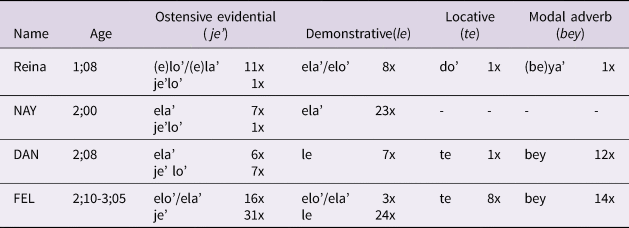
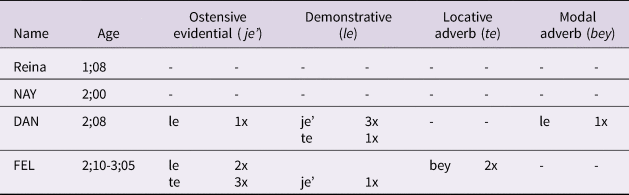
In order to map out the communicative function and the type of referent that corresponds to each base in children's speech, the results were organized into two different tables. Table 4 shows all of the deictics whose communicative functions and referent types were classified as correct according to the adult norm. Table 5 shows all of the deictics that were used incorrectly according to the adult norm. Table 4 was organized in ascending order according to the age of the children, so the youngest child, Reina (1;08), appears first. It can be seen that at Reina's early age she has already produced at least one deictic form to express the different communication functions with their respective type of referent. However, with the exception of the ostensive evidential, she identifies a certain function with a form that she has not yet managed to grasp phonologically. The deictic forms she utters emulate the final syllable, which in Yucatec Maya is perceptually salient. She uses la’/lo’ mostly for the presentative function (ostensive evidential); she directs attention to an entity (demonstrative) using ela’. She also uses the illustrative function once to describe how to perform an action, in response to a question from an adult (Bix ken in k'a’ej?, “How will I put it together?”), using the form ya’, which Gaskins interprets as beya’, and actually corresponds to the modal adverb function in the adult norm. For the locative adverb function, she uses the protoform do’.
Children's Deictics Classified as Correct According to the Adult Norm

Children's Deictics Classified as Incorrect According to the Adult Norm

In NAY (2;00), a child of similar age, there is an utterance of one complete ostensive evidential, but the other utterances lack the initial consonant, which is the minimal pair that makes the distinction between a demonstrative and an ostensive evidential. Here it is important to recall that adults use these incomplete forms or aphaereses for the ostensive evidential and demonstrative. NAY's utterances use only the demonstrative and ostensive evidential functions.
DAN (2;08) and FEL (2;10-3;05), unlike the younger children, can pronounce every deictic base like adults. It is noteworthy that only the older children have started to use the demonstrative base with its directive function.
Tables 4 and 5 show two stages. In the first (Table 4), younger children use forms and protoforms that can be recognized as forms paired with an adult function. In a second stage, although we can see in Table 4 that most forms are used correctly, Table 5 shows that every base is used for functions that correspond to a different base, suggesting a reorganization of the deictic system in which there are some overextensions of the bases.
DAN (2;08) overextends demonstratives (le) in functions that correspond to ostensive evidentials and modal adverb functions, at the same time using ostensive evidentials (je’) and locative adverb forms (te’) for functions that correspond to demonstratives. FEL (2;10-3;05) overextends demonstratives (le) and locative adverbs (te’) to ostensive evidentials, modal adverb forms (bey) to locative adverbs, and an ostensive evidential (je’) to demonstratives. Three examples of FEL's overextensions are shown in (6), (7), and (8). In (6) he overextends the modal adverb form as a locative adverb, so when he utters bey he seems to refer to the video camera as a place:

FEL might be wondering about how he is being recorded compared to his brother (“Where is FEL being recorded? Just like VAL is being recorded?”). Either way, the utterance refers indirectly to a place, and all of the Yucatec Maya native speakers consulted agreed that these expressions are only found in child speech.
In (7) FEL (2;10) wants to suggest a new focus of attention on a book. Given that he is in joint attention with his sister, adult speech would require the demonstrative lela’. Instead, he uses three different forms to direct the focus of attention in joint attention, and he repeats them.

In this example, ostensive evidentials in the complete form are being overextended. Since the second aphaeresis is a repetition it was counted only once. FEL attributes the same directive function to an entity using ela’, leti’Footnote 5, and je'la’. He might know intuitively that they are different, but he cannot choose one. In (8) he uses the locative adverb form (te’) as a presentative, an ostensive evidential function.

Discussion
Yucatec Maya has a complex place deictic system, which, unlike European languages, includes ostensive evidentials and modal adverbs in addition to demonstratives and locative adverbs. The differences in function within the system are subtle: the communicative function of demonstratives and locative adverbs is directive, as they direct attention to a specific referent, but the former refers to entities and the latter to locations. Ostensive evidentials and modal adverbs also refer to entities, but ostensive evidentials refer to entities that are unknown to or outside the focus of attention of the Speaker, and modal adverbs refer to them with the communicative function of exemplifying or comparing, what has been described here as an illustrative function. As Tanz (Reference Tanz1980) notes, the main obstacle children face in acquiring correct use of deictic terms is in learning the symbolic distinctions they map. For Yucatec Mayan children this is a very complex task. The present study shows that this mapping of deictic terms onto their respective functions is a two-stage process.
First Stage
A key difficulty for children learning Yucatec Maya is the phonetic similarity of different forms in its deictic system. Protoforms like lo’/la’ are used in the first stage, mapped initially with a presentative function (ostensive evidential) and uttered as elo’/ela’ with a directive function for entities (demonstrative). Carter (Reference Carter and Lock1978) found that an English phoneme similar to /th/ serves as the pivot protoform in the acquisition of deictic words like “this”, “these”, “that”, “there”, and even “the.” It could be that Yucatec Mayan children grasp that there are phonological forms that can be used for certain prototypical or frequent functions, which they then use as pivot forms. In the case of the younger children (1;08-2;00) in the present study, it is not the beginning but the end of the words lo’/la’ and elo’/ela’ that seem to be a pivot (proto-)form for demonstratives and ostensive evidentials, a well-known feature in the acquisition of Mayan verbs (Pye, Pfeiler, de León, Brown & Mateo, Reference Pye, Pfeiler, de León, Brown, Mateo and Pfeiler2007). Importantly, although the locative adverb te'lo’ has the same ending as the demonstrative and ostensive evidential forms, children do not mix them in this stage: they somehow separate the forms that refer to entities and locations.
Flores Vera (Reference Flores Vera1998) reports that the first deictic of the child in his study (1;1-1;07) was je’, the base of the ostensive evidential form and the complete form je'lo’ was also found in the younger children of the present study. It seems that the form je’(lo´) and the aphaeresis converge in the first stage of acquisition to express both demonstrative and ostensive evidential functions, i.e., both presentative and directive referring to entities irrespective of the Addressee's knowledge of the referent. Bowerman (Reference Bowerman, Waterson and Snow1978) notes that children's categorization of the meaning of their first words resembles the categorization of meaning in other languages. The categorization performed here by Yucatec Mayan children actually resembles that of demonstratives in many other languages (including English and Spanish, and essentially all others except Mayan languages) in which there is no deictic word to refer specifically to entities that are unknown to the Addressee.
The presence of locative and modal adverbs is rare in the first stage, so it seems that although children have managed to map these forms to prototypical or frequent functions, it takes them longer to associate them with additional contexts and associate them with their respective functions. In the language acquisition process, it is not uncommon for children to learn a word or linguistic construction and associate it with a particular context to express a very particular function: for example, by saying “bye-bye” every time a door is closed. It is only later that children extend the function of locative and modal adverbs to other contexts, which may be mostly correct, but which may also overextend, a phenomenon found in a second stage.
Second Stage
Having grouped the ostensive evidential bases and the aphaereses to express functions of both demonstratives and ostensive evidentials, children finally manage to differentiate them in the second stage, so it is here that the demonstrative bases appear in their speech for the first time. However, this differentiation is not yet completed, since the demonstrative and ostensive evidential bases are each used to express functions of the other. Demonstrative forms are also overextended to the function corresponding to modal adverbs. It seems that children have identified that demonstratives direct attention to entities, not locations (there is no overextension with locative adverbs), but it is still not yet clear to them that demonstratives cannot be used with an illustrative function (a function they can perform in English when combined with “like”, as in “like this”). The locative adverb base te’ is also used for a function corresponding to the ostensive evidential, where the child directs attention to a location already in the Speaker's focus of attention, meaning that the child is probably aware of the Addressee's knowledge of the referent. This is a specialization of the system, a characteristic that takes longer to refine.
The final incorrect use noted, where the child uses the modal adverb bey to direct attention to a location (the video camera), is also interesting. Bey could have been used to point to the video camera if it was conceived of as an entity, not a location, and only if the expression implied the function of illustrating something. This was not the case in the example of FEL, an example that “sounded like children's speech” to adult native speakers of Yucatec Maya. This is once again an example of overextension, where children map forms and functions but go through a process of trial and error. As Bowerman (Reference Bowerman, Rogers and Sloboda1983) notes, this overextension of functions suggests that children go through a defined stage where they reanalyze meanings and reorganize their lexicon. Yucatec Mayan children map the form and meaning of each of the members of this complex system, noting their similarities before accommodating the complex specialization of each function.
Conclusion
It can be concluded that the acquisition of the Yucatec Mayan deictic system begins with expressing broad prototypical functions, which can actually match the deictic categorizations of other languages. A second step consists of a trial-and-error stage where children use more specialized functions, with a reanalysis and reorganization of the system, that may involve overextension. Overextensions are found in language acquisition at all levels, but to find them in the deictic system of Yucatec Maya is extremely helpful because it allows us to follow a path into this complex microsystem. The linguistic clues that can be followed in less constrained areas, like the overextension of meaning in the nominal or verbal lexicon, allow us to focus a high-powered microscope on the phenomena of early acquisition. In this study, it was possible to take a step back to see how children accommodate the elements of a highly complex constrained linguistic system.
Abbreviations
- ABS
Absolutiv
- ADJ
Adjective
- ADV
Adverb
- CLAS
Classifier
- COM
Completive Aspect
- DEI
Deictic
- ENCL
Enclitic
- ERG
Ergative
- EP
Epenthesis
- IMP
Imperative
- INT
Interjection
- NEG
Negation
- NOM
Proper Name
- NUM
Numeral
- PL
Plural
- POS
Possessive
- PROX
Proximal
- REF
Reflexive
- SG
Singular
- VB
Verb
- 1
First person
- 3
Third person
Acknowledgments
I am indebted to the Mayan families who allowed us to make videorecordings in their homes and to Silvestre Naal Llanez for the systematic and committed data recollection. In its different stages, this work benefited from feedback and comments from Melissa Bowerman†, Penelope Brown, Barbara Pfeiler, Lorena Pool Balam, and two anonymous reviewers, to whom I am grateful.
Appendix Semantic and pragmatic characteristics in the locative deictic system of Yucatec Mayan