Dilatation of the aortic root is a frequent complication after surgical repair of CHD during the long-term follow-up. Aortic root dilatation will lead to subsequent aortic insufficiency, dissection, or rupture, and can result in death. Reference Niwa1,Reference Cotts, Salciccioli and Swanson2 The aortic dilatation in patients with coarctation of the aorta, bicuspid aortic valve, and conotruncal abnormalities including tetralogy of Fallot and pulmonary atresia with ventricular septal defect could develop due to intrinsic pathology, hemodynamic factors, or associated malformations. Reference Niwa1,Reference Cotts, Salciccioli and Swanson2 On the other hand, the newly constructed aorta after CHD repair involving the aortic valve or aortic roots, such as the Ross operation, the arterial switch operation, or the Konno operation, could expand after being exposed to high systemic pressure over time. Reference Schusterova, Banovcinova and Vachalcova3–Reference Koolbergen, Manshanden and Yazdanbakhsh6
The aortic root diameter is a major criterion for elective aortic root replacement and this criterion is markedly influenced by the underlying aetiology and histopathology of aortic diseases. However, the definitive operative criteria for patients with a history of surgical repair for CHD and aortic root dilatation have not been established.
The purpose of this study is to assess the mid-term surgical outcomes of aortic root replacement after CHD repair and to discuss the indication for aortic root replacement in these patients with pathological findings.
Materials and methods
Patient population and study design
This study is a retrospective, cohort study with consecutive patients undergoing aortic root replacement after surgical repair of CHD at the Tokyo Women’s Medical University Hospital between June 1999 and December 2022. The patients with simple atrial septal defect repair or with Marfan syndrome were excluded. This study was approved and monitored by the Tokyo Women’s Medical University’s research ethics committee (institutional review board number: 2022-028, approval date: Jul 1, 2022). The need for patient consent was waived because of the retrospective, registry-based study design. This study was performed in conformity with the Declaration of Helsinki.
Evaluation and definition
The preoperative diameter of the sinus of Valsalva, the dimension and function of the ventricle, and valve size and function were assessed by trans-thoracic echocardiography. Systemic ventricular dimension was assessed using end-diastolic diameter and end-systolic diameter and systemic ventricular function was assessed using fractional shortening. Post-operatively, these parameters were assessed at 6 months, 1, 3, and 5 years after surgery, and compared overtime. Early mortality was defined as death before hospital discharge and late mortality was defined as any death after discharge.
Operative indication and procedure
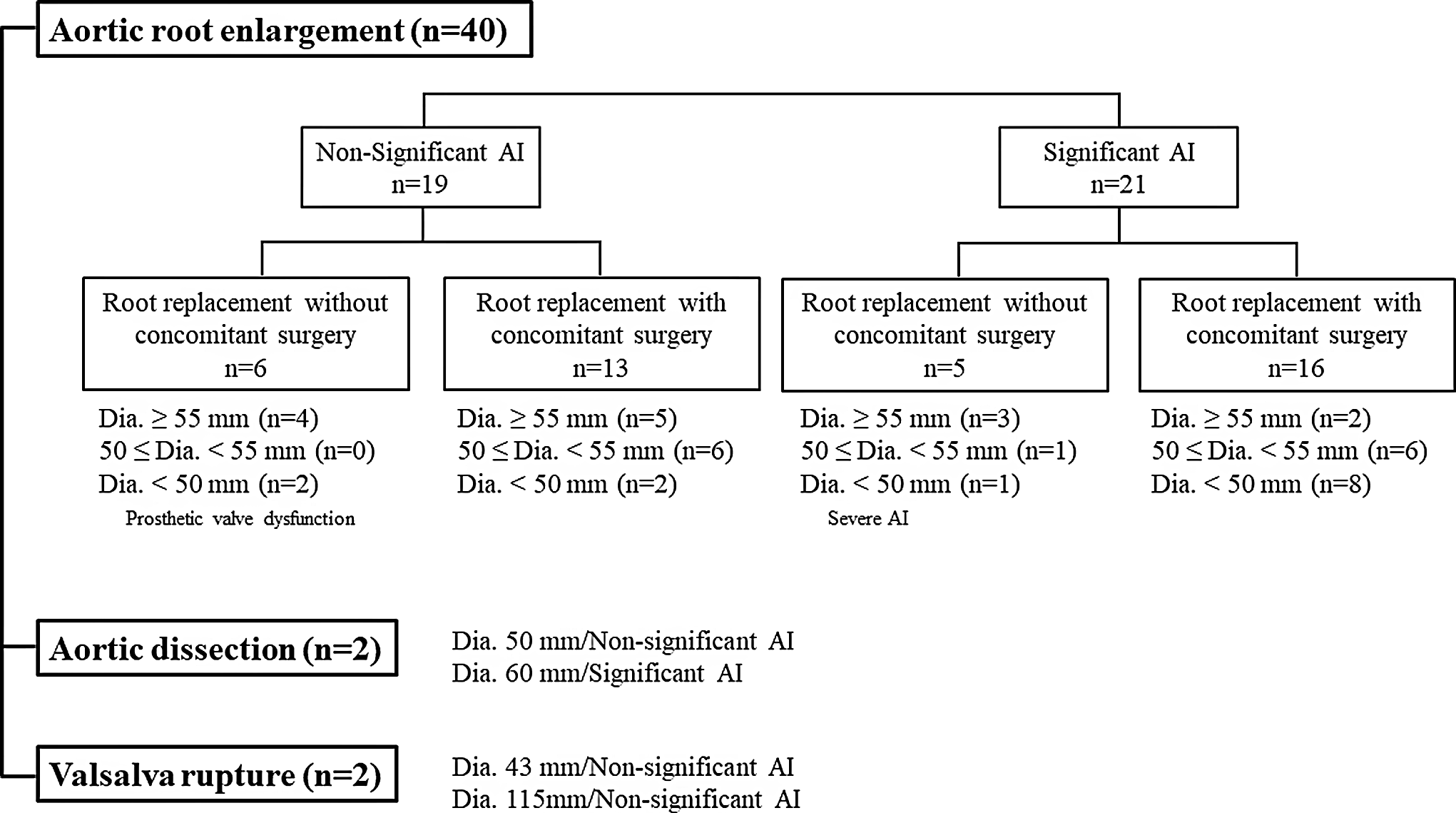
The primary indications for surgery typically encompass aortic root enlargement, rupture of the Valsalva sinus, and aortic dissection. However, the decision to proceed with surgical intervention for aortic root enlargement can exhibit slight variations influenced by the patient’s hemodynamic condition, aortic insufficiency, the presence of concomitant surgical procedures, each surgeon’s decision, and even the patient’s preference. For example, among six patients without significant aortic insufficiency undergoing aortic root replacement without concomitant surgery for aortic root enlargement, four patients had aortic enlargement more than 55 mm, and two patients had root diameters less than 50 mm and prosthetic aortic valve dysfunction. On the other hand, among five patients with significant aortic insufficiency undergoing aortic root replacement without concomitant surgery for aortic root enlargement, three patients had aortic enlargement more than 55 mm, and one patient had a root diameter of less than 50 mm and severe aortic insufficiency. The patient demographic of this study is summarised in Figure 1. The choice between valve-replacing and valve-sparing in aortic root replacement depended on the anatomic conditions. The type of prosthetic valve was decided after consultation with the patient. The method of cardiopulmonary bypass and coronary reconstruction was determined by the surgeon. A concomitant procedure was added based on the hemodynamics in respective cases.
The patient demographic. A total of 44 patients were enrolled in our study. Of these patients, two patients underwent aortic root replacement for aortic dissection and two patients for sinus of Valsalva rupture. Forty patients underwent aortic replacement for aortic root enlargement with/without significant aortic insufficiency and with/without concomitant surgery. AI = aortic insufficiency.

Statistical analysis
All statistical analyses were performed with JMP Pro version 16 software (SAS Institute Inc., Cary, NC, USA) and R version 4.3.1 (R Foundation for Statistical Computing, Vienna, Austria). Data of continuous variables were presented as mean ± standard deviation for a normal distribution and as median (25th–75th percentile interval) for a non-normal distribution after confirming by the Shapiro–Wilk test. Categorical variables were presented as a number (frequency). A one-way repeated measures analysis of variance was used to determine whether the normal distribution between paired observations on a particular outcome is significantly different and the Bonferroni test was used as a post-hoc test. The actual survival time was estimated from the date of aortic root replacement to the date of all-cause death or the last contact and analysed by the Kaplan-Meier curve. The competing risks regression model was developed to describe the cumulative incidence function according to the method of Fine and Gray. The cumulative incidences of cardiovascular reoperation and aortic root or valve-related reoperation were calculated with death as competing for failure events. P values of < 0.05 were considered statistically significant.
Results
Patient characteristics
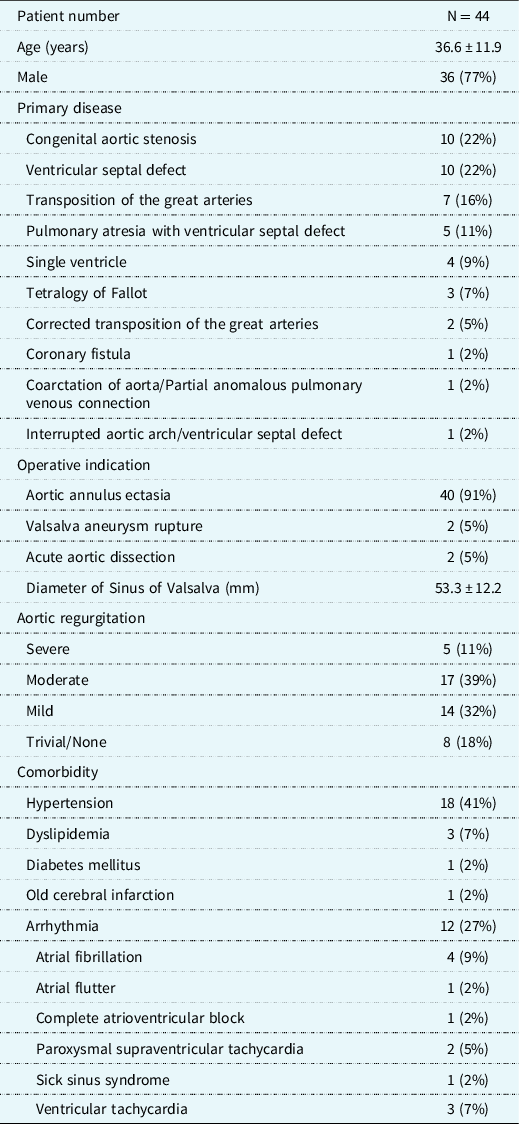
Forty-four patients (36 male and 8 female) were enrolled. The mean age at the operation was 36.6 ± 11.9 years. Mean body weight and body surface areas were 57.6 ± 11.8 kg and 1.6 ± 0.2 m2, respectively. The most frequent primary congenital diagnosis was congenital aortic stenosis (n = 10) and ventricular septal defect (n = 10), followed by transposition of the great arteries (n = 7). Chromosomal disorder included Turner syndrome (n = 1), and heterotaxy syndrome included polysplenia (n = 3). Operative indications were aortic root enlargement with or without aortic insufficiency (n = 40), Valsalva aneurysm rupture (n = 2), and aortic dissection involving aortic root (n = 2). Significant aortic insufficiency, more than moderate aortic insufficiency, was found in 22 patients (50%). The mean diameter of the sinus of Valsalva was 53.3 ± 12.2 mm. In two cases of dissection, the measurements were 50 mm and 60 mm. In two cases of sinus of Valsalva rupture, the aortic root diameters were 43 mm and 115 mm. The patient demographic is summarised in Figure 1. Mean end-diastolic diameter, end-systolic diameter, and fractional shortening of systemic ventricle were 54.7 ± 9.8 mm, 38.0 ± 8.1 mm, and 0.29 ± 0.07, respectively. Two patients had more than moderate systemic atrioventricular valve regurgitation, and two had more than moderate pulmonary atrioventricular valve regurgitation. Almost half of the patients were treated with the anti-hypertensive drug preoperatively. The median predicted operative mortality rate derived from the EuroSCORE II was 8.9 (7.2–10.6) %. Patient characteristics are summarised in Table 1.
Patient characteristics

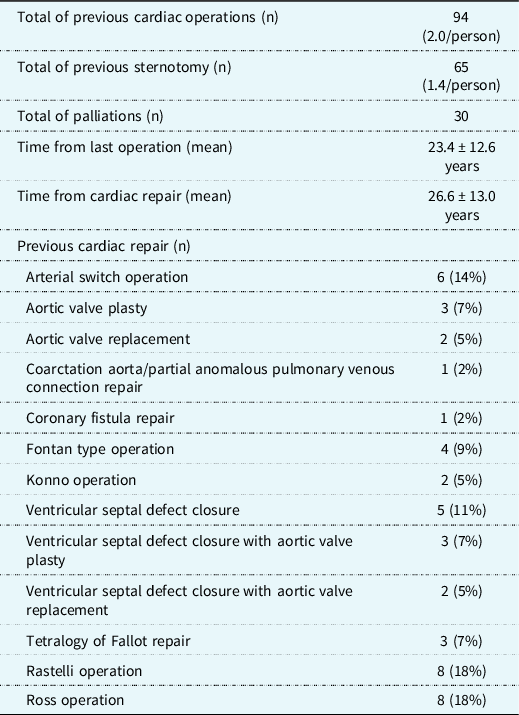
The mean time from the surgical repair of CHD to aortic root replacement and time from the last operation to aortic root replacement was 26.6 ± 13.0 and 23.4 ± 12.6 years. A total of 18 patients underwent 30 palliations prior to CHD repair. The most frequent CHD repair was ventricular septal defect closure (n = 10), followed by Rastelli operation (n = 8) and Ross operation (n = 8). Twenty-three patients underwent 26 aortic root or aortic valve-related procedures including the Ross operation (n = 8), aortic valvuloplasty (n = 6), the arterial switch operation (n = 6), aortic valve replacement (n = 4), and the Konno operation (n = 2). Previous operative data are summarised in Table 2.
Previous operation

Surgical outcomes
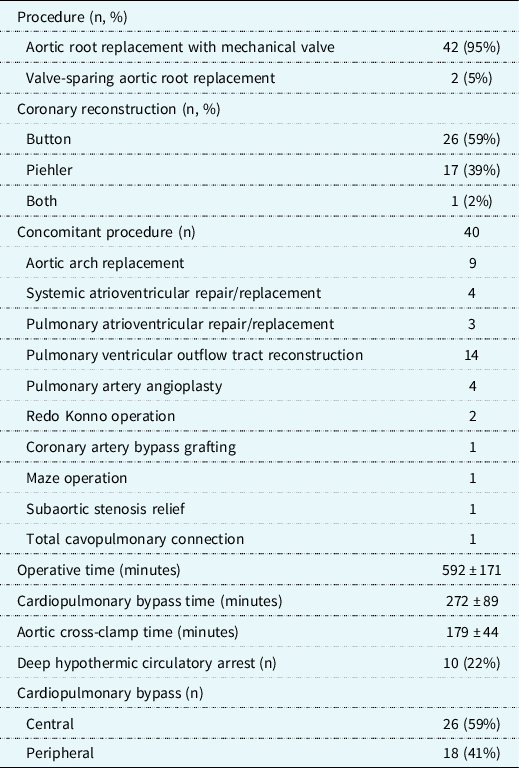
Forty-two patients underwent valve-replacing aortic root replacement, and two patients underwent valve-sparing. One valve-sparing aortic root replacement was intraoperatively converted to valve-replacing aortic root replacement due to uncontrollable aortic insufficiency. All valve-replacing aortic root replacement was completed using a mechanical valve. A total of 40 concomitant procedures were conducted on 29 patients. Mean cardiopulmonary bypass and aortic cross-clamp times were 272 ± 89 and 179 ± 44 minutes. For postoperative hemodynamic support, one patient required post-operative extracorporeal membrane oxygenation, and one required intra-aortic balloon pumping. Operative results are summarised in Table 3.
Operative results

Early outcomes
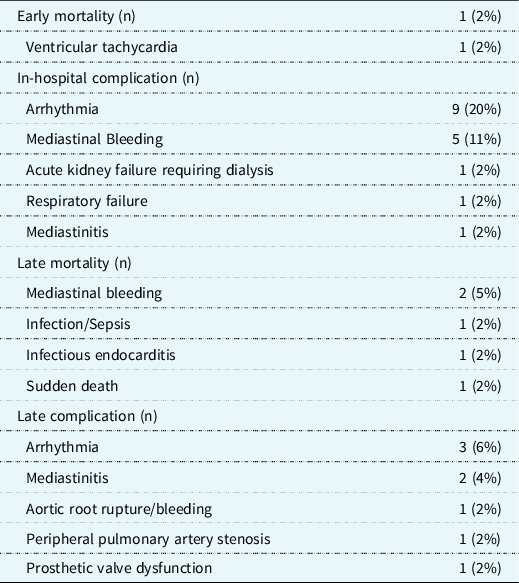
There was one early mortality (2%). A 48-year-old patient with congenital aortic stenosis, who had a surgical history of aortic valvuloplasty with mitral valvuloplasty at the age of 5, the Konno operation at 18, and mitral valve replacement at 48, underwent emergent valve-replacing aortic root replacement with redo Konno operation for sinus of Valsalva rupture 7 months after mitral valve replacement. However, the patient died of uncontrollable ventricular tachycardia 13 days after root replacement. The most frequent in-hospital complication was arrhythmia including atrial fibrillation (n = 5), atrial tachycardia (n = 2), ventricular tachycardia (n = 1), and complete atrioventricular block (n = 1) where the pacemaker was implanted. Post-operative outcomes are summarised in Table 4.
Post-operative outcomes

Late outcomes
The median follow-up was 3.5 (1.3–7.6) years. There were five late mortalities, and the causes of the death were mediastinal bleeding, sepsis, infectious endocarditis, and sudden death. A 50-year-old man with ventricular septal defect, who had a history of ventricular septal defect closure at the age of 6 years, experienced aortic root rupture and bleeding 9 months after aortic root replacement. Then, he underwent redo valve-replacing aortic root replacement and concomitant coronary artery bypass grafting, however, he died of sepsis 1 month after redo surgery. Two patients died of mediastinal bleeding after experiencing mediastinitis. Actuarial survival at 5–10 years after root replacement was 81.0 ± 6.6% (Fig. 2a).
Survival and reoperation. a ) Actuarial survival at 5 and 10 years after root replacement was 81.0 ± 6.6% and 81.0 ± 6.6%, respectively. b ) The cumulative incidence of cardiovascular-related reoperation was 11.9% at 5 years after root replacement and 18.4% at 10–15 years. c ) The cumulative incidence of the aortic root or valve-related reoperation at 5–15 years after root replacement was 5.6%.

There were five cardiovascular reoperations including two pacemaker implantations for one sick sinus syndrome and one atrioventricular block, one implantable cardiac defibrillator implantation for ventricular tachycardia, one aortic valve re-replacement for prosthetic valve dysfunction, and one aortic root re-replacement for aortic root rupture as described above. There was no bleeding event associated with anticoagulant therapy. The cumulative incidence of cardiovascular-related reoperation was 11.9% at 5 years after root replacement and 18.4% at 10–15 years (Fig. 2b), and the cumulative incidence of the aortic root or valve-related reoperation at 5–15 years after root replacement was 5.6% (Fig. 2c). Late catheter intervention included one peripheral pulmonary artery stenting for left pulmonary artery stenosis and one catheter ablation for atrial fibrillation. The complications and the cause of mortality are summarised in Table 4.
Echocardiographic data
Time-course of changes in systemic ventricular end-diastolic diameter, end-systolic diameter, and fractional shortening were described in Fig. 3a-c. Systemic ventricular end-diastolic diameter decreased from 54.7 ± 9.8 mm before root replacement to 47.6 ± 5.0 mm at 5 years after aortic root replacement though there were no significant differences between the time points (Fig. 3a: One-way repeated measures analysis of variance, p = 0.0666). Systemic ventricular end-systolic diameter also decreased from 38.0 ± 8.1 before root replacement to 33.5 ± 4.8 at 5 years after root replacement (Fig. 3b); however, there was no significant time-course change (One-way repeated measures analysis of variance, p = 0.5131). After temporally decreasing within 1 month after root replacement, fractional shortening increased from 0.26 ± 0.07 at 1 month to 0.30 ± 0.07 at 5 years (Fig. 3c); however, there was no significant difference in time-course change (One-way repeated measures analysis of variance, p = 0.7007).
Time-course changes of systemic ventricular EDD, ESD, and FS. a ) Systemic ventricular EDD decreased significantly over time from 54.7 ± 9.8 before root replacement to 47.6 ± 5.0 at 5 years after root replacement, however, there were no significant differences (One-way repeated measures ANOVA, p = 0.0666). b ) Systemic ventricular ESD also decreased from 38.0 ± 8.1 before root replacement to 33.5 ± 4.8 at 5 years after root replacement; however, there was no significant time-course change (One-way repeated measures ANOVA, p = 0.5131). c ) FS decreased temporally within 1 month after root replacement and increased from 0.26 ± 0.07 at 1 month after root replacement to 0.30 ± 0.07 at 5 years after root replacement; however, there was no significant difference in time-course change (One-way repeated measures ANOVA, p = 0.7007). ANOVA = analysis of variance; FS = Fractional shortening; EDD = End-diastolic diameter; ESD = End-systolic diameter.

Pathological findings
Histopathological specimens were studied in nine non-Marfan syndrome patients, which are single ventricle (n = 3), transposition of the great arteries after the arterial switch operation (n = 2), coarctation of aorta with partial anomalous pulmonary venous return (n = 1), congenital aortic stenosis after the Ross procedure (n = 1), ventricular septal defect (n = 1), and ventricular septal defect with interrupted aorta after the Konno procedure (n = 1).
In a patient with transposition of the great arteries after the arterial switch operation undergoing valve-replacing aortic root replacement with pulmonary valve replacement, moderate medial degeneration including focal loss of elastic lamellae and mucoid extracellular matrix accumulation was found in the aortic root (Fig. 4) and similar findings were found in the pulmonary artery (Fig. 5). Similar aortic medial degeneration with less arteriosclerotic lesion was also observed in the other eight patients with a different aetiology such as single ventricle, ventricular septal defect, and congenital aortic stenosis after the Ross procedure. The extension and severity of degeneration varied from case to case and one case with a history of ventricular septal defect repair presented Marfan syndrome-like findings (Fig. 6).
Histopathological examination (aortic root). a ) Hematoxylin-eosin staining. b ) Elastica-van Gieson method. c ) Masson-trichrome method. Moderate medial degeneration including focal loss of elastic lamellae and mucoid extracellular matrix accumulation was found in the aortic root. The extension and severity of this degeneration depended on the case.

Histopathological examination (pulmonary artery). a ) Hematoxylin-eosin staining. b ) Elastica-van Gieson method. c ) Masson-trichrome method. Moderate medial degeneration including focal loss of elastic lamellae and mucoid extracellular matrix accumulation was also found in the pulmonary artery.

Histopathological examination (aortic root). Cystic medial degeneration, a condition often associated with connective tissue diseases like Marfan syndrome, was observed in a 22-year-old man who had undergone ventricular septal defect repair at the age of 3.

Discussion
Aortic root procedure
For patients with aortic root diseases, valve-replacing aortic root replacement has been used widely while valve-sparing aortic root replacement is becoming a well-established procedure. Reference Mookhoek, Korteland and Arabkhani7,Reference Baliulis, Ropponen and Salmon8 In the context of a conotruncal abnormality, valve-sparing aortic root replacement appears to be challenging due to anatomical and hemodynamic factors, as well as the potential addition of other concomitant procedures. Reference Dearani, Burkhart and Stulak9,Reference Volguina, LeMaire and etal10 Especially in patients with significant aortic insufficiency, it might not be feasible because significant aortic insufficiency will result in poor aortic valve durability and this procedure will prolong cardiopulmonary and aortic cross-clamp times compared to valve-replacing. Reference Volguina, LeMaire and etal10 We have preferred valve-replacing aortic root replacement over valve-sparing procedures based on these reasons, and this study shed light on the mid-term of aortic root replacement in these complex patients.
Comparison with aortic root replacement for non-CHD patients
The outcomes of aortic root replacement after CHD repair seem to be different from those for non-CHD patients because of the primary diseases, the history of cardiac surgeries, and potentially pathological characteristics. According to a systematic review and meta-analysis for root replacement with mechanical valves, it was reported that the pooled early mortality was 6% and the annual linearised occurrence rate for late mortality was 2%. Reference Mookhoek, Korteland and Arabkhani7 In our study, the early mortality of root replacement for CHD patients was lower with an observed mortality of 2.0% than the predicted mortality of 8.9% by EuroSCORE II. However, the late mortality seemed higher with overall survival of 81.6% at 5–10 years after root replacement, compared to other studies. Reference Mookhoek, Korteland and Arabkhani7,Reference Hamandi, Nwafor and Baxter11 Furthermore, the cumulative incidence of aortic root or valve-related reoperation, at 5.6%, appeared higher than the linearized occurrence rates reported in a systematic review and meta-analysis, which were 0.46% for root-related reoperations and 0.30% for valve-related reoperations. Reference Mookhoek, Korteland and Arabkhani7 These findings may suggest that aortic root replacement after CHD repair can be performed safely with low mortality, but those patients have high risks of root- and valve-related reoperation and subsequent late mortality due to primary disease including single ventricle or multi-valvular diseases and a history of multiple surgeries.
Pathological characteristics in aortic root diseases after CHD repair
Medial degeneration is defined as disorganisation, thinning, and fragmentation of elastic fibres, a conspicuous increase in collagen, mucoid extracellular matrix accumulation, and smooth muscle cell disorganisation and nuclei loss. Reference Niwa1 Aortic medial degeneration was severe in Marfan syndrome, and some adults with CHD experience progressive dilatation of the aortic root even after CHD repair, due to aortic medial degeneration. Aortic medial degeneration in CHD patients is either caused by intrinsic factors or volume overload of the aorta due to primary right-to-left shunting and reported to be less extensive and less severe in patients with CHD in previous studies than that in Marfan syndrome. Reference Niwa1,Reference Niwa, Perloff and Bhuta12 In our study, a histological study was conducted on nine non-Marfan patients. The important findings are that aortic medial degeneration with less arteriosclerotic lesion was found in all patients regardless of primary diagnosis or previous operation, and the extension and severity of degeneration varied from case to case. Medial degeneration was additionally observed in the pulmonary artery in the transposition of the great arteries patient. Therefore, a pulmonary artery also might have a risk of dilating during the long-term follow-up.
Operative indication of aortic root dilatation
As aortic root replacement for aortic root dilatation is a prophylactic surgery to avoid acute aortic dissection or rupture, the timing of surgical treatment is arguable. The aortic diameter is a major criterion for elective surgery and this criterion is markedly influenced by the underlying aetiology and histopathology of aortic diseases, such as a bicuspid aortic valve or Marfan syndrome. However, the surgical indication for dilated aorta in CHD patients has not been established and data are usually derived from adult guidelines. The current consensus recommendation for adult patients with CHD is the ascending aorta with a diameter of 55 mm or greater. Reference Niwa1 Others have suggested earlier intervention if there is moderate or greater aortic regurgitation. While we primarily consider a threshold of aortic root diameter greater than 50 mm with significant aortic insufficiency, it’s important to acknowledge that the decision for aortic root replacement isn't solely determined by this criterion. It is influenced by a combination of factors, including hemodynamics, the severity of aortic insufficiency, and the potential need for other concurrent procedures. Therefore, a comprehensive assessment is essential in making the decision regarding aortic root replacement.
Natural history of aortic root dilatation and pathologic aortic regurgitation have been clarified in recent studies. Segupta and colleagues reported that root z-scores remained stable with time in tetralogy of Fallot and its morphological variants, and in truncus arteriosus. Reference Sengupta, Lee and Gauvreau13,Reference Sengupta, Gauvreau and Shukla14 These findings imply that although there is a correlation between aortic root diameter and the occurrence of aortic insufficiency, the incidence of aortic dissection and rupture can be notably infrequent. On the other hand, it’s noteworthy that two cases of aortic dissection and two cases of sinus of Valsalva rupture were encountered in this study, and one patient had progressive aortic root enlargement after transposition of the great artery repair and subsequent aortic valve replacement resulting in aortic root replacement with re-aortic valve replacement. In addition, the pathological examinations revealed aortic medial degeneration in certain patients. Consequently, we maintain the view that prophylactic surgery may be warranted for specific patients, taking into account a variety of patient-related factors. We expect guidelines for aortic root replacement in adult CHD patients to be set as soon as possible based on various studies including our report.
Limitations
This study has several limitations, including its retrospective nature and single-centre design, which may introduce biases due to the relatively small number of patients. The extensive time frame covered by the retrospective analysis could have resulted in biases related to post-operative management, surgical techniques, and the use of uncommon surgical strategies. Additionally, histopathological specimens were not available for study in all patients, which could potentially affect the comprehensiveness of the findings.
Conclusions
The early and mid-term outcomes of aortic root replacement after the surgical repair of CHD were favourable. However, as late mortalities and cardiovascular-related reoperation could occur during the long-term follow-up, vigilant and thorough follow-up is crucial.
Acknowledgements
None.
Author contributions
Study conception and design: A. Furuta and T. Shinkawa.
Analysis and interpretation: A. Furuta, S. Yoshizawa, and T. Shinkawa.
Writing the article: A. Furuta, S. Yoshizawa, and T. Shinkawa.
Critical revision of the article: A. Furuta, T. Shinkawa, and H. Niinami.
Final approval of the article: A. Furuta, S. Okugi, T. Shinkawa, S. Yoshizawa, and H. Niinami.
Data collection: A. Furuta, S. Okugi, and S. Yoshizawa.
Financial support
This research received no specific grant from any funding agency, commercial, or not-for-profit sectors.
Competing interests
None.
Availability of data and materials
The datasets used and/or analysed during the current study are available from the corresponding author upon reasonable request.
Literature search: A. Furuta and T. Shinkawa.
Administrative, technical, or logistic support: T. Shinkawa and H. Niinami.
Ethical standards
This study was performed in conformity with the Declaration of Helsinki of 1975, as revised in 2008. This study was approved and monitored by the Tokyo Women’s Medical University’s research ethics committee (institutional review board number: 2022-028, approval date: Jul 1, 2022). The need for patient consent was waived because of the retrospective, registry-based study design.
Ethics approval
Tokyo Women’s Medical University IRB, number 22-0310