Introduction
In the USA, approximately one in three adults is obese (Flegal et al. Reference Flegal, Carroll, Ogden and Curtin2010). The obesity epidemic is not limited to the USA as the prevalence of overweight and obesity has increased worldwide in both affluent and less affluent nations (WHO, 2000; Haslam & James, Reference Haslam and James2005). Obesity is associated with a range of physical and psychological outcomes, including diabetes, hypertension and heart disease (Malnick & Knobler, Reference Malnick and Knobler2006), and may ultimately contribute to premature mortality (Flegal et al. Reference Flegal, Graubard, Williamson and Gail2005; Adams et al. Reference Adams, Schatzkin, Harris, Kipnis, Mouw, Ballard-Barbash, Hollenbeck and Leitzmann2006). Psychologically, obese individuals may be at greater risk for depression (Luppino et al. Reference Luppino, De Wit, Bouvy, Stijnen, Cuijpers, Penninx and Zitman2010) and may face discrimination in settings ranging from the work place to the doctor's office (Puhl & Heuer, Reference Puhl and Heuer2009). Although depression is often considered a result of obesity (Anderson et al. Reference Anderson, Cohen, Naumova, Jacques and Must2007; Bjerkeset et al. Reference Bjerkeset, Romundstad, Evans and Gunnell2008), longitudinal research indicates that depression and symptoms of depression can increase risk of obesity and weight gain (Richardson et al. Reference Richardson, Davis, Poulton, Mccauley, Moffitt, Caspi and Connell2003; Vogelzangs et al. Reference Vogelzangs, Kritchevsky, Beekman, Newman, Satterfield, Simonsick, Yaffe, Harris and Penninx2008; Luppino et al. Reference Luppino, De Wit, Bouvy, Stijnen, Cuijpers, Penninx and Zitman2010). The present research addressed the mutual relationship between adiposity and depressive symptoms across the adult lifespan.
Most longitudinal research has addressed the question of whether depressive symptoms at baseline predict obesity at follow-up. Comparatively fewer longitudinal studies have assessed both depressive symptoms and adiposity at multiple points in time to test how baseline depression is associated with the trajectory of adiposity and none have addressed this relationship with multiple assessments past age 50. One study of younger adults found that baseline depressive symptoms were associated with small increases in waist circumference, but not body mass index (BMI; Needham et al. Reference Needham, Epel, Adler and Kiefe2010). This study only included younger adults (mean age about 30 years at baseline), and because the effect of depression on obesity may be cumulative (Kivimäki et al. Reference Kivimäki, Lawlor, Singh-Manoux, Batty, Ferrie, Shipley, Nabi, Sabia, Marmot and Jokela2009), this effect may be stronger in middle and older ages. Thus, multiple assessments over a broad age range are needed to test for potential non-linear changes over time.
In addition to the effect of depressive symptoms on the trajectory of adiposity, weight may also be associated with the trajectory of depressive symptoms. Symptoms of depression tend to follow a U-shaped curve across adulthood, with younger and older adults reporting more symptoms of depression than middle-aged adults (Sutin et al., unpublished observations). Similar to the effect of depression on weight, longitudinal research has focused primarily on predicting incident depression (Anderson et al. Reference Anderson, Cohen, Naumova, Jacques and Must2007; Kasen et al. Reference Kasen, Cohen, Chen and Must2008) and depressive symptoms (Herva et al. Reference Herva, Laitinen, Miettunen, Veijola, Karvonen, Läksy and Joukamaa2006; Bjerkeset et al. Reference Bjerkeset, Romundstad, Evans and Gunnell2008) from baseline weight. Although there is support for obesity as a predictor of subsequent major depression (Anderson et al. Reference Anderson, Cohen, Naumova, Jacques and Must2007; Kasen et al. Reference Kasen, Cohen, Chen and Must2008), among younger adults baseline adiposity tends to be unrelated to the trajectory of depressive symptoms (Needham et al. Reference Needham, Epel, Adler and Kiefe2010). The first aim of this research was to test whether depressive symptoms are associated with the trajectory of adiposity and whether adiposity is associated with the trajectory of depressive symptoms across the adult lifespan.
A second aim was to test whether the association between depressive symptoms and changes in weight is stronger for women than men. Obese women are more likely than obese men to have suffered major depression (Onyike et al. Reference Onyike, Crum, Lee, Lyketsos and Eaton2003; Beydoun & Wang, Reference Beydoun and Wang2010) and depressive symptoms (Heo et al. Reference Heo, Pietrobelli, Fontaine, Sirey and Faith2006; Dragan & Akhtar-Danesh, Reference Dragan and Akhtar-Danesh2007; Zaninotto et al. Reference Zaninotto, Pierce, Breeze, Oliveira and Kumari2010; Gaysina et al. Reference Gaysina, Hotopf, Richards, Colman, Kuh and Hardy2011). The association may even be reversed for men (Carpenter et al. Reference Carpenter, Hasin, Allison and Faith2000; Beydoun & Wang, Reference Beydoun and Wang2010). Carpenter et al. (Reference Carpenter, Hasin, Allison and Faith2000), for example, found that obese men had a lower risk than individuals of average weight of past-year major depressive disorder (MDD) whereas obese women were at greater risk. A systematic review of the literature (Atlantis & Baker, Reference Atlantis and Baker2008) and a meta-analysis (de Wit et al. Reference de Wit, Luppino, Van Straten, Penninx, Zitman and Cuijpers2010) indicated that the association between symptoms of depression and obesity is stronger among women than men. Not all studies, however, find this sex difference (e.g. Simon et al. Reference Simon, Von Korff, Saunders, Miglioretti, Crane, Van Belle and Kessler2006; Luppino et al. Reference Luppino, De Wit, Bouvy, Stijnen, Cuijpers, Penninx and Zitman2010).
With more than 10 000 observations of both BMI and depressive symptoms, we use hierarchical linear modeling (HLM) and cross-lagged models to test whether baseline depressive symptoms are associated with the trajectory of BMI and vice versa. We took a comprehensive approach by also including two additional measures of adiposity (waist and hip circumference) and four symptom subscales (depressed affect, well-being, somatic complaints, and interpersonal problems). Finally, we tested sex as a moderator of the longitudinal relationship between depressive symptoms and adiposity.
Method
Participants
Participants (n=2251) were drawn from the Baltimore Longitudinal Study of Aging (BLSA), an ongoing multidisciplinary study of normal aging performed by the National Institute on Aging. Participants in the BLSA are generally healthy and educated (mean=16.47 years of education, s.d.=2.42); the present sample is 74% White, 20% Black, 6% other ethnicity and 47% women. Basic anthropometric measures have been available on all participants since the BLSA's inception; administration of the current depressive symptoms measure started in 1979. The mean age at the first assessment of the Center for Epidemiologic Studies Depression Scale (CES-D; Radloff, Reference Radloff1977) was 57.85 years (s.d.=17.06, range=19 to 95) and the mean age at the most recent assessment was 65.54 years (s.d.=16.08, range=19–99). The local Institutional Review Board approved the study and all participants provided written informed consent before each assessment.
Depressive symptoms
Depressive symptoms were measured with the CES-D (Radloff, Reference Radloff1977), a 20-item scale that assesses the frequency of depressive symptoms within the previous week. Items are rated on a four-point scale from 0 (rarely) to 3 (most or all of the time). In addition to the total scale score, four subscales tap into different aspects of depressive symptoms (Radloff, Reference Radloff1977; Hertzog et al. Reference Hertzog, Van Alstine, Usala, Hultsch and Dixon1990): Depressed Affect (e.g. ‘I felt sad’), Well-Being (e.g. ‘I enjoyed life’), Somatic Complaints (e.g. ‘My sleep was restless’) and Interpersonal Problems (e.g. ‘I felt that people disliked me’). The CES-D is a reliable, valid and widely used measure of depressive symptoms (Gatz & Hurwicz, Reference Gatz and Hurwicz1990; Lewinsohn et al. Reference Lewinsohn, Seeley, Roberts and Allen1997). It correlates with other measures of depressive symptoms and interviews assessing clinical depression (Weissman et al. Reference Weissman, Sholomskas and Pottenger1977; Roberts & Vernon, Reference Roberts and Vernon1983) and has an internal consistency typically between 0.80 and 0.90 (Naughton & Wiklund, Reference Naughton and Wiklund1993). Previous investigations of the factor structure have found the four-factor solution a good fit to the data, indicating that the CES-D measures four aspects of depressive symptoms (Knight et al. Reference Knight, Williams, Mcgee and Olaman1997). Participants had up to 19 assessments of depressive symptoms (mean assessments per participant=4.49, s.d.=3.49, range=1–19) approximately 2.5 years apart (mean interval=2.46, s.d.=1.78) for a total of 10075 assessments. At baseline, the CES-D had a mean of 7.05 (s.d.=6.92), Depressed Affect had a mean of 1.21 (s.d.=2.11), Well-Being had a mean of 9.88 (s.d.=3.06), Somatic Complaints had a mean of 2.64 (s.d.=2.58) and Interpersonal Problems had a mean of 0.24 (s.d.=0.67).
Participants who had only one CES-D assessment (21%) were more likely to be of an ethnicity other than White or African American (χ2=33.08, p<0.01) but there were no differences in age (F 1,2250=0.14, n.s.), education (F 1,2250=2.70, n.s.) or sex (χ2=2.19, n.s.). Controlling for age, sex, education and ethnicity, those who had only one assessment of the CES-D scored higher on depressive symptoms than those who had repeated CES-D assessments [mean=8.29 (s.e.=0.32) versus mean=6.60 (s.e.=0.16), p<0.01].
Anthropometric assessments
Participants' weight and height were measured and recorded by trained staff clinicians and BMI was derived as kg/m2. Weight and hip circumferences were obtained with a flexible tape measure, manipulated to maintain close contact with the skin without compression of underlying tissues. Waist circumference was defined as the minimal abdominal perimeter located halfway between the rib cage and the pelvic crest. Hip circumference was defined as the point of maximal protrusion of the gluteal muscles and, in the anterior plane, the symphysis of the pubis. For participants who had at least one assessment of depressive symptoms, there were 10 049 assessments of height and weight concurrent and subsequent to the initial CES-D assessment (mean assessments per participant=4.46, s.d.=2.96, range=1–16; mean interval between assessments=2.51 years, s.d.=1.47, range=0–20), 9542 assessments of waist circumference (mean assessments per participant=4.29, s.d.=2.83, range=1–16; mean interval between assessments=2.00 years, s.d.=1.77, range=0–20) and 9494 assessments of hip circumference (mean assessments per participant=4.29, s.d.=2.82, range=1–16; mean interval between assessments=1.99 years, s.d.=1.71, range=0–18). At baseline, BMI had a mean of 25.94 kg/m2 (s.d.=4.42), waist circumference had a mean of 86.92 cm (s.d.=12.96) and hip circumference had a mean of 100.85 cm (s.d.=8.72).
Statistical overview
We used two approaches, HLM and cross-lagged models, to test whether depressive symptoms were associated with change in adiposity and vice versa across adulthood. First, we used HLM (Raudenbush & Bryk, Reference Raudenbush and Bryk2002; Singer & Willett, Reference Singer and Willett2003) to model change in adiposity and depressive symptoms over time. HLM is a flexible approach that can be applied to evaluate within-individual change or growth trajectories. In HLM analyses, the number and spacing of measurement observations may vary among persons, given that the time-series observations in each individual are used to estimate each individual's trajectory (Level 1) and those individual parameters are the basis of the population estimates (Level 2). Even data from individuals who were tested on only a single occasion can be used to stabilize estimates of the mean and variance. In this way, all available data can be included in the analyses. This is a major advantage of conducting analyses within the HLM framework; by contrast, missing data and varying timing pose major problems in conventional repeated-measures analyses of variance (ANOVAs). Longitudinal HLM can also estimate age trajectories over a broad age span with data collected in a relatively shorter time interval.
We conducted the analyses using HLM Version 6 (Raudenbush et al. Reference Raudenbush, Bryk and Congdon2004). To evaluate the longitudinal trajectories, we first defined the Level 1 model and then tested possible Level 2 predictors. At Level 1, we fit a quadratic model for each of the adiposity measures because of the established non-linear changes in weight across the lifespan (Rissanen et al. Reference Rissanen, Heliovaara and Aromaa1988; Drøyvold et al. Reference Drøyvold, Nilsen, Krüger, Holmen, Krokstad, Midthjell and Holmen2006). We also included antidepressant medication use (5% on antidepressants at any time during the study) and smoking status (2.2% current smokers at any time during the study) as time-varying covariates at Level 1. At Level 2, we entered characteristics of the individual as independent variables to explain between-subjects variation in the intercept and the linear slope. Specifically, we tested sex, ethnicity, education and the first assessment of depressive symptoms as Level 2 predictors of both the intercept and linear slope. Supplementary analyses controlled for women who reported ever being on hormone therapy (58% of women with data available on hormone therapy). We centered age in decades on the grand mean [(age – 65.54 years)/10] to minimize the correlation between the linear and quadratic terms. The equations for the models were:
-
Level 1: BMI=γ0+γ1 (Age)+γ2 (Age2)+γ3 (Smoking)+γ4 (Antidepressant Medication)+e.
-
Level 2: γ0=β00+β01 (Sex)+β02 [Ethnicity (Black)]+β03 [Ethnicity (Other)]+β04 (Education)+β05 (Depressive Symptoms)+u 0.
-
γ1=β10+β11 (Sex)+β12 [Ethnicity (Black)]+β13 [Ethnicity (Other)]+β14 (Education)+β15 (Depressive Symptoms)+u 1.
-
γ2=β20+u 2.
where γ0 is the estimated intercept, γ1 is the estimated linear slope and γ2 is the estimated quadratic slope and e is error. We fit a similar set of models to test for the association between baseline adiposity and the trajectory of depressive symptoms. At Level 1, we again fit a quadratic model for the CES-D because of non-linear changes in depressive symptoms across the lifespan (Sutin et al., unpublished observations), and we included antidepressant medication use and smoking as time-varying covariates. At Level 2, we tested sex, ethnicity, education and each of the adiposity measures (BMI, waist circumference and hip circumference) as predictors of the intercept and linear slope of the total CES-D and for each of the subscales. Because of the large number of statistical tests, we set p to <0.01.
In addition to HLM, we also used cross-lagged models (Jöreskog & Sörbom, Reference Jöreskog and Sörbom1979; Ferrer & McArdle, Reference Ferrer and McArdle2003) to examine the potential bidirectional relationship between depressive symptoms and weight. For all participants with two or more assessments of both weight and depressive symptoms measured concurrently (n=1759), we used the first (Time 1) and the last (Time 2) assessments. Each variable at Time 2 was specified as a function of three components: (1) an autoregression (β) representing the effect of the same variable at baseline, (2) a cross-lagged regression (γ) representing the effect of the other variable at baseline, and (3) a residual (d) that is allowed to correlate with the residual of the other variable. All cross-lagged models controlled for age, sex, ethnicity, education, antidepressant use and smoking. We used Mplus (Muthén & Muthén, Reference Muthén and Muthén2008) to test the cross-lagged models.
Results
Baseline depressive symptoms and the trajectory of adiposity
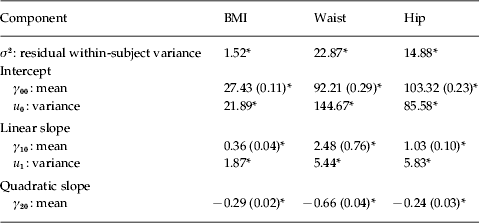
Consistent with previous analyses on this sample (Sutin et al. Reference Sutin, Ferrucci, Zonderman and Terracciano2011) and others (Clarke et al. Reference Clarke, O'Malley, Johnston and Schulenberg2009), both the linear and quadratic terms were significant for each adiposity measure (Table 1). These terms indicated that, on average, participants tended to gain weight across adulthood, with a slight plateau in old age.
HLM coefficients and variance estimates of intercept, linear and quadratic equations predicting adiposity from age in decades

HLM, Hierarchical linear modeling; BMI, body mass index.
n=2251 for BMI, n=2225 for Waist, and n=2212 for Hip. Standard errors are shown in parentheses.
* p<0.01.
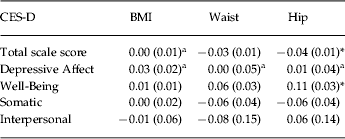
Contrary to expectation, the total scale score for the CES-D was unrelated to change in BMI and waist circumference (Table 2). The CES-D had a small negative relationship with the slope of hip circumference: participants who experienced depressive symptoms gained less weight on their hips across adulthood. This association was probably due to the reverse-scored items related to positive affect included in the total CES-D score. That is, the Well-Being subscale was associated with hip circumference: participants who reported experiencing positive emotions increased more in hip circumference across adulthood. There were no other significant associations between the subscales of the CES-D and the trajectories of any of the three measures of adiposity. We also tested whether depressive symptoms were associated with the trajectory of the waist–hip ratio (WHR) because of its association with disease phenotypes. The total CES-D score and all of the subscale scores were unrelated to the slope of the WHR (all b's=0.00).
CES-D predictors of the slope of three measures of adiposity

CES-D, Center for Epidemiological Studies Depression Scale; BMI, body mass index.
n=2251 for BMI, n=2225 for waist, and n=2212 for hip. Standard errors are shown in parentheses. Coefficients are applied to (age – mean age) in decades.
a Significant interaction with sex.
* p<0.01.
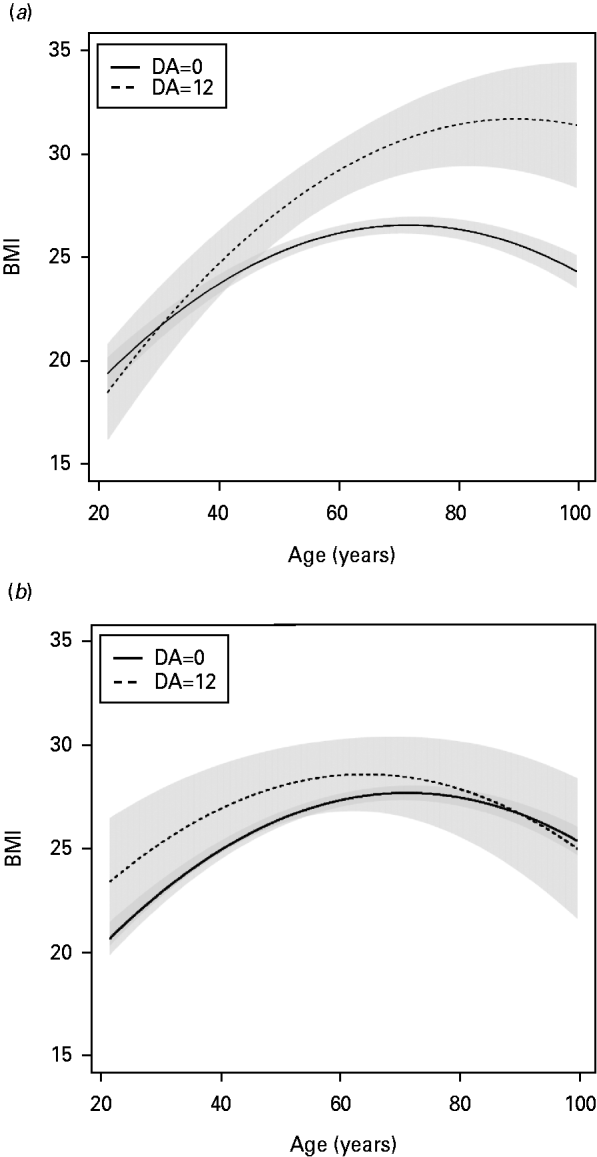
The association between depressive symptoms and the trajectory of adiposity was, however, moderated by sex. Of interest, depressive symptoms had the opposite effect on the trajectory of BMI for men and women (b CES-D×Sex=0.03, s.e.=0.01, p<0.01). Among women, an increase in depressive symptoms was associated with more weight gain across the lifespan. By contrast, men who experienced depressive symptoms, although initially heavier in younger adulthood, gained less weight over time than men who did not experience such symptoms. The analyses of the subscales of the CES-D revealed that the association at the full-scale level was due to Depressed Affect (DA; Fig. 1): women who experienced Depressed Affect gained more weight whereas men who experienced Depressed Affect gained less (b DA×Sex=0.12, s.e.=0.04, p<0.01). A similar pattern emerged for waist (b DA×Sex=0.22, s.e.=0.10) and hip (b DA×Sex=0.20, s.e.=0.08) circumference. These findings were almost identical when controlling for hormone therapy use among women. Sex did not moderate the association between the other aspects of depressive symptoms and adiposity. In addition, neither ethnicity nor education moderated the effect of depressive symptoms on the trajectory of any of the adiposity measures.
Estimated trajectories of body mass index (BMI) plotted separately for a baseline Depressed Affect (DA) score of 0 and a baseline DA score of 12 for (a) women and (b) men.

We next tested whether having ever experienced severe depressive symptoms (CES-D ⩾16; Beekman et al. Reference Beekman, Deeg, Van Limbeek, Braam, De Vries and Van Tilburg1997) at any point during the study period was associated with the trajectory of adiposity. Participants who had experienced at least one such episode increased more in BMI across adulthood than participants who had not experienced such symptoms (b=0.24, s.e.=0.09, p<0.01). Similar to the above analyses, there was an interaction with sex, such that this association was only apparent among female participants (b=0.37, s.e.=0.14, p=0.01). Severe depressive symptoms were unrelated to the trajectory of waist and hip circumference.
Finally, we used cross-lagged models as a second way of testing the association between depressive symptoms and weight over time. Similar to the HLM analyses, the total CES-D score was unrelated to changes in BMI over time (γ=0.01, n.s.). Also consistent with the HLM analyses, Depressed Affect was associated with greater increases in BMI (γ=0.03) and this effect was moderated by sex: Depressed Affect was associated with weight gain among women (γ=0.06, p<0.01) but not among men (γ=−0.01, n.s.). In contrast to the HLM analyses, the Well-Being subscale was associated with increases in waist circumference (γ=0.04, p<0.01), but neither the total CES-D (γ=−0.01, n.s.) nor Well-Being (γ=0.00, n.s.) was associated with an increase in hip circumference. There were no other effects of depressive symptoms on change in weight.
Adiposity and the trajectory of depressive symptoms
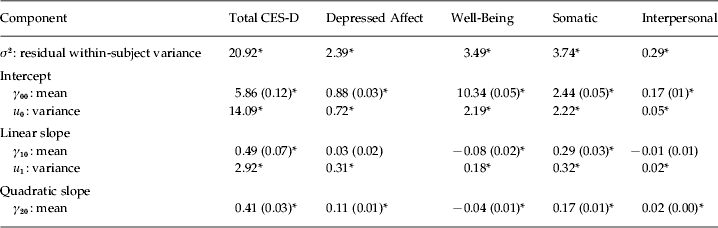
Consistent with previous research on this sample (Sutin et al., unpublished observations) and others (Needham et al. Reference Needham, Epel, Adler and Kiefe2010), the estimated trajectory of depressive symptoms was curvilinear (Table 3). That is, both the linear and the quadratic terms were significant: depressive symptoms decreased from early to middle adulthood but then gradually increased again in older adulthood. BMI, waist circumference and hip circumference were unrelated to the trajectory of depressive symptoms, measured both as the total CES-D score and the four subscales (median estimate=0.00, range=0.00–0.01). Sex, ethnicity and education did not moderate the effect of adiposity on the trajectory of depressive symptoms. The cross-lagged models also indicated no relationship between any of the measures of adiposity and changes in depressive symptoms over time (median estimate=0.01, range=−0.01 to 0.03).
HLM coefficients and variance estimates of intercept, linear and quadratic equations predicting depressive symptoms from age in decades

HLM, Hierarchical linear modeling; CES-D, Center for Epidemiological Studies Depression Scale.
n=2251. Standard errors are shown in parentheses.
* p<0.01.
Discussion
We used data from a long-running longitudinal study of community-dwelling volunteers to address several questions about the nature of the relationship between depressive symptoms and adiposity across adulthood. We found that women who experienced depressive symptoms, specifically depressed affect, gained more weight across adulthood than women who did not experience such symptoms, whereas the opposite pattern emerged for men. Adiposity was unrelated to the trajectory of depressive symptoms across adulthood.
Across the lifespan, women are at greater risk for experiencing depressive symptoms and disorders (Piccinelli & Wilkinson, Reference Piccinelli and Wilkinson2000; Angst et al. Reference Angst, Gamma, Rössler, Ajdacic and Klein2009). Women also tend to gain more weight on average across adulthood than men (Williamson, Reference Williamson1993). The effect of depressive symptoms on weight gain for women was more pronounced in middle age. That is, the estimated trajectory of BMI was similar for women experiencing depressive symptoms and symptom-free women until around midlife, at which point women who experienced depressive symptoms gained weight more rapidly than women without such symptoms. Controlling for hormone therapy did not change the results. Thus, among women, depressive symptoms may exacerbate the weight gain associated with normal aging, particularly the effects of menopause. This finding also suggests that the effect of depression on adiposity and potential sex differences may not become apparent until middle and older ages. Indeed, the effect of depression on obesity may be cumulative (Kivimäki et al. Reference Kivimäki, Lawlor, Singh-Manoux, Batty, Ferrie, Shipley, Nabi, Sabia, Marmot and Jokela2009), and multiple assessments over a long period of time may be necessary to uncover such effects (Luppino et al. Reference Luppino, De Wit, Bouvy, Stijnen, Cuijpers, Penninx and Zitman2010). Of note, Needham et al. (Reference Needham, Epel, Adler and Kiefe2010) did not find sex-specific effects of depressive symptoms on increases in adiposity among younger adults. The age of participants at their last assessment, however, was about the same time that sex differences started to emerge in the present study.
Sex differences in the behavioral correlates of depression may contribute to greater weight gain for women than men. Among individuals suffering from atypical depression, for example, women are more likely to report overeating and extreme fatigue than men (Angst et al. Reference Angst, Gamma, Sellaro, Zhang and Merikangas2002b ). Among individuals suffering from MDD, compared to men, women are more likely to experience increased appetite and a loss of interest in pleasurable activities (Romans et al. Reference Romans, Tyas, Cohen and Silverstone2007). Among individuals suffering from depressive symptoms, women are more likely to report changes in appetite, feelings of fatigue and difficulty sleeping than are men (Angst et al. Reference Angst, Gamma, Gastpar, Lépine, Mendlewicz and Tylee2002a ). Finally, to cope with symptoms of depression, men are more likely to engage in sports and other hobbies, whereas women are more likely to be prescribed antidepressant medication (Angst et al. Reference Angst, Gamma, Gastpar, Lépine, Mendlewicz and Tylee2002a ). Depressed women may be more vulnerable to weight gain than depressed men because their most common behavioral expressions of depression are the two most common risk factors for weight gain: overeating and physical inactivity. In addition, poor sleep quality (Gangwisch et al. Reference Gangwisch, Malaspina, Boden-Albala and Heymsfield2005; Spiegel et al. Reference Spiegel, Knutson, Leproult, Tasali and Van Cauter2005) and antidepressant medication (Fava, Reference Fava2000) have both been associated with weight gain.
Biological mechanisms may also contribute to the association between depressive symptoms and weight gain among women. Activity of the hypothalamic–pituitary–adrenal (HPA) axis has been implicated in both depression and obesity. When faced with a stressor, the cortisol response increases with age, and this increase is three times stronger for women than men (Otte et al. Reference Otte, Hart, Neylan, Marmar, Yaffe and Mohr2005). Resting cortisol among women suffering from MDD increases with age, starting in about middle adulthood (Akil et al. Reference Akil, Haskett, Young, Grunhaus, Kotun, Weinberg, Greden and Watson1993). Such hyperactivity of the HPA axis has been implicated in weight gain over time (Vicennati et al. Reference Vicennati, Pasqui, Cavazza, Pagotto and Pasquali2009). This weight gain may also contribute to the link between depressive symptoms and chronic diseases, such as cardiovascular disease and diabetes.
At the sample level, the total CES-D score was primarily unrelated to the trajectory of the three measures of adiposity. The subscale analyses, however, revealed that negative affect and positive affect were both associated with weight gain. Among women, weight gain was particularly tied to feelings of sadness and loneliness. Somewhat surprisingly, the Well-Being subscale was also associated with increases in hip circumference (HLM analysis) and waist circumference (cross-lagged analysis) over time. The Depressed Affect and Well-Being subscales have higher internal consistencies than either the Somatic Complaints or Interpersonal Problems subscales; thus, the associations between adiposity and the affective dimensions may be more robust than the more heterogeneous subscales. Of note, the Somatic Complaints subscale of the CES-D was unrelated to weight gain, which is surprising given that these items tap into the physical manifestations of depression, including changes in appetite.
Sadness and happiness are often assumed to lie on opposite sides of the same continuum, but evidence suggests that negative and positive affect are two independent dimensions (Watson et al. Reference Watson, Clark and Tellegen1988). Their correlates, therefore, may not necessarily go in opposite directions; they may be similar. In the current study, Depressed Affect and Well-Being did share similar associations with weight gain, which obscured the association between the total CES-D and weight gain score because the items that measured well-being were reverse scored into the total score. These findings suggest that emotionality rather than the valence of the emotion per se is associated with weight gain.
The relationship between emotions and weight is certainly complex and both negative and positive emotions can lead to increases in food consumption (Macht, Reference Macht2008). For example, depressed mood may lead to greater food intake in an attempt to regulate emotions (Chua et al. Reference Chua, Touyz and Hill2004) whereas positive emotions increase the pleasantness of food (Macht et al. Reference Macht, Roth and Ellgring2002). Although some have found that experiencing positive mood can lead to increases in food consumption (Macht, Reference Macht1999; Patel & Schlundt, Reference Patel and Schlundt2001), others find positive affect to be unrelated to eating behavior and weight gain (Cyders & Smith, Reference Cyders and Smith2008). Thus, the association between Well-Being and weight gain in the present study should be interpreted with caution, particularly given that this association did not extend to overall increases in BMI and the relationships differed across analytical techniques.
Obesity increases risk of both clinical depression and severe depressive symptoms (Luppino et al. Reference Luppino, De Wit, Bouvy, Stijnen, Cuijpers, Penninx and Zitman2010). Obesity is a stigmatized condition that, if internalized, could lead to feelings of low self-worth and depression (Ashmore et al. Reference Ashmore, Friedman, Reichmann and Musante2008; Hatzenbuehler et al. Reference Hatzenbuehler, Keyes and Hasin2009). Body shape influences how individuals feel about themselves (Schwartz & Brownell, Reference Schwartz and Brownell2004), how they are perceived (Crandall, Reference Crandall1994; Roehling et al. Reference Roehling, Roehling and Odland2008), and their interactions with others (Hebl & Mannix, Reference Hebl and Mannix2003). In addition to the social pressures associated with weight, obese individuals may engage in fewer activities because of their weight, which reduces quality of life (Hassan et al. Reference Hassan, Joshi, Madhavan and Amonkar2003). In the present research, however, we found no evidence that BMI or other measures of weight were associated with the trajectory of depressive symptoms; higher BMI was unrelated to greater increases in depressive symptoms across the adult lifespan. This finding complements previous research that found adiposity to be unrelated to changes in depressive symptoms across early adulthood (Needham et al. Reference Needham, Epel, Adler and Kiefe2010).
This study had several strengths, including multiple assessments of depressive symptoms and adiposity across 30 years in individuals ranging from young adulthood to old age. This study also had limitations. Participants in the BLSA tend to be healthy and educated; our findings, however, are broadly consistent with previous research on young adults (Needham et al. Reference Needham, Epel, Adler and Kiefe2010) and thus are unlikely to be sample specific. In addition, we considered the potential bidirectional association between adiposity and depressive symptoms, but similar relationships may or may not be found for clinical disorders, such as major depression. Given that major depression follows a different trajectory across adulthood than depressive symptoms, the association with weight may also vary. Future research would benefit from assessments of clinical depression, other psychiatric conditions, and medical conditions that are commonly co-morbid with depression and also associated with weight. Finally, we did not address the mechanisms through which depressive symptoms are associated with weight gain. Future research could test behavioral and/or physiological factors that may mediate the relationship between depressive symptoms and increases in adiposity across adulthood.
With more than 10 000 assessments of both BMI and depressive symptoms, we tested the nature of the relationship between depressive symptoms and adiposity across the adult lifespan. Women who experienced depressed affect gained more weight over time, but there was no evidence that obesity increased depressive symptoms for either women or men. The present research suggests that, compared to men, women may suffer greater physiological costs of depressive symptoms with aging.
Acknowledgments
This research was supported entirely by the Intramural Research Program of the National Institutes of Health (NIH), National Institute on Aging. Dr A. R. Sutin had full access to all of the data in the study and takes responsibility for the integrity of the data and the accuracy of the data analysis. The funder had no role in the design and conduct of the study; in the collection, analysis and interpretation of the data; or in the preparation, review or the decision to submit.
Declaration of Interest
None.