Introduction
For several seabird species, the consumption of fisheries discards can lead to population increases in the long term (Furness Reference Furness2003). In the Southern Ocean, the southern giant petrel (SGP) Macronectes giganteus (Gmelin) is one of the main scavenging seabirds, whose recent population increase can be attributed to interaction with fishing activities, i.e. feeding on fishing discards (Copello & Quintana Reference Copello and Quintana2003, Quintana et al. Reference Quintana, Punta, Copello and Yorio2006) or on animals injured or killed during fishing activities (González-Zevallos & Yorio Reference González-Zevallos and Yorio2006). Recently, Krüger et al. (Reference Krüger, Paiva, Petry and Ramos2017) confirmed that a population of SGP from the Antarctic Peninsula shift their distribution to Argentina and the Falkland Islands off-waters during the non-breeding season, where they overlap with areas of higher fishing intensity. Increases in Argentine populations of SGP were attributed to feeding on discards from trawlers and jiggers (Copello & Quintana Reference Copello and Quintana2003, Reference Copello and Quintana2009, Quintana et al. Reference Quintana, Punta, Copello and Yorio2006). The bycatch rates are relatively low for SGP (Favero et al. Reference Favero, Blanco, García, Copello, Pon, Frere, Quintana, Yorio, Rabuffetti, Canete and Gandini2011, Yeh et al. Reference Yeh, Huang, Dietrich and Melvin2013), so there are negligible negative effects of their interaction with fisheries. Assuming that the interaction with fisheries might have an influence on SGP population numbers, we evaluated the relationship between fishing catches within the current non-breeding distribution and the population numbers of SGP on Elephant Island between 1985 and 2011.
Methods
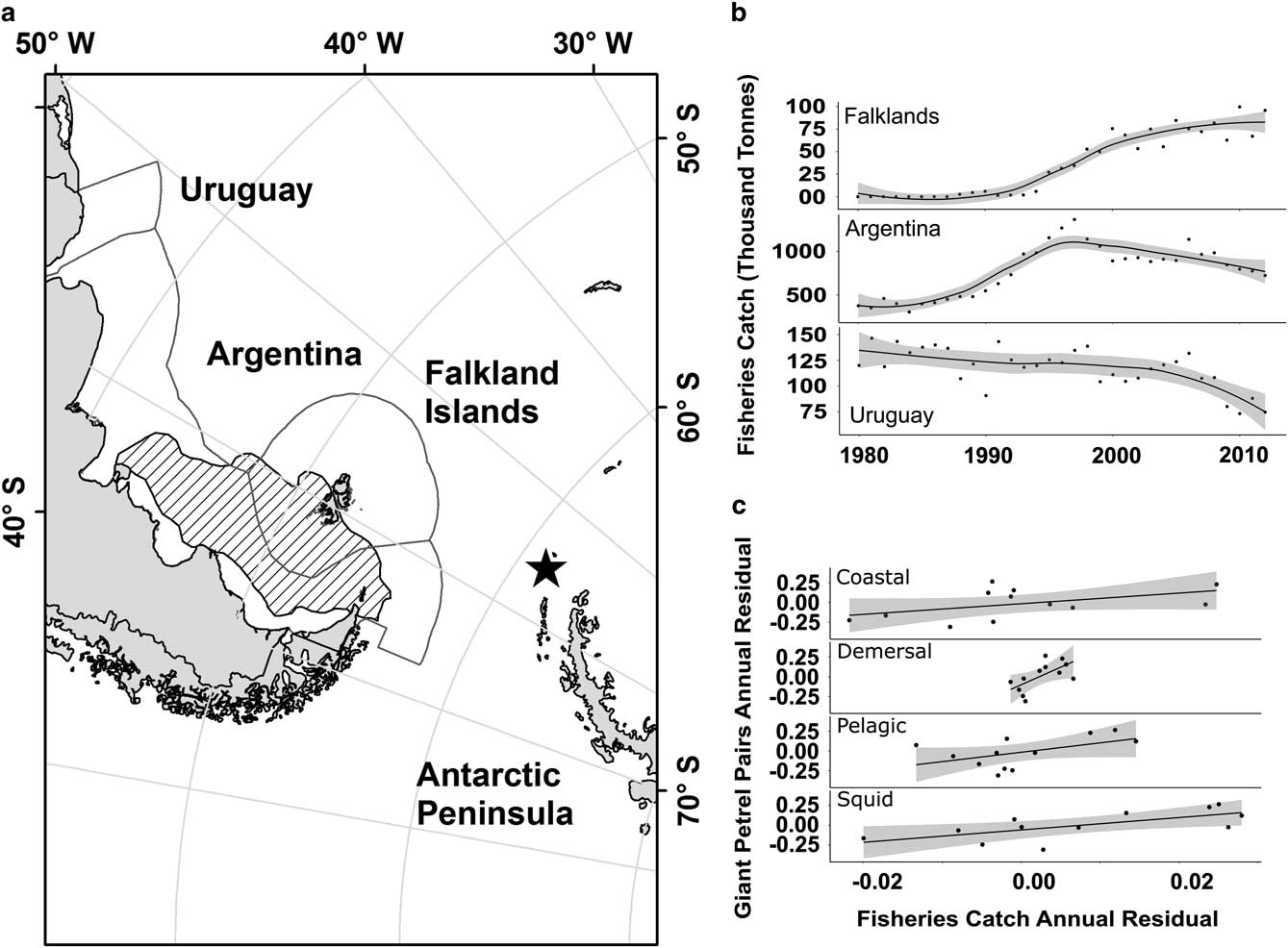
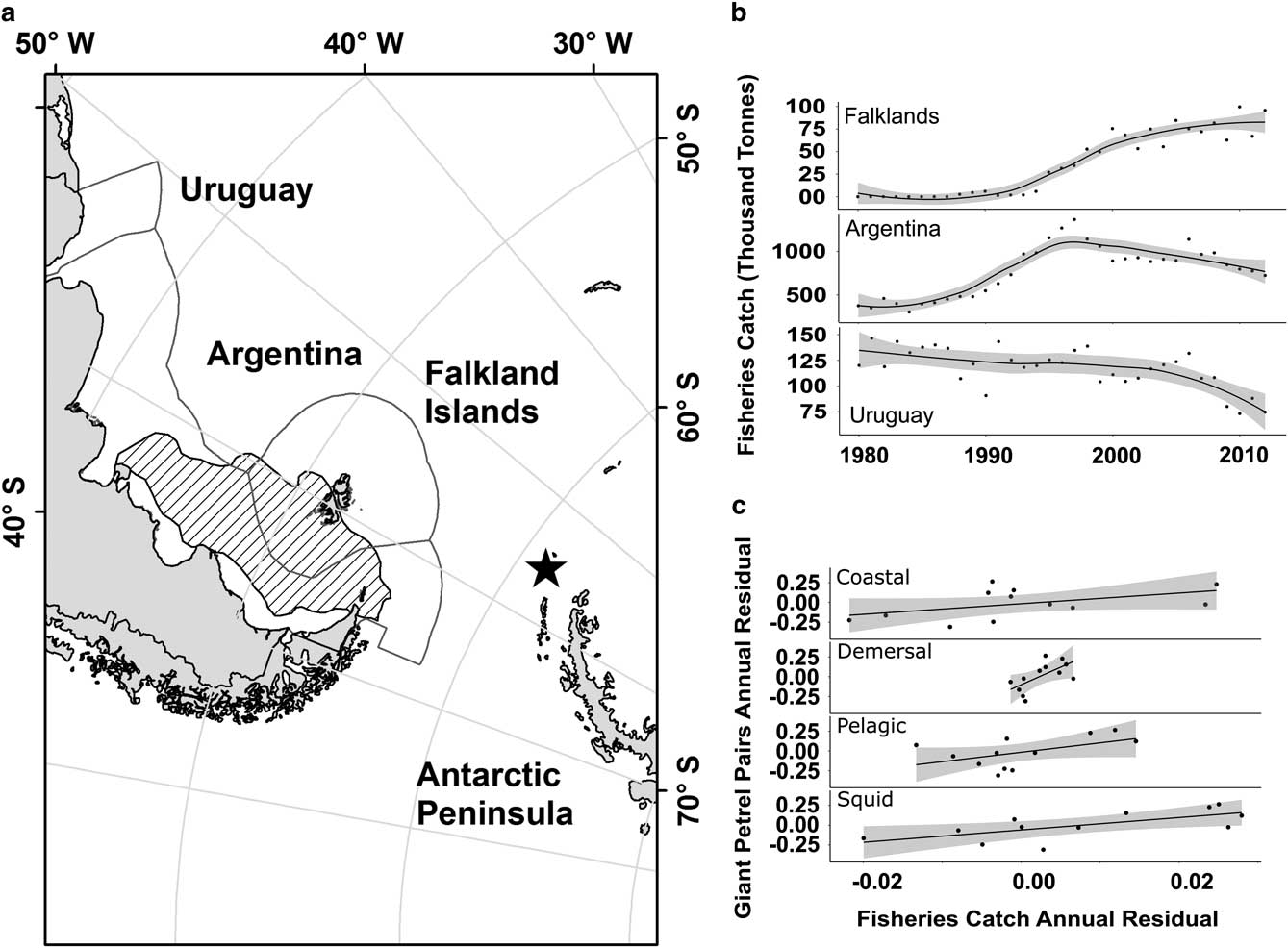
The study was conducted on Stinker Point, Elephant Island (61.17°S, 55.35°W; Fig. 1a). All incubating birds (breeding pairs) on Stinker Point were counted between 1985 and 1992 and between 2009 and 2011. The relationship between SGP number of breeding pairs and fisheries catches was evaluated by applying Poisson linear regressions over the residuals of the annual variability of the number of breeding pairs (breeding pairs ~ (1/year)) and fisheries catches (fisheries catch ~ (1/year)) from generalized linear mixed models (GLMMs) in the lmerTest R package (Kuznetsova et al. Reference Kuznetsova, Brockhoff and Bojesen2016). Fishing catches were extracted from FishStatJ 3.01.0 for the Argentina, Uruguay and the Falkland Islands Economic Exclusive Zones (EEZs; Fig. 1a & b), as these are the areas mainly used by the SGPs from Stinker Point during the non-breeding season (Krüger et al. Reference Krüger, Paiva, Petry and Ramos2017; Fig. 1a). Fisheries were classified according to FAOSTAT groups in FishStatJ.
a. Non-breeding foraging area (hashed polygon) of southern giant petrels (SGPs) from Stinker Point, Elephant Island (star), off South America (from Krüger et al. Reference Krüger, Paiva, Petry and Ramos2017). The Economic Exclusive Zones (EEZs) for each country are indicated by grey lines. b. Historical trends of fish landings (tons) from fisheries off the Falkland Islands, Argentina and Uruguay between 1980 and 2012. Data are loess mean trend ± standard deviation. c. The annual residuals of the historical annual catches (tons) for fisheries off South America between 1985 and 2011 and the number of SGP breeding pairs. The lines represent the linear mean trend ± standard deviation.
Results
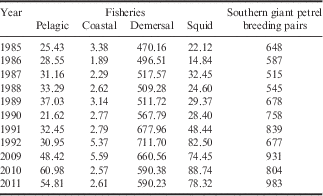
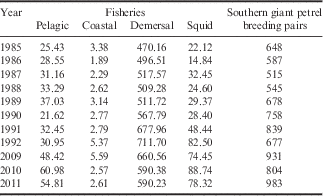
The SGP population on Stinker Point increased from 648 breeding pairs in 1985 to 983 pairs in 2011 (Table I). Fisheries catches were higher off the Falkland Islands and Argentina from the mid-1990s until 2012 compared with the 1980s, but a decreasing trend is seen off Uruguay (Fig. 1b). The annual variability of the number of breeding pairs was proportional to the annual variability of squid (r 2=0.419, F 1,9=6.49, β=12.967, P=0.031) and demersal (r 2=0.410, F 1,9=4.863, β=12.165, P=0.034) fisheries, but was not related to pelagic (r 2=0.207, F 1,9=2.344, β=5.016, P=0.160) or coastal (r 2=0.171, F 1,9=1,860, β=1.476, P=0.206) fisheries (Fig. 1c).
Annual variability of fisheries catch (thousands of tons) off Patagonian waters by type (classified according to FISHTAT group) and number of breeding pairs of southern giant petrels at Stinker Point, Elephant Island.
Discussion
Fisheries are assumed to be the main factor contributing to population increases of SGPs from Argentina (Quintana et al. Reference Quintana, Punta, Copello and Yorio2006, Copello et al. Reference Copello, Quintana and Pérez2008, Copello & Quintana Reference Copello and Quintana2009). It is likely that a similar process is occurring in the population from Elephant Island as there is an area of the non-breeding distribution that overlaps with areas of high fishing activity off Argentina and the Falkland Islands with strong evidence for interactions with fishing vessels, particularly for squid (Krüger et al. Reference Krüger, Paiva, Petry and Ramos2017). Discards from squid fisheries may comprise 0.5–6.0% of the total catch (Kelleher Reference Kelleher2005, Arkhipkin et al. Reference Arkhipkin, Rodhouse and Pierce2015), which can be substantial when catches are estimated at 70 000–270 000 tonnes annually (Arkhipkin et al. Reference Arkhipkin, Rodhouse and Pierce2015). Furthermore, there is evidence that SGPs may scavenge and predate on seabirds killed or injured by fishing gear or cables (González-Zevallos & Yorio Reference González-Zevallos and Yorio2006).
Evidence suggests that consumption of fishery discards during non-breeding periods can increase population survival rates when natural sources of food are low, leading to increases in population size (Furness Reference Furness2003, Grémillet et al. Reference Grémillet, Pichegru, Kuntz, Woakes, Wilkinson, Crawford and Ryan2008, Österblom et al. Reference Österblom, Olsson, Blenckner and Furness2008). Whilst several SGP populations from the sub-Antarctic and temperate regions are increasing (Cuthbert & Sommer Reference Cuthbert and Sommer2004, Quintana et al. Reference Quintana, Punta, Copello and Yorio2006, Copello et al. Reference Copello, Quintana and Pérez2008, Reid & Huin Reference Reid and Huin2008, Copello & Quintana Reference Copello and Quintana2009), populations near or south of 60°S show highly variable trends (Sander et al. Reference Sander, Carneiro, Balbao, Bays, Costa, Mascarello, Oliva and dos Santos2005, Lynch et al. Reference Lynch, Naveen and Fagan2008, Patterson et al. Reference Patterson, Woehler, Croxall, Cooper, Poncet, Peter, Hunter and Fraser2008, Petry et al. Reference Petry, Valls, Petersen, Krüger, Piuco and dos Santos2016). Colonies may be exposed to the effects of human presence locally (such as tourism and research stations; e.g. Sander et al. Reference Sander, Carneiro, Balbao, Bays, Costa, Mascarello, Oliva and dos Santos2005) but the large-scale effects (i.e. climate; see Krüger et al. Reference Krüger, Sander and Petry2012, Schulz et al. Reference Schulz, Krüger and Petry2014) to which populations in the same archipelago (i.e. South Shetland Islands) are exposed are similar, suggesting that differences in the non-breeding distribution could be acting to generate differences in the population breeding performance. We envisage the possibility that such large localized differences on high latitude populations (Sander et al. Reference Sander, Carneiro, Balbao, Bays, Costa, Mascarello, Oliva and dos Santos2005, Lynch et al. Reference Lynch, Naveen and Fagan2008, Patterson et al. Reference Patterson, Woehler, Croxall, Cooper, Poncet, Peter, Hunter and Fraser2008, Petry et al. Reference Petry, Valls, Petersen, Krüger, Piuco and dos Santos2016) may be caused by variability in the interaction with fisheries during the non-breeding period. Nonetheless, to the best of our knowledge, there is no tracking data from populations breeding south of 60°S to support this hypothesis. Tracking studies from such populations would help to elucidate this matter. Finally, our study shows that we need to further understand the effects of fishery discards/offal on scavenging seabirds of the Southern Ocean, and highlights the importance of understanding the carry-over effects of the interactions of seabirds with fisheries during non-breeding seasons on population dynamics.
Acknowledgements
LK acknowledges CNPq for his PhD scholarship (245540/2012-1). VHP acknowledges the support given by FCT (SFRH/BPD/85024/2012). We acknowledge the Brazilian Navy for field research support in Antarctica, the National Institute of Science and Technology Antarctic Environmental Research (INCT-APA), CNPq (574018/2008-5) and FAPERJ (E-16/170.023/2008). We acknowledge the support of the Brazilian Ministries of Science, Technology and Innovation (MCTI), Environment (MMA), and Inter-Ministry Commission for Sea Resources (CIRM). This study benefited from the MARE strategic programme, financed by FCT (MARE - UID/MAR/04292/2013). We thank Jessica Hey for the English review. We also thank the reviewers for their constructive comments.
Author contribution
LK, VHP and JAR conceived the study. LK and MVP collected data. LK analysed the data. LK led the writing of the paper with input from all of the co-authors.