1 Introduction
This study is concerned with the syllabification of consonant clusters in Italian. Although it is generally accepted that consonant clusters can form branching onsets in this language, it has been argued that not all cluster types syllabify in the same way. In particular, there is a class of word-initial consonant clusters that has been argued to be heterosyllabic. This includes clusters beginning with a sibilant (Davis Reference Davis1990, Kaye et al. Reference Kaye, Lowenstamm and Vergnaud1990, Kaye Reference Kaye1992), often referred to as ‘impure s’. The synchronic evidence for heterosyllabicity comes from, inter alia, morphological alternation of the definite, indefinite and partitive articles preceding a masculine noun. There is also a good deal of diachronic evidence, including epenthesis of a vowel before the sibilant in Old Italian. Nonetheless, recent experimental studies probing native speaker intuitions have been unable to provide a conclusive picture of the syllabification of these clusters. Bertinetto & Loporcaro (Reference Bertinetto and Loporcaro2005) argue that for contemporary speakers of Italian the syllabification of sibilant clusters is underdetermined. As Bertinetto (Reference Bertinetto2004: 351) puts it, ‘the syllabification of /sC/ clusters in present-day Italian is likely undecidable’.
The morphological alternations for the definite article are as follows. Masculine nouns starting with a single consonant select allomorph il, as in (1a). Those starting with obstruent–liquid clusters select the same allomorph, as in (b). However, nouns starting with sibilant–obstruent clusters select the allomorph lo instead, as in (c). This is not the case for a single sibilant, e.g. sale in (1a), which takes the il form.
(1)

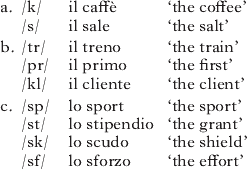
Sibilant–obstruent clusters are not the only word onsets to trigger definite article allomorphy. The allomorph lo is also selected by masculine nouns starting with sibilant–sonorant clusters, e.g. sm /zm/ and sl /zl/, and with intrinsically long consonants sc /ʃː/, gn /ɲː/ and glides j/i /jː/, as well as affricates, e.g. z / . The lo form is also selected by a number of other clusters occurring in loanwords from Greek (especially ps /ps/ and pn /pn/), but words beginning with these clusters are sometimes found with il (McCrary Reference McCrary2004), and can be pronounced with an intrusive vowel by some speakers (Krämer Reference Krämer2009, Repetti Reference Repetti2012). In this study we focus on sibilant–obstruent clusters.
Chierchia (Reference Chierchia1986), Davis (Reference Davis1990), Kaye (Reference Kaye1992) and McCrary (Reference McCrary2004), amongst others, have provided evidence for heterosyllabicity on the basis of patterning in relation to sandhi gemination in central and southern varieties of Italian, a phenomenon variously referred to as syntactic doubling (Lepschy & Lepschy Reference Lepschy and Lepschy1977, Nespor & Vogel Reference Nespor, Vogel, Hulst and Smith1982, Marotta Reference Marotta1986), raddoppiamento fonosintattico (Basbøll Reference Basbøll1989, Repetti Reference Repetti1991, Loporcaro Reference Loporcaro1997a, b), raddoppiamento sintattico (Absalom & Hajek Reference Absalom, Hajek, Bertinetto, Gaeta, Jetchev and Michaels1997) and rafforzamento fonosintattico (Bertinetto & Loporcaro Reference Bertinetto and Loporcaro2005). This process has been claimed to apply after word-final stressed vowels, geminating the initial consonant of the following word, as in (2a), so that the first half of the geminate becomes a syllable coda in the first word, and also after a number of unstressed function words.Footnote 1
This gemination occurs with single consonants as well as with obstruent–liquid clusters (2b), but never with clusters that are involved in the selection of lo, (2c). The relevant consonant is given in bold.Footnote 2
(2)
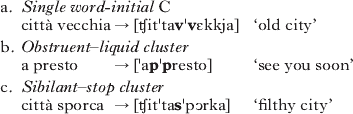
The absence of gemination in (2c) is consistent with a different syllabification for these clusters, in which the sibilant is not part of the onset. It is therefore available to take the coda position in the first word. Diachronic evidence again provides support, in that a in (2b) is derived from ad, which underwent regular sandhi assimilation of the word-final consonant, resulting in ap before p (Loporcaro Reference Loporcaro1997a, Bertinetto & Loporcaro Reference Bertinetto and Loporcaro2005).
In this study we seek evidence from a different domain. Studies in the framework of Articulatory Phonology (Browman & Goldstein Reference Browman and Goldstein1986, Reference Browman and Goldstein1988, Reference Browman and Goldstein1992) have proposed that syllable structure is reflected in the coordination of articulatory gestures (Browman & Goldstein Reference Browman and Goldstein2000, Nam et al. Reference Nam, Goldstein, Saltzman, Pellegrino, Marisco, Chitoran and Coupé2009). This coordination has already been used to investigate languages with interesting word-initial sequences (Goldstein et al. Reference Goldstein, Chitoran, Selkirk, Trouvain and Barry2007, Shaw et al. Reference Shaw, Gafos, Hoole and Zeroual2009, Reference Shaw, Gafos, Hoole and Zeroual2011, Marin & Pouplier Reference Marin and Pouplier2010, Marin Reference Marin2011, Gafos & Goldstein Reference Gafos, Goldstein, Cohn, Fougeron and Huffman2012, Pouplier Reference Pouplier, Fuchs, Weirich, Pape and Perrier2012), and to show that word-initial consonant clusters in languages which allow branching syllable onsets (where the beginning of the word is the beginning of the syllable onset) are coordinated in different ways from those which disallow branching onsets, and consequently, only the last consonant of the cluster is in the syllable onset. This was first shown in a cross-linguistic study by Goldstein et al. (Reference Goldstein, Chitoran, Selkirk, Trouvain and Barry2007), comparing Georgian (which has been claimed to have branching onsets) with Tashlhiyt Berber (which has been claimed to have simple onsets only), as in (3a) and (b) respectively, where the syllable onsets are underlined.
(3)
Footnote 3

As well as more detailed investigations of Tashlhiyt Berber (Hermes et al. Reference Hermes, Ridouane, Mücke and Grice2011) and American English (Marin & Pouplier Reference Marin and Pouplier2010), further studies have been carried out on another language with simple syllable onsets, Moroccan Arabic (Shaw et al. Reference Shaw, Gafos, Hoole and Zeroual2009, Reference Shaw, Gafos, Hoole and Zeroual2011), and two languages with complex syllable onsets, Romanian (Marin Reference Marin2011) and German (Pouplier Reference Pouplier, Fuchs, Weirich, Pape and Perrier2012).
However, all of these studies have provided evidence for one single articulation pattern within each language investigated. That is, the beginning of words in a given language either have a pattern reflecting branching syllable onsets or have one restricted to simple onsets, and this pattern is found across the board.
In a number of languages (e.g. English (Harris Reference Harris1994), German (Hall Reference Hall1992, Wiese Reference Wiese1996), Dutch and Greek (Goad Reference Goad, van Oostendorp, Ewen, Hume and Rice2011) and Romanian (Marin Reference Marin2011)), sibilant–stop clusters (e.g. /sp st sk/) pose a challenge for syllabification algorithms, precisely because the Sonority Sequencing Principle (Goldsmith Reference Goldsmith1976, Clements Reference Clements, Kingston and Beckman1990) is violated, the sibilant being more sonorous than the following stop. The same holds for sibilant–fricative sequences. As a consequence, several proposals have been made for the syllabification of the sibilant in such clusters. It has variously been analysed as part of a complex onset (Boyd Reference Boyd2006), as the coda of a previous syllable (Kaye Reference Kaye1992, Harris Reference Harris1994, Pan & Snyder Reference Pan, Snyder, Brugos, Micciulla and Smith2004), as the onset of a syllable with an empty nucleus (Scheer Reference Scheer2004), as extrasyllabic (Gierut Reference Gierut1999, Barlow Reference Barlow2001) or as part of a complex segment (akin to an affricate; Wiese Reference Wiese1996). Several studies have claimed, or assumed, that these clusters have a universal syllabification (e.g. Kaye Reference Kaye1992), but see Ewen & Botma (Reference Ewen, Botma, Nasukawa and Backley2009) for a different view.
Studies investigating the gestural coordination of word-initial sibilant–stop clusters in American English, Romanian and German have shown that these clusters are coordinated in the same way as other consonant clusters in the languages concerned. These studies thus provide evidence for sibilant–stop clusters as branching onsets, such that /sp/ in spin is at the same time a word onset and a syllable onset (for American English see Browman & Goldstein Reference Browman and Goldstein2000 and Marin & Pouplier Reference Marin and Pouplier2010, for Romanian Marin Reference Marin2011, and for German Pouplier Reference Pouplier, Fuchs, Weirich, Pape and Perrier2012). From this evidence it is possible to deduce that languages that allow branching onsets syllabify sibilant clusters in the same way as other clusters.
This study challenges the view that there is a universal syllabification of sibilant clusters. Given the uncertainty as to the heterosyllabicity of sibilant–obstruent clusters in Italian, we seek evidence for their syllabification from articulatory coordination. Furthermore, this study specifically addresses the general issue as to whether all types of clusters in this language have the same syllabification. This is particularly relevant for Italian, as there is a general consensus as to the tautosyllabicity of obstruent–liquid clusters. That is, the language allows for branching onsets.
In a preliminary study, Hermes et al. (Reference Hermes, Grice, Mücke and Niemann2008, Reference Hermes, Grice, Mücke, Niemann, Hoole, Bombien, Pouplier, Mooshammer and Kühnert2012) provided initial articulatory evidence for a difference in Italian word onsets with and without a sibilant. Whereas obstruent–liquid clusters like /pr/ showed articulatory patterns similar to those in other languages with branching onsets, such as /pl/ in English, sibilant–obstruent clusters like /sp/ were clearly different. However, since this work, a number of new methods have been developed to investigate word-onset types, in particular measures of variability and stability. These methods will be reviewed in detail in §2.2. The study reported on in this paper extends the subject pool and target words and employs these new methods in an attempt to obtain a more definitive answer to the main questions at issue: does an obstruent–liquid cluster form a branching onset?; does a sibilant–obstruent cluster form a branching onset?
2 Kinematics of syllable structure
In Articulatory Phonology (Browman & Goldstein Reference Browman and Goldstein1988, Reference Browman and Goldstein2000, Honorof & Browman Reference Honorof, Browman, Elenius and Branderud1995), speech is decomposed into a set of invariant phonological units: articulatory gestures. Consonantal and vocalic gestures (henceforth C and V gestures respectively) are temporally coordinated with each other at the syllable level, i.e. the timing relations between Cs and Vs reflect phonological knowledge of syllable organisation (Gafos & Goldstein Reference Gafos, Goldstein, Cohn, Fougeron and Huffman2012). The phonological representation has been modelled using non-linear coupled oscillators (Browman & Goldstein Reference Browman and Goldstein2000, Nam & Saltzman Reference Nam, Saltzman, Solé, Recasens and Romero2003, Nam Reference Nam, Cole and Hualde2007, Nam et al. 2009, Goldstein Reference Goldstein, Gutiérrez-Bravo, Mikkelsen and Potsdam2011; details in §5.2) and in terms of optimisation using a set of violable constraints (Gafos Reference Gafos2002, Davidson Reference Davidson2006, Gafos et al. Reference Gafos, Hoole, Roon, Zeroual, Fougeron, Kühnert, D'Imperio and Vallée2010). In this study, we aim to model Italian word onset structure using the non-linear coupled oscillator model. The reasons for this will become clear in the light of our results, and we accordingly postpone discussion of this issue until §5.
(i) Complex onset pattern. For word-initial consonant clusters forming a branching, or complex, onset, the centre of both onset consonants (more specifically, the temporal midpoint of the targets of the consonantal gestures, i.e. the C-centre) is aligned with the vocalic target. This phenomenon is referred to as the C-centre effect.
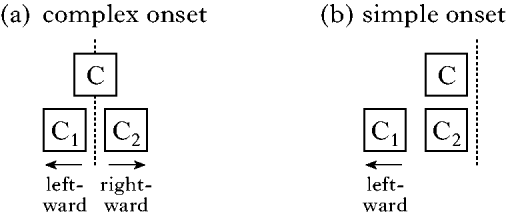
All measures calculating this effect take a word-initial single consonant as a starting point, and compare this with a consonant cluster in the same position. If a C is added to the beginning of a word to make a C1C2 cluster, the prevocalic consonant (C2) is shifted to make room for the added consonant (C1) to its left. For example, comparing /l/ in English lay to /pl/ in play, there is a systematic rightward shift of the target of the prevocalic C (in this case /l/, see Fig. 1a). At the same time the target for the consonant /p/ in play is shifted to the left relative to /p/ in pay (referred to as leftward shift). The relative stability measured when comparing the alignment of the temporal midpoint of the consonantal targets in clusters to that of single targets is referred to as centre stability, although this stability is particularly vulnerable to influences on timing due to place and manner effects (Goldstein et al. Reference Goldstein, Byrd, Saltzman and Arbib2006, Goldstein et al. Reference Goldstein, Nam, Saltzman, Chitoran, Fant, Fujisaki and Shen2009, Shaw et al. Reference Shaw, Gafos, Hoole and Zeroual2011).
Schematised gestural coordination pattern for consonants comparing a single consonant to a cluster involving (a) a complex onset and (b) a simple onset, where C1 of the cluster is not part of the onset.
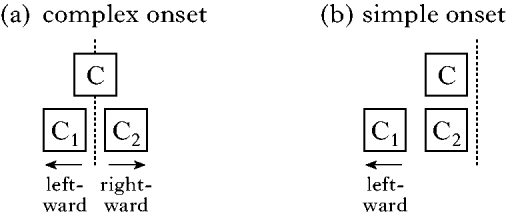
(ii) Simple onset pattern. In languages such as Moroccan Arabic, which do not have complex syllable onsets, the added consonant C1 does not interfere with the relative timing of the prevocalic consonant, C2, and the following vowel. That is, C2 is not shifted to the right towards the vowel. For example, comparing /m/ in mun ‘accompany’ to /sm/ in smun (‘causative-accompany’), there is no rightward shift of the prevocalic C, in this case /m/ (see Fig. 1b). In fact, the timing of /m/ in both cases is remarkably similar. This is reflected in a right-edge stability.
The selected methods for the gestural analysis employed in this study are presented in §2.1.
2.1 Selected methods for gestural analysis
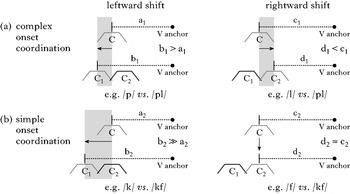
Figure 2 schematises the timing patterns corresponding to complex onset coordination (a) and simple onset coordination (b), showing the temporal adjustments of word-initial C (leftward shift) and immediately prevocalic C (rightward shift).
Hypothesised coordination patterns: (a) complex onset coordination, as in American English, and (b) simple onset coordination, as in Tashlhiyt, with expected adjustments of prevocalic C (rightward shift) and word-initial C (leftward shift) relative to the following V anchor. The gestures being compared are given in grey.

The first measurement is the Rightmost C variable, which calculates the latencies for the target of the rightmost consonant in a cluster relative to the following vocalic target, referred to as the V anchor, and compares these (c1 and d1, c2 and d2 on the righthand side of Fig. 2). Whereas d1 is smaller than c1, d2 is approximately equal to c2.
The second is the stability index (i.e. the coefficient of variance) for the Rightmost C variable, taking the C to V anchor latencies for all tokens in each set (including the single C and the rightmost C in clusters), calculating the standard deviation and dividing it by the mean (stability index=σ/μ) for all tokens in each set, i.e. for C and C1C2. This index was first applied to evaluate gestural coordination patterns in consonant clusters by Shaw et al. (Reference Shaw, Gafos, Hoole and Zeroual2009, Reference Shaw, Gafos, Hoole and Zeroual2011), and subsequently employed by Hermes et al. (Reference Hermes, Ridouane, Mücke and Grice2011), Marin (Reference Marin2011) and Pouplier (Reference Pouplier, Fuchs, Weirich, Pape and Perrier2012), among others.
The third measurement, the Leftmost C variable, investigates the temporal coordination of the word-initial consonant, i.e. the target of the leftmost C, relative to the vocalic anchor. The distances between the leftmost C and the V anchor are shown on the lefthand side of Fig. 2, where b1 is greater than a1, and b2 is much greater than a2.
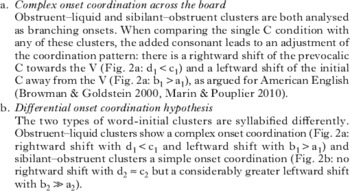
The above gestural analysis allows us to test the two possible scenarios in (4) for the analysis of Italian word-initial clusters.
(4)
3 Method
3.1 Recordings
We recorded four native Italian speakers (3 female (S1–S3), 1 male (S4)) with an electromagnetic midsagittal articulograph (Carstens AG 100) and a time-synchronised DAT-recorder. Speakers S1 and S2 are from Bari (Apulia), S3 from Bologna (Emilia-Romagna) and S4 from Trento (Trentino).
Sensors were placed on upper and lower lips, tongue tip, tongue blade and tongue body. Additionally, two reference sensors were placed on the bridge of the nose and on the upper gums to correct for head movements. A bite plate was used to rotate the data relative to the occlusal plane, to normalise for physiological differences across speakers. Articulatory data were recorded at 400 hz, downsampled to 200 hz and smoothed with 40 Hz low-pass filters. The acoustic data were digitised at 44·1 kHz/16 bit.
3.2 Speech material
The speech material contains target words with simple onsets (e.g. /rima/ ‘rhyme’, /sila/ (place name)) and clusters with sibilants (e.g. /spina/ ‘thorn’, /zvita/ ‘s/he unscrews’)Footnote 4 and without (e.g. /prima/ ‘first’). Feminine nouns are used, since the definite article la occurs before all word-onset types, regardless of their segmental make-up. Verbs were used in three target words, in which case la was the direct object (feminine). The target words were incorporated into a carrier sentence (see (5)), with alternating vowel height throughout the sequences to ensure gestural target identification.
(5)
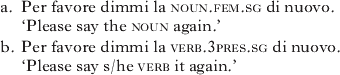
Each target word was presented ten times, in a pseudo-randomised order. Since the study is concerned with the coordination of the consonantal gestures in relation to each other, the speech material had to contain heterorganic clusters (e.g. /pr kr sp sk/), and exclude clusters such as /tr/, where both involve a gesture of the same articulator, in this case the tongue tip.
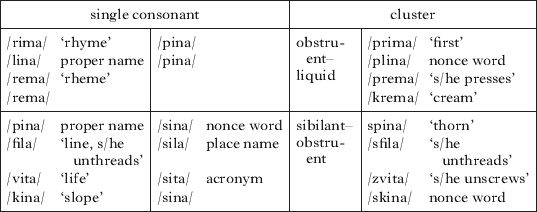
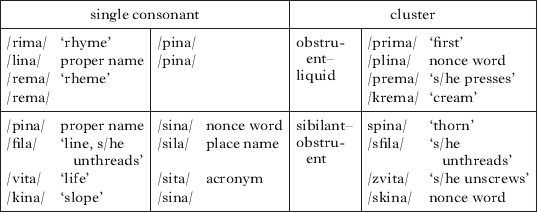
The target words are listed in Table I. A total of 720 sentences were analysed (18 target words×10 repetitions×4 speakers).Footnote 5
Target words beginning with single consonants and corresponding clusters, given in phonemic transcription.
3.3 The prosodic structure of target sentences
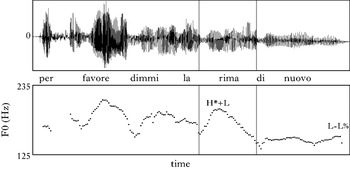
Since it is known that factors such as prosodic prominence (stress and accent) as well as position in a phrase can influence articulatory timing patterns (see e.g. Beckman et al. Reference Beckman, Edwards, Fletcher, Docherty and Ladd1992, De Jong Reference De Jong1995, Harrington et al. Reference Harrington, Fletcher, Beckman, Broe and Pierrehumbert2000, Cho & Keating Reference Cho and Keating2009, Shaw et al. Reference Shaw, Gafos, Hoole and Zeroual2011), we were particularly careful to control for these effects in our study. We ensured that each sentence was read in isolation, with a nuclear pitch accent on the target word, and that there was no major phrase break after the target word. An example from the Bari variety is given in Fig. 3. For each variety we ensured that the same nuclear pitch accent was used throughout.
Example of a target sentence, Per favore dimmi la rima di nuovo ‘Please say the rhyme again’, as produced by speaker S1, showing the waveform and fundamental frequency (F0), with the nuclear pitch accent in the target word /rima/ ‘rhyme’. The nuclear accent is transcribed according to Grice et al. (Reference Grice, D'Imperio, Savino, Avesani and Jun2005).

3.4 Labelling procedure
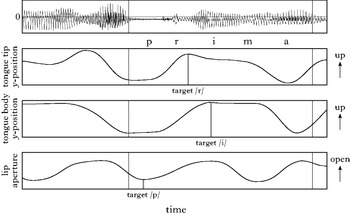
Data were annotated manually with the EMU Speech Database System (Cassidy & Harrington Reference Cassidy and Harrington2001). Gestural targets were identified for each consonantal and vocalic gesture in the vertical plane (y-position) by identifying minima and maxima in the respective velocity trace. A labelling scheme for the target word /prima/ is provided in Fig. 4.
Example of landmarks for target word /prima/ ‘first’, as produced by speaker S1. Targets are indicated for each consonantal gesture, /p/ and /r/, and for the vocalic gesture /i/.

The following trajectories were analysed: the tongue tip for the alveolars /l s z r/, the tongue body for the vowels /i a/ and for the velar plosive /k/, and the lower lip for the labiodentals /f/ and /v/. For bilabial /p/ the lip aperture index was calculated as the Euclidean distance between the upper and lower lips (see Byrd Reference Byrd2000).
4 Results for coordination patterns
Results for the coordination patterns of word-initial consonant clusters in Italian will be presented for both cluster-type conditions: obstruent–liquid, referred to as CC, and sibilant–obstruent, referred to as SC. As described in §2.1, we calculated the Rightmost C variable, the stability index and the Leftmost C variable. These are reported on separately in the following sections.
4.1 The Rightmost C variable
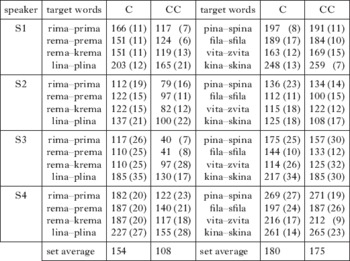
Descriptive results will be presented for the Rightmost C variable, which was investigated to describe the gestural timing pattern for the consonant preceding the vowel. We compared the CC cluster condition with a simple onset, with the second consonant in the cluster identical to the consonant in the simple onset, e.g. /r/ in /prima/ compared to /r/ in /rima/. The same was compared for the SC cluster condition, e.g. /p/ in /spina/ was compared to /p/ in /pina/. In Table II, the averaged latency measures for the Rightmost C variable are displayed for each pair of target words, comparing simple onsets with CC clusters and SC clusters for each speaker separately.
Mean latencies, with standard deviation, for the Rightmost C variable (ms) comparing C–CC and C–SC, for each speaker separately.

In the CC cluster condition, the rightmost C is shifted towards the anchor when a consonant is added (averages for e.g. /rima/ vs. /prima/: S1 166 ms vs. 117 ms; S2 112 ms vs. 79 ms; S3 117 ms vs. 40 ms; S4 182 ms vs. 122 ms). Latencies for the Rightmost C variable are lower for CC clusters than for simple onsets.
However, in the SC cluster condition the latencies for this variable remain stable in comparison to the single C condition. The rightmost C is not adjusted when the sibilant is added to the simple onset (averages for e.g. /pina/ vs. /spina/: S1 197 ms vs. 191 ms; S2 136 ms vs. 134 ms; S3 175 ms vs. 157 ms; S4 269 ms vs. 271 ms).
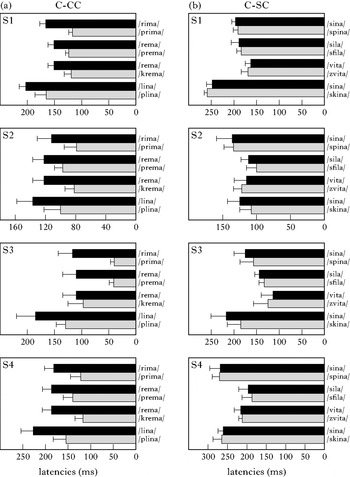
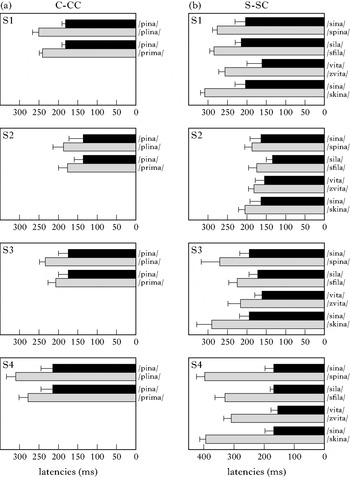
Figure 5 displays the results for the Rightmost C variable graphically, and shows that latencies decrease when an obstruent is added before a liquid at the beginning of the word, whereas it remains stable when a sibilant is added before an obstruent. The results are compatible with the differential onset coordination hypothesis in (4b).
Bar plots for the Rightmost C variable in (a) C–CC and (b) C–SC, for each speaker separately. The line-up point is the vocalic target (V anchor).

4.2 The stability index
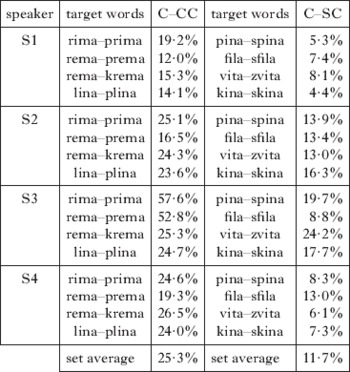
The Rightmost C variable analysed above, with its distinct gestural coordination patterns for CC and SC clusters, was further analysed by means of a stability measure. This measure, referred to as the stability index, is used to assess the stability of the latency from the rightmost C to the anchor across pairs of matched stimuli (see Table III; e.g. /rima–prima/ and /pina–spina/).
Stability index for the Rightmost C variable in C–CC and C–SC, for each word pair and speaker separately.

Applying the stability index to the Rightmost C variable provides further evidence for a distinct gestural coordination pattern. Values for SC clusters are considerably lower than for the CC cluster condition. In all cases, for all speakers the results reflect that there is more variability, i.e. a higher value, for the investigated variable in the CC condition as opposed to the SC condition (grand mean for C–CC:  =25·3% vs. C–SC: =11·7%). A repeated measure ANOVA was conducted, including Stability Index as dependent variable, Cluster Type (CC–SC) as within-subject factor and Speaker as random factor. There was a main effect of Cluster Type (CC–SC) on the measure F(1, 8): 16·82337; p<0·05. The analysis shows the expected right-edge stability for sibilant–obstruent clusters, where the most stable patterns were found for the right-edge to anchor latencies.
4.3 The Leftmost C variable
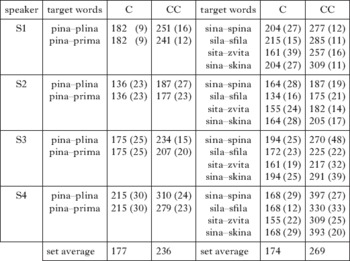
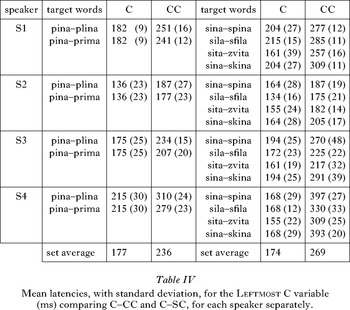
To gain further insight into the coordination pattern of both consonantal gestures in clusters, we additionally analysed the gestural timing pattern for the leftmost consonant in a cluster. We again compared the cluster condition with a simple onset, where the first consonant in the cluster is identical to the consonant in single C condition, e.g. /p/ in /plina/ compared to /p/ in /pina/. The same was compared for the SC cluster condition, e.g. /s/ in /spina/ compared to /s/ in /sina/.Footnote 6 In Table IV, the averaged latency measures for the Leftmost C variable are displayed for each pair of target words, comparing simple onsets with CC clusters and SC clusters for each word pair and speaker separately.
Mean latencies, with standard deviation, for the Leftmost C variable (ms) comparing C–CC and C–SC, for each speaker separately.

When a consonant is added before the vowel to create a CC cluster, the leftmost C is pushed further away from the vowel to make room for an additional consonant (averages for e.g. /pina/ vs. /plina/: S1 182 ms vs. 251 ms; S2 136 ms vs. 187 ms; S3 175 ms vs. 234 ms; S4 215 ms vs. 310 ms).
When a consonant is added before the vowel to create an SC cluster, the sibilant is also shifted to the left (e.g. /sina/ vs. /spina/: S1 204 ms vs. 277 ms; S2 164 ms vs. 187 ms; S3 194 ms vs. 270 ms; S4 168 ms vs. 397 ms). It is worth noting, however, that the shift of the leftmost C is considerably greater in SC than in CC clusters.
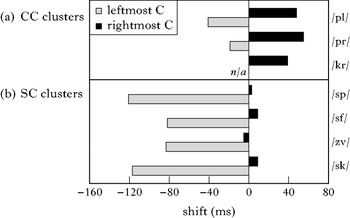
Figure 6 displays the results graphically, showing the shift of the leftmost C in both CC and SC clusters. In both cluster conditions, the leftmost obstruent in obstruent–liquid clusters (C–CC) and the sibilant in sibilant–obstruent clusters (S–SC) is, on average, pushed further to the left in relation to its single counterpart (e.g. the leftward shift on average for /p/ in /prima/ compared to /p/ in /pina/ is: S1 Δ=59 ms; S2 Δ=41 ms; S3 Δ=32 ms; S4 Δ=64 ms; for /s/ in /sfila/ compared to /s/ in /sila/ it is: S1 Δ=70 ms; S2 Δ=41 ms; S3 Δ=53 ms; S4 Δ=162 ms).
Bar plots for the Leftmost C variable in (a) C–CC and (b) C–SC, for each speaker separately. The line-up point is the vocalic target (V anchor).

Individual speakers display considerable variation. For three of the four speakers the shift is much greater in the sibilant–obstruent clusters. Thus, in SC clusters the leftmost consonant (the sibilant) is shifted further away from the vocalic anchor than in CC clusters (the obstruent). This is expected, given that SC clusters do not incur a rightward shift.
4.4 Summary of coordination relations in Italian word onsets
A combined look at leftward and rightward shifts together provides a clearer picture of the results. Figure 7 displays the direction and extent of the shift of the individual consonantal gestures (the leftward shift of the leftmost consonant and the rightward shift of the rightmost consonant), pooling the results for all speakers. Assuming that syllable structure is reflected in the coordination of consonantal and vocalic gestures, these combined results give a clear indication that obstruent–liquid and sibilant–obstruent clusters have different syllable structures: (i) obstruent–liquid clusters (Fig. 7a) show both a leftward and a rightward shift, a pattern which indicates C-centre alignment and resembles that of complex onsets in other languages (d1<c1 and b1>a1; see the discussion in §2.1); (ii) sibilant–obstruent clusters (Fig. 7b) show a different pattern.Footnote 7 There is virtually no shift of the rightmost C, but a considerable shift of the sibilant to the left (d2≈c2 and b2≫a2).
Shift of leftmost consonant (grey bars) and rightmost consonant (black bars) for (a) obstruent–liquid (CC) clusters and (b) sibilant–obstruent (SC) clusters. Results for all speakers have been pooled.

These distinct coordination patterns thus lead us to reject the first potential analysis, (4a), in which all clusters are analysed as tautosyllabic (i.e. branching onsets). Instead, they provide support for the second analysis, (4b), in which sibilant–obstruent clusters are syllabified differently from obstruent–liquid clusters.
Figure 8 summarises the results and interpretation in terms of syllable structure which can be drawn from the results so far. In obstruent–liquid clusters, both consonants belong to the onset, whereas in sibilant–obstruent clusters, only the consonant immediately preceding the vowel and not the sibilant occupies the onset position.
Schematised gestural coordination pattern and affiliation to the onset of the components of (a) CC clusters and (b) SC clusters.

5 Modelling syllables with non-linear planning oscillators
The results of gestural coordination can be modelled with non-linear coupled oscillators. In this model, proposed by Browman & Goldstein (Reference Browman and Goldstein2000), Nam & Saltzman (Reference Nam, Saltzman, Solé, Recasens and Romero2003), Nam (Reference Nam, Cole and Hualde2007) and Nam et al. (Reference Nam, Goldstein, Saltzman, Pellegrino, Marisco, Chitoran and Coupé2009), articulatory gestures are associated with non-linear planning oscillators (clocks). The oscillators are coupled in pairwise fashion. The couplings for consonantal and vocalic gestures trigger the temporal coordination patterns within the syllable. This coupling information is part of the phonological representation of a given utterance.
At the beginning of the (simulated) planning process for an utterance, the oscillators are set into an arbitrary initial phase. The oscillators are set into motion and – over time – the coupling between oscillators forces them to settle into a stable timing pattern, specified as relative phase (Nam & Saltzman Reference Nam, Saltzman, Solé, Recasens and Romero2003, Nam et al. Reference Nam, Goldstein, Saltzman, Pellegrino, Marisco, Chitoran and Coupé2009). ‘The steady-state output of this planning process is a set of oscillations with stabilized relative phases’ (Nam et al. Reference Nam, Goldstein, Saltzman, Pellegrino, Marisco, Chitoran and Coupé2009: 303).
For this model, two competing modes of stabilised relative phases (coupling modes) are assumed: gestures start either at the same time (synchronously) or one after the other (sequentially). Within the coupling hypothesis of syllable structure, these two competing modes, synchronous (6a) and sequential (6b), are applied as temporal triggers to articulatory gestures (Browman & Goldstein Reference Browman and Goldstein2000, Nam & Saltzman Reference Nam, Saltzman, Solé, Recasens and Romero2003, Nam Reference Nam, Cole and Hualde2007).
(6)
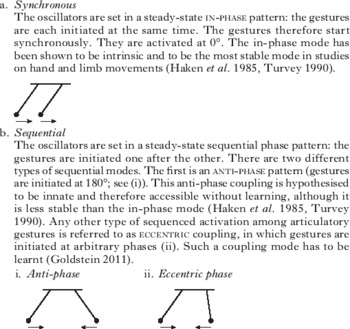
In a CV syllable the consonantal and vocalic gestures start simultaneously (although the vocalic gesture is slower and thus takes longer to execute). These are in-phase. In a VC syllable the C gesture for the coda is initiated after the V gesture. These gestures are sequentially phased (anti-phase).
(7) illustrates the coupling between C and V for English syllables (a) with single consonants and (b) with clusters in the onset and coda. The difference between onset and coda is that the coupling between the onset C and V is synchronous (represented by a solid line) whereas the coupling between V and the following coda C is sequential (represented by a dashed line).
(7)
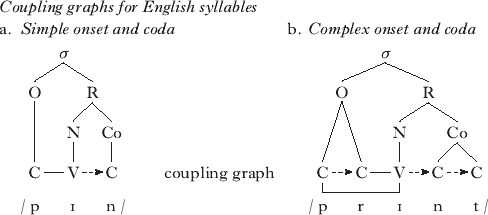
For word-initial consonant clusters which form a complex onset, both consonants are coupled in-phase with the vowel, and at the same time are in a sequential relation to each other (7b), resulting in competition between the consonants for synchronous phasing with the vowel.Footnote 8 Quantitative evidence for this competitive structure can be found in the relative timing of gestures, more specifically the timing of the achievement of constriction gestures, or targets, in relation to an anchor later in the syllable, such as the target of the vocalic gesture. It is the centre of both onset consonants (more specifically, the temporal midpoint of the targets of the consonantal gestures, i.e. the C-centre), which is aligned with the vocalic target. This is the C-centre effect.
(8) proposes two distinct coupling relations for word-initial clusters in Italian. CC clusters (8a) are coupled like complex onsets (similar to American English and Romanian, i.e. both C gestures have in-phase links to the V, and at the same time display either anti-phase or eccentric sequential linking with each other). This competitive coupling structure leads to both a leftward and a rightward shift. By contrast, SC clusters (8b) do not form complex onsets (similar to Moroccan Arabic and Tashlhiyt Berber). The prevocalic C has the sole in-phase link with the V, leading to right-edge stability.
Two distinct gestural timing patterns have been found for Italian word-initial clusters, as in (4b): complex onset coordination for CC clusters and simple onset coordination for SC clusters.
(8)

6 Discussion
Our results have shown that not all word onsets constitute syllable onsets in Italian. Word-initial obstruent–liquid clusters such as pr show C-centre-like coordination, and thus pattern like complex onsets in English, Georgian and Romanian. By contrast, sibilant–obstruent clusters such as sp show stability of the rightmost consonant, indicating a heterosyllabic analysis, as is the case for word-initial clusters in Moroccan Arabic and Tashlhiyt Berber. We have thus confirmed the differential syllabification hypothesis for Italian word onsets.
Although we have moved a step further towards answering the question as to the syllabification of ‘impure s’, the design of our experiment does not permit us to test whether or not the sibilant is the coda of the preceding syllable (i.e. of la in la spina leading to /las.pina/). It is also difficult to imagine how we could empirically test whether the sibilant is an onset or coda of a syllable with an empty nucleus.
We have concentrated on word-initial clusters, although the language also has word-medial clusters. There is a general consensus on the basis of vowel length and phonotactics that word-medial obstruent liquid clusters are tautosyllabic, whereas sibilant–obstruent clusters are heterosyllabic (e.g. [ˈkaː.pra] vs. [ˈpas.ta]). Thus our results are compatible with a scenario in which word-initial and word-medial clusters syllabify in the same way, although some caution is required when comparing our results, given that the stress pattern was different, la being unstressed.
In this paper we have concentrated on clusters that violate the sonority hierarchy, sibilant–stop and sibilant–fricative clusters. We predict on the basis of pilot results from one speaker that sibilant–sonorant clusters (e.g. /zm zl/) will pattern in the same way as sibilant–obstruent clusters (e.g. /sp sf zv/), although these results would have to be corroborated for a greater variety of speakers and words. Predictions for other words which select lo, e.g. those starting with /ps/ and /pn/, are more difficult to make. Words such as psicologo and pneumatico have been attested with the article il, indicating a patterning with obstruent–liquid clusters. Furthermore, alternative pronunciations, albeit in non-standard usage, are possible, either with an epenthetic vowel between the first two consonants ([pisiˈkɔlogo] and [pine ˈmatiko]; Repetti Reference Repetti2012), or simplification of the cluster ([neˈmatiko]; Krämer Reference Krämer2009). The use of il might thus reflect the loss of the word-initial cluster. A more detailed study investigating speaker-specific and word-specific factors is needed to form a clear prediction here.
From the point of view of methodology, this study provides evidence for two distinct word-initial coordination patterns within one language, it confirms the diagnostic value of this type of articulatory analysis and extends its capacity to probe syllable phonology not only across languages but also within a single language.