INTRODUCTION
Chilika Lagoon is the largest brackish water ecosystem along the east coast of India and an internationally famous Ramsar Site, regarded as a store house of rich living resources. Ecologically, Chilika Lagoon is an assemblage of shallow to very shallow marine, brackish and freshwater ecosystems. Salinity is the most dominant factor determining the lagoon's ecology, and salinity dynamics are controlled jointly by the nature of the connection to the sea, associated tidal fluctuation, and the volume and timing of freshwater inflows into the lagoon from the Delta Rivers and western catchments (Mohapatra et al., Reference Mohapatra, Mohanty, Mohanty, Bhatta and Das2007). Several studies have documented ichthyofauna of the lagoon in past and recent times. Rama Rao (Reference Rama Rao and Ghosh1995) gave a comprehensive list of fish known from Chilika Lagoon; Bhatta et al. (Reference Bhatta, Pattnaik and Behera2001) added a few more species to the list and Mohanty et al. (Reference Mohanty, Mohanty, Mohapatra, Bhatta and Pattanaik2006) and Mohapatra et al. (Reference Mohapatra, Mohanty, Mohanty, Bhatta and Das2007), provided information on post-ecorestoration biodiversity of the lagoon. All the earlier studies reported only one species of the family Monodactylidae, i.e. Monodactylus argenteus (Linnaeus, 1758) from the lagoon.
The family Monodactylidae comprises 11 nominal species and six valid species in two genera throughout the world (Froese & Pauly, Reference Froese and Pauly2013). The genus Monodactylus comprises four species of which M. argenteus (Linnaeus, 1758) is the most common species in the coastal waters of India. A second species, M. falciformis Lacépède, 1802, with a slender body and more gill rakers, is also reported from the Indian coast. During a survey of ornamental species along the east coast of India, a single specimen of 79 mm standard length (SL) size was collected from the Chilika Lagoon which is similar to M. argenteus. It was later identified as Monodactylus kottelati Pethiyagoda, Reference Pethiyagoda1991. Monodactylus kottelati is reported here as the first record from the Chilika Lagoon itself, as well as extending the range of the species to the east coast of India and providing the first substantiated report from Indian waters.
MATERIALS AND METHODS
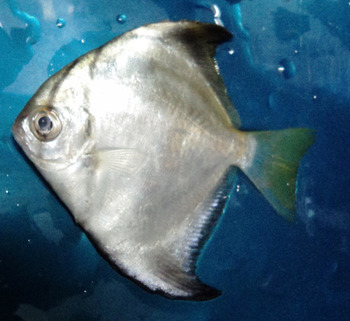
One specimen, collected from the central sector of Chilika Lagoon (19°15.749′N 84°54.933′E) on 24 June 2012. The specimen was catalogued as ZSI/MARC/F-2517 (Fig. 1) and deposited at the Marine Aquarium and Research Centre, Zoological Survey of India, Digha, West Bengal.
RESULTS AND DISCUSSION
The single specimen thus obtained has been identified as Monodactylus kottelati Pethiyagoda, Reference Pethiyagoda1991 and the distinguishing characters of the specimen are described hereafter.
Characters
Body rhomboid in shape, very deep and strongly compressed; its depth 1.1 (94.2%) in SL. Distance between tip of dorsal and anal fins 0.7 in SL. Eye large, 2.7 in head length (HL) and its diameter longer than snout length, snout length 4.1 times in HL. Dorsal profile of body steep; mouth small and oblique; upper jaw 2.7 in HL. Both jaws contain small conical teeth. Lateral line strongly arched and complete; scales on lateral line 68. Gill membrane free from isthmus; gill rakers 25. Dorsal fin continuous with VIII spines and 29 soft rays, anterior soft dorsal rays are elongated; anal fin with III spines and 28 soft rays; posterior part of dorsal and anal fins are straight; both are falcate anteriorly. Pectoral fin small, 4.2 times in SL. Pelvic fin absent. Caudal fin emarginated; caudal peduncle depth 6.7 in SL and its length 12.6 in SL.
Colour
Body silvery with two vertical curved black bars through eye and another through pectoral fin base to dorsal fin origin. Dorsal and anal fins dusky with black tip; caudal fin whitish at base and posteriorly light yellow.
Remarks
This species is often confused with the Monodactylus argenteus (Linnaeus, 1758) because of its very similar colour pattern and structure. However, M. kottelati differs from M. argenteus in having a greater body depth (1.0–1.1 in SL vs 1.2 to 1.6 in SL in M. argenteus) and distance between tips of dorsal and anal fins (0.6 to 0.7 times in SL vs 0.8 to 0.9 times in SL in M. argenteus). The posterior parts of the dorsal and anal fins are almost straight in M. kottelati whereas in M. argenteus, the posterior edge of the dorsal and the anal fins is distinctly concave.
Monodactylus kottelati previously was known only from Sri Lanka (Pethiyagoda, Reference Pethiyagoda1991; Froese & Pauly, Reference Froese and Pauly2013), although Kottelat (Reference Kottelat, Carpenter and Niem2001) mentioned its distribution as ‘Definitively known only from a single locality in Sri Lanka and the Laccadive Archipelago (India)’ and he tentatively referred juvenile specimens from Medan (Sumatra) to this species. Occurrence of M. kottelati in the Laccadives (Lakshadweep Islands) (Pethiyagoda, Reference Pethiyagoda1991) is based only on the illustration provided in Jones & Kumaran (Reference Jones and Kumaran1980) as that of M. argenteus. However, the present record forms the first substantiated report of this species from Indian waters, extending its range of distribution to the east coast of India. Further, its occurrence in the Chilika Lagoon indicates it may be available throughout its range, but confused with M. argenteus due to similarities as observed in de Bruin et al. (Reference De Bruin, Russell and Bogusch1995).
Monodactylus kottelati Pethiyagoda, 1991 collected from Chilika lagoon, India.

ACKNOWLEDGEMENT
The authors thank Dr K. Venkataraman, Director, Zoological Survey of India, for providing necessary facilities for the work.