Introduction
During the last 25 years, millions of lives have been lost due to disasters and billions more have been affected. Tens of billions of dollars have been spent on repairing damage, rebuilding public health infrastructure, and reconstructing lives.Reference Hogan and Burstein 1 As the world’s population and density continues to increase, there has been an associated increase in urbanization and industrialization. The majority of the population are now migrating to urban, disaster-prone areas that are without an adequate public health protective infrastructure, placing a greater proportion of the world community at risk.
Most disasters are defined by the need for external assistance to overwhelmed local capacity. The Center for Research on the Epidemiology of Disasters (CRED; Brussels, Belgium) defines a disaster as a “situation or event, which overwhelms local capacity, necessitating a request to a national or international level for external assistance.” 2 While the severity of a disaster has typically been measured in terms of direct morbidity and mortality, contemporary discussions of disaster management acknowledge the importance of the indirect consequences of disaster - death and illness due to the devastation of public health infrastructure, displacement, overcrowded living conditions, food insecurity, and disrupted livelihoods.Reference Burkle and Gregg Greenough 3 For the purpose of this review, the CRED definition of disaster was adopted and both the direct and indirect components of disaster management were included. The direct components of disaster management were defined as anything directly relating to prevention, mitigation, preparedness, response, or recovery.
The indirect components of disaster management were defined as anything directly relating to displacement and internally displaced populations, refugees, food supply and food insecurity, and the breakdown of public health infrastructures and protections. To be included in this review, these topics needed to have been discussed in the context of disasters and disaster management.
The extent to which researchers are able to identify and manage disasters in the future is contingent upon the current collective understanding of disasters and how best to prepare, respond, and recover from them. A prerequisite to developing such an understating is adopting an evidence-informed approach. An evidence-informed approach to disaster management requires the assembly of a body of evidence derived from the results of relevant studies. This body of evidence should be easily accessible to facilitate implementation into education, practice, policy, and delivery. A body of information related to the management of disasters is accumulating. However, it requires critical review and analysis so that disaster responders, managers, and educators can apply the lessons learned during one disaster to the management and response of the next. Ultimately, this may help save many lives and protect livelihoods. This study contributes to the assembly of this body of knowledge by identifying literature relevant to the management of disasters using a range of electronic resources.
Methods
A comprehensive and systematic review of the literature relevant to the management of disasters was undertaken. The search methodology utilized for this review was developed in consultation with a senior information scientist and was informed by the Cochrane Collaboration (London, United Kingdom) systematic review and PRISMA process. This approach ensured that a comprehensive and systematic search strategy was developed using appropriate concepts, keywords, and subject heading terms.
The search terms utilized in the search strategies for this review included: Disaster; Catastrophe; Mass-Casualty; Mass Casualty; Public Health Emergency; PHE; Bioevent; Bio-event; Biodisaster; Bio-disaster; Complex Humanitarian Emergency; and CHE.
A recent publication reported on the development of a search filter for use in retrieving public health and health promotion literature.Reference Lee, Dobbins, Decorby, McRae, Tirilis and Husson 4 The paper highlighted that a large number of titles needed to be screened to reach a final relevant data set, and that no one database adequately captured a range of these relevant papers. This challenge stems from the lack of a single database dedicated exclusively to public health literature, requiring searches in multiple health, science, and social science databases. This challenge has also been reported in the disaster health literature where disaster health publications were published in over 780 different journals.Reference Smith, Wasiak, Sen, Archer and Burkle 5 Cognizant of these challenges, the following electronic databases were searched to inform this review: Medline (1956 – July 2017; US National Library of Medicine, National Institutes of Health; Bethesda, Maryland USA); CINAHL (1961 – July 2017; EBSCO Information Services; Ipswich, Massachusetts USA); EMBASE (1947 – July 2017; Elsevier; Amsterdam, Netherlands); PsycInfo (1967 – July 2017; American Psychological Association; Washington DC, USA); and the Cochrane Library (1996 – July 2017; The Cochrane Collaboration; Oxford, United Kingdom).
In addition to collecting information from databases and search engines, relevant publications were also identified through consultation with experts in the field, including the Cochrane Collaboration’s “Evidence Aid.” In cases where identified sources cited relevant references, the original references were also collected and included in this literature review. All records initially retrieved by the search strategies were reviewed by title by one reviewer with an independent check of 10% of all retrieved records by an additional independent reviewer to ensure quality. All potentially relevant records identified by the initial title search were then reviewed by two independent reviewers. Cohen’s Kappa Value was calculated for the inter-rater reliability between the two researchers in identifying relevant publications. The Kappa Value is generally thought to be a more robust measure than simple percent agreement calculation, since κ takes into account the possibility of the agreement occurring by chance. Potentially relevant records were then reviewed in full-text and a data extraction form developed for this review was applied by two independent reviewers to all relevant records identified by the search.
A data extraction form developed for this review was used to record information from each publication, including: phase of disaster management (prevention, mitigation, preparedness, response, and recovery); publication type (systematic review, randomized controlled trial, controlled trial, cohort study, case-control study, and cross-sectional study); methodology (quantitative, qualitative, or descriptive); the focus/topic of the publication; the specific disaster or event; the journal of publication; and whether the paper had used an evaluation framework.
Results
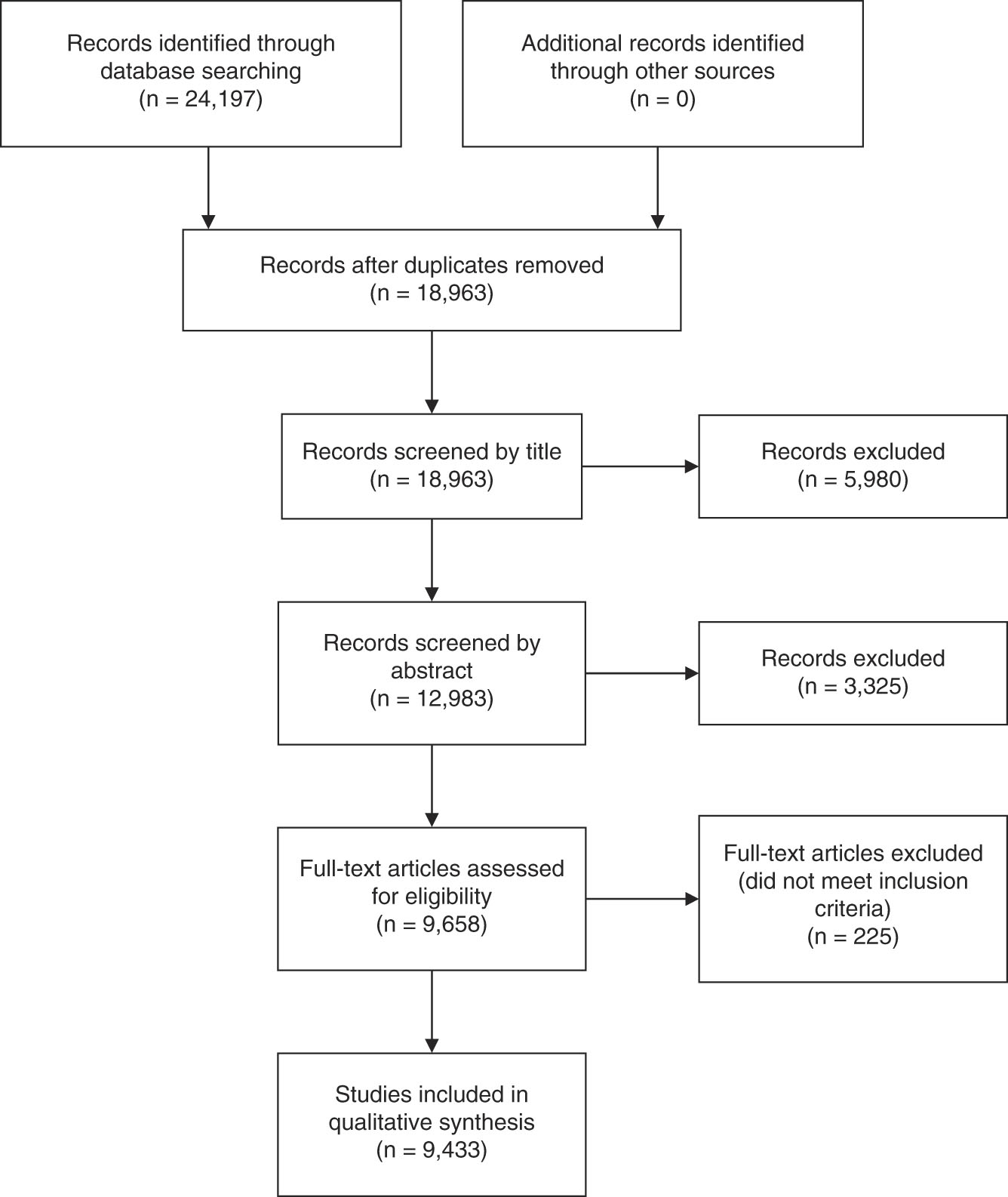
The combined search strategies yielded 24,197 individual records. Initial title review of these records identified 12,983 potentially relevant records. Subsequent abstract review refined the number of potentially relevant records to 9,658. Full-text review of these records identified 9,433 publications that met the inclusion criteria for this study and informed the results of this literature review (Figure 1). The Kappa Value for inter-rater reliability was 0.80, which indicated excellent agreement between reviewers in determining whether the records retrieved by the search strategy were directly related to disaster management.
Screening Flow Chart.

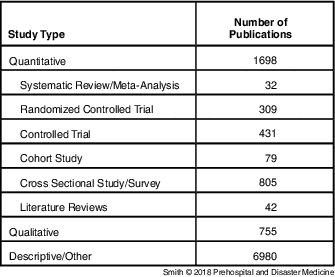
The publications were overwhelmingly descriptive (74%). Less than 20% of publications reported the use of a quantitative methodology. Almost 50% of these quantitative studies reported the use of cross-sectional survey methodology and less than 10% were classified as high-level evidence (randomized controlled trials, controlled trials, systematic reviews, or meta-analyses). Less than 10% of published studies reported the use of qualitative methodologies. A summary of the study methodologies utilized in the identified publications is provided in Table 1.
Study Methodology Reported in Publications

Of the 9,433 publications identified by the search strategies, the majority focused on the direct impact and costs of disaster (95%). Of these 8,961 publications addressing the direct impact of disaster, two percent focused on prevention, 11% discussed mitigation strategies, 13% outlined preparedness initiatives, 31% described the response to disaster, and 43% explored recovery following disaster. Of the publications on recovery, the primary focus was on mental health, posttraumatic stress disorder (PTSD), and the psychosocial impact of disaster (32%); 14% were on recovering essential public health infrastructure; and eight percent reported on economic recovery. Of the publications focused on the direct impact and costs of disaster, 1,137 (13%) addressed some aspect of disaster resilience.
A small number of publications (5%) addressed the indirect impact of disaster, including displacement and internally displaced populations in the context of disasters (<1%), refugees in disaster settings (2%), issues surrounding food insecurity and food supply during disaster (1%), the breakdown of public health infrastructures and protections resulting from disaster (1%), and the management dilemmas of responding to complex humanitarian emergencies (<1%).
The findings of this research highlighted a lack of publications reporting on the application of evaluation tools or frameworks. A total of 1,273 publications (13%) reported on an objective evaluation of a disaster, including evaluations of training, planning, and response. Around one-half of these were published within the past five years, identifying a growing trend in both conducting and reporting on objective, post-disaster evaluation. Of the publications on evaluation, less than one percent discussed the development of, or use of evaluation tools such as the Utstein Template and the Kamedo Framework.
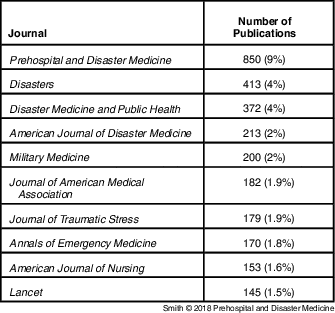
The publications were published in 918 multi-disciplinary journals, of which 34% were mental-health-related journals, 28% were public health journals, and 11% were medical journals. The journal Prehospital and Disaster Medicine (World Association for Disaster and Emergency Medicine; Madison, Wisconsin USA) had the greatest number of publications (9%) of all journals publishing on issues within the scope of disaster management, followed by Disasters (Overseas Development Institute; London, United Kingdom; 4%), and Disaster Medicine and Public Health Preparedness (Society for Disaster Medicine and Public Health; Rockville, Maryland USA; 4%). A list of the top 10 journals of publication for the studies included in this review is provided in Table 2. Hurricane Katrina (2005; Gulf Coast USA) had the most number of disaster-specific publications (17%) followed by the September 11, 2001 terrorist attacks (New York, Virginia, and Pennsylvania USA; 15%).
Top 10 Journals for Peer-Reviewed, Disaster Management Relevant Publications

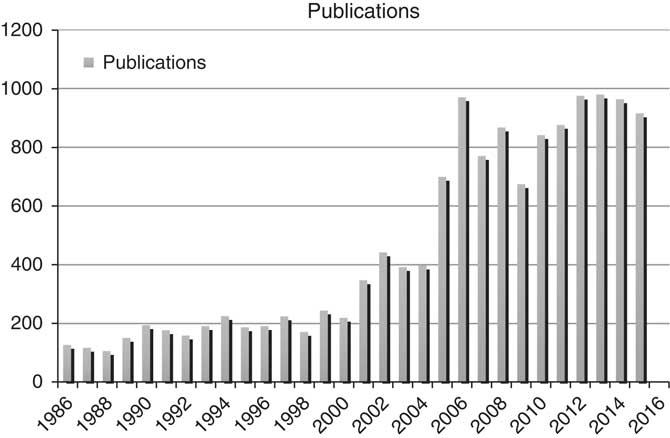
The number of publications per year started to grow steadily from the early 1980s and peaked in 2006 with 970 publications, averaging around 850 publications per year until peaking again in 2013 with 979 publications. Over the past five years, the numbers of disaster-related publications published each year had started to decrease. Figure 2 graphically illustrates the number of disaster-related publications per year for the past 30 years. The country of origin for the majority of the studies published was the United States. Studies from Australia, the United Kingdom, and Europe were also prevalent. There was also an emerging disaster research profile for Asia.
Publications by Year – 1986-2016.

Discussion
This review documents the largely descriptive and anecdotal nature of existing disaster management literature and identified the lack of high-level evidence and objective post-disaster evaluations. Rigorous and analytical research needs to be conducted to strengthen the disaster management evidence-base and to support those currently working within the disaster planning, response, and recovery environments. This review is novel for the disaster management field in that it utilized a range of electronic databases to identify literature relevant to the broad spectrum of activities that fall within the umbrella of disaster management. This is the first comprehensive literature review to utilize this range of databases to identify published disaster management literature from 1947 through July 2017. Previous reviews have been limited in timeframe and databases searched,Reference Fleiss 6 , Reference Lettieri, Masella and Radaelli 7 and in scope.Reference Smith, Wasiak, Sen, Archer and Burkle 5
In the disaster management field, anecdotal and descriptive reports on disasters have typically been used as the best available science.Reference Lurie, Manolio, Patterson, Collins and Frieden 8 A review of the emergency planning literature for public health emergencies noted that the published literature for emergency planning is largely dominated by event reports.Reference Challen, Lee, Booth, Gardois, Woods and Goodacre 9 This can be problematic in that outcomes and conclusions taken from these descriptive reports may not be generalizable to other populations, settings, or interventions. 10 As an expanding, multi-disciplinary field, disaster management needs to be informed by the best available evidence and for rigorous forms of evidence, including objective, post-disaster evaluation, to inform future disaster prevention, mitigation, response, and recovery. Given that the “science” of disaster management is spread across over 900 different journals, adopting such an evidence-informed approach to disaster management will continue to be a challenge.
This review has highlighted a lack of high-level evidence within the existing disaster management evidence-base. However, the difficulties associated with conducting controlled research within the context of disasters could mean that the traditional hierarchy of evidence applied to clinical research is not necessarily appropriate in this field. The challenge of using the traditional evidence hierarchy to inform evidence-based decision making has been raised outside of the disaster management field.Reference Challen, Lee, Booth, Gardois, Woods and Goodacre 9 , Reference Upshur, VanDenKerkhof and Goel 11 The hierarchical approach to evidence is quantitatively oriented and does not cater to a multi-disciplinary field such as disaster management where much of the evidence generated is descriptive or qualitative in nature – nor does it consider how context may modify the relevance of evidence.
A multi-disciplinary field such as disaster management requires an inclusive definition of evidence, one that acknowledges the importance of both quantitative research that involves measurement, as well as qualitative research that explores context and meaning. The literature identified in this review supports the idea that both quantitative and qualitative methodological approaches are valuable in generating knowledge to understand the complexities associated with each phase of the disaster cycle.
Such research will benefit from having a sufficient theoretical base that will allow it to have solid “scientific” standing in the eyes of proponents of evidence-based practice.Reference Upshur, VanDenKerkhof and Goel 11 , Reference Khan, Fazli and Henry 12 This is particularly important in the disaster management field where the majority of evidence is descriptive and lacks a sufficient theoretical base. Many changes are emerging in the field of disaster management. These changes include how prevention, mitigation, and preparedness are addressed, how response is managed, and how recovery activities are considered within the context of building back more resilient communities. Given these changes, are the existing fundamental concepts of the disaster management cycle (prevention, preparedness, mitigation, response, and recovery) truly guiding in today’s modern world? Or are they outdated?
The Prevention/Preparedness/Response/Recovery (PPRR) concept was developed over 20 years ago, and while it certainly still has a place in disaster management of today, it is not without its problems. In recent years, there has been a shift within disaster management from an internal agency focus to a community-centered focus. With this shift has come a change in focus from hazards to vulnerability, emphasizing a proactive, multi-disciplinary approach to community-centered risk management.Reference Salter 13 This new approach emphasizes the interaction between community and hazard. Such consideration goes well beyond the physical hazard and includes socioeconomic and psychological vulnerability factors such as income, perceptions, and support groups. Many of these factors do not easily lend themselves to categorization within the PPRR framework, which implies a clear delineation between the elements and assumes that all elements are of equal importance and should be applied in a sequential order.Reference Crondstedt 14
Along with this shift has come an emerging evidence-base on community resilience to disaster. This review identified that over 1,000 of the publications retrieved by the search strategy discussed resilience in the context of disasters. Most of these 1,000 publications were published within the last five years, which makes sense given this changing approach to disaster management.
The underlying challenge now is to address the identified “short-comings” of the existing disaster management evidence-base. However, the lack of frequent, predictable, or controllable real-world opportunities to study the many different facets of disaster management has hindered the development of an evidence-base to support best practices, performance measures, and standards. An important step in assessing this issue is identifying key priorities for future disaster research and focusing on methods to identify core processes, develop novel data sources and measures based on smaller-scale proxy events, and develop approaches to support the translation of research into practice within the wide variety of disaster management systems in place around the world.Reference Nelson, Beckjord and Dausey 15
As for any type of health care, decisions about disaster management must be guided by the best possible evidence. The best available evidence has been defined as the results of methodologically sound and patient-centered clinical research.Reference Sackett, Rosenberg, Gray, Haynes and Richardson 16 Systematic review, including both qualitative and quantitative studies, while useful, will not always be possible in the uncontrollable and unpredictable field of disaster. It will be important therefore for disaster managers to combine the results of the best available evidence given the context with knowledge about local values, preferences, and feasibility.Reference Gerdin, Clarke and Allen 17 In addition, there is a need to apply the evidence generated by research to the real world—to bridge the “know-do” gap through operational research.Reference Blanchet, Sistenich and Ramesh 18
Limitations
These findings should be understood in the context of some limitations. As with all systematic literature reviews, there is a possibility that some relevant disaster management literature was missed. The rigorous and comprehensive search strategies developed for each of the electronic databases utilized for this research should minimize this. Furthermore, the search was limited to articles published in English. The authors did not assess publication bias, although it is unlikely that this bias influences publication of disaster management studies. Finally, quality of individual research studies was not assessed beyond research design in this review, and for this reason the themes identified in the literature do not take into account specific methodological strengths and weaknesses of the included studies. Quality assessment is ideal to include and future research should focus on this.
Conclusion
The complexity of disaster management is reflected in the large number of studies published in over 900 discipline-diverse journals. This review has documented the largely descriptive and anecdotal nature of existing disaster management literature and identified the lack of high-level evidence and objective, post-disaster evaluations. Rigorous and analytical research needs to be conducted to strengthen the disaster management evidence-base and to support those currently working within the disaster planning, response, and recovery environments. This review focused on the body of primary research that has been conducted in the disaster management field and aimed to identify the type of research being published, where the research is being published, and what the focus of the research was. By providing answers to these questions, this review is a valuable tool furthering the current understanding of existing disaster management science and revealing potential knowledge gaps for future research.
Acknowledgements
The authors would like to acknowledge the contributions of Emeritus Professor Frank Archer, Ms. Anne-Marie Williams, Mr. Jason Wasiak, and Professor Ross Spark for their contributions to the development of this review. The authors would also like to acknowledge the support and assistance from staff at: The Department of Community Emergency Health and Paramedic Practice at Monash University (Melbourne, Australia); the College of Public Health, Medical, and Veterinary Sciences, Division of Tropical Health and Medicine at James Cook University (Cairns, Australia); and the School of Medical and Health Science, Edith Cowan University (Joondalup, Western Australia).