


%20--%3e%3c!DOCTYPE%20svg%20PUBLIC%20'-//W3C//DTD%20SVG%201.0//EN'%20'http://www.w3.org/TR/2001/REC-SVG-20010904/DTD/svg10.dtd'%3e%3csvg%20version='1.0'%20id='Layer_1'%20xmlns='http://www.w3.org/2000/svg'%20xmlns:xlink='http://www.w3.org/1999/xlink'%20x='0px'%20y='0px'%20width='64px'%20height='64px'%20viewBox='5.5%20-3.5%2064%2064'%20enable-background='new%205.5%20-3.5%2064%2064'%20xml:space='preserve'%3e%3cg%3e%3ccircle%20fill='%23FFFFFF'%20fill-opacity='0'%20cx='37.785'%20cy='28.501'%20r='28.836'/%3e%3cpath%20fill='%23595959'%20d='M37.441-3.5c8.951,0,16.572,3.125,22.857,9.372c3.008,3.009,5.295,6.448,6.857,10.314%20c1.561,3.867,2.344,7.971,2.344,12.314c0,4.381-0.773,8.486-2.314,12.313c-1.543,3.828-3.82,7.21-6.828,10.143%20c-3.123,3.085-6.666,5.448-10.629,7.086c-3.961,1.638-8.057,2.457-12.285,2.457s-8.276-0.808-12.143-2.429%20c-3.866-1.618-7.333-3.961-10.4-7.027c-3.067-3.066-5.4-6.524-7-10.372S5.5,32.767,5.5,28.5c0-4.229,0.809-8.295,2.428-12.2%20c1.619-3.905,3.972-7.4,7.057-10.486C21.08-0.394,28.565-3.5,37.441-3.5z%20M37.557,2.272c-7.314,0-13.467,2.553-18.458,7.657%20c-2.515,2.553-4.448,5.419-5.8,8.6c-1.354,3.181-2.029,6.505-2.029,9.972c0,3.429,0.675,6.734,2.029,9.913%20c1.353,3.183,3.285,6.021,5.8,8.516c2.514,2.496,5.351,4.399,8.515,5.715c3.161,1.314,6.476,1.971,9.943,1.971%20c3.428,0,6.75-0.665,9.973-1.999c3.219-1.335,6.121-3.257,8.713-5.771c4.99-4.876,7.484-10.99,7.484-18.344%20c0-3.543-0.648-6.895-1.943-10.057c-1.293-3.162-3.18-5.98-5.654-8.458C50.984,4.844,44.795,2.272,37.557,2.272z%20M37.156,23.187%20l-4.287,2.229c-0.458-0.951-1.019-1.619-1.685-2c-0.667-0.38-1.286-0.571-1.858-0.571c-2.856,0-4.286,1.885-4.286,5.657%20c0,1.714,0.362,3.084,1.085,4.113c0.724,1.029,1.791,1.544,3.201,1.544c1.867,0,3.181-0.915,3.944-2.743l3.942,2%20c-0.838,1.563-2,2.791-3.486,3.686c-1.484,0.896-3.123,1.343-4.914,1.343c-2.857,0-5.163-0.875-6.915-2.629%20c-1.752-1.752-2.628-4.19-2.628-7.313c0-3.048,0.886-5.466,2.657-7.257c1.771-1.79,4.009-2.686,6.715-2.686%20C32.604,18.558,35.441,20.101,37.156,23.187z%20M55.613,23.187l-4.229,2.229c-0.457-0.951-1.02-1.619-1.686-2%20c-0.668-0.38-1.307-0.571-1.914-0.571c-2.857,0-4.287,1.885-4.287,5.657c0,1.714,0.363,3.084,1.086,4.113%20c0.723,1.029,1.789,1.544,3.201,1.544c1.865,0,3.18-0.915,3.941-2.743l4,2c-0.875,1.563-2.057,2.791-3.541,3.686%20c-1.486,0.896-3.105,1.343-4.857,1.343c-2.896,0-5.209-0.875-6.941-2.629c-1.736-1.752-2.602-4.19-2.602-7.313%20c0-3.048,0.885-5.466,2.658-7.257c1.77-1.79,4.008-2.686,6.713-2.686C51.117,18.558,53.938,20.101,55.613,23.187z'/%3e%3c/g%3e%3c/svg%3e)
%20--%3e%3c!DOCTYPE%20svg%20PUBLIC%20'-//W3C//DTD%20SVG%201.0//EN'%20'http://www.w3.org/TR/2001/REC-SVG-20010904/DTD/svg10.dtd'%3e%3csvg%20version='1.0'%20id='Layer_1'%20xmlns='http://www.w3.org/2000/svg'%20xmlns:xlink='http://www.w3.org/1999/xlink'%20x='0px'%20y='0px'%20width='64px'%20height='64px'%20viewBox='5.5%20-3.5%2064%2064'%20enable-background='new%205.5%20-3.5%2064%2064'%20xml:space='preserve'%3e%3cg%3e%3ccircle%20fill='%23FFFFFF'%20fill-opacity='0'%20cx='37.637'%20cy='28.806'%20r='28.276'/%3e%3cg%3e%3cpath%20fill='%23595959'%20d='M37.443-3.5c8.988,0,16.57,3.085,22.742,9.257C66.393,11.967,69.5,19.548,69.5,28.5c0,8.991-3.049,16.476-9.145,22.456%20C53.879,57.319,46.242,60.5,37.443,60.5c-8.649,0-16.153-3.144-22.514-9.43C8.644,44.784,5.5,37.262,5.5,28.5%20c0-8.761,3.144-16.342,9.429-22.742C21.101-0.415,28.604-3.5,37.443-3.5z%20M37.557,2.272c-7.276,0-13.428,2.553-18.457,7.657%20c-5.22,5.334-7.829,11.525-7.829,18.572c0,7.086,2.59,13.22,7.77,18.398c5.181,5.182,11.352,7.771,18.514,7.771%20c7.123,0,13.334-2.607,18.629-7.828c5.029-4.838,7.543-10.952,7.543-18.343c0-7.276-2.553-13.465-7.656-18.571%20C50.967,4.824,44.795,2.272,37.557,2.272z%20M46.129,20.557v13.085h-3.656v15.542h-9.944V33.643h-3.656V20.557%20c0-0.572,0.2-1.057,0.599-1.457c0.401-0.399,0.887-0.6,1.457-0.6h13.144c0.533,0,1.01,0.2,1.428,0.6%20C45.918,19.5,46.129,19.986,46.129,20.557z%20M33.042,12.329c0-3.008,1.485-4.514,4.458-4.514s4.457,1.504,4.457,4.514%20c0,2.971-1.486,4.457-4.457,4.457S33.042,15.3,33.042,12.329z'/%3e%3c/g%3e%3c/g%3e%3c/svg%3e)
1. Introduction
The rise of far-right and green parties in Western Europe has prompted discussions on how mainstream parties should respond to competition on immigration and environmental issues. The influential work of Meguid (Reference Meguid2005; Reference Meguid2008) emphasizes the role of both position-taking and issue salience, distinguishing between dismissive, accommodative, and adversarial strategies. Mainstream parties can decide to downplay the issue (dismissive strategy) or engage with the new issue, and either move toward the challenger’s position (accommodative strategy) or increase policy distance (adversarial strategy).
Meguid’s empirical findings suggest that accommodative strategies are most effective against radical right or green challengers. This insight is widely shared in public discourse and by party strategists. Conservative parties like the German CDU/CSU and social democratic parties such as Denmark’s social democrats increasingly adopt restrictive positions on immigration. However, recent studies point to the possibly detrimental effects of accommodative strategies for the parties’ own votes. While Hjorth and Larsen (Reference Hjorth and Larsen2022) and Spoon and Klüver (Reference Spoon and Klüver2021) find that accommodation benefits mainstream left parties, others find that it can harm vote shares (Chou et al., Reference Chou, Dancygier, Egami and Jamal2021) or even strengthen radical right challengers (Krause et al., Reference Krause, Cohen and Abou-Chadi2023). Still, this strategy is empirically prevalent among mainstream parties facing radical right challengers (Abou-Chadi and Krause, Reference Abou-Chadi and Krause2020; Spoon and Klüver, Reference Spoon and Klüver2021).
We contribute to this debate by focusing on what strategy is best for established parties that are faced with an extreme challenger party, in terms of their own electoral success. While it is possible that minimizing the challenger is also a winning formula for the established mainstream party, this must not always be the case. Vote-maximizing and challenger-minimizing are conceptually independent goals, and it might well be that what is most effective to minimize the challenger does not serve the goal of maximizing a party’s own share. In this contribution, we explicitly focus on vote-maximizing strategies.
Following on recent advances on the role of issue salience in party competition (Adams et al., Reference Adams, Merrill and Zur2024; Vasilopoulou and Zur, Reference Vasilopoulou and Zur2024; Kurella, Reference Kurella2025), we model party strategies in a multidimensional policy space, allowing parties to adjust both their policy positions and issue salience. Building on this framework, we incorporate voter preferences, party valence, and, in an extension, partisan attachments. This addresses two key limitations in existing empirical research. First, by identifying Nash equilibrium strategies through best responses, we account for the interdependence of parties’ choices without requiring empirical counterfactuals. This means we account for the strategic interactions of all competing parties simultaneously, which allows us to identify the optimal strategy of each party in response to the others’ behavior. While the equilibrium vote share for the mainstream party may be lower than in previous elections—when the challenger was absent, or the voter configuration differed—this strategy nonetheless represents the most advantageous course of action given the prevailing empirical conditions. Second, we extend the model to better reflect the multidimensional nature of many Western-type democracies and the reality of voters’ party biases in political competition, and thus provide conclusions based on more appropriate assumptions. In doing so, we aim to bridge the gap between formal theoretical expectations and recent empirical observations.
We apply the model to empirical data on German federal elections (1980–1987; 2013–2021), covering the entry of two niche challengers: the Greens (from 1980) and the Alternative for Germany (AFD) (from 2013). Our results show that accommodative strategies are generally unattractive for moderate mainstream parties. If voters’ preferences are only weakly correlated across issues, parties may alienate supporters on other dimensions when shifting their stance on one. This effect is amplified when challengers establish strong partisan ties with ideologically homogeneous voter groups, who are unlikely to switch allegiance even if mainstream parties converge on the challenger’s policy. Only under restrictive conditions—namely for small, low-valence parties facing a newly entering challenger and weakly aligned voter preferences—can accommodation become vote-maximizing. We treat these cases as exceptions rather than as the dominant strategic pattern. These findings support empirical evidence on negative implications of accommodative strategies for established parties’ own votes, at least for major parties. Their optimal strategy is to stay close to the mean voter and keep the salience of the niche issue at a moderate or low level.
The paper proceeds as follows: Sections 2 and 3 review the literature on party strategies for position and salience and present the theory. Section 4 introduces the model and equilibrium concept. Section 5 describes the empirical calibration. Section 6 discusses the results, and Section 7 concludes.
2. Party competition for position and salience on niche issues
Meguid’s (Reference Meguid2005; Reference Meguid2008) work on competition between mainstream and challenger parties provides a foundational framework for understanding how mainstream and smaller parties react to the entry of challengers advocating extreme positions on new or secondary issue dimensions. Her contributions significantly advanced the literature on niche party success, which had previously focused on niche parties in isolation, largely ignoring the strategic responses of mainstream parties.
It is now evident that niche party success depends not only on their own positioning but also on the strategic actions of established parties, a concept that aligns with the traditional spatial model of competition (Downs, Reference Downs1957). Meguid (Reference Meguid2005; Reference Meguid2008) also made an important contribution in pointing out that it is not only parties’ strategic positions that shape competition, but that the salience of a policy issue also plays a crucial role in determining the competitive situation in policy spaces that are shaped by more than one line of conflict. Established parties may choose to ignore an issue introduced by a challenger, particularly if the issue had previously been neglected in the political discourse. This pattern of reaction has been observed with niche parties introducing issues such as data security in the context of digitization, which had been absent from earlier political agendas.
Subsequent research on mainstream party responses to niche party entry can be divided into studies focusing on either the emphasis placed on the issue or the positioning strategies adopted by mainstream parties. A significant body of work, following Meguid’s approach, shows that mainstream parties often react to niche party success by adopting accommodative strategies. This behavior is particularly pronounced among parties of the same ideological camp (Adams and Somer-Topcu, Reference Adams and Somer-Topcu2009; Han, Reference Han2015) and among opposition parties (Van Spanje, Reference Van Spanje2010). In contrast, governing parties tend to distance themselves from radical right parties, as evidenced by a time-series cross-sectional analysis of West European party systems from 1980 to 2011 on immigration issues (Abou-Chadi, Reference Abou-Chadi2016). Importantly, mainstream parties’ positional strategies also vary depending on the nature of the issue. While left and right mainstream parties tend to accommodate right-wing niche parties (Van Spanje, Reference Van Spanje2010; Abou-Chadi and Krause, Reference Abou-Chadi and Krause2020; Spoon and Klüver, Reference Spoon and Klüver2021), they show less inclination to do so on environmental issues (Abou-Chadi, Reference Abou-Chadi2016; Grant and Tilley, Reference Grant and Tilley2019).
The findings on the consequences of accommodative strategies on mainstream parties’ own electoral success are mixed. For instance, Spoon and Klüver (Reference Spoon and Klüver2021) report that mainstream left parties can retain voters from switching to radical right parties by taking tougher stances on immigration. This effect does not extend to mainstream right parties. Furthermore, it remains unclear whether the net effect is positive for the mainstream left when accounting for voters who defect to other left-leaning parties due to their accommodative stance. Loxbo (Reference Loxbo2023) shows that the consequences of mainstream left parties’ accommodative strategies depend on the type of welfare regime: adopting restrictive immigration policies proves more effective in terms of vote-winning in social democratic welfare regimes with strong in-group and low out-group solidarity, such as the Nordic countries, but not in conservative regimes.
Other recent empirical studies have challenged the positive outcomes of accommodative behavior for immigration: For example, based on a conjoint experiment on German voters before the 2017 federal election, Chou et al. (Reference Chou, Dancygier, Egami and Jamal2021) demonstrate that going tough on immigration is not a vote-winning formula for the mainstream parties SPD (socialdemocrats) and CDU (conservatives), as it alienates more of their existing voters than it attracts from the radical right AfD. Nevertheless, their results suggest that tougher stances could still reduce the AfD’s support, thus supporting their effectiveness in terms of minimizing the challenger. Hjorth and Larsen (Reference Hjorth and Larsen2022) find that accommodative strategies can strengthen a mainstream left-led government, as votes lost to other left-wing parties are offset by gains from the radical right, resulting in a net benefit for the left camp overall. Chou et al. (Reference Chou, Dancygier, Egami and Jamal2021) conclude that mainstream parties are unlikely to make significant shifts in policy in response to radical right challengers, given the overall negative impact on their vote share.
Krause et al. (Reference Krause, Cohen and Abou-Chadi2023) focus on the consequences of accommodative strategies for radical right challenger parties by investigating radical right party support across a large span of time and countries. Contrary to Chou et al. (Reference Chou, Dancygier, Egami and Jamal2021), their findings indicate that mainstream parties’ accommodative strategies on immigration do not weaken radical right challengers. Instead, they contribute to an increase in the electoral support of these parties. Similar results are reported by Down and Han (Reference Down and Han2020) and Dahlström and Sundell (Reference Dahlström and Sundell2012), who point to a key mechanism: when mainstream parties adopt anti-immigration stances, they legitimize these positions, inadvertently strengthening the parties that originally championed them. In contrast, Grant and Tilley (Reference Grant and Tilley2019) examine accommodative strategies concerning green party success and find that, while mainstream parties can undermine young green parties by adopting environmentally friendly policies, this strategy has the opposite effect once green parties are established. As the salience of environmental issues increases, green party support is strengthened.
The empirical findings on parties’ salience strategies in response to niche party entry and success are mixed. It is broadly agreed that rival parties cannot indefinitely ignore niche issues, but will eventually take a position and incorporate the niche issue into their campaigns (Green-Pedersen and Mortensen, Reference Green-Pedersen and Mortensen2015; Seeberg, Reference Seeberg2022). For example, Spoon et al. (Reference Spoon, Hobolt and De Vries2014) show that non-green parties respond to green party success with higher salience levels for environmental issues, especially when they are ideologically close, and the green party poses an electoral threat. Their analysis, based on data from the Comparative Manifesto Project spanning 19 countries over 30 years, contrasts with the findings of Abou-Chadi (Reference Abou-Chadi2016), who narrows the focus to mainstream parties. This study reveals that growing green party support does not prompt mainstream parties to emphasize environmental issues more heavily. However, mainstream parties react differently when faced with radical right challengers, increasing their emphasis on immigration in response to these challengers’ electoral gains (Abou-Chadi, Reference Abou-Chadi2016).
How will these responses in terms of issue salience affect the electoral fortunes of the mainstream and challenger parties? It has been shown that radical right party success is closely linked to the salience of immigration issues (Dennison and Geddes, Reference Dennison and Geddes2019; Dennison, Reference Dennison2020), demonstrating the general role of salience for the success of niche parties (Adams et al., Reference Adams, Merrill and Zur2024; Vasilopoulou and Zur, Reference Vasilopoulou and Zur2024). In particular, Kurella and Rapp (Reference Kurella and Rapp2024) have shown that radical challenger parties will benefit electorally from increasing salience of their niche issue if they have a competitive advantage in the multidimensional policy space, i.e., if they take a moderate position on the primary policy dimension and have a unique position on the niche issue. Therefore, it is questionable whether issue engagement by mainstream parties is a vote-winning strategy. If an increase in niche issue salience fuels the success of niche parties, it rather puts another obstacle to the effectiveness of accommodating strategies, at least when facing extreme challengers that are favorably positioned in the policy space.
In summary, the effectiveness of accommodative strategies—both for mainstream parties’ electoral outcomes and the success of radical right and green challengers—varies significantly. The literature suggests that accommodation may be effective under certain conditions: it works when green challengers are in their infancy, and for mainstream left parties in Nordic countries on immigration issues. Beyond these contexts, however, there is little consensus. Moreover, most evidence on positioning strategies pertains to immigration policy, while research on environmental competition remains sparse (but see Abou-Chadi, Reference Abou-Chadi2016; Grant and Tilley, Reference Grant and Tilley2019).
3. Theory
Our contribution to the literature lies in approaching the question of how mainstream parties respond to niche party entry from a game-theoretic perspective. Specifically, we ask what constitutes the optimal strategy for mainstream parties, simultaneously accounting for both position and salience. Thereby, we closely reflect Meguid’s original framework with respect to party strategies, but deviate notably by focusing on a different dependent variable: instead of assessing effectiveness in terms of minimizing the challenger, we ask which strategy maximizes the established party’s votes. We further extend the model to consider multiple issue dimensions and party biases.
Drawing on insights from equilibrium configurations in multiparty competition (Cox, Reference Cox1987; Schofield, Reference Schofield2007), we do not expect to detect equilibria in which all parties converge to the same extreme position as the challenger party. Previous work has shown that major parties, with non-policy-related valence advantages, face centripetal incentives in their positioning, while small parties are driven by centrifugal forces (Groseclose, Reference Groseclose2001; Kurella and Pappi, Reference Kurella and Pappi2015). Therefore, we anticipate distinct equilibrium positions. Regarding salience, Kurella (Reference Kurella2025) has shown that parties’ optimal emphasis strategies also depend on their non-policy-related valence attribute, and on their position on the primary conflict line, with extreme parties facing incentives to push the salience of secondary, niche issues. We build on the basic logic of this model and adjust it to our case at hand.
In particular, we assume that parties remain fixed on the economic left–right dimension, with the pattern of competition on this dimension frozen during the short-term of an election campaign. However, parties are free to adjust their positions on secondary, niche issues. From a technical viewpoint, this assumption creates an ideological constraint in that parties hold additional advantages among voters aligned with them on the economic dimension. For example, it is less attractive for economically left-leaning parties to adopt anti-immigration positions if their economically aligned voters tend to prefer pro-immigration policies. Consequently, large shifts on the niche issues become more costly. As a result, we do not expect parties to leapfrog each other in equilibrium.
The success of radical right parties might also stem from voter considerations beyond policy and salience, e.g., issue ownership (Bélanger and Meguid, Reference Bélanger and Meguid2008; Lachat, Reference Lachat2014). Even if the center-right party takes over radical right party stances on immigration, voters might still prefer the radical right if they see it as “more competent to handle immigration.” We consider this in an extension of the model that additionally incorporates a party bias as first suggested by Adams (Reference Adams2001). Although this party bias is not a direct measure of issue ownership, it serves to capture party advantages among voter groups that stem from considerations beyond policy positions, such as issue ownership, competency considerations, or class linkages. If these party sympathizers are very homogeneous in their policy preferences on an issue, this will influence parties’ optimal position strategies; i.e., it will make it harder for another party to catch these voters even when accommodating the challenger’s policy—partisans are still biased toward their party. Adam’s analysis demonstrates that if party sympathizers are ideologically clustered, “parties cannot prise loose support from a rival party’s sympathizers by mimicking this rival’s ideology. Instead, they must present policies that are significantly more attractive than—hence different from—their rivals’ positions” (Adams, Reference Adams2001, 132).
Evaluating optimal (equilibrium) positions against the empirical party positions allows us to determine whether moving closer to the niche party is a viable strategy for mainstream parties. This approach raises an important, yet often overlooked question regarding the definition of accommodative and adversarial strategies: Does accommodation entail approaching the niche party’s position as closely as possible? Or is there a tipping point, beyond which further convergence becomes counterproductive when parties try to maximize their vote shares? We rely on a strict definition that follows the original definition of Meguid (Reference Meguid2005), 349,Footnote 1 i.e., consider a party strategy as accommodation if the equilibrium position is identical to or lies very close to the niche party’s stance. The strategic rationale behind this tactic is to become a viable option for voters who would otherwise be inclined to vote for the niche party due to its issue position on the new issue, and become the new owner of this issue.Footnote 2 If, however, the optimal location involves a small policy shift toward the challenger, but is still significantly different from the challenger’s stance, we do not consider this to constitute an accommodating strategy. Mainstream parties often exhibit centripetal adjustments or positional moderation on the niche dimension. These can materialize as small movements toward the challenger, but rather reflect mean-voter optimization due to spatial incentives than strategic accommodation. This avoids interpreting even small discrepancies between observed and equilibrium positions as evidence of the efficiency of accommodation, as this would be misleading especially for parties that are located at the opposite end of the policy dimension. For clarity, if accommodation were defined as any positional movement toward the challenger, then accommodation would almost mechanically appear successful, as vote-maximizing equilibria frequently involve limited centripetal adjustment toward electorally attractive regions of the policy space. Such a definition would conflate marginal mean-voter repositioning with strategic imitation aimed at undermining issue ownership, thereby obscuring the distinct logic of accommodative strategies as originally theorized.
Instead, we consider the relation to the niche party’s position and key locations of the voter distribution, i.e., the mean voter’s position, when evaluating optimal strategies. We also consider the optimal salience level in our evaluation of optimal strategies. In accordance with Meguid (Reference Meguid2008), we count as accommodative and adversarial strategies those in which the party mimics or opposes the challenger’s position and at the same time emphasizes the issue in its campaign.
4. The model
We take a Downsian spatial model as a starting point, where voters are characterized by their policy preferences as ideal points in a multidimensional Euclidean space. Building on the work of Schofield Lin et al. (Reference Lin, Enelow and Dorussen1999); Schofield (Reference Schofield2005a, Reference Schofield, Austen-Smith and Duggan2005b); McKelvey and Patty (Reference McKelvey and Patty2006), and Kurella (Reference Kurella2025), our model integrates a policy proximity term with a valence component, which captures non-policy-related factors of the vote function such as perceived competence and likeability of leaders and parties. This measure therefore absorbs non-policy advantages associated with incumbency, parliamentary strength, and institutional embeddedness.Footnote 3 The proximity term consists of a weighted squared distance on three policy issue dimensions,Footnote 4 allowing flexibility to model competition with more or less than three dimensions. We opt for a three-dimensional model, enabling us to model competition on the principal, economic line of conflict, and two additional new-cultural niche issues.
Many spatial models rely on a general left–right dimension as the primary axis of competition. We deliberately do not adopt this approach here. Left–right self-placement often functions as a superdimension that bundles together economic, cultural, and moral policy considerations, and may already incorporate attitudes toward issues such as immigration or environmental regulation (Steiner, Reference Steiner2024). Using such a composite dimension would therefore risk conflating baseline ideological positioning with the niche issue dimensions that are central to our analysis.Footnote 5
The spatial coefficients represent the weights with which each policy dimension enters the vote calculus. It is not an individual-specific parameter, but reflects the general decision weight for the electorate as a whole. In line with established literature, we interpret these spatial coefficients as representing the electoral salience of the respective issue dimensions (Ansolabehere and Puy, Reference Ansolabehere and Puy2018). We assume that parties can strategically influence this aggregate salience through campaign emphasis and agenda setting, and we explicitly endogenize these incentives in our algorithm by allowing parties to choose optimal salience levels in equilibrium. We acknowledge that parties’ ability to affect voters’ subjective issue importance is empirically constrained and may vary across issues and contexts (see e.g Seeberg, Reference Seeberg2022; Adams et al., Reference Adams, Merrill and Zur2024). Yet, our framework allows us to derive clear implications about how parties would optimally attempt to shape electoral salience.Footnote 6
Voters are described by ideal points on all three issues:  ${\left\{x_{i} , y_i, z_i\right\}}$ with
 ${i \in N}$. Each party
 $j$ is characterized by its policy offer,
 ${\left\{x_{j} , y_j, z_j\right\}}$. Voter
 $i$’s utility is given by
 \begin{equation}
u_{ij}=\alpha \lambda_j - \beta_{1} (x_{i} - x_{j})^2 - \beta_{2} (y_{i} - y_{j})^2 - \beta_{3} (z_{i} - z_{j})^2 + \epsilon_{ij},
\end{equation}
where  $\lambda_j$ is party
 $j$’s non-policy-related valence score, and
 $\alpha$ is the respective coefficient indicating the overall impact of party valence on voting. The
 $\beta$ parameters capture the salience of each of the three issue dimensions, and
 $\epsilon_{ij}$ is the error of the model. In our second, extended model, we further include a party bias:
 \begin{equation}
u_{ij}=\alpha \lambda_j + \gamma p_{ij}- \beta_{1} (x_{i} - x_{j})^2 - \beta_{2} (y_{i} - y_{j})^2 - \beta_{3} (z_{i} - z_{j})^2 + \epsilon_{ij},
\end{equation}
where  $p_{ij}$ is a dummy variable that takes on the value 1 if voter
 $i$ identifies with party
 $j$. Voting is assumed to be probabilistic, such that voters vote for each party with probability proportional to the value of the utility function. The concrete vote probability is given by
 \begin{equation}
\rho _{ij} = \text{Pr} [[u_{ij} \gt u_{il} ], \text{ for all }l \neq j] .
\end{equation}
Assuming that the error terms of  $u$ follow a Type-I generalized extreme value distribution, we can rewrite that as
 \begin{align*}
\rho_{ij}&= \frac{\exp^{u_{ij}}}{\sum_{l=1}^{J}\exp^{u_{il} }}.
\end{align*}
4.1. Model assumptions
Parties seek to maximize their votes by choosing optimal positions and salience parameters. In order to connect the theoretical model with the empirical reality in the German multiparty system to which we apply the model, we introduce the following constraints on party strategies: First, parties are tied to their empirical position on the first, that is, the economic policy issue dimension. The reason is that parties might face immense credibility loss when abandoning their policy position on the historically strong economic cleavage. Yet this does not mean that such shifts do not occur. In fact, the liberal party FDP undertook significant policy shifts on economic issues in the 1980s when it abandoned its previous social democratic coalition partner SPD and entered a coalition with the conservative CDU/CSU. However, such moves are rare, only incrementally perceived by the electorate, and accompanied by valence losses (see Table A1 in the Online appendix). We consider movements on the economic issue dimension by tying the parties’ positions to the current empirical position, which may well change from one election to the next. But we do not grant leeway for parties to change their economic position in the short course of an electoral campaign, and therefore remove that option from the strategy space. As outlined previously, this assumption introduces an ideological bias: parties gain an added advantage in the utility function of voters who are ideologically aligned with them on the economic dimension. This makes it reasonable for parties to tailor their policy proposals on the two secondary policy dimensions to the preferences of these economically close voters.
Secondly, we also fix parties’ positions on an additional issue dimension if the party acts as a niche party on that issue or possesses issue ownership. This is the case for the German Greens on nuclear energy/environmental issues, as well as for the radical right AfD on immigration issues, at least from 2017 onward. This step is necessary if we want to investigate other parties’ optimal strategies in response to the challenger’s extreme position, which is the focus of this paper. Consequently, we do not question whether it is a vote-maximizing strategy for the challenger to take an extreme position in the first place, but take their position as empirically given. However, we let the challenger choose an optimal salience level for the respective issue.
4.2. Optimization algorithm and equilibrium concept
Equilibrium configurations are detected by a computer-based stepwise optimization algorithm that iteratively solves best response functions to the other parties’ best responses conditional on empirical voter distributions and previously estimated electoral salience parameters. The parameters to optimize are the individual party’s salience parameters  $\beta_j$ for the second and third (non-economic) issue dimensions; and each party’s policy proposals on the second and third dimensions:
 $y_j$,
 $z_j$, given that party
 $j$ is not a challenger party on the respective issue dimension.Footnote 7
We first outline the general logic of the optimization algorithm and then describe each step in more detail below. The optimization procedure works as follows:
Step 1 All parties start at their empirically observed position in the three-dimensional policy space given an empirical voter distribution. The
 $\beta$-parameters are initially set to their empirically estimated values (from the vote choice models). Parties possess fixed valence traits as empirically estimated.
Step 2 Parties optimize salience on the non-economic issues in random order.Footnote 8
• The first party optimizes the salience parameters for the second and third issues.
• ...
• The
$j$th party optimizes the salience parameters for the second and third issues.
Step 3 Parties optimize their position given the adapted salience levels from Step 2 in random order.
• The first party optimizes its position on the second and third issues.
• ...
• The
$j$th party optimizes its position on the second and third issues.
Step 4 Steps 2 and 3 are repeated until an equilibrium is reached in which no party has the incentive to unilaterally change either its salience or its position.


In the following, we describe each step in more detail.
Step 1. The way in which we empirically estimate the starting values is described in Section 5. We take these empirical party positions, and the empirical estimates for valence and salience parameters as start values, but consider their uncertainty by randomly drawing the start values from the 95% confidence bands around the point estimates. We take the empirical voter positions as given.
Step 2. In order to model optimal salience strategies, we give parties the leeway to pick optimal  $\beta_2$ and
 $\beta_3$ parameters. The salience of the economic issue dimension,
 $\beta_1$, is not subject to optimization. The justification for that is both technical and theoretical. Firstly, fixing one spatial coefficient eases convergence because it serves as the reference for the other two decision weights. As this term already indicates, the
 $\beta$s are weights and are thus only meaningfully interpreted in relation to each other. Choosing one
 $\beta$ as the baseline is therefore an intuitive idea. We choose the weight of the economic issue since we assume that it has a stable, non-zero impact on voting behavior in German federal elections. Secondly, this modeling choice also prevents unrealistic equilibrium configurations in which parties do not emphasize any issue dimension and voting would be solely determined by valence. We fix the salience of the economic issue dimension as a baseline for policy voting, and parties can influence
 $\beta_{2}$ and
 $\beta_{3}$ to make these other two issues more or less salient than the economic issue. Concretely, each party chooses its optimal
 $\beta^*_{2,j}$ and
 $\beta^*_{3,j}$ one after the other. At the end of Step 2, we define an updated overall salience parameter for each issue dimension by:
 $\beta_2=\frac{1}{J} \sum \beta^*_{2,j}$ and
 $\beta_3=\frac{1}{J} \sum \beta^*_{3,j}$. This reflects the idea that the overall electoral salience is the product of each party’s issue emphasis taken together. These updated salience parameters enter Step 3. To prevent ordering effects, we randomize the order in which parties optimize their salience level at the beginning of Step 2.
Step 3. Given the updated  $\beta$-parameters of Step 2, parties now choose optimal positions on issue dimensions 2 and 3, if they are not a niche party. Challengers only optimize their position on the one remaining issue dimension, of which they are not the owner. Concretely, the vote share function
 \begin{equation}
V_j = \frac{1}{n} \sum_{i\in N} \rho_{ij}
\end{equation}
is optimized for the first party, given the updated salience parameter and the initial empirical party configuration. The resulting optimal positions  $(y^*_j,z^*_j)$ for party
 $j$ are then considered in the next iteration, when it is the turn of party
 $k\neq j$, such that party
 $k$ already reacts optimally to the optimal position of party
 $j$. Optimal positions are then computed for each party after the other. The algorithm thus solves the best response function of one party to the best response functions of the other parties. To prevent ordering effects, we randomly draw the order in which parties optimize their position at the beginning of Step 3. The resulting party configuration enters the next step.
Step 4. Steps 2 and 3 are repeated, and the salience parameters and position coordinates are updated after each step until an equilibrium is reached. An equilibrium is reached when no party has an incentive to alter its  $\beta^*_{2,j} $ and
 $\beta^*_{3,j}$ by a value larger than a pre-defined
 $\epsilon$-value, given the optimal positions and salience strategies of the remaining parties, and when at the same time no party has an incentive to unilaterally change its position given the optimal positions of the other parties by a value larger than
 $\epsilon$. We set
 $\epsilon=0.001$. This corresponds to the equilibrium concept of Nash: no party gains votes or further minimizes the challenger’s vote share, respectively, by abandoning the equilibrium strategy. Once such an equilibrium state is reached, it is stable. Yet it is not guaranteed that it is unique. This means that it is possible that we detect multiple equilibria, and the question of which equilibrium state will be reached might depend on random factors. We are interested in detecting all possible equilibria given the empirical configuration, and therefore we run the optimization algorithm not just once, but 300 times. We intentionally introduce random factors such as the random order of party movements, and we also add some random noise to the starting values to consider the uncertainty that surrounds our empirical estimates.
5. Empirical data and model specifications
The optimization algorithm is applied to empirical data on German voters and parties. We focus on Germany as it combines a multiparty system with the rise of both green and radical right challengers, allowing us to examine party strategies across multiple issue dimensions.
Its clear party system shifts, and rich voter data make it a suitable case for studying strategic behavior in a multidimensional space. The Greens clearly qualify as a challenger during their early phase of federal entry, whereas after entering government in 1998 they are better described as an established niche party. We distinguish between challenger status and niche party type. In our terminology, a challenger party is a new entrant to federal-level competition that has not (yet) participated in national government. This definition captures the idea that challengers compete from an outsider position and have not been incorporated into governing coalitions. By contrast, a niche party is defined by its distinctive issue profile and ownership on a secondary issue dimension. Niche status may persist even after a party becomes system-integrated. The AfD, while electorally sizeable by 2021, remains a challenger under our definition insofar as it has not participated in federal government.Footnote 9 We calibrate the model with empirical parameter estimates for  $\alpha$,
 $\lambda$, all
 $\beta$s, and empirically estimated voter preferences on the three issue dimensions,
 ${x,y,z}$. For that purpose, we draw on data from the German election studies that were fielded shortly before or after the respective federal election in 1980, 1983, 1987, 2013, 2017, and 2021 (Bechmann et al., Reference Bechmann, Frederichs, Kaltefleiter, Pappi and Zuma1985; Berger et al., Reference Berger, Gibowski, Kaase, Klingemann, Küchler, Pappi, Roth and Schulte2012a, Reference Berger, Gibowski and Roth2012b; GLES, 2019a, 2019b, 2023). These data contain information on respondents’ intended vote choice, party identification, as well as on their preferences and their perceived party positions concerning multiple policy issue scales.
The German party system increased in size over the course of the period of investigation. Up to 1980, it was characterized by three viable parties: the social democrats SPD, the smaller liberal party FDP, and the conservative party union CDU/CSU. The green party was founded in 1980 and participated in the federal elections, yet it missed the electoral threshold with mere 1.5% of party-list votes.Footnote 10 After the German reunification in 1990, the socialist PDS (later Die Linke) entered the German political arena. In the 2013 elections, we are therefore applying our model to a five-party system. The far-right AfD was competing in the 2013 elections for the first time, but also failed the 5% threshold. It is debatable to what extent the AfD was a radical right-wing party at the time, as it only later radicalized its stance on immigration. Yet, it definitely competed with pronounced EU skepticism. At the next election in 2017, it competed with a clearly anti-immigration policy. We include the AfD in the 2013 election even though it did not act as an extreme challenger on immigration. We therefore present two separate analyses: one in which it is tied to its not-too-extreme empirical position on immigration, and one in which we give it leeway to adjust its immigration policy.
As described above, we always include an economic issue item to describe the first issue dimension of the multidimensional policy space.
We model party competition to take place on two additional, secondary issue dimensions. These address the broad domain of environmental and cultural policy. Which concrete policy issues have been on the agenda within these broad domains naturally changes over the course of time.
In the 1980 and 1987 elections, the environmental issues revolved around the question of whether nuclear power plants should be shut down or whether the technology should be developed further. In the 1983 election, we operationalize environmental preferences using an item that asks respondents to evaluate stricter regulations on air and water pollution even if this implies higher costs for citizens. In the last three elections, in 2013, 2017, and 2021, respondents were asked whether they prefer giving climate action priority over economic growth, or whether they would prioritize economic growth even if it accelerates climate change. This reflects the shift in public discourse on green policy that has occurred alongside the “Friday’s for Future” movement and the growing voices of environmentalists and scientists calling for action to tackle global warming. These items capture attitudes toward environmental regulation under explicit economic trade-offs, and therefore constitute a positional issue rather than a valence measure of general environmental concern.Footnote 11
The nature of the cultural dimension also varies in our empirical application. In the 1980s, immigration policy in Germany was largely shaped by discussions about the number and integration of so-called guest workers, but there was no viable radical right-wing party that took extreme positions on this issue. This policy issue defines our third issue dimension in the 1983 election. At the 1980 election, we define the third dimension of the policy space to address the issue of rearmament of NATO against the backdrop of the NATO Double-Track Decision of 1979. In 1987, we take a moral issue that was the subject of much debate at the time: the right to abortion.
For all these issue items, the surveys provide information on respondents’ own ideal point, as well as on their perception of party standpoints. We rescale this data to account for differential item functioning as described by Hare et al. (Reference Hare, Armstrong, Bakker, Carroll and Poole2015) (Aldrich and McKelvey, Reference Aldrich and McKelvey1977, see also).
Unfortunately, party placements are not available for the Greens in 1980, and for the AfD in 2013. As these are key elections for our purpose, we insert the parties by hand in the Aldrich–McKelvey-rescaled policy space. For the Greens in 1980, we rest our placement on the information provided in the Greens’ party program (Die Grünen, 1980). They took clear anti-nuclear energy and pro-disarmament positions which they loudly proclaimed, so we place them at an extreme left position on both dimensions. They also took a pro-worker position on the right to strike, but since this was not one of their core topics, we assume voters do not perceive the Greens as an extreme left economic party, and place them at a moderate-left position between the social democrats and the liberals. For the AfD in 2013, we rely on their position estimates based on the manifesto project (Lehmann et al., Reference Lehmann, Franzmann, Al-Gaddooa, Burst, Ivanusch, Lewandowski, Regel, Riethmüller and Zehnter2025).
In the 2013 federal election, the AfD did not yet campaign on a distinct anti-immigration platform; instead, its appeal centered primarily on opposition to the European Union. This orientation shifted markedly in response to Chancellor Merkel’s refugee policies during the 2015 crisis, when the party’s radical-right program began to crystallize. For the 2013 election, we locate the AfD based on its manifesto positions at the right end of the economic left–right dimension, reflecting its strongly market-liberal economic agenda at the time. On immigration, we position it slightly to the right of the CDU, in line with the Manifesto Project’s estimates in the categories “National Way of Life: Positive” and “Multiculturalism: Negative.” The party’s environmental stance was not clearly articulated in 2013: its manifesto contained no explicit statements on environmental protection and only limited references to “Anti-Growth Economy: Positive.” On this basis, the AfD appears as the most anti-environmental party in 2013. However, this likely reflects the absence of a settled position rather than a firmly held anti-environmental stance; accordingly, we place it at a moderately conservative position on the environmental dimension, between the FDP and the CDU.
To estimate relevant parameters of our spatial model of party competition, we include policy proximity terms as predictors in a conditional logit model of vote choice next to a valence term that captures the non-policy aspect of the vote calculus.
Valence is operationalized by an item in which respondents are asked what they think of the various political parties in general on a scale from minus five to plus five. We rescale this variable to range from 1 to 11. We use the means of these like-dislike scores as they are reported in Table A1 in the Online Appendix. It shows that the mainstream parties CDU and SPD have the highest valence scores across all waves. These empirical estimates are included as a generic predictor in the conditional logit model of vote choice.
We estimate separate vote choice models for each election year, and additionally estimate models that include a partisan bias. We follow Adams (Reference Adams2001) and operationalize this bias via the survey item asking for respondents’ party identification, which serves to capture the special sympathy that is directed toward a single party. The inclusion of this parameter affects the parameter estimates for valence and policy, as party identification is partly correlated with policy proximity and parties’ valence attributes. At this point, we are not interested in the causal direction of these variables, which possibly runs both ways, but regard the effect of party identification as independent of policy shifts at the current election.
Tables A2 and A3 in the Online Appendix present and shortly discuss the results of the conditional logit models of vote choice. We use these parameters to calibrate the equilibrium algorithm and apply it to the empirical distribution of voter ideal points. Concretely, we insert the valence coefficient for  $\alpha$ and the empirically estimated valence scores for
 $\lambda$ in Equation (1). We then take the spatial coefficients of Tables A2 and A3 as starting values for the
 $\beta$ coefficients of the three policy dimensions.Footnote 12
We also use the perceived party positions as starting values for the algorithm.Footnote 13 The respondents of the respective election study serve as electorate for the optimization algorithm.
5.1. Equilibrium results
We calibrate the equilibrium algorithm with the empirical parameters as presented in the last section and then perform 300 equilibrium searches for each election and for each optimization goal (maximizing one’s own vote share or minimizing the challenger’s vote share). The results are shown in Figures 1–5. They are all arranged in the same way: In the first column, parties’ positional strategies are presented. The simulated equilibrium positions are shown as colored data clouds on the gray line. The solid dots below indicate the empirical party positions. We interpret the equilibrium positions relative to the configuration of the challenger party’s position and the voter distribution. If the empirical and the equilibrium positions do not overlap for a party, we conclude that the party faces incentives to move its position in the direction of the equilibrium position. As described above, we define accommodative strategies as if a party’s equilibrium position is identical to or very close to the challenger’s position. Thus, even if a party’s equilibrium position lies closer to the niche party than its empirical position, we do not interpret this as if an accommodative strategy would be optimal, but it depends on how close that optimal position is to the challenger.
The density curve depicts the empirical distribution of voters’ preferences on the respective issue. The party system is centered on the mean voter such that the origin of the x-axis corresponds to the mean voter’s position. The second column shows parties’ optimal salience strategies for each of the 300 equilibrium searches. Higher values indicate higher salience in equilibrium. As we have fixed the economic dimension in the equilibrium search, the values can be interpreted in relation to the size of the spatial coefficient of the economic issue dimension: if it is larger than that, this implies that in equilibrium, a party would seek to emphasize the issue more than the economic issue. The salience of the economic issue dimension is indicated by a solid horizontal line (for concrete values see Tables A2 and A3).
5.1.1. Optimal strategies responding to the Greens’ entry in the 1980s
Spatial model with valence. In Figure 1 we can inspect the changing policy and salience strategies of the two mainstream parties CDU and SPD and of the smaller FDP in response to the Greens’ entry. The Greens’ location is fixed to its empirically estimated position, but it can engage in salience competition. We detect many equilibria in which the Greens themselves have no incentive to engage with the environmental issue, yielding optimal salience levels of zero. In our view, this does not invalidate the model per se, but demonstrates the policy-seeking motivation of the Greens. Since their empirical strategy obviously was to push the nuclear energy question, we report only those equilibria in which their optimal salience level is larger than 0. Note, however, that this only applies to the 1980 election. In 1983 and 1987, we detect no equilibrium configuration in which the Greens do not fully engage with the environmental issue.
Equilibrium positions on the environment, 1980–1987.

Figure 1 Long description
Six graphs divided into two columns for each year: 1980, 1983 and 1987. Each year has a ′Position′ graph and a ′Salience′ graph. 1980: Position. The horizontal axis ranges from minus 2 to 2, representing party positions. The vertical axis shows density. CDU, SPD, FDP and GRU are represented by different colored markers. The graph shows CDU and SPD positions near 0, while FDP and GRU are more spread out. 1980: Salience. The horizontal axis lists parties: CDU, SPD, FDP, GRU. The vertical axis ranges from 0 to 3, indicating salience levels. CDU and SPD have low salience near 0, while FDP and GRU have higher salience, with GRU near 3. 1983: Position. Similar axis and party representation as 1980. CDU and SPD positions cluster near 0, with FDP and GRU showing more variation. 1983: Salience. CDU and SPD maintain low salience, while FDP shows both low and high salience and GRU remains high near 3. 1987: Position. CDU and SPD positions remain near 0, with FDP and GRU showing slight shifts. 1987: Salience. CDU and SPD continue with low salience, while FDP and GRU maintain higher levels, with GRU consistently near 3. Overall, the graphs illustrate that CDU and SPD have stable positions and low salience, while FDP and GRU show higher salience, particularly GRU, which remains consistently high across all years.
As Figure 1 illustrates, there is no incentive for any party to accommodate the Greens in 1980, nor in 1987. Only in 1983 do we detect a handful of equilibrium configurations in which the small liberal FDP would accommodate the Greens. In the majority of equilibria, however, its optimal location is at the opposite pole of the party spectrum, though we observe some centripetal adjustments. In terms of salience, the FDP mostly faces strong incentives to fully engage with the environmental issue dimension. Notably, the moderate parties also face incentives to moderately engage with the environmental issue at all three elections. As indicated in the second column of Figure 1, their optimal salience levels lie somewhat below that of the economic issue (indicated by the solid horizontal line), but are never zero.
Moreover, CDU and SPD should optimally locate very close to the mean voter’s position in 1983 and 1987. For the CDU, this involves shifting their empirical position closer to the challenger party, yet we do not interpret this as an accommodative strategy—after all, their optimal positions are quite distinct from the Greens. The optimal strategy is indeed not adequately described by an accommodative, adversarial, or dismissive strategy, but it is a moderate strategy through and through: take a moderate position and moderately engage with the issue. The FDP, however, runs an adversarial strategy in most equilibria.
Spatial model with valence and party bias. Figure 2 displays the equilibrium configurations when voters’ party attachments are taken into account. This adjustment leaves the strategic positions of the two major parties, SPD and CDU, largely unchanged—they remain optimally located near the mean voter. By contrast, the FDP’s strategy shifts. In 1980, it faces incentives to accommodate the Greens already at their first electoral entry, but these incentives diminish almost completely in the 1983 election. A plausible explanation is that pro-nuclear voters were more firmly tied to one of the two major parties in 1980, making it difficult for the FDP to attract them. Conversely, the party could exploit its valence advantage over the new green party to compete for anti-nuclear voters. Once the Greens had established themselves as the principal anti-nuclear party and consolidated ties to this electorate from 1983 onward, the FDP’s incentive to position itself at that end of the policy scale effectively disappeared. By 1987, its incentive to pursue an adversarial strategy had likewise diminished. Instead, the CDU was better placed to adopt the opposite pole to the Greens and run an adversarial strategy on the issue, though with a still more moderate position than empirically estimated. In this scenario, the FDP’s optimal response converges with that of the SPD: remain near the mean voter while engaging moderately with the issue.
Spatial model with valence and party bias. Note: Equilibrium results for parties’ optimal position and salience on the environmental issue dimension, 1980–1987.

Figure 2 Long description
Six scatter plots divided into three years, 1980, 1983 and 1987, each with Position and Salience graphs. 1980: Position: The horizontal axis ranges from negative 2 to 2, representing party position. The vertical axis is unlabeled. Clusters appear around negative 1.6 and 0.5. A smooth density curve indicates distribution. Colors differentiate parties: CDU, SPD, FDP and GRU. Salience: The horizontal axis lists parties CDU, SPD, FDP, GRU. The vertical axis ranges from 0 to 3. CDU and SPD have low salience near 0.2 to 0.5, while FDP and GRU reach around 3.0. 1983: Position: The horizontal axis ranges from negative 1.5 to 1.5. Clusters are near negative 0.5 and 0.3. The density curve shows distribution. Colors distinguish parties. Salience: CDU has a high salience near 3.0. SPD and FDP are around 0.4, while GRU is at 3.0. 1987: Position: The horizontal axis ranges from negative 1.5 to 1.5. Clusters appear near negative 0.7 and 0.2. The density curve indicates distribution. Colors differentiate parties. Salience: CDU remains high near 3.0. SPD is around 0.8, FDP varies from 0.4 to 1.2 and GRU is at 3.0. Overall, the plots show how party positions and salience change over time, with CDU and GRU maintaining high salience in later years, while SPD and FDP show more variation.
To understand why the equilibrium configuration changes once we control for party identification, we take a look at the distribution of partisans on the environmental issue scale as presented in Figure 3. It shows that by 1980, partisans were not strongly polarized over this issue, but that partisan sorting increased over the course of the three elections, with CDU partisans preferring anti-environmental, that is, pro-nuclear energy policies, and partisans of the social democrats incrementally moving toward the pro-environmental end of the scale.Footnote 14 The graph also demonstrates that by 1987, the Greens established bonds with a sizable voter group with homogeneous policy preferences at the pro-environmental end of the scale. This helps to understand why it is optimal for the CDU to pursue an adversarial strategy and confront the Greens with an opposing policy offer on environmental issues.
Share of partisans by environmental policy preference, 1983–1987.

Figure 3 Long description
Three stacked bar graphs compare party shares across environmental preferences for 1980, 1983 and 1987. The x axis ranges from pro environment to anti environment, with categories labeled 2 to 6. The y axis represents the proportion of respondents, ranging from 0.0 to 1.0. In 1980, CDU dominates the anti-environment end, while SPD has a significant share across all categories. By 1983, the Greens begin to appear at the pro-environment end. In 1987, the Greens increase their share in pro-environment categories, while CDU maintains dominance in anti-environment categories. FDP has a small but consistent presence across all years. The graphs highlight shifts in party composition over time, with notable growth in pro-environment support for the Greens.
Notably, the equilibrium results demonstrate that neither accommodation nor dismissal is a winning strategy for any of the established parties facing competition by the Greens as a new challenger party in the 1980s, irrespective of whether party biases are considered in the model.
5.1.2. Optimal strategies responding to the AfD’s entry in 2013
Spatial model with valence. Figure 4 shows the equilibrium configurations on the immigration policy scale for 2013, 2017, and 2021. As already mentioned, the AfD did not yet run with an extreme anti-immigration position in 2013, but competed with a distinct neoliberal, anti-EU program. We therefore take their empirical, not so extreme immigration position and compute equilibria for two different scenarios in 2013: First, we fix their immigration position to the empirical position, in order to see whether any other party has incentives to accommodate it, depicted in the first row (2013a). Second, acknowledging that in 2013 the AfD cannot be classified as an issue owner of immigration policy, nor as a niche party proclaiming an extreme policy on that issue, we also give it leeway to choose its optimal position on the immigration dimension, as shown in the second row (2013b). This helps us to understand whether it faced electoral incentives to adopt a more extreme position on the issue, as it later actually did.
Equilibrium positions and salience on immigration, 2013–2021. Note: 2013a treats the AfD’s immigration stance as fixed; 2013b treats the AfD’s immigration position as a dimension that is optimized.

Figure 4 Long description
Eight scatter plots divided into four pairs, each representing the years 2013a, 2013b, 2017 and 2021. Each pair includes a Position plot and a Salience plot. For the Position plots, the horizontal axis ranges from negative 1.5 to 1.5, representing the immigration policy stance. The vertical axis shows a density curve indicating the distribution of party positions. Each dot represents a party′s stance, with colors distinguishing different parties: CDU, SPD, FDP, GRU, LIN and AFD. For the Salience plots, the horizontal axis lists the parties: CDU, SPD, FDP, GRU, LIN and AFD. The vertical axis ranges from 0 to 3, indicating the importance or focus on immigration policy. Dots are plotted for each party, showing how prominently they feature immigration in their agenda. Key observations include: - In 2013a, most parties cluster around a moderate position with low salience. - In 2013b, positions spread more widely, with some parties showing increased salience. - By 2017, positions remain diverse, but salience increases for some parties, notably GRU and LIN. - In 2021, FDP and GRU show high salience, while CDU and SPD maintain lower salience. The plots illustrate how party positions and the emphasis on immigration policy have evolved over time, with notable shifts in both stance and salience. Colors and dot styles differentiate parties, enhancing visual clarity and comparison across years.
The equilibrium analyses for the elections in 2017 and 2021 treat the AfD as a niche party on the immigration issue, such that their position is fixed to the extreme, empirically-detected location at the right pole of the scale.
Across all three elections, a consistent pattern emerges for the two major mainstream parties, the CDU/CSU and the SPD: their vote-maximizing strategies are characterized by centripetal positioning around the mean voter combined with moderate—and eventually declining—issue engagement relative to the economic dimension (horizontal line in the plots in the right column in Figure 4). At no point do mainstream parties face incentives to accommodate the AfD by converging toward its position.
While the mainstream parties remain anchored near the mean voter, the equilibrium configurations in 2013 also reveal incentives for the small liberal FDP to pursue a more entrepreneurial strategy on immigration. In particular, when the AfD’s position is fixed, the FDP is incentivized to leapfrog both the CDU and the AfD and occupy the right pole of the issue space. This highlights that the 2013 voter distribution already contained an unmet demand for a radical right alternative—demand that was not optimally addressed by the mainstream parties.
When giving leeway to the AfD to optimize its immigration position (scenario 2013b), its equilibrium position lies at the extreme right pole of the issue scale, with the optimal salience level reaching its maximum. Importantly, this does not alter the strategic incentives of the mainstream parties. Even as the AfD adopts an extreme right position with maximal salience, both CDU/CSU and SPD continue to maximize votes by locating near the mean voter and engaging only moderately with the issue. This confirms that accommodation is not a vote-winning strategy for mainstream parties, even at the moment of challenger entry. The FDP remains incentivized to move further to the right relative to its empirical position and to increase the salience of immigration, but it no longer leapfrogs the AfD in most equilibria. Its optimal strategy in this scenario is therefore one of accommodation. This accommodative tendency weakens in the subsequent elections of 2017, where the FDP optimally adopts more moderate positions than would have been advantageous in 2013.
Across all three elections, Die Linke emerges as the pro-immigration pole party in equilibrium, frequently fully engaging with the immigration issue and thereby optimally pursuing an adversarial strategy. While its equilibrium position remains close to its empirically observed location, the configuration differs in that the Greens are not optimally positioned as the most pro-immigration pole party, contrary to their empirical stance. The optimal strategies of the two major parties mirror those they adopted in the 1980s when confronting the Greens as a new challenger: remain near the mean voter with moderate salience levels. This pattern stands in sharp contrast to the mainstream parties, whose heterogeneous electorates make such pole positioning electorally unattractive.
The overall pattern of results suggests that the entry of the right-wing AfD exerted a stabilizing effect on party competition. Whereas multiple equilibrium positions are observed in 2013 and remain detectable for all parties in 2017, by 2021 party competition appears more consolidated, as indicated by the marked reduction in the number of unique equilibria per party. This pattern implies that both positional and salience incentives have become clearer over time. Generally, SPD and CDU locate around the mean voter, though their optimal positions in 2021 are characterized by stronger centrifugal differentiation than in 2017. Optimally for vote maximization, they moderately engage with the issue. In 2021, Die Linke is the left pole party and, as such, runs an adversarial strategy by fully engaging with the issue. The Greens, although not being a pole party, also face incentives to engage with the issue. The FDP’s optimal strategy is to inhabit the area between the CDU and the challenger AfD, i.e., faces incentives for centrifugal mean voter adjustments. Its optimal position is at a significant distance from the AfD’s far-right stance. Still, the FDP faces incentives to strongly engage in issue competition.
In summary, the analysis of party competition on immigration following the AfD’s entry shows that accommodative strategies are never vote-maximizing for mainstream parties. Accommodation emerges only as a boundary case for the small liberal FDP, and only in the first election in which the AfD competes. Adversarial strategies are optimal only for ideologically opposed pole parties, while mainstream parties consistently prioritize centripetal positioning and moderate issue emphasis.
Spatial model with valence and party bias. We now extend the model of political competition by incorporating party-specific biases. Figure 5 presents the corresponding equilibrium outcomes for both position and salience. Again, we conduct two separate analyses for 2013, first fixing the AfD’s immigration position (first row, 2013a), and then letting it optimize its policy proposal (second row, 2013b).
As before, the AfD optimizes its vote share by pursuing a radical right agenda in 2013 if given the leeway to adjust its position. Again, the liberal FDP optimally locates at an extreme right position in 2013 and often fully engages with the issue. In the second scenario, the liberals still face incentives to accommodate the AfD in some of the equilibria. After 2013, however, centrifugal incentives weaken under the party bias condition as compared to without party bias. This shows that as the AfD establishes a voter base, the voter potential on the right decreases further for the FDP.
Equilibrium positions and salience on immigration when considering party bias, 2013–2021. Note: 2013a treats the AfD’s immigration stance as fixed; 2013b treats the AfD’s immigration position as a dimension that is optimized.

Figure 5 Long description
Eight graphs arranged in four rows. Each row corresponds to a year: 2013a, 2013b, 2017 and 2021. Within each row, the first graph shows party positions and the second shows party salience. Each party is represented by distinctly coded markers throughout all graphs. 2013a Position graph: The horizontal axis represents ideological position ranging from negative 1.5 to positive 1.5. The vertical axis is not labeled with numeric values. An overlaid density curve peaks near negative 0.3. Clusters of markers appear for CDU and SPD around negative 0.5 to negative 0.3, for FDP near negative 0.2, for GRU near 0.0, for LIN near negative 0.5 and for AFD near positive 1.0. Solid dot markers below the clusters indicate empirical positions: CDU near negative 1.0, SPD near negative 0.8, FDP near negative 0.2, GRU near 0.0 and AFD near positive 0.9. 2013a Salience graph: The horizontal axis lists six parties: CDU, SPD, FDP, GRU, LIN, AFD. The vertical axis ranges from 0 to 3.0 in increments of 1.0. A horizontal reference line appears at approximately 0.5. CDU markers cluster between 0.0 and 0.5. SPD markers cluster between 0.0 and 0.5. FDP, GRU and LIN markers are near 0.0. AFD markers span from approximately 0.0 to 3.0, with one outlier point near 3.0. 2013b Position graph: The horizontal axis ranges from negative 1.5 to positive 1.5. The density curve peaks near negative 0.3. Party marker clusters remain similar to 2013a: CDU and SPD near negative 0.5, GRU near 0.0, AFD near positive 1.0. Empirical solid dots show CDU near negative 0.8, SPD near negative 0.7 and AFD near positive 1.5. 2013b Salience graph: The horizontal axis lists CDU, SPD, FDP, GRU, LIN, AFD. The vertical axis ranges from 0 to 3.0. A horizontal reference line appears near 0.5. CDU markers cluster between 0.0 and 0.5. SPD markers cluster between 0.0 and 0.4. FDP, GRU and LIN markers are near 0.0. AFD markers span from 0.0 to 3.0, with a point near 3.0. 2017 Position graph: The horizontal axis ranges from negative 1.5 to positive 1.5. The density curve peaks near 0.0. Party marker clusters show CDU and SPD tightly grouped near negative 0.2 to 0.0, GRU near negative 0.1, AFD near positive 0.8. Empirical solid dots show CDU near negative 0.4, SPD near negative 0.4, GRU near negative 0.3 and AFD near positive 0.8. 2017 Salience graph: The horizontal axis lists CDU, SPD, FDP, GRU, LIN, AfD. The vertical axis ranges from 0 to 3.0. A horizontal reference line appears near 0.5. CDU markers range from approximately 0.1 to 0.6. SPD markers cluster near 0.1 to 0.4. FDP and LIN markers are near 0.0. GRU has a marker near 3.0. AfD has a marker near 3.0. 2021 Position graph: The horizontal axis ranges from negative 1.5 to positive 1.5. The density curve peaks near 0.0. CDU and SPD markers cluster near negative 0.3 to 0.0, GRU near 0.0, AFD near positive 0.8 to positive 1.0. Empirical solid dots show CDU near negative 0.5, SPD near negative 0.4 and AFD near positive 0.9. 2021 Salience graph: The horizontal axis lists CDU, SPD, FDP, GRU, LIN, AfD. The vertical axis ranges from 0 to 3.0. A horizontal reference line appears near 0.5. CDU markers cluster near 0.1 to 0.4. SPD markers are near 0.0. FDP and LIN markers are near 0.0. GRU has a marker near 3.0. AfD has a marker near 3.0. Across all four years, the position graphs share the same horizontal axis scale and density curve structure, while the salience graphs consistently show CDU and SPD with lower values and GRU and AfD with markers reaching 3.0.
Incorporating party-specific biases further strengthens the centripetal incentives of mainstream parties. In 2017 and especially in 2021, both CDU/CSU and SPD optimally reduce immigration salience to zero, effectively adopting dismissive strategies.
Other than that, there are some noteworthy deviations from the models without partisan bias. First, instead of the left party Die Linke, it is now the Greens who optimally run an adversarial strategy and take the left pole position. Second, the optimal salience levels are much lower in 2017, and even more so in 2021, for both the moderate major parties, as well as for Die Linke. In fact, moderate parties face incentives to dismiss the issue completely. Only the two pole parties, AfD and the Greens, fully engage with the issue.
Inspecting Figure 6 further clarifies the underlying pattern of results. We clearly see partisan sorting taking place on immigration policy preferences, with most of the Greens’ partisans clearly preferring pro-immigration policies in 2021. Conversely, many individuals holding anti-immigration positions identify with the AfD. These patterns indicate that both parties benefit from electoral advantages that extend beyond mere policy alignment and valence, enabling them to pursue adversarial strategies effectively. For the FDP, an accommodative strategy is less viable, as voters at the extremes are less likely to be swayed by policy proximity alone.
Share of partisans by immigration policy preference, 2013–2021.

Figure 6 Long description
Three stacked bar charts for the years 2013, 2017 and 2021, illustrating party shares by immigration policy preference. Each chart has a vertical axis labeled from 0.0 to 0.8, representing the proportion of party support. The horizontal axis includes categories labeled pro immigration, 3, 4, 5, 6, 7, 8, 9 and 10, indicating an immigration attitude scale. In 2013, the SPD and CDU dominate across most categories, with the Greens and Linke also present. By 2017, the AfD appears, gaining significant support in higher-numbered categories, while SPD and CDU maintain presence. In 2021, AfD′s presence grows further, especially in categories 7 to 10, while SPD and Greens show consistent support across the scale. The legend identifies parties: AfD, FDP, CDU, SPD, Greens and Linke. The charts show a shift in party dominance over time, with AfD′s increasing influence in later years. The visual differentiation is achieved through distinct sections for each party within the bars, illustrating changes in political alignment regarding immigration policy preferences.
In summary, the pronounced partisan sorting in 2021 makes immigration a less attractive domain of competition for all parties except those located at the ideological poles. For mainstream parties in particular, electoral incentives favor withdrawing from immigration competition and shifting attention to other policy dimensions, where they have greater potential to attract support through substantive policy appeals. Consequently, these parties optimally adopt dismissive strategies on immigration in equilibrium.
5.2. Discussion
To summarize, a consistent pattern emerges across most scenarios for major established parties: accommodation is not a vote-winning strategy when facing an extreme challenger. Instead, established parties gravitate toward the mean voter and engage only moderately with the niche issue. A narrow exception arises in the very first election that a new challenger competes, where a small, low-valence party (the FDP) faces incentives to moderately accommodate the newcomer. These accommodative incentives vanish already at the second election the challenger contests. Beyond this narrow exception, low-valence parties from the opposite camp tend to adopt adversarial strategies.
There are two notable exceptions to this general trend. First, the CDU adopts an adversarial strategy on environmental policy in 1987 when party biases are incorporated into the vote model. Second, in 2021, all established parties except the Greens pursue a dismissive strategy on immigration in response to the AfD—again, a result that emerges only when party biases are taken into account. The general results are summarized in Table 1 (for a more detailed summary for both periods and each party per election, please refer to Tables B4 and B5 in the Online Appendix).
Summary of vote-maximizing strategies by party role

Table 1 Long description
Columns list party role, optimal position strategy, and optimal salience strategy. For mainstream parties, CDU CSU and SPD, the position strategy is centripetal positioning near mean voter with no accommodation, and the salience strategy is moderate engagement with shifts toward low salience under strong partisan sorting. For the low valence neighboring party, FDP, the position strategy is accommodation only at challenger entry then centripetal thereafter, and the salience strategy is high engagement at entry then moderate or low engagement once the challenger consolidates. For the opposed pole party, Left, the position strategy maintains pole and counter pole differentiation with an adversarial location relative to the challenger and no accommodation, and the salience strategy is often higher engagement than mainstream parties and may downplay under strong partisan sorting. For the non mainstream niche party, Greens, the position strategy is differentiated positioning often pole adjacent with no accommodation, and the salience strategy is relatively higher engagement than mainstream parties across contexts.
These results show that accommodation is generally not a winning strategy for major established parties facing an extreme challenger. This contrasts with the optimal strategy if the parties’ goal was to minimize the challenger. Substituting the objective function in the computational algorithm to minimize the niche challenger’s votes instead of maximizing the party’s own vote share, all parties will closely approach the challenger’s policy position in equilibrium and engage with the issue, as illustrated for the Greens as challenger in Figure B4, and for the AfD as challenger in Figure B5 in the Online Appendix.
This is a key implication of our analysis: Mainstream parties’ strategic incentives depend critically on the objective function. Strategies designed to reduce the challenger’s vote share—for example, by directly contesting issue ownership through strong positional convergence combined with heightened issue emphasis—need not coincide with strategies that maximize the mainstream party’s own vote share. In a multidimensional electoral environment, strong engagement on a challenger-owned niche issue may impose opportunity costs on other dimensions and risk alienating parts of a mainstream party’s heterogeneous coalition. Conversely, strategies that maximize vote share often take the form of centripetal positioning and comparatively weak issue emphasis, which can be electorally efficient for the mainstream party while leaving the challenger’s niche electorate relatively unaffected. For major mainstream parties, this separation is particularly consequential, as strategies aimed at challenger containment are frequently dominated by vote-maximizing centripetal positioning.
This separation has three broader implications. First, it helps explain why empirical work has reached mixed conclusions: studies that implicitly evaluate “success” as challenger vote losses may draw different inferences than studies focused on mainstream vote gains. Second, it suggests that mainstream parties may face a short-run/long-run trade-off: vote-maximizing strategies in the immediate election can be compatible with challenger persistence, whereas challenger-containment strategies may involve short-term electoral costs. Third, the misalignment of objectives implies likely intra-party tensions, as the two goals of combating a challenger and winning votes are conceptually and practically independent. This means that different factions and strategic actors can prioritize different goals (e.g., coalition-oriented vote maximizers vs. challengers-containment advocates). Taken together, the results caution against treating “the optimal response to challengers” as a single strategy: it is inherently conditional on which political objective parties prioritize.
Turning back to the optimal vote-winning strategies, our results suggest that mean-voter-orientation and moderate engagement are optimal for established major parties. This implies that while these parties should address emerging issues, they should do so from a centrist position that reflects the views of the moderate majority in order to maximize their electoral support. Moreover, we find that equilibrium party configurations consistently exhibit centrifugal tendencies—that is, parties do not converge entirely at the mean voter position but instead maintain distinct positions. This points to the importance of policy differentiation between parties. As Downs (Reference Downs1957) argues, clear policy distinctions are essential for voters to meaningfully distinguish between competing parties.
The entry of a challenger party also introduces another dynamic: while equilibrium configurations appear more dispersed at the point of a challenger’s emergence, the policy space becomes more stable following their entry. This is reflected in the lower number of unique equilibrium points per party. This suggests that in situations of unstable equilibria, challenger parties can successfully enter the electoral arena. Unstable equilibrium configurations can arise if an electoral demand is not sufficiently met by the current party system, as observed on the immigration issue dimension in 2013.
6. Conclusion
This paper contributes to the ongoing debate on how established parties should respond to the rise of extreme, niche challenger parties. We ask how different position-and-salience strategies affect the parties’ own electoral success. Drawing on the logic of the spatial model of party competition, we develop a framework in which parties can adjust both their policy positions and their issue emphasis (salience) in a multidimensional policy space. In an extension of the model, we additionally consider party biases within the electorate. By evaluating the resulting equilibrium configurations against empirically observed party positions, we assess whether parties are best served by dismissive, accommodative, or adversarial strategies in response to a niche party’s extreme stance on a particular issue dimension.
To empirically calibrate our model, we use data from German federal elections from 1980 to 1987 and from 2013 to 2021, capturing the entry of two challenger parties: the Greens (first entering parliament in 1983) and the AfD (entering parliament in 2017). Our results reveal a recurring pattern in parties’ optimal behavior: for major established parties, accommodative strategies are not vote-maximizing. Instead, these parties adopt moderate positions near the mean voter and engage only weakly with challenger-owned issues. Accommodation only emerges as a vote-winning strategy for the low-valence party FDP and only when the challenger is still new.
Additionally, one party pursues an adversarial strategy, while the remaining parties adopt distinct but moderate positions near the mean voter and engage only moderately with the issue. Additionally, we detect one equilibrium configuration—in the 2021 election—where all parties, except for the opposing pole party, adopt dismissive strategies. This is a result of heightened partisan sorting on immigration, which made it electorally unattractive for non-pole parties to engage meaningfully with the issue.
While indicating that accommodative strategies are not optimal for major parties, our findings do not refute Meguid’s foundational framework, but rather illuminate how defining parties’ goals shapes what is optimal. Substituting the objective function in our algorithm indeed reveals the effectiveness of accommodative strategies in preventing the success of the niche challenger. From that we may infer that parties face an internal trade-off between maximizing their votes and minimizing the challenger’s electoral success. While the first goal may yield short-term gains, the second one may prove more beneficial in the long run. This distinction is particularly important for large mainstream parties, whose heterogeneous electoral coalitions make strong accommodation electorally costly even when it may weaken the challenger.
However, prior research has found that engaging in a more and more immigration-hostile discourse can empirically strengthen right-wing populist parties (Krause et al., Reference Krause, Cohen and Abou-Chadi2023). Although our spatial model does not map such dynamics, it provides theoretical and formal support for the argument that, in a polarized context such as the 2021 election, it would have been strategically optimal for all (but the Greens) to downplay the salience of the immigration issue and shift focus to other dimensions such as the economy and environmental policy, instead of fueling discussions on immigration policy. Furthermore, accommodating policy shifts coupled with anti-immigration rhetoric risk normalizing right-wing discourse without adequately addressing voter preferences. The majority of voters hold moderate views on immigration—views that should be reflected in the policy proposals of major parties.
Beyond their substantive implications, our findings also speak to how party competition should be studied empirically. First, they caution against inferring accommodative strategies solely from the direction of positional change. Small movements toward a challenger’s position may reflect centripetal, mean-voter-oriented optimization rather than strategic imitation aimed at undermining issue ownership. Second, our results highlight the importance of aligning empirical outcome measures with the theoretical objective under study: strategies that reduce a challenger’s vote share need not maximize a mainstream party’s own electoral performance. Empirical analyses that focus on only one of these outcomes may therefore reach divergent conclusions.
Finally, the findings underscore the need to jointly consider position-taking and issue salience. Studies that focus exclusively on positional shifts risk overlooking situations in which parties optimally respond to challengers by downplaying challenger-owned issues rather than contesting them. Taken together, these insights suggest that future empirical work should more explicitly distinguish between different strategic objectives and incorporate salience alongside position to capture the full range of parties’ strategic responses.
Declaration of interests
None.
Funding statement
This research is funded by Deutsche Forschungsgemeinschaft (German Research Foundation-DFG)—Projektnummer 436624663.
Supplementary material
The supplementary material for this article can be found at https://doi.org/10.1017/psrm.2026.10141. To obtain replication material for this article, please visit https://url.uk.m.mimecastprotect.com/s/_q4tCmQRRf5Z5DvOSGf89sRi4BK?domain=doi.org.


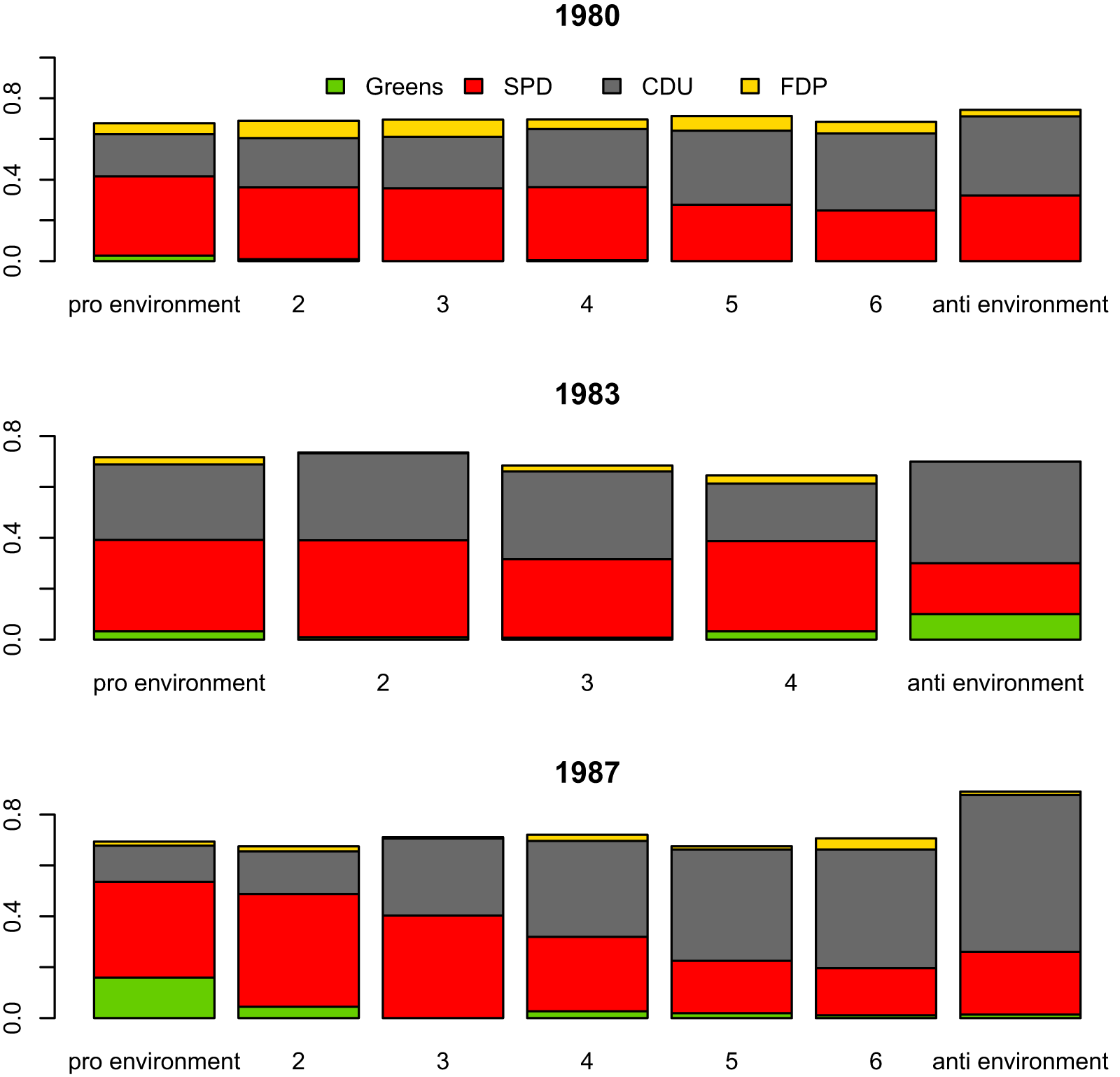


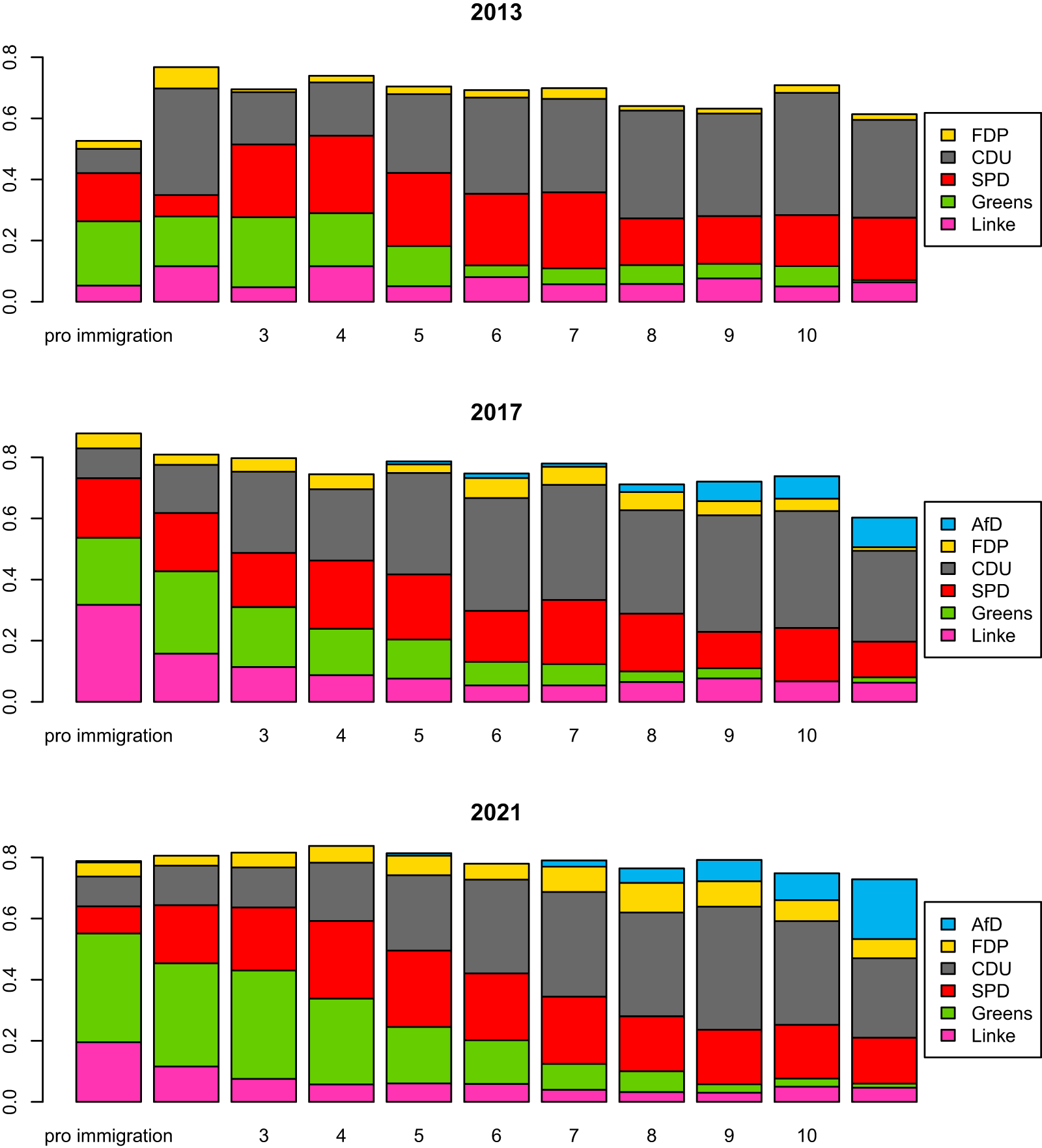


 Open access

