1. Introduction
The Devonian–Carboniferous (D–C) boundary represents a prominent time interval that is associated with global eustatic perturbations, glaciation in Gondwana, palaeoceanographic changes, global biotic extinction and faunal overturns (Walliser, Reference Walliser1984; Caputo & Crowell, Reference Caputo and Crowell1985; Isaacson et al. Reference Isaacson, Díaz-Martínez, Grader, Kalvoda, Bábek and Devuyst2008). In numerous sections, the D–C successions are manifested by distinct facies such as the well-documented Hangenberg black shales (HBS) and Hangenberg shales and sandstone (HSS); the former is assumed to indicate a biotic event (the Hangenberg Event sensu stricto) of global importance (Walliser, Reference Walliser1984). In spite of the correlative value of these latest Devonian and earliest Carboniferous events, the chronostratigraphic definition of the D–C boundary (GSSP) is based purely on biostratigraphic constraints, i.e. the first appearance datum (FAD) of the Siphonodella sulcata conodont in the early evolutionary lineage of the genus Siphonodella (Flajs & Feist, Reference Flajs and Feist1988). New data from the D–C stratotype in the GSSP at La Serre, southern France, reveal that the first occurrence of the index fossil Si. sulcata is located much lower in the stratigraphic succession than previously reported and that the La Serre D–C boundary GSSP requires re-positioning (Kaiser, Reference Kaiser2009). The limestone beds in La Serre only contain rare Siphonodella and reveal a diachronous occurrence of Si. sulcata, which is often controlled by facies (Ziegler & Sandberg, Reference Ziegler, Sandberg and Clark1984). The new findings of Si. sulcata draw the position of the D–C boundary closer to the global Hangenberg Event, which is regarded by Walliser (Reference Walliser1984) as a worldwide synchronous, natural D–C boundary. The glacioeustatic nature of the Hangenberg Event was proposed by Kalvoda (Reference Kalvoda and Walliser1986) and later confirmed by the discovery of glacial sediments in the South American part of Gondwana (Isaacson et al. Reference Isaacson, Hladil, Shen, Kalvoda and Grader1999, Reference Isaacson, Díaz-Martínez, Grader, Kalvoda, Bábek and Devuyst2008; Streel et al. Reference Streel, Caputo, Loboziak and Melo2000). In many European sections (Carnic Alps, Rheinsche Schiefergebirge, Montagne Noire), the Hangenberg Event is associated with a positive carbon isotope excursion, which is interpreted as a result of increased burial of organic matter in the global ocean (Buggisch & Joachimski, Reference Buggisch and Joachimski2006; Kaiser et al. Reference Kaiser, Steuber, Becker and Joachimski2006; Kaiser, Steuber & Becker, 2008). The stable isotope geochemistry can therefore provide a reasonable solution to the event-based D–C boundary.
Both biostratigraphy and isotope geochemistry, however, have their well-known limits; the latter being expensive, instrumentally demanding and susceptible to compositional bias, particularly in the Palaeozoic (Veizer, Reference Veizer and Gornitz2009). In addition, a significant gap may occur between discrete and fragmentary representations of the isotope curves and the vertical continuum of a real stratigraphic column. An alternative approach can be found in proxy parameters such as the gamma-ray spectrometry (GRS) of carbonate rocks (Rider, Reference Rider1999; Ehrenberg & Svana, Reference Ehrenberg and Svana2001; Halgedahl et al. Reference Halgedah, Jarrard, Brett and Allison2009; Koptíková et al. Reference Koptíková, Bábek, Hladil and Slavík2010) – a method which is inexpensive, quantitative and applicable directly in the field. GRS can quickly provide high-quality, high-resolution proxy data, which can be interpreted in terms of a siliciclastic admixture in carbonates, redox conditions at the sediment–water interface and, hence, relative sea-level changes (Postma & Ten Veen, Reference Postma and Ten Veen1999; Lüning et al. Reference Lüning, Wendt, Belka and Kaufmann2004; Bábek et al. Reference Bábek, Kalvoda, Aretz, Cossey, Devuyst, Herbig and Sevastopulo2010). In addition, the petrophysics and isotope geochemistry data can be significantly enhanced by element geochemistry to provide a multiproxy geochemical mosaic, which can be used for correlation purposes and for the interpretation of the steering mechanisms on deposition (terrigenous input, redox conditions, bioproductivity).
In this paper, we combined conodont and foraminifer biostratigraphy with carbonate compositional analysis, GRS, carbon isotopes and major- and trace element geochemistry at three D–C sections in the Moravian Karst, SE Czech Republic (Fig. 1). At these sections, the FAD of Si. sulcata can be well traced in different deep-water carbonate facies (Kalvoda & Kukal, Reference Kalvoda and Kukal1987; Kalvoda, Bábek & Malovaná, Reference Kalvoda, Bábek and Malovaná1999; Kalvoda, Reference Kalvoda2002) (Fig. 2). The co-occurrence of shallow-water foraminifers and deep-water conodonts in calciturbidite facies enables a good correlation between the conodont-based zonations and the foraminifer zonations of the East European platform and the Urals. The Moravian Karst sections (southern Laurussia) are correlated with the Carnic Alps (Intra-Alpine, peri-Gondwana terrane), based on the published isotope data (Kaiser et al. Reference Kaiser, Steuber, Becker and Joachimski2006) and our new GRS and element geochemistry data from the well-known Grüne Schneid section. The aim of the paper is to present the quantitative multiproxy method as a useful correlative tool in the event-based solution of the D–C boundary and to advocate its benefits in Palaeozoic stratigraphy.
Location of the studied sections.

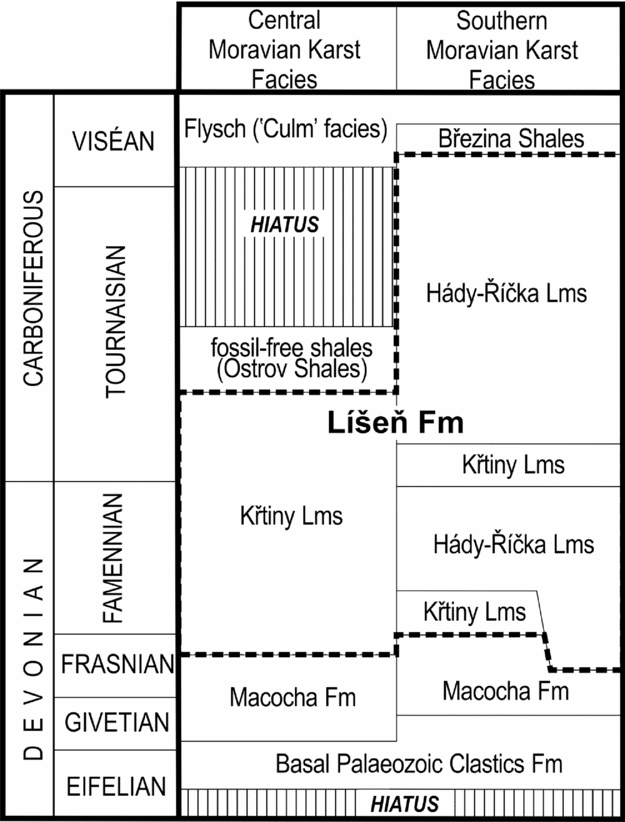
Generalized lithostratigraphy of the central and southern part of the Moravian Karst (after Kalvoda et al. Reference Kalvoda, Bábek, Fatka, Leichmann, Melichar and Špaček2008).

2. Geological setting and stratigraphy
The studied sections Lesní lom Quarry (WGS 84: 49°13′19.78″N; 16°41′49.73″E), Mokrá Quarry (WGS 84: 49°13′43.94″N; 16°46′8.40″E) and Křtiny Quarry (WGS 84: 49°17′38.10″N, 16°44′9.76″E) are located NE of Brno in the southern and central parts of the Moravian Karst, Moravia, Czech Republic (Fig. 1). The Middle Devonian to Viséan carbonates (Macocha and Líšeň formations) of the Moravian Karst (Figs 1, 2) represent the sedimentary cover of the Brunovistulian terrane, which is generally regarded as an eastern continuation of the Rhenohercynian Zone at the southern margin of Laurussia (Kalvoda, Reference Kalvoda1998; Kalvoda et al. Reference Kalvoda, Melichar, Bábek and Leichmann2002, Reference Kalvoda, Leichmann, Bábek and Melichar2003, Reference Kalvoda, Bábek, Fatka, Leichmann, Melichar and Špaček2008).
On top of the drowned platforms of the Macocha Fm (Hladil, Reference Hladil1994) and in the troughs, condensed hemipelagites and calciturbidites (Líšeň Fm) were deposited in the Late Frasnian to early Viséan period (Kalvoda, Bábek & Malovaná, Reference Kalvoda, Bábek and Malovaná1999). Facies development of the Líšeň Fm (Fig. 2) in the southern part of the Moravian Karst (Lesní lom and Mokrá) comprises largely skeletal calciturbidites in the Famennian (Hády-Říčka Lms), mud calciturbidites (Křtiny Lms) in the Early Tournaisian and skeletal calciturbidites (Hády-Říčka Lms) from the Middle Tournaisian to the early Viséan. In the central part of the Moravian Karst (Křtiny), nodular hemipelagic Křtiny Lms range from the Famennian to the Early Tournaisian. An onlap of deep-water shales, radiolarian cherts and siliciclastic turbidites of ‘Culm’ flysh facies on the Líšeň Fm takes place in the early Viséan (Kalvoda, Bábek & Malovaná, Reference Kalvoda, Bábek and Malovaná1999).
3. Material and methods
The lithology of the sections was logged in a bed-by-bed manner. The sections were sampled in great detail for conodont and foraminifer biostratigraphy, quantitative microfacies analysis, element geochemistry and carbon isotope geochemistry.
Samples for conodonts (2–4 kg each) were taken from each limestone bed and then dissolved in 15% acetic acid. Conodonts were hand-picked from the sieved (mesh size 0.125) insoluble residues and then studied under a binocular microscope. Foraminifers were studied in a large number (about 200 thin-sections) of standard size (27 × 46 mm) thin-sections with a high-magnification binocular microscope (Nikon 80i) in transmitted light at magnifications ranging from × 20 to × 400.
The quantitative microfacies analysis was focused on compositional variations of major allochem groups in 60 carbonate samples from the Lesní lom section. Qualitative microscopic observations were followed by point counting of high-resolution images (250 random points per image) using JMicroVision image analysis software (Nicolas Roduit, Switzerland).
The lithological description and sampling was supported by field GRS logging, using a RS-230 Super Spec portable spectrometer (Radiation Solutions, Inc., Canada) with a 2 × 2′ (103 cm3) bismuth-germanate (BGO) scintillation detector. The measurement at each logging point was performed on a flat rock surface (2π geometry), perpendicular to the section wall and with the instrument in full contact with the rock (Svendsen & Hartley, Reference Svendsen and Hartley2001, p. 662). One measurement with a 180 s count time was performed at each logging point. The sections were logged with a 0.25 m thickness interval and 223 GRS data points were measured. The time-dependent measurements revealed that the concentrations of K, U and Th sufficiently stabilized after 120 to 150 s. The counts per second in selected energy windows were converted to concentrations of K (%), U (ppm) and Th (ppm) automatically by the instrument, based on calibrations carried out by the manufacturer on test pads with a known elemental composition. Computed gamma-ray (CGR) values, used as improved clay volume indicators, were calculated from the spectral values using the formula CGR [API] = Th[ppm]·3.93 + K[%]·16.32 (Rider, Reference Rider1999).
For carbon isotope geochemistry, several milligrams of rock powder (preferably micrite from lime mudstone and wackestone lithologies) were recovered from rock fragments. The carbonate powder was reacted with phosphoric acid in an online carbonate preparation system (Carbo-Kiel) connected to a ThermoFinnigan 252 mass spectrometer. All the values are reported in ‰ relative to V-PDB (Vienna Pee-Dee Belemnite) by assigning a δ13C value of +1.95 ‰ and a δ18O value of 2.20 ‰ to NSB 19. The accuracy and precision were controlled by replicate measurements of laboratory standards and were better than ± 0.1 ‰ for both carbon and oxygen isotopes.
Element analyses were performed by energy dispersive X-ray fluorescence spectrometry (XRF) using MiniPal 4.0 (PANalytical, the Netherlands) with a Rh lamp and Peltier cooled Si PIN detector. Hand-ground samples were poured into plastic cells with Mylar foil bottoms with a diameter of 25 mm. Al and Si signals were acquired for 300 s at 5 kV/400 μA with a Kapton filter under He flush (99.996% purity), K, Ti, Fe, and Mn and Fe for 200 s at 12 kV/200 μA with a thin Al filter in air, and Zr for 500 s at 30 kV/200 μA with a Ag filter in air. The XRF proxy signal was calibrated by analyses of 11 samples by an accredited analytical laboratory in TU Ostrava, Czech Republic. The samples were finely powdered in a ball mill, pressed with a Hoechst Wachs C Mikropulver and analysed with an XRF spectrometer SPECTRO X-LAB (3 kW Rh-tube, liquid nitrogen cooled Si (Li) detector).
4. Results
4.a. Biostratigraphy
The latest Famennian and Early Tournaisian conodont zonation sensu Ji (Reference Ji1985) and Kaiser et al. (Reference Kaiser, Becker, Spalletta and Steuber2009) is used in this paper and is presented with the former standard conodont zonations (Sandberg et al. Reference Sandberg, Ziegler, Leuteritz and Brill1978; Ziegler & Sandberg, Reference Ziegler, Sandberg and Clark1984) and foraminiferal zonation (Kalvoda, Reference Kalvoda2002) in Figure 3.
Lithology and distribution of the most important conodonts and foraminifers in the Lesní lom and Křtiny Quarry sections.

The studied D–C boundary interval begins in the Middle Palmatolepis gracilis expansa Zone in Křtiny and in the Upper expansa Zone in Lesní lom and most probably Mokrá (Fig. 3). The base of the Siphonodella praesulcata Zone is difficult to locate owing to the scarcity of the early siphonodellids and the similarity of the associated conodont fauna with the underlying Upper expansa Zone. The first siphonodellids from Lesní lom (unpublished specimen from the collection of Dr Krejčí, Czech Geological Survey, Brno) and Křtiny rank among the morphotypes of Si. sulcata (Group 1 sensu Kaiser & Corradini, Reference Kaiser and Corradini2011), whereas the first typical Si. praesulcata (Groups 2 and 3 sensu Kaiser & Corradini, Reference Kaiser and Corradini2011) occurs higher within the praesulcata Zone. Both in Lesní lom and Mokrá, the conodont-sterile laminite, assigned to the Bispathodus costatus – Protognathodus kockeli Interregnum (CKI), is overlain by an interval of silty marlstones with scarce limestone nodules. The nodules yielded, in Lesní lom, relatively abundant Pr. meischneri and Pr. collinsoni at the base, and the first specimens of Pr. kockeli at the top of this interval. Because of the absence of protognathodids, there is no biostratigraphic evidence of the kockeli Zone in Křtiny. The sulcata Zone with relatively abundant Si. sulcata, Pr. kuehni and reworked Late Famennian conodonts (Bábek & Kalvoda, Reference Bábek and Kalvoda2001) was distinguished in Lesní lom (Fig. 3) and at the tectonically disturbed Mokrá–Central Quarry section at the base of ooidal-bioclastic calciturbidites. The abrupt onset of the relatively abundant Si. sulcata and transition morphotypes close to Si. bransoni just above the D–C boundary in Křtiny points to a hiatus in the lower parts of the sulcata Zone. The overlying Siphonodella bransoni, Siphonodella duplicata and Siphonodella hassi zones are well marked by their index and accompanying taxa in the Lesní lom and Křtiny quarries. The uppermost part of the investigated section in Křtiny contains an association of the Siphonodella sandbergi Zone (Fig. 3).
Foraminifers of the middle Palaeozoic were benthic and only associated with a shallow-water environment (Vachard, Pille & Gaillot, Reference Vachard, Pille and Gaillot2010). Their presence in the Lesní lom section is tied to the bioclastic calciturbidites (Kalvoda, Bábek & Malovaná, Reference Kalvoda, Bábek and Malovaná1999). The studied section in Lesní lom (Fig. 3) begins below the laminite in the Upper Famennian Quasiendothyra kobeitusana – Q. konensis Zone (Kalvoda & Kukal, Reference Kalvoda and Kukal1987). The Tournayellina beata Zone associated with the entry of its index species Tournayellina beata pseudobeata (Barskov et al. Reference Barskov, Simakov, Alekseev, Bogoslovsky, Byvsheva, Gaciev, Kononova, Kochetkova, Kusina and Reitlinger1984; Kalvoda & Kukal, Reference Kalvoda and Kukal1987; Reitlinger & Kulagina, Reference Reitlinger, Kulagina and Maslov1987; Kalvoda, Reference Kalvoda2002; Kulagina, Gibshman & Pazukhin, Reference Kulagina, Gibshman and Pazukhin2003; Pazukhin, Kulagina & Sedaeva, Reference Pazukhin, Kulagina, Sedaeva, Puchkov, Kulagina, Nikolaeva and Kochetova2009) is recognized just above the laminite in the CKI (Fig. 3). In contrast to the Belgian sections (Poty, Devuyst & Hance, Reference Poty, Devuyst and Hance2006), the Tournayellina beata Zone is also characterized by the presence of quasiendothyrs, which continue well into the Tournaisian bransoni Zone. Quasiendothyrids are not associated with intraclasts and there are no differences in their preservation in comparison with Tournaisian chernyshinellids. Consequently, their reworking from Upper Famennian limestones seems to be highly improbable. Moreover, the obtained associations resemble those in the Urals where quasiendothyrids (Quasiendothyra communis. Quasiendothyra sp., Quasiendothyra ex gr. konensis) are also reported in the earliest Tournaisian (Reitlinger & Kulagina, Reference Reitlinger, Kulagina and Maslov1987; Pazukhin, Kulagina & Sedaeva, Reference Pazukhin, Kulagina, Sedaeva, Puchkov, Kulagina, Nikolaeva and Kochetova2009). The rare occurrence of chernyshinellids, represented by Eochernyshinella crassitheca, Prochernyshinella oldae and at the very top of the section also Prochernyshinella triangula, is typical in the Tournaisian part of the section (Fig. 3).
4.b. Facies and microfacies characteristics
Five facies types with seven microfacies subtypes (Table 1) were distinguished in the measured sections, based on the bedding patterns, grain size, sedimentary structures and allochem composition. All facies types were deposited in relatively deep water, well below the fair-weather wave base, as indicated by abundant radiolarians, sponge spicules, thin-shelled bivalves, trilobites and the ubiquitous presence of lime mud in the autochthonous deposits. Their deep-water origin is supported by abundant conodonts of the palmatolepid-bispathodid and siphonodellid biofacies. Nodular, micrite-rich facies with abundant pelagic faunas (F5) are interpreted to represent suspension deposits, analogous to the recent periplatform oozes (Boardman & Neumann, Reference Boardman and Neumann1984) and Palaeozoic ‘pelagic’ deposits (Bandel, Reference Bandel, Hsü and Jenkyns1974). Considerable parts of the sedimentary record (Lesní lom and Mokrá sections) comprise thin-bedded calcarenites and calcisiltites (F4) with frequent erosive bed bases, graded bedding, bed-parallel lamination and mixed shallow-water benthic (ooids, peloids, foraminifers, dasyclad algae, echinoderms) and pelagic and deep-water (radiolarians, sponge spicules) allochems, often with biogenic grading. This facies is interpreted as relatively medium to distal carbonate turbidites. These facies alternate with marly and shaly background interbeds (F1, F2). The facies F3, so-called ‘laminite’, with abundant radiolarians and a distinct bed-parallel lamination, which is emphasized by pressure dissolution and occasional thin laminae of graded calcarenite, probably represents a succession of extremely distal turbidites and a pelagic suspension deposit, presumably modified by bottom currents.
Facies and microfacies of the studied Moravian Karst sections

4.c. Facies tracts and compositional variations
Thickening upward trends in the Upper and uppermost Famennian skeletal and peloidal calciturbidites (MF4b and to a lesser extent MF4a) at the Lesní lom section (Fig. 4) are capped by a thick bed of laminite (F3). The overlying siliciclastic horizon comprises mudstones (F1) with lenses of calciturbidites (MF4c, MF4a) and in the upper part, marlstones (F2). The marlstones begin to alternate with peloidal calciturbidites (MF4c) at the very top of the Famennian, where a single level of goniatite-bearing (?Acutimitoceras sp.; Kalvoda & Kukal, Reference Kalvoda and Kukal1987) wackestone nodules (F5) also occurs. The base of the Tournaisian is marked by the onset of ooidal and skeletal calciturbidites (MF4e, MF4d, MF4c, MF4a) with a distinct drop in the occurrence of algae and multicellular foraminifers (Fig. 4). The heterolithic nature of this interval is expressed by the common alternations of calciturbidites and centimetre-thick marlstones (F2). Within the overlaying Lower Tournaisian mud calciturbidite interval (MF4a prevailing, MF4d and MF5 less common), the second siliciclastic horizon (F2) occurs (Fig. 4).
Stratigraphic trends in selected compositional groups (percentages from point counting) in the Lesní lom Quarry section.

The Mokrá section is similar to the Lesní lom succession; however, more distal facies prevail (Fig. 3). The Famennian calciturbidite interval consists mainly of the MF4a with occasional thin coarser bases (MF4b). The laminite (F3) is underlain by a black shale layer and overlain by calcareous siltstones with wackestone nodules (MF4a,d) (Fig. 3). Oolitic calciturbidites are absent, and primarily thin-bedded mud calciturbidites (MF4a) predominate in the Lower Tournaisian.
The Křtiny section (Fig. 3) exposes a relatively monotonous succession of nodular wackestones (MF5) with common radiolarians, ostracodes, bivalves and trilobites. Wackestones of the Upper Famennian, pinkish at the base and greyish up section, reveal an upward-thinning trend, which culminates in the strongly nodular interval of the uppermost Famennian. The upward-thickening trend (Fig. 3) with a colour transition from yellow to grey slightly nodular wackestones occurs from the base of the Tournaisian.
4.d. Gamma-ray spectra
Covariance between the dose rate (nGy.kg−1) and K, Th and U concentrations (Fig. 5a) demonstrates that the main contribution to the entire gamma-ray signal is derived from Th, followed by K and U. The K and Th concentrations have good covariance (Fig. 5b), which indicates that these typically terrigenous elements (K is incorporated into the lattice of common clay minerals such as illite and Th is adsorbed on the surface of clay minerals) vary proportionally to one other. Their covariance is presumably driven by the dilution effect of CaCO3, which is consistent with the common interpretation of K and Th in GRS logs as the ‘shale content’ or ‘shaliness’ indicator (Rider, Reference Rider1999; Ehrenberg & Svana, Reference Ehrenberg and Svana2001).
Bivariate plots and linear regression coefficients of the (a) total dose rate (TOT) v. K, U and Th, (b) Th v. K and (c) δ18Ocarb v. δ13Ccarb from the Moravian Karst sections. (d) Principal component analysis of the EDXRF data from the Moravian Karst.

In Lesní lom (Fig. 6), the Upper and uppermost Famennian peloidal-bioclastic calciturbidites (MF4b) are characterized by low CGR values (mean CGR 24.7 API) with minima of CGR (20.3 API) and Th/U (< 2) in the laminite (F3). The GRS signal sharply increases in the uppermost Famennian siliciclastic interval (CGR 87.72 API) and then systematically decreases at the D–C boundary and in the basal Tournaisian heterolithic facies (F2 + F4). Another peak in CGR values (87.72 API) is located within the Lower Tournaisian mud calciturbidites (MF4a, MF4d), being associated with the upper siliciclastic interval (F1, F2).
Correlation of the Moravian Karst sections based on biostratigraphy, lithology, spectral gamma-ray logs (CGR and Th/U) and δ13Ccarb curves with interpretation of the important stratigraphic horizons.

Trends in the GRS values at the Mokrá section (Fig. 6) are almost identical to those from Lesní lom. The Famennian calciturbidites have low K and Th concentrations and CGR values, with the minimum in the laminite (CGR 20.7 API; < 2 Th/U). The maximum U concentrations occur at this level. The overlying sharp increase of the GRS signal in the siliciclastic horizon is replaced by a decreasing trend in the Lower Tournaisian mud calciturbidites.
At the Křtiny section (Fig. 6), the lowest GRS values (CGR 20.7 API) and a high Th/U ratio (> 7) were measured in the reddish Upper Famennian pelagic calcilutites. The GRS signal increases upwards with the maximum values (CGR 40.35 API) located at the top of the uppermost Famennian greyish, strongly nodular calcilutites. The GRS values decrease in the basal Tournaisian yellowish calcilutites and then slightly increase again in the Lower Tournaisian.
4.e. Isotope geochemistry
Covariance of δ13Ccarb and δ18Ocarb in marine carbonates is regarded as evidence of the diagenetic overprint of C isotopes (Rosales, Quaseda & Robles, Reference Rosales, Quaseda and Robles2001). The degree of the majority of the measured samples’ covariance is low (Fig. 5c); therefore, the isotopic record of the C could be regarded as reflecting the primary signal of the oceanic waters. Only samples with low δ13Ccarb have a slight covariance, which reflects diagenetic alteration.
In Lesní lom (Fig. 6), the average δ13Ccarb values from the upper Bouma divisions of the calciturbidite beds (MF4a, F5) of the Upper expansa and the praesulcata zones are ~ 2.5 ‰ (Fig. 6). A significant positive excursion (~ 4‰ δ13Ccarb) is located in the laminite (F3), which belongs to the CKI. The lowest values (~ 0.5 ‰) were measured in the nodular wackestones (F5) of the kockeli Zone. A return to values of ~ 2.5 ‰ occurs in the samples from the base of the sulcata Zone. Certain δ13Ccarb values from the kockeli Zone and from the base of the sulcata Zone are affected by dolomitization and reach distinct negative values (~ −5‰).
The base of the succession at the Křtiny section (Fig. 6) has uniform δ13Ccarb values (~ 2.1 ‰) in the Upper expansa Zone. The values then decrease to ~ 1.5 ‰ at the end of this Zone and subsequently increase to the background values (~ 2.5 ‰) in the praesulcata Zone. A negative excursion (0.2 ‰) is located within the markedly nodular wackestones of the CKI. The values then increase upwards with small fluctuations throughout the sulcata and bransoni zones where they reach ~ 2.2 ‰ δ13Ccarb.
4.f. Elementary geochemistry
The typically terrigenous elements (Si, Ti, Zr, Rb, Al, etc.) from the studied sections show a strong positive statistical correlation, which is expressed as similar principal component loadings in the principal component analysis (PCA; Fig. 5d), and suggests a common and stable siliciclastic provenance. The strong negative statistical correlation of these elements with Ca (Fig. 5d) indicates that the variability in the terrigenous elements is driven by the effect of ‘dilution’ by CaCO3. This supports the GRS interpretation. The Mn, Sr and P contents do not correlate with the terrigenous elements (Fig. 5d).
Concentrations of Si, Ti, Zr, Rb, usually normalized to Al (for elimination of the dilution effect), can be used as proxies for relative changes in the sedimentation rates of detrital mineral phases such as quartz (Si), heavy minerals (Ti, Zr) and detrital clays (K) in carbonates (Sageman & Lyons, Reference Sageman, Lyons and Mackenzie2005). Mn and rare earth elements proved useful as palaeoredox proxies (Sageman & Lyons, Reference Sageman, Lyons and Mackenzie2005).
The Upper and uppermost Famennian calciturbidites and the laminite at the Lesní lom section (Fig. 7) are characterized by a low content of terrigenous element concentrations and higher Sr/Al ratios. An increase in the content of the terrigenous elements, with high Zr/Al and a decrease in Sr/Al and Mn/Al ratios, takes place in the siliciclastic interval just below the D–C boundary. The Lower Tournaisian heterolithic interval with mud calciturbidites has a fluctuating content of terrigenous elements, low and stable Zr/Al and lower Sr/Al and Mn/Al ratios (Fig. 7). In Mokrá the laminite is characterized, as is the case in Lesní lom, by a growing Mn/Al and Sr/Al (Fig. 7). A decrease in these values takes place in the siliciclastic interval while the Al content increases. The Křtiny section is characterized by low contents of terrigenous elements in the Upper and uppermost Famennian wackestones, and their subsequent pronounced increase (with higher Zr/Al) just below the D–C boundary where the Sr/Al ratio concomitantly decreases (Fig. 7).
Correlation based on the chosen geochemical proxies of the Moravian Karst sections.

5. Discussion
5.a. Biostratigraphic correlation
The study of the Moravian D–C sections reveals numerous problems associated with the application of conodont biostratigraphy in the D–C boundary definition (Kaiser et al. Reference Kaiser, Steuber, Becker and Joachimski2006). First, owing to the rare occurrence of the early siphonodellids in the Famennian, the base of the praesulcata Zone cannot be fixed precisely (Fig. 3). Second, the recognition of the standard Middle praesulcata Zone of Ziegler & Sandberg (Reference Ziegler, Sandberg and Clark1984), which is defined by the last occurrence of Palmatolepis gracilis gonioclymeniae, is problematic owing to the absence of this index in the uppermost Famennian of the Moravian Karst (Fig. 3). A possible solution is the application of the alternative zonation of Ji (Reference Ji1985) and Kaiser et al. (Reference Kaiser, Becker, Spalletta and Steuber2009), who proposed the CKI, which represents the main extinction interval of the Hangenberg Event (Kaiser et al. Reference Kaiser, Becker, Spalletta and Steuber2009). The main biostratigraphic problem, however, is connected with the supposed Si. praesulcata – Si. sulcata evolutional lineage (Feist & Flajs, Reference Flajs and Feist1988). In the Moravian Karst sections (Lesní lom and Křtiny), the FAD of Si. sulcata was recorded in the praesulcata Zone, just before the entry of the Si. praesulcata and protognathodid fauna (Fig. 3). This is in accordance with data from Franconia (Germany), where Siphonodella sulcata morphotypes enter below the Hangenberg Event almost simultaneously with the entry of Si. praesulcata (Tragelehn, Reference Tragelehn2010). The biostratigraphically valuable protognathodid fauna is relatively abundant in Lesní lom, where the FAD of the early Protognathodus species corresponds with their known global range (Fig. 3). It is a scarce feature in the majority of the global scenario (Corradini et al. Reference Corradini, Kaiser, Perri and Spalleta2011). In Křtiny, on the other hand, the protognathodid fauna is missing and, therefore, the kockeli Zone cannot be recognized, most probably due to the hiatus (Fig. 3). This stratigraphic gap also comprises the lower part of the sulcata Zone (Fig. 6). It is supported by the abrupt appearance of the transitional morphotypes Si. sulcata – Si. bransoni just above the D–C boundary.
In terms of foraminiferal zonation, the entry of Tournayellina beata pseudobeata recognized in Belgium (Poty, Devuyst & Hance, Reference Poty, Devuyst and Hance2006), the Urals (Reitlinger & Kulagina, Reference Reitlinger, Kulagina and Maslov1987; Pazukhin, Kulagina & Sedaeva, Reference Pazukhin, Kulagina, Sedaeva, Puchkov, Kulagina, Nikolaeva and Kochetova2009) and China (Hance et al. Reference Hance, Hou, Vachard, Devuyst, Kalvoda, Poty and Wu2011) represents an important event. In contrast to the other sections, the Moravian sections enable the precise establishment of its FAD to the higher part of the CKI (Fig. 3). A multidisciplinary approach to the study of the entry of T. beata pseudobeata in the Belgian sections is underway.
5.b. Regional correlation between the Moravian Karst and the Carnic Alps
The observed geochemical and petrophysical patterns can be correlated between sections from two different deep-water carbonate depositional environments of the Moravian Karst (Figs 6, 7). The main correlatable pattern is the low GRS signal due to low terrigenous element content in the Upper and uppermost Famennian (the Upper expansa and praesulcata zones and the lower part of the CKI) and the subsequent sharp increase in GRS values and terrigenous elements just below the D–C boundary (within the CKI). The decrease in GRS values together with the terrigenous content upwards through the basal Tournaisian and the second increase in the Lower Tournaisian duplicata Zone are also good correlatable patterns.
The laminite horizon at the base of the CKI with the weak GRS signal and the positive δ13Ccarb excursion in Lesní lom is absent at the Křtiny section (Fig. 6). A possible explanation is provided by the stratigraphic gap, which encompasses the peak δ13Ccarb interval. The stratigraphic gap in Křtiny is also supported by the absence of the high Mn/Al ratio, which was observed at this level in Lesní lom and Mokrá (Fig. 7). A decrease of δ13C (Fig. 6) and Sr/Al (Fig. 6) just below the D–C boundary, coinciding with the high GRS values (Fig. 6) and Zr/Al ratio, was documented both in the Lesní lom and Křtiny sections (Fig. 7).
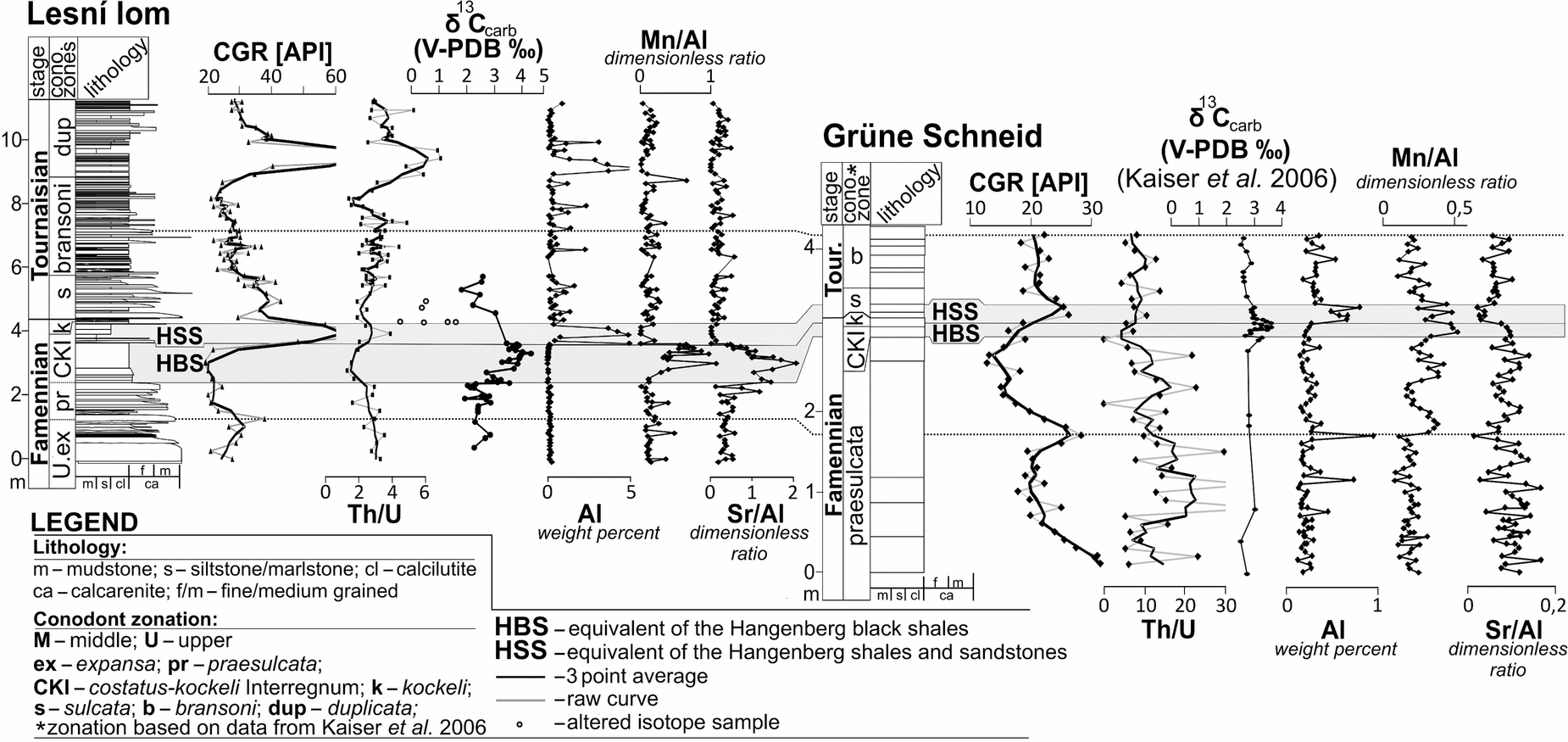
The petrophysical and geochemical trends from the Moravian Karst can be well correlated with the multiproxy dataset from the Grüne Schneid section of the Carnic Alps, Austria (Figs 1, 8). The positive δ13Ccarb excursion in the CKI and the kockeli Zone at the Grüne Schneid section (Kaiser et al. Reference Kaiser, Steuber, Becker and Joachimski2006) correlates with a similar δ13Ccarb peak at the Trolp section (Graz Palaeozoic, Austria) and δ13Corg at the Hasselbachtal section (Rheinische Schiefergebirge, Germany) (Kaiser et al. Reference Kaiser, Steuber, Becker and Joachimski2006; Kaiser, Steuber & Becker, Reference Kaiser, Steuber and Becker2008). This isotope peak correlates with the positive δ13Ccarb excursion exactly at the same stratigraphic level (CKI) in Lesní lom and coincides with the low GRS values, low concentrations of terrigenous elements and increasing Mn/Al and Sr/Al at both the Grüne Schneid and Lesní lom sections (Fig. 8). Just above the isotopic shift, the GRS signal and the contents of the terrigenous elements significantly increase and Mn/Al with Sr/Al decrease both in the Lesní lom (CKI) and the Grüne Schneid sections (the kockeli Zone). The high GRS values decrease from the base of the sulcata Zone at both sections (Fig. 8).
Correlation based on the gamma-ray logs, δ13Ccarb and element geochemical proxies between the Moravian Karst (represented by the Lesní lom Quarry) and the Carnic Alps (Grüne Schneid) with an interpretation of the main correlative horizons.

5.c. Equivalents of the Hangenberg black shales
The Upper and uppermost Famennian succession in Lesní lom and Mokrá comprise calciturbidites with common algae, peloids, foraminifers and crinoids (Fig. 4) representing the mixed autotroph-heterotroph carbonate factory (T factory; Schlager, Reference Schlager2005). The overlying laminite horizon with the abundance of planktonic radiolarians and the millimetre-thick calciturbidites and bottom-current deposits in the lower part of the CKI is assumed to have recorded initial deceleration of carbonate production, having manifested itself by reduced allochem shedding into the deep basin. This almost siliciclastic-free horizon is characterized by a positive δ13Ccarb excursion at Lesní lom (Fig. 6). Enhanced burial of organic matter has led to the black shale deposition in some regions (Hangenberg black shales and their equivalents, e.g. Exshaw shales) and thus to a depletion of the isotopically lighter organic carbon from the global oceanic reservoir (Caplan & Bustin, Reference Caplan and Bustin1999; Kaiser et al. Reference Kaiser, Steuber, Becker and Joachimski2006; Kaiser, Steuber & Becker, Reference Kaiser, Steuber and Becker2008). The resulting positive Hangenberg Event δ13Ccarb excursion was thus documented at sections where the black shales are absent and carbonates were preserved, e.g. at the Grüne Schneid, Carnic Alps (Kaiser et al. Reference Kaiser, Steuber, Becker and Joachimski2006), Trolp, Graz Palaeozoic (Kaiser, Steuber & Becker, Reference Kaiser, Steuber and Becker2008), Glen Wood Canyon, Colorado (Myrow et al. Reference Myrow, Strauss, Creveling, Sicard, Ripperdan, Sandberg and Hartenfels2011) and Lesní lom, Moravian Karst (presented herein). The enhanced carbon burial could have been connected with the oceanic mixing, when the cold, nutrient-rich upwelling waters (Caplan & Bustin, Reference Caplan and Bustin1999) reached the shelves and carbonate platforms, where an increase in bioproductivity and consequent eutrophication was produced (Caplan, Bustin & Grimm, Reference Caplan, Bustin and Grimm1996). The upwelled cool waters undersaturated with respect to calcium carbonate might have caused dissolution of the pelagic, slowly sedimented, slope carbonates (Bandel, Reference Bandel, Hsü and Jenkyns1974) and produced the stratigraphic gap in the Křtiny section. The subsequent onset of dysoxic conditions, caused by high oxygen utilization in the bottom waters, is regarded as the Hangenberg Event sensu stricto connected with the mass extinction (Kaiser et al. Reference Kaiser, Becker, Spalletta and Steuber2009). The relative O2 depletion trend can be inferred from the decreasing curve of the Th/U (Adams & Weaver, Reference Adams and Weaver1958) also in the Moravian Karst and Carnic Alps (Figs 6, 8). In contrast, an interesting feature of the HBS-equivalent interval at Lesní lom, Mokrá and Grüne Schneid is the increasing Mn/Al ratio, which is usually used as the proxy for growing oxygenation (Sageman & Lyons, Reference Sageman, Lyons and Mackenzie2005; Roy, Reference Roy2006). This contradiction could be explained by the precipitation of Mn oxyhydroxides in the halocline (the zone of the ‘bathub ring’; Maynard, Reference Maynard and Mackenzie2005) where it reached the upwelled water mass. The considerable amount of Mn precipitates were consequently buried in a reducing zone below (‘manganese pump’) where dissolution provides adequate Mn2+ and the reaction with dissolved bicarbonate forms Mn carbonates (Roy, Reference Roy2006). A slight increase in the Sr/Al ratio in all investigated sections is evidence for the low sedimentation rate in this stratigraphic level. An origin of higher Mn and Sr content from the continental runoff is unlikely because the discussed HBS-equivalent level is almost free of terrigenous elements and therefore the source could be in the upwelled deep waters.
5.d. Equivalents of the Hangenberg shales and sandstones
The short but significant lithological change from the carbonates to the fine siliciclastic sediments just above the laminite at Lesní lom and Mokrá (Fig. 6) and thin-bedded nodular wackestones at Křtiny (Fig. 6) and Grüne Schneid (Fig. 8) records a carbonate crisis and enhanced continental input of siliciclastic sediments. The high Zr/Al ratio at Lesní lom is interpreted as the coarsening of the terrigenous siliciclastic input. This horizon is thus correlated with the lowstand HSS facies and with their equivalents (Van Steenwinkel, Reference Van Steenwinkel1993). The high content of ooids and peloids in the interval of the upper CKI to the bransoni Zone (Fig. 4) can be interpreted as products of distally steepened ramp sedimentation (Read, Reference Read1982) after the emersion of carbonate platforms (Kalvoda, Reference Kalvoda1982). According to Wright (Reference Wright1994), the extensive development of oolite shoals is a distinctive feature of early Carboniferous carbonate systems when extensive upwelling currents moved cool, nutrient-rich waters into the shallow seas creating conditions suitable for extensive inorganic carbonate precipitation.
5.e. Interpretation of the relative sea-level changes
The upwelling currents and HBS deposition were probably associated with the transgressive to highstand system tract (maximum flooding surface), as is evidenced by landward facies shifts (e.g. Van Steenwinkel, Reference Van Steenwinkel1993). It is also evidenced from Lesní lom and Mokrá by the onset of the relatively deeper water facies of laminite (F3; Table 1; Fig. 4) with respect to the underlying skeletal calciturbidites (F4; Table 1; Fig. 4). The enhanced continental input of coarser terrigenous material above the δ13Ccarb excursion (Figs 6–8) was probably connected with the glacioeustatic sea-level fall (Isaacson et al. Reference Isaacson, Hladil, Shen, Kalvoda and Grader1999, Reference Isaacson, Díaz-Martínez, Grader, Kalvoda, Bábek and Devuyst2008) and the demise of the carbonate platform (Kalvoda, Reference Kalvoda1982).
In summary, as the petrophysical and geochemical proxies largely reflect the global glacioeustatic oscillations, their time resolution is beyond the scope of biostratigraphy. The conodont zonation is facing serious problems at the D–C boundary connected both with the problematic taxonomy and the scarcity of first siphonodellids and discontinuous occurrences of protognathodids (Corradini et al. Reference Corradini, Kaiser, Perri and Spalleta2011; Kaiser & Corradini, Reference Kaiser and Corradini2011). The positive δ13Ccarb excursion of the Hangenberg Event recognized both in Eurasia and North America (Brand, Legrand-Blain & Streel, Reference Brand, Legrand-Blain and Streel2004; Buggisch & Joachimski, Reference Buggisch and Joachimski2006; Kaiser et al. Reference Kaiser, Steuber, Becker and Joachimski2006; Kaiser, Steuber & Becker, Reference Kaiser, Steuber and Becker2008; Cramer et al. Reference Cramer, Day, Saltzman and Witzke2011; Myrow et al. Reference Myrow, Strauss, Creveling, Sicard, Ripperdan, Sandberg and Hartenfels2011) of less than 100000 years duration (Davydov, Schmitz & Korn, Reference Davydov, Schmitz and Korn2011) represents a useful tool for chronostratigraphic correlations which can contribute to the calibration of the conodont zonation. The GRS trends and higher Sr/Al and Mn/Al ratios both in the Carnic Alps and Moravia correlate well with the δ13Ccarb excursion (Fig. 8). They thus represent additional perspective proxies for the recognition of the glacioeustatic oscillations at the D–C boundary and calibration of biostratigraphy, the study of which should also be extended to other sections.
6. Conclusions
Petrophysical and geochemical changes across the D–C boundary in the Moravian Karst and Carnic Alps sections provide a useful proxy for the determination of the Hangenberg Black Shales Event (HBE sensu stricto; Fig. 8) and good support for its interpreted origin due to oceanic upwelling, eutrophication and glacioeustatic oscillations. While the positive δ13Ccarb anomaly of the Hangenberg Event has already been identified worldwide, previously unknown peaks in GRS, terrigenous elements and Mn/Al (Fig. 8) represent new possible proxies for the calibration of the biostratigraphy at the D–C boundary. The correlative potential of these proxies is high and capable of refining the biostratigraphic division of the D–C boundary interval. The obtained results support the views of Walliser (Reference Walliser1984) who regarded the Hangenberg Event as worldwide, synchronous and a natural D–C boundary. Consequently, the new biostratigraphical definition of the D–C boundary that is under discussion should approach this event.
Acknowledgements
This research has been financially supported by the Czech Science Foundation (grant number P210/11/1891). The first author is a Brno Ph.D. Talent Scholarship Holder, funded by the Brno City Municipality.