1 Introduction
Compounding is a general procedure used in a great variety of languages to create new words out of old (Bauer Reference Bauer and Haspelmath2001). In English it is very common to combine two or more nouns to produce a noun–noun compound that functions as a single lexical item. Many such compounds are familiar to all speakers and are assumed to be lexicalised to some degree (e.g. taxi driver, trade union and coffee table), yet completely novel compounds are frequently created and can often be interpreted by language users without conscious deliberation or even awareness of the compound's ambiguity (what is a pineapple radio?). Empirical studies have suggested that 3%–4% of all words in English text are constituents of a noun–noun compound, while the vast majority of compounds occur very rarely in accordance with a Zipfian distribution of types (Baldwin and Tanaka Reference Baldwin and Tanaka2004; Ó Séaghdha Reference Ó Séaghdha2008).
The frequency of compounds in English means that a natural language processing (NLP) system for high-recall semantic interpretation cannot avoid dealing with them. At the same time, the productivity of compounding means that one cannot hope to store meanings for all possible compounds in a dictionary or lexical database. NLP research on compound interpretation has a long history, going back at least as far as Su (Reference Su1969) and Russell (Reference Russell1972), and remains an active area of research. One reason for its longevity as an open problem is that the semantic relation holding between a compound's constituents is not directly indicated by its surface form. It is not possible to predict a compound's meaning from its modifier and head words:Footnote 1 a cheese knife is a knife for cutting cheese but a kitchen knife is not a knife for cutting kitchens and a cheese sandwich is not a sandwich for cutting cheese. Rather, the relational meaning must be ‘decoded’ by recruiting a combination of lexical clues, analogical reasoning, knowledge about language use and knowledge about the world. This makes compound understanding an archetypal challenge for computational semantics: a wide-ranging semantic competence is necessary in order for an automatic system to perform well.
Early research assumed the existence of a detailed, manually constructed semantic lexicon, based on which logical interpretation rules could be defined. In common with most other NLP problems, the past two decades have seen a shift towards statistical methods for semantic analysis in order to attain broad coverage and robust performance in the face of prevalent lexical and relational ambiguity. In this paper we cast compound interpretation as a classification problem: the task is to select the correct relation label from a fixed inventory. This is in line with most recent NLP research on compounds (Lauer Reference Lauer1995; Nastase and Szpakowicz Reference Nastase and Szpakowicz2003; Girju et al. Reference Girju, Moldovan, Tatu and Antohe2005; Turney Reference Turney2006). However, some researchers have proposed an alternative paraphrase-based paradigm, in which compound interpretation is seen as the problem of finding one or more paraphrases that make explicit the relation expressed by a compound (Nakov Reference Nakov2008; Butnariu et al. Reference Butnariu, Kim, Nakov, Ó Séaghdha, Szpakowicz and Veale2010). We believe that the two approaches are complementary, in the sense that labels from a fixed relation inventory generally correspond to coarse-grained groupings of paraphrases; for example, the coarse label HAVE might subsume the paraphrases X belongs to Y, Y owns X, Y has X, X is part of Y, etc.
The statistical learning approach that we adopt is based on kernel methods, whereby the fundamental modelling construct is a notion of similarity between items formalised as a function with particular mathematical properties (the kernel function). Applying this framework to the task at hand amounts to an analogical hypothesis of compound interpretation: We assume the relational meaning of a given compound can be predicted, at least in part, by knowledge about the meanings of similar compounds. Some cognitive linguists and psycholinguists have argued that human compound interpretation is an analogical or similarity-driven process (Ryder Reference Ryder1994; Gagné and Shoben Reference Gagné and Shoben2002; Devereux and Costello Reference Devereux and Costello2007), suggesting that an analogical conception of the problem is justified. The kernel framework is well suited to classification with heterogeneous information sources; this property is fundamental to our approach as we show that combining lexical and relational information about compounds can yield levels of performance that significantly exceed the performance attained by either kind of information on its own.
The kernel methods applied here are based on those previously proposed by Ó Séaghdha and Copestake (Reference Ó Séaghdha and Copestake2008, Reference Ó Séaghdha and Copestake2009).Footnote 2 As well as an integrated description of these methods, this paper describes experiments with a wider collection of feature sets and an expanded experimental design involving classification at multiple levels of semantic granularity. In doing so, we report the best performance yet achieved on the compound dataset of Ó Séaghdha (Reference Ó Séaghdha2008), surpassing the results previously achieved by other researchers and by ourselves.
2 Information sources for compound interpretation
Understanding a noun–noun compound comes easily to human language users but it involves applying a rich resource of heterogeneous information: the discourse context, ‘world knowledge’ about entities and how they interact, lexical knowledge about familiar compounds. In order to exploit a similar range of knowledge sources for automatic interpretation we might consider the following kinds of information and related measures of similarity:
Lexical information: Information about the individual constituent words of a compound.
Relational information: Information about how the entities denoted by a compound's constituents typically interact in the world.
Contextual information: Information derived from the context in which a compound occurs.
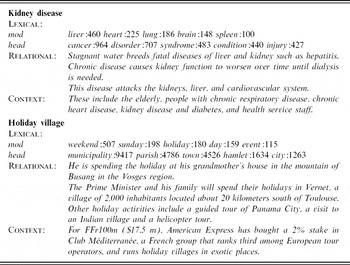
Table 1 gives examples of each kind of information as extracted for two compounds used in our experiments.
Information sources for sample compounds; lexical information is represented by syntactic coordination features, relational information by sets of context strings and contextual information by the BNC sentence from which the compound was originally extracted

Adopting a similarity-based perspective on interpretation, the use of lexical information assumes that compounds whose constituents are similar will tend to have similar relational meanings. If we know that a history book is a book about history, we might assume that a geography article is an article about geography given the lexical similarity between history and geography and between book and article. The task of computing lexical similarity is a much-studied one in NLP; among the most successful data-driven techniques are distributional methods, which relate the meaning of a word to its patterns of co-occurrence in text corpora. The fundamental idea here is to associate each word with a numerical vector that measures the strength of association between that word and each member of a set of co-occurrence contexts, which may correspond to words or to basic syntactic structures. When the co-occurrence vector of a word is a normalised vector of counts that sums to 1, this is equivalent to estimating a probability distribution over co-occurrence contexts for that word. The literature on distributional semantics is voluminous and cannot be adequately summarised here, but many comprehensive overviews exist (Curran Reference Curran2003; Padó and Lapata Reference Padó and Lapata2007; Turney and Pantel Reference Turney and Pantel2010). In this paper we implement lexical similarity by estimating co-occurrence distributions for each constituent of a compound and comparing the corresponding constituents of two compounds using a kernel defined on probability distributions (Section 3.2).
Whereas measures of distributional lexical similarity consider the co-occurrences of each constituent of a word pair separately, relational similarity is based on the contexts in which both constituents appear together. Relational similarity has also been called analogical similarity, e.g. by Turney (Reference Turney2006, Reference Turney2008). The underlying intuition is that when nouns N 1 and N 2 are mentioned in the same context, then that context is likely to yield information about the relations that hold between those nouns’ referents in the world. For example, contexts mentioning brick and wall might frequently describe a wall made of bricks or a wall constructed with bricks, while contexts mentioning wood and floor might describe a floor made of wood or a wall constructed with wood. A relational distributional hypothesis would therefore state that two word pairs are semantically similar if their members appear together in similar contexts. In order to compute relational similarity between compounds in our kernel-based framework, we extract sets of contexts for each modifier-head pair in our compound dataset and use a kernel on sets of strings to compare compounds (Section 3.3).
As a general principle in NLP, the context in which a pair of word tokens occur is a valuable source of information about the semantic relation that holds between them. As one might expect, context features, such as surrounding words, play an important role in tasks such as semantic role labelling or semantic relation classification in the vein of ACE or SemEval-07 Task 4 (Girju et al. Reference Girju, Nakov, Nastase, Szpakowicz, Turney and Yuret2007; ACE 2008). Compound interpretation can indeed be seen as a special case of semantic relation identification; however, context features are of little value for understanding compounds, as demonstrated empirically by Ó Séaghdha and Copestake (Reference Ó Séaghdha and Copestake2007). This should not be surprising, as it is a defining characteristic of compounds that information about the semantic relation between constituents is not made explicit in context but rather left for the hearer to ‘unpack’. Treated as a single lexical item, the distributional profile of a compound is primarily defined by its head noun rather than by its relational semantics. As a result we do not use contextual similarity in the experiments described here, even though the compound dataset that we use has been annotated in context.
Most statistical learning approaches to compound interpretation use lexical information, relational information or both. Lexical information is usually extracted from a lexical resource such as WordNet or Roget's Thesaurus (Nastase and Szpakowicz Reference Nastase and Szpakowicz2003; Girju et al. Reference Girju, Moldovan, Tatu and Antohe2005; Kim and Baldwin Reference Kim and Baldwin2005; Tratz and Hovy Reference Tratz and Hovy2010); apart from our own work, the only use of distributional features that we are aware of is by Nastase et al.(2006). Our eschewal of WordNet and other manually constructed resources is motivated in part by a scientific interest in the potential for learning semantics using purely distributional information and partly by a concern for portability to domains and languages where broad-coverage lexical resources do not exist. Relational information extracted from corpora (including the World Wide Web) has been applied to the interpretation problem by Lauer (Reference Lauer1995), Turney (Reference Turney2006, Reference Turney2008), Nakov and Hearst (Reference Nakov and Hearst2008) and Tratz and Hovy (Reference Tratz and Hovy2010). One further source of similarity information that we do not consider (but could easily add) is morphological information, including suffix and prefix features (Tratz and Hovy Reference Tratz and Hovy2010).
3 Kernel methods for classification
3.1 Overview
Having sketched our concepts of lexical and relational similarity, we proceed in this section to provide technical details of the methods we use to implement them. Kernel methods is the name given to a statistical modelling paradigm in which data items are viewed by the learning algorithm in terms of their similarity to other items (Shawe-Taylor and Cristianini Reference Shawe-Taylor and Cristianini2004). This similarity is captured through a function known as the kernel function (or simply kernel). Kernel-based learning has a number of advantages, including the facilitation of efficient methods for non-linear classification and classification with complex feature spaces, and has become very popular in NLP and many other disciplines. Furthermore, kernel algorithms are modular in the sense that switching to a new kernel does not require a new learning algorithm. While traditional feature-based learning can also exploit rich feature mappings, one cannot simply ‘slot in’ a new inner product geometry as we do here without altering the learning algorithm.
A kernel is a function  $k:\mathcal {X}\times \mathcal {X}\mapsto {\mathbb {R}}_+$ which is equivalent to an inner product
 $\langle \cdot ,\cdot \rangle _\mathcal {F}$ in some inner product space
 $\mathcal {F}$ (the feature space):
 \begin{equation}
k(\mathbf {x}_i,\mathbf {x}_j) = \langle \phi (\mathbf {x}_i),\phi (\mathbf {x}_j) \rangle _\mathcal {F}
\end{equation}
 \begin{equation}
\mathbf {v}^{\prime}K\mathbf {v} \ge 0, \forall \mathbf {v} \in {\mathbb {R}}^n
\end{equation}
 $\mathcal {X}$ to
 $\mathcal {F}$. For example, the polynomial kernel of degree l=3, k P3(xi, xj)=(〈xi, xj〉+R)3 defined on input vectors of dimension d=2 corresponds to an inner product in the space whose
 $\binom{d+l}{l} = 10$ dimensions are the monomials of degree i, 1≤i≤3, hence φ(x)=φ(x 1, x 2)=[x 31, x 32, x 21x 2, x 1x 22, x 21, x 22, x 1x 2, x 1, x 2]. Note that we do not need to represent the 10-dimensional vectors φ(xi) and φ(xj) as the kernel can be computed directly in 2-D space. Given a set
 $X = \lbrace \mathbf {x}_1, \mathbf {x}_2,\dots , \mathbf {x}_n \in \mathcal {X}\rbrace$ and a kernel k, the n×n matrix K with entries Kij=k(xi, xj) is called the kernel matrix or Gram matrix. It follows from Mercer's Theorem (Mercer Reference Mercer1909) that a valid kernel on a set
 $\mathcal {X}$ is defined by any symmetric finitely positive semi-definite function, i.e. a function for which the Gram matrix of function values calculated on any finite set
 $X \subseteq \mathcal {X}$ satisfies
The space of functions satisfying the positive semi-definite (psd) property (2) is large. The Euclidean dot product
 $\langle \cdot ,\cdot \rangle _{{\mathbb {R}}^d}$, also known as the linear kernel in the context of classification, is a kernel for which the input and spaces are the same and φ is the identity mapping. Other kernels, such as the Gaussian kernel
 $k = \operatorname{exp}(-\beta \sum _d (x_{id} - x_{jd})^2)$, correspond to an inner product in an infinite-dimensional space. Furthermore, the elements of the input set
 $\mathcal {X}$ need not be vectors. In Sections 3.2 and 3.3, we consider classes of kernels on probability distributions, strings and sets of strings that will prove useful for compound classification. For other aspects of kernel methods, the book by Shawe-Taylor and Cristianini Shawe-Taylor and Cristianini (Reference Shawe-Taylor and Cristianini2004) is recommended as a comprehensive guide.
Given training data X={x1, . . ., xn} drawn identically and independently from some set  $\mathcal {X}$, with corresponding labels Y={y 1, . . ., yn} belonging to a set
 $\mathcal {Y}$, the supervised classification task is to learn a function
 $f:\mathcal {X}\mapsto \mathcal {Y}$ that best predicts the unknown label yj for a data point
 $\mathbf {x}_j \in \mathcal {X}$ that was not seen in training. In order to render learning feasible, f is usually restricted to a particular functional class; for binary classification (i.e.
 $\mathcal {Y} = \lbrace -1,1\rbrace$) we might define
 $f(\mathbf {x}) = \operatorname{sign}g(\mathbf {x})$, where
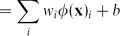
 $g:\mathcal {X}\mapsto {\mathbb {R}}$ belongs to the class of linear functions:
 \begin{align}
g(\mathbf {x}) &= \langle \mathbf {w},\phi (\mathbf {x}) \rangle _{{\mathbb {R}}^d} + b
\end{align}
 \begin{align}
&= \sum _i w_i \phi (\mathbf {x})_i + b
\end{align}
 $\phi:\mathcal {X}\mapsto {\mathbb {R}}^d$ that maps data points to a d-dimensional feature vector of real numbers and a vector w of feature weights that capture the predictive power attributed to each feature.
 $\langle \cdot ,\cdot \rangle _{{\mathbb {R}}^d}$ is the inner product in
 ${\mathbb {R}}^d$, i.e. the dot product. The vector w defines a hyperplane
 $\langle \mathbf {w},\phi (\mathbf {x}) \rangle _{{\mathbb {R}}^d} = 0$ in
 ${\mathbb {R}}^d$; the sign of g(x) indicates the side of this hyperplane on which the point x lies, while the absolute value of g(x) indicates the distance from x to the hyperplane.
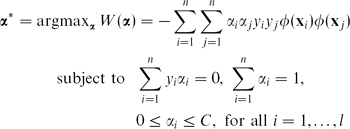
A dataset is linearly separable if a hyperplane exists such that all instances with label –1 are on one side and all instances with label 1 are on the other. Linear separability is usually an unrealistic condition for complex problems. The support vector machine (SVM) is a classifier that aims to find the ‘best’ decision boundary in the sense that violations of the boundary are minimised and the separation between classes (the ‘margin’) is maximised (Cortes and Vapnik Reference Cortes and Vapnik1995). The (dual) SVM optimisation problem is:
 \begin{align}
{\mathbf {\alpha}}^* = \operatorname{argmax}_{\mathbf \alpha} W({\mathbf \alpha}) &= -\sum _{i=1}^n\sum _{j=1}^n \alpha _i\alpha _jy_iy_j\phi (\mathbf {x}_i)\phi (\mathbf {x}_j) \\
\mathrm{subject\ to}\ \ &\sum_{i=1}^ny_i\alpha _i = 0,\ \sum _{i=1}^n \alpha _i = 1,\nonumber \\
& 0 \le \alpha _i \le C,\ \mathrm{for\ all}\ i=1,\dots ,l\nonumber
\end{align}
 \begin{equation}
W({\mathbf \alpha}) = -\sum _{i=1}^n\sum _{j=1}^n \alpha _i\alpha _jy_iy_jk(\mathbf {x}_i,\mathbf {x}_j)
\end{equation}
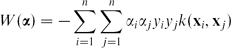
 $\phi (\mathbf {x}_i)\phi (\mathbf {x}_j) = \langle \mathbf {x}_i,\mathbf {x}_j \rangle _{\mathcal {F}}$. This suggests that we can use SVMs to do classification in a kernel feature space by rewriting the objective as
where k is a valid kernel on
 $\mathcal {X}$. The SVM classifier optimising this objective will learn a decision function
 $f(\mathbf {x}) = \mathrm{sign}(\langle \mathbf {w},\phi (\mathbf {x}) \rangle _\mathcal {F} + b)$ that is linear in the codomain
 $\mathcal {F}$ of φ but nonlinear in the input space
 $\mathcal {X}$.
Support vector machines have been shown to achieve state-of-the-art performance on a great number of classification problems in NLP and other fields. Good performance with SVMs is contingent on the choice of an appropriate kernel function. The kernel chosen determines both the feature mapping φ and the inner product used to compare data points in feature space. If a kernel function induces a mapping into a space where the data classes are well separated, then learning a decision boundary in that space will be easy. Conversely, if the feature space mapping of the data does not contain discriminative information, SVM classification will perform poorly. Hence, if we can use a kernel function tailored to the prior knowledge we have about our classification problem, we expect to do better than we would with a less appropriate kernel. In the following sections we discuss how our intuitions about lexical and relational similarity can be applied to improve performance on the compound classification task.
3.2 Kernels on probability distributions
The most commonly used kernels on vectors of real numbers (including co-occurrence vectors) are the linear and Gaussian kernels. It can be shown that these kernels are related to the Euclidean L 2 distance by two transformations that relate positive semi-definite kernels k to squared metrics  $\tilde{k}$, also known as negative semi-definite kernels (Berg, Christensen and Ressel Reference Berg, Christensen and Ressel1984):
 \begin{align}
k(\mathbf {x}_i,\mathbf {x}_j) &= \tilde{k}(\mathbf {x}_i,\mathbf {x}_0) + \tilde{k}(\mathbf {x}_j,\mathbf {x}_0) - \tilde{k}(\mathbf {x}_i,\mathbf {x}_j) - \tilde{k}(\mathbf {x}_0,\mathbf {x}_0),\ \mathbf {x}_0 \in \mathcal {X}\ \mathrm{(linear)}
\end{align}
 \begin{align}
k(\mathbf {x}_i,\mathbf {x}_j) &= \exp (-\beta \cdot \tilde{k}(\mathbf {x}_i,\mathbf {x}_j)),\ \beta > 0 \ \mathrm{(RBF)}
\end{align}
 \begin{align}
k_{L_2 (\text{linear})}(\mathbf {x_i},\mathbf {x_j}) &= \sum _i x_{ii}x_{ji}
\end{align}
 \begin{align}
k_{L_2 (\text{RBF})}(\mathbf {x_i},\mathbf {x_j}) &= \operatorname{exp}\left(-\beta \cdot \tilde{k}_{L_2}(\mathbf {p},\mathbf {q})\right)
\end{align}
 $\tilde{k}$ to be the square of the L 2 distance, i.e.
 $\tilde{k}_{L_2} = \sum _d(x_{id} - x_{jd})^2$ and setting x0 to be the zero vector, the linear transformation (7a) yields a function that is twice the linear kernel and the Radial Basis Function (RBF) transformation (7b) yields the Gaussian kernel:
Research on distributional lexical semantics has shown that the L 2 distance performs relatively poorly compared with other distance and similarity measures (Lee Reference Lee1999). Hein and Bousquet (Reference Hein and Bousquet2005) describe a family of kernels that relate to well-known distance measures on probability distributions, including the Jensen–Shannon Divergence (JSD), L 1 distance and Hellinger Divergence, using the transformations (7a) and (7b). Ó Séaghdha and Copestake (Reference Ó Séaghdha and Copestake2008) observe that these kernels include a number of well-established distributional similarity measures and demonstrate empirically that performance on classification tasks involving lexical similarity can be improved by using such distributional kernels. A representative example is the JSD
 \begin{equation}
\tilde{k}_{\text{JSD}}(\mathbf {p},\mathbf {q}) = \sum _i p_i \log _2 \left(\frac{2p_i}{p_i+q_i} \right) + q_i \log _2 \left(\frac{2q_i}{p_i+q_i} \right)
\end{equation}
 \begin{align}
k_{\text{JSD} (\text{linear})}(\mathbf {p},\mathbf {q}) &= - \sum _i p_i \log _2 \left(\frac{p_i}{p_i+q_i} \right) + q_i \log _2 \left(\frac{q_i}{p_i+q_i} \right)
\end{align}
 \begin{align}
k_{\text{JSD} (\text{RBF})}(\mathbf {p},\mathbf {q}) &= \operatorname{exp}\left(-\beta \cdot \tilde{k}_{\text{JSD}}(\mathbf {p},\mathbf {q}\right)
\end{align}
To compare two words w, w′ with a distributional kernel, we compare their estimated co-occurrence distributions. As our goal is to apply distributional kernels to compound interpretation, we must proceed from comparing individual words to comparing pairs of words. A lexical kernel on compounds can be defined as the normalised sum of a kernel function on heads and a kernel function on modifiers:
 \begin{equation}
k_{\text{lex}}((w_m,w_h),(w_m^{\prime},w_h^{\prime})) = \frac{1}{2}k(w_m,w_m^{\prime}) + \frac{1}{2}k(w_h,w_h^{\prime})
\end{equation}
The development of new kernels on distributions is an area of active research in the machine learning community. In addition to the family of kernels described by Hein and Bousquet (Reference Hein and Bousquet2005), further distributional kernels have been proposed by Lafferty and Lebanon (Reference Lafferty and Lebanon2005), Martins et al. (Reference Martins, Smith, Xing, Aguiar and Figueiredo2009) and Agarwal and Daumé III (Reference Agarwal and Daumé2011). The experiments described in Ó Séaghdha (Reference Ó Séaghdha2008) and preliminary experiments on some of these more recent proposals suggest that while most of these distributional kernels consistently outperform Euclidean linear and RBF kernels, their performance on semantic classification tasks is often similar. As the focus of this paper is on integrating semantic information sources rather than a comprehensive investigation of alternative kernels on distributions, we use only the L 2 (8) and JSD (11a) linear kernels in our experiments.
3.3 Kernels on strings and sets
The necessary starting point for our implementation of relational similarity is a means of comparing contexts. Contexts can be represented in a variety of ways, from unordered bags of words to rich syntactic structures. The context representation adopted here is based on strings, which preserve useful information about the order of words in the context yet can be processed and compared quite efficiently. String kernels are a family of kernels that compare strings s, t by mapping them into feature vectors  $\phi _{\text{String}}(\mathbf {s})$,
 $\phi _{\text{String}}(\mathbf {t})$ whose non-zero elements index the subsequences contained in each string. Once an embedding is defined, any inner product can be used to compare items.
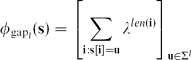
A string is defined as a finite sequence s=(s 1, . . ., sl) of symbols belonging to an alphabet Σ. Σl is the set of all strings of length l, and Σ* is the set of all strings or the language. A subsequence u of s is defined by a sequence of indices i=(i 1, . . ., i |u|) such that 1≤i 1<. . .<i |u|≤|s|, where |s| is the length of s. len(i)=i |u|−i 1+1 is the length of the subsequence in s. An embedding  $\phi _{\text{String}}:\Sigma ^*\rightarrow {\mathbb {R}}^{|\Sigma |^l}$ is a function that maps a string s onto a vector of positive ‘counts’ that correspond to subsequences of exactly l symbols contained in s.
One example of an embedding function is a gap-weighted embedding, which incorporates information about non-contiguous as well as contiguous subsequences. This is an intuitively useful property for semantic classification, as words in a sentence need not be adjacent to be semantically related. The gap-weighted embedding is defined as
 \begin{equation}
\phi _{\text{gap}_l}(\mathbf {s}) = \left[ \sum _{\mathbf {i}:\mathbf {s}[\mathbf {i}] = \mathbf {u}} \lambda ^{len(\mathbf {i})} \right]_{\mathbf {u} \in \Sigma ^l}
\end{equation}
An alternative embedding is that used by Turney (Reference Turney2008) in his PairClass system for analogical classification. For the PairClass embedding  $\phi _{\text{PC}}$, an n-word context
 \begin{equation*}
[0-1\ \mathrm{words}]\ N_{1|2}\ [0-3\ \mathrm{words}]\ N_{1|2}\ [0-1\ \mathrm{words}]
\end{equation*}
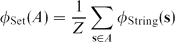
Relational similarity relies on comparing sets of contexts, i.e. sets of strings. In order to derive useful kernels on such sets, we use an embedding function for sets that uses an embedding of set members as a building block. A natural approach is to map a set to the normalised aggregate of the embeddings of its members:
 \begin{equation}
\phi _{\text{Set}}(A) = \frac{1}{Z}\sum _{\mathbf {s}\in A}\phi _{\text{String}}(\mathbf {s})
\end{equation}
 \begin{equation}
k_{\text{rel}}((w_m,w_h),(w_m^{\prime},w_h^{\prime})) = k_{\text{JSD}(\text{linear})}\left(\phi _{\text{Set}}(S(w_m,w_h)),\phi _{\text{Set}}(S(w_m^{\prime},w_h^{\prime}))\right)
\end{equation}
 $\phi _{\text{Set}}(A)$ have unit Euclidean norm and we compare embeddings with the Euclidean dot product, then we retrieve the averaged kernel of Gärtner et al. (Reference Gärtner, Flach, Kowalczyk and Smola2002) with the string kernel of Lodhi et al. (Reference Lodhi, Saunders, Shawe-Taylor, Cristianini and Watkins2002) as base kernel. Alternatively, we can normalise the embedding so that it sums to 1, defining a multinomial probability distribution over subsequences. Under this perspective, context sets are viewed as samples from underlying probability distributions and it is natural to use distributional kernels to compare sets. In this paper we implement relational similarity as the JSD linear kernel computed between embeddings of context sets produced with set embedding (14) and string embedding
 $\phi _{\text{gap}_l}$ (13) or the PairClass embedding
 $\phi _{\text{PC}}$:
where S(wm, wh) is the set of context strings associated with the word pair (wm, wh).
3.4 Kernel combination
The set of kernels is closed under addition and multiplication by a positive scalar (Shawe-Taylor and Cristianini Reference Shawe-Taylor and Cristianini2004). It follows that a linear combination of l kernels with positive weights μ is also a valid kernel:
 \begin{equation}
k_{\text{comb}}(\mathbf {x}_i,\mathbf {x}_j) = \sum _l \mu _l k_l(\mathbf {x}_i,\mathbf {x}_j), {\mathbf \mu} \in {\mathbb {R}}_+^l
\end{equation}
Multiple kernel learning (MKL) is the name usually given to the task of optimising the combination weights in (16). Finding the best μ is a non-trivial optimisation problem for more than a small number of kernels, as it is not practical to perform an exhaustive search. As far as we are aware, multiple kernel learning methods have not previously been applied in NLP research; we performed experiments using a multiclass adaptation of the two-stage algorithm proposed by Cortes, Mohri and Rostamizadeh (Reference Cortes, Mohri and Rostamizadeh2010), but our findings were inconclusive. Multiple kernel learning can give a small boost in performance but it is not always reliable, especially for larger label sets, and our best results were achieved through uniform weighting.
4 Experimental design
4.1 Compound dataset
Our experiments use the dataset of 1,443 unique two-noun English compounds described at length in Ó Séaghdha (Reference Ó Séaghdha2008). These compounds were randomly sampled from a collection of 430,555 types (covering over 1.5 million tokens) harvested from the written component of the British National Corpus (BNC) (Burnard Reference Burnard1995) and annotated in context for their semantic relations. The inventory of semantic relations consists of six coarse-grained relations: BE, HAVE, IN, ACTOR, INST(RUMENT) and ABOUT. Each is a binary relation; a compound expressing a particular relation is assumed to fill one argument slot with its head and the other with its modifier. With the exception of BE, the argument slots for each relation are semantically distinct and it is useful to note which constituent fills which slot. Thus, pig pen would be labelled IN (M,H) as the head denotes the location and the modifier denotes the located entity; pen pig would be labelled IN (H,M) as the head and modifier roles are reversed.
Furthermore, each compound in the dataset is annotated with the annotation rule that licenses the assignment of its coarse-grained label. For example, the rules licensing IN distinguish between spatially located objects (pig pen), spatially located events (air disaster), temporally located objects (evening edition) and temporally located events (dawn attack). The table in Appendix A summarises the various annotation rules and their distribution over the dataset. The design of the inventory was motivated by a desire to avoid inconsistent or overlapping relations and by a concern for general linguistic and psycholinguistic principles. The dataset is freely available online, as are the detailed guidelines used by the annotators.Footnote 3
Ó Séaghdha (Reference Ó Séaghdha2008) reports an inter-annotator agreement analysis performed on a more complex task which contained as a part the semantic annotation used here but also involved the detection of extraction errors and non-compositional or lexicalised compounds. Overall agreement was 66.2% (Cohen's κ=0.62) for coarse-grained annotation, 64.0% (κ=0.61) for coarse-grained labels with role order and 58.8% (κ=0.56) for fine-grained annotation. Further analysis by Ó Séaghdha suggests that agreement on the semantic relation annotation is probably a few points higher (estimated κ=0.68), as a significant amount of disagreement relates to decisions about lexicalisation. These agreement figures are not as high as those reported for some other tasks but are comparable to those reported in the literature on semantic annotation of compounds (Tratz and Hovy Reference Tratz and Hovy2010).
Prior work on this dataset has restricted itself to the coarse-grained annotation with six semantic relation labels (Ó Séaghdha and Copestake Reference Ó Séaghdha and Copestake2008, Reference Ó Séaghdha and Copestake2009; Tratz and Hovy Reference Tratz and Hovy2010). In this paper we consider the tasks of classification at the following three levels of granularity:
Coarse: Predicts coarse-grained relations (six labels).
Directed: Predicts coarse-grained relations and which constituents fill which relation slots (eleven labels).
Fine: Predicts fine-grained labels corresponding to annotation rules and which constituents fill which relation slots (thirty-seven labels).
Not all potential labels are well-represented in the dataset; for example, there are only five examples of ABOUT (H,M) (e.g. sitcom family). In our classification experiments all labels occurring ten times or fewer in the dataset were excluded, with the result that in practice the Directed and Fine inventories contain ten and twenty-seven labels respectively.
4.2 Corpora
In order to extract data for the lexical and relational kernels we used three source corpora:
• The written component of the British National Corpus (BNC), consisting of 90 million words (Burnard Reference Burnard1995), lemmatised, POS-tagged and parsed with the RASP toolkit (Briscoe, Carroll and Watson Reference Briscoe, Carroll and Watson2006).
• A Wikipedia dump (WIKI), consisting of almost 1 billion words, collected by Clark et al. (Reference Clark, Copestake, Curran, Zhang, Herbelot, Haggerty, Ahn, Wyk, Roesner, Kummerfeld and Dawborn2009), lemmatised, POS-tagged and parsed with the fast Combinatory Categorial Grammar (CCG) pipeline described by Clark et al.
• The English Gigaword Corpus (GW), 2nd Edition, consisting of 2.3 billion words (Graff et al. Reference Graff, Kong, Chen and Maeda2005), lemmatised and tagged with RASP but not parsed.
These corpora are also used to produce two larger corpora by concatenation: BNC+WIKI and BNC+GW.
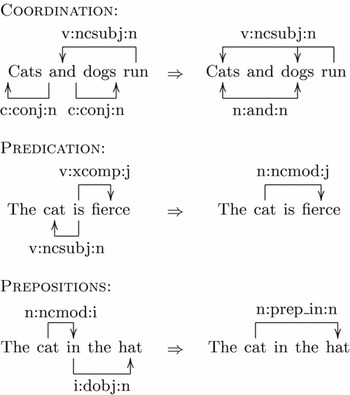
The BNC and BNC+WIKI corpora were used to extract distributional lexical information based on grammatical relations (GRs) in the parser output. Although the BNC and WIKI corpora were processed with different parsers, both the RASP and CCG parsers can produce grammatical relations in the same format and therefore their outputs are interoperable. In order to maximise the yield of semantically salient information, the GR graph for each sentence was preprocessed with the transformations specified in Figure 1. All parts of speech other than nouns, verbs, adjectives, prepositions and adverbs were ignored, as were stopwords, tokens of fewer than three characters and the semantically weak lemmas be and have. The following feature sets were extracted for each noun w that appears as a constituent in the compound dataset:
Coordination: All nouns w′ appearing linked to w in a coordinative structure (labelled n:and:n in Figure 1). This is the same feature specification as in Ó Séaghdha and Copestake (Reference Ó Séaghdha and Copestake2008); it is very sparse but rich in semantic class information. For example, if a noun is frequently coordinated with cat, dog and goldfish, then it is most likely a household animal.
All GRs: All tuples (w′, r) where w′ is a word appearing as the dependent of w in the GR graph and r is the GR label on the edge connecting w and w′, and all tuples (w′, r −1) where w′ appears as the head of w. For example, given the GR graph fragment
GR Clusters: Rather than using the very sparse All GRs feature space, we can use clusters of GRs induced by applying the ‘topic modelling’ approach of Ó Séaghdha and Korhonen (Reference Ó Séaghdha and Korhonen2011). This method, based on the Latent Dirichlet Allocation model proposed for document analysis by Blei, Ng and Jordan (Reference Blei, Ng and Jordan2003), associates each word with a multinomial distribution over latent variables and associates each latent variable with a multinomial distribution over GR tuples. Given that the number of latent variables |Z| is generally much lower than the number of GR tuples, the parameters of a word's distribution over latent variables can be interpreted as defining a low-dimensional distribution over clusters of GR tuples. In order to estimate the parameters of this model, we use the efficient Gibbs sampling algorithm of Yao, Mimno and McCallum (Reference Yao, Mimno and McCallum2009) and estimate the probability P(z|w) that a GR involving word w is associated with latent variable z as the proportion of GR instances involving w in the training corpus to which z is assigned in the final sampling state. We run the Gibbs sampler for 1,000 iterations and set |Z|=1, 000. We have not investigated the effect of modifying |Z|, although it would be feasible to combine feature sets with different parameterisations to exploit multiple granularities or to combine feature sets derived from multiple sampling runs to reduce variance.
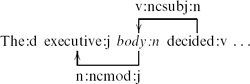
Dependency graph preprocessing.

The BNC+GW corpus was used to extract sets of string contexts for each pair of compound constituents. For each compound in the dataset, the set of sentences in the combined corpus containing both constituents of the compound was identified. As the Gigaword Corpus contains many duplicate and near-duplicate articles, duplicate sentences were discarded so that repeated strings would not dominate the similarity estimates. Sentences in which the head and modifier words were more than ten words apart were also discarded, as it is plausible that there is no direct relation between the words in such sentences. The modifier and head were replaced with placeholder tokens M:n and H:n in each sentence to ensure that the classifier would learn from relational information only and not from lexical information about the constituents. Punctuation and tokens containing non-alphanumeric characters were removed. Finally, all tokens more than five words to the left of the leftmost constituent or more than five words to the right of the rightmost constituent were discarded; this has the effect of speeding up the set kernel computations and should also focus the classifier on the most informative parts of the context sentences. Examples of the context strings extracted for the modifier-head pair (history,book) are

This extraction procedure resulted in a corpus of 1,472,798 strings. There was significant variation in the number of context strings extracted for each compound: 288 compounds were associated with 1,000 or more sentences, while 191 were associated with ten or fewer and no sentences were found for forty-five constituent pairs. The largest context sets were predominantly associated with political or economic topics (e.g. government official, oil price), reflecting the journalistic sources of the Gigaword sentences.
4.3 Classification setup
All experiments were performed using the SVM training algorithm implemented in LIBSVM.Footnote 4 We decompose the multiclass classification problem into a set of binary classification problems through the one-against-all method: a single classifier is trained for each class label, treating data instances with that class as positive examples and all other instances as negative, and the final prediction for a test instance is the label for which that instance has the greatest positive (or least negative) distance from the corresponding decision boundary. In each cross-validation fold, the SVM cost parameter C is optimised through a grid search over the set {2−4, 20, . . ., 212}, selecting the value that gives the best ten-fold cross-validation performance on that fold's training set. For each feature set and each set embedding vector, L 1 normalisation (normalisation to unit sum) was performed before computing the JSD kernel; for the experiments with the L 2 linear kernels, L 2 normalisation (normalisation to unit Euclidean norm) was performed.
We compute evaluation results for five-fold cross-validation on the 1,443-compound dataset. As well as prediction accuracy (the proportion of compounds that were correctly labelled), we also report macro-averaged F-score, the average of the standard F-score measure calculated individually for each label. Accuracy rewards good performance on the most frequent labels, while macro-averaged F-score rewards performance on all labels equally. The best previously reported results for this dataset are 63.1% accuracy, 61.6 F-score (Ó Séaghdha and Copestake Reference Ó Séaghdha and Copestake2009) and 63.6% accuracy (Tratz and Hovy Reference Tratz and Hovy2010). The random-guess baseline is 16.3% accuracy for the Coarse label set, 10.0% accuracy for the Directed label set and 3.7% accuracy for the Fine label set. Where we wish to measure the statistical significance of a difference between two methods, we use paired t-tests (two-tailed, df = 4) on the cross-validation folds following the recommendation of Dietterich (Reference Dietterich1998).
5 Results
5.1 Results for lexical feature kernels
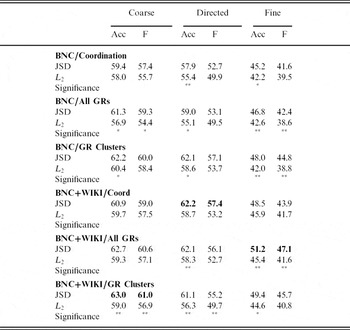
Table 2 presents results for the three lexical feature sets Coordination, All GRs and GR Clusters, using distributional information from the BNC and BNC+WIKI corpora and the JSD and L 2 linear kernels. Performance is notably lower for the fine-grained label set than on the coarse-grained set; this is not unexpected, as there are four times as many labels and consequentially less positive training data for each label. However, performance on the Directed label set is in some cases quite close to that on Coarse.
Comparison of JSD and L 2 linear kernels across feature sets. */** denote significant difference at the 0.05/0.01 level

For almost all combinations of feature and label sets, features extracted from the larger BNC+WIKI corpus give better performance than BNC (the only exceptions occur with the L 2 kernel and fine-grained label set). This is as we would expect, given that a larger corpus contains more information and will be less affected by sparsity of co-occurrences. No one feature set outperforms the other throughout, although the richer All GR and GR Cluster sets tend to score better than Coordination features alone.
Comparing performance with the JSD and L 2 linear kernels, the distributional kernel is the clear winner, outperforming the standard linear kernel on every combination of feature and label sets. The majority (19/36) of improvements are statistically significant, with many more coming very close to significance. This corroborates the finding of Ó Séaghdha and Copestake (Reference Ó Séaghdha and Copestake2008) that the JSD kernel is usually a better choice than the standard linear kernel for semantic classification tasks.
5.2 Results for relational kernels
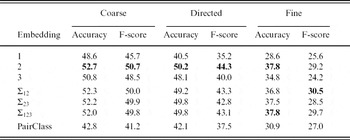
Table 3 presents results for classification with relational kernels. Results are reported for settings of the subsequence length parameter l in the range {1, 2, 3} as well as additive combinations (denoted Σ) of gap-weighted embeddings corresponding to different subsequence lengths and the PairClass embedding adopted from Turney (Reference Turney2008). In all cases performance is worse than that achieved by the lexical kernels, indicating that relational information (at least as implemented here) is not sufficient for state-of-the-art compound classification. Kernels with l=2 and the combined kernels generally perform best across all label sets; the difference between these kernels and the PairClass kernel is consistently significant at the p<0.01 level.
Results for relational string-set kernels

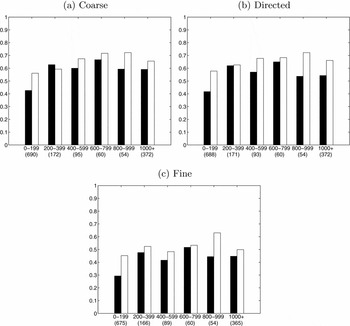
One obvious explanation for the relatively poor performance with relational information alone is data sparsity. As previously noted, 191 compounds are associated with ten or fewer context strings; in these cases there is very little relational information on which to base a prediction. Figure 2 illustrates the effect of context set size on performance for representative relational and lexical kernels. For the former, we use the ∑123 combination, but similar effects are observed for other subsequence length settings. Across all label sets, classification accuracy with relational kernels drops by about 20% in absolute terms for compounds with fewer than 200 associated context strings. For compounds with more than 200 context strings performance is more or less stable at a level that is comparable to that achieved by the lexical kernels.
The effect of context set size on classification accuracy using the ∑123 relational kernel (left, black) and the lexical JSD kernel with BNC+WIKI/Coord features (right, white).

5.3 Results for combined kernels
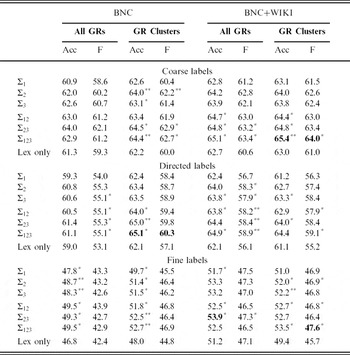
Table 4 presents results achieved by combining lexical and relational kernels, taking the best-performing lexical feature specifications All GRs and GR clusters.Footnote 5 The benefits of combination are clear: in the vast majority of cases, performance with a combined kernel is better than performance with the relevant lexical kernel on its own. The results are particularly good for combinations involving the summed relational kernels Σ23 and Σ123; across twenty-four combinations of lexical feature set and label set, only four fail to contribute a statistically significant improvement on at least one evaluation measure. The best results on the Coarse label set – 65.4% Accuracy, 64.0 F-score, achieved by combining the BNC+WIKI/GR Clusters lexical kernel with the summed Σ123 relational kernel – are higher than all previously reported performances on this dataset.
Results for combined lexical and relational kernels: */** denote significant improvement over the corresponding lexical-only result at the 0.05/0.01 level

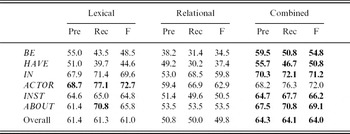
Table 5 analyses performance for each individual relation in the Coarse label set, taking competitive representatives from the lexical, relational and combination kernel categories. The most difficult relations to classify are BE and HAVE; these are also the least frequent relations in the dataset. IN and ACTOR seem to be the easiest. The lexical kernel results are better than the relational kernel results for every relation, and the combined kernel results are better than either for every relation except ACTOR, where the lexical kernel does very slightly better.
Macro-averaged Precision, Recall and F-score by coarse label for lexical kernel (BNC+WIKI/GR Clusters), relational kernel (Σ123) and their combination

5.4 Head-only and modifier-only prediction
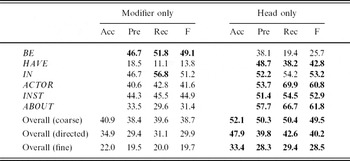
Table 6 reports results using lexical information about compound heads only or compound modifiers only. These results were attained with the GR Cluster features and BNC+WIKI corpus, although results with other feature sets and corpora follow the same pattern.
Classification results using modifier-only and head-only lexical information (BNC+WIKI/GR Clusters)

The relative importance of modifier and head words for compound comprehension has been the subject of some debate in psycholinguistics. For example, Gagné and Shoben (Reference Gagné and Shoben1997) Competition Among Relations In Nominals (CARIN) model affords a privileged role to modifiers in determining the range of possible interpretations, and Gagné (Reference Gagné2002) finds that meanings can be primed by compounds with semantically similar modifiers but not by similar heads. However, other authors have challenged these findings, including Devereux and Costello (Reference Devereux and Costello2005), Estes and Jones (Reference Estes and Jones2006) and Raffray, Pickering and Branigan (Reference Raffray, Pickering and Branigan2007). While not proposing that human methods of interpretation are directly comparable to machine methods, we suggest that classification performance with head- and modifier-only features can give valuable insight into the discriminative potential of each constituent.
Table 6 shows that overall F-score and accuracy attained with head features exceed those attained with modifier features by about 10 points for all label granularities. However, head performance is in turn 10–15 points worse than performance with both sets of features, indicating that both do contain valuable information. Of the coarse-grained relations, BE is the only relation better predicted with modifier features than with head features. A partial explanation for this last result is that compounds where the modifier is a substance or material frequently express BE (annotation rule 2.1.1.2 in Appendix A), for example corduroy trousers, ice crystal, and copper wire. On the other hand, modifier information is very weak at recognising instances of HAVE, ACTOR and ABOUT, which seem to be predominantly signalled by the head constituent – for example, compounds headed by book, story and film are very likely to encode a topic relation, while compounds headed by driver or salesman are likely to encode an agentive relation.
6 Conclusion
In this paper we have described a classification-based approach to compound interpretation that integrates lexical and relational information in a kernel combination framework. We have experimented with three different granularities of semantic relation labels, demonstrating in every case that performance with a combination of information sources is superior to that achieved with individual sources.
Potential future work includes the investigation of new kernels and feature sets for lexical and relational similarity. We also intend to evaluate our methods on other datasets and potentially on other domains and languages; as we do not require specific lexical resources other than a suitable corpus, the methods should be easily portable. Even where high-quality parsing is unavailable or impractical, we hope that reasonable lexical and relational information can still be acquired. More generally, we hope to demonstrate the applicability of our methods to other tasks involving semantic analogies and reasoning about semantic relations.
Acknowledgments
We are very grateful to Diane Nicholls for her part in the data annotation, and to Anna Korhonen and Diana McCarthy for feedback on the work. This research was supported by doctoral awards to DÓS by Corpus Christi College Cambridge, the University of Cambridge and the Engineering and Physical Sciences Research Council.
Appendix A Semantic relations used in the dataset