





1. Introduction
In recent decades, large-area spectroscopic surveys such as the RAdial Velocity Experiment (RAVE; Steinmetz Reference Steinmetz2003), the Large Sky Area Multi-Object Fiber Spectroscopic Telescope (LAMOST; Cui et al. Reference Cui2012), the GALactic Archeology with HERMES survey (GALAH; Martell et al. Reference Martell2017), and the Sloan Digital Sky Survey IV (SDSS-IV; Blanton et al. Reference Blanton2017), including APOGEE-2 and SDSS-V (Almeida et al. Reference Almeida2023) Milky Way Mapper (Kollmeier et al. Reference Kollmeier2017), have provided vast datasets of stellar spectra encompassing a wide variety of stellar populations.
Characterizing these samples is a complex task, often addressed with general-purpose pipelines that perform reasonably well across different types of stars. The determination of basic atmospheric parameters, such as effective temperature (T
 $_{\rm eff}$
), surface gravity (
 $\log g$
), and overall metallicity ([M/H]), typically relies on comparing observed spectra with synthetic models. Although synthetic spectral grids have improved over the years, offering broader and more regular coverage of the parameter space, the reliability of the derived parameters still depends on the spectral type and evolutionary stage of the target, with reduced accuracy for both hot and cool stars.
2. Atmospheric parameter determination
We determined Teff,
 $\log g$
, [M/H], and projected rotational velocity (
 $v\sin i$
) for 548 young Orion stars located in four different groups using the TONALLI code (Adame et al.Adame, Román-Zú 2024). TONALLI compares APOGEE-2 spectra with synthetic grids optimized for the H band, incorporating rotational broadening and photometric priors on
 $\log g$
. The SDSS-IV APOGEE-2 survey operates in the H band (
 $\sim$
1.5-1.7
 $\mu$
m) at a spectral resolution of
 $\sim$
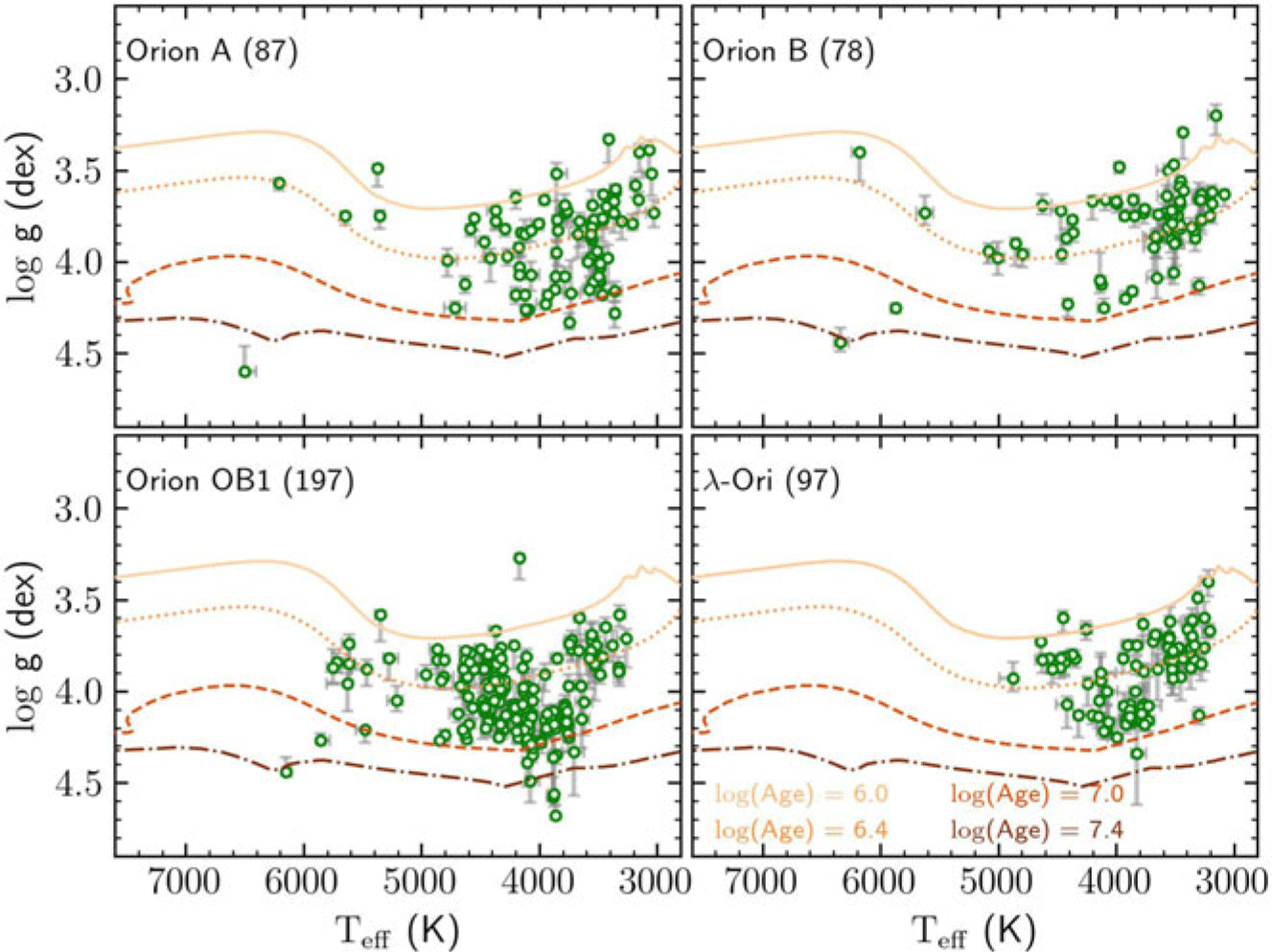
22,500. Figure 1 shows the Kiel diagrams obtained for the four Orion groups studied. Our
 $T{\rm eff}$
and, especially,
 $\log g$
values are consistent with pre-main-sequence evolutionary models.
Kiel diagrams obtained with TONALLI for the 548 stars of Orion split into the four groups analyzed. As a reference, we include evolutionary models of Marigo et al. (Reference Marigo2017) for solar metallicity. The number in parentheses indicates the number of stars included in each group.

3. Chemical Abundance Determination
We derived the chemical abundances of C, Mg, Si, K, Ti, and Fe using BACCHUS (Masseron et al. Reference Masseron, Merle and Hawkins2016), APOGEE-2 infrared spectra, and the atmospheric parameters obtained from TONALLI. BACCHUS performs a line-by-line analysis by fitting MARCS model atmospheres (Gustafsson et al. Reference Gustafsson, Edvardsson, Eriksson, Jørgensen, Nordlund and Plez2008) and using the atomic line lists from López-Valdivia et al. (Reference López-Valdivia2024) and Grilo et al. (Reference Grilo2024). The main assumption in this procedure is that the input atmospheric parameters of each star are the true, or at least the best available, values.
Because these parameters have uncertainties, we performed a Monte Carlo error propagation. In each of 100 iterations, we randomly varied the input parameters within their respective uncertainties, and then computed the mean and standard deviation of the resulting abundance distributions. These were adopted as the final abundance value and its associated uncertainty.
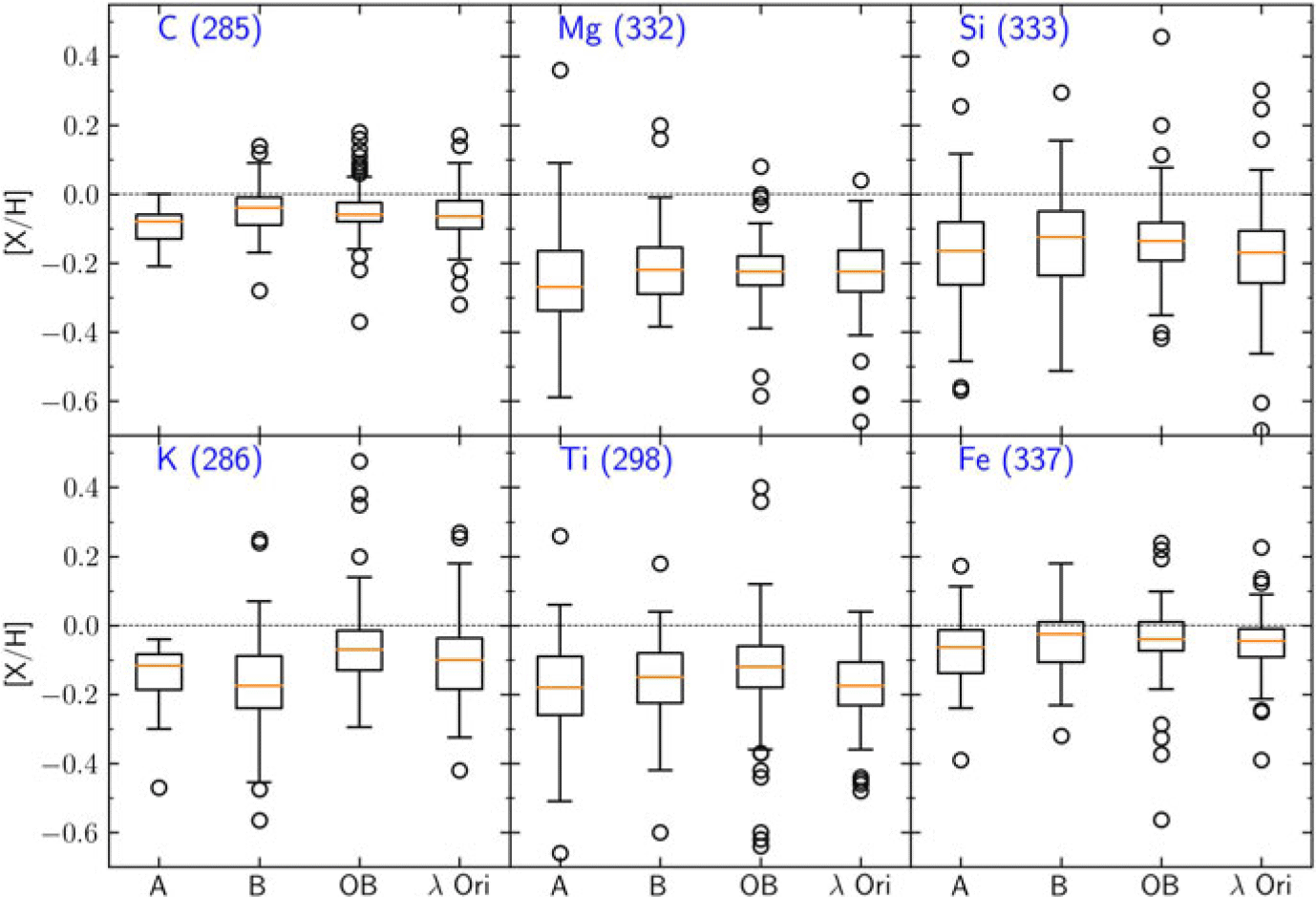
We determined reliable chemical abundances for 340 stars (62% of our Orion sample). Our results show that Orion has slightly sub-solar [Fe/H] values, with its distribution centered at
 $-0.05 \pm 0.09$
dex. We also found that the Orion complex is chemically homogeneous (see Figure 2). Further details on our methodology and analysis are provided in López-Valdivia et al. (Reference López-Valdivia2025).
Boxplot of the [X/H] abundance ratios derived in this work for each Orion group. The total number of stars for each element is within parentheses.

4. Future work: hot stars and magnetic fields
Our framework is robust, minimizes systematic trends, and ensures homogeneous atmospheric parameter and abundance determinations. We are now working on including the determination of stellar magnetic field strengths in our characterization. We are obtaining direct measurements of Zeeman broadening from APOGEE-2 infrared spectra, which can be readily used to infer magnetic field strengths.
In the near future, we plan to extend our characterization to include hot stars. This extension can be approached from two perspectives: By making use of available theoretical models or synthetic spectral grids. By leveraging the large number of observed spectra in the APOGEE-2 survey to construct an empirical template grid.

 Open access

