Prospective and retrospective longitudinal studies consistently show that adults who were victims of abuse or neglect in childhood have poorer mental and physical health than adults who did not experience maltreatment in their early years (Gilbert et al. Reference Gilbert, Widom, Browne, Fergusson, Webb and Janson2009; Wegman & Stetler, Reference Wegman and Stetler2009; Irish et al. Reference Irish, Kobayashi and Delahanty2010). These mental health problems include elevated rates of mood disorders, behavioural health problems, personality disorders, and post-traumatic stress disorder (Widom et al. Reference Widom, Ireland and Glynn1995, Reference Widom, DuMont and Czaja2007, Reference Widom, Czaja and Paris2009; Maxfield & Widom, Reference Maxfield and Widom1996; Widom, Reference Widom1999; Cohen et al. Reference Cohen, Brown and Smaile2001; Scott et al. Reference Scott, Smith and Ellis2010; Thornberry et al. Reference Thornberry, Henry, Ireland and Smith2010; Afifi et al. Reference Afifi, Mota, Dasiewicz, MacMillan and Sareen2012). Physical health problems include elevated rates of asthma (Scott et al. Reference Scott, Smith and Ellis2012), decreased levels of albumin (which is a marker for kidney and liver disease; Widom et al. Reference Widom, Czaja, Bentley and Johnson2012), and increased risk of cardiovascular disease (Dong et al. Reference Dong, Giles, Felitti, Dube, Williams, Chapman and Anda2004) and associated risk factors (e.g., obesity, diabetes; Noll et al. Reference Noll, Zeller, Trickett and Putnam2007; Danese et al. Reference Danese, Moffitt, Harrington, Milne, Polanczyk, Pariante, Poulton and Caspi2009; Widom et al. Reference Widom, Czaja, Bentley and Johnson2012; Midei et al. Reference Midei, Matthews, Chang and Bromberger2013). These associations are observed even in samples where maltreated and non-maltreated groups are matched for sociodemographic characteristics (Thornberry et al. Reference Thornberry, Henry, Ireland and Smith2010; Widom et al. Reference Widom, Czaja, Bentley and Johnson2012), suggesting that maltreatment itself is likely to be a distal or proximal cause of poor health.
Nevertheless, many adults are in good health despite their childhood history of maltreatment. From an intervention perspective, it is important to identify factors that explain individual differences in the response to adverse early experiences like maltreatment. The goal of our research was to test whether differences in the experience of safe, supportive, and nurturing relationships in adulthood explained why some women were resilient to the adverse effects of childhood maltreatment on adult health, while others were not. Safe, supportive, and nurturing relationships involve intimate relationships – usually with a romantic partner, but also with friends – that are free of physical or emotional violence and that offer emotional and material support (Merrick et al. Reference Merrick, Leeb and Lee2013). This concept is closely related to the Centers for Disease Control and Prevention's (2014) Essentials for Childhood framework that, along with safety and nurturance, promotes stability in relationships and environments as fundamental for children's positive development. Socially supportive relationships may generally promote positive outcomes because they increase positive affect, provide stability, validate the individual's sense of self-worth, and help the individual avoid negative experiences (Cohen & Wills, Reference Cohen and Wills1985). For women who were abused or neglected in childhood, socially supportive relationships in adulthood may be particularly important because these women are at heightened risk of being exposed to on-going violence and to socioeconomic stress (Currie & Widom, Reference Currie and Widom2010; Widom et al. Reference Widom, Czaja and Dutton2014; Fisher et al. Reference Fisher, Caspi, Moffitt, Wertz, Gray, Newbury, Ambler, Zavos, Danese, Mill, Odgers, Pariante, Wong and Arseneault2015). Under conditions of on-going adversity, safe, supportive, and nurturing relationships may provide women with needed support to cope with their circumstances.
Although access to social support is hypothesized to promote good physical or mental health among individuals who have a history of maltreatment (Cicchetti, Reference Cicchetti2013), relatively few studies have explicitly tested this hypothesis. Two studies used data from the Midlife in the United States Study to test whether socially supportive relationships in adulthood mediated or moderated effects of retrospectively-reported physical abuse on adult health. While one found that psychosocial resources (e.g., a sense of personal control and the ability to form and maintain intimate relationships) mediated the relationship between childhood physical abuse and self-reported health (Shaw & Krause, Reference Shaw and Krause2002), the other was consistent with a ‘main effects’ model of social support; receiving higher (v. lower) levels of emotional support was associated with better self-reported physical health for all adults, not just for those who reported childhood physical abuse (Pitzer & Fingerman, Reference Pitzer and Fingerman2010). However, another study was more consistent with a buffering effects model, finding that adults who were psychiatrically healthy despite a childhood history of abuse were more likely than similarly healthy, non-abused adults to have experienced stable romantic relationships in adulthood, suggesting that the protective effects of stable relationships were more pronounced for those with v. those without a history of abuse (Collishaw et al. Reference Collishaw, Pickles, Messer, Rutter, Shearer and Maughan2007). Moreover, the quality of adult friendships and the stability of adult romantic relationships differentiated ‘resilient’ v. ‘non-resilient’ adults (Collishaw et al. Reference Collishaw, Pickles, Messer, Rutter, Shearer and Maughan2007).
In a previous study, we found that the presence of safe and nurturing relationships differentiated women who broke the cycle of violence from women who had childhood histories of maltreatment and whose own children were victims of maltreatment (Jaffee et al. Reference Jaffee, Bowes, Ouellet-Morin, Fisher, Moffitt, Merrick and Arseneault2013). We now extend that investigation to test whether women who have safe, supportive, and nurturing relationships have better mental health (e.g., major depressive, generalized anxiety, and psychosis spectrum disorders), physical health (e.g., general health, sleep problems, and limited physical activity) and fewer health-risk behaviours (e.g., antisocial behaviours, substance use problems, and food insecurity) than women who lack such relationships. Consistent with the stress-buffering hypothesis, we predict that the beneficial effects of safe, supportive, and nurturing relationships on health will be stronger for women with v. women without a childhood history of maltreatment. We also expect that a cumulative effect of having safe, supportive, and nurturing relationships on health-related outcomes and behaviours will be more pronounced than the effects of any specific component of these positive relationships.
Methods
Sample
Participants were mothers involved in the Environmental Risk (E-Risk) Longitudinal Twin Study, which tracks the development of a nationally representative birth cohort of British children. The sample was drawn from a larger birth register of twins born in England and Wales in 1994–1995 (Moffitt & The E-Risk Team, Reference Moffitt2002). The original sample (n = 1116 families) was constructed using a high-risk stratification sampling procedure to represent the UK population of mothers having children in the 1990s by oversampling women who gave birth to their first child when 20-years-old or younger to replace those selectively lost to the register due to nonresponse and undersampling older, well-educated mothers having twins via assisted reproduction. Women were, on average, 33 years old at the initial assessment (thereafter referred to as T1). Three additional assessments were undertaken when they were, on average, 35, 38, and 40 years old (thereafter referred to as T2, T3, and T4). The attrition was minimal and the T4 assessment included 96% of the women. This study sample encompasses 914 women involved in an intimate relationship at some point by T3. Participants gave written informed consent after a complete description of the study. The Joint South London and Maudsley and the Institute of Psychiatry Research Ethics Committee approved each phase of the study.
At follow up, the study sample represented the full range of socioeconomic conditions in the UK, as reflected in the families’ distribution on a neighbourhood-level socioeconomic index [ACORN (A Classification of Residential Neighbourhoods), developed by CACI Inc. for commercial use in Great Britain] (Odgers et al. Reference Odgers, Caspi, Russell, Sampson, Arseneault and Moffitt2012a ). ACORN uses census and other survey-based geodemographic discriminators to classify enumeration districts (~150 households) into socioeconomic groups ranging from ‘wealthy achievers’ (category 1) with high incomes, large single-family houses, and access to many amenities, to ‘hard pressed’ neighbourhoods (category 5) dominated by government-subsidized housing estates, low incomes, high unemployment, and single parents. ACORN classifications were geocoded to match the location of each E-Risk study family's home (Odgers et al. Reference Odgers, Caspi, Bates, Sampson and Moffitt2012b ). E-Risk families’ ACORN distribution closely matches that of households nationwide: 25.6% of E-Risk families live in ‘wealthy achiever’ neighbourhoods compared with 25.3% nationwide; 5.3% v. 11.6% live in ‘urban prosperity’ neighbourhoods; 29.6% v. 26.9% live in ‘comfortably off’ neighbourhoods; 13.4% v. 13.9% live in ‘moderate means’ neighbourhoods; and 26.1% v. 20.7% live in ‘hard-pressed’ neighbourhoods. E-Risk underrepresents ‘urban prosperity’ neighbourhoods because such households are likely to be childless.
Measures
History of childhood maltreatment
Women's history of childhood maltreatment was retrospectively assessed at T4 using the short form of Childhood Trauma Questionnaire (CTQ-SF; Bernstein et al. Reference Bernstein, Stein, Newcomb, Walker, Pogge, Ahluvalia, Stokes, Handelsman, Medrano, Desmond and Zule2003). This instrument enquires about five categories of childhood maltreatment: emotional, physical, and sexual abuse and also emotional and physical neglect. The validity of the original instrument and a brief version has been previously demonstrated in clinical and community samples (Bernstein & Fink, Reference Bernstein and Fink1998; Bernstein et al. Reference Bernstein, Stein, Newcomb, Walker, Pogge, Ahluvalia, Stokes, Handelsman, Medrano, Desmond and Zule2003). Responses to the five CTQ items within each of the five clinical subscales are scored on a 1 to 5 scale ranging from ‘never true’ to ‘very often true.’ Scores are summed. We used the score classification evaluated and recommended by the CTQ manual (Bernstein & Fink, Reference Bernstein and Fink1998) and considered a specific category of maltreatment present if the mothers had a moderate to severe score. For example, in the physical abuse category, scores of 10–12 are indicative of ‘moderate’ abuse and scores of 13 or higher are indicative of ‘severe’ abuse. Subsequently, we derived a cumulative exposure index for each woman by counting the number of maltreatment categories present: 77.2% of women experienced no maltreatment, 16.4% experienced moderate maltreatment (one to two categories), and 6.4% experienced severe maltreatment (three categories or more). Using the manual's recommended classification scores (Bernstein & Fink, Reference Bernstein and Fink1998), we identified 202 women (22.8%) in this study sample with a history of at least one type of maltreatment as ‘any maltreatment’.
Socioeconomic deprivation
Socioeconomic deprivation was constructed from a standardized composite of each family's income, education and occupational status (coded according to the Standard Occupational Classification) collected at T1 (Office of Population Censuses and Surveys, 1991; Trzesniewski et al. Reference Trzesniewski, Moffitt, Caspi, Taylor and Maughan2006). These indicators were highly correlated (correlations ranged from 0.57 to 0.67, p < 0.05) and loaded significantly onto one latent factor (factor loadings were 0.80, 0.70, and 0.83 for income, education, and social class, respectively). The scores were standardized and averaged. In this study sample, 238 women (26.0%) were considered as living in socioeconomically deprived conditions.
Mental health problems
Major Depressive disorders and generalized anxiety disorder were diagnosed using the Diagnostic Interview Schedule (DIS; Robins et al. Reference Robins, Cottler, Bucholz and Compton1995) according to the Diagnostic and Statistical Manual of Mental Disorders-IV criteria (DSM-IV; APA, 1994). We enquired about women's history of depression at T1 and T3 and their history of generalized anxiety disorder at T4. Psychosis-spectrum disorder was also assessed at T3 using the DIS, which inquires about characteristic symptoms: hallucinations, delusions, disorganized speech, grossly disorganized or catatonic behaviour, and negative symptoms (avolition, flat affect, and alogia). Our interview ruled out symptoms with plausible explanations and symptoms occurring solely under the influence of alcohol or drugs. Following DSM-IV criteria for schizophrenia, women were classified as having a psychosis-spectrum disorder given the presence of hallucinations plus at least two other symptoms, as well as evidence of social, occupational, or self-care dysfunction (Poulton et al. Reference Poulton, Caspi, Moffitt, Cannon, Murray and Harrington2000). Our goal was not to diagnose clinical schizophrenia, but to identify women who endorse impairing psychotic-like experiences and beliefs, given compelling evidence that psychosis-spectrum syndromes in the general population are more prevalent than registered treated cases of schizophrenia (Myin-Germeys et al. Reference Myin-Germeys, Krabbendam and van Os2003).
Physical health problems
Overall health at T4 was measured with the Short Form-12 physical health scale (Gandek et al. Reference Gandek, Ware, Aaronson, Apolone, Bjorner, Brazier, Bullinger, Kaasa, Leplege, Prieto and Sullivan1998). Participants rated their overall health on a scale from poor to excellent (0, poor; 1, fair; 2, good; 3, very good; 4, excellent). Participants also reported whether their physical health limited their ability to engage in moderately strenuous (e.g., moving a table, pushing a vacuum cleaner) or more intensely strenuous activities (e.g., climbing several flights of stairs) (0, no; 1, limited a little; 2, limited a lot). Participants reported on their symptoms of sleep problems in a standardized interview at T4 (Gregory et al. Reference Gregory, Moffitt, Ambler, Arseneault, Houts and Caspi2012). A diagnosis of sleep problems was made based on the criteria outlined by the Diagnostic and Statistical Manual of Mental Disorders, 4th edition (DSM-IV) (APA, 1994). Specifically, women were asked if they experienced difficulty falling asleep, difficulty staying asleep, or problems waking too early. Answers were provided on a 5-point scale (0, none; 1, mild; 2, moderate; 3, severe; 4, very severe). We also asked women ‘how much do sleep problems interfere with your daily functioning?’ (1, not at all to 5, very much). If women reported any sleep difficulty that they considered ‘severe or ‘very severe’ and reported an interference score ⩾3, they were considered to have sleep problems.
Health risks and health-risk behaviours
History of antisocial behaviours was assessed at T1 with the Young Adult Self-Report (Achenbach, Reference Achenbach1997), modified to obtain lifetime data and supplemented with questions from the DIS (Robins et al. Reference Robins, Cottler, Bucholz and Compton1995) to assess lifetime presence of six DSM-IV symptoms of Conduct Disorder and Antisocial Personality Disorder (e.g., deceitfulness, aggressiveness; APA, 1994). Participants rated each question as being ‘not true’, ‘somewhat or sometimes true’ or ‘very or often true’ at T1. Items were summed (Cronbach's α = 0.83).
Substance abuse was derived from the short Michigan Alcoholism Screening Test (Selzer et al. Reference Selzer, Vinokur and van Rooijen1975) and the Drug Abuse Screening Test (Skinner, Reference Skinner1983). Participants rated each question as being ‘not true’, ‘somewhat or sometimes true’ or ‘very or often true’ at T1. Items were summed (Cronbach's α = 0.73).
The family's food insecurity situation was assessed at T2 and T3 using a seven-item scale developed by the US Department of Agriculture and administered to participants (Cronbach's α = 0.85 at T2 and 0.87 at T3) (Bickel et al. Reference Bickel, Nord, Price, Hamilton and Cook2000). This scale distinguishes families that are: (1) food-secure (i.e., there is no evidence of food insecurity; 0–1 positive responses); (2) food-insecure without hunger (i.e., food insecurity is evident, but there is no reduction in the family's food intake; 2–4 positive responses); or (3) food-insecure with hunger (i.e., food intake is reduced; 5–7 positive responses). In our study, fewer than 2% of families experienced food insecurity with hunger, so we combined them with the other food-insecure families (Melchior et al. Reference Melchior, Caspi, Howard, Ambler, Bolton, Mountain and Moffitt2009). Inadequate access to food was deemed a health risk.
Protective factors
We examined romantic relationship safety by asking participants 12 questions, nine of which were taken from the Conflict Tactics Scale-Form R (Straus, Reference Straus, Straus and Gelles1990), plus three items describing other physically abusive behaviours (pushed/grabbed/shoved; choked/strangled; threatened with knife/gun). Participants responded ‘not true’ or ‘true’ to each item. Questions regarding partner violence were asked at T1, covering the period of 5 years since the twins’ birth (Cronbach's α = 0.80) and again at T3, 5 years later (Cronbach's α = 0.98) (Jaffee et al. Reference Jaffee, Moffitt, Caspi, Taylor and Arseneault2002). We identified 606 women who were in safe relationships at both time points (66.3%).
Emotional intimacy with women's current partner was assessed at T1 with 14 items (including the questions ‘We feel very close to each other’, ‘I feel that I can trust my partner completely’, ‘We discuss problems and feel good about the solutions’) rated on a scale from 0 (No) to 2 (Yes, true) (Fincham, Reference Fincham1998). Responses to these items were summed (Cronbach's α = 0.89). We split this composite score into tertiles. We identified 211 women who reported having high levels of emotional intimacy with their partner (23.1%).
We assessed three components of social support from partners, friends, or family at T1: (1) financial support (whether financial support was provided in times of need); (2) support with twins (how much help was provided with taking care of the twins in times of need); and (3) emotional support (how much support was provided when the mother was upset, worried or needed someone to talk to) (Simons & Johnson, Reference Simons, Johnson, Pierce, Sarason and Sarason1996). Participants rated how true each of 12 social support items was of their situation (0, ‘not true’; 1 ‘somewhat true’; 2 ‘yes, true’). Scores were summed (Cronbach's α = 0.76) and we split this scale into tertiles. We identified 293 women who reported having high levels of social support (32.1%) in this study sample.
Cumulative protective factors
We created a cumulative measure of protective factors by summing the three factors described above (romantic relationship safety; emotional intimacy; and social support). In the study sample, 20% had no protective factors (n = 181), 46% had one factor (n = 408), 26% had two factors (n = 227), and 8% had three factors (n = 69). Because relatively few women had all three protective factors, they were combined with the group who had two factors. Women with and without a childhood history of maltreatment were not equally likely to be characterized by these protective factors. Romantic relationship safety more commonly characterized women who did not have a childhood history of maltreatment (72% v. 48% with a childhood history of maltreatment). Similarly, 25% of women without childhood histories of maltreatment reported high levels of emotional intimacy with a partner compared with 14% of women who had childhood histories of maltreatment. Finally, 36% of women without childhood histories of maltreatment reported high levels of social support compared with 17% of women who had childhood histories of maltreatment.
Statistical analyses
First, we examined the associations between women's history of maltreatment with their mental and physical health problems, and also with their health-risk behaviours, using a series of logistic and linear regression analyses. All analyses controlled for women's socioeconomic status. Second, we tested the protective effect of safe and nurturing relationships on women's mental and physical health problems and health-risk behaviours by including an interactive term between a history of childhood maltreatment and the cumulative protective factors measure. We conducted all analyses using STATA 13.1 (Stata Corp., 2013).
Results
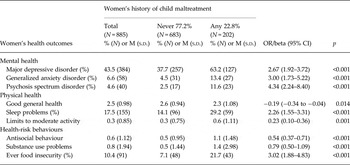
The odds of having mental health problems, physical health problems, or of engaging in health-risk behaviours were two to four times greater for women with a history of childhood maltreatment compared to women without a history of maltreatment (Table 1). Furthermore, for outcomes that were measured continuously, effect size (Cohen's d) differences between women who did and did not have a history of maltreatment were small to moderate in size [general health: d = −0.28 [95% confidence interval (CI) −0.43 to −0.12]; functional limitations: d = 0.33, (95% CI 0.17–0.48); substance use problems: d = 0.47 (95% CI 0.31–0.63); antisocial behaviour: d = 0.55, (95% CI 0.39–0.71)].
Association between women's history of child maltreatment and health outcomes in adulthood

N, number; M, mean; s.d., standard deviation; OR, odds ratio; CI, confidence interval.
Notes: All analyses controlled for women's socioeconomic status.
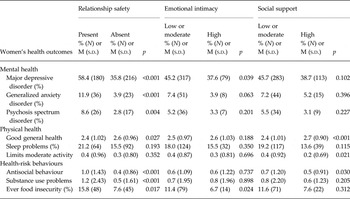
As shown in Table 2, of the three component protective factor, romantic relationship safety was the most consistent correlate of good mental health and physical health as well as low levels of health-risk behaviours. Having higher v. lower levels of emotional intimacy with a partner was associated with lower rates of depression and food insecurity. Having high v. lower levels of social support was associated with better overall health, fewer functional limitations, and fewer antisocial behaviours.
Associations between safe and nurturing relationships with health outcomes in adulthood

N, number; M, mean; s.d., standard deviation.
Notes: All analyses controlled for women's socioeconomic status.
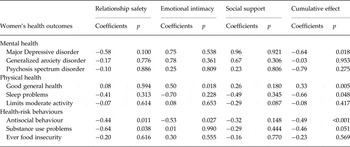
The cumulative protective factors measure comprising safe and nurturing relationships moderated the effect of a history of childhood maltreatment on women's health and health-risk behaviours (Table 3). Having safe and nurturing relationships in adulthood was associated with reductions in rates of depressive episodes among women who reported a history of child maltreatment and with better overall health, lower rates of sleep problems and decreases in antisocial behaviour. There is no specific component of the cumulative protective factor that consistently drove the moderator effect (Table 3).
Moderating effect of safe and nurturing relationships on the association between women's history of child maltreatment and health outcomes in adulthood

Notes: All analyses controlled for women's socioeconomic status.
Coefficients are shown as those of interactive term between protective measure and adult health outcome.
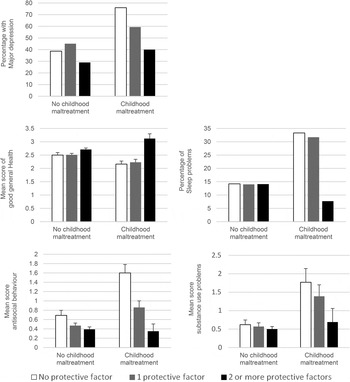
Furthermore, the cumulative measure was marginally associated with reductions in substance use problems among women who experienced child maltreatment. As illustrated in Fig. 1, an accumulation of safe, supportive, nurturing factors was associated with reductions in women's mental and physical health problems as well as their health behaviours if they had a history of childhood maltreatment. In contrast, among women who lacked a childhood history of maltreatment, rates of poor mental health, physical health, and health behaviours were low and not associated with cumulative protective factors.
Buffering effect of the cumulative protective measure of safe, supportive, and nurturing relationships for women with a history of maltreatment on later health outcomes.

Discussion
Women who had a childhood history of maltreatment were at elevated risk for poor mental, physical, and behavioural health problems in adulthood compared with women who did not have a childhood history of maltreatment. However, women who were characterized by safe, supportive, and nurturing relationships were buffered from the adverse effects of a childhood history of abuse with respect to depression, general health, sleep problems, and antisocial behaviour. Similar patterns of results were observed for substance use, but only at trend levels of significance. In contrast, women who did not experience childhood abuse had relatively low rates of mental, physical, and behavioural health problems and these did not vary as a function of the quality of their interpersonal relationships.
Women's interpersonal relationships were truly protective – in the sense that they mostly mattered for women who had histories of abuse – rather than generally promotive of positive health outcomes. This finding is consistent with research in the social support literature which distinguishes stress buffering from main effects of socially supportive relationships (Cohen & Wills, Reference Cohen and Wills1985). This literature suggests that stress buffering is most likely to be observed when individuals appraise their circumstances as stressful, but also perceive that someone is on hand to provide needed instrumental or emotional support. As described above, there is ample evidence to suggest that women with childhood histories of maltreatment experience more stressful life events in adulthood than women without such histories. Under these circumstances, the presence of a warm and trusted partner as well as the perception that friends or family can provide instrumental or emotional support may alter women's appraisals of their circumstances (e.g., what initially appeared stressful may not, once it has been discussed with a partner, friend, or family member) or may offer solutions that relieve the stress, both of which could contribute to better mental, physical, or behavioural health (Cohen & Wills, Reference Cohen and Wills1985). In contrast, a measure that captures whether (and to what extent) women feel socially isolated v. socially integrated within a network may be associated with positive health outcomes regardless of a woman's history of maltreatment (Cohen & Wills, Reference Cohen and Wills1985).
Although we derived a cumulative protective factors measure, some of the buffering effects we observed appeared to be driven by specific factors. For example, romantic relationship safety alone appeared to improve substance use outcomes for women with childhood histories of maltreatment. In contrast, high levels of emotional intimacy were related to reports of better (v. poorer) general health for women with childhood histories of maltreatment. Interestingly, although the cumulative effect of romantic relationship safety, social support, and emotional intimacy buffered women from the adverse effects of childhood maltreatment on risk for depression, none of the individual factors were statistically significant predictors.
Safe, supportive, and nurturing relationships did not buffer women with histories of abuse from less common mental and physical health problems, such as psychosis spectrum symptoms, or functional impairments in physical health. Given the relatively low base rates of these problems, it is possible that our analyses were under-powered to detect buffering effects. Additionally, it is possible that these problems are sufficiently severe that they require more than what violence-free, supportive, and emotionally-intimate relationships can offer. A third possibility is that the protective factors (most of which were assessed only at T1) were more strongly predictive of outcomes measured around the same time (like antisocial behaviour) than later outcomes. However, this possibility is unlikely given that many of the significant buffering effects we detected were for other outcomes that were measured at T3 or T4 (e.g., depression, general health, and sleep problems). Finally, although a history of abuse and neglect was also associated with food insecurity, it is likely that money, rather than safe, supportive, and nurturing relationships, buffers women from experiencing that outcome.
Limitations
The current study contributes to a small literature that shows that socially supportive relationships can mitigate the adverse effects of a history of maltreatment on adult health. Nevertheless, the study was characterized by various limitations. First, mothers reported retrospectively on their own history of maltreatment. Individuals who provide retrospective reports have a tendency, on the one hand, to forget past events and, on the other hand, to recall past events in ways that are congruent with their current mood or that make sense of their current circumstances (Widom & Shepard, Reference Widom and Shepard1996; Reuben et al. Reference Reuben, Moffitt, Caspi, Belsky, Harrington, Schroeder, Hogan, Ramrakha, Poulton and Danese2016). However, retrospective reports as measured by the CTQ correspond highly with reports of an individual's abuse history based on other sources (Bernstein et al. Reference Bernstein, Ahluvalia, Pogge and Handelsman1997).
Second, cumulative measures are criticized for making arbitrary designations of risk (or protection). This was true of the measure of emotional intimacy and the social support measure, both of which were dichotomized at the top tertile, consistent with other reports from this sample (Jaffee et al. Reference Jaffee, Caspi, Moffitt, Polo-Tomas and Taylor2007, Reference Jaffee, Bowes, Ouellet-Morin, Fisher, Moffitt, Merrick and Arseneault2013). Research on protective effects is also criticized for equating the absence of risk with the presence of protection, as might have been the case with the measure of romantic relationship safety. Nevertheless, cumulative risk or protection measures are parsimonious and consistent with many theoretical models, such as bioecological or allostatic load models (Brody et al. Reference Brody, Yu, Chen, Kogan, Evans, Beach, Windle, Simons, Gerrard, Gibbons and Philibert2013; Evans et al. Reference Evans, Li and Whipple2013).
Third, although we measured a range of mental health problems, some that are moderately to strongly associated with a history of maltreatment were not measured (e.g., post-traumatic stress disorder and borderline personality disorder). It is unknown whether socially supportive relationships buffer women with histories of abuse and neglect from these disorders.
Fourth, we excluded women who did not have a romantic partner from the analysis. We were concerned that assigning ‘0’ scores to women who did not have a partner and to women whose relationships were low in quality would introduce an unacceptable level of heterogeneity. As a consequence, our comparison of women with higher v. lower levels of support is clearer, but our results do not extend beyond women who are in romantic relationships.
In our previous work, we showed that safe, supportive, and nurturing relationships differentiated mothers who broke the cycle of abuse and neglect in their own families from those who did not (Jaffee et al. Reference Jaffee, Bowes, Ouellet-Morin, Fisher, Moffitt, Merrick and Arseneault2013). One interpretation of these findings is that children are at low risk of being maltreated by biological or step-fathers if those men are nurturing and non-abusive in their intimate relationships with the children's mothers. The current findings suggest a second possibility: that experiencing safe, supportive, and nurturing relationships makes mothers themselves less likely to perpetrate abuse and neglect by improving their mental and behavioural health. Although both of these interpretations assume that effects of safe, supportive, and nurturing relationships are causal, experimental or quasi-experimental designs are needed to ascertain whether this is true. Data were not available in E-Risk to test whether there were systematic differences earlier in life between women who had socially supportive relationships v. women whose relationships were less supportive. Consistent with the possibility that selection effects do not entirely explain the effect of social support on women's mental health however, another study that used propensity score weighting methods to adjust for pre-existing differences between youth with higher v. lower levels of social support showed that youth who received more social support had fewer depressive symptoms (Dingfelder et al. Reference Dingfelder, Jaffee and Mandell2010).
Conclusions
Women who have histories of abuse or neglect are at elevated risk for mental and physical health problems. The growing interest in measuring social determinants of health at the point of primary care (Alley et al. Reference Alley, Asomugha, Conway and Sanghavi2016) may mean that adult women will start to be screened systematically for childhood maltreatment and adult domestic violence. The identification of women who are at the greatest risk of poor health and the use of information about their social and socioeconomic circumstances to effectively target services and clinical care could be a positive development. As noted in a recent editorial however, responsible screening for social determinants of health means that practices must have the infrastructure and knowledge to link patients to services and must train physicians to be comfortable and sensitive when asking questions about family violence, housing, or food insecurity (Garg et al. Reference Garg, Boynton-Jarrett and Dworkin2016). Many practices lack the resources to devote to this effort. Nevertheless, there are models of successful screening and integrated service delivery in paediatric primary care with, for example, the Safe Environments for Every Kid programme (SEEK; Dubowitz et al. Reference Dubowitz, Feigelman, Lane and Kim2009). For women who are already experiencing mental and physical health problems, standard pharmacological treatments for problems such as depression or poor sleep could be extended to include couples therapy to improve communication and warmth with a partner.
Finally, we note the potential importance of treating women's mental health problems in order to prevent the intergenerational transmission of abuse and neglect, as only a minority of women who need them get mental health services once they are in the child welfare system (Staudt & Cherry, Reference Staudt and Cherry2009). The Nurse Family Partnership (NFP), which is a preventative intervention targeted at low-income, single mothers, has been shown to be successful at preventing child maltreatment (Miller, Reference Miller2015); this may be because of the programme's focus on building supportive relationships with friends and families. The programme does not directly target mothers’ mental health, however, and has not been shown to consistently reduce mothers’ symptoms of depression (Miller, Reference Miller2015). Greater efforts to link mothers who need mental health services to such services could boost the efficacy of programmes such as NFP. Expanding the targets of preventative interventions like NFP to include women with childhood histories of abuse and neglect might also be a cost-effective way of reducing the intergenerational transmission of maltreatment.
Acknowledgements
The E-Risk Study is funded by the Medical Research Council (UKMRC G9806489 and G1002190). Additional support was provided by the National Institute of Child Health and Human Development (grant HD077482), the Centers for Disease Control and Prevention, and by the Jacobs Foundation. Ryu Takizawa is a Newton International Fellow Alumnus funded by the Royal Society, the British Academy and through a Grant-in-Aid for Scientific Research (B) (JSPS KAKENHI Grant Number JP16H05653) from the Japanese Society for the Promotion of Science (JSPS). Louise Arseneault is the Mental Health Leadership Fellow for the UK Economic and Social Research Council (ESRC). The findings and conclusions in this paper are those of the authors and do not necessarily represent the official position of the Centers for Disease Control and Prevention or the other funding organizations. We are grateful to the study mothers and fathers, the twins, and the twins’ teachers for their participation. Our thanks to Terrie E. Moffitt and Avshalom Caspi the founders of the E-Risk Study, to Michael Rutter and Robert Plomin, to Thomas Achenbach for kind permission to adapt the Child Behavior Checklist, CACI, Inc., and to members of the E-Risk team for their dedication, hard work, and insights. The funders had no role in the study design, data collection, data analysis, decision to publish, or preparation of the manuscript.
Author Contributions
SRJ, RT, and LA are responsible for the study concept and design, interpretation of data, drafting, and revising the manuscript for important intellectual content. RT and LA had full access to all the data in the study, takes responsibility for the integrity of the data and the accuracy of the data analysis.
Declaration of Interest
None.