The week of the 2013 Boston Marathon brought a series of unique traumatic events to the greater Boston area. On Monday, April 15, 2 bombs were detonated near the finish line of the Marathon, killing 3 and physically injuring several hundred additional people. For the following several days, graphic images of the bombing and investigations flooded local and national media, while little was known about the perpetrators. On Thursday, April 18, investigative authorities released images of 2 suspects, and over the subsequent 24 hours, several Boston-area municipalities were affected by the associated manhunt and shelter-in-place order. Additionally, there were related acts of violence in the surrounding community, including the murder of a public safety officer, a carjacking with an aborted kidnapping attempt, and shootouts with a SWAT (special weapons and tactics) team presence in residential neighborhoods.
Little research exists on the immediate impact of community-wide traumatic events like this on patients seen by acute psychiatric services within the affected communities.Reference Beinecke, Raymond and Cisse1 Prior to this study, an extensive literature search revealed few studies looking at actual patient presentations to psychiatric emergency services (PES) before and after the Boston Marathon bombings or any other terror event in the United States. Instead, existing literature focuses on insurance billing records,Reference Dimaggio, Galea and Richardson2, Reference Schlenger, Caddell and Ebert3 organizational structure,Reference Oser, Shah and Gitlin4 and the impact on providers.Reference Wilson5 One past study focusing on 4 mass casualty events with high media exposure and their impact on PES revealed that disaster week census did not differ significantly from predisaster weeks, including treatment-seeking for anxiety-related issuesReference Claassen, Kashner and Xuan6; however, a limitation of this study was that the study period lasted only 1 week after a terrorist event. Additional and updated research on the impact of such events on patient encounters in PES with increased time frames of study is needed to provide valuable information on the demands that terrorist events may place on psychiatric acute services in the future.
This study adds to the growing body of literature on the impact of terrorist events on health care services by examining the impact of this event as seen in the Cambridge Hospital Psychiatric Emergency Services (CHPES) in Cambridge, MA, in the 2 months following the bombings. CHPES is located less than 3 miles from the bombing and less than 4 miles from the site of suspects’ shootout with police and final capture of the surviving suspect. It is also located within blocks of other deeply affected community sites, including 1 suspect’s home, which was also the site of intensive law enforcement intervention during the manhunt, and former schools. As a result of its geographic location proximate to multiple traumatic events associated with the bombing and its focus on community-based care, the CHPES was uniquely poised to care for individuals both directly affected by the bombing and associated community trauma in the weeks following these events.
METHODS
The Cambridge Health Alliance electronic medical record (EMR) was used to identify all patient encounters in the CHPES in the 8-week period following the Boston Marathon bombing (April 15, 2013, to June 10, 2013). The study period of 8 weeks was chosen as prior studies have indicated that presentation of acute traumatization after a mass casualty event typically presents in the weeks to months following the event,Reference Schuster, Stein and Jaycox7-Reference Whalley and Brewin8 with the Diagnostic and Statistical Manual of Mental Disorders, Fifth Edition (DSM-V) defining acute stress disorder as stress-related symptoms occurring from 3 days through 1 month after the event, and posttraumatic stress disorder (PTSD) as stress-related symptoms occurring from 1 month after the event onward.9 Whereas a similar study looked at a time frame of only 1 week,Reference Claassen, Kashner and Xuan6 this study focused on a longer time frame to capture acute reactions falling into both the acute stress disorder and PTSD time frames.
All encounters were screened to assess whether they met inclusion criteria consisting of an age ≥ 18 years old and existence of a full PES evaluation in the EMR. Encounters by children, prisoners, and women known to be pregnant were excluded from the study as vulnerable subjects. Triage-only encounters, visits in which the standard evaluation template was not followed, and visits erroneously repeated in the database were also all excluded. In total, 483 encounters were initially identified for the study population, and 440 met inclusion criteria.
Encounters meeting inclusion criteria were reviewed and coded for gender, age, prior diagnoses, current psychiatric symptoms, prior trauma history, and mention of the marathon bombing or subsequent manhunt. Race and ethnicity were not universally documented in records and therefore were not captured in the data retrieval. Identification of prior diagnoses was based on patients’ self-reports of past diagnoses or from patients’ collateral contacts, as well as any diagnoses already listed within patients’ EMRs. If multiple diagnoses or conflicting diagnoses were present, all previously identified diagnoses were included, because definitive clarification of the most accurate diagnosis was not possible based on review of the encounter note alone. Presenting psychiatric symptoms were coded based on patients’ subjective symptom reports, as well as clinicians’ documented observations of the patient on mental status exam and assessment. An inclusive symptom-based, rather than diagnosis-based, approach to identification of presenting problems was used to accommodate heterogeneity in adherence to strict use of International Classification of Diseases, Tenth Revision (ICD-10) codes among providers of different backgrounds and credentials (eg, registered nurses, psychologists, and physicians). History of trauma was assessed based on a patient self-report of past trauma history and/or prior diagnosis of PTSD.
All post-bombing encounters were also reviewed to see whether the bombing or manhunt was explicitly mentioned by the patient or a collateral contact during the encounter. For this subset of encounters, records were also reviewed in detail to assess whether the patient reported new symptoms of PTSD or acute stress disorder in response to the bombing or associated traumatic events, such as the manhunt or lockdown.
The characteristics of all encounters seen during the study period were compared with those seen in the 8-week period preceding the bombing. The demographics, presenting problems, historical diagnoses, and trauma histories of the pre- and post-bombing populations were then compared using a phi correlation coefficient.Reference Derrick, Dobson-Mckittrick and Toher10 Similar statistical comparisons were also conducted between each presenting problem, historical diagnosis, history of trauma and current substance abuse, and with the binary variable on whether the individual mentioned the bombing event. All statistical analyses were produced through Stata 14 (StataCorp, College Station, TX).
The study was approved by the Cambridge Health Alliance International Review Board (IRB). A waiver of the requirement for informed consent was granted by the IRB.
RESULTS
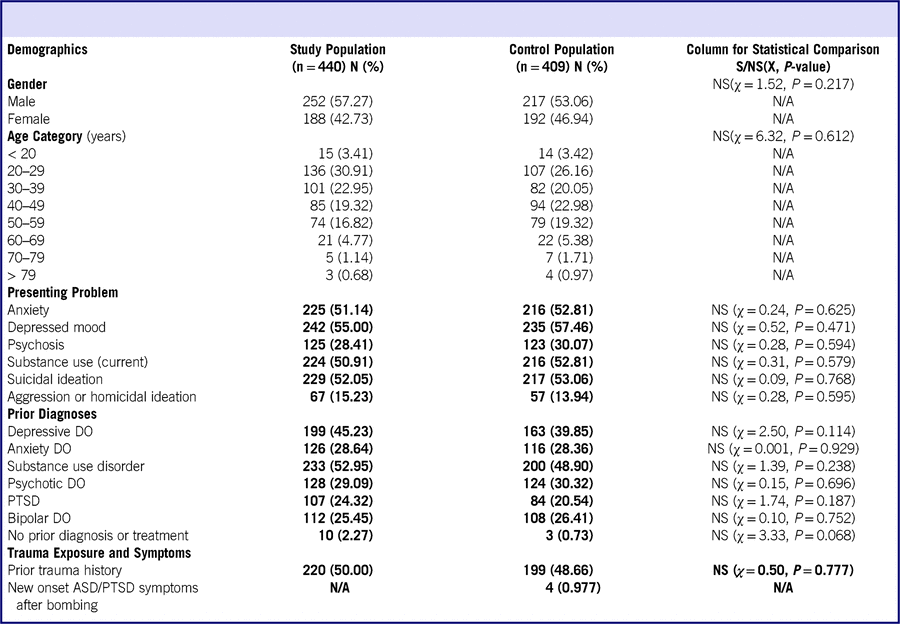
Table 1 shows that 440 encounters were identified that met the inclusion criteria in the 8 weeks following the bombing and manhunt, compared with 409 encounters in the 8 weeks preceding the bombing, a non-significant increase in eligible cases presenting to the PES in the 8 weeks after the bombing, compared with the 8 weeks prior (Appendix 1). Differences in the ages of patients seen and the gender composition of the overall patient population were not significant. Although there was an 8 percent increase in the number of encounters before and after the bombing and manhunt, the nature of the specific differences discussed later between the groups of patients who generated these results does not suggest that this overall difference was primarily a response to the bombing. Rather, it suggests the overall difference likely to be due to other factors.
(PES Paper) Differences Between Encounters in 8 Weeks Preceding and Following Bombing
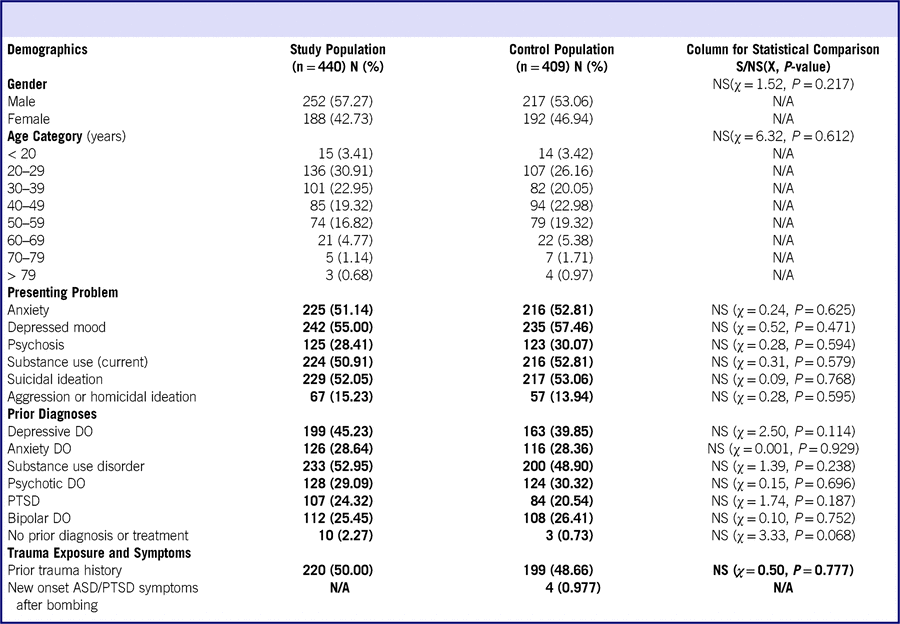
The prior diagnoses, presenting problems, and presence or absence of a prior trauma history were also compared between the study and control populations. The most commonly seen presenting problems in both periods were depressed mood, anxiety, substance use, and suicidal ideation. Psychotic symptoms and aggression or homicidal ideation were also common, though less so than the previously named problems. Other symptoms (eg, cognitive impairment) were also seen sporadically in both populations, but were not included in detailed analysis because their overall incidence was very low.
The most common past diagnoses for patients seen after the bombing were depressive disorders and substance use disorders. Histories of psychotic disorders, PTSD, bipolar disorder, and anxiety disorders were also common, and approximately half of all study patients had a prior history of trauma. Very few (2.3%) had no prior psychiatric diagnoses or treatment history. Differences in prior diagnoses between the 2 populations were not statistically significant. Presence of a prior trauma history was also similar between the 2 populations.
Of all of the visits in the 8 weeks following the bombing, only 4 encounters described new symptoms of PTSD or acute stress disorder specifically related to being in close proximity to either the bombing or manhunt (eg, witnessing the bombing, or having to take cover secondary to the manhunt). These 4 encounters represented 3 patients, as 1 patient visited 2 times in the study period for complaints of PTSD symptoms. The majority of patients seen who reported PTSD symptoms referenced trauma occurring prior to the bombings as the initial inciting event leading to their PTSD diagnosis.
A total of 36 visits (8.2%) in which the bombing or manhunt was directly mentioned were identified, and 2 of these visits were repeat patients, that is, patients whose symptoms resulted in > 1 visit over the study period. Of all 36 visits, only 2 patients had no prior psychiatric history. Similar to the general study population, the most common prior psychiatric diagnoses were substance use disorder (n = 17 visits; 47.2%) and depressive disorder (n = 13; 36.1%). The most common psychiatric problems at the time of evaluation for this subset population were anxiety (n = 19), depressive symptoms (n = 17), and substance use (n = 14). In 15 of the 36 visits, patients had either a prior diagnosis of PTSD (n = 11) or a trauma history occurring in the absence of a formal PTSD diagnosis (n = 4). The rate of prior PTSD in patients who did mention the bombing was no higher than the rate in the overall PES population before or after the bombing.
DISCUSSION
This comparison of the patient encounters seen in the 2-month periods before and after the Boston Marathon bombings showed little difference between the 2 encounter groups, with no statistically significant difference in demographics, presenting problems, past diagnoses, and presence of a prior trauma history. These findings and the relatively small number of individuals reporting new PTSD symptoms stemming from the bombing suggest that, following a community-wide traumatic event, acute services may see a spectrum of diagnoses and presenting problems that resembles a usual baseline patient population, rather than seeing a dramatic increase in cases of new PTSD or acute stress disorder.
The findings of this study are in line with the few past similar studies revealing little need for bolstered emergency room mental health providers in the immediate aftermath of a terrorist event.Reference Claassen, Kashner and Xuan6 Emergency services should not expect to see fewer visits from the population they are accustomed to serving; that is, services need to be ready to meet the needs of their usual patient population after a terrorist event and should not assume that visits from a certain population (eg, those with mood disorders) will decrease while trauma-related visits increase dramatically. The results of this study add to the existing literature by providing updated statistics that support prior studies from mass casualty events over a decade prior and suggest that these prior findings remain consistent when the study period is lengthened to a 2-month time period. The results are consistent in showing little increase in acute mental health psychiatric presentations to emergency rooms in the time following a terrorist event and may continue to guide hospital staffing on how to allocate services to those with both physical and mental health needs following a terror event.
There are likely several explanations for the relatively minimal number of cases of new PTSD or acute stress disorder seen in this setting. First, the timeline of this study included only encounters seen in the 2 months following the bombing; it is possible that a more extended study window would reveal a greater number of patients presenting to acute services with PTSD caused by the bombing, for example, at the time of media reminders of the event or event anniversaries. Second, the psychological burden of exposure to these events in the local population may in fact be higher, yet the overall acuity of such symptoms may be low enough that people with symptoms are more likely to interface with the mental health care system via lower acuity settings, such as primary care offices or outpatient mental health services. The avoidance symptoms that tend to be present in both acute stress disorder and PTSD, as well as potential fear of a new terrorist attack, could explain the lack of visits to a PES. Also, individuals may have presented to other medical centers in the Boston metropolitan area and therefore, never interacted with the CHPES. Last, the overall incidence of acute stress disorder and PTSD in the general population is actually quite low, thus accounting for few presentations to the PES.
This study has a number of limitations. It is not a randomized controlled trial, nor would a randomized controlled trial be possible. As a retrospective and descriptive study, the data analyzed likely had greater variability than a prospective study with a strictly defined assessment protocol. An additional limitation to this study is its small sample size relative to the total number of potentially affected individuals in the greater Boston area.
In addition, patient evaluations were performed by a variety of different CHPES clinicians who were not trained to follow a specific study protocol, and it is possible that individual evaluators may therefore report symptoms differently. In this context, chart notes were variable in the amount of detail included. The impact of this variability was likely mitigated by the fact that the same pool of clinicians was providing assessments to patients seen both before and after the bombing.
Further, in a naturalistic, emergency room setting in which greater focus may be placed on risk assessment and disposition decisions rather than on comprehensive assessment of all possible diagnoses, individual providers can vary in level of adherence to comprehensive ICD-10 coding of diagnoses. In this study, presenting problems were therefore identified via a symptom report or observation by the provider rather than encounter diagnoses alone, to ensure that primary sources of distress for the patient were not overlooked, as could occur with coding based on ICD-10 diagnosis alone. This could lead to over-inclusion of presenting problems, though it is expected that over-inclusion would be universal across diagnoses rather than selectively increasing the report of only certain types of diagnoses or presenting problem.
CONCLUSION
In sum, this naturalistic study suggests that while community PES play a critical role in aiding those with mental health crises, they may not be the primary site where new cases of PTSD or acute stress disorder are likely to be seen in the immediate aftermath of a terrorist attack. Future directions to advance understanding in this area include replication of the study in other PES and in outpatient environments, focused study of the presentations of children and adolescents under similar circumstances, and repetition of the study over a longer time period or at discrete times near anniversaries or reminders of the bombings. Additionally, a more detailed examination of the 36 subjects for whom the bombing or manhunt was explicitly mentioned in their PES evaluations would be beneficial to better understand vulnerabilities that may predispose a person to requiring acute services following an event of this nature, and to assess the nature of the complaints of this patient subset relative to the broader population seen over this time period.
Conflict of Interest Statement
The authors have no conflicts of interest to declare.
Funding
This research did not receive any specific grant from funding agencies in the public, commercial, or not-for-profit sectors.
APPENDIX 1
Did the number of eligible cases increase after the bombing?
Answer: Not significantly
Eligible Cases

Chi squared = Σ [(Fo-Fe)2/Fe ] = 1.14; df = 1; P = ns.