INTRODUCTION
History and other social sciences are poised to play an important helping role to comprehend and shape the future of the world's oceans and to provide understanding of present day effects and conditions. Studies on environmental history and historical ecology of marine ecosystems in a variety of cultural and environmental settings demonstrate the complex interplay between humans, their demography and technology, climate change, coastal productivity, and the biodiversity inherent in local marine ecosystems (Rick & Erlandson, Reference Rick, Erlandson, Rick and Erlandson2008). Data on historical occurrences may provide more information on how communities, populations and species have shifted over long temporal scales (Tingley & Beissinger, Reference Tingley and Beissinger2009) or establish baseline datasets.
Regarding marine mammals the impact of history on current biological knowledge is much greater than we can immediately imagine and questions commonly arise such as which species occurred in the past, where and how abundant they were. Also, studying the historical influence of fishing and other human activities on natural populations of marine mammals proves to be a useful tool to understand and manage marine ecosystems. These systems are very complex and historical insight adds time dimension and interaction between humans and sea (Holm, Reference Holm2003).
Until very recently little effort has been invested on documenting the occurrence and distribution of cetaceans frequenting or occasionally occurring along the Portuguese mainland shores. An exception is the resident population of bottlenose dolphins (Tursiops truncatus) in the Sado Estuary (e.g. dos Santos, Reference dos Santos1998). Most accounts of cetaceans for the late 20th Century have been given by anecdotes and a couple of non-systematic studies (e.g. Sequeira, Reference Sequeira1988; Wise et al., Reference Wise, Ferreira, Silva, Sequeira and Silva2005). Nevertheless, there are indications that toninhas were observed and captured in large numbers at mainland Portugal since several centuries ago and mainly during the late 19th and 20th Centuries. Several Portuguese authors refer to toninhas as common dolphins (Delphinus delphis), for almost all the Portuguese coast (e.g. Nascimento, Reference Nascimento1945; Gama, Reference Gama1957) but this word may also refer to harbour porpoises (Phocoena phocoena) (e.g. Reiner, Reference Reiner1981).
Generally, common dolphins are considered the most abundant cetacean off Portugal (e.g. Teixeira & Duguy, Reference Teixeira and Duguy1981; Sequeira, Reference Sequeira1988). Surveys between 1997 and 1999 also presented small cetaceans distribution (Wise et al., Reference Wise, Ferreira, Silva, Sequeira and Silva2005, Reference Wise, Silva, Ferreira, Silva and Sequeira2007) and data from 20th century stranding records (Sequeira et al., Reference Sequeira, Inácio, Silva and Reiner1996, Reference Sequeira, Inácio and Silva1997) indicate the regular presence of common dolphins and harbour porpoises along the Portuguese coast. These references provide a good case-study for the use of available historical information on small cetaceans' occurrence.
Most historical or baseline information regarding cetaceans in Portugal has been obtained from whaling records and fishing statistics. The commercial exploitation of large whales was an important activity off mainland Portugal since the Middle Ages and continued for centuries, even though there were peaks at certain times (Brito, Reference Brito, Brito and Evans2009). These accounts are still under analysis but until now there is no indication of a regular and directed capture of small cetaceans. This paper contributes to the understanding of historical occurrence of small cetaceans through a review of a wide range of data available for mainland Portugal and emphasizes the importance of using historical information by showing number of presences in time and space. Old data from the 13th to 19th Centuries add to other references such as captures and surveys during the 20th Century and recent observations of opportunity. Our contribution towards the compilation of relevant ‘forgotten science’, such as old naturalists observations on the wild, whaling data, grey literature and observations of opportunity, will contribute with new data to the study of cetaceans in a poorly known region.
MATERIALS AND METHODS
Historical research was conducted to obtain old records about the occurrence of cetaceans, and the importance of fishing and whaling activities along Portuguese shores, since the 13th Century. A search on Portuguese documents was conducted at the National Library of Portugal (Lisbon) and other regional libraries and historical archives (Nazaré, Peniche, Sesimbra, Setúbal and Faro). Our investigation included historical sources and old accounts mainly village charters, royal privileges and levying of tithes, between the 12th and 17th Centuries. Scientific articles, newspapers, illustrations, maps, unpublished scientific reports and some other grey literature such as unpublished theses, from the 18th Century onwards were taken into consideration. We did not include recent information already published elsewhere. National statistics books and fishing statistics since the end of the 19th Century were also consulted in the National Institute of Statistics (Lisbon).
There are some difficulties in finding original relevant sources and afterwards to select useful historical information on species occurrence. Frequently, secondary sources are a first step to find the initial publications on coastal or oceanic biological aspects and related historical conservation issues. Here we used the definition of historical occurrence by Tingley & Beissinger (Reference Tingley and Beissinger2009), where observed detection provides evidence of true presence of individuals of a species at a certain location. Although there was available information for other cetaceans, we only used the presence of toninhas due to the existence of several references over a long time frame. Also, the word toninhas can be assigned to a species (common dolphins and/or harbour porpoises) as the word golfinho (dolphin) that appeared a couple of times may refer to any delphinids. These presences were considered as sightings and over time were classified as follows: historical account (any type of event; from the 13th to the 18th Centuries); historical sighting (observation at sea; from the 19th Century to mid-20th Century); historical stranding (described stranding; from the 19th Century to mid-20th Century); captures or by-catches (20th Century); scientific sightings (20th Century).
A search for recent observations of opportunity was also conducted based on information given by nature photographers, SCUBA divers and biologists. We only used positive identifications from photographs and/or 100% secure personal observations together with respective approximate geographical location (all 21st Century). Modern reports of sightings and strandings of small cetaceans were not used and are published elsewhere (e.g. Sequeira et al., Reference Sequeira, Inácio, Silva and Reiner1996; Brito et al., Reference Brito, Vieira, Sá and Carvalho2009).
RESULTS
Historical accounts
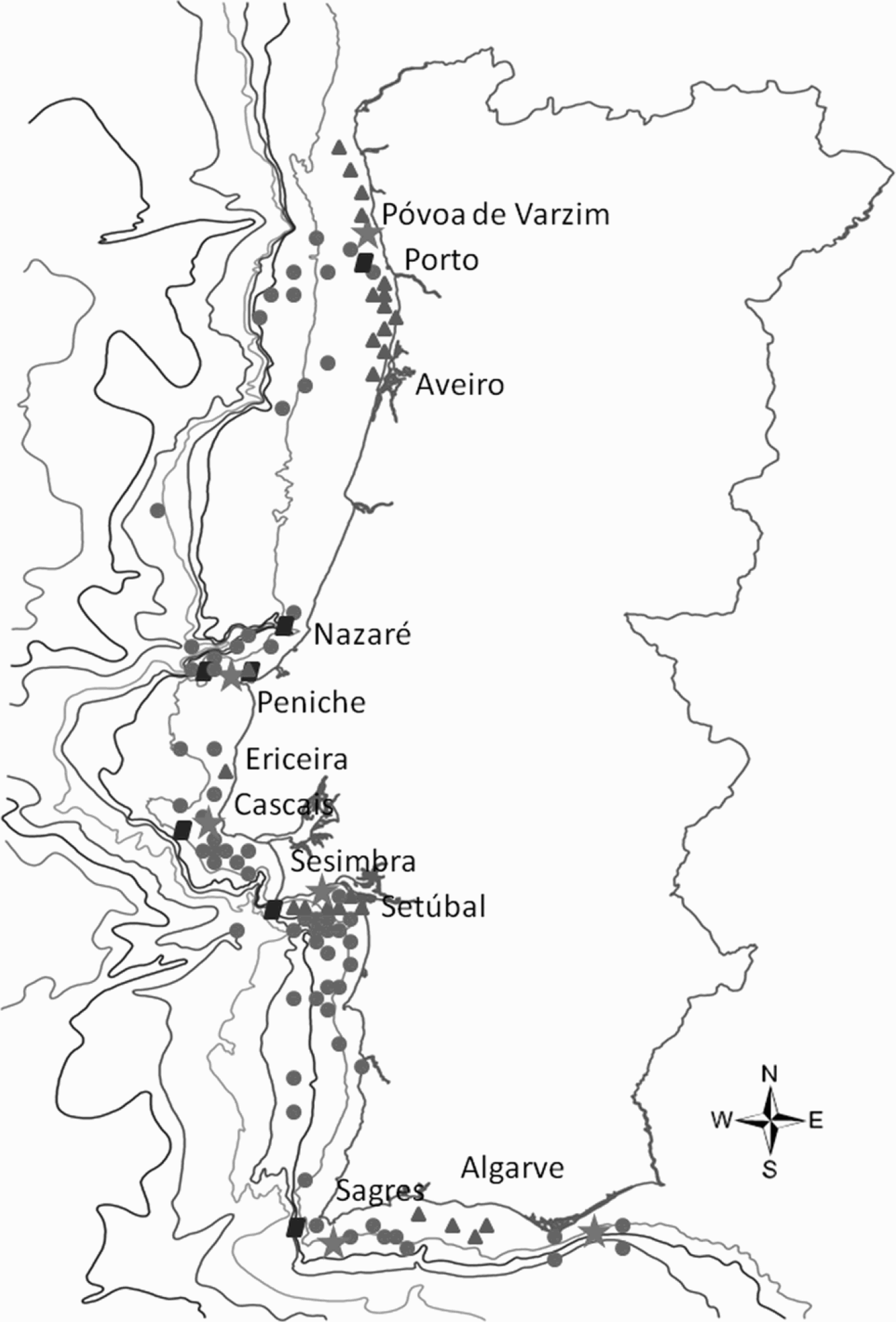
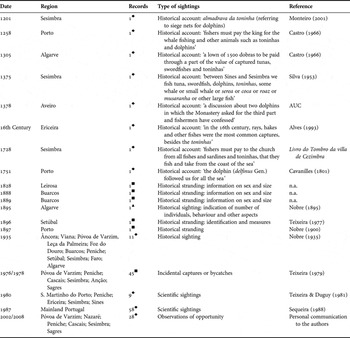
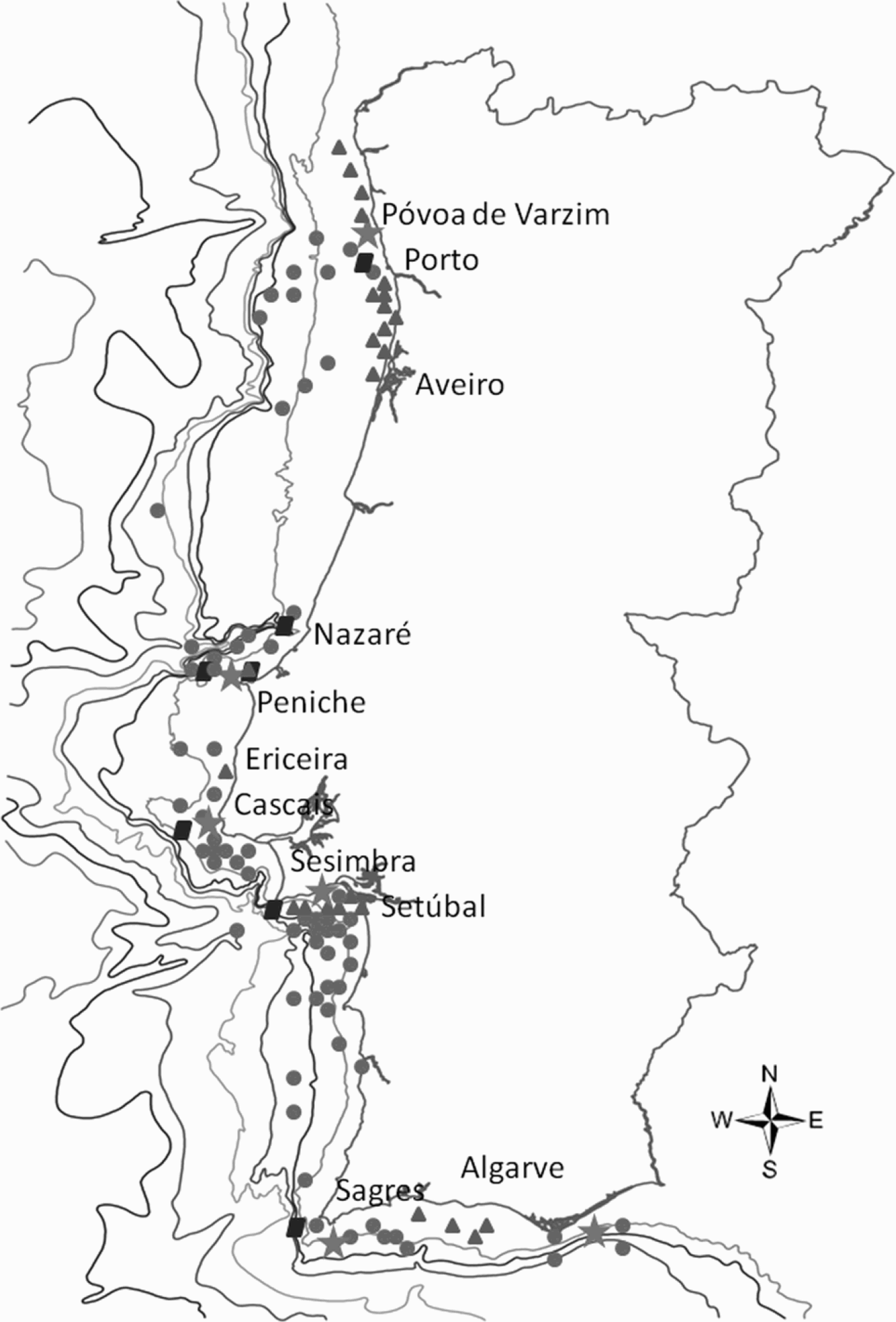
We obtained a total of 165 independent accounts of toninhas common dolphins over time (from the 13th Century to the present) in several locations along the mainland Portuguese coast (Figure 1). It is important to note that each mark indicates one of the 165 records collected and does not indicate the number of individuals. These accounts resulted from a compilation of 8 historical references, 17 historical stranding/sighting records, 45 capture records, 67 scientific sightings and 28 recent observations of opportunity (Table 1).
Map of Portugal mainland showing approximate geographical location of the fishing villages referred to in the present study and of all different types of accounts regarding the occurrence of common dolphins through their approximate geographical postion over bathymetric lines (N = 165):  , historical accounts/sightings/strandings;
 , 20th Century scientific sightings following Teixeira & Duguy (Reference Teixeira and Duguy1981) and Sequeira (Reference Sequeira1988);
 , 20th Century local captures following Teixeira (Reference Teixeira1979);
 , recent observations of opportunity.
Records of the occurrence of toninhas common dolphins over time in Portugal mainland (N = 165), according to historical accounts, historical sightings and strandings, captures, scientific surveys and recent observations of opportunity (♦, indicates number of sightings, but more than one individual may have been observed; ▴ record of the observation of 3 individuals, one adult and 2 calves, indicates a certain degree of detail in early ‘scientific’ observations; ■ number of records is the same as number of individuals).

n.a., not applicable.
Captures over time
Most historical sightings refer to captures, dolphin use and related legislation. In the early 20th Century toninhas were frequently captured off Sesimbra as indicated by the number of individual hand harpoons registered in the national statistics books. Fishing data indicate that, at least, between 1896 and 1906, dolphins might have been captured, but there only are references to 1902, 1904, and 1906 when respectively 39, 41, and 41 harpoons were officially listed. Although data are only available for some years, their absence does not mean there were no harpoons in other years, probably confirming the lack of registered information found on that specific fishery.
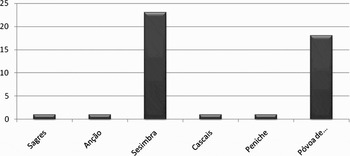
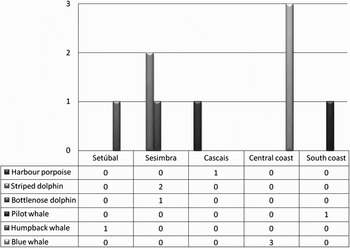
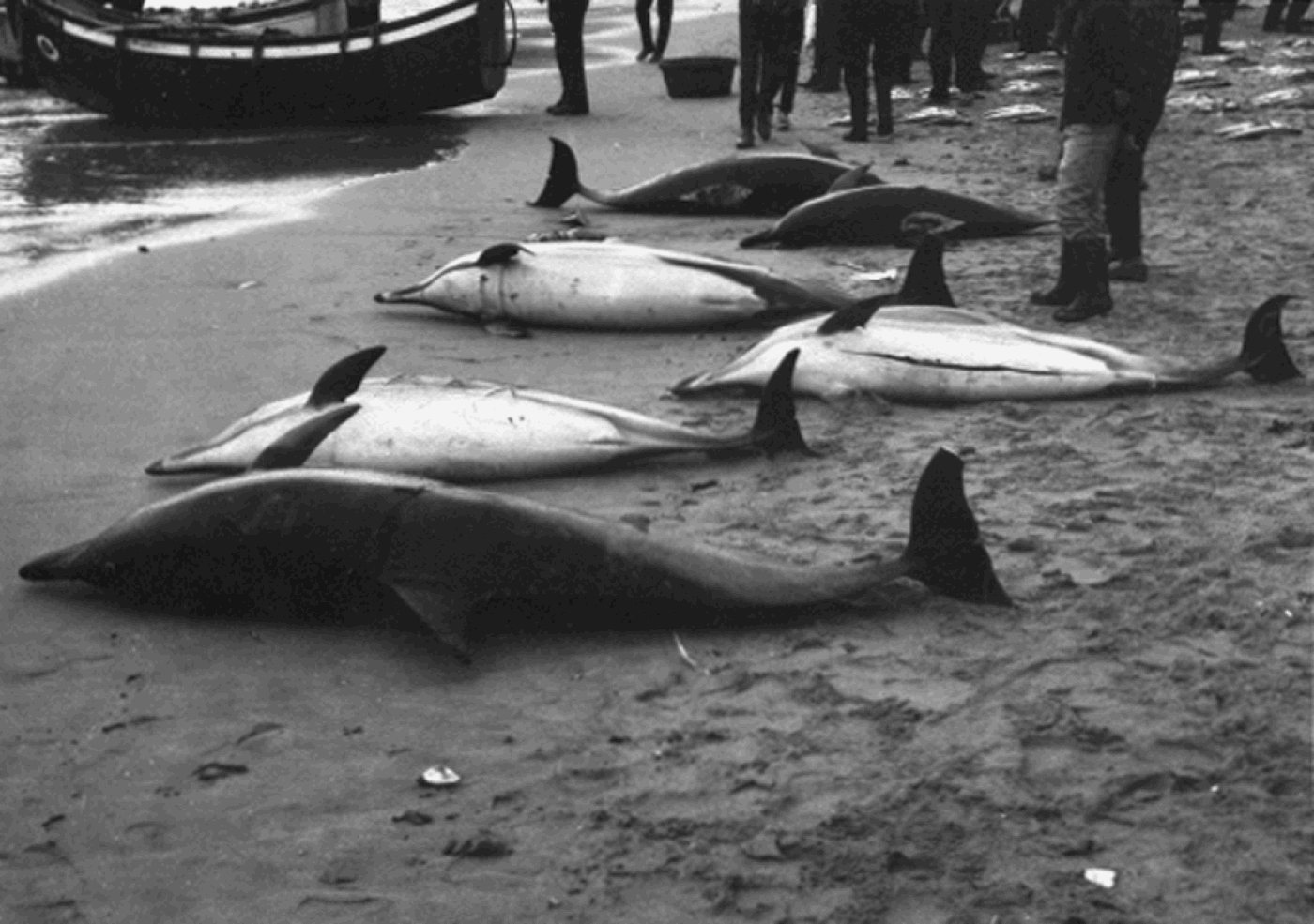
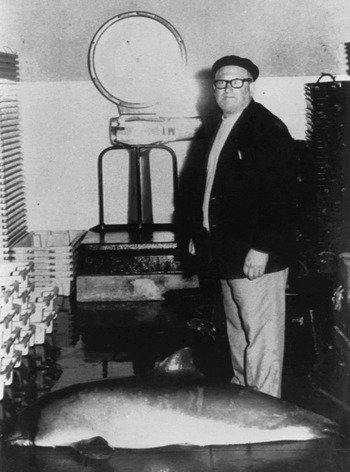
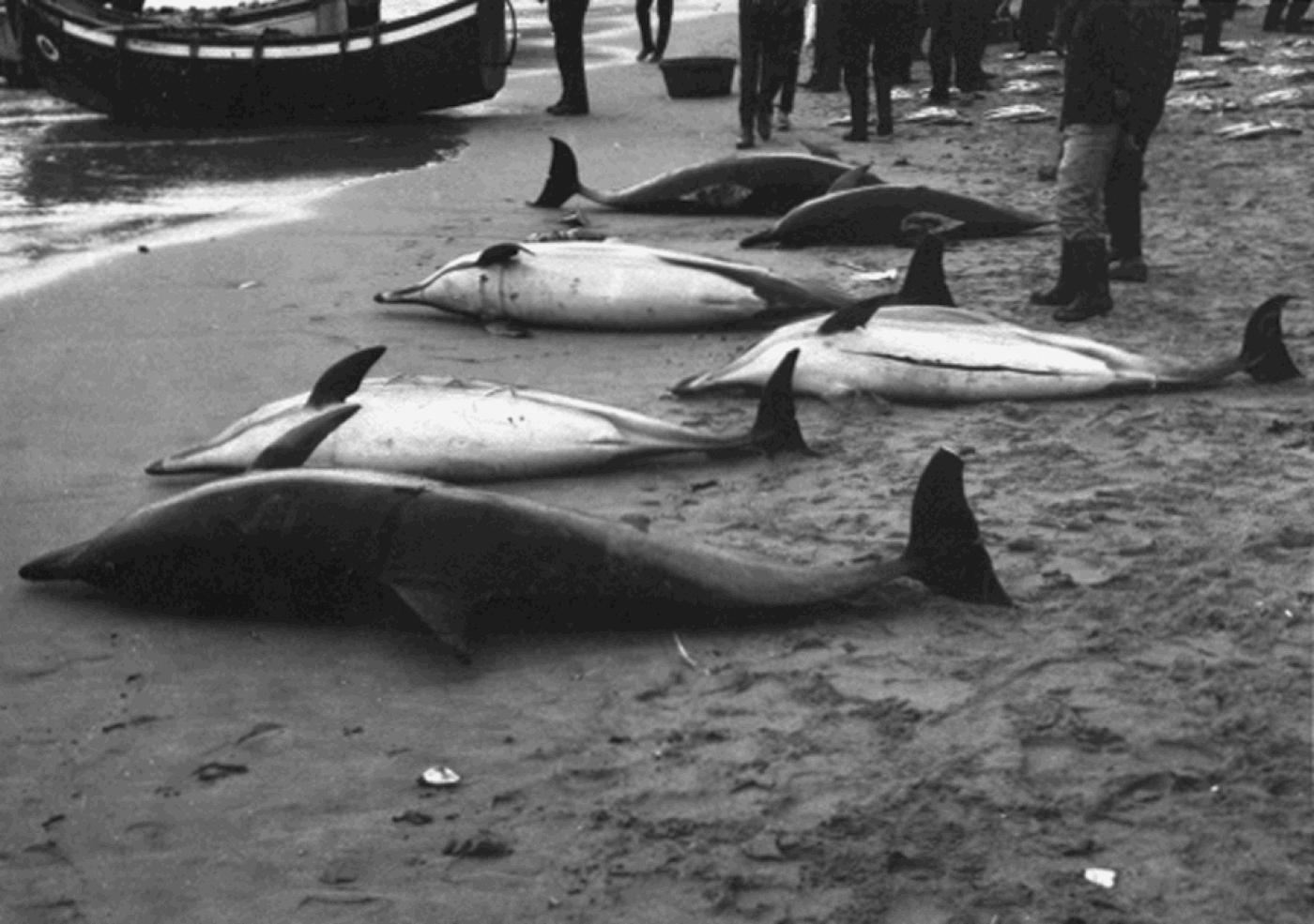
Between 1976 and 1978, a study on captured cetaceans along the Portuguese shore found in fish markets was conducted (Teixeira, Reference Teixeira1979) and resulted in a total count of 45 cetaceans (Figure 2). Most captures were of small cetaceans (87% common dolphins), although other odontocetes and four baleen whales were also registered (Figure 3). These captures occurred all along the coastline using hand harpoons. Captured individuals were sold at the beach fishing markets together with all the captured fish (Figure 4). These captures were part of a local non-industrial fishery and not its main target, but rather opportunistic catches or even by-catches of other fisheries (Figure 5). Delphinids were not protected by any law at that time and were caught with hand harpoons or accidentally drowned in fish nets, and sometimes were sold at major fish markets, for instance Sesimbra, Peniche and Póvoa de Varzim.
Number of captured common dolphins in some fishing villages along the Portuguese coast (N = 45), between 1976 and 1978.

Number of captures of other cetaceans species along fishing villages in Portugal mainland (N = 9), between 1976 and 1978.

Photograph of the fish market in the village of Sesimbra at the beach, in the 1960s, showing six captured common dolphins (image obtained from the Historical Archive of Sesimbra, Portugal).
Photograph of a by-caught harbour porpoise in fishing nets, 1977 in Caminha (photograph made available by António Teixeira).

Science over time
After that period two separate data sets are available (1980 and 1988) regarding recent historical scientific surveys conducted for cetacean detection and study. In both situations, which included dedicated boat-based and opportunistic surveys (Teixeira, Reference Teixeira1979; Sequeira, Reference Sequeira1988) and an aerial survey (Sequeira, Reference Sequeira1988), common dolphins are reported to be the most frequently sighted cetacean off mainland Portugal. More recently a compilation of observations of opportunity was also made (Brito et al., Reference Brito, Vieira, Sá and Carvalho2009) and common dolphins comprise 60% of the total occurrences. Harbour porpoises are also reported but in much smaller number and in very restricted areas.
DISCUSSION
For a long time misunderstanding has existed regarding the vulgar name of common dolphins (Delphinus delphis) and harbour porpoises (Phocena phocoena) in Portugal (Nobre, Reference Nobre1900; Gama, Reference Gama1957). However, generally, the word toninhas is used for common dolphins (Nascimento, Reference Nascimento1945). Although assuming that accounts of toninhas were common dolphins and/or harbour porpoises, we need to keep in mind that other species occurred in the region. Moreover, it is very difficult to establish species identification on medieval and early accounts. Anyhow, our main objective was not to identify a particular species but rather to present a case-study for the use of historical accounts to assess past occurrence and distribution of small cetaceans.
Regular information on past and present numbers of dolphins living in this region is unavailable but our qualitative assessment on existing literature indicates that, most probably, common dolphins have been regular elements of coastal fauna, at least, since the 13th Century. In case of cetaceans' historical occurrence, increase of the number of identified species, as well as number of events and sightings, reflect directly the effort dedicated to those types of events. Over time more people became interested in this subject and different activities developed around whale and dolphin presence in Portuguese coastal waters. During medieval times only small coastal populations of fishermen would be in contact with dolphins, but since the 18th Century, naturalists, zoologists and people with curiosity were also involved in reporting accounts. During the 20th Century whalers, whale watchers, scientists, politicians and lately the public were aware of nature and marine conservation which is clearly reflected by the increasing number of sightings and events.
Early historical sources mostly refer to captures and use of dolphins while the more recent historical data most commonly refer to sightings or strandings. This does not mean that captures of small dolphins stopped in recent times. On the contrary they were continuous and large numbers of animals are referred as having been captured during the 20th Century. Rather it shows an emergence of a natural/scientific perspective since the late 19th Century. Although historical records of common dolphins mainly refer to their presence during captures of other cetaceans or their economic value, they give us an idea of where and when this species occurred in the past. The same applies for recent historical sightings and strandings, which were made by zoologists or other researchers of the time; in those cases dolphins were spotted at sea or beaches and their approximate location was recorded. Legislation protecting cetaceans came into force in 1981, and since then only sporadic reports of captures or by-catches are available.
This paper as with other studies (e.g. Bearzi et al., Reference Bearzi, Holcer and di Sciara2004) stresses the importance of documenting past events and historical trends that usually go unnoticed, owing to factors such as difficult access to relevant literature and scarcity of quantitative reports. In this case-study we try to show that long-term information can be constructed from several types of historical material. Long temporal patterns of occurrence as well as some spatial gradients were determined, which may indicate new and important spots for the future study and assessment of small cetaceans.
ACKNOWLEDGEMENTS
We would like to acknowledge the contribution of Andreia Sousa, Natividade Anastácio (DGPA) and António Teixeira (ICNB), as well as those who sent us their observations of opportunity. We thank Inês Carvalho, Charles Paxton and one anonymous referee for valuable comments and remarks on the paper. We also acknowledge the Portuguese Foundation for Science and Technology for Cristina Brito's doctoral grant (SFRH/BD/21836/2005).