INTRODUCTION
Coastal lagoons are dynamic, rapidly changing ecosystems, characterized by the instability of the abiotic environment (Barnes, Reference Barnes1980; Guelorget & Perthuisot, Reference Guelorget and Perthuisot1992) and the limited biodiversity in terms of species richness, as few organisms, mainly of marine origin, are found (Arias & Drake, Reference Arias and Drake1994; Cognetti & Maltagliatti, Reference Cognetti and Maltagliatti2000). These brackish habitats are valuable due to their high productivity (Barnes, Reference Barnes1980; Guelorget & Perthuisot, 1992; Baizari et al, 2003; Mogias & Kevrekidis, Reference Mogias and Kevrekidis2005). They are also ideal systems for biological and evolutionary studies mostly because of the increased presence of sibling species (Cognetti & Maltagliatti, Reference Cognetti and Maltagliatti2000; Virgilio & Abbiati, Reference Virgilio and Abbiati2004).
Lake Vouliagmeni is the common name of a lagoon located in Attica, Greece, of high biological importance (Chintiroglou et al., Reference Chintiroglou, Valkouma and Culley1996). It is a ‘tectonic laguna’ (Guelorget & Perthuisot, Reference Guelorget and Perthuisot1992), that was formed 2000 years ago (Papapetrou-Zamanis, Reference Papapetrou-Zamanis1969) and has been exploited as a spa area since the end of the 19th Century (Chrystomanos, Reference Chrystomanos1889). The area still attracts large numbers of bathers and has been declared a natural monument by the Greek State (Chintiroglou et al., Reference Chintiroglou, Antoniadou, Damianidis and Diapoulis2004), though the on-going development of tourist facilities have raised serious concerns over the viability of this closed micro-ecosystem (Gontikaki et al., Reference Gontikaki, Antoniadou and Chintiroglou2003).
The biological research of Lake Vouliagmeni started when Doumenc et al. (Reference Doumenc, England and Chintiroglou1987) described Paranemonia vouliagmeniensis, a new species of sea anemone, which is endemic in the lagoon. Afterwards, few works were published about the life cycle and the ecology of P. vouliagmeniensis (Chintiroglou et al., Reference Chintiroglou, Valkouma and Culley1996, Reference Chintiroglou, Antoniadou and Damianidis2000) and the population structure of the two bivalves, Abra segmentum and Cerastoderma edule, of the lagoon (Gontikaki et al., Reference Gontikaki, Antoniadou and Chintiroglou2003). Recent research showed the presence of several genera of taxonomic interest, i.e. Cliona and Manayunkia (Chintiroglou et al., Reference Chintiroglou, Antoniadou, Damianidis and Diapoulis2004). It seems therefore relevant to acquire original datasets, focusing on structural and functional aspects of its biocoenoses.
Taking into account all the above, the present work aims at assessing: (1) the structure of hard and soft substrata benthic biocoenoses, including a trophic group analysis; and (2) the distribution of benthic biodiversity and its comparison with other Mediterranean lagoons.
MATERIALS AND METHODS
Study area and sampling sites
Lake Vouliagmeni, situated 25 km south-east of the centre of Athens, was formed when the roof of an underground cave collapsed and flooded, after an earthquake occurred 2000 years ago (Chintiroglou et al., Reference Chintiroglou, Valkouma and Culley1996). The lagoon covers a surface area of 4000 m2 with a maximum depth of 13 m (Gontikaki et al., Reference Gontikaki, Antoniadou and Chintiroglou2003). The ‘western’ part of the lake is a 30 m high rocky cliff. The lagoon is 260 m long and 145 m wide with an extensive underwater channel network, that reaches depths of 100 m. The surface water temperature varies from 19–21oC. The lagoon has no direct communication with the adjacent sea. It is supplied with warm seawater (28–35oC) via an underground channel, which spreads longer than 3 km through a network of flooded caves. On the eastern side of the lagoon a small supply of freshwater exists making its water brackish, with salinities that vary from 14.5–17 psu. Lake Vouliagmeni is a popular spa, which attracts a large number of swimmers throughout the year, who want to benefit from the hydrogen sulphide containing waters. The source of hydrogen sulphide is believed to be several de-oxidized organic salts (Chrystomanos, Reference Chrystomanos1889), whereas the presence of sulpho-bacteria is still under discussion (Papapetrou-Zamanis, Reference Papapetrou-Zamanis1969).
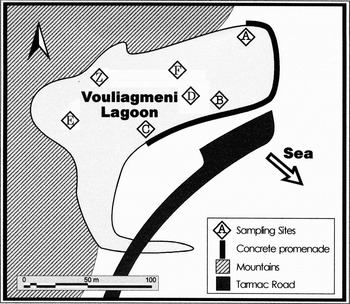
After preliminary sampling, four types of habitats were identified at the lagoon: (1) typical hard substratum of calcareous rocks (0–13 m); (2) soft substratum of mixed calcareous deposits and gravels with sand and silt at the upper sublittoral zone (until 0.5 m); (3) soft substratum of silt and sandy-silt in deeper (>1.5 m); and (4) meadows of the species Ruppia cirrhosa and Scyrpus maritimus (3–6 m). Seven sampling sites were set dispersed at the lagoon (Figure 1) according to the habitat type and the degree of the anthropogenic pressure, which is tenser on the southern coast of the lagoon and is shallow, mainly due to bathers’ activities. Thus, three sites were set at the upper sublittoral zone (A, B and C, ranked as B > A > C in terms of disturbance), one at the lower sublittoral (D), one at meadow (F) and two at the hard substratum (E and Z).
Map of Lake Vouliagmeni indicating sampling sites.

Sampling techniques
Seasonal sampling (July 1997, October 1997, January 1998 and April 1998) was carried out with SCUBA diving at the seven sites. Regarding soft substrata (sites A, B, C and D) three replicates were collected at each site, with the use of an 18 × 25 cm corer sampler (Stirn, Reference Stirn1981; Antoniadou et al., Reference Antoniadou, Krestenitis and Chintiroglou2004; Kourelea et al., Reference Kourelea, Vafidis, Chintiroglou, Trontsios and Chicharo2004). Three replicates were collected from hard substrata (sites E and Z) with the use of a 400 cm2 quadrate sampler, by totally scraping off the substrate to include both sessile and motile species (Antoniadou & Chintiroglou, Reference Antoniadou and Chintiroglou2005). Three replicates (5 l each) were also collected from meadows at site F (Gontikaki et al., Reference Gontikaki, Antoniadou and Chintiroglou2003). Overall, 84 samples were obtained, sieved (mesh opening 0.5 mm) and fixed in 9% formaldehyde. After sorting, all living specimens were identified at species level and counted.
Temperature, salinity, conductivity, dissolved O2 and pH were measured in the water column with a WTW salinity–conductivity O2-meter and Lovibond Checkit (pH meter) micro-electronic equipment. Water clarity was measured with the Secchi disc, while the inclination of the hard substrate was calculated with a clinometer. Sediment analysis (granulometric composition) was carried out and Folk's system of classification was applied (Folk et al., Reference Folk, Andrews and Lewis1970). Two substrate samples were collected with SCUBA diving and use of 1 l corer sampler at each sampling period (Gee & Bauder, Reference Gee, Bauder and Klute1986; Antoniadou et al., Reference Antoniadou, Krestenitis and Chintiroglou2004).
Data analyses
The collected material (flora and fauna) was identified at species level. Zoobenthos was counted and classified in trophic groups, according to the nature and origin of food: (1) herbivores (H), feeding on macroalgae and/or phanerogams; (2) carnivores (C), feeding on various sessile or motile invertebrates; (3) suspension feeders (S), feeding on suspended organic particles in the water column; (4) deposit feeders (D), feeding on deposit particles at the bottom of the lagoon; and (5) micrograzers (M), feeding on living microorganisms and biofilm (Fauchald & Jumars, Reference Fauchald and Jumars1979; Hily & Bouteille, Reference Hily and Bouteille1999; Bazairi et al., Reference Bazairi, Bayed, Glemarec and Hily2003). Then, it was analysed with common biocoenotic methods (Karalis et al., Reference Karalis, Antoniadou and Chintiroglou2003; Antoniadou & Chintiroglou, Reference Antoniadou and Chintiroglou2005), including the estimation of abundance as population density (N/m2) and the calculation of diversity indices (i.e. Margalef's richness, Shannon–Wiener and Pielou's evenness, based on log2).
Analysis of variance (two-way ANOVA) was used to check the null hypothesis of no significant differences in the abundance of the dominant taxa or trophic groups between sites and seasons. Prior to the analyses, the homogeneity of variance was tested by Cohran's test and, when necessary, data were log-transformed (Zar, Reference Zar1984; Clarke & Green, Reference Clarke and Green1988). The Fisher LSD test was used for post hoc comparisons.
Non-metric multidimensional scaling (nMDS) via Bray–Curtis distances on log-transformed numerical abundances data was used to visualize spatial and seasonal changes in the composition of the fauna. Analysis of similarity (ANOSIM) was used to assess the significance of the multivariate results. Similarity of percentages (SIMPER) was used to identify the species which were responsible for any spatial or seasonal pattern found in the composition of the fauna. All multivariate analyses were performed with the PRIMER software package (Clarke & Warwick, Reference Clarke and Warwick1994).
RESULTS
Abiotic factors
The values of the physical and chemical parameters recorded in the water column showed a similar spatial pattern with slight seasonal differences. Temperature ranged from 21–28oC (March and June values, respectively), salinity from 16–18 psu, dissolved oxygen from 6.5–8.5 mg/l and pH varied around 7.2. Water clarity overpassed 7 m in all cases. The inclination of hard substratum was around 60o at both sites (E and Z), while the sediment was silt at site D, and sandy with gravels at sites A, B and C.
Biocoenosis structure
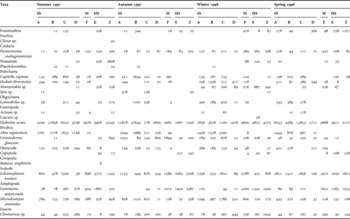
Twelve phytobenthic and 17 zoobenthic species (five higher taxa, namely Foraminifera, Nematoda, Platyhelminthes, Copepoda and Ostracoda were not identified at species level) were identified (Table 1). The highest species richness of the fauna was recorded on hard substratum (21 taxa), followed by soft substratum (18 taxa) and Ruppia cirrhosa meadow (17 taxa). Overall, 61,975 individuals were counted, showing increased abundance at the latter habitat. Generally the same species were recorded at the different habitats studied, but with large fluctuations in terms of abundance.
Population density of the zoobenthic species recorded at Lake Vouliagmeni (SS, soft substratum, sites A, B, C and D; M, meadow, site F; HS, hard substratum, sites E and Z).

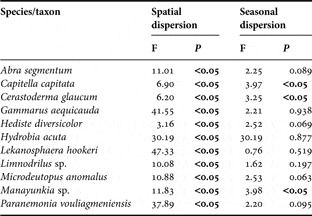
The dominant species in soft substratum sites (A, B, C and D) were Hydrobia acuta, Abra segmentum, Lekanosphaera hookeri and Microdeutopus anomalus, whereas Cerastoderma glaucum showed occasionally high abundance too. In hard substratum sites (E and Z), and also in Ruppia cirrhosa meadow (F) the species H. acuta, L. hookeri and Gammarus aequicauda dominated, while the species Paranemonia vouliagmeniensis and the taxon of Annelida showed increased abundance at times. The abundance of the above species showed significant differences among the studied habitats (ANOVA results; Table 2). Accordingly, they all showed increased abundance in Ruppia cirrhosa meadow, with two exceptions: (1) the annelid Limnodrilus sp. and the bivalve A. segmentum, whose densities were higher at the upper sublittoral soft substratum sites; and (2) the polychaete Capitela capitata, whose density varied among the four habitats, apart from the hard substratum and the lower sublittoral soft substratum sites, where similar values were recorded. In contrast, only the bivalve C. glaucum and the polychaetes C. capitata and Manayunkia sp. showed significant seasonal variations in abundance (ANOVA results; Table 2), with increased density recorded in autumn for the former two species and in winter and in spring for the later one.
Two-way ANOVA results (significant differences in bold).

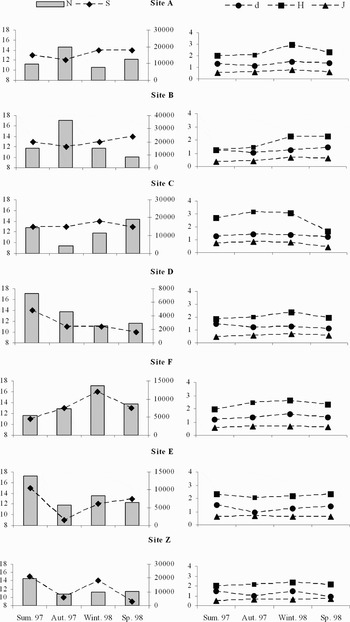
Richness values (d) ranged from 0.93 to 1.57, H′ values from 1.23 to 3.14 and J′ values from 0.33 to 0.85 (Figure 2).These values were rather low, as a limited number of species was recorded, among which several dominated.
Seasonal variation of the biocoenotic parameters (above) and diversity indices (below) at each sampling site (A–Z) of Lake Vouliagmeni (N, number of individuals; S, number of species; d, Margalef richness; H, Shannon–Wiener index; J, Pielou's evenness).

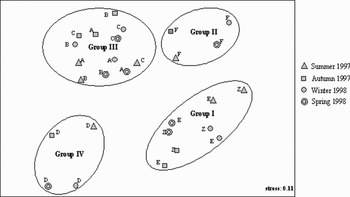
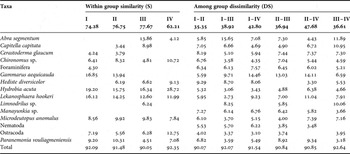
The study of the similarity of the sites was based on zoobenthos. Non-metric MDS indicated the separation of the sites in four main groups, which represented the four different habitats of the lagoon: (1) Group I, hard substratum samples; (2) Group II, meadow samples; (3) Group III, upper sublittoral soft substratum samples; and (4) Group IV, lower sublittoral soft substratum samples (Figure 3). SIMPER analysis showed that 8–10 species contributed to 90% of the average similarity of groups, while 13–15 species contributed to 90% of the average dissimilarity of groups (Table 3). The spatial discrimination of these groups was confirmed by one-way ANOSIM (global R = 0.852 P < 0.1), whereas the pairwise test showed significant variations in all cases (R = 0.767–0.926). In contrast, the seasonal discrimination of samples was not significant (ANOSIM results R = 0.039 P = 23.8). However, focusing at each community level, some trends came up. In the photophilic algae community, developed on hard substratum, the samples from both sites (E and Z) matched according to season, with the exception of the summer, when they discriminated. In the Ruppia cirrhosa meadow (site F) and in the silty sublittoral soft substratum (site D) two seasonal subgroups were apparent: (1) summer and spring; and (2) autumn and winter. Finally, in the community of fine sands with gravels, from the upper sublittoral zone (sites A, B and C), no seasonal trends were recorded.
Non-metric multidimensional scaling showing the spatial and seasonal patterns according to the zoobenthic structure at Lake Vouliagmeni.

SIMPER results. Percentage contribution of species to 90% within group similarity (S) and/or among group dissimilarity (DS).

Trophic group analysis
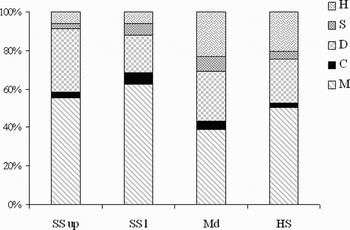
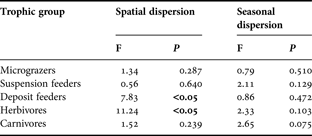
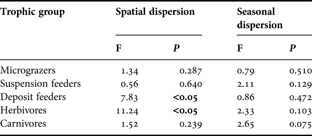
Micrograzers was the dominant trophic group at all habitats of the lagoon, followed by deposit feeders and herbivores, while suspensivores and carnivores made a small contribution (Figure 4). The temporal dispersion of the above trophic groups was not significant, while significant spatial differences were only detected with respect to deposit feeders and herbivores (ANOVA results; Table 4). Deposit feeders showed increased abundance at the upper sublittoral soft substratum sites and herbivores at hard substratum sites and at Ruppia cirrhosa meadow.
Contribution of the trophic groups at each community (HS, hard substratum; Md, Ruppia cirrhosa meadow; SS up, soft substratum upper sublittoral; SS l, soft substratum lower sublittoral; H, herbivores, S, suspensivores; D, deposit feeders; C, carnivores; and M, micrograzers).

Two-way ANOVA results (significant differences in bold).
Biodiversity comparisons
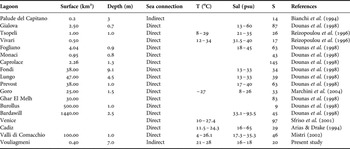
The biodiversity of Lake Vouliagmeni, in terms of species richness, was compared with relevant data from other Mediterranean lagoons (Table 5) and accordingly the Lake was classified among the less diverse temperate lagoons. Comparing the morphological characteristics of these lagoons, showed that it is also among the smaller and deeper lagoons with no direct communication to the sea, characterized by the stability of temperature and salinity. Therefore, Lake Vouliagmeni constitutes a unique environment that could explain the presence of endemic species, as well as the absence of species of marine origin that increase the biodiversity in most Mediterranean lagoons.
Biodiversity of Mediterranean lagoons (T, annual range of temperature; Sal, annual range of salinity; S, number of animal species).

DISCUSSION
Lake Vouliagmeni hosts a total of 32 species: 12 floristic, 17 invertebrates and 3 vertebrates (pisces). With the exception of the sea anemone Paranemonia vouliagmeniensis, which is endemic to the Lake, all these species have been previously reported from other Mediterranean lagoons (Nicolaidou et al., Reference Nicolaidou, Bourgoutzani, Zenetos, Guelorget and Perthuisot1988; Barnes, Reference Barnes and Kjerfve1994; Millet & Guelorget, Reference Millet and Guelorget1994; Reizopoulou et al., Reference Reizopoulou, Thessalou-Legaki and Nicolaidou1996; Koutsoubas et al., Reference Koutsoubas, Arvanitidis, Dounas and Drummond2000; Marchini et al., Reference Marchini, Gauzer and Occhipinti-Ambrogi2004; Virgillio & Abbiati, 2004) and considered as common brackish water species with high ecological adaptability (Cognetti & Maltagliatti, Reference Cognetti and Maltagliatti2000). Particularly strange is the occurrence of Mollienisia sp., a South American aquarium fish (Vogel et al., Reference Vogel, Brazda and Brazda1965), which seems to have been transferred to the lagoon and has, somehow, successfully settled (Chintiroglou et al., Reference Chintiroglou, Antoniadou, Damianidis and Diapoulis2004).
Most of the macrobenthic species recorded in Lake Vouliagmeni had a large spatial distribution and were not characteristic of a single habitat. Still, the different habitats provided in the lagoon were separated according to their faunistic abundance. Nearly all species showed increased density in Ruppia cirrhosa meadows, where others dominated at specific habitats. The bivalve Abra segmentum, the polychaete Capitella capitata and the oligochaete Limnodrilus sp. prevailed at soft substratum sites; the bivalve Cerastoderma glaucum and the amphipod Gammarus aequicauda prevailed at both hard substratum and Ruppia cirrhosa meadow, while foraminiferans were mostly found on hard substratum.
All the recorded benthic species showed significant spatial differences to their abundance, while seasonal differences were scarcely detected. The seasonal differences should be the result of biological processes, since the abiotic environment was stable throughout the year. Thus, the increased density of the bivalve C. glaucum in autumn could be attributed to the life cycle of the species. Its life span in Lake Vouliagmeni is around 1 year, with recruitment in autumn and disappearance of the population in summer (Gontikaki et al., Reference Gontikaki, Antoniadou and Chintiroglou2003). The polychaete C. capitata, a known opportunistic species (Pearson & Rosenberg, Reference Pearson and Rosenberg1978; Borja et al., Reference Borja, Franco and Perez2000), can quickly exploit the increased organic load, which accumulates in the sediment by the decay of the flora, after summer (Malea et al., Reference Malea, Kevrekidis and Mogias2004). Manayunkia sp. is a sessile species that probably utilizes the space offered by the elimination of the various epiphytes in the cold season of the year (Diapoulis & Koussouris, Reference Diapoulis and Koussouris1988).
The structure of the zoobenthic communities in Lake Vouliagmeni showed insignificant temporal trends. This is a quite unusual feature, since most of the Mediterranean coastal lagoons experience strong seasonal fluctuations, in both species richness and population densities (Millet & Guelorget, Reference Millet and Guelorget1994; Koutsoubas et al., Reference Koutsoubas, Arvanitidis, Dounas and Drummond2000; Sfriso et al., Reference Sfriso, Birkemeyer and Ghetti2001; Arvanitidis et al., Reference Arvanitidis, Chatzigeorgiou, Koutsoubas, Kevrekidis, Dounas, Eleftheriou, Koulouri and Mogias2005; Mogias & Kevrekidis, Reference Mogias and Kevrekidis2005). This is probably the result of the combined effect of three major factors: the stability of the abiotic environment, the relatively great depth of the lagoon and the lack of migration, due to the remoteness from the bordering sea.
Micrograzers was the dominant trophic group at all habitats of the lagoon, due to the increased abundance of Hydrobia acuta, which feeds on benthic diatoms and bacteria (Graham, Reference Graham1988). Deposit feeders follow, represented by A. segmentum and Lekanosphaera hookeri, with the former exclusively found on soft substrata and meadow. The trophic structure analysis revealed that soft substratum communities were functionally different from both hard substratum and Ruppia cirrhosa meadow, mostly due to the increased presence of herbivores at the latter two. This result coincides with a previously published scheme for the Lake (Chintiroglou et al., Reference Chintiroglou, Valkouma and Culley1996).
Lake Vouliagmeni was classified among the less diverse Mediterranean lagoons, considering the reported number of species. Most Mediterranean lagoons retain a direct connection with open sea, facilitating the migration of marine species and the distribution of the fauna in zones (I–V) according to the degree of confinement (Guelorget & Perthuisot, Reference Guelorget and Perthuisot1992; Barnes, Reference Barnes and Kjerfve1994). In contrast, Palude del Capitano and Lake Vouliagmeni communicate through underground channels (Bianchi et al., Reference Bianchi, Boero, Forti and Morri1994; Chintiroglou et al., Reference Chintiroglou, Valkouma and Culley1996). The isolation from the adjacent sea through a continuous calcareous rocky barrier hinders the entrance of marine species and their fauna is typically paralic (zones IV and V). This fact combined with the stability of the abiotic environment of Lake Vouliagmeni, seems to play a key role in the maintenance of a rather stable and limited fauna, including the presence of an endemic sea anemone. This fact stimulates the scientific interest for further research and justifies the declaration of this special system as a natural monument.
ACKNOWLEDGEMENTS
This work was supported by the Greek Ministry of Development (General Secretariat for Research and Technology) over the period 1997–1999. We are grateful to the Managerial Board of Lake Vouliagmeni for their help during samplings and to both anonymous referees for providing useful comments which improved our manuscript.