Introduction
Chronic diseases account for a substantial proportion of disability and premature mortality in the developed countries as well as globally (Wang et al. Reference Wang, Dwyer-Lindgren, Lofgren, Rajaratnam, Marcus, Levin-Rector, Levitz, Lopez and Murray2012). Adaptation to these illnesses constitutes an important psychosocial transition in the human life course, as chronic conditions are likely to affect the daily activities of most individuals at some point in their lives (Katz & Yelin, Reference Katz and Yelin1995; Affleck et al. Reference Affleck, Tennen, Zautra and Urrows2001; Crimmins, Reference Crimmins2004). There is an extensive research on the negative emotional reactions associated with chronic diseases (Stanton et al. Reference Stanton, Revenson and Tennen2007; de Ridder et al. Reference de Ridder, Geenen, Kuijer and van Middendorp2008) as well as on sociodemographic factors and psychological coping styles that may modify these reactions (Davydov et al. Reference Davydov, Stewart, Ritchie and Chaudieu2010; Evers et al. Reference Evers, Zautra and Thieme2011). However, the broader implications of chronic diseases to personality development have not been studied in detail. These personality changes are not well captured by narrow concepts of psychological distress. Personality change related to chronic diseases is also relevant for psychiatry and clinical psychology, as enduring personality change due to the physiological effects of a medical condition is one of the diagnostic categories of personality disorders. We investigated whether common chronic diseases affect the long-term development of personality traits assessed with the more comprehensive five-factor model of personality.
Adaptation to chronic diseases
The onset of a chronic disease involves several health-related physiological, psychological and social changes (Penley et al. Reference Penley, Tomaka and Wiebe2002; Sharpe & Curran, Reference Sharpe and Curran2006). Some chronic diseases, such as stroke and many cancers, present special challenges for those who survive these diseases, as the risk of recurrence is often high (Go et al. Reference Go, Mozaffarian, Roger, Benjamin, Berry, Borden, Bravata, Dai, Ford, Fox, Franco, Fullerton, Gillespie, Hailpern, Heit, Howard, Huffman, Kissela, Kittner, Lackland, Lichtman, Lisabeth, Magid, Marcus, Marelli, Matchar, McGuire, Mohler, Moy, Mussolino, Nichol, Paynter, Schreiner, Sorlie, Stein, Turan, Virani, Wong, Woo and Turner2013). Other diseases, such as arthritis, respiratory diseases and heart disease, often cause considerable disability and functional limitations, and increase mortality risk in the long term (McCathie et al. Reference McCathie, Spence and Tate2002; Strong et al. Reference Strong, Mathers, Leeder and Beaglehole2005; Evers et al. Reference Evers, Zautra and Thieme2011). Medication and other treatments alleviate symptoms of most common chronic diseases to some extent, but a substantial proportion of individuals with chronic diseases do not follow their prescribed treatments (Osterberg & Blaschke, Reference Osterberg and Blaschke2005), which weakens the effectiveness of available medical care.
Despite the substantial distress and functional limitations associated with chronic diseases (Prince et al. Reference Prince, Patel, Saxena, Maj, Maselko, Phillips and Rahman2007; Stanton et al. Reference Stanton, Revenson and Tennen2007; de Ridder et al. Reference de Ridder, Geenen, Kuijer and van Middendorp2008), many people are able to adjust to physical illnesses over time, so not all mental health problems caused by chronic illnesses are permanent (Wu, Reference Wu2001; Powdthavee, Reference Powdthavee2009). Indeed, many studies have shown that people tend to regain their earlier levels of well-being after negative life events (Clark et al. Reference Clark, Diener, Georgellis and Lucas2008; Powdthavee, Reference Powdthavee2009; Davydov et al. Reference Davydov, Stewart, Ritchie and Chaudieu2010), although this is not always the case (Headey, Reference Headey2010). Moreover, surviving and learning to live with a chronic disease may prompt personal growth in some individuals (Sheikh, Reference Sheikh2004), suggesting that negative and positive experiences may coexist in adaptation to chronic diseases (Barskova & Oesterreich, Reference Barskova and Oesterreich2009; Bostock et al. Reference Bostock, Sheikh and Barton2009). It is therefore difficult to extrapolate the long-term psychological impact of chronic diseases from the short-term distress reactions to disease onset.
Most of the earlier studies have investigated adaptation with measures of psychological distress, quality of life, physical pain, limitations in daily activities, or disease progression, but not with complete personality inventories. In clinical practice, changes in personality are often reported especially in stroke survivors (Remer-Osborn, Reference Remer-Osborn1998). In one retrospective study, individuals recovering from stroke (n = 35) were rated by their carers to be more bored, frustrated, dissatisfied, unhappy, irritable, worried and unreasonable after compared with before stroke (Stone et al. Reference Stone, Townend, Kwan, Haga, Dennis and Sharpe2004). Another retrospective study based on informant-rated personality before and after stroke (n = 70) found increased levels of depression and communication difficulties but no change in indifferent, inappropriate or manic behaviour (Nelson et al. Reference Nelson, Cicchetti, Satz, Stern, Sowa, Cohen, Mitrushina and van Gorp1993).
Disease-related changes in personality have also been studied in neurodegenerative diseases, such as Alzheimer's disease (Robins Wahlin & Byrne, Reference Robins and Byrne2010), Parkinson's disease (Mendelsohn et al. Reference Mendelsohn, Dakof and Skaff1995), dementia (Gao et al. Reference Gao, Dolan, Hall and Hendrie2000) and in cases of brain injury (Obonsawin et al. Reference Obonsawin, Jefferis, Lowe, Crawford, Fernandes, Holland, Woldt, Worthington and Bowie2007). Like stroke, these conditions directly affect brain functioning, and they can also be expected to pose major challenges of adjustment and recovery. The majority of these studies have assessed personality change by comparing current and retrospective assessment of personality characteristics evaluated by family members (Robins Wahlin & Byrne, Reference Robins and Byrne2010). Considerable decreases (between 1 and 3 s.d.s) in levels of conscientiousness (e.g. forgetfulness, difficulties in persisting with tasks at hand), emotional stability (e.g. symptoms of depression) and agreeableness (e.g. interpersonal conflicts) in individuals with brain-related diseases or injuries have been reported (Robins Wahlin & Byrne, Reference Robins and Byrne2010). However, it is difficult to evaluate to what extent such changes represent the outcome of brain pathology or patterns of personality change related to chronic diseases in general.
Besides the above studies on stroke and neurodegenerative diseases, we were unable to find any longitudinal studies comparing people's personality before and after the onset of common chronic diseases, such as diabetes and heart disease. Thus, research on the implications of common chronic diseases for long-term personality development appears to be scarce. In particular, there is a lack of prospective longitudinal data with standardized personality measures.
The present study
We carried out an individual-participant meta-analysis with more than 17 000 participants from four cohort studies to examine whether the onset of a chronic disease – heart disease, stroke, diabetes, cancer, respiratory disease, arthritis and hypertension – among individuals initially free of the disease is associated with subsequent changes in personality traits, measured using the five-factor model (extraversion, emotional stability, agreeableness, conscientiousness, and openness to experience). More specifically, we ask whether chronic conditions accelerate or reverse the average age-related personality trajectories, or whether personality remains largely unchanged despite the appearance of physical morbidities. Prospective longitudinal data with repeated measurements of personality from four cohorts provided a methodologically robust setting to examine these associations.
Based on previous studies of chronic diseases and quality of life (Stanton et al. Reference Stanton, Revenson and Tennen2007; de Ridder et al. Reference de Ridder, Geenen, Kuijer and van Middendorp2008) we hypothesized that the onset of a disease would be associated with a decrease in emotional stability due to psychological distress, disability, and limitations to daily activities caused by the disease. We also hypothesized a decrease in extraversion, because several chronic diseases cause fatigue and loss of energy (de Ridder et al. Reference de Ridder, Geenen, Kuijer and van Middendorp2008) that potentially decrease features of extraversion, such as positive mood, activity, and approach-motivated behaviour. Furthermore, some studies have suggested that suffering from physical illnesses increases irritability and interpersonal conflicts, perhaps because of a lowered level of patience or concern for other people's troubles (Stanton et al. Reference Stanton, Revenson and Tennen2007). We therefore hypothesize that such changes might decrease agreeableness. Decreases in conscientiousness and openness have been reported in chronic diseases affecting the brain (Robins Wahlin & Byrne, Reference Robins and Byrne2010), but we did not have sufficient a priori evidence to evaluate whether a similar change would be expected in relation to other chronic diseases. Finally, we hypothesized that the personality change associated with stroke would be more marked than those for other chronic diseases studied, that is, heart disease, diabetes, hypertension, cancer, respiratory disease and arthritis, because stroke affects brain functioning. Besides this disease-specific hypothesis, we had no other hypotheses regarding differences between the seven chronic diseases included in the present study.
Method
The data for the individual-participant meta-analysis were selected by searching the collections of the Interuniversity Consortium for Political and Social Research (ICPSR; http://www.icpsr.umich.edu/icpsrweb/ICPSR/) to identify large-scale cohort studies with repeated measurements of personality and chronic diseases. We included all studies with repeated measurements of personality assessed using the five-factor model, information on specific chronic health conditions, and large sample size (n > 1000). The following studies met these inclusion criteria: the Health and Retirement Study (HRS); the National Survey of Midlife in the United States (MIDUS); and the Wisconsin Longitudinal Study (WLS) graduate and sibling samples.
Full details of the cohorts and measures are provided in the online Supplementary material. Briefly, the HRS is a nationally representative longitudinal study that started in 1992 and altogether includes more than 30 000 individuals representing the US population older than 50 years (Juster & Suzman, Reference Juster and Suzman1995). The MIDUS is based on a nationally representative random-digit-dial sample (n = 7108) of non-institutionalized, English-speaking adults, aged 25–74 years in 1995–1996 [National Survey of Midlife Development in the United States (MIDUS), 1995–1996, computer files; O. G. Brim, P. B. Baltes and L. L. Bumpass (2007); http://www.icpsr.umich.edu/icpsrweb/ICPSR/series/00203. The WLS is a study of 10 317 participants who were born between 1937 and 1940 and who graduated from Wisconsin high schools in 1957 (Wollmering, Reference Wollmering2007). In addition to the main sample of the 1957 high school graduates, the WLS has also collected data on a selected sibling of a sample of the graduates. The data collection in adulthood has been very similar although not entirely identical for the siblings as for the graduates. Although the graduate and sibling samples are collected in the same study, we treated them separately because the sibling sample is more heterogeneous in terms of age compared with the graduate sample.
Measures
In all studies, personality was assessed using one of the standardized questionnaire instruments based on the five-factor model of personality (for details of the measures, see the online Supplementary material). The instruments measure five higher-order personality traits that sum up individual variation in several more specific personality dispositions. ‘Extraversion’ reflects characteristics such as social assertiveness, sociability, and sensitivity to positive emotions. Individuals with high ‘emotional stability’ (or low neuroticism) are not easily distressed or sensitive to negative emotions; they are resilient in stressful situations and seldom experience feelings of anxiety, sadness or depression. ‘Agreeableness’ measures cooperativeness, altruism and trust toward other people. ‘Conscientiousness’ is expressed as self-control, orderliness and adherence to social norms. ‘Openness to experience’ correlates with curiosity, broad-ranging interests and open-mindedness. For comparison, we examined corresponding changes in ‘self-rated health’ and ‘depressive symptoms’ (or negative mood) over the same follow-up period as the analysis of personality change. The seven common chronic conditions included in the analysis were self-reported. The participants of each study were asked to report whether they had been diagnosed of and/or treated for: heart disease, stroke, respiratory disease, diabetes, cancer, arthritis and hypertension (for detailed questions, see the online Supplementary material).
Statistical analysis
Personality change was assessed by predicting personality trait score at Time 2 by chronic disease onset between Time 1 and Time 2 among individuals without the disease of interest at Time 1, adjusting for personality trait score at Time 1, sex, age, race/ethnicity, the length of follow-up between Time 1 and Time 2 (in months), and the number of other chronic diseases besides the disease of interest as the outcome variable at Time 1. A corresponding analysis was carried out for depressive symptoms and self-rated general health (instead of personality traits). In addition to examining each chronic disease separately, we predicted personality change by the number of chronic diseases between Time 1 and Time 2 in the total sample, adjusting for the number of chronic diseases at baseline and the other covariates listed above. This analysis enabled us to evaluate the dose–response nature of the relationship between chronic conditions and change in personality. Finally, we examined whether concurrent changes in self-rated health and depressive symptoms associated with the onset of diseases accounted for the changes in personality traits by predicting personality change with a continuously coded number of diseases between Time 1 and Time 2 (adjusted for the other covariates listed above) and then added change scores of self-rated health and depressive symptoms in the models.
To facilitate interpretation of effect sizes, all outcome variables (i.e. personality traits, depressive symptoms and self-rated general health) were first transformed into T-scores (mean = 50, s.d. = 10) before analysis using means and standard deviations at Time 1 as the metric to standardize scores at both Time 1 and Time 2. As an additional method of quantifying the effect sizes, we estimated the average personality change in the five traits by pooling the estimates of study-specific personality change scores in a separate meta-analysis. We then calculated the corresponding number of years in average age-related personality trajectories associated with the disease–personality change. For the descriptive analysis of average personality change scores, we included only participants aged 50 years or older in order to avoid potential non-linear changes at younger ages. To take into account differences in follow-up times between studies, we assumed a linear association between years of follow-up and personality change; this assumption was based on data suggesting that non-linear patterns of personality change are relevant only on much longer follow-up periods over the life course than the 4 to 11 years included here (e.g. Roberts et al. Reference Roberts, Walton and Viechtbauer2006). In each study we transformed the raw change scores by dividing the scores by follow-up time (in years) and multiplying this by 5 to have the personality change per 5 years of age as the outcome variable in each study. This allowed us to compare the associations between chronic diseases and personality change across the samples relative to average personality change.
In all analyses we applied a two-stage approach: models were first fitted separately within each cohort, and the results from the individual cohorts were then pooled using random-effects meta-analysis. Standard errors were calculated using the robust estimator method to take into account the non-independence of individuals from the same households. All analyses were conducted using Stata version 12.1 (metan command for meta-analysis; StataCorp LP, USA). Heterogeneity in the effect sizes was examined using I 2 estimates.
Results
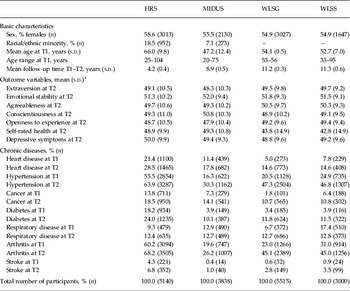
Descriptive statistics of the study samples are presented in Table 1. The HRS participants were older and ethnically more heterogeneous than the other samples. Accordingly, the disease prevalence and onset were higher in the HRS than in the MIDUS in which diseases were more prevalent than in the WLS samples.
Descriptive statistics of the samples

HRS, Health and Retirement Study; MIDUS, National Survey of Midlife in the United States; WLSG, Wisconsin Longitudinal Study graduate sample; WLSS, Wisconsin Longitudinal Study sibling sample; T1, Time 1; s.d., standard deviation; T2, Time 2.
a Outcome variables are standardized as T-scores against baseline values, so T1 mean = 50 and s.d. = 10 for all outcome variables.
First, a meta-analysis on all participants irrespective of their chronic disease status was undertaken to assess average age-related change in personality scores. These results indicated that among participants aged 50 years or older, extraversion decreased [B = –0.50 per 5-year increase in age, 95% confidence interval (CI) −0.84 to −0.16], emotional stability increased (B = 1.03, 95% CI 0.76 to 1.31), agreeableness remained stable (B = –0.04, 95% CI −0.35 to 0.26), conscientiousness decreased (B = –0.40, 95% CI −0.70 to −0.11) and openness to experience decreased (B = –0.79, 95% CI −1.22 to −0.35). The cohort-specific details of this meta-analysis are shown in online Supplementary Fig. S1.
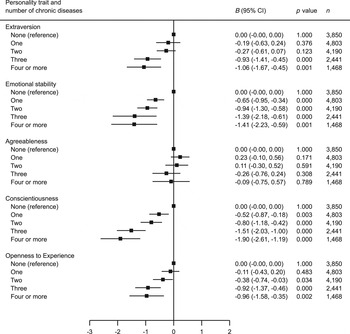
The total number of new chronic diseases between Time 1 and Time 2 taken together showed that higher number of diseases was associated with decreasing extraversion, decreasing emotional stability, decreasing conscientiousness and decreasing openness to experience over time (Fig. 1; cohort-specific associations reported in online Supplementary Figs S2–S6), while no significant association was observed for change in agreeableness. The associations followed a dose–response pattern, with each chronic condition strengthening the association in a linear fashion. The estimates for linear trends (i.e. personality change per one disease onset when the number of diseases was coded as a continuous variable) are reported in the first row of Table 2.
Associations between the number of onset chronic diseases and personality change between baseline and follow-up phase in the pooled sample (random-effects meta-analysis), adjusted for sex, age, race/ethnicity, follow-up time and number of chronic diseases at baseline (for cohort-specific details, see online Supplementary Figs S2–S6). CI, Confidence interval.

Pooled associations between chronic diseases and personality change, adjusted for concurrent change in depressive symptoms and self-rated health a

E, Extraversion; S, emotional stability; A, agreeableness; C, conscientiousness; O, openness to experience.
a Values are regression coefficients (95% confidence intervals) indicating linear change in personality trait T-score per one chronic disease between baseline and follow-up. n = 16454 due to missing data on depressive symptoms and self-rated health.
Comparing the estimates for average personality changes (online Supplementary Fig. S1; reported above) with estimates obtained from the association between disease onset and personality change (Table 2) suggested that the onset of a new disease accelerated the average age-related personality change by 2.5 years in extraversion [ = (−0.25/–0.50) × 5 = 2.5], 5.5 years in conscientiousness, and 1.6 years in openness to experience. Given that average age changes and disease associations were in the opposite directions for emotional stability, the onset of each disease ‘reversed’ the average development of emotional stability by 1.9 years.
To examine whether the extent of personality change associated with chronic disease onset was dependent on age, we refitted the models in Fig. 1 by treating the number of chronic diseases between Time 1 and Time 2 as a continuous variable, and including an interaction term between age and number of chronic diseases between Time 1 and Time 2 (WLSG cohort was excluded from this analysis because of the restricted age range). There was no evidence for significant effect modification by age (all p values for pooled interaction >0.31; details not shown). In a stratified analysis, the pooled associations were also substantially the same when the models in each cohort were fitted separately for participants ⩽55 years and >55 years of age (data not shown), suggesting no age interactions.
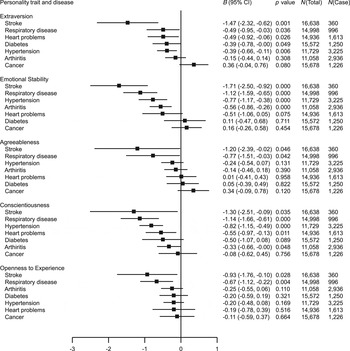
The disease-specific associations are shown in Fig. 2. Decreases in extraversion, emotional stability and conscientiousness were observed after the onset of most chronic diseases examined, while changes in agreeableness and openness were observed only after stroke and respiratory disease. The magnitude of personality change was relatively modest, the difference being 1–2 T-score units (equal of 0.1–0.2 s.d.s) between those with and without incident disease. The onset of stroke and respiratory disease showed the largest personality change while cancer, diabetes and arthritis were associated with the least personality change. Cohort-specific results are reported in online Supplementary Figs S7–S13.
Personality change associated with the onset of different chronic diseases in participants free of the chronic disease of interest at baseline, adjusted for sex, age, race/ethnicity, follow-up time and the number of chronic diseases at baseline. A separate meta-analysis was carried out for each chronic disease and personality trait, and the pooled estimates of random-effects meta-analysis are plotted in the figure (for cohort-specific details, see online Supplementary Figs S7–S13). Estimates within each personality trait are sorted in order of effect magnitude of the disease. CI, Confidence interval.

For comparison, we analysed disease-related changes in self-rated health and depressive symptoms. As expected, self-rated general health decreased and depressive symptoms increased after the onset of chronic disease (online Supplementary Fig. S14). In the pooled analysis of the number of chronic diseases as the exposure and those with no disease as the reference group (B = 0.00), self-rated health decreased by −3.0 (95% CI −3.8 to −2.2), −6.4 (95% CI −8.1 to −4.6), −10.0 (95% CI −13.2 to −6.7) and −13.7 (95% CI −18.4 to −8.9) T-score units per one, two, three and four or more chronic diseases, respectively. For depressive symptoms, the corresponding increases in symptoms associated with chronic disease onset were 0.77 (95% CI 0.43–1.10) for one disease, 1.12 (95% CI 0.74–1.51) for two diseases, 2.08 (95% CI 1.59–2.57) for three diseases and 3.34 (95% CI 2.70–3.99) for four or more diseases. Changes in self-rated health were thus substantially larger than changes in personality traits or depressive symptoms, while changes in depressive symptoms were twice as large, on average, compared with changes in the four personality traits described above.
To examine whether the extent of personality change was related to the extent of change in depressive symptoms and self-rated health, we fitted the number of chronic conditions as a continuous (Table 2) rather than as categorical (Fig. 1) measure, and then examined whether the associations between chronic disease onset and personality change attenuated after adjustment for depressive symptoms and self-rated health. As shown in Table 2, adjusting for change in depressive symptoms affected little the associations, while adjusting for change in both depressive symptoms and self-rated health attenuated the associations of chronic conditions with personality change in neuroticism, conscientiousness and openness to experience by approximately one-third, and those with change in extraversion almost by two-thirds. Thus, deteriorating self-reported health after the onset of chronic diseases may account for some of the association between the onset of chronic diseases and personality change, especially in extraversion.
Discussion
The current individual-participant meta-analysis of four large prospective cohort studies suggests consistent changes in four of the five personality traits of the five-factor model associated with the onset of chronic diseases. The magnitude of these changes can be illustrated by considering how chronic diseases accelerate or decelerate the average rate of personality development after middle age. In a model adjusted for prevalent chronic diseases at baseline, the onset of each additional chronic disease between baseline and follow-up produced changes comparable with average decline in extraversion by 2.5 years, decline in conscientiousness by 5.5 years, and openness to experience by 1.6 years, while the increasing levels of emotional stability with age were attenuated by 1.9 years.
The findings suggest that the increasing prevalence of chronic diseases with age may help to explain some of the age-related average patterns in personality development, especially in old age. In particular, previous studies have reported declining levels of extraversion, conscientiousness and openness to experience with age (Lucas & Donnellan, Reference Lucas and Donnellan2011; Wortman et al. Reference Wortman, Lucas and Donnellan2012). These developmental trends are in line with the current findings on disease onset and personality change. On the other hand, emotional stability and related traits have been shown to increase (Wortman et al. Reference Wortman, Lucas and Donnellan2012) or remain stable (Lucas & Donnellan, Reference Lucas and Donnellan2011) in adulthood at least up to the age of 70 years, after which levels of negative affectivity may increase again (Baird et al. Reference Baird, Lucas and Donnellan2010; Jokela et al. Reference Jokela, Batty and Kivimäki2013a ). Thus, the decreasing emotional stability associated with chronic diseases observed in the present study seems to attenuate the otherwise increasing levels of emotional stability with age.
Plausible mechanisms
Several mechanisms may underlie the observed associations between chronic diseases and changes in personality. First, the present findings of decreasing emotional stability are in agreement with the extant research showing elevated psychological distress associated with chronic diseases (Sharpe & Curran, Reference Sharpe and Curran2006; de Ridder et al. Reference de Ridder, Geenen, Kuijer and van Middendorp2008). The decreasing levels of emotional stability observed in the present study may be partly caused by people's difficulties in coping with the emotional, behavioural and cognitive challenges that are posed by the diagnosis of a pernicious condition. Low emotional stability has been associated with less adaptive and less successful coping mechanisms, including avoidance and rumination (Penley et al. Reference Penley, Tomaka and Wiebe2002; Carver & Connor-Smith, Reference Carver and Connor-Smith2010).
Chronic diseases often induce symptoms of fatigue and lethargy, and decrease the person's available energy for physical, emotional and social activities (de Ridder et al. Reference de Ridder, Geenen, Kuijer and van Middendorp2008). This may reflect, at least in part, the infectious and inflammatory processes that cause various non-specific psychosomatic symptoms, such as depressed mood (Raison & Miller, 2013), sleeping problems (Kivimäki et al. Reference Kivimäki, Shipley, Batty, Hamer, Akbaraly, Kumari, Jokela, Virtanen, Lowe, Ebmeier, Brunner and Singh-Manoux2014) and fatigue (Cho et al. Reference Cho, Kivimäki, Bower and Irwin2013). In terms of personality change, these physiological changes may be expressed as lower levels of extraversion because extraversion entails positive mood, sensitivity to rewarding experiences, and active engagement with the external world. The present results also suggest that decreasing extraversion levels may be particularly linked to the worsening general health induced by chronic diseases. Adjusting for change in depressive symptoms and self-rated health explained more than 60% of the association of chronic disease with change in extraversion, while the corresponding proportion was 36% or less for the other personality traits.
Of the five personality dimensions studied, conscientiousness is the trait most strongly associated with health behaviours and health outcomes (Bogg & Roberts, Reference Bogg and Roberts2004; Martin et al. Reference Martin, Friedman and Schwartz2007), including premature mortality (Jokela et al. Reference Jokela, Batty, Nyberg, Virtanen, Nabi, Singh-Manoux and Kivimäki2013b ), obesity (Jokela et al. Reference Jokela, Hintsanen, Hakulinen, Batty, Nabi, Singh-Manoux and Kivimäki2013e ) and adult-onset diabetes (Jokela et al. Reference Jokela, Elovainio, Nyberg, Tabák, Hintsa, Batty and Kivimäki2013c ). The current results suggest that conscientiousness may also be the trait that is most influenced by deteriorating health, as the disease-related change was the largest for conscientiousness. It seems plausible that one of the emotional and cognitive costs of chronic diseases is a decrease in the ability to organize daily activities and fulfill responsibilities in relation to work, family and personal life, which may become expressed as decreasing levels of conscientiousness. The decrease in openness to experience might also reflect the cognitive costs of chronic morbidity, such as difficulties in the ability to concentrate, willingness to try out new things, and a preference for sticking to existing routines and habits. Except for the brain-related effects of stroke, the associations with openness to experience appear to represent the cumulative effect of morbidity rather than an impact of any specific disease, as the change in openness was observed mainly with the cumulative number of diseases.
As noted in the Introduction, personality change due to physiological consequences of a medical condition is one of the diagnostic categories of personality disorders: code F07.0 in the International Classification of Diseases, 10th revision, clinical modification (ICD-10-CM); code 3.17.11 in Diagnostic and Statistical Manual of Mental Disorders, fifth edition (DSM-5). The diagnosis mainly considers diseases that directly affect the brain (i.e. clear evidence for physiological mediation) rather than common chronic diseases that may involve both psychosocial adjustment and distal physiological effects (e.g. metabolic and inflammatory responses, e.g. Jokela et al. Reference Jokela, Hamer, Singh-Manoux, Batty and Kivimäki2013d ). In DSM-5, the five main types of such personality change include the labile, disinhibited, aggressive, apathetic and paranoid types. Conceptually, labile type would correspond to low emotional stability, disinhibited to low conscientiousness, and apathetic to low extraversion. These changes were observed for most of the diseases in the present study, suggesting some commonalities. Aggressive and paranoid types, in turn, would correspond to low agreeableness, but this change was observed only for stroke and respiratory diseases. Specific personality disorders have been associated with more detailed five-factor trait profiles (Saulsman & Page, Reference Saulsman and Page2004). The current studies did not include data to separate the contributions of physiological and non-physiological pathways in personality change, and the five-factor traits only partly cover the maladaptive aspects of personality variation (Saulsman & Page, Reference Saulsman and Page2004). Additional studies addressing these methodological limitations are needed to assess the clinical relevance of personality changes in response to common chronic diseases.
Associations of specific chronic conditions
With respect to specific diseases, the largest personality changes were observed for stroke, involving decreasing levels in all five higher-level personality traits. This provides support for the anecdotal evidence of major personality changes often reported in stroke survivors by family members and friends (Stone et al. Reference Stone, Townend, Kwan, Haga, Dennis and Sharpe2004). Decreasing agreeableness associated with stroke – a change not observed in relation to the other chronic diseases examined in our analysis – might reflect increasing levels of irritability, aggressiveness, and a lack of motivation or energy to reconcile interpersonal conflicts. Similar findings have been reported in relation to degenerative brain diseases, such as dementia and Alzheimer's disease, but with much larger effect sizes of between 10 and 30 T-scores decreases in conscientiousness, emotional stability and interpersonal warmth (Robins Wahlin & Byrne, Reference Robins and Byrne2010). Although one would expect more marked personality change in degenerative brain diseases than in stroke, it should also be noted that most of the previous studies have relied on retrospective reports by informants, which may confound the assessment of true personality change with perceived personality change (Franzén-Dahlin et al. Reference Franzén-Dahlin, Billing, Näsman, Mårtensson, Wredling and Murray2006).
The second largest change in personality was observed in relation to respiratory diseases. Chronic obstructive pulmonary disease is a particularly disabling condition, greatly limiting a person's physical activities (McCathie et al. Reference McCathie, Spence and Tate2002). The personality changes associated with respiratory disease and, to a lesser extent, with hypertension, heart problems and arthritis indicate that chronic illnesses do not have to affect the brain directly in order to induce systematic personality change. In fact, our findings suggest that the degree of personality change may not be directly related to the degree of physical discomfort or functional impairment caused by the disease. For example, the overall personality change was somewhat larger for hypertension than for arthritis even though hypertension may be symptom-free while arthritis is characterized by considerable physical pain (Evers et al. Reference Evers, Zautra and Thieme2011). On the other hand, hypertension is one of the strongest predictors of stroke and may be associated with microvascular changes in the brain (Go et al. Reference Go, Mozaffarian, Roger, Benjamin, Berry, Borden, Bravata, Dai, Ford, Fox, Franco, Fullerton, Gillespie, Hailpern, Heit, Howard, Huffman, Kissela, Kittner, Lackland, Lichtman, Lisabeth, Magid, Marcus, Marelli, Matchar, McGuire, Mohler, Moy, Mussolino, Nichol, Paynter, Schreiner, Sorlie, Stein, Turan, Virani, Wong, Woo and Turner2013).
Interestingly, cancer was not associated with long-term change in any of the five personality traits. This is surprising, because cancer is clearly a disease with considerable psychological impact (Reich, Reference Reich2008), and adjustment to cancer is often thought to introduce major changes in cancer survivors’ cognitive–emotional styles, social behaviour and general outlook on life (Hulbert-Williams et al. Reference Hulbert-Williams, Neal, Morrison, Hood and Wilkinson2012). With the focus on long-term personality change, the present study included only long-term cancer survivors. While the short-term psychological impact of cancer is likely to be particularly severe (Reich, Reference Reich2008), it is possible that cancer survivors adapt to their life circumstances over time. Cancer is also the only disease included in the present analysis that is not necessarily a progressive condition but from which a full recovery is possible. It is possible that the adverse psychological impact of cancer is counterbalanced by the relief of overcoming the disease, and that there are no long-term changes in basic personality dispositions among individuals who have completely or partially recovered from cancer.
Strengths and limitations
The notable strengths of the present study include prospective data from four cohort studies, and the use of standardized personality measures. The lack of multiple repeated measurements of personality precluded a more detailed analysis of temporal trajectories, that is, how different aspects of personality are affected immediately after the first symptoms of a chronic disease, and how these changes attenuate or exacerbate over time. However, it is worth noting that comparisons of cohort-specific associations did not suggest that the extent of personality change was associated with the length of follow-up (online Supplementary Figs S2–S13). Another methodological limitation was the reliance on self-reported data on chronic diseases, which underestimates the true prevalence of diseases. Third, because observational study designs cannot establish causal associations with certainty, some of the associations might have been confounded by unobserved variables related to the ageing process or disease onset. This appears unlikely, as (1) not all personality traits changed in the same average direction associated with ageing (i.e. emotional stability decreased with the onset of diseases whereas the average age-related change was increasing emotional stability), and (2) the unobserved confounder would need to explain why different chronic diseases are associated with different degrees of personality change.
It is possible that the assessment of mean changes in personality associated with disease onset conceals important individual differences in the nature and magnitude of changes in personality. It has been suggested that some individuals might be able to use their adverse experiences with a disease to facilitate personal growth and greater appreciation of positive aspects of their lives (Barskova & Oesterreich, Reference Barskova and Oesterreich2009; Bostock et al. Reference Bostock, Sheikh and Barton2009). Thus, individual variation and potential beneficial personality changes in other psychological dispositions besides basic personality dimensions associated with disease onset require further investigation.
Conclusion
Data from over 17 000 individuals suggest that the onset of chronic diseases is associated with changes in four of the five major dimensions of personality assessed by the five-factor model. For extraversion, conscientiousness and openness to experience, the age-related average decline in these personality traits in the population is accelerated by approximately 1.5 to 5.5 years of age for each disease, while the age-related increase in emotional stability was set back by about 2 years. This individual-participant meta-analysis provides strong evidence to suggest that common chronic diseases modify personality development throughout the adult life span.
Acknowledgements
The authors wish to gratefully thank the original collectors of the data, and the ESDS (Economic and Social Data Service; http://www.esds.ac.uk/) and the Interuniversity Consortium for Political and Social Research (http://www.icpsr.umich.edu) for making the data available. The research uses data from the Wisconsin Longitudinal Study (WLS) of the University of Wisconsin-Madison. Since 1991, the WLS has been supported principally by the National Institute on Aging (AG-9775 and AG-21 079), with additional support from the Vilas Estate Trust, the National Science Foundation, the Spencer Foundation and the Graduate School of the University of Wisconsin-Madison. A public use file of data from the WLS is available from the Wisconsin Longitudinal Study, University of Wisconsin-Madison, 1180 Observatory Drive, Madison, Wisconsin 53 706 (and http://www.ssc.wisc.edu/wlsresearch/data/). The interpretations, opinions and inferences based on the data are solely the responsibility of the authors.
This research was supported by the Academy of Finland (grant no. 124322, 124271 and 132944); the Medical Research Council (MRC K013351); the US National Institutes of Health (NIH) (R01HL036310; R01AG034454); and the Finnish Work Environment Fund. C.H. was financially supported by the Research Foundation of the University of Helsinki and the Finnish Cultural Foundation; A.S.-M. was supported by the National Institute on Aging, NIH (R01AG013196; R01AG034454). M.K. is an Economic and Social Research Council Professor.
Supplementary material
For supplementary material accompanying this paper visit http://dx.doi.org/10.1017/S0033291714000257.
Declaration of Interest
None.