Implications
There is an increasing move towards the inclusion of welfare outcome assessment within farm assurance schemes. The practical implications and value of these additions for pig farmers are largely unknown. Our findings suggest that the attitude of the vet who conducts the welfare outcome assessment is highly influential on how farmers value these additions to their farm assurance schemes. The benefit to individual farmers was perceived as negligible, but this could be improved substantially by using compliance with the welfare outcome assessment commercially to promote and market pork products.
Introduction
One response to the growing public criticism of production animal husbandry systems has been the introduction of farm assurance schemes (FAS) (Main et al., Reference Main, Webster and Green2001; Liu et al., Reference Liu, Kaler, Ferguson, O’Kane and Green2018). Participation in these schemes is usually voluntary, with membership denoting that the farmer keeps their animals to a certain standard which then enables them to access certain markets and sell their products to certain retailers (van Dijk et al., Reference van Dijk, Elwes, Main, Mullan and Jamieson2018). Originally such schemes focused on measuring resource or environmental parameters. FAS are now increasingly moving towards assessing animal-based parameters or welfare outcomes (WO) instead of, or as well as, resource-based parameters. This shift in thinking, advocated by Farm Animal Welfare Committee (FAWC) and other bodies (Main et al., Reference Main, Mullan, Atkinson, Cooper, Wrathall and Blokhuis2014), demonstrates an increasing recognition that simply ensuring that an animal’s environment is of a sufficient standard does not guarantee that the animal will have good welfare. WO, such as an animal’s behaviour and physical condition, provide a more direct insight into an animal’s welfare than can be gained by assessing resource-based parameters alone (Mullan et al., Reference Mullan, Browne, Edwards, Butterworth, Whay and Main2009a).
In the UK, the pig industry is leading the way in the adoption of WO measures as part of their FAS. Pig production is one of the most intensive livestock industries (Bock and van Huik, Reference Bock and van Huik2007) and consequently has been the recipient of some negative attitudes, often influenced by how pig farms are portrayed in the media (Ngapo et al., Reference Ngapo, Dransfield, Martin, Magnusson, Bredahl and Nute2004; Bergstra et al., Reference Bergstra, Hogeveen, Erno Kuiper, Oude Lansink and Stassen2017). FAS for UK pig producers are nominally voluntary; however, in reality joining an FAS is a necessity if farmers are to be able to sell their produce through major slaughterhouses and retailers (Carmen et al., Reference Carmen, Michael and Guy2007; Hubbard, Reference Hubbard2012). Almost all finisher pig herds in the UK are members of the Red Tractor FAS (Agriculture and Horticulture Development Board, (AHDB), 2017). In 2013, five WO measures were added to the existing Red Tractor FAS assessment for finisher herds under the name ‘Real Welfare’. The WO measures are assessed in a representative sample of pens by each farms own vet, who must be a member of the UK’s Pig Veterinary Society (AHDB, 2017). The total number of pigs assessed is dependent on the number of finishing pigs the farm has (AHDB, 2017). The WO measures are taken on three of the four quarterly veterinary inspections that the farm must receive under the terms of their FAS when the vet inspects the farm and pigs to update the farm’s Veterinary Health Plan (AHDB, 2017). This creates a rolling average reflecting a more accurate farm status by reducing the effect of the particular situation on each individual visit day, for example with regard to weather or disease (Mullan et al., Reference Mullan, Browne, Edwards, Butterworth, Whay and Main2009a; AHDB, 2017). The five WO measures are the number of pigs requiring hospitalisation, the number of lame pigs, the number of pigs with severe, mild or no visible tail damage, the number of pigs with severe, mild or no body marks visible and the number of pigs interacting with environmental enrichment or pen mates and other pen features. Pandolfi et al. (Reference Pandolfi, Stoddart, Wainwright, Kyriazakis and Edwards2017b) provide further detailed description of the WO measures and the sampling protocol.
The Real Welfare data are not audited by the FAS, but should any issue be identified by the vet, the actions jointly agreed by the vet and the producer to address this issue are included in the herd health plan which is audited (AHDB, 2017; Pandolfi et al., Reference Pandolfi, Stoddart, Wainwright, Kyriazakis and Edwards2017b). Therefore, in practice some dialogue between vet and farmer regarding the WO assessment is expected.
Real Welfare not only allows the pig industry to evaluate welfare by directly assessing the animal for the first time, but has also enabled them to document the welfare of the UK pig industry as a whole something which may be seen as equally as important (Brandt et al., Reference Brandt, Rousing, Herskin, Olsen and Aaslyng2017). From an animal welfare perspective, WO assessments (WOA) such as Real Welfare provide a mechanism by which animal welfare can be recorded and improvements made within an existing FAS (Main et al., Reference Main, Mullan, Atkinson, Bond, Cooper, Fraser and Browne2012).
The data generated in the first 3 years of Real Welfare have been described and analysed elsewhere (AHDB, 2017; Pandolfi et al., Reference Pandolfi, Kyriazakis, Stoddart, Wainwright and Edwards2017a and Reference Pandolfi, Stoddart, Wainwright, Kyriazakis and Edwards2017b). Real Welfare has been reported a success, with results from 2013 to 2016 demonstrating a reduction in the prevalence of WO measures representing welfare concerns (Pandolfi et al., Reference Pandolfi, Stoddart, Wainwright, Kyriazakis and Edwards2017b). But the impact of Real Welfare from a farmer perspective has yet to be explored.
Here, we aim to investigate how the introduction of the Real Welfare protocol has been perceived by the farmers involved, what value it has (if any), whether any practical changes on farm have been a direct consequence of Real Welfare and ultimately whether they consider that the welfare of their pigs has been improved by the introduction of the protocol.
Materials and methods
Semi-structured interviews with 15 English pig farmers were conducted to explore their perceptions and experiences of the Real Welfare process. The process and interview schedule were approved by the University of Bristol Faculty of Health Sciences Research Ethics Committee. The interviews took place in March and April 2017.
Recruitment of participants
Pig farmers were recruited to participate in the study via an Internet directory (Yell.com) and existing contact lists held by the Bristol Veterinary School. Initial contact was made by telephone. Prospective participants were given information about the study and the possibility of audio recording the interview was discussed, along with data confidentiality procedures and the request for informed consent regarding the use of the data generated. A date and time for the interview was arranged if the prospective participant agreed, and a participant information sheet and consent form were emailed, if this was possible, prior to the interview. Information sheets and consent forms were also taken to the interview to ensure that these had been read and the terms agreed to before the interview commenced.
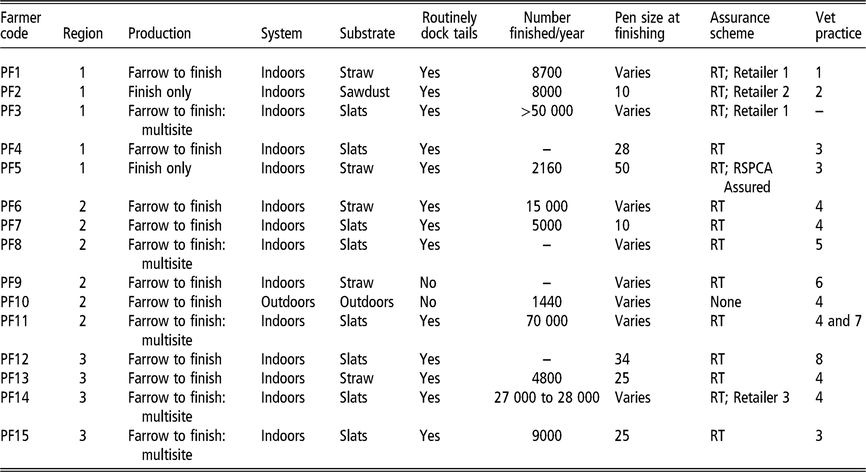
Farm characteristic data reported by Pandolfi et al. (Reference Pandolfi, Stoddart, Wainwright, Kyriazakis and Edwards2017b) were used as a guide to ensure that the sample recruited reflected the characteristics of the Real Welfare 2013–16 sample in terms of the system (indoors/outdoors), pen size and feed type. UK pig production is predominantly situated in England (Hubbard et al., Reference Hubbard, Bourlakis and Garrod2007) and consequently our sampling strategy focused on three geographic regions of England. Table 1 summarises the characteristics of the participants’ pig production enterprises.
Pig production enterprise characteristics of the study sample

PF = participating farmer; RT = Red Tractor; RSPCA = Royal Society for the Prevention of Cruelty to Animals.
The interview process
Interviews were conducted face-to-face (n = 14) apart from one interview that was conducted over the telephone at the participants request after an initial interview date required rearranging. The interview schedule consisted of 33 predominantly short-answer questions divided into four sections covering details of the farm, the FAS they were part of and the inspection process, Real Welfare in practice and the implications of Real Welfare. An additional section with a further three questions was included for participants who were members of Royal Society for the Prevention of Cruelty to Animals (RSPCA) Assured or the Soil Association FAS. The interview schedule can be found in the Supplementary Material S1. Once the interviewer opened with the short series of questions about the participants’ farm (e.g. farm type, size of unit), the interviews typically took the form of a discussion. The schedule was used predominantly as a guide to make sure key topics were discussed rather than rigidly adhered to.
As many of the farmers had limited time available, interviews were kept relatively brief. The mean interview duration was 38 min, with the shortest being 22 min and the longest 1 h 15 min.
Data analysis
All participants gave their consent for the interview to be audio recorded. The recordings were transcribed verbatim, and the resulting transcripts were analysed manually by the first author (JH). An inductive analysis approach was taken to identify common themes between transcripts. Points of variance between participants’ responses were also identified and noted. The transcripts were independently analysed by the third author (SM), and the resultant themes subsequently discussed with the first author in light of their analysis. The inductive analysis showed good agreement between the authors of the dominant themes identified, validating the analysis process.
Results and discussion
The pig farmers forming our sample were comparable to the wider population reported in the Real Welfare data (Pandolfi et al., Reference Pandolfi, Stoddart, Wainwright, Kyriazakis and Edwards2017b), with the majority of systems raising their pigs indoors and routinely tail docking.
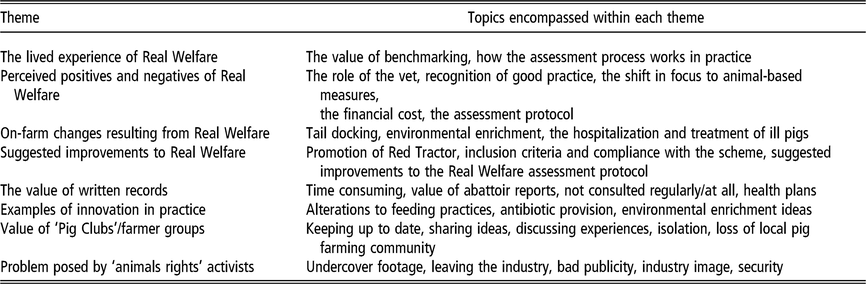
Despite the relatively small sample size, it is important to note that by the final interviews we reached saturation with no new themes emerging. While a number of interesting themes emerged from the analysis (see Table 2), only those related to Real Welfare and the concept of welfare outcome assessment are reported here.
Themes that emerged from inductive analysis of the transcripts from the pig farmer interviews

The lived experience of real welfare
Incorporating WOA without extending the FAS visit by longer than 30 min has been identified as an important criteria for conducting these assessments in practice (Main et al., Reference Main, Mullan, Atkinson, Bond, Cooper, Fraser and Browne2012) and the general impression gained from the farmer interviews was that Real Welfare had been added almost seamlessly to the quarterly vet inspections required by their FAS. Certainly, the extra time added to the visit seemed relatively minimal, ‘in our particular case it does not take us a great deal longer’ (PF14), ‘it’s just an extra 20 minutes on her visit really’ (PF7), ‘it didn’t seem to take any longer than a normal … and it was part, it flowed’ (PF13).
The majority of farmers did not discuss their Real Welfare results with their vet unless there was a problem. Rather it was felt that Real Welfare was something that the vet did, and the farmer was only party to it if something came up:
Only if there’s a problem. If there’s not a problem, I don’t hear from him no. I just sign the paper and it goes on. (PF1)
I think the Real Welfare thing it happens, he does what he has to do with it. Do I ever look at the results? No. Does it influence over how I manage the unit? No because if we had a problem of that nature we would have addressed it. (PF8)
In this respect, Real Welfare was perceived by some farmers as just another part of the assurance process, and consequently, it was seen as somewhat removed from them and the management of their production system. The farmer quoted above went on to discuss this further, emphasising the lack of unity between those who want to use the Real Welfare data and those whose animals are the data:
Quite how the Real Welfare data is being accepted in the processor/retailer world I have got no idea. I hope that it’s what they were looking for and is ticking the box for them, even if we struggle with the meaning at the coal face. (PF8)
This lack of farmer buy-in to the Real Welfare process is at odds with the industry belief that farmers would use the data generated by the assessment as a benchmarking tool (AHDB, 2017; Pandolfi et al., Reference Pandolfi, Stoddart, Wainwright, Kyriazakis and Edwards2017b). When benchmarking was mentioned by the interviewer, it was often interpreted as a way of trying to better other pig farmers rather than as a useful tool for self-improvement. Many were adamant that pig farmers should all be on the same side, that ‘it’s not a competition’ (PF2). However, when farmers were probed further on this issue many spoke of the benefit of having a ‘pig savvy vet’ (PF4) who inspected pigs at a number of sites as they were able to make suggestions based on the good results another farm had had with the same changes/intervention. This vet mediated form of benchmarking was seen as a good thing and interestingly a common aspect that was raised by participants in relation to this was environmental enrichment, one of the areas covered by Real Welfare.
The fast turnaround of animals in the pig industry means that the majority of farmers interviewed benchmark their current herd against the performance of their previous herds rather than against other producers. However, some farmers did see a value in being able to benchmark themselves against other producers in the industry:
I do think it is always interesting to know where you lie in the national herd and [how] are you doing, then you know whether you have gotta, where you ought to be improving or just trying to maintain where you are. (PF13)
Benchmarking is not a panacea for all farmers in every context. Opinions regarding the value of benchmarking can be conflicting, with perceived value relating to the attributes of the benchmarking tool itself as well as the personal goals of individual farmers (Ronan and Cleary, Reference Ronan and Cleary2000; de Snoo et al., Reference de Snoo, Lokhorst, van Dijk, Staats and Munsters2010; Phythian et al., Reference Phythian, Phillips, Wright and Morgan2014). However, engaging in a benchmarking programme has been associated with improved outcomes in other sectors, for example in dairy calves (Atkinson et al., Reference Atkinson, von Keyserlingk and Weary2017; Sumner et al., Reference Sumner, von Keyserlingk and Weary2018). Promoting benchmarking more widely within the pig industry may lead to similar management changes and welfare improvements. Many of the farmers interviewed were or had been members of regional pig farmer groups and found these a useful platform to share ideas and compare practices. Unfortunately, changes within the UK pig industry have resulted in fewer pig farms operating in some regions and the subsequent closure of their associated pig farmer groups. In light of this, promoting the benchmarking opportunities provided by Real Welfare, and even expanding on them, would provide pig farmers with a new platform to connect with their peers and share ideas and best practice as well as demonstrating a practical value of the assessment for the individual farmers.
The perceived positives and negatives of Real Welfare
The perceived positives
The overriding opinion of the farmers we spoke to was that the value of Real Welfare lies with the vet who conducts the assessment. Most farms were assessed by their regular vet, who is typically seen as ‘a valuable part of the business’ (PF13) and ‘part of the management team’ (PF14). The requirements of Real Welfare provided them with an opportunity to spend more time with their vet, and ‘pick her brains’ (PF7) while they were on farm, which also helped some farmers feel that they were getting their money’s worth from the process:
We walk around with them as they are doing the welfare assessment and they’ll say well there’s slightly more bite marks on those pigs, you know why would that be? … We pay the vets a lot of money and we also have to pay for this Real Welfare for this time that they spend doing it, so we feel that by actually being involved in what they are doing, what they’re assessing and what they, you know what they see, sometimes it’s quite useful to you have a different set of eyes on your pigs. (PF4)
The value of WOA in enhancing discussion between producers and vets has also been identified in other studies (e.g. Mullan et al., Reference Mullan, Edwards, Butterworth, Ward, Whay and Main2011a; van Dijk et al., Reference van Dijk, Elwes, Main, Mullan and Jamieson2018). The opportunity that Real Welfare provides for facilitating vet–farmer dialogue could be used to help promote the benefits of this scheme for the individual farmers involved, instead of predominantly focusing on the benefits at an industry level.
Farmers who differed from this opinion were those who were dissatisfied with their current vet and/or practice due to their lack of pig expertise:
We used to have vets in the past who weren’t specialist pig vets and it was a complete waste of time, they just didn’t understand anything about managing pigs. (PF4)
I really could do with a vet that is a bit more pig orientated, because it would be more useful. (PF12)
In a broader context, some farmers welcomed the shift in focus that Real Welfare represents:
The concept of Real Welfare I’m a big fan of and I’m not saying that I am not a fan of assurance, but I like the concept of let’s assess the pigs rather than the pens. (PF11)
Real Welfare was also flagged up by some farmers as a way ‘to show the public that we are trying our best’ (PF1). The success, or otherwise, of Real Welfare in this context is something that will be explored further below.
Finally, some farmers said they found Real Welfare a positive experience because,
I like being inspected if I am honest. I like at the end of it that you, it’s kind of a reward for doing your job right. (PF12)
Recognition of your efforts and successes from external sources can be an important motivator for participation and engagement (Hars and Ou, Reference Hars and Ou2002; Hansen et al., Reference Hansen, Smith and Hansen2002). The intrinsic value of feeling that your work is acknowledged, and successes recognised should not be underestimated as a motivating factor for active engagement with FAS.
The perceived negatives
As with the positive perspectives of Real Welfare, some of the negatives were also greatly influenced by the individual vet who conducted the assessment. One farmer, who is part of a multisite operation, reported that the vet practice he uses sends the senior vet to inspect the sows on the breeding unit while ‘junior’ (PF3) vets conduct the Real Welfare assessments on the finishing pigs. This means that he never consistently has the same people assessing the pigs, something that was perceived to add value by those farmers who had the same vet at each visit. It was not surprising that this farmer did not see any value in Real Welfare, dismissing it as ‘pretty much a tick box exercise’ (PF3).
As the example above shows, the perceived attitude of the vet towards the Real Welfare process made a significant difference to how it was perceived by the interviewed farmers. The farmer above was given the impression that his vet practice prioritises the welfare of the sows over the finishing pigs when allocating veterinary expertise. Sometimes the attitude of vets towards Real Welfare was expressed more explicitly to the farmers, for example verbally rather than simply through their behaviour.
He [the vet] can’t understand it and he says as much, we are paying for somebody else’s data collection really. (PF15)
Understandably, this farmer also saw no value in the Real Welfare process.
In a study preceding the inclusion of WOA in pig FAS, Mullan et al. (Reference Mullan, Edwards, Butterworth, Whay and Main2011c) identified the need for assessors to accept the measures being included for the assessment to work outside of research projects. Our findings here suggest that further to this, the acceptance of the assessors to the scheme in its entirety is also critical for its success. Given the critical importance of the vet to the success of Real Welfare and the buy-in of the farmers, priority should be given to improve communication with veterinary practices to enhance their understanding of the value it has for individual farmers and the wider industry.
The issue raised by farmer PF15 also reflects the conflict between collecting data that are useful on a farm level and collecting data that support an industry or FAS (van Dijk et al., Reference van Dijk, Elwes, Main, Mullan and Jamieson2018). This can be a difficult balance in practice but for true farmer engagement, tangible benefits for individual farms must be realised as well as for the industry.
Much of the negativity surrounding the Real Welfare assessment was associated with the cost to the farmer of paying the vet to complete the assessment when they felt that they received ‘nothing at all’ (PF3) in return:
We’ve had nothing back from that [Real Welfare] whatsoever so apart from £100 a bill extra from the vet. (PF3)
For me it’s had absolutely no impact, other than my wallet is a little thinner now. Probably best not to think by how much to be honest. (PF15)
The cost of mandatory farm assessments has been raised as an issue by farmers in other studies (Alberto, Reference Alberto2007; Hubbard et al., Reference Hubbard, Bourlakis and Garrod2007). This was particularly related to the fact that costs to the farmer were not reflected in the price they got for their produce (Alberto, Reference Alberto2007).
It was not cost alone that troubled the farmers. Many were unhappy that they had to pay their vet to assess aspects of their pigs’ welfare that they believed they assessed themselves on a daily basis:
I could have told him [the vet] what he was gonna find before he went into the pen. There is the odd lame pig that’s maybe slipped the radar and he will pick that up but aside from the odd little bit that’s been missed, I could write his Real Welfare for him in here before he ever goes down there. (PF8)
The perception that external inspections to check animal welfare are a waste of time is not isolated to pig farmers (van Dijk et al., Reference van Dijk, Elwes, Main, Mullan and Jamieson2018). Similar sentiments were reported by sheep farmers responding to Liu et al.’s (Reference Liu, Kaler, Ferguson, O’Kane and Green2018) self-administered questionnaire with 41% of the farmers indicating that external inspections were not important for maintaining animal welfare standards (Liu et al., Reference Liu, Kaler, Ferguson, O’Kane and Green2018). One solution to this view might be to introduce some form of self-assessment into the process (van Dijk et al., Reference van Dijk, Elwes, Main, Mullan and Jamieson2018); however, this is likely to lead to criticism from outside the industry. The accuracy and reliability of animal welfare measures assessed by owners or caretakers can be questionable even with a framework in place to help guide assessments, for example body condition scoring in pet dogs (White et al., Reference White, Hobson-West, Cobb, Craigon, Hammond and Millar2011) and horses (Stephenson et al., Reference Stephenson, Green and Freeman2011). In a consultation with the pig industry, prior to Real Welfare being incorporated into the Red Tractor FAS, 67% of producers reported to be quite willing to do some self-assessment of welfare as part of their farm assurance scheme (Mullan et al., Reference Mullan, Butterworth, Whay, Edwards and Main2010). This suggests that self-assessment might be an appropriate direction for Real Welfare to take from the perspective of the producers involved; however, more research is needed to evaluate whether WOA can be effectively conducted by the farmers themselves.
The last theme that emerged when farmers considered the negative aspects of Real Welfare was the practicalities of the assessment process itself. Many of the farmers questioned the appropriateness of conducting behavioural observations when pigs are so reactive to the presence of unfamiliar humans.
… it’s awfully difficult to judge the behaviour because you are breaking a pattern of behaviour that would normally apply merely by your presence. (PF14)
… even if you walk into a room it affects the behaviour of the pigs so it’s quite difficult to actually get a genuine assessment of how the pigs are behaving … In an ideal world you need to creep into a room and stand there for 10 minutes for them all to settle back down again and then do your assessment, but life’s too short for that isn’t it? (PF4)
Some vets reportedly conduct the Real Welfare component on a second walk through of the unit with the farmer explaining that ‘the pigs tend not to sort of take as much notice on the second walk through’ (PF5). Concerns regarding the feasibility of animal-based monitoring in commercial settings have been raised elsewhere (Bracke, Reference Bracke2007). Balancing restrictions on time and money with the need to collect animal-based data means that compromises have to be made in the assessment protocol. It is perhaps worth communicating these decisions to the farmers, so that they do not assume that those developing assessment protocols are unaware of the limitations.
Incorporating WOA into an FAS without incurring too great a time or financial cost for the farmer restricts the number of animals that can practically be assessed at each inspection (Mullan et al., Reference Mullan, Browne, Edwards, Butterworth, Whay and Main2009a; Main et al., Reference Main, Mullan, Atkinson, Bond, Cooper, Fraser and Browne2012), as well as assessment procedures that are used. It is partially for this reason that Real Welfare utilises a rolling average (Mullan et al., Reference Mullan, Browne, Edwards, Butterworth, Whay and Main2009a); however, some of the farmers voiced concerns about how the Real Welfare sampling strategy worked in practice:
… if they go into the building and there’s the first pen that they come to that’s tail biting in that pen but that isn’t one of the pens they’ve actually decided that they are going to assess … then as far as the welfare result is concerned we have no tail biting, whereas she can see, physically see there’s pigs in that pen that are tail biting. (PF4)
Our findings support those of previous studies that suggest that better communication with farmers and vets over the decisions made in the development of WOA, for example why certain measures were included and sampling strategies adopted, would be beneficial so that farmers can appreciate why certain procedures are in place rather than being asked to simply accept them however suboptimal they may seem (van Dijk et al., Reference van Dijk, Elwes, Main, Mullan and Jamieson2018).
As professionals, vets are typically held in high esteem due to their knowledge and expertise, positioning them as trusted individuals within their clients’ information network and the primary go-to source of information and advice on animal health (Osborne, Reference Osborne2002; Carbone, Reference Carbone2010; Hockenhull et al., Reference Hockenhull, Olmos, Whatford, Whay, Main, Roderick and Buller2014). Here, the value and expertise of the vet spanned the perceived positive and negative opinions of Real Welfare given by the interviewees, forming an overarching theme throughout our interviews. Our findings demonstrate the impact that an individual vet can have on farmer attitude, acceptance and ultimately behaviour change within the context of FAS. The changing role of the veterinary professional from reactive treatment provider to proactive member of a farm management advisory team and knowledge provider (Atkinson, Reference Atkinson2010; Ruston et al., Reference Ruston, Shortall, Green, Brennan, Wapenaar and Kaler2016) delivers a valuable opportunity to facilitate practical change and animal welfare improvement. Greater recognition of the value of enhanced communication skills for effective knowledge transfer and facilitation of human behaviour change is now evident, both in the veterinary research literature (Jansen and Lam, Reference Jansen and Lam2012; Bard et al., Reference Bard, Main, Haase, Whay, Roe and Reyher2017) and in the veterinary curriculums training the vets of the future (e.g. Mossop et al., Reference Mossop, Gray, Blaxter, Gardiner, MacEachern, Watson, Whittlestone and Robbé2015). Our findings suggest that such increased focus on communication is likely to have wider benefits for the acceptance of WOA in FAS and potentially other animal welfare interventions.
On-farm changes resulting from Real Welfare
Three key areas where Real Welfare had potential implications for practice were raised by farmers during the interviews; tail docking, environmental enrichment and the hospitalisation of ill pigs. These areas are discussed in turn below, highlighting any changes in management practices influenced by Real Welfare.
Tail docking
Of the 15 farmers we spoke to only 2 (13%) did not routinely dock the tails of their pigs, although most made it clear that this was a practice that was regularly reviewed by themselves and their vet rather than being entrenched in their management regime.
We tried not docking tails and that was an unmitigated disaster, but it was something we needed to do because we hadn’t done for a very long time, so we have proved that its better with the docking. (PF15)
Most of the farmers felt that tail docking was preferable to an outbreak of tail biting, both economically and in terms of welfare:
If you don’t tail dock and you end up getting an incident of tail biting then the consequences of it are absolutely diabolical and you get huge condemnations you get you know atrocious growth rate, poor food conversion it is just devastating financially and for the welfare of the pigs (PF4)
And so the theory as well is that you shouldn’t tail dock the pigs unless there’s a problem, if I’ve already got 700 pigs here and suddenly something goes wrong and they’re tail biting I’ve got potentially 700 pigs chucked in the bin … so it’s one of those pre-emptive things that we do, well now the RSPCA has big questions about it as an unnecessary procedure but … (PF5)
The farmers we spoke to were pro-tail docking purely as a means of reducing the likelihood and subsequent impact of a tail biting outbreak. As voiced in other studies, the farmers felt that tail docking was perceived as a welfare concern by the public simply because they lack the knowledge and understanding of how and why it is conducted, and the consequences if it is not (Lassen et al., Reference Lassen, Sandøe and Forkman2006). Interviews with farmers and key stakeholders in previous studies have also raised whether tail docking itself is a welfare issue given the scale of the problem it is intended to ameliorate; rather the underlying causal factors are seen as the true welfare concern (Mullan et al., Reference Mullan, Edwards, Butterworth, Ward, Whay and Main2011a). Mutilations, such as tail docking, are often seen as a necessity to adapt an animal to the constraints of their housing condition, and while they may be aversive or painful for the individual, they are considered beneficial for the group (Nordquist et al., Reference Nordquist, van der Staay, van Eerdenburg, Velkers, Fijn and Arndt2017). Fears that regulations intended to promote welfare in FAS may fail to improve welfare and in fact may actually endanger it have been voiced by other pig producers (Bock and van Huik, Reference Bock and van Huik2007; Hubbard et al., Reference Hubbard, Bourlakis and Garrod2007). While this sentiment was not expressed explicitly by farmers in this study, many felt that FAS had done nothing to either help them resolve the need to tail dock or to change the practices they already had in place to minimise tail biting occurring:
Tail biting is an economic loss to us anyway so we are always going to try and do something to stop it, so from that point of view, I don’t think farm assurance has helped us one little bit. (PF15)
Overall, the farmers we spoke to unanimously felt that Real Welfare had had a negligible effect on whether or not they tail docked their pigs and the management actions they take to the reduce the chance of a tail biting outbreak. However, it was perhaps not that clear-cut as discussed below.
Environmental enrichment
Environmental enrichment is one means by which the risk of a tail biting outbreak can be minimised (Beattie et al., Reference Beattie, Walker and Sneddon1995; van de Weerd et al., Reference Van de Weerd, Docking, Day, Breuer and Edwards2006; van de Weerd and Day, Reference van de Weerd and Day2009) and whether enrichment is provided for the pigs is included in the Real Welfare assessment protocol (AHDB, 2017). When it came to discussing enrichment provision rather than management changes to reduce the risk of tail biting, farmers’ answers changed:
No we’ve not changed a thing, no. No. No. We’ve put in a few more toys maybe … but that’s mainly to make sure that the toys we put in at the last visit are still there. (PF1)
In one respect, Real Welfare was seen to have improved on-farm practice when it comes to the provision of enrichment:
For things like pigs’ toys if the audits weren’t there you might get a little complacent and think yeah that’ll do - but if you know you have got an audit coming up why leave everything to the last minute, where you’ve got to find 20 pig toys … Just replace the pig toy as it breaks or it gets worn away. Yeah you can always improve, especially on pig toys. (PF2)
Main et al. (Reference Main, Mullan, Atkinson, Cooper, Wrathall and Blokhuis2014) speculated that excessively prescriptive standards in FAS may inhibit farmer innovation. The provision of environmental enrichment appears to be one area where this holds true. Although most farmers recognised the value of providing enrichment, some felt that there was no need to go beyond the criteria required by the FAS, even if this was not optimal practice for the pigs:
If you are gonna do a proper job with toys and manipulable material … you would have to change them every day. Pigs are not dissimilar to humans in that the novelty wears off and they don’t use them anymore, so if you are going to keep a pig entertained you have got to change those every day and that’s not within the scheme, it’s very time consuming. It’s not something I am gonna do unless I am forced to, so in terms of toys, I have to tick a box on an assurance scheme and that’s what we do. (PF8)
But other farmers were more innovative and went above and beyond the requirements of the FAS, providing additional items that were not considered as manipulable material by the scheme (and that they would consequently receive no recognition for providing), but that they stated their pigs enjoyed playing with, for example balls, chains, old welly boots and plastic drums. Some even discussed rolling out the provision of extra enrichment items to their sows even though they are not covered by the Real Welfare scheme.
Real Welfare seems to have had a positive impact on the provision of environmental enrichment from the perspective of the farmers interviewed. Even if what is provided is simply aimed at meeting the minimum requirements, at least it means that the pigs are being routinely provided with an improvement to their environment that they may not otherwise receive. It was interesting to note that although English and European legislation specifies that all pigs should have permanent access to sufficient material ‘… to enable proper investigation and manipulation activities’ (Her Majesty’s Stationery Office, 2003; European Union, 2008), none of the farmers said that they provided enrichment to meet legal standards, rather they stated that enrichment was provided and maintained to meet the requirements of Real Welfare. Consequently, it appears that the Real Welfare has provided farmers with an incentive to not only provided enrichment but also to ensure it is maintained and renewed as required.
Hospitalisation and treatment of ill pigs. The hospitalisation and, more specifically, the treatment of ill pigs was one of the aspects of Real Welfare that the farmers appeared to find most controversial. There seemed to be a divide between the farmers as reflected in the quotes below:
We’ve got a zero tolerance of casualties … It’s not fair for the pig to suffer. (PF2)
I think we are more wasteful now … Anything we’re at all unsure of we shoot rather than give it a chance just because we might get told off for keeping alive an animal that shouldn’t be. (PF3)
… welfare really isn’t helping when you are euthanizing animals, to me that isn’t welfare. (PF12)
It is interesting to note that the one reported case of FAS non-compliance that came to light during our interviews concerned a farm where a pig was observed in a hospital pen that the assessing vet believed should have been euthanised. Mullan et al. (Reference Mullan, Edwards, Butterworth, Whay and Main2011b) reported biases between assessors as a result of their attitude towards farm animal welfare, with those believing in the mental state of a pig more likely to identify pigs as needing hospitalisation, possibly as they are more likely to attribute a negative mental state to a sick or injured pig. For ill pigs, a certain amount of subjectivity is required when assessing whether they should be hospitalised, treated or euthanised, particularly in borderline cases. If farmers have the attitude that they want to give a pig ‘a chance’ (PF3), they may be more likely to keep the pig alive for treatment than to immediately euthanise it. Whether you are giving an animal a chance or allowing it to suffer is a very narrow and subjective line to tread and perhaps this is an area that requires greater explanation and quantification within FAS protocols.
Suggested improvements to Real Welfare
Three key areas where the Real Welfare scheme would benefit from improvements were identified by the farmers.
Red Tractor should promote Real Welfare to the consumers. Previous studies have documented that many UK pig farmers consider FAS to be a ‘necessary evil’, something they essentially have to join to remain in business but otherwise see no additional benefit from (Hubbard et al., Reference Hubbard, Bourlakis and Garrod2007). The findings of our study support this perspective and take it further, highlighting the negligible return to the farmer and lack of awareness outside the industry that the Real Welfare process even takes place:
Well from a personal point of view I would scrap the Real Welfare side of things because I have seen nothing in return for the extra time or cost to the farmer. (PF3)
It’s [Real Welfare] crept in somewhere and yeah I don’t know if people outside of AHDB and the farmers are aware that it even happens I mean our, I don’t think consumers know. (PF5)
Some farmers even expressed doubts that many members of the public had heard of farm assurance at all:
… it just doesn’t seem to have the power at the other end. You get inspected for a reason, so there is an advertisement mark for your pigs and I think that is where it falls down. The public aren’t aware of what we have to do to produce a pig and the Red Tractor doesn’t kind of advertise that fact. (PF12)
Aside from discussing the lack of consumer awareness about the welfare standards of Red Tractor-assured pig products, there was a notable absence of discussion about retailer requirements despite farmers who supplied three different major retailers being included in the sample along with a number who sold their products directly to local retailers. None of the farmers explicitly mentioned the role of retailers and the wider market in driving change and welfare improvement; rather FAS were viewed primarily as a means of accessing slaughterhouse facilities and the wider supply chain.
On the whole, the farmers who we spoke to appreciated the need, not only to maintain good pig welfare on farm but also to document it (Brandt et al., Reference Brandt, Rousing, Herskin, Olsen and Aaslyng2017). However, from their perspective, Red Tractor needed to go further, to use the Real Welfare initiative to promote the welfare standards of UK pigs to the public to help to sell their product in a highly competitive market rather than just sitting on the Real Welfare data as a safeguard should the public raise concerns.
… where does anyone see what’s happening? The shopper and that aren’t gonna see anything … I don’t see how it’s made any help for the industry. (PF13)
Essentially many farmers felt that Real Welfare was a reactive rather than a proactive strategy, a concern that has been voiced by pig farmers regarding FAS in other studies (e.g. Thorslund et al., Reference Thorslund, Aaslyng and Lassen2017). Raising consumer awareness of FAS requirements has been suggested by farmers previously as a means of benefiting from the welfare standards they are required to meet to gain higher prices for their product (Hubbard et al., Reference Hubbard, Bourlakis and Garrod2007; Mullan et al., Reference Mullan, Butterworth, Whay, Edwards and Main2010; Thorslund et al., Reference Thorslund, Aaslyng and Lassen2017). Using their farm assurance scheme to gain a competitive advantage over foreign imports, as raised in the quote below, would be taking this one step further. But to achieve this, consumers need to be aware what standards UK pig farmers are required to meet and to be able to identify UK-produced product at the point of sale through better labelling than currently exists (Hubbard et al., Reference Hubbard, Bourlakis and Garrod2007).
… the only situation where possibly we could argue that benchmarking would have a use is when we’re actually comparing our pig units with other countries … and that’s probably a very, very good reason for actually using Real Welfare because you can actually say well we’ve been doing this scheme for so many years … so therefore if you don’t have that scheme you don’t have the right to sell your pigs in our country until you have that kind of a scheme to say that your pigs come up to the same welfare as our pigs do in our country. (PF4)
It is widely accepted that farmers and the public have differing perceptions of animal welfare (Te Velde et al., Reference Te Velde, Aarts and Van W oerkum2002; Vanhonacker et al., Reference Vanhonacker, Verbeke, Van Poucke and Tuyttens2008; Sørensen and Fraser, Reference Słrensen and Fraser2010; Cornish et al., Reference Cornish, Raubenheimer and McGreevy2016). Farmers tend to define welfare as health and productivity and consequently see it as the basis of their job (Mullan et al., Reference Mullan, Butterworth, Whay, Edwards and Main2010). Consumers are often perceived by farmers as well intentioned but ill-informed with little understanding of farming (Hubbard et al., Reference Hubbard, Bourlakis and Garrod2007), although it should be recognised that views are far from uniform even within each stakeholder group (Sørensen and Fraser, Reference Słrensen and Fraser2010). The public’s lack of knowledge about farming was also seen as an area that needed to be addressed:
I appreciate the need to demonstrate to the public that what we do is, for want of a better word, kosher. I think that we should spend a lot more time educating people as to what’s involved in producing their food. (PF15)
But the farmers in this study, similar to those of other studies (e.g. Hubbard et al., Reference Hubbard, Bourlakis and Garrod2007), doubted whether consumers were really willing to pay for the welfare improvements they advocated even if they really understood what happened on farm:
In theory farm assurance is there for our customers. Is it giving them reassurance? I am not convinced that it is because people aren’t seeing the Red Tractor logo and saying I must go and buy that because I know that that’s been well looked after. What they are looking at is the bit that’s got the pound symbol in front of it … (PF15)
One farmer encapsulated this very concisely ‘would it sell more pork? This is the question’ (PF1). His feeling was that until consumers were made aware of the welfare standards UK pig farms had to adhere to and were prepared to pay a higher price for pig products produced in the UK, Real Welfare and FAS in general have little financial benefit for the farmer.
Consumer willingness to pay for higher welfare products is often overestimated in the published literature, thought to be largely due to publication bias with studies reporting non-significant findings or low willingness to pay either not being submitted or otherwise excluded from publication (Clark et al., Reference Clark, Frewer, Panzone and Stewart2017). Consequently, farmer opinion may be a more accurate reflection of consumer willingness to pay than the published literature which as a whole considerably overestimates how prepared consumers are to pay for highly priced products on welfare grounds alone.
We have to recognise that one of the main incentives for farmers to participate in FAS is financial, including improved market access and better prices (Bock and van Huik, Reference Bock and van Huik2007). One possible way of achieving this would be to use engagement with Real Welfare as a selling point for UK pig products rather than purely as a data source for the industry. Although it was positive to note that none of the farmers interviewed raised the concerns voiced in other studies that an industry-level data set had relatively little value and may actually be used against farmers rather than for them (van Dijk et al., Reference van Dijk, Elwes, Main, Mullan and Jamieson2018). However, to utilise participation in Real Welfare to provide a marketing advantage for pork products requires further action by the industry and the retailers. Consumer understanding of the current labelling schemes for animal products that are produced by production systems with differing welfare standards is known to be poor (Ellis et al., Reference Ellis, Billington, McNeil and McKeegan2009). Alongside this is the growing awareness that current labelling schemes do not go far enough to distinguish between products produced under FAS with differing welfare standards to enable informed consumer choice, which has led to calls for improved labelling standards (e.g. the ‘Labelling Matters’ coalition comprised of Compassion in World Farming, Eurogroup for Animals, the RSPCA and the Soil Association formed in 2011and Compassion in World Farming’s ‘Honest Labelling’ campaign launched in 2018). A combination of consumer education and better product labelling is required before farmers are likely to receive any financial recompense for their participation in a scheme driven by public concern but seemingly unsupported by consumer purchasing behaviour.
Inclusion criteria and compliance
Farm assurance schemes need to negotiate a fine balance whereby their standards are stringent enough not to allow all farmers entry, yet are achievable (Main et al., Reference Main, Webster and Green2001). Many of the farmers we spoke to openly questioned the value of the Red Tractor FAS, and within it Real Welfare, given that farmers rarely heard of anyone being suspended or asked to leave the scheme due to non-compliance and poor welfare:
I don’t believe that almost anybody has ever been thrown out of Red Tractor or they are very very few and I think that there are some systems, some sites that maybe don’t reach the standards but it actually makes it tougher to defend the industry while we have an assurance scheme that there’s not enough people being thrown out of. (PF11)
While some farmers mentioned that anyone can stay on the scheme consequently devaluing it, others had experienced the consequences of non-compliance, or had heard about farmers who had. One farmer who had had their licence suspended voiced serious concerns about the way the process was handled.
[It is] really archaic and draconian the way that they enforce that 30 day thing … there needs to be a bit more understanding, understanding between the farm assurance body and the farm and the abattoir and you know a bit of give and take there really. (PF4)
Farmers also felt that FAS should be more than just a means of setting a minimum standard and should go further to encourage and recognise the ‘good’ farmers:
It’s about us belonging to these bodies, which I really question what they are actually doing over and above policing the bad ones and helping to raise those standards. They’re not genuinely helping the good ones. (PF10)
Just how this could be achieved in practice was uncertain, particularly regarding welfare. While the possibility of a grading system within each FAS was raised by some farmers, others felt that welfare is not an area that could or should be graded:
All things deserve good welfare it’s not some should have better than others. (PF11)
The Real Welfare assessment procedure
As reflected in the discussion above there seemed to be a degree of confusion about what the Real Welfare scheme was actually intended to do:
… what message are we trying to get across? … it’s a complete failure on the part of farm assurance schemes and people who are asking for them, to explain what they are after. (PF15)
There seemed to be a lack of clarity on whether the scheme was intended to benefit the farmer, the industry or both parties. A significant body of work went into developing Real Welfare and identifying the most appropriate informative measures to include (e.g. Mullan et al., Reference Mullan, Browne, Edwards, Butterworth, Whay and Main2009a, Reference Mullan, Edwards, Butterworth, Whay and Main2009b, Reference Mullan, Butterworth, Whay, Edwards and Main2010). However, there is typically a trade-off between the original design and intention of a WOA protocol and the changes that have to be made to make it feasible to roll out on farm at an industry level (van Dijk et al., Reference van Dijk, Elwes, Main, Mullan and Jamieson2018) and the results of this trade-off may compromise how the value of the assessment is perceived:
I think that the problem with the Real Welfare has been they have ended up half arsing it so to speak. In its full incantation as it was meant or originally designed, it was gonna be very very time consuming and I think that’s why it got watered down and I think that it’s been watered down so far that it’s more or less not fit for purpose. (PF8)
Some farmers took a more positive view than PF8, considering that while Real Welfare as it stands is ‘far from the finished article’ (PF11), it is something that can be developed and refined.
Suggested improvements to the scheme included closer working relationships between FAS and vets in the development and setting the requirements of FAS. Vets play a fundamental role in the promotion and safeguarding of animal welfare (Cornish et al., Reference Cornish, Raubenheimer and McGreevy2016) and as discussed above, vet buy-in is critical for farmers to engage with, and value, FAS.
Another suggestion raised was the possibility of reducing the rate of Real Welfare inspections now that the baseline data have been collected and analysed:
It creates cost and I am not sure having established the results that we need to maintain it at the same level. I think periodic with welfare inclusion at a veterinary visit would be fine, but I am not at all sure that it needs to be done with such regularity, especially on those farms where standards are high. (PF14)
Whether high welfare standards can be maintained in the absence of regular external inspections is something that needs to be evidenced.
Conclusions
Pig farmer perspectives of Real Welfare, the welfare outcome component of their farm assurance scheme, revealed a number of positive aspects alongside areas where improvement is required. For the majority of farmers, the value of the Real Welfare process lies with the vet who conducts the assessment. Farmers whose vet valued the process engaged them in the assessments and discussed results with them felt that they had benefitted from Real Welfare; farmers whose vets did not see the value of Real Welfare did not perceive any benefit of the process themselves. Improving the commitment of vets to the scheme is likely to also increase engagement of their farmer clients and part of this move could be to give the vets a greater role in the future refinement of the Real Welfare assessment protocol. Our findings highlight the extent of disconnect and paucity of communication between the various stakeholders involved. This is manifested at numerous levels – between vets and farmers, the FAS and vets, the FAS and farmers, the FAS and retailers, farmers and consumers, consumers and retailers. Overcoming this high level of disconnect is critical for greater acceptance of the scheme and realisation of practical and financial benefits. Improved communication at each of these stages is key to achieving this. In particular, enhanced communication and dialogue between FAS stakeholders, vets and farmers would benefit vet and farmer buy-in to the scheme as they would be able to understand the underlying decision-making process rather than dismiss the resultant assessment protocol requirements as ill-informed. While the benefits of Real Welfare for the industry were acknowledged by some farmers, more tangible benefits need to be realised for farmers at the level of the individual. This could be achieved in part through raising awareness of the welfare standards of UK pig production outside of the industry, to consumers and the general public, hopefully leading to greater appreciation of UK pig production standards and resulting in an increase in financial reward for farmers.
Acknowledgements
The authors would like to thank all of the farmers who gave up their time to be interviewed for this study and Katja Stoddart for her help and support.
J. Hockenhull, 0000-0002-9224-7304
Declaration of interest
The authors declare no conflicts of interest in this article.
Ethics committee
The study was approved by the University of Bristol Faculty of Health Sciences Faculty Research Ethics Committee in February 2017.
Software and data repository resources
None of the data were deposited in an official repository.
Supplementary material
To view supplementary material for this article, please visit https://doi.org/10.1017/S1751731119000946.